Occasional thoughts of an Anglican Episcopal priest

Category: Acts (Page 4 of 9)

Just Like Adam; Just Like Jesus – Sermon for 1 Epiphany (10 January 2016)

====================

A sermon offered on the First Sunday after Epiphany (The Baptism of our Lord), January 10, 2016, to the people of St. Paul’s Episcopal Church, Medina, Ohio, where Fr. Funston is rector.

(The lessons for the day are Isaiah 43:1-7, Psalm 29, Acts 8:14-17, and Luke 3:15-17,21-22. These lessons may be found at The Lectionary Page.)

====================

James B. Janknegt, Baptism of JesusWe’ve heard this Gospel story before. We all know what happens (at least in the Synoptic Gospels) after Jesus is baptized: a voice is heard from heaven, “You are my Son, the Beloved; with you I am well pleased” (Lk 3:22) and then Jesus goes into the desert for forty days of retreat where he grapples with temptations.

As Matthew and Mark tell the story, they move immediately from the baptism to the desert. But Luke, who tells of the baptism near the end of Chapter 3 and of the desert retreat at the beginning of Chapter 4 of his Gospel, does something unexpected. After the portion we heard this morning, right after the voice of God is heard declaring the Sonship of Jesus, right at the end of Chapter 3, he adds these verses which (for obvious reasons) are almost never read in worship services:

Jesus was about thirty years old when he began his work. He was the son (as was thought) of Joseph son of Heli, son of Matthat, son of Levi, son of Melchi, son of Jannai, son of Joseph, son of Mattathias, son of Amos, son of Nahum, son of Esli, son of Naggai, son of Maath, son of Mattathias, son of Semein, son of Josech, son of Joda, son of Joanan, son of Rhesa, son of Zerubbabel, son of Shealtiel, son of Neri, son of Melchi, son of Addi, son of Cosam, son of Elmadam, son of Er, son of Joshua, son of Eliezer, son of Jorim, son of Matthat, son of Levi, son of Simeon, son of Judah, son of Joseph, son of Jonam, son of Eliakim, son of Melea, son of Menna, son of Mattatha, son of Nathan, son of David, son of Jesse, son of Obed, son of Boaz, son of Sala, son of Nahshon, son of Amminadab, son of Admin, son of Arni, son of Hezron, son of Perez, son of Judah, son of Jacob, son of Isaac, son of Abraham, son of Terah, son of Nahor, son of Serug, son of Reu, son of Peleg, son of Eber, son of Shelah, son of Cainan, son of Arphaxad, son of Shem, son of Noah, son of Lamech, son of Methuselah, son of Enoch, son of Jared, son of Mahalaleel, son of Cainan, son of Enos, son of Seth, son of Adam, son of God. (Lk 3:23-38)

Why does he do that? Mark doesn’t even bother to give a genealogy and Matthew (who gives us a slightly different list of Jesus’ ancestors) put his genealogy right at the beginning in Chapter 1. So why, do you suppose, does Luke give us a genealogy and plop it down here at the end of the story of Jesus’ baptism, interrupting the narrative flow from baptism to desert to temptation? And why does he call Adam “son of God”?

I posed that question in an online clergy discussion group and some of my colleagues’ responses are these:

“All are ‘sons (and daughters) of God.’ The question is to what degree is Jesus uniquely so? A reboot… a second Adam? (That is, of course, a Biblical concept.) A ‘new’ first born? But we all share that heritage – to what degree? Is the giving of the Spirit in fact a third Genesis of sorts?”

“I always thought Luke’s point in tracing Jesus to Adam, rather than to David or Abraham, was to state that Jesus is universal savior, identified as he is as Son of Adam, rather than (merely) Son of David or son of Abraham.”

“It’s the Creation narrative Lite for Gentile readers — the point being that God is the source of all life.

Those are all good answers and they encapsulate pretty much the scholarly and traditional understandings of why Luke plops the genealogy down in this place, between baptism and temptation: Jesus, only begotten son of God, is contrasted with Adam, the first created son of God, and we as created children of God descended from Adam and as adopted children of God baptized into Jesus share in the nature of both!

We definitely share in the nature of Adam and others listed in this genealogy. Phil Ryken, the president Wheaton College who has recently gotten some bad press for his (in my opinion) wrong decision to discharge a professor who suggested that Christians and Muslims worship the same God, has been quoted as writing this about the men listed in Luke’s genealogy of Jesus:

They were guilty of the same kinds of sins as we are. All these men were sinners. It’s nice to think that our ancestors were noble and good, and that they did something heroic. This is one of the reasons people like to study their family trees. Whether they were heroic or not, the people who came before us were just as deeply flawed as we are. We can infer this from the mere fact that they were human beings, but we can also prove it from the pages of the Bible. Consider some of the skeletons in the family closet as recorded in the Old Testament: Terah, the father of Abraham, was an idolater; Abraham was a liar; Jacob was a cheater and a thief; Judah traded slaves and consorted with prostitutes; David was a murderer and an adulterer. We usually remember these men as heroes, but they were also scoundrels, all the way back to Adam. At the tap root of the family tree, like any genealogy, the one in Luke’s Gospel records a long line of sinners. (Citation unknown; quoted in a sermon published on line.)

I think Dr. Ryken was wrong about firing the professor, but I think he’s right about human nature and “the skeletons in [our] family closet.” Just like these ancestors of Jesus, we all are people who make mistakes, make bad decisions (like wrongfully discharging an instructor), do bad things; we share in the nature of Adam.

My friend Mark Sandlin, an ordained Presbyterian elder in North Carolina, yesterday posted online a part of his sermon for today. He is saying to his congregation:

The Jewish and Christian religious stories are stories underlined with the constant reality of seeking out something, searching for something. Adam and Eve seek out knowledge. Noah seeks shelter from the storm. Abraham and Sarah seek out the unknown land God sends them to. Joseph seeks to understand the king’s dreams and bring his family back together. Moses seeks to bring his people to the promised land. David seeks to become the leader God clearly believes he is. The prophets seek to bring the people of God back to God’s ways. Jesus seeks to show us what love looks like and teach us God’s ways. Paul seeks to grow the church in the ways of God. We are seekers. It is our story. We cannot escape it. We should not try. We Christians are seekers. Always have been. Always will be. It’s in our ancestral DNA. (Posted on Mark’s Facebook page)

Mark might disagree with me if I were to say that he and Dr. Ryken are saying the same thing, but the truth is that often in our seeking, we seek in the wrong places, or we seek the wrong things, and we end up making the bad decisions and mistakes Dr. Ryken describes Jesus’ forebears making. Again, it’s that human nature that we all share with Adam as created children of God.

But from the earliest days of the church, it has been the Christian understanding that we also share in the nature of Jesus. In the second century, Irenaeus, bishop of Lyons (c. 130–202) said that God “became what we are in order to make us what he is himself.” (Against Heresies, Book V, Preface) His contemporary, Justin Martyr (c. 100–165) taught that Christians are “children of the Most High” because, in the beginning human beings “were made like God, free from suffering and death” and, therefore, “deemed worthy of becoming gods and of having power to become sons of the highest.” (Dialogue with Trypho, Ch. 124)

Justin was quoting Psalm 82 in calling us “children of the Most High,” but he might have been quoting our Psalm from today, which (unfortunately) the Prayer Book mistranslates. In the first verse of our gradual for today, Psalm 29, the psalmist commands, “Ascribe to the Lord, you gods, ascribe to the Lord glory and strength.” The Hebrew words translated here as “you gods” are “bene Elohim,” more correctly translated as “sons (or children) of the Almighty.” Psalm 29 is believed to be derived from a very early liturgical hymn extolling the Canaanite god Baal or a similar ancient Near Eastern “storm deity,” and thus addressed originally to “heavenly beings” or lesser gods, but we might understand it to be addressed to us, to those whom God describes in today’s reading from Isaiah:

Do not fear, for I am with you;
I will bring your offspring from the east,
and from the west I will gather you;
I will say to the north, “Give them up,”
and to the south, “Do not withhold;
bring my sons from far away
and my daughters from the end of the earth –
everyone who is called by my name,
whom I created for my glory,
whom I formed and made.”
(Isa. 43:6-7)

We were created for glory, descendants of Adam formed by and made children of God, and our original created goodness is renewed by Jesus in whom we are adopted children of the Most High. No wonder that “in the temple of the Lord all are crying, ‘Glory!’ ”

This, I believe, is why Luke interrupts the flow of action in his telling of the Gospel story, why unlike Mark and Matthew, he doesn’t move directly from baptism to temptation. He finishes the story of Jesus’ baptism and then adds, almost as an explanatory footnote, “O, by the way, this is who this guy is. He’s a human being, just like you; descended from a bunch of fallible, flawed human beings, just like you; a descendent of Adam, the original created son of God, just like you.” Only after offering us that reassurance does Luke go on to tell us about the forty days in the desert, a story in which we learn that there’s something about Jesus that isn’t just like us, that he is able to resist temptation. And the rest of the story (as Paul Harvey used to say on radio) is that through his faithfulness and through our faith in him, we can become (by adoption) just like him. Telling the story in this way – baptism-genealogy-temptation – is Luke’s way of saying that God “became what we are in order to make us what he is himself.”

Thus, it is Luke’s way of underscoring the central message of the Gospel, which we hear in our readings today in the Old Testament lesson: “Do not fear, for I have redeemed you.” (Isa. 43:1) If we had to put the Gospel of Jesus Christ into one phrase, it would have to be, “Don’t be afraid.” It’s what Gabriel said to Mary (Lk 1:30); it’s what the angel said to Joseph (Mt 1:20); it’s what the angels said to the shepherds in Bethlehem (Lk 2:10); it’s the first word the angel spoke on Easter morning: “Don’t be afraid” (Mt 28:5). It is what the risen Christ said to his disciples: “Do not be afraid. I am with you always.” (Mt. 28:10,20)

It’s one thing to say it, however, and it’s another thing to believe it. That, too, is part of the human nature we’ve inherited from Adam; we know all about our ancestors, people like Abraham the liar, Jacob the cheat, and David the adulterer; we know all about how badly they screwed up, and we’re afraid we might do it, too. But remember the words of God, “Do not fear, for I have redeemed you; I have called you by name, you are mine.” (Isa 43:1) Remember that we share not only Adam’s nature, but Jesus’ nature as well.

A well-known theologian once confessed that he was plagued many nights by a terrible dream. He dreamed that he was traveling in some distant city, and he ran into someone with whom he had gone to high school. In the bad dream, the person would say, “Henri, Henri, haven’t seen you in years. What have you done with your life?” This question always felt like judgment. He’d done some good things in his life, but there had also been some troubles and struggles. And when the old schoolmate in the dream would say, “What have you done with your life?” he wouldn’t know what to say, how to account for his life. Then one night he had another dream. He dreamed that he died and went to heaven. He was waiting outside the throne room of God, waiting to stand before almighty God, and he shivered with fear. He just knew that God would be surrounded with fire and smoke and would speak with a deep voice saying, “Henri, Henri, what have you done with your life?” But, then, in the dream, when the door to God’s throne room opened, the room was filled with light. From the room he could hear God speaking to him in a gentle voice saying, “Henri, it’s good to see you. I hear you had a rough trip, but I’d love to see your slides.” (Note: this story has been used by many preachers; I’ve not been able to find an original source.)

I think there is truth in that dream. I think that’s exactly what will happen, that God will say to each one of us, “It’s good to see you! You are my child. I hear you’ve had a rough trip, but I’m pleased with you and I’d love to see your pictures.”

So, don’t be afraid. God has redeemed you; God has called you by name; you are God’s. Just like “. . . Nathan, son of David, son of Jesse, son of Obed, son of Boaz, son of Sala, son of Nahshon, son of Amminadab . . .” and all the rest of them. Just like Adam. And just like Jesus. Amen.

====================

A request to my readers: I’m trying to build the readership of this blog and I’d very much appreciate your help in doing so. If you find something here that is of value, please share it with others. If you are on Facebook, “like” the posts on your page so others can see them. If you are following me on Twitter, please “retweet” the notices of these meditations. If you have a blog of your own, please include mine in your links (a favor I will gladly reciprocate). Many thanks!

====================

Father Funston is the rector of St. Paul’s Episcopal Church, Medina, Ohio.
Caring vs Rules: A Sermon for Proper 27B, Pentecost 24 (8 Nov 2015)

====================

A sermon offered on Twenty-Fourth Sunday after Pentecost (Proper 27B, Track 1, RCL), November 8, 2015, to the people of St. Paul’s Episcopal Church, Medina, Ohio, where Fr. Funston is rector.

(The lessons for the day are Ruth 3:1-5;4:13-17; Psalm 127; Hebrews 9:24-28; and Mark 12:38-44 . These lessons may be found at The Lectionary Page. The collect for the day, referenced in the sermon, is found at the same site.)

====================

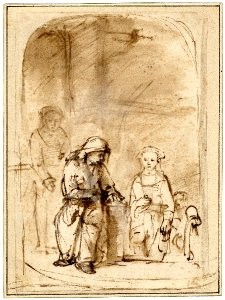
The Widow's Mite by RembrandtI get letters. Sometimes they’re really nice letters. And sometimes they’re not. Today, I want to tell you about a letter and how it caused me to rethink the two stories of women in today’s lectionary readings: First, the end of the story of Ruth from the biblical book named for her, and second, the story of Jesus watching and commenting upon the sacrificial giving of a widow in the Jerusalem temple.

The Book of Ruth is a very simple story. As Dr. Alphonetta Wines, a Methodist theologian, has said:

The genius of the book of Ruth begins with its literary simplicity. In chapter one, Naomi’s troubles are relentless as one by one, famine, displacement, and bereavement steal her joy, turning her into a bitter woman. In chapter two Ruth ekes out a living for Naomi and herself. Both are abundantly blessed in the process. In chapter three, Ruth, at Naomi’s bidding, encounters Boaz on the threshing floor. In chapter four, the birth of Ruth’s child Obed brings Naomi joy that she thought would never be hers again. What began in misfortune has turned out to be a blessing for generations to come. (Working Preacher Commentary)

It’s simplicity, however, obscures for us its very radical messages: one of hope for women in a patriarchal society where the rules are all stacked against them, and another for inclusion of the stranger and the alien for it tells us this foreign woman, Ruth the Moabite, was the great grandmother of Israel’s King David and, thus, an ancestor of his descendent whom we believe to be the Son of God.

The story of the widow in the temple is another study in simplicity. Jesus is in the temple teaching, very clearly teaching against the scribes whom he criticizes for their opulent and self-serving ways. Having just criticized the scribes for “devouring widows’ houses,” he watches this particular widow turn over to those same scribes everything she possesses. Jesus seems to praise her for giving “out of her poverty . . . everything she had,” while criticizing wealthier donors who merely “contribute out of their abundance.”

This story has been used countless times a “stewardship sermon” text to encourage sacrificial giving by modern Christians. However, while I certainly want to encourage your generosity to the church, I think that’s a misuse of the text. Elsewhere, Jesus has encouraged such giving (as when he tells the wealthy young man to “sell all you have and give the money to the poor”) but I don’t believe that that is his intent here. Rather, in this story he is (I believe) teaching a lesson about two approaches to religion, a lesson also taught by the whole story of Ruth.

I came to this conclusion on Friday. Two things happened on Friday. The first was my practice of reading every morning from Daily Office lectionary; the second was the letter I just mentioned, which was delivered to the church office by our mailman on Friday afternoon.

The Daily Office Old Testament readings for the past couple of weeks have been from the books of Ezra and Nehemiah telling the story of the return of Jerusalem’s exiles from Babylonia and their rebuilding of the Temple; the Gospel readings have been from Matthew’s Gospel. On Friday, the latter was the story of the feeding of the 5,000 with two fish and five loaves of bread, while the lesson from Ezra told of the sacrifice made in thanksgiving for the completion and dedication of the restored temple:

At that time those who had come from captivity, the returned exiles, offered burnt-offerings to the God of Israel, twelve bulls for all Israel, ninety-six rams, seventy-seven lambs, and as a sin-offering twelve male goats; all this was a burnt-offering to the Lord. (Ezra 8:35)

In my Daily Office meditation on Friday, I wrote that the contrast between the grossly exorbitant – one is tempted to say “wasteful” – sacrifice in the story from Ezra and the frugal but plentiful picnic in Matthew is a striking illustration of two very different understandings of religion: on the one hand, religion as rules; on the other, religion as caring.

In our contemporary society and for the past several years, it’s been fashionable amongst some people to make a distinction between being “spiritual” and being “religious.” Those who study modern religion, such as the Pew Institute, even have a classification, “SBNR,” as one of their demographic categories, the “spiritual but not religious.” That distinction, I think, is what is addressed by our bible stories today; I don’t think Ruth or Naomi or Jesus or the widow in the temple would ever make that distinction, however. They would never divorce spirituality from religion. They might, however, make a distinction between these two kinds of religious practice: religion as rules versus religion as caring.

You know that I love looking into word origins, what is technically called “etymology”. Usually when I do this in a sermon I ask you to consider the original Greek of the New Testament, or the Hebrew of the Old Testament, but today I want to look at the English word religion, its root and derivation, and what we mean by it. If we look in the dictionary we will find that it is defined as “an organized system of beliefs, ceremonies, and rules used to worship a god or a group of gods.” (Merriam-Webster) Wikipedia, the online encyclopedia, offers this definition: “A religion is an organized collection of beliefs, cultural systems, and world views that relate humanity to an order of existence.”

The British Broadcasting Corporation, as part of their web presence, has a really good subsection for reporting religious news from all over the world. On the homepage of that religious news section, the BBC includes this statement:

Religion can be explained as a set of beliefs concerning the cause, nature, and purpose of the universe, especially when considered as the creation of a superhuman agency or agencies, usually involving devotional and ritual observances, and often containing a moral code governing the conduct of human affairs. (BBC.co.uk)

Notice what is common to all these definitions: beliefs about gods (or at least the supernatural), regulations of conduct, and ritual ceremonies. In other words, they are all about religion as rules. Only at the end, and only as a optional element, does the BBC definition include anything about morality or social behavior or anything that could be called “religion as caring”.

These definitions apply fully to the conduct of the scribes Jesus talks about in the Gospel lesson: they “like to walk around in long robes, and to be greeted with respect in the marketplaces, and to have the best seats in the synagogues and . . . for the sake of appearance say long prayers.” They also apply to the Israelite society into which Naomi and Ruth come from Moab, a patriarchal society dominated by religious regulations, the Law of Moses, which denied independent livelihood to women. Beliefs, regulations, rituals: religion as rules.

The first recorded use of the word religion in the English language was in the 12th Century to describe the state of life of those bound by monastic vows and only later to describe the pious conduct all persons, lay and “religious” alike, but in both uses the emphasis is on religion as rules. Our word religion derives from the Latin word religionem which Roman philosophers, such as Cicero and Lactantius, used to connote a respect for the sacred and reverence for the gods; St. Jerome used it in the Latin vulgate translation of the Bible to render a Greek word meaning “religious ceremonies” (threskeia, Acts 26:5 & James 1:26-27).

The root of the Latin word religionem, however, was a matter of some dispute amongst those same Roman writers. Some believed it came from the verb religare which means “to bind up,” which is what rules do. Others, however, argued that it derived from relegere meaning “to read again” or “to read carefully,” that it is related to the word religiens meaning “careful”, the opposite of negligens, or negligent. This second derivation suggests that religion is less about rules than it is about caring.

The beliefs-rules-and-rituals understanding of religion is the way a lot of people, like the temple scribes and like early Israelite patriarchal society, understand religion. When this is our understanding, we end up following rules that lead the grossly over-the-top sacrifice of nearly 200 head of livestock described in Friday’s Old Testament reading, we end up following rules that leave widowed women unable to provide for themselves, and we end up with religious leaders who make a show of their piety but who “devour widows’ houses.” Religion, understood as a set of binding rules proscribing behavior and prescribing rituals and ceremonies, produces such results . . . and it produces that second thing that happened on Friday, this letter delivered to the church office by our mailman that afternoon. [Note: the letter may be viewed here as a PDF file; the highlighting is in the original as delivered.]

In the November issue of our parish newsletter, we published an article about applauding during worship services which my colleague, the Rev. Peter Faass of Christ Church, Shaker Heights, had written. In it Fr. Faass commented that he invites applause when introducing married couples and, in that, made oblique reference to the fact that following this summer’s General Convention the Episcopal Church now offers marriage to same-sex couples. He recommended, however, that most of the time applause should not be offered during worship because what we do in the liturgy is not done as a performance for the congregation, but rather as an offering to God. What Peter suggested was that

instead of applause it would be best to offer a moment of silence after a pleasing offering; a moment when we may reflect on the gifts God has given to the person who is offering them up in the liturgy. In that silence let’s offer thanks. In that stillness let’s hear God’s applauding approval. [Note: Fr. Faass’s entire article can be read in PDF format in the parish newsletter here.]

Apparently we have a neighbor who reads our newsletter and who often drives by our building because that’s who this letter is from. In it, our neighbor takes us to task not only for Fr. Faass’s points, but also for our sign on which we have, from time to time, put the statement which has become a sort of unofficial motto of our diocese: “God Loves Everyone. No Exceptions.”

The letter begins, “It seems that Episcopalians are proud of being Episcopalians, but ashamed to be Christian. That explains why they find it so easy to stray from Scriptures, and hold so tightly to ‘tradition.'” The writer condemns us as “heavily influenced by popular culture” and then goes on to proof-text from Scripture why, in our correspondent’s opinion, same-sex marriage is contrary to his understanding of religion citing particularly the story of Adam and Eve. He then suggests that Fr. Faass is incorrect about God’s applause saying, “It may very well be that God is not only not applauding, but is sickened by ‘the liturgy,'” and he cites the prophets Amos and Isaiah who condemned the festivals, sacrifices, and assemblies of unfaithful Israel.

With respect to our sign, our neighbor informs us that “God Loves Everyone. No Exceptions” is simply not true, that there are, in fact, human beings whom God not only doesn’t love but whom God positively abhors. He cites one of the Psalms for this proposition.

This [the letter] is religion understood as that which binds, religion as rules; this is Scripture understood as a set of binding regulations proscribing behavior, prescribing some rituals and prohibiting others, and denying not only basic dignity but even the love of God to many of God’s children. This is the religion of the temple scribes.

To this sort of religion, Jesus contrasted the religion of the widow in the temple. No law, no rule required her make her offering of “two small copper coins, which are worth a penny.” This is not her tithe (that would have been paid at a different time and in a different way). This is not a sin offering or a burnt offering (that would have entailed the sacrifice of some animal). This is nothing more nor less than a gift of thanks, given “out of her poverty” because she cared for the God on whose blessings she depended, because she cared for the faith that was in her. Because she cared, she gave; “out of her poverty [she] put in everything she had.” This is religion as caring.

I could answer this letter. I could write to our neighbor and tell him that the Episcopal Church believes that when Jesus told Nicodemus, “God so loved the world that he gave his only son” (Jn 3:16) he didn’t put any qualifications or restrictions on that statement. I could write to our neighbor and tell him that the Episcopal Church believes with our parish patron, St. Paul, that “neither death, nor life, nor angels, nor rulers, nor things present, nor things to come, nor powers, nor height, nor depth, nor anything else in all creation, will be able to separate [any of] us from the love of God in Christ Jesus our Lord.” (Rom 8:38-39) I could do that. I could answer this letter, but I think the better response is for us as a church community to continue doing what we are called to do, to continue living a religion that emphasizes caring rather than rules.

Our correspondent admonished us that it is incumbent upon every Christian “to set the good example of following after Christ,” and he referenced the Letter of James: “Religion that is pure and undefiled before God, the Father, is this: to care for orphans and widows in their distress, and to keep oneself unstained by the world.” (Jm 1:27 NRSV) What James is saying is that religion is caring, and the Episcopal Church could not agree more strongly!

Imagine how different this world might be if the caring, rather than the binding rules aspect, were the general understanding of religion! If we understood religion to mean “caring,” rather than “an organized system of beliefs, ceremonies, and rules used to worship a god or a group of gods,” I really don’t think there would be any people who would describe themselves as “spiritual but not religious.” When the story of Ruth is understood not as a story about the rules of ancient Israelite society but, as Dr. Wines suggested, as the story of “a blessing for [all] generations to come” . . . when the story of the widow in the temple is understood not as a story about following the rules of stewardship, but as a story of giving as an act of caring . . . when the whole Bible is understood not as a book of rules and regulations, but as a collection of stories about God’s love . . . then it is clear that, contrary to our neighbor’s letter, Episcopalians do not “stray from Scripture.”

Our calling as “Episcopalians [who] are proud of being Episcopalians, [and who are positively delighted] to be Christian” is to demonstrate, to live out, and to invite others into what our new Presiding Bishop likes to call “the Jesus Movement,” a religion of caring, not a religion of rules. Like the widow in the temple, we are called to give out of our poverty all that we have and all that we are, and to invite into our self-giving not only those who are like ourselves, but also and especially those are different, the stranger, the alien, the one who is not like us, without regard to his or her social status, race, sex, sexual orientation, nationality, or anything else because nothing “in all creation, [is] able to separate [any of] us from the love of God in Christ Jesus our Lord,” because “God Loves Everyone. No Exceptions.”

Amen.

====================

A request to my readers: I’m trying to build the readership of this blog and I’d very much appreciate your help in doing so. If you find something here that is of value, please share it with others. If you are on Facebook, “like” the posts on your page so others can see them. If you are following me on Twitter, please “retweet” the notices of these meditations. If you have a blog of your own, please include mine in your links (a favor I will gladly reciprocate). Many thanks!

====================

Father Funston is the rector of St. Paul’s Episcopal Church, Medina, Ohio.

Under the Protection of the Dioscuri – From the Daily Office Lectionary

Under the Protection of the Dioscuri . . . .

From the Daily Office Lectionary for Friday in the week of Proper 16, Year 1 (Pentecost 13, 2015)

Acts 28:11 ~ Three months later we set sail on a ship that had wintered at the island, an Alexandrian ship with the Twin Brothers as its figurehead.

One of the things I most love about Holy Scripture are the odd little details that its writers throw in; this is true for both Hebrew and Christian Scriptures in the Bible, and it is true for the Scriptures of other faiths. I sometimes wonder if there is point to them, or if they are just odd little details, the sort of thing someone would write down in their diary without much thought other than to report a stray fact.

This is particularly so with Luke’s mention of the ship’s figurehead of the Dioscuri, Castor and Pollux. Is this just something he noted in his journal and then repeated when transcribing his diary notes into his history for Theophilos? Or is he saying something about the faith of the Alexandrian ship captain and his crew? Something about Paul’s (and his own) open-mindedness in sailing on a Gentile ship under the protection of pagan demi-gods? Something about the Dioscuri themselves.

The myths about the Twins, the children of Leda and Zeus (who seduced their mother in the form of a swan) are varied and contradictory. One story holds that both are the sons of Zeus; another version says that only Pollux is and that Castor is the son of Leda’s earthly husband Tyndareus. Thus, only Pollux is “naturally” a demi-god but it is said that Pollux bargained with his father to give like status to his half-twin Castor. They have an ambiguous relationship with immortality being required, after their earthly life, to spend half of their time in Pluto’s realm of the dead, Hades, while allowed to spend the other half alive on Olympus with Zeus. They are said to be helpers of humankind, particularly of travelers and sailors; their intervention is sought during times of crisis.

Is Luke suggesting something, some parallelism perhaps, in specifically noting that he and Paul are bringing to Rome the Gospel of the Son of Yahweh on board a ship under the protection of the sons of Zeus? Probably not; his mention of the figurehead of the Twin Brothers is probably just one of those odd little details one records in a diary.

Learning, Ignorance, Insanity – From the Daily Office Lectionary

Learning, Ignorance, Insanity

From the Daily Office Lectionary for Tuesday in the week of Proper 16, Year 1 (Pentecost 13, 2015)

Acts 26:24 ~ While [Paul] was making this defense, Festus exclaimed, “You are out of your mind, Paul! Too much learning is driving you insane!”

I confess to a fondness for this verse and often wonder can too much learning drive a person insane? I don’t think so, but it’s certainly worth contemplating. It may just be a matter of perspective; perhaps in some circumstances the actions of a learned person can appear irrational to those lacking knowledge which the educated person possesses. In any event, with two masters degrees and two doctorates, I’m hardly the person to scoff at education.

In fact, I believe in life-long education and continue to take classes when I can and to read and study new things. Each year I find a subject about which I knew only a little and strive to learn more. Last year, I read several texts on quantum mechanics, string theory, and the nature of the universe (or the multiverse, according to some). Did I understand it all? Of course not! There times when what I was reading seemed absolutely crazy, but I continued my course and I think I’m a better person for having done so. This year, I am reading the history of Palestine and Israel from a variety of perspectives.

I don’t believe that too much learning leads to insanity. But I do believe that ignorance can produce irrational conduct. Consider, for example: the anti-vaccination craze, denial of human causation of climate change, so-called “creation science,” congressional refusal to fund federal research into gunshot injuries as a medical issue, a state legislature’s refusal to allow its state agencies to properly measure changes in sea level along its coasts, laws requiring doctors to give their patients misinformation about birth control and abortion, etc. We now live with governmental policies affecting nearly every facet of our lives adopted by people who say, “I am not a scientist, but . . . . ” and then enact laws regarding the very scientific issue about which they have confessed ignorance. That’s crazy!

I don’t believe that too much learning leads to insanity, but I do believe that too little does. You are out of your mind, America! Too little learning is driving you insane.

Leavening the Lump – From the Daily Office Lectionary

Leavening the Lump . . . .

From the Daily Office Lectionary for Thursday in the week of Proper 15, Year 1 (Pentecost 12, 2015)

Acts 24:22 ~ But Felix, who was rather well informed about the Way, adjourned the hearing with the comment, “When Lysias the tribune comes down, I will decide your case.”

Paul, a Roman citizen demanding his rights, is brought before Felix the governor after being accused of starting a riot in the Jerusalem Temple. The Jewish authorities lay out their case; Paul makes his defense; the governor postpones judgment. In recording the scene, Luke (the author of Acts) makes this parenthetical remark which is easily overlooked, that Felix “was rather well informed about the Way,” i.e., about the claim of some Jews (and now a few Gentiles) that Jesus of Nazareth is the Messiah, risen from the dead and ascended into heaven, and the way of life lived in consequence of that belief.

Antonius Felix, the procurator of Judaea, a Greek freedman, divorced and remarried to a divorced woman, known for cruelty and licentiousness, more than willing to accept bribes and look the other way, under whose governorship the province experienced a significant increase in criminal activity, “was rather well informed about the Way.” How could that be?

Felix was governor of Judaea for only six or seven year, 52-58 AD, about twenty years after the death and resurrection of Jesus. Although the Christian faith had spread (this trial takes place about six years after Paul’s trip to Athens, for example), it was still a small community, so how is it that the Roman governor, a pagan from the imperial city itself, in office and in the province only a few years, is “well informed about the Way”?

I suggest there’s only one way for this to be true: early Christians talked about their faith, shared their story with others, and spread the gospel in their daily lives. I’m not suggesting that any member of the church actually had spoken directly to Felix, but rather that (if I may use one of Jesus’ own metaphors) like yeast in a lump of dough knowledge of the Christian story spread through the community as neighbor talked to neighbor, Jew talked with Gentile, Palestinian native spoke to Roman occupier, and so it goes.

Some 2,000 years later, we live in a society where many claim to be “rather well informed about the way” but few are. There is a lot of talking about Christianity, but precious little of that talk is accurate and few who talk it actually live it. It may be that Antonius Felix was rather better informed about the Way than are many modern Christians and certainly better than the “nones” among us.

There is only one remedy for this: yet again, the yeast must leaven the lump.

The Jews of Asia, Watts, & Monoliths — From the Daily Office Lectionary

From the Daily Office Lectionary for Thursday in the week of Proper 14, Year 1 (Pentecost 11, 2015)

Acts 21:27 ~ When the seven days were almost completed, the Jews from Asia, who had seen [Paul] in the temple, stirred up the whole crowd.

When I was a kid growing up in Las Vegas I knew there were some people called “the Jews.” That is about all I knew about that particular group of people. My family knew a couple of Jewish families; my dad was friends with Sammy Davis, Jr., who was a black Jew and I knew that that was somehow really different. But I didn’t know anything about different sorts of Jews; they were all one group in my childish understanding.

When I went away to boarding school, I met and befriended a young Jewish man who introduced me to the American varieties of Judaism: Orthodox, Conservative, Reform, Reconstruction. His family went to a Reform synagogue and, he told, were Sephardim by ancestry, thus introducing me to the difference between Sephardim and Ashkenazim. In my senior year, my English class read Leon Uris’ recently published novel “Exodus” and these differences took on more meaning, and the concept of the Sabra was introduced to my understanding.

In college, I read Martin Buber and learned of the Hasidim and the ultra-Orthodox; I also took a course about the founding of Israel and learned about the Mizrahim (Jews from eastern Arabic, Persian Gulf countries), the Maghrebim (Jews from North Africa), and the Falasha (black Jews from Ethiopia).

So when I read the words “the Jews from Asia” in today’s Acts reading, I wondered which of these modern divisions of Judaism and ethnic Jewry (if any) they might have represented. That I am currently reading a new text on the history of Israel probably encouraged that.

And then I wondered how many modern American Christian readers of the Acts lesson appreciated the existence of such divisions. We are so prone to monolithic thinking. I know from Bible study conversations over the past 30 years of ministry, that when we read the words “the Jews” in the Christian Scripture we Christians tend to create in our minds a united block of co-religionists who rejected and then opposed the teachings of Jesus and his disciples.

We do the same when someone says, “The early church ….” Again, in our minds we create this mythical monolithic united religion which even a short course in Christian history will demolish.

We do the same when someone says, “The Muslims ….” Monolithic thinking, even in the face of news reports reminding us that there are differences between Sunnis and Shi’ites, between Arab Muslims and Iranian Muslims, between radical Iraqi jidahists and moderate American imams.

We whites do it at the mention of “African Americans” and blacks do it at the mention of whites. We know better but, initially, as if it’s part of some human hard-wired programming that we must constantly over-write, we do it anyway.

“The Jews of Asia” stirred up a riot in the Temple precincts on flimsy and false premise that Paul had taken a Gentile, Trophimus the Ephesian, into the Temple. The police were called; Paul was arrested; the riot was put down. As I listened to the radio news this morning, I was informed that today is the fiftieth anniversary of the Watts riots, a civil disturbance with perhaps more justification, and certainly more damage, than the Biblical riot.

I was not quite a high school freshman living in another part of the Los Angeles metroplex in August of 1965. That was back when I still thought of “the Jews” as a singular, monolithic group; I thought of black Americans the same way. I remember the riots. I remember “our” fear of “them.” God help us, not much seems to have changed in fifty years! In all honesty, not much has changed in two thousand years. That hard-wired pre-programmed initial response of monolithic thinking, both about “us” and about “them,” whoever the “us” is and whoever the “them” is, is still with us, still a part of us, still in control of us.

When I was in seminary, I had a dormitory neighbor named Elizabeth, a doctoral student from Australia. I had the privilege of hearing her preach a children’s sermon one day on the parable of the lost sheep. She gathered the community’s children around her and asked them if they knew how God counts people. They all said “No,” of course, and she proceeded to point directly at each child saying, “One … one … one … one …” Her point for the children was that each one of us can be a lost sheep and that in God’s eyes each one of us is “number one,” the most important, the one God will take all the time necessary to search for and find.

As I think about our reading today and “the Jews from Asia” and the Watts riots, I remember Elizabeth’s children’s sermon and draw another inference: for God there are no monolithic groups, there are only individuals gathered into a flock. It is one of Jesus’ many lessons for us to learn, remember, re-learn, and remember again as we constantly over-write that programming; there is no “us” and there is no “them.” There are no monoliths!

God’s Sense of Humor – From the Daily Office Lectionary

From the Daily Office Lectionary for Friday in the week of Proper 13, Year 1 (Pentecost 10, 2015)

Acts 19:32 ~ Meanwhile, some were shouting one thing, some another; for the assembly was in confusion, and most of them did not know why they had come together.

I will only say that if ever there was evidence of God’s sense of humor, it is the coincidence of a reading with this verse in it and the aftermath of last night’s event at Quicken Loans Arena (“the Q”) in Cleveland, Ohio. (My wife insists that there are no “coincidences,” only “God-incidences.” This morning I will agree with her and, again, suggest evidence of Divine humor.)

A Weed in Your Garden? – From the Daily Office Lectionary

From the Daily Office Lectionary for Thursday in the week of Proper 13, Year 1 (Pentecost 10, 2015)

Acts 19:18-19 ~ Many of those who became believers confessed and disclosed their practices. A number of those who practiced magic collected their books and burned them publicly; when the value of these books was calculated, it was found to come to fifty thousand silver coins.

The author of Acts obviously approves of the burning of “fifty thousand silver coins” worth of books. I cringe. In this brief passage, I hear the precursor not only of the burning of banned books throughout European and North American Christian history, I hear the stirrings of the destruction of Buddhist antiquities by the Taliban and of ancient Assyrian sculptures by ISIS. I hear the early rumblings of the gathering storms of religious purity, suppression of differing viewpoints, and the murder of those who are different.

Some years ago, I was teaching an adult education class at a church in another diocese at the time of the General Convention of the Episcopal Church held in Phoenix, Arizona (July 1991). As part of the opening ceremonies of that convention, a group of Native American “smudgers” had blessed the worship space in a ritual that involves the burning of aromatic herbs and the offering of the smoke; the smudgers who participated were active members of the Episcopal Church. A participant in my adult ed class was outraged; she likened the event to one purposefully planting a noxious weed into a garden, condemning the Native American tradition as “pagan” and “satanic.” (I should note that the congregation where the course was offered was an Anglo-Catholic parish which made abundant use of incense, so I don’t think the herbal smoke, in and of itself, was the issue for this class member.)

I wondered then and I wonder now how she feels about Christmas trees, Advent wreaths, Easter eggs, and the various other pre-Christian and “pagan” practices the church has incorporated into its ritual and popular practices. (Smudging has become rather a common, though not widespread, practice in the Episcopal Church, by the way. It was incorporated into the investiture ceremony of the Most Rev. Katharine Jefferts Schori as Presiding Bishop of the Episcopal Church in 2006, and her successor as Bishop of Nevada, the Rt. Rev. Dan Edwards welcomed smudgers at his consecration; in both cases, the smudgers were active members of Nevada Native American congregations.)

We have much to learn from the rituals, ceremonies, and ritual practices of others. To the extent they are not diametrically opposed to the truths of our faith, they can enrich our spirituality. The Roman Catholic theologian Raimon Panikkar (who is of both Spanish and [east] Indian ancestry) once suggested that if Christ is the fulfillment of earlier scripture then, as the Hebrew Scriptures are read in churches in the west, perhaps the Vedas or other ancient texts should be read in the churches of India and the east. Of his own personal pilgrimage to India he wrote, “I left Europe as a Christian, I discovered I was a Hindu and returned as a Buddhist without ever having ceased to be Christian.” For such sentiments, Panikkar was expelled from the Opus Dei community and disciplined by the Vatican. I, however, find them intriguing.

My student’s outrage and Panikkar’s ecclesiastical discipline are both direct descendants of the book burning recorded in Acts. I wonder what was lost when those “fifty thousand silver coins” worth of books were burned.

Non-Scriptural Influences — From the Daily Office Lectionary

From the Daily Office Lectionary for Saturday in the week of Proper 12, Year 1 (Pentecost 9, 2015)

Acts 17:22-23 ~ Paul stood in front of the Areopagus and said, “Athenians, I see how extremely religious you are in every way. For as I went through the city and looked carefully at the objects of your worship, I found among them an altar with the inscription, ‘To an unknown god.’ What therefore you worship as unknown, this I proclaim to you.”

The altar window at my parish church, St. Paul’s Episcopal Church in Medina, Ohio, unlike most such windows which depict Jesus Christ in some way, shows this scene of Paul preaching to the Athenians. Paul stands in front of an ancient, columned temple; he and his listeners are dressed in togas. Paul’s audience is youthful and attentive; his elderly visage is earnest; his left arm is raised as he points upward, index finger extended. A banner across the bottom third of the window reads, “Whom therefore ye ignorantly worship, him declare I unto you.”

A dozen or more years ago, when I first entered the church’s worship space and viewed that window, my first thought was, “Why do they have a window of Socrates?” Then realization struck, “Ah, St. Paul!” Still, every time I see that window (which is now several times a week) I cannot help but notice how much the “Paul” depicted there resembles the ancient busts of Socrates; surely the stained glass artisan chose Socrates’ statues as his model.

It was, I think, a poor choice. Most historical reconstructions of Paul’s life and missionary journeys suggest that he was born in 5 CE and made this trip to Athens in 49 CE. The portrait in our window of an elderly bald European with a fringe of silver grey hair and a flowing white beard is clearly not that of a world traveling First Century Palestinian fisherman in his mid-40s. And yet this is the picture of Paul firmly placed in the minds of six generations of Medina Episcopalians (the church and window were built in 1884).

As I read Luke’s description of Paul’s witness in the Book of Acts, this window leaps unbidden to mind. How much, I wonder, of our understanding of Scripture is based on non-scriptural influences like the altar window? (The altar window is a relatively harmless example, although its depiction of Paul could be argued to foster and support a Eurocentric hegemony.) How many layers of information and misinformation filter our appreciation? And to what extent can preachers and religious educators deconstruct those inputs before endangering our listener’s faith? It’s a fine line, nearly a tightrope, that we walk, frequently unawares. The window reminds of me that.

Police Brutality – From the Daily Office Lectionary

From the Daily Office Lectionary for Saturday in the week of Proper 12, Year 1 (Pentecost 9, 2015)

Acts 16:35-37 ~ When morning came, the magistrates sent the police, saying, “Let those men go.” And the jailer reported the message to Paul, saying, “The magistrates sent word to let you go; therefore come out now and go in peace.” But Paul replied, “They have beaten us in public, uncondemned, men who are Roman citizens, and have thrown us into prison; and now are they going to discharge us in secret? Certainly not! Let them come and take us out themselves.”

According to Wikipedia, “The term ‘police brutality’ was in use in the American press as early as 1872, when the Chicago Tribune reported on the beating of a civilian under arrest at the Harrison Street Police Station.” (Police Brutality article) The Book of Acts bears witness that harsh and cruel treatment of accused (or even un-accused) prisoners of law enforcement was not unknown in the First Century.

Just think about that for a moment.

« Older posts Newer posts »