====================
This sermon was preached on Sunday, July 29, 2012, at St. Paul’s Episcopal Church, Medina, Ohio, where Fr. Funston is rector.
(Revised Common Lectionary, Proper 12B: 2 Kings 4:42-44; Psalm 145:10-19; Ephesians 3:14-21; and John 6:1-21)
====================
 How many of you have ever attended a potluck supper or potluck luncheon in this parish? Let’s have show of hands. OK – hands down. Those of you who have done so . . . have you ever known there to be an insufficiency of food at any such event? Ever? Keep that in mind, please, as we take a look at these lessons today.
First of all, a story about the prophet Elisha from the Second Book of Kings. This the fourth in a series of miracles which are set out in Chapter 4 to prove that Elisha is a spokesman for God. In the first story, one of Elisha’s disciples dies leaving a widow with two children to raise by herself; her only possession, we are told, is a jar of oil. Elisha instructs her to borrow as many vessels from her neighbors as she can and to pour the oil from her jar into the borrowed vessels. She and her children fill vessel after vessel with the oil from her jar. When all the borrowed vessels are filled, the miraculous supply of oil stops. Elisha then instructs her to sell the oil, pay her debts, and live off the remaining money. It is a story of over-flowing abundance.
In the second story, Elisha promises a barren woman who has provided him hospitality that she will conceive and bear a son, which she does. Sometime later, however, the son becomes ill and dies. The woman, after placing the body in the room of her house where Elisha had stayed, finds Elisha and tells him what has happened; he offers to send his servant Gehazi but she insists that the prophet himself must come. He does so and raises the son from the dead. Again, it is a story of over-flowing grace.
The third and fourth stories are tales about food. In the third, we learn that on his return from raising the boy a time of famine has come upon his land of Gilgal, but Elisha nontheless orders his disciples to make a big pot of stew. One of the students goes into the field to gather herbs. Along with other ingredients he brings some gourds from a wild vine. As they eat the stew, apparently some fall ill and die as the men cry out, “O man of God, there is death in the pot!” Elisha, by the simple expedient of throwing some flour in the pot, “cures” the stew. Once again, the prophet brings life out of death. Perhaps more importantly, when his disciples were without food, God through Elisha’s ministry was able to provide them with what they needed.
And then we come to our reading for today at the end of the chapter. In this fourth story, twenty loaves of barley bread and some undefined but clearly small amount of grain feed a hundred people with plenty left over. This story differs from the first three in that it specifically mentions the commandment of God. The instruction to give the loaves and grain to the people and to eat and have some left over are not Elisha’s, they are the Lord’s.
This series of miracles accomplished through Elisha proves his legitimacy as a prophet of God, but beyond that in each of these events God meets and satisfies a significant human need. Saving orphaned children and their widowed mother from poverty and possibly slavery, providing a son to a barren woman and then raising that child from the dead, and feeding the hungry with more than enough are accomplished in these miracles. These are not demonstrations of power for the sake of impressing an audience; these are acts of abundant compassion and love flowing from God.
These stories, especially the one chosen by the Lectionary this morning, form a backdrop to the story of Jesus feeding the 5,000. This story was so important to and had made such an impression upon the first Christians that we find it in all four of the Gospels – each of the the Evangelists puts a different “spin” on the story, but there it is in every Gospel. In fact, it is the only miracle of Jesus that is reported in all four Gospels. John, whose version we heard today, uses it to introduce a lengthy discourse on the “bread of life” from which we will hear pieces read over the next five weeks, but for now let’s just concentrate on story itself.
As John tells the story, Jesus had gone off to be by himself after a particularly intense period of ministry. However, the crowds followed him: “Jesus,” writes John, “went up the mountain and sat down there with his disciples. . . . . [Then] he looked up and saw a large crowd coming toward him.” This isn’t the sermon on the mount; it’s not a teaching event; he hadn’t encouraged this group of people to come to this place. In fact, as John tells it, there is almost a suggestion that Jesus didn’t want these people around, but there they are! There they are in a wilderness area at the end of the day, tired, hungry, and apparently without food.
“How are we going to buy food to feed these people?” he asks Phillip. Notice that there is no doubt or hesitation about whether or not he and his disciples have any responsibility to do so; it’s not even a question worth asking or thinking about. These people are here; they need to eat; what are we going to do about it? And Phillip’s immediate response is, “We don’t have enough money.” Meanwhile, Andrew pops up with the fact that there is a boy present with five loaves fish and two loaves, but then immediately observes (like Elisha’s servant in the story from Second Kings) that that clearly isn’t enough food for the number of people to be fed.
Elisha’s servant could not see how twenty loaves could feed a hundred men; Philip and Andrew could not see past the probably out-of-reach cost of sufficient supplies or the meagerness of the boy’s five loaves and two fish. And we, even though we regularly experience episodes of improbable and exorbitant abundance (remember those potluck meals I asked you to keep in mind), are much like them. We base many of our decisions on an assumption of scarcity and on our fear of insufficiency; we hoard and save and worry and end up living our lives, personally and corporately, in small and safe (but largely boring and ineffective) activities. We pull back when we should push forward. We give in to our fear of a shortfall rather than exercising faith in God’s profligate generosity. Elisha and Jesus, out of God’s overflowing abundance, gave the people what they needed.
These miracles, Elisha’s feeding of his 100 disciples and Jesus’ feeding of the 5,000, demand that we as the church face squarely this question: “Do we believe that God will provide what we need to do the ministry God wants done?” Note the essential qualifiers – what we need, not necessarily what we want, and the ministry God wants, not necessarily the ministry we’ve planned. Another way to ask the question: Do we operate according to a mind-set of abundance or of scarcity? The former engenders generosity, joy, and hope; the latter brings anxiety, fear, and decline. These stories encourage us to rely about God’s infinite abundance, to live in God’s world of generosity and hope, in God’s world of infinite possibility.
These stories demonstrate that will of God for God’s people, throughout both the Old and the New Testaments, is profligate generosity; God’s will for God’s people is the same today. God wants to meet our human needs. We face no problems that are any different from those faced by God’s people in the past; the problems we face can and will be resolved when we rely upon God’s generous abundance without fear of scarcity or insufficiency. Our problems are not our problem! Our problem is really believing that God is still able and willing to enter into our lives to meet our needs.Our problem is in really internalizing what we are saying when we repeat the words of the Psalm: “You open wide your hand and satisfy the needs of every living creature.”
And yet we have our own experiences of that abundant provision. Elisha told his servant to feed the 100 men with the twenty loaves of bread: “He set it before them, they ate, and had some left, according to the word of the Lord.” Jesus had the people sit down; he took five loaves and two fish from the boy, gave thanks to God, and distributed the food. After everyone had eaten, “he told his disciples, ‘Gather up the fragments left over, so that nothing may be lost.’ So they gathered them up, and . . . filled twelve baskets.”
That’s exactly what happens when we have those potlucks I asked you to keep in mind! When we have shared suppers in this parish, no one has ever gone away hungry. There are always plenty of leftovers. They don’t always go home with the people who brought them either – they are sent home with our seniors who live alone, with struggling young families with children to feed, or with the family whose breadwinner has recently lost his job. At our potlucks we personally experience of the very stories we read in the Bible. God not only meets our needs, God overfills them with profligate generosity.
With that experience, we really should have no trouble believing that God is able and willing to enter every area of our lives to meet our needs, not just at our potluck suppers but in every thing we do as individuals and together as the church. We should have no trouble comprehending, with all the saints, the breadth and length and height and depth of the love of Christ and the fullness of God whose power, working in us, can do infinitely more than we can ask or imagine. Amen.
 Although this is not the end of the the Letter to the Church in Ephesus, it sure sounds like it ought to be! Maybe that’s why the Book of Common Prayer uses it as one of the possible endings to the Daily Offices of Morning Prayer and Evening Prayer. The others are 2 Corinthians 13:14 and Romans 15:13; the first reminds us of God’s grace, love, and fellowship; the second, of hope, joy, and peace. This one reminds us of God’s abundance. God can do “abundantly far more” than we can conceive. The Prayer Book version is practically hyperbolic: “Glory to God whose power, working in us, can do infinitely more that we can ask or imagine.” (BCP 1979, p. 126) ~ This is a profoundly countercultural message! In a world controlled by bankers, insurers, and oil companies, we have been sold a story of scarcity that competes with and, in the popular secular imagination, has prevailed over the gospel of abundance. Yes, some resources (such as fossil fuels) are limited, so they have to properly used and preserved. But alternatives are not – science and agriculture have proven that there are many sources of fuel which are renewable. Because human culture has taken the irreplaceable resources (coal, oil, metals) as the paradigm for all economies, rather than sustainable and renewable resources (crops, herds, rapid-growth woods) we buy into the scarcity model even though these alternatives demonstrating God’s provident abundance are all around us. ~ What can we do to change this? How can the church of Christ, which has the gospel of plenty to preach, foster a paradigm shift from a distrustful economy of scarcity to generous economy of abundance? It seems to me that we don’t even try. Once a year, most church congregations beg their members for annual pledges and then budget on the scarcity model, denying even our most fundamental teaching of reliance on God. I wonder what would happen if we truly believed and truly lived the abundance Scripture assures us is there. I really do wonder . . . because abundance is wonderful!
 I wasn’t sure whether I wanted to quote this bit or the story from Numbers 11 (also in the Lectionary cycle for today) in which Moses chose 70 men to receive a portion of the spirit and to take on some of the burden of the people. Two of the men, Eldad and Medad, did’t make it to the tent of meeting, but nonetheless received the spirit in the camp. Joshua, Moses’ assistant, protested but Moses replied, “Would that all the Lord’s people were prophets, and that the Lord would put his spirit on them!” It seems to me that Paul is saying that’s what God accomplishes in Jesus; that all people now are prophets, all have the spirit, all together are becoming a dwelling place for God. ~ Today I’m drawn to Paul’s opening words in this passage, particularly “you are citizens.” We’ve seen a lot of politicking in our country recently and a lot of talk about a citizen’s duty. Partisans on both the Left and the Right correctly assert that a citizen should ask questions, know what’s going on, and be informed. I believe this is true regardless of where one lives, whether one is a citizen of the United States, Canada, Ireland, or Cameroon. Wherever one is a citizen, one should do these things to be an active participant in one’s country. ~ If we are “citizens with the saints,” of what are we citizens. Paul answers this question elsewhere saying “our citizenship is in heaven.” (Philippians 3:20) As citizens of heaven, then, we should be as informed as possible about “that heavenly country where, with all [God’s] saints, we [hope to] enter the everlasting heritage of [God’s] sons and daughters.” (BCP 1979, p. 369) This means that throughout life we have an obligation to engage in bible study, in life-long Christian formation and education, in asking questions of clergy and church leaders and questioning the answers we receive. There should never be “graduation” from Sunday School! ~ There is much wringing of hands and gnashing of teeth today about the failure of the church and its state of decline, and much of it is warranted. At root, however, I believe part of the fault for the state of the church lies in the laps of its leadership over the past several decades, leaders who have failed to encourage the church’s members to think of themselves as spirit-filled citizens, and I believe part of the failure in all this lies with ourselves and our fellow citizens to stay truly active and informed. ~ Do I have a solution? No, not really. I offer no panacea, just encouragement to acknowledge the spirit within you, to get involved, and be an informed citizen of heaven. Like the consuls of revolutionary France I cry, “Let our citizens arise for the security of what they hold most dear, for the sacred interests of humanity!”
 There was a meme circulating the conservative blogosphere and email circuit several months ago in which folks of a certain political persuasion asserted that they were “praying” for President Obama by reciting a verse from Psalm 109: “Let his days be few, and let another take his office.” The psalm continues in the next verse: “Let his children be fatherless, and his wife become a widow.” And the petition get even worse after that. This is not what Paul is admonishing the faithful to do in his letter to the young bishop Timothy. In fact, it is clearly the very opposite. ~ What would our country and our society be like if everyone did offer “supplications, prayers, intercessions, and thanksgivings … for … all who are in high positions”? One of the things I counsel folks who come to me with issues of unresolved anger toward another is to pray for that other. Not specific intercessions just simply to offer that person’s name before God with the simple request, “In this person’s life, Lord, may your will be done.” The nearly universal experience of my counselees is that over the course of time (the length of time varies from person to person) their anger dissipates; the typical observation is that is impossible to stay angry at someone for whom you are praying. ~ The purpose of prayer is not to inform God of anything of which we believe God may be unaware, to give God our good advice, or to conform God’s will to ours. Rather, it is to relinquish our own selfish desires in acquiescence to the one “whose power, working in us, can do infinitely more than we can ask or imagine,” as we remind ourselves as the end of the Daily Office (quoting Ephesians 3:20). ~ What would our society be like if everyone prayed for our leadership, even the leaders with whom we have political disagreements or personal dislikes? What would things be like if I prayed for that jackass in Congress, or that SOB in the state house? I cannot imagine, but Paul assures me that we would all “lead a quiet and peaceable life in all godliness and dignity.” Maybe we (that really means, I) should give it a try.
 My father died in an automobile accident when I was five years old. Two things important to my religious life resulted from that. First, my mother and I stopped attending the Baptist church which she and my brother and I had gone to up to that point. Second, I started spending every summer with my paternal grandparents, Charles Edgar and Edna Earle Funston, in the town of Winfield, Kansas, and thus began attending the Methodist church during those summer vacations.
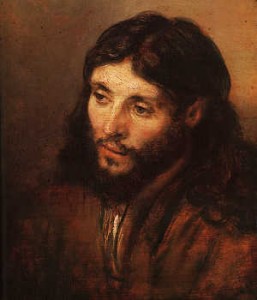 In the beginning he had been tempted by riches, by power, by idolization; all these had been offered in the desert. Now how great the temptation must have been to simply give up! Poet Denise Levertov ponders this allure in her poem Salvator Mundi: Via Crucis
 In this second act of the drama all that has gone before is recapitulated; all that we saw in yesterday’s first act, the supper in the upper room, the act of servanthood taught there, the agonized prayer in the garden, the willing surrender to unjust authority, and more. Not just yesterday’s first act, but all that has gone before from our first act of defiance in the first garden. Poet Ross Miller reminds us of that bond in his brief verse entitled Tau
 The simple answer is that fasting is going without some or all food or drink or both for a defined period of time. An absolute fast is abstinence from all food and liquid for a period of at least one day, sometimes for several days. Other fasts may be only partially restrictive, limiting particular foods or substance. The fast may also be intermittent in nature; for example, Muslims fast during the daylight hours of the month of Ramadan which is intended to teach Muslims patience, spirituality, humility, and submissiveness to God. Fasting as a spiritual practice is common to all major religions. Mahatma Gandhi once noted:

