====================
This sermon was preached on Sunday, August 19, 2012, at St. Paul’s Episcopal Church, Medina, Ohio, where Fr. Funston is rector.
(Revised Common Lectionary, Proper 15B: Proverbs 9:1-6; Psalm 34:9-14; Ephesians 5:15-20; and John 6:51-58)
====================
 As I may have mentioned here before, I spent many of my childhood summers in the southeastern Kansas town of Winfield with my paternal grandparents, C.E. and Edna Funston. Winfield was my parents’ hometown, both of them were raised there and my mother had been born there. Her maternal grandparents, Hinrich and Harmke Buss, were immigrants from that area of Germany right next to Holland called “Ostfriesland”. My father was born in Dodge City, and he and his folks moved to Winfield when he was just a few months old; they were relative newcomers but my grandfather soon became a prominent citizen.
Anyway, one of the things I remember about Winfield is the way newcomers, or anyone someone was meeting for the first time, were almost invariably asked two questions. I once discussed this with a friend who was born and raised in South Carolina and she said it was the same in her hometown, that these are what she called “very Southern questions.” That makes sense because in an odd way, southeastern Kansas is much more Southern than it is midwestern. My mother used to all that part of Kansas “lap land” – meaning that it is were Oklahoma and Arkansas lap over into Kansas.
So there were these two questions that people asked when first meeting another person. The first was, “Who are your people?” Winfield was an agricultural center and not much else. There was no industry or manufacturing that would bring people to town. There was farming and the businesses that support farming, all of which were family owned. So if somebody new came to town to work in on a farm or in a farm-supporting business, it was assumed you must be part of the family. So, who are your people? The answer placed you in a particular social context. So I would say, “Well, my mother is Betty Sargent, one of the Buss cousins.” Anyone local would then know I was a descendant of Henry Buss. My greatgrandfather had had two families. One set of children were born to first wife Mary – she had 14 kids who lived; another set of 13 living children were born to Harmke, my greatgrandmother. According to his obituary, all of those children were alive when Henry died and he left approximately 200 acres of land to each of them. Doing the math, you get the idea that he had acquired a lot of farmland (something over 5,000 acres) and that he (and his children after him) were influential in the local economy. As I mentioned before, on the paternal side my grandparents were comparatively new to the town, but they had become very active members of the Methodist Church and my grandfather, an active Mason, had risen in those ranks as well. So if I continued to my inquirer, “And my father is C.E. and Edna Funston’s youngest son,” he or she would immediately know I was related to a Past Master of the Lodge and an elder in the Methodist Church.
Because of that, I wasn’t often asked the second question, “Where do you go to church?” But I could have been because it really wasn’t a given that I would have been a Methodist. The Busses were members of the Dutch Reformed Church and the Sargents belonged to the Disciples of Christ; I could have been either of those – but the truth was, except for those summer months with the Funstons at the Methodist Church, I really didn’t go to church as a kid.
In any event, those questions served to place someone in a social context, to define in the questioner’s mind who they were and where the fit. And the truth is they aren’t just “Kansas questions” or “Southern questions”. They are everywhere questions. In the fall of 2005, Evie and I took our first trip to Ireland and, as part of that trip, visited County Donegal as I was in search of Funstons in the area where I believe my Funston great-greatgrandfather originated. In Donegal Town itself, we happened to stop into a woolen sweater store run by a man named Sean McGinty. Mr. McGinty asked about our trip and I was explaining to him my family connection to the area. He turned to his wife Mary and said, “You’re from Pettigo; weren’t there some Funstons in Pettego.” She thought for a moment and replied, “Yes . . . . but they weren’t our people.” — They weren’t our people, meaning they weren’t Roman Catholic. The Irish Funstons were and still are Church of Ireland – Anglicans . . . Protestants. “Who are your people?” “Where do you go to church?” They or something like them are human questions; the help us to put people in their place, to categorize one another, to define each other. They are human questions.
But they are not God’s questions! Long before St. Paul would write to the Galatians that in Christ “there is neither Jew nor Greek, there is neither slave nor free man, there is neither male nor female,” (Gal. 3:28) the compiler of the Book of Proverbs would make the same point in the 8th and 9th Chapters of that book, part of which we read today. In these chapters we read of Lady Wisdom, one of the most intriguing characters in all of the Old Testament. In the 8th Chapter, before the part we heard this morning, she tells us herself:
When [God] established the heavens, I was there, when he drew a circle on the face of the deep, when he made firm the skies above, when he established the fountains of the deep, when he assigned to the sea its limit, so that the waters might not transgress his command, when he marked out the foundations of the earth, then I was beside him, like a master worker; and I was daily his delight, rejoicing before him always, rejoicing in his inhabited world and delighting in the human race. (Prov. 8:27-31)
She was, she tells us, a “master worker” helping God to create all that is. And in our reading this morning from Chapter 9, we see her as “the hostess with the mostest” who is ready to throw a party, to do the honors at a great feast. She has “slaughtered her animals, she has mixed her wine, she has . . . set her table,” and she sent her servants out to invite her guests. In fact, she herself stands in her doorway, in the highest places of the town calling,
“You that are simple, turn in here!” To those without sense she says, “Come, eat of my bread and drink of the wine I have mixed. Lay aside immaturity, and live, and walk in the way of insight.” (Prov. 9:4-6)
Note that she doesn’t ask, “Who are your people? Where do you go to church?” She doesn’t ask if any are Jew or Greek, slave or free, black or white, straight or gay, Republican or Democrat, Catholic or Protestant, none of that matters . . . all she asks is that we be “simple” and “without sense.”
Now that’s a bit disconcerting and, frankly, I think the translation belies the true meaning of the invitation. The Hebrew here is, “Mi-phethi yasur henah chasar-leb ‘am’rah lo.” The word translated as “simple” (and sometimes as “naive”) is phethi. It’s root is the word pawthaw, which means “wide open”. An alternative and more positive understanding of this word is “open-minded”. The term “without sense” (sometimes rendered “lacking understanding”) is chasar-leb. Chasar means “without” or “lacking”. Leb (rendered here as “sense” or “understanding”) is most often translated as “heart” because in the ancient Hebrew understanding the heart was believed to be the seat of comprehension and emotion. This is not simple understanding or sense, this is passionate belief, enthusiastic commitment; in a negative sense we might say “bias” or “prejudice”.
Lady Wisdom is not inviting simpletons or the foolishly naive into her parlor; she is inviting the open-minded, those who have no preconceptions, no intolerant prepossessions. Lady Wisdom, God’s master worker, does not care if you are Jew or Greek, Irish or German, black or white or Asian or Native American, straight or gay or lesbian or transgendered, Democrat or Republican or Socialist or Libertarian. Lady Wisdom, God’s master worker, doesn’t care who your people are; she cares about whose you are! She doesn’t care where you go to church; she cares that you are the church, the People of God! She wants you to be open-minded, to come without prejudice or preconception. Her invitation is reminiscent of the Prophet Isaiah’s, “Come now, and let us reason together, saith the Lord.” (Isaiah 1:18 – KJV) She invites us to come and learn.
She has set her table; she is ready to host her party. “Come, [she says] eat of my bread and drink of the wine I have mixed. Lay aside immaturity, and live, and walk in the way of insight.” Lady Wisdom’s celebration is the marriage feast of the Lamb; her invitation is to that very supper Jesus would share with his disciples and shares with us throughout all the ages. St. Paul wrote to the Corinthians the words we recite each time we gather at this Table:
. . . that the Lord Jesus on the night when he was betrayed took a loaf of bread, and when he had given thanks, he broke it and said, “This is my body that is for you. Do this in remembrance of me.” In the same way he took the cup also, after supper, saying, “This cup is the new covenant in my blood. Do this, as often as you drink it, in remembrance of me.” (1 Cor. 11:23-2)
And here in John’s Gospel today he promises that “those who eat my flesh and drink my blood have eternal life, and I will raise them up on the last day; for my flesh is true food and my blood is true drink. Those who eat my flesh and drink my blood abide in me, and I in them.” (John 6:54-56)
To this Feast we are all invited without regard to who our people may be, without regard to where we go to church. To this Feast today we welcome Nathan Joseph Daley who is to be baptized. No one here will ask, “Who are your people?” but if anyone ever does, Nathan can answer “The People of God” . . . and if he wants to be more specific, he can say “The Episcopalians!” No one here will ask, “Where do you go to church?” but if anyone ever does, Nathan can answer, “St. Paul’s!”
Someone else may ask those questions of Nathan or of you or me, but God is never going to ask them! God will ask, “Are you open-minded? Are you free of bias and prejudice?” God will ask, “Are you filled with the Spirit? Do you sing psalms and hymns and spiritual songs? Do you sing and make melody to the Lord in your heart? Do you give thanks at all times and for everything in the name of our Lord Jesus Christ?” (Questions drawn from Ephesians 5:18-20) God will ask, “Do you seek and serve Christ in all persons, loving your neighbor as yourself? Do you strive for justice and peace among all people? Do you respect the dignity of every human being?” (Questions drawn from the Baptismal Covenant in the Book of Common Prayer, pg. 305)
With God’s help, Nathan and we will grow and learn to do these; through God’s grace, he and we will feast on Bread and Wine, and “lay aside immaturity, and live and walk in the way of insight.”
Let us pray:
Grant, Lord God, to Nathan who is about to be baptized into the death and resurrection of your Son Jesus Christ, and to those who already have been baptized, that, as we have put away the old life of sin, so we may be renewed in the spirit of our minds, lay aside immaturity, and live and walk in the way of insight, righteousness, and true holiness; through Jesus Christ our Lord, who lives and reigns with you, in the unity of the Holy Spirit, one God, now and for ever. Amen.
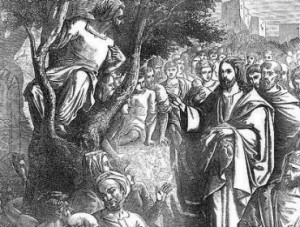 Zacchaeus climbs a tree to see Jesus. So today’s reading got me thinking scattered thoughts about trees. The weeping willow in my childhood backyard. The peach and cherry trees in my grandfather’s garden. The pinion pines of my native Nevada. The eucalyptus trees that were everywhere on my college campus. The huge ornamental pepper tree that shaded the first house my wife and I bought. I close my eyes, think of those trees, and I see my parents, my childhood friends, my college roommates. Trees are filled with meaning and memory; they bear the fruits of remembrance.
 Although from a modern perspective, the prayer of the Pharisee is rather bigoted, but we should try to see it from his perspective and from within his culture, which Jesus shares. When we do so, we can see that Jesus is not criticizing the individual, but rather condemning an entire system of religion which divides and categorizes people. Jesus is denouncing any system, religious, social, or political, which separates people on the basis of bigotry and fear.
 From time to time, people tell me that they have appreciated something I’ve said or done and I try to remember to say, “Thank you.” But inside, I really don’t think about compliments very much. It’s not that I don’t appreciated them, but I don’t do what I do to be complimented, and I really don’t think that I have much to do with it when whatever I do has gone well or had a positive impact on someone. I sort of take Paul’s attitude from the Letters to the Romans and the Galatians: “It is no longer I who live, but it is Christ who lives in me” (Gal. 20:2) and “I will not venture to speak of anything except what Christ has accomplished through me” (Rom. 15:18). So I do think, generally, that the answer to Eliphaz’s question is, “Yes.” Mortals can be of use to God. But there are times I would answer otherwise.
  God used the vision of a sheet filled with unclean animals to get Peter’s attention. “Here,” said the voice, “eat this stuff!” That would certainly have gotten my attention! I eat all sorts of things Jews would consider “not kosher” – pork, ham, bacon, crab, lobster, clams, black pudding (I love black pudding!), haggis; none of that would have gotten my attention. But a commandment to eat from a sheet filled with eels or snakes or lizards or insects of any sort would definitely have done so. So I can understand Peter’s rather negative reaction! ~ This vision was metaphorical or allegorical or a simile or something like that. (You’d think a one-time English major could keep those straight.) God wasn’t really telling Peter to eat those things; God was making a point about people. God’s point was to make Peter understand that God had nothing against gentiles, that all are equal in God’s sight. (I’m not sure how, as a gentile, I feel about being represented by eels and whatever, but I suppose God can use whatever metaphors God chooses. . . .) The lesson, obviously, was that Peter ought to be as accepting and admit gentiles into the Christian fellowship. ~ When the voice said to Peter, “What God has made clean, you must not call profane,” those words were meant to have application far beyond Peter and Cornelius (the specific gentile who was about to come seeking baptism). There’s a lesson there for us, too. In Christ, God has made every person in the world equal before him without regard to nationality, ethnicity, race, sex, sexual orientation, hair-eye-or-skin color, right- or left-dominance (and even the ambidextrous)! As Paul wrote in yesterday’s epistle lesson: “There is no longer Jew or Greek, there is no longer slave or free, there is no longer male and female; for all of you are one in Christ Jesus.” (Gal. 3:28). Therefore, we Christians must treat every person we meet with dignity and respect. It’s more than too bad that we don’t; it’s sinful! ~ I may not be willing (or even able) to eat eels or snakes or insects. In fact, the very idea of eating eels makes me go, “Ewwwww!” and get slightly nauseated. But I had better learn to accept every human being as my equal before God, or I suspect that I will not be allowed to stand there myself.
 I try really hard not politicize these meditations, but I cannot help but think of the political rancor in our country during this election season, particularly the signs that have been paraded at so-called “tea party” rallies by persons who self-identify as “Christians” or more particularly as members of the “Christian Right”. There’s been plenty on the Left, as well, but it is from the Right that the most vile “hate speech” is heard. Just yesterday I saw a news item that Terry Jones, the pastor of the Dove World Outreach Center in Gainesville, Florida, the same fellow who threatened to burn a Qur’an several months ago, has now hung an effigy of President Obama on a gallows in front of his church. How can someone who presents himself as a Christian pastor do that? Especially in light of these words from Jesus? Especially in light of the words from Paul which are also in today’s Daily Office reading: “There is no longer Jew or Greek, there is no longer slave or free, there is no longer male and female; for all of you are one in Christ Jesus.” (Gal. 3:28) One hastens to point out to “Pastor” Jones that President Obama (despite the rantings of the far Right and no matter how one may feel about his politics) is a baptized Christian, a brother in the Lord, a fellow member of the church universal. How on earth can this man do this? ~ A couple of days ago some members of my parish and I were talking about the festival held each spring in an Ohio village near our town. It celebrates something like the return of the swallows to San Juan Capistrano in California, only in this case it is the return of the turkey vultures to Hinckley, Ohio. (You read that correctly . . . turkey vultures.) For some reason I once learned that turkey vultures (and other types of buzzard) defend themselves through the use of projectile vomiting. It occurs to me on reading this text from Matthew and considering our political discourse (especially antics like these of “Pastor” Jones) in its light, that the projectile-vomiting turkey vulture just might be the mascot of present-day American politics. May God have mercy!
 I’m not sure, but those may be my three favorite words in all of Paul’s writings: “You stupid Celts!” That’s what he’s saying here. The Galatians were Celts, distant cousins of the Irish, Welsh, Scots, and Bretons. They all had their origins in the Celtic homelands of the northwestern Alps and migrated to Asia Minor, the islands of Britain and Ireland, and other places. And here Paul calls the Celts of Asia Minor anoetos, a Greek word which means “lacking understanding” and is variously translated as foolish, thoughtless, senseless, or stupid. “You stupid Celts!” ~ It is generally believed that Paul is reacting against the Galatians acceptance of the suggestion of the “Judaizers” that they needed to be circumcised before they could really become Christians. But I wonder . . . . I’ve done a fair amount of study of Celtic spirituality, at least of the western (British Isles) sort; I spent a three-month sabbatical translating ancient Gaelic religious poetry. The western Celtic understanding of Christ’s work was rather different from the Pauline notion. Paul (especially as developed by Augustine but, I think pretty clearly, originally) saw Christ’s salvific work in terms of propitiation and justification: just a few more verses and he will insist to the Galatians “Christ redeemed us from the curse of the law.” (v. 13) The Celts, on the other hand, thought in terms of Jesus completing the goodness of creation; they believed much like Origen did that human beings were not so much fallen or cursed by sin as immature and incomplete, striving not for redemption but for perfection. ~ Some of Origen’s views were eventually anathematized as heretical and, though he is viewed as a “Church Father”, he has not been sainted. Later Celtic theologians have suffered the same indignity. The Irishman Johannes Scotus Eriugena believed that all human beings reflect attributes of divinity and that all are capable of progressing toward perfection, a view that Paul would clearly have disputed; Eriugena’s theology was discredited as “Irish porridge” and “an invention of the devil.” The Culdee monk Pelagius (who was probably a Breton rather than Irish) taught that humans do not have inherent sinfulness, but rather have a natural sanctity and the moral capacity to choose to live a holy life; Pelagius, too, was condemned as a heretic. ~ I sometimes wonder if this pervasive western Celtic belief in the essential goodness of humankind and in the progressive divinization or completion of creation might have been shared by their eastern cousins in Galatia. If so, it might have been this which led them to be more accepting of the Judaizer’s suggestions; after all, if the Christian goal is divinization and if circumcision put the Chosen People closer to God, perhaps it ought to be considered. No wonder Paul, who didn’t believe human beings could do anything to contribute to their own sanctification, thought them stupid and foolish! How different might the Christian church today be if the views of the Galatians, Pelagius, Eriugena, and other Celts had prevailed? One will never know. ~ I do know this, however. Those Celtic views ought to be heard and considered. None of us fully knows the mind of God and the views and thoughts of all should be valued as we struggle together to understand. They may be my favorite words of Paul, but not because they are particularly beneficial; indeed, they are not. The church today would be much better off and a much more congenial society if no one ever said or wrote anything like, “You stupid Celts!”
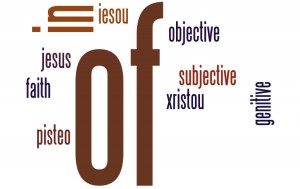 Do you see that little asterisk at the end of the quoted scripture? It’s there because a footnote in the Bible tells us that “faith in Jesus Christ” is only one possible interpretation of the original koine Greek. The alternative is “the faith of Jesus Christ.” Change a preposition and you change the entire sense of the sentence! “In” or “of”? Are we saved by our faith in Jesus? Or by Jesus’ faith in his Father? I’m going to suggest that it is the latter. The faith of Jesus, the confidence he had in the God he trusted in, the commitment he made to his mission, the fidelity he had to the values he taught. That is what saves us, not anything we do, say, or believe. Salvation is a matter of grace, the unwarranted, unmerited, unearnable grace of God. ~ The reason this debate exists, by the way, is that the preposition is not even there in Greek. Rather, in Greek the ending of the noun gives an indication of meaning. In the Greek of this text we find something called the “genitive” case. It is unclear whether Paul intended the “genitive subjective” (which would support the “of” understanding) or the “genitive objective” (which leads to the “in” translation). Although the objective understanding has prevailed for centuries, a lot of modern scholars are arguing that we might better understand Paul’s meaning with the subjective interpretation. I think they have a point. ~ It is not our faith in Jesus which justifies us, but the faithfulness of Jesus Christ to his mission and to his God. What is most important about this is the implication it has for us. Faith is a gift; we are saved through faith by grace and not by any work of our own. Salvation is not from the human act of believing but from the divine act of Jesus’ obedience. Thus, our human faith is not a prerequisite for salvation but is our appropriate response to the blessing given through the faithfulness of Christ. ~ “We know that a person is justified not by the works of the law but through the faith of Jesus Christ.” Of not in!
 I’m very tempted to ask, “O come on, Paul! You really didn’t expect them to remember you after you’d gone, did you?” But, of course, he did! It seems to me that Paul here is very much like modern clergy. I think we all expect to have lasting impact on the places we serve, but the truth is most of us will not. Clergy are transients; in the past half-decade I’ve seen studies variously reporting the average length of a pastorate across denominations as somewhere between three and five years. That’s not much time to make much of an impact. ~ Now, there are exceptions. Every parish seems to have its sainted Father Usedtobehere, that one priest or pastor whom everyone remembers with great affection. He (it’s usually “he” in my denomination because we haven’t had women in the presbyterate long enough yet) was the best at visiting, best at preaching, best at organizing, best at presiding at the altar, best at remembering parishioners’ birthdays, best at whatever. He is remembered as the paragon of ministry even by people who came to the parish after he departed! There’s really no competing with such ghosts. One just has to accept that they are here and will live on in memory long after one has gone . . . and that it is unlikely that most of us will ever enjoy such exalted canonization. ~ However, I’m not suggesting that we clergy adopt the attitude of the Preacher whose writing is also included in today’s lectionary readings: “I considered all that my hands had done and the toil I had spent in doing it, and again, all was vanity and a chasing after wind, and there was nothing to be gained under the sun.” (Eccl. 2:11) As unlikely as it may be that any of us attain the celebrated status of parish patron saint, it is equally likely that we will have an impact (usually through something we think of as mundane or insignificant) on the lives of one or two people, maybe more. Most of us may not be remembered by the whole congregation as the cream of the clergy crop; the majority of the parish may (as Paul complained) quickly desert us. But those few will remember . . . and here’s the rub (as Hamlet might have said) – we don’t know who they will be, nor what action or word of ours may make the difference. We just have to try to do the best we can in any given pastoral situation, in most of which we may feel woefully inadequate, because we never know. ~ That’s what Paul should have remembered; that’s what the Preacher should have remembered; that’s what each clergyperson should remember!

