From the Gospel of John:
[Jesus said,] “I am the bread of life. Your ancestors ate the manna in the wilderness, and they died. This is the bread that comes down from heaven, so that one may eat of it and not die. I am the living bread that came down from heaven. Whoever eats of this bread will live for ever; and the bread that I will give for the life of the world is my flesh.”
(From the Daily Office Lectionary – John 6:48-51 (NRSV) – February 4, 2014.)
 Sunday, February 2, was significant for three things. It was the Feast of the Presentation of Jesus in the Temple, also called the Purification of Mary, also called Candlemas, a principal feast in the Christian faith and one that rarely falls on a Sunday. It was Groundhog Day, a very silly secular holiday in the United States and the inspiration for one of the more profound movies about personal growth and maturity, 1993’s Groundhog Day starring Bill Murray. It was Super Bowl Sunday.
The National Football League’s Super Bowl is a really big deal. For reasons that have almost nothing to do with the quality of the football played in this alleged championship match, millions of people plan their lives (at least on that day) around this game even though it is typically not a very good game. This year’s match between the Seattle Seahawks and the Denver Broncos was no exception; Seattle beat the crap out of the Broncos 43 to 8. Almost from the very first minutes, it was no contest. Nonetheless, millions of dollars changed hands, millions of people paid attention, and millions of other people were inconvenienced.
For all of my life as an ordained person, I have been aware of the Super Bowl’s effect on church attendance. The first parish I served as a priest was in the Pacific Time Zone and there I learned very early on that one does not schedule the annual membership business meeting on Super Bowl Sunday; you might not have enough people in church to constitute a quorum! Even now, when I minister with a congregation in the Eastern Time Zone where the game isn’t shown until the evening hours, I have come to expect low attendance; people are preparing either to host or to attend a Super Bowl party and (apparently) it takes more than eight hours to do so.
In commentary about the game this year, it has been suggested that one-third of the American populace watched all or a significant part of the game at home, at a Super Bowl party, or at their local sports bar. That would be more than 100 million people! In many of those commentaries, the term “bread and circuses” has been mentioned. This is a reference to a Latin expression from ancient Rome, panem et circenses, a phrase coined by the satirical poet Juvenal, who wrote
Already long ago,
from when we sold our vote to no man,
the People have abdicated our duties;
for the People who once upon a time
handed out military command,
high civil office, legions — everything,
now restrains itself and anxiously hopes
for just two things:
bread and circuses.
The reference is to the Roman practice, both republican and imperial, of gaining political power and keeping the masses in check by providing free wheat to the citizens, as well as costly entertainments, such as the circus gladiatorial games.
I don’t know, and in this space do not want to opine, whether the Super Bowl is, in fact, a “circus” offered by the leaders of our society to keep the population docile. I don’t want to opine here about the means, or failure of the means, by which society provides bread to those in need. But I am struck by today’s gospel reading and Jesus claim that he, his flesh, is the Bread which will let one live forever; in light of Sunday’s low turnout, one would have to admit that the Bread lost out to the circus.
The immediate gratification of the NFL circus — the parties and bar gatherings, the fun of cheering on one’s team, the camaraderie of the fans, the food, and the beer — is clearly more attractive than the gospel of eternal life. Why is that? I truly wish I knew. I’m not a sports fan and I don’t understand the attraction. But someone in the church needs to figure that out for the rest of us. Please. Soon.
====================
A request to my readers: I’m trying to build the readership of this blog and I’d very much appreciate your help in doing so. If you find something here that is of value, please share it with others. If you are on Facebook, “like” the posts on your page so others can see them. If you are following me on Twitter, please “retweet” the notices of these meditations. If you have a blog of your own, please include mine in your links (a favor I will gladly reciprocate). Many thanks!
====================
Father Funston is the rector of St. Paul’s Episcopal Church, Medina, Ohio.

 In a sense, we walk on the surface of chaos all the time. One of the learnings from quantum mechanics is that things are not nearly as solid as they seem. The everyday world seems to “float” on what has been called a “quantum foam.” The Greeks posited that if we continue to divide matter we get to atoms; if we divide atoms, we get electrons, neutrons, and other subatomic particles; if we try to divide subatomic particles, eventually we get to get quantum fields and even multidimensional vibrating strings. At the quantum level, reality is a quivering mass of quantum chaos. We walk on the surface of chaos all the time!
 Is it just me, or does this speech of Jesus (the verses are part of a long, long address to “the Jews”) just drip with frustration? And it makes me wonder – did Jesus really express such frustration? Or is it John who is frustrated and does his frustration color the way he presents the gospel story?
 There are times when I’m reading one or another of the Gospels and I am pulled up short; I just have stop and say, “Really? Jesus said that? Really?”
  I’m intrigued that, near the end of what is a pretty standard hymn-of-praise sort of psalm, there is this admonition to be a careful observer. Jesus will echo this admonition, not in its exact words but in intent, several times in the gospels.
  These few verses are the end of the story of Jesus’ encounter with the Samaritan woman at Jacob’s well which led to his two-day sojourn in the Samaritan city of Sychar. Whenever I have heard this story preached (and, I confess, when I have preached it myself), the emphasis seems always to be on the Lord’s daring to speak with a woman, and a Samaritan woman, at that! The focus is his unconventionality, his willingness to step outside the Law, and his abrogation of ethnic and sexual norms. We are told how extraordinary this encounter was.
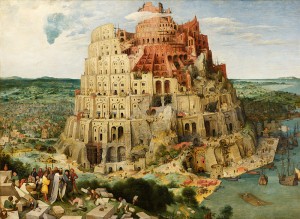 I’ve never quite understood the story of the tower of Babel. I get that it’s an etiological myth to explain the variety of languages spoken by human beings, but the picture of God that it paints is (shall we say?) less than positive. Might it have been better to cast someone else (say the Tempter?) as the “bad guy” who thwarts the plans of the tower builders?
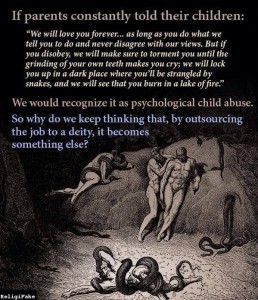 Making the rounds of Facebook these days is an anti-religious meme which basically equates religious teaching to child abuse. It says:
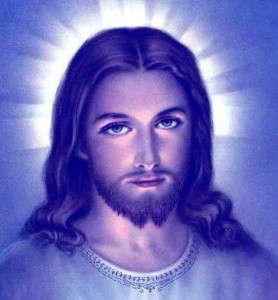 The Definition of Chalcedon affirms, in part:
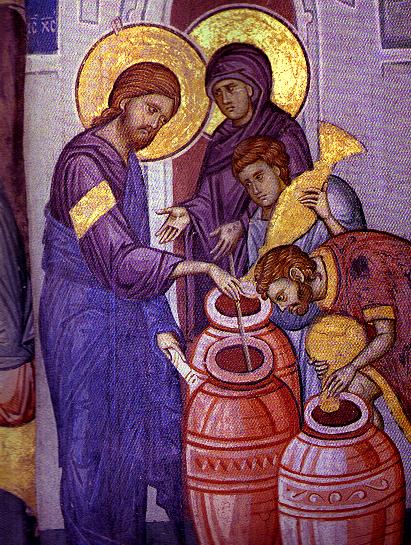 Today is the feast of St. Antony of Egypt. According to a Life of St. Antony written by Athanasius, Antony and his younger sister were orphaned when he was about 18 years of age, inheriting a goodly estate which he began to manage. However, writes Athanasius, six months after his parents’ death he was “turning over in his mind the way the apostles had left everything to follow the Savior” when he heard a sermon on Christ’s encounter with the rich young man whom the Lord instructed, “If you wish to be perfect, go, sell your possessions, and give the money to the poor, and you will have treasure in heaven; then come, follow me.” (Matt. 19:21)

