Revised Common Lectionary for the Fifth Sunday in Lent, Year B: Jeremiah 31:31-34; Psalm 51:1-13 or Psalm 119:9-16; Hebrews 5:5-10; and John 12:20-33
 This is the fifth and last Lenten sermon addressing a question posed by a parishioner and, in fact, I will try to answer succinctly two related questions that two parishioners asked. One was “What does the word catholic mean when we say it in the Nicene Creed?” and the other was “What do you (meaning me, Father Funston) mean when you describe the Episcopal Church as being ‘in the Catholic tradition’?” (If you could see the way I have typeset these sermon notes, you would see that I have capitalized the “C” in catholic in the second question, but not in the first. That’s an important point which I will address shortly. But let me start with a basic definition in answer to the first inquiry.
These questions arise, of course, because there is one church denomination in this country and throughout the world which has arrogated to itself this word catholic and, of course, I refer to the Church of Rome. In everyday speech if you say the word catholic nearly everybody will think you are referring to the Roman Catholic Church, but, in truth, the word has much broader meaning and application than one denomination, however large and powerful it may be or think itself.
Catholic comes from the Greek katholikos, a compound word made up of kata meaning “about” or “concerning” and holos meaning “whole” (from the latter we get a word familiar many, holistic, which means to look at something in its entirety). Thus, the word catholic means “regarding the whole” or, more simply put, “universal” or “general.” In the context of the Creed, the word does not have anything to do with any denomination which calls itself “Catholic” such as the Church of Rome. In the worship book of the rather evangelical Methodist church which my paternal grandparents attended there was an asterisk next to the word catholic in the Creed and a footnote which read “meaning universal” just to be sure no one misunderstood and thought the Methodists had reunited with the Bishop of Rome.
As used in the Creed, the word catholic describes one of what are called the “four marks of the church”; these are that the church is one, holy, catholic, and apostolic. These are set out in the Outline of the Faith we find in The Book of Common Prayer. If you would turn to page 854 in the BCP, you can follow along in Catechism:
Q. Why is the Church described as one?
A. The Church is one, because it is one Body, under one Head, our Lord Jesus Christ.
Q. Why is the Church described as holy?
A. The Church is holy, because the Holy Spirit dwells in it, consecrates its members, and guides them to do God’s work.
Q. Why is the Church described as catholic?
A. The Church is catholic, because it proclaims the whole Faith to all people, to the end of time.
Q. Why is the Church described as apostolic?
A. The Church is apostolic, because it continues in the teaching and fellowship of the apostles and is sent to carry out Christ’s mission to all people.
In the words of the Gospel according to Matthew, we are sent out by Christ [there’s the apostolicity] to “make disciples of all nations [there’s the catholicity], baptizing them in the name of the Father and of the Son and of the Holy Spirit [there’s the holiness], and teaching them to obey everything that [Jesus, our one Lord] commanded” the apostles (Matthew 28:19-20a).
So in the Creed we express our faith in the point that Jesus makes in today’s gospel lesson. This confrontation by the curious Greeks reiterates something Jesus said to Nicodemus not too long before: “When I am lifted up from the earth, will draw all people to myself.” The Church is catholic because its mission is to draw all people to Christ.
This is what we mean by catholic with a lower-case “c” and applies to all Christian churches without regard to their polity, their style of worship, their understanding of the sacraments, their theology, or their manner of choosing, training, and addressing their clergy and leadership. When we capitalize the word and apply it to a subset of Christian traditions or to one in particular, we removing it slightly from its original meaning, and giving it a different twist. We start with an old “canon” or rule attributed to St. Vincent of Lerins: “What everywhere, what always, and what by all has been believed, that is truly and properly Catholic.”
Thus, instead of looking to the writings and doctrines of any Medieval or Reformation theologian, a church in the Catholic tradition looks to the earliest, universally accept teachings of the church, in addition to Holy Scripture this means primarily the first seven Ecumenical Councils: the First Council of Nicaea (325), the First Council of Constantinople (381), the Council of Ephesus (431), the Council of Chalcedon (451), the Second Council of Constantinople (553), the Third Council of Constantinople (680), and the Second Council of Nicaea (787). While the writings and doctrines of the Medieval theologians (Aquinas, Abelard, Duns Scotus, and others) or the reformers (Martin Luther, John Calvin, John Knox, and so forth) are of interest, they are not definitive. Only Holy Scripture is definitive, and only these councils of the undivided church and certain early theologians, especially the universally acknowledged “doctors of the church”, are given authoritative weight in the development of theological doctrine. (Those doctors of the church, by the way, are Saints Ambrose, Augustine, Jerome, Gregory the Great, John Chrysostom, Basil the Great, Gregory of Nazianzus, and Athanasius of Alexandria.)
So here is one refinement on the concept of catholicity: In the Catholic tradition, our theology and doctrine are drawn primarily from that which has been universally accepted and taught since the earliest days of the church, not from the teachings of a Medieval or Reformation theologian (no matter how wise and scholarly that theologian may have been). Thus, the Catholic churches (including both the Roman and the Anglican Traditions) preserve an understanding of the sacramental nature of the priesthood, the oblationary nature of Holy Communion, and the Real Presence of Christ in the Eucharist.
Another refinement of the concept of catholicity is in the polity (or organization) of the church and a reliance upon an historic, ordered ministry. As our Catechism in The Book of Common Prayer defines it:
Q. Who are the ministers of the Church?
A. The ministers of the Church are lay persons, bishops, priests, and deacons.
A Catholic understanding of the ministry, then, is that there is one basic order of ministers encompassing all the baptized, the laos or people of God, some of whom are set apart for special ministries in the orders of deacon, priest, and bishop. In particular, Catholic polity reveres the office of the bishop. One of those early theologians we like to look to for guidance, in this case St. Ignatius of Antioch, who wrote: “Wherever the Bishop appears, there let the multitude of the people be; just as where Christ Jesus is, there is the catholic church.” In Ignatius’s view, the Eucharist is Christ-centered and both the bishop and the priest, through their ministry, enable Christ to be present when each presides at a Eucharist. The priest presides only because he or she is ordained by the bishop and the college of presbyters, and serves with the consent of the bishop. The bishop, in turn, was ordained by other bishops in historic succession. Thus, the ordered polity of the churches ministry preserves its Catholicity through time.
Finally, I would note that the high regard of churches in the Catholic tradition for the sacraments encourages a certain liturgical style. The Catholic revival in the Church of England in the mid-19th Century promoted the use of Eucharistic vestments, the priest standing at the center of the altar (not standing at the north end which had been the practice encouraged by the Puritans in the Anglican church), the use of unleavened bread for the Eucharist, the mixing of water with the wine, the use of candles and of incense, and the chanting of Psalms and other parts of the service; all of these are now standard practices in the Episcopal Church. Our worship at its best cultivates a sense of reverence, awe, and mystery in the presence of the Holy One before whom even the angels in heaven veil their faces.
This is what I mean when I describe the Episcopal Church as being within the “Catholic tradition.” And I believe this tradition to be soundly biblical.
In the Epistle Lesson today, the writer of the Letter to the Hebrews looks back to one of the obscure characters of the Old Testament, the priest Melchizedek, in making his theological argument for the divinity of Christ. He quotes from Psalm 110:4 in which the Psalmist quotes God speaking to some unnamed prince of the people, “The Lord has sworn and he will not recant: ‘You are a priest for ever after the order of Melchizedek.'” This, argues the writer of Hebrews, was said to Christ.
Melchizedek is mentioned only one other place. In the Book of Genesis, Abram (whom God had not yet renamed Abraham) does battle with and defeats King Chedorlaomer of Elam and three other kings. When he does so, Melchizedek, who is described as King of Salem and priest of God Most High, approaches him, gives him bread and wine, and blesses him saying, “Blessed be Abram by God Most High, maker of heaven and earth; and blessed be God Most High, who has delivered your enemies into your hand!”
A high, Catholic understanding of ministry, especially of priestly ministry and worship, is fully in keeping with Scripture’s reverent depiction of Melchizedek. His name means, “My king is righteousness.” In his offering of bread and wine to Abram, St. Cyprian of Carthage (d. 258) saw “the Sacrament of the Sacrifice of the Lord prefigured,” and in one of the church’s earliest Eucharistic prayers we find a petition that the bread and wine offered in our worship be accepted by God like “the bread and wine offered by your priest Melchisedech.” An early Christian document from the Nag Hammadi library even suggests that Melchizedek may have been Christ himself. Melchizedek is therefore a type or exemplar of the universal priesthood, what Scripture calls “the priesthood of all believers,” of which the sacerdotal priesthood is merely a subset.
Catholic spirituality also is profoundly incarnational. Through Jesus, the Word made flesh, we see, hear and touch God. Similarly today, through the Holy Spirit, God uses his creation (bread, wine, holy oil, holy water etc.) as ways we can know and experience him. The Catholic tradition, recalling that God has written his covenant in our hearts (to use an image from today’s Jeremiah reading), encourages us to use our whole selves and all of our senses in worship so that the whole self, both body and soul, is lifted up in prayer and praise of God.
So the simple answer to the question “What does catholic mean?” is that it means “universal” or “general”, that it means that the church offers a message of salvation that is for all people, in all places, at all times. And that is also what it means to describe our church as holding to a “Catholic tradition;” that we teach, organize ourselves, and worship in a manner consistent with “what everywhere, what always, and what by all has been believed” in an unbroken line of continuity stretching even as far back as Melchizedek, the king of righteousness and priest of God Most High. It means that we seek to exemplify and to proclaim to the world a faith that is incarnational, vibrant and inviting, rooted in the traditions of the past but living in the present and embracing of the future, a faith in the One who was lifted up from the earth, that he might draw all people to himself.
Let us pray:
O God of unchangeable power and eternal light: Look favorably on your whole Church, that wonderful and sacred mystery; by the effectual working of your providence, carry out in tranquillity the plan of salvation; let the whole world see and know that things which were cast down are being raised up, and things which had grown old are being made new, and that all things are being brought to their perfection by him through whom all things were made, your Son Jesus Christ our Lord. Amen.
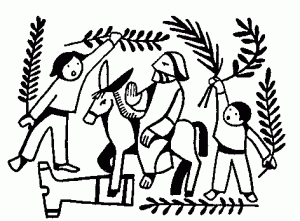 We have just read the simple, yet dramatic story of our Lord’s Passion as related in Mark’s Gospel. But we began our worship this morning with John’s story of Christ’s triumphal entry into Jerusalem. In the span of a few minutes we covered an entire week at the end of Jesus’ earthly life. Logic and reason cannot really make sense of this, and no ten-minute homiletic exegesis of these texts can help us comprehend the enormity of those events.
  The simple answer is that fasting is going without some or all food or drink or both for a defined period of time. An absolute fast is abstinence from all food and liquid for a period of at least one day, sometimes for several days. Other fasts may be only partially restrictive, limiting particular foods or substance. The fast may also be intermittent in nature; for example, Muslims fast during the daylight hours of the month of Ramadan which is intended to teach Muslims patience, spirituality, humility, and submissiveness to God. Fasting as a spiritual practice is common to all major religions. Mahatma Gandhi once noted:

