Revised Common Lectionary readings for the Seventh Sunday of Easter (Sunday after the Ascension): Acts 1:15-17, 21-26; Psalm 1; 1 John 5:9-13; and John 17:6-19.
 The story from the Acts of the Apostles this morning tells us that the apostles, in choosing a replacement for Judas Iscariot, relied on a game of chance. They couldn’t decide between two candidates so, rather than voting, they “cast lots”, drew straws, rolled the dice. Matthias got the short straw. As I was contemplating these lessons, and particularly this story, this week, I was also assaulted by radio and television advertisements for the new Horseshoe Casino in downtown Cleveland. And just like the lessons of the past few weeks, this coincidence of events triggered a memory of childhood. But this week, the memory was not of summers spent with my grandparents, it was of Saturdays spent with my father.
My father, R. York Funston, was a Certified Public Accountant in Las Vegas, Nevada. During the 1940s and 1950s one of the ways the authorities kept tabs on the gaming industry was through weekly audits of the casino records conducted by state-appointed CPAs, of which my dad was one. For some reason, the Gaming Control Board thought Saturday mornings would be the best time for the books to be collected, so that was when he would make the rounds of the five casinos he was responsible for. It was also the day my mother did her housekeeping and she didn’t want me underfoot, so I would accompany my dad as he drove through Las Vegas visiting the casinos.
The Las Vegas of the early 1950s was rather different from the city one visits today. In those days, Las Vegas as about the size of current-day Medina, Ohio. A permanent population of right around 30,000 people, a downtown like that of any other city with a Sears-Roebuck, a Rexall drug store, a locally owned department store called Ronzone’s, a movie theatre that showed double-features, and half-a-dozen or so casinos. We lived near the south edge of town in a post-war housing development called Huntridge. Just a couple blocks south of us was Sahara Boulevard, south of which was the desert and a collection of horse ranches called Paradise Valley.
Dad and I would get up and leave the house at about 6 a.m. on Saturday mornings and drive through Paradise Valley headed for the Tropicana Hotel & Casino to pick up the first set of books. Then we’d hit three other places on the strip and finish up downtown at Binny Binion’s Horseshoe, the casino which eventually became the big publicly-traded corporation now running a casino in Cleveland.
This was not, in terms of miles traveled, a very long trip, but it would take about four or five hours because at each stop my dad would have a cup of coffee and a conversation with the casino managers. At each place, I would get to spend time with a change girl or a cocktail waitress while Dad conducted his business, and sometimes I’d get to meet other people. For example, I met Frank Sinatra and Dean Martin and all the rest of the Rat Pack when I was four years old. But when we got to Binion’s, I got to do something else.
The Horseshoe was on the corner of Fremont, the downtown main street of Las Vegas, and Third Street, and the whole corner of the building was open to the street. Right at the corner, visible for everyone passing by to see, was a big glass box in which, it was said, there was $1,000,000 in U.S. currency in bills of various denominations. On either side of the box stood a uniformed guard carrying a shotgun. Casino patrons could get inside that box with all that money and large fan would blow a whirlwind around them and lift those bills so they were flying all around the person. I’m not sure how long the patron had, maybe a minute, but whatever it was, the idea was that during that period of time whatever bills the person could catch and hold on to, they got to keep. My dad would leave me there at the entrance to Binion’s Horseshoe and let me watch those people trying to catch money while he went inside and got the books. I never saw anybody catch very many bills – that’s really hard to do.
So when the Bible describes a game of chance as the means by which the apostles chose a successor to Judas, and the radio is broadcasting ads for a new casino in Cleveland, I remember those childhood visits to Binion’s Horseshoe and those silly people grabbing at those flying bills.
Luke does not tell us whether Matthias was commissioned in any way for his ministry as Judas’s replacement, but I think we can be fairly certain that he was. Elsewhere in Acts Luke describes acts of laying of hands and prayer to commission people for special ministries, and church historians assure us that from the very earliest days of the church this was the regular practice. Today we are commissioning a group of St. Paul’s members to perform a special ministry as part of what is called a Grow My Church Task Force. The “my” in “Grow My Church” refers to Christ; this title is a paraphrase of Jesus’ “Great Commission” to the Apostles, the commandment given them just before his ascension into heaven. St. Matthew reports it in these words:
Go therefore and make disciples of all the nations, baptizing them in the name of the Father and the Son and the Holy Spirit, teaching them to observe all that I commanded you; and lo, I am with you always , even to the end of the age. (Matt. 28:19-20)
Jesus refers to his intention to do this in today’s gospel from John, in what is called his “high priestly prayer” offered to God on the night of the Last Supper. In fact, this prayer is the Apostles’ commissioning by Jesus for the ministry they will be given:
Sanctify them in the truth; your word is truth. As you have sent me into the world, so I have sent them into the world. And for their sakes I sanctify myself, so that they also may be sanctified in truth. (John 17:17-19)
The word for sending here in the original Greek of the New Testament is apostello and it is from this word that we get our word apostle – an apostle is one who is sent.
In a few minutes, we will formally commission the Task Force, we will make them apostles sent to do a job, but before we do, I want to tell you what the Vestry, our parish governing board, has charged them to do. At its last meeting, the Vestry adopted this resolution:
We, the Vestry of St Paul’s Episcopal Church formally charge the members of the newly formed Grow My Church! Team, which includes Barbara Baird, Shelley Triebsch, Mark Hansen, Joe Mahn, David Muffet, Steve Rucinski, and Ray Sizemore, to help us learn more about our congregation. We commend to you the Grow My Church! course and ask that you exercise all diligence in prayer and study, and return to us with recommendations. Therefore, in the course of your study we formally charge you to develop a Congregational Growth Plan to help reinvigorate our church and better live out our role in The Great Commission. We pledge to review your recommendations, intending to fruitfully apply your work as the Holy Spirit guides us. We expect to hear back from you in four months and pledge to keep everyone involved in our prayers
The Task Force will be meeting on Monday evenings for twelve weeks. Each meeting will address a particular topic:
- Organization
- Landscape (What are the societal and community factors influencing our church?)
- Leadership (How does our governance structure work? How could it be improved?)
- Purpose (What is our mission? How well is it known to our members and to non-members?)
- Worship (Why we gather on Sunday? What do we do? What should we do?)
- Spirituality (What is our church’s relationship with God?)
- Service (What are our community outreach ministries? Are there others we should be doing?)
- Fellowship (What about the social time we spend together? Can it be improved?)
- Generosity (How do we talk about money? How do we raise it, use it, steward it?)
- Hospitality (How are we at welcoming the visitor and incorporating the newcomer?)
- Invitation (How well do we do at asking others to join us? What can we do to make our invitations more frequent and more effective?)
- Growth Plan (Putting it all together with action recommendations reported to the Vestry.)
OK … so that’s who they are, what they’ve been commissioned to do, and how they’re going to go about doing it.
Here’s what I hope they (and we) won’t do.
First, I hope they won’t be like those people in the glass box at Binion’s Horseshoe grabbing at the flying money. I sometimes feel that that is what the church has been doing for the past three or four decades. We have known that church membership has been declining, that Average Sunday Attendance has been going down, but we haven’t known what to do about it, so we stand in the whirlwind and grab at anything that flies by. We’ve had program after program that was supposed to reinvigorate the church and make us grow. We’ve had canned studies called Edge of Adventure, Living the Adventure, Faith Alive, Acts 29, and on and on. We’ve had spiritual experiences like Cursillo, Marriage Encounter, the charismatic movement, and the so-called contemporary worship craze. We’ve done Natural Church Development and we’ve done Unbinding the Gospel.
Some of these things have worked for while; some of these things have taught us lessons we ought to remember; some of these things actually have done harm. But much of it has been “like chaff which the wind blows away” or like the dollar bills flying around in that glass box. I hope this Task Force doesn’t repeat that experience but will be solidly grounded and take from the things we’ve tried and the things they study some good, reliable insights on which to make recommendations to the Vestry and to all of us. I hope that in this study this Task Force will be “like trees planted by streams of water, bearing fruit in due season.”
Second, I hope they won’t feel constrained by the past. I hope they won’t use (or even hear) two sentences. One is “We’ve never done it that way before” and the other is “We’ve always done it that way before.” There are lots of things that we (throughout the church not just in this parish) have not done that we clearly ought to be doing; and there are plenty of things that we’ve done for years that we need to abandon. Someone recently reminded me of an observation made back in the 1990s by Father Robert Farrar Capon, one of the great writers of our church. Fr. Capon, in a book entitled The Astonished Heart: Reclaiming the Good News from the Lost-and-Found of Church History, wrote:
The church can’t rise because it refuses to drop dead. The fact that it’s dying is of no use whatsoever: dying is simply the world’s most uncomfortable way of remaining alive. If you are to be raised from the dead, the only thing that can make you a candidate is to go all the way into death. Death, not life, is God’s recipe for fixing up the world.
As John wrote in today’s epistle, God intends for us to have eternal life, “and this life is in his Son,” and his Son said:
Very truly, I tell you, unless a grain of wheat falls into the earth and dies, it remains just a single grain; but if it dies, it bears much fruit. Those who love their life lose it, and those who hate their life in this world will keep it for eternal life. (John 12:24-25)
I believe that is as true for the church as a community as it is for each of us as individuals, but just as individuals must die to self in order to be born again, the church must die to all the things, the practices, the ways-we’ve-always-done-it that may have worked in the past but that are now holding us back.
Third, I hope that you won’t ignore their work. I hope you will participate in this process. As the Task Force works through these twelve weeks of study, they will be seeking your input. This white board over here will be in the hallway each week with a question or maybe two. There will be inserts in your bulletin for your answers. Please give them and put them on the board with those colored magnets you see. And sign them! The Task Force cannot respond to anonymity – they may want to get more information from you and they will want to respond to you. So give them your thoughts and take ownership of them. Have the courage of your convictions and let the Task Force have your testimony about your church.
Finally, after we commission them, we will hold them responsible for producing an action plan to report to the Vestry within four months pursuant to that resolution. I hope that they won’t just walk away from it. I hope that they, in turn, will hold us responsible to do the things in that plan. They are a Task Force and when their task is done, they will be discharged and their team disbanded, but I hope they will continue to be active in our pursuit of the Great Commission making sure that we do what they determine in this study we need to do.
The liturgy of commissioning the members of the Grow My Church! Task Force is in your bulletins. Would you please pull that out while I ask the members of the Task Force to step forward….
 Today is the Feast of the Ascension. Today we remember that, forty days after his resurrection, Jesus ascended into heaven, disappearing from his disciples’ sight into the clouds. Luke tells us in the Book of Acts that the disciples stood there gazing up towards heaven, and that two men, presumably angels, appeared and asked “Why do you stand looking up towards heaven? This Jesus, who has been taken up from you into heaven, will come in the same way as you saw him go into heaven.” (Acts 1:11) So we have two biblical promises: “I’m still with you” and “He’s not with you but he’ll be back.” The Christian paradox illustrated in the readings for a single day. ~ For me the meaning of the Ascension is summarized in the petition of one of the collects for the day in the American Book of Common Prayer (1979): that “we may also in heart and mind there ascend, and with him continually dwell” – or as Jesus put it in John’s gospel “that where I am, there you may be also.” (John 14:3) I don’t understand that as a future conditional promise but rather as a present permissive reality. Christ’s ascension allows us to be in God’s presence, now . . . no matter what our circumstance may be. It’s a matter of us recognizing that presence in the present, which we so often fail to do because we think of it as a future reward for some good behavior or something on our part when, in reality, it has nothing to do with our behavior or our goodness at all. The apparent paradox of the two biblical promises accurately reflects our confusion.
  Are you a music fan? A classical music fan? I am. I love the great symphonies – Beethoven’s Fifth, his Ninth, Tchaikovsky’s Fifth, Dvorak’s From the New World, and many others – they just bowl me over. I can sit down in a concert venue and no matter what emotional state I may be in, a good symphony or concerto can overcome it – cynicism, depression, grumpiness, whatever my condition may be it will be conquered by the music and I will be uplifted. It doesn’t even have to be live in a concert hall. Sometimes when I’m feeling a bit out of sorts, I’ll put on a CD and just let great music lift me up. In fact, even badly played band music can have that effect.
 I hadn’t really planned to do a sermon series about my childhood summers spent with Edgar and Edna Funston, but these “I am” statements of Jesus from the Fourth Gospel keep taking me back there, so once again . . . a story from Winfield, Kansas, fifty years ago.
 My father died in an automobile accident when I was five years old. Two things important to my religious life resulted from that. First, my mother and I stopped attending the Baptist church which she and my brother and I had gone to up to that point. Second, I started spending every summer with my paternal grandparents, Charles Edgar and Edna Earle Funston, in the town of Winfield, Kansas, and thus began attending the Methodist church during those summer vacations.
 “Let it be so for now.” Acceptance of the status quo, even if only for a little while, is a hard thing for a change agent like John, but some times that’s what has to be done. Some time after this event, Jesus would use the metaphor of a mustard seed to describe the kind of faith that can accomplish great things. (Matthew 17:20; Luke 17:6) It’s a great metaphor because it reminds us of the need to follow the advice he gave here to John: “Let it be.” ~ As any gardner knows (and this is the time of year when gardners are reminded if they’ve forgotten), waiting and accepting the status quo is the essence of planting seeds. After all the fun and anticipation of choosing seeds from a catalog or garden-supply store, after the activity of preparing the soil, after making the hole for your seed, after covering the seed and watering . . . there is the waiting. If one is an impatient type of person, growing things from seeds is not the way to experience instant gratification. The worst thing about growing seeds is waiting for them to grow. But that’s what has to be done: “Let it be.” ~ Depending on what one has planted, the wait may be anywhere from five or ten days or to as much as six or eight weeks to germinate. Until then, you continue to water soil that just sits there looking the same. You hope for sunlight, because sunlight warming the soil is important to growth, but there’s not much you can do about that. So you water and you wait. It’s what has to be done: “Let it be.” ~ If a change agent like John can be patient, can make a small change and then accept the status quo for a little while, great changes can be wrought. Jesus used the seed metaphor another time. He said, “Very truly, I tell you, unless a grain of wheat falls into the earth and dies, it remains just a single grain; but if it dies, it bears much fruit.” (John 12:24) ~ Small change . . . patience . . . great change. “Let it be so for now.” And you may just hear the voice of God saying, “I am well pleased.”
 “A little while, and you will no longer see me, and again a little while, and you will see me.” Say, what? I have to admit that I have the same reaction to what Jesus says here that the disciples seem to have – a sort of scratching of the head and wondering, “What the heck does that mean?” ~ On the other hand, when I read that statement what immediately comes to mind is that traveling carnival arcade game “Whack-a-Mole” – the one where the rodent pops up unexpectedly from holes and you’re supposed to hit it with a mallet! Undoubtedly, someone will tell me that I’m being blasphemous or sacrilegious or something, but the image that comes to my mind is that game with Jesus popping up out of the holes – “Now you see me. Now you don’t. A little while . . . you’ll see me again. Try to get me!” ~ And truly, that is the way Jesus sometimes “pops up” in my life. I see Jesus in the hungry who come to my church’s food pantry on Saturday mornings and in the volunteers who serve them, but then sometimes on Sunday I wonder where he is: “He was here yesterday. Why isn’t he here now?” Or sometimes, I do see him on Sunday morning in the wonder and glory of worship and in the fellowship among parishioners during coffee hour, but then on Monday I see folks I know driving less-than-courteously in what my daughter calls “gas guzzling SUVs” (confession: I drive one, too) and I wonder: “Where’s Jesus?” He pops up, I see him, he disappears, I don’t see him, a little while . . . there he is again. Like that darned rodent popping up in the game! ~ I know full and well that this is not what Jesus was talking about to the disciples. I know he’s talking about his crucifixion and his resurrection and his ascension; I know that . . . but I still see that “Whack-a-Mole” game in my mind’s eye! That’s one of the beauties of Scripture, that we can find applications of the text in situations that may not be exactly what the original story was about, but that are nonetheless related and valid. Jesus may have been talking about his immediate return in the resurrection, but he also returns in his community through the ages. The original disciples didn’t see him and then they did; church members today are still seeing him in many places and contexts. Sometimes we don’t, but then in a little while, we do. ~ I’m terrible at “Whack-a-Mole”, by the way. I have lousy reaction times with such things, always have – it’s why I was terrible at sports like baseball or tennis in elementary, junior high, and high schools. But I was good at shooting guns. I went to a military high school where we were required to pass Army ROTC firearms tests. I qualified as either a “marksman” or an “expert” with every weapon on which we trained. I was also pretty good at archery. Did you know that the New Testament word for “sin” comes from the sport of archery? It’s hamartia, which means “missing the mark”. Aristotle (384-322 BC) borrowed the term and used it in his Poetics to describe the “fatal flaw” in the hero of a dramatic tragedy; the writers of the New Testament then used it to mean “sin”. ~ So, sometimes I don’t see Jesus when I ought to. It’s not that Jesus isn’t there; it’s just that I don’t see him or if I do, like not reacting to the mole fast enough, I don’t recognize him. Like playing “Whack-a-Mole” and failing to hit the rodent, my reaction timing is just not right and I “miss the mark”. I sin by failing to “whack” when Jesus pops up! Therein lies the spiritual discipline to which this text calls me – to look, to recognize, to hone my reaction time, to respond quickly and affirmatively, and (if you’ll pardon some really blatant sacrilege) to Whack-a-Jesus!
  The early members of the church were prepared, I think, to be separated from the synagogue, to be cast out from Judaism, and to take the major step of becoming adherents of a new and distinct religion. The church members of the first few centuries were, I think, prepared to be persecuted, killed, martyred. Through their witness and the strength of their faith, the church overcame that separation and that persecution to become the most powerful institution in Western Europe; it was prepared to do that. That was, of course, a mixed blessing and there is a lot of historical debate about and some warranted condemnation of the church’s record as the established religion of empires and kingdoms. However, for 2,000 or so years the church, faced with and prepared for either persecution or power, flourished. ~ What the church was not and still is not prepared for is to be relegated to the sidelines, to be treated with indifference, to be seen as irrelevant to the lives of the people it is charged to reach (I’m thinking “Great Commission” here – Matthew 28:16–20). In other words, the church is not prepared for the contemporary, so-called post-modern world which it, in many ways, has helped to create. A recent book, The Millenials (B&H Books, 2011), claims that 70% of those born between 1980 and 2000 consider the church irrelevant to their lives. Meanwhile,
 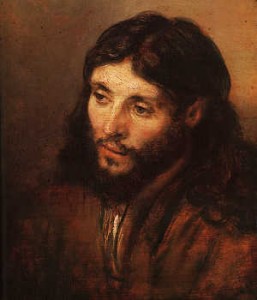 In the beginning he had been tempted by riches, by power, by idolization; all these had been offered in the desert. Now how great the temptation must have been to simply give up! Poet Denise Levertov ponders this allure in her poem Salvator Mundi: Via Crucis
 In this second act of the drama all that has gone before is recapitulated; all that we saw in yesterday’s first act, the supper in the upper room, the act of servanthood taught there, the agonized prayer in the garden, the willing surrender to unjust authority, and more. Not just yesterday’s first act, but all that has gone before from our first act of defiance in the first garden. Poet Ross Miller reminds us of that bond in his brief verse entitled Tau
 A meal is in progress… Is it a seder, the ritual meal of remembrance of the Passover? We don’t really know; the playwrights have not made this clear; the theater critics, the scholars debate this issue. Three of the story-tellers suggest that it is but the fourth, John, tells the tale very differently. (The synoptic gospels tell the story in a similar way and, if truth be told, in the same way – Luke and Matthew based their stories on Mark’s, so to be honest there aren’t three stories, there’s only one that would make us think that this supper is a seder, but John doesn’t. In fact, John doesn’t even care about that – he spends no time at all describing the meal, for him the important thing is what happened afterward, and that comes in a later scene. So as we begin this three-day, three-act drama of redemption, since we have heard Luke’s voice narrating the story, let’s just assume that what we see in this first scene of the first act is, indeed, a seder.)
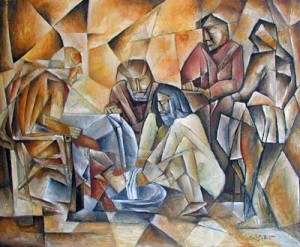 The meal is over, the dishes have been cleared. The disciples are arguing among themselves about who is the greater among them. Jesus looks frustrated and troubled; the teachable moment has passed and they clearly have not understood! They just haven’t gotten it.
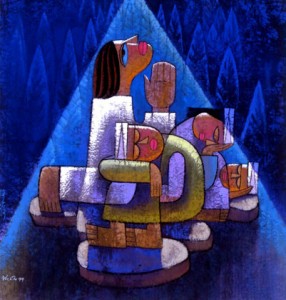 “Stay here,” he tells them, “Stay awake while I go over there to pray.” As they settle themselves, he moves away from them, and collapses in a heap, sobbing: “O God … Father, let this pass!”

