Occasional thoughts of an Anglican Episcopal priest

Category: John (Page 8 of 25)

Act Three (Pt 1): Fully Human – Easter Vigil 2017

====================

A homily offered by the Rev. Dr. C. Eric Funston at the Great Vigil of Easter, Saturday, April 15, 2017, to the people of St. Paul’s Episcopal Church, Medina, Ohio, where Fr. Funston is rector.

(The lessons for the service are from the Revised Common Lectionary: Genesis 1:1-2:4a; Exodus 14:10-31,15:20-21; Proverbs 8:1-8,19-21,9:4b-6; Zephaniah 3:14-20; Psalm 114; Romans 6:3-11; and St. Matthew 28:1-10. These lessons can be read at The Lectionary Page.)

====================

Two weeks ago, the Sunday lectionary treated us to the entire long Gospel lesson of the story of Jesus’ raising of Lazarus and then last week the Daily Office lectionary repeated it in smaller bits over the course of several days. Last Sunday I suggested that Holy Week and Easter can be conceived as a three-act drama to which the Triumphal Entry of Palm Sunday is an overture.

The Lazarus story, like last Sunday’s Gospel, is part of that overture, the introduction to the three-act drama of celebration in which we have participated this week and in which we have come, this evening, to the third and final act. Lazarus has been much on my mind as we have prepared for this Easter celebration and for the baptisms we have just performed. I believe the story of Lazarus’ raising has much to teach us about what we have done here tonight in this third act, this Baptismal Vigil, this liturgy of welcoming and inclusion.

Lazarus was the brother of Mary and Martha of Bethany; they are a family which figures prominently in the Gospels as friends of Jesus. They are clearly people who believe in Jesus and in his mission, but their belief is much, much more than simply signing on to his program, a new approach to religion. This family really seems to know Jesus; he apparently stayed with them on several occasions. He lodged with them, ate with them, taught in their home. When word is sent to Jesus that Lazarus is ill, Lazarus is described to him as “he whom you love.” (John 11:3) Lazarus and his sisters are close to Jesus; they are practically family, may even be family.

As the story of Lazarus raising is told, the family is described as accompanied by “Jews.” That has always struck me as a bit odd. After all, aren’t they all Jews? Mary, Martha, Lazarus, Jesus, the whole lot of them? Of course they are! So many scholars suggest that we should better understand John’s term Ioudaiou to mean “Judeans,” that is people native to the Jerusalem area; these scholars suggest that Mary, Martha, and Lazarus, like Jesus, were Galileans who had moved to Judea and been accepted into this southern community. This strengthens the suggestion that they may have been members of Jesus’ extended family.

Next, when both of the sisters greet Jesus (Martha’s greeting is earlier in the story), the very first thing each says is, “If you had been here, he wouldn’t have died.” (John 11:21 & 32) Not “Hi, how are you?” Not “Welcome back.” Not “I’m so sorry we have to tell you.” What the sisters say is not really a greeting; it’s an angry, accusative confrontation. “You could have prevented this!”

We’re told that Jesus’ response to this is that he is “greatly disturbed in spirit and deeply moved.” That’s a fine translation, but it’s also a bit misleading. The Greek word rendered “disturbed” very literally means he “snorted with anger”; and the word translated “deeply moved” means “stirred up” and implies a certain physicality, not simply an emotion. Jesus response to the sisters’ confrontations, to Lazarus’ death, to the whole situation is to become indignant and sick to his stomach.

The Lazarus story contains the shortest verse in the New Testament, famously rendered in the King James Version with only two words, “Jesus wept.” Some of the Judeans, John tells us, interpreted this as a sign of Jesus’ love for Lazarus; “See how he loved him!” they said. While I’ve no doubt that that is true, I suggest that, since John describes Jesus as angry and physically sick, we might consider another way to understand what is happening in this story.

We have just baptized four children and, together with them, we have affirmed the Baptismal Covenant beginning with a recitation of the Apostle’s Creed in which we will claim that Jesus, the Son of God, was “conceived by the power of the Holy Spirit and born of the Virgin Mary” (BCP 1979, p 304). In the Nicene Creed, which we recite most Sundays during the Holy Eucharist, we go further and declare that he “became incarnate . . . and was made man,” that is, that he became a flesh-and-blood human being. (BCP 1979, p 358). In the Definition of Chalcedon, which you can find on page 864 of the Prayer Book, the church goes even beyond that and asserts its conviction that Jesus is “truly [human] . . . like us in all respects, apart from sin.”

I believe that standing before that tomb where his beloved friend Lazarus had been buried four days earlier, feeling the anger and frustration of his close friends Mary and Martha, surrounded by Judeans muttering “couldn’t he have prevented this,” and perhaps physically exhausted from traveling from the other side of the Jordan valley where he was when he got the news, Jesus’ humanity hit him like a ton of bricks. In that moment, everything that it meant to be human came crashing in on him: the way human beings settle for easy answers, half-truths, and superficial relationships; the injustice, oppression, and exploitation we impose on one another; the pain, rejection, hunger, and war we endure . . . but, also, the love, friendship, community, family, support, and every other good thing about being a human being; it all come together in that moment standing at that grave.

Why do I think that? Because that’s what I feel every time I stand at a grave. The first time I did that, I was 5-1/2 years old. I remember standing between my mother and my paternal grandmother watching two members of the US Army fold the flag that had draped my father’s coffin, feeling loss, grief, anger, confusion, and emotions I couldn’t even name. But there was also the love of family, pride in my father’s military service, a sense of community with extended family and friends, all the comfort that comes from our common humanity. And every time I have stood beside a grave, I have felt that again, and I can surely imagine that our Lord experienced something very like that. No wonder Jesus – the sorrowful-but-also-angry and stirred-up Jesus, the knowing-he-too-might-soon-be-dead Jesus, the fully-human, like-us-in-all-respects Jesus – wept.

We should feel that same way when we welcome a new member into the household of God through the Sacrament of Baptism. Symbolically, baptism is burial; in the oldest tradition of the church, full immersion baptism, we go down under the water in the same way a body is buried in the earth, then we come up out of the water as Lazarus came from his tomb, as Jesus came from his grave. Baptism is death, burial, and restoration to life all encapsulated in one short liturgical act. As St. Paul asks in his letter to the Romans which was read just a few minutes ago, “Do you not know that all of us who have been baptized into Christ Jesus were baptized into his death?” The Prayer Book says in the blessing of the baptismal water, “In it we are buried with Christ in his death.”

St. Paul’s assurance that “if we have been united with him in a death like his, we will certainly be united with him in a resurrection like his,” is echoed by the Prayer Books bold promise that by baptism we share in Jesus’ resurrection, and that “through it we are reborn by the Holy Spirit.” (BCP 1979, p 306) As Jesus called for Lazarus to be unbound from his funeral wrappings, as Jesus himself rose and set aside his shroud, through Holy Baptism our Lord calls us “from the bondage of sin into everlasting life” (ibid), into a new life of full humanity joined with those whom the Psalmist describes as having “clean clean hands and a pure heart, [those] who have not pledged themselves to falsehood nor sworn by what is a fraud, [those who] shall receive a blessing from the Lord and a just reward from the God.” (Ps 24:4-5)

The Creation story in Genesis tells us that “God created humankind in his image, in the image of God he created them; male and female he created them.” (Gn 1:27) The story of the Fall reminds us that somehow that divine likeness has been marred, that on our own we fail to live up to that image; we fail to fully live up to the potential God created in humankind. Through baptism, the divine image is restore; through our baptism into the life, death, and resurrection of Jesus Christ, a process of transformation begins and God restores us to who and what we were meant to be – fully human.

When we baptized these children, we asked them and their baptismal sponsors (and we asked ourselves) some questions which are taken directly from the Apostle’s Creed, to which I referred earlier. These questions began with the words, “Do you believe . . . .”

A few years ago a colleague of mine said that he had once asked his congregation, when reciting the Nicene Creed, to say “We trust in” instead of “We believe in” since the original Greek could have been translated either way. He said he wondered if the church would be less fragmented if we had used “trust.” He suggested that there might have been far less of, “You don’t believe exactly what I believe, so I’m out of here,” or, “You don’t believe exactly what I believe, so you are out of here.” When we ask those questions of baptismal candidates and their Godparents, when we say the creeds ourselves, are expressing a deep affirmation of community whether we say, “We believe in . . .” or “We trust in . . .” Maybe we don’t “believe” exactly the same things that others here believe, but we all trust in the same God.

In that same conversation, another priest objected to what he called the distinction between “faith as trust and faith with content.” “It’s always struck me as a strange distinction,” he said. “If, for example, faith as trust is about relationship [and not about content], it is like someone saying to a prospective marriage partner, ‘I love you and I want to marry you, but I’m not certain who you are.’” I suggested to him, however, and I suggest to you now that this distinction really doesn’t exist, that faith as trust or as relationship necessarily implies and includes “faith with content.” One cannot place trust in another person, such as the Father, the Son, and the Holy Spirit named in the Creed, without assenting to that person’s existence and properties; to say, “I trust you” or “I love you” and not also agree that you exist makes very little sense.

This is why we ask those questions of baptismal candidates. When we say, “Do you believe in” the three Persons of the Holy Trinity, we are not merely asking if the candidates (and the congregation who join them in answering) are assenting to certain doctrines about them; we are asking if they claim to be in a relationship of trust and love with God the Holy Trinity, and through God with the full community of human beings whom God loves and whom God has redeemed in all that long salvation history that we have heard read from the Hebrew Scriptures this evening. When we baptized these children, when we baptize any new member of the Christian community, we recognize them as part of that fully human community whom God invites to “lay aside immaturity, and live, and walk in the way of insight” (Prov 9:6), whom God promises to save, and gather, and bring home, and restore. (Zeph 3:19-20)

That full human community relationship, I believe, is why Jesus wept. To be sure, he grieved the death of his friend Lazarus, but he knew he was about to do something to change that; there was no reason to cry about that. But that in-rushing crash of realization of what it is to be a human being, of what it is to be fully human, that is enough to make anyone cry. The story of the raising of Lazarus is a story about Jesus’ full humanity, the full humanity he shares with and promises to us, the full humanity which gathered with friends and family at the Last Supper in the first act of this drama of redemption, the full humanity which was arrested and brutalized and crucified in the second act, the full humanity whose Resurrection we celebrate in this, the third act, the feast of Easter. It is into that Easter promise that we have baptized Kadence, Bryce, Hadley, and Joseph this evening. And that is why the Lazarus story figures so prominently in the church’s preparations for Holy Week and Easter, part of the overture of this three-part drama of redemption!

In the words of a popular Franciscan blessing, let us pray that, as these children grow into the full humanity into which they are initiated today, God will bless them with discomfort at easy answers, half-truths, and superficial relationships, so that they may live deep within their hearts; that God will bless them with anger at injustice, oppression, and exploitation of people, so that they may work for justice, freedom, and peace; that God will bless them with tears to shed for those who suffer from pain, rejection, hunger, and war, so that they may reach out their hands to comfort others and turn their pain into joy; and that God bless them with enough foolishness to believe that they can make a difference in this world, so that they can do what others claim cannot be done, to bring justice, kindness, and love to all.

As they have been buried with Christ, they have begun to share in his Resurrection; may God bless them with the gift and the commission to be, like Christ, fully human. Amen.

====================

Father Funston is the rector of St. Paul’s Episcopal Church, Medina, Ohio.

Act Two: Do You Love Me? – Good Friday 2017

====================

A homily offered by the Rev. Dr. C. Eric Funston on Good Friday, April 14, 2017, to the people of St. Paul’s Episcopal Church, Medina, Ohio, where Fr. Funston is rector.

(The lessons for the day are from the Revised Common Lectionary: Isaiah 52:13-53:12; Hebrews 10:16-25; Psalm 22; and St. John 18:1-19:42. These lessons can be read at The Lectionary Page.)

====================

On Palm Sunday, I suggested that we think of Holy Week and Easter as a three-act drama beginning with an Overture on Palm Sunday. Last night, we took part in the first act. The analogy of the Three Holy Days (or “Triduum”) to a play breaks down if we think of ourselves as the “audience.” We are not the audience.

The audience of worship is God. The one, holy, blessed, and glorious Trinity, Father, Son, and Holy Spirit, God is the audience. We, all of us, are the actors. We, all of us, are the cast.

So, here we are . . . . the second act . . . .

In the first act of the drama of redemption, Love tried to teach his lesson through bread and wine, through water and basin, through garden prayer, and through willing surrender to corrupt authority. The Body and Blood symbolically broken, the Body washing other bodies, the Blood sweated out in agonized prayer, these did not suffice and so, betrayed and exhausted, he surrendered. Whether or not he knew what would ultimately happen is irrelevant. He could do nothing else – if he were to remain faithful to his God, faithful to his values, faithful to his principles, faithful to his mission, he could do nothing else. And so now, in the second act, the incarnate Creator is prisoner to Destruction, now Life is condemned to death by Death.

In the beginning he had been tempted by riches, by power, by idolization; all these had been offered in the desert. Now how great the temptation must have been to simply give up! Poet Denise Levertov ponders this allure in her poem Salvator Mundi: Via Crucis

Maybe He looked indeed
much as Rembrandt envisioned Him
in those small heads that seem in fact
portraits of more than a model.
A dark, still young, very intelligent face,
A soul-mirror gaze of deep understanding, unjudging.
That face, in extremis, would have clenched its teeth
In a grimace not shown in even the great crucifixions.
The burden of humanness (I begin to see) exacted from Him
That He taste also the humiliation of dread,
cold sweat of wanting to let the whole thing go,
like any mortal hero out of his depth,
like anyone who has taken herself back.
The painters, even the greatest, don’t show how,
in the midnight Garden,
or staggering uphill under the weight of the Cross,
He went through with even the human longing
to simply cease, to not be.
Not torture of body,
not the hideous betrayals humans commit
nor the faithless weakness of friends, and surely
not the anticipation of death (not then, in agony’s grip)
was Incarnation’s heaviest weight,
but this sickened desire to renege,
to step back from what He, Who was God,
had promised Himself, and had entered
time and flesh to enact.
Sublime acceptance, to be absolute, had to have welled
up from those depths where purpose
drifted for mortal moments.
(In The Stream & the Sapphire: Selected poems on religious themes [New Directions Books: 1997])

In this second act of the drama of redemption, it is faith and will which prevail, the faith and will of Jesus who did not step back, who did not give in to the human longing to simply cease.

In this second act of the drama all that has gone before is recapitulated; all that we saw in yesterday’s first act, the supper in the upper room, the act of servanthood taught there, the agonized prayer in the garden, the willing surrender to unjust authority, and more. Not just yesterday’s first act, but all that has gone before from our first act of defiance in the first garden. Poet Ross Miller reminds us of that bond in his brief verse entitled Tau

That dreadful beam
that Jesu bore
knot made from pine
but ancient tree
that bore a bitter fruit

That pole on which it hung
he hung
knot made from pine
undying tree of life
that bears forever fruit

Take and eat – the Serpent cried
You shall not die
You shall be
like God
We bit
The Servant took those twisted words
held them on the knotted wood
Take and eat – the Servant cries
You shall not die
You shall be
like me
(Found in 2012 at Stations of the Cross (www.stations.org.nz) a no-longer-working site)

We shall be like him! It is here on the cross in this second act that the promise of the Incarnation, the guarantee of the Nativity is made good. Then we sang

Great little One! whose all-embracing birth
Lifts Earth to Heaven, stoops Heaven to Earth.
(In The Holy Nativity of Our Lord God: A Hymn Sung as by Shepherds, Richard Crashaw [1613-49])

Here on the cross, indeed, God “gathers up all things in Christ, things in heaven and things on earth.” (Eph. 1:10) And here on the cross, in an act of faithfulness and will, he died. Here on the cross, in this final fact of human existence, truly “God became man so that man might become a god.” (St. Athanasius, De Incarnatione)

But his death, we know, cannot be the end of the story. This is only the second act of a three-act drama. So his body must be taken down; it must be dealt with in the appropriate way.
Composer Jimmy Owens paints the picture in his cantata No Other Lamb:

They took Him down,
His poor dead body,
and prepared Him for His burial.

They took Him down,
His poor pale body
drained of life, ashen, and stained
with its own life-blood.

His healing hands, now pierced and still;
Serving hands, that broke five loaves
to feed five thousand;
Holy hands, often folded in fervent prayer;
Poor gentle hands, now pierced and still.

His poor torn feet, now bloodied and cold;
Feet that walked weary miles
to bring good news to broken hearts
Feet once washed in penitent’s tears;
Poor torn feet, now bloodied and cold.

His kingly head, made for a crown,
now crowned – with thorns.
His poor kingly head, crowned with thorns.

His gentle breast, now pierced by
spear-thrust, quiet and still;
His poor loving breast.

His piercing eyes, now dark and blind;
Eyes of compassion, warming the soul;
Fiery eyes, burning at sin;
Tender eyes, beckoning sinners;
His piercing eyes, now dark and blind.

His matchless voice, fountain of the Father’s
thoughts, stopped –
and stilled – to speak no more.
Silence now, where once had flowed
Wisdom and comfort, Spirit and life;
His matchless voice; stilled, to speak no more.

They took Him down,
His poor dead body,
and prepared Him for his burial.
(They Took Him Down in No Other Lamb [Lillenas Publishing Co.])

And so the second act comes to a close, the body is laid in a tomb and as the rock is rolled to seal it, the now-torn curtain descends. We are left in the darkness of our hearts to contemplate our place in this drama. With poet Luci Shaw we realize that we just may be Judas or Peter….

because we are all
betrayers, taking
silver and eating
body and blood and asking
(guilty) is it I and hearing
him say yes
it would be simple for us all
to rush out
and hang ourselves
but if we find grace
to cry and wait
after the voice of morning
has crowed in our ears
clearly enough
to break our hearts
he will be there
to ask each again
do you love me?
(Judas, Peter in A Widening Light: Poems of the Incarnation [Regent College Publishing, 1997])

====================

Father Funston is the rector of St. Paul’s Episcopal Church, Medina, Ohio.

Act One: Use Your Towel – Maundy Thursday 2017

====================

A homily offered by the Rev. Dr. C. Eric Funston on Maundy Thursday, April 13, 2017, to the people of St. Paul’s Episcopal Church, Medina, Ohio, where Fr. Funston is rector.

(The lessons for the day are from the Revised Common Lectionary: Exodus 12:1-14; Psalm 116:1,10-17; 1 Corinthians 11:23-26; and St. John 13:1-17,31b-35. These lessons can be read at The Lectionary Page.)

====================

On Palm Sunday, I suggested that we think of Holy Week and Easter as a three-act drama beginning with an Overture on Palm Sunday. Today, we take part in the first act. The analogy of the Three Holy Days (or “Triduum”) to a play breaks down if we think of ourselves as the “audience.” We are not the audience.

The audience of worship is God. The one, holy, blessed, and glorious Trinity, Father, Son, and Holy Spirit, God is the audience. We, all of us, are the actors. We, all of us, are the cast.

So, here we are….

Act One, Scene One: The curtain rises. We see a group of people gathered in an upper room somewhere in Jerusalem.

A meal is in progress… we wonder if it might be a seder, the ritual meal of remembrance of the Passover. We don’t really know; the playwrights have not made this clear and the theater critics, the scholars, debate the issue.

Three of the story-tellers suggest that it is. Luke and Matthew based their stories on Mark’s, so to be honest there aren’t three stories, there’s only one that would make us think that this supper is a seder.

However, the fourth, John, tells the tale very differently. John doesn’t even seem to care about the dinner – he spends no time at all describing the meal; for him, it’s not important. What’s important is what happened afterward.

So as we continue this three-act drama of redemption let’s just assume that that Matthew, Mark, and Luke are correct and what we see in this first scene of the first act is, indeed, a seder.

Those present are prepared to do all that is laid out in the instructions in the book of Exodus; they have worn their sandals; they carry their staffs; they expect to eat of roasted lamb and unleavened bread and bitter herbs. They anticipate spending the night in remembrance of that which happened generations before in Egypt. If we can imagine that they celebrate as modern Jews celebrate, they are gathered in that upper room, those serving the meal coming and going, and a breeze blowing through the open windows. They are following along in their prayer books, the Haggadah; they expect the youngest among them to ask the questions, beginning with “Why is this night different from all other nights?” They know that the head of the household, their rabbi Jesus, will answer those questions in the prescribed way and tell the story of the Passover.

So, when the youngest asks “Why do we eat the broken matzah?” they expect Jesus to answer “This is the bread of our affliction; the unleavened bread of poverty, baked and eaten in haste,” but instead he takes the bread, brakes it and says, “This bread is my body, given for you.”

They look up startled, glancing at one another, murmuring to each other, “What is he talking about? That’s not here! That’s not the right answer. Where is he? What page is he on?” But the moment passes, the meal moves on.

At the end he takes up the fourth and final cup of wine, the kiddush cup, which recalls God’s promise, “I will acquire you as a nation; you will be my people and I will be your God.” As before, they expect Jesus to say the prescribed prayer, “Blessed are you, O Lord our God, sovereign of the universe, creator of the fruit of the vine,” but instead they hear, “This cup is my blood!” “What?!” They look at one another in disbelief. “What is he saying???”

It is for Jesus and his disciples one of those fleeting opportunities when, because of the pupils’ confusion or frustration or grasping for understanding, the teacher can pass on to the students new information, new values, new moral understanding, a new behavior, a new skill, a new way of seeing and coping with reality; it is what we have come to call “the teachable moment” and so he teaches, yet again, “Remember! Remember,” he says, “Love one another as I have loved you.”

The curtain falls as Jesus continues to teach; the disciples look mystified.

Act One, Scene Two: The curtain rises again. We see the same group of people gathered in the same upper room somewhere in Jerusalem.

The meal is over, the dishes have been cleared. The disciples are arguing among themselves about who is the greater among them. Jesus looks frustrated and troubled; the teachable moment has passed and the disciples clearly have not understood! They just haven’t gotten it.

“Look,” he says, “the greatest among you must become like the youngest, and the leader like one who serves. For who is greater, the one who is at the table or the one who serves? Is it not the one at the table? But I am among you as one who serves. Here, let me show you what I mean.” Getting up from the table, he takes off his robe, picks up a basin of water and a towel, and begins to wash and dry their feet.

As many of you know, I am a fan of science fiction, so when I hear about towels, one of the first things I think of is the late Douglas Adams’ hilariously funny novel, The Hitchhiker’s Guide to the Galaxy. The book begins seconds before Earth is demolished to make way for a galactic freeway, when the protagonist Arthur Dent is plucked off the planet by his friend Ford Prefect, a researcher for a revised edition of The Hitchhiker’s Guide to the Galaxy who has been posing for the last 15 years as an out-of-work actor. The one thing Prefect makes sure that Dent brings with him is a towel. Quoting from the guidebook, he explains that a towel is the one, crucial, indispensable necessity that the intergalactic traveler must bring along on any journey:

A towel (says The Hitchhiker’s Guide) is about the most massively useful thing an interstellar hitchhiker can have . . . . you can wrap it around you for warmth . . . . you can lie on it on . . . brilliant marble-sanded beaches . . . . you can sleep under it beneath the stars . . . . use it to sail a mini-raft down a slow river . . . . wet it for use in hand-to-hand combat; wrap it round your head to ward off noxious fumes . . . . you can wave your towel in emergencies as a distress signal, and of course dry yourself off with it if it sill seems to be clean enough.

Any man who can hitch the length and breadth of the galaxy, rough it, slum it, struggle against terrible odds, win through, and still know where his towel is is clearly a man to be reckoned with.

John tells us that Jesus made use of the towel to dry the disciples’ feet and then said, “I have set you an example, that you also should do as I have done to you.” It has occurred to me that The Hitchhiker’s Guide suggests many other ways in which we might use a towel in following Jesus’ lead.

When we baptize someone here at St. Paul’s Parish, the altar guild supplies towels for them to be dried with; I often joke about getting those towels back. But now it seems to me that we might better give them to the newly baptized with an admonition to follow Jesus’ example of loving service. The towel of service just might be the one, crucial, indispensible necessity that the Christian traveler should bring along on his or her journey through life. It just may be the most massively useful thing we can have as we serve others. We can wash and dry their feet; we can wrap them in warmth; we can provide a comfortable place to sleep; we can help them on a journey; we can protect them; we can signal to them and for them in emergencies; we can clothe the naked, swaddle a baby, comfort the sick. I’m sure you can come up with many more uses, small and large, for a towel and, by extension, for your heart, for your life, and for your willing hands.

That Jesus made use of the towel in the context of the Lords’ Supper is a really important point. There used to be what some thought of as a silly and useless bit of priestly vesture worn at Communion called a “maniple.” It looked sort of like a short stole and was made of the same material as the stole and chasuble. It was worn over the left forearm and looked like, and in fact was meant to symbolize, the sort of towel or table napkin often worn by the wait-staff in fancy restaurants, a symbol of service. Anglican clergy stopped wearing maniples long ago and Roman Catholic priests were allowed to discontinue them in 1967, one of the minor reforms of the Second Vatican Council.

In abandoning that symbolic vestment, however, we may have lost a reminder that, in addition to being called to follow Jesus along the way of the cross, we are also called to follow him in his use of the towel! Just as Jesus said, “Take up your cross and follow me,” he might also have said, “Take up your towel and follow me.” In fact, he did when he said, “I have set you an example, that you should also do as I have done to you.”

Perhaps we no longer use the maniple as a priestly vestment because the ministry of Christian servanthood which it represents is not limited to clergy; it is the ministry of all baptized people. “Will you seek and serve Christ in all persons, loving your neighbor as yourself?” we are asked in the liturgy of baptism, and every person present answers, “I will, with God’s help.” This servant ministry is one which we all share, just as this meal of Bread and Wine, of Christ’s Body and Blood, is one which we all share.

The disciples, however, don’t get the opportunity to serve one another, for this second scene ends with Jesus, visibly agitated, declaring, “One of you will betray me.” As the curtain goes down, the disciples are looking puzzled and Judas Iscariot is leaving.

Act One, Scene Three: The curtain rises again. We see a garden and an olive grove just outside of Jerusalem. Jesus is there, accompanied by Peter, James, and John. “Stay here,” he tells them, “Stay awake while I go over there to pray.” As they settle themselves, he moves away from them, and collapses in a heap, sobbing: “O God … Father, let this pass!”

Three times he returns to find them asleep; three times they rise looking sheepish and embarrassed; twice he tells them again to try to stay awake as he goes away still pleading with God for a way out. “Enough,” he says the third time, “Enough! We’re leaving.”

When they look back on that night, how must they feel? When we look back, how should we feel? Poet Mary Oliver offers a glimpse in her poem Gethsemane:

The grass never sleeps.
Or the roses.
Nor does the lily have a secret eye that shuts until morning.
Jesus said, wait with me. But the disciples slept.

The cricket has such splendid fringe on its feet,
and it sings, have you noticed, with its whole body,
and heaven knows if it ever sleeps.

Jesus said, wait with me. And maybe the stars did,
maybe the wind wound itself into a silver tree,
and didn’t move, maybe the lake far away,
where once he walked as on a blue pavement,
lay still and waited, wild awake.

Oh the dear bodies, slumped and eye-shut, that could not
keep that vigil, how they must have wept,
so utterly human, knowing this too
must be part of the story.

Yes, this too, our utterly human inability to fully keep company with our Lord, this too must be part of the story when it is told, part of the third scene of the first act of this drama that is retold again and again. This minor, little betrayal is as much a part of the story as Judas’ treachery which now plays out.

Scene Three ends as Jesus is arrested and taken away off-stage. In the wings, a trivial side-story plays out as Judas dies, either by hanging himself (as Matthew asserts) or by falling and suffering some sort of rupture (as Luke portrays in the Book of Acts). In any event, Judas dies and, in the church’s eyes, is condemned.

The Scottish poet Robert Williams Buchanan, in a very long elegy entitled The Ballad of Judas Iscariot, tells the tale of the soul of Judas carrying his body in search of a burial place, only to have it rejected by even the worst of places in all creation. Eventually, he comes to a banquet hall where a wedding feast is waiting to get started. The guests (that is, the church), recognizing Judas, demand that he be “scourged away,” but the Bridegroom has a different idea:

The Bridegroom stood in the open door,
And he waved hands still and slow,
And the third time that he waved his hands
The air was thick with snow.

And of every flake of falling snow,
Before it touched the ground,
There came a dove, and a thousand doves
Made sweet sound.

‘Twas the body of Judas Iscariot
Floated away full fleet,
And the wings of the doves that bare it off
Were like its winding-sheet.

‘Twas the Bridegroom stood at the open door,
And beckon’d, smiling sweet;
‘Twas the soul of Judas Iscariot
Stole in, and fell at his feet.

“The Holy Supper is spread within,
And the many candles shine,
And I have waited long for thee
Before I poured the wine!”

The supper wine is poured at last,
The lights burn bright and fair,
Iscariot washes the Bridegroom’s feet,
And dries them with his hair.

We sometimes use a Scottish invitation to Communion which comes from the ecumenical monastic community on the island of Iona:

The table of bread and wine is now to be made ready.
It is the table of company with Jesus,
And all who love him.
It is the table of sharing with the poor of the world,
With whom Jesus identified himself.
It is the table of communion with the earth,
In which Christ became incarnate.
So come to this table,
You who have much faith
And you who would like to have more;
You who have been here often
And you who have not been for a long time;
You who have tried to follow Jesus,
And you who have failed;
Come. It is Christ who invites us to meet him here.

All who have faith; all who would like to have more; all who have been to Communion often; all who have not been for a long time; all who have tried to follow Jesus (in the way of the cross or the way of the towel); all who have failed to do so. In other words, as John of Patmos witnessed in his vision recorded in the Book of Revelation, everyone is called to the Supper of the Lamb; everyone is invited to the Wedding Feast! Even the disciples who fell asleep in the garden; even Judas Iscariot!

In this, the first act of the drama of redemption, Jesus has gathered his disciples. He has gathered us at the table that in the upper room. He has shared Bread and Wine. He washed and dried feet. He has given us the New Commandment: “Love one another.” He has said, “I have set you an example.” He might well have said, “Take up your towel and use it.”

The Hitchhiker’s Guide says your towel can be used as a signal. So take up your towel; wave it so that all may see, and when you have their attention, invite them into this drama of redemption in which, tonight, we witness and take part in the first of three acts. Say to them, with Jesus, “Come! Come to this table! . . . . We have waited long for thee!”

====================

Father Funston is the rector of St. Paul’s Episcopal Church, Medina, Ohio.
Living Water: Sermon for Lent 3, RCL Year A (19 March 2017)

overflowingwellToday the lectionary gives us two stories about water. The first set in the Sinai desert where the Hebrews found themselves exhausted, thirsty, and more than a little bit feisty and quarrelsome demanding water from Moses and from God; the second set at a well in a Samaritan village where Jesus, “tired out by his journey” (Jn 4:6, NRSV), encountered a lone woman and asked her for a drink.

I sometimes think that we take the biblical metaphor water way too lightly. We live in a world which is water-abundant. Here in NE Ohio we are surrounded by the stuff! There’s that big lake up to the north of us; there are rivers and streams running nearby; and I’ll bet most of us live in neighborhoods where some of our neighbors have ponds in their back yards. There’s water everywhere.

Even in the sorts of desert places I lived as a young adult along the Southern California coast there is an abundance of water. There’s all that salt water in the ocean, of course, but that won’t sustain human life. What there is is water brought in by aqueduct from the Sacramento River or piped in from the Colorado River; without that Los Angeles and Orange and San Diego Counties could not sustain the populations that presently live there.

Continue reading

We Were There: Sermon for Lent 2 (RCL Year A) – 12 March 2017

====================

A homily offered by Mr. Donald Romanik, President of the Episcopal Church Foundation, on the Second Sunday in Lent, March 12, 2017, to the people of St. Paul’s Episcopal Church, Medina, Ohio. Mr. Romnanik led a Vestry Retreat for the Parish the previous two days and graciously agreed to preach the sermon for our congregation on Sunday morning.

(The lessons for the day are from the Revised Common Lectionary, Year A: Genesis 12:1-4a; Psalm 121; Romans 4:1-5,13-17; and St. John 3:1-17. These lessons can be read at The Lectionary Page.)

====================

We-Were-There-at-Pearl-HarborWhen I was child in my tween years, I spent a lot of time at the Public Library checking out stacks of books, with that wonderful musty library smell, to read under the big oak tree in our back yard on hot summer days. As I was a U.S. history buff both then and now, I gravitated toward a series of children’s books whose titles began with the phrase – “we were there”. For example, We Were There at Lexington and Concord, We Were There at Battle of Gettysburg and my favorite – We Were There at Pearl Harbor. The books had the same two characters – a boy and a girl around my age at the time, who happened to be living right in the middle of these key historic events. They often performed semi-heroic acts and were usually honored or congratulated by some famous person at the end of the book.
In addition to making these historic events come more alive, I was intrigued by the idea of actually being present during important times in human history and trying to imagine what I would see, say or do had I been there. I also engaged in this same exercise with bible stories, especially those involving Jesus. What would it be like to be living in first century Palestine and experience Jesus first hand? Which characters in the New Testament did I most identify with? And it was not just about being present during the most significant events in the life of Christ – his birth, death or resurrection. Sometimes I would just want to follow him along the way and watch him preach, teach and heal. And unlike the two protagonists in the “We were there” series, I didn’t even have to do or say anything – just be an innocent bystander or a proverbial fly on the wall.

Today’s Gospel passage would be a good time for me to be a fly on the wall in order to overhear the conversation between Jesus and Nicodemus. Like much of the Gospel of John, this passage is not about the action, it’s about the dialogue and Jesus has the principal speaking part. Furthermore, there isn’t a lot to see because it’s dark since Nicodemus comes to Jesus at night. So let’s set the scene and try to think about what we would hear and experience had we been there.

So far in John’s narrative, after being heralded by John the Baptist, Jesus does two main things – turning water into wine at the wedding feast and driving the moneychangers out of the temple in Jerusalem right before the Passover. Both of these events illustrate how God was acting out God’s purpose in the world in the person of Jesus – the wine as a symbol of God’s abundance and grace and the temple event suggesting that animal sacrifices were no longer necessary because human salvation was now assured through the cross and resurrection. It is with this background and in this context that Nicodemus comes to see Jesus.

In addition to dialogue, John is a master of dramatic setting and vivid imagery. Note that Nicodemus arrives at night with all of its connotations of darkness and secrecy. Nicodemus begins his encounter with a bold affirmation that clearly Jesus must have been sent by God as evidenced by his God-like actions and signs. In a somewhat typical John-like non-sequitur, Jesus responds with a pronouncement that no person can see or experience the kingdom unless being born from above, or, in some translations, born again. This is followed by back and forth interactions, confusion on part of Nicodemus on the difference between spirit and flesh, and Jesus’ somewhat glib comment that a Jewish leader and a learned scholar should be much more knowledgeable and astute. But Nicodemus’s apparent ignorance or naiveté provides Jesus with the perfect opportunity to proclaim the bold reality that the Son of Man has come from heaven to be lifted up as a sign that God loves the world and that whoever believes will have eternal life. Jesus invokes the image of Moses lifting up the serpent in the desert and portends his own lifting up on the cross at Calvary. We then hear one of the most famous and beloved passages in the Bible: “For God so loved the world that he gave his only Son, so that everyone who believes in him may not perish but have eternal life.”

All we know of Nicodemus in the Bible is contained in the Gospel of John. Nicodemus is described as a Pharisee, that group of Jews who were fastidious in keeping the letter of the law and often opposed Jesus throughout his ministry, especially when they felt he did not share their legalistic and ideological purity. Jesus criticized Pharisees on several occasions especially for their blatant hypocrisy. Nicodemus was also a member of the Sanhedrin in Jerusalem which was the final court of appeals for matters relating to Jewish law and tradition. It was the Sanhedrin that condemned Jesus to death but ultimately needed the approval of Pilate since the death penalty was beyond their jurisdiction under Roman law.

John reports that Nicodemus came to speak to Jesus at night. Some scholars speculate that since he was a Jewish leader and official, Nicodemus was afraid, or at least embarrassed, to be seen with Jesus in broad daylight. But given his position on the Sanhedrin, wasn’t it perfectly appropriate for Nicodemus to question Jesus in order to assess his theological credentials? No one should have been able to question Nicodemus’ authority or motivation for being there although his opening comment that Jesus must have been sent from God could have raised a few eyebrows back at the temple. Clearly, Nicodemus was as least curious about Jesus if not somewhat intrigued by and attracted to his ministry. Interestingly, after this incredible explanation by Jesus of his role as the Son of Man who came to reveal and demonstrate God’s love and the promise of new life, Nicodemus has no response. In fact, he simply disappears from the scene and presumably goes back to his former role as a member of the establishment – not yet ready to accept Jesus or to make a commitment to follow him and embrace his message of love. Perhaps after this encounter Nicodemus decided that he just wasn’t as curious or interested in Jesus as he thought he would be. As innocent bystanders and flies on the wall, all we are left with at the end of this passage is Jesus’ incredibly profound words.

Nicodemus reappears at two later points in John’s Gospel. In Chapter 7 he is sitting as a member of the Sanhedrin – that official body that condemns Jesus to die and offers a somewhat half-hearted defense that Jesus should at least have the right to defend himself and respond to the charges against him. In Chapter 20, however, Nicodemus accompanies Joseph of Arimathea, another secret follower of Jesus, and contributes an exorbitant quantity of spices for Jesus’ ritual burial. Can we assume that by the time of the crucifixion Nicodemus finally gets it and accepts Jesus as his Lord? Does Nicodemus finally have the conversion experience of being born from above and now able to experience God’s kingdom of love?

This passage from John’s Gospel is often used by fundamentalist, evangelical Christians to support their belief in the necessity of an actual and affirmative conversion experience – being born again – in order to be a true follower of Christ. But I think this approach sells these words of Jesus short and oversimplifies the concept of conversion. I’m sure there may be some people who truly have a dramatic experience of being born again into a new life in Christ. For most of us, including our friend Nicodemus, the process of discipleship moves much more slowly, and, may take an entire lifetime in order to be truly realized.

Let’s look at these famous words of Jesus once again – “God so loved the world that he gave his only son.” Jesus did not say that God was responding to the pleas of anguish from humankind or was acting from a sense of justice, power or expectation. God does not ask the world whether it wants to be loved. God just goes ahead and loves, and not only loves, but gives his only beloved Son over to death. God’s sending Jesus to our broken world was an act of unconditional love – plain and simple. God loves us whether we like it or not. In light of this love, however, we are called to accept it, embrace it and share it with others or, in the alternative, run away screaming. For it is virtually impossible to remain neutral or ambiguous in light of such Godly extravagance and abundance.

Notwithstanding a vivid imagination and my “we were there” reading memories from childhood, I was not present at Lexington and Concord, the Battle of Gettysburg or at Pearl Harbor on December 7, 1941. But, while I was not present with Nicodemus when he had his conversation with Jesus at night, attempted to defend him at his trial and helped prepare him for burial after his brutal passion and death, I feel that I and all of us have a lot in common with this famous Pharisee.

Ultimately, like Nicodemus, we have to choose to be followers of Christ fully mindful that the process is not easy, predictable, linear or quick. And that’s why we have Lent. Lent provides us with an incredible opportunity to step back, take a deep breath, appreciate God’s unconditional love and contemplate God’s ultimate act of redemption. What we learn from Nicodemus this morning is that being born from above takes time. And what we learn from Jesus’ interaction with Nicodemus is that God is infinitely patient, does not expect us to be perfect, loves us unconditionally and is waiting for us with open arms – dramatically symbolized by the open arms of Jesus on the cross. Amen.

====================

Donald Romanik is the President of the Episcopal Church Foundation.

Listen to Him! – Sermon for the Last Sunday after Epiphany, 26 February 2017

====================

A homily offered by the Rev. Dr. C. Eric Funston on the Last Sunday after the Epiphany, February 26, 2017, to the people of St. Paul’s Episcopal Church, Medina, Ohio, where Fr. Funston is rector.

(The lessons for the day are from the Revised Common Lectionary, Year A: Exodus 24:12-18; Psalm 2; 2 Peter 1:16-21; St. Matthew 17:1-9. These lessons can be read at The Lectionary Page.)

====================

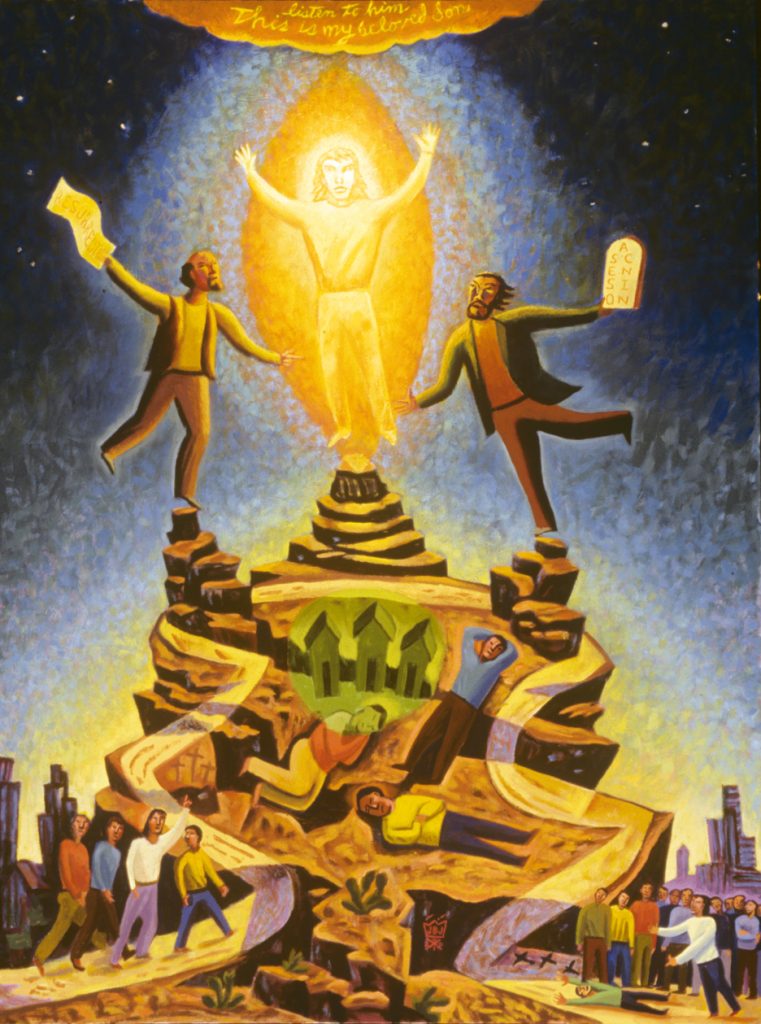
transfiguration_wLGHere we are at the end of the first period of what the church calls “ordinary time” during this liturgical year, the season of Sundays after the Feast of the Epiphany during which we have heard many gospel stories which reveal or manifest (the meaning of epiphany) something about Jesus. On this Sunday, the Sunday before Lent starts on Ash Wednesday, we always hear some version of the story of Jesus’ Transfiguration, a story so important that it is told in the three Synoptic Gospels, alluded to in John’s Gospel, and mentioned in the Second Letter of Peter.

Six days before, Jesus had had a conversation with the Twelve in which he’d asked them who they thought he was. They had said that other people thought Jesus might be a prophet and that some thought he might even be Elijah returned from Heaven or John the Baptizer returned from the dead. Jesus put them on the spot, though, and asked, “But who do you say I am?” (Mt 16:15; cf Mk 8:29; Lk 9:20) Peter answered, “You are the Messiah.”

Then they had an argument. Jesus congratulated Peter for his astute answer and then tried to explain to him and the others what that would mean predicting his own death in Jerusalem. Peter, headstrong and outspoken, had contradicted Jesus and vowed that they would never let that happen. That’s when Jesus called him “Satan” and told Peter to stop obstructing him. “Get behind me,” he said. (Mt 16:23) Then he told the rest of them that to be his disciple would mean suffering and probably death. “If any want to become my followers, let them deny themselves and take up their cross and follow me.” (Mt 16:25)

Continue reading

Facts, Opinions, Beliefs: Truth and the Role of the Clergy

====================

A “Rector’s Reflection” by the Rev. Dr. C. Eric Funston to be published in the February 2017 issue of The Epistle, the monthly newsletter of St. Paul’s Episcopal Church, Medina, Ohio, where Fr. Funston is rector.

====================

Introduction

moynihanIn a New York Times editorial, Frank Bruni said:
[O]ne of the fundamental challenges will be to respond to [President Trump], his abettors and his agenda in the most tactically prudent way and not just the most emotionally satisfying one. To rant less and organize more. To resist taunts and stick with facts. To answer invective with intelligence.

And to show, in the process, that there are two very different sets of values here, manifest in two very distinct modes of discourse. (The Wrong Way to Take On Trump, January 24, 2017)

In recent conversations (and, truth be told, in conversations stretching back years) about politics, about religion, about a number of things, I have found this to be true. That one must bite one’s tongue (sometimes to the point of blood) and bridle one’s temper (also to the point of bleeding) so that one does not participate in devolving the discussion into the depths of a donnybrook.

It has seemed to me most recently that a way to avoid this (the devolution, not the alliteration) is to have in mind a clear differentiation of fact, opinion, and belief. For example, I recognized some time ago that I could not discuss economics and governmental finance with a clergy colleague (not in my diocese) with whom I’ve been friends for many years. He has completely accepted the veracity of the theories of Friedrich Hayek and Ludwig von Mises, the economists behind the so-called Austrian school of economics. It is their thinking that underlies that darling of the conservative Right, “trickle-down” or “supply-side” economics.

My friend, and so many on that side of the political spectrum, hold to these theories despite the fact that they are not only unproven, they demonstrably disproven. The governmental policies based on them – tax cuts for the wealthy which were supposed to create thousands of jobs but did not, austerity policies which were to rescue failing economies such as Greece but did not, and their new incarnation in the notion of privatization of education (a favorite idea of Secretary-designate of Education DeVos) and of infrastructure (likely to be an element of the Trump administration plan) – have not worked in this or any other country in which they have been implemented.

Nonetheless, my friend and many conservative Republicans continue to hold, with an almost religious fervor, a bed-rock reliance on the Austrian school theories, policies, and programs; they are, for them, absolutely true. It seems to me, however, that they are “true” not in the sense that facts are “true,” but in the manner in which “beliefs” are “true.” They certainly hold them with a strength with which one would not hold a mere opinion. And, it seems to me, that there are many other notions held by those on both right and left which are of this nature.

As a clergyman who believes most firmly that Jesus meant what he said when speaking to “the Jews who had believed in him” saying, “You will know the truth, and the truth will make you free,” (Jn 8:31-32), and who believes it is my duty not only to proclaim truth as I understand it, but also to teach my congregants to discern truth for themselves, and also as one who agrees with Mr. Bruni, I have written (lightly and engagingly, I hope) the following essay as my “Rector’s Reflection” for the upcoming issue of our parish newsletter. In it, I try to distinguish between fact, opinion, and belief, and conclude with some ways (strategies, if you will) in which to engage in conversation that respect (or, at least, understand) the distinctions between them.

Rector’s Reflection: Facts, Opinions, Beliefs (February 2017 parish newsletter, St. Paul’s Episcopal Church, Medina, Ohio)

A short while ago I was in a conversation in which I stated a fact (see below) but to which the person I was talking with responded, “Well, that’s just your opinion.” No, I replied, it’s a verifiable scientific fact.

The conversation reminded me of the several I have had over the years with avowed atheists who have labeled my belief in God as an “opinion.” No, I reply, it’s a belief. My free-thinking friends seem not to appreciate the difference. So, too, the person with whom I was recently speaking did not seem to be aware of the difference between a fact and an opinion.

When a high presidential adviser a few days ago used the term “alternative facts” in a news interview, these conversations and this confusion about what is a fact, what is an opinion, and what is a belief came immediately to mind.

I’m not an academically trained philosopher, although I’ve taken my share (maybe more than my share) of philosophy courses in college and graduate school. I’m also not an academic theologian; I’m more a practical, arm-chair theologian sitting with (as Karl Barth might have said) the Bible in one hand, the newspaper (or, actually, my laptop computer) in the other, and trying to make sense of both armed with a little bit more than the usual amount of theological book learning. So what I’m about to write is a matter of considered and educated opinion.

It’s also something a work in progress. What I am about to write is what I think about these subjects today (January 25, 2017, by the way); I invite you to explore them with me and maybe both of us will think something rather different a month or a year or a decade from now.

So . . . there are these three things: facts, opinions, and beliefs. This is what I understand them to be.

A fact is (and this is straight from a dictionary) “something that actually exists; reality; truth.” I’m going to steer away from the last word in the definition for a moment, but I will come back to it. A fact actually exists in reality. It is something empirically and objectively provable. Water is made up of oxygen and hydrogen; that’s a fact. The earth orbits the sun; that’s a fact. I was born on September 29, 1952; that’s a fact. Everyone can agree on facts.

An opinion is defined in the dictionary as “a judgment that rests on grounds insufficient to produce complete certainty; a personal view, attitude, or appraisal.” I have edited that definition to take out the suggestion that “opinion” and “belief” are equivalent (see below). I come from a legal background in which “opinion” also means the judgment of a court which carries the force of law, making such opinions almost as solidly grounded as facts. In the course of my practice in healthcare law, I also came to rely on physicians’ medical opinions which almost carry the weight of beliefs (see below). Most of our opinions, however, are somewhere in between; they are grounded on facts, colored by our beliefs, and should represent our considered judgment about the nature of reality. Fish is generally inedible; that’s my opinion. The music of composer Olivier Messiaen is unendurable; again, my opinion. Curling is a fascinating sport; another opinion. Despite the origin of the word, opinions are certainly not flights of fantasy to be dismissed simply as “your opinion” and worthy of no consideration; opinions on matters great and small, as personal appraisals of our reality, are the way we navigate through life!

A belief is, according to the dictionary I’m looking at, “something believed; an opinion,” and the illustration given is “a belief that the earth is flat.” I’m going to flatly reject that definition and suggest that the acceptance of the notion that the earth is flat is not a “belief” nor is it an “opinion;” it is a rejection of scientifically verifiable fact; it is a delusion. So what is a belief? The dictionary also defines it to be “confidence in the truth or existence of something not immediately susceptible to rigorous proof; confidence; faith; trust.” This is an acceptable definition, particularly those last two words!

I always keep in mind that “belief” is related linguistically to the word “beloved.” The Latin word for “opinion” was opinio which carries with it a hint of unreality. I recall reading a book on Hispanic fiction which equated opinions with “the organizing principles of private fantasy” and Thomas More, author of Utopia, created the word existimation to translate it in regard to one’s self-conceived reputation. On the other hand, the Latin word for “belief” was fides (usually translated as “faith”) or confidentia (usually translated as “confidence”), while the Latin verb “to believe” is credere, meaning “to rely on” and is related (like “beloved”) to the word for “heart”: in other words, what we believe is what we stake our hearts upon. For this reason, I do not equate “opinions” with “beliefs.”

Beliefs to the believer are as fundamentally certain as facts. Beliefs are not scientifically or historically verifiable like facts, but to the one who holds them they are just as true. This is why I steered away from using the word “truth” in regard to defining “fact.” Facts are one form of truth; beliefs are another. In post-modern thought, beliefs are the truths which may differ amongst persons. Facts are objective truths on which all may agree; beliefs are subjective truths on which we may differ; neither is likely to be changed by argument. Opinions, however, may be.

Beliefs and facts share the characteristic that they are subject to disproof. For centuries human beings held as fact the notion that the sun revolved around the earth; that was an objectively observable, verifiable phenomenon everyone saw every day. But that “fact” was disputed by the ancient astronomer Aristarchus in about 270 BCE and by Nicolaus Copernicus in the 16th Century; both stricter observation and mathematics proved the “fact” to be false. Were one to accept still the notion that the earth is the center of the universe, that idea would not be a fact; it would not be a belief; it would not be an opinion. It would be a delusion.

In our conversations, let us resolve to accept objectively verifiable facts; where we are wrong about facts, we must be willing to accept correction. Let us also resolve to be respectful of one another’s beliefs remembering that these are matters of heart-invested trust. As to opinions, let us be gracious when challenged; let’s remember the title of that book written by the great theologian Snoopy, Has It Ever Occurred to You that You Might Be Wrong?

I am sure that there will be many conversations with family, friends, fellow Christians, and others in which these admonitions will be tested! Keep in mind the British motivational poster from World War II, “Keep Calm and Carry On”!

Afterward

Given what I had to say above about my clergy friend’s acceptance of the Austrian school economic theories, you’ve probably figured out that I hold his “beliefs” to be delusions. Unfortunately, I’m afraid that those who are deluded about that and many other things now hold the reins of government in this country. This is why I strongly, and fearfully, believe that Mr. Bruni was correct in his New York Times editorial when he concluded that if the level of public discourse is allowed to pass into derangement, “Trump may be victorious in more than setting newly coarse terms for our political debate. He may indeed win on many fronts, over many years.” (Ibid.)

The ministry of clergy in all traditions to proclaim the truth as we understand it and to teach our people to discern it for themselves has become even more important and urgent.

====================

Father Funston is the rector of St. Paul’s Episcopal Church, Medina, Ohio.

Praying for Presidents: Sermon for Epiphany 2, Year A – 15 January 2017

====================

A homily offered by the Rev. Dr. C. Eric Funston on the 2nd Sunday after the Epiphany, January 15, 2017, to the people of St. Paul’s Episcopal Church, Medina, Ohio, where Fr. Funston is rector.

(The lessons for the day are from the Revised Common Lectionary, Year A: Isaiah 49:1-7; Psalm 40:1-12; 1 Corinthians 1:1-9; and St. John 1:29-42. These lessons can be read at The Lectionary Page.)

====================

prayer-in-church“The Lord called me before I was born, while I was in my mother’s womb he named me.” (Isa. 49:1b) What a powerful statement that is that the prophet makes in today’s reading. We name this prophet Isaiah; scholars name him Deutero-Isaiah or Second Isaiah. We don’t really know his name . . . but God did! God named him before he was born. Gave him personhood and human identity.

In many ancient and pre-scientific cultures names hold a very special significance; this was so in the near-Eastern cultures from which our Bible comes at the time of Second Isaiah and right down to and after the time of Jesus. Far from merely identifying a person, names in ancient Jewish culture revealed a person’s essential character and, it was believed, their destiny. So it is that this same Second Isaiah prophesies the name of the messiah, Immanuel – “God with us” (Isa 7:14), and the angel of the Annunciation instructs Joseph to name Mary’s child Jesus – “God saves” (Matt 1:21). Jesus does this with Simon in today’s Gospel lesson when he tells him: “You are to be called Cephas (which is translated Peter).” (Jn 1:42) This name, Cephas or Peter, means “rock” and Simon Peter did, indeed, become a rock anchoring the fledgling Christian church after Jesus’ death, resurrection, and ascension.

Furthermore, it was believed that to know a person’s name was to have a certain power over that person. This is why the name of God is never spoken by devout Jews; indeed, it is never read even when written in Scripture. We Anglicans have continued that tradition even into our Prayer Book and our service bulletins; if you look at today’s Gradual, Psalm 67, in the Book of Common Prayer, and as we have reprinted it in today’s bulletin, you will see that the word “LORD” is printed in all upper-case letters.

The reason for this is that Jews developed the idea that God’s name was so holy that it could not be uttered. When Jews read from the Hebrew Scriptures and get to the name of God, written only with four consonants and no vowels, “YHWH,” they will not try to pronounce it as “Yahweh;” instead, they will say “Adonai,” which means “Lord.” The Psalter in the Book of Common Prayer continues this tradition.

When the Old Testament was translated into English, the translators continued to signify the holiness of God’s name: when they came to “YHWH” in the Hebrew text, they wrote “LORD” instead. If you look through the Authorized Version of the Old Testament you will see this done many times – over 6000 times in fact. In every case, the original Hebrew says “YHWH,” but it is translated “LORD.”

In the Gospel lesson today, John the Baptizer names Jesus, “the Lamb of God who takes away the sin of the world.” (Jn 1:29) If ever there was a naming which revealed a destiny, that was it. Names have power. To know and to use someone’s name, or to refuse to use someone’s name, is always an act of power: sometimes an act of domination; sometimes an act of submission; sometimes an act of collaboration; and sometimes an act of dismissal.

Rabbi Andrew Davids, head of the Beit Rabban Jewish School in New York, commenting on the first few chapters of the Book of Genesis, writes:

God gave human beings the ability and power to name. Just as God separates light from darkness and dry land from water, [the biblical creation story] affirms that humans – created in the image of God – may seek to bring order to our chaotic and dynamic world through the process of naming. The power to name can be experienced in our everyday lives; for example, nothing grabs the attention of a misbehaving child more effectively than a parent – the bestower of the child’s names – calling him [or her] by . . . first, middle, and last names.

The rabbis caution us, however, to use the power of our voices and our words wisely. We must make certain that we use the divine gift of naming in a moral, appropriate, and thoughtful manner. (The Power Of A Name: The Power Of Naming)

In a commentary on that event recorded in Genesis when Jacob wrestles with the Angel of God and gets his named changed to Israel (“one who wrestles with God and prevails”), David Lose, President of Lutheran Theological Seminary in Philadelphia, challenged preachers to challenge their congregations about names. He wrote:

The task before us . . . Working Preacher, is to invite our people to confess their names. Whether silently or by writing them down on a paper, ask them first to answer this one question: Who are you? Really. What is your name? What is it that others call you? More importantly, what is it that you call yourself? What is that name you can scarce speak for fear or shame? Scoundrel, cheat, or phony like Jacob? Unworthy, irresponsible, unfaithful? Discouraged or burnt-out? Divorced, deserted, or widowed? Coward or bully? Unloved or unloving? Disappointed or disappointing? Abused or abuser? Ugly or abnormal? (Working Preacher Commentary, October 14, 2013)

And he continues, “Names, as we know, can limit us, hurt us, even kill. But so also can they heal and make alive. And so a part of what [the church does each week], is to invite people to come and be reminded once again of our true name and new identity so that we may go out into the world as new persons, as God’s own beloved child.”

One of the things that happens when human beings are angry with one another is that we stop using names; by doing so, we deprive the other of personhood. One of the greatest offenses you can give a person is to not use their name. It’s dehumanizing. It takes away that precious gift that God gave to Second Isaiah even before he was born! So, in my pastoral counseling with persons dealing with anger issues, one of the first things I suggest to them is to pray for the person with whom they are angry by name. Nothing elaborate, just a simple prayer; something as simple as, “Lord, I pray for [fill in the blank].” Doing so does not endorse the person’s behavior or validate what it is about them that has angered you, but it does create an intimacy which can defuse the anger. Praying for the person by name, naming the person, brings them into your sphere of being.

One of the saints of our church, Dr. James DeKoven, a priest who taught Church history at Nashotah House seminary in Wisconsin in the 19th Century, wrote that prayer brings the one for whom we pray present to us “in the deep, hidden bonds” that link persons together. (From a letter written just before his death, March 1879.) Although he was writing of prayer for deceased loved ones, I believe his observation is true of prayers for the living, as well.

I bring this up because an event is about to happen which has caused some consternation and debate in our denomination and in others. It is something that we have already addressed in this congregation and which we will not change so long as I am the rector and the one charged by tradition and canon with making liturgical decisions.

When I came to St. Paul’s Parish in the summer of 2003, although the President of the United States was being prayed for in the generic manner set out in the standard forms of the Prayer Book, George W. Bush (who was then the president) was not being named. I began to name him and to instruct prayer leaders to do so. Some people not of Mr. Bush’s political persuasion objected. When he left office and Barack Obama was elected, we began praying for him by name. Some people not of Mr. Obama’s political persuasion objected. When we started distributing the sheets with the additional petitions to be read by members of the congregation, some people refused to read the petition including Mr. Obama’s name. Now that Donald Trump has been elected and we have added his name as president-elect, some people have refused to read that petition.

On Friday, Mr. Trump will be sworn in as the 45th President of the United States. Some of us are pleased as punch about that. Some of us are appalled. Most of us are somewhere in between. And many are debating about whether or not to pray for him by name. What an incredibly silly thing to argue about! And what a terrible thing to do, to refuse to pray for someone by name.

In St. Paul’s First Letter to Timothy, he writes:

First of all, then, I urge that supplications, prayers, intercessions, and thanksgivings be made for everyone, for kings and all who are in high positions, so that we may lead a quiet and peaceable life in all godliness and dignity. This is right and is acceptable in the sight of God our Savior, who desires everyone to be saved and to come to the knowledge of the truth. For there is one God; there is also one mediator between God and humankind, Christ Jesus . . . . (1 Tim. 2:1-5)

In this parish on Sunday morning, as a congregation, will pray for the president and “all who are in high positions” by name. To do otherwise is to deprive them personhood, to dehumanize them, and in doing that we dehumanize ourselves.

In our Gospel lesson today, when the Baptizer named Jesus the Lamb of God, two of John’s disciples took off following Jesus. They asked him what to us sounds like an impertinent, but really quite inessential, question, “Rabbi, where are you staying?” (Jn 1:38)

[T]he English obscures the significance of the phrase. The Greek verb is meno: abide, remain, endure, continue, dwell, in the sense of permanence or stability. John the Baptist recognizes Jesus when the Holy Spirit remains (meno) upon him (John 1:32). After Jesus provides bread enough to satisfy a crowd, with plenty left over, he cautions the people to work not for the food that perishes, but for the food that endures (meno) for eternal life (John 6:27). He promises that he will abide (meno) in those who abide (meno) in him (John 15:4-10). Wherever Jesus stays (meno), people have the opportunity to believe (John 4:40; 10:40). (Audrey West, Working Preacher Commentary, January 15, 2017)

The Lord abides; the Lord endures: earthly rulers do not. The Psalms remind us:

It is better to rely on the LORD *
than to put any trust in flesh.
It is better to rely on the LORD *
than to put any trust in rulers. (Ps 118:8-9)

and again

Put not your trust in rulers, nor in any child of earth, *
for there is no help in them. (Ps 146:2)

Presidents come and presidents go; Jesus Christ, “the Lamb of God who takes away the sin of the world,” endures. (The dude abides!) “He will . . . strengthen [us] to the end.” (1 Cor 1:8) So we rely on the Lord . . . and we pray for presidents.

By name.

Amen.

====================

Father Funston is the rector of St. Paul’s Episcopal Church, Medina, Ohio.

A Christmas Lamb Chop: Sermon for Christmas Eve 2016

====================

A homily offered by the Rev. Dr. C. Eric Funston on Christmas Eve, December 24, 2016, to the people of St. Paul’s Episcopal Church, Medina, Ohio, where Fr. Funston is rector.

(The lessons for the day are the second set of readings from the Revised Common Lectionary for Christmas in Year A: Isaiah 62:6-12; Psalm 97; Titus 3:4-7; and St. Luke 2:1-20. These lessons can be read at The Lectionary Page.)

====================

lambchop1I was in the pet supply aisle at Giant Eagle several days ago getting food for the Archbishop (that’s our black cocker spaniel, Lord Dudley of Ballycraic, the Archbishop Canine of Montville) when I found, right in front of the Beneful which is his favorite meal, a bin filled with these: dog toys in the likeness of a lamb dressed for Christmas. And not just any lamb! This is Lamb Chop, the somewhat snarky puppet introduced to the world by the late Shari Lewis in 1957.
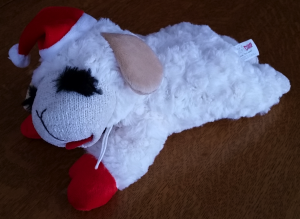
As many of you know, this is something I do every year for this Christmas Eve sermon . . . find something to be a sort of “focus object” or trigger for our Christmas Eve meditations. Lamb Chop just seemed perfectly suited. This Christmas toy suggested four poetic associations to me: one is the title given Jesus by John the Baptizer, “the Lamb of God;” a second was a familiar nursery rhyme; the third was a romantic English poem; and the fourth, a song that Lamb Chop sang on the Shari Lewis television show, all of which can help us explore and understand the Incarnation of God in Christ Jesus.

So, the first thing that comes immediately to mind when we look at a lamb, whether Lamb Chop the puppet dressed up for Christmas or an actual lamb in the fields is the statement made by John the Baptizer in the Gospel of John: “[John] saw Jesus coming toward him and declared, ‘Here is the Lamb of God who takes away the sin of the world!’” (Jn 1:29) That seems an odd way to refer to a grown man, which Jesus was at the time.

The 20th-century bible scholar Joachim Jeremias suggested that a way to understand John’s statement is that he probably used the Aramaic word talya. Jeremias says that “lamb” (amnos in the Greek in which the gospel is written) is a translation of this Aramaic word, which can also be translated “boy,” “child” or “servant.” When Jesus was described as the talya of God, Aramaic speakers of the earliest church would have heard “child” of God, or “son” of God, or “servant” of God, or “lamb” of God. When that gospel story was written after Jesus’ Crucifixion and Resurrection, the image of the sacrificial lamb of the Hebrew tradition resonated with the author. (See America)

According to some widely accepted Christian theologies, the sacrifice of the cross is the very reason for which Jesus was born. I’m not entirely sure that’s the case; I suspect that God the Father would much rather have had Jesus followed than killed, but certainly God made use of Jesus’ Crucifixion and through it opened for us the way of salvation. In any event, some people think that the nursery rhyme Mary Had a Little Lamb, the second thing called to mind by our Christmas Lamb Chop, is about Jesus’ birth as the sacrificial lamb of God. You know the one:

Mary had a little lamb,
a little lamb, a little lamb
Mary had a little lamb,
Its fleece was white as snow.

It’s not really about the Virgin Mary and the birth of Jesus, however. It was written by Sarah Josepha Hale of Sterling, Massachusetts, in 1830, and is said to describe an actual event of a pet lamb visiting the local schoolhouse. (See Wikipedia) Nonetheless, we can learn something about our Christian faith by considering the lamb of that story.

The rhyme continues that the lamb followed Mary and “everywhere that Mary went the lamb was sure to go.” Although I don’t believe that the Son of God was born necessarily or primarily to be a sacrifice, I am sure he was born to be followed; I’m certain Christ came into Creation to teach us how to live life God’s Way. He is the Word given to us to lead us to salvation. The little lamb in the nursery rhyme trusted Mary and followed her, and that is what God wants us to do, to trust and follow the Son so that, with the Son, we may live the abundant life of the Kingdom of Heaven that God constantly offers us. This is what makes his birth so important to us and why we celebrate the Incarnation in our many special ways.

So, anyway, I picked up this Christmas Lamb Chop dog toy and the first thing I did was check to see where it was made. I’m very careful not to give the Archbishop, Lord Dudley, anything made overseas. (I’m sure you’ve heard about the toxins found in dog toys and treats made, for example, in China.) Doing so, I thought of another bit of lamb-inspired poetry, one by the English Romantic poet William Blake. You may know it; it is entitled simply The Lamb. It is, in essence, a question asked of a lamb by a child:

Little Lamb who made thee
Dost thou know who made thee
Gave thee life & bid thee feed.
By the stream & o’er the mead;
Gave thee clothing of delight,
Softest clothing wooly bright;
Gave thee such a tender voice,
Making all the vales rejoice!
Little Lamb who made thee
Dost thou know who made thee

Little Lamb I’ll tell thee,
Little Lamb I’ll tell thee!
He is called by thy name,
For he calls himself a Lamb:
He is meek & he is mild,
He became a little child:
I a child & thou a lamb,
We are called by his name.
Little Lamb God bless thee.

Blake’s poem is a deceptively naive child’s song. Beginning with a descriptive, pastoral stanza, it moves quickly to focus on the abstract spiritual matter of Creation. The child’s guileless but profound question – “Who made thee?” – echoes the deep and timeless question that all human beings have about our origin. It reminds us of the opening lines of John’s Gospel with its abstract account of the Incarnation:

In the beginning was the Word,
and the Word was with God,
and the Word was God.
He was in the beginning with God.
All things came into being through him,
and without him not one thing came into being.
And the Word became flesh and lived among us,
and we have seen his glory,
the glory as of a father’s only son,
full of grace and truth
(Jn 1:1-3,14)

In Blake’s poem, this profound truth is presented with the naiveté of a child’s puzzle revealing the child’s confidence in a simple and innocent Christian faith. Our Christmas Lamb Chop reminds us that “whoever does not receive the kingdom of God as a little child will never enter it.” (Mk 10:15) Christmas is a time for us all to experience once again our childlike wonder at the simple beauty that is the Incarnation.

But our Christmas dog toy can trick us! We have to beware of oversimplifying the Incarnation. I read recently about “a Christmas display . . . at [a shopping] mall: giant plush bears robed as Mary and Joseph, beaming at a swaddled Baby Jesus bear in the manger.” Theologian Fredrica Mathewes-Green, who described this display, said of it,

If there was once grand mystery around the Incarnation, it has long since dispersed. Three jolly bears now convey everything we know or expect to know. It is a scene plump with stupidity. Jesus as a cookie. God as a pet. (Patheos)

This, she says, “is very bad news,” because “a circle of cuddly bears is useless at helping us deal with pain. It cannot help us grasp searing heartbreak.” Neither can a puppet, even a nice Christmas Lamb Chop puppet, but it can serve as a warning and a reminder!

Tracy Dugger, an Episcopal priest in Florida, has written about what she calls “meat puppet theology,”

. . . the idea that our bodies are machines simply being utilized and driven around by our minds. The mind/soul is the control, and the body is subservient. This way of thinking about the mind/body connection is wrong, and leads us into some pretty wrongheaded [ideas]. (The Young Anglican)

“The ultimate example of why bodies are important,” she says, is the simple fact that “JESUS HAD ONE! Jesus was Incarnate. Not only was Jesus, Son of God, begotten by the Holy Spirit, He was knit together in Mary’s womb. Jesus was a man of flesh and blood, as well as God from God, light from light.”

Mathewes-Green puts it this way:

God came down in a suit of skin and bones, and walked and talked and offended people, and finally they tortured him to death. And by that death he destroyed death; he rescued us and gave life everlasting and every other good thing. Into this universe crammed with pain we say that God came down, because he loves us with the kind of love that we can only understand by thinking of how a parent loves. (Patheos)

In an Advent meditation offered earlier this week, Brother Mark Brown of the Society of St. John the Evangelist reminded us that parental love and every act of kindness is an action of the body. He wrote: “The Spirit of God animates us, but it all happens in the flesh: every deed of kindness, every act of generosity, every word of encouragement happens in the flesh. Every embodiment of Christ’s grace or truth or love happens in the flesh – or it doesn’t happen.”

Tonight, tomorrow, as we celebrate the Word becoming flesh, we celebrate that bodily parental love . . . the love of mother and father tending their newborn child; the eternal love of the Father sending the Son to redeem us. As we celebrate the birth of Jesus to Mary, we celebrate also the truth we recite every Sunday (and this evening) in the Nicene Creed:

We believe in one Lord, Jesus Christ,
the only Son of God,
eternally begotten of the Father . . .
(BCP 1979, Pg 358)

Jesus was born in Bethlehem once for all time; the Son of God is eternally begotten of the Father and both, as we say in the Creed, for our salvation.

lambchop2Which brings me to the fourth and last bit of poetry our Christmas Lamb Chop brought to mind, which is a song Lamb Chop and Shari Lewis taught their viewers during the 1992 season of the PBS show Lamb Chop’s Play-Along. Some of you may know the song and can sing along:

This is the song that doesn’t end
Yes, it goes on and on my friends
Some people started singing it
Not knowing what it was
And they’ll continue singing it
Forever just because . . .
(Repeat)

There is a contemporary Christmas carol by Canadian folksinger Bruce Cockburn entitled The Cry of a Tiny Babe which expresses the timelessness and eternality of Jesus’ birth in its refrain:

Like a stone on the surface of a still river
Driving the ripples on forever
Redemption rips through the surface of time
In the cry of a tiny babe
(Cry of a Tiny Baby YouTube)

In the last book of the bible, St. John of Patmos recorded his many visions, the last of which was of the Lamb:

I saw no temple in the city, for its temple is the Lord God the Almighty and the Lamb. And the city has no need of sun or moon to shine on it, for the glory of God is its light, and its lamp is the Lamb. The nations will walk by its light, and the kings of the earth will bring their glory into it. Its gates will never be shut by day – and there will be no night there. People will bring into it the glory and the honor of the nations. * * * Nothing accursed will be found there any more. But the throne of God and of the Lamb will be in it, and his servants will worship him; they will see his face, and his name will be on their foreheads. And there will be no more night; they need no light of lamp or sun, for the Lord God will be their light, and they will reign for ever and ever. (Rev 21:22-26,22:3-5)

Our Christmas Lamb Chop reminds us that salvation is a song that doesn’t end, that “redemption rips through the surface of time,” and that our Christmas carols are but a faint echo of the multitude’s song of worship before the throne of the Lamb for ever and ever. Mary had a little lamb, the Lamb of God, the Word made flesh through Whom all things were made, Who came down for our salvation, and Whose song of redemption doesn’t end. Yes, it goes on and on, my friends.

Merry Christmas!

====================

Father Funston is the rector of St. Paul’s Episcopal Church, Medina, Ohio.

Our Immigrant Lord: For the Parish Newsletter, December 2016

====================

A “Rector’s Reflection” offered by the Rev. Dr. C. Eric Funston in the December 2016 issue of The Epistle, the newsletter of St. Paul’s Episcopal Church, Medina, Ohio, where Fr. Funston is rector.

====================

thirstednot-jesusindesert2A few years ago I read an essay about the trials and tribulations of relocation, particularly from region to region within our country. In it the author made the comment that when relocating to the South, there were two invariably asked questions of the newcomer: “Who are your people?” and “Where do you go to church?” These, he said, are quintessentially Southern inquiries which serve to position the interrogated in a place’s social network and milieu. The assumptions, of course, are that no one would relocate to a town where they did not have “people” (i.e., family members) and that everyone goes to church somewhere.

I’m not sure, after making several regional locations myself, that those are only Southern questions. They seem to be universally asked, in one form or another, of newcomers to every American community. In fact, they may be quintessentially human questions asked around the world!

In 2005, when Evelyn and I made our first trip to Ireland, one of my goals was to find distant relatives, members of the Funston clan whose ancestors had stayed there when my great-great-grandfather had come to America. So we visited the places I believed he might have come from, the Funston township lands of Counties Donegal, Tyrone, and Fermanagh. During our stay in the city of Donegal we happened to visit a woolen goods store run by a delightful man named Sean McGinty. We entered the shop just as Sean was closing up for the day and he graciously stayed open so we could peruse his sweaters, tweeds, and other goods. Of course, that meant he was going to be late to dinner . . . and, as a result, his wife Mary came looking for him.

We’d been in conversation with Sean before Mary arrived and told him of my search for Funstons. He said he thought there might be some living in Pettigo, a small village on the border of County Donegal and County Fermanagh. When Mary came into the shop, he drew her into our conversation and asked her, “Mary, you’re from Pettigo. Were there any Funstons living there?” She thought for a moment and then replied, “Aye! But they weren’t our people.” I knew immediately what she meant: they weren’t members of the Catholic Church. And that would have been right! My ancestor was a member of the Anglican Church of Ireland and his descendants are still Anglicans!

So there were those same two concerns: “Who are your people?” and “Where do you go to church?” They are the questions still being asked of newcomers to our communities wherever we may be, whether we are in the South of the United States, in Ohio, or somewhere in Europe. As so many people are on the move because of war, political unrest, and economic necessity, as so many are labeled “immigrant” and “refugee,” they are increasingly divisive and exclusive questions.

“Who are your people?” . . . “Where do you worship?” . . . What is your ethnic background? . . . What is your religion? . . . Instead of being asked to position the newcomer within the social milieu of his or her new home, the questions and their answers too often lead to the erection of social barriers, sometimes even physical walls. Instead of being welcoming questions of inclusion, they are the defensive or belligerent interrogations of exclusion.

Recently in the Christian press, particularly those journals which cater to a more conservative audience, there has been a lot of discussion about the assertion that Jesus was an immigrant and refugee. It is a common enough hermeneutic drawn from the story of the Holy Innocents and the flight of the Holy Family into Egypt as related in Matthew’s Gospel: “An angel of the Lord appeared to Joseph in a dream and said, “Get up, take the child and his mother, and flee to Egypt, and remain there until I tell you; for Herod is about to search for the child, to destroy him.” (Matt 23:13 NRSV) It occurred to me that it may be a useful reminder that the Son of God was an immigrant from the very start, that he was not and is not a native resident of our world; he is from elsewhere, from heaven, from the very Throne of God.

As Dr. John Marshall, a Southern Baptist minister in Missouri, recently wrote: “Our Savior was an immigrant. He left His home in Heaven to become a stranger in the very world He created. There was no room for Him in the Bethlehem inn (Lk 2:7). He came to His own people, but they received Him not (Jn 1:11).” (Marshall) As we prepare once again to welcome him in the annual celebration of his Incarnation, we do well to remember that and to remember that he remained an immigrant and a refugee throughout his life.

Jesus was born in Bethlehem of Judea, a land dominated by the Roman empire through a client ruler named Herod the Great. Apparently Mary, Joseph, and Jesus remained there for a couple of years before fleeing to Egypt where they lived until Herod died about four to six years after that. When they left Egypt, they returned not to Bethlehem but to Nazareth in Galilee, which was under the rule of Herod’s son, Herod Antipas, Tetrarch of Galilee. Jesus grew up, then, as a resident of Galilee; when he undertook his ministry to Jerusalem (which is in Judea), although he was returning to the country of his birth, he was an immigrant into Judea.

Judea, by the way, during Jesus’ life and ministry was ruled not by a local king but directly by the Romans. Herod the Great was succeeded by his son Archelaus, who had the title of “Ethnarch of Judea.” Archelaus died less than ten years after succeeding his father. After his death, a series of Roman governors or “Prefects” ruled, the last of whom during Jesus’ life was Pontius Pilate.

In truth, Jesus spent most of his time on the move. Both Matthew and Luke report him saying to a potential follower, “Foxes have holes, and birds of the air have nests; but the Son of Man has nowhere to lay his head.” (Matt 8:20; Lk 9:58) Jesus was not a settled person and, interestingly enough, neither are his followers (us) supposed to be. This goes back to the Jewish roots of our faith, a reminder of which is found in the Torah’s instructions for eating the Passover feast: “You shall eat it [with] your loins girded, your sandals on your feet, and your staff in your hand; and you shall eat it hurriedly.” (Ex 12:11) We are always to be ready to be on the move.

Our parish patron, St. Paul, takes up this theme in his letters. He reminded the Philippians that we are not to set our mind on earthly things because “our citizenship is in heaven.” (Philip 3:19-20) And he promised the Ephesians that we are “citizens with the saints and also members of the household of God.” (Eph 2:19) Theologians Stanley Hauerwas and William Willimon expanded on this notion in their book Resident Aliens (Abingdon, 1989), arguing that today the church is not “a service club within a generally Christian culture,” but rather “a colony within an alien society.” (pg. 115)

How might this inform and shape our Advent preparations and our Christmas celebrations? What if we understood that we are not getting ready to welcome Jesus into our settled existence, our cozy homes and our warm hearths, our abundant feasts and our lovely dining rooms? Rather, we should be preparing for our immigrant Lord Jesus to invite us to join him on the road, to eat with him hastily consumed meals wearing our sandals and holding our walking sticks, to sleep with him in places where we have no place to put our heads. What might we do differently to get ready for the anniversary of his Incarnation and for his promised return? What might we do differently for all who, like him, are refugees and immigrants?

Who are our people? The people of God whoever they are and wherever they may be, temporarily settled in “a colony within an alien society” or on the road. Where do we worship? Wherever we find our Lord, in church, in a refugee camp, in places we cannot even imagine. Every year Advent and Christmas challenge us with what Hauerwas and Willimon call “the greatest challenge facing the church in any age” which is to be “a living, breathing, witnessing colony of truth.”

May that challenge be our blessing in 2016! May each of us, and all of us together, be living, breathing witnesses to the Truth!

(Note: The image is a digital painting by an internet blogger calling himself Horseman. I could find no further information about it or him.)
====================

A request to my readers: I’m trying to build the readership of this blog and I’d very much appreciate your help in doing so. If you find something here that is of value, please share it with others. If you are on Facebook, “like” the posts on your page so others can see them. If you are following me on Twitter, please “retweet” the notices of these meditations. If you have a blog of your own, please include mine in your links (a favor I will gladly reciprocate). Many thanks!

====================

Father Funston is the rector of St. Paul’s Episcopal Church, Medina, Ohio.

« Older posts Newer posts »