Occasional thoughts of an Anglican Episcopal priest

Category: John (Page 9 of 25)

Unity, Love, Prayer: Homily for a Celebration of New Ministry – November 18, 2016

====================

A homily offered by the Rev. Dr. C. Eric Funston on Friday, November 18, 2016, to the people of St. Timothy’s Episcopal Church, Massillon, Ohio, at the Celebration of New Ministry (Installation) of the Rev. George Baum as their rector.

(The lessons for the service were Joshua 1:7-9; Psalm 134; Ephesians 4:7,11-16; and St. John 15:9-16)

====================

prayercircleGood evening! For those who don’t know me, I am Eric Funston, a priest of the Episcopal Church and rector of St. Paul’s Parish in Medina, Ohio. For those of you who don’t know why I’m preaching here tonight . . . I wish I could tell you! Usually these ordination or installation homily gigs go to someone with whom the new clergy person has had a, shall we say, formative relationship: a former pastor, a seminary professor or a ministry supervisor, an elder minister under whom the new pastor served a curacy, someone responsible for the priestly formation of the new rector. But that doesn’t describe me . . . I am not responsible for George Baum ~ and that is very probably a good thing!

Seriously, I’m here simply because George and I are friends and colleagues, and he asked me to preach, which I am honored and pleased to do.

An ecumenical friend of mine was asked to do the same, to preach at the installation of a new pastor of his denomination with whom he had not had a mentor relationship, so he sent the soon-to-be-plugged-in clergyman an email asking what sort of church he hoped he’d be joining. The answer was, “I would love to come into a church that was unified, where everyone loved each other, and they all prayed for the pastor.” When my friend shared that reply with our ministerial alliance, we all started laughing. Not because it’s funny, but because it’s so universally true. Every pastor would love to have a parish characterized by unity, love, and prayer.

I didn’t ask George what he might be looking for in a new pastoral call, nor what he might be hoping for from this installation sermon; frankly, I was sort of afraid to do so! Besides, when I even hinted at what I might say tonight he started to (and I quote from his Facebook page) “make a few phone calls for backup preachers.” Nonetheless, I suspect that if I had asked him, he might have said pretty much the same thing, that he would love to have St. Timothy’s Parish be a church that is unified, where everyone loves one another, and where the members pray for the rector.

So, about that first item, unity:

George selected a well-known passage from St. Paul’s letter to the church in Ephesus as our Epistle Lesson tonight. In the three verses which come before the opening sentence of our reading, St. Paul wrote these words which, I think, will also be very familiar to all of you:

There is one body and one Spirit, just as you were called to the one hope of your calling, one Lord, one faith, one baptism, one God and Father of all, who is above all and through all and in all. (Eph 4:4-6)

These verses summarize the primary focus of the letter to the Ephesians, which is the church’s call to unity. The letter stresses that members of the church are to make “every effort to maintain the unity of the Spirit in the bond of peace.” (4:3) After making this appeal, Paul launches, as we heard, into a celebration of the church’s diversity: some members are apostles, some are prophets, some are evangelists, some are pastors, some are teachers, and so on. He has done this before, as when he reminded the Corinthians that

there are varieties of gifts, but the same Spirit; and there are varieties of services, but the same Lord; and there are varieties of activities, but it is the same God who activates all of them in everyone. (1 Cor 12:4-6)

Or when he wrote to the Galatians that though they might have been Jew or Greek, slave or free, male or female, those differences no longer mattered “for all of you are one in Christ Jesus.” (Gal 3:28) Whatever and whoever we are, we are all given gifts to equip the saints for ministry “until all of us come to the unity of the faith and of the knowledge of the Son of God, to maturity, to the measure of the full stature of Christ.” (Eph 4:13). Paul’s call in this letter is for unity not uniformity, for a unity which embraces and celebrates diversity so that, in the words of our Lord’s prayer to his Father:

. . . [all] may be one, as we are one, I in them and you in me, that they may become completely one, so that the world may know that you have sent me and have loved them even as you have loved me. (Jn 17:22-23)

More than a half-century ago, when I was in junior high school, I saw a made-for-television movie which portrayed the most outrageous future you could imagine, a future in which every home had in it a computer terminal on which the family could talk to their friends and co-workers, could order their groceries, and could even cast their votes. In this impossible-to-imagine future, every citizen would enjoy instant coverage of world news, direct contact with political leaders, immediate access to all sorts of data, and be well-informed. This, of course, would lead to political unity and world peace. Oh … and everyone would have flying cars.

I’m still waiting for that future. We have the computers in our homes but not much else. Perhaps all the rest will come along when the flying cars get here. In the meantime, what our 24/7 instantaneous news cycle and our direct access to data (both true and false) have done is exacerbate our differences. Instead of drawing us closer together, the internet seems to have pushed us apart into competing “bubbles” and “echo chambers.” If the recently concluded election cycle, its outcome, and reactions to that result teach us anything, it is that the church’s witness to unity in diversity is needed now more than ever. And it is within this wider context of division and conflict that this community, St. Timothy’s Episcopal Church of Massillon, Ohio, has called the Rev. George Baum to be its rector.

Now, let’s be honest, the church has not always been a paragon of unity, despite Jesus’ prayer and St. Paul’s admonitions. There have always been divisions and differences of opinion within the church; there have always been black and white and several shades of grey and many colors in between; there have always been yesses and there have always been noes; there have always been those who want to push forward and those who want to hold back. But on a recent episode of the NPR show On Being Muslim American social scholar Eboo Patel argued that religious communities must stand together and witness to what he called “diversities of justice.” In this, he echoes the call of Anglican theologian David F. Ford, who has called upon our churches, within themselves and in outreach to others, to form what he labels “improved partnerships of disagreement.” Only if we ourselves are in unity of faith measuring up to the full stature of Christ can we make that witness to the world.

You have called George to be your rector which means that, among other things, you have called him to be a prophet, to be your parish’s and the wider church’s and God’s spokesman to the community around you. In a few minutes, your wardens will present him a set of keys and encourage him to open the doors of this place to all people; shortly after that, George will kneel in the center of the nave and pray for God’s blessing that through his ministry and yours “all the world may be drawn into [God’s] blessed kingdom.” Regardless of where a rector may personally stand on any of the economic, political, demographic, or social spectra of difference and disagreement which encourage us to division and conflict, he or she is called to represent your unity in and to the wider world.

Don’t get me wrong, disagreements are fine and leaders in the church should welcome lively discussion of issues because no one person has a monopoly on all wisdom. Disagreement and debate help church leaders to hear all sides of the issues and force them to think matters through. But when all is said and done, when all the disagreements have been aired, and all the points debated, the church community will still be here and it must be united in faith and growing into the full stature of Christ.

The only way we can do that is with the second element of the new pastor’s request, love:

“This is my commandment,” said Jesus, “that you love one another as I have loved you.” (Jn 15:12)

We all know that no matter what may be happening in the larger world, no matter what disagreements or conflicts we may get into in business, or politics, or the church, babies still get born, children still grow up, teens and young adults still go through the changes and passages of life, young men and women still get married . . . and older people do too! People still get sick and people still die . . . and, George, these fine people here have invited you to be their pastor, guide, companion, and counselor to share all of that with them. No matter where they or you may stand on those many spectra of opinion, demographics, politics, or economics, they are going to invite you into some of the most intimate and sacred moments of their lives.

And it is in those intimate and sacred moments that the reality of our unity in Christ is made most clear. Connections, sacramental connections are made between people at different points on those various spectra; a web of relationship comes into being and fosters and upholds the work to which we all are called. That web is elastic but tough; it is flexible and enduring; it is stronger than any of those one-dimensional spectra could ever be. We give that web the name of “love.”

Good people of St. Timothy’s Parish, please remember that George does not do this ministry alone! Tending to this web of relationship we call “love” is everyone’s job. As St. Paul continues in his letter to the church in Ephesus, while some are given the charism of being pastors and teachers, to “each [and every one] of us [grace is given] according to the measure of Christ’s gift . . . to equip the saints for the work of ministry, for building up the body of Christ.”

Love is the glue that bonds the church in unity. Love for Christ and love for each other. In St. Paul’s letter to the Colossians, he writes that he hopes his readers’ hearts will “be encouraged and united in love.” (Col 2:2) The Greek word translated as “united” is sumbibazo. It’s the same verb Paul uses in our Ephesians text this evening, translated here as “joined together,” the way the ligaments and tendons hold the joints of the body together and promote its growth, “building itself up in love.” (Eph 4:16) Remember that love is never an emotion; it is always an action. Love is not something we feel; love is something we do.

Love is patient; love is kind; love is not envious or boastful or arrogant or rude. It does not insist on its own way; it is not irritable or resentful; it does not rejoice in wrongdoing, but rejoices in the truth. It bears all things, believes all things, hopes all things, endures all things. Love never ends. (1 Cor 13:4-8a)

So love each other and love your new rector. As our bishop is fond of saying, “Love God. Love your neighbor. Change the world.”

One of my favorite hymns includes the repeated refrain, “God is love and where true love is, God himself is there.” So, George, remember those words of God to Joshua, “Be strong and courageous; do not be frightened or dismayed, for the Lord your God is with you wherever you go.” Or, as St. Paul wrote to the young bishop Timothy for whom this parish is named, “God [does] not give us a spirit of cowardice, but rather a spirit of power and of love and of self-discipline.” (2 Tim 1:7)

Which brings us, finally, to the third request of the new pastor, to the discipline of prayer.

“You that stand by night in the house of the Lord, lift up your hands and bless the Lord.” (Cf. Ps 134) The Psalmist’s fancy way to say, “Pray!” What more can be said? What more needs to be said? Not much, really . . . but I’m a preacher so it’s my job say what shouldn’t need to be said. Tonight, let’s say it. “Pray!”

Prayer is the putting into action of the love that binds our unity. Let me say that again: Prayer is the putting into action of the love that binds our unity.

It’s easy, I’m sure you’ll all agree, to pray for those we like, for those with whom we agree. It’s also pretty easy to pray for people we don’t know; our formal in-church prayer often include prayers for foreign provinces of the Anglican Communion – this Sunday, for example, we are asked to pray for church members in the Falkland Islands and for their bishop William Nigel Stock. I don’t know Bishop Stock or anyone else in the Falklands so I’m perfectly happy to pray for them until the cows come home!

It should be easy to pray for members of our family and of our church, and for our friends, although sometimes we may not like them very much and often we may not agree with them, and that makes it a little harder. And then there are those other people, the ones we really don’t like or with whom on a scale of 1-to-10 we disagree at level 12; for me, I confess, it’s practically impossible to pray for them. But Someone once said, “Love your enemies, do good to those who hate you, bless those who curse you, [and] pray for those who abuse you.” (Lk 6:27-28)

In my counseling with people who are dealing with anger issues, I often suggest to them that they should pray by name for the one with whom they are angry. In every parish I have served, I have insisted that we pray for the president, by name, at every Sunday service: I have had parishioners who refused to pray for Bill Clinton; I have had parishioners who refused to pray for George Bush; I have had parishioners who refused to pray for Barack Obama; and I know I will have parishioners who will refuse to pray for Donald Trump. Nonetheless, I will insist that we do so because, as Paul wrote to Timothy, “I urge that supplications, prayers, intercessions, and thanksgivings be made for everyone, for kings and all who are in high positions, so that we may lead a quiet and peaceable life in all godliness and dignity.” (1 Tim 2:1-2)

Note what Paul says there. He urges prayer for our leaders not so that they, the ones being prayed for, will be successful, but rather so that we, the ones who are praying, may have the blessings of quiet, peace, godliness, and dignity. Prayer works on the heart of the one who prays. One of the chief purposes of prayer is to transform the heart of the person praying so that it more closely resembles the heart of God. Prayer nourishes us and aligns our wills with God’s will. In this way, prayer heals and strengthens our relationships with the ones for whom we pray.

To be sure, we also believe that prayer benefits the subject of our prayers, as well. Prayer, as an offering of humble dependence, strengthens all within the community which finds its source and harmony in God. Prayer is the putting into action of the love that binds our unity.

In every epistle, Paul begs his churches to pray for him. It is the constant need of every pastor, to feel supported by the prayers of his or her people. So, please, pray for George (even when he disappoints – which he will, occasionally; even when you disagree with him – which you will, occasionally); pray for his family; pray for one another; and pray for the community and the world within which together you begin this new ministry.

So there you have it. The three things every priest wishes to find in his or her parish: unity, love, and prayer. With these as foundation, together with your new rector, you can faithfully respond to Jesus, who says to you, just as surely as he said to his first disciples, “You did not choose me but I chose you. …. Go and bear fruit that will last.”

It is common at the end of these sorts of homilies to give a specific charge to the person whose new ministry is being celebrated so, George, I invite you to stand . . . and every member of St. Timothy’s Parish, I invite you to stand, also . . . I can offer all of you no better charge than that given by the Patron Saint of my parish to the Patron Saint of your parish:

Pursue righteousness, godliness, faith, love, endurance, [and] gentleness. Fight the good fight of the faith; take hold of eternal life . . . keep the commandment without spot or blame . . . [and] guard what has been entrusted to you. (1 Tim 6:11-12,14,20)

Do so in unity, with love, holding each other in prayer. Because despite what I said in the jest at the beginning of this sermon, I am responsible for George Baum. We are all responsible to and for one another. So, again, live and minister in unity and with love, and pray for one another.

Amen.

====================

Father Funston is the rector of St. Paul’s Episcopal Church, Medina, Ohio.

An Unpreached Clergy Installation Sermon in the Time of Donald Trump

====================

A homily which will NOT be offered by the Rev. Dr. C. Eric Funston on Friday, November 18, 2016, to the people of a neighboring parish in Ohio, at the celebration of the new ministry of the Rev. George ___________ as rector. (I have not disclosed names or locations as they are, frankly, irrelevant to this soon-to-be-unpreached sermon.)

(The lessons on which this sermon is based are Joshua 1:7-9; Psalm 134; Ephesians 4:7,11-16; and St. John 15:9-16)

====================

Note: When first asked to preach at George’s celebration of new ministry, I penned this sermon. After a few days, I decided to go in a different direction and, using only a few bits and pieces of what I had written here, cobbled together with other material, I crafted another sermon which I will preach. Nonetheless, I believe this homily to have merit and, therefore, publish it here. (I will publish the actual sermon once it has been delivered.)

donald-trump-prune-faceOn the day after the general election, a Presbyterian clergyman in Iowa, a married gay man, found a computer-printed note tucked under his car’s windshield wiper addressed to “Father Homo.” The text of the note began with the question “How does it feel to have Trump as your president?” and was both belittling and threatening. The same day a softball dugout in Island Park in Wellsville, New York, was defaced with graffiti reading “Make America White Again,” accompanied by a large swastika. The next day, students at nearby Canisius College, a Jesuit institution, found a black baby doll with a noose tied around its neck in the freshman dormitory elevator, and students at Wellesley College in Massachusetts witnessed two young white men drive a truck through their campus flying a Trump campaign banner, yelling “Make American Great Again,” and spitting on African-American young women.

Last Sunday, St. David’s Episcopal Church in Bean Blossom, Indiana, was vandalized by someone who painted a swastika, an anti-gay slur, and the words “Heil Trump,” on its walls, and in Silver Spring, Maryland, a sign for the Episcopal Church of Our Saviour’s Spanish-language service was marked with the words “Trump nation. Whites only.”

Meanwhile, thousands of people have taken to the streets in New York City, Los Angeles, San Francisco, Chicago, Portland, Atlanta, Miami, and even Akron, Ohio, brandishing signs reading “Not My President” and “Dump Trump.”

“Now, wait,” you’re probably thinking, “none of that has happened here (where we are celebrating), nor in Medina (where my church is), so why are you bringing it up?”

Well, in the three verses which precede the opening sentence of our Epistle Lesson this evening, St. Paul wrote these words which will, I think, be very familiar to all of you:

There is one body and one Spirit, just as you were called to the one hope of your calling, one Lord, one faith, one baptism, one God and Father of all, who is above all and through all and in all. (Eph. 4:4-6)

The primary focus of the letter to the Ephesians is the church’s ministry of reconciliation and our call to unity. The letter stresses that members of the church are to make “every effort to maintain the unity of the Spirit in the bond of peace.” (4:3) We are all given gifts, as we heard in the portion read tonight, to equip the saints for ministry “until all of us come to the unity of the faith and of the knowledge of the Son of God, to maturity, to the measure of the full stature of Christ.” (4:13)

And we are to do that in the context of a nation in which threatening notes are left on minister’s cars, public recreation facilities are defaced with messages of racial hatred, students are made to feel unsafe on their college campuses, and churches are tagged with anti-gay or anti-immigrant graffiti, a nation where thousands protest because they cannot accept the outcome of a national election. We are called to be a community of unity (not of uniformity, but of unity), a community of reconciliation in a context of division and conflict.

It is within this wider context that the community of St. [Swithun’s], has called the Rev. George __________ to be its rector.

In those three verses, which form a sort of explanatory preamble to the first verse we heard read (verse 7), the word “one” is used seven times! It is the drum-beat of a hymn to the church’s unity which crescendos with the oneness of God, the “Father of all, who is above all and through all and in all.” In the first three chapters of the letter, Paul has identified God as the source of the church’s identity; here, he identifies the oneness of God as the source, foundation, and ultimate goal of the church’s unity and our ministry of reconciliation.

In the Greek, verse 7 (the first verse we heard from the letter) also begins with the word “one.” It’s not possible to translate that parallelism into English, but to fully appreciate Paul’s thrust we might add a couple of words to our translation. We might underscore Paul’s point by rendering it not simply as “each of us was given” but more emphatically as “each one of us was given” a gift of grace for this work. Paul is bringing his notion of oneness back to our individual experience – each one of us experiences God’s grace in the larger context of the church’s ministry and goal of unity and reconciliation.

In an opinion piece published Monday in the Bethlehem, Pennsylvania, Morning Call, the provisional bishop of Bethlehem and Bishop of Northwest Pennsylvania, the Rt. Rev. Sean Rowe, wrote:

[T]he news is full of public figures talking about reconciliation. *** [B]ut before we strike up a rousing chorus of “Kumbaya,” I hope we will pause to make sure we understand that real reconciliation requires deep self-examination, an ability to acknowledge both when one has been wronged and when one has done wrong, and the willingness to behave and communicate in new ways. (Rowe)

I believe that what Bishop Rowe is saying is an echo of God’s words to Joshua as he took over leadership of the Hebrews from Moses: “Be strong, be courageous, be careful; do not turn to the right or to the left.” (Josh 1:7) That’s hard work, but God’s message to Joshua is God’s message to us: “Be strong and courageous; do not be frightened or dismayed, for the Lord your God is with you wherever you go.” (1:9)

While no one, at least so far as I am aware, has tagged any churches in this community with anti-gay or anti-immigrant or pro-Trump graffiti, and while no one, at least so far as I am aware, has marched through the streets of this town in protest of the election’s results, I would be willing to bet that this community, and even this parish, has within it both those who voted for Trump and are rejoicing, and those who voted for Clinton and are in grief. This is the reality of human community and of the church; as I said a moment ago, we are a community of unity not of uniformity, called to be a community of reconciliation in a context of such division and conflict.

I don’t know and don’t really care how any of you voted; I don’t know and don’t really care how Father George voted. There have always been divisions and differences of opinion within the church; there have always been black and white and several shades of grey and many colors in between; there have always been yesses and there have always been noes; there have always been those who want to push forward and those who want to hold back. And regardless of where a rector may personally stand on any of those spectra, he or she is called into the midst of them to be pastor, guide, companion, and counselor to the whole of the community.

Because no matter what may be happening in the larger world, babies are still being born, children are still growing up, teens and young adults are still going through the changes and passages of life, young men and women are still getting married, older people are, too! And people are still getting sick and dying . . . and, George, they are counting on you to be their pastor, guide, companion, and counselor through it all. No matter where they or you stand on those many spectra of opinion, demographics, politics, or economics, they will invite you into some of the most intimate and sacred moments of their lives.

And it is in those intimate and sacred moments that the reality of reconciliation occurs. Connections, sacramental connections are made between people at different points on those various spectra of opinion; a web of relationship comes into being which fosters and upholds the work of reconciliation to which all are called.

So, George, “Be strong and courageous; do not be frightened or dismayed, for the Lord your God is with you wherever you go.” Or, as the apostle Paul wrote to the young bishop Timothy for whom this parish is named, “God [does] not give us a spirit of cowardice, but rather a spirit of power and of love and of self-discipline.” (2 Timothy 1:7)

But, good people of St. [Swithun’s], George does not do this alone! As St. Paul continues in his letter to the church in Ephesus, while some are given the charism of being pastors and teachers, to “each [and every one] of us [grace is given] according to the measure of Christ’s gift . . . to equip the saints for the work of ministry, for building up the body of Christ.”

“Who are the ministers of the Church?” asks our Catechism. “The ministers of the Church,” it answers, “are lay persons, bishops, priests, and deacons.” The ministry of the laity, it continues

is to represent Christ and his Church; to bear witness to him wherever they may be; and, according to the gifts given them, to carry on Christ’s work of reconciliation in the world; and to take their place in the life, worship, and governance of the Church. (BCP 1979, page 855)

“To carry on Christ’s work of reconciliation in the world . . .” and we are right back where we began: we are called to be a community of reconciliation in a context of division and conflict. In a world where so many are “tossed to and fro and blown about by every wind of doctrine, by people’s trickery, by their craftiness in deceitful scheming,” we, all of us, are call to “speak[] the truth in love.” (Eph. 4:14-15) George will do that; so must you.

George, as you may know, is named for the Patron Saint of England whose red cross emblazons our Episcopal Church flag and shield. What you may not know is that St. George is also the patron saint of Palestine. A few years ago, my wife and I were privileged to make a pilgrimage to the Holy Land and among the places we visited was the village of Burkin which sits on the boundary between Samaria and Galilee.

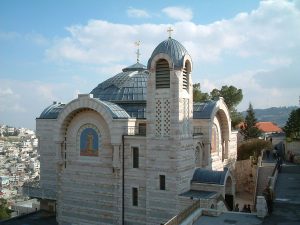
There, we visited the tiny Church of St. George, which commemorates the spot on which Jesus healed ten lepers. (Luke 17:12-19) It is the fourth oldest continuously in use worship space in the world! There has been a church on that spot since the early Fourth Century! It is under the jurisdiction of the Greek Orthodox Patriarchate of Jerusalem.

Our host was Usama, a member of the Greek Orthodox congregation. One could tell that he and the other members of St. George’s Church are very proud of their heritage. Their worship space is immaculate. The silver is polished; the cloth hangings and altar vestments are clean and bright; the icons are dusted. Pride of place is patent in every corner.

The worship space is tiny – our group of eighteen people more than half filled it. It is probably very crowded on Sundays for the Divine Liturgy and at other times of Orthodox worship. This congregation has a membership of 65 people. They are the only Christians in a town of over 7,000 population. Their witness is astounding!

Usama and his wife Nadija hosted us to lunch in their home. The tables were filled with tomato and cucumber salad, yoghurt, pita, and chicken and lamb shwarma served on heaping platters of seasoned rice. There was enough to feed a group five times our size.

Several of us had two or three helpings of the delicious food when Usama’s wife, Nadija, came around and piled one more serving on everyone’s plate: “Eat,” she said, “how do I know you liked it if you leave some behind?” It was all in good fun, and the graciousness and vibrancy of their hospitality was overwhelming.

We talked with them about the dwindling of their congregation, what it is like to be a Christian minority in an overwhelmingly Muslim community. Someone in our group asked if they had ever considered leaving Burkin. “No,” Nadija replied quickly, “If we left, who would be the church?”

It was a brilliant response, “Who would be the church?” Not ”Who would take care of the church?” Not “Who would polish the silver?” Not “Who would do whatever ….” but “Who would be the church?” Who would be the community of reconciliation in that context of division and conflict?

Usama and Nadija and their brothers and sisters in Burkin are called to be that community there; you and George are called to be that community here. So I want to be very clear what it means to be a community of reconciliation in a world of division and conflict. It does not mean to simply make nice and live in an uneasy peace with those with whom we disagree; it does not mean to accept what cannot be accepted; it does not mean to approve what cannot be approved.

Reconciliation does not take place in a vacuum, nor in a fog of niceness; reconciliation can only take place within a context of, and when it incorporates the elements of, repentance, forgiveness, restitution, justice, amendment of life, and the healing of relationships.

In the sacramental rite of reconciliation, “evidence of due contrition” must be shown and the Confessor may require that “something to be done as a sign of penitence and [an] act of thanksgiving.” (BCP 1979 page 446) In the invitation to the general confession in our older prayer books and in Rite One of the current Prayer Book, the presider calls on those

. . . who do truly and earnestly repent you of your sins, and are in love and charity with your neighbors, and intend to lead a new life, following the commandments of God, and walking from henceforth in his holy ways. (BCP 1979 page 330).

This is the prophet’s call to change. Standing in the web of reconciliation, addressing one another and those outside our community who stand at different points on the various spectra of politics, economics, and demography, our work of reconciliation is the work of a prophet.

For example, the Old Testament law commands, “The alien who resides with you shall be to you as the citizen among you; you shall love the alien as yourself, for you were aliens in the land of Egypt.” (Leviticus 19:34) As ministers of reconciliation we are obligated by our baptismal promises to treat resident aliens in this way, to call others to do so, and to resist those who would treat immigrants, refugees, or ethnic minorities in any other way.

The prophet Micah told us that what is required of us is “to do justice, and to love kindness, and to walk humbly with your God.” (Micah 6:8) As Christian ministers of reconciliation it is incumbent upon us to do so, to encourage others to do so, and to seek to change systems and practices that do not promote justice and loving kindness.

Jesus was once asked, “Which commandment in the law is the greatest?” And he replied “‘You shall love the Lord your God with all your heart, and with all your soul, and with all your mind.’ This is the greatest and first commandment. And a second is like it: ‘You shall love your neighbor as yourself.’” (Matthew 22:36-39) In fulfillment of these commandments, our ministry of reconciliation requires that we “strive for justice and peace among all people, and respect the dignity of every human being,” (BCP 1979, Page 305) call others to do so, and oppose those who would thwart those goals.

Jesus suggested that the Father blesses those who feed the hungry, give drink to the thirsty, welcome strangers, clothe the naked, take care of the sick, and visit those in prison, and turns away those who fail to do such things. (See Matt. 25:32-46) Our ministry of reconciliation demands that, like Jesus, we say to those who refuse to do these things “Depart from me, I do not know you,” until they change and do what they can for the least of his brothers and sisters.

When Jesus was arrested, one of his disciples drew a sword and cut off someone’s ear, but Jesus said, “Put your sword back into its place; for all who take the sword will perish by the sword.” (Matt. 26:52). Our ministry of reconciliation must include a prophetic echo of Isaiah and Micah calling on the manufacturers, purveyors, and wielders of weapons to “beat their swords into plowshares, and their spears into pruning hooks.” (Isaiah 2:4; Micah 4:3)

You, good people of St. [Swithun’s], have called George to join you in this prophetic ministry of reconciliation; with him you are called to be the church in this place at this time, a community of unity and reconciliation in the larger conflicted and divisive context of this age. To you, Jesus says, just as surely as he said to his first disciples, “You did not choose me but I chose you. …. Go and bear fruit that will last,” the fruit of the prophetic ministry of reconciliation.

It is common at the end of these sorts of homilies to give a specific charge to the clergy person whose new ministry is being celebrated so, George, I invite you to stand, and as friend to friend, presbyter to presbyter, long-winded preacher to long-winded preacher, I can offer no better advice than that given by St. Paul in his first letter to a new pastor, Timothy:

Pursue righteousness, godliness, faith, love, endurance, [and] gentleness. Fight the good fight of the faith; take hold of the eternal life . . . keep the commandment without spot or blame . . . [and] guard what has been entrusted to you. (1 Tim. 6:11-12,14,20)

Amen.

====================

Father Funston is the rector of St. Paul’s Episcopal Church, Medina, Ohio.

The photograph of President-elect Donald J. Trump is from the Library Grape website.

A Saintly Obligation: Sermon for All Saints Sunday – November 6, 2016 (RCL Year A)

====================

A homily offered by the Rev. Dr. C. Eric Funston on All Saints Sunday, November 6, 2016, to the people of St. Paul’s Episcopal Church, Medina, Ohio, where Fr. Funston is rector.

(The lessons for the day are from the Revised Common Lectionary for All Saints Day in Year C: Daniel 7:1-3,15-18; Psalm 149; Ephesians 1:11-23; and St. Luke 6:20-31. These lessons can be read at The Lectionary Page.)

====================

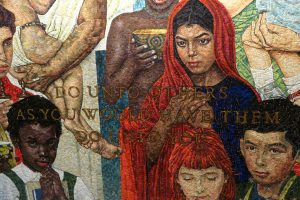
un-rockwell-mos-largeTuesday was the Feast of All Saints (which we are commemorating today, as is permitted by tradition, by translating the feast to the following Sunday). Traditionally, All Saints Day (or All Saints Sunday) commemorates the departed members of the Christian church who are believed to have attained heaven (it is not limited to those officially canonized by a church hierarchy).

It recognizes the reality that:

Our ancestors are sacred and their resting place is hallowed ground. *** Our religion is the traditions of our ancestors – the dreams of our old men, given them in solemn hours of the night . . . and the visions of our [sages], and is written in the hearts of our people. (Chief Seattle, Native American)

It looks to and gives thanks for the example of those who knew that “it is easy enough to be friendly to one’s friends but to befriend one who regards himself as your enemy is the quintessence of true religion.” (M.K. Gandhi, Hindu) And it is underscored by the Christian community’s certainty “that in the religion of Love there are no believers and unbelievers. Love embraces all.” (Rumi, Sufi Muslim)

It is a Christian holy day, but I have just described it in three quotes from notable sages none of whom were Christians. The description of our ancestors as sacred and of religion as written on the hearts of the people is from Chief Seattle, the 19th Century leader of Suquamish and Duwamish nations of the northwest, a man who followed the religion of his ancestors. The observation about befriending one’s enemies is from Mohandas K. “Mahatma” Gandhi, a Hindu from India. And the statement about the religion of love is from Jal?l ad-D?n Muhammad R?m?, a 13th Century Muslim Sufi mystic and poet.

I quote from these three men because I’ve come to believe that in our commemoration of all the saints, we should include those who are recognized as “holy” or “saintly” in other religious traditions, as well. There is, I believe, nothing in what these saintly men said that could be disagreed with by anyone of any differing religious or philosophical background. Nonetheless, I am sure that there are some (perhaps many) who would reject their words entirely, with little or no thought, as a sort of knee-jerk reaction simply because they were not Christian, despite the wisdom, morality, and generosity of spirit which they displayed.

Such is the world and the nation in which we celebrate All Saints Day this year, two days before the voters of the United States will select a new chief executive for our country. We are a society divided, polarized, and given to knee-jerk reactions. It is in this context that our Lectionary today asks us to read and consider a portion of the Book of Daniel, the only piece of apocalyptic literature in the Hebrew Scriptures, a book which focuses the reader’s attention on “the relationship between earthly and heavenly rule, emphasizing that the sovereign authority of earthly [rulers] depends upon the will of God.” (Portier-Young)

In the vision shown to Daniel, God gave sovereignty to “one like a Son of Man,” one like a human being in response to the suffering of God’s people under the domination of the Persian, Median, Macedonian, Seleucid, and Ptolemaic empires. Professor Anathea Portier-Young of Duke Divinity School argues that in so doing, God sought to free the oppressed from political domination, state terror, and persecution, to empower them to exercise authority and participate willingly in the political systems in which they live, and to inaugurate just rule on earth as in heaven. (Ibid.)

The culmination of Daniel’s vision is the handing of the earthly over to “the holy ones of the Most High.” Historically, these “holy ones” may have been understood as divine beings, but from the perspective of the Christian Gospel, the “holy ones of God” are those good people who were deeply engagement in the power struggles of their day and time, those divided, polarized, and knee-jerk reactive struggles that threatened to change to course of history. (Davidson) The “holy ones of the Most High” are those who, in the midst of a highly troubled and dangerous world, know that God is present and that God is more powerful than all the unjust empires and political systems human beings can devise. The saints, of whatever religious tradition, know that God loves and nourishes us, and gives us hope and meaning, life and salvation, gives us “the kingdom [to] possess . . . for ever – for ever and ever.” (Gaiser)

In our context, we have been given not a kingdom, but a participative democracy in which we have the same obligation as the saints of old to be deeply engaged in the struggle for justice to which Jesus calls us in today’s reading from the Gospel according to Luke, the blessings and woes from the Sermon on the Plain. We are to remember the poor and the hungry, those who weep, and those who are hated, reviled, and excluded. We are to love our enemies, do good to those who hate us, bless those who curse us, and pray for those who abuse us. We are to follow what has come to be called “the Golden Rule:” “Do to others as you would have them do to you.” These are not merely good ideas to be followed sometimes; they are moral imperatives which are to inform every activity of our lives, including our participation – wisely, morally, and with generosity of spirit – in the democracy we have been given.

As I wrote in our parish newsletter this month, I believe that voting is more than a privilege, more than a right; it is, I believe, an ethical, moral obligation. It is, for me as a Christian, an exercise in stewardship. We have been given this country and its governance by our forebears – and even, if Daniel’s vision is true (and I believe it is), by God – and we have the obligation to participate in its democratic processes, preserve it, and pass it on to our children, grandchildren, and more distant descendants.

We have heard too much cynicism in this election season. We have been told again and again how the candidates nominated by our two major parties are both deeply disliked and deeply distrusted by the electorate. On November 1, All Saints Day itself, the United Kingdom’s Independent newspaper reported that 60 per cent of likely voters view Mrs. Clinton negatively and a similar percentage dislike Mr. Trump. In a pastoral letter to his flock last weekend, the Most Rev. Paul S. Coakley, Roman Catholic Archbishop of Oklahoma, wrote, “Our major party candidates are both deeply flawed.” (Patheos)

Well, I have some news for the Archbishop: that is just the way people, all people, are. He might just as well have written, “Our major party candidates are both human beings.” When the Roman Catholic Church began the process to canonize Pope John Paul II as a Capital-S Saint, the popular Jesuit author James Martin wrote an article responding to those who objected because they felt the late pope was insufficiently perfect to warrant it. Martin wrote of the saints:

[E]ven after their decisions to amend their lives, the saints remained stubbornly imperfect. In other words: human. And the history of sinful saints begins right at the start of Christianity. St. Peter, traditionally described as the “first pope,” denied knowing Jesus three times before the Crucifixion.

After cataloguing the indiscretions of several well-known saints, Martin commented:

All these men and women were holy, striving to devote their lives to God. They were also human. And they knew it, too. Of all people, the saints were the most cognizant of their flawed humanity, which served as a reminder of their reliance on God. (Slate)

Yes, our candidates are deeply flawed human beings. But to slightly misquote Jesus, “Let the one who is without sin cast the first ballot.” (See John 8:7)

I believe Archbishop Coakley was correct in writing that “what we most need is a renewed commitment to the pursuit of virtue, to seek the good and adhere to the truth as inscribed in our hearts by our Creator” and that “[v]oting is a moral act. It ought to be guided by prayer and an evaluation not only of the political, but also the moral implications of our decisions.” (Patheos)

In today’s reading from Paul’s letter to the church in Ephesus, the Apostle writes of the church and the Christian faith being “an inheritance” for which the saints are to praise God. As I have said, I believe this nation and our participative democracy are likewise an inheritance. As Paul prayed for the Ephesians, so I pray for all of us, especially this week, that God may give us a spirit of wisdom and revelation, that the eyes of our hearts may be enlightened, and that we may know what is the hope to which God has called us. None of us, not our candidates, not our neighbors, not our fellow voters, and especially not ourselves . . . none of us is perfect; we are all deeply flawed human beings. But we are also saints like the saints of old whom we commemorate today and like them we have been given the kingdom, on earth as in heaven, to possess and to participate in for ever – for ever and ever.

It is a saintly obligation. May we exercise it wisely, morally, and will generosity of spirit.

Let us pray:

Almighty God, to whom we must account for all our powers and privileges: Guide the people of the United States in the election of officials and representatives; that, by faithful administration and wise laws, the rights of all may be protected and our nation be enabled to fulfill your purposes; through Jesus Christ our Lord. Amen. (BCP Page 822)

====================

Father Funston is the rector of St. Paul’s Episcopal Church, Medina, Ohio.

The Perfect Scorecard: A Funeral Homily (James McKee, 28 July 2016)

====================

A homily offered by the Rev. Dr. C. Eric Funston at the funeral of James William McKee, July 28, 2016, to the people of St. Paul’s Episcopal Church, Medina, Ohio, where Fr. Funston is rector.

(The lessons for the day are from The Book of Common Prayer lectionary for burials: Isaiah 61:1-3; Psalm 23; Second Corinthians 4:16-5:9; and St. John 10:11-16. These lessons may be found at The Lectionary Page.)

====================

golfWhen I was practicing law and serving as the chief legal officer of the Episcopal Diocese of Nevada, there was a church member (of another congregation than mine) who always greeted me with a lawyer story. “What’s the difference between a lawyer and ….? ” “There was a lawyer who went to heaven ….” I think I’ve heard all the lawyer jokes, and I considered starting with one this morning. If I had had more than a passing acquaintance with Jim McKee, I might have done so. But I didn’t know Jim, so I won’t do that. Instead, I’ll begin with some poetry.

The death of anyone important in our lives is a tragic and painful thing. This is especially so when a father or grandfather passes away, perhaps because we use that metaphor of fatherhood to explain God’s relationship to us. Whenever a father or an older brother passes away, I cannot help but remember the poem by the Welsh poet Dylan Thomas, Do Not Go Gentle Into That Good Night

Do not go gentle into that good night,
Old age should burn and rave at close of day;
Rage, rage against the dying of the light.

Though wise men at their end know dark is right,
Because their words had forked no lightning they
Do not go gentle into that good night.

Good men, the last wave by, crying how bright
Their frail deeds might have danced in a green bay,
Rage, rage against the dying of the light.

Wild men who caught and sang the sun in flight,
And learn, too late, they grieve it on its way,
Do not go gentle into that good night.

Grave men, near death, who see with blinding sight
Blind eyes could blaze like meteors and be gay,
Rage, rage against the dying of the light.

And you, my father, there on the sad height,
Curse, bless, me now with your fierce tears, I pray.
Do not go gentle into that good night.
Rage, rage against the dying of the light.

As I said, I didn’t know Jim McKee; I do not know if he was Thomas’s wise man, a good man, a wild man, or a grave man, so I cannot eulogize him. But I do know that he was a father and I know that he was a lawyer specializing in what I think of as an esoteric specialty (intellectual property law), and that he had a loving wife, two children and five grandchildren, and that he loved football and golf (though he is said to have had no skill at the latter).

So I have a few things in common with Jim McKee. I’m also am a loving husband, a father, and a grandfather. I, too, am a lawyer (though my specialty, before I left active practice, was medical negligence litigation) and I am a terrible golfer.

I don’t play the game any longer, but as I was preparing to celebrate Jim’s life and preach this homily today, I got to thinking about golf. I remembered the observation made by someone (I can’t remember who) that there are probably more prayers said on the golf courses of America on Sunday morning than are said in its churches, although as evangelist Billy Graham once quipped, “The only time my prayers are never answered is on the golf course.”

I collect prayers, as you might suppose, and over the years I’ve collected quite a few golf-themed petitions. One of the nicer is this one:

God, What is my fascination with this game? Is it the outdoors – the green fairways, the blue skies, the lakes and trees, the feel of the breeze across my face? Is it the friends with whom I play – their companionship, their encouragement, the conversation between holes, the silence as we wait our turn? Is it the game – the balance between grace and skill and power, the striving for perfection, the loft of the ball, the precision of the putt? Or is it all of these, and in these, meditations about all of life – harmony, friendship, balance, and – every once in awhile – the perfect shot and a glorious Amen. (The Joy of Golfing)

I suspect that that prayer captures what it was about golf that attracted an intelligent and thoughtful man like James McKee.

Another golf prayer, one written by a man named Don Humm, begins this way:

Oh God, in the game of life, you know that most of us are duffers and that we all aspire to be champions with plenty of birdies or eagles.

Help us, we pray, to be grateful for the course including both the fairways and the rough. We thank you for those who have made it possible for us to tee off. Thank you for the thrill of a solid soaring drive; the challenge of the dogleg; the trial of the trap; the discipline of the water hazard; the beauty of a cloudless sky and the exquisite misery of rain and cold. (Presbyterian Church of the Roses)

The Buddhist writer Roy Klienwachter writes that “golf is a metaphor for life. It is up and down. The harder you try to win the worse you get. When you learn to let go the game gets easier. So,” he advises, “learn to play the game and go with it. The ‘practice’ is the game, learn to practice.” And Roman Catholic monk and golfer Thomas Moore writes that a game of golf is “an abbreviated, symbolic round of life. A green is like Eden: You reach it, and you feel that you have arrived at an unearthly place with its perfect grass and chance at salvation.”

In our lesson from the Gospel of John this morning, Jesus describes our salvation this way: “I am the good shepherd. The good shepherd lays down his life for the sheep,” so that “there will be one flock, one shepherd.” (Jn 10:11,16) The Eucharistic prayer which we will offer in a few minutes picks up this theme of salvation, recalling that Jesus “stretched out his arms upon the cross, and offered himself, in obedience to [the Father’s] will, a perfect sacrifice for the whole world.” (BCP 1797, Pg 362)

Lutheran Pastor Chris Rosebrough uses golf as a metaphor to explain Christ’s atoning sacrifice:

Pretend you are a terrible golfer (for most there is not much imagination needed here). Now pretend that your eternal salvation depends on you scoring a perfect round of Golf (par or better for the entire round) at Bethpage Black (arguably the toughest golf course on the planet) and the course has been set up for U.S. Open conditions (7400 yards long, 8 inch rough and greens so fast it’s like putting in a bath tub). But, wait just to make things even more difficult, the devil has thrown in gail force winds that are swirling and gusting as high a 60 miles an hour.

To give you an idea of how difficult this feat is, Tiger Woods at the 2002 U.S. Open at Bethpage Black, with practically perfect weather conditions was the ONLY golfer with a score that was UNDER par. Phil Mickleson was the only other golfer that scored an even par for the tournament. Every other golfer was above par for the tournament. But under these course conditions not even Tiger Woods has any hope of being saved. Sadly, even if Jesus gave you a Mulligan then there would still be no hope of your being saved. One ‘do-over’ would be quickly gobbled up at Bethpage Black under these conditions.

So then how can you be ‘saved’ in this scenario?

The Gospel teaches us that even under these impossible conditions, Jesus Christ shot the perfect round of golf for you at Bethpage Black and is offering you His scorecard as your own. He’s already taken your scorecard, the one with all the sins on it, and he’s atoned for those sins on the cross. In return, He will give you His perfect scorecard and let you sign your name to it as if you were the one who shot that round. (Extreme Theology)

Our guaranteed salvation notwithstanding, we must still face those “impossible conditions” as we play the fairways and putt the greens of life even though we are assured that they cannot defeat us. As the rabbis teach, we must not be daunted by the enormity of the world’s grief. Do justly now. Love mercy now. Walk humbly now. We are not obligated to complete the work but neither are we free to abandon it. We must, as the Buddhist philosopher said, continue to play the round and practice.

Thus, in Mr. Humm’s prayer, he give thanks that golf teaches us important life lessons: “how to get the right grip on life; to slow down in our back swing; to correct our crazy hooks and slices; to keep our head down in humility and to follow through in self-control . . . to be good sports who will accept the rub of the green, the penalty for being out-of-bounds, the reality of lost golf balls, the relevancy of par, the dangers of the 19th hole, and the authority of [the] rule book.” As Leonard Finkel wrote in Chicken Soup for the Golfers Soul, “In golf, as in life, obstacles are placed in our path. In overcoming these roadblocks, our greatest triumphs occur.” It is such times that we know that God (as Isaiah put it) brings good news to the brokenhearted, “the oil of gladness instead of mourning.” (Is 61:3)

New York Times writer Harold Segall observed that golf is “an adventure, a romance . . . a Shakespeare play in which disaster and comedy are intertwined.” The author L.R. Knost didn’t mention golf but she could certainly have been describing the game when she wrote:

Life is amazing. And then it’s awful. And then it’s amazing again. And in between the amazing and the awful, it’s ordinary and mundane and routine. Breathe in the amazing, hold on through the awful, and relax and exhale during the ordinary. That’s just living heartbreaking, soul-healing, amazing, awful ordinary life. And it’s breathtakingly beautiful.

As I said at the beginning, I did not have the privilege to know James William McKee. I do not know if he was the wise man, the good man, the wild man, or the grave man of Dylan Thomas’ poem. But I know from what I have been told that Jim did bless each of you with his fierce tears, that he battled bravely the cancer which finally took him from you, and that he did not go gentle into the night, but raged against the dying of the light. Nonetheless, his last putt has dropped into the cup; the light of his last day has faded into the darkness of death, and though his trophies may be few, his handicap still too high, and that hole-in-one still an unfulfilled dream, he is able to turn in that guaranteed perfect scorecard.

Today, we commend to almighty God the life and death of James William McKee – father, grandfather, lawyer, friend, lover of golf – whose life was, like a round of the game he loved, an adventure and a romance, amazing and awful and ordinary and routine and, like everyone’s in its own way, breathtakingly beautiful. Remember that, remember the beautiful part, and be assured that, through the grace of God, he is at rest in the final clubhouse, that building “not made with hands, eternal in the heavens.” (2 Cor 5:1)

I didn’t want to start this homily with a lawyer story but I’ll finish with one: A lawyer went to heaven. That’s it. No long tale, no punchline. Just a true story: A lawyer went to heaven. Amen.

====================

A request to my readers: I’m trying to build the readership of this blog and I’d very much appreciate your help in doing so. If you find something here that is of value, please share it with others. If you are on Facebook, “like” the posts on your page so others can see them. If you are following me on Twitter, please “retweet” the notices of these meditations. If you have a blog of your own, please include mine in your links (a favor I will gladly reciprocate). Many thanks!

====================

Father Funston is the rector of St. Paul’s Episcopal Church, Medina, Ohio.

Nostalgia Is a Lie: Brexit & Plowing (Sermon for Pentecost 6, Proper 8C)

====================

A homily offered by the Rev. Dr. C. Eric Funston on the Sixth Sunday after Pentecost, June 26, 2016, to the people of St. Paul’s Episcopal Church, Medina, Ohio, where Fr. Funston is rector.

(The lessons for the day are Proper 8C of the Revised Common Lectionary: 1 Kings 19:15-16,19-21; Psalm 16; Galatians 5:1,13-25; and St. Luke 9:51-62. These lessons may be found at The Lectionary Page.)

====================

Brexit-flagsAs many of you know, this past week was a harrowing one for my wife and for me; specifically, Wednesday was one of those days you would rather not have to live through. In the afternoon, I was told by a urologist that I probably have prostate cancer, and later that night Evelyn nearly died from pulmonary embolism. She is OK now – I will be leaving right after this service to bring her home from the hospital – and my diagnosis will be either confirmed or proven wrong by a biopsy in about a month.

So all is well . . . but, really, I’d rather go back to Tuesday!

And I’m not the only one who’d like to start the week over!

No doubt, you have heard about this week’s “Brexit” referendum in Great Britain which decided whether the United Kingdom would continue to be part of the European Union. There were the Remainers or the “Ins” on the side of doing so, and the Leavers or the “Outs” on the side of exiting the Union. The “Outs” won to the shock and horror of nearly everyone else around the world.

The pound sterling lost more than 30% of its value in a matter of hours. Stock markets tumbled; the FTSE 100 index (the British equivalent of the Dow-Jones Industrial Average), which had closed the previous day at £6,388 opened the next morning at £5,789, a drop of more than 8.5%, inching back up during the day to a final loss of 3.15% The Dow itself closed down 610 points, its eighth-largest point loss ever.

In my humble opinion, the entire exercise of the referendum, from the decision by the Conservative government of David Cameron to hold it, to the very poor campaign run by the Remainers who simply didn’t believe they could lose, to the patently dishonest campaign waged by the Leavers, to the eventual outcome has been and is an exercise in monumental stupidity!

That the Outs’ victory was predicated on falsehood is the worst part of the whole mess. As Nick Cohen wrote in Saturday’s edition of The Guardian, the “politicians who [led the Vote Leave effort] knowingly made a straight, shameless, incontrovertible lie the first plank of their campaign. Vote Leave assured the electorate it would reclaim a supposed £350m Brussels takes from us each week. They knew it was a lie.” (EU referendum Opinion) Nigel Farage, one of those politicians, after the votes were counted and Leave had won, admitted that the assertion was (as he put it) “a mistake.” (USUncut)

The Brexit Leave campaign was a lie in another much more subtle way, as well, a way to which we on this side of the Pond are equally vulnerable. The campaign played upon the people’s nostalgia for a Great Britain that they believe used to exist: “We want our country back” was the campaign slogan of Mr. Farage’s UK Independent Party, and other Outs resurrected Margaret Thatcher’s early campaign slogan from the 1960s “Let’s Make Britain Great Again.” The day after the election, London’s Daily Star newspaper ran a picture of a bulldog (remember that Winston Churchill’s mascot was the British bulldog) with the headline “Now Let’s Make Britain Great Again.”

Nostalgia has been defined as the “yearning to return home to the past – more than this, it is a yearning for an idealized past – a longing for a sanitized impression of the past . . . – not a true recreation of the past, but rather a combination of many different memories, all integrated together, [with] all negative emotions filtered out.” (Hirsch, Alan R., Nostalgia: a Neuropsychiatric Understanding)

And that brings us to today’s lessons, to Elijah’s call to Elisha to be his servant and apprentice prophet, to Jesus’ encounter with three potential disciples who wish to follow him but have other business to attend to before hitting the road. Elisha had such business as well – he wished to say good-bye to his parents – and Elijah allowed it (although the Hebrew is unclear; we cannot tell if he did so supportively or grudgingly).

Jesus was not so understanding. He told the first potential follower that to come with him would be hard and uncomfortable and, by not telling us that the man came along after that, Luke implies that this dissuaded the would-be disciple. When the second asked for a delay to bury his father, Jesus replied, “Let the dead bury the dead;” not the most pastoral response! And to the third who, like Elisha wished simply to say farewell to family, Jesus said, “No one who puts a hand to the plow and looks back is fit for the kingdom of God.”

“Here, Jesus makes reference to the story of Elisha out plowing in the field that we encountered in the first reading. And so it seems that Elijah’s [enigmatic reply] was indeed scolding Elisha – or at least, Jesus is suggesting Elisha should have been scolded for his request to kiss his parents goodbye.” (Soltis, Kathryn Getek, The Tensions of Discipleship)

The text from the First Book of Kings doesn’t tell us whether Elisha did, in fact, kiss his parents. What it tells us is that he slaughtered the oxen with which he was plowing, cooked them over a fire made by burning his farming equipment, and fed them as a farewell feast to his co-workers. We sometimes speak of burning our bridges behind us; Elisha prophetically acted out such a burning – the destruction of the return path in this feast of boiled oxen. Nostalgia was no longer an option for the young prophet-to-be.

Elisha, a farmer who had plowed a field, seems to have known that you have to watch carefully in front of you to keep the furrows straight, that you have to look forward not behind. “Look backward and you will swerve one way or another.” (Rogness, Michael, Commentary on Luke 9:51-62) And so, to avoid doing so, he destroys that which might lure him to look backward.

Elisha knew this and so, too, did the people of Jesus’ time. Luke “attributes to Jesus a saying that would have been rather well-known in the ancient Mediterranean world. For example, in Hesiod’s Works and Days [a didactic poem written around 700 BCE], a plowman is described as one ‘who attends to his work and drives a straight furrow and no longer gapes after his comrades, but keeps his mind on his work.’ In other words, to look back from the plow (whether to family living or dead) was to risk cutting a crooked or shallow furrow and thus ruining the work altogether! There is no place for looking back or even trying to look in two directions at once (being ‘two-faced’); rather, would-be disciples must be single-minded in purpose, setting their faces like Jesus on the task at hand.” (Parsons, Mikeal C., Commentary on Luke 9:51-62)

Nostalgia, that bittersweet yearning for a past that never was, encourages us to be “two-faced,” because nostalgia is a lie. Nostalgia is never true. “Nostalgia is a dirty liar that insists things were better than they seemed,” writes the poet Michelle K. Another poet, Alessandro Baricco, writes, “It’s a strange grief… to die of nostalgia for something you never lived.” He continues:

What is nostalgia?
What is it for you?
Is it the other half of a whole…
a fraction of a whole,
which takes up more space than the rest…
Is it a perfect day…
the sun was shining even if it was stormy,
even if it was the darkest of night…
there was sun in your heart
and it lit everything up in a glow
which you will never forget…
which still shines…
but do you remember it as it was or as…
it felt in that blissful moment
when all was right in the world, in your world…
it feels now seen from a distance
which has changed what it was
because of where you are now…
you wish you’d enjoyed that moment
rather than wasting it…
you wasted it…
why…
because it wasn’t as good as…
but now it is…
better than…
so you make amends in retrospect…
Is it a perfect memory…
one which isn’t anything like
what actually happened,
but you like this version better…
time heals wounds
sometimes by blurring the truth
with pretty lies…

Have you ever been accused of lying
when you told the truth…
it was not what others wanted to hear
and so it became a lie.
Have you ever accused someone of lying
because they told the truth…
but it was not one you wanted to hear
and so it became a lie.
Have you ever wondered how much
of what you remember is true…
and how much is a lie.
So much gets clouded…
sometimes by very beautiful clouds…
in a cerulean sky…

Like all untruth, nostalgia is a trap! It is a trap, says author C.G. Blake in his advice to new writers, because “by living in the past, we cheat the present.” He continues:

I’m a big believer in living in the present. Learn from the past, yes. Revere loved ones who have passed on. Keep the past in our hearts, but keep our eyes looking forward. Don’t dwell on the past because no matter how hard you wish it, you’re never going to change it. You can only change your present and your future. (The Nostalgia Trap)

We’re never going to change the past. And we are never, ever going to go back to it, especially not to that sanitized impression of the past with no negative emotions that nostalgia offers us!

If we dwell on it, we are trapped. The Brexit Outs wanted to make their country “great again.” What they got was a monumentally stupid mess of unknown proportions that no one knows how to handle, a country in turmoil where the Prime Minister had no choice but to resign, a nation now fracturing as politicians in Scotland call for a second independence vote and politicians in Northern Ireland seek a poll on whether to leave the United Kingdom and become part of the Republic of Ireland. The Brexit Leavers wanted to “take back their country.” What they got was a free falling economy, a nearly 10% reduction in the value of their investments and pensions, and a very uncertain future. They were trapped by the false promises of nostalgia.

Don’t get me wrong! I understand the lure of nostalgia, the desire to go back to some simpler and emotionally better time, even one that never existed. As I said, I’d like to go back to Tuesday! But we are never, ever going to go back to – nor recreate – the past!

What sets us free from the nostalgia trap, what sets us free from any lie, from any untruth, is truth. “You will know the truth,” Jesus told his followers, “and the truth will make you free.” (John 8:32) And the Truth tells us to get started on the important the work before us and to fix our gaze straight ahead, because “no one who puts a hand to the plow and looks back is fit for the kingdom of God.”

====================

A request to my readers: I’m trying to build the readership of this blog and I’d very much appreciate your help in doing so. If you find something here that is of value, please share it with others. If you are on Facebook, “like” the posts on your page so others can see them. If you are following me on Twitter, please “retweet” the notices of these meditations. If you have a blog of your own, please include mine in your links (a favor I will gladly reciprocate). Many thanks!

====================

Father Funston is the rector of St. Paul’s Episcopal Church, Medina, Ohio.

“In Order That” – Sermon for Easter 5C – April 24, 2016

====================

A sermon offered by the Rev. Dr. C. Eric Funston on the Fifth Sunday of Easter, April 24, 2016, to the people of St. Paul’s Episcopal Church, Medina, Ohio, where Fr. Funston is rector.

(The lessons for the day are Acts 11:1-18; Psalm 148; Revelation 21:1-6; and St. John 13:31-35. These lessons may be found at The Lectionary Page.)

====================

janitorbucketDr. Robert Waldinger is the current director of the Harvard Study of Adult Development which is something called “a longitudinal cohort study” in which the same individuals are observed over a long study period. It is the longest running study of this kind in history. For 75 years researchers have tracked the lives of 724 men from all walks of life.
Last November, Dr. Waldinger gave a TED talk entitled What makes a good life? in which he drew on the results of the Harvard study. This is some of what he said:

The clearest message that we get from this 75-year study is this: Good relationships keep us happier and healthier. Period.

We’ve learned three big lessons about relationships. The first is that social connections are really good for us, and that loneliness kills.

And we know that you can be lonely in a crowd and you can be lonely in a marriage, so the second big lesson that we learned is that it’s not just the number of friends you have, and it’s not whether or not you’re in a committed relationship, but it’s the quality of your close relationships that matters. It turns out that living in the midst of conflict is really bad for our health.

And the third big lesson that we learned about relationships and our health is that good relationships don’t just protect our bodies, they protect our brains.

Over and over, over these 75 years, our study has shown that the people who fared the best were the people who leaned into relationships, with family, with friends, with community.

The good life is built with good relationships.

So . . . last week I began my sermon by trying to sing Led Zeppelin’s classic rock song Stairway to Heaven and, in the homily, I suggested to you that, unlike the lady in the song, we do not need to buy or build such a stairway because the good news of Jesus’ Gospel is that heaven is already here: “The kingdom of heaven has come near.” (Mt 10:7) “The kingdom of God has come to you.” (Mt 12:28) It’s here; we don’t need to worry about getting there. And later in the week I got some feedback about that sermon; two people asked questions about it.

One asked, “Don’t you believe in an afterlife?” That’s the easy question to answer, “Yes, I do. But I’m not concerned about it.” I trust that Jesus was telling the thief on the other cross the truth when he said, “Today you will be with me in Paradise.” (Lk 23:4) I believe he was telling the truth to the disciples when, speaking of his own death, he told them “I go to prepare a place for you.” (Jn 14:2) I believe that the afterlife is a given and that there is nothing we need to do, indeed there is nothing we can do, to “earn” it. As the Eucharistic preface used during a requiem in the Episcopal Church says, “to [God’s] faithful people . . . life is changed, not ended; and when our mortal body lies in death, there is prepared for us a dwelling place eternal in the heavens.” (BCP 1979, page 382)

The second question was a little tougher: “What about someone whose life just sucks? How can you say to someone like that that heaven is here?” Now that’s a good question. And the answer lies in that research done by Dr. Waldinger and his colleagues and their predecessors, and in today’s Gospel lesson, particularly in Jesus’ words, “I give you a new commandment, that you love one another. Just as I have loved you, you also should love one another.” (Jn 13:34) – This is the way our New Revised Standard Version translates the Greek. There may be a better way to translate it, but let’s go with this for the moment.

Seminary professor Karoline Lewis writes of today’s Lectionary reading:

Jesus’ command to love one another is dangerously out of context. Read without its literary framework, it becomes another biblical platitude quoted by those who think it’s easy and who rarely stick to it themselves. It ends up on posters with the backdrop being some sort of idyllic scene of an ocean, snow-capped mountains, a rushing waterfall, or birds flying across a bright blue sky. It actually seems doable. (Resurrection Is Love)

But, she points out, lovely scenery and idyllic circumstances are not the context of this “new commandment.” Rather, it was given to the disciples at a time when evil seemed to be getting its way. It was spoken at the end of the Last Supper when someone Jesus and the others thought they could trust had just left to betray especially him and in reality all of them. Jesus commanded his followers to love at time “when the actions and words of others clearly [came] from hate and suspicion and prejudice;” in the words of my questioner, at a time when life sucked!

Jesus’ “new commandment,” says Prof. Lewis, “remind[s us] to choose love when evil seems to be having its way,” when life sucks. “And,” she says, “our decision to choose love does not even have to be in the face of the most overt and blatant expressions of its opposite. Our lives are full of minor incidents, if you will, when we can decide to come from a place of love rather than one of frustration and anger and judgment.”

Theologians sometimes use the word irruption when talking about the Kingdom of God. It is a word related to such ideas as eruption (a breaking out of something) and disruption (a breaking apart). Irruption means “to break into.” It conveys the idea that God’s rule, the kingdom of heaven, has broken into our reality. “The kingdom of God has come to you.” When we make the choice of love, we actualize that irruption; we make that in-breaking of heaven apparent and perceivable in a world which seems very much to the contrary.

But we are left, still, with a very serious question: How do we do that? If the “new commandment” is that we are to love one another, what does that mean? How are we to love one another? What are to be the manifestations of this love we are commanded to have?

Elizabeth Johnson, who teaches theology in Cameroon, points out that in John’s narrative the “new commandment” is bracketed by two stories of action. (Commentary) The first is Jesus washing the feet of his disciples about which he says: “If I, your Lord and Teacher, have washed your feet, you also ought to wash one another’s feet. For I have set you an example, that you also should do as I have done to you.” (Jn 13:13-15) The second is the crucifixion about which Jesus says: “No one has greater love than this, to lay down one’s life for one’s friends. You are my friends if you do what I command you.” (Jn 15:13-14)

These two actions parallel and help to flesh out the meaning of the “new commandment”. On the one hand, “love one another” compels us to “heroic acts of great risk; it extends even to the point of giving one’s life for another.” On the other, “loving one another as Jesus has loved encompasses the mundane; it means serving one another, even in the most menial tasks.”

So that’s one way to understand the “new commandment” – that we are commanded to love one another and to act out that love in these sorts of ways. But some will object that love cannot be commanded, and that telling someone to love another and demanding that the one serve the other only breeds resentment and contempt. I know this from experience and I suspect you do, as well.

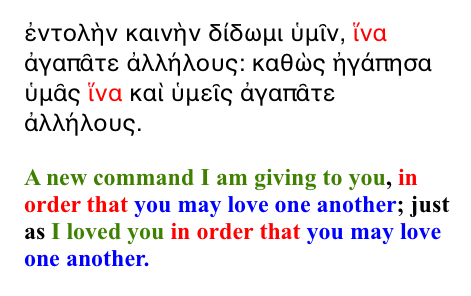
For that reason, I find the work of a Presbyterian pastor named Mark Davis compelling. Pastor Davis has a Ph.D. in theology and is very accomplished in the study and translation of Greek. He has recently made the argument that our typical translation of John is wrong and that, as a result, we haven’t properly understood the “new commandment.” It’s easier to show you his argument than it is to tell it, so I’m going to put a slide up on the big screen TV. (Commanding Love; see also ‘In Order That’ You May Love)

Here’s what we’ve got:

greekcolorcode

This is John 13:34 in the original Greek, and the lower color-coded text is Dr. Davis’s translation. The color coding helps to explain his argument.

Dr. Davis first points out that the original Greek is one sentence, not two. The translation in the New Revised Standard Version breaks it into two sentences. Second, he points out that the Greek is written in a poetic form called “parallelism,” which is the balanced and symmetrical repetition of a thought or idea in slightly different forms as a way to emphasize the message. The New Revised Standard fails to honor the parallelism and, in fact, adds an imperative that simply isn’t there. Third, he points out that the Greek word “hina” (which he has color-coded in red) has been either overlooked or possibly mistranslated.

This third point is really the most important. Pointing out that the word “hina” can be translated either as “that” or as “in order that,” and that “hina” is normally understood to specify purpose, Dr. Davis suggests the second translation, as shown here, is the better choice.

Thus, the “new commandment” is not simply “love one another.” The “new commandment” is something else that Jesus has said, done, or taught which enables us to love one another in the same way that his empowering love enables us to do so.

Therefore, Dr. Davis’ asks, “What is the new command ([of] which loving one another is the result)?” and answers his own question, “I would suggest that the whole demonstration of Jesus washing the disciples’ feet is the command.” In other words, the “new commandment” is not to love one another, it is to do what Dr. Johnson called those “mundane, menial tasks” and from that work will flow the capacity for and the actuality of loving one another, from that work will flow the actualizing and appreciation of the irruption the kingdom of God, from that work will flow the realization that “the kingdom of heaven has come near.” I know, from personal experience, that this is true.

In the spring of 1971, I was 18 years old and finishing my sophomore year of college. And I was failing, badly. So I dropped out. I went to work in a hospital where I eventually worked as an orderly, but I didn’t start out as an orderly. I started out as a janitor. Once I had learned how to clean toilets and mop floors in proper hospital fashion, I was turned loose to take care of the common areas and of the patient rooms.

Early in my employment, I became acquainted with Mr. Aronson. I have no idea what Mr. Aronson’s medical problem was . . . all I know is that whatever it was it made Mr. Aronson’s life miserable. Mr. Aronson’s digestive system was out of control. If he ate, he vomited and he had diarrhea. His doctors were trying to treat this, of course, and he had to eat to see of the treatment was working, and most of the time it seemed it wasn’t. Nearly every day I would get a call to go to Mr. Aronson’s room where I had to mop the floor of either puke or feces and to gather up soiled bed linens. I hated getting those calls. I hated going to that room. I hated mopping that smelly floor and packing up those stinking linens and, I’m sorry to say, I hated Mr. Aronson. His life sucked and it was making my life suck.

And he knew it. He knew his life miserable and that his misery was negatively impacting everyone around him. But he must have known something else because he never acted that way. He was always gracious and he was always grateful. I’d show up with my 18-year-old “I hate being here” attitude, and if he was awake he would greet me courteously. I’d mop up his puke and his diarrhea, and stuff his soiled linens into a laundry bag, and he’d thank me. I didn’t want to be there; I didn’t want to deal with his mess or his smelly sheets; and I didn’t want his gratitude. But, when you’re employed as a hospital janitor, that’s what you do.

And after several days of doing that, you stopped noticing the smell and the misery. Instead, you looked forward to the greeting and you were grateful for the gratitude. And when, after a few weeks, Mr. Aronson died because they couldn’t fix whatever was wrong with him, you wept because, you discovered, you no longer hated Mr. Aronson. You loved Mr. Aronson; he had become your friend, and your friend was gone.

Mr. Aronson, it turned out, was the rabbi of the local Reform Jewish synagogue. His wife invited all of the hospital employees who had taken care of him, even us janitors, to attend his funeral, and it was there that I first heard and first recited the prayer called The Mourner’s Kaddish:

Glorified and sanctified be God’s great name throughout the world
which He has created according to His will.
May He establish His kingdom in your lifetime and during your days,
and within the life of the entire House of Israel, speedily and soon;
and say, Amen.
May His great name be blessed forever and to all eternity.
Blessed and praised, glorified and exalted, extolled and honored,
adored and lauded be the name of the Holy One, blessed be He,
beyond all the blessings and hymns, praises and consolations that
are ever spoken in the world; and say, Amen.
May there be abundant peace from heaven, and life, for us
and for all Israel; and say, Amen.
He who creates peace in His celestial heights,
may He create peace for us and for all Israel;
and say, Amen.

I think that what Mr. Aronson knew that allowed him to be gracious and grateful is what I have come to know and believe: that if we will just take care of one another doing whatever mundane, menial tasks are needed, God will establish his kingdom in our lifetime and there will be abundant peace from heaven and life for all of us. From those mundane, menial tasks flows the capacity for and the actuality of loving one another, and that from that love flows the realization that “the kingdom of heaven has come near.”

Whether we understand the “new commandment” to be “love one another” or to be “do these things in order that love for one another can grow,” the point of Jesus’ “new commandment” is to foster good relationships between people, those good relationships that Dr. Waldinger’s research has shown are the foundation of a good life. I have faith that sometime in the future the kingdom of heaven will be complete and God will exercise a gracious and just control over everything in (and outside of) time and space, but I know that right now heaven is close at hand through Christians and other good people, individually and collectively, engaging the world in acts of love, both mundane and heroic.

Jesus insists that the kingdom of heaven is close at hand when we love one another. Medical science has proved it: “The good life is built with good relationships.” So I can say with confidence that heaven is here now, even for the person whose life sucks. Mr. Aronson taught me that. Amen.

====================

A request to my readers: I’m trying to build the readership of this blog and I’d very much appreciate your help in doing so. If you find something here that is of value, please share it with others. If you are on Facebook, “like” the posts on your page so others can see them. If you are following me on Twitter, please “retweet” the notices of these meditations. If you have a blog of your own, please include mine in your links (a favor I will gladly reciprocate). Many thanks!

====================

Father Funston is the rector of St. Paul’s Episcopal Church, Medina, Ohio.

Stairway to Heaven – Sermon for Easter 4C – April 17, 2016

====================

A sermon offered by the Rev. Dr. C. Eric Funston on the Fourth Sunday of Easter, April 17, 2016, to the people of St. Paul’s Episcopal Church, Medina, Ohio, where Fr. Funston is rector.

(The lessons for the day are Acts 9:36-43, Psalm 23, Revelation 7:9-17, and St. John 10:22-30. These lessons may be found at The Lectionary Page.)

====================

Stairway to HeavenThere’s a lady who’s sure
All that glitters is gold
And she’s buying a stairway to heaven
When she gets there she knows
If the stores are all closed
With a word she can get what she came for . . .

As I read and pondered both the vision of heaven in John of Patmos’ Revelation and the words of Jesus – “My sheep hear my voice. I know them, and they follow me” (Jn 10:27) – I could not get the words of Led Zeppelin’s Stairway to Heaven out of my head!

The metaphor of God’s Presence – and of our future and eternal life with God – in a place “beyond the sky” may be the oldest metaphor in the human lexicon. It is shared, in some form, by every culture on earth. Our distant ancestors standing at night and gazing at the moon and the stars, watching the sun as “wide he goes through empty heaven with repose” (RL Stevenson, Summer Sun), or facing “the fierce wind, while mid-day lightnings prowl [and] untimely thunders growl” (Wm Wordsworth, Composed During A Storm) conceived of the sky as a place of unspeakable and unimaginable power, the dwelling place of the gods.

But we have been there; we “have slipped the surly bonds of earth, and danced the skies on laughter-silvered wings;” we have “trod the high untrespassed sanctity of space.” (JG Magee, Jr, High Flight) Men have walked on the moon and our machines are even now wondering the surface of Mars; our probes have studied the moons of Jupiter and the rings of Saturn, and then left the planetary system entirely moving on “through corridors sublime, the [realms] of interstellar space and [the passageways] of time.” (And Have the Bright Immensities, The [Episcopal] Hymnal 1982, Hymn 459) We know that beyond the blue dome of our earthly sky is not some otherworldly domain filled with angels and gods, but the physical reality of the Solar System, the Milky Way galaxy, and the limitless universe. And, yet, the metaphor of heaven up there beyond the sky where we may get to go when we die, that metaphor still captures our imaginations and our spirits.

Our lesson from the Book of Revelation today is the second half of a two-part vision shown to John in Chapter 7 of the book; it begins with the words “After this. . . .” – “After what?” we may ask. In the first eight verses of the chapter, John is shown the “servants of our God [marked] with a seal on their foreheads,” an army numbering 144,000 – 12,000 from each of the Twelve Tribes of Israel. These represent what we traditionally call “the church militant,” defined theologically as Christ’s “disciples [who] are pilgrims on earth” (CCC 954), who are “engaged in constant warfare against the world, the flesh and the devil” (Turner, H.M., The Genius and Theory of Methodist Polity, A.M.E. Church, Philadelphia:1885, online). In other words, you and me and every other Christian currently alive, the people doing Jesus’ work on earth right now. Bible commentator Christopher C. Rowland of Oxford University tells us that the number, 144,000, is neither exclusive nor limiting; instead, like all of the numbers and measures in the book, it is a sign of God’s possession and ownership of the earth and its people. John’s numbers are not “a measure of the success of human endeavours.” (NIB, Vol. XII, page 620)

It is after this part of the vision that John then sees the “great multitude that no one could count, from every nation, from all tribes and peoples and languages, standing before the throne and before the Lamb.” (Rev. 7:9) This is “the church triumphant,” those who have died and “are in glory, contemplating ‘in full light, God himself triune and one, exactly as he is.’” (CCC 954) In a word, these are the “saints in heaven.”

John says that “one of the elders” in his vision describes them as those “who have come out of the great ordeal.” (vv 13-14) Early translations use the term “great tribulation” and many have suggested that this refers to some kind of organized persecution that may have been experienced by John’s original audience. But other scholars suggest that “the ‘tribulation’ (thlipsis) of Revelation’s [original] audience was not state-sponsored persecution but rather the social, economic, and religious marginalization of those who refused to participate in the Roman imperial system.” (Barbara Rossing) Thus, the lesson for us “is not that all Christians must shed blood as a form of testimony but rather, all Christians are candidates for tribulation in some form or the other, and in whatever comes their way, it is paramount to follow the Lamb’s way.” (Israel Kamudzandu)

Laurence Hull Stookey, Professor at Wesley Theological Seminary in Washington, D.C, in his book on the liturgical calendar, reminds us that these saints seen by John are not there by their own merit: “Men and women do not by sheer determination and self-discipline become saints. Sanctity is a divine gift. It is indeed the power of the resurrection at work in human lives. * * * We are saints because God’s sanctity is at work in us, not because on our own we have come to great spiritual attainment.” (Calendar: Christ’s Time for the Church, Abingdon Press, Nashville:1996, pp. 141-42)

In terms of Led Zeppelin’s famous song, we cannot build or buy a stairway to heaven on our own; we can only get there by “follow[ing] the Lamb’s way,” by hearing the Shepherd’s voice, being known by him, and following him. But if we listen to the Shepherd, what do we learn about heaven? What do we learn about where and when it is? Is it, as John’s vision suggests, only accessible after death? Is it, as John’s vision and Led Zep’s song and all the myths and legends of heaven suggest someplace beyond the sky?

Here’s an interesting thing . . . look the word “heaven” up in the New Testament and review all the times Jesus uses it and you will notice something fascinating: Jesus never refers to heaven in anything other than the present tense. Heaven is always now, never then. It’s not in the past; it’s not in the future; it’s now. And the other thing you will notice is that it is not far away: “The good news [is that]‘The kingdom of heaven has come near.’” (Mt 10:7) “The kingdom of God has come to you.” (Mt 12:28) “The time is fulfilled, and the kingdom of God has come near.” (Mk 1:15) “Blessed are you who are poor, for yours is the kingdom of God.” (Lk 6:20)

In today’s Gospel lesson, Jesus says, “My sheep hear my voice. I know them, and they follow me.” (Jn 10:27) He’s really just repeating something he said earlier in this same chapter: “I am the good shepherd. I know my own and my own know me, just as the Father knows me and I know the Father.” (Jn. 10:14-15) In John’s Gospel, “knowledge is not a cognitive category, but is a category of relationship.” (O’Day, Gail R., NIB, Vol. IX, p. 670) Those who hear his voice and follow him belong to Jesus and are in relationship with him in the same way that Jesus is in relationship with the Father. This kind of relationship “does not mean to be acquainted; rather, it means to have a living bond.” (Haenchen, Ernst, Commentary on the Gospel of John, Fortress Press, Philadelphia:1984, Vol. 2, p. 48)

And what is that “living bond”? Bishop Charles Grafton, early 20th Century bishop of the Episcopal Diocese of Fond du Lac, answered that in his commentary on the Catechism: “The Holy Spirit is the living bond which unites us in Baptism to Christ’s nature.” (Grafton, Charles C., A Catholic Atlas: Or Digest of Catholic Theology, Longmans Green, New York:1914, Vol. III, p. 112) It is through the action of the Holy Spirit that we are in relationship with Jesus and hear the voice of our Shepherd, or as the great 17th Century bible commentator Matthew Henry put it: “The great Shepherd of the sheep knows all that are his, guards them by his providence, guides them by his Spirit….” (Matthew Henry’s Commentary, online) The Spirit, as Jesus reminded Nicodemus late one night, “blows where it chooses, and you hear the sound of it, but you do not know where it comes from or where it goes.” (Jn 3:8) So we must listen carefully to hear the voice of our Shepherd.

“It is [a] voice which is especially precious in times of struggle and pain. And it is one we sometimes have to work harder to hear in better times when other voices especially seem to drown it out.” (Janet Hunt) Thus, “we tend to hear God’s voice better when we do so in community with others than when we are listening alone.” (Eric Mathis)

Led Zeppelin’s Stairway to Heaven ends with these words:

Dear lady, can you hear the wind blow
And did you know
Your stairway lies on the whispering wind
And as we wind on down the road
Our shadows taller than our soul
There walks a lady we all know
Who shines white light and wants to show
How everything still turns to gold
And if you listen very hard
The tune will come to you at last
When all are one and one is all
To be a rock and not to roll

Our “stairway to heaven” lies on the wind; it depends on the Spirit, who blows where she will and cannot be controlled, but who conveys to us the voice of our Shepherd. “And as we wind on down the road,” as we follow our Shepherd on the path he sets, “all are one and one is all;” we are all in that relationship, that living bond, with God and with one another. And we are not in want. We are cared for and protected, for our Shepherd is also our “strong rock, a castle to keep [us] safe . . . [our] crag and [our] stronghold.” (Ps 31:3) A rock that will not roll.

This is the kingdom of heaven – where we are – on the path with our Shepherd, hearing his voice, and being in relationship with him. We need not buy or build, indeed we cannot buy or build a stairway to get there; we are already here. “The kingdom of God has come to [us].” (Mt 12:28) When the Shepherd speaks and we hear his voice and follow, heaven it is not far away; it is here, always here, never there. Heaven is not in the past, nor is it in the future. It’s always now, never then. It’s here and it’s now.

Let me close by quoting a song about a hundred years older than Stairway to Heaven, a hymn first published in 1883:

Oh, not in far-off realms of space,
the spirit hath its throne;
in every heart, it findeth place,
and waiteth to be known.

Thought answereth alone to thought,
and soul with soul hath kin;
the outward God he findeth not
who finds not God within.

And if the vision come to thee,
revealed by inward sign,
earth will be full of Deity,
and with his glory shine.

Thou shalt not wait for company,
nor pitch thy tent alone:
the indwelling God will go with thee,
and show thee of his own.

O gift of gifts, O grace of grace!
That God should condescend
to make thy heart his dwelling-place,
and be thy daily friend.

(Hosmer, F.L., The Indwelling God, in Sacred Songs For Public Worship, Savage, M. J., ed., Geo. H. Ellis, Boston:1883, p. 35)

Rejoice! The kingdom of heaven has come to you! No stairway required. Amen.

====================

A request to my readers: I’m trying to build the readership of this blog and I’d very much appreciate your help in doing so. If you find something here that is of value, please share it with others. If you are on Facebook, “like” the posts on your page so others can see them. If you are following me on Twitter, please “retweet” the notices of these meditations. If you have a blog of your own, please include mine in your links (a favor I will gladly reciprocate). Many thanks!

====================

Father Funston is the rector of St. Paul’s Episcopal Church, Medina, Ohio.

Between Two Fires – Sermon for the 3rd Sunday of Easter – 10 April 2016

====================

A sermon offered by the Rev. Dr. C. Eric Funston on the Third Sunday of Easter, April 10, 2016, to the people of St. Paul’s Episcopal Church, Medina, Ohio, where Fr. Funston is rector.

(The lessons for the day are Acts 9:1-20, Psalm 30, Revelation 5:11-14, and St. John 21:1-19. These lessons may be found at The Lectionary Page.)

====================

https://upload.wikimedia.org/wikipedia/commons/thumb/5/5b/Church_of_Saint_Peter_in_Gallicantu.jpg/1200px-Church_of_Saint_Peter_in_Gallicantu.jpgIn Jerusalem, just outside the walled Old City to the south is a church built on the place where the house of Caiaphas, the high priest who oversaw Jesus’ crucifixion, is believed to have been. The church is named St. Peter in Gallicantu; the name is from the Latin meaning, “St. Peter where the rooster crowed.” It is a reference, of course, to Peter’s three denials of Christ in the courtyard of the high priest’s house.
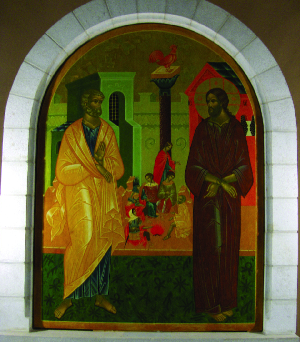
In the interior of the church, in niches on either side of the altar, are two icons. One depicts that episode which gives the church its name; the other, the story which we heard in today’s gospel lesson. The icons are similar in that they both depict Peter and Jesus on either side of a charcoal fire.

In the first, the fire is quite small and several other people are gathered around it. Jesus and Peter are in the foreground. Jesus is bound and looking directly at Peter; Peter’s eyes, on the other hand, are downcast and he is holding up one hand, palm toward Jesus as if to fend him off. The icon is captioned in Latin “Non novi illum” (Lk 22:57) – “I do not know him.”

In the second, the fire is much larger and is accompanied by baskets of fish and bread. There are no other people around the fire; the other disciples are still in the boat some distance off shore. Jesus, again, is looking directly at Peter. Peter, in this picture, is looking directly at Jesus and holding his hand out to Jesus to receive a shepherd’s staff which Jesus is handing to him. This icon is also captioned, again in Latin, “Domine tu omnia scis tu scis quia amo te” (Jn 21:17) – “Lord, you know everything; you know that I love you.”

Some bible scholars believe that Chapter 21 of John’s Gospel is an add-on, that the original text of this gospel ended with the statement at the end of Chapter 20: “Now Jesus did many other signs in the presence of his disciples, which are not written in this book. But these are written so that you may come to believe that Jesus is the Messiah, the Son of God, and that through believing you may have life in his name.” (vv 30-31) These scholars argue, and I think we have to admit, that that sounds pretty much like a definitive conclusion to the book. Thus, they argue that Chapter 21 from which we have heard today is either an afterthought that John felt compelled to add or the work of a second author, a false John who was apparently unsatisfied with the original text. However, I would suggest that Chapter 21 is neither an afterthought of John’s nor the forged addition of another: it is connected to the main body of John’s gospel by those charcoal fires and the number three.

Non novi illumOn that awful night, as all was being lost and his rabbi was being tried, mocked, and ultimately killed, Peter stood at that first charcoal fire and denied Jesus three times. As John tells the story in Chapter 18, Judas led the authorities to Jesus in the Garden of Gethsemane. Jesus was then taken away to Caiaphas’s courtyard and Peter, who had sworn that he would never deny Jesus, followed. The maid who watched the gate to the courtyard saw Peter and said to him, “Aren’t you one of this man’s disciples?”
Peter replied, “No, I’m not.”

John then tells us, “Now the slaves and the police had made a charcoal fire because it was cold, and they were standing around it and warming themselves. Peter also was standing with them and warming himself.” (Jn 18:18) There and here in today’s story in Chapter 21 are the only two places in all of the New Testament that fires are specifically described as being a “charcoal fire.” John is very deliberately contrasting these two scenes in his gospel.

A bit later, those with whom Peter was standing and keeping warm by the fire asked him if he were one of Jesus’ disciples; he replied, “No, I am not.” (Jn 18:25) And immediately another person asked Peter the same question and again Peter replied, “No.”

Just then, while Peter was still standing next to the charcoal fire in the courtyard, is when the crowed, confirming Jesus’ earlier word to Peter that Peter would deny him three times before the rooster’s call. Luke’s account tells us that at that moment, “the Lord turned and looked at Peter.” (Lk 22:61) That was when Peter realized what he had done and he was devastated: this is the moment depicted in the first icon in the Church of St. Peter in Gallicantu.

Peter left that first charcoal fire a broken man, weeping bitterly, and all alone. Eventually, he would re-connect with his fellow disciples. Eventually, with them, he would witness the empty tomb and encounter the Resurrected Jesus. Eventually, with Thomas, Nathaniel, James, John, and two others John does not name, he would go fishing. Eventually, he would come to this beach and to the second charcoal fire.

Domine tu omnia scisLooking at Peter across this charcoal fire after their breakfast of grilled fish, Jesus would begin a conversation of three questions and three answers: “Simon, son of John, do you love me more than these?” (Jn 21:15)

What Jesus is asking is if Peter loves Jesus more than the other disciples love Jesus. That is, after all, what Peter had said at dinner that night when he said that even if the others deserted Jesus he would never do that. But that, of course, is exactly what he did and more; he denied even knowing Jesus. So it must have been difficult for Peter to have this conversation at this charcoal fire remembering what happened at that charcoal fire.

Nonetheless, he answered, “Yes, Lord, you know that I love you.” In words that can only be taken as a clear sign of forgiveness as much as they are of empowerment and commissioning, Jesus responded, “Feed my lambs.” But that doesn’t end the conversation!

Jesus asked Peter a second time, “Simon son of John, do you love me?” Peter must have wondered, and certainly we wonder, why Jesus would ask him the same question. Again, he answered, “Yes, Lord; you know that I love you,” and again Jesus commissioned him, “Tend my sheep.”

And then, yet again, Jesus asked, “Simon son of John, do you love me?” (John changes the Greek verb here from agápe used in the first two questions to philía, naming in some circumstances a different sort of love, but whether that has any theological significance is a matter of debate. For us, today, it does not, but we should be aware of that change.)

John tells us that this third time, the question stings Peter. Says John, “Peter felt hurt . . . and he said to him, ‘Lord, you know everything; you know that I love you.'” (v 17) And again, Jesus commissioned Peter, “Feed my sheep” but this time with a warning saying, in essence, “It will be dangerous and you will suffer at the hands of others.”

Jesus then ended the conversation with a simple, “Follow me,” an invitation ripe with forgiveness; whatever had happened at that first charcoal fire, it is put behind them; it does not matter. The three denials have been wiped away by three declarations of love and three commissions to service. All that matters now is that Peter follow his Master and live out the task he has been given.

The second icon illustrates this as Jesus passes the pastoral staff, the shepherd’s crook, to Peter who reaches out to receive it.

In Section IV of T.S. Elliot’s poem Little Gidding the poet writes that we will all be “consumed by either fire or fire:”

The dove descending breaks the air
With flame of incandescent terror
Of which the tongues declare
The one dischage from sin and error.
The only hope, or else despair
Lies in the choice of pyre or pyre –
To be redeemed from fire by fire.

Who then devised the torment? Love.
Love is the unfamiliar Name
Behind the hands that wove
The intolerable shirt of flame
Which human power cannot remove.
We only live, only suspire
Consumed by either fire or fire.

The two charcoal fires of John’s Gospel, the two charcoal fires in the Gallicantu icons, show us the two fires of Elliot’s poem: the destructive fire of denial, or the life-giving, nourishing fire of resurrection, reconciliation, and forgiveness. The genius of the Church of St. Peter in Gallicantu is that it is in the space between these fires, between the two icons, between these two stories in John’s Gospel that the people’s worship takes place, that our lives as the people of God are lived, wearing that “intolerable shirt of flame which human power cannot remove.”

What that placement of worship between those two icons says is that Peter represents all of us, that in a sense we are all Peters. All of us have committed ourselves, like Simon Peter, to follow Jesus. That commitment was made at our baptism and again at our confirmation; it has been reaffirmed again and again, as it was on Easter morning in the reaffirmation of the baptismal covenant, as it was last week when we joined in baptizing Anthony Jon and Laura May on whose behalf the promises of that covenant were made for the first time. But, just like Peter, we have all of us betrayed that covenant, broken those promises, and denied the Lord we have sworn to follow. But then comes that gentle but supreme act of absolution, uttered from the cross: “Forgive them, Father, they don’t know what they are doing.” (Lk 23:34)

The image of the charcoal fires in the Gospel of John becomes an image of that divine mercy. One moment we’re warming ourselves at the fire of denial, potentially destroyed by the poor decisions we make, decisions that break our covenant promises. The next moment we’re with Jesus as he feeds us at the fire of mercy and forgiveness. The Lord is faithful to us even when we have not been faithful to him, and it is through his faith that we are healed and restored, and eventually, like him and with him, risen to new life.

Thanks be to God. Amen.

====================

A request to my readers: I’m trying to build the readership of this blog and I’d very much appreciate your help in doing so. If you find something here that is of value, please share it with others. If you are on Facebook, “like” the posts on your page so others can see them. If you are following me on Twitter, please “retweet” the notices of these meditations. If you have a blog of your own, please include mine in your links (a favor I will gladly reciprocate). Many thanks!

====================

Father Funston is the rector of St. Paul’s Episcopal Church, Medina, Ohio.

God Is the Question – Sermon for Easter 2, Year C (3 April 2016)

====================

A sermon offered by the Rev. Dr. C. Eric Funston on the Second Sunday of Easter, April 3, 2016, to the people of St. Paul’s Episcopal Church, Medina, Ohio, where Fr. Funston is rector.

(The lessons for the day are Acts 5:27-32; Psalm 150; Revelation 1:4-8; and St. John 20:19-31. These lessons may be found at The Lectionary Page.)

====================

The-Doubt-of-St_Thomas-300x300Every year on the Second Sunday of the Easter season, we read the story from John’s Gospel of Thomas’s refusal to accept the testimony of his fellow disciples, but in each year of the Lectionary Cycle, it is coupled with different lessons from the Book of Acts and a different epistle lesson. So this year, in Year C of the cycle, we have heard of the confrontation between Peter and the high priest about the apostles’ teaching in the Temple, and we have heard part of the introduction of John of Patmos’ Revelation.

In the first, we see the clash between two parties each absolutely convinced of the truth of their conception of God: the high priest, speaking for the council, is absolutely sure that his God, the God of the Hebrew Scriptures, had nothing to do with the itinerant rabbi from Galilee; Peter, speaking for the fledgling Christian community, is just as certain that his God, the Father of Jesus Christ, had everything to do with him. There is no way to avoid conflict between these two camps, their spokesmen, and their very different understandings.

In the reading from Revelation, John of Patmos gives us yet another view of God, whom he quotes as saying, “I am the Alpha and the Omega,” and who (says John) is and was and is to come. John’s God is a god of multiple times, multiple places, and multiple possibilities.

These lessons encourage us to grapple with the story and example of Thomas, the apostle whose insistence on solid evidence of Jesus’ Resurrection earned him the epithet “the Doubter,” but who in fact made the first post-Resurrection statement of convicted faith, crying out “My Lord and my God!” upon seeing Jesus.

My friend David Henson, a priest and journalist in North Carolina, says that “it hardly seems fair” to brand Thomas as “the archetypal doubter, the skeptic that demanded proof.” “He wasn’t the only disciple in the Christian gospels to express disbelief or doubt at the reports of resurrection.” (Easter for Doubters: The Unexpected Faith of Thomas, Patheos, April 1, 2013) And Professor David Lose, president of Lutheran Seminary in Philadelphia, agrees with him:

When you read through the resurrection accounts of all four gospels, you quickly realize that Thomas is not alone in his doubt. In fact, doubt isn’t the exception but the rule. No one – even after all the predictions – no one says, “Welcome back.” Or “We knew it.” Or even “What took you so long?” No. No one anticipates Jesus return and when he shows up, everyone doubts. Everyone.

Which makes me think that maybe doubt isn’t the opposite of faith but, actually, part of it, maybe even an essential part of it. (Faith and Doubt, Dear Working Preacher, April 8, 2012)

Last week in The New York Times, William Irwin, professor of philosophy at King’s College, a Roman Catholic school in Wilkes-Barre, PA, wrote an op-ed piece entitled God Is a Question, Not an Answer (The New York Times Opinionator Blog, March 26, 2016). In it he said:

People who claim certainty about God worry me, both those who believe and those who don’t believe. They do not really listen to the other side of conversations, and they are too ready to impose their views on others. It is impossible to be certain about God.

***

We should all feel and express humility in the face of the question even if we think the odds are tilted heavily in favor of a particular answer.

Thus, Prof. Irwin says, “The believer should concede that she does not know with certainty that God exists. There is no faith without doubt.”

Today, we will baptize Laura May and Anthony Jon, and welcome them into the household of faith, into the community which believes not only that there is a God, but that that God is most fully revealed to humankind in the life, ministry, death, and resurrection of Jesus of Nazareth. Over the course of their lifetimes, they will explore with us what that means.

We could tell them, as many Christian preachers do, that “God is the answer.” They will encounter people like the Christian writer Dana Gatlin who begins one of her books with this firm statement and admonition:

In every human difficulty I have learned to center on God as the way out. God is the answer! ~ Center on God quickly, completely. God cannot fail! God loves you, right now is waiting to help you, and if you really put your trust in Him with all your heart, He will not fail you. Trusting in Him utterly, you cannot fail! ~ Whatever your dilemma or need may be, God is the answer. (God Is the Answer, Kansas City: Unity School of Christianity, 1940, p 7)

And they will encounter many others who witness that many in this life do in fact fail and that there always seem to be dilemmas which cannot be resolved and needs that are never met, and thus just as firmly assert that not only is God not the answer, but that there is no God. This conflict of certainties is not unlike that between Peter and the high priest about which we heard in the reading from the Book of Acts.

In this Easter season of alleluias we can sometimes be blinded to the reality of human doubts, fears, and pain, even our own. We tend to forget, as Professor Lose reminded us, that for the first disciples, for every one of them, not just Thomas, there was fear, doubt, pain, and confusion before there was understanding and joy at what had taken place. The loud alleluias of Easter can make us forget that, as Prof. Irwin suggests, we “all exist along a continuum of doubt. Some of us will approach religious certainty at one extreme and others will approach atheistic certainty at the other extreme. Many of us will slide back and forth over time.” The story and example of Thomas serves as a reminder.

Poet Denise Levertov in her poem St. Thomas Didymus remembers another man in scripture who, like Thomas, expressed his doubts, a father who came to Jesus in the midst of fear and pain seeking healing for his child. Mark tells us the story of the man who brought his son to Jesus saying, “Teacher, I brought you my son; he has a spirit that makes him unable to speak; and whenever it seizes him, it dashes him down; and he foams and grinds his teeth and becomes rigid. * * * If you are able to do anything, have pity on us and help us.” Jesus replied, “All things can be done for the one who believes.” In answer, the man cried out, “I believe; help my unbelief!” (Mark 9:17-24)

Levertov imagines that Thomas witnessed this encounter and, remembering that Thomas’s name means, “the Twin,” names the father as Thomas’s “spiritual twin.” Her poem gives voice to Thomas’s doubts and their resolution:

In the hot street at noon I saw him
a small man
gray but vivid, standing forth
beyond the crowd’s buzzing
holding in desperate grip his shaking
teeth-gnashing son,

and thought him my brother.

I heard him cry out, weeping and speak
those words,
Lord, I believe, help thou
mine unbelief,

and knew him
my twin:

a man whose entire being
had knotted itself
into the one tight-drawn question,
Why,
why has this child lost his childhood in suffering,
why is this child who will soon be a man
tormented, torn, twisted?
Why is he cruelly punished
who has done nothing except be born?

The twin of my birth
was not so close
as that man I heard
say what my heart
sighed with each beat, my breath silently
cried in and out,
in and out.

After the healing,
he, with his wondering
newly peaceful boy, receded;
no one
dwells on the gratitude, the astonished joy,
the swift
acceptance and forgetting.
I did not follow
to see their changed lives.
What I retained
was the flash of kinship.
Despite
all that I witnessed,
his question remained
my question, throbbed like a stealthy cancer,
known
only to doctor and patient. To others
I seemed well enough.

So it was
that after Golgotha
my spirit in secret
lurched in the same convulsed writhings
that tore that child
before he was healed.
And after the empty tomb
when they told me that He lived, had spoken to Magdalen,
told me
that though He had passed through the door like a ghost
He had breathed on them
the breath of a living man –
even then
when hope tried with a flutter of wings
to lift me –
still, alone with myself,
my heavy cry was the same: Lord
I believe,
help thou mine unbelief.

I needed
blood to tell me the truth,
the touch
of blood. Even
my sight of the dark crust of it
round the nailholes
didn’t thrust its meaning all the way through
to that manifold knot in me
that willed to possess all knowledge,
refusing to loosen
unless that insistence won
the battle I fought with life.

But when my hand
led by His hand’s firm clasp
entered the unhealed wound,
my fingers encountering
rib-bone and pulsing heat,
what I felt was not
scalding pain, shame for my
obstinate need,
but light, light streaming
into me, over me, filling the room
as I had lived till then
in a cold cave, and now
coming forth for the first time,
the knot that bound me unravelling,
I witnessed
all things quicken to color, to form,
my question
not answered but given
its part
in a vast unfolding design lit
by a risen sun.

(St. Thomas Didymus in Denise Levertov, The Stream and the Sapphire; Selected Poems on Religious Themes, New York: New Directions Books, 1997, p 81)

In a moment, we will baptize Laura May and Anthony Jon. Before we do so, their parents and Godparents will make some promises and commitments on their behalf and then, as the presiding priest, I will ask them and you some questions about belief: “Do you believe in God the Father?” “Do you believe in Jesus Christ, the Son of God?” “Do you believe in God the Holy Spirit?” And each time the answer will be, “I believe.”

Perhaps for some of us, perhaps sometimes for all of us, the unspoken answer will be “I believe, help thou mine unbelief.” The affirmations of the Creed, which is what those answers are, are not statements of certainty like those of Peter or the high priest, of the author who asserts that “God is the answer,” or of the atheist who insists there is no God. They are, rather, statements of faith, statements of hope, statements of trust in the God who is the Alpha and the Omega, who is and was and is to come, the God of multiple times, multiple places, and multiple possibilities.

The Trappist monk Thomas Merton wrote, “You cannot be a [person] of faith unless you know how to doubt. You cannot believe in God unless you are capable of questioning . . . .” Therefore, he said, religious faith “is a decision, a judgment that is fully and deliberately taken in the light of a truth that cannot be proven.” (Thomas Merton, New Seeds of Contemplation, New York: New Directions Books, 2007, p 105)

It is said that when the early 20th Century novelist and poet Gertrude Stein lay on her deathbed, her life partner Alice B. Toklas at her bedside, Stein roused herself and asked, “What is the answer?” Toklas was unable to respond and sat there silent. “In that case,” Stein said, “What is the question?”

The question is God. God is the Question. When we welcome Laura May and Anthony Jon into the household of faith, we welcome them not to a life of nailed down certainty, but to a life of exploring the Question, in the course of which some lesser questions may be answered, but for the most part they will find that, like Levertov’s Thomas, their questions (and ours) will not so much answered as given their part in a vast unfolding design lit by the risen Son. Amen.

====================

The illustration is “The Doubt of St. Thomas” by the Chinese artist He Qi.

A request to my readers: I’m trying to build the readership of this blog and I’d very much appreciate your help in doing so. If you find something here that is of value, please share it with others. If you are on Facebook, “like” the posts on your page so others can see them. If you are following me on Twitter, please “retweet” the notices of these meditations. If you have a blog of your own, please include mine in your links (a favor I will gladly reciprocate). Many thanks!

====================

Father Funston is the rector of St. Paul’s Episcopal Church, Medina, Ohio.

An Ordinary Olive Grove – Sermon for Maundy Thursday, 24 March 2016

====================

A sermon offered by the Rev. Dr. C. Eric Funston on Maundy Thursday, March 24, 2016, to the people of St. Paul’s Episcopal Church, Medina, Ohio, where Fr. Funston is rector.

(The lessons for the day are Exodus 12:1-14; Psalm 116:1,10-17; 1 Corinthians 11:23-26; and St. John 13:1-17,31b-35. These lessons may be found at The Lectionary Page.)

====================
Gethsemane Olive TreesThey have had their dinner during which, predicting his death, Jesus has instructed them to share bread and wine again and again in his memory. Jesus has washed their feet. He has given them his New Commandment, “Love one another.” Now, dinner ended, it is time for a stroll in the garden.

In 2014, when Evelyn and I were privileged to visit Jerusalem and spend some time in the Garden of Gethsemane, what struck me most (and I admit that this entirely pedestrian and not the least bit spiritual) was how very similar the trees there were the olive trees she and I had in our front yard when we lived in Las Vegas! And as I have contemplated our experience with olive trees, it has struck me how appropriate that location was, how illustrative and instructive it is that Jesus prayed amongst olive trees.

The first thing that I can tell you from experience is that olive trees are messy! They are a broad-leafed evergreen, which means they are constantly shedding leaves. The olive leaf is only about an inch or two long and about a half-inch wide. They have a lovely glossy deep green color on top, and a pale silvery green underside. They are tough and very stiff, especially as they dry out. This makes them impossible to rake up! Our life with olive trees was a constant battle with cleaning up leaves that didn’t want to be cleaned up. Furthermore, at the beginning of the growing season, the olive blossoms produce huge amounts of yellow-tan pollen that blows all over everything, and then the blossoms themselves fall off. We had a large in-ground pool in Las Vegas; keeping it clear of olive leaves, olive pollen, and olive blossoms was simply impossible! And, finally, there is the fruit itself. Olives seem to have a hard time holding on to their fruit; it drops about as often as leaves. I guess in commercial groves enough must stay on the tree to make their cultivation financially viable, but our ornamental trees seemed to lose more fruit to the wind than there was left on the tree to harvest.

And isn’t that what life is like. It’s messy! Jesus praying amidst the messy olives of Gethsemane reminds us that Jesus meets us in the messiness of life, that he redeems messy human life. There is not a single person on this earth, and never has been, whose life is not in same way a mess. Every one of us has problems, some worse than others; we all struggle with issues and circumstances. Some of them we share with each other and we get one another’s help, but some of them scared us so badly that we keep them to ourselves. We put on a brave face and we smile through them and meanwhile the messiness eats us up inside . . .

So we go someplace by ourselves and throw ourselves on the ground and pray, “God, if it is possible, let this cup pass from me….” (Mt 26:39) The truth is that that is the very place where God meets us: in the messiness of life, in the brokenness of life, in the painful chaos that we cannot, on our own, make orderly, and neat, and fixed. If you read the Bible, if you really read the stories of the Old and New Testament, that’s when God shows up in people’s lives; at the worst possible time, when everything is breaking down and going to pot, that’s when God shows up.

That’s what was happening that night in Jesus’ closest companions’ lives. They had “hoped that he was the one to redeem Israel” (Lk 24:21), but after they made that great entry into Jerusalem everything had changed and gone from bad to worse, and at dinner instead of talk of overthrowing the oppressors and taking the throne he had spoken of betrayal and death and sacrifice. Instead of proclaiming a “new world order,” he’d gotten down on his knees and washed away the dirt from their feet. Not in their political dreams of revolution, but in the messiness that they had walked through, in the messiness they had tracked into the Passover Feast, that was where Jesus met them.

The messiness of the olive grove in which Jesus prayed reminds us of that: that God meets us in the messiness of life.

Olives are also long-lived. They aren’t the longest lived of trees. Those are the bristlecone pines (pinus longaeva) of my native state, Nevada. In my college years, as I have mentioned a time or two before, a common pastime of my friend group was backpacking and wilderness camping. During the late spring and summer months, one of our favorite places to go was an area called the Mammoth Lakes region of the Sierra Nevada Mountains. On the inland side of the Sierras in that area is a subsidiary range on the California-Nevada border called the White Mountains. This is the location of the oldest living tree on earth. The US Forestry Service claims that in the White Mountain forest there is a bristlecone pine that is over 5,070 years of age. They will not identify the particular tree, but they do acknowledge that it is in the southern part of the White Mountain range. That is exactly the area where we used to hike and camp, so it’s possible that I have sat beside that elder-statesman tree. I always marvel at old trees and what they must have witnessed!

I felt that way amongst the old olive trees at Gethsemane. But while the domestic olive tree (olea europea) can live for hundreds of years, they do not live as long as bristlecone pines. None of the trees currently in the Garden of Gethsemane were there at the time of Jesus. The eight oldest olive trees in the grove (which, by the way, what it was and is, a grove not a garden) have been analyzed and the scientists who did so say they date from the early 12th Century. They are genetically identical; they share the same DNA. They appear to have been cultivated from a single parent tree which, in the 12th Century, was reputed to have witnessed events of Holy Thursday night. Father Pierbattista Pizzaballa, the Franciscan Custos of the Holy Land, has suggested that that 12th Century cultivation of these eight trees was “a deliberate attempt to pass on a precious heritage for future generations.” (Reuters news article, October 19, 2012)
In any event, Jesus at prayer amongst the long-lived olive trees reminds us of the promise that he will make to his disciples after his Resurrection: “Remember, I am with you always, to the end of the age.” (Mt 28:20) Indeed, it is true that God has been and always will be yearning to be with us. As one of our Eucharistic prayers puts, “Again and again, [God] called us to return. Through prophets and sages [God] revealed [God’s] righteous Law.” (Eucharistic Prayer C, Book of Common Prayer 1979, p 370)

The longevity of the olive trees under whose branches Jesus prayed reminds us of that: that God has always been there, has always wanted to be in relationship with us, and in Jesus has promised to be with us always, longer than the life of the olive, longer than the life of the bristlecone pine, longer than we can imagine.

The third thing we know about olives is that they are nutritious. Dozens of health-protective nutrients have been identified in olives. The high monounsaturated fat content of olives has been associated with reduced risk of cardiovascular disease. They are very high in vitamin E and other powerful antioxidants. Studies show that they may protect against osteoporosis and cancer. Olives are good food.

Many years ago I read an interview with the abbess of a Zen Buddhist convent in Tokyo. The interview had to do with the convent’s reputation not only for spiritual nourishment, but for very good food as well. Abbess Koei Hoshino said in that interview, “We receive three graces from food. First, we become healthy in mind and body; second, we have the ability to be thankful for all things, and to maintain that state of mind; third, we are able to work for others with our mind and body. We will be able to give to others. Those are the virtues we receive.” (T. King, The Spiral Path, Yes International:1992, p 161) A Christian monastic, Brother Peter Reinhart makes a similar point: “Food is not only a basic human need, it is also a sacred symbol: God in a multitude of forms and bodies. It is a focal point of fellowship and celebration.” (Sacramental Magic in a Small-Town Cafe, Running Press:1994, p xxii)

When we end our Eucharist this evening, we will go into the Parish Hall for a short time of fellowship, a simple meal recalling the Passover meal Jesus shared with his friends. We share simple foods: bread, cheese, wine, fruit, olives. We do not presume to call our meal a Passover feast; we give it a different name: The Agape Meal. Agape is one of the Greek words translated into English as “love”, so the meal is sometimes called a “love feast.” Scholars tell us that in early Christian practice a similar meal was nearly always shared whenever the faith community gathered for the Eucharist; the two rituals when hand-in-hand. A core tradition in the early church, the Agape Meal explicitly recalls not only the Last Supper, but all the meals Jesus shared with his friends and disciples, including the post-resurrection meals recounted in the Gospels of Luke and John. “It is a focal point of fellowship and celebration.”

The fruit of the olive trees amongst which Jesus prayed reminds us of that, of the Christian sacramental view in which ordinary things – ordinary food shared with ordinary people – can be instruments of grace embracing us in God’s immediacy, God’s intimacy in our lives.

On Maundy Thursday, Jesus took ordinary food, the bread and wine of a meal, and instituted the Holy Eucharistic. He took an ordinary towel and a basin of water and commanded his disciples, “Love one another as I have loved you.” He prayed in an ordinary grove of trees and reminded us that God comes to us in all the messy ordinariness of life, always and forever, and with immediate and intimate grace.

Amen.

====================

A request to my readers: I’m trying to build the readership of this blog and I’d very much appreciate your help in doing so. If you find something here that is of value, please share it with others. If you are on Facebook, “like” the posts on your page so others can see them. If you are following me on Twitter, please “retweet” the notices of these meditations. If you have a blog of your own, please include mine in your links (a favor I will gladly reciprocate). Many thanks!

====================

Father Funston is the rector of St. Paul’s Episcopal Church, Medina, Ohio.

« Older posts Newer posts »