Occasional thoughts of an Anglican Episcopal priest

Category: Mark (Page 10 of 18)

Parabolic Poetry, Parabolic Focus – Sermon for Pentecost 3B (14 June 2015)

====================

A sermon offered on the Third Sunday after Pentecost, June 14, 2015, to the people of St. Paul’s Episcopal Church, Medina, Ohio, where Fr. Funston is rector.

(The lessons for the day are 1 Samuel 15:34-16:13; Psalm 20; 2 Corinthians 5:6-17; and Mark 4:26-34. These lessons can be read at The Lectionary Page.)

====================

Conic SectionsBefore we tackle today’s lessons from Scripture, we’re going to recall (or perhaps learn for the first time) something from geometry class. First, I want you to envision a cone. You know what a cone is: A cone is a three-dimensional geometric shape that tapers smoothly from a flat base to a point called the apex or vertex; or another way of defining it is the solid object that you get when you rotate a right triangle around one of its two short sides. So, envision one of those.

Now, envision a one-point thick plane slicing through the cone and envision the plane as being exactly parallel to the slope of the cone, or more technically, parallel to a plane which is tangential to the cone’s surface.

Where the plane and the cone intersect, there is now a U-shaped, two-dimensional, mirror-symmetrical curve called a “parabola.” If take that curve, invert it, and rotate it through 360 degrees, we create a “parabolic bowl.” Astronomers mirror-coat such bowls and use them in their telescopes because they reflect light inward to a common point and amplify its intensity; parabolic reflector telescopes make whatever they are looking at clearer to see. Parabolic microphones work the same way with sound.

OK… why am I telling you this?

That curve, a “parabola,” was given its name by Apollonius of Perga, a 3rd Century B.C.E. mathematician, who put together two Greek words: para, meaning “along side,” and ballein, meaning “to throw” or “to place.” The plane which cuts the parabolic curve from the cone is placed (or thrown) alongside (parallel to) the plane tangent to the cone and the curve is created.

The English word parable, which describes these stories of Jesus (and others), is derived from exactly the same original Greek words. Parables are not just cute stories; they are extended metaphors. When someone tells a parable, they are throwing (ballein) one image alongside (para) another as away to illuminate our understanding; like a parabolic mirror or a parabolic microphone, their purpose is to focus our attention so as to lead to greater understanding.

So now we have two parables in today’s gospel, two short stories which are meant to help us understand the kingdom of God. Not “heaven”! Not some mythical place of eternal reward to look forward to after we die, but the kingdom of God which Jesus told us “has come near” and which we pray (some of us) everyday will “come on earth as it is in heaven,” the kingdom of God which is a present, if not yet fully comprehended, reality.

To what can we compare the kingdom of God? Seed scattered (actually “thrown”) by an unobservant and unaware person, seed which takes root and grows when the sower isn’t watching and in ways the sower cannot understand, seed which then produces a crop to the benefit of this ignorant sower. Or, alternatively, to a grain of mustard which also grows in a mysterious way to become a giant bush in which all the birds can make their nests; in fact, the sort of mustard of which Jesus would have been speaking completely takes over the soil in which it is grown – it is an invasive weed whose roots spread in great profusion so that nothing else can grow with it.

Thrown alongside our incomplete picture of the kingdom of God, what can we learn from these parables? What further understanding is parabolically illuminated?

Let’s ponder that question while we turn our attention to today’s Old Testament lesson from the First Book of Samuel. Many commentaries will tell you today’s reading begins the story of David as King of Israel, but that’s not really so. At best, it is the story of David’s first anointing, privately with only his family present, as a potential king in ancient Israel; he will be anointed again, publicly, as king over Judah, in the second chapter of Second Samuel and then again publicly as king over the rest of Israel in the fifth chapter. This isn’t the beginning of David’s story; it is really a tangent, an excursus from Saul’s story, from the story of Saul’s decline and eventual failure as Israel’s first king.

Note the way the lesson begins – “Samuel went to Ramah . . . . ” – and then note the way it ends – “Samuel went to Ramah . . . . ” The words are repeated almost verbatim. In Hebrew literature this repetition indicates a sort of parenthetical addition to a main story. It’s as if the story teller were saying, “O let me fill you in on a little backstory” or “Hang on while I tell you this interesting but unrelated bit of information.” German bible scholars coined a term for this; it’s called a wiederholenden Wiederaufnahme, which simply means “repetitive resumption.” “Samuel went to Ramah” – tell your parenthetical story, then pick up the main story again by repeating – “Samuel went to Ramah.” We find examples like this scattered throughout the Old Testament.
So we have the story of David’s private anointing as just an aside to the larger story of King Saul. Like the parables of the scattered grain and the mustard seed, it is a story of the seemingly insignificant. Samuel expected that Jesse’s eldest son, the tall, good-looking Eliab, was God’s chosen, but that wasn’t so; nor was it to be Abinadab, nor Shammah, nor any of the next three. It was the smallest, the youngest, little David, out keeping the sheep and easily forgotten, who was to be the next king.

In the kingdom of God, the least can be the source of greatness, what is unseen, uncomprehended, and not understood can be the source of a great harvest. The measures and standards of the world where size and good-looks, power and influence, status and position determine outcomes are not those of the kingdom of God. So David is anointed . . . . and then “Samuel went on to Ramah” and the story of Saul continues.

The story of David’s private anointing in his father Jesse’s home is like a little seed planted in the reader’s mind, a little seed planted in Israel’s history. For the rest of the story of Saul, who doesn’t die for another fifteen chapters, as Saul descends into physical, mental, and spiritual illness, as he first calls David as a soothing friend and companion but soon turns against him as his rival and eventual replacement, this little seed of David’s private anointing will take root and grow. He will publicly become king and his kingship will blossom, his kingdom will grow, and under the reign of his son Solomon it will be an earthly empire. Eventually, his descendant Jesus of Nazareth will be born. In God’s kingdom, the seed planted in Jesse’s home will slowly grow until in the incarnation of God in Jesus as the babe of Bethlehem, in his life, death, resurrection, and ascension the kingdom of God will come near and Jesus will reign in heaven and on earth, a kingdom that will never end, growing in ways we cannot see and cannot understand, spreading like a mustard bush, producing a yield ripe for harvest.

To what can we compare the kingdom of God and what parable can we use for it? It grows, in ways we cannot see and cannot comprehend; from small beginnings it spreads its branches until everyone can find shelter in them. In our prayer book office of morning prayer there is a wonderful prayer for mission written by Bishop Charles Henry Brent which begins with these words: “Lord Jesus Christ, you stretched out your arms of love on the hard wood of the cross that everyone might come within the reach of your saving embrace . . . .” I have a friend who dislikes this prayer; it is, he insists, “simplistic transactional theology.” I have to admit that I don’t even know what he means when he says that, but my answer to him is, “It’s not theology; it’s prayer . . . and it’s poetry, parabolic poetry.” The prayer, like a telescope with a parabolic mirror, like a parabolic microphone, like the parables of Jesus, focuses our attention on our place and our mission as followers of Jesus. Like the wide-spreading branches of the mustard bush, Jesus’ arms spread wide inviting all to take shelter.

What began as the small seed of the private anointing of David in the home of Jesse the Bethlehemite has come to fruition in his ancestor Jesus, who (as Paul reminds us) is the “one has died for all . . . so that those who live might live no longer for themselves,” but rather live as “a new creation: everything old has passed away; see, everything has become new!”

Bishop Brent’s prayer for mission concludes with this petition: “So clothe us in your Spirit that we, reaching forth our hands in love, may bring those who do not know you to the knowledge and love of you . . . .” We may not see and we may not understand how the seed germinates, how it grows, how “first the stalk, then the head, then the full grain in the head” appear, but now, and like the sower in the parable, it is time for us to go in with our sickle, with our hands reaching forth in love, because the harvest has ready. Amen.

====================

A request to my readers: I’m trying to build the readership of this blog and I’d very much appreciate your help in doing so. If you find something here that is of value, please share it with others. If you are on Facebook, “like” the posts on your page so others can see them. If you are following me on Twitter, please “retweet” the notices of these meditations. If you have a blog of your own, please include mine in your links (a favor I will gladly reciprocate). Many thanks!

====================

Father Funston is the rector of St. Paul’s Episcopal Church, Medina, Ohio.

“By the Grace of God” – Blasphemy! (Sermon for Pentecost 2, 7 June 2015)

====================

A sermon offered on the Second Sunday after Pentecost, June 7, 2015, to the people of St. Paul’s Episcopal Church, Medina, Ohio, where Fr. Funston is rector.

(The lessons for the day are 1 Samuel 8:4-20;11:14-15; Psalm 138; 2 Corinthians 4:13-5:1; and Mark 3:20-35. These lessons can be read at The Lectionary Page.)

====================

CrownAs I read the lessons for today, I had one of those weird little flashes of memory when some small bit of trivial knowledge you had forgotten you knew floats to the surface . . . . In this case it was something from my 9th Grade American History class. My American History teacher loved to fill us up with the minutiae of our country’s past and the one that came to mind is the debate over what to call the President of the United States: the Founders had to determine how the president was to be introduced. There were, apparently, some who favored “His Democratic Majesty, by the Grace of God, President of the United States.” Other senators recommended “His Elective Majesty” and John Adams recommended the title: “His Highness, the President of the United States and Protector of their Liberties.” All of this embarrassed George Washington who would have none of it; he wanted simply to be called “the President of the United States” and to be addressed as “Mr. President.” And thus it has been since then. The American president doesn’t even get “Your Excellency” as the presidents of other nations do.
The reason this came to mind, I think, is the story of the election or selection of Saul as first king of the Israelites, the first part of which we heard today from the First Book of Samuel. Let’s set the scene . . . .

This is the end of the period of the judges, which is a really poor translation of the Hebrew word shofet which describes what were essentially warlords. After the Hebrews had finished their trek across the desert of Egypt, after the first generation (whom God had forbidden to enter the Promised Land) had died, they settled the land which came to be called Israel and they become known as Israelites. But they were not a united nation in the sense we think of today. At best, they were a loose confederation of tribes with no sort of central administration. Whenever they were threatened from the outside, the leader of one tribe would be commissioned and anointed to lead their assembled troops. You know the names of some of these people: Gideon, Deborah (yes, there were female judges), Samson. They would lead the amassed warriors until the end of whatever crisis and then return to their life as a tribal leader.

Eventually, however, the people decided that this wasn’t a workable arrangement. So they come to the most recent of the judges, who was also a prophet, Samuel, and say to him (as we heard in the lesson), “Anoint us a king so that we can be like other nations.” Specifically, in our reading today, they say they want a king to “govern us and go out before us and fight our battles;” in other words, they want someone to go to war for them.

Samuel is very upset by this; he considers this to be an affront not only to himself but to God! So he prays to God and asks what to do. God reassures him, “They aren’t rejecting you; they are rejecting me, which they have done many times in the past.” And God tells him to give them what they want, but tells Samuel to warn them of what will happen, what it means to have a king who goes to war. He does so. He tells them, “Look – a king will turn you into slaves. He will take your sons and turn them into soldiers; he will make your daughters [I love this]; he will take your horses and your flocks and the produce of your fields. You will not like it, but when you call out to God, God will not answer you.” I think that last warning may be a statement that whomever they choose (and they end up choosing Saul) will not be king “by the Grace of God.” This is fine with the people: “We want a king,” they say.

So off they all go to Gilgal and, although we aren’t given the details in today’s lesson, they choose Saul to be king . . . and we know how that works out – Saul is a terrible king and has to be replaced. Eventually God would send Samuel to anoint David and David would then be succeeded by Solomon and, after Solomon, the kingdom would split and both Israel in the north and Judah in the south would suffer a series of pretty bad monarchs. But even David and Solomon, back to whose rule the people of God have looked for millennia as a sort of “golden age,” were not that great: David was guilty of essentially murdering a soldier, Uriah, and committing adultery with his wife, Bathsheba; Solomon had hundreds of wives and amassed great wealth at the expense of his people. None of them lived up to the ideal of kingship which God had pronounced through Moses at the very beginning of the Hebrews’ occupation of the Promised Land.

Interestingly, our Daily Office Lectionary this past week included (on Wednesday) that very description of kingship in a reading from the Book of Deuteronomy. As I was pondering today’s reading, I wondered if Samuel, or perhaps even God, had forgotten these words spoken to the Hebrews by Moses on the border of Canaan which he (as part of that disobedient original generation) was forbidden to enter. In his farewell discourse, speaking on God’s behalf, Moses had said:

When you have come into the land that the Lord your God is giving you, and have taken possession of it and settled in it, and you say, “I will set a king over me, like all the nations that are around me,” you may indeed set over you a king whom the Lord your God will choose. One of your own community you may set as king over you; you are not permitted to put a foreigner over you, who is not of your own community. Even so, he must not acquire many horses for himself, or return the people to Egypt in order to acquire more horses, since the Lord has said to you, “You must never return that way again.” And he must not acquire many wives for himself, or else his heart will turn away; also silver and gold he must not acquire in great quantity for himself. When he has taken the throne of his kingdom, he shall have a copy of this law written for him in the presence of the levitical priests. It shall remain with him and he shall read in it all the days of his life, so that he may learn to fear the Lord his God, diligently observing all the words of this law and these statutes, neither exalting himself above other members of the community nor turning aside from the commandment, either to the right or to the left, so that he and his descendants may reign long over his kingdom in Israel. (Dt 17:14-20)

When I researched this apparent lapse in divine memory, I found one commentator who explained that the difference between what Moses says and what the Israelites did in demanding a king is the difference between peace and war. Moses’ ideal king was to be appointed when the land was “settled,” when the people were at peace; the ideal king was to look after the welfare of the people, not amassing wealth nor preparing for war. In the First Book of Samuel, the people demand a king to “govern us and go out before us and fight our battles;” they want a king to go to war. This is a far cry from the ideal approved by God through Moses.

Let that sit for a moment and let’s turn to the Gospel lesson taken from the third chapter of Mark. We are early in Jesus’ career, but a lot has already happened. He has been baptized and spent forty days in the desert discerning his mission. He has called the Twelve who are his inner circle and, together with them, he has walked through the countryside visiting villages, preaching his good news, healing the sick, and casting out demons. His reputation has grown and now he has come to his home town. The crowds are huge and they press in so tightly that he and his friends can’t even eat.

The situation is made more chaotic when Jesus’ family, Mary and his brothers James and Joses and Jude and Simon and Jesus’ sisters (whose names we are never told), show up to “restrain” him because they’ve decided his nuts! They’ve heard what he’s up to and they think he’s gone crazy. And not only are they there, some of the religious authorities from Jerusalem have come and they are saying that Jesus is evil! He’s in league with Beelzebul, either because he’s been possessed or, worse, because he’s intentionally working for the Devil.

Here is Jesus doing good works, healing people, feeding people, casting out demons, modeling a new kind of kingship, and his family says he’s a lunatic and the scribes say he’s Satan. He declares both assertions to be blasphemy, but he says that these blasphemies can be forgiven, there is only one unforgiveable sin: “whoever blasphemes against the Holy Spirit can never have forgiveness, but is guilty of an eternal sin.”

Now what is blasphemy? If I were to ask, you’d probably say something like “cursing God” or “speaking ill of God,” and in one sense you would be correct. Muslims might say that drawing a cartoon of Mohammed is a blasphemy and many believe that putting a crucifix in a container of urine, as artist Andres Serrano did several years ago, is a blasphemy. But none of those answers is technically, theologically correct. Blasphemy, as theologian Craig Uffman has written in a paper prepared for the up-coming General Convention, “is claiming God’s union with us in our doing that which is false, such as murdering, stealing, or any of the other ways we choose the opposite of the good.”

Blasphemy is when we claim that in what we are doing, in whatever incomplete, incorrect, sinful, false, inadequate thing we are doing, God is cooperating, that our will is God’s will. The most egregious contemporary example I can think of is the Nazi regime in World War II Germany, which claimed that in their oppression and annihilation of the Jews “Gott mit uns” (“God is with us”). Wehrmacht soldiers wore this slogan on their belt buckles. But God was not with them; God is not in, with, or supportive of any corrupt, false, oppressive, violent, or degrading act of sinful human beings. To claim otherwise is blasphemy, blasphemy against the Spirit of God, the unforgiveable sin.

Now, let’s go back to the Israelites demanding a king . . . I believe that this is why their experiment with kingship worked out so badly, worked out exactly as God warned them through Samuel, again and again as they anointed kings not as administrators of peace (according to the ideal set forth in Deuteronomy) but as warlords to “govern us and go out before us and fight our battles.” Those kings might have claimed, as European monarchs later would claim, that they served at the election of and “by the Grace of God.” God’s ideal, however, was very different.

I think that’s why that little tidbit of American history came to mind as I considered this lesson. I believe our Founding Fathers, particularly George Washington, were very wise in eschewing titles of nobility for anyone, but especially such titles and forms of address for our president. We certainly pray that God’s grace will sustain and guide our national leaders, but our leaders serve by the election and selection of the people; they cannot claim to serve “by the Grace of God” and if they do so, they blaspheme! I think that in every election in which I have voted (and I have voted in every election since becoming eligible to do so) there has been at least one candidate who has hinted (and some have said outright) that “God told me to run.” That makes me very uncomfortable because that is the very core of the sin of blasphemy, claiming God’s union with us in what we do, claiming that our will is God’s will. I think that in the acceptance speech of every politician who has successfully run for office during my adulthood there has been some sort of claim (hinted at if not stated outright) that God was responsible for their victory. That makes me very uncomfortable because that is the very core of the sin of blasphemy, claiming God’s union with us in what we do, claiming that our will is God’s will. We’ve had at least one president who claimed that God told him to take our country into war! That makes me very uncomfortable because that is the very core of the sin of blasphemy, claiming God’s union with us in what we do, claiming that our will is God’s will.

Look again at our opening collect this week, the prayer that began our worship today:

O God, from whom all good proceeds: Grant that by your inspiration we may think those things that are right, and by your merciful guiding may do them; through Jesus Christ our Lord, who lives and reigns with you and the Holy Spirit, one God, for ever and ever. Amen.

We can certainly seek God’s inspiration and strive to follow God’s merciful guidance. In doing so, we are brothers and sisters of Jesus who said in today’s Gospel lesson, “Who ever does the will of God is my mother and my brother.” But we have to admit that, like the ancient kings of Israel, we are always going to fall short of the ideal! We strive to do God’s will, but because we are human there will be in everything we do that small bit of sinfulness, that portion of self-serving falsehood. By what we do and by what we leave undone, we will constantly err and stray from God’s ways like lost sheep, we will follow too much the devices and desires of our own hearts, and we will we offend against God’s holy laws. None of us can ever claim that our will is God’s will; none of us can ever claim that God is in union with us in what we do, because what we do is, at least partially, always corrupt, false, and incomplete. Beware of anyone, especially any leader, especially any politician, who claims otherwise.

The best we can do is the best we can do, always knowing that it will fall short of God’s ideal. Thus, we can never claim that our will and our falsehood is God’s. To do that is unforgiveable blasphemy. All that we can do is acknowledge our shortcomings, constantly seek God’s inspiration, and strive to follow God’s guidance. Then, by the Grace of God, we will be not kings ourselves, but brothers and sisters of the King. Amen.

====================

A request to my readers: I’m trying to build the readership of this blog and I’d very much appreciate your help in doing so. If you find something here that is of value, please share it with others. If you are on Facebook, “like” the posts on your page so others can see them. If you are following me on Twitter, please “retweet” the notices of these meditations. If you have a blog of your own, please include mine in your links (a favor I will gladly reciprocate). Many thanks!

====================

Father Funston is the rector of St. Paul’s Episcopal Church, Medina, Ohio.

Enter Into Resurrection: Sermon for Easter Sunday 2015

====================

A sermon offered on Resurrection Sunday, April 5, 2015, to the people of St. Paul’s Episcopal Church, Medina, Ohio, where Fr. Funston is rector.

(The lessons for the day are Isaiah 25:6-9; Psalm 118:1-2, 14-24; 1 Corinthians 15:1-11 and Mark 16:1-8. These lessons can be read at The Lectionary Page.)

====================

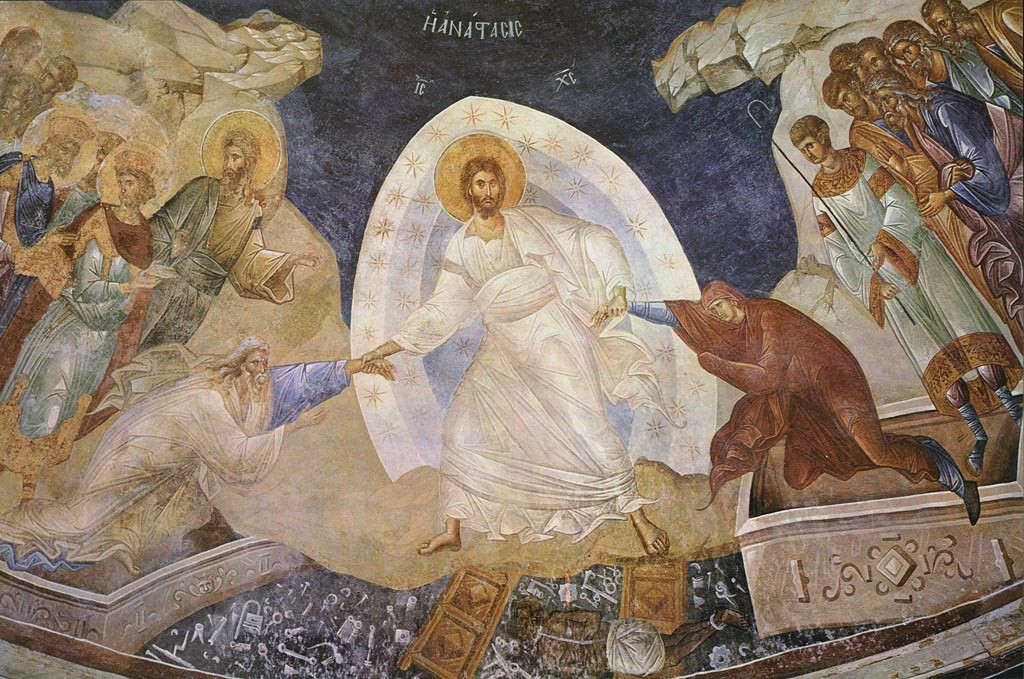
Anastasis Icon at Chora

I love poetry. There is something about the way poets describe the world that simply cannot be found in other forms of literature. Poets encourage us not to understand the world, but to experience it; not to be concerned with facts, but to comprehend Truth.

Recently, I’ve been introduced to the world of a Guatemalan woman named Julia Esquivel. Esquivel lived through the Guatemalan civil war which lasted from the 1960s into the 1990s and during which hundreds of thousands of people died in terror sanctioned by the Guatemalan government. Many of these simply “disappeared;” they were the “Desaparecidos,” taken away from their families and never seen again. Many families in Guatemala will never know what happened to their loved one; few of those responsible for the tragedies have stood trial and most never will. Darkness and evil often seem to entomb goodness and light. Into this hopelessness Esquivel’s poetry speaks a word of hope:

There is something here within us
which doesn’t let us sleep, which doesn’t let us rest,
which doesn’t stop pounding deep inside,
it is the silent, warm weeping
of Indian women without their husbands,
it is the sad gaze of the children
fixed there beyond memory,
in the very pupil of our eyes
which during sleep, though closed, keep watch
with each contraction of the heart
in every awakening . . . .

What keeps us from sleeping
is that they have threatened us with resurrection!
Because at each nightfall,
though exhausted from the endless inventory
of killings since 1954,
yet we continue to love life,
and do not accept their death!

. . . . because in this marathon of Hope,
there are always others to relieve us
in bearing the courage necessary
to arrive at the goal which lies beyond death. . . .

Accompany us then on this vigil
and you will know what it is to dream!
You will then know how marvelous it is
to live threatened with resurrection!
To dream awake,
to keep watch asleep
to live while dying
and to already know oneself resurrected!
(From Threatened With Resurrection: Prayers and Poems from an Exiled Guatemalan, September 1982)

Isn’t that wonderful? To “know how marvelous it is to live threatened by resurrection!”

We, unfortunately, live in a world in which other things are threatened — in which the sorts of things that happened in Guatemala (and in many Latin American countries) in the late 20th Century continue to happen in many places. Human cruelty to other humans often astounds us; human indifference to the suffering of other humans amazes us. We live in a world where laws are passed to make it easy for privileged majorities to discriminate against minorities, to abuse those who are unusual, to despoil the lives those who are different, to bury the poor in their poverty, to entomb the stranger in hopelessness, to start wars in distant countries, to trouble us so that “there is something here within us which doesn’t let us sleep, which doesn’t let us rest, which doesn’t stop pounding deep inside.”

Today, we celebrate the Resurrection of Jesus Christ, the One who “exhausted from the endless inventory of killings . . . continue[d] to love life, and [did] not accept . . . death,” the One in whose death and resurrection we acknowledge that, yes indeed, we are “threatened with” resurrection, the One in whom we “already know [ourselves] resurrected.”

I mentioned in our Parish Newsletter for April that one of my favorite contemporary American poets is Kentucky farmer Wendell Berry, and one my favorites among his poems is Manifesto: The Mad Farmer Liberation Front:

Love the quick profit, the annual raise,
vacation with pay. Want more
of everything ready-made. Be afraid
to know your neighbors and to die.
And you will have a window in your head.
Not even your future will be a mystery
any more. Your mind will be punched in a card
and shut away in a little drawer.
When they want you to buy something
they will call you. When they want you
to die for profit they will let you know.

So, friends, every day do something
that won’t compute. Love the Lord.
Love the world. Work for nothing.
Take all that you have and be poor.
Love someone who does not deserve it.
Denounce the government and embrace
the flag. Hope to live in that free
republic for which it stands.
Give your approval to all you cannot
understand. Praise ignorance, for what man
has not encountered he has not destroyed.

Ask the questions that have no answers.
Invest in the millennium. Plant sequoias.
Say that your main crop is the forest
that you did not plant,
that you will not live to harvest.
Say that the leaves are harvested
when they have rotted into the mold.
Call that profit. Prophesy such returns.

Put your faith in the two inches of humus
that will build under the trees
every thousand years.
Listen to carrion – put your ear
close, and hear the faint chattering
of the songs that are to come.
Expect the end of the world. Laugh.
Laughter is immeasurable. Be joyful
though you have considered all the facts.
So long as women do not go cheap
for power, please women more than men.
Ask yourself: Will this satisfy
a woman satisfied to bear a child?
Will this disturb the sleep
of a woman near to giving birth?

Go with your love to the fields.
Lie down in the shade. Rest your head
in her lap. Swear allegiance
to what is nighest your thoughts.
As soon as the generals and the politicos
can predict the motions of your mind,
lose it. Leave it as a sign
to mark the false trail, the way
you didn’t go. Be like the fox
who makes more tracks than necessary,
some in the wrong direction.
Practice resurrection.
(From The Mad Farmer Poems, January 2014)

Esquivel reminds us, in the face of a world of cruelty and death, that we are “threatened with resurrection” and that we should “already know [ourselves] resurrected;” Berry encourages us embrace that “threat” as a promise, to “expect the end of the world [and] laugh,” not merely to know ourselves resurrected, but to act upon that knowledge and “practice resurrection.”

That’s not easy to do in this world, no matter how simple Wendell Berry makes it sound. Sometimes the biggest barrier we face . . . is ourselves. The late Israeli poet Yehuda Amichai writes about this in his short verse The Place Where We Are Right:

From the place where we are right
Flowers will never grow
In the spring.

The place where we are right
Is hard and trampled
Like a yard.

But doubts and loves
Dig up the world
Like a mole, a plow.
And a whisper will be heard in the place
Where the ruined
House once stood.
(From The Selected Poetry Of Yehuda Amichai, Newly Revised and Expanded, October, 1996)

Every single human being on earth is convinced that he or she is right; that’s the nature of human beings and always has been. Judas was sure he was right; the chief priests and the scribes were sure that they were right; Pilate, the Imperial governor, was sure that he was right; the Roman soldiers were sure that they were right. We are always sure that we are right and, thus, we become the ones who pass the laws that make it easy to discriminate, to abuse, to despoil, to crucify, and to entomb beneath that hard and trampled place where we are right, where “there is something here within us which doesn’t let us sleep, which doesn’t let us rest, which doesn’t stop pounding deep inside.”

Yesterday, in our meditations for Holy Saturday, I shared with those assembled here that my favorite artistic depiction of Christ’s Resurrection is an Orthodox icon in which Jesus stands within the arch of his tomb ready to come out. Beneath his feet are the gates of Hell, broken and fallen into the form of a cross, and o either side of him are two other tombs, broken open. From them Christ is pulling two figures, a man and a woman representing Adam and Eve. They seem almost reluctant to leave their graves, but Jesus grasps them by their wrists and seems to strain to lift them. Behind them are ranged the prophets and patriarchs of Israel, the righteous dead awaiting resurrection. This liberation of those who were already dead is known as the “Harrowing of Hell,” which is the title of poet Denise Levertov’s contemplation of this icon:

Down through the tomb’s inward arch
He has shouldered out into Limbo
to gather them, dazed, from dreamless slumber:
the merciful dead, the prophets,
the innocents just His own age and those
unnumbered others waiting here
unaware, in an endless void He is ending
now, stooping to tug at their hands,
to pull them from their sarcophagi,
dazzled, almost unwilling. Didmas,
neighbor in death, Golgotha dust
still streaked on the dried sweat of his body
no one had washed and anointed, is here,
for sequence is not known in Limbo;
the promise, given from cross to cross
at noon, arches beyond sunset and dawn.
All these He will swiftly lead
to the Paradise road: they are safe.
That done, there must take place that struggle
no human presumes to picture:
living, dying, descending to rescue the just
from shadow, were lesser travails
than this: to break
through earth and stone of the faithless world
back to the cold sepulchre, tearstained
stifling shroud; to break from them
back into breath and heartbeat, and walk
the world again, closed into days and weeks again,
wounds of His anguish open, and Spirit
streaming through every cell of flesh
so that if mortal sight could bear
to perceive it, it would be seen
His mortal flesh was lit from within, now,
and aching for home. He must return,
first, in Divine patience, and know
hunger again, and give
to humble friends the joy
of giving Him food – fish and a honeycomb.
(From A Door in the Hive, October 1989)

Levertov, I think, is probably right when she suggests that the work of freeing those trapped in Hell was, for Christ, easier than “break[ing] through [the] earth and stone of the faithless world;” breaking through where privileged majorities to discriminate against minorities, abuse those who are unusual, despoil the lives those who are different, bury the poor in their poverty, entomb the stranger in hopelessness, and start wars in distant countries; breaking through the hard and trampled place where we insist that we are right . . . but break through he does for he is the love that digs up the world so that whispers are again heard where the ruined houses of our lives once stood.

Do you doubt that? Do you have difficulty feeling that promise of resurrection? Do you not feel threatened with resurrection in your own life? Do you not know yourself already resurrected?

At the vigil service each year, in place of a sermon of my own, I follow the ancient tradition of the Orthodox church and read for those present an oration or homily from one of the early doctors of the church; today I read selections from St. Gregory Nazianzan’s Second Easter Oration. In part of that great speech, St. Gregory offers advice on how one can enter personally into the Resurrection; if one cannot comprehend the whole of the story, focus on that part which most resonates with you. This is what he wrote:

If you are a Simon of Cyrene, take up the Cross and follow.
If you are crucified with Him as a robber, acknowledge God as a penitent robber.
If even He was numbered among the transgressors for you and your sin, do you become law-abiding for His sake. Worship Him Who was hanged for you, even if you yourself are hanging; make some gain even from your wickedness; purchase salvation by your death; enter with Jesus into Paradise, so that you may learn from what you have fallen.
Contemplate the glories that are there; let the murderer die outside with his blasphemies; and if you be a Joseph of Arimathæa, beg the Body from him that crucified Him, make your own that which cleanses the world.
If you be a Nicodemus, the worshiper of God by night, bury Him with spices.
If you be a Mary, or another Mary, or a Salome, or a Joanna, weep in the early morning. Be first to see the stone taken away, and perhaps you will see the Angels and Jesus Himself.
Say something; hear His Voice. If He say to you, Touch Me not, stand afar off; reverence the Word, but grieve not; for He knows those to whom He appears first.
Keep the feast of the Resurrection; come to the aid of Eve who was first to fall, of Her who first embraced the Christ, and made Him known to the disciples.
Be a Peter or a John; hasten to the Sepulchre, running together, running against one another, vying in the noble race. And even if you be beaten in speed, win the victory of zeal; not Looking into the tomb, but Going in.
And if, like a Thomas, you were left out when the disciples were assembled to whom Christ shows Himself, when you do see Him be not faithless; and if you do not believe, then believe those who tell you; and if you cannot believe them either, then have confidence in the print of the nails.
If He descended into Hell, descend with Him. Learn to know the mysteries of Christ there also, what is the providential purpose of the twofold descent, to save all [humankind] absolutely by His manifestation.
(From Oration 45, Nicene and Post-Nicene Fathers, Second Series, Volume 7, February 1996)

Become a part of the story in whatever way you can. If you cannot now comprehend the whole, grab hold of that fraction that resonates for you, but do not strive to understand, do not strive to be right, do not trample hard a place where flowers will never grow; instead, enter into the narrative, simply experience the truth, put your faith in two inches of spiritual humus where you may plant things you may not live to harvest. Remember that Christ is the love Who digs up the world, Who breaks through faithless earth and stone, expect the end of the world and laugh:
Accompany us then on this vigil
and you will know what it is to dream!
You will then know how marvelous it is
to live threatened with resurrection!
To dream awake,
to keep watch asleep
to live while dying
and to already know [your]self resurrected!

Christ is Risen! We are risen! Alleluia!

(Note: The illustration above is widely agreed to be the most striking exemplar of the traditional Byzantine Anastasis icon. It is the fresco in the apse of the arekklesion or funerary chapel, of the Monastery of Chora at Istanbul.)

====================

A request to my readers: I’m trying to build the readership of this blog and I’d very much appreciate your help in doing so. If you find something here that is of value, please share it with others. If you are on Facebook, “like” the posts on your page so others can see them. If you are following me on Twitter, please “retweet” the notices of these meditations. If you have a blog of your own, please include mine in your links (a favor I will gladly reciprocate). Many thanks!

====================

Father Funston is the rector of St. Paul’s Episcopal Church, Medina, Ohio.

Kingdom Life: Common, Routine, Mundane – Sermon for Palm Sunday 2015

====================

A sermon offered on Palm Sunday, March 29, 2015, to the people of St. Paul’s Episcopal Church, Medina, Ohio, where Fr. Funston is rector.

(At the blessing of the Palms, Zechariah 9:9-12 was read. The lessons at the Mass were Isaiah 50:4-9a; Psalm 31:9-16; Philippians 2:5-11; and Mark 11:1-11. The Passion according to Mark, Mk 14:1-15:47 was read at the conclusion of the service. Other than Zechariah, these lessons can be read at The Lectionary Page.)

====================

Icon of the Entry Into JerusalemThe four evangelists are traditionally represented by iconic depictions of the emphasis of their gospels. John, whose gospel is the longest and most different of the four tellings of Jesus’ story, is represented by an eagle because he emphasizes the divinity of Christ. Matthew, on the other hand, begins his gospel with Jesus’ genealogy and emphasizes the humanity of the Savior, so he is represented by a man. Luke emphasizes the sacrificial nature of Jesus’ ministry and mission; thus, he is represented by an ox or bull (often winged), the sort of animal offered in the Temple.

Mark, from whose gospel we read today, both the story of Jesus’ “triumphal entry” into Jerusalem and the story of his Passion, is represented by a winged lion, an emblem of kingship, because his emphasis is both the Jewish expectation that the Messiah would be of lineage of King David and that Jesus’ mission was rather different, the ushering in of the kingdom of God.

Which, I think, gives us an interpretive tool for understanding why Mark tells the story of the “triumphal entry” as he does. John, who (as I said) is most interested in portraying Jesus as divine, blows by this episode in two sentences: basically he says, “There was a crowd; they cheered; Jesus rode a donkey. Now back to the important stuff.” Matthew, who (remember) emphasizes Jesus’ humanity, adds the story of Jesus losing his temper with the money changers and animal merchants in the Temple courtyard. Luke, who is intent on portraying Jesus as the sacrificial Messiah predicted by prophecy, adds a second donkey to the parade (because he apparently misunderstands Zechariah, tells us that Jesus wept over Jerusalem on the way in to town, includes a conversation between Jesus and some Pharisees about the stones singing “Hosanna,” follows Matthew in adding the cleansing of the Temple, and concludes the story with Jesus staying in the Temple and teaching while the chief priests figure out how to kill him.

Mark, however…. Mark keeps it simple – not as simple as John, but direct and to the point. But what is his point? In the NRSV translation of Mark 11:1-11 which we read at the blessing of the palms there are 232 words. 144 of them are spent describing the process of locating, procuring, saddling (so to speak), and sitting astride the donkey. Only 67 words actually describe Jesus’ entry into Jerusalem. And 21 words finish the pericope with its anti-climactic ending, “…and when he had looked around at everything, as it was already late, he went out to Bethany with the twelve.” I find that intriguing.

Now it may seem silly to count words, but this is one of the things bible scholars do. Sometimes, when studying a book or section of the Bible, we can better understand an author’s theme by examining the frequency of word usage. For example, the use of love in the First Letter of John and the repeated use of immediately in Mark’s gospel are enlightening. So noting the number of words invested in telling the different parts of a story can, perhaps, tell us what the author felt important, and Mark seems to think the getting the donkey is roughly twice as important as Jesus actually riding it into the city!

So let’s first look at the lesser important part of the story, Jesus’ entry into Jerusalem. What’s going on here? In a word, what’s going on here is politics! Jesus is making a huge political statement; first, he is very clearly acting out the prophecy of Zechariah: “Rejoice greatly, O daughter Zion! Shout aloud, O daughter Jerusalem! Lo, your king comes to you; triumphant and victorious is he, humble and riding on a donkey, on a colt, the foal of a donkey.” (Zec 9:9) He is making an acted-out, very visual claim to be the king!

Furthermore, he is doing it in a way that mocks the Roman governor. It was the practice of the governor, at this time Pontius Pilate, to make a show of force at the time of the Passover. Because so many potentially rebellious Jews were gathered in Jerusalem to celebrate the feast of an historic liberation, the Exodus from Egypt, the Romans feared the possibility of open revolt. So at the beginning of the festival, the governor would come to Jerusalem from his usual residence at the imperial seaport of Caesarea Maritima, entering the city from the west, riding his war stallion or perhaps in a chariot of state, at the head of long column of armed soldiers. Jesus, on the other hand, is approaching from the east, coming up from Jericho and the Jordan valley, over the Mount of Olives through the peasant villages of Bethphage and Bethany. Riding the lowliest of beasts of burden, the least military of animals, Jesus is making the point that the kingdom of Heaven is about something other than regal authority and military might, something other than power elites and superiority over others.
And, I suggest, that’s why Mark spends so many words telling us about the locating, procuring, preparing, and mounting of the donkey.

There is a legendary suggestion that the two unnamed disciples whom Jesus’ sent to get the colt were none other than James and John, the sons of Zebedee, who just before this (at the end of Mark’s Chapter 10, in fact) had come to Jesus and said to him, “Grant us to sit, one at your right hand and one at your left, in your glory.” (10:37) None of the evangelist tell us the names of the two disciples sent to get the donkey, but wouldn’t that have been a graphic way for Jesus to demonstrate to them that “whoever wishes to become great among you must be your servant, and whoever wishes to be first among you must be slave of all?” (10:43-44) It is certainly a clear sign that life in the kingdom is not a glamorous thing; it’s not a life of war stallions and chariots, palaces and fine meals, or relaxing at your ease while others bear the burdens. It is not that sort of life for the king, and it is not that sort of life for his followers.

As Tom Long, who teaches preaching at Candler School of Theology, has noted,

The disciples in Mark get a boat ready for Jesus, find out how much food is on hand for the multitude, secure the room and prepare the table for the Last Supper and, of course, chase down a donkey that the Lord needs to enter Jerusalem. Whatever they may have heard when Jesus beckoned, “Follow me,” it has led them into a ministry of handling the gritty details of everyday life. (Donkey Fetchers, in The Christian Century, April 4, 2006, page 18)

Life in the kingdom, where all are servants, is common, routine, mundane, and often exhausting. This, I think, is why Mark makes more of getting the donkey than he does of Jesus’ riding it into Jerusalem. He wants us to understand that life in the kingdom is the life of the king whose faithfulness to his God and to his understanding of his mission required him to take up the cross, the king who said, “If any want to become my followers, let them deny themselves and take up their cross and follow me. For those who want to save their life will lose it, and those who lose their life for my sake, and for the sake of the gospel, will save it.” (Mk 8:34-35)

Poet Mary Oliver imagined this story from the point of view of the donkey when she wrote:

On the outskirts of Jerusalem
the donkey waited.
Not especially brave, or filled with understanding,
he stood and waited.

How horses, turned out into the meadow,
leap with delight!
How doves, released from their cages,
clatter away, splashed with sunlight!

But the donkey, tied to a tree as usual, waited.
Then he let himself be led away.
Then he let the stranger mount.

Never had he seen such crowds!
And I wonder if he at all imagined what was to happen.
Still, he was what he had always been: small, dark, obedient.

I hope, finally, he felt brave.
I hope, finally, he loved the man who rode so lightly upon him,
as he lifted one dusty hoof, and stepped, as he had to, forward.

(The Poet Thinks about the Donkey, Thirst, Beacon Press, 2007)

The One who rode the donkey also “stepped, as he had to, forward,” into that most common, most routine, most mundane, and most exhausting fact of life. He stepped willingly into death. Therefore,

“Death has been swallowed up in victory.”
“Where, O death, is your victory? Where, O death, is your sting?”
***
Thanks be to God, who gives us the victory through our Lord Jesus Christ.
Therefore . . . be steadfast, immovable, always excelling in the work of the Lord, [however common or routine or mundane or exhausting] because you know that in the Lord your labor is not in vain.” (1 Cor 15:54-55,57-58)

Let us pray:

Almighty God, whose dear Son went not up to joy but first he suffered pain, and entered not into glory before he was crucified: Mercifully grant that we, walking in the way of the cross, may find it none other that the way of life and peace; through Jesus Christ your Son our Lord, who lives and reigns with you and the Holy Spirit, one God, for ever and ever. Amen. (Collect for Monday in Holy Week, BCP 1979, page 220)

====================

A request to my readers: I’m trying to build the readership of this blog and I’d very much appreciate your help in doing so. If you find something here that is of value, please share it with others. If you are on Facebook, “like” the posts on your page so others can see them. If you are following me on Twitter, please “retweet” the notices of these meditations. If you have a blog of your own, please include mine in your links (a favor I will gladly reciprocate). Many thanks!

====================

Father Funston is the rector of St. Paul’s Episcopal Church, Medina, Ohio.

Decision Train: Between Stimulus and Response – Sermon for Lent 2, 2015

====================

A sermon offered on the Second Sunday in Lent, March 1, 2015, to the people of St. Paul’s Episcopal Church, Medina, Ohio, where Fr. Funston is rector.

(The lessons for the day were Genesis 17:1-7,15-16; Psalm 22:22-30; Romans 4:13-25; and Mark 8:31-38. These lessons can be read at The Lectionary Page.)

====================

Decision Train TrackI was an English and American literature major in college (well, I finished as an English literature major – I was a biology major, a sociology major, an anthropology major, a philosophy major, and an undeclared major before ending up with a degree in literature.) I remember a certain type of end-of-term take home exam, the compare-and-contrast question. For instance, you’d read a bunch of novels and then along would come the final exam with a question like, “Compare and contrast the vision of the sea in Hemingway’s Old Man and the Sea and Melville’s Moby Dick.”
Reading our lectionary selections today, I had the sense that I was being handed a compare-and-contrast question: Compare and contrast the covenant made by God with Abram in Genesis 17 with the demand made by Jesus in the 8th Chapter of Mark.

On the one hand, we have “I will make you exceedingly numerous. You shall be the ancestor of a multitude of nations. I will make you exceedingly fruitful.” On the other, “If any want to become my followers, let them deny themselves and take up their cross and follow me. For those who want to save their life will lose it, and those who lose their life for my sake, and for the sake of the gospel, will save it.”

On the one hand, “I will give you everything.” On the other, “Give it all up.”

And yet the process and the promise is the same. The covenant offered to Abram and the demand made by Jesus both require a decision (that’s the process) and both lead to the promise described both by Paul in his letter to the Romans and by the Psalmist in Psalm 22: “the promise that [the righteous will] inherit the world” – the promise that “they shall be known as the Lord’s for ever” – that they shall enjoy what Jesus variously described as the kingdom of God, the kingdom of heaven, eternal life, or abundant life.

As I was making my notes for this homily, I was also carrying on a conversation by internet chat with a friend and colleague about something else, and my friend quoted the late philosopher-psychiatrist Viktor Frankl. He reminded me of something Frankl, an Austrian Jew, had written in his book Man’s Search for Meaning which described the things he had observed and learned as a prisoner in the Nazi concentration camp at Auschwitz. Frankl wrote, “Between stimulus and response, there is space. In that space is our power to choose our response. In our response lies our growth and our freedom.” It occurred to me that Frankl’s “space between stimulus and response” is a key to understanding the process which is common to God’s covenant and Jesus’ requirement.

Between God’s offer to Abram and Abram’s answer, between Jesus’ demand of his disciples and their reply is what Frankl identified as this space of our power to choose, this place where our potential for growth and freedom lies entirely within our control, where we either accept the kingdom of God or reject that abundant life. God offers, Jesus mandates, but we decide. We choose our response and “in our response lies our growth and our freedom.”

In our response also lies our identity. It is important to note that it is when Abram accepts God’s offer – which he does not only for himself but for his wife Sarai, a detail we might explore at another time – he and his wife are given new names; they become Abraham (“father of many nations”) and Sarah (“princess to all”). Their new names are symbolic of their act of giving up their former lives for the sake of God’s truth. In that “space between stimulus and response,” they were freed to live and grow into the new names, the new identities that God promised to give them.

The same is true for the disciples of Jesus. In that moment of decision, that “space between stimulus and response,” they (we) are given a new name. It is not without reason that in the sacramental sign of that decision, baptism, we are given a name, “sealed by the Holy Spirit,” and “marked as Christ’s own for ever.” As Peter reminds us in his first letter, we are to “glorify God because [we] bear [the] name” of Christian.

I got to thinking about the language we use to describe the act of deciding, and particularly the difference between the way Americans describe deciding and the way the British refer to it. We are, as George Bernard Shaw is supposed to have quipped, “two countries separated by a common language.” In colloquial American speech, we “make decisions,” but in idiomatic British, one “takes a decision.” To “make” a decision, or to “take” a decision? In all honesty, I think the British have the better of us here. To take a decision is certainly more responsible and more theologically sound than to make one. Here’s what I mean . . . .

Consider the difference between “making” something and “taking” something.

When you make something . . . when you have made something, you’re done with it. You do a lot of preparation, a lot work getting ready; you put a lot into the process, and then you create whatever it is – a painting, a piece of pottery, a casserole, a pie, whatever. You make it, and then you stop making it because there it is. You’ve made it. It has an independent existence in the world. You set it on the counter and the world will do with it whatever the world will do. You can just leave it there and let the world have it.

When we “make” decisions, we do the same thing. We treat decisions as destinations, as end points. In business management courses, students are taught to use “decision trains” in which the process of deciding is metaphorically diagrammed as a locomotive passing through “stations” labeled “situation,” “factors to consider,” “desired outcomes,” “possible consequences,” and so forth, eventually arriving at the terminus labeled “decision.” We even, in everyday speech, talk about “reaching a decision.”

There! We have arrived! We’ve done it! We’ve made our decision! Set it on the counter, record it in the minutes, put it in the filing cabinet, and let the world do with it whatever the world will do. We’re finished.

But when you “take a decision” the act of deciding is not the end . . . it is the beginning. When you take something, you are doing something very different from making something. When you take something, you hold it in your hands rather than set it on the counter. When you take something, you have to do something with it rather than let the world do with it whatever the world will do. When you take a decision, you have to act on it. It is not the terminus of your decision train; it is the start of the journey. Not the end, but the beginning.

When we make a decision, our “decision train” runs from stimulus to response . . . and stops. When we take a decision, our “decision train” starts at the response and runs for the rest of our lives.

In that “space between stimulus and response,” between God’s offer of covenant and our reply, between Jesus’ demand for discipleship and our answer . . . in that space lies our power to choose, to decide, not to make a decision and simply end an old way of being, but to take a decision and begin a new way of being, to give up an old life and save a new one, to surrender our old name and take on a new name, our true name.

As Episcopal theologian Elizabeth Webb reminds us: “To know our true name is, as it was for Abraham and Sarah, to turn, to reorient ourselves according to that name, and to live it. Just as God’s naming of Abraham and Sarah was also a calling, in naming us God is calling us to discipleship, casting off the old names by which we’ve been known, and living into (and maybe ‘up to’) the name that God bestows.” Whether that name be Abraham (“father of nations”), or Sarah (“princess to all”), or, simply, Christian (“follower of Jesus”).

So . . . compare and contrast . . .

For some, the decision we must take is to accept God’s offer: “I will give you everything.” For others, the decision we must take is to follow Jesus’ demand: “Give it all up.” For all, the promise is the same: “[We] shall be [named and] known as the Lord’s for ever.” Amen.

====================

A request to my readers: I’m trying to build the readership of this blog and I’d very much appreciate your help in doing so. If you find something here that is of value, please share it with others. If you are on Facebook, “like” the posts on your page so others can see them. If you are following me on Twitter, please “retweet” the notices of these meditations. If you have a blog of your own, please include mine in your links (a favor I will gladly reciprocate). Many thanks!

====================

Father Funston is the rector of St. Paul’s Episcopal Church, Medina, Ohio.

What Is Lent All About? – Sermon for Lent 1, 2015

====================

A sermon offered on the First Sunday in Lent, February 22, 2015, to the people of St. Paul’s Episcopal Church, Medina, Ohio, where Fr. Funston is rector.

(The lessons for the day were Genesis 9:8-17; Psalm 25:1-9; 1 Peter 3:18-22; and Mark 1:9-15. These lessons can be read at The Lectionary Page.)

====================

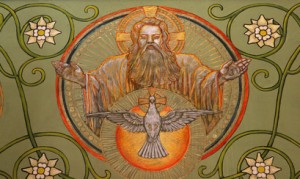
God the Father and Holy SpiritWhat is Lent all about?

Some say it’s a time when we are supposed to find the presence of God in everyday life. Dr. Jonn Sentamu, the current Archbishop of York, suggested as much in his 2015 Ash Wednesday meditation when he said, “Lent is a time to get to know God better.” Similarly, an interdenominational Lenten devotional refers to Lent as a “journey [on which] you seek – and find – God.”

That’s one way to think about Lent. But that way isn’t working for me this year, especially as I contemplate Mark’s description of Jesus’ baptism and its aftermath. If in our Lenten discipline we are to be, in some way, doing what a Lenten hymn attributed to St. Gregory the Great says — “keep[ing] vigil with our heavenly lord in his temptation and his fast” — then we should pay particular attention to what really was going on there and seek to do during Lent what seems to be going on with Jesus in the wilderness.

Let’s look at Mark’s spare and barebones description of it all again. It’s a short Gospel text, so let’s read it in full one more time:

In those days Jesus came from Nazareth of Galilee and was baptized by John in the Jordan. And just as he was coming up out of the water, he saw the heavens torn apart and the Spirit descending like a dove on him. And a voice came from heaven, “You are my Son, the Beloved; with you I am well pleased.”

OK. It doesn’t seem to me that Jesus needed to look for God! God is always there (which is the promise of the story of the rainbow in today’s Genesis reading) and the presence of God is very apparent in these first few lines of this Gospel story. The Holy Spirit (the Third Person of the Trinity) doesn’t just make a polite visit here; she’s not just gliding in here or fluttering by. No! The heavens, Mark says, were “torn apart” and the Spirit (in the form of a dove) came diving done like some eagle homing in on its prey! And there’s a bit of a mistranslation here, as well; the English translation we read says the Spirit descended “on” Jesus but the Greek makes more sense if we read it as saying that the Spirit came down into Jesus.

This really is an active, even violent description, that Mark has laid out for us. Jesus doesn’t just emerge from the water like someone stepping carefully out of a swimming pool; the Greek is “euthus anabainon” – Jesus “immediately ascended” out of the water; like a whale breaching the surface of the sea. And the Spirit, having torn the heaven’s apart, “katabainon eis auton“, dives down into Jesus. Rapid movement up is met with rapid movement down, a collision of the Son and the Spirit. This dove dove deep into Jesus; Jesus was possessed by the Holy Spirit.

And, of course, God the Father (First Person of the Trinity) is right there as well, fairly shouting, “You’re my son! I love you! I’m please as punch with you!” Jesus doesn’t need to go on any journey to find this God; he doesn’t need any time to get to know this God any better!

So what happens next?

And the Spirit immediately drove him out into the wilderness.

Mark continues his energetic, and here overtly violent, description of Jesus’ encounter with the Holy Spirit. There’s a sense here that Jesus is not a willing volunteer; the Spirit is making no polite suggestion that Jesus go spend a few days in the desert so that he can know “the presence of God in everyday life.” No! Jesus is prodded, herded, pushed, forced, driven out into the rough country to cozy up to the wild beasts.

Why? What was he to do out there?

He was in the wilderness forty days, tempted by Satan; and he was with the wild beasts; and the angels waited on him.

Peiradzomenos hupo tou satana” reads the Greek: literally, “he was tested by the tempter.” Our English translation eliminates the definite article that is clearly there in the Greek, “the satan,” the tempter, and then capitalizes “satan” thus personalizing this tempter and, in fact, makes us think of the Devil of later Christian poetic mythology. But who else might the tempter have been?

“Sometimes we are devils to ourselves, when we will tempt the frailty of our powers, presuming on their changeful potency,” wrote William Shakespeare in the play Troilus and Cressida (Troilus speaking to Cressida and Aeneas, Act IV, scene 4). “The devil tempts us not — ’tis we tempt him….” wrote George Eliot in her 19th Century novel Felix Holt, the Radical.

Could it be that the temptations Jesus faced were those he put before himself? We certainly put enough temptations in front of ourselves; we are, more often than not, our own tempters. Could it be that Jesus’ tempter was his own human self? Scripture reminds us (and the Lenten preface of our Eucharistic prayer repeats) that in Jesus “we do not have a high priest who is unable to sympathize with our weaknesses, but we have one who in every respect has been tested as we are, yet without sin.” (Heb 4:15) Could it be that the Spirit drove Jesus into the wilderness to confront himself, to learn about himself?

If Lent is not a journey to find God, could it be journey to find ourselves? It could indeed! Lent, it has been said, is a period of self-discovery in which we encounter the parts of ourselves we don’t want to discover. If Jesus was made to spend time in the desert to learn about himself, then such self-discovery during this season surely would be, as Gregory’s great Lenten hymn proclaims, a reminder that “though frail we be, in [God’s] own image were we made.” Lent is a time to find ourselves, a time to reorient ourselves to who we are, where we have come from, where we are going, and how we are going to get there. This is surely what those forty days in the desert were for Jesus, as Mark demonstrates when he concludes this brief story with these words:

Now after John was arrested, Jesus came to Galilee, proclaiming the good news of God, and saying, “The time is fulfilled, and the kingdom of God has come near; repent, and believe in the good news.”

At the end of his 40 days with the wild beasts, Jesus knew who he was and what he was about. What can we do, then, to experience a similar self-revelation? How can we reorient ourselves to who we are, where we have come from, where we are going, and how we are to get there?

What we can do is to engage in a Lenten discipline, a rule-of-life for these 40 days. I plan to adopt a program set out several years ago by a famous bishop of Rome. It is known as “the daily decalogue of Pope John XXIII.” I plan to use it as a Lenten spiritual exercise to be renewed and lived out each day. As its name implies, it has ten parts:

  1. Only for today, I will seek to live the live-long day positively without wishing to solve the problems of my life all at once.
  2. Only for today, I will take the greatest care of my appearance: I will dress modestly; I will not raise my voice; I will be courteous in my behavior; I will not criticize anyone; I will not claim to improve or to discipline anyone except myself.
  3. Only for today, I will be happy in the certainty that I was created to be happy, not only in the other world but also in this one.
  4. Only for today, I will adapt to circumstances, without requiring all circumstances to be adapted to my own wishes.
  5. Only for today, I will devote 10 minutes of my time to some good reading, remembering that just as food is necessary to the life of the body, so good reading is necessary to the life of the soul.
  6. Only for today, I will do one good deed and not tell anyone about it.
  7. Only for today, I will do at least one thing I do not like doing; and if my feelings are hurt, I will make sure that no one notices.
  8. Only for today, I will make a plan for myself: I may not follow it to the letter, but I will make it. And I will be on guard against two evils: hastiness and indecision.
  9. Only for today, I will firmly believe, despite appearances, that the good Providence of God cares for me as no one else who exists in this world.
  10. Only for today, I will have no fears. In particular, I will not be afraid to enjoy what is beautiful and to believe in goodness. Indeed, for 12 hours I can certainly do what might cause me consternation were I to believe I had to do it all my life.

I hope that through this daily wilderness exercise of prayer, fasting, and discipline I will find myself, even those parts of me that I don’t want to discover.

May your Lent, too, be a wilderness time of self-discovery. Remember, you don’t need to look for God; God is always there. This Lent, look for yourself. Amen.

====================

A request to my readers: I’m trying to build the readership of this blog and I’d very much appreciate your help in doing so. If you find something here that is of value, please share it with others. If you are on Facebook, “like” the posts on your page so others can see them. If you are following me on Twitter, please “retweet” the notices of these meditations. If you have a blog of your own, please include mine in your links (a favor I will gladly reciprocate). Many thanks!

====================

Father Funston is the rector of St. Paul’s Episcopal Church, Medina, Ohio.

I Wish I Knew Her Name: Simon’s Mother-in-Law – Sermon for Epiphany V, February 8, 2015

====================

A sermon offered on the Fifth Sunday after Epiphany, February 8, 2015, to the people of St. Paul’s Episcopal Church, Medina, Ohio, where Fr. Funston is rector.

(The lessons for the day were Isaiah 40:21-31; Psalm 147:1-12,21c; 1 Corinthians 9:16-23; and Mark 1:29-39 . These lessons can be read at The Lectionary Page.)

====================

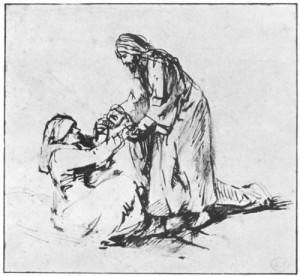
Rembrandt, 1660, Healing of Peter's Mother-in-LawAfter I did my first sermon-prep read through of this morning’s gospel I thought, “There are two stories here.” Then I thought, “No, there are three.” And then I realized that there are really more stories here than I can count.

Mark, of course, is interested in telling only one story, Jesus’ story, and so he gives us these glimpses into the lives of others only insofar as they serve to move his main story along.

We haven’t even reached the end of Chapter One yet and already Jesus has been baptized in a river, heard the voice of God, spent forty days in the wilderness tempted by Satan and waited on by angels, recruited four disciples, taught in a synagogue, cast out a demon, and (in today’s bit) healed a woman in a private home, gone back out into the wilderness to pray, and then traveled throughout the region preaching in more synagogues and casting our more demons.

And Mark has told us all of that in only 39 sentences. Mark probably would have failed a creative writing class and definitely would have failed a journalism class! He hasn’t even come close to answering those all important questions known to every reporter and every novelist on the planet: Who? What? When? Where? How? and Why? He hasn’t come close to answering them because he doesn’t care; unless those are questions about Jesus, Mark simply isn’t interested in them.

But I am! I would like to know some details. I’m like Karoline Lewis, Associate Professor of Preaching at Luther Seminary in St. Paul, Minnesota, who in writing about Simon’s mother-in-law repeatedly makes the parenthetical observation, “I so wish she had a name!” I would love to know her name. In fact, not only would I like to know who she is, I’d like to know what she’s doing there! Why is she in Simon’s household at all?

Is she there because she’s widowed and, bound by the law of Moses to be dependent on some man, has no male relatives other than her daughter’s husband to rely on for support? Is she there because Simon’s widowed and needs her help to raise his children? (Are there any children to raise?) Why is Simon’s mother-in-law the one who (after arising from her sickbed) performs the duties of hostess which normally would be those of a wife or an elder daughter? For that matter, why was she sick in the first place? What was actually wrong with her? There are more stories here than I can count because Mark hasn’t told them, because he hasn’t answered any of these questions.

Mark isn’t interested in answering the questions; the answers aren’t necessary to moving his story of Jesus along, but they would help me in understanding my story of Jesus. I know I’m not very much like Jesus, though I try to be; I am, however, a lot like those other people, like Simon or his mother-in-law or that man in the synagogue we heard about last week. If I could know more about how they related to and followed Jesus, it would help me as I stumble along trying to do the same.

I wish we knew more about the nameless Mrs. Simon’s mother (I wish Simon’s wife had a name!) because it would help me understand this statement: “The fever left her, and she began to serve them.” I read that statement and my 1960s-70s college student, sexual revolution, women’s liberation, gender equality heart just goes all cold and still, and I think, “Really? The first thing an elderly woman does on being relieved of sickness is get up and cook for the men?” But, you see, that’s my story, not Mark’s; that’s me reading into the text, instead of setting aside my preconceptions and letting the text read out to me. If I read the text carefully and in the context of the whole story of Jesus (as told by Mark’s and the other gospel writers), my gender-equality objections may not entirely fade away, but at least they are answered.

Here’s how . . . .

First, there’s the way Jesus seems to have refused to countenance the position of women in First Century Jewish society. In the Palestine of Jesus’ day, women were subservient men; they had no rights of their own; they could not own property; they were completely dependent upon the eldest male member of their family (which is one reason why Simon’s mother-in-law may have been living in his household). But we should remember that Jesus would have none of that! Jesus spoke openly with women when that was absolutely contrary to the norms of his culture as, for example, when he converse with the woman at Jacob’s well in Sychar (Jn 4) or when he prevented a crowd from stoning the woman caught in adultery (Jn 8:3-11). Jesus believed that a woman had as much right to study Torah with him as a man might, as when (over her sister’s objection) he permitted Mary of Bethany to sit at his “feet and listen to what he was saying.” (Lk 10:38-42) Jesus allowed women to whom he was not related to touch him, as when (in the home of another Simon) he allowed a woman known to be a sinner to bathe and anoint his feet (Lk 7), or when Mary of Bethany did the same just before his crucifixion (Jn 12:3). Would Jesus, who seemed to value women as the equals of men, have allowed an elderly woman to wait on him in a subservient manner? I wouldn’t think so.

Second, there’s that word “serve.” In this passage the translation of the Greek original is not incorrect, but it’s a certainly a loaded one! A 21st Century Christian American like myself hears inequality in that word “serve;” I hear a disparity in social position between the one who serves, the servant, and the one who is served, the master. I cannot shake the sense that the one serving is subservient, and that is especially so when reading Holy Scripture in English translation.

There are a couple of Greek words we should learn here; they both are interpreted as meaning “to serve” in modern translations of the New Testament. One is douleuo; its root is doulos, a noun meaning “slave.” One who serves in the since of douleuo serves as a slave serves. Jesus frequently uses this as a metaphor for the Christian life. When, for example, he said, “A disciple is not above the teacher, nor a slave above the master,” it is this word doulos that he uses; not simply “servant,” but “slave.” (Mt 10:24) And again, when he instructs the Twelve that “whoever wants to be first must be last of all and servant of all,” it is this word doulos, “slave,” that he uses. (Mk 9:35) And when he reminds us all that “no slave can serve two masters; for a slave will either hate the one and love the other, or be devoted to the one and despise the other. You cannot serve God and wealth,” it is again this word doulos, “slave,” and this kind of servitude – slavery – that he describes. (Lk 16:13)

And that is what we hear, what we understand when we read this word “serve” in English translation. We hear it here: Simon’s mother-in-law rose from her sickbed and like a subservient slave she waited on these men. Except she didn’t! That’s not what the Greek says even though that’s how we hear it when the second of the Greek words is translated as “serve” and that word, used in this passage, is diakoneo. As a noun, the word is diakonos. The verb means “to minister;” the noun we is the root of our word “deacon.” This is not the servile submission of a slave. When Mark, or any of the gospel writers, uses this term, something very different is intended: this is the willing ministration of one equal to another.

It is instructive to look at other instances where Mark uses the word diakoneo; this author uses the word only four times! The first is when Jesus is in the desert for forty days and Mark tells us that “the angels waited on him.” (Mk 1:13) The second is in today’s gospel reading. The third is when Jesus tells his disciples, “the Son of Man came not to be served but to serve.” (Mk 10:45) The last is when Mark describes those who were present at Christ’s crucifixion: “There were also women looking on from a distance; among them were Mary Magdalene, and Mary the mother of James the younger and of Joses, and Salome. These used to follow him and provided for him when he was in Galilee; and there were many other women who had come up with him to Jerusalem.” (Mk 15:40-41) In that last, the word translated “provided for” is diakoneo. This then is the sort of “serving” Simon’s mother-in-law does: ministering to Jesus and his disciples in the manner of the angels, serving as Jesus himself came to serve, providing for Jesus and the others as the women at the cross had provided for him.

Episcopal nun and priest, Suzanne Guthrie, writes, “Something more than healing occurs when Jesus ‘grasps’ her. The word used is the same as the word for Jesus’ resurrection – he ‘raises her up’. She embodies the Easter mystery of resurrection and the Pentecost mystery of apostleship – of service. …. She’s a mother of the church. A deacon. A template of holiness.” (Edge of the Enclosure)

Cuban theologian Ofelia Ortega observes, “This woman gets up and turns the Sabbath into a paschal day of service to others. Jesus does not command her. She is the one that assumes the initiative and awaits the consequences, discovering the value of mutual service above the sacredness of the Sabbath.” (Feasting on the Word Year B, Vol. 1)

This is the story Mark does not tell. Mark is interested only in moving forward his tale of Jesus, his life and ministry, his death and resurrection, so he does not give us any details about other stories that he considers tangential. If we want to learn from those other stories, we have to ferret out the details ourselves; we have to read Mark’s brief mention of other people along the way within the larger contexts of Mark’s whole story and the gospel story as told by others. When we read the story of Simon’s mother-in-law in this way, we find much more than the story of a subservient First Century woman merely doing what was expected of her. We learn from and are called to emulate the ministry of a woman many scholars have called “the first deacon of the church,” who rose restored from her sickbed, made well and whole by Son of God, and offered herself in service to others.

As Professor Lewis said, “I so wish I knew her name.” Amen.

====================

A request to my readers: I’m trying to build the readership of this blog and I’d very much appreciate your help in doing so. If you find something here that is of value, please share it with others. If you are on Facebook, “like” the posts on your page so others can see them. If you are following me on Twitter, please “retweet” the notices of these meditations. If you have a blog of your own, please include mine in your links (a favor I will gladly reciprocate). Many thanks!

====================

Father Funston is the rector of St. Paul’s Episcopal Church, Medina, Ohio.

Making the Organic Connection: Sermon for Advent 3B – December 14, 2014

====================

A sermon offered, on the Third Sunday of Advent, Year B, December 14, 2014, to the people of St. Paul’s Episcopal Church, Medina, Ohio, where Fr. Funston is rector.

(The lessons for the day, RCL Advent 3B, were Isaiah 66:1-4,8-11; Psalm 8126; 1 Thessalonians 5:16-24; and John 1:6-8,19-28. These lessons can be read at The Lectionary Page.)

====================

Bible and Newspaper “There was a man sent from God, whose name was John. He came as a witness to testify to the light. . . .” (Jn 1:6) The baptism of Jesus is never mentioned in the Gospel of John, so John the forerunner is never called “the Baptist” in this Gospel. He is, instead, the one who testifies, the witness who tells the truth.

Truth telling is risky business, as we all know and as John the witness would find out. He told the truth about Herod Antipas and his adulterous relationship with Herodias, and he lost his head over it. Telling the truth is risky business.

John told the Truth to Power. Dressed like a wild man (according to Mark’s Gospel which we heard last week), he stood in the midst of the People of Israel and interpreted for them the signs of the time in light of the words of the Prophets who had preceded him.

The mid-20th Century theologian Karl Barth is reputed to have advised preachers that they should work the newspaper in one hand and the Bible in the other. Whether he ever actually said that is a matter of some debate, but in a letter to his friend Eduard Thurneysen in November of 1918, he described himself as “brood[ing] alternately over the newspaper and the New Testament” seeking to discern “the organic connection between the two worlds concerning which one should … be able to give a clear and powerful witness.” (Barth to Thurneysen, 11-11-1918) John the testifier of Truth to Power was doing that very thing, making the organic connection between the world of his day and the world of his Scriptures, and giving a clear and powerful witness.

And that is the very thing which you and I and every follower of Jesus Christ are also called to do; it is the ministry not only of the professional theologian, not only of the parish priest and preacher, not only of the prophet; it is the ministry of each and every baptized person to “proclaim by word and example the Good News of God in Christ.” (BCP 1979, page 305) That is the ministry which we promise to undertake when we are baptized, a promise we repeat at every baptism in which we take part.

Today is the second anniversary of the killing of twenty children and six adults at Sandy Hook Elementary School in Newtown, Connecticut. On the Sunday following that awful massacre I stood in this pulpit and told you that I had spent the previous “48 hours following the news reports, weeping, screaming at the television, reading the statements of bishops and other clergy, enraged at the injustice of it, angry because as a society we seem unwilling (not incapable, unwilling) to do anything about the epidemic of gun violence that seems to sweep unchecked across our country.” (2012 Sermon)

I was later advised by a well-meaning member of the congregation suggested that I should turn off the TV, put down the newspaper, disconnect my internet news-feeds, and “just tell the nice parts of the Jesus story.” But I can’t do that, you see, because that wouldn’t be making the organic connection between the world of our day and the world of our Scriptures. That wouldn’t be testifying to the light; that would be lying about the darkness. Psalmist didn’t simply sing about shouldering the sheaves with joy; the Psalmist also paid heed to the fact that that joy follows carrying out the seed with weeping; the harvest of rejoicing comes after the seed is sowed with tears. (Ps 126:6-7)

Rejoicing in the midst of difficulty is the theme of this Third Sunday of Advent! In the tradition of the church, today is known as Gaudete Sunday or “Rejoicing Sunday” because in the medieval church the introit, entrance chant which began the Mass, was Gaudete in Domino semper: iterum dico, gaudete, “Rejoice in the Lord always; again, I say, rejoice,” from Paul’s letter to the Philippians (Phns 4:4), the same message he writes to the Thessalonian church in today’s epistle lesson: “Rejoice always, pray without ceasing, give thanks in all circumstances.” (1 Th 5:16)

This year, as two years ago, it is difficult to focus on that theme of thanks and rejoicing. Although we hold in one hand the Gospel of light, in the other we hold the newspaper coverage of the Senate Intelligence Committee’s executive summary of a report detailing the unspeakable acts of “enhanced interrogation techniques” undertaken by the Central Intelligence Agency as part of the so-called “war on terror.” (See, e.g., Mother Jones) It is difficult to focus on thanksgiving and joy when we read about the things done on our behalf . . . and let’s be honest and not try to distance ourselves from that fact, these things were done on our behalf to gain information to ferret out and punish those who had accomplished, and to protect us from other potential, acts of terrorism.

Let’s also be honest and put to rest the euphemism of “enhanced interrogation techniques” and admit that it is more accurate and truthful to describe the CIA’s actions as torture, as Senator John McCain did in his statement on the Senate floor: “I have long believed some of these practices amounted to torture, as a reasonable person would define it.” (McCain Floor Statement) Unfortunately, the public debate about the CIA’s actions has, in the words of my friend and colleague Tobias Haller, gotten “lost in the utilitarian thicket of ‘did it produce results’ rather than sticking with the basic truth that ‘torture is wrong’.” (Facebook status)

Although it is clear that we, as Americans, can differ on the question of whether torture produces useful information – personally, I agree with Senator McCain “that the abuse of prisoners will produce more bad than good intelligence . . . that victims of torture will offer intentionally misleading information if they think their captors will believe it . . . [and that] they will say whatever they think their torturers want them to say if they believe it will stop their suffering” – although we can differ on that issue, we need to set aside the “utility” question, this red herring about whether torture produces useable intelligence. “Utility” underlies an ends-justifies-means morality which is contrary to, among other things, the Christian faith we claim to hold.

“Utility” is not and never should have been the basis of discussion or consideration of or decision to use torture to gather intelligence. As Christians we believe that God spoke to and through the prophet and commissioned not only him, commissioned not only Jesus who used his words to begin his public ministry, but commissioned all of God’s People

to bring good news to the oppressed,
to bind up the brokenhearted,
to proclaim liberty to the captives, and release to the prisoners;
* * *
to comfort all who mourn. (Isa. 61:1-2)

As Christians who have accepted this as our own ministry in our baptismal promise to “strive for justice and peace among all people, and respect the dignity of every human being,” (BCP 1979, page 305) we must insist that morality, not utility, is and should have been the touchstone for that decision, and that that decision should have been other than it was.

We must speak that Truth to Power. Some of us may feel called to hold signs in marches and protests, though not all of us need do so; some of may feel called to telephone or write our senators and congressmen, though not all of us need do so; some of may feel called to author letters to the editors of national or local publications, though not all of us need do so. What we must all do, however, is witness to the Truth as we know it in our everyday lives: Jesus said to his disciples and says to us today, “You will be my witnesses in Jerusalem, in all Judea and Samaria, and to the ends of the earth.” (Acts 1:8)

We are to witness to and rejoice in the moral truth of the simple command, “Do to others as you would have them do to you.” (Lk 6:31) This, as Jesus made clear, is the heart of the Law and the central message of the Prophets. (Mt 7:12) We witness to this truth when we “love [our] enemies, do good, and [give], expecting nothing in return,” when we are “merciful, just as [our] Father is merciful,” when we refuse to judge, when we forswear condemnation, when we extend forgiveness. (Lk 6:35-37)

There was another story in the news this week, one which initially made me quite sad but in which, in retrospect, I find cause to rejoice.

Last Wednesday there was a funeral in Los Angeles, California. People of faith, from several religious traditions, came together to assist the County of Los Angeles in burying the ashes of nearly 1500 people who had been cremated in 2011 and whose ashes, for a variety of reasons, had been unclaimed by family members for three years. They included over 900 men, over 400 women, and nearly 140 infants and children. They were buried together in one grave with a simple stone bearing only the year, 2011.

According to the report in the L.A. Times, those present decorated the grave with teddy bears and flowers; a cellist played a simple, somber tune. Clergy offer Christian and Jewish prayers; a Hindu chant was intoned. The Lord’s Prayer was said in English, Spanish, Korean and a language from the Fiji Islands. Religious leaders read poems by the late Maya Angelou.

I rejoice that people of faith joined together to pray for the repose of those who had been abandoned, that people of faith took the place of the families who had forgotten them, that people of faith provided for these forsaken dead a human community to mourn their passing.

And this is the relationship between these two otherwise unrelated news stories of the past week. Studies of the survivors of torture demonstrate that they are left with intense feelings of abandonment, with a sense of estrangement from their families and communities, with an inability to form or reform human relationships of dependency and attachments, and with muted and inexpressible rage and grief. Those who are tortured are made to feel like those dead and abandoned ashes.

In concluding his statement on the Senate floor, Senator McCain agreed with me that torture’s immorality, not any concern about its utility, is the reason it should not be used. “In the end,” he said, “torture’s failure to serve its intended purpose isn’t the main reason to oppose its use. I have often said, and will always maintain, that this question isn’t about our enemies; it’s about us. It’s about who we were, who we are and who we aspire to be.”

We Christians stand with our Bible in one hand, with the newspaper in our other, making the organic connection between the world of our day and the world of our Scriptures. Making that connection we must face the question, who do we aspire to be? Who are we called to be? Are we called to be those who, themselves or by delegation to others, make the living feel like dead ashes? Or are we rather called to be those who “comfort [and] provide for those who mourn, [who] give them a garland instead of ashes, the oil of gladness instead of mourning, the mantle of praise instead of a faint spirit?” (Isa 61:2-3)

“Rejoice always, pray without ceasing, give thanks in all circumstances” (1 Th 4:4) that we aspire to the latter calling, the great calling to be Christ’s witnesses, tellers of Truth to Power, to the ends of the earth! Amen.

====================

A request to my readers: I’m trying to build the readership of this blog and I’d very much appreciate your help in doing so. If you find something here that is of value, please share it with others. If you are on Facebook, “like” the posts on your page so others can see them. If you are following me on Twitter, please “retweet” the notices of these meditations. If you have a blog of your own, please include mine in your links (a favor I will gladly reciprocate). Many thanks!

====================

Father Funston is the rector of St. Paul’s Episcopal Church, Medina, Ohio.

We Do Not Have The Privilege – Sermon for Advent 1 – November 30, 2014

====================

On the First Sunday of Advent, Year B, November 30, 2014, this sermon was offered to the people of St. Paul’s Episcopal Church, Medina, Ohio, where Fr. Funston is rector.

(The lessons for the day, RCL Advent 1B, were Isaiah 64:1-9; Psalm 80:1-7, 16-18; 1 Corinthians 1:3-9; and Mark 13:24-37. These lessons can be read at The Lectionary Page.)

====================

Racism Is So YesterdayWhen Philip told Nathanael that he had found the Messiah and that he was the son of a carpenter from Nazareth, Nathanael’s immediate response was, “Can anything good come from Nazareth?” (Jn 1:46). Obviously Nazareth had a reputation, and not a good one. I often wonder if, as Jesus was making his way through the Holy Land, especially early in his ministry when he wasn’t well-known, people would ask him, “What was it like growing up in Nazareth?”

All of my life, whenever I tell my story to folks, they have asked, “What was it like growing up in Las Vegas?” And I have always answered, “Like growing up anywhere else. Las Vegas, when you get off the Strip, was just like anywhere else. It was hometown America.” Las Vegas at the time was smaller than Medina is today; the population of Las Vegas in the early 1950s was only about 25,000 people.

Although there was an airport by then, visitors to Las Vegas usually either drove across the desert or rode the Union Pacific Railroad. The line from Salt Lake City to Los Angeles went through Las Vegas; the railroad ran through town north-to-south and the business and hotel district now know as “the Las Vegas Strip” grew up parallel to, and east of, the tracks.

That’s the side of the tracks I grew up on; on the other side, “the Westside,” was where black people lived. Whites didn’t go there, and Negroes (as black Americans were then politely called) didn’t come to the east side of the tracks except to work, mostly in low paying service jobs as janitors, maids, cooks, porters, and doormen. Yes, indeed, the Las Vegas of my childhood was hometown America. Just like any other town in this country was, and just like many still are. Need I mention the St. Louis metropolitan area and its suburb of Ferguson? Need I mention the Cleveland metroplex and the westside neighborhood near the Cuddell Recreation Center? Need I mention, even, Medina itself?

Yes, I think I need to. A few years ago, our nation elected a black man to be president and many proclaimed that we now lived in a “post-racial” world, that racism is “so yesterday.” Throughout the whole of Barack Obama’s presidency, however, the rhetoric and behavior of many have demonstrated just how wrong that judgment was. We do not live in a “post-racial” society. The shooting deaths of black men and boys, Michael Brown in Ferguson, MO, John Crawford in Beavercreek, OH, and Tamir Rice in Cleveland, OH, all by white police officers, and the choke-hold death of Eric Garner, a black man in the custody of white officers of the New York Police Dept., together with the perceived failures of the justice system and the social unrest which have followed, have demonstrated just how wrong that judgment was. We do not live in a “post-racial” world.

“Keep awake!” said Jesus, “Keep alert!”

Elsewhere, ISIS in Iraq and the Taliban in Afghanistan murder those who differ from themselves, Jewish nationalists in Israel pass laws denying basic human rights to Palestinian Arabs, and Buddhist monks in Myanmar threaten to kill Muslim children, demonstrating just how wrong that judgment continues to be not only in our own country but throughout the world. We do not live in a “post-racial” world. Racism is not “yesterday;” it is today!

“Keep awake!” said Jesus, “Keep alert!”

Meanwhile, epidemics such as the ebola crisis in Africa have caused social upheaval, ethnic conflict, and calls for borders to be closed and walls to be raised between nations. Really quite silly notions about vaccines have led people to refuse them and diseases once thought nearly eradicated are being seen again, such as polio and bubonic plague.

“Keep awake!” said Jesus, “Keep alert!”

Weather extremes are being felt throughout the world and sea levels are rising threatening populations in low-lying areas in the South Pacific Islands, southeast Asia, various parts of Africa and South America, and even in our own country, and these things seem to be the result of our poor stewardship of the earth’s environment. At least, that’s what the great majority of the world’s climate scientists tell us.

“Keep awake!” said Jesus, “Keep alert!”

Jesus said, “Nation will rise against nation, and kingdom against kingdom; there will be earthquakes in various places; there will be famines . . . Brother will betray brother to death, and a father his child, and children will rise against parents and have them put to death . . . There will be suffering, such as has not been from the beginning of the creation . . . [and] after that suffering, the sun will be darkened, and the moon will not give its light, and the stars will be falling from heaven, and the powers in the heavens will be shaken.” (Mk 13:8,12,19,24-25)) Therefore, “Keep awake!” said Jesus, “Keep alert!”

Are we seeing the end-times? Are these things that are happening – the racial and ethnic conflicts, the wars, the epidemics, the weather crises, the floods – are these those fig-tree signs that “when [we] see these things taking place, [we] know that [the Son of Man] is near, at the very gates”? (Mk 8:29) I don’t think so, but who’s to say? As Jesus made quite clear, “about that day or hour no one knows, neither the angels in heaven, nor the Son, but only the Father.” (v. 32)

So I don’t know if these are the signs of the end, but I do know this, that these are the signs of things that displease God. And when God is displeased, watch out! When God is displeased, God “tear[s] open the heavens and . . . the mountains . . . quake at [God’s] presence.” (Is 64:1) It is when God is angry that stars fall from heaven and the powers of the heavens are shaken. We do not want to face an angry God!

And yet we cannot dismiss God’s indignation. We would like to. We would like to focus only on the loving God proclaimed by Jesus, not that angry God that Isaiah and the Psalmist remind us of. We would like to, but we can’t because when we blind ourselves to the potential of God’s anger, we blind ourselves to the things that provoke God’s anger. We fail to see (and thus to deal with) the racism which is endemic our society; we fail to see (and thus to deal with) our poor stewardship of creation; we fail to see (and thus to deal with) the illnesses and diseases which are pandemic among populations less fortunate than ourselves.

I’ll be honest with you. I don’t want to talk about the shooting of Michael Brown in Ferguson, MO, the shooting of John Crawford in Beavercreek, Ohio, the shooting of Tamir Rice in Cleveland, Ohio, or the chokehold death of Eric Garner in New York City. I don’t want to talk about the response of the justice system to those deaths and whether or not it functioned properly in not punishing, in some way, the police officers responsible for those deaths. I don’t want to.

In the same way, I don’t want to remember that when my father’s client and friend Sammy Davis, Jr., came to Las Vegas to perform in the Strip casino showrooms he was not allowed to enter those casinos through the front door but had to come in through the service entrance. I don’t want to remember that when Louis Armstrong and Duke Ellington played in Las Vegas they were not allowed to stay in the hotels that hired them but had to put up at boarding houses on the Westside. I don’t want to remember that when Cab Calloway played at a casino bar in Las Vegas in 1954 he was refused a drink at that same bar during a break in the performance.

I don’t want to talk about or remember these things and, I suspect, neither would most people in this church this morning. Frankly, a large fraction of the white society in which we live would, likewise, prefer that we not do so. We believe that we enjoy the privilege of not talking about, remembering, or doing anything about those things, that those things really don’t affect us, that they really aren’t any of our business. The families of Michael Brown, John Crawford, Tamir Rice, and Eric Garner, and the communities within which they lived, however, do not have that privilege. Black performers who succeeded Davis, Armstrong, Ellington, and Calloway, who now can enter the casino through the front door, stay in the hotel, and drink at the bar, who are the beneficiaries of the groundbreaking they did, do not have that privilege.

And, truth be told, neither do we. If we do not remember and talk about these things, we will have failed to see and deal with the racism, the conflict, the poor stewardship of humankind that is all around us; we will have failed to follow Jesus’ admonition in today’s Gospel to “keep alert” and to “keep awake.” We will have failed to follow the second great commandment to “love our neighbors as ourselves.” We will have failed to heed to word of God recorded in the law of Moses: “You shall not wrong a stranger or oppress him” (Ex 22:21); “The stranger who resides with you shall be to you as the native among you, and you shall love him as yourself” (Lev. 19:34); “You shall not pervert the justice due to [anyone]” (Deut. 24:17). We simply are not allowed to think of or to treat any human being differently from ourselves. We do not have the privilege not to talk about, not to remember, not to do something about the injustices done to others, whatever their race or color, whatever their religion, whatever their sex or sexual orientation.

Nathanael asked Philip, “Can anything good come out of Nazareth?” The world today is asking, “Can anything good come out of Ferguson? Out of Beavercreek? Out of Cleveland? Can anything good come of the shooting deaths of young black men by white police officers?” I pray that it can: we have had enough of the bread of tears; we have had enough of the derision of neighbors; we have had enough of the laughter of scorn. Some good must come from these things and it must start with our realization that we do not have the privilege to stand by and think these things have nothing to do with us.

We do not have the privilege to think of or to treat anyone differently from ourselves. We do not have the privilege not to talk about, not to remember, not to do something about the injustices done to others. If we do that, we fail to keep alert and to keep awake, and we risk the anger of the God who tears open the heavens and makes the mountains quake.

Are the things we are seeing signs of the end-times? No, I don’t think so. Are they signs to which we need to pay attention? Things we need to do something about? Oh, yes! Very much so!

“O Lord, you are our Father; we are the clay, and you are our potter; we are all the work of your hand. Do not be exceedingly angry, O Lord, and do not remember [our] iniquity forever.” (Is 64:8-9) “Restore us, O Lord God of hosts; show the light of your countenance, and we shall be saved.” (Ps. 80:18)

Amen.

====================

A request to my readers: I’m trying to build the readership of this blog and I’d very much appreciate your help in doing so. If you find something here that is of value, please share it with others. If you are on Facebook, “like” the posts on your page so others can see them. If you are following me on Twitter, please “retweet” the notices of these meditations. If you have a blog of your own, please include mine in your links (a favor I will gladly reciprocate). Many thanks!

====================

Father Funston is the rector of St. Paul’s Episcopal Church, Medina, Ohio.

Clear Instructions – From the Daily Office – October 17, 2014

From the Gospel of Luke:

Then from the cloud came a voice that said, “This is my Son, my Chosen; listen to him!”

(From the Daily Office Lectionary – Luke 9:35 (NRSV) – October 17, 2014)

You couldn’t get clearer instructions, could you? “Listen to him!” So why don’t people?

I don’t mean people in general, I mean people who call themselves Christian. They pay attention to Leviticus and Deuteronomy. They pay attention to Paul. Why don’t they pay attention to Jesus?

Get their knickers all in a twist, for example, about gay and lesbian people and their relationships when Jesus had nothing at all to say about that — they pay attention to a couple of verses in Leviticus, a couple of verses in the letters of Paul, but do they listen when Jesus says to the woman guilty of adultery, “Neither do I condemn you. Go your way, and from now on do not sin again.” (Jn 8:11) That’s just about the only thing he had to say about anyone’s sexual relationships, “I don’t condemn you.” Why don’t they listen to him and do likewise?

Seems to me that Jesus boiled everything down to something just about as simple as the Father’s admonition. When asked which of the commandments was the greatest, he said: “The first is, ‘Hear, O Israel: the Lord our God, the Lord is one; you shall love the Lord your God with all your heart, and with all your soul, and with all your mind, and with all your strength.’ The second is this, ‘You shall love your neighbor as yourself.’ There is no other commandment greater than these.” (Mk 12:29-31) My diocese has summarized this on a bumper sticker:

Love God Bumper Sticker

You can’t get clearer instructions, can you? Listen to him!

====================

A request to my readers: I’m trying to build the readership of this blog and I’d very much appreciate your help in doing so. If you find something here that is of value, please share it with others. If you are on Facebook, “like” the posts on your page so others can see them. If you are following me on Twitter, please “retweet” the notices of these meditations. If you have a blog of your own, please include mine in your links (a favor I will gladly reciprocate). Many thanks!

====================

Father Funston is the rector of St. Paul’s Episcopal Church, Medina, Ohio.

« Older posts Newer posts »