Occasional thoughts of an Anglican Episcopal priest

Category: Mark (Page 14 of 18)

Y’All Ain’t Gonna Believe This! – Sermon for Pentecost Sunday – May 19, 2013

====================

This sermon was preached on the Feast of Pentecost, May 19, 2013, at St. Paul’s Episcopal Church, Medina, Ohio, where Fr. Funston is rector.

(Revised Common Lectionary, Pentecost (Year C): Genesis 11:1-9; Psalm 104:25-35,37; Acts 2:1-21; and John 14:8-17,25-27. These lessons can be read at The Lectionary Page.)

====================

Iconic Fresco of the scattering at the Tower of BabelI was told once that there is a difference between Yankee fairy tales and Northern fairy tales, and the difference is found in the way they begin. Yankee fairy tales start off, “Once upon a time . . . . ” Southern fairy tales begin, “Y’all ain’t gonna believe this!”

We sort of have two stories of those sorts given to us today to go along with the lesson from the Gospel of John. Now, I’m not suggesting that the stories from Genesis and the Book of Acts are fairy tales . . . but the story of the Tower of Babel is a sort of “Once upon a time” story, and the story of the first Christian Pentecost is a “Y’all ain’t gonna believe this” story.

Sometimes I think that the entire Book of Acts was written with a sort of understood “Y’all ain’t gonna believe this” underlying all of its history of the earliest Christian community. The author of this book is the same person who wrote the Gospel of Luke, so we’ll call him “Luke”. Luke was writing to someone he addresses as “Theophilus”; I don’t know if that was his correspondent’s actual name – the word means “God lover” so it may not have been. In any case, Luke writes to Theophilus and in the introduction to Acts, Luke says something along the lines of, “In the first book, Theophilus, I wrote about all that Jesus did and taught from the beginning until the day when he was taken up to heaven, after giving instructions through the Holy Spirit to the apostles whom he had chosen.” (Acts 1:1-2) “Now, I’m going to tell you about what happened afterward with his followers . . . and y’all aint gonna believe this!” And then he goes on to tell all the things that the apostles and disciples did – healing people, raising people from the dead, living peacefully in community, supporting one another, spreading the Gospel, and growing the Christian community. It’s a pretty amazing story!

In today’s Gospel, Jesus promised Philip and the other apostles that, because he was going to the Father and because they would receive the Holy Spirit, they would do greater things than he had done. In the Book of Acts, this “ya’ll ain’t gonna believe this” story, Luke tells Theophilus that that promise had been fulfilled.

The “once upon a time” story that we get to go along with the Pentecost story is the tale of the Tower of Babel. In Jewish literature, this story is not called that. Jews prefer to call this “the story of the generation of division,” which is really a better title because it focuses on what’s important about the tale, the effect of building the tower, not the tower itself.

Now again, I’m not suggesting this is a fairy tale, but I would suggest to you that it is a myth, a word that I use in the strictest technical sense. This story is the last of the tales in what some scholars call the “prehistory” or “primeval stories” section of the Old Testament, Chapters 1 through 11 of the Book of Genesis, which deal with four large “themes” or theological issues at the heart of the Jewish faith and, thus, of our Christian religion, as well. They are myths in the sense that the writer Joseph Campbell hinted at when he said, “Myths are clues to the spiritual potentialities of the human life.” A myth, as defined by the Encyclopedia Britannica, is

a symbolic narrative, usually of unknown origin and at least partly traditional, that ostensibly relates actual events and that is especially associated with religious belief.

The church historian and theologian Phyllis Tickle makes a distinction between Scriptural stories which are “actual” and those which are “factual.” These mythic theological narratives of Genesis are actually true, even though they may not be factual. We don’t know when, or even if, they happened . . . “Once upon a time” . . . myths may not tell us any facts, but they convey great and central truths.

In Chapter 1 of Genesis, of course, we find the theme of creation, the great cosmic story of how everything came to exist, of how God created “in six days” all that is, seen and unseen. In Chapters 2 through 5, the story of Eden and of Adam and Eve, we learn how and why humankind is distinctive within creation; how and why men and women have knowledge, reason, and skill; how and why we are different from the other animals in the world. The themes here are knowledge and self-awareness. In part of this story, the subplot of Cain and Abel, the themes of evil and separation are brought in; the story seeks to answer the question, “Why — when given all this wonderful world, when blessed by God with memory, rationality, and talent — why do human beings nonetheless behave badly and hurt one another?” Chapters 6 through 10, the story of the Flood and of Noah and his family, the themes of obedience, disobedience, and sin, and of God’s response to them, become the focus.

And then we come to this story in Chapter 11. This story forms a sort of bridge between the mythic pre-history and the historic tales of the Jewish people themselves, beginning with the calling of Abram from his home in Ur of the Chaldees to become Abraham, the father of nations, the first of the Hebrews, and the spiritual ancestor of all Jews, Christians, and Muslims. This story treats of the question of diversity: why — if all humans came from one family, first from Adam and Eve, and then after the Flood from Noah and his brood — why are there so many different nations and races, so many different languages? But the theme here is not diversity.

Once upon a time, the story goes, all these people settled in the plain of Shinar (which would be in modern day Iraq, by the way), and they decided to build a city and, in that city, to build a tower that could reach to the heavens. They were united by one language and they shared a single purpose. But God objected! “We’re not going to allow that,” God said. One wonders, or at least I do, what’s the problem? These people are unified; they are functioning well as a community. They are doing the best they can – that’s the whole point of the storyteller pointing out that they used oven-fired bricks and “bitumen” (which is tar) to build the tower; these were the finest materials available in that place. But for some reason, God objected.

The source of God’s objection is revealed to us in the reason the people stated among themselves for undertaking this mighty building project. “Let us make a name for ourselves; otherwise we shall be scattered abroad upon the face of the whole earth.” (Gen. 11:4) This is not about unity of purpose, nor is it about religious faith, even though their goal is make a tower to reach to heaven. (Note that the Lord is not mentioned by these people, these tower-builders; God, the Lord, does not figure into their plans at all.)

No, this is not about unity, or community, or religion. This is about power. In the ancient middle east having a name meant having power. Having a name meant that you were somebody. Having a name meant that you have a position on the stage of the drama that is the world. Having a name might even mean that you were center stage. And knowing someone else’s name – that was about power, too.

Remember the story of Moses meeting God in the burning bush? Moses asks God’s name, and God basically says, “Nope. Not going to tell you. I am who I am and that’s name enough for you to use. As far as you’re concerned, that is my name for all time.” (See Exodus, Ch. 3) Knowing someone’s name in that time and place was believed to give you power over that other, and having a name of your own meant being the central power of your own life. The issue here, the great theme of this “Once upon a time” story is not about having unity; the theme is not about religion. The theme is about power and about who or what is central on the stage of human existence.

There is a secondary theme, as well, a theme that echoes the theme of the Flood story. When God created the first humans in the cosmic creation story of Genesis, Chapter 1, God commanded them: “Be fruitful and multiply, and fill the earth, and subdue it; and rule over the fish of the sea and over the birds of the sky and over every living thing that moves on the earth.” (Gen. 1:28) And after the Flood, God repeated this command to Noah and his family: ” God blessed Noah and his sons and said to them, ‘Be fruitful and multiply, and fill the earth.'” (9:1) These folks on the plain at Shinar wanted power to avoid “filling the earth.” They wanted to not be “scattered abroad,” but rather to remain in that one place; a direct violation of God’s mandate.

So God thwarted their designs. The story is a tale of folk etymology. The name of the place was “Babel” or Babylon, and no one really knows the origin of that name. But the Jews, in telling these stories, as they often did, linked the name to a word in their language, the word “balel,” a word meaning “confusion.” The story says the name of the place is “Babel” because it was there that God confused them by changing their speech, by creating a diversity of languages so that they no longer understood one another. They could not work together and in their confusion, they scattered, accomplishing God’s design that humankind fill the earth. They attempted to place themselves and their power at the center of the story, and they suffered the consequences.

The four human themes of the theological narratives of Genesis 1-11 are knowledge and self-awareness, evil and separation, obedience and sin, and power. Over-arching them all, though, is the theme of God’s creative spirit and of God’s grace. In the words of Psalm 99, “You were a forgiving God to them, and yet an avenger of their evil deeds;” the God who brought everything into being responds again and again with forgiveness and grace.

Coptic Icon of PentecostWhich brings us to the second story, the “y’all ain’t gonna believe this” story of the first Christian Pentecost. The twelve (with the addition of Matthias a few days before) who would become known as the Apostles were again together in the Upper Room, perhaps together with several other disciples including all those women, Joanna, Suzanna, Mary the mother of James, Mary Magdalen, and the other Mary, those women who “used to follow him and provided for him when he was in Galilee.” (Mark 15:41) The first ECW! They were there in that room where they’d shared that last supper, that Passover meal with Jesus, that room where they had cowered in fear on the day of the crucifixion and the next day hiding from the Jewish authorities and the Roman police, that room where the risen Jesus had come to them not once but twice and had allowed Thomas to feel his wounds, that room where Jesus had told them to wait for “the Advocate, the Holy Spirit, whom the Father will send in my name, will teach you everything, and remind you of all that I have said to you.” (John 14:26) There they were, in that room, probably as confused and bewildered as all those people on the plain at Shinar when the Lord scattered them with confused speech.

All of a sudden it happened, there was the sound a mighty rushing wind and . . . y’all ain’t gonna believe this . . . they all caught fire! Or, at least, that’s what it looked like. “Tongues, as of fire, appeared among them, and a tongue rested on each of them. All of them were filled with the Holy Spirit and began to speak in other languages.” (Acts 2:3) And they went out into the streets and began to preach the story of Jesus, the Good News of God’s salvation of humankind, to everyone there. It was the feast of Shavuot, called Pentecost in Greek. Fifty days after the Passover (that’s what Pentecost means in Greek, “fiftieth day”), this was an agricultural festival when Jews came from all over to make the offerings of the First Fruits at the Temple in Jerusalem. So there were Jews and proselytes from all the known world — from Pamphylia and Phrygia, from Egypt and Mesopotamia, from Libya and Crete, from Greece and Rome — people who spoke a bewildering variety of languages. Yet when the disciples went out into the streets, each of these heard the Gospel preached in his or her own language.

Now language, which had once divided and scattered the people, united them. The difference was in what was put at the center. Where the people on the plain at Shinar, the people who tried to build that great city and that tower reaching to the heavens, had put themselves and their own name, their own power, at the center, the disciples and those who heard their message, put God incarnate in Jesus Christ, God active in the Holy Spirit, at the center. From here they would go out — Andrew to Greece, Jude to Persia, Thomas to India, Mark to Egypt, Matthew to Ethiopia, Peter to Rome, Philip to Asia Minor, and others to many other places — they would fill the earth with the Good News of Jesus, healing the sick, raising the dead, creating the beloved community wherever they went. All because they put God at the center.

And this is the message for us in these two stories on this Pentecost Sunday, this birthday of the Church, this celebration of the coming of the Holy Spirit promised by Jesus in our reading from the Gospel of John.

Once upon a time we human beings put ourselves and our name and our power at the center of our lives . . . and look where that got us. But if we put God at the center? Y’all ain’t gonna believe this . . . . !

Amen!

====================

A request to my readers: I’m trying to build the readership of this blog and I’d very much appreciate your help in doing so. If you find something here that is of value, please share it with others. If you are on Facebook, “like” the posts on your page so others can see them. If you are following me on Twitter, please “retweet” the notices of these meditations. If you have a blog of your own, please include mine in your links (a favor I will gladly reciprocate). Many thanks!

====================

Father Funston is the rector of St. Paul’s Episcopal Church, Medina, Ohio.

Lord, I Believe; Help Thou My Unbelief – Sermon for “Thomas Sunday” (Easter 2) – April 7, 2013

====================

This sermon was preached on the Second Sunday of Easter, “Thomas Sunday,” April 7, 2013, at St. Paul’s Episcopal Church, Medina, Ohio, where Fr. Funston is rector.

(Revised Common Lectionary, Second Sunday of Easter: Acts 5:27-32; Psalm 150; Revelation 1:4-8; and John 20:19-31. These lessons can be read at The Lectionary Page.)

====================

Doubting Thomas by GuercinoLeslie Dixon Weatherhead (1893-1976) was an English Methodist Minister who served at the City Temple, a Congregational Church in London. He served there from 1936 until his retirement in 1960. In one of his several book, The Christian Agnostic, he wrote, “When people said to me, ‘I should like to be a member of the City Temple, what must I believe?’ I used to say, ‘Only those things which appear to you to be true.’”

Last week at our Easter services, many of us reaffirmed our Baptismal Covenant doing exactly what we are about to ask Graham _____________, or those speaking on his behalf, to do . . . and we will all do it again with them. We will ask one another, “What do you believe?” and in good liturgical fashion we will all answer in the same way; we will answer the questions, “Do you believe in God the Father? Do you believe in Jesus Christ, the Son of God? Do you believe in God the Holy Spirit?” with responses which are nothing more and nothing less than the ancient Apostle’s Creed. Our Anglican tradition calls this creed “the Baptismal Symbol.”

Not a single one of us is likely to balk in the midst of our liturgy and say, “Unless I see the mark of the nails in his hands, and put my finger in the mark of the nails and my hand in his side, I will not believe.” And yet I’ll bet that some of us might be thinking something very much along those lines as we dutifully recite the answers set out for us in The Book of Common Prayer. Many people in our world today, both outside and inside the church, do.

And there is nothing wrong with thinking that. Nothing at all. Because, you see, there are varieties of belief. Writing to the church in Corinth, St. Paul said, “Now there are varieties of gifts, but the same Spirit; and there are varieties of services, but the same Lord; and there are varieties of activities, but it is the same God who activates all of them in everyone.” (1 Cor. 12:4-6) I suggest to you that there are varieties of belief, but the same Christian faith throughout the church.

For example, on a regular Sunday, a Sunday when we are not baptizing new member of God’s household, we would recite the Nicene Creed, which begins:

We believe in one God,
the Father, the Almighty,
maker of heaven and earth,
of all that is, seen and unseen.

Now let’s just take the last phrase of that bit, the part that says God is the “maker of all that is, seen and unseen.” Let’s just take the last word of the last phrase of that bit, “unseen.” What, in your understanding, does that mean?

Are you one of those who believes in a spiritual or supernatural realm? One who believes that, as the introduction to an old television anthology series used to put it, “there is, unseen by most, an underworld, a place that is just as real, but not as brightly lit.” Is that what you think of when you acknowledge your belief in God as maker all that is unseen?

Perhaps you think of the microscopic, atomic, and subatomic realms of Newtonian space or Einsteinian space-time. Maybe you think of the multiverse and the infinite number of alternate realities suggested by the probability equations of quantum mechanics. Possibly you give thought to the 13 tightly curled, hidden dimensions of superstring theory. Or perhaps you don’t think of any of that. Maybe you’ve never given it any thought; you just say the words that are put there in the Prayer Book.

Whatever, it’s all perfectly acceptable because, as the Rev. Mr. Weatherhead said, there is nothing in particular that you must believe about God as maker of all things unseen, “only those things which appear to you to be true.” And if we were to make our way through the rest of the creed, whether the Apostle’s Creed or the Nicene Creed, we would find ourselves facing a bewildering variety of beliefs as we paused at each phrase or word and teased out the various and sundry meanings we all might give it. One of us might say, “This is what that means,” and another would respond, “I don’t believe that at all!” And yet all of us would nonetheless still be comfortable in saying the creed together because, as Peter said to the Temple authorities, “We must obey God rather than any human authority.” (Acts 5:29) And the creeds, important as they are, are human authority, the words of bishops and church counsels and church tradition, not the word of God.

Early in our Anglican history, there were those who wanted to impose a single understanding, a single interpretation of the creeds, of our several prayers, of the Sacraments, and of Scripture. They wanted to enforce a single way of worshiping God and they prevailed upon Queen Elizabeth I to enforce that uniformity for them. She declined. She simply required that the English people worship together, but what each might make of that worship, of the words spoken, of the Sacraments administered, or of the Scriptures read she left to each: “I would not open windows into men’s souls,” she declared. Her preference, worked out in Parliament in a series of acts known as The Elizabethan Settlement, has been called the terminal point of the English Reformation and, in the long run, the foundation of Anglicanism and the “via media” (or “middle way”) we still, 550 years later, claim to be. We still do not open windows into each other’s souls; we still treat ascent to the historic creeds as a matter of individual conscience and interpretation.

Mr. Weatherhead, in his book The Christian Agnostic, also wrote this:

I believe passionately that Christianity is a way of life, not a theological system with which one must be in intellectual agreement. I feel that Christ would admit into discipleship anyone who sincerely desired to follow him, and allow that disciple to make his creed out of his experience; to listen, to consider, to pray, to follow, and ultimately to believe only those convictions about which the experience of fellowship made him sure.

Mr. Weatherhead may have been a Methodist, but these words would sum up the understanding of every Episcopalian or Anglican true to our heritage. Being an Anglican follower of Christ, to which manner of life today we welcome Graham _____________, is not a matter of theological system, even though we ask those questions with prescribed, systematic, creedal answers. Being an Anglican follower of Christ is about community and fellowship, a community and a fellowship in which it would be perfectly acceptable to say, “Unless I see the mark of the nails in his hands, and put my finger in the mark of the nails and my hand in his side, I will not believe.” Because more than mere intellectual assent to particular propositions is at stake. Because there are varieties of belief, but the same Christian faith throughout the church.

That is why the Baptismal Covenant does not end with those three questions and those three systematic, creedal responses. The Baptismal Covenant continues with questions about community and fellowship, questions about respect and dignity, questions about behavior and practice, questions about ministry and mission. Five questions:

Will you continue in the apostles’ teaching and fellowship, in the breaking of bread, and in the prayers?
Will you persevere in resisting evil, and, whenever you fall into sin, repent and return to the Lord?
Will you proclaim by word and example the Good News of God in Christ?
Will you seek and serve Christ in all persons, loving your neighbor as yourself?
Will you strive for justice and peace among all people, and respect the dignity of every human being?

Five questions to which the answer is the same: “I will, with God’s help.”

In the ninth chapter of the Gospel according to Mark there is a story of a man who comes to Jesus seeking healing for his son who is possessed by a demon. The mean tells Jesus that the demon “has often cast him into the fire and into the water, to destroy him; but if you are able to do anything, have pity on us and help us.” Jesus responds to man saying, “If you are able! – All things can be done for the one who believes.” In the wonderful poetic language of the King James version of the Bible we are told that, with tears, the father cries, ” Lord, I believe; help thou mine unbelief.” (Mark 9:17-24)

It is that same cry that we utter when we answer those behavioral questions of the Baptismal Covenant, “I will, with God’s help.” Lord, we believe (we have said that in answer to the first three questions; we believe in whatever manner each of us believes) . . . Lord, we believe; help thou our unbelief. Help us to carry through on the way of life which is implicit in those stated beliefs. We will; we’ll carry through “with God’s help.”

Belief is one of those ambiguous words that can mean so many things. In the creedal sense, it means to give intellectual assent to a stated proposition. “Do you believe in God?” in this sense means do you accept the proposition as true that there is a God. Suppose we change the object of question, however. “Do you believe in your wife/husband/child/parent?” It would be ridiculous, wouldn’t it, to interpret this as asking, “Do you accept as true the proposition that your wife/husband/child/parent exists?” We know that the question, that the word belief as used in the question, means something very different. It means, “Do you trust in your family member? Do you have faith in them? Do you expect them to behave in certain ways, to carry through on promises, to have your best interests at heart?” And if you believe in your family member, will you behave toward them and within the community of your family in equivalent and considerate ways?

And that is precisely what the word belief really means in the creeds and in the Baptismal Covenant. Do you trust in God? Do you have faith in Christ? Do you expect the Holy Spirit to act in certain ways in your life? Are you confident that God will carry through on God’s promises with your best interests at heart? Do you believe in God? And if you believe in God, will you behave toward God and within the community of God’s household the church and of God’s world, “all that is, seen and unseen,” in equivalent and considerate ways?

Thomas, known for all time as “Doubting Thomas,” wanted to believe! The words of that grieving father, “Lord, I believe; help thou mine unbelief,” could as easily have been his. And they are, most certainly, ours. “I will, with God’s help.” Help thou mine unbelief!

Jesus gave Thomas the help he needed; he showed him his hands and his feet; he invited him to put his hand into the wound in his side. “Thomas answered him, ‘My Lord and my God!’ Jesus said to him, ‘Have you believed because you have seen me? Blessed are those who have not seen and yet have come to believe.'” Jesus was talking about us, about you, about me, about all of us “who have not seen and yet have come to believe.” And he was talking about Graham _____________ who, if we do as we promise each time we reaffirm our Baptismal Covenant, if we continue “with God’s help,” if we persevere “with God’s help,” if proclaim “with God’s help,” if we seek and serve others “with God’s help,” if we strive for justice and peace “with God’s help” . . . if we do all that, with God’s help, Graham too will be blessed as one who has not seen and yet has come to believe, because he will, in fact, have seen. He will have seen Christ in us.

“Lord, we believe; help thou our unbelief.”

And now, “to him who loves us and freed us from our sins by his blood, and made us to be a kingdom, priests serving his God and Father, to him be glory and dominion forever and ever. Amen.” (Rev. 1:5b)

The candidate for Holy Baptism will now be presented . . . . .

====================

A request to my readers: I’m trying to build the readership of this blog and I’d very much appreciate your help in doing so. If you find something here that is of value, please share it with others. If you are on Facebook, “like” the posts on your page so others can see them. If you are following me on Twitter, please “retweet” the notices of these meditations. If you have a blog of your own, please include mine in your links (a favor I will gladly reciprocate). Many thanks!

====================

Father Funston is the rector of St. Paul’s Episcopal Church, Medina, Ohio.

The Leaflet in the Lou – From the Daily Office – March 19, 2013

From the Letter to the Romans:

But what does it say? “The word is near you, on your lips and in your heart” (that is, the word of faith that we proclaim); because if you confess with your lips that Jesus is Lord and believe in your heart that God raised him from the dead, you will be saved. For one believes with the heart and so is justified, and one confesses with the mouth and so is saved. The scripture says, “No one who believes in him will be put to shame.” For there is no distinction between Jew and Greek; the same Lord is Lord of all and is generous to all who call on him. For, “Everyone who calls on the name of the Lord shall be saved.”

(From the Daily Office Lectionary – Romans 10:8-13 (NRSV) – March 19, 2013.)

Public Restroom SinksIn my opinion there is probably no more misused piece of writing in all of Holy Scripture, unless perhaps it is Paul’s other toss-off line (in this same epistle): “For we hold that a person is justified by faith apart from works prescribed by the law.” (Rom. 3:28 NRSV) Both of them have led people to a religion that is all talk and no walk, which I am quite sure was not Paul’s intention at all!

I went to high school pretty much in the absolute middle of the United States. The geographic center of the U.S. is just outside the small town of Lebanon, Kansas. I went to high school in Salina, Kansas, about 100 miles away. At the time, and probably to this day, it is pretty much conservative, evangelical Christian territory. There are a few nutty Episcopalians, but not many; a few more good German Lutherans and just about as many good German Catholics. But the conservative, evangelical traditions rule the roost.

One of the things I most remember about my high school years in the center of the country are the evangelical Christian pamphlets that one would find distributed in, of all places, the public restrooms of filling stations and coffee shops. I know that sounds weird, and frankly it is weird! But almost without fail, anytime I would make use of such public facilities in the late 1960s I would find a small pamphlet on the wash basin counter, on the back of the toilet, or on top of the urinal telling me that all I needed to do to be saved and escaped the fires of Hell was “confess with your lips that Jesus is Lord and believe in your heart that God raised him from the dead.” That’s all. Nothing more.

That always struck me as nonsense. Even to a 14-year-old high school freshman, it just seemed like there ought to be more to it than the five-step outline for salvation set out in the public restroom pamphlet (and which I’ve subsequently seen enumerated elsewhere):

  1. Hear the Gospel (Romans 10:17)
  2. Believe the Gospel (Mark 16:16)
  3. Repent of sins (Luke 13:3)
  4. Confess Christ. (Matthew 10:32)
  5. Be Baptized for the remission of sins (Acts 2:38).

It seemed like poppycock because pretty regularly the priest in my church would recite other passages of Scripture: “Not every one that saith unto me, Lord, Lord, shall enter into the kingdom of heaven; but he that doeth the will of my Father which is in heaven.” (Matt. 7:21 KJV) was his favorite offertory sentence. And I recall more than one sermon in which he made reference to the Letter of James with its (to me, at least) cogent reasoning:

What good is it, my brothers and sisters, if you say you have faith but do not have works? Can faith save you? If a brother or sister is naked and lacks daily food, and one of you says to them, “Go in peace; keep warm and eat your fill,” and yet you do not supply their bodily needs, what is the good of that? So faith by itself, if it has no works, is dead. But someone will say, “You have faith and I have works.” Show me your faith apart from your works, and I by my works will show you my faith.

The leaflet in the lou seemed not even to require faith. I know it says that one step is to “Believe the Gospel” and another to “Confess Christ,” but those only require intellectual ascent, not faith. Just because one accepts the factuality of the Jesus story, and possibly even tells others about it, doesn’t mean that one trusts in Jesus as Lord and Savior. So even though it might have been parroting Paul in the 10th chapter of Romans, it seemed to have overlooked the 3rd chapter. And it’s authors had clearly dismissed James’s conclusion that “faith by itself, if it has no works, is dead.”

It’s not that the five steps in the bathroom broadside are wrong. It’s that they are incomplete. There are so many more steps – feeding the hungry, clothing the naked, caring for the ill, visiting the prisoners, housing the homeless, selling everything you own and giving the money to the poor, not being a stumbling block to others, loving your neighbor, and many many more. One can’t just talk the talk; one must walk the walk; one must take the journey.

Salvation is a journey of many steps through many places doing many things. Salvation is not achieved with five simple steps communicated through a community water closet!

====================

A request to my readers: I’m trying to build the readership of this blog and I’d very much appreciate your help in doing so. If you find something here that is of value, please share it with others. If you are on Facebook, “like” the posts on your page so others can see them. If you are following me on Twitter, please “retweet” the notices of these meditations. If you have a blog of your own, please include mine in your links (a favor I will gladly reciprocate). Many thanks!

====================

Father Funston is the rector of St. Paul’s Episcopal Church, Medina, Ohio.

God’s Annoying Accent – From the Daily Office – March 13, 2013

From the Prophet Jeremiah:

The word that came to Jeremiah from the Lord: “Come, go down to the potter’s house, and there I will let you hear my words.” So I went down to the potter’s house, and there he was working at his wheel. The vessel he was making of clay was spoiled in the potter’s hand, and he reworked it into another vessel, as seemed good to him. Then the word of the Lord came to me: Can I not do with you, O house of Israel, just as this potter has done? says the Lord. Just like the clay in the potter’s hand, so are you in my hand, O house of Israel. At one moment I may declare concerning a nation or a kingdom, that I will pluck up and break down and destroy it, but if that nation, concerning which I have spoken, turns from its evil, I will change my mind about the disaster that I intended to bring on it. And at another moment I may declare concerning a nation or a kingdom that I will build and plant it, but if it does evil in my sight, not listening to my voice, then I will change my mind about the good that I had intended to do to it. Now, therefore, say to the people of Judah and the inhabitants of Jerusalem: Thus says the Lord: Look, I am a potter shaping evil against you and devising a plan against you. Turn now, all of you from your evil way, and amend your ways and your doings.

(From the Daily Office Lectionary – Jeremiah 18:1-11 (NRSV) – March 13, 2013.)

Potters Hands at WheelYears ago, my wife and I were active in the Cursillo community in another state. In fact, we met through that community, so it was very important to us. We participated in the three-day weekends; we took part in the reunions; we even had the “De Colores” bumper-stickers on our cars. At that time, folk masses and simple guitar-accompanied choruses were also popular in the Episcopal Church and a lot of the music used in the Cursillo movement spilled over into church on Sundays and at other times. A favorite of many people was a tune which mixed Jeremiah’s potter metaphor with some of Jesus’ language from the Gospels:

Abba, Abba Father
You are the potter
And we are the clay,
The work of your hands
Mold us, mold us and
Fashion us,
Into the image,
Of Jesus your Son
Of Jesus your Son.
Father, may we be one in you,
May we be one in you,
As he is in you,
And you are in him
Glory, glory and praise to you
Glory and praise to you
Forever amen….

I remember sitting with my table groups during the Cursillo weekends and at nearly every one one of the speakers would ask that we sing this song, and then would talk about how God molds each individual into a Christ-like figure. But that isn’t what the song says, at all! Nor is it what Jeremiah prophesies in this pericope! This isn’t about individuals.

The song, following Jeremiah’s lead, speaks of a group being molded: “Mold us . . . Fashion us.” Us not me. God the potter in Jeremiah’s prophecy molds “the house of Israel,” a nation, a kingdom, not the individual residents of that house or nation. Certainly, as a part of that group each member may be, must be changed, but the emphasis is on and the prophecy is about systemic, group-wide change, not individual transformation.

When a potter molds a pot, a drinking vessel, a piece of sculpture, he works with a mass of clay. The mass is made up of molecules, but the potter does not concern himself with these small, constituent bits. He does not work with each molecule. He pushes this way and that on the mass, and the individual molecules, most of which are never directly manipulated by the potter, move and change as the mass moves; most are shoved about not by the potter but by their neighbors. The potter may, from time to time, work with smaller bits, but always with the intention that that bit will add to the value or beauty of the whole. His concern is with the larger work.

Of course, Jesus was concerned about individual people. He loved the one lost sheep separated from the ninety-nine; he searched for the one of ten coins that was missing. His reason for doing so, however, was restoration of the community. The ninety-nine were incomplete without the missing lamb; the “round ten” were not round without the missing coin. He sent the Samaritan women at the well back into her city (John 4); he rescued the woman caught in adultery from being stoned, but sent her back into her community, saying “Go your way” (John 8); he raised a little girl from death, restoring her to her family whom he instructed to nourish her (Mark 5).

Jesus was concerned about individuals, but he was committed to the ideal of community in which there would be a close relationship between members. His disciples were related not just individually to him, but also to one another. He formed them into a group that would give itself mutual support, a community that would reach out to others and invite them in. Yes, he said, the first commandment is to love God, but there is a second, equal commandment — Love your neighbor as yourself. (Matt. 22:37-39 NRSV)

St. Paul used the metaphor of “the body of Christ” to describe the church: “Now you are the body of Christ and individually members of it.” (1 Cor. 12:27 NRSV) God the potter molds the church and each of us get shoved into our proper place as the potter works. At times, the potter may work with an individual bit, but the potter’s attention is on the whole. God the potter’s concern was with “the house of Israel;” God the potter’s concern is with the Body of Christ, the church.

It’s too bad modern English doesn’t have a clearly plural form of the pronoun you. That used to be the plural pronoun and thou was the singular. Perhaps we should create a new plural form or borrow one to use in translating Scripture. We could render God the potter as sounding like a Southerner: ” Can I not do with y’all just as this potter has done?” Or like a Pittsburgher: “Can I not do with youse just as this potter has done?” We might find God’s accent annoying, but at least we would understand what was meant!

====================

A request to my readers: I’m trying to build the readership of this blog and I’d very much appreciate your help in doing so. If you find something here that is of value, please share it with others. If you are on Facebook, “like” the posts on your page so others can see them. If you are following me on Twitter, please “retweet” the notices of these meditations. If you have a blog of your own, please include mine in your links (a favor I will gladly reciprocate). Many thanks!

====================

Father Funston is the rector of St. Paul’s Episcopal Church, Medina, Ohio.

The Possibility Is Just Too Wonderful – From the Daily Office – February 23, 2013

From the Psalms:

Lord, you have searched me out and known me;
you know my sitting down and my rising up;
you discern my thoughts from afar.
You trace my journeys and my resting-places
and are acquainted with all my ways.
Indeed, there is not a word on my lips,
but you, O Lord, know it altogether.
You press upon me behind and before
and lay your hand upon me.
Such knowledge is too wonderful for me;
it is so high that I cannot attain to it.
Where can I go then from your Spirit?
where can I flee from your presence?
If I climb up to heaven, you are there;
if I make the grave my bed, you are there also.
If I take the wings of the morning
and dwell in the uttermost parts of the sea,
Even there your hand will lead me
and your right hand hold me fast.

(From the Daily Office Lectionary – Psalm 139:1-9 (BCP version) – February 23, 2013.)

Multiple Worlds IllustrationA few days ago I wrote about my interest in superstring theory, m-theory, and the multiverse concept which springs from my life-long love of science fiction and the especially the “alternate reality” sorts of tales. I suggested that Jesus’ miracles might have been accomplished by his somehow accessing an alternate reality to affect this world; that would imply some sort of access to knowledge of those other universes.
I’ve never believed that the human Jesus had access to the divine mind in that way, so I’m not sure how I feel about that implication. Or maybe a spiritual connection to another reality doesn’t require that; perhaps that sense of and access to a healthier reality is what the Celts are onto with their idea of a “thin place”. Perhaps there are places where the divisions between the universes are permeable, and perhaps there are people who, like Jesus can sense that, and draw the realities together. Perhaps the ability to do this is what Jesus promised his disciples when he said, “If you do not doubt in your heart, but believe that what you say will come to pass, it will be done for you. So I tell you, whatever you ask for in prayer, believe that you have received it, and it will be yours.” (Mark 11:23-24) I know that’s a lot of “perhapses” . . . . but that’s part of what meditation is all about, imagining the possibilities.

And it is possibilities and alternate realities, and the question of God’s knowledge of them, that grab my attention today as I consider the evening psalm. The psalmist sings of God’s knowledge, which is all encompassing; God’s understanding of the psalmist’s existence is inescapable. In theology this is call “omniscience”; God is described as “all knowing.”

If there is only a universe, a single reality, this would mean that God knows the past, the present, and the future of the one-and-only timeline, and this gives rise to the doctrine of predestination, a sort of determinism: if God knows ahead of time what will happen, then events in the universe are effectively predetermined from God’s point of view. I have a lot of difficulty with predestination because, if it is true, then Jesus promise that “the truth will make you free” (John 8:32) is hollow. There is no freedom in a single universe whose future is determined.

But what if m-theory is right and there are alternative realities, an infinity of them? What if what God “knows” is not the future of a single reality, but all the multiplicity of possible outcomes? What God “knows” in that case is not what must be, but what might be. God knows, for example, what will become of Schrödinger’s cat . . . in every possible outcome there may be.

The multiverse theory is much too complicated to lay out in a brief theological reflection (and I’m certainly not the theoretical mathematician who could do so, in any case), but at its highest level it simply postulates that any universe that is mathematically possible has equal possibility of actually existing: if the physicists and mathematicians can get it to work out on paper, even if it can’t exist in this universe, it would exist “somewhere”. And, I would suggest, the God of possibilities would know about that universe.

God’s omniscience over a multiverse reality truly is “too wonderful for me.” It is also, from my point of view, much more exciting than any deterministic, single-universe idea that God simply knows the future of a solitary timeline. It means that God is the God of possibility. “For God all things are possible,” said Jesus (Matt. 19:26) And again, “What is impossible for mortals is possible for God.” (Luke 18:27) And again, “Abba, Father, for you all things are possible.” (Mark 14:36)

Søren Kierkegaard wrote, “Inasmuch as for God all things are possible, it may be said that this is what God is: one for whom all things are possible . . . God is that all things are possible, and that all things are possible is the existence of God.” (The Sickness Unto Death) For Kierkegaard, human existence is not confined to the known, to one concrete, “factual” reality; a multitude of possibilities is fundamental to human life. The human soul is released by possibility; it is possibility that makes us free.

Superstring theory, m-theory, the multiverse hypothesis . . . these are the new science of possibility. Our omniscient God is the God of possibility. And possibility is the truth that sets us free! That is just too wonderful!

====================

A request to my readers: I’m trying to build the readership of this blog and I’d very much appreciate your help in doing so. If you find something here that is of value, please share it with others. If you are on Facebook, “like” the posts on your page so others can see them. If you are following me on Twitter, please “retweet” the notices of these meditations. If you have a blog of your own, please include mine in your links (a favor I will gladly reciprocate). Many thanks!

====================

Father Funston is the rector of St. Paul’s Episcopal Church, Medina, Ohio.

Then A Miracle Occurs – From the Daily Office – January 24, 2013

From the Gospel according to Mark:

Jesus said, “The kingdom of God is as if someone would scatter seed on the ground, and would sleep and rise night and day, and the seed would sprout and grow, he does not know how. The earth produces of itself, first the stalk, then the head, then the full grain in the head. But when the grain is ripe, at once he goes in with his sickle, because the harvest has come.”

(From the Daily Office Lectionary – Mark 4:26-29 (NRSV) – January 24, 2013.)

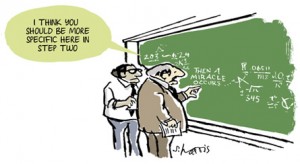
And then a miracle occurs cartoonMy late brother had a cartoon cut from some magazine taped to the door of his university office (he was a professor of political science and constitutional law) for years. I suspect it came from either Playboy or The New Yorker, but I really don’t know. It depicted two scientists working at a chalk board. To their left on the board was a complicated looking mathematical formula and to their right, another one. Connecting the two sets of numbers were arrows drawn from and to the words, “The a miracle occurs.” One of the scientists speaking to the other says, “I think you should be more specific here in step two.” (Of course, I’ve been able to find the cartoon on the internet and will post it with this meditation.)

That bit of scientific humor came to mind when I read this parable. I know this parable is meant to portray the church, the work of discipleship, the eschatological reality of the last judgement, etc. However, I am fascinated by the actual reality of planting seed, growing a crop, and harvesting the result, and Jesus’ words, “He does not know how!” 2,000 years after he spoke those words we truly still do “not know how” plants go from seed to harvest. We know a lot more of the “how” than we did, but we still don’t really have a clue what’s going on. We can name the elements and chemicals involved; we can describe the interactions and processes; we can pretty much point to the genes and DNA code that produce the end characteristics of the particular species. But when it comes right down to it, we don’t know how or why it happens, and we can’t actually produce it from scratch. We could mix all the constituent elements and chemicals together in exactly the right proportions and all we’ll have is a batch of chemicals, not a seed or plant or harvestable fruit.

Some day, perhaps, but not now. Research scientists keep pushing back the horizons of our knowledge, but there is still something we don’t know. Australian physicist Paul Davies put it this way in his book The Fifth Miracle, “Scientists still can’t quite put their finger on exactly what it is that separates a living organism from other types of physical objects.” Elsewhere, in an article in the journal BioSystems, Davies has said, “Living systems form a very special subset among the set of all complex systems. Biological complexity is distinguished by being information-based complexity, and a fundamental challenge to science is to provide an account of how this unique information content and processing machinery of life came into existence.”

In other words, the “how” (and especially the “why”) of what happens between planting of seed and harvesting of fruit remains a mystery. And, Dr. Davies helps frame the question: “Given a soup of classical molecular building blocks, how did this mixture ‘discover’ the appropriate extremely improbable combination by chance in a reasonable period of time?” I applaud the efforts of scientists to figure that out. I came across Dr. Davies’ writings because of my interest in quantum mechanics and string-theory; he proposes that quantum processes are at work in the origins of life. It’s an interesting hypothesis and might go a long way in answer the “how” question. It won’t, I don’t think, answer the “why”.

From my perspective (which I know some of my less religious friends and colleagues think is naive), what we don’t know (both the “how” and the “why”) is the second step in the cartoon’s equation. What we don’t know is the miracle that occurs, the miracle that occurred when the first primordial organism developed in the original soup of elements and chemicals way back when in the history of our earth.

It seems to me that this “then a miracle happens” unknown element is present in other parts of our existence, as well.

Two people meet, then a miracle happens – they fall in love. Sure, there’s a lot of interplay of pheromones and hormones and brain chemistry and what-not; we know a lot of the “how”, but we don’t know the “why”. Why these two and not those two, why each of these with the other and not with some other person, why sometimes two people once in love find themselves no longer so . . . . It’s in the second step, “then a miracle occurs.”

A human being grows to maturity and develops the ability to paint beautiful portraits or landscapes, to sculpt exquisite models of the human form, to write entertaining scripts, or to pen moving poetry. We can talk of environment and education and innate artistic ability; we can describe the “how” of her up-bringing and her craft. But we cannot answer the question “why” this person develops these talents and her sibling did not. It’s in the second step, “then a miracle occurs.”

The cartoon is right; we can’t just leave it at that! We need to be more specific in step two. So I cheer on the scientists who are seeking the answers. But I also celebrate the mysterious and the miraculous, and cheer on the mystics, the religious, the spiritual, the artists, the poets, the priests, and all the other seekers after truth. Let’s all try to learn what’s going on when a miracle occurs.

====================

A request to my readers: I’m trying to build the readership of this blog and I’d very much appreciate your help in doing so. If you find something here that is of value, please share it with others. If you are on Facebook, “like” the posts on your page so others can see them. If you are following me on Twitter, please “retweet” the notices of these meditations. If you have a blog of your own, please include mine in your links (a favor I will gladly reciprocate). Many thanks!

====================

Father Funston is the rector of St. Paul’s Episcopal Church, Medina, Ohio.

Lousy Soil or Lousy Sowing? – From the Daily Office – January 23, 2013

From the Gospel according to Mark:

Jesus explained the Parable of the Soils: “The sower sows the word. These are the ones on the path where the word is sown: when they hear, Satan immediately comes and takes away the word that is sown in them. And these are the ones sown on rocky ground: when they hear the word, they immediately receive it with joy. But they have no root, and endure only for a while; then, when trouble or persecution arises on account of the word, immediately they fall away. And others are those sown among the thorns: these are the ones who hear the word, but the cares of the world, and the lure of wealth, and the desire for other things come in and choke the word, and it yields nothing. And these are the ones sown on the good soil: they hear the word and accept it and bear fruit, thirty and sixty and a hundredfold.”

(From the Daily Office Lectionary – Mark 4:14-20 (NRSV) – January 23, 2013.)

The Sower by Van GoghIt’s a familiar enough parable, this story of the farmer who sows his seed only to have most of it fail to produce for one reason or another. Jesus’ use of the broadcasting seed as a metaphor for preaching is reassuring to those of us who preach on a regular basis. It seems to say it isn’t our fault if what we preach has little or no impact on the hearers; it’s the fault of the “soils” into which we are sowing – maybe “Satan” snatched it away, or maybe the hearers have no “depth”, or maybe they are just too concerned with “cares of the world”.
Or maybe we really are lousy preachers.

The task of ordained ministry is centered, at least in part, on the Word. The ministry of the clergy in many traditions is specifically referred to as a “ministry of Word and Sacrament.” A few years ago, an ecumenical group of pastors called The Eleison Group said that the clergy’s “primary responsibility is sharing the gospel of Jesus Christ with our congregations, our communities, and our world.” We who are ordained are expected to be wordsmiths and public speakers. The care with which we use words reflect not just upon us or upon the church; it reflects also upon the message we proclaim. “A bad book about the love of God remains a bad book,” wrote Thomas Merton. “[M]en pick up these books and say: If the ones who say they believe in God cannot find anything better than this to say about it, their religion cannot be worth much.” It is wrong to say of such readers that they have fallen prone to Satan, or that they lack depth, or that they are too concerned with worldly cares.

But Jesus’ point in the parable is well-taken. Communication is a two-way street. Even the best preacher can fail if she does not take into account the situation of her audience. It is the responsibility of the preacher to figure out what sort of “soil” the listener might be. In the mixed crowd of a congregation there will be some of all types, so preaching styles must vary; different texts must be chosen (the lectionary accomplishes this for those in such traditions); methods of delivery must be engaging and, frankly, entertaining; new technologies must be used. There are different kinds of “soils” and we must employ different kinds of techniques when “sowing” the Word. Sometimes we will fail, and sometimes it will not be our fault. But Jesus’ metaphor does not relieve the sower of all responsibility; the parable of the sower is not a blanket pardon from the sin of lousy preaching. No farmer knowingly wastes his seed on stony or weed-infested ground; no sower throws his seed where he expects the birds to immediately eat it up (nor does he fail to take precautions to keep the birds away). If any farmers do act thusly, they are lousy farmers and deserve the poor crops they get.

Preachers who fail to carefully prepare their homilies, who do not strive for excellence, are likely to get similar results. They have only themselves to blame, not the “soils” where they are sowing their seeds.

====================

A request to my readers: I’m trying to build the readership of this blog and I’d very much appreciate your help in doing so. If you find something here that is of value, please share it with others. If you are on Facebook, “like” the posts on your page so others can see them. If you are following me on Twitter, please “retweet” the notices of these meditations. If you have a blog of your own, please include mine in your links (a favor I will gladly reciprocate). Many thanks!

====================

Father Funston is the rector of St. Paul’s Episcopal Church, Medina, Ohio.

Jesus Is Crazy – From the Daily Office – January 22, 2013

From the Gospel according to Mark:

Then [Jesus] went home; and the crowd came together again, so that they could not even eat. When his family heard it, they went out to restrain him, for people were saying, “He has gone out of his mind.”

(From the Daily Office Lectionary – Mark 3:19b-21 (NRSV) – January 22, 2013.)

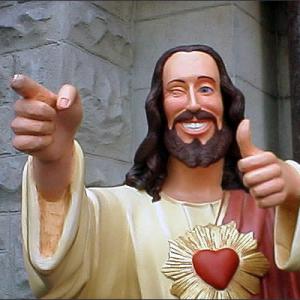
Buddy Jesus from the movie DogmaMark, Matthew, and John all report that on another occasion Jesus commented, “Prophets are not without honor except in their own country and in their own house.” One can’t get much more dishonored that being accused of being crazy!
I was at meeting today where the issue of evangelism was discussed – we were being honest, I think, in referring to it as “marketing” and using a marketing analysis of how we can go about putting the gospel before others.

At one point during the discussion, one of our number referred to a part of the market as “the crazies,” by which he meant those going through crises in their life: divorce, death of a loved one, loss of a job, alcoholism or other addiction (their own or someone else’s), etc. There are numerous disruptions, dysfunctions, crises, tragedies, and catastrophes that can lead to craziness in a family. What, he asked, can we offer to those facing “the crazies”?

We can offer Jesus whose family and friends thought he was “out of his mind”; we can offer the Jesus who is crazy! We have a crazy savior who is with us in the midst of the craziness. Of course, by calling Jesus “crazy,” I’m not saying Jesus was insane. C.S. Lewis, in Mere Christianity, addressed that issue when he suggested that in thinking about who Jesus was and is, we only three choices — (1) Jesus was mad. Only a madman would make some the outlandish statements Jesus made; (2) He was lying. He might or might not have believed what he said about himself, but regardless they were not true; or (3) What he said was and is true and he is the Son of God, the Incarnate Lord who came from heaven to live among us, who died on the cross, rose from the dead, and ascended into heaven opening the way of salvation to us. This is how Lewis makes this profound logical argument.

I am trying here to prevent anyone saying the really foolish thing that people often say about Him: “I’m ready to accept Jesus as a great moral teacher, but I don’t accept His claim to be God.” That is the one thing we must not say. A man who was merely a man and said the sort of things Jesus said would not be a great moral teacher. He would either be a lunatic – on the level with a man who says he is a poached egg – or he would be the devil of hell. You must take your choice. Either this man was, and is, the Son of God: or else a madman or something worse.

You can shut Him up for a fool, you can spit at Him and kill Him as a demon; or you can fall at His feet and call Him Lord and God. But let us not come with any patronizing nonsense about His being a great human teacher. He has not left that open to us. He did not intend to.

No, when I say that Jesus is “crazy,” I’m not thinking he was nuts. Rather, I’m remembering a character from a television show from my childhood – The Life and Loves of Dobie Gillis. Bob Denver played the beatnik character Maynard G. Krebs. When Maynard really liked something, he would say, “That’s like crazy, man!” That’s what I think about Jesus; he’s like crazy, man. And he’s with us when things go crazy!

====================

A request to my readers: I’m trying to build the readership of this blog and I’d very much appreciate your help in doing so. If you find something here that is of value, please share it with others. If you are on Facebook, “like” the posts on your page so others can see them. If you are following me on Twitter, please “retweet” the notices of these meditations. If you have a blog of your own, please include mine in your links (a favor I will gladly reciprocate). Many thanks!

====================

Father Funston is the rector of St. Paul’s Episcopal Church, Medina, Ohio.

Bursting The Old Wineskin – From the Daily Office – January 18, 2013

From the Gospel according to Mark:

Jesus said, “No one sews a piece of unshrunk cloth on an old cloak; otherwise, the patch pulls away from it, the new from the old, and a worse tear is made. And no one puts new wine into old wineskins; otherwise, the wine will burst the skins, and the wine is lost, and so are the skins; but one puts new wine into fresh wineskins.”

(From the Daily Office Lectionary – Mark 2:21-22 (NRSV) – January 18, 2013.)

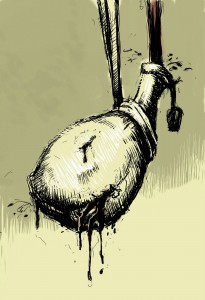
Bursting WineskinFor the past few years, I’ve been reading some of the folks who are writing about “emerging Christianity,” primarily Brian McLaren and Phyllis Tickle, but others as well. So last weekend I went to an event called an “Emergence Christianity conversation,” which was really a kick off for Ms. Tickle’s latest book. I was one of 400 or so participants, many of whom had been to earlier “emergence” events or are members of “emerging church” communities or both. Since I have not and am not, I was at most a johnny-come-lately to the conversation and at least an outsider. Nonetheless, I took part as I hoped to learn more about this (as Ms. Tickle put it) new tributary in the river that is Christianity.

My reason for doing so was, frankly, practical. What, I wanted to know, is happening on the ground in those places where “emerging Christianity” has taken the form of viable communities and working ministries? What might we in the historic, institutional church (what the emergent community calls “the inherited church”) learn from them?

I got fewer answers to those questions than I had hoped. The major presentations of this conversation were more about “framing the discussion” of the emerging church than about the practical ministries of emerging congregations. However, in smaller gatherings and in private conversations, I did pick up some ideas.

The practical question is how one can incorporate these new ways of being Christian into the life of an established, institutional congregation with a nearly 200-year history: how to, in the words of Jesus’ metaphors today, sew new cloth onto an old garment, how to pour new wine into an old wineskin. The emerging church conversation yields no answers to these questions because most of these experiments in doing new things (or old things a new way) are “start ups” outside of traditional church structures. Those few that are within older institutions are from less structured denominations with fewer restrictions (real or perceived) than our Anglican/Episcopal tradition, and even they show the signs of strain Jesus’ parable suggests.

Of course, we’re not dealing with old cloth or old leather . . . we’re dealing with people and, unlike cloth or leather, people can make the conscious decision to change, to be more flexible, to give up old ways and old notions. Henry Ford has been quoted (probably inaccurately) as saying, “I’m looking for a lot of people who have an infinite capacity to not know what cannot be done.” That’s the kind of people who aren’t old cloth or old leather. People who won’t say, “Oh, it can’t be done,” or “We’ve never done it that way,” but who will say, “Hey, anything’s possible. If the Lord is with us, let’s give it a shot.” The cloth wouldn’t tear and the wineskin wouldn’t burst if they were able to think like that.

Although I’m also thinking that maybe bursting the old wineskin of the church wouldn’t be a bad thing . . . .

====================

A request to my readers: I’m trying to build the readership of this blog and I’d very much appreciate your help in doing so. If you find something here that is of value, please share it with others. If you are on Facebook, “like” the posts on your page so others can see them. If you are following me on Twitter, please “retweet” the notices of these meditations. If you have a blog of your own, please include mine in your links (a favor I will gladly reciprocate). Many thanks!

====================

Father Funston is the rector of St. Paul’s Episcopal Church, Medina, Ohio.

The Actual or the Factual – From the Daily Office – January 15, 2013

From the Gospel according to Mark:

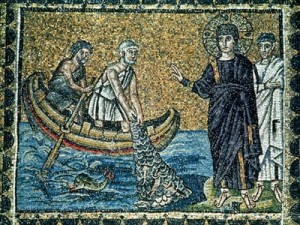
As Jesus passed along the Sea of Galilee, he saw Simon and his brother Andrew casting a net into the lake — for they were fishermen. And Jesus said to them, “Follow me and I will make you fish for people.” And immediately they left their nets and followed him. As he went a little farther, he saw James son of Zebedee and his brother John, who were in their boat mending the nets. Immediately he called them; and they left their father Zebedee in the boat with the hired men, and followed him.

(From the Daily Office Lectionary – Mark 1:16-20 (NRSV) – January 15, 2013.)

Mosaic, Sant'Apollinare Nuovo, Ravenna, Italy“I don’t know if this story happened, but I know it is true.” One of my favorite stories begins this way. The Gospel accounts do not, but they could . . . .

One of the things critics of Christianity like to point out is the inconsistency one finds in the gospel accounts of the various events they report. It cannot be denied that the stories of the calling of the initial disciples are contradictory. Mark’s is believed to be the earliest gospel and, therefore, one can assume the one written closest in time to the events described, but even it was probably written about sixty years after this event on the shore of Lake Galilee. Matthew relates the story similarly, but in Luke’s account Jesus first uses Simon Peter’s boat as a place from which to preach to crowds on the shore. Afterward, he tells Simon where to fish for a large catch and Simon actually tells Jesus to leave him because he, Simon, is a sinful human being; Andrew is never mentioned. John’s Gospel tells a very different story in which Andrew, described as a follower of the Baptizer, first encounters Jesus and then a day later introduces Simon to him.

So the community of faith has these three rather different accounts of his initial followers’ encounter with Jesus and the critics find in this a reason to disbelieve them all. I always ask them if their extended families have any favorite stories that are told at family gatherings, you know, the “remember the time Crazy Uncle Harry . . . . ” sorts of tales. My family did. If you were to go to one of my family’s reunions, you’d probably hear that story told. You’d probably hear it told by several different people. And you’d probably hear it told in several different ways. And you’d walk away wondering if you’d actually heard the same story because the details are so widely and wildly different! That’s the way it is with oral transmission of family stories, particularly as they are told by those who weren’t present but have heard them from someone else who heard them from someone else who maybe heard them from someone who was actually there.

A few days ago I heard the author Phyllis Tickle make a distinction between believing that the Bible is actually true and believing that the Bible is factually true. Her contrast is catchier than my own – in Bible studies and in confirmation classes I tell my students to make a distinction between facticity and truth – but the point is the same. Stories may be true (actual) without being factual. We make the Bible and its various forms of literature into something they are not if we insist upon treating them as factually accurate, as though they were scientific history, a reporting of facts. They are not. Biblical literature is concerned with truth, not with fact. Facts are true, but truth is larger than a collection of facts. To insist that truth is only factual devalues beauty, love, the spirit, personal honor, all those things which cannot be scientifically verified.

Were Simon and Andrew, James and John disciples of Jesus? Yes. Were they called as Mark relates? I have no idea. Is there truth in Mark’s story of their being called? Of course there is. Mark wants us to understand and appreciate the urgency of their call, the immediacy of their response to the call, the nature of the ministry to which they were called. These are all matters of truth although Mark’s account may not be factual. We of the modern age with our scientific worldview need to set aside our infatuation with the factual and become passionate about the actual, to give up our lust for facts and fall deeply in love with truth.

I don’t know if this story happened, but I know that it is true . . . .

====================

A request to my readers: I’m trying to build the readership of this blog and I’d very much appreciate your help in doing so. If you find something here that is of value, please share it with others. If you are on Facebook, “like” the posts on your page so others can see them. If you are following me on Twitter, please “retweet” the notices of these meditations. If you have a blog of your own, please include mine in your links (a favor I will gladly reciprocate). Many thanks!

====================

Father Funston is the rector of St. Paul’s Episcopal Church, Medina, Ohio.

« Older posts Newer posts »