Occasional thoughts of an Anglican Episcopal priest

Category: Mark (Page 15 of 18)

The One Who IS – From the Daily Office – January 11, 2013

From the Gospel of John:

When evening came, his disciples went down to the lake, got into a boat, and started across the lake to Capernaum. It was now dark, and Jesus had not yet come to them. The lake became rough because a strong wind was blowing. When they had rowed about three or four miles, they saw Jesus walking on the lake and coming near the boat, and they were terrified. But he said to them, “It is I; do not be afraid.” Then they wanted to take him into the boat, and immediately the boat reached the land towards which they were going.

(From the Daily Office Lectionary – John 6:16-21 (NRSV) – January 11, 2013.)

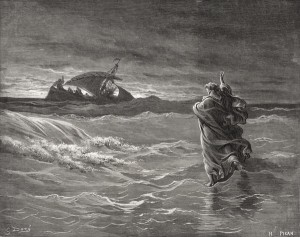
Gustav Dore, Jesus Walking on the Water (1866)Jesus walking on the water has always struck me as a very funny story. “Funny” in the sense of “oddly out of place”, although it also has a certain Monty-Python-esque quality to it as well. The fact that it is reported in three of the Gospels – in the synoptic Gospels of Mark and Matthew and here in John – attests to its importance for the early church. John’s version of the story is the simplest, but it contains all the elements – a storm, rough seas, disciples’ fear. Like Mark, John leaves out Matthew’s addition of Peter trying to join Jesus on the surface of the lake.

I say the story seems out of place because it is (other than Jesus’ fit of pique at the poor fruitless fig tree, which has a parabolic quality to it, the fig being a rabbinic metaphor for the Torah; Mark 11:12-14, and Matthew 21:18-22) the single demonstration of divine power by Jesus which does not benefit another person or group of people. Other manifestations of power result in the provision of food (the wine at the wedding in Cana, the feeding of crowds of 5,000 and 4, 000) or in the healing of the supplicant or some other person. Jesus here seems to be simply about his own business. In fact, Mark makes it clear that “He intended to pass them by.” (Mark 6:48b) However, the disciples see him so he must respond.

It is Jesus’ response that underscores why this story is here, I think, and the NRSV translation does not do it justice. The Greek is “Ego eimi, me phobeithe.” The words “ego eimi” are the same words used in the Septuagint (the early Greek translation of the Hebrew Scriptures) when God’s identity is revealed as “I AM” (for this is what the Greek emphatically states). In Exodus, God speaks to Moses out of the burning bush and, when Moses asks God’s name, he is told, “I AM who I AM;” the Greek is “ego eimi”. (Exodus 3:14) In a similar way, Isaiah the prophet reports God saying several times, “I, even I AM He;” the Greek is “ego eimi.” Later in John’s Gospel, Jesus will use this same construction in his famous “I am” statements. Here as there, Jesus’ identity with God is what is stressed.

And this is also the import of the story of Jesus’ walking on the water, this miracle with no other purpose, no parabolic meaning as in the blasting of the fig tree, no benefit to another as in the feeding or healing miracles. This miracle simply demonstrates the power of Jesus over nature, and simply over nature, but over the forces of death and chaos represented by water and the storm. It is, purely and simply, a manifestation of divine power.

I try always to keep before my mind’s eye the Jesus who is human, to remember that he was “one who in every respect has been tested as we are” (Heb. 4:15) But every so often it is important to remember that Jesus is also divine, fully divine, God incarnate. It is necessary every so often simply to stand in awe of the One who walked on the water, the One WHO IS, and yet who humbled himself to become as we are.

====================

A request to my readers: I’m trying to build the readership of this blog and I’d very much appreciate your help in doing so. If you find something here that is of value, please share it with others. If you are on Facebook, “like” the posts on your page so others can see them. If you are following me on Twitter, please “retweet” the notices of these meditations. If you have a blog of your own, please include mine in your links (a favor I will gladly reciprocate). Many thanks!

====================

Father Funston is the rector of St. Paul’s Episcopal Church, Medina, Ohio.

An Angry Jesus – From the Daily Office – December 1, 2012

From Luke’s Gospel:

As Jesus came near and saw the city, he wept over it, saying, “If you, even you, had only recognized on this day the things that make for peace! But now they are hidden from your eyes. Indeed, the days will come upon you, when your enemies will set up ramparts around you and surround you, and hem you in on every side. They will crush you to the ground, you and your children within you, and they will not leave within you one stone upon another; because you did not recognize the time of your visitation from God.” Then he entered the temple and began to drive out those who were selling things there; and he said, “It is written, “My house shall be a house of prayer’; but you have made it a den of robbers.” Every day he was teaching in the temple. The chief priests, the scribes, and the leaders of the people kept looking for a way to kill him; but they did not find anything they could do, for all the people were spellbound by what they heard.

(From the Daily Office Lectionary – Luke 19:41-48 (NRSV) – December 1, 2012)
 
Detail from "Christ Cleansing the Temple" by Carl Heinrich Bloch, 1875When I was eight years old, my grandparents gave me an illustrated copy of the King James Version of the Holy Bible. More than 50 years later, I still have it. It is rather small, a little bigger than a standard paper-back novel, and has a zippered leather cover. There are perhaps thirty glossy color plates with (one must admit) mediocre depictions of various biblical events. My favorite has always been the depiction of Jesus cleansing the Temple.

In that picture (not the picture I’ve appended to this post, I’m sorry to say), Jesus stands like some comic-book superhero, eyes blazing with righteous fury, his hair and the skirts of his robe flaring out as if he were some rapidly pirouetting dancer, arms outstretched, cat-o-nine-tails whipping about his head. Tables are crashing to the ground, animals are scattering, and the money changers and merchants are fleeing in terror. You can almost hear the panicked cries of the animals and the men.

Throughout the years, as I would go to Sunday School (not very often) or take confirmation instruction (required at my parochial high school) or attend college classes on “the bible as literature”, I would use that bible and look at those pictures, especially that one. I couldn’t really relate to the wise and gentle Jesus sitting on a hillside rock preaching the Beatitudes, nor to the suffering victim hanging on the cross under a stormy and darkling sky. But I could relate to the superhero furiously chasing the bad guys out of the Temple.

Many years later, I was practicing law as a trial lawyer and serving as the chancellor of my diocese. An older priest of the church during some council or committee meeting, or perhaps during the annual diocesan convention, in support of some position or other on some important issue of the day made the assertion that, “of course, Jesus never lost his temper.” What? thought I. You’ve got to be kidding! I’d grown up with a picture of a very angry Jesus kicking butt in Jerusalem!

But . . . as the years have passed, I have seen his point. Jesus was angry, but Jesus didn’t lose his temper. To be angry, even demonstrably angry is one thing; to lose one’s temper, however, suggests something more. Consider the synonymous descriptions we use: blow a fuse, fly into a rage, hit the roof, hit the ceiling, have a cow, have a fit, go ballistic, fly off the handle, flip one’s wig, flip one’s lid, blow one’s stack, throw a fit, blow up. They all describe a loss of control.

That’s the point, I believe, my older, more seasoned colleague was making. Jesus was angry, but Jesus was not out of control. Luke does not elaborate in his description of the cleansing of the Temple, nor do Mark or Matthew other than to add that he overturned the merchants’ tables. John, however, has a more interesting description:

In the temple he found people selling cattle, sheep, and doves, and the money changers seated at their tables. Making a whip of cords, he drove all of them out of the temple, both the sheep and the cattle. He also poured out the coins of the money changers and overturned their tables. He told those who were selling the doves, “Take these things out of here! Stop making my Father’s house a marketplace!” (John 2:14-16)

Jesus was angry, but he was not out of control. He did not “lose his temper”. What he did was deliberate and determined. This was an incident of symbolic prophetic action, like Jeremiah breaking a clay pot, Isaiah walking naked through the city, or Hosea marrying a prostitute. This is Jesus very carefully and very consciously acting out the last verse of the prophecy of Zechariah: “There shall no longer be traders in the house of the Lord of hosts on that day.” (Zech. 14:21)

So, after all these years, even though that superhero picture in my illustrated bible remains my favorite, I think the artist was wrong in his or her depiction of Jesus. If I were going to paint that scene now, everything might be the same except for Jesus’ eyes. I would not paint them flashing with terrible, uncontrolled rage; I would show in them the same kind of disappointed, almost sad, displeasure I sometimes saw in my parents’ eyes. That’s the only sort of anger I can imagine Jesus expressing . . . controlled, deliberate, and so very, very disappointed.

====================

A request to my readers: I’m trying to build the readership of this blog and I’d very much appreciate your help in doing so. If you find something here that is of value, please share it with others. If you are on Facebook, “like” the posts on your page so others can see them. If you are following me on Twitter, please “retweet” the notices of these meditations. If you have a blog of your own, please include mine in your links (a favor I will gladly reciprocate). Many thanks!

====================

Father Funston is the rector of St. Paul’s Episcopal Church, Medina, Ohio.

Giving It All Up, Getting Back Very Much More – From the Daily Office Lectionary – November 26, 2012

From Luke’s Gospel:

Jesus said, “It is easier for a camel to go through the eye of a needle than for someone who is rich to enter the kingdom of God. Those who heard it said, “Then who can be saved?” He replied, “What is impossible for mortals is possible for God.” Then Peter said, “Look, we have left our homes and followed you.” And he said to them, “Truly I tell you, there is no one who has left house or wife or brothers or parents or children, for the sake of the kingdom of God, who will not get back very much more in this age, and in the age to come eternal life.”

(From the Daily Office Lectionary – Luke 18:25-30 (NRSV) – November 26, 2012)
 
Jesus Talking to the DisciplesDo you ever wish someone whom you respect and admire hadn’t said what they said, because what they said is so hard to explain to someone who doesn’t respect and admire them, and what they said just sounds wrong, even to you? Then you know how I feel about the last response of Jesus in this conversation with Peter!

Jesus has just answered the question of someone Luke calls “a certain ruler” (in Mark’s Gospel he is described as a “rich young man”) about how to inherit eternal life with the famous reply, “Sell everything you own and give the money to the poor.” The disciples (more people than the Twelve, I think) are as unhappy with this hyperbolic response as the original questioner, and Peter seems downright outraged. “What are you saying?” I can almost hear him shouting at Jesus. “We have given up everything for you!” Is Jesus simply placating him with the promise of pie-in-the-sky-by-and-by? That’s what it sounds like. “Don’t worry! You’ll get it all back and get to live forever, too!”

Of course, I’m pretty certain that’s not what Jesus meant, but it’s so hard to explain that to someone who is skeptical of this whole God-Incarnate thing to begin with.

The reason I’m pretty certain that that’s not what Jesus meant is that here, unlike in the Markan version of this story, he doesn’t say, “You’ll get back a lot more of the things you gave up.” In Mark he does say pretty much that: “Truly I tell you, there is no one who has left house or brothers or sisters or mother or father or children or fields, for my sake and for the sake of the good news, who will not receive a hundredfold now in this age – houses, brothers and sisters, mothers and children, and fields, with persecutions – and in the age to come eternal life.” (Mark 10:29-30) Gave something up? Get a hundred more back. That’s what Mark’s Jesus says. But in Luke’s version of the story all that Jesus promises is “very much more.” I think that here there is a qualitative rather than quantitative difference in the promised return. In Mark, Jesus promises his follower will get a lot of the same stuff but at a price, i.e., persecutions; here, something better is promised . . . maybe peace, contentment, love, blessing, the Presence of God, the gifts of Holy Spirit . . . one doesn’t know, but it will be “very much more” than what was sacrificed. Are Mark and Luke trying to say the same thing? Are the things they report Jesus promising as rewards to the faithful follower equivalent? I don’t know; I hope they are, but the texts don’t make it easy to tell. And neither text makes it easy to explain to the skeptical unbeliever.

And the icing on the cake in both versions is the promise of “eternal life” in “the age to come”! It looks like a promise of immortality in the future, but (again) I’m not so sure. Both of these are coded phrases. The second one is found in lots of rabbinic literature, some contemporary with Jesus, some from later periods. It doesn’t necessarily mean the future; it means the time when God’s rule directs human affairs. That can be at any time when a person or persons give up their falsely perceived autonomy and live in accordance with God’s will. “The age to come” can (and does) exist concurrently with “this age”. It’s like that both-and, here-and-not-here, within-you-but-also-only-nearby thing that Jesus announced, the Kingdom of God. “Eternal life” is also not a future thing. For Jesus “eternal life” doesn’t mean immortality; it means life in eternity, where eternity is God’s Presence. “Eternal life” means living in God’s Presence with full awareness.

So the promised reward (whether it includes a hundred houses or not) is a qualitatively different life. Whatever we are called to give up in order to live a faithful life, possibly the hyperbolic “everything” that Jesus and Peter mention in this text, the reward of such a life is “very much more.” Which brings me back to how to explain it to the unbeliever . . . and the truth is that I don’t think it can be explained. It can only be lived and when it is lived, it becomes very apparent to someone not living it. An old friend of mine used to say this was the very best form of evangelism, to live the Christian life so well that one fairly glows with peace, contentment, love, blessing, the Presence of God, and the gifts of Holy Spirit. Others will see that and think, “I want that.” Then we don’t have to explain it, just offer it. Give it all up; get back so very much more.

====================

A request to my readers: I’m trying to build the readership of this blog and I’d very much appreciate your help in doing so. If you find something here that is of value, please share it with others. If you are on Facebook, “like” the posts on your page so others can see them. If you are following me on Twitter, please “retweet” the notices of these meditations. If you have a blog of your own, please include mine in your links (a favor I will gladly reciprocate). Many thanks!

====================

Father Funston is the rector of St. Paul’s Episcopal Church, Medina, Ohio.

Is go dtí tú mo mhuirnin slán

The Most Important Election . . . NOT! – Sermon for Election Day – November 6, 2012

====================

This sermon was preached on Tuesday, November 6, 2012, at St. Paul’s Episcopal Church, Medina, Ohio, where Fr. Funston is rector.

(Lessons selected for the Mass were Isaiah 26:1-8, Romans 13:1-10, and Mark 12:13-17, from the Episcopal Book of Common Prayer’s lectionary for various occasions, “For the Nation”; the gradual, Psalm 146, was selected by the preacher.)

====================

Romney Campaign Button "Most Important Election"“This election is the most important, ever. If that candidate is elected, it will be the end of the world!” The first time I heard that was during the campaign of the first presidential election I paid attention to: the race between John F. Kennedy and Richard Nixon in 1960. I heard it as my family watched the televised debate; it was said by my older brother who was then a freshman studying history and political science at the University of Texas, so of course he knew everything. “That candidate,” by the way, was Richard Nixon. We heard it again in 1964; remember the television commercial with the little girl plucking petals from a daisy and the atomic explosion? “If Barry Goldwater is elected,” it suggested none too subtly, “it will be the end of the world.” We hear it every election, “This election is the most important election of our lifetimes.” And, to be honest, that is a correct statement. Those in the past are no longer important; they’re done and other with. Only this election can impact the future so, at this time, up to now, it is the most important. But truth be told . . . none of them, including this election, are really all that important in the grand scheme of things.

In the Daily Office Lectionary of the Episcopal Church, the cycle of bible readings to be read each morning, today’s New Testament reading was from the Book of Revelation which records the vision St. John of Patmos had of “the new Jerusalem,” of heaven. In the lesson, this is what John reports:

I saw what appeared to be a sea of glass mixed with fire, and those who had conquered the beast and its image and the number of its name standing beside the sea of glass with harps of God in their hands. And they sing the song of Moses, the servant of God, and the song of the Lamb:
“Great and amazing are your deeds,
Lord God the Almighty!
Just and true are your ways,
King of the nations!
Lord, who will not fear
and glorify your name?
For you alone are holy.
All nations will come
and worship before you,
for your judgments have been revealed.” (Revelation 15:2-4)

This song of praise was a wonderful reminder with which to begin Election Day: God is the king of the nations; he alone is holy. As we went to the polls today, we were casting our ballots for political leaders, not religious ones, and certainly not a savior. Today we chose between candidates for various offices, all of whom are simply human beings like ourselves, fallible human beings whom we hope will strive to overcome whatever their faults and frailties may be, and govern to the best of their abilities. Whether the candidates for whom you or I happened to vote are elected is not, at this point, of any real importance; what is of importance is that we respect and honor our system of governance, and support and pray for whichever candidates are ultimately placed in office.

The Psalm which we recited just a few minutes ago reminds us:

Put not your trust in rulers, nor in any child of earth, for there is no help in them.
When they breathe their last, they return to earth, and in that day their thoughts perish.
(Ps. 146:2-3, BCP version)

We are admonished not to rely, although we surely do, on our earthly leaders. We repose more trust, and certainly more expectation, than we ought in our elected leaders, forgetting that they are no different from, nor more perfect than we.

This evening we do not celebrate nor do we extol any political party, any platform, any candidate, any elected office holder. Instead, we give thanks for the freedoms we enjoy, for the country we love, and for the electoral process which allows us to maintain both through peaceful changes in government. We give thanks for the wisdom of our Founding Fathers, for the insight of the framers of the Constitution, for the bravery and sacrifice of those who have defended our rights and liberties, and for the commitment of our fellow citizens who have participated in our democracy and voted in this election. We give thanks for all these things to the one upon whom all this rests, to the one who is the foundation of our existence, to the one who is our ultimate concern, to the one in whose service we find perfect freedom.

When we gather to give thanks for and to pray for our national life, the lectionary of our church asks us to hear and consider the story of the Pharisees and Herodians asking Jesus about taxes: Is it lawful to pay them to Caesar? To which Jesus’ makes his famous reply, “Render to Caesar the things that are Caesar’s and to God the things that are God’s.” This gospel story, says theologian Daniel Deffenbaugh

. . . calls us to be neither enemies of the state nor its staunch allies. Rather, we should think of ourselves, in the words of Stanley Hauerwas, as “resident aliens. ” We do not refuse to give to the emperor the things that are the emperor’s, even when – much to our dismay – their utilization defies our most deeply held convictions. This is as true of the right as it is of the left, and in this we can take some solace. But the affections of our hearts and minds must always, and with greater fervor, be focused on the more urgent clause in Jesus’ directive: “give to God the things that are God’s.” (Allies or Enemies?

This, he says, leaves us in a “posture of perpetual discernment,” constantly trying to distinguish our steadfast devotion to God from our obligations to the nation.
The Cathechism of the Roman Catholic Church interprets this gospel tale as teaching that we should “give to God everything, but give Caesar his due.” Thus, we are called to take part in our national culture for the common good. “It is necessary that all participate, each according to his position and role, in promoting the common good. This obligation is inherent in the dignity of the human person.” (CCC 1913) To the best of our ability, we should all participate in the public arena for the good of the society. Jesus’ answer to the Pharisees and Herodians gives each person freedom to act in that public sphere, but with that freedom come awesome responsibilities, none more awesome than the privilege and obligation to participate in democratic elections, even if we do so in a “posture of perpetual discernment.”

We do our best in that state of constant decision-making. We study the issues and the candidates. We make our choices. We participate in the public arena. We vote. And then we trust . . . not in rulers, not in political parties, not in the candidates, not in any child of earth . . . We render our trust not to Caesar nor anything that is Caesar’s, but to God. It is not that our vote is unimportant, but it is not of ultimate concern.

In the Anglican Communion on November 6, we commemorate one of our greatest theologians, Archbishop William Temple, who served as Archbishop of Canterbury near the Second World War. He served in that post only two years, from his appointment in 1942 to his death in October, 1944. He served in the episcopate for 23 of his 63 years, first as Bishop of Manchester, then as Archbishop of York, and finally in the See of Canterbury. Throughout his life, he was a prolific author of philosophy and theology.

While serving in York, he addressed the 1938 Lambeth Conference, the decennial gathering of Anglican bishops, with these words which, I think, are a good reminder for us today:

While we deliberate, God reigns.
When we decide wisely, God reigns.
When we decide foolishly, God reigns.
When we serve God in humble loyalty, God reigns.
When we serve God self-assertively, God reigns.
When we rebel and seek to withhold our service, God reigns –
The Alpha and the Omega, which is and which was,
And which is to come, the Almighty.

John of Patmos in his apocalypse, the Psalmist in Psalm 146, Archbishop Temple in his address to the gathered bishops . . . they all remind us that no matter how we decide, no matter who is elected today, God reigns. As the graphic on the cover of our bulletin says, “No matter who is president, Jesus is king.”

Let us pray.

O God of light and love, inspire us, we pray, that we may rejoice with courage, confidence, and faith in the Word made flesh, Jesus our King, and that through our participation in our national culture and our democratic processes we may establish that society which has justice for its foundation and love for its law; through the same Jesus Christ, our Lord, who lives and reigns with you and the Holy Spirit, one God, now and for ever. Amen.

====================

A request to my readers: I’m trying to build the readership of this blog and I’d very much appreciate your help in doing so. If you find something here that is of value, please share it with others. If you are on Facebook, “like” the posts on your page so others can see them. If you are following me on Twitter, please “retweet” the notices of these meditations. If you have a blog of your own, please include mine in your links (a favor I will gladly reciprocate). Many thanks!

====================

Father Funston is the rector of St. Paul’s Episcopal Church, Medina, Ohio.

No Ifs, Ands, Or Buts – From the Daily Office – October 22, 2012

From Luke’s Gospel:

As they were going along the road, someone said to him, “I will follow you wherever you go.” And Jesus said to him, “Foxes have holes, and birds of the air have nests; but the Son of Man has nowhere to lay his head.” To another he said, “Follow me.” But he said, “Lord, first let me go and bury my father.” But Jesus said to him, “Let the dead bury their own dead; but as for you, go and proclaim the kingdom of God.” Another said, “I will follow you, Lord; but let me first say farewell to those at my home.” Jesus said to him, “No one who puts a hand to the plough and looks back is fit for the kingdom of God.?”

(From the Daily Office Lectionary – Luke 9:57-62 – October 22, 2012)

No ExcusesJesus is so demanding! Follow me and you won’t have a place rest; leave your dead; if you look back, you aren’t worthy!

My grandmother used to have a way of responding to excuses. She’d tell us to do something and my brother or my cousins or I would say, “But, Grammy . . . . ” And she would reply, “No ifs, ands, or buts!”

As I reflected on today’s gospel lesson I tried to find some humor in it, but the plain truth of the matter is that Jesus is demanding. To the rich young man he said, “Sell all you have, give the money to the poor, then follow me.” (Luke 18:22) To his followers he says, “If something in your life, even a part of your body, causes you to sin, get ride of it.” (Mark 9:43-47) Our allegiance to him and his gospel is to be so exclusive that it may even make enemies of our closest relatives: “I have come to set a man against his father, and a daughter against her mother, and a daughter-in-law against her mother-in-law; and one’s foes will be members of one’s own household.” (Matthew 10:35-36) No ifs, ands, or buts about it!

This is a man who brooks no compromise and if we are to be his followers, he demands that we adopt the same attitude: “A disciple is not above the teacher, nor a slave above the master; it is enough for the disciple to be like the teacher, and the slave like the master.” (Matthew 10:24-25)

No wonder many of those who thought they would be his disciples turned back and even those who continued with him found his teachings and example hard to follow. We still do; the church and her members still make the compromises he warned us not to make. But in the end we are left to ask with Peter, “Lord, to whom can we go? You have the words of eternal life.” (John 6:68)

It is a dilemma! To whom else can we go? But Jesus is so demanding! No ifs, ands, or buts about it!

====================

A request to my readers: I’m trying to build the readership of this blog and I’d very much appreciate your help in doing so. If you find something here that is of value, please share it with others. If you are on Facebook, “like” the posts on your page so others can see them. If you are following me on Twitter, please “retweet” the notices of these meditations. If you have a blog of your own, please include mine in your links (a favor I will gladly reciprocate). Many thanks!

====================

Father Funston is the rector of St. Paul’s Episcopal Church, Medina, Ohio.

In God We Trust – From the Daily Office – October 15, 2012

From the Prophet Micah:

Put no trust in a friend,
have no confidence in a loved one;
guard the doors of your mouth
from her who lies in your embrace;
for the son treats the father with contempt,
the daughter rises up against her mother,
the daughter-in-law against her mother-in-law;
your enemies are members of your own household.
But as for me, I will look to the Lord,
I will wait for the God of my salvation;
my God will hear me.

(From the Daily Office Lectionary – Micah 7:5-7 – October 15, 2012)

In God We Trust on Dollar BillSound familiar? Jesus sounded a lot like Micah at times:

Do not think that I have come to bring peace to the earth; I have not come to bring peace, but a sword. For I have come to set a man against his father, and a daughter against her mother, and a daughter-in-law against her mother-in-law; and one’s foes will be members of one’s own household. (Matt. 10:34-36; cf. Luke 12:51-53)

Micah is the same prophet who authored what may be my favorite verse in all of the Old Testament: “He has told you, O mortal, what is good; and what does the Lord require of you but to do justice, and to love kindness, and to walk humbly with your God?” (6:8) And Jesus is the same preacher who said “Love your neighbor as yourself” was one of the greatest commandments. (Mark 12:31) How does one reconcile these admonitions with advice to put no trust in friend or loved one and promises to bring enmity between family members?

The answer lies in the last part of the above quotation from Micah: Trust in God. In the 1950s the U.S. Congress decided to emblazon “In God We Trust” across American currency as a response to the rise of “Godless communism” in the Soviet Union and its sphere of influence. One may debate whether it was appropriate under the U.S. Constitution, or whether it has since had any salutary effect, but it is what Micah models here, and it is the message of Scripture and of Jesus. “Don’t trust human beings! Trust God!”

In the last weeks of the U.S. presidential campaign, as political debates lead to family arguments and people begin to see the members of their own households as political enemies, it is well to remember this. Human beings, even the best of us, are fallible and untrustworthy, especially the ones we put on pedestals and look to to solve the problems of our nation or our world. As the Psalmist (echoing Micah’s sentiment) reminded us, “Put not your trust in rulers, nor in any child of earth, for there is no help in them.” (Ps. 146:2, BCP version)

It may sound trite. It may be misplaced on our currency. But it is the only solution: “In God We Trust.” If we remember that, maybe we can all just get along . . . .

====================

A request to my readers: I’m trying to build the readership of this blog and I’d very much appreciate your help in doing so. If you find something here that is of value, please share it with others. If you are on Facebook, “like” the posts on your page so others can see them. If you are following me on Twitter, please “retweet” the notices of these meditations. If you have a blog of your own, please include mine in your links (a favor I will gladly reciprocate). Many thanks!

====================

Father Funston is the rector of St. Paul’s Episcopal Church, Medina, Ohio.

Simple Wisdom from Above – Sermon for Pentecost 17, Proper 20B – September 23, 2012

====================

This sermon was preached on Sunday, September 23, 2012, at St. Paul’s Episcopal Church, Medina, Ohio, where Fr. Funston is rector.

(Revised Common Lectionary, Proper 20B: Wisdom of Solomon 1:16-2:1,12-22; Psalm 54; James 3:13-4:3,7-8a; and Mark 9:30-37.)

====================

Wisdom Highway SignThe collect for today from The Book of Common Prayer:

Grant us, Lord, not to be anxious about earthly things, but to love things heavenly; and even now, while we are placed among things that are passing away, to hold fast to those that shall endure; through Jesus Christ our Lord, who lives and reigns with you and the Holy Spirit, one God, for ever and ever. Amen.

On the positive side, the side of “things heavenly,” there is the “wisdom from above [which] is first pure, then peaceable, gentle, willing to yield, full of mercy and good fruits, without a trace of partiality or hypocrisy.” On the negative side, the side of “earthly things,” there is “wisdom [which] does not come down from above, but is earthly, unspiritual, [and] devilish;” the story from the Wisdom of Solomon demonstrates what this sort of “negative wisdom” leads to. How do we learn wisdom and how do we learn to choose one sort over the other?

One way, of course, is from our elders. We learn by watching them, by listening to them, by doing what they do. Sometimes that’s good, sometimes not so good, but as the old saying goes, apples don’t fall far from the tree. For most of us, the ways we do things, the ways we make choices and decisions, the ways we react the world around us are pretty much the same ways our parents or grandparents did. I know I’m not alone in having those moments when I hear myself saying something and then think, “O heavens! When did I turn into my father (or into my mother)?”

But the world changes rapidly and we don’t always find ourselves in situations where the “wisdom of the elders” can be used. We face new contexts and different challenges; we deal with a reality that they never encountered.

My wife’s father passed away a couple of weeks ago and last weekend we were away in Nevada for his memorial service. (Our thanks to the many of you who have expressed your condolences.) Paul was 95-1/2 years old, and as we celebrated his life I thought about the way the world has changed in the almost complete century of his life. The Wright brothers flew their plane at Kitty Hawk, North Carolina, just 14 years (almost to the day) before he was born. Look what has happened to the air transportation and space flight since then. Paul’s entire working life was spent in the telephone communications industry and look what has happened in that business and its offshoots, cell phones, smartphones, the internet, Facebook, and all the rest. The world has changed dramatically in just the span of his life, and the wisdom of the early 20th Century is sometimes woefully inadequate in dealing with the 21st Century.

Sometimes we humans can’t deal with change, particularly when it comes at us rapidly as it has in these past several decades. Our reaction is often to try lock things down, to try to stop the change. But we can’t really do that; the world changes anyway. Wisdom, the right kind of wisdom, the “wisdom from above” as James calls it, recognizes that. It is, he says, “willing to yield.” Earlier in his letter, in fact in its very first words, James writes, “My brothers and sisters, whenever you face trials of any kind, consider it nothing but joy, because you know that the testing of your faith produces endurance.” (1:2-3) For James, it is a simple thing: ” Humble yourselves before the Lord, and he will exalt you.” (4:10)

James understands, and he wants his readers, you and me, to understand that nothing is ever locked down, that change can never be stopped, it can only be embraced; for James this is as true for changes in ourselves as it is for changes in the world. In this letter, James writing to the whole church; unlike Paul’s letters which were written to particular congregations to solve particular problems, James’s epistle is written to all Christians in every place at every time. Therefore, he knows he is writing to people who are in different and widely differing circumstances, to Christians who are at different stages of spiritual maturity. But he is able to address each of us, no matter where along the journey we may be, because even our faith is not locked down.

Conversion to Christ is not a one-time thing; it is an on-going, life-long process. We aren’t brought suddenly in a blinding instance from darkness fully into the light so that everything before some point of conversion is left behind and all ambiguity removed. It just doesn’t work that way. Conversion is an on-going process. Every day we have to leave behind our anxieties about earthly things, and learn again to love things heavenly; every day we have to turn away from the wisdom from below, from envy and selfish ambition, from disorder and wickedness, toward the wisdom from above, toward peaceableness and gentleness, toward simplicity and mercy.
I spend some time each day in prayer and one of my favorite resources is this book, Celtic Daily Prayer from the Northumbria Community in northeastern England. In it are readings for each day of the year. This was yesterday’s taken from another book entitled Hebridean Altars: The Spirit of an Island Race by a Scots Presbyterian minister named Allistair MacLean:

When the shadows fall upon hill and glen;
and the bird-music is mute;
when the silken dark is a friend;
and the river sings to the stars:
ask yourself, sister,
ask yourself, brother,
the question you alone have power to answer:
O King and Saviour of all,
what is [Your] gift to me?
and do I use it to [Your] pleasing?

That is a wonderfully wise, spiritually simple question to ask everyday, a question which we each are only able to answer for ourselves in prayerful conversation with God: What is God’s gift to me and do I use it to God’s pleasing? It is a question which can help us to turn from earthly things, from envy and ambition and disorder and wickedness, toward heavenly things, toward peace and gentleness and mercy. It is a question which we, God’s children, should ask everyday in prayerful conversation with the Father.

In today’s Gospel lesson from Mark, when the disciples are arguing amongst themselves about envy and ambition, Jesus took a little child and put her among them; Jesus took the child in his arms and said to them, “Whoever welcomes one such child in my name welcomes me, and whoever welcomes me welcomes not me but the one who sent me.” When Matthew tells this story, Jesus also says, “Unless you change and become like children, you will never enter the kingdom of heaven. Whoever becomes humble like this child is the greatest in the kingdom of heaven.” (Matt. 18:3-4) In Mark’s Gospel he will say this in another setting, “Truly I tell you, whoever does not receive the kingdom of God as a little child will never enter it.” (Mark 10:15)

As a child, we look to our elders to learn wisdom; as children of God, we look to our Father to learn the wisdom from above. In that way, we receive the kingdom of God; we enter the kingdom of heaven. In today’s reading in Celtic Daily Prayer, also from Hebridean Altars, this is the very image presented, the image of a child reaching up to and being lifted up by the Father:

Often I strain and climb
and struggle to lay hold
of everything I’m certain
You have planned for me.
And nothing happens:
there comes no answer.
Only You reach down to me
just where I am.
When you give me no answer
to my questions,
still I have only to raise my arms
to You, my Father
and then You lift me up.
Then because You are my Father
You speak these words of truth
to my heart:
“You are not an accident.
Even at the moment of your conception,
out of many possibilities,
only certain cells combined,
survived, grew to be you.
You are unique.
You were created for a purpose.
God loves you.”

In our world today, the search for spiritual answers, the search for religious certainty, the attempt to lock things down does more to divide than it does to unite. It is a misguided quest governed more by the wisdom from below than by the wisdom from above. The wisdom from above does not try to lock down an unchangeable certainty, but rather turns daily to God with childlike simplicity to ask, “What is your gift for me today?”

In 1848, in the spirit of James’s epistle and Christ’s metaphor of childlike welcoming and faith, Elder Joseph Brackett of the Shaker community in Alfred, Maine, wrote one-verse song describing a simple children’s dance as a paradigm for gaining wisdom. It is entitled Simple Gifts, and these are the words:

‘Tis the gift to be simple, ’tis the gift to be free
‘Tis the gift to come down where we ought to be,
And when we find ourselves in the place just right,
‘Twill be in the valley of love and delight.
When true simplicity is gained,
To bow and to bend we shan’t be ashamed,
To turn, turn will be our delight,
Till by turning, turning we come ’round right.

You’ll find this song in the hymnal, Hymn No. 554. Will you stand and sing it with me today and then everyday remember to seek the wisdom from above by asking that simple question of God: “What is your gift to me today, and do I use it to your pleasing?” Shall we sing?

An Instant of Transforming Grace – Sermon for Pentecost 15, Proper 18B – September 9, 2012

====================

This sermon was preached on Sunday, September 9, 2012, at St. Paul’s Episcopal Church, Medina, Ohio, where Fr. Funston is rector.

(Revised Common Lectionary, Proper 18B: Isaiah 35:4-7a; Psalm 146; James 2:1-17; and Mark 7:24-37.)

====================

Yellow and Purple WildflowersIf you are a political junkie like me, you’ve been following the campaigns, watching the conventions, reading the editorials, and generally getting angry with one side or the other or both and the whole process. You may have noticed, as I have, that candidates are never alone. They are surrounded by a whole corps, an entire gaggle of handlers, some of whom have the responsibility to make sure the candidate stays “on message”, that he or she makes no “gaffs”. Jesus was surrounded by a gaggle, as well, but these were not handlers and there was no one to keep him “on message” except himself. In fact, the gospel witness is pretty clear that even right up to the end the gaggle that followed him around really didn’t understand the message!

To be honest, it’s not clear in today’s lesson whether the gaggle is even around. Mark doesn’t say anything about them and the way he writes this story it sounds like Jesus may have gone without them to the city of Tyre, a gentile town north of the sea of Galilee and on the Mediterranean coast in what is now Lebanon. But whether they were with him or not, he doesn’t have anyone there who can stop him making a really awful racist gaff, from calling this foreign woman “a dog”! O.M.G.! Can you imagine what Fox News or MSNBC would have done with this?

Gentle Jesus, meek-and-mild Jesus, love-everyone Jesus, welcome-the-sinner Jesus has just said about the worst, most insulting, most awful thing he could say to a woman who wanted nothing more than to get medical help for her daughter! And make no mistake about it, that is what he has done. He has uttered a racial slur!
Immediately we want to say, “That can’t be! Jesus couldn’t possibly have been racist!” But Mark’s story of Jesus’ encounter with this Syrophoenician woman says otherwise. Jesus has called this woman, who simply wants a cure for her child, a dog, a dehumanizing ethnic slur common at the time. We can do some theological dancing, some interpretive two-step to avoid this uncomfortable reality, but eventually we have to face the truth. Jesus, with no handlers nearby to stop him making a “gaff”, has uttered a racial insult.

The difficulty of this passage is that we, as 21st Century Christians, want Jesus to be the simple, easy answer to all of our problems and to all of society’s problems. When faced with the problem of racism, whether personal or institutional, we would prefer to think of Jesus as always loving all people regardless of skin color or ethnicity. But Jesus the First Century Palestinian Jew doesn’t give us those easy 21st Century answers. He had a real life and real feelings. He was born and reared in a real culture with all of its trappings.

As a good Jewish man, Jesus would have given thanks daily that he was born a Jew not a Gentile, a man not a woman. He would have said the siddur prayer every day, one version of which praises God “. . . who has created me a human and not beast, a man and not a woman, an Israelite and not a gentile, circumcised and not uncircumcised, free and not slave.” (From the Cairo Genizah.) Even the best of humanity, the Incarnation himself, could get entangled in the sexist and racist snare of this tradition, could get caught up in its inherent system of oppression, its culture of supremacy.

The great lesson of his encounter with the Syrophoenician woman is that it teaches us how the cultural dynamics of racism, of prejudice of any kind, can be overcome in a real moment of conversion. Jesus’ understanding of what he was called to do was changed and expanded because of this gentile woman’s challenge. From that moment, he moved forward, and went about his work with an expanded awareness of who the Good News was for, healing the woman’s daughter and then going deeper into gentile territory.
Mark masterfully combines this story with the tale of healing the man with the speech impediment which seems also to have taken place in gentile territory. Mark writes that Jesus returned to the Sea of Galilee by way of Sidon; if you look at a map, that makes no sense. The Galilean Lake is south of Tyre and inland; Sidon is a considerable distance north of Tyre and on the coast. Like Tyre, it was and is a gentile settlement. The way Mark tells the story it may have been here that Jesus restored the hearing of the man with impeded speech. Mark combines the stories because because the second story explains the first. Jesus metaphorical ears, his ethnic or socio-political ears (if you will) were opened by the woman in the same manner that the deaf man’s physical ears were opened by Jesus. That Jesus went deeper into gentile territory and there healed the deaf man, probably himself a gentile, shows the impact of the woman’s words on Jesus. The man’s ears were opened by Jesus, his tongue was loosened, and he no longer spoke his slurred speech; Jesus’ “ears” were opened by the woman, his traditional upbringing was loosened, and he no longer uttered ethnic slurs.

What is noticeable about both “healings” is their surprising quickness. The Syrophoenician woman challenges Jesus and in a single instant of profound grace his heart is changed; Jesus speaks a single word and in an instant of profound grace the man’s ears are unstopped and his speech restored. These gospel stories of sudden and immediate transformation are combined for us today with a short lesson from the prophet Isaiah who likens the coming of God’s power, the time when the ears of the deaf will be opened and the eyes of the blind will be given sight, to one of the briefest moments in the desert, that time when the spring rains come and the desert quickly blooms.

There’s nothing quite like springtime in the desert! One is never sure when it will happen but one spring day a storm moves in and for a few hours the dry burning sands are covered with pools, the thirsty ground runs with streams that rush through the desert often to the point of dangerous flooding. In just a few more hours, the wilderness blooms with an intensity that truly has to be seen to be appreciated. Around my hometown of Las Vegas, the spring rains produce an incredible variety of blossoms. There are all sorts of different yellows: bear poppy, bristly fiddleneck, buttercups, and desert dandelion, to name a few. There are vivid pinks: beardtongue and arrowweed and the mojave thistle. There’s a red-spotted purple flower called “desert five spot”. There’s a flower called “desert bell” that is the most vivid blue you’ve ever seen and, of course, there are the red-orange California poppies all over the place. It’s just incredible! And it happens almost instantaneously and then, in just a few hours, the desert goes dry again . . . and the brilliant rainbow of desert color is gone, but for that brief moment the desert has been transformed and, truly, it will never be the same again.

Isaiah tells us that that is precisely the way the power of God comes, with that same sort of startling swiftness, in a moment of magnificent immediacy. That’s the way new hearing and new understanding came to the deaf man and, surprisingly, to Jesus, as well. And that’s the way it comes to us. We may study Scripture for years; that’s a good thing to do and we gain knowledge and understanding that way. But it is not through that study that we are transformed. We may attend worship services weekly or even daily; that’s a good thing to do and we show our love of God in that way. But it is not through liturgy that we are transformed. We may regularly give of our time and talent in ministry to the poor; that’s a good thing to do and we serve Christ in others in that way. But it is not through that service that we are transformed. It is, rather, through the swift and surprising in-breaking of God’s power and Spirit that we are transformed! And it is through that transformation that we are empowered to serve with new vigor, to worship with new thanksgiving, to read Scripture with new understanding.

Isaiah assures us that when the waters of God’s power break forth in the wilderness of our lives, when the streams of God’s Spirit flow through the deserts of our existence, then the burning sands of our souls become pools, the thirsty ground of our hearts become springs of living water. Through the words of the Syrophoenician woman it happened to Jesus; through the ministry of Jesus it happened to the man with the speech impediment; and through the power of the Holy Spirit it happens to us. The writer of the letter to the Hebrews declares that God in Jesus became like us “his brothers and sisters in every respect” that he might be “the pioneer and perfecter of our faith” (Heb. 2:17, 12:2) so that, as John says, “we will be like him!” (1 John 3:2) It happens in an instant, like the transformation of the desert in the spring rains or, as Paul said, “in the twinkling of an eye.” (1 Cor. 15:42)

Let us pray:

Almighty and merciful God, how wonderfully you created us and still more wonderfully transform us. In moments of surprising grace, you send your Holy Spirit into our hearts to reform our lives; you constantly renew us through your redeeming love, refreshing us as rain refreshes the wilderness. We thank you for the wondrous streams of your mercy, for the pools of your love, for the water of life which restores our parched spirits and transforms us ever more closely into the likeness of your Son, through whom in the power of the Holy Spirit, we join with the whole Church to give you praise, now and for ever. Amen.

Arise, My Love, My Fair One, and Come Away: A Baptismal Sermon – Pentecost 14, Proper 17B – September 2, 2012

====================

This sermon was preached on Sunday, September 2, 2012, at St. Paul’s Episcopal Church, Medina, Ohio, where Fr. Funston is rector.

(Revised Common Lectionary, Proper 17B: Song of Solomon 2:8-13; Psalm 45:1-2,7-10; James 1:17-27; and Mark 7:1-8,14-15,21-23.)

====================
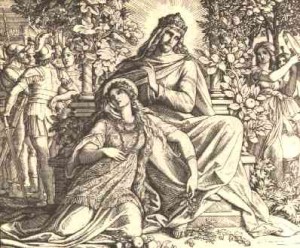
I want you for just a minute to close your eyes. Just sit back and relax, and imagine that you are hearing not my voice, but the voice of your beloved, the voice of the one person in this world who loves you more than any other . . . .

“Arise, my love, my fair one, and come away.”

Those words, of course, are from Scripture, from the Song of Songs or Song of Solomon, one of the oddest books in the Holy Bible, for it is nothing more nor less than a love song, a sensual and even erotic love song.

Our psalm this morning is also a love song. It is a marriage song which the Bible tells us was written by the Korahites or “Sons of Korah” for the wedding of a king. In fact, the Bible tells us a lot about this psalm, information that we don’t find in the Book of Common Prayer Psalter. First, it has an instruction: “To the leader: according to the Lilies.” Apparently this tells the choral director the tune or melody to which the psalm was to be sung. Second, it tells us that it was a song “of the Korahites” who were a musical guild (probably hereditary) in the Temple. Third, the psalm is described as a Maskil – this word is derived from a Hebrew word meaning “understanding” or “insight” and, thus, it is believed that Psalms so described are “insight-giving” or especially instructive. And, finally, it is described as a love song.

The insight comes, perhaps, in what is the third verse of our abbreviated recitation this morning:

Your throne, O God, endures for ever and ever,
a scepter of righteousness is the scepter of your kingdom;
you love righteousness and hate iniquity.
(Verse 7 in the BCP; vv. 6-7a in the NRSV)

In this verse, which has puzzled scholars for generations, though the singer seems still to be singing of the King, he names him “God”! The psalm appears to ascribe divinity to an earthly king which is something quite foreign to ancient Judaism. This is underscored by the last verse of the Psalm:

I will make your name to be remembered
from one generation to another;
therefore nations will praise you for ever and ever.
(Verse 18 in the BCP; v. 17 in the NRSV)

Here, this remarkable psalm lavishes on the human king the type of praise generally given to God! Christians, therefore, read this psalm as referring to Jesus, as we also read the Song of Solomon. The usual interpretation of both is that the Bridegroom or King is Jesus and the Bride or Queen is the church. However, in the middle ages the monastic mystics St. Teresa of Avila and St. Bernard of Clairvaux suggested a much more personal interpretation. In their commentaries Bernard and Teresa envisioned the love between Christ the Bridegroom and his bride, the individual soul, and they noted the way in which that love overflows to others.

For Bernard, the Song is about the manner in which the “thirsting soul” can rediscover the power of God’s love. “What a great thing is love, provided always that it returns back to its origin,” he writes; “flowing back again into its source, it acquires fresh strength to pour itself forth once again.” (On the Songs of Songs 83:4) Our journey to God’s love does not consist in our finding the path, but rather in being found on the path by Christ the Bridegroom who passionately seeks us. “Arise, my love, my fair one, and come away,” are words spoken by Christ to each one of us as he invites us to follow him. But the divine love is never intended to be, and is not complete if it is, purely individual and personal.

Bernard writes that the human soul aflame with the love of God “strives to win [other] souls with its habitual fire and renewed courage.” (58:1) “Love reveals itself,” he writes, “not by words or phrases, but by action and experience.” (70:1) Thus, says St. Bernard, love of God is not merely a personal experience; it is never complete unless it leads us to love our neighbors.

For Teresa of Avila, similarly, the Bridegroom’s call leads the soul back from a lack of love to love most fully realized:

Along how many paths, in how many ways, by how many methods You show us love! …[Not] only with deeds do You show this love, but with words so capable of wounding the soul in love with You that You say them in this Song of Songs and teach the soul what to say to You. (Meditations on the Song of Songs 3:14)

Using the sisters Martha and Mary of Bethany, as examples, Teresa, like Bernard, writes that the Song propels us to an exterior expression of love of neighbor. Only disciples who both pray with fervent desire and care for their neighbors, she writes, “imitate the laborious life that Christ lived.” (7:8)

So with the background of these songs of a divine love that compels us to share the love of God with those around us, we turn to today’s Gospel story of Jesus being confronted by and answering the Pharisees. The confrontation is over an issue of ritual cleansing, the failure of Jesus’ disciples to wash their hands before eating. Jesus, however, quickly turns that objection aside quoting from the 29th chapter of Isaiah, “‘This people honors me with their lips, but their hearts are far from me . . . . ” For Jesus the question is not one of ritual, not one of purity, not one of custom, not one of tradition. For Jesus the issue is love. “Their hearts are far from me.”

“Look,” he says, “the issue is not what’s on the outside. What’s on the outside cannot defile you. The issue is what’s on the inside. If the human heart is not filled with love, all sorts of filth results. If the human heart is not turned toward God with love, the result is disastrous.”

“Arise, my love, my fair one, and come away.”

Understand, the Pharisees weren’t bad people. They were trying to be good Jews. As the People of God, the Jews believed that God wanted them to be separate from other nations and peoples, that God wanted them to be pure and spotless. The word Pharisee means literally “separate ones.” They believed that the better and more stringently you observe the ritual practices, the more you were separate from, different from, and therefore more holy than others. Jesus was just telling them they were wrong, so he quoted from Isaiah about the heart and about love. This was the same prophet he quoted when he began his public ministry in his hometown synagogue in Nazareth. There, he read a passage from the 61st chapter of Isaiah. As Luke reports,

the scroll of the prophet Isaiah was given to him. He unrolled the scroll and found the place where it was written: “The Spirit of the Lord is upon me, because he has anointed me to bring good news to the poor. He has sent me to proclaim release to the captives and recovery of sight to the blind, to let the oppressed go free, to proclaim the year of the Lord’s favor.” (Luke 4:17-19)

Where the Pharisees sought to be separated from the unclean around them, Jesus preached the love of God which compels us to serve those around us, especially the ones who are considered unclean. Where the Pharisees were concerned about cleaning cups and washing hands, Jesus was concerned about cleaning lepers and washing their wounds. “Love reveals itself,” St. Bernard writes, “not by words or phrases, but by action and experience.” Only disciples who both pray with fervent desire and care for their neighbors, writes St. Teresa, “imitate the laborious life that Christ lived.”

This is the theme James takes up in today’s reading from his epistle: “Be doers of the word, and not merely hearers who deceive themselves.” “Religion that is pure and undefiled before God, the Father,” writes James, “is this: to care for orphans and widows in their distress, and to keep oneself unstained by the world.”

And this is what the Baptismal Covenant is all about. In a few minutes, we will baptize an infant, Finn, and an adult, John. Together with them and their sponsors, we will all reaffirm our own Baptismal Covenant as they make theirs. We will be asked, “Do you believe in God the Father? Do you believe in Jesus Christ, the Son of God? Do you believe in the Holy Spirit?” Answering these questions, we will prove ourselves to be hearers of the word. But that is not the end of the Baptismal Covenant.

We will then be asked these five questions:

  • Will you continue in the apostles’ teaching and fellowship, in the breaking of bread, and in the prayers?
  • Will you persevere in resisting evil, and, whenever you fall into sin, repent and return to the Lord?
  • Will you proclaim by word and example the Good News of God in Christ?
  • Will you seek and serve Christ in all persons, loving your neighbor as yourself?
  • Will you strive for justice and peace among all people, and respect the dignity of every human being?

In other words, we will be asked, “Will you be doers of the word, and not merely hearers?” Our response will be, “I will, with God’s help.”

In Baptism, the Christ the Bridegroom embraces us as his own. “Arise,” he says as we come up out of the Baptismal waters, “Arise, my love, my fair one, and come away.” Come away not to be separated from others, but come away to share God’s overflowing love with them. Come away to strive to win other souls with habitual fire and renewed courage. Come away to imitate the laborious life that Christ the Bridegroom lived. “Arise, my love, my fair one, and come away.”
Amen.
The Blameless Bagged at Sunrise – From the Daily Office – August 31, 2012

From the Psalms:

To the leader: according to The Deer of the Dawn. A Psalm of David.

(From the Daily Office Lectionary – Psalm 22, introduction – August 31, 2012)
 
Deer at SunriseEpiscopalians reciting the Daily Office usually read the Psalms from The Book of Common Prayer, not from the Bible. This can cause some confusion about psalm verses because the versification and number of verses in the BCP differs from that in most Bible translations. The Psalter used in Anglican prayer books, including that of the Episcopal Church (until the 1979 book) was based on Miles Coverdale’s translation of the Bible which predated the Authorized (King James) version by nearly 80 years. The Coverdale Psalter had been used in all editions of The Book of Common Prayer, back to the first in 1549; while some editorial changes were made, the basic versification and numbering was maintained and this was continued in the 1979 version, which is a new translation but follows the tradition of Coverdale. Although not metrical, the translation was rendered with chanting in mind.

I often take a look at the Psalms in the New Revised Standard Version (my preferred translation) to see what differences there might be. Among the things not included in the BCP’s Psalter are the introductory directions and titles found in the Psalms in the Bible, so it was the introduction to this evening’s Psalm that caught my attention today, particularly the image “the Deer of the Dawn.”

Not all of the Psalms have these introductory directions; in fact, the majority do not. Some of them are clearly musical instructions: “On stringed instruments” (Ps. 41, 54, 55, 61, and 67), “For flutes” (Ps. 5), “According to the Sheminith” (Ps. 6 and 12, apparently a reference to an eight-stringed instrument, or perhaps to a particular meter or octave); “For the harp” (Ps. 8 and 81 ). Fifteen of the Psalms (120-134) are titled “songs of ascent”, which may be a liturgical direction or a reference to particular festival usage. Several Psalms, like this one, have introductory authorship ascriptions: for example, many say “a psalm of David”; a few are labeled “a psalm of Asaph”.

A few psalms, like today’s, have lovely, poetic images in their introductory rubrics. Psalm 56 is labeled “concerning the silent dove afar off”; Psalms 45 and 69 are “for the lilies”; and Psalms 60 and 80 are described is “on the lily of the testimony.” Some believe these might be references to popular tunes to which the Psalm is to be sung, but no one really knows.

In any event, the image of the “deer of the dawn” caught me up today. Psalm 22 is familiar to most Christians because Jesus is said by Matthew and Mark to have quoted its first verse on the cross: “My God, my God, why have you forsaken me?” (Matt. 27:46; Mark 15:34) Psalm 22 is prescribed in the liturgy for Good Friday, and is sometimes recited during overnight prayer vigils on Maundy Thursday. But in none of those usages is the introductory rubric and this image, “the deer of the dawn,” mentioned; the introductory directions are not read as part of the liturgy.

I am not a hunter. I can safely say that I have never shot at a wild animal, ever. But I have many friends who are hunters and they tell me that dawn is the best time to go after deer. They tell that the earliest hours of the morning are when the deer are most active. Right around dawn is when they leave their beds and move to feeding areas. A spot near a trail between the two will give a hunter a good opportunity for an hour or two after sunrise. I believe this because our home backs up to a wooded easement a few miles in length and about 500 yards wide. I usually rise just about at dawn and as I get my first cup of coffee in the dim light of the kitchen, I can just make out the woods and any movement there may be. Frequently, a doe and one or more fawns or yearlings will be moving through the trees . . . often headed for our landscaping to munch on our hostas and other plants! (I have never shot at a wild animal . . . but I have been tempted.)

It seems somehow oddly appropriate that Jesus quoted from this Psalm and that it is used at late-night Maundy Thursday vigils and at Good Friday liturgies. Not simply because of Jesus’ words, nor because the Psalm includes such crucifixion-relevant language as

All who see me laugh me to scorn;
they curl their lips and wag their heads, saying,

“He trusted in the Lord; let him deliver him;
let him rescue him, if he delights in him.”

(and)

They stare and gloat over me;
they divide my garments among them;
they cast lots for my clothing.

(Ps. 22:7-8, 17)

But because of this almost-forgotten introductory image “the deer of the dawn.”

We are told in Mark 14 and Matthew 26 that after the passover supper, Jesus took Peter, James, and John to the garden at Gethsemane and spent some time in prayer. It has always seemed to me that this must have stretched over several hours and that his betrayal and arrest must have occurred in the early morning hours. The Temple authorities, soldiers, and police who came to get him chose a time and a place not unlike a deer hunter, a time when they would have the best opportunity to find him, the best shot to take him. Jesus is “the Lamb of God” but it seems he is also “the deer of the dawn,” the innocent taken in the quiet of the new day’s early hours, the blameless bagged at sunrise.

====================

Father Funston is the rector of St. Paul’s Episcopal Church, Medina, Ohio.

« Older posts Newer posts »