Occasional thoughts of an Anglican Episcopal priest

Category: Mark (Page 9 of 18)

You Don’t Know What You’re Asking – From the Daily Office Lectionary

From the Daily Office Lectionary for Wednesday in the week of Proper 13, Year 1 (Pentecost 10, 2015)

Mark 8:34 ~ [Jesus] called the crowd with his disciples, and said to them, “If any want to become my followers, let them deny themselves and take up their cross and follow me.”

Confession: I don’t really believe Jesus said this. The metaphor of “taking up the cross” would not have been something a First Century Palestinian Jew would use. Do I think Jesus said something like this? Yes, I do. I’m pretty sure that Jesus knew that following his path would be costly and that he was “straight up” with those who would join him. I believe that when the church remembered him and his words, those who told the story “read back” the cross metaphor which, because of his death and his example, had by then become current in Christian circles. So, I don’t believe Jesus said this, but I do believe he made this point.

And when he made it, I’ll bet someone said, “You don’t know what you’re asking.” We’re coming up on the beginning of the church’s “program year” which means that we’re also coming up on Father Fundraiser’s least favorite season: “stewardship campaign season.” God knows, I hate this time of year!

First of all, I hate the misuse of the word “stewardship” as a synonym for “fundraising.” It distorts what should be a year-round lifetime concern of every person. Stewardship is not fundraising; it is the care of everything we have been given so that it is not despoiled and can be passed on to those who come after us.

Second, I hate asking for money. I hated having to ask for money when I was a kid. I pretty much grew up in a single-parent household with a mother who worked hard to raise two kids. There wasn’t a lot of extra money, and I knew it. (As, as if I didn’t, I was reminded of that fact.) I still hate asking for money.

Third, I hate it when someone says, “You don’t know what you’re asking” and then proceeds to tell me all about their mortgage, their kids’ college tuition, and their medical expenses, but fails to mention their cruise in the Caribbean or their ski vacation to Colorado or their top-of-the-line, latest model SUV. Yeah, I do know what I’m asking: I’ve got a mortgage, kids who went to college, and plenty of medical expenses (and I’ve never taken a cruise, haven’t gone skiing in 30 years, and drive an eleven-year old vehicle). Besides, I’m not really asking. I hate asking for money. What I’m doing, or at least trying to do, is preaching stewardship, not fundraising.

“If any want to become my followers, let them deny themselves and take up their cross and follow me.”

“But, Jesus, you don’t know what you’re asking!”

I don’t think Jesus actually said that, but yeah, I’m pretty sure he got that response.

Only One Loaf – From the Daily Office Lectionary

From the Daily Office Lectionary for Monday in the week of Proper 13, Year 1 (Pentecost 10, 2015)

Mark 8:14 ~ Now the disciples had forgotten to bring any bread; and they had only one loaf with them in the boat.

What is it with Christians, beginning from the very first followers of Jesus? We seem to have a penchant for going off half-cocked! Even when we have direct and immediate experience that should influence us otherwise; this failure to bring bread follows almost immediately on their failure to have sufficient supplies with them when Jesus fed the 4,000, which itself followed shortly the feeding of the 5,000. You’d think they would have learned, and you’d think their successors through nearly 2,000 years of human history would have learned! But we don’t. We often begin projects without sufficient preparation.

OK. It’s not a purely Christian failing; it’s a human predisposition. Failure to prepare. Some people overcompensate for this by swinging their preparation pendulum way over to the opposite extreme; my spouse is one of these people . . . sometimes. Often when we travel she will pack twice as many clothes as she will need, but will then leave her mobile phone behind (more than one hurried return trip has been made retrieve something like that when an item’s absence has been discovered as we are half-way to the airport).

Is there an answer? Well, yes. Checklists. “He’s making a list, he’s checking it twice . . . .” I’ve heard my wife and my children singing that song under their breath as I prepare for a journey or a project. Fine, make fun of me. It works, and it’s fully in keeping with Jesus’ teaching. Remember the parable of the slave who did not prepare and whose master found him unready – Jesus promised he would “receive a severe beating.” (Lk 12:47) Or consider his question to those who would be his followers: “Which of you, intending to build a tower, does not first sit down and estimate the cost, to see whether he has enough to complete it?” (Lk 14:28)

We are, of course, to rely upon the abundant graces of God. “God will provide” is a sentiment in which more of us should trust. On the other hand, we are supposed to be stewards of God’s bounty and stewards are supposed to be people of common sense and good preparation. Setting off on a journey, undertaking a major project with only a single loaf of bread is not good stewardship!

Overflowing Abundance: Sermon for the Ninth Sunday after Pentecost (Proper 12B, 26 July 2015)

====================

A sermon offered on Ninth Sunday after Pentecost (Proper 12B, Track 1, RCL), July 26, 2015, to the people of St. Paul’s Episcopal Church, Medina, Ohio, where Fr. Funston is rector.

(The lessons for the day are 2 Samuel 11:1-15; Psalm 14; Ephesians 3:14-21; and John 6:1-21. These lessons may be found at The Lectionary Page.)

====================

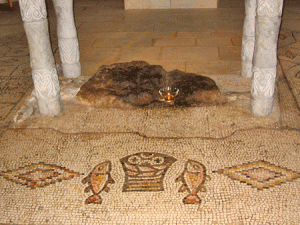
Tabgha Mosaic FloorSo this is a very familiar story, right? Actually, two very familiar stories. We all know about the feeding of the 5,000. All four gospels – Matthew, Mark, Luke, and John – tell it with slightly varying details. We all know about Jesus walking on the water. Three of the four gospels – Mark, Luke, and John – include that tale, again with slightly varying details. We sometimes mix up those variations, but basically the stories are the same so no big deal.

The problem is that we know the stories so well that we don’t know what we don’t know about them. We think we know the whole story, but we don’t! And one of the things we don’t know, as Evie and I discovered when we were in Palestine last summer, is the geography of the feeding of the multitude. So I thought start with a sort of geography lesson, if that’s OK with you? OK?

OK.

I want you, first, to think about what you know about Lake Erie. You know that it’s up there, north of us somewhere. You know that at one end (the western end) are Detroit and Toledo and at the other (the eastern end) is Buffalo. You know that the far shore is a foreign country called Canada, and you know pretty well where the cities and towns are located along the American shore.

So now I want you take Lake Erie and rotate it 90 degrees. Buffalo is now at the lower end; Toledo is at the top; the foreign country called Canada is still on the far shore. If we come down the near shore from Toledo, we’ll come to (among other places) Maumee, Sandusky, Lorain, Cleveland, Ashtabula, Erie.

By rotating Lake Erie, we’ve oriented it in the same way the Sea of Galilee is oriented and, by a strange coincidence, many of the places we know of along the shore of the Sea of Galilee are in relationship to one another in much the same way as places we know along the shore of Lake Erie! So … Bethsaida – you remember Bethsaida, it’s where Jesus healed a blind man and it was the hometown of Philip, Andrew, and Peter – Bethsaida would be about where Detroit is. Capernaum, which Jesus sort of made his home base and where Peter actually seems to have lived, would be about where Toledo is. A place called Tabgha, which is probably where the feeding of the 5,000 took place, would be about where Sandusky is. Gennesaret, which is where Mark says the apostles were headed when they saw Jesus walking on the water, would be about where Cleveland is. Tiberias, a resort city built by Herod Antipas (the king who beheaded John the Baptist), would about where Erie, Pennsylvania, is. Finally, go way away from the lake to Cincinnati, that would be about where Nazareth, Jesus’ hometown would be.

Except … shrink everything by at least a factor of ten, because that’s how much bigger Lake Erie is than the Sea of Galilee; that’s how much bigger Ohio is than the region of Galilee. So, now, Cincinnati/Nazareth, instead of 250 miles from the lake is 25 miles away, and Toledo/Capernaum, instead of being about 40 miles from Sandusky/Tabgha is less than 3 miles away. And the other distances are similarly reduced, but remember . . . they didn’t have cars and interstates; they would have been walking or riding a donkey on dirt paths, or maybe sailing or even rowing a fishing boat on the lake.

So let me tell you about Tabgha. Until 1948, when the Israelis uprooted its residents, there was a village there and had been for centuries; now it is simply an agricultural area and a place of religious pilgrimage. The name is a corruption of the Greek name of the place, Heptapegon, which means “seven springs;” its Hebrew name is Ein Sheva, which means the same thing. It is venerated by Christians for two reasons; on a bluff overlooking the place is where the feeding of the multitude is believed to have occurred and on the beach is where the Risen Christ is thought to have had a grilled fish breakfast with Peter during which he asked him, three times, “Do you love me?” At each location, there is a shrine and a church: the first is called The Church of the Multiplication; the second is called “Mensa Domini” (the Lord’s Table) and also known as the Church of the Primacy of Peter.

A Fourth Century pilgrim from Spain named Egeria reported visiting, in about 380 CE, a shrine where the Church of the Multiplication now stands; in her diary, she tells us that the site had been venerated by the faithful from the time of Christ onward. Shortly after her visit, a new church was built there in which was laid a mosaic floor depicting the loaves and fishes. That floor still exists today – a picture of it is on the front of your bulletin.

The reason I spend so much time on the geography of the place is this: we all know the story of the feeding of the 5,000, but sometimes we think to ourselves, “It probably wasn’t that big a crowd.” We think John and the other evangelists, or whoever first told the story, may have been exaggerating. But consider: it’s only about an hour’s walk from Capernaum to Tabhga, only an hour from Genessaret, only an hour and a half from Chorazin, maybe two hours from Bethsaida or Tiberias, perhaps several hours from Nazareth and more distant towns. But if one had a donkey or a horse, or if one could come over the water by boat, the time would be considerably less. If Jesus and his companions were there for several hours, word could easily have spread and people from all those places and more could have come to see this famous prophet and miraculous healer. Each of those places I’ve named was an important agricultural or fishing site, a residential center, a political center; each had a fairly large population for the time. It’s entirely possible that, hearing that this famous teacher was there, a crowd of thousands could have gathered there, a crowd of thousands who dropped what they were doing and headed out to see, not thinking about supplies or provisions, a crowd of thousands without enough to eat.

So there they are. Jesus has been teaching and healing, and it’s getting late, and people are getting hungry, and there’s nowhere to buy anything. Philip and Andrew are getting worried; they don’t know what a big crowd of hungry people might do, so they talk with Jesus about it. They want him to send the people away. After all, there’s nothing nearby, but (like I said) it would only take these people an hour or two to walk back home or to someplace where food could be found. But Jesus says, “No. They’re here because we’re here; we have to take responsibility for that and feed them.” Andrew says, “We’ve checked the supplies and all we have are these two fishes and five loaves (which, by the way, we didn’t bring; some boy brought them as his lunch, some boy with more smarts than a group of grown men).”

Jesus assures them it will be enough, tells everyone to sit down, blesses the food, and the picnic starts. Sure enough, there is enough. More than enough. Jesus, being environmentally aware, instructs the apostles to pick up after themselves and the crowd, and they gather the leftovers (all four of the gospels tell us) into twelve baskets. The Greek word used is kophinos, which the lexicon tells us is a wicker basket, probably a large one like a hamper. Twelve large hampers of leftovers! This isn’t simply a story about miraculously feeding a big bunch of people with a small amount of food…. this is a story about overfeeding a big bunch of people. This is a story about God’s abundance.

When Evie and I lived in Las Vegas, back before I was ordained, we used to go to a restaurant there called Keller’s. One of the things I liked about Keller’s (besides the really great food and their superb wine cellar) was that if you took home any leftovers, they made it an event. They were proud that you were taking home their food. Instead of a paper sack or styrofoam box, you got a work of art. Someone in the kitchen obviously knew the art of origami, so your bit of leftover chicken breast might come back to you packaged in a graceful silver swan; your second helping of trout, in a beautiful gold fish; your half-a-piece of cheesecake in a gorgeous multi-colored gift box.

I’ll bet that as people left the field at Tabgha that afternoon, they were sent home with leftovers, some more of the bread and fish to see them on their way. I’m pretty certain they didn’t get Keller’s origami packaging, but I like to visualize the scene that way with those thousands of people carrying silver foil swans, gold paper fish, and multi-colored paper gift boxes. Although I’m sure they didn’t have those pretty packages in their hands, they carried something even more precious as they made their way back to Bethsaida (up there about where Detroit would on Lake Erie) or Capernaum (sort of where Toledo is) or Genneserat (kind of where Cleveland is) or the longer journeys to Tiberias (about where Erie would be) or even distant Nazareth (far away like Cincinnati).

They carried the abundant, overflowing grace of God, what Paul called “the riches of [God’s] glory.” They carried the assurance in their hearts that they had been cared for with “the love of Christ that surpasses knowledge” and that they had been “filled with all the fullness of God.” They knew, because they had seen the evidence with their own eyes, tasted it with their own tongues, and carried it away in their own hands, that the power of God “is able to accomplish abundantly far more than all we can ask or imagine.”

Today, we are going to baptize Tatum E________ K_________; today, we are going to welcome her into the household of God in which that promise of abundance is realized; today, we are going to assure her that, as Mark says of the crowd in his telling of this story, God in Christ Jesus has abundant compassion for her. Whatever may happen in her life, whatever stormy seas she may sail, she has only to look (as the apostles looked from their boat) to see that Jesus is there and he will calm the storm.

These are familiar stories; they are familiar because they are important; they are so important that all four of the gospels tell them. They are important because remind us, they assure us of God’s overflowing, abundant love and grace of which there is always more than enough.

Let us pray:

O God, your Son Jesus Christ fed the crowds out of his copious compassion; he stilled the stormy seas with his plentiful power; and he prepared his disciples for the coming of the Spirit through the abundant grace of his teaching: Make our hearts and minds, and especially Tatum’s heart and mind, ready to receive the overflowing blessings of your Holy Spirit, that we may be filled with your grace and strengthened by your Presence; through Jesus Christ our Lord. Amen.

====================

A request to my readers: I’m trying to build the readership of this blog and I’d very much appreciate your help in doing so. If you find something here that is of value, please share it with others. If you are on Facebook, “like” the posts on your page so others can see them. If you are following me on Twitter, please “retweet” the notices of these meditations. If you have a blog of your own, please include mine in your links (a favor I will gladly reciprocate). Many thanks!

====================

Father Funston is the rector of St. Paul’s Episcopal Church, Medina, Ohio.

Don’t Carry All That Baggage – From the Daily Office Lectionary

From the Daily Office Lectionary for Saturday in the week of Proper 11, Daily Office Year 1 (Pentecost 8, 2015)

Mark 6:7-9 ~ He called the twelve and began to send them out two by two, and gave them authority over the unclean spirits. He ordered them to take nothing for their journey except a staff; no bread, no bag, no money in their belts; but to wear sandals and not to put on two tunics.

A few years ago I took a sabbatical. It was my first (and, so far, only) sabbatical in 40 years of professional life, 25 of them in ordained ministry. I went to England, Scotland, Wales, and Ireland for a total of three months. The first two weeks I visited pre-Christian and early Christian sites in southern Scotland, northern and western England, and Wales. Then I flew from Edinburgh to Dublin. Checking in for the flight, I learned that I had misunderstood an airline website and my baggage was overweight. Substantially overweight! The fees and penalties amounted to nearly £300! (I paid more for my baggage to go one way than for myself to fly round-trip.) I’d brought books for a course of study I was undertaking in Ireland; I’d brought a summer’s worth of clothing; I was carrying a heavy CPAP machine I use while sleeping; I was way, way overweight. I could have carried nothing, ” no bread, no bag, no money in [me] belt,” and purchased everything in Ireland for less than those airline penalties. I guess I would have needed the money, but the bread, the bag, and everything else I didn’t need.

We carry so much that we don’t need. That’s what this story always says to me. We carry so much that we don’t need, that gets in our way more than it helps, that weighs us down and impedes us, that distracts us from what we are supposed to be doing. Jesus is clearly telling his disciples, originally the Twelve and, through them, us, that we don’t need all that stuff. We need some good footwear and something to lean on when we’re weary, and that’s about it. Anything else we may need we can acquire along the way; in fact, the promise of the story is that we will acquire it – it will be provided when it is needed.

When my two-month sojourn in Ireland was ended and I flew back to Scotland to join my wife for a two-week end-of-sabbatical vacation, I left behind most of what I had paid £300 to ship there. Books I could purchase again in the US, I gave to a school library. Clothing I wouldn’t need for those last two weeks, I gave to church to pass on to the needy. A second bag no longer needed, I gave to my landlady who had admired it. Things I was keeping but didn’t need to travel with, I shipped home. The CPAP machine I took back to Scotland, but for that I had pared my possessions down to one backpack; I was carrying again the same spare load I had carried on my first three-month trip to Europe when I was 16 years old. Following Jesus’ lightweight travel advice, I received the promise of the Psalmist: “He satisfies you with good things, and your youth is renewed like an eagle’s.” (Ps 103:5)

Take Jesus’ advice: don’t carry all that baggage!

Effin’ the Ineffable – From the Daily Office Lectionary

From the Daily Office Lectionary for Tuesday in the week of Proper 11, Yr 1 (Pentecost 8, 2015)

Mark 4:30 [Jesus] said, “With what can we compare the kingdom of God, or what parable will we use for it?”

This is the question, isn’t it? (Emphasis on “the”!) This is the religious question. At the heart of every religion, every spirituality, every theology is the experience of the [power, force, spirit, god, structure, law, probability] that [undergirds, overshadows, creates, sustains, regulates, controls, defines] everything that is. What follows that experience is the question of how to communicate it: what [parable, metaphor, simile, comparison] do we use? Demonstrating the difficulty of even asking the question, Jesus uses a metaphor to do so, i.e., “kingdom of God.” ~ The unfortunate next step seems always to be to concretize one or more of our metaphors or comparisons: this has been done in Christianity with Jesus’ term here, “kingdom of God,” so that any alternative metaphor (“dominion,” “realm,” “commonwealth”) is sometimes greeted with derision and claims of heresy. Even worse is are challenges to the metaphor “Father,” despite the venerable history of the alternative “Mother” in Christian spirituality. Concretized metaphors are, themselves, the stuff of heresy; we must abandon them. ~ The philosopher Paul Feyerabend was not the first (though perhaps one of the most succinct) in observing that “Ultimate Reality, if such an entity can be postulated, is ineffable.” Jesus’ question (and ours) is, “How do we eff the ineffable?” The first step, I think, is to let go of our effin’ metaphors.

If You’re Serious About This: Sermon for Proper 11B (Pentecost 8, 19 July 2015)

====================

A sermon offered on Eighth Sunday after Pentecost (Proper 11B, Track 1, RCL), July 19, 2015, to the people of St. Paul’s Episcopal Church, Medina, Ohio, where Fr. Funston is rector.

(The lessons for the day are 2 Samuel 7:1-14a; Psalm 89:20-37; Ephesians 2:11-22; and Mark 6:30-34,53-56. These lessons may be found at The Lectionary Page. Note: The Revised Common Lectionary provides that the first lesson is 2 Samuel 6:1-5,12b-19.)

====================

LoveGodBumperSticker

I was ordained a deacon in May of 1990 and made a priest in June of 1991. For two years, I served as associate rector of a parish in Nevada and then accepted a call to be rector of a parish in the Kansas City metropolitan area in a small, exurban community called Stilwell. Sometime after we had moved to Stilwell, my family and I visited my parents in southern California.

Now I should tell you that my parents were not church-going people. After the death of my biological father in 1958, my mother pretty much stopped going to church. In 1962, she married by step-father, a non-practicing Roman Catholic, in a Methodist church ceremony, but that is the only time I remember my parents going to church on their own (that is to say, not dragged there for the holidays or some other special occasion by one of their children). My folks were not particularly happy campers the day I told them I would be leaving the practice of law and entering ordained ministry.

So we were visiting my parents about three years after my ordination as a priest and during the visit I happened to go into their bedroom and found, on my mother’s bedside table, a copy of The Book of Common Prayer and an Inquirer’s Class study folder from St. George’s Episcopal Church in Laguna Hills, California. I picked them up and went out to the living room where they were both watching television and said, “Hey, Mom? What’s this all about?”

“Well,” she said, “I guess you’re serious about this, so I thought I should check it out.”

“If you’re serious about this . . . .” Took her three years after my priesting, but she finally, reluctantly got there . . . . But that was my mom. Today would have been her 96th birthday, by the way.

Once she decided I was serious about this, she got serious about this. She and my step-dad completed their Inquirer’s Class, became members of St. George’s and then a few years later transferred their membership to St. Wilfrid of York in Huntington Beach, California. Both volunteered to work at the church in various ways; he did handiwork; she became the secretary of the ECW. Both are now buried in the memory garden at St. Wilfrid Parish. That was my mom: “If you’re serious about this, then be serious about this.”

In the Gospel lesson today, I can imagine Jesus saying something similar to the apostles.

Chapter 6 of Mark’s Gospel is a bit hard to read because it’s all choppy and excited, like someone telling a story but who can’t get his words out fast enough to satisfy himself. Mark jams this chapter full of detail, but breaks the details up. Jesus goes to his home town and is rejected, so he and the apostles leave. He then sends the apostles out two-by-two with no provisions or equipment. They spread through the countryside, proclaiming the gospel of repentance, casting out demos, and anointing the sick. Mark tells us that King Herod hears about all this activity and becomes convinced that John the Baptizer has returned from the dead, at which point Mark goes off on a tangent and tells the story of Herod and Herodias, Salome’s dance and demand for the Baptizer’s head, and John’s execution. Now, in today’s bit, we return to the apostles and their missionary journey.

They are back, all excited by what they’ve done; Mark tells us (in Mark’s usual breathless style) that they told Jesus “all that they had done and taught.” So Jesus tells them to slow down; he can tell that they are excited by what they’ve done, but they are also exhausted and, because of all the coming and going of people who have heard about them, they can’t even take a break to eat. So he tells them, “Come away to a deserted place all by yourselves and rest a while.” I can almost hear him, in my mother’s voice, prefacing that with, “If you’re serious about this . . . .”

“If you’re serious about this, come away to a deserted place all by yourselves and rest a while.”

What’s going to happen is that they are going to try to do as Jesus instructs, but people aren’t going to let that happen. They are going to get in their boat, head out to a deserted place a few miles away across the lake, the “Sea” of Galilee, a place now called “Tabgha,” but the people are going to follow; in fact, they are going to “hurry there on foot from all the towns and arrive ahead of them.” (v. 33) “If you’re serious about this, come away to a deserted place all by yourselves and rest a while.” But guess what, you’re not going to get the chance to do that today.

Do you notice the verse references on your insert? Once again, the Lectionary has us edit out some verses in our Sunday readings, nearly twenty of them from this gospel reading. Guess what happens in those twenty verses. Jesus feeds the 5,000 people who have “hurried there on foot from all the towns and arrived ahead of them,” and he sends the apostles back across the lake by themselves, and he walks on water, and he calms a strong adverse wind. All of that in this one short chapter . . . all of that, but no one actually gets away to deserted place by themselves. Instead, they are continually confronted by the demands of people who “rush about the whole region and bring the sick on mats to wherever they hear Jesus and the apostles may be.”

If you are serious about following Jesus, however, you have to find a way to get away to that deserted place by yourself. If you are serious about following Jesus, if you are going to love God, you have to find time for private time with God. If you are serious about following Jesus, if you are going to love your neighbor as yourself, you have to find time to take care of yourself.

We have another variation on this same theme in the story from the Second Book of Samuel. David has become king over Israel, supplanting Saul. He has taken over the city of the Jebusites, sometimes called Jebus, sometimes metsudat Zion, and made it his capital, renaming it “Jerusalem, the City of David.” He has built a fine house for himself (a “house of cedar,” as he calls it). He has reclaimed the Ark of the Covenant from the Philistines and moved it to Jerusalem, where it is now housed in a tent. Now he wants to build a house for the Ark, a temple for God.

At first, the prophet Nathan, who is David’s trusted adviser, says, “Fine. Go ahead and do this thing.” But then Nathan has a dream in which he is given a message to David from God. He is to say to David, “Are you the one to build me a house to live in? I have not lived in a house since the day I brought up the people of Israel from Egypt to this day; I have been moving about in a tent and a tabernacle.” In other words, God doesn’t want a temple; God is happy with a moveable tent. And Nathan is to remind David, “I took you from the pasture, from following the sheep to be prince over my people Israel….” In other words, God has given you a job to do and, if you’re serious about this, you need to do it. If you are serious about being king over Israel, make sure the people may live in their own place and be disturbed no more. If you are serious about being king over Israel, make sure that evildoers shall afflict the people no more. If you are serious about being king over Israel, do the jobs I have given you and don’t take on tasks that don’t need to be done now (building the temple will be someone else’s job).

And that’s really Paul’s point in writing to the Ephesians, as well. “You [Gentiles],” he writes to them, “are no longer strangers and aliens, but you are citizens with the saints and also members of the household of God, built upon the foundation of the apostles and prophets, with Christ Jesus himself as the cornerstone. In him the whole structure is joined together and grows into a holy temple in the Lord; in whom you also are built together spiritually into a dwelling place for God.” He will, in a few pages, say to them, “I beg you to lead a life worthy of the calling to which you have been called, with all humility and gentleness, with patience, bearing with one another in love, making every effort to maintain the unity of the Spirit in the bond of peace.” (Eph 4:1-3) He will remind them that every church member, baptized into the one faith, following the one Lord, is gifted, equipped for ministry, for the building up of the body. “If you’re serious about this,” he seems to be saying, “if you’re serious about being a Christian, then get serious. Do the job you have been given to do.”

And what is that job? The job given to each of us, though we may be given different gifts with which to accomplish it is, is the same. We who are “living stones … built into a spiritual house” (1 Pt 2:5) of which Christ is the cornerstone all have the same job: “You shall love the Lord your God with all your heart, and with all your soul, and with all your strength, and with all your mind; and your neighbor as yourself.” (Lk 10:27)

If you’re serious about being a Christian, get serious about this:

Don’t take on jobs that you don’t need to do; building the temple is someone else’s job. If you’re serious about serving God, do the tasks God gives you.

Go away to a deserted place from time to time; spend time in prayer. If you’re serious about loving God, spend time with God. If you’re serious about loving your neighbor as yourself, take care of yourself.

If you’re serious about following Jesus . . . Love God. Love your neighbor. Use the gifts you have been given. Change the world.

Amen!

====================

A request to my readers: I’m trying to build the readership of this blog and I’d very much appreciate your help in doing so. If you find something here that is of value, please share it with others. If you are on Facebook, “like” the posts on your page so others can see them. If you are following me on Twitter, please “retweet” the notices of these meditations. If you have a blog of your own, please include mine in your links (a favor I will gladly reciprocate). Many thanks!

====================

Father Funston is the rector of St. Paul’s Episcopal Church, Medina, Ohio.
Use Your Imagination – From the Daily Office

From the Daily Office Lectionary for Wednesday in the week of Proper 10B (Pentecost 7, 2015)

Mark 2:14 ~ “As [Jesus] was walking along, he saw Levi son of Alphaeus sitting at the tax booth, and he said to him, ‘Follow me.’ And he got up and followed him.”

This is one of those mornings when what I read in the appointed Scriptures dovetails so nicely with something I read in the news (or in this case on a friend’s Facebook page) that I can hardly believe it. I don’t often read the Episcopal Cafe blog, but a colleague posted a link to yesterday’s notice there of comments by a Baptist preacher (pastor of a megachurch in Dallas, Texas) when interviewed on Fox & Friends (a show I admit to never ever watching). I linked to a clip of his interview and, sure enough, just as reported in the Episcopal Cafe headline, this fellow said that liberal churches “are following the Jesus of their imagination rather than the Jesus of the Bible.” ~ It occurred to me that since at least 33 A.D. not a single human being who follows Jesus as Lord has done anything differently. Levi (who is sometimes also identified as Matthew) and his colleagues “got up and followed” Jesus, a real flesh-and-blood guy whom they could reach and touch and with whom they could eat, walk, talk, cry, laugh, and tell jokes. Since his Ascension, however, not one other person has been able to do that. We follow a “Jesus of the imagination,” just like the Baptist preacher said. Even the Baptist preacher follows a “Jesus of the imagination.” ~ To start off, we follow a Jesus of the imaginations of Matthew, Mark, Luke, John, Paul, and the other writers of the New Testament. These men (any women there?) like every writer of every genre of literature made use of imagination in setting pen to paper (or parchment or velum or whatever) to tell their stories. Then each reader employs his or her own imagination in bringing to life in his or her mind the characters and events of the story. The Gospels and other documents of the New Testament are not verbatim histories; they are personal stories infused with imagination and read with imagination and, as a result, we all follow “the Jesus of [our] imagination.” We can’t help it. ~ It is when one comes to that realization that it is possible to abandon dogma, bigotry, and ignorance, to enter into real conversation with Scripture, and to actually engage with and follow Jesus. Then, and only then, can a follower of Jesus encounter and engage with others in real dialog. ~ One is tempted to note that, in a very real way, even our encounters with, our following of “real-life flesh-and-blood” human beings are encounters with imagination! Our imaginations filter, color, and influence every interpersonal encounter we experience. So, my advice to my Baptist colleague: stop denying and start using your imagination.

Neither Hot Nor Cold: A Sermon of Ecclesial Disappointment – 12 July 2015

====================

A sermon offered on Seventh Sunday after Pentecost (Proper 10B, Track 1, RCL), July 12, 2015, to the people of St. Paul’s Episcopal Church, Medina, Ohio, where Fr. Funston is rector.

(The lessons for the day are 2 Samuel 6:1-19; Psalm 24; Ephesians 1:3-14; and Mark 6:14-29. These lessons may be found at The Lectionary Page. Note: The Revised Common Lectionary provides that the first lesson is 2 Samuel 6:1-5,12b-19.)

====================

Israel-Palestine MapWhy do people in church seem like cheerful, brainless tourists on a packaged tour of the Absolute? On the whole, I do not find Christians, outside of the catacombs, sufficiently sensible of conditions. Does anyone have the foggiest idea what sort of power we so blithely invoke? Or, as I suspect, does no one believe a word of it? The churches are children playing on the floor with their chemistry sets, mixing up a batch of TNT to kill a Sunday morning. It is madness to wear ladies’ straw hats and velvet hats to church; we should all be wearing crash helmets. Ushers should issue life preservers and signal flares; they should lash us to our pews. For the sleeping god may wake someday and take offense, or the waking god may draw us out to where we can never return. (Annie Dillard, Teaching a Stone to Talk: Expeditions and Encounters [New York: Harper & Row, 1982], pp. 40-41.)

I wonder if Ms. Dillard might not have had in mind the episode recounted today in our reading from the Second Book of Samuel. Confession: The Lectionary edited out the verse that describe the death of the priest Uzzah and the circumstances and causes thereof. I put them back in because they explain the sudden reluctance of David to take the Ark of the Covenant into his city, and his three-month delay in doing so. With Uzzah’s death David, as the writer of Second Samuel tells us, got a notion of “what sort of power we so blithely invoke,” of what sort of power he was bringing into Jerusalem, and it frightened him.

After all, what had Uzzah done. Nothing disrespectful of God, that’s for sure. If anything, he saved the Almighty the indignity of the Ark tumbling out of the ox cart and falling to the ground. All he had done was reach out to steady it when it was jostled by the oxen; he was doing only what comes naturally when one is moving a large, heavy object over rough terrain. And for this, for touching the Ark with the most innocent and benign of intentions, he was stricken dead. At first, David was angry with God about that; apparently he cursed up a storm because the place gets renamed “Perez-uzzah” which means “outburst about Uzzah” – could be God’s outburst that killed Uzzah, more likely it’s David’s outburst of anger after Uzzah is dead. Once he vents, however, David becomes frightened; we are told, “David was afraid of the Lord that day; he said, ‘How can the ark of the Lord come into my care?'” So, he leaves the Ark right there in the care of a foreigner, Obed-edom the Gittite, for three months. David has realized that he may need a crash helmet when dealing with the power of the Almighty.

And then there’s John the Baptizer. John knew all too well the Power he’s been dealing with; he’d talked directly with God (“The one who sent me to baptize with water said to me,” he claimed – Jn 1:33) and John spoke to earthly power on God’s behalf. He said to the crowds that came out to him, to the scribes and the Pharisee, the priests and the Sadducees, to all who came to him at the River Jordan, “You brood of vipers! Who warned you to flee from the wrath to come? Bear fruits worthy of repentance. Do not begin to say to yourselves, ‘We have Abraham as our ancestor;’ for I tell you, God is able from these stones to raise up children to Abraham. Even now the ax is lying at the root of the trees; every tree therefore that does not bear good fruit is cut down and thrown into the fire.” (Lk 3:7-9) John knew there was danger, terrible danger when one becomes involved with Almighty God. It was the writer of the Letter to the Hebrews who said it, but John knew well, “It is a fearful thing to fall into the hands of the living God.” (Heb 10:31) Because even if the power of God doesn’t kill you, the ministry demanded of you by God may well put you in harm’s way . . . and that, in the end, is what happened with John.

Speaking truth to power, John publicly denounced Herod Antipas for his sinful, adulterous relationship with his half-brother Philip’s wife Herodias, who also happened to be Antipas’s niece. For that public reproof, John was arrested and held for a time in prison; the Gospel lesson tells us that Herod protected John after his arrest because he feared him! – Even Herod Antipas felt the danger of involvement with the Almighty at second hand, the danger of dealing with God’s anointed prophet. But in the end, tricked by his own foolish behavior, Antipas must order John beheaded; for John the ax is laid not at the foot of the tree, but at the base of his neck. As Ms. Dillard might put it, “The waking god drew John out to where he could never return.”

We, the Episcopal Church, take this dangerous prophetic step out to where we might never return every time we make a statement or take an action and proclaim to the world, “We do this because we are called to do so by our Lord and our God.” I do it every time I step into this pulpit and dare to preach a sermon. You do it every time you take a stand on an issue or behave in a particular way and say, “I do this because I am a Christian, because I am an Episcopalian.” Our church does it when it meets in deliberative council, in vestry meetings, in diocesan conventions, or as we have just done in our triennial General Convention; we do it when we issue public statements on important issues of the day.

We feel like we have done it now in the aftermath of our 78th General Convention because, for example, we have taken the bold step of opening our marriage liturgies to same-sex couples. However, I would suggest to you that that was not a very prophetic step after all. We had already, several years ago, declared that gay and lesbian persons are beloved children of God entitled to the full ministry of and to full inclusion within the body of the faithful. We underscored that a dozen years ago when we approved the election and consecration of the first openly gay bishop, Gene Robinson of New Hampshire. When we declared last week that same-sex couples could marry in the church, we were only continuing down a path we had already been walking, a path which (frankly) the United Church of Christ, the Presbyterian Church in the USA, and the United States Supreme Court had just walked before us. It’s easy to be prophetic when others have already done so before you.

We feel like we have taken a prophetic stance because 1,500 bishops, deputies, and other Episcopalians marched the streets of Salt Lake City to protest against gun violence and to call for rational handgun licensing laws and for background checks on all gun sales including gun show and private transactions. We feel like we have done so because, a few days after that protest march, the General Convention passed a resolution making that same call; but in all honesty it’s a call we have made before. We have been on record as a church in support of reasonable regulation of gun manufacture, sale, and ownership for nearly 40 years; we have passed resolution after resolution urging registration, licensing, and insuring of handguns, as well as the banning of civilian sale and ownership of automatic and semi-automatic weapons since at least 1976. And we have not been alone among the churches in doing so. It’s not particularly original or prophetic to do and say again that which you and many others have done and said many, many times.

We feel like we have been prophetic in the House of Bishop’s election of Michael B. Curry of North Carolina to be our Presiding Bishop, our first black Presiding Bishop! But, folks, we have had black bishops in the Episcopal Church for over 140 years since the consecration of James Theodore Holly to be Bishop of Haiti in 1874. Neither God nor the world would be out of line in telling us that Bishop Curry’s election is not particularly prophetic and asking, “What took you so long?”

It’s not that these are not important and vital issues; they are. It’s not that our voice, added to so many others, is not worth raising about these issues; it is. It’s not that we should not be taking a stand on these matters; we should. We should and we have and we will continue to do so, but we are not being particularly prophetic when we do so. We are merely doing what comes naturally moving a large, heavy institution over the rough terrain of difficult issues. Like Uzzah steadying the Ark of the Covenant, it may be dangerous, but it’s not particularly prophetic.

We did have the opportunity to be prophetic, but we failed to take it. A resolution numbered D016 was offered for our consideration. It would have called upon our church and our leadership to

work earnestly and with haste to avoid profiting from the illegal occupation of Gaza and the West Bank, and [to] seek to align itself with, and learn from, the good work of our Ecumenical and Anglican Communion partners, who have worked for decades in support of our Palestinian Christian sisters and brothers and others oppressed by occupation. (Resolution D016 as originally proposed)

It did not call for divestment from Israeli investments. It did not call for the boycotting of products made in the occupied territories. It did not call for sanctions against Israel. It did not call upon us to join the “BDS” movement as it is called – Boycott, Divest, Sanction. It was opposed on the grounds that it did, but in truth it did not.

We could have taken such action; we could have joined BDS although the resolution did not call for it. Alternatively, we could have proclaimed that, instead of doing that, we would work through positive investment and constructive engagement with both Israelis and Palestinians to foster reconciliation and peace. Or, we could simply have done as the resolution sought and undertaken a time of intentional study and discernment as to what our ministry as a church with important ties to the Holy Land might be, how we might try to encourage healing in that broken, wounded, and bleeding place. We could have done any of those things, any of those prophetic things. But do you know what we did?

We ducked the issue. We played it safe. We closed off debate. We failed to act. The House of Bishops rejected Resolution D016 so the House of Deputies never had a chance to consider it and, thus, we did nothing. – We should know better! As Paul wrote to the Ephesians,

With all wisdom and insight [God] has made known to us the mystery of his will, according to his good pleasure that he set forth in Christ, as a plan for the fullness of time, to gather up all things in him, things in heaven and things on earth. (Eph 1:8b-10)

We know that! We have declared as much in our catechism that “the mission of the Church is to restore all people to unity with God and each other in Christ,” and that “the Church pursues its mission as it prays and worships, proclaims the Gospel, and promotes justice, peace, and love.” (BCP 1979, page 305) We are a church for whom the ministry of reconciliation should come as naturally as reaching out to steady the cargo on an ox cart came to Uzzah. And yet with respect to our brothers and sisters in Israel and Palestine, we did nothing…. We are a church who believes itself to speak like John the Baptizer prophetically to power on any number of subjects. And yet with respect to our brothers and sisters in Israel and Palestine, we said nothing….

As a church meeting in deliberative assembly and praying for the guidance of the Holy Spirit, we did nothing, we said nothing to promote justice, peace, love, and reconciliation in the Holy Land.

When John of Patmos had the vision recorded in the Book of Revelation, he was instructed to deliver a message from Jesus to the church in Laodicea. He was told to write these words to them: “I know your works; you are neither cold nor hot. I wish that you were either cold or hot. So, because you are lukewarm, and neither cold nor hot, I am about to spit you out of my mouth.” (Rev. 3:16) With regard to those living in the land where Jesus was born, where he lived and taught and loved and died, where he rose from the dead for our salvation . . . with regard to our brothers and sisters living in that land, our General Convention action (or, really, lack of action) was lukewarm; it was tepid; neither hot nor cold, worthy only to be spit out.

I love my church. I love what we do in our synods and our conventions. I love that we take positions, sometimes unpopular positions. I love that we take risks with power, the kind of risks that Uzzah took, the kind of risks that John the Baptizer took, the kind of risks for which we should be wearing crash helmets and life preservers and holding signal flares. But we failed to do that with regard to the occupation of Palestine and the strife existing between our Israeli and Palestinian brothers and sisters, and I am disappointed in the church I love. As the Rev. Winnie Varghese, a priest from New York who was one of the supporters of Resolution D016, wrote after its rejection: “I will never understand why we would not listen … to our brothers and sisters truly on the ground, the lay and ordained Palestinian Christians who have been displaced; who work for justice; and who ask for our help.” (Huffington Post, July 10, 2015) Nor will I. I will never understand.

Let us pray:

Lord our God, the earth is yours and all that is in it, so we lift up our heads, we open our gates, and we give you glory; the Psalmist asked who could stand in your holy places and answered his own question saying, “Those who have clean hands and a pure heart;” give us clean hands and pure hearts that we may follow through on the promises made at our baptism, promises to “proclaim by word and example the Good News of God in Christ,” to “respect the dignity of every human being,” and to “work for justice and peace;” give us grace that we, as the Episcopal Church, may do so in solidarity with those who have dedicated their lives to justice for Palestinians and security for Israel, that we may be either hot or cold, never tepid or lukewarm; give us the strength to do what should come naturally and to speak prophetically in your name; all this we ask through your Son, our Savior, the King of Glory. Amen.

====================

A request to my readers: I’m trying to build the readership of this blog and I’d very much appreciate your help in doing so. If you find something here that is of value, please share it with others. If you are on Facebook, “like” the posts on your page so others can see them. If you are following me on Twitter, please “retweet” the notices of these meditations. If you have a blog of your own, please include mine in your links (a favor I will gladly reciprocate). Many thanks!

====================

Father Funston is the rector of St. Paul’s Episcopal Church, Medina, Ohio.

Back at the Beginning – From the Daily Office Lectionary

From the Daily Office Lectionary (Yr 1), Friday in the week of Proper 9B (Pentecost 6, 2015)
Mark 1
1 The beginning of the good news of Jesus Christ, the Son of God.

Here we are, a little past half-way through the calendar year, somewhat further along in the church’s liturgical year, and we’re starting over. The middle of July and we’re back at the beginning. For an Episcopalian recently returned from the General Convention, this is a good thing! As important as the triennial governing synod is, as vital as the issues we addressed (or failed to address) in our legislative hearings and floor debates are, as necessary as elections and budgets may be, those things are also, in a very real sense, distractions. Jesus once reminded the Jews of his day that “The sabbath was made for humankind, and not humankind for the sabbath.” (Mk 2:27) We need the same kind of reminder that the General Convention exists to serve the Gospel, not the other way around; beginning at the beginning does that for us. The General Convention and its results are important, but only to the extent that they serve the church in spreading the Good News of Jesus Christ, the Son of God. When the issues of the day take our attention away from our main business, then the General Convention is dangerous distraction. ~ My son and daughter-in-law, both deputies to this recent Convention, took a few days of vacation to hike the mountains of Colorado. Friends (at whose stamina I marvel) flew to their homes from Salt Lake City (the location of this triennium’s synod) and almost immediately boarded other planes to fly to China or to Japan or to the Holy Land. Unlike them, I returned to home and church office and immediately dove into the minutiae of parish ministry. Unlike them, I returned to home and church office and to a barrage of questions about the work of the Convention. Unlike them, I didn’t take the time to clear my head of resolutions, elections, and budgets. I thought they were crazy to embark on vacations with such immediacy; now I see that they were wiser than me. When they return, they will be better able to focus on the beginning of the Good News. Perhaps that should be made a requirement for everyone who serves in any capacity at the General Convention: “You shall take vacation when this is finished! You shall clear your heads of all this stuff!” ~ In any event, the Convention has done its work. We have a new church reality in which to work. We are back at the beginning of the Good News of Jesus Christ, the Son of God.

Parabolic Poetry, Parabolic Focus – Sermon for Pentecost 3B (14 June 2015)

====================

A sermon offered on the Third Sunday after Pentecost, June 14, 2015, to the people of St. Paul’s Episcopal Church, Medina, Ohio, where Fr. Funston is rector.

(The lessons for the day are 1 Samuel 15:34-16:13; Psalm 20; 2 Corinthians 5:6-17; and Mark 4:26-34. These lessons can be read at The Lectionary Page.)

====================

Conic SectionsBefore we tackle today’s lessons from Scripture, we’re going to recall (or perhaps learn for the first time) something from geometry class. First, I want you to envision a cone. You know what a cone is: A cone is a three-dimensional geometric shape that tapers smoothly from a flat base to a point called the apex or vertex; or another way of defining it is the solid object that you get when you rotate a right triangle around one of its two short sides. So, envision one of those.

Now, envision a one-point thick plane slicing through the cone and envision the plane as being exactly parallel to the slope of the cone, or more technically, parallel to a plane which is tangential to the cone’s surface.

Where the plane and the cone intersect, there is now a U-shaped, two-dimensional, mirror-symmetrical curve called a “parabola.” If take that curve, invert it, and rotate it through 360 degrees, we create a “parabolic bowl.” Astronomers mirror-coat such bowls and use them in their telescopes because they reflect light inward to a common point and amplify its intensity; parabolic reflector telescopes make whatever they are looking at clearer to see. Parabolic microphones work the same way with sound.

OK… why am I telling you this?

That curve, a “parabola,” was given its name by Apollonius of Perga, a 3rd Century B.C.E. mathematician, who put together two Greek words: para, meaning “along side,” and ballein, meaning “to throw” or “to place.” The plane which cuts the parabolic curve from the cone is placed (or thrown) alongside (parallel to) the plane tangent to the cone and the curve is created.

The English word parable, which describes these stories of Jesus (and others), is derived from exactly the same original Greek words. Parables are not just cute stories; they are extended metaphors. When someone tells a parable, they are throwing (ballein) one image alongside (para) another as away to illuminate our understanding; like a parabolic mirror or a parabolic microphone, their purpose is to focus our attention so as to lead to greater understanding.

So now we have two parables in today’s gospel, two short stories which are meant to help us understand the kingdom of God. Not “heaven”! Not some mythical place of eternal reward to look forward to after we die, but the kingdom of God which Jesus told us “has come near” and which we pray (some of us) everyday will “come on earth as it is in heaven,” the kingdom of God which is a present, if not yet fully comprehended, reality.

To what can we compare the kingdom of God? Seed scattered (actually “thrown”) by an unobservant and unaware person, seed which takes root and grows when the sower isn’t watching and in ways the sower cannot understand, seed which then produces a crop to the benefit of this ignorant sower. Or, alternatively, to a grain of mustard which also grows in a mysterious way to become a giant bush in which all the birds can make their nests; in fact, the sort of mustard of which Jesus would have been speaking completely takes over the soil in which it is grown – it is an invasive weed whose roots spread in great profusion so that nothing else can grow with it.

Thrown alongside our incomplete picture of the kingdom of God, what can we learn from these parables? What further understanding is parabolically illuminated?

Let’s ponder that question while we turn our attention to today’s Old Testament lesson from the First Book of Samuel. Many commentaries will tell you today’s reading begins the story of David as King of Israel, but that’s not really so. At best, it is the story of David’s first anointing, privately with only his family present, as a potential king in ancient Israel; he will be anointed again, publicly, as king over Judah, in the second chapter of Second Samuel and then again publicly as king over the rest of Israel in the fifth chapter. This isn’t the beginning of David’s story; it is really a tangent, an excursus from Saul’s story, from the story of Saul’s decline and eventual failure as Israel’s first king.

Note the way the lesson begins – “Samuel went to Ramah . . . . ” – and then note the way it ends – “Samuel went to Ramah . . . . ” The words are repeated almost verbatim. In Hebrew literature this repetition indicates a sort of parenthetical addition to a main story. It’s as if the story teller were saying, “O let me fill you in on a little backstory” or “Hang on while I tell you this interesting but unrelated bit of information.” German bible scholars coined a term for this; it’s called a wiederholenden Wiederaufnahme, which simply means “repetitive resumption.” “Samuel went to Ramah” – tell your parenthetical story, then pick up the main story again by repeating – “Samuel went to Ramah.” We find examples like this scattered throughout the Old Testament.
So we have the story of David’s private anointing as just an aside to the larger story of King Saul. Like the parables of the scattered grain and the mustard seed, it is a story of the seemingly insignificant. Samuel expected that Jesse’s eldest son, the tall, good-looking Eliab, was God’s chosen, but that wasn’t so; nor was it to be Abinadab, nor Shammah, nor any of the next three. It was the smallest, the youngest, little David, out keeping the sheep and easily forgotten, who was to be the next king.

In the kingdom of God, the least can be the source of greatness, what is unseen, uncomprehended, and not understood can be the source of a great harvest. The measures and standards of the world where size and good-looks, power and influence, status and position determine outcomes are not those of the kingdom of God. So David is anointed . . . . and then “Samuel went on to Ramah” and the story of Saul continues.

The story of David’s private anointing in his father Jesse’s home is like a little seed planted in the reader’s mind, a little seed planted in Israel’s history. For the rest of the story of Saul, who doesn’t die for another fifteen chapters, as Saul descends into physical, mental, and spiritual illness, as he first calls David as a soothing friend and companion but soon turns against him as his rival and eventual replacement, this little seed of David’s private anointing will take root and grow. He will publicly become king and his kingship will blossom, his kingdom will grow, and under the reign of his son Solomon it will be an earthly empire. Eventually, his descendant Jesus of Nazareth will be born. In God’s kingdom, the seed planted in Jesse’s home will slowly grow until in the incarnation of God in Jesus as the babe of Bethlehem, in his life, death, resurrection, and ascension the kingdom of God will come near and Jesus will reign in heaven and on earth, a kingdom that will never end, growing in ways we cannot see and cannot understand, spreading like a mustard bush, producing a yield ripe for harvest.

To what can we compare the kingdom of God and what parable can we use for it? It grows, in ways we cannot see and cannot comprehend; from small beginnings it spreads its branches until everyone can find shelter in them. In our prayer book office of morning prayer there is a wonderful prayer for mission written by Bishop Charles Henry Brent which begins with these words: “Lord Jesus Christ, you stretched out your arms of love on the hard wood of the cross that everyone might come within the reach of your saving embrace . . . .” I have a friend who dislikes this prayer; it is, he insists, “simplistic transactional theology.” I have to admit that I don’t even know what he means when he says that, but my answer to him is, “It’s not theology; it’s prayer . . . and it’s poetry, parabolic poetry.” The prayer, like a telescope with a parabolic mirror, like a parabolic microphone, like the parables of Jesus, focuses our attention on our place and our mission as followers of Jesus. Like the wide-spreading branches of the mustard bush, Jesus’ arms spread wide inviting all to take shelter.

What began as the small seed of the private anointing of David in the home of Jesse the Bethlehemite has come to fruition in his ancestor Jesus, who (as Paul reminds us) is the “one has died for all . . . so that those who live might live no longer for themselves,” but rather live as “a new creation: everything old has passed away; see, everything has become new!”

Bishop Brent’s prayer for mission concludes with this petition: “So clothe us in your Spirit that we, reaching forth our hands in love, may bring those who do not know you to the knowledge and love of you . . . .” We may not see and we may not understand how the seed germinates, how it grows, how “first the stalk, then the head, then the full grain in the head” appear, but now, and like the sower in the parable, it is time for us to go in with our sickle, with our hands reaching forth in love, because the harvest has ready. Amen.

====================

A request to my readers: I’m trying to build the readership of this blog and I’d very much appreciate your help in doing so. If you find something here that is of value, please share it with others. If you are on Facebook, “like” the posts on your page so others can see them. If you are following me on Twitter, please “retweet” the notices of these meditations. If you have a blog of your own, please include mine in your links (a favor I will gladly reciprocate). Many thanks!

====================

Father Funston is the rector of St. Paul’s Episcopal Church, Medina, Ohio.

« Older posts Newer posts »