Occasional thoughts of an Anglican Episcopal priest

Category: Matthew (Page 16 of 29)

Particular Social Groups – From the Daily Office – July 16, 2014

From the Gospel according to Matthew:

Jesus said: “When the Son of Man comes in his glory, and all the angels with him, then he will sit on the throne of his glory. All the nations will be gathered before him, and he will separate people one from another as a shepherd separates the sheep from the goats, and he will put the sheep at his right hand and the goats at the left. Then the king will say to those at his right hand, ‘Come, you that are blessed by my Father, inherit the kingdom prepared for you from the foundation of the world; for I was hungry and you gave me food, I was thirsty and you gave me something to drink, I was a stranger and you welcomed me, I was naked and you gave me clothing, I was sick and you took care of me, I was in prison and you visited me.’ Then the righteous will answer him, ‘Lord, when was it that we saw you hungry and gave you food, or thirsty and gave you something to drink? And when was it that we saw you a stranger and welcomed you, or naked and gave you clothing? And when was it that we saw you sick or in prison and visited you?’ And the king will answer them, ‘Truly I tell you, just as you did it to one of the least of these who are members of my family, you did it to me.’ Then he will say to those at his left hand, ‘You that are accursed, depart from me into the eternal fire prepared for the devil and his angels; for I was hungry and you gave me no food, I was thirsty and you gave me nothing to drink, I was a stranger and you did not welcome me, naked and you did not give me clothing, sick and in prison and you did not visit me.’ Then they also will answer, Lord, when was it that we saw you hungry or thirsty or a stranger or naked or sick or in prison, and did not take care of you?’ Then he will answer them, ‘Truly I tell you, just as you did not do it to one of the least of these, you did not do it to me.’ And these will go away into eternal punishment, but the righteous into eternal life.”

(From the Daily Office Lectionary – Matthew 25:31-46 (NRSV) – July 16, 2014)

Social GroupsI don’t usually quote the entire Daily Office Lectionary lesson in these meditations, I try to focus on one image, one metaphor, one statement in one or two verses from one of the lessons or psalms for the day, but today it just seems right to set out the whole end-time, judgment day, sheep-and-goats story that Jesus tells of the Last Day. Here’s why:

A couple of days ago a friend and colleague in ordained ministry posted a link to an essay on her Facebook page. The essay concerned the difficulty the essayist felt in being what he called “a liberal Christian.” He complained (rightly, in my experience) about the fact that among his politically liberal (and not uncommonly agnostic or atheist) friends, he found himself criticized and even ridiculed for his religious faith, while among his religiously Christian (and not uncommonly politically conservative) friends, he found himself criticized and even rejected because of his liberal politics. (The essay is here.)

The very first comment posted by any of her Facebook friends was this, “Chaplain, why not just preach The Word without regard for particular social groups?” (My friend has spent most of her ordained ministry in uniform ministering to American armed forces personnel, which explains why she is addressed as “Chaplain” by the commenter.)

Apart from the ambiguity of whatever it may be that the commenter means by “The Word,” which would be a subject for another meditation perhaps, my reaction to the suggestion was, “Is that even possible?” My faith is a social one (I’m even tempted to say “a political one”); “the word” (here, I mean “the bible”) is almost exclusively about God’s dealing with “particular social groups.” Whenever the prophets of the Old Testament speak, they speak to social classes (usually the ruling class) about the treatment of “particular social groups” (usually the poor). When Jesus deals with individuals (apart from the healing stories), it is usually not about their individual faith or personal behavior, and if it is, it’s almost always about how that behavior affects others.

For example, although in his conversation with the Samaritan woman at Jacob’s Well he and she do mention her personal life he does not focus on that. Instead, he turns the conversation toward the propriety of worship by groups (her Samaritans, his Jews, and eventually “true worshipers”) in various places and at various times. (Jn 4) When the Canaanite (or Syrophoenician) woman seeks healing for her daughter, neither the nature of the illness nor the personal behavior of the woman or the child are the subject of conversation; the discussion focuses on the targets of Jesus’ ministry (“the children” – i.e., the Jews – or “the dogs” – i.e., the Gentiles). (Mt 15:22-28) When Jesus does address matters of individual religious practice, it is usually to criticize it for taking the believer’s attention away from the needs of “particular social groups”:

The Pharisees and the scribes asked him, “Why do your disciples not live according to the tradition of the elders, but eat with defiled hands?” He said to them, “Isaiah prophesied rightly about you hypocrites, as it is written, ‘This people honors me with their lips, but their hearts are far from me; in vain do they worship me, teaching human precepts as doctrines.’ You abandon the commandment of God and hold to human tradition.” Then he said to them, “You have a fine way of rejecting the commandment of God in order to keep your tradition! For Moses said, ‘Honor your father and your mother’; and, ‘Whoever speaks evil of father or mother must surely die.’ But you say that if anyone tells father or mother, ‘Whatever support you might have had from me is Corban’ (that is, an offering to God ) — then you no longer permit doing anything for a father or mother, thus making void the word of God through your tradition that you have handed on. And you do many things like this.” (Mk 7:5-13)

And then today’s Daily Office gospel lesson. How can one “preach The Word without regard for particular social groups” when the Word Incarnate does not do so? Here he specifically tells us that his followers will be (are they not already?) divided into “particular social groups” at the day of judgment, into the “sheep” on his right and the “goats” on his left. And he will address each group with regard to how they treated other “particular social groups” — the naked, the hungry, the thirsty, the sick, the imprisoned, the “members of my family.”

I cannot see any way to “preach The Word without regard for particular social groups.” Neither Judaism nor Christianity is an individual faith; neither is concerned exclusively, nor even primarily, with individual behavior and practice, with the individual’s relationship with God. Both have major social components; both are concerned with human beings living in community, in covenant relationship with other human beings, in “particular social groups.” The Jews are nowhere described as “the chosen individuals of God;” they are the People of God. Christians were not told that where one is praying Jesus would be there, but “where two or three are gathered.” (Mt 18:20) Ours is a social, even a political, faith concerned with “particular social groups.”

====================

A request to my readers: I’m trying to build the readership of this blog and I’d very much appreciate your help in doing so. If you find something here that is of value, please share it with others. If you are on Facebook, “like” the posts on your page so others can see them. If you are following me on Twitter, please “retweet” the notices of these meditations. If you have a blog of your own, please include mine in your links (a favor I will gladly reciprocate). Many thanks!

====================

Father Funston is the rector of St. Paul’s Episcopal Church, Medina, Ohio.
Fruits of the Spirit and Groaning: Another Day in Palestine – From the Daily Office – July 5, 2014

From the Letter to the Romans:

We know that the whole creation has been groaning in labor pains until now; and not only the creation, but we ourselves, who have the first fruits of the Spirit, groan inwardly while we wait for adoption, the redemption of our bodies.

(From the Daily Office Lectionary – Romans 8:22-23 (NRSV) – July 5, 2014)

We saw the fruits of the spirit today in the faces of young children — and we did a lot of groaning as our tired muscles climbed yet another mountain!

On our second full day in the area of Nablus we drove first to Zababdeh, a town about 19 miles away to the north. Here we met Fr. Saleem Dawani (who happens to be Bishop Dawani’s nephew). He is the pastor of St. Matthew’s Arab Episcopal Church, one of four Christian congregations in this town of about 7,000 people. The other three are Greek Orthodox, Greek Catholic, and Roman Catholic (called “Latin” in this part of the world). There are two mosques in the town. Fr. Saleem estimated that the town is 60% Christian and 40% Muslim.

Fr. Saleem met us on the main street of the town and guided us on the approximately two block walk to St. Matthew’s Church. He explained along the way that the church is currently hosting its summer camp for village children.

I was fortunate to walk with Fr. Saleem and learned that he was ordained a priest less than a year ago. He attended seminary in Beirut, Lebanon; I got the impression that the seminary is an ecumenical one. He told me the Diocese of Jerusalem sends its seminarians to five different theological schools: a Lutheran school in Cairo (which is where Fr. Nairouz of Nablus went); the school in Beirut; Virginia Theological School; Cuddesdon at Oxford in England; and a school in Austria (which seems to be an Old Catholic school).

When we arrived at the gate of the church’s courtyard, we could hear the happy sounds of children at play. There are, he told us, 150 children and 50 adult volunteers participating in the camp.

After we observed the courtyard activities for a few minutes, Fr. Saleem ushered us into the church building and gave us some information about the parish. There are 275 members. Some are high church Anglicans, some are low church Anglicans, so the congregation tends to be “broad” or middle of the road. They have a projection screen on which contemporary music is projected and occasionally other parts of the service.

With regard to the summer camp program, he told us that children come from all four of the Christian communities for two weeks of learning, singing, games, and fun Their families are asked to make a summer donation of NIS 60 (about $20) to the program — this helps defray the costs of food (every child is served lunch) and the craft/educational supplies.

The church has a very lovely carved stone altar and a similar pulpit, baptismal font, and tabernacle. On the front of the pulpit and the baptismal font are stenciled in verses familiar to most. On the pulpit Psalm 51:15 is stenciled (in Arabic) — “Open my lips, O Lord, and my mouth shall proclaim your praise” (vs. 16 in the BCP version) — and on the font, Matthew 19:14 (“Let the little children come to me”), which is the same verse carved into the font at St. Paul’s, Medina.

While we looked around the church and observed the summer camp activities, I met a seminarian named Jameel, a native of the town. Jameel is also attending the school in Beirut, where he has completed his second of a Master of Divinity degree. His bachelor’s degree is from Arab American University located close to Zababdeh; his undergraduate major was accounting.

After seeing the church, we went to lunch with Fr. Saleem at the Sultan Ibrahim Restaurant. Lunch was the usual assortment of salads with a main course of chicken seasoned with onion and sumac, a popular spice in Palestinian cooking. There Fr. Saleem, who has been married only two months, told us that because his wife is an Israeli citizen from Jerusalem while he has a Palestinian passport, they could not travel together to their honeymoon destination. She had to fly from Tel Aviv, while he flew from Amman, Jordan! They were reunited in the Maldives for their two-week wedding trip, then had to fly back home again separately.

As we learned more about the church’s summer camp ministry during lunch, we took up a collection and gave Fr. Saleem about $120 to assist with their expenses. He told us he would use the money to get ice creams for the children.

From Zababdeh, we returned to Nablus by way of Sebastia, the ruins of the capital of ancient Samaria, and also of Galilee under Herod Antipas. This was the place where John the Baptist was held in prison and then beheaded. We trudged up the mountain from the car park, followed (and hounded) by souvenir hawkers, stopping at the ruined (and desecrated) Byzantine chapel said to be on the spot of John’s imprisonment and execution, then from there to the ancient palace of Jeroboam, Omri, and Ahab (and Ahab’s notorious queen Jezebel) — see the First Book of Kings for details.

Down the other side of the hill, we came upon the Roman amphitheater from the days of Herod Antipas when the city was called Sebastia (now called Sebaste). One can see why the ancient Samaritans and the Romans chose this site for a capital — it commands a fantastic view of the surrounding countryside, is steep, and looks like it would be practically impregnable. Obviously, it wasn’t.

It was an exhilarating and exhausting day. As I said, the fruits of the Spirit and groaning!

====================

A request to my readers: I’m trying to build the readership of this blog and I’d very much appreciate your help in doing so. If you find something here that is of value, please share it with others. If you are on Facebook, “like” the posts on your page so others can see them. If you are following me on Twitter, please “retweet” the notices of these meditations. If you have a blog of your own, please include mine in your links (a favor I will gladly reciprocate). Many thanks!

====================

Father Funston is the rector of St. Paul’s Episcopal Church, Medina, Ohio.

Food & Fruit in God’s Vineyard: Another Holy Land Day – From the Daily Office – July 2, 2014

From Matthew’s Gospel:

Jesus told a parable: “Listen to another parable. There was a landowner who planted a vineyard, put a fence around it, dug a wine press in it, and built a watchtower. Then he leased it to tenants and went to another country. When the harvest time had come, he sent his slaves to the tenants to collect his produce. But the tenants seized his slaves and beat one, killed another, and stoned another. Again he sent other slaves, more than the first; and they treated them in the same way. Finally he sent his son to them, saying, ‘They will respect my son.’ But when the tenants saw the son, they said to themselves, ‘This is the heir; come, let us kill him and get his inheritance.’ So they seized him, threw him out of the vineyard, and killed him. Now when the owner of the vineyard comes, what will he do to those tenants?” They said to him, “He will put those wretches to a miserable death, and lease the vineyard to other tenants who will give him the produce at the harvest time.”

(From the Daily Office Lectionary – Matthew 21:33-41 (NRSV) – July 2, 2014)

Today we went to many places where Jesus taught, many places where he told parables. We drove all around and all over God’s vineyard – or so it seemed.

Today’s breakfast at the Sisters of Nazareth Guest House was rather different from our breakfasts on other days at St. George’s. This was more European: a soft sesame sprinkled baguette, salami, cheese, a variety of fruit spreads (and some chocolate spread), orange juice, hard-boiled eggs. When we checked in last night, I said to Evelyn, “This is a French order. We’ll have real coffee!” I was wrong. The ubiquitous packets of instant coffee (Nescafe seems most popular in this country) were on the table. The cheese was surprising, too: what I would call “American processed cheese food” in individually plastic-wrapped slices, not real cheese. Nonetheless, a filling breakfast.

After breakfast, we headed to the River Jordan, just up from where it enters the Sea of Galilee. This is not where tradition says Jesus was baptized by John, but is a more secluded spot where Iyad likes to bring pilgrims. Keith Owen presided as we renewed our baptismal vows, asperging the group with an olive branch dipped in the river, then Mary Carson and I anointed any who wished to receive it. I somehow got so caught up in everything that I forgot to take any photographs! I’ll rely on others to supply those.

Several of us waded into the river (it has a soft sandy bottom, not muddy thank heaven) and I can personally attest that the River Jordan is NOT chilly and cold despite what the song says. We filled several bottles with river water to be used in baptisms back home.

Back on the bus (with wet sandy feet) and off we went to the Sea of Galilee proper where our first stop was the traditionally identified Mount of the Beatitudes where there is a Barluzzi church – one of his earliest and not as impressive as the others we’ve seen. Lovely gardens filled with citrus trees as well as many kinds of flowers. Lots of people from all over the world. After our visit there, we drove a short distance to the top of another hill (one someone is using as a repository for old tractors) and got off the bus. Iyad told us we were going to take a walk down the hill to another site much more likely to have been the site of the Sermon on the Mount. This site, Mark tells us, was identified by a Benedictine monk named Bargil Pixner who set up a very rustic outdoor chapel.

We hiked down the hill seeing numerous orchards of a variety fruits all around us, although we were hiking through desert terrain; we stopped at Pixner’s chapel, where Liddy Hoster presided as we celebrated the Eucharist. (Several of us took pictures of her doing so — and I regretted not asking anyone to do so when I celebrated yesterday. O well…..) Then a short climb down to where the bus was waiting. Stopping short of the bus, Iyad explained to us how Jesus could have preached to 5,000 or more people in this place, and Mark — standing at the mouth of a cave in the hillside — demonstrated the acoustic properties of the cave, which amplified his reading of the Beatitudes so that we could hear it quite a ways a way, even with intervening motor traffic!

From there, we walked past the bus to Mensa Christi (Table of Christ), another Barluzzi church commemorating Jesus’ post-Resurrection breakfast of grilled fish with the disciples. This simple chapel is right on the beach of Lake Galilee. Several of us waded in and I collected three small stones to place in the font when we baptize back home. (I had planned to bring back stones from the Jordan River but the place where we renewed our baptismal vows was not stony, so I got them here.)

Then back on the bus! You kind of get the story of this pilgrimage so far — lots of stuff to do, many places to go and see, lots of riding on the bus. This time our ride ended at the Tanurin Restaurant where we enjoyed a lunch of (basically) fish and chips preceded by the usual assortment of salads: ginger marinated carrots, tabouleh, cabbage slaw (this time with sesame seeds added), a spicy tomato and onion relish, pickled corn kernel salad, hummus, cucumbers in a sour cream dressing, all served with lots of pita (including, this time, pita toasted with butter, basil, and garlic). Then the main course of fish with French fries. We had the option (which two of us took) of getting a whole roasted St. Peter’s fish – most opted for a simple filet.

After eating fish, we went for a boat ride! We went to the Man in the Galilee Museum where a First Century boat has been preserved and put on display, watched a video about the preservation of the boat, then went for a ride on an excursion boat. The wind kicked up while we were on the water, so we had some appreciation of the story of the storm that frightened the apostles (although our storm wasn’t really very scary).

Next we went to Capernaum, a short bus ride away, again past numerous fruit orchards. Here a very modern church built in the 1990s in the shape of an eight-sided flying saucer is literally suspended from black stone pillars over the excavated ruins of an octagonal Byzantine church believed to have been built on the traditional site of St. Peter’s home. A Roman era synogogue is nearby (like almost next door!) and has been partially restored. The “flying saucer” church has a glass floor through which the ruins of the Byzantine church can be seen!

Our final location of the day was at Tabgha (the name is an Arabic corruption of the original Greek name meaning “seven springs”) where a modern Benedictine monastery and church commemorates the feeding of the 5,000. In front of the altar is the mosaic of loaves and fishes which is famous to the area.

After that, it was back to the Guest House to take a quick shower before Iyad shared with us a “surprise.” The surprise was a trip into the caves under the Sisters’ convent where some ruins discovered in the middle of the 20th Century are believed to be the home in which Jesus was raised! There is also a cistern showing years and years of use and, further down, a burial tomb of exactly the sort that would have been used when Christ was crucified. The whole narrative of his removal from the cross, his placement in the tomb prepared by Joseph of Arimethea, and Mary Magdalene’s trip to the tomb on Sunday morning now makes so much more sense!

Then dinner (a sensible European meal of meat and potatoes), compline, and bed — but not before a walk through the market area of the town and a stop at the local sweets shop!

Mark Stanger, our priest guide (Iyad’s assistant on this tour), commented that a visit to a Middle Eastern sweets shop smells like a visit to Crabtree & Evelyn because they use so many floral flavorings (like rose and geranium). So it was! We went to one where the pastries are all laid out on large trays – you fill a plate and pay by weight. I had baklava (both the traditional and “bird’s nest” style), kanafeh (a goat cheese concoction), semolina-almond balls (a sort of donut hole that has been described as “deep fried honey”), qatayef (a small cinnamon-flavored pancake folded and stuffed with nuts and dried fruit), and freshly made halvah. The plate of sweets was at least 10,000 calories and a diabetic coma waiting to happen, but O, my! it was good! (Although, people keep assuring me that just like coffee hours at church, food consumed on pilgrimage has no caloric content.)

As we traveled throughout the day, one of the recurring images was of food and the production of fruit. There were vineyards to be sure, but also orange groves, mango orchards, banana plantations (yes! bananas!), olive orchards, and others; and then there were those meals! This can be a fruitful land and could be even more so if the tenants would stop fighting with one another, and cooperate with the landlord and with each other. Unfortunately, they seem little inclined to do so — God doesn’t need to put these “wretches to a miserable death;” they are doing that themselves. The news of the day, again, was filled with mentions of the kidnapping and killing of teenagers. We enjoyed a lovely day in a land filled with sadness. It’s all very confusing.

====================

A request to my readers: I’m trying to build the readership of this blog and I’d very much appreciate your help in doing so. If you find something here that is of value, please share it with others. If you are on Facebook, “like” the posts on your page so others can see them. If you are following me on Twitter, please “retweet” the notices of these meditations. If you have a blog of your own, please include mine in your links (a favor I will gladly reciprocate). Many thanks!

====================

Father Funston is the rector of St. Paul’s Episcopal Church, Medina, Ohio.

The Holiest Place – From the Daily Office – June 28, 2014

From Matthew’s Gospel:

When they had come near Jerusalem and had reached Bethphage, at the Mount of Olives, Jesus sent two disciples, saying to them, “Go into the village ahead of you, and immediately you will find a donkey tied, and a colt with her; untie them and bring them to me. If anyone says anything to you, just say this, ‘The Lord needs them.’ And he will send them immediately.” This took place to fulfill what had been spoken through the prophet, saying, “Tell the daughter of Zion, Look, your king is coming to you, humble, and mounted on a donkey, and on a colt, the foal of a donkey.” The disciples went and did as Jesus had directed them; they brought the donkey and the colt, and put their cloaks on them, and he sat on them. A very large crowd spread their cloaks on the road, and others cut branches from the trees and spread them on the road. The crowds that went ahead of him and that followed were shouting, “Hosanna to the Son of David! Blessed is the one who comes in the name of the Lord! Hosanna in the highest heaven!” When he entered Jerusalem, the whole city was in turmoil, asking, “Who is this?” The crowds were saying, “This is the prophet Jesus from Nazareth in Galilee.”

(From the Daily Office Lectionary – Matthew 21:1-11 (NRSV) – June 28, 2014)

Is it merely fortuitous that this turns out to be the Gospel lesson for the Daily Office today? Today we went to the Mount of Olives, to Gethsemane, to the place were Jesus was questioned by Caiaphas the High Priest.

We started, as we started yesterday, with that Middle Eastern breakfast of cucumbers and olives, pita and cheeses, yogurt and pickled eggplant. It was an early start, too. A short bus ride to the Garden of Gethsemane where we were the only people present! Walking around (not in) the Garden, seeing the ancient (though not 2,000 year old) olive trees, smelling the garden flowers in the early morning . . . it was (as my wife said) exactly as one would have envisioned it. And, of course, it’s designed that way. This Garden is a relatively modern iteration of the old reality, a modern version whose creation was guided by those spiritual and artistic sensitivities of centuries of Christian devotion. It’s emotional impact is not less real for all of that. Modern garden or not, this is the place where Jesus spent his last free moments of life.

The Garden is dominated by the Church of All Nations, a 1924 structure built by an Italian architect, Antonio Barluzzi. Heavy, dark, and foreboding as befits the story of Maundy Thursday, it is an impressive structure. It houses what is called the stone of agony: “Going a little farther, he threw himself on the ground and prayed that, if it were possible, the hour might pass from him.” (Mark 14:35) By tradition, this stone is the “ground” on which Jesus prayed for an alternative outcome. Kneeling before the altar, placing one’s hands and forehead on the stone, and giving up one’s will to God’s will is deeply profound experience.

After Gethsemane, we went up the Mount of Olives and back a few days in the Holy Week story, to Palm Sunday. We went to the Church of Bethphage at the place where Jesus is said to have stopped on his way into the city:

When they were approaching Jerusalem, at Bethphage and Bethany, near the Mount of Olives, he sent two of his disciples and said to them, “Go into the village ahead of you, and immediately as you enter it, you will find tied there a colt that has never been ridden; untie it and bring it. If anyone says to you, ‘Why are you doing this?’ just say this, ‘The Lord needs it and will send it back here immediately.’ ” (Mark 11:1-3)

Another Barluzzi church (actually his restoration of a pre-existing church), Church of Bethphage is quite small, but was wonderful accoustics. Mark Stanger and Keith Owen blessed small olive branches for us to carry, and we sang All Glory, Laud, and Honor (“Valet will ich der geben”). That was glorious! Great to be with people who clearly love to sing and in a place where that singing is enhanced.

Then we cheated a bit . . . we took a bus part of the way down the Mount, disembarked, and walked to the church called Dominus Flevit, “The Lord Wept.” Again, a Barluzzi building built in the 1950s. At the corners of the building, at roof level, are representations of urns supposed to be vials for collecting tears, inspired by the psalm verse, “You have noted my lamentation;put my tears into your bottle; are they not recorded in your book?” (Ps. 56:8, BCP version) The reference to Jesus weeping is not to the death of Lazarus, but to Jesus weeping over the city of Jerusalem which is said to have occurred at this spot.

This was the most moving part of the day for me, and I will return to it in a minute.

From there we walked on to Gethsemane, where we had already been, then board the bus for a drive through the Kidron Valley and up the slopes to an old part of Jerusalem outside the current walls, but not before a small detour to learn more about the state of things in modern Israel and Palestine.

At the top of the highway is Mount Scopus, or Mount of the Lookout. Hebrew University has a campus here and we stopped at a scenic viewpoint and terrace owned by the university on the Jerusalem side of the mountain. Visible from there was the Hecht Synagogue on the campus, which was built in honor of US Senator (from Nevada) Chic Hecht; Chic had been a good friend of my father when I was child in Las Vegas! From there, we went to a similar viewpoint on the other side of the mountain. Visible from there was the desert landscape of occupied West Bank . . . and the “settlements” Israel is building there.

“Settlement” has always suggested to me a small group of temporary houses or perhaps mobile homes occupied by a few crazy Zionist families. That’s not what they are at all. They are massive planned communities housing hundreds of thousands of people. Israel is surrounding Arab East Jerusalem (which is in the West Bank – geography here is confusing) with a ring of settlements so that, eventually, 200,000 Palestinian Arabs will be surrounded by nearly half a million Jewish “settlers.” This is not a bunch of fanatics breaking the law — this is a nation breaking international law and stealthily, steadily taking over and conquering occupied territory!

After that eye-opener about the modern state of Israel, we returned to the First Century, making our way to what is believed to have been the location of the High Priest Caiaphus’s house where Jesus was taken after his arrest and where Peter denied knowing him. A Byzantine church was built on the site many centuries ago. That was replaced in the 1990s by a modern French Benedictine church called St. Peter in Gallicantu which means “St. Peter at Cock Crow.”

Below the church is a dungeon where it is believed Christ was questioned and spent the night before his crucifixion. Here, in the pit, we gathered and recited Psalm 87. Outside the church is an ancient stone stairway leading up from the Kidron Valley into the old city. Our guides tell us that we can be certain that Christ walked these steps when he went to and from Jerusalem from and to the home of his friend’s Mary, Martha, and Lazarus in Bethany.

After that . . . lunch in a local restaurant (a variety of salty Middle Eastern “salads,” followed by baked chicken with rice, carrots, and peas) and then a return to St. George’s Guest House where, after freshening up and napping, we heard a presentation on Islam, enjoyed a lovely dinner of fish, and then read Compline together.

As I mentioned above, the most moving part of the day for me was at the Church Dominus Flevit. I entered the church and found a congregation gathered for Holy Communion. The Franciscans were setting the altar and preparing to say the Mass, and I noted that the altar window frames the Dome of the Rock. Christians celebrating our most holy sacrament would look out at two of the most holy sites of the other two Abrahamic faiths: Judaism’s temple mount and Islam’s Dome of the Rock. It occurred to me that our holiest site is not a geographically fixed place. As holy and moving as all the places we have visited (and those we will visit) are, none of them is our faith’s holiest place. Our holiest place is a table. It may be the altar or communion table of our local church; it may be a table in our own homes; it may be a folding table set up at summer camp. Wherever the elements of bread and wine are offered, blessed, broken and shared as the Body and Blood of Christ, that is our holiest place.

I had to come half-way around the world to this land of the Holy One to discover that the holiest place is back home, wherever home may be.

====================

A request to my readers: I’m trying to build the readership of this blog and I’d very much appreciate your help in doing so. If you find something here that is of value, please share it with others. If you are on Facebook, “like” the posts on your page so others can see them. If you are following me on Twitter, please “retweet” the notices of these meditations. If you have a blog of your own, please include mine in your links (a favor I will gladly reciprocate). Many thanks!

====================

Father Funston is the rector of St. Paul’s Episcopal Church, Medina, Ohio.

One Is Never Too Old – From the Daily Office – June 24, 2014

From the Book of Numbers:

The earth opened its mouth and swallowed them up, along with their households — everyone who belonged to Korah and all their goods. So they with all that belonged to them went down alive into Sheol; the earth closed over them, and they perished from the midst of the assembly. All Israel around them fled at their outcry, for they said, “The earth will swallow us too!” And fire came out from the Lord and consumed the two hundred and fifty men offering the incense.

(From the Daily Office Lectionary – Numbers 16:32-35 (NRSV) – June 24, 2014)

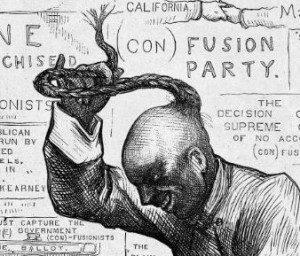
Chinese Hair QueueBelieve it or not, I’ve actually had the last of these selected verses quoted to me as part of an argument against the use of incense in the church. I was in a conversation with someone about our use of incense in “high church” liturgies, being told (among other things) that incense was fine when we were younger and acting like hippies but now that we are older and mature we should put aside such childish ways, when this chestnut was pulled out. Since I’ve studied the Old Testament (as most clergy have) I knew my critic was misusing the text.

Such a reading is hard to square with other parts of Scripture in which the use of incense as an honorable offering to God is approved. For example, speaking through the Prophet Malachi God says, “For from the rising of the sun to its setting my name is great among the nations, and in every place incense is offered to my name, and a pure offering; for my name is great among the nations, says the Lord of hosts.” (Mal 1:11)

It’s even harder to harmonize with those places were the burning of incense in religious ceremonies is not only approved, it is commanded. For instance, in the Book of Exodus Moses is commanded to make an altar for incense upon which Aaron is to burn incense two times every day: “Aaron shall offer fragrant incense on it; every morning when he dresses the lamps he shall offer it, and when Aaron sets up the lamps in the evening, he shall offer it, a regular incense offering before the Lord throughout your generations.” (Ex 30:7-8)

And more than that, that reading doesn’t accord with the verse’s own context, and that’s what I’m thinking about today. The story of Korah’s and his followers’ destruction at the hand of an angry God has nothing to do with incense. The burning of incense although it figures prominently in the story is really incidental to the story; Korah and his tribe were destroyed because of their pride, because they sought to usurp the priesthood of Aaron which was not and never would be theirs. In the story, Aaron also burns incense to the Lord and his offering is accepted; further, shortly after this incident Aaron stops a plague among the people through the burning of incense. Clearly, incense is perfectly acceptable to God.

So to say that “fire coming out from the Lord and consuming the two hundred and fifty men offering incense” is an indictment of the use of incense in worship is proof-texting of the worst type, inconsistent with other scriptural references and inconsistent with its own context.

I recall a joke (or maybe it’s a true story) about a preacher who abhorred the traditional Chinese men’s hairstyle holding forth in California in the late 1800s urging Chinese immigrants to abandon the queue or “topknot.” All Chinese men, but particularly those who had converted to Christianity, he argued, should cut off their queues because Christ himself had uttered the words, “Topknot go down!” And he was correct, sort of. What Jesus had said was, “Let him who is on the housetop not go down to take what is in his house . . . .” (Mt. 24:17) Picking and choosing the Bible’s words out of context is not a new phenomenon.

The only way to combat proof-texting is knowing the Scriptures oneself. Jesus is our model in this regard. Tempted by the devil after his baptism, he was able to answer each of Satan’s references to Scripture with counter-references of his own. (Matt. 4) If we are to respond to misuses of Scripture, we must know it ourselves.

Now, I don’t agree with my incense critic about old age and maturity being a reason to give up incense, but I suppose there might be something to that. Perhaps given the respiratory problems some older folks have, one can be too old for incense. However, one is never too old for Christian education and Bible study!

====================

A request to my readers: I’m trying to build the readership of this blog and I’d very much appreciate your help in doing so. If you find something here that is of value, please share it with others. If you are on Facebook, “like” the posts on your page so others can see them. If you are following me on Twitter, please “retweet” the notices of these meditations. If you have a blog of your own, please include mine in your links (a favor I will gladly reciprocate). Many thanks!

====================

Father Funston is the rector of St. Paul’s Episcopal Church, Medina, Ohio.

Awkward Anglicanism – From the Daily Office – June 23, 2014

From the Letter to the Romans:

But now, irrespective of law, the righteousness of God has been disclosed, and is attested by the law and the prophets, the righteousness of God through faith in Jesus Christ for all who believe.

(From the Daily Office Lectionary – Romans 3:21-22 (NRSV) – June 23, 2014)

AwkwardGreat! Here it is, the single phrase in Paul’s writing, the single preposition the translation of which can radically change one’s understanding of the doctrine of justification by faith. But . . . I’m not going to address that doctrine this morning; I’m more interested right now in ambiguity.

And in that vein, what I just wrote about translating the original Greek is not entirely accurate: it’s not how a preposition is translated because, in the Greek, there is no preposition. The Greek of the last phrase (everything after the last comma) is dikaiosene de Theou dia pisteo Iesou Xristou ei panta tou pisteuonta. The construction pisteo Iesou Xristou is what is called the genitive case. The standard translation of this case into English requires insertion of the preposition “of”. However, it can also be understood as a variant called the objective genitive in which the preposition “in” is inserted for interpretation. In other words, Paul’s Greek is ambiguous.

Which means — right? — that we have to figure out which it is. Is the righteousness of God disclosed by our faith or by Jesus’ faith? Are we saved by our trust in Jesus or by Jesus’ trust in his Father?

This is a debate that has gone on for centuries and the church’s traditional answer has been to go with the objective genitive translation and insert an “in” in this sentence (and similar statements throughout Paul’s writing). But doesn’t that put the ball in our court? Doesn’t that say it is something we do, not something Jesus does? Somehow, it seems to me, that that one little preposition — “in” — puts us in charge of the process of redemption; it requires of me that which Jesus once painfully demonstrated even his most ardent followers did not have — faith at least the size of a mustard seed. (Mt 17:20; Lk 17:6)

So, we have to figure this out! Or do we? What if there is no definitive answer to this question? The ambiguous Greek of this otherwise simple phrase cannot be made any clearer. Like much of Holy Scripture it is a matter of interpretation and either reading can find support in other verses of the Bible; whole theologies have been constructed on one reading or the other.

Early in the morning, not yet showered, with only one cup of coffee in me . . . I’m not going to reach any definitive answer nor build a theory of salvation. In fact, wide awake and dressed for battle I wouldn’t be able to do so. And that’s just fine, because in its ambiguity, Paul’s prose probably should be understood in both ways. I believe that Paul (or perhaps the Holy Spirit working through Paul) is being deliberately inexact, forcing his readers to think in alternative and creative ways!

This is both the beauty and the frustration of bible study, the beauty and the frustration of Christian belief. Accepting such ambiguity, and learning to live with it, is why I am an Episcopalian, an Anglican. For me, this is the beauty and delight of Anglicanism. Our theological tradition is sometimes called a “both/and” tradition. Anglicanism is also sometimes caricatured as attempting to be everything to everyone and thereby being nothing to anyone. We Anglicans describe ourselves as a via media (“middle way”) among the various iterations of western Christianity, between the papal authoritarianism of Rome and the paper authoritarianism of the Protestants. This middle position has been called both a strength and a weakness; I tend to view it positively, but I have to admit that it’s often an awkward place to be. Anglicanism is often awkward!

I think that awkward position is precisely where consideration of which preposition to insert when interpreting Paul’s Letter to the Romans puts us, and I think that it’s a good place to be. Between “of” and “in”, between either/or and both/and, between nothing and everything is a place of dynamic tension. It’s not a place to find definitive answers, but it’s a good place to start the day.

====================

A request to my readers: I’m trying to build the readership of this blog and I’d very much appreciate your help in doing so. If you find something here that is of value, please share it with others. If you are on Facebook, “like” the posts on your page so others can see them. If you are following me on Twitter, please “retweet” the notices of these meditations. If you have a blog of your own, please include mine in your links (a favor I will gladly reciprocate). Many thanks!

====================

Father Funston is the rector of St. Paul’s Episcopal Church, Medina, Ohio.

Creative Conflict: Back to Basics – From the Daily Office – June 19, 2014

From Matthew’s Gospel:

[Jesus said] “If another member of the church sins against you, go and point out the fault when the two of you are alone. If the member listens to you, you have regained that one. But if you are not listened to, take one or two others along with you, so that every word may be confirmed by the evidence of two or three witnesses. If the member refuses to listen to them, tell it to the church; and if the offender refuses to listen even to the church, let such a one be to you as a Gentile and a tax-collector.”

(From the Daily Office Lectionary – Matthew 18:15-17 (NRSV) – June 19, 2014)

Two Men in Verbal ConflictIf Jesus stands for anything, he stands for community, for the ability of people graced by God to reconcile with one another despite their differences. Yet even he acknowledges that there are times when reconciliation is impossible, that there are people who will not engage in constructive dialog, will not compromise, and will not modify their behavior. His advice is to let such a person go: “Let such a one be to you as a Gentile and a tax-collector.”
We do a terrible job of following Jesus’ directions in many things, this one most of all. We, church members and church leaders, are so afraid of decline that we try to please everyone so that not only do we not let those go who really ought to go, we actively hang on to them. We try to please everyone for fear of losing anyone when we really should lose a few someones. As a result, we have an epidemic of “niceness” in the church.

By being “nice,” we allow dysfunctional persons to get away with behavior that would be unacceptable in any other organization, group, or workplace. Adult church members are allowed to act in ways that would get children expelled from school, and all the “nice” people look the other way or try to placate them. But we aren’t called to be “nice;” we’re called to love. Sometimes loving both a person and a community means letting go of the person to preserve and safeguard the community, letting “such a one be to you as a Gentile and a tax-collector.”

An article published in The Huffington Post a couple of years ago (April 2012) is popping up again on social media sites like Facebook. It reports on a study of over 580 clergy from 39 denominations:

An online study published in the March issue of the Review of Religious Research found 28 percent of ministers said they had at one time been forced to leave their jobs due to personal attacks and criticism from a small faction of their congregations.

The researchers from Texas Tech University and Virginia Tech University also found that the clergy who had been forced out were more likely to report lower levels of self-esteem and higher levels of depression, stress and physical health problems.

And too few clergy are getting the help they need, said researcher Marcus Tanner of Texas Tech.

“Everybody knows this is happening, but nobody wants to talk about it,” Tanner said in an interview. “The vast majority of denominations across the country are doing absolutely nothing.” (David Briggs, Silent Clergy Killers: ‘Toxic’ Congregations Lead to Widespread Job Loss)

I recently read the profile of a congregation in search of a pastor. A survey of the membership was included and, interestingly, the majority had said they wanted a clergy person who would “make creative use of conflict” rather than avoid it. That’s refreshing, but it makes one wonder if they truly mean it and raises the question: what’s lurking underneath that response?

I also wonder why, when Jesus has given us a perfectly good model for dealing with conflict, we think we need to get creative about it. Maybe what we need to do is get back to basics, back to following Jesus’ instructions.

====================

A request to my readers: I’m trying to build the readership of this blog and I’d very much appreciate your help in doing so. If you find something here that is of value, please share it with others. If you are on Facebook, “like” the posts on your page so others can see them. If you are following me on Twitter, please “retweet” the notices of these meditations. If you have a blog of your own, please include mine in your links (a favor I will gladly reciprocate). Many thanks!

====================

Father Funston is the rector of St. Paul’s Episcopal Church, Medina, Ohio.

Woe to You – From the Daily Office – June 18, 2014

From Matthew’s Gospel:

Woe to the world because of stumbling-blocks! Occasions for stumbling are bound to come, but woe to the one by whom the stumbling-block comes!

(From the Daily Office Lectionary – Matthew 18:7 (NRSV) – June 18, 2014)

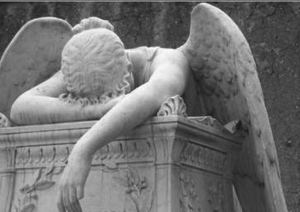
Weeping AngelUntil I undertook a little bit of Greek language study, I always thought Jesus’ pronouncements of woe were angry condemnations, predictions of doom, and certainly they can be that. On the other hand, they can be understood as something very different. The Greek word translated as “woe” is ouai which can also (and perhaps more properly) be translated as “alas.” The word is onomatopoeic, representing a deep sigh of sorrow or resignation. Perhaps Jesus is not so much condemning as mourning.

I grew up with a picture of Jesus that was internally contradictory. There was the Good Shepherd Jesus who was loving and kind, who healed children, sought out the lost, and wept over the death of friends. On the other hand, there was the angry, condemning Jesus who braided a whip out of cords, overturned tables, pronounced doom-laden “woes”.

Although his earthly post-Resurrection were certainly more the former sort of Jesus, it seemed it was the angry Jesus who really rose because that’s the one John of Patmos said was coming back: “From his mouth comes a sharp sword with which to strike down the nations, and he will rule them with a rod of iron; he will tread the wine press of the fury of the wrath of God the Almighty.” (Rev 9:15)

Then I studied Greek and read, for example, Luke’s “blessings and woes” rather differently:

Woe to you who are rich, for you have received your consolation. Woe to you who are full now, for you will be hungry. Woe to you who are laughing now, for you will mourn and weep. Woe to you when all speak well of you, for that is what their ancestors did to the false prophets. (Lk 6:24-26)

The same ouai, the same deeply sad sigh, the same “alas” as in today’s reading. Now it seems to me that Jesus, rather than venting fury at these people, is saying, “I feel sorry for you rich . . . I fell sorry for you full . . . I feel sorry you who laugh . . . I feel sorry for you who have great reputations.” This Jesus, sadly disappointed rather than angry with those about whom he expresses woe, is not contradictory to the Jesus who heals, who cares, who listens, who feeds, and who weeps.

I still don’t know what to do with that raging horse rider with the sharp sword for a tongue, but I’m feeling a lot better about the Jesus who says, “Woe to you . . . . ”

====================

A request to my readers: I’m trying to build the readership of this blog and I’d very much appreciate your help in doing so. If you find something here that is of value, please share it with others. If you are on Facebook, “like” the posts on your page so others can see them. If you are following me on Twitter, please “retweet” the notices of these meditations. If you have a blog of your own, please include mine in your links (a favor I will gladly reciprocate). Many thanks!

====================

Father Funston is the rector of St. Paul’s Episcopal Church, Medina, Ohio.

A Fishy Tale – From the Daily Office – June 17, 2014

From Matthew’s Gospel:

When they reached Capernaum, the collectors of the temple tax came to Peter and said, “Does your teacher not pay the temple tax?” He said, “Yes, he does.” And when he came home, Jesus spoke of it first, asking, “What do you think, Simon? From whom do kings of the earth take toll or tribute? From their children or from others?” When Peter said, “From others,” Jesus said to him, “Then the children are free. However, so that we do not give offence to them, go to the lake and cast a hook; take the first fish that comes up; and when you open its mouth, you will find a coin; take that and give it to them for you and me.”

(From the Daily Office Lectionary – Matthew 17:22-27 (NRSV) – June 17, 2014)

Childrens Bible Illustration of the Fish and Coin“O great,” I think, reading this story. “Here’s one of those fairy tales that make the story of Jesus so unbelievable for some people.” Let’s face it, a fish with a silver coin in its mouth that’s just enough to pay the taxes levied by the authorities ranks right up there with Jack’s magic beans, the goose that laid golden eggs, and Rapunzel’s spinning wheel that made gold from straw. It has all the markings of the fantastic and none of the real.

Commentators are all over the board in trying to figure it out, too! They pose all sorts of questions: How did Jesus know the fish would have the coin? How did Peter know where to throw his hook? What is the significance of the fish itself? Or of the coin? And they posit answers: The story shows Jesus’ complete divine knowledge of everything (omniscience). The story shows Jesus’ mastery over nature (omnipotence). The tale demonstrates Jesus’ contempt for the temple authorities. (That last one is probably accurate. I don’t believe that the human Jesus, even though God incarnate, had access to complete divine knowledge or complete control over nature, I can’t agree with so the first two.)

The tale even has a standard name: “The Miracle of the Coin in the Fish’s Mouth.” But here’s the thing . . . .

It never happened!

There is no story of Peter actually following through. There is no story of Peter going fishing. There is no tale of coins actually being found in a fish’s mouth. There is no narrative of Peter paying the temple tax.

All we have is a story of a conversation. After relating the conversation, Matthew immediately shifts scene to the disciples’ discussion about greatness in the kingdom of heaven (ch. 18). Not word is written by Matthew or by anyone about Peter actually going fishing.

If Matthew, a tax collector, actually wrote the gospel bearing his name, it makes sense that he would remember and relate a conversation about taxes; he is the only evangelist to tell of this discussion. If Peter really had caught a fish with a coin and used it to pay a mandated offering to the Temple . . . can we believe that such an incredible occurrence would not have been known to and told about by the other gospel writers? That just sounds fishy!

I want to make the radical suggestion that all of the ink spilled in analysis of the “miracle of the coin in the fish’s mouth” has been wasted, that we should focus our attention on the conversation, not on an event that is never described as having taken place. What might the conversation mean? What was its context? Is Jesus being humorous? Could this conversation (which probably took place sixty years or more before it was written down) been more speculative? Could Jesus really have said something like, “Suppose you went down to the lake, cast a line, and caught this fish . . . . ”

Here’s my thought for the morning: this is not a story about a miracle. It’s not a fairy tale like the beans, the goose, or the spinning wheel. It’s a conversation in critique of the temple tax. I believe Jesus is posing a fantastic hypothetical. — “If you were lucky enough to catch a fish with the exact amount of the tax in its mouth and used that to pay the tax, would that be a worthy offering? The authorities would accept it, but would it truly represent you and me? Would it be a sacrificial gift to God? And if the temple tax can be paid with something you were just lucky to find in the most unlikely of circumstances does it have any meaning?”

If Jesus is about anything, he is about investment in faith; he is about commitment; he is about personal sacrifice. Messing with nature so that Peter would find a coin to pay the tax would be out of character for him; telling a tale to illustrate the inadequacy of the established religion, not so much.

====================

A request to my readers: I’m trying to build the readership of this blog and I’d very much appreciate your help in doing so. If you find something here that is of value, please share it with others. If you are on Facebook, “like” the posts on your page so others can see them. If you are following me on Twitter, please “retweet” the notices of these meditations. If you have a blog of your own, please include mine in your links (a favor I will gladly reciprocate). Many thanks!

====================

Father Funston is the rector of St. Paul’s Episcopal Church, Medina, Ohio.

I Arise Today: Sermon for Trinity Sunday – RCL, Year A – June 15, 2014

====================

On Trinity Sunday, the First Sunday after Pentecost, June 15, 2014, this sermon was offered to the people of St. Paul’s Episcopal Church, Medina, Ohio, where Fr. Funston is rector.

(The lessons for the day were: Genesis 1:1-2:4a; Canticle 13 (Song of the Three Young Men 29-34); 2 Corinthians 13:11-13; and Matthew 28:16-20. These lessons can be read at The Lectionary Page.)

====================

Triquetra

I arise today
Through a mighty strength, the invocation of the Trinity
Through belief in the Threeness
Through confession of the Oneness
Towards the Creator.

Although he probably didn’t actually write it, tradition credits St. Patrick of Ireland with the poetic charm called a “lorica” or “breastplate” which begins with these words, an invocation of the One, Holy, Blessed, and Glorious Trinity whom we today celebrate. Since the time of St. Thomas a Becket, the first Sunday after the Feast of Pentecost has been set aside as day of special veneration of the Triune nature of the Godhead. Becket was consecrated Archbishop of Canterbury on the Sunday after Pentecost, and his first act was to decree that the anniversary of his consecration should be commemorated each year in honor of the Holy Trinity. This observance spread from Canterbury throughout the whole of the western church.

Patrick continues:

I arise today
Through the strength of Christ with his baptism,
Through the strength of his crucifixion with his burial,
Through the strength of his resurrection with his ascension
Through the strength of his descent for the Judgment of doom.

Our Gospel lesson today is the end of Matthew’s Gospel. In it Christ on the mount of the ascension, just before going up into heaven, gives the eleven remaining Apostles what has come to be known as “The Great Commission”:

Go therefore and make disciples of all nations, baptizing them in the name of the Father and of the Son and of the Holy Spirit, and teaching them to obey everything that I have commanded you.

For Matthew mountains are what Celtic Christianity refers to as “thin places,” those places where the separation between the spiritual realm and the physical realm is narrowest, where the veil which separates heaven from earth is nearly transparent so that we have the feeling we could reach out and touch, even enter, the holy presence.

On a mountain, in such a place, Jesus calls his followers to a new beginning. The Eleven, standing proxy for all the followers of Jesus then and now, for you and for me, are called to be people moving in mission. It is important for us to note that this mountain is in Galilee, the place where Jesus began his ministry, the place from which he went forth but to which he returned, the place where he was grounded and rooted. The disciples, too, are from this place and their grounding in the Christian story is this same country where their journey began. Like them, we are called to claim our origins, to be rooted in the place where we entered the Christian story, not to be permanently bound there, but to draw strength from it as we venture out in mission into the wider world beyond. The place where we began as members of the community of Christ is, to each of us, an important place of foundation and also, perhaps, a thin place where we encounter the Triune God.

Patrick’s lorica continues:

I arise today
Through the strength of the love of Cherubim
In obedience to the Angels,
In the service of the Archangels,
In hope of resurrection to meet with reward,
In prayers of patriarchs,
In predictions of prophets,
In preaching of Apostles,
In faith of confessors,
In innocence of Holy Virgins,
In deeds of righteous [people].

Here, St. Patrick claims membership in the Christian community as his source of strength, as his foundation, as the community in which his mission is grounded and from which it is nurtured.

In a few moments, we will do something we have not done since Lent . . . join together in the General Confession, jointly and publically acknowledging that as individuals and as a community we have failed to live up to our obligations, that we have sinned “by what we have done, and by what we have left undone.” And we will be forgiven that failure by God’s absolution which reconciles us and restores us to the community and fellowship of the Church. When, as presiding priest, I pronounce the words of absolution, I speak not on my own behalf but for the whole church to which Jesus gave what is called “the power of the keys” when he said to the Apostles, “I will give you the keys of the kingdom of heaven, and whatever you bind on earth will be bound in heaven, and whatever you loose on earth will be loosed in heaven.” (Mt 16:19; cf. 18:18)

The words of absolution, which I speak as much to myself as to anyone, loose our sins, but also bind us into the beloved community:

Almighty God have mercy on you, forgive you all your sins through our Lord Jesus Christ, strengthen you in all goodness, and by the power of the Holy Spirit keep you in eternal life.

The community with which we are reconciled through confession and absolution is the community of the Trinity.

In the Triune Godhead all Christian community begins and finds its perfect expression. Humankind, as our Genesis reading reminded us, was and is created in the image of God. Thus, we are blessed with reason and skill; we are capable of experiencing emotion; and, like God, we have individual will and freedom of action. To be created in God’s likeness also means that we have the possibility of attaining holiness and immortality. To be created in God’s likeness further means that we are created to experience, participate in, and share interrelationship with others, for we are made in the image of the Holy Trinity.

The Doctrine of the Trinity is not a static principal of faith; it is the way in which the church, through the revelation of God, has come to appreciate and express of the significantly dynamic nature of God in the relationship of the Father, the Son, and the Holy Spirit. If we have been created in the image of God and if God is Trinity then at the deepest level of our being, we are communitarian, created not for ourselves, but for one another, for relationship with each other and with God.

Many look at the mystery of the Trinity as if it were a problem in differential calculus. They seem to have the attitude that if one solves the equation, they will have figured out God and earned their entry into heaven. But, as Benedictine poet Killian McDonnell writes, God is not a problem to be solved:

God is not a problem
I need to solve, not an
algebraic polynomial equation
I find complete before me,

with positive and negative numbers
I can add, subtract, multiply.
God is not a fortress
I can lay siege to and reduce.

God is not a confusion
I can place in order by my logic.
God’s boundaries cannot be set,
like marking trees to fell.

God is the presence in which
I live, where the line between
what is in me and what
before me is real, but only God

can draw it. God is the mystery
I meet on the street, but cannot
lay hold of from the outside,
for God is my situation,

the condition I cannot stand
beyond, cannot view from a distance,
the presence I cannot make an object,
only enter on my knees.

Which brings us back to confession, to reconciliation, and to community.

The community to which and in which we are to be reconciled is not only that of the church or that of the human commonwealth, it is the community of the whole of creation. This is why our round of readings from Sacred Scripture bids us on Trinity Sunday to hear the long lesson from Genesis recounting the days of creation as each part of the natural order is ordained by God and pronounced good. This is the community that Matthew’s Jesus claims when he asserts that “all authority in heaven and on earth has been given to me.” “Heaven and earth” is a figure of speech called a merism, a manner of speaking by which the whole of something is referenced by enumerating its constituents or traits. In the Genesis creation story, heaven and earth comprise a single entity — God’s whole creation. We are a part of that community of creation and it is to that universal community that Patrick next looks in his lorica:

I arise today
Through the strength of heaven:
Light of sun
Brilliance of moon
Splendor of fire
Speed of lightning
Swiftness of wind
Depth of sea
Stability of earth
Firmness of rock.

The whole of nature comprises the foundational community of strength and support upon which a follower of Jesus may depend, because this community finds its strength and support in paradigm community of the Holy Trinity by whom it was creation.

Genesis insists that there is one God, who is sovereign and powerful. Unlike the gods of other peoples in the ancient Middle East, the God of Israel had no specified area of competence. The creation in the first chapter of Genesis is, as one commentator has said, “fiercely monotheistic,” yet even in its insistence on the one God, not limited in space or time, Genesis reveals the Trinity. From this god, the God, a wind, the Holy Spirit, came forth and spread across the void. This god, the God, created everything. This god, the God, simply spoke the Word (“in the beginning was the Word,” said John of Jesus) and creation happened. It is to this god, the God that Patrick looks for strength and protection:

I arise today
Through God’s strength to pilot me:
God’s might to uphold me,
God’s wisdom to guide me
God’s eye to look before me,
God’s ear to hear me,
God’s word to speak for me,
God’s hand to guard me,
God’s way to lie before me,
God’s host to secure me
against snares of devils
against temptations of vices
against inclinations of nature
against everyone who shall wish me ill,
afar and anear,
alone and in a crowd.

But we are never truly alone, nor are we ever really beset by these and the many other spiritual and physical dangers that Patrick goes on to list. St. Paul blessed and reminded his readers, “the grace of the Lord Jesus Christ, the love of God, and the communion of the Holy Spirit” are with us all. Jesus promised and reminded the Eleven (and through them, us), “I am with you always, to the end of the age.”

These are not mere blessings or simple an appeals to get along with one another; these are exhortations to be the new creation that the Spirit of God equips us to be, a foundational community patterned on the Holy Trinity. Just as the Persons of the Divine Trinity are never alone, human beings are created with a need for one another, a need to communicate with one another. Our thirst to communicate ourselves to others, to be in authentic relationship with each other is never exhausted. The only difference between our community and that of the Trinity is that God’s Triune relationship is perfect and total whereas in our human reality communication and relationship are imperfect and partial. Paul’s appeal for the presence of Christ’s grace, God’s love, and the Spirit’s fellowship is an appeal to enter more to the divine love that creates and sustains the church, that perfects and completes our relationships. The Trinity is the very source of our life in Christ, and in Christ we are a new creation with whom Christ promises always to stay.

So in the lorica, Patrick extols the totality of Christ’s presence, the inescapabilty of Jesus’ promise, “I am with you always, to the end of the age.” Patrick writes:

Christ with me,
Christ before me,
Christ behind me,
Christ in me,
Christ beneath me,
Christ above me,
Christ on my right,
Christ on my left,
Christ where I lie,
Christ where I sit,
Christ where I arise,
Christ in the heart of every [person] who thinks of me,
Christ in the mouth of every [person] who speaks of me,
Christ in every eye that sees me,
Christ in every ear that hears me.

Patrick concludes as he began, invoking the One, Holy, Blessed, and Glorious Trinity whom we today celebrate:

I arise today
Through a mighty strength, the invocation of the Trinity,
Through belief in the Threeness,
Through confession of the Oneness
Towards the Creator.

“The grace of our Lord Jesus Christ, and the love of God, and the fellowship of the Holy Spirit, be with us all evermore. Amen.” (2 Cor 13:14 as used to conclude the Daily Office in The Book of Common Prayer, page 102)

====================

A request to my readers: I’m trying to build the readership of this blog and I’d very much appreciate your help in doing so. If you find something here that is of value, please share it with others. If you are on Facebook, “like” the posts on your page so others can see them. If you are following me on Twitter, please “retweet” the notices of these meditations. If you have a blog of your own, please include mine in your links (a favor I will gladly reciprocate). Many thanks!

====================

Father Funston is the rector of St. Paul’s Episcopal Church, Medina, Ohio.

« Older posts Newer posts »