Occasional thoughts of an Anglican Episcopal priest

Category: Matthew (Page 19 of 29)

Mystical Jesus – From the Daily Office – March 1, 2014

From John’s Gospel:

Now among those who went up to worship at the festival were some Greeks. They came to Philip, who was from Bethsaida in Galilee, and said to him, “Sir, we wish to see Jesus.” Philip went and told Andrew; then Andrew and Philip went and told Jesus.

(From the Daily Office Lectionary – John 12:20-22 (NRSV) – March 1, 2014.)

Single Grain of WheatThis is such a great set up! Here are these Greeks (whether gentiles or Greek-speaking Jews of the Diaspora is unclear) who want to meet Jesus. They come to Philip who apparently speaks Greek and make their request. He goes to Andrew (another unclear thing: does he take the Greeks with him?) The two of them go see Jesus (with the Greeks?)

Now, how will Jesus respond?

If the Greeks are gentiles, will he respond as he did to the Syro-Phoenician woman: “It is not fair to take the children’s food and throw it to the dogs.” (Matt. 15:26)

Will he respond as he did to the centurion who sought healing for his servant: “Truly I tell you, in no one in Israel have I found such faith.” (Matt. 8:10)

If they are Jews, will he remind them of the Law as he did the rich young man who asked about eternal life: “You lack one thing; go, sell what you own, and give the money to the poor, and you will have treasure in heaven; then come, follow me.” (Mk. 10:21)

Will he welcome them and invite them to eat with him as he did the tax collectors and sinners? (Luke 15:1-2)

Uh . . . no. Not John’s Jesus. John’s Jesus goes off on some entirely self-centered tirade about glorification and grain dying and eternal life and his soul being troubled! John’s Jesus doesn’t respond to Andrew or Philip or the Greeks at all! I swear, there are times when Jesus as portrayed in the Fourth Gospel seems to be somewhere on the autism spectrum; his answers to inquiries are so far removed from the subject of the question one wonders if he even heard what was asked, or knows or cares who is asking. (This is one of those times!) Is this an accurate portrayal of the way Jesus interacted with people? Can this be historically factual?

So here’s my thought: the Jesus of the Fourth Gospel is not the historical Jesus. This Jesus is John’s attempt to communicate the spiritual nature of the resurrected and ascended Lord; this Jesus is a mystical reality not an historical portrait. L. William Countryman in The Mystical Way in the Fourth Gospel called Jesus’ strange, almost non-responsive, frequently offensive dialogs “obnoxious.” Although that’s a good description, I think they are almost hallucinatory. They twist the reader’s understanding of reality and open the reader’s mind to new possibilities. Would you see Jesus? Then consider a kernel of grain and how its life increases even though it dies? Would you see Jesus? Then follow Jesus, do as Jesus does, do what Jesus teaches. Would you see Jesus? Then listen for the voice of the Father. Jesus’s answers seem non-responsive, but they are gateways to new appreciations.

====================

Father Funston is the rector of St. Paul’s Episcopal Church, Medina, Ohio.

Living With Integrity – Sermon for the Seventh Sunday after Epiphany (Year A) – February 23, 2014

====================

This sermon was preached on the Seventh Sunday after Epiphany, February 23, 2014, at St. Paul’s Episcopal Church, Medina, Ohio, where Fr. Funston is rector.

(The lessons for the day were: Leviticus 19:1-2,9-18; Psalm 119:33-40; 1 Corinthians 3:10-11,16-23; and Matthew 5:38-48. These lessons can be read at The Lectionary Page.)

====================

Integrity Venn DiagramJesus doesn’t ask much, does he? Only perfection! “Be perfect,” he tells us, “as your heavenly Father is perfect.” Of course, Jesus is simply echoing the words Moses spoke on God’s behalf delivering the Law to the Hebrews: “You shall be holy, for I the Lord your God am holy.” What can this mean? How can we be expected to be perfect and holy like God? How can we do that, especially when both Moses and Jesus insist that that means, among other things, loving our enemies, not seeking redress, not holding a grudge, and not getting that to which we are sure we are entitled?

Let’s first be certain that we know what we’re talking about! Let’s remember that these English words are translations of ancient Hebrew and biblical Greek, and that there may be connotations and nuances in those older languages that the English interpretations obscure.

The Hebrew in our reading from Leviticus is qadowsh and is derived from a root word meaning “set apart” (qadash). This, of course, was the purpose of the Law which God, through Moses, was giving to the Hebrews: it was to set them apart from other nations, other peoples. They were to be consecrated to God as a “holy nation” – a nation separated from the rest of humankind for a God’s special purposes.

God, through Moses and then repeatedly through the prophets, makes it clear that this does not mean that they are in any way better than other nations; they are simply different in that they will be used by God to accomplish God’s purposes. The prophet Amos, for example, reminded the Israelites that God had relationships with other nations: “Are you not like the Ethiopians to me, O people of Israel? says the Lord. Did I not bring Israel up from the land of Egypt, and the Philistines from Caphtor, and the Arameans from Kir?” (Amos 9:7)

The modern Orthodox Jewish view is that God chooses and sets apart many nations for differing purposes. The former Chief Rabbi of Great Britain, Immanuel Jakobovits, expressed it this way:

I believe that every people—and indeed, in a more limited way, every individual—is “chosen” or destined for some distinct purpose in advancing the designs of Providence. Only, some fulfill their mission and others do not. Maybe the Greeks were chosen for their unique contributions to art and philosophy, the Romans for their pioneering services in law and government, the British for bringing parliamentary rule into the world, and the Americans for piloting democracy in a pluralistic society. The Jews were chosen by God to be “peculiar unto Me” as the pioneers of religion and morality; that was and is their national purpose. (Commentary Magazine, August, 1966)

So this is what “holiness” means in our reading from Leviticus – to be set apart for God’s use in a particular way. It does not mean that the ancient Jews, nor we as the grafted-on “new Israel,” are expected to be God-like or sacred (whatever that means) or divine or particularly righteous or pure. It means, rather, that we are to be prepared, like a tool is prepared, to be used for God’s purposes.

In echoing Moses, however, Jesus chose to use another word, the word perfect. In the koine Greek of the New Testament, the word is teleios which signifies wholeness and completion, something brought to its intended end; it derives from a word meaning “the end” (telos) which carries with it a nuanced suggestion of a goal or a purpose. It is not identical to the Hebrew word used by Moses, but it carries much of the same implications. Jesus is not admonishing his hearers, then or now, to some sort of moral perfectionism, but rather to becoming what God has intended, to accomplishing one’s God-given purpose.

And so the question for us in response both to Leviticus and to Matthew’s Gospel is, “How do we do this? How can we be holy as God is holy? How can we be perfect as the Father is perfect?” We find the answer close at hand both in God’s giving of the Law and in Christ’s Sermon on the Mount.

The Levitical admonition to holiness is followed by several exemplary commandments, none of which are particularly religious! Leave something in your fields for the hungry to glean. Don’t lie to one another. Don’t defraud one another. Don’t steal from each other. Don’t mistreat the handicapped. Don’t be partial in your judgments. Don’t hate anyone or seek vengeance or even bear a grudge. That’s what holiness is; that’s what being set apart for God’s purposes is.

In the section of the Sermon on the Mount in today’s Gospel, Jesus continues with the rhetorical form he began in last week’s Gospel reading, the antitheses in which he contrasts the Law with his own teaching: “You have heard it said . . . but I say to you . . . .” You have heard the rule of justice, “an eye for an eye,” but I say to you, “Don’t insist on it. In fact, offer more. If you’re struck on one cheek, offer the other. If someone takes your cloak, give them your shirt, too. If you are pressed into service to carry a burden, carry it twice the distance.” You have heard it said, “Love your neighbor and hate your enemy” . . . . (Now, that one puzzles the scholars because although the Law does say, “You shall love your neighbor as yourself,” there is no commandment to hate one’s enemy. There are plenty of Old Testament examples of hating one’s enemy, but no commandment along those lines. In any event . . . .) You have heard it said, “Love your neighbor and hate your enemy,” but I say to you, “Love your enemies and pray for those who persecute you.” Why? Because God sends rain on the righteous and the unrighteous alike; God gives sunshine to both the good and the evil. God treats everyone impartially – and so should you. God is good to everyone impartially – and so should you be. That’s what it means to be perfect, to be whole and complete and living according to God’s purposes.

Another word for this is integrity. Integrity is that sort of wholeness that we experience or perceive in someone when their life is integrated – when who they are matches what they do. And more than that it’s that wholeness that we sense when a person not only “practices what they preach,” but when it all seems to flow from the very core of their being, when their preaching and their practice all seem to be in accord with God’s purpose for them. When we meet such a person, say for example Jesus, we know that they have no trouble forgiving their enemies and praying for their persecutors, don’t we? We’re sure of it!

So, how do we live an integrated life? How do we live with integrity? It’s really easy for a preacher to stand here and tell you to do that by imitating Christ, by living out God’s generous and unrestricted grace, mercy and love in all your relationships, with friend and foe alike. But that just begs the question! That’s just saying, “Live with integrity by living with integrity” and it’s not fair for a preacher to do that because we all know that there are times when being gracious and merciful and loving just isn’t all that easy, such as those times when we are called to love our enemies and those who do us wrong.

Frederick Buechner, the great Presbyterian story teller, wrote about this in his book Whistling in the Dark in an essay entitled Enemy:

Cain hated Abel for standing higher in God’s esteem than he felt he himself did, so he killed him. King Saul hated David for stealing the hearts of the people with his winning ways and tried to kill him every chance he got. Saul of Tarsus hated the followers of Jesus because he thought they were blasphemers and heretics and made a career of rounding them up so they could be stoned to death like Stephen. By and large most of us don’t have enemies like that anymore, and in a way it’s a pity.

It would be pleasant to think it’s because we’re more civilized nowadays, but maybe it’s only because we’re less honest, open, brave. We tend to avoid fiery outbursts for fear of what they may touch off both in ourselves and the ones we burst out at. We smolder instead. If people hurt us or cheat us or stand for things we abominate, we’re less apt to bear arms against them than to bear grudges. We stay out of their way. When we declare war, it is mostly submarine warfare, and since our attacks are beneath the surface, it may be years before we know fully the damage we have either given or sustained.

Jesus says we are to love our enemies and pray for them, meaning love not in an emotional sense but in the sense of willing their good, which is the sense in which we love ourselves. It is a tall order even so. African Americans love white supremacists? The longtime employee who is laid off just before he qualifies for retirement with a pension love the people who call him in to break the news? The mother of the molested child love the molester? But when you see as clearly as that who your enemies are, at least you see your enemies clearly too.

You see the lines in their faces and the way they walk when they’re tired. You see who their husbands and wives are, maybe. You see where they’re vulnerable. You see where they’re scared. Seeing what is hateful about them, you may catch a glimpse also of where the hatefulness comes from. Seeing the hurt they cause you, you may see also the hurt they cause themselves. You’re still light-years away from loving them, to be sure, but at least you see how they are human even as you are human, and that is at least a step in the right direction. It’s possible that you may even get to where you can pray for them a little, if only that God forgive them because you yourself can’t, but any prayer for them at all is a major breakthrough.

In the long run, it may be easier to love the ones we look in the eye and hate, the enemies, than the ones whom—because we’re as afraid of ourselves as we are of them—we choose not to look at, at all.

“Pray for them a little, if only that God forgive them because you yourself can’t . . . .”

When I read those words I was reminded of an incident in my own life which I’m pretty sure I have told here before. Back when I was a practicing attorney defending doctors and dentists in malpractice cases, I had occasion to defend a maxillofacial surgeon whose hobby was sculpting. One of the pieces he showed me was a crucifix on which the face of Jesus was contorted in extreme rage. When I asked him what that was all about, he asked if I remembered Jesus’ words in the Gospel according to Luke: “Father, forgive them; for they do not know what they are doing.” (Luke 23:34) He said he’d never heard those words as expressing forgiveness on Jesus’ part. Quite to the contrary, he said, he heard Jesus saying, “You forgive them, because right now, I can’t!”

Jesus was put in that place on that cross because he was holy – set apart for God’s particular purpose. Jesus was put in that place on that cross because he was perfect – he had a goal, a purpose, to be good, to live according to the law of love, to demonstrate God’s love for all humankind. If he was truly to live that life, to show that love, his integrity required that he do and say the things that put him in that place on that cross. But if my dentist client was correct (and I think he may have been), the best that even he could do in all his holiness, in all his perfection, in all his integrity, was turn forgiveness over to God; on his own on that cross, Jesus couldn’t do it.

And there is the answer to our question: How do we live with integrity? How can we be holy and perfect? Well, it’s what I suggested earlier, by imitating Christ, and that means by turning things over to God. On his own on that cross, Jesus couldn’t do it; on our own, we cannot do it. The Psalmist put it this way:

There is no king that can be saved by a mighty army; *
a strong man is not delivered by his great strength.
The horse is a vain hope for deliverance; *
for all its strength it cannot save. (Ps. 33:16-17; BCP version)

and again

Though my flesh and my heart should waste away, *
God is the strength of my heart and my portion for ever. (Ps. 73:26)

In our human weakness, we may be (we probably are) unable to not hate anyone, unable to eschew vengeance, unable to let go of our grudges. We may be (we probably are) unable to love our enemies or to pray for those who persecute us. But that’s OK. Because if the best we can do is pray, “God, you forgive them, because right now, I can’t!” that will be enough.

Let us pray:

O God, the Father of all, whose Son commanded us to love our enemies: Lead them and us from prejudice to truth: deliver them and us from hatred, cruelty, and revenge; and in your good time enable us all to stand reconciled before you, through Jesus Christ our Lord. Amen. (BCP 1979, page 816)

====================

A request to my readers: I’m trying to build the readership of this blog and I’d very much appreciate your help in doing so. If you find something here that is of value, please share it with others. If you are on Facebook, “like” the posts on your page so others can see them. If you are following me on Twitter, please “retweet” the notices of these meditations. If you have a blog of your own, please include mine in your links (a favor I will gladly reciprocate). Many thanks!

====================

Father Funston is the rector of St. Paul’s Episcopal Church, Medina, Ohio.

Choose Life! L’Chaim – Sermon for the 6th Sunday after Epiphany – February 16, 2014

====================

This sermon was preached on the Sixth Sunday after Epiphany, February 16, 2014, at St. Paul’s Episcopal Church, Medina, Ohio, where Fr. Funston is rector.

(The lessons for the day were: Deuteronomy 30:15-20; Ecclesiasticus 15:15-20 (used as the gradual); 1 Corinthians 3:1-9; and Matthew 5:21-37. These lessons can be read at The Lectionary Page.)

====================

Alphabet ChartAs I have mentioned here more than a couple of times, I went to high school at a boarding school in the middle of nowhere . . . a place called Kansas. At the time, my family was living in Southern California in the San Fernando Valley area of Los Angeles, so I was very far from home. Truth be told, nearly all of us in the cadet corps of St. John’s Military School in Salina were far from home; there were very few Kansans in the student body.

The dormitory at the school was called “the barracks” but, in truth, it wasn’t barracks-style living with everyone sharing one big room. We had discrete two-, three-, or four-bed rooms; there were also single rooms, but those were reserved to the highest ranking officers of the cadet battalion. At the end of each year, you could request a particular room for the next school year. Each size of room had its particular advantages; the four-bed rooms were newer, had better study carrels, nicer beds, and larger closets. So at the end of my first year, I requested a four-person room for the coming year.

You could also request particular roommates but that didn’t always work out. It usually would if it was just two people agreeing to share a two-bed room, but even then you couldn’t be guaranteed a roommate. I really didn’t care, so I just asked for the size of room I wanted and trusted to the luck of the draw for my roommates.

We got notice in late July what our room assignments were and who are roommates would be. As it turned out, two other continuing students with whom I was good friends got assigned to the same room, as did a new kid. I think they may have assigned him to room with me because, like me, he was from Southern California — San Diego, to be exact.

So I get this notice and it tells me that my roommates will be the two guys I knew and someone named “Joseph Joachim __________.” Well, with a name like that I was pretty certain that he was going to turn out to be Roman Catholic and Latino, specifically, since he was from San Diego, I figured he’d be a Mexican-American. So in August, when I reported to school, I was expecting to meet someone with brown skin and dark hair, and probably smaller than me. (This is an object lesson in never forming expectations based solely on someone’s name!)

What I encountered, instead, was a young man who stood about 6′ 2″ and towered over me! Plus, he had flaming red hair and a face full of freckles. He looked as Irish as Brian Boru! And turned out to be Jewish.

We became good friends and through that friendship, I had my first introduction to Judaism. Jojo (that was his nickname, Joseph Joachim shortened to “Jojo”) took me with him to a Chanukah party at one of the local — actually, I think, the only synagogue in Salina, Kansas, and it was there, also, that I experienced a Passover Seder for the first time. It was also because of my friendship with Jojo that I first experienced a traditional Jewish wedding.

I was attending college in San Diego, Jojo’s hometown. Jojo, though a year behind me in high school, had graduated from college before me, and shortly after completing his degree decided to get married. He invited me to be a part of that celebration and I accepted. One of the traditions of a Jewish wedding (as in every wedding) is the offering of toasts and one frequently given is the Hebrew salutation, “L’chaim!” — “To Life!” It is a wish for a person’s, or in this case the couple’s, health and well-being.

Jojo’s father was the first to offer the toast. I was standing beside him as he did so, and I may have been the only person to hear a muttered after-thought that he spoke when giving the toast. He said the usual few words about how proud and happy he was, loudly proclaimed “L’chaim!” and then muttered, “And don’t screw it up.”

That is precisely what Moses is saying to the people of the Hebrews today in our reading from the Old Testament: “L’Chaim! – And don’t screw it up!”

Remember where we are in this reading. The Book of Deuteronomy is supposed to be the farewell address from Moses to the people he has led across the desert for forty years. The first generation that had left Egypt has died off — you may remember that they angered God with their stiff-necked whining so God had sworn that none of them could enter the Promised Land, even Moses! God has promised Moses, however, that he would be able to see Canaan, even though he couldn’t go in.

So in Deuteronomy, we are standing on a high hill looking over the border into Canaan-land and Moses is reminding the Hebrews of their past. In a series of three discourses, Moses reminds them of their time of slavery in Egypt, of their liberation at the Passover, of their trek through the desert, and of God’s giving of the Law at Sinai. He has recounted the Ten Commandments and the rest of 613 mitzvot required in the Torah. And he is now, in the third discourse, consigning the Hebrews to the leadership of his assistant, Joshua the son of Nun, and encouraging them to success in the land God is giving them.

In the portion that was read this morning he says to them, “I am laying before you a choice between life and death. Choose life.” And then he tells them that doing so successfully is really a very simple thing; there are only three elements, three things that have to be done. There may be ten major commandments and 613 little rules and regulations, but really there are only three things that are required for them to live a good life in the land God is giving them: love God, obey God, and be faithful. He underscores this by saying it twice in this short passage: “If you obey the commandments of the Lord your God that I am commanding you today, by loving the Lord your God, walking in his ways, and observing his commandments, decrees, and ordinances, then you shall live . . . .” (v. 16) and again “Choose life so that you and your descendants may live, loving the Lord your God, obeying him, and holding fast to him . . . .” (vv. 19b-20) Love God, obey God, and be faithful. Choose life!

Or as Jojo’s father put it, “L’Chaim! And don’t screw it up!”

In our epistle lesson, Paul is writing to the Christians in Corinth. He’s gotten word that they are screwing it up! The church he planted there has become split; there is conflict; people are following different practices and different teachings, dividing themselves according to whomever they were converted or baptized or taught by. “It has been reported to me by Chloe’s people,” he says in the beginning of this letter, “that there are quarrels among you.” (1 Cor. 1:11) The followers of Apollos were at odds with followers of Paul and both were at odds with the followers of Cephas.

In correcting them, Paul basically tells them that they are acting like children! He reminds them that in proclaiming the Gospel to them he spoke to them as if they were children: “I could not speak to you as spiritual people, but rather as people of the flesh, as infants in Christ. I fed you with milk, not solid food, for you were not ready for solid food. Even now you are still not ready . . . . (1 Cor. 3:1-2)

Paul made the same point about religion, really about maturity in religion, in his letter to the Galatians when he spoke of the Jewish law (the Torah, the same law of ten major commandments and 613 mitzvot about which Moses had spoken to the Hebrews on that hill overlooking Canaan) as a “disciplinarian”:

Before faith came, we were imprisoned and guarded under the law until faith would be revealed. Therefore the law was our disciplinarian until Christ came, so that we might be justified by faith. But now that faith has come, we are no longer subject to a disciplinarian, for in Christ Jesus you are all children of God through faith. (Gal. 3:23-26)

The actual Greek word is paidagogos which is more accurately translated as “tutor” or “schoolmaster.” It is the word from which we get pedagogy.

Traceable Letter AAs I thought about this image of learning, this metaphor of the Law as schoolmaster, I thought about the way we all learn to write, by first learning to letter (or “print” as some people call it). I’m sure we all started in the same way, with those workbooks with very wide ruled lines, maybe 1/2 inch? And there were dashed lines over which we traced with our pencils. We started with the straight-line letters . . . I . . . then added a crossbar at the top . . . T . . . or a bar at the bottom . . . L . . . then two bars . . . F . . . and so on. Eventually, when we had mastered the straight lines, we learned to make diagonals . . . X . . . and . . . Z . . . and then . . . Y And after that came the curved letters . . . O . . . then . . . C . . . then . . . S. And I remember that . . . Q . . . was last because it had that little squiggly addition.

What was the point of that? Were we learning to trace dashed lines? Not really. The rule was to trace the dashed line, but what we were learning was lettering, writing, and really not even that . . . what we were learning was a means of communication! The point was not to trace dashed lines; the point was to communicate.

As I thought about that further, I remembered my grandfather Funston. I’ve mentioned him a time or two and told you how I spent my childhood summers with my grandparents. My grandfather, when I knew him, was an insurance salesman, the owner of the Funston Insurance Agency on Fourth Street in Winfield, Kansas (another part of the middle of nowhere). But earlier in life, before he “retired,” he was a school teacher, and he had been a certified Palmer method penmanship instructor. So one of the “fun” things his grandchildren got to do during their summer vacations was learn to write in cursive. Does anybody do that anymore? Write what we used to call “long-hand”? Email begat texting and texting begat tweeting and it seems no one writes notes or letters in beautiful flowing script anymore. But my grandfather made sure that my cousins and I learned to write that way!

There was one sentence that we practiced over and over. Later, in high school at St. John’s Military School, when I learned to type from a retired baseball player named “Lefty” Loy, I encountered that sentence again. And when my mother and I bought my first typewriter for college, we used that sentence to test the key action — and still to this day when I test computer keyboards I type out that same sentence. It’s one that I am sure is familiar to many if not most of you: “The quick brown fox jumps over the lazy white dog.” An English sentence containing every letter of the Latin alphabet.

The quick brown fox . . . .

Writing that sentence again and again, typing it over and over, was I learning about brown foxes or white dogs? No! The rule was to write or type the sentence, but the goal was to learn yet another means of written communication. The dashed lines in the workbook, the constant repetition of that sentence were training us in an underlying principle. In Paul’s words, they served as a schoolmaster until we had internalized the lessons. The Law of Moses, the Ten Commandments, the 613 mitzvot, served as schoolmaster until the Hebrews had (as Moses said) learned to love God, obey God, and be faithful. Until they had learned to choose life.

But over time, the rules and regulations, the commandments, the laws, and the ordinances had become more important than those underlying principles. They screwed it up! So that the tracing of the dashed lines was more important than the communication. Then, through God’s grace, Jesus came “so that we might be justified by faith,” so that we might be set free from a disciplinarian, from a schoolmaster which had become more important the lessons the schoolmaster was supposed to teach.

In our Gospel lesson, Jesus is on a hillside beside the Sea of Galilee delivering what we have come to know as “The Sermon on the Mount.” And here in this section we hear a part of what are known as “the antitheses” in which Jesus deals with this very issue. He takes apart the Torah and shows that beneath its specific rules is an underlying principle by dealing with several of the commandments in this fashion: “You have heard it said . . . . but I say to you.” You have heard the rule, but I tell you something more basic, something that is the foundation of the rule.

For example, he begins with the commandment, “You have heard that it was said to those of ancient times, `You shall not murder’; and `whoever murders shall be liable to judgment.'” (v. 21) So, why do people commit murder? The last time you murdered someone, why did you do it? Statistically, we know that most murders are committed in what the law calls “the heat of passion.” In other words, people mostly kill other people because they’re angry! They’re mad as hell and lose control. So Jesus says, “But I say to you that if you are angry with a brother or sister, you will be liable to judgment.” And he continues to say that if you act on that anger in any way you will be liable to damnation. It isn’t the rule against murder that is, in and of itself, important; it is the underlying principle of not losing control to anger. The commandment is a schoolmaster; the commandment is a dashed line; the commandment is a repetitive sentence teaching us the foundational lesson to control our passions. And so Jesus continues with the commandment against adultery and its relationship to foundational issue of lust and covetousness, and with the commandment against false swearing and its relationship to the foundational issue of honesty. And so it goes for all of the Ten Commandments and all of the 613 mitzvot. And the foundational principle for the whole of the Torah is what Moses taught on the hill overlooking Canaan: Love — love God, obey God, be faithful — choose life.

You recall that Jesus was once asked what the greatest commandment was and you remember how he answered: the greatest commandment is this, “Love the Lord your God with all your heart, with all your mind, and with all your strength.” And, he added, there is a second, “Love your neighbor as yourself.” In so answering, Jesus was not declaring anything new; his answer was straight up traditional rabbinic teaching.

There is a story about a rabbi contemporary to Jesus, Rabbi Hillel, the leader of one of the influential schools of Judaism at the time. A story related in the Jewish Talmud tells about a gentile who was curious about Judaism. This man challenged Hillel to explain Jewish law while he (the gentile) stood on one foot. Accepting the challenge, Hillel said: “What is hateful to you, do not do to your neighbor. That is the whole Torah; the rest is commentary. Now, go and read it!”

Jesus and Hillel, good First Century rabbis, were simply saying what Moses had said to the people of the Hebrews standing on that hill looking into Canaan-land so many centuries before. There are a lot of commandments, a lot of rules, a lot of ordinances . . . but they are simply schoolmasters, disciplinarians teaching an underlying, foundational principle: Love God, obey God, be faithful. To do this is to choose life; to do anything else is to choose death.

Choose life!

L’Chaim! And don’t screw it up!

Amen.

====================

A request to my readers: I’m trying to build the readership of this blog and I’d very much appreciate your help in doing so. If you find something here that is of value, please share it with others. If you are on Facebook, “like” the posts on your page so others can see them. If you are following me on Twitter, please “retweet” the notices of these meditations. If you have a blog of your own, please include mine in your links (a favor I will gladly reciprocate). Many thanks!

====================

Father Funston is the rector of St. Paul’s Episcopal Church, Medina, Ohio.

City on the Hill, Obscured – Sermon for the 5th Sunday after Epiphany, Year A – February 9, 2014

====================

This sermon was preached on the Fifth Sunday after Epiphany, February 9, 2014, at St. Paul’s Episcopal Church, Medina, Ohio, where Fr. Funston is rector.

(The lessons for the day were: Isaiah 58:1-12; Psalm 112:1-10; 1 Corinthians 2:1-16; and Matthew 5:13-20. These lessons can be read at The Lectionary Page.)

====================

The Mythical City on the Hill by Colej_ukListen again to the words of the Prophet Isaiah:

Is not this the fast that I choose:
to loose the bonds of injustice,
to undo the thongs of the yoke,
to let the oppressed go free,
and to break every yoke?
Is it not to share your bread with the hungry,
and bring the homeless poor into your house;
when you see the naked, to cover them,
and not to hide yourself from your own kin?
Then your light shall break forth like the dawn,
and your healing shall spring up quickly;
your vindicator shall go before you,
the glory of the Lord shall be your rear guard.
Then you shall call, and the Lord will answer;
you shall cry for help, and he will say, Here I am.
If you remove the yoke from among you,
the pointing of the finger, the speaking of evil,
if you offer your food to the hungry
and satisfy the needs of the afflicted,
then your light shall rise in the darkness
and your gloom be like the noonday.

Listen again to the words of our Savior Jesus Christ:

You are the salt of the earth; but if salt has lost its taste, how can its saltiness be restored? It is no longer good for anything, but is thrown out and trampled under foot. You are the light of the world. A city built on a hill cannot be hid. No one after lighting a lamp puts it under the bushel basket, but on the lampstand, and it gives light to all in the house. In the same way, let your light shine before others, so that they may see your good works and give glory to your Father in heaven.

If you read my blog of meditations on the Daily Office readings which I post to the internet everyday and offer to this parish and to others through Facebook, you will already have read some of what I have to say this morning. This is because earlier this week the Daily Office lectionary included the story of the near-sacrifice of Isaac by his father Abraham, at the end of which, after Abraham has shown himself willing to do this humanly unthinkable thing at the command of God and thus demonstrated his faithfulness to God, the angel of the Lord addresses Abraham saying, “By your offspring shall all the nations of the earth gain blessing for themselves, because you have obeyed my voice.” It is the first mention in Scripture of the over-arching purpose of God’s People, the ministry that will be Israel’s and then will be the church’s: to be a source of blessing for all people, not just to be the recipients of blessing, but to be the source of blessing for all nations, to be (as Jesus says in this morning’s gospel) salt and light for the world.

This is and has always been the mission of God’s People; it is repeated again and again throughout the Old Testament. Isaiah prophesied to Israel that “in days to come the mountain of the Lord’s house shall be established as the highest of the mountains, and shall be raised above the hills; all the nations shall stream to it.” (Isa. 2:2) Psalm 72 includes the prayer for the king of Israel that all nations may be blessed in him (v. 17), and Psalm 87 proclaims that God will say of all people from every nation that “this one was born” in Zion (v. 6). Ben Sira refers to the promise to Abraham when he writes, “To Isaac also he gave the same assurance for the sake of his father Abraham. The blessing of all people and the covenant he made to rest on the head of Jacob.” (Ecclus. 44:22-23)

We were reminded last Sunday that this mission was inherited by Jesus when old Simeon took the infant Christ in his arms and proclaimed that he was to be “a light for revelation to the Gentiles and for glory to your people Israel.” (Lk 2:32) And now this week, as an adult rabbi, Jesus passes on that mission to his church, the new Israel (as St. Paul would later call it). Jesus instructs his disciples, those present at the Sermon on the Mount and all those to follow them through the ages, right down to you and me, to “let your light shine before others, so that they may see your good works and give glory to your Father in heaven.” (Mt 5:16) He has commissioned us to be “the salt of the earth” and “the light of the world,” and reminds us that “a city built on a hill cannot be hid.” (v. 14)

The Puritan preacher John Winthrop, who became governor of the Massachusetts Bay Colony, took up that image when he proclaimed the Puritan colonists’ covenant aboard the vessel Arbella in 1630; he admonished his band of pilgrims to set an example of righteousness for the world. He concluded a very long sermon with these words:

Now the only way . . . to provide for our posterity, is to follow the counsel of Micah, to do justly, to love mercy, to walk humbly with our God. For this end, we must be knit together, in this work, as one man. We must entertain each other in brotherly affection. We must be willing to abridge ourselves of our superfluities, for the supply of others’ necessities. We must uphold a familiar commerce together in all meekness, gentleness, patience, and liberality. We must delight in each other; make others’ conditions our own; rejoice together, mourn together, labor and suffer together, always having before our eyes our commission and community in the work, as members of the same body. So shall we keep the unity of the spirit in the bond of peace. The Lord will be our God, and delight to dwell among us, as His own people, and will command a blessing upon us in all our ways, so that we shall see much more of His wisdom, power, goodness, and truth, than formerly we have been acquainted with. We shall find that the God of Israel is among us, when ten of us shall be able to resist a thousand of our enemies; when He shall make us a praise and glory that men shall say of succeeding plantations, “may the Lord make it like that of New England.” For we must consider that we shall be as a city upon a hill. The eyes of all people are upon us. So that if we shall deal falsely with our God in this work we have undertaken, and so cause Him to withdraw His present help from us, we shall be made a story and a by-word through the world. We shall open the mouths of enemies to speak evil of the ways of God, and all professors for God’s sake. We shall shame the faces of many of God’s worthy servants, and cause their prayers to be turned into curses upon us till we be consumed out of the good land whither we are going.

And to shut this discourse with that exhortation of Moses, that faithful servant of the Lord, in his last farewell to Israel, Deut. 30. “Beloved, there is now set before us life and death, good and evil,” in that we are commanded this day to love the Lord our God, and to love one another, to walk in his ways and to keep his Commandments and his ordinance and his laws, and the articles of our Covenant with Him, that we may live and be multiplied, and that the Lord our God may bless us in the land whither we go to possess it. But if our hearts shall turn away, so that we will not obey, but shall be seduced, and worship other Gods, our pleasure and profits, and serve them; it is propounded unto us this day, we shall surely perish out of the good land whither we pass over this vast sea to possess it.

Therefore let us choose life,
that we and our seed may live,
by obeying His voice and cleaving to Him,
for He is our life and our prosperity.

Presidents John F. Kennedy and Ronald Reagan made use of the “city on the hill” metaphor in their inaugural addresses; Reagan conflated it with Jesus’ lamp on a lampstand by adding the adjective “shining” . . . America, said President Reagan, should be a “shining city on the hill.”

Now, I would be the last person to stand in a pulpit and tell you that I believe the United States of America was founded to be a “Christian nation.” I know my history far too well to offer that canard. America was not founded to be a Christian nation; it was founded to be a religiously free nation, a pluralist nation, a spiritually diverse nation. But America is a Christian majority country; it is a nation in which Christians have had influence; it is a nation in which Christians still have influence; and it is a nation in which Christians should act like Christians! It is we, the Christians — the followers of Jesus Christ — to whom Jesus gave the mission to be the “city on the hill,” to “let our light shine before others.”

Governor Winthrop, in his address to Puritan pilgrims, made reference to the Prophet Micah and made specific reference to that prophet’s proclamation: “[God] has told you, O mortal, what is good; and what does the Lord require of you but to do justice, and to love kindness, and to walk humbly with your God?” (Mic. 6:8) Isaiah’s prophecy read today puts flesh on the bones of Micah’s admonition: we do justice, love kindness, and walk with God when we feed the hungry, house the homeless, and clothe the naked.

We Episcopalians are pretty good at those material things. We run food pantries like our own Free Farmers’ Market. We run soup kitchens like the phenomenal ministry at Church of the Holy Apostles in New York City. We plant public gardens like our brothers and sisters at our own diocesan cathedral have done. We support shelters for the homeless and the abused, like our local Battered Women’s Shelter. We provide financial backing and volunteer labor to programs like Habitat for Humanity. Our own youth group and their adult supporters have traveled on mission trips to the Gulf Coast, to Appalachia, to central Pennsylvania, and to north-central Ohio to participate in housing improvement projects. We participate in Blanket Sunday programs to provide warm blankets and clothing to those in need. Our own knitting groups make shawls for the sick, and mittens, scarves, and woolen caps for merchant seamen. And we are just one of thousands of parishes around the country doing these things and many others.

We Episcopalians are pretty good, really, at the material mercies of feeding, housing, and clothing those in need.

But Isaiah didn’t stop fleshing out Micah’s call to justice, kindness, and humility with only those material ministries. He added that we have to “remove the yoke from among [us], the pointing of the finger, [and] the speaking of evil.” This is what Governor Winthrop was addressing when he said:

We must uphold a familiar commerce together in all meekness, gentleness, patience, and liberality. We must delight in each other; make others’ conditions our own; rejoice together, mourn together, labor and suffer together, always having before our eyes our commission and community in the work, as members of the same body. So shall we keep the unity of the spirit in the bond of peace.

I’m not so sure we Episcopalians . . . I’m not so sure that we mainstream American Christians of any denomination . . . have done such a good job in these areas.

Last Sunday was notable not only as the Feast of the Presentation, on which we heard that story of Simeon declaring the infant Jesus to be the light of the world, it was also Super Bowl Sunday. During the broadcast of that game, Coca-Cola offered an advertisement featuring several people of differing ethnicities singing in a variety of languages a rendition of the song America the Beautiful. It was, I thought, a lovely commercial. I enjoyed it. It reminded me of the same company’s ad from nearly 40 years ago when a crowd of folks on hillside proclaimed their desire to “teach the world to sing in perfect harmony.”

Apparently, however, there were others who saw the ad differently. Almost immediately after its showing, the internet social media was flooded with statements of outrage demanding that the Coca-Cola singers “speak American,” condemning the singing of “our national anthem” in any language other than English, and threatening a boycott of Coke. (As much as I might want to, I’m not going to address the issues that are raised by someone referring to the English language as “American” or by someone not knowing that America the Beautiful is not the national anthem of the United States.)

I must admit that I was both shocked and puzzled that people whom I believe would claim to be Christian, and who clearly claim to be Americans, would be upset with a successful American corporation advertising its product in a commercial in which people from all over the world extol the beauty of our country. The only explanation I can conceive is some sort of misunderstanding of what national unity is, and a misapprehension that uniformity of language promotes such unity. Indeed, that is the tenor of many remarks I’ve seen in the internet social media since the Super Bowl advertisement was aired. In many of those comments, the old image of America as a “melting pot” has been invoked.

Many of us may remember that image from grade school and junior high civics lessons; I remember a junior high school civics and history instructor who suggested another image. Our society is not and never has been a melting pot, he told us. A melting pot, he said, blends everything together. If our country was a melting pot, there wouldn’t be Hispanic barrios, black ghettos, Little Italies, Chinatowns, Levittowns, lace-curtain Irish neighborhoods, and all the other ethnic enclaves that have existed for decades and even centuries. We’re not a melting pot, he said. We are a tossed salad, a lively, tasty, vibrant, salty (to use Jesus’ metaphor) tossed salad. It is our diversity that makes us exciting and makes us strong, unity in diversity, not uniformity, which is what the critics of the Coca-Cola ad seem to want.

Ethnic diversity, however, is the biblical model. All the nations of the world receive a blessing through Abraham and his descendants, but they do not become Israel; they do not become Jews. Even as the nations stream to the mountain of God as Isaiah prophesied, even as God enrolls them as Psalm 87 describes declaring their birth in Zion, they remain Rahab, Babylon, Philistia, Tyre, Ethiopia, and all the other nations of the world. As immigrants come to be part of America, even as they may become naturalized citizens, they retain their histories and identities as Moroccan, Thai, Xosa, French, Maori, and all the rest, with cultural heritages to be honored, languages to be spoken and sung, and diversity to be celebrated. The shining city on the hill shines with diversity, the diversity shown in the Coke commercial!

I hope you saw the ad. I hope you enjoyed as much as I did. I hope you didn’t send any of those tweets and other messages condemning it and calling for people to “speak American.” I hope you didn’t receive any of those messages from acquaintances, but I have to tell you that I did. And I have to confess to you that it wasn’t until a few days later that I was able to reply to them. I have to confess to you that in failing to immediately respond and to gently rebuke, I failed to “remove the yoke from among [us], the pointing of the finger, [and] the speaking of evil.” I failed to “uphold a familiar commerce in meekness, gentleness, patience, and liberality.” I failed to “keep the unity of the spirit in the bond of peace.” And in that failure I allowed the bushel of hatred and malice to cover the light set upon the lampstand; I allowed the darkness of injustice and oppression to obscure the city on the hill.

And . . . I’m sorry to say . . . I don’t think I’m untypical as an Episcopalian, even as a mainstream American Christian. We are very good at the material ministries of food, housing, and clothing. Not so good at the spiritual ministries of unity and peace. We need to get better — I need to get better — at expressing the Christian faith in public. When someone tells a joke that is racist or sexist or homophobic, when someone makes a statement that demeans another, when someone speaks in any way that promotes injustice or oppression, we need — I need — to not be silent, but to respond immediately with “all meekness, gentleness, patience, and liberality.” Otherwise all of our material works of mercy, all the feeding, all the housing, all the clothing, will be obscured; the city on the hill will be hidden; our light will not shine for all to see; and none will glorify our Father in heaven.

Let us pray:

Grant, O God, that your holy and life-giving Spirit may so move every human heart and especially the hearts of Christian people throughout our country — especially our own hearts — that any barriers which divide us may crumble, suspicions disappear, and hatreds cease; that we recognize that diversity is not division and that unity does not require uniformity. Help us to confront injustice and oppression without hatred or bitterness, to struggle for justice and truth with gentleness and patience, and to work with everyone with forbearance and respect, that our city on the hill may not be obscured and that our light may shine before others so that they glorify you, our Father in heaven, through your Son, our Savior Jesus Christ. Amen.

====================

A request to my readers: I’m trying to build the readership of this blog and I’d very much appreciate your help in doing so. If you find something here that is of value, please share it with others. If you are on Facebook, “like” the posts on your page so others can see them. If you are following me on Twitter, please “retweet” the notices of these meditations. If you have a blog of your own, please include mine in your links (a favor I will gladly reciprocate). Many thanks!

====================

Father Funston is the rector of St. Paul’s Episcopal Church, Medina, Ohio.

Interviewing with Jesus – From the Daily Office – February 8, 2014

From the Gospel of John:

[Jesus said,] “Do not judge by appearances, but judge with right judgment.”

(From the Daily Office Lectionary – John 7:24 (NRSV) – February 8, 2014.)

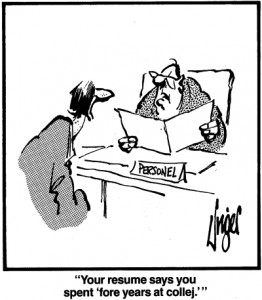
Interview CartoonMy grandmother was a great fan of that old shibboleth, “Don’t judge a book by its cover.” We all know what it means: you have to get to know someone (“read the book”) before you can make any judgment about them. “Appearances,” goes another, “can be deceiving.” Until you have worked passed and through the surface, you cannot know and make judgments about what lies underneath. Until, as the Native American teaching goes, you have walked a mile in another person’s moccasins, you have no basis on which to render judgment.

On the other hand, we all know how incredibly difficult it is to avoid doing exactly what Jesus here counsels against, how very hard not to do what the old sayings say we shouldn’t. Everyone makes “snap decisions” based on very little evidence, and everyone is influenced by their first impressions of others. I’ve been acutely aware of this during the past week while interviewing applicants for a part-time job at my church office.

Since the job is part-time (and not particularly well-paid), I’ve not done the same kind of extensive job-skills testing, or background and reference checking, that I would do with a full-time, high responsibility job. I’ve relied mostly on first impressions gained during the course of a brief interview and a quick review of resumes and letters of recommendation.

When I was first in the job market as a professional, I was counseled on the value of a good first impression. I learned about something called “the halo effect,” which is the psychological phenomenon in which our perception of positive traits about one aspect of a person gives rise to the perception or expectation of similar qualities in the individual as a whole. For example, you might be impressed with how tastefully and neatly dressed a person is and, thus, perceive them as organized and knowledgeable in their work; they may, of course, be nothing of the sort.

First impressions matter, but eventually substance will prevail. While dressing well may predispose an interviewer to think the applicant must be a good worker because she creates a competent first impression, the effect will wear off if she turns out to be a poor secretary. “Time will tell,” advises another old shibboleth.

So I have tried even more this week not to make judgments on first impressions. The person I hire will be working not just with me, but with every member of the congregation. It’s important that I choose wisely. A snap decision just wouldn’t be a good idea!

Jesus is quite obviously right to counsel against judging by appearances. But it’s awfully hard advice to follow! Sometimes Jesus says some really hard things: “If your right hand causes you to sin, cut it off and throw it away” (Mat. 5:30), comes immediately to mind. I find, however, that his “hard sayings” are less difficult to follow than when he’s simply giving reasonable advice! It’s when Jesus sounds like my grandmother, that it’s hardest of all.

====================

A request to my readers: I’m trying to build the readership of this blog and I’d very much appreciate your help in doing so. If you find something here that is of value, please share it with others. If you are on Facebook, “like” the posts on your page so others can see them. If you are following me on Twitter, please “retweet” the notices of these meditations. If you have a blog of your own, please include mine in your links (a favor I will gladly reciprocate). Many thanks!

====================

Father Funston is the rector of St. Paul’s Episcopal Church, Medina, Ohio.

Bravo Coca-Cola – From the Daily Office – February 5, 2014

From the Book of Genesis:

The angel of the Lord called to Abraham a second time from heaven, and said, “By myself I have sworn, says the Lord: Because you have done this, and have not withheld your son, your only son, I will indeed bless you, and I will make your offspring as numerous as the stars of heaven and as the sand that is on the seashore. And your offspring shall possess the gate of their enemies, and by your offspring shall all the nations of the earth gain blessing for themselves, because you have obeyed my voice.”

(From the Daily Office Lectionary – Genesis 22:15-18 (NRSV) – February 5, 2014.)

During the Super Bowl broadcast last Sunday Coca-Cola offered an advertisement featuring several people of differing ethnicities singing in a variety of languages a rendition of the song America the Beautiful. Almost immediately, the twitterverse was flooded with tweets of outrage demanding that the Coca-Cola singers “speak American,” condemning the singing of “our national anthem” in any language other than English, and threatening a boycott of Coke. (As much as I might want to, I’m not going to address the ignorance of referring to the English language as “American” or of not knowing what the national anthem of the United States actually is.)

That little tempest in a tea pot came to mind when I read God’s promise to Abraham that “by your offspring shall all the nations of the earth gain blessing for themselves.” This is the mission of God’s People. Isaiah prophesied that “in days to come the mountain of the Lord’s house shall be established as the highest of the mountains, and shall be raised above the hills; all the nations shall stream to it.” (Isa. 2:2) Psalm 72 includes the prayer for the king of Israel, “May all nations be blessed in him” (v. 17) and Psalm 87 proclaims that God will say of all people from every nation that “this one was born” in Zion (v. 6). Ben Sira refers to the promise to Abraham when he writes, “To Isaac also he gave the same assurance for the sake of his father Abraham. The blessing of all people and the covenant he made to rest on the head of Jacob.” (Ecclus. 44:22-23)

As we were reminded on Sunday morning, this mission was inherited by Christ and his church, the new Israel (as St. Paul said). Old Simeon took the infant Jesus in his arms and proclaimed that he was to be “a light for revelation to the Gentiles and for glory to your people Israel.” (Lk 2:32) As an adult rabbi, Jesus would instruct his disciples to “let your light shine before others, so that they may see your good works and give glory to your Father in heaven” (Mt 5:16) having commissioned them to be “the light of the world,” and reminding them that “a city built on a hill cannot be hid.” (v. 14)

The Puritan preacher John Winthrop took up that image when, preaching to the Massachusetts Bay colonists aboard the vessel Arbella in 1630, he admonished them to set an example of righteousness to the world. Presidents Kennedy and Reagan made use of the “shining city on the hill” metaphor in their inaugural addresses.

So I am puzzled why people who claim to be conservative, Christian, free market Americans would be upset with a successful American corporation advertising its product in a commercial in which people from all over the world extol the beauty of America . . . . the only explanation is a misunderstanding of unity and a misapprehension that uniformity of language promotes that unity. And, indeed, that is the tenor of many conversations I’ve seen on Facebook and Twitter since the Super Bowl advertisement was aired. In many of those conversations, the old image of America as a “melting pot” has been invoked.

Although many of us may remember that image from grade school civics lessons, I remember a junior high school civics and history instructor who sought to disabuse us of the notion. Our society is not and never has been a melting pot, he told us. If we had been, there wouldn’t be barrios, black ghettos, Little Italies, Chinatowns, Levittowns, lace-curtain Irish neighborhoods, and all the other ethnic enclaves that have existed for decades and even centuries. We’re not a melting pot, said my civics teacher, we are a tossed salad. It is our diversity that makes us exciting and makes us strong, unity in diversity, not uniformity, which is what a melting pot creates, which is what an enforced uniformity of language would promote.

Ethnic diversity, in fact, is the biblical model. All the nations of the world receive a blessing through Abraham and his descendents, but they do not become Israel; they do not become Jews. Even as God enrolls the nations in Psalm 87 declaring their birth in Zion, they remain Rahab, Babylon, Philistia, Tyre, Ethiopia, and all the other nations of the world. As immigrants come to be part of America, even as they may become naturalized citizens, they retain their histories and identities as Moroccan, Thai, Xosa, French, Maori, and all the rest, with cultural heritages to be honored, languages to be spoken and sung, and diversity to be celebrated. The shining city on the hill shines with diversity!

So, bravo, Coca-Cola, bravo!

====================

A request to my readers: I’m trying to build the readership of this blog and I’d very much appreciate your help in doing so. If you find something here that is of value, please share it with others. If you are on Facebook, “like” the posts on your page so others can see them. If you are following me on Twitter, please “retweet” the notices of these meditations. If you have a blog of your own, please include mine in your links (a favor I will gladly reciprocate). Many thanks!

====================

Father Funston is the rector of St. Paul’s Episcopal Church, Medina, Ohio.

Chaotic Water – From the Daily Office – February 1, 2014

From the Gospel of John:

When evening came, his disciples went down to the lake, got into a boat, and started across the lake to Capernaum. It was now dark, and Jesus had not yet come to them. The lake became rough because a strong wind was blowing. When they had rowed about three or four miles, they saw Jesus walking on the lake and coming near the boat, and they were terrified. But he said to them, “It is I; do not be afraid.” Then they wanted to take him into the boat, and immediately the boat reached the land towards which they were going.

(From the Daily Office Lectionary – John 6:16-21 (NRSV) – February 1, 2014.)

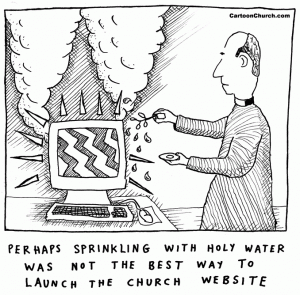
Blessing the Church Computer copyright Dave WalkerToday, February 1, is the ancient Irish feast of Imbolc, considered the beginning of spring and sacred to the goddess Brigid; it has become the commemoration of St. Brigid of Kildare, sometimes called Ireland’s “other patron saint.” (The lesson from John’s Gospel, however, is simply the Daily Office reading, not specific to the saint’s day.) Among the traditions of Imbolc (and, thus, of St. Brigid’s feast) is the visiting of holy wells, walking around them in prayer, and taking some of their water to be used to bless people and things.

For ancient peoples, the sea and other large bodies of water were vast, chaotic, and frightening places. In the ancient middle east, the sea was deified as Tiamat, goddess of primordial chaos and mother of the gods. In Irish mythology, the chaotic and dangerous sea separates the land of the living from the Otherworld, called Tír na nÓg (“Land of Youth”). Holy wells are viewed as places where the chaotic, spiritual dimension breaks into the everyday world.

Jesus’ walking on the water is a story told in three of the Gospels: Mark, Matthew, and John — Matthew adds Jesus inviting Peter to join him. It is a demonstration of the Lord’s mastery over the chaotic; Matthew’s addition of the invitation to Peter and Peter’s being able to do so until, as writer Madeleine L’Engle put it, “he remembered he didn’t know how” is symbolic of the empowerment Christ offers us to do the same.

Quantum Space-TimeIn a sense, we walk on the surface of chaos all the time. One of the learnings from quantum mechanics is that things are not nearly as solid as they seem. The everyday world seems to “float” on what has been called a “quantum foam.” The Greeks posited that if we continue to divide matter we get to atoms; if we divide atoms, we get electrons, neutrons, and other subatomic particles; if we try to divide subatomic particles, eventually we get to get quantum fields and even multidimensional vibrating strings. At the quantum level, reality is a quivering mass of quantum chaos. We walk on the surface of chaos all the time!

The story of Jesus (and Peter) walking on the water and the reality of the quantum chaos beneath our everyday lives should remind us that we do know how to do this. Water as a symbol of blessing is also a reminder of that; when we bless water and then use it to bless other things, like the Irish use the water from holy wells, we are declaring that we have the power and ability to deal with the chaos and to control the chaos in our lives.

====================

A request to my readers: I’m trying to build the readership of this blog and I’d very much appreciate your help in doing so. If you find something here that is of value, please share it with others. If you are on Facebook, “like” the posts on your page so others can see them. If you are following me on Twitter, please “retweet” the notices of these meditations. If you have a blog of your own, please include mine in your links (a favor I will gladly reciprocate). Many thanks!

====================

Father Funston is the rector of St. Paul’s Episcopal Church, Medina, Ohio.

Punctuation and Spirituality – From the Daily Office – January 29, 2014

From the Gospel of John:

[Jesus said:] “Very truly, I tell you, the hour is coming, and is now here, when the dead will hear the voice of the Son of God, and those who hear will live. For just as the Father has life in himself, so he has granted the Son also to have life in himself; and he has given him authority to execute judgment, because he is the Son of Man. Do not be astonished at this; for the hour is coming when all who are in their graves will hear his voice and will come out — those who have done good, to the resurrection of life, and those who have done evil, to the resurrection of condemnation.”

(From the Daily Office Lectionary – John 5:25-29 (NRSV) – January 29, 2014.)

Punctuation Saves LivesThere are times when I’m reading one or another of the Gospels and I am pulled up short; I just have stop and say, “Really? Jesus said that? Really?”

This is one of those times! Did Jesus really say (and I paraphrase), “We’re going to get people up out of their graves just so we can punish them.” That’s what verse 29 is saying with that weird turn of phrase “the resurrection of condemnation”; all the dead will be raised, some to life and some to condemnation. (Whether that means an eternity of punishment or simply annihilation is another issue I’ve dealt with before and won’t address again today.)

Maybe what Jesus said ended before this verse; maybe this is John interpreting what Jesus said. Perhaps the quotation from Jesus should end with the words “because he is the Son of Man” and the part that starts “Do not be astonished” is John’s commentary. Could be. It’s an issue that could be solved by judicious use of punctuation. Unfortunately, John didn’t use punctuation and where to insert quotation marks, periods, commas, etc. is left to the “best guess” of modern translators based on noun declensions, verb tenses, and a colloquial understanding of the original language.

You see, punctuation is a modern invention. So are spaces between the words, although they have been around longer than colons, semi-colons, and full stops. Spaces were the bright idea of Irish monks working in early medieval scriptoria about 1400 years ago; punctuation marks came along about a thousand years later. They weren’t even all that common when the translators of the Authorized (“King James”) version made their estimations of where to put them in the biblical text in 1611.

The lack or improper placement of punctuation can lead to interesting misunderstandings. A popular t-shirt design noting that “punctuation saves lives” demonstrates its point with two similarly worded but radically different sentences:

“Let’s eat Grandma.”

versus

“Let’s eat, Grandma.”

Scripture itself contains an example of a misunderstanding which punctuation might have cleared up. In Mark’s Gospel, the writer applies a prophecy of Isaiah to John the Baptizer saying that his is “the voice of one crying out in the wilderness: ‘Prepare the way of the Lord, make his paths straight,'” (Mk. 1:3) Isaiah, however, seems to have said something slightly different: “A voice cries out: ‘In the wilderness prepare the way of the Lord, make straight in the desert a highway for our God.'” (Isa. 40:3) Matthew and Luke, relying on Mark, repeat his slightly altered quotation — compare Matt. 3:3 and Luke 3:4. Is the voice crying out in the wilderness or is the way of the Lord in the wilderness? The gospellers and the prophet seem to have a disagreement.

So which is it in John’s Gospel? Should the quotation from Jesus be ended a sentence earlier and the bit about getting people out their graves only to condemn them be attributed to the writer instead? To do so would, I admit, fly in the face of centuries of understanding of Jesus’ words to the Jewish authorities when they confronted him in the Temple following the healing of the crippled man at the pool of Bethesda, from which this text is taken. But it’s at least a possibility to consider, and it highlights how carefully one must read scripture.

Punctuation, as the t-shirt says, can save lives. It can also have a significant impact one’s spirituality!

====================

A request to my readers: I’m trying to build the readership of this blog and I’d very much appreciate your help in doing so. If you find something here that is of value, please share it with others. If you are on Facebook, “like” the posts on your page so others can see them. If you are following me on Twitter, please “retweet” the notices of these meditations. If you have a blog of your own, please include mine in your links (a favor I will gladly reciprocate). Many thanks!

====================

Father Funston is the rector of St. Paul’s Episcopal Church, Medina, Ohio.

Make the Circuit – From the Daily Office – January 27, 2014

From the Psalter:

Make the circuit of Zion; walk round about her;
count the number of her towers.
Consider well her bulwarks; examine her strongholds;
that you may tell those who come after.

(From the Daily Office Lectionary – Psalm 48:11-12 (BCP Version) – January 28, 2014.)

Look Crosswalk Pavement SignI’m intrigued that, near the end of what is a pretty standard hymn-of-praise sort of psalm, there is this admonition to be a careful observer. Jesus will echo this admonition, not in its exact words but in intent, several times in the gospels.

Jesus often urges his followers to pay attention to things and to observe carefully; each of the gospels includes at least one such admonition:

“From the fig tree learn its lesson: as soon as its branch becomes tender and puts forth its leaves, you know that summer is near.” (Matt: 24:32; cf. Mark 13:28)

“Be alert at all times . . . . (Luke 21:36; cf. Mark 13:33)

“Pay attention to what you hear . . . .” (Mark 4:24; cf. Luke 8:18)

“Do you not say, ‘Four months more, then comes the harvest’? But I tell you, look around you, and see how the fields are ripe for harvesting.” (John 4:35)

In the novel Stranger in a Strange Land, the science fiction author Robert Heinlein invented the profession of “Fair Witness.” This is an individual trained to observe events and report exactly what he or she sees and hears, making no extrapolations or assumptions; the Fair Witness draws no conclusions and makes no inferences from what is observed. At one point in the story, a Fair Witness is asked the color of house. She replies, “It is white on this side;” she refuses to venture an opinion as to the color of the sides which cannot be seen.

When I first read Stranger, I was intrigued with that idea and when I was a practicing trial lawyer, I often wished that I could call a Fair Witness to the stand. Practicing attorneys are well aware of how poorly most people observe, recall, and report what happens in the world around them. Although traditionally valued by the courts, eye-witness testimony is notoriously inaccurate!

So the Bible’s admonitions to carefully observe, to “make the circuit” of the subject, to walk around it, to count its features, to examine, and to consider well are good ones. But it is not “Fair Witness” observation to which we are encouraged, not simply the accurate gathering of facts. It is, rather, to intelligent consideration and contemplation, to the drawing of inferences, and to the making of conclusions on the basis of observed data. A modern reader might even say that the Bible urges us to make use of the scientific method!

A Cambridge University scientist, William Beveridge, in his book explaining The Art of Scientific Investigation (1957) wrote, “Interpreting the clue and realizing its possible significance requires knowledge without fixed ideas, imagination, scientific taste, and a habit of contemplating all unexplained observations.” I believe that this is as true of religion as it is of science. It applies to consideration of one’s faith and one’s spirituality, as well as to observation of the physical world. This is why the Bible encourages us to pay attention.

Like science, religion is hampered by “knowledge with fixed ideas,” by lack of imagination, and by failure to contemplate the unexplained. I also think it is imperative that a religious person have what Beveridge calls “scientific taste,” which I understand to mean a passion for observation, a commitment to being alert at all times, a delight in taking the time to “make the circuit of Zion.”

====================

A request to my readers: I’m trying to build the readership of this blog and I’d very much appreciate your help in doing so. If you find something here that is of value, please share it with others. If you are on Facebook, “like” the posts on your page so others can see them. If you are following me on Twitter, please “retweet” the notices of these meditations. If you have a blog of your own, please include mine in your links (a favor I will gladly reciprocate). Many thanks!

====================

Father Funston is the rector of St. Paul’s Episcopal Church, Medina, Ohio.

The Neighbors Can See In! — Sermon for the Annual Parish Meeting — January 26, 2014

====================

This sermon was preached on the Patronal Feast Sunday of St. Paul’s Episcopal Church, Medina, Ohio, where Fr. Funston is rector. It was the Sunday of the Annual Parish Meeting and, as part of the service, a newly built Gallery addition to the parish’s fellowship hall was dedicated.

(The lessons for the day were for the Conversion of St. Paul from the Episcopal Church’s sanctoral calendar: Acts 26:9-21; Galatians 1:11-24; Psalm 67; and Matthew 10:16-22. These lessons can be read at The Lectionary Page.)

====================

St Paul's Church -- December 2013

A few decades ago when I was studying law I was introduced to the term “officious intermeddler.” In law, an officious intermeddler is someone who, on their own and without any authority either by invitation or pre-existing legal duty, interjects himself into the affairs of another, and then seeks some sort of recompense for doing so. That pretty much describes young Saul of Tarsus and at least his initial quest to rid Judaism of the followers of Jesus of Nazareth. He was simply a rabbinic student, not any sort of priest or religious official when he began his crusade against Peter and James and the others. I don’t think he was doing it for money, but I do think he might have been looking for a pay-off in the form a religious reputation; if he was successful, he would become a powerful rabbi among the Jewish the people.

Saul was born and raised in the Greek city of Tarsus and apparently received a good education both in orthodox Judaism and in Greek philosophy; Tarsus was a center of Stoic teaching and we see a good deal of Stoicism in the letters he wrote after becoming a Christian missionary. While still fairly young, Saul was sent to Jerusalem to receive rabbinic instruction at the Hillel school under Gamaliel, one of the most noted rabbis in Jewish history. This would have exposed the young rabbinic student to a broad range of classical literature, philosophy, and ethics. Not a lot more is known of his background before he decided to make a name for himself dealing with the pesky proclaimers of what he considered to be a pernicious heresy.

Until the destruction of the Jerusalem Temple in 70 A.D. the followers of Jesus of Nazareth were simply one of many subsets of Judaism; there were few, if any, Gentile followers of Jesus and those Gentiles who wanted to be a part of the new group were required to convert to Judaism before being allowed to join the Jesus group. Judaism at the time was much like Christianity is today; there were different “schools,” similar to our denominations.

We are familiar from the Gospel stories with the Pharisees and the Sadducees, two of the competing versions of the faith; we may also be familiar with the Essenes who were part of the mix. In addition, influential rabbis had their groups of followers: John the Baptizer had had his disciples; Gamaliel had his; perhaps Nicodemus, who became a secret follower of Jesus, had his own school; and, of course, Jesus had had his. On the major feasts and liturgical days, all Jews would observe the Temple rituals together, but for their sabbath observance and instruction they would go to the synagogue which adhered to the school they found most convincing, or where their rabbi taught. They recognized each other as Jews; they just didn’t agree on some particulars. No big deal. And, usually, when their rabbi passed away, their group disbanded.

Except for the disciples of Jesus, those people who followed what they called “the Way.” Their rabbi was dead; the whole city had seen him crucified. But unlike the followers of other dead rabbis, these people didn’t disband; they claimed that their rabbi was still alive and they still met to proclaim his teachings. They even went so far as to suggest that he was divine; they were claiming that he had ushered in a new kingdom of God. In the Jewish council, the Sanhedrin, some sought to have them kicked out of the temple, but Saul’s own teacher, Gamaliel, defended them. The Book of Acts reports his words to the Sanhedrin:

Fellow Israelites, consider carefully what you propose to do to these men. For some time ago Theudas rose up, claiming to be somebody, and a number of men, about four hundred, joined him; but he was killed, and all who followed him were dispersed and disappeared. After him Judas the Galilean rose up at the time of the census and got people to follow him; he also perished, and all who followed him were scattered. So in the present case, I tell you, keep away from these men and let them alone; because if this plan or this undertaking is of human origin, it will fail; but if it is of God, you will not be able to overthrow them — in that case you may even be found fighting against God! (Acts 5:35-39)

Apparently Saul did not agree with his teacher. He became an officious intermeddler, a self-appointed — that’s really what “officious” means — a self-appointed policeman protecting the purity of the Temple; he was going to get that Jesus crowd kicked out. In his letter to the Galatians he would confess that prior to his conversion he “was violently persecuting the church of God and was trying to destroy it.” (Gal. 1:13) It is in the description of the martyrdom of the first deacon, Stephen, that we first encounter Saul in the New Testament. We don’t know whether Saul was an instigator of the events that led to Stephen’s death, but we know that he was there.

The 7th Chapter of Acts tells us that Stephen preached a sermon in the presence of the Temple council, an admittedly rather inflammatory homily, after which “with a loud shout [those present] rushed together against him. Then they dragged him out of the city and began to stone him; and the witnesses laid their coats at the feet of a young man named Saul.” (Acts 7:57-58) We are told that “Saul approved of their killing him.” (Acts 8:1) Saul didn’t take part, really; he just stood at the road side looking on.

After that, Saul became more and more openly and actively involved in the persecution of the Jesus movement, “ravaging the church by entering house after house; dragging off both men and women, he committed them to prison.” (Acts 8:3) Eventually, this officious intermeddler received his remuneration — recognition and ratification of his activities by the high priest from whom he sought, and received, letters of warrant empowering him to go to Damascus, “arrest any who belonged to the Way, men or women, [and] bring them bound to Jerusalem.” (Acts 9:2) It was while journeying to Damascus that the events he described to King Agrippa in the reading we heard this morning occurred. It was while on that road to Damascus that the truth of the Gospel of Jesus Christ, which he had been unable to see, was revealed to him. As he wrote to the Galatians, God “was pleased to reveal his Son to me, so that I might proclaim him among the Gentiles.” But in the experience, we are told in Acts, something like scales covered his eyes as if symbolizing the blindness of heart he had suffered, and until he learned the fullness of the Gospel he was unable to see.

I will return to Saul and his conversion in a moment, but before I do I want to review a little bit of our parish history. So for the moment, let’s put Saul aside but keep in mind his story, especially those scales that eventually fell from his eyes.

We are beginning the 197th year of the life of St. Paul’s Parish. Founded in 1817 in Weymouth, the congregation moved to this location in the 1830s. After about 50 years in a wooden Greek revival structure, in 1884 the congregation built the stone church in which we are worshiping today. When weather permitted they would gather for after church fellowship on the lawn, fully open to their neighbors’ view and could invite the neighbors to take part.

In 1903, they built the Parish House in which our present day Parish Hall, kitchen, and dining room are located. It was a separate structure with one of those wide and inviting Victorian front porches. When the congregation gathered after church for fellowship, education, or other activities, they came and went through the front doors of the church, onto that veranda, and in and out the front door of the Parish House, again fully visible to their neighbors whom they continued to invite to participate.

Another fifty or so years later, the congregation built Canterbury House and linked it together with the Parish House and the church building with the concourse that came to be known simply as “the hallway.” The hallway replaced the Victorian veranda with fortress-like stone wall; it cut off the neighbors’ view of the congregation’s comings and goings, and blocked the neighbors’ appreciation of the church’s fellowship and other activities. The hallway incorporated a new entryway off the driveway leading to a parking lot that was built at the rear of the church property, and it was through those doors (and other doors at the rear of the Parish House) that members began entering the church building. The front doors of the Parish House and the church building fell into disuse, and the parishioners stopped invited the neighbors.

If anything was going on inside the Episcopal Church, you couldn’t tell it from the street. Stained glass windows on the church building, opaqued windows on the hallway, that imposing stone wall, and a set of large red doors which could not be opened from the outside blocked the public’s view of whatever it was the Episcopalians were doing.

Interestingly enough, the Episcopalians couldn’t see out, either. But until the new Gallery was built, and the sunshine and view of the street let in, we had failed to notice that! We were simply unaware that when we were inside this church’s physical plant we were visually cut off from the world around us; we just didn’t notice. We sat at here at the road side, but we were disconnected from the world going by on the major trafficway outside.

To be sure, there was plenty going on inside the church. Things were booming. It was the 1960s and the World War II and Korean War generations were coming to church, raising their children, participating in church clubs, holding fundraisers, even reaching out in overseas mission. The Episcopal Church was an active place . . . you just couldn’t tell it from the street.

And that story was true for the Episcopal Church as a whole, as a national institution, as well. We were pretty much a self-contained and self-reliant denomination. Someone not born into the Episcopal Church might occasionally wander through our doors, become fascinated with our peculiar style of being Christian, and join us, but we didn’t go out and encourage that sort of thing. Billy Graham and people like him might go out and evangelize and try to convert people, but that just wasn’t our style. We were doing quite well behind our stone walls and opaque windows, and our understanding of evangelism was that it was something other people did. After all, as one grand dame of the era is supposed to have put it, “Everyone who should be an Episcopalian already is one.” The world outside the Episcopal Church didn’t know much about us, and we were fine with that.

Then came the 1970s and things began to change. Social change was in the air both in the secular world and in the church. It was not comfortable. Women started suggesting that some of them might have a call to ordained ministry, and some of our best theologians supported them and agreed; behind our stone walls and opaque windows we were fighting like cats and dogs about it. The outside world only got a glimpse of it when a few very angry people threw open the red doors and stormed out, proclaiming themselves to be the only real Anglican Christians and the rest of us heretics, doomed to Hell. We got a lot of press, but not the kind of attention we really wanted. As soon as we could, we closed the red doors and regained our composure behind our stone walls.

But then, not very many years later, the General Convention approved a new Prayer Book. The process of revision had been going on for nearly 20 years but most of us hadn’t been paying attention. When the new book was approved in 1976 and then ratified in 1979 it seemed to many that the church was being completely overturned. The outside world got another glimpse of us when some more very angry people threw open the red doors and stormed out, proclaiming that they used the only real Anglican Prayer Book and that the rest of us were heretics, damned to Hell. Again, we got a lot of press, but once again it was not the kind of attention we really wanted. As soon as we could, we got back behind our stone walls.

Things were quiet for a while, but then the people of the Diocese of New Hampshire decided to elect their Archdeacon to be their Bishop and, horror of horrors, it turned out (they had known all along) he was a homosexual living in a committed, long-term relationship with another man. All hell broke loose behind our stone stone walls and opaque windows as we dealt with that. The arguing got so loud that the neighbors could hear us and, again, a group of very angry people threw open the red doors and stormed out, proclaiming themselves to be the only real Anglican Christians and the rest of us heretics, definitely headed straight to Hell. Again, we got a lot of press, and again we tried to regain our composure behind our stone walls. But we couldn’t because, finally, we started noticing something.

We noticed that the church was getting smaller. Fewer people were attending. Fewer children were enrolling in Sunday School. Fewer teens were coming to EYC meetings. Fewer dollars were getting deposited into the bank. And we decided, because we had gotten out of the habit of looking outside, that it was because of something we had done — it was because we ordained women; it was because we’d changed the Prayer Book; it was because we had a gay bishop. We were wrong, however. If we hadn’t been shut up behind our stone walls and opaque windows, we might have noted that the same thing — lower attendance, fewer children, fewer teens, less income — was happening to the Lutherans, and the Methodists, and the Presbyterians, and also to non-church groups like the Masons, and the Elks, and local bowling leagues. There was a societal change going on and, unable to see out through our stone walls and opaque windows, we couldn’t see it. We couldn’t figure out why the church was leaking membership because we weren’t looking in the right place.

And while all of that was going on . . . every time it rained there was water pouring into the church basement. Every time there was a heavy snow and it melted, there was water pouring into the basement. We got used to seeing buckets in the entryway and water stains on the basement ceiling because we couldn’t figure out where the leak was and we couldn’t figure out how to stop it. Physically, as well as metaphorically, we couldn’t figure out why the church was leaking.

We’ve learned a thing or two in the Episcopal Church in the last decade. We’ve learned that the church fails to grow not because of our internal failures; it fails to grow because of our external failures. The church has failed to grow because we have sequestered ourselves behind stone walls and opaque windows, and have failed to engage with our neighbors, who cannot see what we are doing and to whom we have not been paying attention. Out of this have come movements and experiments to get our denomination back out, on the other side of our stone walls, back into public engagement.

We are seeing new ministries such as “Church Without Walls,” an experiment in the Jacksonville, Florida, which calls people from all walks of life into partnership with “the least of these.” “Church Without Walls” describes itself as “a community of presence made up of individuals looking for the spiritual companionship and connection that give meaning to life.” The community seeks to welcome everyone — the homeless and the affluent, the addicted and those in recovery, the churched and the un-churched, the spiritual but not religious, the believer, the doubter and the seeker. They are grounded in the reality that “by opening ourselves to strangers, the despised or frightening or unintelligible other, we will see more and more of the holy.” (Description from the Diocese of Florida website.) And similar communities are being created in San Jose, California; Springfield, Pennsylvania; Bentonville, Arkansas; Milwaukee, Wisconsin; and elsewhere.

We are seeing experiments in public liturgy such as “Ashes to Go” — an effort to give people an opportunity to receive the mark of repentance and encourage them to give thought to their spiritual lives without requiring them to attend a full Ash Wednesday service. The first such public imposition of ashes was offered by the cathedral in Chicago, Illinois, and has since been offered in a variety of locations throughout the country, including some places here in Ohio.

What the Episcopal Church has learned through these and other programs is that we have to tear down the stone walls and break out the opaqued windows that have separated us from our neighbors. When we do that and the church again engages with the world around it, the leaking stops; the church begins to grow again. Like Saul, after the scales fell his eyes when he was baptized and took the name Paul, by which we know him better, we have seen the truth and know that we, too, are “to open [the eyes of those around us] so that they may turn from darkness to light and from the power of Satan to God, so that they may receive forgiveness of sins and a place among those who are sanctified by faith in [Jesus].” (Acts 26:18)

And here we are in a congregation that has quite literally removed its stone wall and its opaqued windows, whose neighbors can now see clearly what is going on in the Episcopal Church, and who can see our neighbors even when we are inside our building. We have opened ourselves to engagement with the world around us. We are not a “Church Without Walls,” but we have become a church that lives in glass house . . . the neighbors can see in and we’d better make sure that what they see is good stuff!

If you have picked up a copy of the 2014 Annual Journal, you will see some interesting data. We are at the beginning a new period of growth. For 2013 we have a mixed bag of membership statistics: 21 new members joined the congregation by baptism, confirmation, reception or transfer; we had larger congregations for both Easter and Christmas services; we had more Sunday services. On the other hand, our average attendance is down slightly. The task before us is to grow both in membership and active commitment. The foundation is here. For 2014, we have a 7% increase in the number of pledging households; total pledging is up (compared to last year) by over 4%. We have a committed membership.

Our outreach to the community is strong. The Free Farmers’ Market, our food pantry, assisted 5,333 individuals during the past year, distributing nearly 50,000 pounds of food. The volunteer effort to accomplish that is phenomenal, and all members of the coordinating committee and all the volunteer workers are to be commended. Our support of the regional Battered Women’s Shelter expanded this year as, in addition to the regular monthly collection of supplies, our new Lenten Rose Chapter of the Daughters of the King oversaw a special drive for personal hygiene items and, through the effort of our Senior Warden, we provided several dozen stuffed toys to the children sheltered there. Our youth group also continued their annual tradition of making and giving away teddy bears to needy children at Christmas time.

Outreach of a different sort is exercised in the monthly Brown Bag Concert program which is entering its seventh year. Our music director is to be commended for the excellent work she does in recruiting performers and hosting our guests at those events. Because of the construction of the new Gallery, we did not hold any “Fridays at St. Paul’s Concerts,” but we are looking forward to the return of that program as early as this coming May when the chamber ensemble of the Cleveland Philharmonic Orchestra will be performing in this sanctuary.

Fellowship continues with the men’s breakfasts, the Episcopal Church Women, the new Daughters of the King chapter, the Sunday morning breakfast group, and the return this month of the Foyer Group dinner program. Christian education for children and youth is going strong with Godly Play and the Episcopal Youth Community; many of our EYC members are recognized leaders in the diocesan youth programs and are to be commended for that. Many of them are not here today because they have spent the weekend in training to lead the next “Happening” retreat for young people. For adults we have a regular weekly bible study and, starting last September, an Education for Ministry seminar group going strong.

By nearly every measure, this is a vibrant and lively parish. This church is no longer leaking! It is not leaking rain water into the basement; it is not leaking membership. Both the literal and the figurative stone walls have fallen away, like the scales that fell from St. Paul’s eyes, and the vibrancy and life of this parish is visible for all to see and for all to be invited into.

We were blinded and confused by our stone walls and our opaque windows, whether figurative or literal, but in the end, we know that we are called, as Paul was, to share the wonderful news that the risen Jesus, the Son of God, is Messiah and his kingdom is here now. Our experience of engaging in the Inviting the Future Project and building our beautiful new Gallery, is our “ Damascus Road ” experience. A new day for St. Paul’s Parish is shining through the windows of the Gallery and our calling is to insure that the neighbors — who can see us once again, just as they could in 1884 and in 1903 and in every year up to 1960, and (more importantly) whom we can now see — our calling is to insure that they can see the kingdom of God shining out, that they are invited to come into it.

Let us pray:

Give us grace, O Lord, to answer readily the call of our Savior Jesus Christ and proclaim to all people the Good News of his salvation, that we and the whole world may perceive the glory of his marvelous works; who lives and reigns with you and the Holy Spirit, one God, for ever and ever. Amen. (Collect for the 3rd Sunday after Epiphany)

====================

A request to my readers: I’m trying to build the readership of this blog and I’d very much appreciate your help in doing so. If you find something here that is of value, please share it with others. If you are on Facebook, “like” the posts on your page so others can see them. If you are following me on Twitter, please “retweet” the notices of these meditations. If you have a blog of your own, please include mine in your links (a favor I will gladly reciprocate). Many thanks!

====================

Father Funston is the rector of St. Paul’s Episcopal Church, Medina, Ohio.

« Older posts Newer posts »