Occasional thoughts of an Anglican Episcopal priest

Category: Matthew (Page 18 of 29)

Cleaving to Dust – From the Daily Office – May 7, 2014

From the Psalter:

My soul cleaves to the dust; give me life according to your word.

(From the Daily Office Lectionary – Psalm 119:25 (BCP Version) – May 7, 2014.)

Handful of DustThe Gospel lesson today is the baptism of Jesus as told by Matthew. With it, for the evening, is coupled a portion of Psalm 119 which includes this verse. This image of a soul clinging to the dirt caught my attention. I wonder if baptism is efficacious if the soul being baptized steadfastly and stubbornly “cleaves to the dust” of its pre-baptismal life.

I sometimes wonder about my own baptism, which happened when I was 14 years of age and attending a private, residential high school affiliated with the Episcopal Church.

As part of the religious instruction required of all students, I had taken the confirmation class offered by the chaplain and was, thus, included in the list of young men upon whom the bishop was to lay hands during his official visit at one Thursday evening chapel service. Earlier in the day, going over his records, the chaplain noticed he had not record of my baptism.

That was not surprising since I’d not been baptized. Growing up in a largely unchurched home with a father estranged from the Methodist Church and a mother who’d been reared in (but left) one of those traditions that practice “believers’ baptism,” there had been no encouragement of nor opportunity for baptism.

So, in a hastily arranged private afternoon ceremony at the back of the chapel after gym class, with two members of the faculty standing as sponsors, I was quickly sprinkled and informed that I was now a Christian, eligible to be confirmed as an Episcopalian. That done, I went to my room to shower and dress for dinner and the obviously more important confirmation service later that evening.

What exactly happened that afternoon? Did my soul turn loose of the dust, or did it cleave to the dirt from which it was supposed to be cleansed? Does it matter? I’m not even going to try to answer those questions this morning, but the pairing of the baptismal story and the image of the soul clinging to the dust is certainly an odd lectionary coincidence.

====================

A request to my readers: I’m trying to build the readership of this blog and I’d very much appreciate your help in doing so. If you find something here that is of value, please share it with others. If you are on Facebook, “like” the posts on your page so others can see them. If you are following me on Twitter, please “retweet” the notices of these meditations. If you have a blog of your own, please include mine in your links (a favor I will gladly reciprocate). Many thanks!

====================

Father Funston is the rector of St. Paul’s Episcopal Church, Medina, Ohio.

Ancestor Abraham – From the Daily Office – May 6, 2014

From the Gospel according to Matthew:

Do not presume to say to yourselves, “We have Abraham as our ancestor”; for I tell you, God is able from these stones to raise up children to Abraham.

(From the Daily Office Lectionary – Matthew 3:9 (NRSV) – May 6, 2014.)

StonesJohn the Baptizer is speaking to the Pharisees and the Sadducees, warning them against the very common human practice of relying upon the piety of our forebears instead of practicing our own faith. Relying on the religion of our ancestors is weakens and attenuates our own spirituality. One might as well be rocks lying by the roadside.

A few days ago, in what I consider a badly reasoned decision, Town of Greece v. Galloway, the U.S. Supreme Court upheld the practice of beginning secular legislative body meetings (in the particular case, a city council) with sectarian prayer. Justice Anthony M. Kennedy, writing for the majority, reasoned: “Legislative prayer has become part of our heritage and tradition, part of our expressive idiom, similar to the Pledge of Allegiance, inaugural prayer, or the recitation of ‘God save the United States and this honorable Court’ at the opening of this Court’s sessions.” He might as well have said, “We have Abraham as our ancestor.”

I’ve no problem with public prayer. I lead it on a pretty regular basis. I have a problem with prayer offered in a secular legislative body in a nation that is supposed to have a separation of church and state. The First Amendment to our Constitution includes two clauses which work that separation. One is known as “the establishment clause” and provides that government “shall make no law respecting an establishment of religion.” The other is called the “free exercise clause” and provides that government shall do nothing “prohibiting the free exercise” of religion.

A legislative body’s rule of procedure requiring prayer at the opening of its sessions violates at least the first of these clauses; it is a law establishing a religious practice. Arguably, it also violates the second clause although (as Kennedy and others have noted) no one is forced to participate in the prayer and, one supposes, could absent oneself from the session until the prayer was concluded.

My concern, in light of today’s reading from Matthew, is not with the Constitutional issue of public governmentally-sponsored prayer. Rather, it is with the notion that somehow the religiosity of our nation is dependent upon practices of government and the (mistaken) notion that our Founders (our equivalent of Abraham) intended this to be a “Christian nation.” This is the argument often made and now being repeated in innumerable online discussions of this ruling.

I can find no difference between “The Founders intended this to be a Christian nation” and “We have Abraham as our ancestor.” Both rely upon the supposed faith of long-dead forebears rather than the lively faith of living people. Any number of prayers may be recited at city council meetings or in state or national legislative chambers; unless and until the people of the nation begin actually living and practicing whatever religion they claim to hold — actually participating in religious events and, more importantly for Christians, feeding the hungry, clothing the naked, and housing the homeless — those prayers are no better than the protest of the Pharisees and Sadducees, “We have Abraham as our ancestor.”

This is especially true when Christian prayer opens a legislative session in which the legislators proceed to enact legislation which flies in the face of Jesus’ commands — when funds are stripped from feeding programs, when homelessness is made a crime, when public assets are diverted to the benefit of the rich at the expense of the poor. The prayer and the faith which it represents are rendered meaningless, with as little life as a pile of rocks.

There is a place for prayer, but it is not in the halls of government and it is not in the historic and attenuated traditions of long-dead forebears. It is in the hearts and lives of living persons acting out their faith. Relying on government-sponsored prayer is nothing more than claiming Abraham as our ancestor, nothing more than being dead stones.

====================

A request to my readers: I’m trying to build the readership of this blog and I’d very much appreciate your help in doing so. If you find something here that is of value, please share it with others. If you are on Facebook, “like” the posts on your page so others can see them. If you are following me on Twitter, please “retweet” the notices of these meditations. If you have a blog of your own, please include mine in your links (a favor I will gladly reciprocate). Many thanks!

====================

Father Funston is the rector of St. Paul’s Episcopal Church, Medina, Ohio.

Religious Leadership – From the Daily Office – April 23, 2014

From the Gospel according to Matthew:

After the priests had assembled with the elders, they devised a plan to give a large sum of money to the soldiers, telling them, “You must say, ‘His disciples came by night and stole him away while we were asleep.’ If this comes to the governor’s ears, we will satisfy him and keep you out of trouble.” So they took the money and did as they were directed.

(From the Daily Office Lectionary – Matthew 28:12-15 (NRSV) – April 23, 2014.)

Bribe SilhouetteTwice in Easter week this story of the Jewish Temple authorities bribing the Roman soldiers to get them to say the followers of Jesus had stolen Jesus’ body is found in the lectionary. It is here in the Prayer Book’s Daily Office readings today; on Monday, it was the Eucharistic lectionary’s gospel lesson.

Surprisingly, it is not a very well known part of the Easter story — or perhaps it’s not so surprising since in none of the three-year cycle of Sunday readings does it occur, and for most people their familiarity with the biblical text starts and stops with what they hear in church.

In any event, it came up on Monday and, as a result, it was something our vestry wrestled with during the time of our regular meeting when we work on spiritual formation.

So . . . thinking about it since Monday evening, I find myself sympathizing with the priests. They have to have been beside themselves with worry. They could just see this whole situation blowing up. Although they didn’t know that something like it would eventually happen 40 years or so later anyway, but they knew that if this story of a risen messiah gained too much credence the people might revolt, the Romans would take action, and their reasonably stable religious institution would be endangered. What they were doing was taking leadership action to prevent a disaster. It wasn’t the best action they could have taken; it certainly had some rather negative moral and ethical implications. But what leadership action is ever unmixed? What leadership action is ever (as one of my law school professors was fond of saying) “pure as the driven slush”? Indeed, what human action is ever thus?

Putting myself into their shoes, what would I have done? I’d like to think that I would have recognized the holiness of what had happened. I’d like to think that I would have realized that, had I not done so earlier, that Jesus was the Anointed One. I’d like to think that I’d have gotten it right. But I suspect I would have agreed with the other priests and elders, would have tried to contain the situation, and would have bribed the soldiers to keep things quiet. I suspect I would have tried to maintain the status quo.

That’s what religious leadership tends to do.

====================

A request to my readers: I’m trying to build the readership of this blog and I’d very much appreciate your help in doing so. If you find something here that is of value, please share it with others. If you are on Facebook, “like” the posts on your page so others can see them. If you are following me on Twitter, please “retweet” the notices of these meditations. If you have a blog of your own, please include mine in your links (a favor I will gladly reciprocate). Many thanks!

====================

Father Funston is the rector of St. Paul’s Episcopal Church, Medina, Ohio.

Standing by Jesus – Sermon for Palm Sunday (Year A) – April 13, 2014

====================

This sermon was preached on Palm Sunday, April 13, 2014, at St. Paul’s Episcopal Church, Medina, Ohio, where Fr. Funston is rector.

(The lessons for the day were: Isaiah 50:4-9a; Psalm 31:9-16; Philippians 2:5-11; and Matthew 21:1-11. In addition, Zechariah 9:9-12 was read at the Liturgy of the Palms, and the Passion story, Matthew 26:14-27:66, was read at the conclusion of the Mass. Except for the Zechariah text, these lessons can be read at The Lectionary Page.)

====================

Donkey with Colt

When fishes flew and forests walked
And figs grew upon thorn,
Some moment when the moon was blood
Then surely I was born;

With monstrous head and sickening cry
And ears like errant wings,
The devil’s walking parody
On all four-footed things.

The tattered outlaw of the earth,
Of ancient crooked will;
Starve, scourge, deride me: I am dumb,
I keep my secret still.

Fools! For I also had my hour;
One far fierce hour and sweet:
There was a shout about my ears,
And palms before my feet.

That’s one of my favorite pieces of verse, The Donkey, by G.K. Chesterton, in which he captures Palm Sunday from the perspective of the donkey that Jesus rode.

Matthew’s version of Jesus’ entry into Jerusalem is somewhat confusing because he pluralizes the donkey. Did you notice that in the reading of the Gospel lesson? “The disciples went and did as Jesus had directed them; they brought the donkey and the colt, and put their cloaks on them, and he sat on them.” Why does Matthew do this (when none of the other Gospel writers do so)? Some have speculated that it is because Matthew wants to tell the story in a way that precisely mirrors the prophecy in Zechariah: as you can see in the Gospel reading, Matthew’s version of Zechariah is that the Messiah will come “mounted on a donkey, and on a colt, the foal of a donkey.”

That argument presupposes, however, that Matthew does not understand Jewish poetry which uses what is called “parallelism” to underscore or highlight a particular idea, saying the same thing in two or more ways, often connected with the conjunction “and”. But Matthew was an educated Jew, so that argument doesn’t float. Others have suggested that Matthew is the first Christian biblical literalist, but that doesn’t hold water either since Matthew’s Gospel is full of metaphor and allegory. No, the likely reason Matthew does this is to present Jesus as the least military, the least kingly, the least imperial of all possible messiahs. Bible scholar John Dominic Crossan points out that Jesus the Messiah (and Matthew the Gospel writer)

. . . want two animals, a donkey with her little colt beside her, and that Jesus rides “them” in the sense of having them both as part of his demonstration’s highly visible symbolism. In other words, Jesus does not ride a stallion or a mare, a mule or a male donkey, and not even a female donkey. He rides the most unmilitary mount imaginable: a female nursing donkey with her little colt trotting along beside her.

Matthew, Mark, and Luke also make point of telling us that Jesus approached Jerusalem from the east. They do this be situating us to landmarks: Matthew tells us in today’s lesson that it was “when they had come near Jerusalem and had reached Bethphage, at the Mount of Olives” that Jesus sent two of the disciples to get the donkey and the colt. This direction of approach is important.

At the time of the Passover, as pilgrims made their way into the city for the ritual observances, the population of Jerusalem would swell from around 50,000 (about twice the size of Medina) to well over 200,000 (more than the population of Akron). We know from secular histories that it was the custom for the Roman governor to make a militaristic triumphal entry to Jerusalem — with war horse, chariot, and weapons — each year in the days before Passover to remind the pilgrims that Rome was in charge. Because the Passover is a celebration of liberation from imperial Egypt, imperial Rome was very uneasy about so many people being in town. Pilate’s procession displayed not only imperial power, but also Roman imperial theology, according to which the emperor was not simply the ruler of Rome, but the Son of God.

The Roman garrison was on the coast at Caesarea Maritima, a city built by Herod the Great to honor Caesar Augustus, so their approach would have been from the west. So there were two processions into Jerusalem. One — the procession of the Roman army — coming from the west, demonstrating imperial might; the other — those with Jesus — coming from the east, making a clearly anti-imperial witness. Jesus’ subversive donkey ride reminded all those waving Palm branches that Rome was the new Egypt, and the Emperor was the new Pharaoh.

And, obviously, the crowd got it! People began to spread their cloaks on the road for Jesus to ride over like a red carpet; they remembered, perhaps, the story in the Second Book of Kings, which tells how the crowds spread their cloaks on the ground when Jehu was anointed King of Israel. They cut palm branches or other leafy plants as Jews did at other celebrations and festivals and strewed them in Jesus’ path; perhaps they remembered the admonition of Psalm 118: “The Lord is God, and he has given us light. Bind the festal procession with branches, up to the horns of the altar.” (v. 27) They must have, for they began chanting verses of that psalm:

Save us, we beseech you, O Lord!
O Lord, we beseech you, give us success!
Blessed is the one who comes in the name of the Lord.
We bless you from the house of the Lord. (Ps 118:25-26)

This is what Hosanna means. Hosanna is not a shout of exultation, though we have made it one; hosanna is a prayer for salvation. The Hebrew is h?shi `?h nn? and it means “Save now, we pray.”

Recognizing Jesus as the “Son of David,” the crowd chanted the words “Hosanna! Blessed is he who comes in the name of the Lord!” and others respond, “Blessed is the coming kingdom of our father David! Hosanna in the highest!”

The scene was set for a clash not only with the authorities of the Jewish nation, but with imperial Rome. The first Holy Week had begun. And ever since that first Holy Week, the followers of Jesus have been trying to figure out what to do with it. Sara Miles of St Gregory of Nyssa Episcopal Church in San Francisco says, “it’s kind of confusing: there’s a lot of different stuff going on in Holy Week. You could get whiplash” and she explains:

Think about it. During Holy Week, we wave palms in the air and hail Jesus as king, the long-awaited messiah who’s going to save us from our oppressors, then we change our minds and scream that the oppressors should crucify him; we share a loving last supper with Jesus and he washes our feet, then we sneak out after dinner and betray him. Jesus begs us to stay with him, we promise we will, then we don’t. We abandon him, he’s arrested and beaten; he forgives us, then we run away. Then Jesus is killed; we lay him in the tomb and weep; we go back for him, then he’s gone, then he’s back, and then — wait! — he’s not dead at all.

Spiritual whiplash, indeed!

But necessary whiplash, I’m afraid . . . . If we just skip from Palm Sunday to Resurrection Sunday, without stopping to ponder the days between, Jesus’ last supper with his friends, his night of tormented prayer in the garden, his scourging and crucifixion, the fear and anguish of his disciples, and their confusion on finding the empty tomb, then we will have misunderstood the whole thing. We’ll be lulled into believing that the Christian life is just one triumph after another. We will have failed to appreciate that triumph often comes with suffering and death. Palm Sunday is only the opening act of the drama of redemption; it takes courage and commitment to enter completely into the fullness of the story.

It is so much easier to come for the pomp of Palm Sunday and then go about our business for the week, ignoring Maundy Thursday and Good Friday, before coming back in for the trumpets, the lilies, the bells, and all the rest of the great show on Resurrection Sunday. But this year somebody needs to stand by Jesus. Somebody needs to hang in there with him. Somebody needs to stay at his side as he is humiliated, beaten, mocked, and killed. Holy Week is our annual confrontation with that choice.

The donkey had no choice facing her

One far fierce hour and sweet:
[When] There was a shout about [her] ears,
And palms before [her] feet.

She and her colt had not choice, but we do. If we don’t have the courage to stand by Jesus, who will?

====================

A request to my readers: I’m trying to build the readership of this blog and I’d very much appreciate your help in doing so. If you find something here that is of value, please share it with others. If you are on Facebook, “like” the posts on your page so others can see them. If you are following me on Twitter, please “retweet” the notices of these meditations. If you have a blog of your own, please include mine in your links (a favor I will gladly reciprocate). Many thanks!

====================

Father Funston is the rector of St. Paul’s Episcopal Church, Medina, Ohio.

Given First by God – From the Daily Office – April 5, 2014

From the First Letter to the Corinthians:

Love is patient; love is kind; love is not envious or boastful or arrogant or rude. It does not insist on its own way; it is not irritable or resentful; it does not rejoice in wrongdoing, but rejoices in the truth. It bears all things, believes all things, hopes all things, endures all things.

(From the Daily Office Lectionary – 1 Corinthians 13:4-7 (NRSV) – April 5, 2014.)

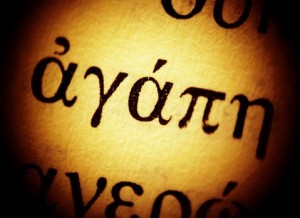
Agape in Greek LetteringThere are six Greek words translated “love” in English: eros (sexual passion), philia (deep friendship), ludus (playful love), pragma (longstanding or mature love), philautia (self love), and agape (unconditional or selfless love). It is the sixth which Paul uses here and which is used extensively throughout the New Testament and in early Christian texts.

It is perhaps perhaps the most radical. This is the love that one extends to all people, whether friends, family members, or strangers. Agape was translated into Latin as caritas, which is the origin of our word “charity.” C.S. Lewis referred to it as “gift love,” the highest form of Christian love. It is similar in nature to concepts appearing in other religious traditions. For example, it has been suggested that the idea of metta or “universal loving kindness” in Theravada Buddhism is the same thing.

Agape is used in the Gospels to describe the love that God has for humanity in general: “For God so loved the world, he gave his only Son” (John 3:16).

It is also used to name the human response to God’s love and to describe the love that Jesus commands be shared and expressed between human beings. In Matthew 5:43-44, agape is used to describe both one’s love of neighbor and the love we are extend to our enemy.

It is not, despite the popularity of this passage as a reading at weddings, about marital love. This is Paul’s instruction to the Corinthians (and through them to all Christians) about “the more excellent way” mentioned at the end of Chapter 12, the manner in which they are to exercise their spiritual gifts.

Chapter 13 does not stand alone. It continues Paul’s discussion of spiritual gifts that begins in the previous chapter and continues through the next. Agape here is to be the guiding principal Christians employ in deciding when, where, and how to use the gifts God has given them. They are to be offered to the community with the same sort of self-sacrificing love exhibited by God to all of humankind: “For God so loved the world that he gave his only Son.”

Agape has nothing to do, as romantic love — eros — does, with attractiveness or attraction; it has nothing to do, as marital love — pragma — does, with compromise; it has nothing to do with any prior relationship, as familial or brotherly love — philia — does. It is to be bestowed on the unloved and the unlovely; it is to be given without regard to whether it is deserved or merited; it is to be given without thought of reciprocity or payback. It is, in a word, to be given as God gives it. It is something human beings are incapable of giving but for the fact that it is first given them by God.

====================

A request to my readers: I’m trying to build the readership of this blog and I’d very much appreciate your help in doing so. If you find something here that is of value, please share it with others. If you are on Facebook, “like” the posts on your page so others can see them. If you are following me on Twitter, please “retweet” the notices of these meditations. If you have a blog of your own, please include mine in your links (a favor I will gladly reciprocate). Many thanks!

====================

Father Funston is the rector of St. Paul’s Episcopal Church, Medina, Ohio.

Jesus’ Cellphone – From the Daily Office – March 27, 2014

From the Gospel of Mark:

Immediately he made his disciples get into the boat and go on ahead to the other side, to Bethsaida, while he dismissed the crowd. After saying farewell to them, he went up on the mountain to pray.

(From the Daily Office Lectionary – Mark 6:45-46 (NRSV) – March 27, 2014.)

Jesus with CellphoneJesus sure spends a lot of time on mountains! And I can understand why. They are generally inaccessible to all but the most determined making them the perfect place for someone who needs a little “down” time, a little bit of “I’m exhausted by all of this and need to recharge” time, a little “leave me be for a while” time.

It may be cynical of me, but my first thought reading these two verses was, “I hope he remembered to turn off his cellphone.” I have learned that lesson well, even though I sometimes fail to follow my own advice and answer the phone on my day away from church business and usually regret it when I do.

Why is it that we take little note of, and often ignore, these last two verses of the story of the feeding of the 5,000? When Matthew’s version of the tale is used in the Sunday readings (as Proper 13 in Year A of the Revised Common Lectionary), his similar statement is cut off from it:

Immediately he made the disciples get into the boat and go on ahead to the other side, while he dismissed the crowds. And after he had dismissed the crowds, he went up the mountain by himself to pray. (Matt 14:22-23)

Luke does not mention Jesus’ behavior after the miracle of the loaves and fishes, but neither Luke’s nor Mark’s versions are read in the Sunday rotation. John’s version ascribes a motive other than prayer to Jesus’ climbing the mountain: “When Jesus realized that they were about to come and take him by force to make him king, he withdrew again to the mountain by himself.” (John 6:15, RCL Year B, Proper 12)

I don’t give John’s political twist much credence. It may be that people wanted to “make him king,” after all the Jews were anticipating that sort of Messiah, but I suspect that exhaustion and the need for privacy were much bigger motives for Jesus at the moment.

When in public worship we end the story with the report that “those who ate were about five thousand men, besides women and children” (Matt. 14:21, cf. Mk. 6:44), we get an incomplete picture of Jesus. And John’s “I don’t want to be king” motivation for his departure just makes it worse! He becomes a superman who does incredible miraculous things with little or no effort and with no cost to himself, and then (like some super-spy) thwarts the political designs of the ignorant and ill-informed; as a model for life or ministry, he is an impossible paradigm. Being Christ-like becomes an impossible task beyond the ken of mortal human beings.

But what if we include these two verses, this post-script about depleted reserves, this acknowledgement of Jesus’ weariness and need to replenish? What a richer, more nuanced vision we are given! Jesus becomes a much more accessible savior! He truly is seen to be (as the writer of the Letter to Hebrews insisted) someone who is able “to sympathize with our weaknesses . . . in every respect . . . as we are.” (Heb. 4:15) He is seen as a model of healthy ministry, of self-care following service to others. We see him as someone who really would turn off his cellphone!

====================

A request to my readers: I’m trying to build the readership of this blog and I’d very much appreciate your help in doing so. If you find something here that is of value, please share it with others. If you are on Facebook, “like” the posts on your page so others can see them. If you are following me on Twitter, please “retweet” the notices of these meditations. If you have a blog of your own, please include mine in your links (a favor I will gladly reciprocate). Many thanks!

====================

Father Funston is the rector of St. Paul’s Episcopal Church, Medina, Ohio.

Zesty Vestry – From the Daily Office – March 18, 2014

From the First Letter to the Church in Corinth:

Do you not know that a little yeast leavens the whole batch of dough? Clean out the old yeast so that you may be a new batch, as you really are unleavened. For our paschal lamb, Christ, has been sacrificed. Therefore, let us celebrate the festival, not with the old yeast, the yeast of malice and evil, but with the unleavened bread of sincerity and truth.

(From the Daily Office Lectionary – I Corinthians 5:6b-8 (NRSV) – March 18, 2014.)

Saccharomyces Cerevisiae YeastPaul uses the metaphor of yeast in a negative way making it symbolize sin and corruption. In the letter to the Galatians, he uses it in a similar manner in an aside about the few who have “prevented you from obeying the truth,” saying, “A little yeast leavens the whole batch of dough.” (Gal. 5:7,9)
Jesus had used the metaphor in a positive way: “The kingdom of heaven is like yeast that a woman took and mixed in with three measures of flour until all of it was leavened.” (Matt. 13:33; cf. Luke 13:21) But he also warned his disciples to beware “the yeast of the Pharisees.” (Matt. 16:6, Mark 8:5, Luke 12:1)

The point of the metaphor is that a small number of individuals can influence the behavior of a large group. A few years ago, some British researchers demonstrated that this is true even when there is no conscious communication within the group. In a series of experiments groups of people were asked to walk randomly within a large but confined space. A few subjects were given detailed instructions about where to walk. Participants were all instructed to stay at least arms length away from any other person and they were not allowed to communicate with one another.

In every run of the experiment, the instructed subjects ended up being followed by others in the crowd, forming a sort of self-organizing conga line. Iterations with varying numbers of subjects up to 200 demonstrated that it only took 5% of the group being instructed to result in an unconscious group consensus. Despite the fact that participants weren’t allowed to talk or gesture to one another, the group ended up being led by the specially instructed minority.

Just think what a small minority within a church community could do if it were united and made conscious effort to influence the larger group. Think what a vestry, session, or other governing board could do if it put its collective mind to being a “yeast” for good within a congregation. Too often church leaders try to persuade congregations to grow through personal evangelism or to reach out in social ministry or to mature in faith through spiritual discipline without actually demonstrating those behaviors themselves. That hasn’t worked. What works is “leading by example,” which is what the small amount of yeast in a loaf does in a way; it’s what the instructed walkers in the British experiments did.

With just a little bit of care and nurture, a little bit of yeast can grow explosively; the most common yeast used in brewing and baking (Saccharomyces Cerevisiae) can double every 100 minutes! The English word “yeast,” according to the dictionary, derives from the Greek word zestos. The word used in the New Testament for “leaven” (and translated here as “yeast”) is zume. These words have no linguistic link to our modern words “zest” and “zoom,” but it occurs to me this morning that if small leadership groups in our churches got truly zesty for spiritual maturity, for personal evangelism, and for social ministry, there’d be no stopping the church; it would zoom. The church would explode! We need to cultivate a zesty vestry in every congregation!

====================

A request to my readers: I’m trying to build the readership of this blog and I’d very much appreciate your help in doing so. If you find something here that is of value, please share it with others. If you are on Facebook, “like” the posts on your page so others can see them. If you are following me on Twitter, please “retweet” the notices of these meditations. If you have a blog of your own, please include mine in your links (a favor I will gladly reciprocate). Many thanks!

====================

Father Funston is the rector of St. Paul’s Episcopal Church, Medina, Ohio.

Break the Chains – Sermon for the Second Sunday of Lent (Year A) – March 16, 2014

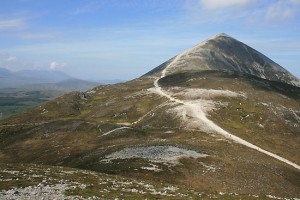
Croagh PatrickIn the Education for Ministry (“EfM”)[1] program we engage in a process called “reflection” (“theological reflection” to be precise). In this process, we take a close look at a thing or a story, an incident from life, a passage of scripture, or an object we use everyday. One of the best group reflections I ever took part in started when someone put their mobile phone in the center of the table and said, “Let’s talk about this.”

In part of the process, we draw on what are called the “four sources” to illuminate the subject of our reflection. The sources are experiential – this is the “Action” source: things we do, think, and feel; positional – our attitudes, opinions, beliefs, and convictions; traditional – drawn from our Christian heritage, scripture, liturgy, hymnody, and so forth; and cultural – popular songs, movies, novels, commercials and advertisements, politics, etc.

Continue reading

Carrying Our Mat – From the Daily Office – March 14, 2014

From the Gospel of Mark:

Some people came, bringing to him a paralyzed man, carried by four of them. And when they could not bring him to Jesus because of the crowd, they removed the roof above him; and after having dug through it, they let down the mat on which the paralytic lay. When Jesus saw their faith, he said to the paralytic, “Son, your sins are forgiven.”

(From the Daily Office Lectionary – Mark 2:3-5 (NRSV) – March 13, 2014.)

Paralytic Lowered Through the RoofIt’s a familiar story. A paralyzed man on a pallet comes to Jesus carried by his friends. They can’t get by the crowd, so they cut a hole in the roof of the house where Jesus is staying. (The first verse of the chapter says “he was at home” in Capernaum. That’s an interesting thing to say of someone who “has nowhere to lay his head,” [Matt. 8:20] but I don’t want to be distracted by that this morning.) The man on his mat is lowered through the hole and Jesus heals him. A pretty straightforward story of a miracle healing.

Except for one thing. In every other story that I can think of it is the faith of the sick person that Jesus witnesses or credits with accomplishing (or at least setting up) their healing. In this story, it is “their faith,” the faith of the paralytic’s friends (perhaps his, as well, but the Greek taken in context is clearly plural).

We live in a world in which the besetting sin is individualism. Our (Episcopal Church) Presiding Bishop, Katharine Jefferts Schori, has commented that she believes the notion of a “personal relationship with Jesus” is “the great Western heresy—that we can be saved as individuals, that any of us alone can be in right relationship with God.” In her opening statement to the General Convention of 2009, she went on to say, “It’s caricatured in some quarters by insisting that salvation depends on reciting a specific verbal formula about Jesus. That individualist focus is a form of idolatry, for it puts me and my words in the place that only God can occupy, at the center of existence, as the ground of being.” Jesus attention to the faith of the paralytic’s community, not simply his personal faith underscores the communal nature of the Christian creed.

The writer of the letter to the Hebrews touched on this in the Daily Office epistle lesson for Ash Wednesday when he noted that we are surrounded by “so great a cloud of witnesses” and suggested by way of admonition that this allows us to “run with perserverance the race that is set before us.” (Heb. 12:1) Any of us alone cannot be in right relationship with God; we are surrounded and supported by the community of faith. The writer of Hebrews also emphasized the community in the next verse when he said of Jesus that he is the “pioneer and perfecter of our faith.” (12:2)

This is why the Nicene Creed was originally written as a “We believe . . . .” statement. Made personal as an “I believe . . . .” creed in Latin and then in English, it is now properly translated in the current Episcopal Church prayer book. It is a statement of the faith of the community, not that of any one individual. (The Apostle’s Creed, on the other hand, is a personal statement of faith made by the individual especially in connection with his or her baptism.)

When we recite the Nicene Creed together in worship, we are all standing on the roof of the house lowering the paralytic to the floor beneath where Jesus can heal him or her. We are also the paralytic on the pallet. Our voices united are the ropes and the Creed, “the sufficient statement of the Christian faith” as Anglicans call it, is our mat. Jesus bids us to stand up and carry our mat for all to see: “Let your light shine before others, so that they may see your good works and give glory to your Father in heaven.” (Matt. 5:16)

====================

A request to my readers: I’m trying to build the readership of this blog and I’d very much appreciate your help in doing so. If you find something here that is of value, please share it with others. If you are on Facebook, “like” the posts on your page so others can see them. If you are following me on Twitter, please “retweet” the notices of these meditations. If you have a blog of your own, please include mine in your links (a favor I will gladly reciprocate). Many thanks!

====================

Father Funston is the rector of St. Paul’s Episcopal Church, Medina, Ohio.

Simple Communication – From the Daily Office – March 12, 2014

From the First Letter to the Corinthians:

When I came to you, brothers and sisters, I did not come proclaiming the mystery of God to you in lofty words or wisdom.

(From the Daily Office Lectionary – 1 Corinthians 2:1 (NRSV) – March 12, 2014.)

Peanuts' Lucy offers writing advice for 5 centsI’m mentoring a study group in my parish, eight well-educated adults seeking to better understand their faith. We’re using some academic materials from a program well-known to Episcopalians. At our last meeting, nearly all of them commented on and complained about the “high falutin'” academic language used by some of our authors. I thought of that as I read Paul describing his missionary efforts as not proclaimed “in lofty words or wisdom.”

I’m amused that in this letter Paul claims to avoid “lofty words or wisdom” when he is often so long-winded and hard to follow! Reading this I couldn’t help but remember last Sunday’s epistle lesson from Romans in which, comparing Jesus to Adam, Paul went on and on about “the one man this” and “the one man that”. . . . (Rom. 5:12-19) Paul is really not one who eschews obfuscation!

I used to teach legal research and writing in a paralegal degree program at a community college. One of the things I would give my students was an essay by Kurt Vonnegut about simplicity in communications. (I have to admit that I no longer remember where I got it from.) In it he says (among other things):

As for your use of language: Remember that two great masters of language, William Shakespeare and James Joyce, wrote sentences which were almost childlike when their subjects were most profound. “To be or not to be?” asks Shakespeare’s Hamlet. The longest word is three letters long. Joyce, when he was frisky, could put together a sentence as intricate and as glittering as a necklace for Cleopatra, but my favorite sentence in his short story “Eveline” is this one: “She was tired.” At that point in the story, no other words could break the heart of a reader as those three words do.

Simplicity of language is not only reputable, but perhaps even sacred. The Bible opens with a sentence well within the writing skills of a lively fourteen-year-old: “In the beginning God created the heaven and the earth.”

This is good advice not only for writing but for all communication. I’m reminded of Jesus’ admonition about giving oaths, which could also be advice about writing and communication: “Let your word be ‘Yes, Yes’ or ‘No, No’; anything more than this comes from the evil one.” (Matt. 5:37)

There is a time for “lofty words and wisdom,” but more often (especially when trying to communicate the Gospel) it is time for simplicity.

====================

Father Funston is the rector of St. Paul’s Episcopal Church, Medina, Ohio.

Heavy snow and/or ice will cause hazardous driving conditions. If you will be traveling in the warning area, you should choose an alternate route if possible or you should use extreme caution if travel is unavoidable.

« Older posts Newer posts »