Occasional thoughts of an Anglican Episcopal priest

Category: Matthew (Page 20 of 29)

Hell can go to Hell! – From the Daily Office – January 21, 2014

From the Gospel of John:

For God so loved the world that he gave his only Son, so that everyone who believes in him may not perish but may have eternal life. Indeed, God did not send the Son into the world to condemn the world, but in order that the world might be saved through him.

(From the Daily Office Lectionary – John 3:16-17 (NRSV) – January 21, 2014.)

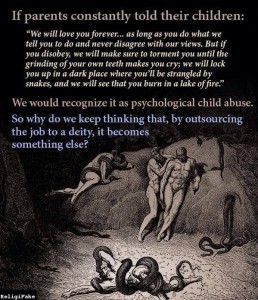
Outsourcing Abuse MemeMaking the rounds of Facebook these days is an anti-religious meme which basically equates religious teaching to child abuse. It says:

If parents constantly told their children:

“We will love you forever . . . as long as you do what we tell you to do and never disagree with our views. But if you disobey , we will make sure to torment you until the grinding of your own teeth makes you cry; we will lock you up in a dark place where you’ll be strangled by snakes, and we will see that you burn in a lake of fire.”

We would recognize it as child abuse.

So why do we keep thinking that, by outsourcing the job to a deity, it becomes something else?

There’s nothing in the meme which specifically mentions Christianity, but because members of our faith so often evangelize by fear, by threatening Hellfire and damnation on those who fail to convert, I’m fairly confident that we can assume the Christian faith to be the target. I wish it weren’t so and I wish I weren’t so sympathetic to the producers of the meme! But, let’s face it, there’s a good deal of really awful theology and really bad evangelism out there.

The truth, however, is that an awful lot (nearly all, in fact) of the mythology of Hell is not found in Holy Scripture. The English word Hell is derived from an ancient Germanic word (hel), which in Norse mythology named a place of eternal punishment. When the Greek Hades (used in the New Testament to name the place of dead) and the Hebrew terms Gehenna or Sheol (used in the Old Testament for the same purpose) were translated into English using this Germanic word, that resulted in a transfer of the pagan concept into Christian theology and its vocabulary.

Then along came poets like Milton and Dante and added all sorts of wonderful, fantastic, and clearly non-biblical imagery to the popular imagination — and, voila! — a full-blown picture of Hell featuring brimstone, lakes of fire, and tormenting demons ruled over by the fallen angel Lucifer, and inhabited by poor human souls condemned to an eternity of pain. One must admit that segments of the church have made full use of this as a scare-tactic mechanism to encourage conversions and to keep the faithful in line, but it was and is wrong to do so. Neither the New Testament Hades nor Old Testament Gehenna had any attached meaning of eternal torment; the Greek signified the place where all the dead, the good, the bad and the indifferent, were thought to go, while the Hebrew terms signified a place of disposal, a place of ending.

It is true that Jesus used imagery of an after-life fire to describe the punishment of unrighteous, but the implication is of annihilation and destruction, not eternal punishment. (See, for example, Matthew 13.) His parables, such as the tale of Dives and Lazarus (Luke 16), cannot be the basis of a theology of eternal torment; parables are metaphoric or analogic teaching tools of limited application and to stretch them beyond their immediate point is to misunderstand and misuse them.

This is especially so when we have his own direct testimony in the Gospel of John. Because of signs displayed in the crowds of many sporting events, many people are familiar with John 3:16 — “For God so loved the world that he gave his only Son, so that everyone who believes in him may not perish but may have eternal life.” And many of us were required to memorize this verse in Sunday School. Few, however, know or memorize the next verse — “Indeed, God did not send the Son into the world to condemn the world, but in order that the world might be saved through him.”

Two things must be observed and emphasized about how these verses describe the mission of the Christ. First, in verse 16 the alternatives are not an eternal life of joy versus an eternal life of punishment; the alternatives are “perishing” (i.e., annihilation and ending) or “eternal life.” Second, the purpose of Jesus’ life, teaching, death, resurrection, and ascension is not to condemn but to save.

The meme, so far as it goes, is accurate. There is way too much bad theology threatening people with Hellfire and damnation; to my way of thinking, any such theology is too much. But the meme is as wrong as those who promulgate the pagan mythology of Hell as a part of the Christian faith. It isn’t and we need to expunge it from our theology and from our vocabulary.

In a word, Hell can go to Hell!

====================

A request to my readers: I’m trying to build the readership of this blog and I’d very much appreciate your help in doing so. If you find something here that is of value, please share it with others. If you are on Facebook, “like” the posts on your page so others can see them. If you are following me on Twitter, please “retweet” the notices of these meditations. If you have a blog of your own, please include mine in your links (a favor I will gladly reciprocate). Many thanks!

====================

Father Funston is the rector of St. Paul’s Episcopal Church, Medina, Ohio.

Obnoxious Jesus – From the Daily Office – January 17, 2014

From John’s Gospel:

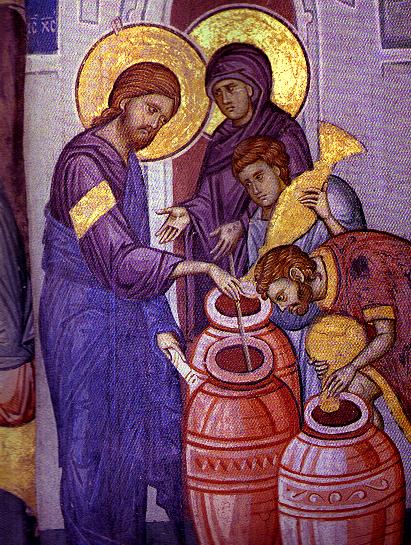
On the third day there was a wedding in Cana of Galilee, and the mother of Jesus was there. Jesus and his disciples had also been invited to the wedding. When the wine gave out, the mother of Jesus said to him, “They have no wine.” And Jesus said to her, “Woman, what concern is that to you and to me? My hour has not yet come.” His mother said to the servants, “Do whatever he tells you.”

(From the Daily Office Lectionary – John 2:1-5 (NRSV) – January 17, 2014.)

Icon of the Wedding at CanaToday is the feast of St. Antony of Egypt. According to a Life of St. Antony written by Athanasius, Antony and his younger sister were orphaned when he was about 18 years of age, inheriting a goodly estate which he began to manage. However, writes Athanasius, six months after his parents’ death he was “turning over in his mind the way the apostles had left everything to follow the Savior” when he heard a sermon on Christ’s encounter with the rich young man whom the Lord instructed, “If you wish to be perfect, go, sell your possessions, and give the money to the poor, and you will have treasure in heaven; then come, follow me.” (Matt. 19:21)

According to Athanasius:

As though this reminder of the saints had ben sent to him by God, and as though that passage had been read specially for his sake, Antony went out immediately, and gave to the villagers the possessions he had inherited from his ancestors — they consisted of some three hundred very pleasant and fertile acres — so that they would not be an encumbrance to him and to his sister. He sold all his possessions and gave the considerable sum h raised to the poor, keeping back only a little of it for his sister.

Again when he went into church, he heard what the Lord said in the gospel, “Do not be anxious about tomorrow.” He could not wait any longer, but went out and gave away even what he had kept back to the poor. He left his sister in the care of some well-known, trustworthy virgins, putting her in a convent to be brought up, and he devoted himself to the ascetic life not far from his home, living in recollection and practicing self-denial.

When I read that, I wondered what Antony’s sister’s reaction to it all might have been . . . . Truthfully, had I been her, my affections toward my older brother would not have been kindled! And then I read this morning’s Daily Office gospel about the wedding at Cana and the (to my mind) very uncomfortable repartee between Jesus and his mother. If we take off the rose-tinted glasses through which the Holy Family and the saints are often viewed and assess this conversation honestly, these are two people talking passed one another and not being terribly pleasant to each other!

When I was in seminary, my New Testament professor Bill Countryman referred to the portrayal of Jesus in the Fourth Gospel as “obnoxious.” In his book The Mystical Way in the Fourth Gospel, Countryman called Jesus’ repeated pattern of hard-to-understand responses to questions “obnoxious discourse.” Jesus seems intent on making his claims as difficult and offensive as possible; everything he says seems designed to irritate the people listening. And, in the story of the wedding at Cana, he seems to be starting with his mother!

Taken together, the story of Antony disposing of the family fortune and this gospel lesson serve as reminders that every family has its “issues.” The saints and holy people whom we revere and to whom we look as exemplars, even Jesus and his mother, were just “regular folks” doing the best they could and trying to work things out as well as possible. Sometimes they were wildly successful and are examples we should seek to emulate. Sometimes we look at them and question their judgments and their actions; not every example is one to follow. In either case, we hope to learn something, even when they are being obnoxious. Perhaps especially when Jesus is obnoxious!

====================

A request to my readers: I’m trying to build the readership of this blog and I’d very much appreciate your help in doing so. If you find something here that is of value, please share it with others. If you are on Facebook, “like” the posts on your page so others can see them. If you are following me on Twitter, please “retweet” the notices of these meditations. If you have a blog of your own, please include mine in your links (a favor I will gladly reciprocate). Many thanks!

====================

Father Funston is the rector of St. Paul’s Episcopal Church, Medina, Ohio.

Sweetgum Balls – From the Daily Office – January 9, 2014

From the Psalter:

Have mercy upon us, O Lord, have mercy,
for we have had more than enough of contempt,
Too much of the scorn of the indolent rich,
and of the derision of the proud.

(From the Daily Office Lectionary – Psalm 123:4-5 (BCP Version) – January 9, 2014.)

Sweetgum Balls on SnowThere’s a lot of talk these days about “class warfare,” most of it sheer nonsense. There is, it must be admitted, a growing class divide, an increasing gap between the wealthiest Americans and the rest of us. One might be tempted to write about that in light of this psalm’s reference to the “scorn of the indolent rich” and the “derision of the proud.” But, let’s face it . . . scorn, derision, contempt, and generally obnoxious conduct transcend class and other distinctions.

Prickly, disagreeable people come in all income groups, all races, all genders and sexual preferences, all religions . . . in any grouping of human beings you care to make. Indeed, everyone of us can be and are, from time to time, prickly and unpleasant. A lot of the time, we are completely oblivious to our own unpleasantness.

Driving past our town square yesterday afternoon, I noticed that a sweet gum tree had shed its empty seedpods, the hard, prickly fruit littering the snow all around the trunk. I rolled down the car window, pulled out my smartphone and took this picture (which came out a bit unfocussed). I thought I might use it as inspiration (or illustration) for a poem. And then this psalm came up on the lectionary rotation and the sweet gum was an obvious metaphor.

Unpleasant people drop little bombs of scorn, little grenades of derision all around them. They mar the world around them the same way the sweet gum tree’s seedpods mar the snow around the tree. But like the tree, they are unaware (or uncaring) of the damage they are doing and seem unable (or unwilling) to bend; they lack the flexibility to remedy the mess they create around them.

The psalmist is right to pray for deliverance from such folk . . . but more importantly we should pray for change in ourselves, that we not be prickly, contemptuous, and scornful towards those around us. Jesus once said to his listeners:

Why do you see the speck in your neighbor’s eye, but do not notice the log in your own eye? Or how can you say to your neighbor, “Let me take the speck out of your eye,” while the log is in your own eye? You hypocrite, first take the log out of your own eye, and then you will see clearly to take the speck out of your neighbor’s eye. (Matt. 7:3-5, NRSV)

In terms of the tree on square . . . deal with your own prickly seedpods of contempt, scorn, or derision before criticizing another’s.

====================

A request to my readers: I’m trying to build the readership of this blog and I’d very much appreciate your help in doing so. If you find something here that is of value, please share it with others. If you are on Facebook, “like” the posts on your page so others can see them. If you are following me on Twitter, please “retweet” the notices of these meditations. If you have a blog of your own, please include mine in your links (a favor I will gladly reciprocate). Many thanks!

====================

Father Funston is the rector of St. Paul’s Episcopal Church, Medina, Ohio.

A Theology of Gift Giving – Sermon for the Second Sunday of Christmas – January 5, 2014

====================

This sermon was preached on the Second Sunday of Christmas, January 5, 2014, at St. Paul’s Episcopal Church, Medina, Ohio, where Fr. Funston is rector.

(The Revised Common Lectionary, Christmas 2A: Jeremiah 31:7-14; Ephesians 1:3-6,15-19a; Psalm 84; and Matthew 2:1-12. These lessons can be read at The Lectionary Page.)

====================

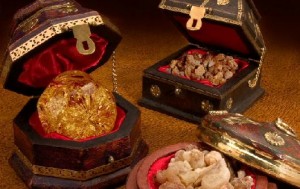
Gifts of the Wise MenVery recently in the church office mail there was this small envelope addressed to me personally — the address has been typed out on a separate sheet of paper, cut therefrom, and glued onto the envelope. There is no return address and the postmark is a Cleveland, OH, cancelation. Inside there was no personal note of any kind, just a page torn from the last quarter’s Forward Day by Day devotional. One side, as you can see, has been scribbled all over; clearly not the side I am supposed to read. The other is the meditation for October 30, 2013, which begins:

Have you ever suffered because you sat through a really boring, abstract, incoherent, and disconnected sermon? Most of us have. Believe it or not, some people report that after enduring something like that, they decide never to go back to that particular church or any church at all. Sermons can make or break some people’s relationship with the church.

(The entire meditation can be read at Forward Day by Day.)

I have to be honest — my first reaction on receiving this was to think, “Well, that’s not something I wanted to get!” And immediately I was reminded of one Christmas when our children were quite young.

Our family tradition is to wait until Christmas morning to open our packages, so even if we’d been to the Midnight Mass we would rise early to see what Santa had brought. On the Christmas I recalled, our daughter rushed down the stairs from her second-floor room to the tree set up in our first-floor den and tore open the largest of her gifts, ripping to shreds the wrapping paper with obvious excitement. However, when she saw what was under the wrapping her expression changed to disappointment and she cried out, “That’s not what I wanted!” I don’t remember what she had wanted; I don’t even remember what we had given her. But I remember that reaction.

It got me to thinking about the reasons we give things to one another, the how of it and the why of it. What is the “theology of gift giving?” The gifts of the wise men to the Christ-child help us to explore that question.

The first element of such a theology would be the recognition that the giving of gifts is perfectly acceptable! There are some who teach that it is not, but we have plenty of examples in Scripture including, of course, the very story we are told in today’s gospel reading of the visitation of the Magi. More basically, we have God’s own example starting with the gift of life to plants, animals, and human beings as described in the Creation stories and exhibited most clearly in God’s self-giving in Jesus Christ. Generosity and charity are fundamental to an active Christian faith. Giving is the very thing that defines our belief: God-made-human gave himself entirely so that we might be free to give ourselves entirely back to God. As James said, “Every generous act of giving, with every perfect gift, is from above, coming down from the Father of lights.” (James 1:17, NRSV) Gift-giving, in a sense, is the purpose of the Incarnation, so it is something strongly encouraged.

The second element of a theology of gift giving is that giving gifts allows us to be ministers of grace, the free and undeserved help of God. The gifts of the wise men were symbolic: the hymn “We Three Kings” lays out in verse what these are. Gold is a symbol of kingship, frankincense (used for incense in worship) is a symbol of deity, and myrrh (an embalming oil) is a symbol of death. (By the way, did you know that that hymn is quintessentially Episcopalian? It was written by John J. Hopkins in 1857 for a Christmas pageant at General Theological Seminary, the Episcopal Church divinity school in New York City.) In other words, they are symbolic of the full grace and mercy of God incarnate in Jesus. Every gift we receive, especially those from God but really from anyone, is a demonstration of God’s grace because, after all, grace is undeserved. How many times have you opened a present and sat there with the gift still in the box, looking at the giver with eyes and thinking to yourself, “What done to deserve this?” That question, of course, is rhetorical. The answer is “Nothing.” Gift giving is a form of grace by which we imitate the behavior of God and model the character of God.

The third element of a theology of gift giving is that it give us opportunity to display the love of God. “Each one must give as he has decided in his heart, not reluctantly or under compulsion, for God loves a cheerful giver,” wrote Paul to the Corinthians. (2 Cor. 9:7, ESV) And, of course, “God so loved the world that he gave his only Son.” (John 3:16, NRSV) Every gift should be a reflection of that love. If a gift is a real gift it is given with no thought of return. It’s not about starting an endless series of gift exchanges. It’s not about buttering someone up. It’s not about impressing someone or trying to get someone to do something for you. A real gift is an act of unconditional love, with no demands, no hints, no requirements of any return. Love, as Paul reminds us in the First Letter to the Corinthians,

is patient; love is kind; love is not envious or boastful or arrogant or rude. It does not insist on its own way; it is not irritable or resentful; it does not rejoice in wrongdoing, but rejoices in the truth. (1 Cor. 13:4-6)

Our gift-giving character should be one of genuine love. By giving a gift, we are symbolically recalling the gift of Christ for our salvation because “God so loved the world.”
The final element of a theology of gift giving, the element to which the first three point, is that it is relational. When the Magi encountered the Christ-child, they worshiped him: “On entering the house, they saw the child with Mary his mother; and they knelt down and paid him homage.” Worship is an expression of relationship at its deepest. However we define the word worship, it has its center in how we relate to God; it is the very reason, Scripture tells us, that we were created.

As I think I’ve mentioned before, one of my favorite poets is the African American James Weldon Johnson. At funerals, I often use one the poems from his collection God’s Trombones: Seven Negro Sermons in Verse. Another poem in that book is entitled The Creation; it explores this truth of our creation. The poem begins —

And God stepped out on space,
And he looked around and said:
“I’m lonely —
I’ll make me a world.”

The poem continues, as Genesis does, detailing the creation of earth, the seas, the plants, the animals . . . and then goes on —

Then God walked around,
And God looked around
On all that He had made.
He looked at His sun,
And He looked at His moon,
And He looked at His little stars;
He looked on His world
With all its living things,
And God said, “I’m lonely still.”

Then God sat down
On the side of a hill where He could think;
By a deep, wide river He sat down;
With His head in His hands,
God thought and thought,
Till He thought, “I’ll make me a man!”

Up from the bed of the river
God scooped the clay;
And by the bank of the river
He kneeled Him down;
And there the great God Almighty
Who lit the sun and fixed it in the sky,
Who flung the stars to the most far corner of the night,
Who rounded the earth in the middle of His hand;
This Great God,
Like a mammy bending over her baby,
Kneeled down in the dust
Toiling over a lump of clay
Till He shaped it in His own image;
Then into it He blew the breath of life,

And man became a living soul.
Amen. Amen.

“Like a mammy bending over her baby . . . .” We are created for relationship — relationship with God and relationship with each other. Like the gift giving of the Magi, that’s what our gift giving to one another is all about. It is a tangible expression of relationship; although gifts are given out of love with no expectation of reciprocation, they do provoke a response. They are relational, and in the way we relate to each other, especially in our giving of gifts to each other, we exhibit how we relate to God.

I’ll be honest. I was upset by this anonymous gift. But in the end I’m grateful for it because it is a reminder of this most important element of the theology of gift giving, this relational aspect. After that rather brutal opening paragraph, the Forward Day by Day meditation examines what it calls “Jesus’ methodology” of preaching by story-telling and then concludes, “In spite of all of our media gadgets, communications systems, and technological tools, we still need to truly perceive, listen, and understand.”

My mentor, the late Fr. Karl Spatz, taught me to think of a sermon as a conversation and as a gift. A sermon is not a lecture and it has many participants. Preaching is grounded in community, and like gift giving is relational. Preaching is not me or any clergy person standing in the pulpit telling you what we think that you should hear. A sermon is an exploration of the things we all struggle to understand, the troubles we all have to deal with, the things we all try to do better, the joys we all celebrate. A sermon is a priest’s prayerful and considered reflection upon these things, offered humbly as a gift to the gathered community. The congregation’s part in the conversation is to receive the gift and, as the meditation says, make the effort “to truly perceive, listen, and understand.” That may sometimes mean that we continue the conversation at a later time, perhaps through notes like this one — but we can only really continue the conversation that if I know who you are . . . .

When all is said and done, any gift giving (including any preaching) is an imperfect thing. It is an imperfect thing that seeks the perfection of the one true gift, the gift of Jesus for the salvation of the world. Amen.

====================

A request to my readers: I’m trying to build the readership of this blog and I’d very much appreciate your help in doing so. If you find something here that is of value, please share it with others. If you are on Facebook, “like” the posts on your page so others can see them. If you are following me on Twitter, please “retweet” the notices of these meditations. If you have a blog of your own, please include mine in your links (a favor I will gladly reciprocate). Many thanks!

====================

Father Funston is the rector of St. Paul’s Episcopal Church, Medina, Ohio.

Chaotic Disorderliness – From the Daily Office – January 3, 2014

From the First Book of Kings:

Now there was a great wind, so strong that it was splitting mountains and breaking rocks in pieces before the Lord, but the Lord was not in the wind; and after the wind an earthquake, but the Lord was not in the earthquake; and after the earthquake a fire, but the Lord was not in the fire; and after the fire a sound of sheer silence. When Elijah heard it, he wrapped his face in his mantle and went out and stood at the entrance of the cave. Then there came a voice to him . . . .

(From the Daily Office Lectionary – 1 Kings 19:11-13 (NRSV) – January 3, 2014.)

The Crowning by Sara StarIt’s almost over . . . nine ballerinas or lady ballroom champions or something are supposed to show up to join the eight milkmaids who came yesterday; then, ten leaping lords are to show up tomorrow. I’m not sure why the dancers are scheduled to get here before the musicians, but the pipers and the drummers won’t get here until the end. In any event, the familiar carol promises that the end of Christmas will be even more noisy and confusing than its beginning.

Thinking of Elijah standing at the mouth of his cave through all the turbulence of storm and temblor and conflagration, but not perceiving God until the “sound of sheer silence,” I am reminded again of how odd I find our (basically) northern European fantasies of the birth of Jesus to be. I sometimes wonder what “first world” Christianity would be like if we’d never developed the notion that the Savior was born on a quiet, snowy night.

We did, though, and church congregations play that up in spades! And, I must confess, my own parish and our liturgical planning for Christmas Eve and the Christ Mass of Christmas Day went right along.

At the Midnight Mass, as a sequence hymn, we sang O Little Town of Bethlehem with that line, “How silently, how silently, the wondrous gift is given . . . .” The Choir sang an anthem version of the Christina Rossetti — Gustav Holst hymn In the Bleak Midwinter with its gorgeous portrayal of a dark winter night:

In the bleak midwinter, frosty wind made moan,
earth stood hard as iron, water like a stone;
snow had fallen, snow on snow, snow on snow,
in the bleak midwinter, long ago.

And we finished off with the lights dimmed, the candles flickering, and everyone singing Silent Night! We bought right into it! More than likely it’s completely wrong, but we did it anyway.

I think passages like this story of Elijah encourage us to envision the Nativity of Jesus as this peaceful, very-quiet-if-not-silent, nighttime event; this story and others make dark silence the normative setting for God’s interaction with humans. There’s Samuel’s late night call from God (1 Sam. 3:1-18). There are the Josephs (Jacob’s son and Jesus’ foster father) who both received dream messages while sleeping (Gen. 37:5-10; Matt. 1:18-25). There is Jacob who encountered God at night at Peniel, although wrestling with God through the night could hardly have been a silent affair (Gen. 32:24-30).

We’re also fooled by the Magi being led by a star. “There’s a star? Must have been at night,” we think, but the Magi were astrologers whose lives and actions, not just their travel plans, were “led” by the stars and constellations regardless of the time of day (Matt. 2:1-12). (Let’s not even mention the fact that the wholesale slaughter of the Holy Innocents suggests that their visit was several months, if not a couple of years, later so the star is completely irrelevant to Jesus’ actual birth!) And we’re told by Luke that shepherds were in the area keeping watch over the flocks “by night” when the angel told them of the birth, but the angel’s message is, “To you is born this day in the city of David a Savior, who is the Messiah, the Lord.” (Luke 2:8-20, emphasis added) Couldn’t the birth have been earlier? During daylight hours, perhaps? To be honest, there is just no indication when the actual birth of Jesus took place.

And that “when” is bigger than time of day! There’s no indication of what time of year, either. As we all know (since the anti-religious crowd loves to tell us every year, just in case we don’t already know or had forgotten since they told us last year), the December 25 date of Christmas was originally the Roman feast of Saturnalia simply taken over by the church. When someone tries to disprove the Christian story by telling me this, my standard response is “So what?” We don’t celebrate the birthday of Jesus; we celebrate the birth of Christ, the Incarnation of God. We can and do that all the time; it doesn’t matter what day of the year we choose to do so in a particular and special way.

Except that we get this cold, bleak, quiet, silent, peaceful, midwinter, snow-on-snow, everyone-bundle-up northern European picture of Jesus’ birth.

I’ve attended births; I was present when both our children were born in the comfort of hospital birthing centers. Neither was quiet, silent, or peaceful! There was panting, grunting, crying, exclamations, excited utterances, anxiety, frustration, elation . . . and my wife was making noise, too! I can’t imagine that the biblical delivery in a stable would have been any less raucous! I’d be surprised if, with the farm animals provoked by all the goings on, Joseph excited, and Mary in the throes of childbirth (and possibly the owner of the stable and members of his family coming and going), it wasn’t a very noisy place!

I am thoroughly convinced that God was present in all the fuss and noise of my children’s births, so I am just as sure that God was present in all the fuss and noise of God’s own Son’s birth! I am pretty certain that God is present in the fuss and noise of all human affairs. So I would not be surprised, therefore, if the Deuteronomic historian responsible for redacting the First Book of Kings and recording this story of Elijah in the cave was just wrong. Perhaps it would have been accurate to say that Elijah did not perceive God in the wind, the earthquake, or the fire, but I think it is simply inaccurate to say that “the Lord was not in” any or all of those. God is with us in all the noisy, chaotic disorderliness of life.

I don’t have a clue what the Christian faith would be like if it were grounded by a more realistic narrative of Jesus’ birth, but I do know that God is there in the midst of turmoil, in the midst of chaos, in all the cacophony of human existence. That’s the truth the Christian faith teaches. So bring on the dancing ladies, the leaping lords, the pipers, and the drummers! Enough of this sheer silence! God’s twelve-day party is nearly over; let’s make the most of it!

====================

A request to my readers: I’m trying to build the readership of this blog and I’d very much appreciate your help in doing so. If you find something here that is of value, please share it with others. If you are on Facebook, “like” the posts on your page so others can see them. If you are following me on Twitter, please “retweet” the notices of these meditations. If you have a blog of your own, please include mine in your links (a favor I will gladly reciprocate). Many thanks!

====================

Father Funston is the rector of St. Paul’s Episcopal Church, Medina, Ohio.

Wild Bells – From the Daily Office – January 1, 2013

From Matthew’s Gospel:

Now the birth of Jesus the Messiah took place in this way.

(From the Daily Office Lectionary – Matthew 1:18a (NRSV) – January 1, 2014.)

BellsThe first day of the year on the Church’s calendar has a variety of names:

The Feast of the Circumcision, in honor of the Jewish tradition of circumcising a male infant on his eighth day of life: “After eight days had passed, it was time to circumcise the child; and he was called Jesus, the name given by the angel before he was conceived in the womb.” (Luke 2:21)

The Feast of the Holy Name: The angel said to Joseph in a dream, “She will bear a son, and you are to name him Jesus, for he will save his people from their sins.” (Matt. 1:21)

The Solemnity of Mary, Mother of God, a celebration of Mary’s motherhood of Jesus.

I think it is occasionally the Feast of the Holy Family (the first Sunday of the Christmas season in the Roman tradition), although that one may get translated if it falls on January 1; I’m not sure about that.

What all of these share with the secular observance of the New Year is an emphasis on beginnings: a newly-minted Jew, a newly-named child, a new mother, a new family. All the promise of the tabula rasa, the pristine, empty tablet waiting to be filled with all the narratives of life.

I don’t make resolutions, primarily because I am simply so bad at keeping them. But I do look forward making changes. There is a tradition in Stockholm, Sweden (of all places), of reading a poem by Alfred, Lord Tennyson, at midnight on New Year’s Eve. Looking forward to another year of trying to be more Christ-like, I follow the Swedish tradition and read this poem myself at midnight. Midnight is passed, but I offer the poem again this morning as we welcome the New Year:

Ring out, wild bells, to the wild sky,
The flying cloud, the frosty light
The year is dying in the night;
Ring out, wild bells, and let him die.

Ring out the old, ring in the new,
Ring, happy bells, across the snow:
The year is going, let him go;
Ring out the false, ring in the true.

Ring out the grief that saps the mind,
For those that here we see no more,
Ring out the feud of rich and poor,
Ring in redress to all mankind.

Ring out a slowly dying cause,
And ancient forms of party strife;
Ring in the nobler modes of life,
With sweeter manners, purer laws.

Ring out the want, the care, the sin,
The faithless coldness of the times;
Ring out, ring out thy mournful rhymes,
But ring the fuller minstrel in.

Ring out false pride in place and blood,
The civic slander and the spite;
Ring in the love of truth and right,
Ring in the common love of good.

Ring out old shapes of foul disease,
Ring out the narrowing lust of gold;
Ring out the thousand wars of old,
Ring in the thousand years of peace.

Ring in the valiant man and free,
The larger heart the kindlier hand;
Ring out the darkness of the land,
Ring in the Christ that is to be.

====================

A request to my readers: I’m trying to build the readership of this blog and I’d very much appreciate your help in doing so. If you find something here that is of value, please share it with others. If you are on Facebook, “like” the posts on your page so others can see them. If you are following me on Twitter, please “retweet” the notices of these meditations. If you have a blog of your own, please include mine in your links (a favor I will gladly reciprocate). Many thanks!

====================

Father Funston is the rector of St. Paul’s Episcopal Church, Medina, Ohio.

Saying “Yes” – Sermon for Advent 4: December 22, 2013 – Revised Common Lectionary, Year A

====================

This sermon was preached on the Fourth Sunday of Advent, December 22, 2013, at St. Paul’s Episcopal Church, Medina, Ohio, where Fr. Funston is rector.

(The Revised Common Lectionary, Advent 4A: Isaiah 7:10-16; Romans 1:1-7; Psalm 80:1-7,16-18; and Matthew 1:18-25. These lessons can be read at The Lectionary Page.)

====================

Maria TheotokosA couple of weeks ago our choir and the brass quartet offered a really lovely service of Advent Lessons and Carols on the evening of Second Advent. We had things set up a little differently than you usually see our chancel and I hear later that someone had asked, “What’s all that Catholic stuff doing on the altar?” I was confused by the question because we always have “Catholic stuff” on the altar!

We have seasonally colored frontals. We have this pure white “fair linen” and this smaller piece of linen with a funny Latin name on which we set the Bread and Wine of the Eucharist. We have a chalice and a patten and a colored veil. We have candles! All of that is “Catholic stuff” and we always have it here on the altar, so I was confused by the question.

Then I realized that what the questioner was asking about were these . . . the icons that we place on the altar during our services of Compline on the last Sunday evening of each month and that I had thought would make a nice addition to the prayerful atmosphere of lessons and carols. This one is a representation of the Madonna and Child known in Greek as Maria Theotokos — which means “Mary the God-Bearer.” The other is called the Christus Pantokrator (the words mean “Christ All-Mighty”) and depicts Christ as a teacher or as the stern-but-merciful, all-powerful judge of humanity. They are actually not so much Catholic as Orthodox. In the Eastern Orthodox tradition, icons are an aid to prayer; they are called “windows into heaven.”
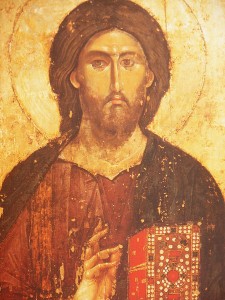
Christus PantokratorFor that reason, icons are typically not realistic; they are very “wooden,” very simple, almost cartoonish. Much is left to the viewer’s, the prayer’s imagination. I love to pray with icons and with other “visual aids,” with paintings, photographs, candles, flowers, all that “Catholic” stuff. It is one of the beauties of our Anglican tradition that we understand worship and prayer to be an activity of the whole person, to engage all of our senses. “Taste and see that the Lord is good,” the Psalmist wrote. (Psalm 34:8) We take those words seriously and so we don’t exclude any form of prayer or spirituality; we don’t distinguish between what is catholic or what is protestant. If it’s helpful in prayer, if it offers an aid to our understanding or our relationship with God, we thinks it’s fine. We draw on the catholic tradition, on the protestant traditions, on the orthodox tradition, even on non-Christian traditions. We’re willing to say “Yes” to anything that aids our connection to God.

But it’s so much easier to say “No,” isn’t it? I have a suspicion that the person who asked, “What’s all that Catholic stuff doing on the altar?” was also thinking something the along the lines of “We’ve never done that before.” That’s what we mean when we say “No.” “No” means we can keep with the status quo; we don’t have to face and deal with something we’ve never done before. That’s what Ahaz, the king of Judah, tries to do in the reading from the prophet Isaiah this morning. The prophet tells the king to ask God for a sign, but Ahaz declines to lest he be thought to put God to the test and be guilty of what Scripture elsewhere denounces as spiritual presumption. He knows that doing so can cause trouble for the asker, so he prefers to the status quo. He says, “No!” God gives him a sign anyway: “Look! A virgin will bear a son and name him ‘Emmanuel’.”

We’re all a bit like Ahaz; we prefer to stick with the way things are. The status quo may not be comfortable, but it is familiar. We know how to deal with it; we may not know how to handle something we’ve never encountered before.

“Yes” opens the future. It opens us to the unknown; it opens us to what we’ve never done before. Saying “Yes” is pregnant with possibility. But saying “No” is so much easier, so much safer!

The icons came to mind today because of the Gospel story.

On the Fourth Sunday of Advent, we like to say that we honor Mary and, to an extent, that’s true. Usually, in two of the three years of the lectionary cycle, we hear about the Annunciation when the angel Gabriel informed Mary that she had been chosen to bear God’s Son. But this year, we hear the other story, the annunciation to Joseph when an angel, not named by Matthew but often also portrayed as Gabriel, appeared to Joseph in a dream and explained Mary’s condition to him. They were betrothed, almost but not quite married, when it was discovered that Mary was pregnant. Joseph knew he wasn’t the father, but he didn’t want to embarrass this young girl, so he planned to divorce her (in a sense) in a quiet, private way. The angel visits him to convince him otherwise.

The icons came to mind today because when I contemplate Bible stories, when I pray about these tales, I like to use art, to look at the way these stories of the faith have been portrayed by painters and sculptors. There are two paintings, in particular, of this story that I like, and one of the Annunciation to Mary that is absolutely my favorite painting of a biblical tale.

The Annunciation by Sandro BotticelliThe Mary painting is by Sandro Botticelli, a Renaissance Florentine painter of the late 15th Century. In his painting, Mary is a Medici princess! She’s all decked out in these Renaissance robes, standing in a beautiful palace in front of window looking out over a lovely formal garden. Not very a very realistic depiction, of course, since she was a 1st Century Palestinian peasant girl! In any event, what is important is not how she’s dressed, but the emotions the painting conveys, and not only hers but also the angel Gabriel’s.

As Mary is depicted, she seems to be flinching away from the angel, holding her hands out as if fending him off. The expression on her face is nearly unreadable, but it is certainly not one of acceptance. Gabriel, also decked out as if he were a Medici courtier but these lovely, golden, semi-transparent wings billowing behind him, is kneeling before her. His hands are reaching out as if pleading. The expression on his face is one of apprehension. You can almost hear him thinking, “Oh, no! She’s going to say, ‘No!’ I’m going to have to go tell God that I blew it!” Of course, she didn’t say, “No.” But . . . what if she had?
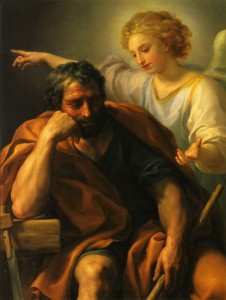
St Joseph's Dream by Raphael MengsThe paintings of Joseph are, first, a painting by an 18th Century German Bohemian painter named Raphael Mengs. Other than this painting, I don’t know this painter, but I did see this painting in the Kunsthistorisches Museum in Vienna. It is notable, first of all, for it’s depiction of Joseph as a relatively young man. Usually in art, Joseph is portrayed as an old man because of a legend that he was very old, had been previously married, had other children (who are those identified in the Bible as Jesus’ brothers and sisters), and passed away early in Jesus’ life. Scholars generally disagree with that: most now believe that Mary was probably only 13 or 14 years of age, Joseph perhaps 16 to 20.

In Mengs painting Joseph is perhaps a bit older than that but still a young man. He is fit and muscular, clearly a hard working man; Joseph, of course, was a carpenter. He has fallen asleep at his workbench, and the angel is speaking to him from behind, sort of over his shoulder. Joseph’s sleeping face is somewhat shrouded in shadow and hard to read. Sometimes when I look at this painting, he looks puzzled or confused; sometimes he looks angry; sometimes, simply uncaring. He does not look like someone who is going to readily agree to whatever the angel is telling him.

The Dream of St Joseph by Georges de la TourThe second painting of Joseph is by another 18th Century painter, the Frenchman Georges de la Tour. De la Tour is more conventional. He portrays Joseph as an elderly man, bald with a bushy beard. He appears to be in bed and to have fallen asleep while reading; a book is in his hand. The angel stands next to him; the scene is lighted by a single candle standing on a bedside table between them. We cannot see the candle, but only its light on the angel’s face and on Joseph’s. Joseph appears to be waking up, but not quite awake. He seems to be in that in-between, liminal stage — not quite asleep but not quite awake. I don’t know about you, but if someone tries to get me to do something when I’m just waking up like that, they’re going to get a resounding “No!”

Again, just like Mary, we know that Joseph did not say, “No.” He did not divorce Mary; he carried through with the marriage. Jesus was born and Joseph reared him as his own son. This is terribly important to Matthew, who traces Jesus’ lineage to King David through Joseph; as the acknowledged foster-adoptive son of Joseph, who is a blood descendent of David (the angel addresses him as “son of David”), Jesus also is “of the house and lineage of David.” This, for Matthew, legitimizes the claim that Jesus is the Davidic Messiah predicted by the prophets.

Think, for a moment, what might have happened if either of these young people had said, “No.” If Mary had declined to bear the Son of God, there would have been no Jesus. Oh, surely, God would have worked the plan of salvation in a different way, but it wouldn’t have been the way we know; there wouldn’t have been a Jesus Christ, a Christian church, the history of the world as we know it. We cannot imagine what it would have been, but it wouldn’t have been this!

If Mary had agreed but then Joseph refused, what might the childhood of the Son of God have been like. As it was, he was reared in a typical 1st Century Jewish family. He learned his lessons, worked with his foster father, learned the craft of carpentry, went to school at the local synagogue, learned the Scriptures and the traditions of his faith, obtained all the knowledge that was the necessary foundation of his life and ministry. But if he had been not the son of a merchant craftsman? What if he’d been the illegitimate son of an unwed mother? Again, we can be sure that God would have worked with that, but the story of salvation would have been radically different!

We have made it nearly all the way through Advent, this introspective season of preparation for the Feast of the Nativity, the celebration of the Incarnation of God in the birth of Jesus of Nazareth. But it is more than that; Advent bids us prepare not only to celebrate Christmas, but to get ready for what we call “the Second Coming,” the Messiah’s return at the end of time. Christmas (which technically hasn’t even started yet) will be over soon. As a church season, it lasts only twelve days starting Tuesday night. For many of us, it will be shorter than that. The tree will be taken down, the gift wrap thrown away, many of the gifts returned to stores and other gifts already broken long before Twelfth Night! But there’s still that unknown and unpredictable “last great day” when Christ will return to “judge the quick and the dead.”

Between now and then, we will have many opportunities to say “Yes” or “No.” We will have many opportunities to open the future. Will we do so? Will we say “Yes” and embrace the unknown pregnant with possibility? Will we play it safe, maintain the status quo, say “No?”

As we come to the end of Advent, give that some thought, give some thought to Mary’s “Yes,” to Joseph’s “Yes,” and prepare yourself again. Get ready! Keep awake! Be alert! When the opportunity comes remember Mary and Joseph, and say “Yes!” Open the future!

Amen!

====================

A request to my readers: I’m trying to build the readership of this blog and I’d very much appreciate your help in doing so. If you find something here that is of value, please share it with others. If you are on Facebook, “like” the posts on your page so others can see them. If you are following me on Twitter, please “retweet” the notices of these meditations. If you have a blog of your own, please include mine in your links (a favor I will gladly reciprocate). Many thanks!

====================

Father Funston is the rector of St. Paul’s Episcopal Church, Medina, Ohio.
Bird Brained – From the Daily Office – December 21, 2013

From the Gospel according to Matthew:

When the Son of Man comes in his glory, and all the angels with him, then he will sit on the throne of his glory. All the nations will be gathered before him, and he will separate people one from another as a shepherd separates the sheep from the goats, and he will put the sheep at his right hand and the goats at the left.

(From the Daily Office Lectionary – Matt. 25:31-33 (NRSV) – December 21, 2013.)

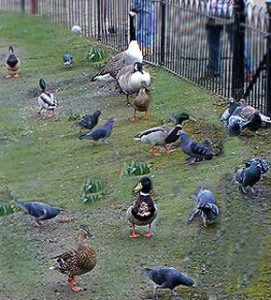
Ducks Geese and PigeonsI ought to be thinking “purer thoughts” or something . . . .
But I’ve been pondering this gospel bit all day, and although there are many things I could say about it, what keeps coming back to my mind is that (given the Phil Robertson, Duck Dynasty, A&E kerfluffle of the past several days) I’m glad that Jesus chose to make his point by separating sheep from goats, not geese from ducks.

I must be punchy (or maybe bird-brained) from Christmas preparations and sermon writing.

====================

A request to my readers: I’m trying to build the readership of this blog and I’d very much appreciate your help in doing so. If you find something here that is of value, please share it with others. If you are on Facebook, “like” the posts on your page so others can see them. If you are following me on Twitter, please “retweet” the notices of these meditations. If you have a blog of your own, please include mine in your links (a favor I will gladly reciprocate). Many thanks!

====================

Father Funston is the rector of St. Paul’s Episcopal Church, Medina, Ohio.

Bible Study – From the Daily Office – December 19, 2013

From the Gospel according to Matthew:

[Jesus said:] “Then the kingdom of heaven will be like this. Ten bridesmaids took their lamps and went to meet the bridegroom. Five of them were foolish, and five were wise.”

(From the Daily Office Lectionary – Matthew 25:1-2 (NRSV) – December 19, 2013.)

Open Bible with EyeglassesThe parable of the bridesmaids has always bothered me. Whenever I have to preach from it I have to get passed my first reaction, which is, “Really? People will be kept out of heaven for being stupid?” Of course, that is a misreading, or perhaps I should say “over-reading,” of the metaphor.

The message of this parable is once again the Advent message of preparation: it is an admonition to be ready for the unexpected return of the Lord, for the in-breaking of the kingdom of heaven. It has nothing to do with “getting into heaven;” it says nothing of the judgment of God, much less of the mercy of God. It is simply about being alert and prepared. The metaphor goes no further.

Extending metaphors beyond their point is often a danger with the things Jesus says! It is, truth be told, the danger with the whole of Scripture. Stories of God have to be read in the context of the whole of the Bible and understood to be limited in themselves; they tell only a part of the much-larger story.

I meet once a week with a group of people studying the Old Testament. The past couple of weeks we’ve been reading and discussing the books of Joshua and Judges. If one were to understand God solely on the basis of the stories of the conquest and settlement of Canaan, one’s picture of God would be that of a petty tyrant interested only in ritual, the acquisition of territory, and racial purity. You would read how God gave victory to the Israelite army and helped them annexed Canaanite territory simply because, with no military preparation at all, they marched around behind priests blowing trumpets. You would read how God then ordered them to slaughter all the men, women, children, and even livestock in some of the towns they captured simply to prevent them from intermarrying with the conquered Canaanites. You would read how God rewarded the Israelites for the behavior of Jael who lied, violated the laws of hospitality, and murdered a guest in her tent. You would read how God empowered Samson to be a judge over Israel, Samson who was, at best, a womanizer and a dolt! Not a pretty picture of God . . . although God’s granting power to Samson goes a long way toward countering the bridesmaids metaphor’s suggestion that God does not reward the stupid.

No. One cannot read selected bits of Scripture, whether they be the ritualized (and largely legendary) military history of the occupation of Canaan or the parabolic words of God Incarnate, out of the larger context of the entire witness of the Bible.

Perhaps that is part of “being prepared,” reading and appreciating the testimony of the entire Scriptures, being biblically literate, knowing the story in its grander dimensions. Advent is nearly over, but it is never too late to begin. Even a foolish bridesmaid or a stupid judge should understand that!

====================

A request to my readers: I’m trying to build the readership of this blog and I’d very much appreciate your help in doing so. If you find something here that is of value, please share it with others. If you are on Facebook, “like” the posts on your page so others can see them. If you are following me on Twitter, please “retweet” the notices of these meditations. If you have a blog of your own, please include mine in your links (a favor I will gladly reciprocate). Many thanks!

====================

Father Funston is the rector of St. Paul’s Episcopal Church, Medina, Ohio.

The Highway of Salvation – Sermon for Advent 3, RCL Year A – December 15, 2013

====================

This sermon was preached on the Third Sunday of Advent, December 15, 2013, at St. Paul’s Episcopal Church, Medina, Ohio, where Fr. Funston is rector.

(The Revised Common Lectionary, Advent 3A: Isaiah 35:1-10; Canticle 15 (The Song of Mary, Luke 1:46-55); James 5:7-10; and Matthew 11:2-11. These lessons can be read at The Lectionary Page.)

====================

Highway though Blooming Desert

There are some numbers that made the news this week: 194 and 11,507. They are important numbers, numbers which represent an unpleasant reality of the world in which we live. I’ll return to them in a moment. but first let’s explore the Scriptures assigned to this, the Third Sunday of Advent, the second week in a row the Gospel focuses on John the Baptizer.

Last week we heard from John himself, this week we have Jesus asking people why they paid attention to John: “What did you go out into the wilderness to look at?” he asks them. “A prophet,” would be the correct answer, but more than a prophet – the forerunner of the kingdom of God. Jesus draws on the tradition of the prophet Malachi through whom God had said, “See, I am sending my messenger to prepare the way before me . . . . ” (Mal. 3:1) It was Malachi who predicted that the Messiah would be heralded by the return of Elijah: “I will send you the prophet Elijah before the great and terrible day of the Lord comes.” (Mal. 4:5) This was and remains in Judaism a traditional expectation known to all Jews. By equating John with Elijah, Jesus was announcing to one and all that, in himself, the reign of heaven had begun, that salvation was at hand. Some who heard him took this testimony seriously, but many others rejected. We take it seriously and because we do, we are preparing once again to celebrate Jesus’ birth.

We take it seriously that salvation is at hand, but what do we really mean when we use that word, “salvation”?

I know that many will say that salvation is a personal thing. “If you confess with your lips that Jesus is Lord and believe in your heart that God raised him from the dead, you will be saved,” wrote Paul to the Romans. Many people believe that what this means is that, doing those two things, each person will get into heaven when he or she dies.

On the other hand, we have the witness of the prophet Isaiah in today’s reading from the Old Testament that salvation is more communal than personal. God “will come and save you,” he says: “Then the eyes of the blind shall be opened, and the ears of the deaf unstopped; then the lame shall leap like a deer, and the tongue of the speechless sing for joy.” Hands that are weak will be strengthened, knees that are feeble will be made firm, and those who are fearful of heart will be made strong. Salvation is something that happens for the whole human community.

And not only is salvation communal, it is universal! Not only is salvation for the human community, it is for the whole of creation! “Waters shall break forth in the wilderness” and “the burning sand shall become a pool.” “The desert shall rejoice and blossom; . . . it shall blossom abundantly.”

Isaiah makes it clear that salvation is so much more than personal; it is so much more than simply getting into heaven when we die. Salvation is for everyone; it is for everything; and it is for the here-and-now. Jesus affirms this when John sends word to Jesus and asks, “Are you the one?” Jesus replies: “Tell John what you hear and see: the blind receive their sight, the lame walk, the lepers are cleansed, the deaf hear, the dead are raised, and the poor have good news brought to them.” Notice that everything Jesus says is present tense! It’s here! It’s now! It’s not “will be;” it’s not “might be;” it’s not sometime in the future. It’s not in heaven when we die! It’s here and it’s now!

So why, then, if salvation is for everyone and everything in the here-and-now, are we told to wait “until the coming of the Lord?” Why in our Epistle Lesson does James tell us to “be patient [as] the farmer waits for the precious crop from the earth, being patient with it until it receives the early and the late rains?” That question haunted me during my prayers and my meditations this past week as I thought about what to say this morning. As I pondered the question, however, I came to realize that I was focusing on the wrong things. I was looking at and questioning the waiting and the patience, and I should have been fixing my attention on the farmer.

I grew up in a farming family. My nuclear family weren’t farmers, but my maternal great-grandfather, Hinrich Buss, homesteaded several thousand acres of Kansas farmland in the late 1800s and quite a few of my Buss cousins to this day run farms on that land. Some grow corn and soybeans; others run dairy farms. I know from family example that while farmers do a lot of waiting and have to be patient people, they are never idle. “Waiting with patience” doesn’t mean sitting around doing nothing; to wait and be patient as a farmer patiently waits is to be active, to be attentive, to take a hand in bringing about that for which one is waiting.

Salvation that transforms the human community, that enables all creation to sing together in present and eternal joy happens as people’s eyes are opened to see and their ears are unstopped to hear both the Good News of God in their own lives and the needs of others to know that Good News in their lives. When that happens, the desert wilderness blooms and becomes a verdant landscape.

Passing through that lush landscape, says Isaiah, there will be a highway. “It shall be called the Holy Way” and the redeemed shall walk upon it to Zion, singing and rejoicing as they go. How will that highway get there? In a few more chapters, Isaiah will answer that question by saying to the People of God, “In the wilderness prepare the way of the Lord, make straight in the desert a highway for our God.” That highway, the highway of salvation, will get there because the People of God will build it!

There is an old story about a time of economic depression in France. The government decided that it would put the unemployed to work building roads. Initially, this worked well: the workers received paychecks, their spirits were high, and the government was pleased with itself. But then some of the laborers began to ask where the roads were leading. The government had to admit that these roads were simply make-work; they were going nowhere, just out into a swamp or something. The workers became dispirited; they lost a sense of purpose in their work. In a very real sense, their eyes were shut and their ears were closed up because they had been robbed of the hope that they were making life better for others and for themselves.

Salvation happens, the highway in the wilderness gets built, when there is hope; hope is there when our eyes and ears are opened to perceive that God is in our midst and to know that amazing things are possible. People of God have known this in every generation and they have seen it in every generation. God “has mercy on those who fear him in every generation.” God shows “the strength of his arm” and “scatter[s] the proud in their conceit” in every generation. God “cast[s] down the mighty from their thrones” and “lift[s] up the lowly” in every generation. God “fill[s] the hungry with good things” and sends “the rich . . . away empty” in every generation.

God does these things through God’s People who in every generation have seen Isaiah’s vision of a God of infinite and unstoppable hope, who in every generation have wondered how to see it more clearly, how to believe it more firmly, and how, like the patiently waiting farmer, to actively and attentively take a hand in transforming the often unpleasant desert realities in which they live.

I mentioned some numbers earlier, numbers that I suggested represent an unpleasant reality of the world in which we live: 194 and 11,507. Yesterday was the one-year anniversary of the murder of 20 children and six adults at Sandy Hook Elementary School in Newtown, Connecticut. We were tragically reminded of that massacre by another shooting incident on Friday at Arapahoe High School in suburban Denver, Colorado. In our country during the year between those two incidents, 11,507 people have died from gunshots; 194 of them have been children 12 years of age or younger. It is an unpleasant reality of the wilderness in which we still live, where we are still called to build the highway of salvation.

Let us pray:

Almighty God our heavenly Father, you have promised to come and save us as the eyes of the blind are opened and the ears of the deaf unstopped: Open our eyes and unstop our ears that we may know that you are in our midst and may share your vision of infinite and unstoppable hope, that we may do the work of transforming unpleasant realities and building the highway of salvation for all; for the sake of him who was and is and is to come, your Son Jesus Christ our Lord. Amen.

====================

A request to my readers: I’m trying to build the readership of this blog and I’d very much appreciate your help in doing so. If you find something here that is of value, please share it with others. If you are on Facebook, “like” the posts on your page so others can see them. If you are following me on Twitter, please “retweet” the notices of these meditations. If you have a blog of your own, please include mine in your links (a favor I will gladly reciprocate). Many thanks!

====================

Father Funston is the rector of St. Paul’s Episcopal Church, Medina, Ohio.

« Older posts Newer posts »