Occasional thoughts of an Anglican Episcopal priest

Category: Matthew (Page 25 of 29)

The Eternal Now – From the Daily Office – September 5, 2012

From John’s Gospel:

Jesus said: “Your ancestor Abraham rejoiced that he would see my day; he saw it and was glad.” Then the Jews said to him, “You are not yet fifty years old, and have you seen Abraham?” Jesus said to them, “Very truly, I tell you, before Abraham was, I am.” So they picked up stones to throw at him, but Jesus hid himself and went out of the temple.

(From the Daily Office Lectionary – John 8:56-59 – September 5, 2012)
 
Salvador Dali, Persistence of TimeI’ve been sort of mulling this over all day. It’s one of those interesting mixed-tense things; Jesus uses the past tense for Abraham (“Abraham was”), but the present tense for himself (“I am”), while placing his presence before Abraham’s past. I think what he’s trying to do here his describe eternity. That’s not easy to do!

There was a sort of “pop theology” popular when I was getting my education for ordained ministry which made a distinction between two “kinds” of time: chronos (one of the Greek words for time) and kairos (another Greek word for time). The former is described as the former refers to our experience of sequential time; it is “human time.” It’s the time Steve Miller sang about with the lyric, “Time keeps on slippin’, slippin’, slippin’ into the future.” (Fly Like an Eagle) Kairos signifies a time of indeterminate nature in which something special happens; it is “God’s time.” It is, I suppose, eternity.

There’s a similar difference between “eternity” and “forever”, and I think it’s the same difference. “Forever” is an extension of sequential time. It’s the way in which time, as we experience, just keeps going on and on and on. But “eternity”, if it is kairos, is somehow outside of the linear sequence of our temporal experience. Eternity encompasses linear time. It was “before” time; it will be “after” time; it is “outside” of time. Forever might come to an end; it might slip into the future to point where it stops. Eternity or kairos, however, doesn’t, can’t, won’t – the concept of an end of eternity is meaningless.

Kairos or eternity, however, is also not the cyclical time of the Eastern religions. It isn’t the wheel of time or kalachakra of Hinduism and Buddhism. The problem (in my estimation) of that concept is that it makes existence seem a bit like a continuous-loop tape recording that plays over and over again, but never gets worn out. Nothing can be avoided; nothing can be changed. There is no final destination and, ultimately, there is no purpose to anything. As the French writer and filmmaker, Jean Cocteau said, “Nothing ever gets anywhere. The earth keeps turning round and gets nowhere.”

Cocteau, continued, however, “The moment is the only thing that counts,” and this (I believe) is where Jesus’ understanding and statement of who he was and is led him and leads us. When asked to teach his disciples to pray, Jesus taught them to focus on the moment: “Give us today our daily bread.” (Matt. 6:11; Luke 11:3) In the sermon on the mount he said, “Do not worry about tomorrow, for tomorrow will bring worries of its own. Today’s trouble is enough for today.” (Matt. 6:34) Rather than worry about one’s clothing or food or drink, he encouraged his followers to “strive first for the kingdom of God and his righteousness.” (v. 33) Be focused on the moment, the eternal now, eternity, kairos.

Ideas of past and future are just baggage. It has been said that depression results from trying to live in the past; anxiety comes from trying to live in the future. Psychologist Abraham Maslow said, “The ability to be in the present moment is a major component of mental wellness.” As Jesus made clear, it is a major component of spiritual wellness, too. Jesus ministry, among other things, was to bring eternity “into” time, kairos into chronos: “Before Abraham was, I am” is a statement of now, the eternal now, kairos.

====================

Father Funston is the rector of St. Paul’s Episcopal Church, Medina, Ohio.

The Blameless Bagged at Sunrise – From the Daily Office – August 31, 2012

From the Psalms:

To the leader: according to The Deer of the Dawn. A Psalm of David.

(From the Daily Office Lectionary – Psalm 22, introduction – August 31, 2012)
 
Deer at SunriseEpiscopalians reciting the Daily Office usually read the Psalms from The Book of Common Prayer, not from the Bible. This can cause some confusion about psalm verses because the versification and number of verses in the BCP differs from that in most Bible translations. The Psalter used in Anglican prayer books, including that of the Episcopal Church (until the 1979 book) was based on Miles Coverdale’s translation of the Bible which predated the Authorized (King James) version by nearly 80 years. The Coverdale Psalter had been used in all editions of The Book of Common Prayer, back to the first in 1549; while some editorial changes were made, the basic versification and numbering was maintained and this was continued in the 1979 version, which is a new translation but follows the tradition of Coverdale. Although not metrical, the translation was rendered with chanting in mind.

I often take a look at the Psalms in the New Revised Standard Version (my preferred translation) to see what differences there might be. Among the things not included in the BCP’s Psalter are the introductory directions and titles found in the Psalms in the Bible, so it was the introduction to this evening’s Psalm that caught my attention today, particularly the image “the Deer of the Dawn.”

Not all of the Psalms have these introductory directions; in fact, the majority do not. Some of them are clearly musical instructions: “On stringed instruments” (Ps. 41, 54, 55, 61, and 67), “For flutes” (Ps. 5), “According to the Sheminith” (Ps. 6 and 12, apparently a reference to an eight-stringed instrument, or perhaps to a particular meter or octave); “For the harp” (Ps. 8 and 81 ). Fifteen of the Psalms (120-134) are titled “songs of ascent”, which may be a liturgical direction or a reference to particular festival usage. Several Psalms, like this one, have introductory authorship ascriptions: for example, many say “a psalm of David”; a few are labeled “a psalm of Asaph”.

A few psalms, like today’s, have lovely, poetic images in their introductory rubrics. Psalm 56 is labeled “concerning the silent dove afar off”; Psalms 45 and 69 are “for the lilies”; and Psalms 60 and 80 are described is “on the lily of the testimony.” Some believe these might be references to popular tunes to which the Psalm is to be sung, but no one really knows.

In any event, the image of the “deer of the dawn” caught me up today. Psalm 22 is familiar to most Christians because Jesus is said by Matthew and Mark to have quoted its first verse on the cross: “My God, my God, why have you forsaken me?” (Matt. 27:46; Mark 15:34) Psalm 22 is prescribed in the liturgy for Good Friday, and is sometimes recited during overnight prayer vigils on Maundy Thursday. But in none of those usages is the introductory rubric and this image, “the deer of the dawn,” mentioned; the introductory directions are not read as part of the liturgy.

I am not a hunter. I can safely say that I have never shot at a wild animal, ever. But I have many friends who are hunters and they tell me that dawn is the best time to go after deer. They tell that the earliest hours of the morning are when the deer are most active. Right around dawn is when they leave their beds and move to feeding areas. A spot near a trail between the two will give a hunter a good opportunity for an hour or two after sunrise. I believe this because our home backs up to a wooded easement a few miles in length and about 500 yards wide. I usually rise just about at dawn and as I get my first cup of coffee in the dim light of the kitchen, I can just make out the woods and any movement there may be. Frequently, a doe and one or more fawns or yearlings will be moving through the trees . . . often headed for our landscaping to munch on our hostas and other plants! (I have never shot at a wild animal . . . but I have been tempted.)

It seems somehow oddly appropriate that Jesus quoted from this Psalm and that it is used at late-night Maundy Thursday vigils and at Good Friday liturgies. Not simply because of Jesus’ words, nor because the Psalm includes such crucifixion-relevant language as

All who see me laugh me to scorn;
they curl their lips and wag their heads, saying,

“He trusted in the Lord; let him deliver him;
let him rescue him, if he delights in him.”

(and)

They stare and gloat over me;
they divide my garments among them;
they cast lots for my clothing.

(Ps. 22:7-8, 17)

But because of this almost-forgotten introductory image “the deer of the dawn.”

We are told in Mark 14 and Matthew 26 that after the passover supper, Jesus took Peter, James, and John to the garden at Gethsemane and spent some time in prayer. It has always seemed to me that this must have stretched over several hours and that his betrayal and arrest must have occurred in the early morning hours. The Temple authorities, soldiers, and police who came to get him chose a time and a place not unlike a deer hunter, a time when they would have the best opportunity to find him, the best shot to take him. Jesus is “the Lamb of God” but it seems he is also “the deer of the dawn,” the innocent taken in the quiet of the new day’s early hours, the blameless bagged at sunrise.

====================

Father Funston is the rector of St. Paul’s Episcopal Church, Medina, Ohio.

Brotherly Advice – From the Daily Office – August 29, 2012

From John’s Gospel:

Now the Jewish festival of Booths was near. So [Jesus’] brothers said to him, “Leave here and go to Judea so that your disciples also may see the works you are doing; for no one who wants to be widely known acts in secret. If you do these things, show yourself to the world.”

(From the Daily Office Lectionary – John 7:2-4 – August 29, 2012)
 
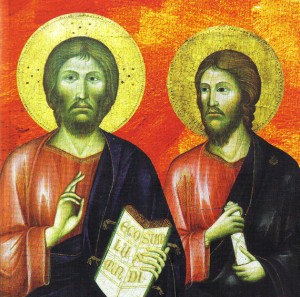
Icon of Jesus and his brother JamesThe picture of Jesus getting advice from his brothers just tickles me. John makes such a deal of it (while pointing out that his brothers did not believe in him – as the Messiah, I suppose – at the time). It seems so at odds with John’s otherwise oh-so-perfect, oh-so-divine Jesus!

It isn’t clear who these brothers are; there are some who suggest they are older half-brothers. Although there’s no biblical warrant for this, there is this pious invention of a first family for Joseph. The story is that Joseph was a lot older than Mary, had been married before, and had sons from that first marriage. Thus, Mary became a step-mother and Jesus had a bunch of older half-brothers. The reason for this invention is a belief in the “perpetual virginity” of Mary which seems to have originated in the 2nd Century with Irenaeus; his contemporary Origen came up with the step-brothers theory. What I always wonder about is why there’s no mention of these other kids in the few stories we have of Christ’s infancy and childhood. Where were they when Joseph and Mary made the trip to Bethlehem? Did they go along (then why aren’t they portrayed in Luke’s Gospel)? Or were they left home with relatives? What about the flight to Egypt? Surely Joseph wouldn’t have left them behind while he moved to another country! Were they with the family in Jerusalem when, instead of joining the return party, Jesus stayed behind to dazzle the Temple intellectuals? If they were, why didn’t they help in the search for the missing boy? Anyway, as this probably makes fairly clear, the whole perpetual virginity thing seems suspect to me.

So if these brothers aren’t Joseph’s boys from a first marriage, they must be Joseph’s and Mary’s subsequent issue; after all, Jesus is described by Luke as Mary’s “firstborn” (Luke 2:7). Presumably they are “James and Joses and Judas and Simon” (named in Mark 6:3 and Matthew 13:55), and they are Jesus’ younger brothers.

I never had a younger brother. I had an older brother (nearly a decade older, in fact). He passed away several years ago and I often miss his brotherly advice. We were not close during my childhood, but once I was in college we got close and became good friends. It helped that we lived in the same metropolitan area; I was a student at UC:San Diego and later at California Western School of Law in San Diego; my brother was on the faculty at San Diego State University. We saw each other often, enjoyed each other’s company, and I often turned to him for counsel.

Jesus getting advice from his brothers (whether they were older or younger doesn’t really matter) appeals to me. I can relate to that picture of Jesus and it helps me to believe that Jesus can relate to me. I believe Jesus can (and does) give me brotherly advice.

====================

Father Funston is the rector of St. Paul’s Episcopal Church, Medina, Ohio.

Citizenship and Prayer – From the Daily Office – August 11, 2012

From the Acts of the Apostles:

Now the whole group of those who believed were of one heart and soul, and no one claimed private ownership of any possessions, but everything they owned was held in common. With great power the apostles gave their testimony to the resurrection of the Lord Jesus, and great grace was upon them all. There was not a needy person among them, for as many as owned lands or houses sold them and brought the proceeds of what was sold. They laid it at the apostles’ feet, and it was distributed to each as any had need.

(From the Daily Office Lectionary – Acts 4:32-35 – August 10, 2012)

This short passage from the Book of Acts describes the sort of world Jesus intended. Not just the sort of church . . . . the sort of world, the sort of human society, a complete community in which no one claims private ownership (it’s all God’s remember) and where there are no needy persons because what is needed is distributed equitably.

Dream world, right? Never gonna happen, you say? Then what do we mean when we say (some of us everyday, but a lot of at least once a week), “Our Father in heaven . . . your kingdom come”? If we don’t mean it, if we don’t want God’s kingdom to come, why do we keep asking for it? (Jesus taught this petition to his disciples when they asked him to teach them to pray. See Matthew 6:9–13 and Luke 11:2–4.)

I got into a beef in an on-line recently because another person attributed Massachusetts Senator Scott Brown’s criticism of his state’s Department of Transitional Assistance to his Christianity. Brown was upset because the department had mailed voter registration materials to some 400,000 welfare recipients; he interpreted this as a pro-Democratic-Party action by the department. (In fact, it was in compliance with a court order regarding the state’s failure to comply with “motor voter” regulations.) Nowhere in the article to which my correspondent referred was there any mention of Brown’s Christian faith (he is reportedly a member of the conservative Christian Reformed Church) by either Brown or the reporter. I objected to this person’s statement as a gratuitous and groundless comment, and a lengthy conversation ensued. (It was eventually and abruptly terminated by my correspondent.)

It got me thinking, though, about how we characterize the actions (political or otherwise) of other people and how in modern America we seldom hear positive actions (other than those expressly undertaken by the church) characterized as Christian! Programs which aid the poor, the elderly, the very young, or others in need are criticized as “socialist” even though that is precisely what the apostles set up in their first century community (long before, it should be noted, any western European economics theorist coined the term “socialist”). They are referred to as “entitlements”, a word often said with a sneer. If they are defended, it is on the grounds not of Christian practice but of some theory of economics or general ethics. The Constitutional separation of church and state, I suppose, is at work here. But for those who do support them and are Christians, if we really mean what we pray in the Lord’s Prayer (or any prayer of intercession for the poor and the needy for that matter), shouldn’t we applaud such programs as consonant with our faith? Shouldn’t we be giving and working toward their success because they are, in fact, elements of that world Jesus intended?

My staunchly Methodist grandfather taught me a number of things. A couple of them come to mind today. He taught me to never approach the altar of God without a gift of thanksgiving. Even if you’ve already made your weekly tithe (and he insisted that one give a tithe, a tenth of income), if you attend another prayer service give another offering. Those offerings, he said, are means by which God’s church carries out God’s work and answers at least some of our prayers. He taught me the same thing about taxes. I don’t know if he was familiar with Justice Oliver Wendell Holmes’s famous statement, “Taxes are the price we pay for a civilized society,” but that was certainly his attitude. He taught me that paying one’s taxes is the way the citizen enables the government to do the work it is created to do: the Preamble to our Constitution says that that is, among other things, to “establish justice, insure domestic tranquility, provide for the common defence, promote the general welfare, and secure the blessings of liberty to ourselves and our posterity.” Providing for the poor, the elderly, the very young, and other needy persons sure seems to me to fit in there.

Another thing he taught me was never to pray for something I was not willing to work for. If you pray for someone to be healed, be willing (and available when called upon) to care for that person. If you pray for war to be ended, be willing (and available when called upon) to do the work of creating peace.

That’s what prayer was to my grandfather: giving and working. I think that’s what citizenship was to him, as well. If everyone who prays “your kingdom come” actually gave and worked toward the kingdom’s appearance, if everyone also looked at their citizenship that way, I suspect that we’d hear a lot less criticism of “entitlements” and that the world would look a lot like what is described in that short bit from the Book of Acts.

====================

Father Funston is the rector of St. Paul’s Episcopal Church, Medina, Ohio.

Traditional Biblical Marriage: Say What!? – From the Daily Office – August 9, 2012

From John’s Gospel:

Now Gideon had seventy sons, his own offspring, for he had many wives. His concubine who was in Shechem also bore him a son, and he named him Abimelech. Then Gideon son of Joash died at a good old age, and was buried in the tomb of his father Joash at Ophrah of the Abiezrites.

(From the Daily Office Lectionary – Judges 8:30-32 – August 9, 2012)

Wedding RingsOK. I know I shouldn’t get into this . . . I know that someone is going to give me a hard time; I can almost predict that someone will tell me they are planning to “leave the church” over this. But here goes.

I am sick and tired of hearing the words “traditional biblical marriage” bandied about by those who oppose the legal and religious recognition of the committed relationships of same-sex couples. Absolutely fed up with it. Because there is no such thing! Read these three verses from the Book of Judges slowly and carefully because they describe the marriage (or should one say marriages . . . or perhaps “sexual relations”) of one of the greatest heroes of the Bible. And what they describe is a far cry from what the proponents of so-called “traditional biblical marriage” think they are talking about about; Gideon was very definitely not in a “one man, one woman” marriage. The text doesn’t tell us how many wives he had, but with seventy sons I would estimated that he had at least fifteen if not a lot more! And he had at least one concubine! It’s entirely possible that he married his wives as part of some political arrangement with their families or tribes, and that it was his concubine who was his actual love interest.

I need not rehearse here the variety of marital arrangements one finds in the Holy Scriptures. Esther J. Hamori, Associate Professor of Hebrew Bible at Union Theological Seminary has already done a superb job of that in an article for the Huffington Post, Biblical Standards for Marriage. Suffice to say that there are all sorts of culturally conditioned settlements . . . and that’s the significant point, “culturally conditioned”. Our Bible does not and never has set down one sort of standard (for interpersonal relationships or for most other things) that is immutable and permanent; the Bible is a collection of stories of changing norms of behavior stretching over centuries. These changeable and changing behavioral norms may be grounded in a set of ethical or religious principles, but they adapt as cultures and conditions change.

I should also note, but will not dwell upon, the history of marriage (or “matrimony”) as a sacrament of the church. It wasn’t one for about the first millennium of the Christian era! The church wasn’t involved in overseeing marriages at all, but as the clergy became society’s record-keepers, and as the rising post-Empire royalty and aristocracy needed some control on the descent of property and titles, the church became involved. Initially it was only as record-keepers, but then ceremonies and rituals were devised and then, eventually, someone began theologizing about the marital estate and the church’s role in helping it be contracted . . . and, before you know it, Voila! It’s a Sacrament . . . and it’s “always” been one. And, of course, it is now incumbent upon all of society, not just the upper crust, to have church-approved marriages.

We live in a different world from Gideon, so fifteen wives and one or more concubines probably probably would not be an acceptable (or practical) living arrangement for a modern man. We live in a different world from medieval Europe. Marriage is no longer (usually) a political arrangement as it generally was in both those times; today, our concept of marriage honors the emotional attachment of the parties. Today, we know that that emotional attachment, that affective attraction is not universally a heterosexual one; we know that some definite percentage of the human species is affectively attracted to members of their same sex. We know that this is not a deviation from the norm; it is the norm. And knowing that, our culture is changing and the culturally conditioned normative behavior of marriage is changing with it.

The task ahead for religious people is not to insist upon enforcing as unchangeable the cultural norms of a long-departed world like Gideon’s. The task is, rather, to re-apply the underlying ethical and religious principles to our new situation. For Christians, this means looking to the two greatest commandments as stated by Jesus: Love God with all your heart, all your mind, and all your strength, and love your neighbor as yourself. (Matt. 22:37-40) Given that, how can we not re-assess our understanding of marriage? How can we not extend our blessing to the committed relationships of same-sex couples? How can we not give up some false notion of “traditional biblical marriage” and instead embrace Christ’s ethic of loving God and loving our neighbor?

====================

Father Funston in the rector of St. Paul’s Episcopal Church, Medina, Ohio.

The Peaceable Thing? – From the Daily Office – July 20, 2012

Paul wrote to the church in Rome:

Let love be genuine; hate what is evil, hold fast to what is good; love one another with mutual affection; outdo one another in showing honor. Do not lag in zeal, be ardent in spirit, serve the Lord. Rejoice in hope, be patient in suffering, persevere in prayer. Contribute to the needs of the saints; extend hospitality to strangers. Bless those who persecute you; bless and do not curse them. Rejoice with those who rejoice, weep with those who weep. Live in harmony with one another; do not be haughty, but associate with the lowly; do not claim to be wiser than you are. Do not repay anyone evil for evil, but take thought for what is noble in the sight of all. If it is possible, so far as it depends on you, live peaceably with all.

(From the Daily Office Lectionary – Romans 12:9-18 – July 20, 2012)

I once served under a bishop who used a slightly edited version of this text as his final blessing at the conclusion of a eucharist, adding “and may the blessing of God Almighty (etc.)” to Paul’s admonitions. Whenever he would recite these words, my mind would stumble over that last sentence: “If it is possible, so far as it depends on you, live peaceably with all.” Doesn’t it always depend on us? Isn’t that the point of the gospel mandate, to live peaceably with all even when they don’t want to? Isn’t that what “turn the other cheek” and “give even your cloak” and “go the extra” (Matt. 5:39-41) mile are all about? It is always in our power to do the peaceable thing.

As I read this lesson and contemplate its meaning and find this minor disagreement with Paul, I am also mindful of last night’s dreadful events in Aurora, Colorado, another mass killing. At last report, 14 killed and 50 or more injured by a gunman at a movie theatre.

On our parish’s Facebook page this morning, I posted the same picture I am attaching here, together with this prayer which I edited out of the New Zealand Prayer Book:

O Lord, we commend those killed and injured in the shooting in Aurora, Colorado, into your loving care. Enfold them in the arms of your mercy. Bless those who died in their dying and in their rising again in you. Be with those who are injured and give wisdom and skill to those who care for them. Bless those whose hearts are filled with sadness, that they too may know the hope of resurrection; for the sake of our Savior Jesus Christ. Amen.

How is it possible to bless and not curse the killer? How is it possible to “live in harmony” in this instant? I confess that I do not know and that the lawyer part of me, the litigator, wants to see him hanged from the gallows as soon as possible. But the Christian part of me reads this lesson and struggles not to be on the side of repaying evil with evil. The best I can do is to pray for the victims and, as for the shooter, offer the prayer that Jesus taught us: “Thy will, O Lord, be done.” That’s the best I can do. I hope that it will suffice as the peaceable thing today.

====================

Father Funston in the rector of St. Paul’s Episcopal Church, Medina, Ohio.

Always the Poor – From the Daily Office – July 19, 2012

From Matthew’s Gospel:

Now while Jesus was at Bethany in the house of Simon the leper, a woman came to him with an alabaster jar of very costly ointment, and she poured it on his head as he sat at the table. But when the disciples saw it, they were angry and said, “Why this waste? For this ointment could have been sold for a large sum, and the money given to the poor.” But Jesus, aware of this, said to them, “Why do you trouble the woman? She has performed a good service for me. For you always have the poor with you, but you will not always have me.”

(From the Daily Office Lectionary – Matthew 26:6-11 – July 19, 2012)

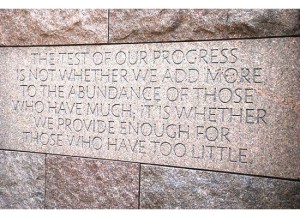
In yesterday’s gospel lesson Jesus told the story of the king separating the righteous form wicked as a shepherd separates sheep from goats and saying “As you care for the poor, you care for me.” It reminded me of a few cogent remarks that have been made about the measure of society – From Samuel Johnson: “A decent provision for the poor is the true test of civilization.” From Mahatma Ghandi: “A nation’s greatness is measured by how it treats its weakest members.” From Franklin Delano Roosevelt: “The test of our progress is not whether we add more to the abundance of those who have much, it is whether we provide for those who have too little.”

Now is Jesus giving up? “You will always have the poor with you.” Is he saying, “No matter how much you do for the poor, it won’t be enough”? And then he says, “But you won’t always have me,” which excuses the act of costly worship performed by the unnamed woman. So fancy rituals are to be preferred to service to those in need? Is that what this means?

I think not, at least I hope not. I believe that Jesus is making reference to an observation in the Book of Deuteronomy: “Since there will never cease to be some in need on the earth, I therefore command you, ‘Open your hand to the poor and needy neighbor in your land.'” (Deut. 15:11) What appears to be going on in this incident is an illustration of timeliness and priority. Service to the poor is a constant obligation but, at that particular time and place, service to Jesus as he prepared to die took priority.

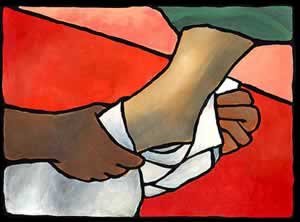
Worship and adoration of God are a priority; in fact, they may be the central priority of the church. An occasional foray into what we might call “pure” worship (the sort of ritual and ceremony Christians do on Sunday morning, for example) is certainly needed, but constant worship as an activity of everyday life is what is enjoined, constant worship in the context of constant service. “Rejoice in the Lord always; again I will say, Rejoice.” (Philip. 4:4) The key word is “always” – not just in the special moments when take time to wash and anoint his feet. We must, as Brother Lawrence admonishes, accustom ourselves to continual conversation with God; this can and should be done in all we do, especially in and during our service to poor whose feet also need washing (remember Bishop Weston’s words quoted yesterday).

Recently, I heard a preacher suggest that a way to understand Jesus’ reference to Deuteronomy, his statement that “you always have the poor with you,” is that it is with the poor that Jesus’ followers will be found; if we truly live out his gospel, we always will be found among and serving the less fortunate of society. This is as much worship as the Mass on Sunday.

So there is no real dichotomy; there was no “giving up”. There was, simply, a recognition of time and place and priority. And the statement of an unfortunate truth: we always have the poor with us.

====================

Father Funston in the rector of St. Paul’s Episcopal Church, Medina, Ohio.

The Heart of the Gospel – From the Daily Office – July 18, 2012

Jesus told of the separation of sheep and goats:

The king will say to those at his right hand, “Come, you that are blessed by my Father, inherit the kingdom prepared for you from the foundation of the world; for I was hungry and you gave me food, I was thirsty and you gave me something to drink, I was a stranger and you welcomed me, I was naked and you gave me clothing, I was sick and you took care of me, I was in prison and you visited me.” Then the righteous will answer him, “Lord, when was it that we saw you hungry and gave you food, or thirsty and gave you something to drink? And when was it that we saw you a stranger and welcomed you, or naked and gave you clothing? And when was it that we saw you sick or in prison and visited you?” And the king will answer them, “Truly I tell you, just as you did it to one of the least of these who are members of my family, you did it to me.”

(From the Daily Office Lectionary – Matthew 25:34-40 – July 18, 2012)

More than any other story in all of the gospel accounts, this one underscores for me what is at the heart of the Good News of Jesus Christ: love of neighbor, service to others, care for those who are unable to care for themselves, and in so doing to demonstrate our love of God.

The First Letter of John sums it up beautifully: “Those who say, ‘I love God,’ and hate their brothers or sisters, are liars; for those who do not love a brother or sister whom they have seen, cannot love God whom they have not seen. The commandment we have from him is this: those who love God must love their brothers and sisters also.” (1 John 4:20-21)

Samuel Johnson was quoted by his biographer, James Boswell, as saying “A decent provision for the poor is the true test of civilization.” A similar sentiment, “A nation’s greatness is measured by how it treats its weakest members,” is attributed to Mahatma Ghandi. In his second inaugural address, President Franklin Delano Roosevelt said, “The test of our progress is not whether we add more to the abundance of those who have much, it is whether we provide for those who have too little.”

In the sacristy of the first church I served as a cleric (which was also the parish that raised me up as a candidate for Holy Orders) was a quotation from the Rt. Rev. Frank Weston, Bishop of Zanzibar from 1908 until his death in 1924. Speaking at the conclusion of a worldwide Anglo-Catholic Congress in London the year before his death, Bishop Weston had reminded his listeners, “You cannot claim to worship Jesus in the Tabernacle, if you do not pity Jesus in the slum.” He concluded his speech with these words:

You have got your Mass, you have got your Altar, you have begun to get your Tabernacle. Now go out into the highways and hedges where not even the Bishops will try to hinder you. Go out and look for Jesus in the ragged, in the naked, in the oppressed and sweated, in those who have lost hope, in those who are struggling to make good. Look for Jesus. And when you see him, gird yourselves with his towel and try to wash their feet.

This message has been proclaimed by many speakers in many ways and at many times, but however it is said, it all boils down to the simple fact that as and what we do for the least in our community, we do for God. If we fail to provide for them, all our words and rituals count for nothing. This is the heart of the gospel.

====================

Father Funston in the rector of St. Paul’s Episcopal Church, Medina, Ohio.

Risky Talents – From the Daily Office – July 17, 2012

Jesus told the parable of the talents:

The one who had received the one talent also came forward, saying, “Master, I knew that you were a harsh man, reaping where you did not sow, and gathering where you did not scatter seed; so I was afraid, and I went and hid your talent in the ground. Here you have what is yours.” But his master replied, “You wicked and lazy slave! You knew, did you, that I reap where I did not sow, and gather where I did not scatter? Then you ought to have invested my money with the bankers, and on my return I would have received what was my own with interest.

(From the Daily Office Lectionary – Matthew 25:24-27 – July 17, 2012)

You know this story. A rich man goes away for some period of time entrusting huge amounts of wealth to his servants. To one he gives five talents, an amount of silver roughly the value of one hundred years of work of an ordinary laborer. To another two and to the third one. The first two use the money and double it. The third, timid and fearful of his employer’s reprisal should he lose it, buries it in the ground. Upon the owner’s return, he is punished for failing to invest the money.

It seems unfair that he should be punished for giving back exactly what he was given. He hasn’t wasted the property; he hasn’t squandered it or take it for his own. The rich man got back every thing he left with him.

I’ve always thought that if the servant had invested the money and lost it, there would have been no punishment. I believe that if the investment had been well thought out, even if it failed, the rich man would have shrugged it off and said, “Fair play!” This isn’t a story about rewarding success; it’s a story about rewarding risk. It’s a story which encourages us to move out of our comfort zones, take a risk, and try something. Jesus wants his followers to take risks; he certainy took plenty of them himself.

It’s been said that Christianity is an adventure of the spirit or it is not Christianity. Christians are called to eschew safety and security, and do the tasks that only Jesus’s people can do. We are called into ministries that take us out of our comfort zones and stretch us beyond the circle of relationships and practices with which we are familiar in our usual faith communities. All around us there are opportunities for extraordinary and life-changing interaction with other people, but require that we move into greater uncertainty and engage in activities in which we have a great chance of feeling discomfort, encountering resistance, or being required to make personal sacrifice.

The author Jack London once wrote:

I would rather be ashes than dust!
I would rather that my spark burn out in brilliant blaze than it be stifled by dry rot.
I would rather be a superb meteor, every atom of me in magnificent glow, than a sleepy and permanent planet.
The proper function of man is to live, not exist.
I shall not waste my days in trying to prolong them.
I shall use my time.

Whatever talents we have been given, we are to use them, not bury them in the ground.

====================

Father Funston in the rector of St. Paul’s Episcopal Church, Medina, Ohio.

A Prophetic General Convention – Sermon for Pentecost 7, Proper 10B – July 15, 2012

====================

This sermon was preached on Sunday, July 15, 2012, at St. Paul’s Episcopal Church, Medina, Ohio, where Fr. Funston is rector.

(Revised Common Lectionary, Proper 10B: Amos 7:7-15; Psalm 85:8-13; Ephesians 1:3-14; and Mark 6:14-29)

====================

In our lessons today, we have two stories about silencing the prophetic voice. First, a snippet of the not-very-familiar story of the Prophet Amos which is, frankly, cut from its context so badly that some explanation really is necessary. Second, the almost-too-familiar story of the beheading of John the Baptizer.

Amos, as he is at pains to say to the priest Amaziah, is not a professional prophet: “I am no prophet, nor a prophet’s son; but I am a herdsman, and a dresser of sycamore trees.” Nonetheless, Amos was commissioned by God in the middle of the 8th Century before Christ to leave his home in the southern kingdom of Judah, travel to the northern kingdom of Israel, and deliver there a condemnation of Israel, its monarch and its people. In this portion of his story, he tells of God showing him four quick visions, of which the plumb line is the third. First, he is shown a swarm of locusts, illustrating that God will wipe out Israel just as locusts wipe out a crop. Second, he is shown a shower of fire that would “eat up the land.” After each of these, Amos speaks up in defense of Isreal and God relents. Third is the vision we heard in the lesson, the plumb line; Amos, however, does not defend Israel after this vision. Instead, the series of visions is interrupted by the tale of the priest Amaziah and his attempt to silence this prophet.

Amos has delivered his message to Amaziah, a message to the whole of the country, but Amaziah, who is high priest at the king’s shrine at Bethel, has edited it before delivering it to the king. Instead of a message to the whole of society, he has made it sound like nothing more than a personal threat against the king and now, certain of the king’s reaction, he warns Amos to flee, to return to the south to make his living as a prophet there, but never to prophecy again in Israel. This is where Amos protests that he is not a professional prophet, but earns his living in agriculture; and this is where the lectionary reading ends. But it is not where the story ends.

Because of his attempt to silence the prophecy, Amos speaks a word from God for Amaziah, predicting that his family will fall in ruin and dishonor and that he himself will die “in an unclean land.” Amos then tells of the fourth of his visions, a bowl of fresh fruit which God explains illustrates that God’s patience with Israel is at an end. It’s a pun in Hebrew, the word for fruit being qay’its and that for end being qets. In English, I suppose, we would say that God is calling it quits with these people. The story ends with God’s final word to Amaziah, to the all of Israel, and to anyone who would muzzle his prophets: “Be silent!” Those who would interfere with God’s word to God’s people are themselves to shut up or face consequences like those promised Amaziah!

Which brings us to the gospel lesson and the beheading of John the Baptizer. It’s so familiar it hardly needs rehearsing, but let’s just refresh our memories, anyway.

Herod imprisoned John in an attempt to appease his wife Herodias because John had been raling against her and her marriage to Herod, who was her brother-in-law before he was her spouse and, therefore, John considered the marriage adulterous. (Some suggest that Herod did so to prevent Herodias from killing John herself.) At a birthday party he threw for himself, Herod witnessed a dance by his step-daughter and was so taken that he made a rash promise to give her anything she might ask for, up to half his kingdom. Consulting her mother, the girl asks for John’s head on a platter. Hoist on the petard of his public promise, Herod has no choice but to give her what she asks, even though he was quite fearful that John was, indeed, a prophet of God. Not recorded in the Bible is the fact that not too long after the events portrayed in the Gospels, Herod was deprived of his kingdom and all his property, and died in squalid poverty exiled to Gaul. Silencing God’s prophets, again, is obviously a really bad idea!

While I would be the last to suggest that the Episcopal Church or any of its leaders are equivalent to Amos or John the Baptist, I do believe that from time to the Church does speak with a prophetic voice. I believe that, in part, because of Christ’s promise that “where two or three are gathered in my name, I am there among them” (Matt. 18:20) and because it has been the tradition and belief of the church since the very first Ecumenical Counsel that (as some Lutheran bishops recently put it) “we trust that God’s Spirit will form the wisdom of God’s faithful people gathered in deliberative assembly.” (ELCA Conference of Bishops, March 10, 2009)

Over 1,000 Episcopalians on Thursday concluded the bicameral deliberative assembly known as The General Convention of the Episcopal Church: 165 bishops participated as voting members of the junior house; 844 lay and clergy deputies, as voting members of the senior house. They were presented with over 440 pieces of business ranging from courtesy resolutions commending the host hotel’s staff to the adoption of a budget for the next three years to the approval of new liturgies to the election of new leadership. Much of that was done quickly, with little fan-fare and hardly any notice. Much of it was done with the boring, long-drawn-out tedium that careful legislative work often seems to entail, but again with little notice. Some of it has received and will receive the attention of a secular press itching for scandal and sensationalism, eager to sell its advertising by selling the world a picture of a church gone (as Bishop Michael Curry of North Carolina, in fact, urged it in his keynote sermon) crazy! (Of course, Bishop Curry was encouraging the church to go “crazy for Christ,” something the secular press will overlook.) Some of what the church did at the 77th General Convention will, I believe, be seen in years to come to be truly prophetic, in the best sense of that word, speaking God’s Truth to a world in need of hearing it, and I suspect that there will be those who try to silence the Convention’s message or stop its actions as Amaziah and Herodias did those of Amos and John the Baptist.

Of all the work done by the Convention, there were three areas in which I believe its actions are the most important. First, it acted in regard to marriage and the promises couples make to one another when forming life-long, loving, and committed relationships. Second, it affirmed the church’s traditional understanding of the dominical sacraments of Baptism and Eucharist. Third, it committed the church to structural and organic reform.

With regard to life-long interpersonal commitments, the Convention called for an in-depth study and proclamation of the church’s contemporary theology of marriage. This, in my opinion, has been needed for many years. Holy Matrimony is one of the five sacramental rites of the church which our Articles of Religion tell us arise from “states of life allowed in the Scriptures” but which have neither “visible sign [n]or ceremony ordained of God.” (Art. XXV, BCP page 872) Marriage is one of those “Traditions and Ceremonies” that it “is not necessary . . . be in all places one, or utterly like.” (Art. XXXIV, BCP page 874) Since it was first identified as a sacrament in about the 10th Century, marriage practices “have been divers,” and the Articles of Religion assure us “may be changed according to the diversity of countries, times, and men’s manners.” (Ibid.) After a thousand years of monkeying about with marriage willy-nilly, and believe me we have done just that throughout the church’s history, taking a good, hard, methodical look at our theology and practice is a great idea!

In the same area, the Convention approved a provisional rite for the blessing of the committed, life-long relationships of same-sex couples. This is the one action that I am sure will be most discussed and most mischaracterized in the secular press. The Standing Liturgical Commission, which developed this rite, and the deputies and bishops who adopted it, have been quite clear that this is not marriage liturgy; it does not confer the sacrament of Holy Matrimony. Furthermore, it is a provisional rite, which means it may only be used provided certain conditions are met. I confess that I have not read the enabling legislation, but it is my understanding that this liturgy may only be used in those States or foreign jurisdictions where the civil authorities have either made the legal state of marriage open to same-sex couples or have created some other form of legally recognized civil union for such couples. Furthermore, it may only be used with the permission of the local bishop.

The second area of important action was in regard to the Sacraments of Baptism and Holy Communion. There was a motion put forward by the Diocese of Eastern Oregon to change the canons of the church so as to permit, as a regular matter, those who are not yet baptized to receive the Sacrament of the Altar. This would have changed what has been the practice and tradition of the church since its very beginning; there has never been a time when it was not considered necessary that a person be baptized before being invited to partake of the Body and Blood of Christ. While we do not check ID’s at the altar rail or communion station, and while we do now open our communion to all who are baptized in any Christian tradition (no longer restricting the Eucharist to those confirmed in the Episcopal Church), the General Convention was not willing to make that change. Instead, in a substitute resolution, the bishops and deputies affirmed that it is the normative practice and expectation of this church that Baptism precede reception of Holy Communion, and affirming that the Episcopal Church invites everyone to be baptized into the saving death and resurrection of Christ Jesus.

The third and, I believe, most important of what I have called the prophetic actions of the General Convention is to take the first step toward reorganization and restructuring of the Episcopal Church. We have a national, provincial, and diocesan structure which is often top-heavy, unwieldy, and counter-productive. One of the buzz-words of recent Convention was “nimble” – that is not a word that in any way, shape, or form describes the Episcopal Church! It doesn’t even describe one of our parishes let alone the entire national organization! All too often we find ourselves standing in our own way, tripping over our own feet. In passing the resolution to re-imagine and restructure the church and calling for a task force made up of new and younger leaders to do so, the General Convention has said that we will get out of the way; we will get out of the Spirit’s way; we will get out of our own way!

There is much work to be done, but it seems to me that the hardest work will be the letting-go and stepping-aside . . . letting go of old ways of doing and being church, letting go of expectations of how things have always been done and how we think they ought to be done, letting go of office and power by those who have governed the church for generations, letting go of the hurt and pain of change . . . stepping aside to allow those newer, younger leaders to come forward, stepping aside to let the Holy Spirit come in, stepping aside to free the center so that it may be filled with something new and different. I hope that the hard work of letting-go and stepping-aside will get done, although I’m not convinced that it will.

Shortly after adopting that resolution, the House of Deputies was given an opportunity to elect newer and younger leadership. It chose instead to elect as its president someone who has been a General Convention deputy eight times and who has had a seat in the highest councils of the church for years. It elected as its vice-president someone who has been a deputy at every General Convention since 1973. I know both of these individuals and I know that they are faithful, dedicated, and capable, but I have to be honest – these folks are part of the well-entrenched, long-experienced cadre of church governors; this is leadership that is anything but new or young (and it pains me to say that since the new president and I are essentially the same age). Still, I live in hope that they can and will, in fact, facilitate and accomplish the change that is needed, because (as I said earlier) I trust that God’s Spirit forms the wisdom of God’s faithful people gathered in deliberative assembly.

So let me bring us back to our lessons for today. What might they be teaching us about how to respond to the actions of our recently-concluded General Convention?

Well . . . first, I suggest that the story of Amos and Amaziah, and the story of the Baptizer and Herodias, these stories in which someone sought to silence the prophetic word encourage us to be aware of the distortions we may hear from both the religious and the secular media. Just as Amaziah misrepresented and tried to silence Amos’s prophecy when relaying it to King Jeroboam, so too may we find the reports distorting the actual words and actions of the Convention in an attempt to undermine and stop them. Just as Herodias sought to behead John, so too we may find the detractors of our church trying to assassinate the character of our leaders.

Secondly, the defense of prophecy in the Book of Amos with its pronouncement of judgment against Amaziah or the end to which Herod and Herodias came might stand as cautionary tales against our own tendency to silence whatever it is that we find unpalatable in the prophetic voices of our church’s Spirit-led Convention, voices calling us to change in those areas in which we as a church and as individuals may be in the greatest need of reformation.

Finally, we might find encouragement that we, like Amos and John, despite the dangers in doing so, might heed God’s call to exercise our own prophetic voices in our communities, in our workplaces, or among our circles of friends speaking on behalf of our church which welcomes all and proclaims the Good News that God loves everyone, no exceptions.

« Older posts Newer posts »