Occasional thoughts of an Anglican Episcopal priest

Category: Matthew (Page 24 of 29)

Defining God, or Not . . . . – From the Daily Office – December 19, 2012

From the Psalter:

The fool has said in his heart, “There is no God.”
All are corrupt and commit abominable acts;
there is none who does any good.
God looks down from heaven upon us all,
to see if there is any who is wise,
if there is one who seeks after God.
Every one has proved faithless;
all alike have turned bad;
there is none who does good; no, not one.

(From the Daily Office Lectionary – Psalm 53:1-3 (BCP 1979 Version) – December 19, 2012.)
 
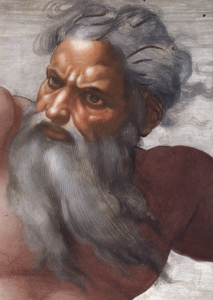
God as envisioned by MichelangeloRecently, following the tragedy in Newtown, Connecticut, a bunch of Christian “leaders” (Mike Huckabee, James Dobson, Bryan Fisher, to name a few) have basically said, “God has been taken out of the schools,” or “God has been taken out of our society,” or some variation on this theme. This, they say is, the reason the shooting at Sandy Hook Elementary School took place. Because of God’s supposed absence (voluntary on God’s part, it would seem) the horror took place. They seek to blame those who have “put God out,” but the way they make this argument really places the responsibility on God who apparently made the decision to stay away; either that or they are describing a God who is powerless in the face of some alleged official refusal to “allow God in” because our Constitution prohibits state-prescribed sectarian prayer in the schools.

Their alternative theory seems to be that because America now condones some sort of behavior to which these so-called “ministers” object (marriage equality, for example), or disallows some behavior they would champion (that state-sponsored school prayer, for example) God is punishing us. They seem to believe that God shares their judgement and is acting upon it . . . by killing children.

If any of this is true about God then I am in the class of fools who have said in their hearts, “There is no God” because I sure don’t believe in a God of the sort they seem to be describing.

But then, to be honest, I’m finding myself not believing in a lot of the Gods various people have described over the years. I read the atheist arguments of folks like scientist Richard Dawkins or the late journalist Christopher Hitchens; when I read their descriptions of God, I think “I don’t believe in that God, either.”

Recently, I’ve been thumbing through an old theology book, one that I think got me through my General Ordination Exam almost single-handedly (if that description can be applied to a book). It is Theological Outlines by Francis J. Hall (Morehouse-Barlow:1933). I found this description of God in the section on Divine Perfection:

By virtue of His infinite perfection, God is self-sufficient. Nothing is wanting to His essence which is needed for His blessedness. Neither His knowledge, nor His will, nor His love, depend upon the existence of the creature, but have sufficient scope for their activity in the eternal relations subsisting between the Persons of the Trinity. Creation is an act of the Divine will, not the result of necessity.

I read that and (guess what?) thought, “I don’t believe in that God!” I don’t believe in a God that has no need of God’s creation. I don’t believe in a God whose love has “sufficient scope for [its] activity” in God alone. The God I believe in wants to be in relationship with God’s creation! The God I believe in not only “looks down from heaven upon us all;” the God I believe in became one of us! The God I believe in was and is incarnate in Jesus Christ, lived in First Century Palestine, was crucified, died, was buried, and ascended to heaven, and yet is with us always, even to the end of the age. (Matt. 28:20) That is not a God in whom “nothing is wanting;” that is a God who wants to be with his creatures, with us!

That, I believe, is a God who wants to know, who lovingly hopes to know “if there is one who seeks after God.” That, I believe, is a God who, finding instead “ministers” like Huckabee who portray him as powerless or Dobson who make God into some kind of child-killing monster, finding atheists who make God into a caricature that no one actually accepts, finding theologians who describe God as some sort of theoretical philosophical construct with no needs, probably does conclude that “every one has proved faithless.”

Maybe as Christmas gets closer and Advent draws to an end, as we celebrate the birth of the God incarnate in Jesus, as we anticipate his return . . . maybe we could stop trying to define God and start trying to relate to God? Maybe we could turn our attention from describing God and instead simply try to do good? Let’s leave defining God up to God.

====================

A request to my readers: I’m trying to build the readership of this blog and I’d very much appreciate your help in doing so. If you find something here that is of value, please share it with others. If you are on Facebook, “like” the posts on your page so others can see them. If you are following me on Twitter, please “retweet” the notices of these meditations. If you have a blog of your own, please include mine in your links (a favor I will gladly reciprocate). Many thanks!

====================

Father Funston is the rector of St. Paul’s Episcopal Church, Medina, Ohio.

Say a Little Prayer . . . for Yourself – From the Daily Office – December 2, 2102

From Matthew’s Gospel:

Jesus said, “Then the kingdom of heaven will be like this. Ten bridesmaids took their lamps and went to meet the bridegroom. Five of them were foolish, and five were wise. When the foolish took their lamps, they took no oil with them; but the wise took flasks of oil with their lamps. As the bridegroom was delayed, all of them became drowsy and slept. But at midnight there was a shout, ‘Look! Here is the bridegroom! Come out to meet him.’ Then all those bridesmaids got up and trimmed their lamps. The foolish said to the wise, ‘Give us some of your oil, for our lamps are going out.’ But the wise replied, ‘No! there will not be enough for you and for us; you had better go to the dealers and buy some for yourselves.’ And while they went to buy it, the bridegroom came, and those who were ready went with him into the wedding banquet; and the door was shut. Later the other bridesmaids came also, saying, ‘Lord, lord, open to us.’ But he replied, ‘Truly I tell you, I do not know you.’ Keep awake therefore, for you know neither the day nor the hour.”

(From the Daily Office Lectionary – Matthew 25:1-13 (NRSV) – December 2, 2012. Please note, this is the Daily Office gospel for today, a Sunday, not the gospel from the Eucharistic lectionary.)
 
Clay Oil LampI have to admit that I’ve never liked this parable! I mean, isn’t the point of the gospel of Jesus Christ that we are “all in this together” and that we’re supposed to help one another, share what we have, take care of our brothers and sisters who have less than we do? But here “wisdom” of five bridesmaids is to be selfish and not share their oil! That just doesn’t sit well with me.

But, of course, that’s not the point of the parable, is it? The thing about parables is that they are are extremely limited in their application. Parables, especially Jesus’ parables, are usually intended to make a single important point, and living in community, sharing what we have, and helping one another is definitely not the point of this parable. This little story is about being ready, being prepared, getting one’s act together.

As a reminder for the first day of the new Christian year, the first Sunday of the season of Advent, this story is most apt. In the midst of all the running about that most of us are doing at this time of year, buying presents, decorating homes and businesses, planning liturgies (those of us in the church business), planning menus, baking fruit cakes, making candy, taking care of travel arrangements . . . the list of pre-Christmas activities goes on and on . . . it is good to take a moment to look beyond the big day. Are we ready for something else? Are we ready for what lies beyond Christmas? Beyond this life? Are we ready for the bridegroom’s return? Will the bridegroom know you when he comes back?

The way to be known to cultivate a relationship; the way we do that with Christ is through prayer. Forty-five years ago this month, Dionne Warwick made the charts with the Burt Bacharach tune I Say a Little Prayer. The song describes several times each day, during every day activities, when the singer said a short prayer for her beloved. That’s really all it takes, a short prayer in the midst everyday life.

Here’s a simple exercise in tending one’s lamp and making sure one’s stock of oil is filled: each time you get into or out of your car say this words – “Jesus Christ, Son of God, have mercy on me.” Nine short words. Say them in connection with that one specific action. It won’t take long but it will cultivate the habit of prayer; it will add a little oil to your store; it will trim the wick of your lamp just a little.

====================

A request to my readers: I’m trying to build the readership of this blog and I’d very much appreciate your help in doing so. If you find something here that is of value, please share it with others. If you are on Facebook, “like” the posts on your page so others can see them. If you are following me on Twitter, please “retweet” the notices of these meditations. If you have a blog of your own, please include mine in your links (a favor I will gladly reciprocate). Many thanks!

====================

Father Funston is the rector of St. Paul’s Episcopal Church, Medina, Ohio.

An Angry Jesus – From the Daily Office – December 1, 2012

From Luke’s Gospel:

As Jesus came near and saw the city, he wept over it, saying, “If you, even you, had only recognized on this day the things that make for peace! But now they are hidden from your eyes. Indeed, the days will come upon you, when your enemies will set up ramparts around you and surround you, and hem you in on every side. They will crush you to the ground, you and your children within you, and they will not leave within you one stone upon another; because you did not recognize the time of your visitation from God.” Then he entered the temple and began to drive out those who were selling things there; and he said, “It is written, “My house shall be a house of prayer’; but you have made it a den of robbers.” Every day he was teaching in the temple. The chief priests, the scribes, and the leaders of the people kept looking for a way to kill him; but they did not find anything they could do, for all the people were spellbound by what they heard.

(From the Daily Office Lectionary – Luke 19:41-48 (NRSV) – December 1, 2012)
 
Detail from "Christ Cleansing the Temple" by Carl Heinrich Bloch, 1875When I was eight years old, my grandparents gave me an illustrated copy of the King James Version of the Holy Bible. More than 50 years later, I still have it. It is rather small, a little bigger than a standard paper-back novel, and has a zippered leather cover. There are perhaps thirty glossy color plates with (one must admit) mediocre depictions of various biblical events. My favorite has always been the depiction of Jesus cleansing the Temple.

In that picture (not the picture I’ve appended to this post, I’m sorry to say), Jesus stands like some comic-book superhero, eyes blazing with righteous fury, his hair and the skirts of his robe flaring out as if he were some rapidly pirouetting dancer, arms outstretched, cat-o-nine-tails whipping about his head. Tables are crashing to the ground, animals are scattering, and the money changers and merchants are fleeing in terror. You can almost hear the panicked cries of the animals and the men.

Throughout the years, as I would go to Sunday School (not very often) or take confirmation instruction (required at my parochial high school) or attend college classes on “the bible as literature”, I would use that bible and look at those pictures, especially that one. I couldn’t really relate to the wise and gentle Jesus sitting on a hillside rock preaching the Beatitudes, nor to the suffering victim hanging on the cross under a stormy and darkling sky. But I could relate to the superhero furiously chasing the bad guys out of the Temple.

Many years later, I was practicing law as a trial lawyer and serving as the chancellor of my diocese. An older priest of the church during some council or committee meeting, or perhaps during the annual diocesan convention, in support of some position or other on some important issue of the day made the assertion that, “of course, Jesus never lost his temper.” What? thought I. You’ve got to be kidding! I’d grown up with a picture of a very angry Jesus kicking butt in Jerusalem!

But . . . as the years have passed, I have seen his point. Jesus was angry, but Jesus didn’t lose his temper. To be angry, even demonstrably angry is one thing; to lose one’s temper, however, suggests something more. Consider the synonymous descriptions we use: blow a fuse, fly into a rage, hit the roof, hit the ceiling, have a cow, have a fit, go ballistic, fly off the handle, flip one’s wig, flip one’s lid, blow one’s stack, throw a fit, blow up. They all describe a loss of control.

That’s the point, I believe, my older, more seasoned colleague was making. Jesus was angry, but Jesus was not out of control. Luke does not elaborate in his description of the cleansing of the Temple, nor do Mark or Matthew other than to add that he overturned the merchants’ tables. John, however, has a more interesting description:

In the temple he found people selling cattle, sheep, and doves, and the money changers seated at their tables. Making a whip of cords, he drove all of them out of the temple, both the sheep and the cattle. He also poured out the coins of the money changers and overturned their tables. He told those who were selling the doves, “Take these things out of here! Stop making my Father’s house a marketplace!” (John 2:14-16)

Jesus was angry, but he was not out of control. He did not “lose his temper”. What he did was deliberate and determined. This was an incident of symbolic prophetic action, like Jeremiah breaking a clay pot, Isaiah walking naked through the city, or Hosea marrying a prostitute. This is Jesus very carefully and very consciously acting out the last verse of the prophecy of Zechariah: “There shall no longer be traders in the house of the Lord of hosts on that day.” (Zech. 14:21)

So, after all these years, even though that superhero picture in my illustrated bible remains my favorite, I think the artist was wrong in his or her depiction of Jesus. If I were going to paint that scene now, everything might be the same except for Jesus’ eyes. I would not paint them flashing with terrible, uncontrolled rage; I would show in them the same kind of disappointed, almost sad, displeasure I sometimes saw in my parents’ eyes. That’s the only sort of anger I can imagine Jesus expressing . . . controlled, deliberate, and so very, very disappointed.

====================

A request to my readers: I’m trying to build the readership of this blog and I’d very much appreciate your help in doing so. If you find something here that is of value, please share it with others. If you are on Facebook, “like” the posts on your page so others can see them. If you are following me on Twitter, please “retweet” the notices of these meditations. If you have a blog of your own, please include mine in your links (a favor I will gladly reciprocate). Many thanks!

====================

Father Funston is the rector of St. Paul’s Episcopal Church, Medina, Ohio.

Unbind Him, and Let Him Go! – Sermon for All Saints Sunday – November 4, 2012

====================

This sermon was preached on Sunday, November 4, 2012, at St. Paul’s Episcopal Church, Medina, Ohio, where Fr. Funston is rector.

(Revised Common Lectionary, All Saints, Year B: Isaiah 25:6-9; Psalm 24; Revelation 21:1-6a; and John 11:32-44. These lessons can be read at The Lectionary Page.)

====================
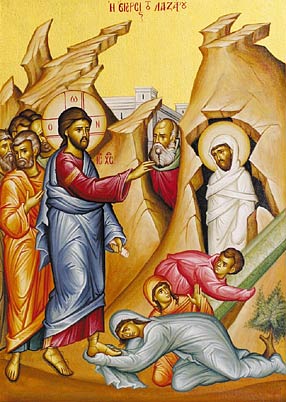
Orthodox Icon of the Raising of LazarusToday, following church tradition, we step away from the calendar of Ordinary Time and, instead, commemorate the Feast of All Saints. That festival is specifically held on November 1, but tradition allows us to celebrate the saints also on the Sunday after that date, so here we are.

Anglicans and Episcopalians for generations have been used to hearing the Beatitudes from Matthew’s gospel (Matt. 5:1-12) or the similar Blessings-and-Woes from Luke’s version (Luke 6:20-26), but since the adoption of the Revised Common Lectionary we also, every three years, hear the story of the raising of Lazarus from the gospel according to John. The listings of who is blessed in the other two gospels make sense as lessons for this day; the story of Lazarus, not so much. It may make us wonder why those who created our new lectionary made that choice.

Unfortunately, there are no easy answers to that question, if there are any answers at all. The development of the lectionary is a creature of time and custom as much as it is of purposeful selection. Lectionaries develop over the centuries. Typically, a lectionary will go through the scriptures in a logical pattern, and also include selections chosen by the community for their appropriateness to particular occasions. The ecumenical scholars who set up our current lectionary looked back over these centuries of development and selected lessons which had the broadest consensus for use on particular days, like today’s celebration of the feasts.

But why that consensus may exist is lost in time. There are no legislative notes indicating why communities thought a particular lesson, like the story of Christ raising Lazarus, fit a particular feast, such as All Saints Day. We who have inherited the tradition must read the lessons and figure out their message for ourselves. On a feast day, the Prayer Book gives us some filters, if you will, to aid in our reflections and our understanding; these are the collect (or prayer) of the day and the “proper preface” said (or chanted) before the Great Thanksgiving. Let’s take a look at the collect again:

Almighty God, you have knit together your elect in one communion and fellowship in the mystical body of your Son Christ our Lord: Give us grace so to follow your blessed saints in all virtuous and godly living, that we may come to those ineffable joys that you have prepared for those who truly love you; through Jesus Christ our Lord, who with you and the Holy Spirit lives and reigns, one God, in glory everlasting. Amen. (BCP Page 245)

The focus of the prayer is the “communion and fellowship” of the saints, the community of the church, which is “knit together . . . in the mystical body” of Christ, which shares in “virtuous and godly living” and together enjoys the “ineffable joys” of eternal life. Likewise the preface focuses on the community:

For in the multitude of your saints you have surrounded us with a great cloud of witnesses, that we might rejoice in their fellowship, and run with endurance the race that is set before us; and, together with them, receive the crown of glory that never fades away. (BCP Page 380)

The emphasis is on the “great cloud of witnesses” (a phrase borrowed from the Letter to the Hebrews 12:1) who rejoice in fellowship and together are crowned with unfading glory.

So in our contemplation of any of the lessons for today, we should look for the ways in which the lesson exemplifies or speaks to the community of faith, and in the raising of Lazarus that comes at the end of the story: “The dead man came out, his hands and feet bound with strips of cloth, and his face wrapped in a cloth. Jesus said to them, ‘Unbind him, and let him go’.” (John 11:44)

“Unbind him, and let him go!” These may be the most powerful words in the story, because with them Jesus not only frees Lazarus, he empowers the community of faith. The community assists in the resurrection; it is the task of the People of God to complete the action of Resurrection. Jesus has called Lazarus out of the tomb, but he is still wearing the clothing of death, his funeral wrappings; the community removes those burial shrouds and dresses him for life.

I love that old Southern Harmony hymn we sang in procession today, especially the chorus which says

As I went down in the river to pray,
Studying about that good ol’ way
And who shall wear the robe and crown?
Good Lord, show me the way.
(“Down in the River to Pray”)

“Who shall wear the robe and crown?” is a reference to the vision of St. John of Patmos recorded in the Book of Revelation, a vision of heaven where “there was a great multitude that no one could count, from every nation, from all tribes and peoples and languages, standing before the throne and before the Lamb, robed in white, with palm branches in their hands.” (Rev. 7:9)

Last Thursday, which was actually All Saints Day, one of the lessons for the Daily Office of Morning Prayer was from the apocryphal book of Second Esdras. In it Ezra reports seeing a similar vision of heaven.

I, Ezra, saw on Mount Zion a great multitude that I could not number, and they all were praising the Lord with songs. In their midst was a young man of great stature, taller than any of the others, and on the head of each of them he placed a crown, but he was more exalted than they. And I was held spellbound. Then I asked an angel, “Who are these, my lord?” He answered and said to me, “These are they who have put off mortal clothing and have put on the immortal, and have confessed the name of God. Now they are being crowned, and receive palms.” Then I said to the angel, “Who is that young man who is placing crowns on them and putting palms in their hands?” He answered and said to me, “He is the Son of God, whom they confessed in the world.” So I began to praise those who had stood valiantly for the name of the Lord. (2 Esdras 2:42-47)

This vision differs from that in Revelation in that the presence of the Son of God is among the crowd, crowning them and putting the palms in their hands. I have to say, I rather prefer this vision to John’s because of that difference. There is something compelling about the Son of God being there with the saints, not high and exalted on a throne, as the Lamb is in the oracle of Revelation, but down with the people. This seems much more like the Jesus described in the Gospels, much more like the God he revealed.

This vision of Christ with the masses, yielding his glory and mixing in with his people, seems somehow quite in keeping with our celebration of all the saints. Today we don’t commemorate only those whose names are known, those who are portrayed in art with golden halos, those in whose particular memory churches and schools are dedicated; today we commemorate those whose names are not known. Ezra’s vision in Second Esdras of Christ mingling with these unknown but godly people appeals to me.

An early 20th Century Roman Catholic Lithuanian archbishop, George Matulaitis, once wrote:

May our model be Jesus Christ: not only working quietly in His home at Nazareth, not only Christ denying Himself, fasting forty days in the desert, not only Christ spending the night in prayer; but also Christ working, weeping, suffering; Christ among the crowds; Christ visiting the cities and villages. (Renovator of the Marians)

This is the Christ of Ezra’s vision; this is the Christ of the saints whom we remember today, Christ among the crowds. Indeed, John of Patmos in our reading from Revelation today describes God among the people: “[God] will dwell with [mortals] as their God; they will be his people, and God himself will be with them; he will wipe every tear from their eyes.” (Rev. 21:3-4)

When Jesus, this Christ among the crowds, this God dwelling with mortals, tells those around him, “Unbind him, and let him go” he is speaking not only to them, but also to us. When we hear those words we should remember another time when he empowered his church to unbind others. In Matthew’s gospel, in conversation with Peter, Jesus said: “I will give you the keys of the kingdom of heaven, and whatever you bind on earth will be bound in heaven, and whatever you loose on earth will be loosed in heaven.” (Matt. 16:19)

And again later to the apostles he said: “Truly I tell you, whatever you bind on earth will be bound in heaven, and whatever you loose on earth will be loosed in heaven.” (Matt. 18:18)

Here the Greek verb luo is translated as “loosen”, but it is the same word in our reading today translated as “unbind”. We have the power and the obligation to unbind and set others free. “Unbind him, and let him go” is Christ’s empowering command to all the saints everyday. It is Christ’s command to us to unbind others and give them their freedom; this is Christ among the crowds, God dwelling with God’s people, showing us the way that we and others can wear the robe and crown.

We unbind others and set them free when we work to alleviate the desperate plight of those who lack material means of survival, whether they are in our own communities, on the Gulf Coast or the eastern seaboard, or in distant countries. We unbind others and set them free when we act to console a brother or sister crushed by loss or fear or despair. We unbind others and set them free when we strive to empower rather than intimidate. We unbind others and set them free when we commit ourselves to justice for all, not merely for ourselves. We unbind others and set them free when we extend to others the mercy we have received from God. Whenever and wherever we find someone bound by sin or system or circumstance, we are to unbind them and set them free, not keep them tangled up in the old affairs, the old clothing, the old funeral wrappings of sin and death; those burial shrouds constrict them and damage everyone. Whenever and wherever we find someone struggling to be free, we are to unbind them and let them go so that we may all wear the robe and crown.

Today we commemorate all the saints, that great cloud of witnesses, that great multitude that no one can count wearing their robes and crowns, the community of the church throughout time and space charged with, committed to, and constantly striving to unbind others and set them free. Amen.

====================

A request to my readers: I’m trying to build the readership of this blog and I’d very much appreciate your help in doing so. If you find something here that is of value, please share it with others. If you are on Facebook, “like” the posts on your page so others can see them. If you are following me on Twitter, please “retweet” the notices of these meditations. If you have a blog of your own, please include mine in your links (a favor I will gladly reciprocate). Many thanks!

====================

Father Funston is the rector of St. Paul’s Episcopal Church, Medina, Ohio.
No Ifs, Ands, Or Buts – From the Daily Office – October 22, 2012

From Luke’s Gospel:

As they were going along the road, someone said to him, “I will follow you wherever you go.” And Jesus said to him, “Foxes have holes, and birds of the air have nests; but the Son of Man has nowhere to lay his head.” To another he said, “Follow me.” But he said, “Lord, first let me go and bury my father.” But Jesus said to him, “Let the dead bury their own dead; but as for you, go and proclaim the kingdom of God.” Another said, “I will follow you, Lord; but let me first say farewell to those at my home.” Jesus said to him, “No one who puts a hand to the plough and looks back is fit for the kingdom of God.?”

(From the Daily Office Lectionary – Luke 9:57-62 – October 22, 2012)

No ExcusesJesus is so demanding! Follow me and you won’t have a place rest; leave your dead; if you look back, you aren’t worthy!

My grandmother used to have a way of responding to excuses. She’d tell us to do something and my brother or my cousins or I would say, “But, Grammy . . . . ” And she would reply, “No ifs, ands, or buts!”

As I reflected on today’s gospel lesson I tried to find some humor in it, but the plain truth of the matter is that Jesus is demanding. To the rich young man he said, “Sell all you have, give the money to the poor, then follow me.” (Luke 18:22) To his followers he says, “If something in your life, even a part of your body, causes you to sin, get ride of it.” (Mark 9:43-47) Our allegiance to him and his gospel is to be so exclusive that it may even make enemies of our closest relatives: “I have come to set a man against his father, and a daughter against her mother, and a daughter-in-law against her mother-in-law; and one’s foes will be members of one’s own household.” (Matthew 10:35-36) No ifs, ands, or buts about it!

This is a man who brooks no compromise and if we are to be his followers, he demands that we adopt the same attitude: “A disciple is not above the teacher, nor a slave above the master; it is enough for the disciple to be like the teacher, and the slave like the master.” (Matthew 10:24-25)

No wonder many of those who thought they would be his disciples turned back and even those who continued with him found his teachings and example hard to follow. We still do; the church and her members still make the compromises he warned us not to make. But in the end we are left to ask with Peter, “Lord, to whom can we go? You have the words of eternal life.” (John 6:68)

It is a dilemma! To whom else can we go? But Jesus is so demanding! No ifs, ands, or buts about it!

====================

A request to my readers: I’m trying to build the readership of this blog and I’d very much appreciate your help in doing so. If you find something here that is of value, please share it with others. If you are on Facebook, “like” the posts on your page so others can see them. If you are following me on Twitter, please “retweet” the notices of these meditations. If you have a blog of your own, please include mine in your links (a favor I will gladly reciprocate). Many thanks!

====================

Father Funston is the rector of St. Paul’s Episcopal Church, Medina, Ohio.

In God We Trust – From the Daily Office – October 15, 2012

From the Prophet Micah:

Put no trust in a friend,
have no confidence in a loved one;
guard the doors of your mouth
from her who lies in your embrace;
for the son treats the father with contempt,
the daughter rises up against her mother,
the daughter-in-law against her mother-in-law;
your enemies are members of your own household.
But as for me, I will look to the Lord,
I will wait for the God of my salvation;
my God will hear me.

(From the Daily Office Lectionary – Micah 7:5-7 – October 15, 2012)

In God We Trust on Dollar BillSound familiar? Jesus sounded a lot like Micah at times:

Do not think that I have come to bring peace to the earth; I have not come to bring peace, but a sword. For I have come to set a man against his father, and a daughter against her mother, and a daughter-in-law against her mother-in-law; and one’s foes will be members of one’s own household. (Matt. 10:34-36; cf. Luke 12:51-53)

Micah is the same prophet who authored what may be my favorite verse in all of the Old Testament: “He has told you, O mortal, what is good; and what does the Lord require of you but to do justice, and to love kindness, and to walk humbly with your God?” (6:8) And Jesus is the same preacher who said “Love your neighbor as yourself” was one of the greatest commandments. (Mark 12:31) How does one reconcile these admonitions with advice to put no trust in friend or loved one and promises to bring enmity between family members?

The answer lies in the last part of the above quotation from Micah: Trust in God. In the 1950s the U.S. Congress decided to emblazon “In God We Trust” across American currency as a response to the rise of “Godless communism” in the Soviet Union and its sphere of influence. One may debate whether it was appropriate under the U.S. Constitution, or whether it has since had any salutary effect, but it is what Micah models here, and it is the message of Scripture and of Jesus. “Don’t trust human beings! Trust God!”

In the last weeks of the U.S. presidential campaign, as political debates lead to family arguments and people begin to see the members of their own households as political enemies, it is well to remember this. Human beings, even the best of us, are fallible and untrustworthy, especially the ones we put on pedestals and look to to solve the problems of our nation or our world. As the Psalmist (echoing Micah’s sentiment) reminded us, “Put not your trust in rulers, nor in any child of earth, for there is no help in them.” (Ps. 146:2, BCP version)

It may sound trite. It may be misplaced on our currency. But it is the only solution: “In God We Trust.” If we remember that, maybe we can all just get along . . . .

====================

A request to my readers: I’m trying to build the readership of this blog and I’d very much appreciate your help in doing so. If you find something here that is of value, please share it with others. If you are on Facebook, “like” the posts on your page so others can see them. If you are following me on Twitter, please “retweet” the notices of these meditations. If you have a blog of your own, please include mine in your links (a favor I will gladly reciprocate). Many thanks!

====================

Father Funston is the rector of St. Paul’s Episcopal Church, Medina, Ohio.

Fruitful House of Bread – From the Daily Office – October 13, 2012

From the Prophet Micah:

But you, O Bethlehem of Ephrathah,
who are one of the little clans of Judah,
from you shall come forth for me
one who is to rule in Israel,
whose origin is from of old,
from ancient days.

(From the Daily Office Lectionary – Micah 5:1 – October 13, 2012)

House of BreadThis obscure little verse in the book of the Prophet Micah is best known to Christians from the story of the visitation of the wisemen in Matthew’s Gospel:

In the time of King Herod, after Jesus was born in Bethlehem of Judea, wise men from the East came to Jerusalem, asking, “Where is the child who has been born king of the Jews? For we observed his star at its rising, and have come to pay him homage.” When King Herod heard this, he was frightened, and all Jerusalem with him; and calling together all the chief priests and scribes of the people, he inquired of them where the Messiah was to be born. They told him, “In Bethlehem of Judea; for so it has been written by the prophet: “And you, Bethlehem, in the land of Judah, are by no means least among the rulers of Judah; for from you shall come a ruler who is to shepherd my people Israel.’ “

I’ve always been intrigued by the word Ephrathah (which Mattew does not quote). Apparently it is a place name; one source indicates that Ephrathah, or Ephrath, is the ancient name for the town of Bethlehem in Judah, in the southern part of the land of Israel. Micah uses both names in order to distinguish the town from another Bethlehem in the north. Another source tells me the name means “fruitful”.

The name Bethlehem means “house of bread” which always intrigues Christians who see it as somewhat prophetic of Jesus words at the Last Supper identifying the bread as his own body.

When I hear that Ephrathah means “fruitful” I am immediately put in mind of two other verses of Scripture. First, God’s admonition to Adam and Eve in Genesis: “Be fruitful and muliply.” (1:28) The second is Christ’s admonition to his disciples: “I appointed you to go and bear fruit, fruit that will last, so that the Father will give you whatever you ask him in my name.” (John 15:16)

In the name of Jesus’ place of birth as set forth in Micah, I hear a call to evangelism. Nurture and sustained by what comes from the “house of bread,” we are “to go and bear fruit;” we are sent out to “be fruitful and multiply,” The fruit which we are to bear is an increase in followers of the Way, an increase in the number of disciples (not simply the fruit of individual good works, nor only the “fruits of the spirit” in our own lives). Our efforts, our ministries, our prayers, our daily lives are to be the means by which the “house of bread” will truly be “fruitful.”

====================

A request to my readers: I’m trying to build the readership of this blog and I’d very much appreciate your help in doing so. If you find something here that is of value, please share it with others. If you are on Facebook, “like” the posts on your page so others can see them. If you are following me on Twitter, please “retweet” the notices of these meditations. If you have a blog of your own, please include mine in your links (a favor I will gladly reciprocate). Many thanks!

====================

Father Funston is the rector of St. Paul’s Episcopal Church, Medina, Ohio.

Three Women, Resources and Priorities – From the Daily Office – October 12, 2012

From the Gospel of Luke:

Jesus went on through cities and villages, proclaiming and bringing the good news of the kingdom of God. The twelve were with him, as well as some women who had been cured of evil spirits and infirmities: Mary, called Magdalene, from whom seven demons had gone out, and Joanna, the wife of Herod’s steward Chuza, and Susanna, and many others, who provided for them out of their resources.

(From the Daily Office Lectionary – Luke 1:1-3 – October 12, 2012)

Generic Debit CardThree cheers for the women of the church! Seriously, it seems to have ever been thus: women do the “heavy lifting” but end up little noticed in the background. One wonders if Jesus and the twelve could have done what they did if these women “who provided for them out of their resources” had not been so generous . . . .

Some suggest the women offered what we would call domestic services for Jesus and the twelve; others that they joined them in preaching the kingdom; still others that they were wealthy benefactors. One auther, Renita Weems, writes: “Mary Magdalene, Joanna, Susanna and other female traveling evangelists made up the band of female workers who surrendered and sacrificed everything to follow Jesus . . . . between teaching, they did the cooking; beyond recruiting, they did the mending; in excess of donating their funds, they donated their time.”

Frankly, I don’t know if there’s any support for such a vision of these women mending, cooking, or laundering, although it’s certainly possible. Nonetheless, it is pretty clear that they gave generously to Jesus’ mission; the gave their gifts, talents, time, money . . . . they gave, as Luke says, out of their resources, whatever those resources may have been. It was the women whose resources kept Jesus’ dream going. These women are paragons of generosity.

Throughout human history, financial support has been needed for any ministry that ever existed. Jesus and the twelve needed monetary support to carry on an active ministry that was dependent on the generosity of others. These women provided that support.

We all know the commonplace wisdom: look at a person’s checkbook, his or her monthly credit card statements or online banking report and you will gain insight as to the values and priorities by which he or she lives. If we had looked at the Magdalene’s statements, Joanna’s checkbook, and Susanna’s credit card receipts, we would have seen, at the top of their list of priorities, one name: Jesus.

Jesus is reported to have said: “Where your treasure is, there your heart will be also.” (Matt. 6:21) I know that all too often my treasure and my heart are elsewhere than they ought to be. Every day, I need to remember, sometimes to relearn what these generous women knew: that my heart and my treasure belong to Jesus Christ!

====================

A request to my readers: I’m trying to build the readership of this blog and I’d very much appreciate your help in doing so. If you find something here that is of value, please share it with others. If you are on Facebook, “like” the posts on your page so others can see them. If you are following me on Twitter, please “retweet” the notices of these meditations. If you have a blog of your own, please include mine in your links (a favor I will gladly reciprocate). Many thanks!

====================

Father Funston is the rector of St. Paul’s Episcopal Church, Medina, Ohio.

Why Do You Call Me “Lord, Lord”? – From the Daily Office – October 8, 2012

From the Gospel of Luke:

Jesus said: “Why do you call me “Lord, Lord,” and do not do what I tell you? I will show you what someone is like who comes to me, hears my words, and acts on them. That one is like a man building a house, who dug deeply and laid the foundation on rock; when a flood arose, the river burst against that house but could not shake it, because it had been well built. But the one who hears and does not act is like a man who built a house on the ground without a foundation. When the river burst against it, immediately it fell, and great was the ruin of that house.”

(From the Daily Office Lectionary – Luke 6:46-49 – October 8, 2012)

Jesus Teaching the CrowdsIt’s a darn good question, “Why do you call me “Lord, Lord,” and do not do what I tell you?” As we come to the last month of the 2012 political campaign, it is one which needs to be carefully considered by many Christians on all sides of the political divide. Are the values on which Christian voters are making their decisions those taught by Jesus, or are they cultural values dressed up in Christian clothing? One-issue voters in particular should take a broader look at their choices; just because a candidate supports your position on a question of particular importance to you does not mean his or her overall platform conforms well to the values of the Gospel, or does what Jesus told us to do.

Yesterday, evangelical preachers and churches around the country broke the law by engaging in something called “Pulpit Freedom Sunday”. They claimed to be the victims of “religious discrimination” because of a provision in American tax law which prohibits churches which claim religious tax exemption from endorsing political candidates and preachers from making campaign speeches from their pulpits. In this blog, I will not debate the law or the legality of what these churches and preachers did, but I do want to suggest that they have lost their way. Christ’s church was never intended to be a political party; Jesus is not a Republican, nor is he a Democrat; he is not a Green, or a Libertarian. Preaching politics from the pulpit undermines the Gospel message which is for all regardless of their political affiliation or their voting decisions. Preaching partisan politics from the pulpit is not doing what Jesus told us to do!

When the Gospel of Christ is equated with a particular party’s platform or a particular candidate’s position, the person or institution preaching that equivalence is not doing what Jesus told us to do. In fact, I believe they have even stopped calling Jesus “Lord, Lord” – they have given their allegiance to something or someone else!

The Gospel should impact our political decisions; I’m not suggesting otherwise. But churches and preachers should not be endorsing political nominees nor telling their congregations how to vote. Instead, they should be encouraging their members to give food to the hungry and something to drink to the thirsty, to welcome the stranger, to give clothing to the naked, to care for the sick and those in prison (see Matthew 25), and ask themselves how their political decisions best accomplish those goals. Because that is what Jesus told us to do!

====================

A request to my readers: I’m trying to build the readership of this blog and I’d very much appreciate your help in doing so. If you find something here that is of value, please share it with others. If you are on Facebook, “like” the posts on your page so others can see them. If you are following me on Twitter, please “retweet” the notices of these meditations. If you have a blog of your own, please include mine in your links (a favor I will gladly reciprocate). Many thanks!

====================

Father Funston is the rector of St. Paul’s Episcopal Church, Medina, Ohio.

Complacency Is Just Not an Option! – From the Daily Office – October 5, 2012

From the Gospel of Luke:

Jesus said: “But woe to you who are rich, for you have received your consolation. Woe to you who are full now, for you will be hungry. Woe to you who are laughing now, for you will mourn and weep. Woe to you when all speak well of you, for that is what their ancestors did to the false prophets.”

Bookplate Engraving of "Sloth"Today I am forcing myself to get back in the groove with these daily meditations on bits of Scripture from the lessons of the Episcopal Church’s Daily Office Lectionary. I took a break two weeks ago about the time of my father-in-law’s death and funeral, a break which was just supposed to be a couple of days, and it stretched on and on and I got out of the habit. I tried, a couple of times (once with a bit from Judith and once with bit from the fourth chapter of Luke), but I couldn’t discipline myself to sit down, compose, and publish the thoughts in my head. I was slothful; in the words of medieval monks, I was suffering from daily, early-morning acedia. Acedia, one of the Seven Deadly Sins, according to Wikipedia is “a state of listlessness or torpor, of not caring or not being concerned with one’s position or condition in the world.” That is not the mental state exhibited by Jesus in today’s Gospel lesson from Luke, but I think he addresses it and, thus, today’s lesson has helped me out of my own torpor.

In today’s Gospel we have the Lukan version of the Beatitudes which differs in many respects from the more well-known and oft-quoted version in Matthew (Matt. 5:3–12). It differs so much that we refer to Luke’s rendition as “the Blessings and Woes” rather than as “Beatitudes,” and that title gives witness to the most distinctive difference, the addition of the “woes” addressed to the well-off. And it is those “woes” which I focus on today.

Each of these states of woe is introduced in the same way. In Greek the word translate into English as “woe” is ouai. It’s pronounced something like “oo-why” and is, according to something I remember reading in seminary but can’t find now, an onomatopoetic term expressive of a sigh . . . a sigh of profound sadness. So rather than being (as is often understood) Christ’s prediction of some terrible calamity that is to befall the well-to-do, the satisfied, the currently happy, or those who are lauded, these “woes” are statements of Jesus’ current sadness about them.

Why should Jesus be unhappy about this state of well-being? I suspect it is because well-being can lead to complacency or, worse, to efforts to maintain it at the expense of others. Complacency is a form of acedia. It makes people fear the unknown, mistrust the untried, and abhor the new; it makes people resist change. The complacent will stick to what they have always done even when it stops working. The theme-song of the complacent is, “We’ve always done it this way.” Jesus stands in opposition to “the way it’s always been done.” He calls us to new ways of behavior, new ways of being in community, new ways of caring for one another. No wonder he sighs so deeply with such sadness for the satisfied, for the complacent.

So this is where I find encouragement, inspiration, and energy in this passage . . . after heaving these profound sighs, Jesus doesn’t just sit there. He goes on with his teaching, issuing his call for changed behavior, and then goes on with his ministry; in the first verse of the next chapter, Luke tells us, “After Jesus had finished all his sayings in the hearing of the people, he entered Capernaum.” (Luke 7:1) Immediately, he is confronted by a request for healing and then, shortly thereafter, he raises the son of the widow of Nain from death. For Jesus (and for us) complacency is just not an option! We may sigh, but there is always something to be done.

====================

A request to my readers: I’m trying to build the readership of this blog and I’d very much appreciate your help in doing so. If you find something here that is of value, please share it with others. If you are on Facebook, “like” the posts on your page so others can see them. If you are following me on Twitter, please “retweet” the notices of these meditations. If you have a blog of your own, please include mine in your links (a favor I will gladly reciprocate). Many thanks!

====================

Father Funston is the rector of St. Paul’s Episcopal Church, Medina, Ohio.

« Older posts Newer posts »