====================
A homily offered by the Rev. Dr. C. Eric Funston on the 21st Sunday after Pentecost, October 9, 2016, to the people of St. Paul’s Episcopal Church, Medina, Ohio, where Fr. Funston is rector.
(The lessons for the day are Proper 23C of the Revised Common Lectionary: 2 Kings 5:1-3,7-15c; Psalm 111; 2 Timothy 2:8-15; and St. Luke 17:11-19. These lessons may be found at The Lectionary Page.)
====================
 For ten months, since the First Sunday of Advent 2015, we have been in Lectionary Year C, during which we’ve been following texts from the Gospel according to Luke. Luke’s Gospel , after telling of his birth and infancy, sets out Jesus’ original mission statement, which he adopted from the Prophet Isaiah and proclaimed in his hometown synagogue:
“The Spirit of the Lord is upon me, because he has anointed me to bring good news to the poor. He has sent me to proclaim release to the captives and recovery of sight to the blind, to let the oppressed go free, to proclaim the year of the Lord’s favor.” (Lk 4:18-19)
Throughout the year, Luke has given us profound glimpses of God’s grace alive in the world of 1st Century Palestine, encouraging us to open our eyes and respond to God’s grace alive in the world today. This sort of awakening and response to grace forms the foundation of Christian stewardship.
In July of 2014, Evelyn and I were privileged to visit the place where the healing of the ten lepers is said to have happened. A tradition stretching back nearly 2,000 years tells us that it was in the village of Burqin and the Christian church which stands there today is believed to be sited on the longest continually used place of Christian worship in the world.
In the Gospel lesson for today, Luke tells us that this place is in “the region between Samaria and Galilee.” I have to assume that Luke was ignorant of Palestinian geography. There is no such “region.” At best, there is a line on the map, a border, between Samaria and Galilee, nothing more. If Jesus was “passing through” such a region, he was simply stepping over an imaginary line separating one human-defined locale from the next. In the modern world, he might have been going through a checkpoint. There’s a wonderful word for doing that, for being in that in-between place, in that “space” which is neither one thing nor the other – liminality. It is derived from the Latin word for “threshold.”
The village of Burqin is located almost exactly halfway between Nazareth in Galilee and Sychar (now called Nablus), the Samaritan city where Jesus spoke with the woman at Jacob’s Well. Today, it is a village of about 6,000 people; fewer than 100 of them are Christian, and all of those are members of the Greek Orthodox congregation that worships at that longest-used church in all the world.
When we visited there, we were treated to lunch in the home of church leaders Usama and Nadya. During our conversations with them, one of our party asked Nadya if they felt uncomfortable living as such a tiny minority among so many Muslims and if she had ever considered leaving. “These are our neighbors and friends; they are our families,” she replied, “why would we ever leave?” She told us how they visited in each other’s homes, watched each other’s children, and celebrated each other’s holidays. And then she said, “Besides, if we left, who would be the church?”
I was struck then and continue to be amazed at the wisdom of her answer, at her choice of verb: “Who would be the church?” In that liminal place, that small group of Christians is constantly in that in-between place. Visiting, working with, celebrating with, being family with their overwhelmingly numerous Muslim neighbors, they cross over and through so many thresholds; they are constantly in spiritual motion yet grounded in that longest-used place of worship.
Their stewardship of that place is phenomenal, by the way. It must rank as the most lovingly cared for and tended church I have ever entered! Not a speck of dust, not a single cobweb, not a trace of tarnish on any of the numerous silver lamps, candlesticks, icon covers, and other objects of devotion, not a thread torn or hanging loose from the linens or tapestries. It was clear that, like the Samaritan leper who was healed there, the members of that community returned again and again to give thanks through their loving stewardship of God’s gifts.
That’s one thing about this story that grabs my attention and excites my imagination, that it takes place in that “space” which is neither one thing nor the other, that it is a story in spiritual motion from one state to another, a spiritual journey culminating in thanksgiving.
It is that sort of story in the other particular that grabs my attention, as well. This other thing is something that I’ve never seen touched on in any commentary on this text, and that is the way in which their disease unites the ten lepers. Although Luke as narrator and Jesus as character in the story comment on the citizenship or race of only the one leper, the implication is that the others are Jews. One commentator has suggested that the Samaritan turned back from going to the Temple to present himself to a Jewish priest because he would have been unwelcomed there, but the others continued on suggesting that they were Jews for whom there was no similar problem. If that is so, then for the ten the shared experience of leprosy had bound them together and had overcome the traditional enmity between Jew and Samaritan.
I’d never thought of that before but now, every day, I show up at a cancer center where I converse with two men I would never before have interacted with. The man who gets his radiation treatment before me drives a Cadillac on which there are two bumper stickers. One reads, “Hillary for Prison 2016” and the other bears only the word “Trump.” In other circumstances, I would be very unlikely to converse with this man. But, thrown together by the common malady of prostate cancer, I know that he is also 64 years old, that he has two daughters and that both are married, and that he has three grandchildren. I know his name. He and I wish one another well every day, even though we know that our political views are wildly disparate. The man who comes after me rides a Harley; he has bushy, unkempt grey beard and tattoos on his arms; he wears “muscle shirts” and grubby jeans and his wallet is attached to his belt loop by several inches of heavy stainless steel chain. In other circumstances, I would be equally unlikely to talk with him. But I know particulars of his life also and we greet one another as friends.
We three will move on from this experience when the linear accelerator has done its thing and we are “cured” of the cancer. Like the ten lepers, our small community of shared disease will break up, but none of us will ever be the same; I will remember them and I hope they will remember me. In some sense, we will remain a community.
That is what the ten lepers were and what they remained even as they moved off on that spiritual journey from one state to another, from leprosy to wholeness; they were a community. I suggest to you that they are an icon of the church. We are all of us, both individually and together, on a journey from some form of “leprosy”, a journey from some illness of spirit, a journey to wholeness and salvation. That iconic community returned a tenth, a tithe (if you will) of its substance to Jesus, praising God with a loud voice, falling prostrate at his feet, and giving thanks. (The other nine, also, would offer thanksgivings if they went, as instructed, to the Temple priests: the Law required a thank offering of two male lambs, a ewe, a measure of fine flour, and a measure of oil.) Thus, in this sense also, this is a story in spiritual motion from one state to another, a spiritual journey culminating in thanksgiving.
Martin Luther was once asked to describe the nature of true worship. His answer: the tenth leper turning back. David Lose, the Lutheran seminary professor whose writings I like so much, says of this story:
All the lepers were healed; one, however, saw, noticed, let what happened sink in … and it made all the difference.
• Because he sees what has happened, the leper recognizes Jesus, his reign and his power.
• Because he sees what has happened, the leper has something for which to be thankful, praising God with a loud voice.
• Because he sees what has happened, the leper changes direction, veering from his course toward a priest to first return to Jesus.
In this light, this story serves as an invitation to believers – then and now – to recognize that what we see makes all the difference. In the face of adversity, do we see danger or opportunity? In the face of human need, do we see demand or gift? In the face of the stranger, do we see potential enemy or friend? (Lose. Emphasis in original.)
After the Samaritan saw that he was healed, the rest of his response is characterized by four actions: he turned back, he praised God, he prostrated himself in worship, and he gave thanks. This, again, is Luke encouraging us to open our eyes and giving us an example of how we ought to respond to God’s grace alive in the world today. This is true worship, a road map for our response to God’s activity in our world: returning, praising, worshiping, and giving in thanks.
Echoing Luther, Prof. Lose asks, “What is true stewardship, worship, and Christian living? It is the tenth leper turning back. For now as then, seeing makes all the difference.” It is the sort of awakening and response to grace that forms the foundation of Christian stewardship.
And now I would like to invite parishioner ____________ to share some thoughts about his spiritual journey and thanksgiving.
====================
A request to my readers: I’m trying to build the readership of this blog and I’d very much appreciate your help in doing so. If you find something here that is of value, please share it with others. If you are on Facebook, “like” the posts on your page so others can see them. If you are following me on Twitter, please “retweet” the notices of these meditations. If you have a blog of your own, please include mine in your links (a favor I will gladly reciprocate). Many thanks!
====================
Father Funston is the rector of St. Paul’s Episcopal Church, Medina, Ohio.
![Dives and Lazarus. Psalter (Munich Golden Psalter). England [Gloucester?], 1st quarter of the 13th century.](http://thefunstons.com/wp-content/uploads/2016/09/Lazarus-and-Dives-300x264.jpg) We could, I suppose, spiritualize the story of Lazarus and the rich man. We could, but if we did we would be twisting it out of shape. This is not a spiritual story. This is a bare-knuckled street-brawl of a story about wealth, about money and possessions, about someone who had plenty and about someone who had none. If we are going to honor the biblical text, we cannot spiritualize this tale; we have to deal with it as it is given us, as a story about money.
We could, I suppose, spiritualize the story of Lazarus and the rich man. We could, but if we did we would be twisting it out of shape. This is not a spiritual story. This is a bare-knuckled street-brawl of a story about wealth, about money and possessions, about someone who had plenty and about someone who had none. If we are going to honor the biblical text, we cannot spiritualize this tale; we have to deal with it as it is given us, as a story about money. I’d like you all to take your Prayer Books in hand and turn with me to page 855 which is way in the back of the book in the section called The Catechism or Outline of the Faith. At the top of the page are three questions about the mission of the church and the answers to those questions that we as Episcopalians teach. I’m going to read the questions; I’d like you to read the answers:
 “Whoever comes to me and does not hate father and mother, wife and children, brothers and sisters, yes, and even life itself, cannot be my disciple. * * * None of you can become my disciple if you do not give up all your possessions.”
 Our first lesson today is from a book with the wholly amazing title The Book of the All-Virtuous Wisdom of Joshua ben Sira, usually (and mercifully) shortened to Sirach. It is accepted as part of the Christian biblical canon by Roman Catholics, the Eastern Orthodox, and most of the Oriental Orthodox churches. In our Anglican tradition, it is not accepted as canonical, but we do read it “for example of life and instruction of manners;” however, it cannot be used to establish any doctrine. (Article VI of the Articles of Religion, 1801) The book is in the tradition known as “wisdom literature;” basically, it is a collection of ethical teachings closely resembling the canonical Book of Proverbs, and serving the same function.
 Our reading from the Book of Isaiah today is the second half of chapter 58, a chapter which begins with God ordering the prophet to “Shout out,” to “do not hold back,” to “lift up [his] voice like a trumpet” with God’s answer to a question asked by the people of Jerusalem: “Why do we fast, but you do not see? Why humble ourselves, but you do not notice?” (Isaiah 58:1,3a)
 In philosophy and theology there is an exercise named by the Greek word deiknumi. The word simply translated means “occurrence” or “evidence,” but in philosophy it refers to a “thought experiment,” a sort of meditation or exploration of a hypothesis about what might happen if certain facts are true or certain situations experienced. It’s particularly useful if those situations cannot be replicated in a laboratory or if the facts are in the past or future and cannot be presently experienced. St. Paul uses the word only once in his epistles: in the last verse of chapter 12 of the First Letter to the Corinthians, he uses the verbal form when he admonishes his readers to “strive for the greater gifts. And I will show you [deiknuo, ‘I will give you evidence of’] a still more excellent way.” It is the introduction to his famous treatise on agape, divine love, a thought experiment (if you will) about the best expression, the “still more excellent” expression of the greatest of the virtues.
 God’s response to Abraham’s challenge is to take Abraham outside and show him the stars and ask him, “Has it ever occurred to you that you might be wrong?” Well, God doesn’t, actually . . . but that’s what it boils down to. God’s response to Abraham is, “Thank again!”
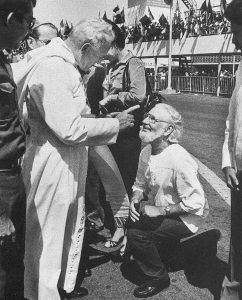 When Pope John Paul II scolded Fr. Cardenal upon the his arrival in Nicaragua, it was because Cardenal had collaborated with the Marxist Sandinistas and, after the Sandinista victory in 1979, he became their government’s Minister of Culture. His brother, Fr. Fernando Cardenal S.J. also worked with the Sandinista government in the Ministry of Education, directing a successful literacy campaign. There were a handful of other priests working in the government, as well.
  We know that if there are tribal circles on that foundational paper, they are more like the circles on a Venn diagram, not only touching but overlapping. That was true of the ancient Hebrews; their tribalism might demand ethnic purity, but they never achieved it; the Old Testament demonstrates that, again and again! Modern ideological tribalism is no different. Ideologies, religious beliefs, political opinions differ in many ways, but in many others they share much in common; they overlap. People’s lives and opinions overlap, but ideological tribalism encourages us to hear only the differing opinions and blinds us to our similar lives.
 Some translations of the Bible like to add to it. They insert explanatory headings and titles into the teachings of the authors of scripture or before the parables or important elements in Jesus’ life and teachings. The New International Version, for example, adds the title “The Parable of the Rich Fool” to our gospel text for today. It breaks up our reading from Ecclesiastes with three such headings: “Everything Is Meaningless,” “Wisdom Is Meaningless,” and “Toil Is Meaningless.” If you have a bible like that, take those titles and subheadings with a very large grain of salt because they are simply not accurate!
 When I was practicing law and serving as the chief legal officer of the Episcopal Diocese of Nevada, there was a church member (of another congregation than mine) who always greeted me with a lawyer story. “What’s the difference between a lawyer and ….? ” “There was a lawyer who went to heaven ….” I think I’ve heard all the lawyer jokes, and I considered starting with one this morning. If I had had more than a passing acquaintance with Jim McKee, I might have done so. But I didn’t know Jim, so I won’t do that. Instead, I’ll begin with some poetry.

