From the Psalms:
For you yourself created my inmost parts;
you knit me together in my mother’s womb.
I will thank you because I am marvelously made;
your works are wonderful, and I know it well.
My body was not hidden from you,
while I was being made in secret
and woven in the depths of the earth.
(From the Daily Office Lectionary – Psalm 139:12-14 (BCP Versification) – September 15, 2012)
I wasn’t sure whether I wanted to tackle what this portion of the evening Psalm for today brings to mind. After all, I love the Old Testament reading for today which is (as many have recently been) from the Book of Job; it is that wonderful chapter where God, having had enough of Job’s whining, finally answers him saying:
Who is this that darkens counsel by words without knowledge?
Gird up your loins like a man,
I will question you, and you shall declare to me.
Where were you when I laid the foundation of the earth?
Tell me, if you have understanding.
I just love God’s reply which basically says, “Who the Hell are you?” But as I was reading this lesson, I came upon this question that God asks, “Who shut the sea with doors when it burst out from the womb?” and that mention of a womb took me back to the evening Psalm and that took me back to a conversation I was part of earlier in the week. The conversation had to do with abortion, opposition to abortion, and what it means to be pro-life.
The conversation was sparked by this picture:
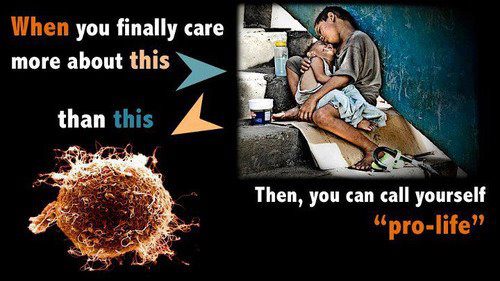
“Jesus,” said one party to the conversation, “commands us to care about both?”
“Where,” asked another party, “does Jesus command us to care about fetuses.”
Of course, Jesus does not; Jesus never made much mention of pregnancy or childbirth or care for the unborn. However, today’s Psalm might be read to lay the foundation for an understanding of God’s care for the unborn. The other party to the conversation didn’t go there, however. Instead, that person referred to Jesus’ citation of the second great commandmant: “Love your neighbor as yourself.” (Matt. 22:39) He continued with this assertion: “Since a baby in utero is a person and a child of God, the baby is your neighbor.” This statement is a logical as well as a theological stretch, I’m afraid, and here is where I started giving the issue some thought.
The reference to “a baby in utero” is fraught with issues. There is considerable debate today as to when a fertilized egg achieves the status of “baby”. It is not, however, at the moment of conception. Technically, from a medical point of view, a baby isn’t a baby until it’s born; “baby”, medically, refers to an infant, a newborn. From two months after conception until birth the child in utero is considered a fetus. During the first two months after conception, it is an embryo. (And then there are the theological issue of “ensoulment”, which is said to happen at “quickening”, and the legal issue of “viability”, which is the ability of the fetus to live outside the womb. Neither time nor space allow exploration of those issues.)
The second issue with the statement is in referring to whatever it is that is in utero as a “person”. Personhood is a legal concept and, in law, personhood is achieved at birth. (I’m not going to get into the currently hot political issue of whether corporations are people; that’s a whole other legal question.) Legally, a person is an autonomous being, a natural born man, woman, or child. The fertilized egg, embryo, or fetus in utero may be a person-in-potential, but is not yet a person-in-actuality. There are, of course, a number of proposed bills or constitutional amendments in several states that would change this legal definition, but as of now this is where American law stands.
Now, having said that, there are good reasons for being opposed to abortion, but basing that opposition on the supposed personhood of the in utero embryo or fetus, and stretching that personhood to neighbor status, and attaching Jesus’ “second great commandment” to that supposed neighbor just is not one of them. I’m opposed to abortion because I truly do believe, as this Psalm says, that God is involved in the procreative and developmental processes, that the development of the embryo into a fetus and the growth of the fetus are not simply mindless biological operations, that there is a mystical, spiritual “knitting” taking place, that we human beings are wonderfully and marvelously made by God. Abortion interferes with God’s work whereby we are “made in secret and woven in the depths of the earth.”
But I am also opposed to the outlawing of abortion because I hold what I believe is a fully consistent “pro-life” philosophy. I believe that one who is opposed to abortion must also be in favor of safeguarding the health and welfare of mothers before, during, and after giving birth. I believe that one must be in favor of improving the lives of children after they are born. A truly pro-life position would promote child and maternal welfare and health programs, feeding programs, education programs, and (I believe) access to safe and legal abortion in those circumstances where the life, health and safety of the mother are at risk, where the pregnancy results from rape or incest, or where there is medical reason to believe that the person-in-potential will be born with severe physical or mental developmental handicaps which would make life an intolerable burden. To be truly pro-life is to be pro-choice, because the choice is not between abortion or a baby; the choice is between a safe, legal abortion and an unsafe, deadly one. No woman should ever have to choose the latter!
To oppose abortion without supporting infant and maternal health programs, child welfare programs, good education, and access to safe and legal abortion when needed, is not a pro-life stance. It is simply to be pro-birth, but there is so much more to life after birth!
We are wonderfully and marvelously made, knit and woven together by God in our mother’s wombs, not just to be born but to have a life, a good life. That’s why, as opposed to abortion as I may be, I hold to a pro-life pro-choice position in favor of the availability of legally regulated, medically safe, accessible abortion for women who need to choose that path.
====================
Father Funston is the rector of St. Paul’s Episcopal Church, Medina, Ohio.
 My father-in-law died a week ago; he will be laid to rest later today. His ashes will be interred next to those of my mother-in-law, his first wife, who passed away sixteen years ago. Marge was a Christian and an active church member; Paul was not. I’m not sure he was ever baptized but, if he was, he left that behind long ago. (Yes, I know the theology of baptism – once baptized, always baptized – and that may true from the church’s point of view, perhaps even from God’s perspective, but that was not Paul’s reality.)
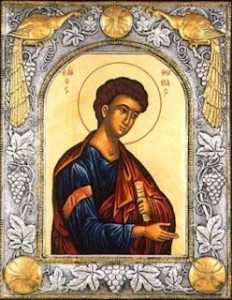 Commentaries insist that all John is doing in identifying Thomas as having been “called the Twin” is translating his Semitic name into its Greek equivalent, Didumos meaning “two-fold, twain, or twin”. But I wonder why he does this? A strain of Christian gnosticism insisted that Thomas was Jesus’ twin brother! Wouldn’t that have been interesting? How would we explain the Incarnation if the “power of the Holy Spirit” which came over Mary and produced a child with no earthly father had actually resulted in twins? Only one of them would be the Incarnation? Would that even make sense? No, I don’t think the gnostics got that one right, at all. But still, I find it intriguing that John throws in this little tidbit that Thomas was called “the Twin.” (He does it three times! He must have thought it important! See also John 20:24 and 21:1.)
 I love this Psalm – it’s about liturgy and worship, something dear to my heart!
  “Average Sunday Attendance” – also known as “ASA” – has become a hot topic in church circles. It’s how we gauge the health of congregations, not that it’s a very good measure of that, but what other easily accessed metric to governing boards and denominational judicatories have? If the parish priest, pastor, senior minister, whatever he/she may be called is doing a good job, the assumption is, the pews are going to be full. So if we count the number of seats in the seats, voila! we know if things are good.
 If you are a political junkie like me, you’ve been following the campaigns, watching the conventions, reading the editorials, and generally getting angry with one side or the other or both and the whole process. You may have noticed, as I have, that candidates are never alone. They are surrounded by a whole corps, an entire gaggle of handlers, some of whom have the responsibility to make sure the candidate stays “on message”, that he or she makes no “gaffs”. Jesus was surrounded by a gaggle, as well, but these were not handlers and there was no one to keep him “on message” except himself. In fact, the gospel witness is pretty clear that even right up to the end the gaggle that followed him around really didn’t understand the message!
 From time to time, people tell me that they have appreciated something I’ve said or done and I try to remember to say, “Thank you.” But inside, I really don’t think about compliments very much. It’s not that I don’t appreciated them, but I don’t do what I do to be complimented, and I really don’t think that I have much to do with it when whatever I do has gone well or had a positive impact on someone. I sort of take Paul’s attitude from the Letters to the Romans and the Galatians: “It is no longer I who live, but it is Christ who lives in me” (Gal. 20:2) and “I will not venture to speak of anything except what Christ has accomplished through me” (Rom. 15:18). So I do think, generally, that the answer to Eliphaz’s question is, “Yes.” Mortals can be of use to God. But there are times I would answer otherwise.
  This was today’s morning psalm, about which I am writing late in the evening. Today’s meditation was delayed by sad news in our family: my wife’s father passed away early this morning. She was unable to be with him since we live far away from her original home where he had continued to reside. We are comforted that his wife (my spouse’s stepmother) and two of his sons were with him.
 As I look at life, crooked lines abound. It’s what human beings do. Bar-Jesus (as the magician Elymas is also named in the Book of Acts) may have been making the straight crooked with evil intent, but I suspect that most human beings just do it out of habit, out of an inability to do anything else, out of (maybe) some sort of primate instinct to make a mess. My mother used to admonish me, in a lot of circumstances, “Don’t get bent out of shape!” At sixty years of age, I have come to suspect that there is no way to avoid life getting bent out of shape! Crooked lines abound.

