From the Acts of the Apostles:
Now the whole group of those who believed were of one heart and soul, and no one claimed private ownership of any possessions, but everything they owned was held in common. With great power the apostles gave their testimony to the resurrection of the Lord Jesus, and great grace was upon them all. There was not a needy person among them, for as many as owned lands or houses sold them and brought the proceeds of what was sold. They laid it at the apostles’ feet, and it was distributed to each as any had need.
(From the Daily Office Lectionary – Acts 4:32-35 – August 10, 2012)
 This short passage from the Book of Acts describes the sort of world Jesus intended. Not just the sort of church . . . . the sort of world, the sort of human society, a complete community in which no one claims private ownership (it’s all God’s remember) and where there are no needy persons because what is needed is distributed equitably.
Dream world, right? Never gonna happen, you say? Then what do we mean when we say (some of us everyday, but a lot of at least once a week), “Our Father in heaven . . . your kingdom come”? If we don’t mean it, if we don’t want God’s kingdom to come, why do we keep asking for it? (Jesus taught this petition to his disciples when they asked him to teach them to pray. See Matthew 6:9–13 and Luke 11:2–4.)
I got into a beef in an on-line recently because another person attributed Massachusetts Senator Scott Brown’s criticism of his state’s Department of Transitional Assistance to his Christianity. Brown was upset because the department had mailed voter registration materials to some 400,000 welfare recipients; he interpreted this as a pro-Democratic-Party action by the department. (In fact, it was in compliance with a court order regarding the state’s failure to comply with “motor voter” regulations.) Nowhere in the article to which my correspondent referred was there any mention of Brown’s Christian faith (he is reportedly a member of the conservative Christian Reformed Church) by either Brown or the reporter. I objected to this person’s statement as a gratuitous and groundless comment, and a lengthy conversation ensued. (It was eventually and abruptly terminated by my correspondent.)
It got me thinking, though, about how we characterize the actions (political or otherwise) of other people and how in modern America we seldom hear positive actions (other than those expressly undertaken by the church) characterized as Christian! Programs which aid the poor, the elderly, the very young, or others in need are criticized as “socialist” even though that is precisely what the apostles set up in their first century community (long before, it should be noted, any western European economics theorist coined the term “socialist”). They are referred to as “entitlements”, a word often said with a sneer. If they are defended, it is on the grounds not of Christian practice but of some theory of economics or general ethics. The Constitutional separation of church and state, I suppose, is at work here. But for those who do support them and are Christians, if we really mean what we pray in the Lord’s Prayer (or any prayer of intercession for the poor and the needy for that matter), shouldn’t we applaud such programs as consonant with our faith? Shouldn’t we be giving and working toward their success because they are, in fact, elements of that world Jesus intended?
My staunchly Methodist grandfather taught me a number of things. A couple of them come to mind today. He taught me to never approach the altar of God without a gift of thanksgiving. Even if you’ve already made your weekly tithe (and he insisted that one give a tithe, a tenth of income), if you attend another prayer service give another offering. Those offerings, he said, are means by which God’s church carries out God’s work and answers at least some of our prayers. He taught me the same thing about taxes. I don’t know if he was familiar with Justice Oliver Wendell Holmes’s famous statement, “Taxes are the price we pay for a civilized society,” but that was certainly his attitude. He taught me that paying one’s taxes is the way the citizen enables the government to do the work it is created to do: the Preamble to our Constitution says that that is, among other things, to “establish justice, insure domestic tranquility, provide for the common defence, promote the general welfare, and secure the blessings of liberty to ourselves and our posterity.” Providing for the poor, the elderly, the very young, and other needy persons sure seems to me to fit in there.
Another thing he taught me was never to pray for something I was not willing to work for. If you pray for someone to be healed, be willing (and available when called upon) to care for that person. If you pray for war to be ended, be willing (and available when called upon) to do the work of creating peace.
That’s what prayer was to my grandfather: giving and working. I think that’s what citizenship was to him, as well. If everyone who prays “your kingdom come” actually gave and worked toward the kingdom’s appearance, if everyone also looked at their citizenship that way, I suspect that we’d hear a lot less criticism of “entitlements” and that the world would look a lot like what is described in that short bit from the Book of Acts.
====================
Father Funston is the rector of St. Paul’s Episcopal Church, Medina, Ohio.
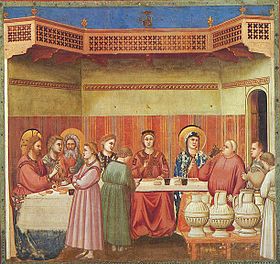 A year ago I was in Ireland, camped out in a cottage outside of the village of Banagher, County Offaly, on sabbatical. As my study project, I was translating old Irish hymns into metrical, rhyming English such that they could be sung to the music of the original. The hymns were published in the early 20th Century in a collection titled Dánta Dé Idir Sean agus Nuadh compiled by Uná ní Ógáin. Dánta Dé includes a communion hymn which elaborates on John’s story of the wedding feast; it is entitled The Blessed Wedding at Cana and is attributed to Maighréad ní Annagáin. I found I could not directly translate the hymn, so instead I wrote a poem of my own. Reading this story today, I recall working on that piece and offer it again.
 OK. I know I shouldn’t get into this . . . I know that someone is going to give me a hard time; I can almost predict that someone will tell me they are planning to “leave the church” over this. But here goes.
 Just a few days ago the Public Religion Research Institute issued a new report entitled A Generation in Transition: Religion, Values, and Politics among College-Age Millennials. A “millennial” is somone currently 18 to 24 years of age, the youngest cohort of adults. (From my point of view at nearly 60 years of age these are children; my son and daughter are both older than this group!) According to the report, these young adults are more likely then the general population to be religiously unaffiliated; one-quarter of them so identify themselves. Interestingly, most of those who do so were reared in religiously affiliated households. The greatest movement away from religious affiliation was seen among those raised in Catholic and white mainline Protestant families. It would appear that we have not been doing a very good job of teaching our children “that they in their turn might tell it to their children”!
 Reading these oh-so-familiar words in the introduction to John’s Gospel, I remember other words I read on another blog yesterday:
 It is intriguing how often in stories of Holy Scripture food plays a role. From the “apple” in the Garden, to Abraham offering a meal of cakes and meat to the three men (who turn out to God) at the Oaks of Mamre, to this story of Gideon, to David and his men eating the Bread of the Presence, to all the food items listed as items of sacrifice in Leviticus, the Old Testament (indeed, the whole Bible) is food focused. The People of God define themselves through the annual reenactment of a ritual meal celebrating the Passover; the new People of God define themselves (in my tradition and others) by the weekly reenactment of a ritual meal celebrating the death and Resurrection of Christ and anticipating his return. It’s intriguing but not surprising. The Jewish and Christian faiths are not, in the long run, about following rules of ritual or moral conduct; they are about being in an intimate relationship with that which is the source of being, that which we call “God” and address as “Father” or brother or redeemer. And, other than sex, there is probably no more intimate activity two or more people can share than eating together.
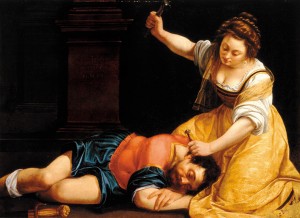 “Most blessed” be a murderess? What is this? Yesterday, a friend and colleague who was only a little older than I am passed away after several months of pancreatic cancer, so I’m a little sensitive on the subject of death this morning. So, really! What is this?
  These are the words spoken by the great crowd of Jews and others who thronged the streets of Jerusalem for the Festival of Shavu’ot when the Twelve, empowered by the Holy Spirit, begin to tell the story of Jesus in languages they had never before spoken. Shavu’ot is a celebration with both agricultural and historical significance in Judaism. It is known as the “festival of the first fruits,” a harvest feast when the first fruits were brought as offerings to the Temple; it is also known as the “festival of the giving of the Law,” a celebration of the handing down of Torah on Mt. Sinai. It was called Pentecost, a Greek word meaning “fiftieth”, because it always falls on the fiftieth day after the Passover. That year it fell on the fiftieth day after the Resurrection and, thus, the Christian feast of the Holy Spirit carries that name, as well.
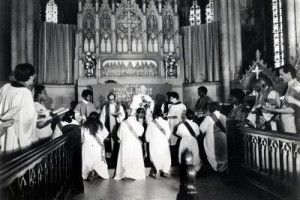 This past Sunday, the Episcopal Church marked the 28th anniversary of the women known as “the Philadelphia Eleven” who were ordained on July 29, 1974. Four retired bishops (Daniel Corrigan, Robert DeWitt, Edward Welles and George Barrett) chose to defy the General Convention of the Episcopal Church which, at its regular triennial meeting in 1973, had voted against opening the priesthood to women; women were already eligible for ordination as deacons. Joined by male presbyters who supported them and the candidates, they ordained eleven women deacons to the priesthood: Merrill Bittner, Alla Bozarth-Campbell, Alison Cheek, Emily Hewitt, Carter Heyward, Suzanne Hiatt, Marie Moorefield Fleisher, Jeannette Piccard, Betty Bone Schiess, Katrina Martha Swanson, and Nancy Hatch Wittig. Shortly thereafter, four additional women were also “irregularly” ordained: Eleanor Lee McGee, Alison Palmer, Betty Powell, and Diane Tickell. A firestorm of controversy erupted in the church: charges were filed against these dissident bishops (Daniel Corrigan, Robert DeWitt, Edward Welles and George Barrett) and an emergency meeting of the Episcopal House of Bishops was convened on August 15, 1974.
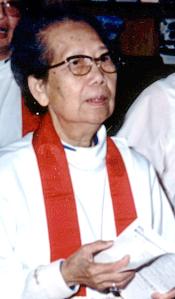 These women were not the first to be ordained to the Anglican priesthood, however. During the Second World War, Florence Li Tim-Oi was ordained to the presbyterate on January 25, 1944, by the Rt. Rev. Ronald Hall, Bishop of Hong Kong, in response to the crisis among Anglican Christians in China caused by the Japanese invasion. No male clergy could be found who were willing to take on the onerous ministry, but Ms. Li was, so she was ordained and served with distinction. After the war, the Archbishop of Canterbury sought to make the bishop and the priest rescind the ordination, but neither did. Ms. Li voluntarily ceased serving as a priest until more than 30 years later when she immigrated to Canada where the Anglican Church, following the Episcopal Church’s lead, had begun to ordain women. Her priesthood was recognized and she served as an honorary canon in Toronto, ministering among the immigrant Chinese population.

