Occasional thoughts of an Anglican Episcopal priest

Category: Psalms (Page 32 of 41)

Spiritual Center – From the Daily Office – December 13, 2013

From the Prophet Haggai:

Now therefore, thus says the Lord of hosts: Consider how you have fared. You have sown much, and harvested little; you eat, but you never have enough; you drink, but you never have your fill; you clothe yourselves, but no one is warm; and you that earn wages earn wages to put them into a bag with holes.

(From the Daily Office Lectionary – Haggai 1:5-6 (NRSV) – December 13, 2013.)

Spiral GalaxyIt never ceases to amaze me how directly Scripture can speak to the present day! The admonition to “Consider how you have fared,” and its description of an economy in a shambles, where the people work but do not enjoy the produce of their labor, continue to be hungry and thirsty, cannot find warmth, and find their earnings dribbling away to nothing, could be addressed to anyone anywhere in today’s world, I think.

Haggai’s purpose in speaking his prophecy is to encourage the rebuilding of the Temple in the years immediately following the end of the Babylonian Exile, sometime around 520 BCE. His thesis seems to be that if the Jews can reclaim their spiritual center, in his eyes quite literally the physical center of the universe, the Temple of God, their lot will improve. It’s a good point, I think.

I’ve noticed over the past few days that a lot of people were remarking that today would be “Friday the 13th,” not a few with noticeable dread. Many of the same people regularly check their horoscopes and will make it a point of telling others, “I’m a Sagittarius,” or will explain someone’s behavior with, “Well, he IS a Leo!”

My late mother was one such person. She didn’t put much stock in concern about the number 13 (live and work in Las Vegas, Nevada, and you see and learn to dismiss a lot of that sort of thing), but she sure seemed to pay attention to astrology. She was a Cancerian; she constantly reminded my brother and me that he was a Leo and I, a Libra. Whatever personality traits we exhibited were explained by the stars! But all that changed when she entered her 70s.

Something else changed then, too. Her son became a priest. About a year after my ordination, my family and I were visiting my parents and I noticed on her nightstand a copy of The Book of Common Prayer, an old study bible that had been on their bookshelves unused for years, and a newcomer’s pamphlet from a local Episcopal Church. I picked up the BCP and walked into the living room.

“Uh . . . what’s this?” I asked innocently.

“Well,” she said in that almost-sarcastic tone of voice on which I think she had a trademark, “I guess you’re serious about this, so I thought I’d better check it out.”

And check it out she did. Both she and my step-father became official members of the Episcopal Church later that year. He became a regular handyman volunteer around the church, and she became an active member (and even an officer) in the Episcopal Church Women. They attended Mass every week, took part in social events, and worked in the church’s outreach ministry. Both pre-planned their memorial services using the burial rites of the Prayer Book, and their ashes are now together in the memory garden next to the larger church sanctuary their capital contributions help to build.

Here’s the interesting thing: after that day when she admitted she was “checking out” religious faith, I never again heard a word about horoscopes or the zodiac. God, Jesus, and the Christian faith had made astrology unnecessary in her life.

I have atheist and agnostic friends who will scoff at that. In their minds there is no difference between belief that the stars control our destiny and belief that there is a God who loves us. There is, however, a significant difference and it is exactly in that verb I just used – love. The stars, the number 13, rabbit’s feet and lucky clovers, the things of superstition are indifferent to human beings; God is never indifferent.

When we put the indifferent (indeed, the inanimate) at the center of our lives, life suffers. Whether that indifferent thing is a distant star or a bank account, a good luck piece or a career, that thing cannot give back any of our devotion. Center on the indifferent, we will sow much and harvest little. When God is at the center of life, our devotion is returned. Our hunger and our thirst are satisfied.

Haggai was on the right track and his prophecy does address our current situation. A religious re-centering was needed and perhaps the Temple was a visible sign of that re-centering of the returned exiles, but one does not really need a physical center. The people, each individually and all together as a society, needed a spiritual center. The people, each of us individually and all of us together as a society, still do.

It is Advent: the Advent call to self-examination continues in Haggai’s prophecy. What is at our spiritual center? As the morning psalm says today, God is our “strong rock, a castle to keep [us] safe,” and God will lead us and guide us. (Ps. 31:3)

====================

A request to my readers: I’m trying to build the readership of this blog and I’d very much appreciate your help in doing so. If you find something here that is of value, please share it with others. If you are on Facebook, “like” the posts on your page so others can see them. If you are following me on Twitter, please “retweet” the notices of these meditations. If you have a blog of your own, please include mine in your links (a favor I will gladly reciprocate). Many thanks!

====================

Father Funston is the rector of St. Paul’s Episcopal Church, Medina, Ohio.

I’m sorry? – From the Daily Office – December 11, 2013

From the Psalter:

I confess my iniquity; I am sorry for my sin.

(From the Daily Office Lectionary – Psalm 38:18 (NRSV) – December 11, 2013.)

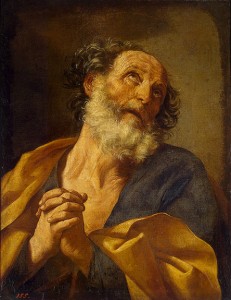
Repentance of St Peter by Guido ReniI thought, “Surely, this is wrong! There can’t be anything as weak and lifeless in Scripture (especially in the Psalms) as the plaintive little cry, ‘I’m sorry . . . .'” So instead of the New Revised Standard Version, I turned to The Book of Common Prayer, sure that I would find a stronger statement, perhaps “I repent.” But, no. The BCP version of this psalm is really even worse because it renders the verb in the future tense: “I will confess my iniquity and be sorry for my sin.” Come on! “I will be sorry”? Really?

I couldn’t sit there in my pajamas disconcerted by such a feeble, apologetic rendering of what must surely be a more forceful statement in the Hebrew. I turned to my old interlinear Hebrew-English Old Testament and my Hebrew lexicon; I had to climb the stairs to the second floor study because those are not close to hand next to the recliner in the den. It was worth the effort; I breathed a sigh of relief. The Hebrew is da’ag, which means “to fear, be anxious, be concerned, be afraid, be careful.” In fact, the American Standard translation (which is what my interlinear uses) renders this verse: ” I am full of anxiety because of my sin.” In the Complete Jewish Bible (which I also snagged while I was upstairs), the translation is similar: “I am anxious because of my sin.” To be fearful or to be filled with anxiety because of one’s sinfulness is a lot more than merely being sorry! But even that doesn’t seem quite strong enough . . . .

I’m not sure why the words “I am sorry” set my teeth on edge, but they do. When my children were younger like all children they committed youthful indiscretions; when called on the carpet, their first words were always, “I’m sorry.” My response was almost always, “Don’t be sorry. Change your behavior.” Feeling badly about one’s wrong-doing is simply not enough! What is called for by Scripture, what is called for by the process of growing to maturity, is repentance. “Repent and turn from all your transgressions; otherwise iniquity will be your ruin,” says Ezekiel (Ezek. 18:30) In another place, the Psalmist proclaims, “If one does not repent, God will whet his sword.” (Ps. 7:12) “Repent,” says Jesus, “for the kingdom of heaven has come near.” (Matt. 4:17)

To repent is to lament one’s guilty state, turn away from it, change one’s mind and purpose, and undertake amendment of life and behavior. It is so much more than simply being sorry! It is to take action to alleviate one’s deep-set feelings of anxiety and fear. “Don’t be sorry. Change your behavior.”

Although Advent is not the penitential season that Lent is, there is in it a call to contrition. Last Sunday and next at the weekly celebration of the Eucharist we hear of John the Baptizer who came “proclaiming a baptism of repentance for the forgiveness of sins,” and announcing the arrival of the one who would baptize with the Holy Spirit and with fire. (Luke 3:3,16) In Advent, we do our best once again to heed his call and prepare again for the Messiah’s arrival.

There is so much more required than simply a weak plea of “I’m sorry,” and certainly more the Prayer Book’s promise to be sorry in the future! Only with true repentance, right now, and amendment of life, now and in the future, can we “come to the unity of the faith and of the knowledge of the Son of God, to maturity, to the measure of the full stature of Christ.” (Eph. 4:13)

====================

A request to my readers: I’m trying to build the readership of this blog and I’d very much appreciate your help in doing so. If you find something here that is of value, please share it with others. If you are on Facebook, “like” the posts on your page so others can see them. If you are following me on Twitter, please “retweet” the notices of these meditations. If you have a blog of your own, please include mine in your links (a favor I will gladly reciprocate). Many thanks!

====================

Father Funston is the rector of St. Paul’s Episcopal Church, Medina, Ohio.

Clergy Cufflinks – From the Daily Office – December 7, 2013

From the Psalter:

The Lord has sworn and he will not recant: “You are a priest for ever after the order of Melchizedek.”

(From the Daily Office Lectionary – Psalm 110:4 (BCP Version) – December 7, 2013.)

Clergy CufflinksI have a pair of cufflinks with part of this verse inscribed on them in Latin: “Sacerdos in Aeternum” (“Priest Forever”). They were given to me as an ordination present. I seldom have reason or opportunity to wear them as I don’t generally wear long-sleeved, let alone French-cuff, shirts. But yesterday I did.

At my parish, our chapter of the Episcopal Church Women holds an annual “English Cream Tea” on the Friday nearest St. Nicholas Day. This is the group’s big fund-raiser for the year and it is a major undertaking. Yesterday was the day! The 21st Annual St. Nicholas Tea.

We are in the process of expanding our church building, specifically the fellowship area and gathering space, and the Tea was the first major event in the not-quite-finished new space. It took a lot of work by a lot of people to get things cleaned up, set up, and ready to go. It took more work by more people to host the event, seat the guests, serve the tea, run the gift shop which is part of the event . . . and then, after 140 guests (in two seatings) had enjoyed their tea and tid-bits, to tear it all down, clean it all up, and put it all away.

I wore my “Sacerdos in Aeternum” cufflinks because each year I join other men in the parish assisting the ladies. We dress in formal wear to do so. It’s the one day each year that I get to wear my tux, French-cuff shirt, silk waistcoat, and those cufflinks. Together, the day, the cufflinks, and their engraved message are a reminder that a priest is a priest in community. It is the community of the church which discerns the call to ordination, nurtures the priest in formation, ordains him or her to the office, and sustains his or her presbyteral ministry. Clergy do not minister in isolation.

Nor are the clergy the only ministers in the church. In my tradition (the Episcopal Church), our catechism reminds us that “the ministers of the Church are lay persons, bishops, priests, and deacons.” (BCP 1979, page 855) We take seriously the Reformation idea of the priesthood of all believers. We are a community of priests, some ordained to the sacerdotal priesthood, but all of us part of the “royal priesthood” about which Peter wrote in his first epistle, “a holy nation, God’s own people, in order that you may proclaim the mighty acts of him who called you out of darkness into his marvelous light.” (1 Pet. 2:9)

That Light is coming into the world. Be alert, be prepared. It’s Advent!

====================

A request to my readers: I’m trying to build the readership of this blog and I’d very much appreciate your help in doing so. If you find something here that is of value, please share it with others. If you are on Facebook, “like” the posts on your page so others can see them. If you are following me on Twitter, please “retweet” the notices of these meditations. If you have a blog of your own, please include mine in your links (a favor I will gladly reciprocate). Many thanks!

====================

Father Funston is the rector of St. Paul’s Episcopal Church, Medina, Ohio.

Kitchen Sink – From the Daily Office – December 5, 2013

From the Psalter:

O Lord my stronghold, my crag, and my haven. My God, my rock in whom I put my trust, my shield, the horn of my salvation, and my refuge.

(From the Daily Office Lectionary – Psalm 18:1-2 (BCP Version) – December 5, 2013.)

Kitchen SinkWhat a great couple of verses to illustrate metaphoric thinking!

I’m reading an old book of popular theology from the 1960s in which one of the essays is about the church and the arts. In it the author makes the point that metaphors or artistic analogs are ways of “changing one’s mind.” They break through intellectual barriers and challenge literal preconceptions. The theological imagination must be an analogic imagination; the only way we can know anything about God is through analogs and metaphors.

Of course, we know clearly that God is not a crag, a shield, a horn, a refuge, a whatever. But God is like these things in some fashion; these things are metaphors that give us a hint of what God might be like. (I know, using “like” makes the analog a simile not a metaphor; deal with it.)

Another form of analogic thinking is the parable. Jesus taught primarily through parables. He did so because giving people straight-up philosophical principles or rules of how to live doesn’t work; it is perceived by one’s audience as … well … boring and uninteresting. But tell them a story of people killing their landlord’s son? You got ’em, Jesus, you got ’em!

Here’s something I don’t quite get, though. God becomes a human (incarnate, we say) in the person of a master storyteller who goes around breaking down his listeners’ intellectual barriers by using simile, metaphor, and parable . . . and a lot of his followers turn out to be literalists, swallowing the nonsense of biblical inerrancy and insisting that everything in the bible is scientific truth. How does that happen? I don’t get it.

So here’s a fun exercise for Advent . . . make up a really ridiculous metaphor or parable of the divine, and explore how that analog might inform your understanding of God. Things like “Jesus is my hot beverage.” (Thanks to my son and his Happening friends for that one.) Or one I suggested a few days ago, “The Kingdom of heaven is like a lawnmower.” Try “God is my kitchen sink” or “the Kingdom of heaven is like a bus station where someone gave away tickets” or, better yet, make up your own.

Exercise your analogic imagination. It will help you to understand that Scripture is too serious to be taken literally! It’s what Jesus would do; it’s what Jesus did!

====================

A request to my readers: I’m trying to build the readership of this blog and I’d very much appreciate your help in doing so. If you find something here that is of value, please share it with others. If you are on Facebook, “like” the posts on your page so others can see them. If you are following me on Twitter, please “retweet” the notices of these meditations. If you have a blog of your own, please include mine in your links (a favor I will gladly reciprocate). Many thanks!

====================

Father Funston is the rector of St. Paul’s Episcopal Church, Medina, Ohio.

Advent Anger – From the Daily Office – December 2, 2013

From the Psalter:

He whose throne is in heaven is laughing; the Lord has them in derision.

(From the Daily Office Lectionary – Psalm 2;4 (BCP Version) – December 2, 2013.)

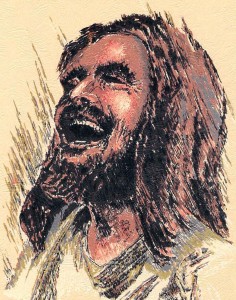
Laughing JesusIn the library of my parish church is a pen-and-ink drawing of Jesus laughing. It’s not a picture I particularly like, nor is it particularly well executed. In fact, if someone hadn’t told me that it is supposed to show Jesus laughing, I would have thought he was angry! Whenever I look at it, this verse from the Psalter comes to mind.

I think it’s hard for some people to conceive of Jesus (or God) showing emotions, particularly negative ones. I remember years ago (I was in my early 20s) listening to a meditation on anger at a church retreat. The priest offering the meditation said, “Jesus never displayed anger.” Really? I thought. What about that little incident in the Temple overturning tables and brandishing a whip? A false and mistaken idea that Jesus was never just plain mad, that God never gets royally pissed off does nothing more than create guilt in people who do (that would be everybody, I think).

One of the most interesting portrayals of the Lord in art that I have ever seen was a small hand-carved crucifix. The face of Jesus was contorted in obvious rage. I asked the artist about it and he told me it was how he saw Jesus saying, “Father, forgive them.” — “I think that what he is saying at that moment is, ‘You forgive them because, right now, I can’t! I have done everything you asked of me. I have taught them, healed them, exhorted them to proper conduct, shown them how to live, and this is what they do to me. I have run out of forgiveness. You do it!'” — I wish I’d been able to obtain that crucifix, but it wasn’t for sale.

I am quit certain that Jesus exhibited the full range of emotion, and I am equally certain that God does, as well. After all, Jesus was — is — God Incarnate. Furthermore, our faith teaches us that through his Ascension, Jesus has taken humanity into God’s heavenly domain; that includes everything it means to be human, including our emotions, positive and negative.

During these days of preparation for Christmas, this season the church calls “Advent,” emotions run high. For many people, sadness, anger, depression, a sense of loss, feelings of exclusion and betrayal may be the major emotions of the holidays. Laughing Jesus who looks to be angry, God laughing in derision, Jesus angry in the Temple, Jesus in exasperated rage on the cross . . . they should remind us that there should be no guilt in feeling these things. They are part of our humanity. Our human task is to accept them, work through them, and let go of them.

Lord, accept my Advent anger, my Christmas blues; help me lay them aside so that I may enter into the joy of your Incarnation.

====================

A request to my readers: I’m trying to build the readership of this blog and I’d very much appreciate your help in doing so. If you find something here that is of value, please share it with others. If you are on Facebook, “like” the posts on your page so others can see them. If you are following me on Twitter, please “retweet” the notices of these meditations. If you have a blog of your own, please include mine in your links (a favor I will gladly reciprocate). Many thanks!

====================

Father Funston is the rector of St. Paul’s Episcopal Church, Medina, Ohio.

The Advent Question – Sermon for Advent 1, RCL Year A – December 1, 2013

====================

This sermon was preached on the First Sunday of Advent, December 1, 2013, at St. Paul’s Episcopal Church, Medina, Ohio, where Fr. Funston is rector.

(The Revised Common Lectionary, Advent 1A: Isaiah 2:1-5; Psalm 122; Romans 13:11-14; and Matthew 24:36-44. These lessons can be read at The Lectionary Page.)

====================

Advent WreathFriday was a Holy Day in America! It was a day when all across the nation thousands, if not millions, of people breathed prayers of thanks. It was a day when all across the nation thousands, if not millions, improved the lives of many, many others. It was a day when news organizations from the smallest local radio station to international broadcast and cable conglomerates asked Americans across the nation, “How did you participate?” Yes, Friday was a Holy Day in America!

Wait! Did he say, “Friday?” Yes, he said, “Friday.” It was Black Friday. The day on which, we are told, retailers whose businesses have been operating at a loss all year long finally find themselves making a profit, when the ink on the ledger changes (in accounting tradition and terminology) from red to black. The thousands, possibly millions, uttering those thanksgivings were the managers, executives, Chief Executive Officers, financial officers, accountants, stockholders, and owners of retail concerns from smallest local boutique to the largest retail chains. Those thousands, possibly millions, who improved the lives of those retail owners and managers were the shoppers, the consumers, the buyers of bargains who . . .

In Odessa, Texas, trampled an 8-year-old boy and got themselves pepper-sprayed by store security in a mad rush to tear open a WalMart pallet of bargain-priced tablet computers.
* * *
In Las Vegas, Nevada, another shopper in the leg during a struggle over a bargain TV in a Black Friday sale at Target.
* * *
In incidents in Virginia and California, stabbed and slashed each other with knives in their efforts to get at sale-priced merchandise.

And they all did it in celebration of the birth of our Lord and Savior Jesus Christ. Or so those news organizations, from the smallest radio station to the international broadcast and cable conglomerates, tell us — this is all a part of “the Christmas Season.”

Somehow, though, I think we can be fairly sure that this isn’t what the Prophet Isaiah had in mind when he wrote:

Come, let us go up to the mountain of the LORD,
to the house of the God of Jacob;
that he may teach us his ways
and that we may walk in his paths.

Nor is it what St. Paul had in mind when he wrote:

Let us live honorably as in the day, not in reveling and drunkenness, not in debauchery and licentiousness, not in quarreling and jealousy.

Yes, the church has a rather different understanding of what we should be about during these days leading up to the celebration of the Messiah’s birth. Contrary to what the retail advertisers and the international news conglomerates tell us, this is not “the Christmas season.” This is the season of Advent. These four weeks or so leading up to Christmas Day are a time when the church bids us, as we make our preparations to celebrate the Messiah’s Birth, also to more consciously prepare for the his return. To ask ourselves a question . . .

But the question for Advent is not “When will Jesus come back?” Although the Scriptures continually remind us that one day God will, in Isaiah’s words, “judge between nations and shall arbitrate for many people,” Jesus reminds us that “about that day and hour no one knows.” So we must “keep awake” because we “do not know on what day [the] Lord is coming.” “The Son of Man is coming at an unexpected hour.” No, the question is not about when (or even if) the Messiah will return.

We all know that preparing to celebrate the birth of Christ is not a once-and-done thing. We do it again and again and again, every year. Sometimes we make mistakes doing it — We invite the wrong co-worker to our open house . . . next year we won’t do that again! We try using gorgonzola cheese in the stuffing . . . won’t do that again! Sometimes something new turns out to be something we want to do again — Apollo’s Fire’s Christmas vespers was lovely; we’ll take that in again next year. Going to church is great; let’s do that again soon! It’s not once-and-done; it’s something we do again and again and again.

Preparing for the Messiah’s return is also not a once-and-done thing. It’s something we have to work at and be ready at any time. This is what Jesus is saying when says that “two will be in the field; one will be taken and one will be left. Two women will be grinding meal together; one will be taken and one will be left,” or when he reminds us that “if the owner of the house had known in what part of the night the thief was coming, he would have stayed awake and would not have let his house be broken into.” It’s not that those things will happen at the end of time when he returns, but rather that they can happen at any time and, therefore, one must always be prepared. We must, in fact, always be preparing. We are to stay awake, to watch for signs of God’s activity in the world.

No, the question is not about when (or even if) the Messiah will return.

On the First Sunday in Advent, we are called upon to take our God and ourselves seriously. We are called upon to recognize that life can be changed, possibly even ended in an instant and to live our lives accordingly.

I was reminded earlier in the week by an old colleague from Kansas about something our bishop, the Rt. Rev. Bill Smalley, often said when we would gather as clergy. He liked to say that each order of the clergy, deacons, priests, and bishops, had a particular “iconic ministry.” Priests, in particular, he would say are the “icons of the story.” The role of the priest, in Bishop Smalley’s estimation, is to tell the story of God, the story of God’s People, the story of Jesus . . . to tell the story again and again and again. My colleague said, “Throughout the church year our worship tells the story over and over without much thought about how we live our lives, how we live in the Kingdom of God. We say we gather to praise God, but in truth we gather to tell the story, over and over. Our praise of God is in our lives.” And so, my old colleague suggested, a person who truly believes the story should ask him- or herself, “How does a person who believes this story live and praise God?”

That strikes me as a really good question to ask oneself during Advent, “How does a person who believes this story live?” Isaiah’s answer was, “they shall beat their swords into plowshares, and their spears into pruning hooks; nation shall not lift up sword against nation, neither shall they learn war any more.” St. Paul’s answer was, “Make no provision for the flesh, to gratify its desires.”

How does a person who believes this story live? It’s not a question that I can answer for you, but it is a question we can explore together and find answers that work for each of us, though our answers may not be exactly the same. And we may find answers that work for us today but won’t be right next year. It’s not a question with a once-and-done answer.

I was reading through a list of “things you can do for Advent,” things like read a chapter of Holy Scripture every morning, or reconnect with five old but not recently contacted friends, or reach out to a new charity. They were all good suggestions, but the one that particular rang a bell for me this year was to take five minutes every morning and make a list. Not a Christmas list of things to buy, or things to do, or things you want. Make an Advent list list of 24 blessings in your life, it could include the people you love, the people who love you in spite of yourself, the signs you recognize of God’s presence in your life. After you’ve made your list, each day in Advent pray a prayer of thanks for one of the things on the list.

That made sense to me this year because for me, this year, the answer to ” How does a person who believes this story live?” is “With gratitude.” And then my friend Mary Frances Schjonberg shared her sermon for this morning and in it introduced me to a poet new to me, Gunilla Norris. She is a psychotherapist who describes her work as “the practice of spiritual awareness in the most mundane and simple of circumstances.” In a poem called Polishing the Silver, she prays for the gift of gratitude:

As I polish let me remember
the fleeting time that I am here. Let me let go of
all silver. Let me enter this moment
and polish it bright. Let me not lose my life
in any slavery – from looking good
to preserving the past, to whatever idolatry
that keeps me from just this –
the grateful receiving of the next thing at hand.

Remember, it’s not Christmas yet. It’s Advent and Advent asks a question: “How does a person ‘keep awake’ because we ‘do not know on what day [the] Lord is coming?'” How does a person who believes this story live? Poet Norris suggests a pretty good answer to consider: By gratefully receiving the next thing at hand. Amen.

====================

A request to my readers: I’m trying to build the readership of this blog and I’d very much appreciate your help in doing so. If you find something here that is of value, please share it with others. If you are on Facebook, “like” the posts on your page so others can see them. If you are following me on Twitter, please “retweet” the notices of these meditations. If you have a blog of your own, please include mine in your links (a favor I will gladly reciprocate). Many thanks!

====================

Father Funston is the rector of St. Paul’s Episcopal Church, Medina, Ohio.

Cleaning the Windshield — Sermon for All Saints Sunday, RCL Year C – November 3, 2013

====================

This sermon was preached on All Saints Sunday, November 3, 2013, at St. Paul’s Episcopal Church, Medina, Ohio, where Fr. Funston is rector.

(The Revised Common Lectionary, All Saints: Daniel 7:1-3,15-18; Psalm 149; Ephesians 1:11-23; and Luke 6:20-31. These lessons can be read at The Lectionary Page.)

[Note: The Revised Common Lectionary Old Testament reading for All Saints in Year C is an edited pericope; I had the reader at Mass read the entire thing, verses 1 through 18.]

====================

Windshield with BugsToday is the first Sunday in November which means that instead of the normal sequence of lessons for Ordinary Time, we are given the option of reading the lessons for All Saints Day, which falls every year on November 1. So today we heard a very strange reading from the Book of Daniel, a to-my-ear very troubling gradual psalm (in which we sing of wreaking vengeance on the nations and punishment on the peoples, of binding king in chains, and of inflicting judgment on the nobles bound in iron), a bit of Paul’s letter to the Church in Ephesus extolling the riches of the inheritance of the saints, and to Luke’s version of the Beatitudes in which Jesus not only blesses the poor, the hungry, and the weeping, he sighs woefully over the future plight people like ourselves – the comparatively wealthy, those whose bellies are full, and those in relatively good state of mind.

I asked our Old Testament reader this morning to read a somewhat longer lesson from Daniel than you find in your bulletin insert because the edited (or, more accurately, gutted) version there (which are the verses required for the day by the Revised Common Lectionary) includes only the introduction of a dream or vision experienced by Daniel and then skips immediately to the interpretation. We would have heard none of the apocalyptic imagery of the dream, but I think it important that we listen to and consider Daniel’s troubling vision of four strange beasts and the coming of one “like a son of man,” else how are we to understand the interpretation given by the “attendant.”

Early in my meditations and study for preaching today, I thought I would explore with you the meaning of the beasts and so on, but the more I thought about that, and especially as I began actually organizing my thoughts and writing out my sermon, I decided against doing so. It would I think be a distraction from the focus of the day. I was thinking that the reading as edited in the Lectionary presents us with a passage that makes little sense, but after reading and hearing again the full Daniel’s story of seeing a winged lion, a tusked bear, a four-headed leopard, and a ten-horned and iron-toothed monster, I guess that’s what we have in the longer reading, too! A lesson that distracts us, as so much in the Bible can do; so many people focus on these arcane details that they miss the bigger picture the Bible tries to show. As result, we get such non-Biblical nonsense as the various forms of “tribulationism” and the story of “the Rapture;” we get “one-issue Christians” who refuse to recognize as members of the same faith Christians who disagree with them. We get exactly the opposite of what the Feast of All the Saints is supposed to underscore.

So, instead of dealing with this troubling bit of the Bible right now, what I’d like you to do is come with me for a drive. Let’s just set the Bible aside and go get in our car and head off down the road. It’s a country road, a hard-pack dirt country road out in the farm country. We’re taking a country drive on a fine, beautiful spring day. It’s been raining, but it’s not raining now. Now the sun is shining and the birds are singing and insects of all sorts are buzzing and humming and chirping. In fact, there are loads of insects. It’s one of those days when the damsel flies are swarming, doing their brief romantic aerial ballets to attract mates and perpetuate their species. It’s one of those days when the grasshoppers are doing their best to eat everything in sight. It’s one of those days with yellow swallow-tails and monarchs and viceroys and white cabbage butterflies are flittering all over the place.

As we drive along, we’re traveling at a pretty good clip and, as you might expect with all those bugs around, the windshield is getting pretty messy. And since it just stopped raining and the dirt road is still a bit muddy, a lot of that has splashed up onto the windows and the windshield, as well. In fact, we can barely see through the windshield! We put the wipers on and twist the knob so the washer fluid sprays onto the glass, but the bug juice is sticky and there’s a lot of mud, so the washers only clear a little of the muck away, and the windshield is now not only covered with dead bugs and muck, it’s streaky, too!

Still, we peer through the streaks of bug blood and mud, and keep our eyes on the road ahead. Eventually we come to a filling station and we pull in. In a bygone era, a man in coveralls with a greasy rag tucked in his pocket would have run out and begun filling our tank with gas, and he would have checked under the hood, and he would have carried out a bucket of soapy water with a large sponge and a squee-gee, and he would have washed our bug-be-splattered, mud-streaked windshield and cleaned away all that distracting muck that was keeping us from seeing our way ahead.

A few days ago, I was reviewing a Vacation Bible School curriculum based on the story of Jonah and in the sales literature the publisher had written these words: “The Bible is a window that shows us God’s heart. In the stories, in the writings, and in the Gospels we see what God is like. The Bible reveals God to us, just like the windows in a car or in a building reveal what is going on outside.”

Isn’t that a great image for Holy Scripture: “The Bible is a window that shows us God’s heart.” Now I don’t know about you, but when I am driving in a car on a day like I described to you, a day when the windshield gets are splattered and messy with dead bugs and mud, I have a hard time looking beyond that cloudy window in front of me. I get distracted by the details on the window; I focus on them and not on the road out in front of me.

But so long as I focus on the window, the window is not serving its purpose. The window is not there to be the object of my attention; it is there to let me see what is happening on the other side. So it is with the Bible.

The Education for Ministry group that I have the privilege to mentor in this parish is made up of all first year students, so everyone in the group is working through study of the Old Testament. We are about six weeks into reading Genesis and Exodus now, and one of the things we’ve noticed is that the stories of the Patriarchs and the first Hebrews are not very pretty: Abraham is a liar; Jacob is a cheat; Joseph’s brothers are petulant bullies who nearly kill him; Moses whines a lot; and Aaron (Moses’ brother), although he is the first high priest, is the one who turns the people away from God and fashions the golden calf for them to worship! We are all, I think, finding it difficult to look past the peccadillos of the Patriarchs in order to see the God who is behind the stories; just like its difficult to look past the bugs and the mud on the windscreen!

And then today, along comes Daniel with his weird vision, the Palmist with his bloodthirsty delight in vengeance and revenge, and Jesus telling us that those of us who are fairly well off are destined to be hungry and in mourning! It’s hard to look past all of that understand where God is. As one commentator on Daniel noted, we who read this story in the Bible are “in the midst of bewildering events that affright and confuse.”

We find this all hard to accept and difficult to look through because we want the Bible to be clear! We want the Bible to be the answer book, to lay it all out for us in simple and easy-to-follow instructions; we want to be able to say, as our Sunday School children sang last week, “The B-I-B-L-E, that’s the book for me! I stand alone on the word of God, the B-I-B-L-E!” We just want it to be clear! But the Bible doesn’t exist to be the object of our devotion; the Bible doesn’t exist to be regarded on its own and for itself. The Bible is a window through which God is reveals Godself to us and, like any window, its got some distracting stuff we have to look past.

It does so because it is book (several books, actually) full of human stories, and human stories are messy. So we end up with stories of people who are sometimes liars and cheaters; people who can sometimes whine and be unfaithful. We end up with stories of weird hallucinations and frightful dreams. We end up with poetry by someone who’s been hurt so badly that vengeance and revenge can look like a gift of God. We end up with troubling warnings that we might, probably will, face hunger and grief. How do we look past that to see, as Paul encouraged the Ephesians, with the eyes of our hearts enlightened, so that we may know what is the hope to which God has called us?

Well, when we were on our drive through the countryside with our windshield spatted with bug goo and mud, we pulled into a gas station, and a mechanic came out and washed all of that away. Remember? Today is the day that we remember those who help clean away all of the distractions, the filling station attendants of the faith. Today we remember the saints who help to clear our vision of God. Broadly speaking, of course, the saints are all those who are baptized, who follow Jesus Christ, and who live their lives according to his teaching, which would include all of us here today. Church tradition, however, also uses the term more narrowly to refer to especially holy women and holy men who are heroes of the faith, who through lives of extraordinary virtue reveal the Presence of God to us, who clean that window through which we all look.

Cleaning a WindshieldThe saints whom we celebrate on this day (and the many who are given special days of individual recognition) were people who tried to live according to the Bible as they understood its teachings. Like us, they read it and encountered those troubling visions, those petulant patriarchs, those bloodthirsty psalms, and somehow looked past them and through them to see the God of faith, the God who Incarnate in Jesus said, “Love your enemies, do good to those who hate you, bless those who curse you, pray for those who abuse you.” We extoll the virtues of those saint and we celebrate their lives and their witness because they help us to do the same. By their lives and their examples, they clean the windshield for us; they clean away the bug blood and the mud, so that we no longer focus on the window, but on the God the window shows us.

This is not to suggest that we should not study nor seek to understand the murkiness and cloudiness that we find on the window, the questionable and troublesome visions of Daniel, the lying and cheating of the Patriarchs, the bloodthirstiness of the Psalmist, or the petulant pettiness of the Prophets. Certainly, we should for we can learn thereby of the graciousness of the God who overlooked and overcame those faults, who regarded and redeemed those men and women! But following the example of the saints before us, we should not let ourselves be distracted by them so that we fail to see and appreciate that same God.

Today we give thanks for the saints, the filling station attendants of the faith, who help us clean our windshields.

O God, the King of saints, we praise and glorify your holy Name for all your servants who have finished their course in your faith and fear: for the blessed Virgin Mary; for the holy patriarchs, prophets, apostles, and martyrs; and for all your other righteous servants, known to us and unknown; and we pray that, encouraged by their examples, aided by their prayers, and strengthened by their fellowship, we also may be partakers of the inheritance of the saints in light; through the merits of your Son Jesus Christ our Lord. Amen. (BCP 1979, Burial of the Dead, page 504)

====================

A request to my readers: I’m trying to build the readership of this blog and I’d very much appreciate your help in doing so. If you find something here that is of value, please share it with others. If you are on Facebook, “like” the posts on your page so others can see them. If you are following me on Twitter, please “retweet” the notices of these meditations. If you have a blog of your own, please include mine in your links (a favor I will gladly reciprocate). Many thanks!

====================

Father Funston is the rector of St. Paul’s Episcopal Church, Medina, Ohio.

Open to God — Sermon for the 23rd Sunday after Pentecost, Proper 25C – October 27, 2013

====================

This sermon was preached on the 23rd Sunday after Pentecost, October 27, 2013, at St. Paul’s Episcopal Church, Medina, Ohio, where Fr. Funston is rector.

(The Revised Common Lectionary, Proper 25C: Sirach 35:12-17; Psalm 84:1-6; 2 Timothy 4:6-8,16-18; and Luke 18:9-14. These lessons can be read at The Lectionary Page.)

====================

3rd Century Mural, Woman in Orans PositionWe are straying from our usual lectionary path today because it is one of our Children’s Sundays and we have some younger kids reading the lessons at the 10 a.m. service. So, instead of a long reading from the prophet Joel (RCL Year C, Track 1), we have a brief lesson from the Book of Ben Sira, which is sometimes called Ecclesiasticus. (RCL Year C, Track 2) We thought it would be easier for a child to read.

This is one of the books of the Apocrypha, those books recognized by the Roman and Eastern Orthodox churches as canonical, but rejected by Protestants. Anglicans steer a middle course and accept them for moral teaching, but not as the basis for religious doctrine. The text is a late example of what is called “wisdom literature,” instruction in ethics and proper social behavior for young men, especially those likely to take a role in governance.

Ben Sira was written early in the 2nd Century before Christ by a Jewish scribe named Shimon ben Yeshua ben Eliezer ben Sira of Jerusalem. The Jewish nation was then under domination of the Seleucid Empire, a Greek-speaking kingdom centered in modern day Syria. Society in Jerusalem was very polarized: powerful vs. weak; rich vs. poor; Jew vs. Gentile. Ben Sira sought to guide his students through socially ambivalent times.

Among the topics he addresses is the proper forms and attitudes of worship. The Seleucid governors had involved themselves in the affairs of the Temple and, therefore, many people (especially the precursors of the Pharisees) believed that Temple worship was comprised and invalid. Furthermore, for many of the city’s wealthy participation in Temple rituals was a matter of show to advance themselves and their agenda; they offered mere lip service to God while oppressing the poor and helpless.

In this social milieu, Ben Sira offered instruction on the nature of worship, sacrifice, and prayer in Chapters 34 and 35 of the book. In Chapter 34 he describes worship that is not acceptable to God:

The Most High is not pleased with the offerings of the ungodly, nor for a multitude of sacrifices does he forgive sins. Like one who kills a son before his father’s eyes is the person who offers a sacrifice from the property of the poor. The bread of the needy is the life of the poor; whoever deprives them of it is a murderer. To take away a neighbor’s living is to commit murder; to deprive an employee of wages is to shed blood. When one builds and another tears down, what do they gain but hard work? When one prays and another curses, to whose voice will the Lord listen? If one washes after touching a corpse, and touches it again, what has been gained by washing? So if one fasts for his sins, and goes again and does the same things, who will listen to his prayer? And what has he gained by humbling himself? (Ben Sira 34:23-31)

He follows this up with the advice we heard in our reading today: “Be generous when you worship the Lord, and do not stint the first fruits of your hands. With every gift show a cheerful face, and dedicate your tithe with gladness. Give to the Most High as he has given to you, and as generously as you can afford.” (Ben Sira 35:10-12)

Ben Sira’s wisdom would have been well known to the people of Jesus’ time. Portions of the book were found among the Dead Sea Scrolls, and a nearly complete scroll was discovered at Masada, the Jewish fortress destroyed by the Romans in 73 AD. In addition, there are numerous quotations of the book in the Talmud, and the Anglican scholar Henry Chadwick (1920-2008) cogently argued that Jesus quoted or paraphrased it on several occasions, including in the petitions of the Lord’s Prayer.

So when Jesus told the parable of two prayers, his original audience would have had Ben Sira’s advice as background; they would have known that Jesus was referring back to a concern about hypocritical worship, about worship that is merely for show, about worship that does not honor the commandments, a concern dating back many years. They would have known who Jesus was condemning, just like we do! They knew that Jesus was not talking about them, just like we know that Jesus is not talking about us! Thank God that we are not like the bad people who pray with self-righteousness and contempt for others . . . .

Oh . . . wait a minute! You see what Jesus has done? He’s trapped us! He’s tricked us into judging the Pharisee, to regarding him with contempt. And by judging the Pharisee we have become like the Pharisee; in order to get Jesus’ point we have to point to the Pharisee and his sin. By pointing to someone else, to “thieves, rogues, adulterers, or even . . . this tax collector,” and to their sins, the Pharisee condemns himself; by pointing to the Pharisee and his sin, we condemn ourselves.

Clever, sneaky preacher, that Jesus! How do we become more like the tax collector and less like the Pharisee? Ben Sira instructed his students to look worship with the eyes and understanding of God, with humility and without partiality.

So here’s an exercise . . . look at the other people all around you in church today. You know most of these people; some of them are in your family; some of them are your friends; you go to breakfast with some of them every Sunday. You may not know others; some are people you see here on Sunday but don’t otherwise socialize with; some may be people you don’t know at all. But about all of them, you do know two things. First, you know that God loves them; God loves every single person in this church today. God made them; God knows them; God loves them.

The second thing you know is that nobody in this church today is perfect. The religious way to say that is that every one of us is a sinner. Each one of us says and does things that hurt others; each one of us says and does things that hurt ourselves; each one of us says and does things that hurt God. Sometimes we do that intentionally; more often we do it negligently. But the simple truth is, whatever the reason for it may be, that we do it.

And here’s a third thing you know, and this you know about yourself . . . that the two things you know about all these people around you in church are also true of you. These are the two central truths of the Christian faith: that we are sinners and that God loves us anyway.

Now I’d like to ask you all to stand, as you may be able.

Raise your right hand, palm cupped up. Receive in that hand the truth that God loves you, that God loves all of us. Now raise your left hand, palm cupped up. Offer from that hand to God the truth that you are not perfect, that you are a sinner. See how your right hand is still holding the first truth; the second doesn’t change it at all. Not about you, not about anyone!

This, by the way, is called the orans position, the ancient position of prayer, standing with one’s hands up-raised, open to God; it has a rich tradition in Jewish and Christian practice, one’s body representing the spirit open to God’s grace.

The Pharisee in the parable failed to be fully open, fully honest with God or with himself. He was willing to raise the one hand to receive God’s blessing, but was unwilling to raise the other, unwilling to admit that he was imperfect, that he was like the thieves, rogues, adulterers, and tax collectors, that he was like us.

Jesus, clever, sneaky preacher that he is, tricks us into acknowledging that we are like the Pharisee. Like Ben Sira before him, he encourages us to place ourselves fully before God, fully open to God, praying with the tax collector, “God, be merciful to me, a sinner!”

Amen.

====================

A request to my readers: I’m trying to build the readership of this blog and I’d very much appreciate your help in doing so. If you find something here that is of value, please share it with others. If you are on Facebook, “like” the posts on your page so others can see them. If you are following me on Twitter, please “retweet” the notices of these meditations. If you have a blog of your own, please include mine in your links (a favor I will gladly reciprocate). Many thanks!

====================

Father Funston is the rector of St. Paul’s Episcopal Church, Medina, Ohio.

As Water to Stone — Sermon for the 22nd Sunday after Pentecost, Proper 24C – October 20, 2013

====================

This sermon was preached on the 22nd Sunday after Pentecost, October 20, 2013, at St. Paul’s Episcopal Church, Medina, Ohio, where Fr. Funston is rector.

(The Revised Common Lectionary, Proper 24C: Jeremiah 31:27-34; Psalm 119:97-104; 2 Timothy 3:14-4:5; and Luke 18:1-8. These lessons can be read at The Lectionary Page.)

====================

Water on Stone“The days are surely coming, says the Lord, when I will . . . watch over [the house of Israel and the house of Judah] to build and to plant. * * * I will put my law within them, and I will write it on their hearts; and I will be their God, and they shall be my people.”

Our lesson from the Book of the Prophet Jeremiah today comes from a section of that book which scholars call “the Little Book of Consolation” or “the Book of Comfort;” it comprises chapters 30-33 of Jeremiah and is thought to be the work of an editor or group of editors generally referred to as “the Deuteronomist” because it is similar in perspective to the Book of Deuteronomy.

In it Jeremiah’s message to the post-exilic community, a message of hope and restoration, appears to have been re-organized theologically around the idea of restoration and obedience to the Torah. It is a theological reflection upon the fact that, at a time in Israel’s history when God’s People faced their darkest hour since being slaves in Egypt, God’s word to them was one of hope for the future. It voices a basic recognition that God is willing to work with humanity even in the face of its sinful rejection of God. It asserts that God’s choice for sinners is nothing short of forgiveness; “I will forgive,” says God, “with no prerequisites and no preconditions.” God’s forgiveness creates newness in the lives of people; it creates a future which will be enough different from the past that even the hearts of God’s People will be transformed.

Earlier Jeremiah had said, “The sin of Judah is written with an iron pen; with a diamond point it is engraved on the tablet of their hearts . . . .” (17:1) Now in the Book of Comfort, as edited by the Deuteronomist, the Prophet asserts that God will write his instruction, his law, his torah on the human heart with his own finger. So the writing involves an erasure as well: where sin was once written, now God’s own will and desires will be written — on each human heart.

This is a socially radical assertion.

If God’s covenant is written on each heart, all members of the community will stand on equal ground. If God’s covenant is written on each heart, all will be equal in righteousness. It will have a leveling effect, eliminating doubt about who can properly be called “Israel.” No longer will it matter whose ancestors stood at Sinai. The marker of the covenant binding the community together will be internal, an invisible sign that cannot be questioned by genealogy or undermined with accusations of impurity. No one can claim the authority to teach the other because each heart has God’s torah inscribed on it.

How is this going to happen?

Jesus gives us a clue in the parable told in this morning’s reading from Luke’s Gospel, parable about not losing heart.

In this reading, Jesus tells the store of a woman who demands justice; he doesn’t tell us the particulars of her case. We do not know her grievance nor what redress she believes should be hers; those details are not important to Jesus’ story. What is important is only that she has a legitimate complaint and seeks some form of amends.
However, her just cause is thwarted by an unjust judge who will not grant her the judgment. So every day she comes to the court and every day makes her plea: “Grant me justice against my opponent.” Finally, she wears down the unjust judge and he grants her that to which she is entitled. In commenting upon that eventual conclusion, Jesus asks, “Will not God grant justice to his chosen ones who cry to him day and night? Will he delay long in helping them? I tell you, he will quickly grant justice to them.”

This passage is usually interpreted to mean that we should persistently petition God for the things we want. If we pester God enough, goes this interpretation, we’ll receive whatever it is we are praying for. So there’s the rich man harassing God for greater wealth. There’s the young woman worrying God for a spouse. There’s the cancer patient insisting that God should intervene and heal him. If we are persistent, if we just wear God down, will God fix everything.

Is this really how God works? Is this really what Jesus meant by telling this parable?

If we believe that if we just ask enough, God will make us rich, how does real poverty in our midst answer that belief? If we believe that if we just ask enough, God will give us the desires of our hearts, what does it say when our hearts are broken? If we believe that God will heal our bodies if we only ask enough, what does it mean when our bodies or our loved ones’ bodies waste away?

Do we really believe that is how God works? That in prayer as in business, the squeaky wheel gets the grease?

If you really believe that is what Jesus telling this parable is saying, then I would ask you to reconsider and, especially, to take into account two things. First, Jesus’ assurance that God “will quickly grant justice” where it is warranted and needed. Second, that in his concluding commentary Jesus asks another much more long term question: “And yet, when the Son of Man comes, will he find faith on earth?”

I believe that Jesus is saying something about the transformation of human hearts, hearts often described in the Hebrew Scriptures as “hearts of stone” (Ezekiel 11:19; 36:26) or as “hardened” (1 Sam. 6:6; Ps. 95:8; Isa. 63:17). The instrument of that transformation is prayer.

Why do we pray? What is the ultimate goal? Are we, as Oswald Chambers once caricatured most prayer, simply “throw[ing] our petitions at [God’s] throne and dictat[ing] to Him what we want Him to do?” Clearly not!

Through prayer we rein in our overactive, worry-prone, and control-oriented minds. Through prayer we remind ourselves of God’s sovereignty. Through prayer we align ourselves with the Spirit, allowing the Advocate to counsel us. Through prayer we eventually conform our mind to His mind – our will to his will.

One definition of prayer says that it “is the divinely appointed means through which we commune with the living God and advance God’s kingdom.” A life lived in prayer creates a relationship with God which conforms our minds to God’s. Through prayer our hearts are aligned with God’s, so that our lives are lived with the unconditional love which characterizes God’s very self. The more we pray, the more we live into God’s own life.

The Roman poet Ovid, who lived at the time of Christ, wrote “Dripping water hollows out stone, not through force but through persistence.” The Chinese philosopher Lao Tse wrote that water is patient and takes its time, so when it does carve through stone, the marks it leaves are smooth and natural. “In this world,” he wrote, “there is nothing softer or thinner than water. But to compel the hard and unyielding, it has no equal. That the weak overcomes the strong, that the hard gives way to the gentle — this everyone knows.”

Jesus is making this same point in the parable of the persistent widow and the unjust judge. As water is to stone, so prayer is to the human heart.

It is not that our persistent prayer wears down the Judge: we are assured that “he will quickly grant justice.” No, the persistent prayer is like water, the waters of grace, wearing down our harden hearts; through our prayers, conforming our wills to God’s will, our minds to God’s mind, God will remove from our bodies the hearts of stone and give us hearts of flesh (Ezek. 36:6), hearts on which God’s torah will be written.

Let us pray:

Grant, Almighty God, that through your grace, with our constant prayer, your Word may be so engraved on the tablets of our hearts, that our wills may be conformed to your will, our minds to your mind, that we may produce the fruit of good living, to the honor and praise of your Name; through Jesus Christ our Lord. Amen.

====================

A request to my readers: I’m trying to build the readership of this blog and I’d very much appreciate your help in doing so. If you find something here that is of value, please share it with others. If you are on Facebook, “like” the posts on your page so others can see them. If you are following me on Twitter, please “retweet” the notices of these meditations. If you have a blog of your own, please include mine in your links (a favor I will gladly reciprocate). Many thanks!

====================

Father Funston is the rector of St. Paul’s Episcopal Church, Medina, Ohio.

To Boldly Go: Sermon for a Celebration of Ministry – St. Paul’s, Manhattan, Kansas – October 16, 2013

====================

This sermon was preached on October 16, 2013, at St. Paul’s Episcopal Church, Manhattan, Kansas, where Fr. Funston’s son, the Rev. A. Patrick K. Funston is rector. Fr. Patrick was installed as rector, and the appointment of the Rev. Sandra Horton-Smith as Deacon in the parish was also celebrated.

(The Episcopal Church sanctoral lectionary for the Feast of Hugh Latimer & Nicholas Ridley, bishops and martyrs: Zephaniah 3:1-5; Psalm 142; 1 Corinthians 3:9-14; and John 15:20-16:1.)

====================
Ridley and LatimerI bring you greetings from the people of St. Paul’s Parish, Medina, Ohio, where I am privileged to serve as rector. Nearly all the active members of our congregation know and respect Patrick, and have asked me to convey their congratulations to him and to you, together with the assurance of their prayers, as you continue together in a new ministry only recently begun. Of course, none of them know Sandy, but we offer our greetings and prayers for her diaconal ministry among you, as well.

I suppose my son asked me to preach this evening because he believes that in 40 years of church leadership including 23 years in ordained ministry as a deacon, curate, associate rector, and now rector in four dioceses, I may have picked up one or two bits of useful information to pass along. I shall strive, Fr. Funston, to make it so.

Sandy, I have never been a vocational deacon and I have had only a little experience working with deacons in the course of my ministry; nonetheless, it is my hope there may be something in what I have to say that will be of use to you.

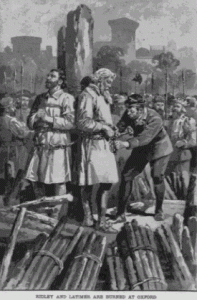
We are gathered this evening on the feast of two Anglican martyrs — Nicholas Ridley and Hugh Latimer. They were bishops of the reformed Church of England put to death, by being burned at the stake, during the short reign and attempted Roman Catholic restoration of Queen Mary I, eldest daughter of Henry VIII. During her less-than-six years on the English throne, nearly 300 Protestants were killed, including these two bishops, so she is known to history as “Bloody Mary.”

The bishops’ martyrdom is most notable for the probably apocryphal story that Latimer, as the fires were lighted beneath them, reached to Ridley, took him by the hand and said, “Be of good cheer, Master Ridley, and play the man, for we shall this day light such a candle in England as I trust by God’s grace shall never be put out.”

I’ll skip the other details of Latimer’s and Ridley’s lives and ministries; I bring them up really only to explain the otherwise incomprehensible choices of lessons for this service; one really must stretch to find anything remotely enlightening about parish ministry in Zephaniah’s “soiled, defiled, oppressing city” filled with faithless people and profane priests, or in the Psalmist’s languishing spirit and loud supplications. There may be (indeed there will be) times when both priest and people may feel like the Psalmist in the course of a pastorate (as Paul wrote to the Corinthians, the work of ministry will be tested by fire), but dwelling on that hardly seems a constructive way to begin the relationship.

I must admit that I was tempted to use the bishop’s martyrdom as a metaphor for parish ministry, but thought better of it; it would be an incomplete metaphor, at best. I think I’ve found a much better metaphor, but before I get to it, I want to digress for a moment and tell you something about our experience, my wife’s and mine, in raising our son.

When Patrick was in junior high school and high school, his band and orchestra directors said to us, “Your son is a talented musician. He could have a great career in music.”

“Yes!” we replied, “Encourage him in that!”

When he was in high school and college, his mathematics instructors said to us, “Your son is a natural mathematician. He could have a great career as a professor or a theoretician.”

“Yes!” we replied, “Encourage him in that!”

When he decided to major in business, we heard from his fellow students and his professors that he had a great mind for economics and finances, and could make millions as a financial planner.

“Yes!” we said, “Encourage that!”

Earlier in his life, from about the age of 14 on, when he was active as an acolyte, and in youth group, and in the diocesan peer ministry program, people would come to us and say, “Patrick has all the skills and the personality to be a wonderful priest.”

“No!” we cried, “Please do not encourage him that way!”

It’s not that we didn’t want Patrick to become a priest; we’re delighted that he has found his calling amongst the clergy of the church and that he has been called to be Rector in this parish. However, his becoming a priest or Sandy’s becoming a deacon is not something we, any of us, including them, have any business “wanting.” It isn’t something that we or anyone should be “encouraging.” Ordained ministry is something to be discerned and what it is to be discerned is whether the potential priest or deacon can be anything else.

Every potential clergy person is asked, over and over again, “Why do you want to be clergy?” And every priest and deacon here tonight has answered that question. We may have phrased the answer differently, but for each of us it is the same. It’s not that the person called to the diaconate wants to be a deacon; it’s that she must be a deacon! It’s not that the person called to priesthood wants to be a priest; it’s that he must be a priest!

Presbyterian pastor and author Frederick Buechner spoke for us all when he answered the question in his book, The Alphabet of Grace:

“I hear you are entering the ministry,” the woman said down the long table meaning no real harm. “Was it your own idea or were you poorly advised?” And the answer that she could not have heard even if I had given it was that it was not an idea at all, neither my own nor anyone else’s. It was a lump in the throat. It was an itching in the feet. It was a stirring of the blood at the sound of rain. It was a sickening of the heart at the sight of misery. It was a clamoring of ghosts. It was a name which, when I wrote it out in a dream, I knew was a name worth dying for even if I was not brave enough to do the dying myself and if I could not even name the name for sure. Come unto me all ye who labor and are heavy laden and I will give you a high and driving peace. I will condemn you to death. (Frederick Buechner, The Alphabet of Grace, pp. 109-110)

Buechner’s last sentence does call to mind the martyrdom of Latimer and Ridley and so many others: “I will condemn you to death.” As a description of the call to parish ministry it is both terrifying and terrific!

The Christ we follow, the Christ we proclaim, the Christ who said, “If they persecuted me, they will persecute you,” does call us, does lead us to die! To die to selfishness, to die to ego. But through that death he leads us to life. We die to self to uncover what the Quakers call, “that of God within” or the “inner Teacher” … the True Self. Your call, Patrick, to priesthood and yours, Sandy, to the diaconate … our call to parish ministry is a call to continue dying to self and, as a result, to continue becoming truly alive.

It is, as any priest or deacon here will tell you, a painful process. To be clergy in Christ’s church is, as Paul made quite clear in his letters to the congregations in Ephesus and Rome, a gift; it is a wonderful, precious, costly, and painful gift. It will take you into the deepest intimacy with God’s people, with your people. At times you will be with them in the midst of their worst nightmares – death and divorce, devastating illness and the depths of despair. At times, you will feel put-upon and misused. At times, you will feel left out and neglected. At times, there will be conflict, and it will seem like it is consuming you alive. At times, it may seem that, a bit like Latimer and Ridley, you are being burned at the stake, because people will hurt you, sometimes intentionally and spitefully, sometimes negligently, often simply because they are in pain.

But as I said a moment ago, that would be an incomplete metaphor because the source of that pain is also the source of the most exquisite joy, when that same intimacy will privilege you with sharing God’s people’s, your people’s happiest and most blessed moments – when two people commit themselves to one another for life, when their children are born, when they get that long-sought promotion, when their kids graduate with honors, when children marry, when grandchildren are born, when these people among whom and with whom you minister know themselves to be God’s beloved.

Cherish those intimate moments — both the painful and the joyful — because they are moments of grace. Each of them is unique; never fall into the black hole of thinking you’ve “been there, done that.” There may have been similar moments . . . but that couple has never been married before and never will be again, that baby has never been born or baptized before and never will be again, that teenager has never graduated from high school before and never will again, that man has never died before and never will again. Each intimate moment, painful or joyful, is unique and no one has ever been there before. Each unique intimate moment, painful or joyful, is bursting with the promise and potential of God’s grace!

Do not fear those moments of graceful intimacy; cherish them because it is in them that you and the people of St. Paul’s Parish will die to self and become truly alive, to continue growing in boldness and righteousness, in faithfulness and patience, in wisdom and even holiness. It is in those moments when we are in the presence of God, when we stand before the throne of grace.

I think you know, Patrick, that one of my favorite verses of Scripture is from the Letter to Hebrews: “Let us therefore come boldly unto the throne of grace, that we may obtain mercy, and find grace to help in time of need.” (Heb. 4:16 KJV) So . . . if I say to you that our mission in parish ministry is to boldly go into those unique moments of grace where no one has gone before, you probably know that my metaphor for parish ministry is “the voyages of the Starship Enterprise.”

I read somewhere recently that one can consider oneself an unqualified success as a parent if you have raised your child to be a Star Trek fan; by that measure, Patrick’s mother and I were successful.

Star Trek Uniform SocksIn the original Star Trek series, the crew’s uniforms were color coded: gold uniforms were command; red uniforms were engineering and security; and blue uniforms were science and medical. Parish ministry entails all three. So, Patrick, I have a little gift for you — a set of three pairs of official Star Trek color-coded uniform socks to remind you of these aspects of pastoral ministry.

Gold — command: Patrick, the canons of your diocese (with which, you may recall, I have some familiarity) provide that as rector, “by virtue of such office, [you have] the powers and duties conferred by the General Canons of the Church, and in this connection shall exercise pastoral oversight of all guilds and societies within the parish, and [you are] entitled to speak and vote on all questions before these bodies.” (Canon IV.6, Diocese of Kansas) The canons provide that you are the chair person of the vestry and that you not only chair the annual meeting of the parish, you are also the final arbiter of who may vote at the meeting.

That’s a good deal of command authority and it should not be taken lightly. Remember two things about it. First, that you share it with others. The canons specify that the vestry “shall share with the Rector a concern and responsibility for the mission, ministry, and spiritual life of the parish.” (Canon IV.5.6(a)) But not only the vestry, all the good people this parish are your co-workers. As our catechism makes clear, “the ministers of the Church are lay persons, bishops, priests, and deacons;” every single baptized person, every member of this church has a ministry. The Rector does not do it alone, nor should he.

You remember on Star Trek: TOS, Captain Kirk went on every away mission. That’s a model of poor leadership; the captain should not have commanded, or even been a part of, every away team. Trust the rest of the crew — the vestry, the staff, volunteers, all the people of the parish — to handle things.

Remember Paul’s opening words to the Corinthians in this evening’s epistle: “We are God’s servants, working together . . . .” You and the vestry and people of this congregation are God’s servants, working together. You as the Rector don’t have to do it all — you do have to know what is happening; you have to be in the information loop and be privy to all the information pertinent to the running of the church and to ministering with and among its members, but you don’t have do it all!

I suspect that if Jesus were to critique Kirk’s style of leadership, he might say something along the lines of “It will not be so among you; whoever wishes to be great among you must be your servant.” (Matt. 20:26) That is the second thing to remember about command authority in the church. Be like the 6th Century pope St. Gregory the Great and remember that as a leader in the church you are the “servant of the servants of God.”

The red uniforms were for those doing engineering and security, and there is a lot of that in parish ministry. Much of it, knowing where the boilers are and how they work, knowing where the circuit breakers and fuses are, knowing how to fix a leaky faucet or a squeaky hinge or a broken kneeler . . . much of it falls into the category of “things they didn’t teach us in seminary.” But there is also a lot of engineering and security that they did teach us.

The ministry of word and sacrament are the engineering and security jobs of the parish priest; preaching God’s word and celebrating God’s Sacraments, for which seminary did prepare us. They are central to any priest’s ministry, and to do them well takes time and it takes prayer.

Preparing a sermon can easily consume 10-15 hours per week. Similarly, planning liturgies, not only for regular Sunday services, but for weddings, funerals, holidays, and other special events takes time and care. Many people are willing to say their clergy should put in this kind of time, but the only way the rector can have this time is if other demands are otherwise taken care of. I have admonished Patrick not to be Captain Kirk going on every away mission. So I admonish you, the people of St. Paul’s Parish, that you must not expect him to make every pastoral visit, oversee every parish activity, make every administrative decision. As St. Paul wrote the Ephesians, each member of the church is given grace according to the measure of Christ’s gift and each member must work to properly promoting the body’s growth. I encourage you to claim the shared ministry of the whole people of God and join with your rector and your deacons in providing pastoral care to one another, in managing parish activities, and in administrative governance.

Patrick, this obligation of the congregation means that you must answer it with a similar commitment. Just like Engineer Scott was always adjusting the “warp coils” and tuning the “dilithium crystals” (whatever those were), you must take time in prayer adjusting your spirit and tuning your psyche. Take the time your congregation gives you to prepare prayerfully for these “red uniform” ministries — preaching and sacramental celebration. Be like Captain Jean-Luc Picard in TNG; take private time in your “ready room;” spend time in conversation with God every day. Other things can wait or someone else can do them . . . but no one else can listen to God for you. You must spend your own time in prayer.

Sandy, I would say the same thing to you. Your engineering and security ministry will be different from Patrick’s, obviously. As a deacon, you are (I’m sure) familiar with the description of the role of the deacon as bringing the world’s needs to the attention of the church and taking the church’s ministry into service in the world. Deacons exemplify Christian discipleship, nurture others in their relationship to God, and lead church people to respond to the needs of the most needy, neglected, and marginalized of the world. Those are definitely “red uniform” tasks, and they too can only be done well with careful and prayerful preparation.

Prayer is also the “red uniform” ministry of whole congregation. The early 19th Century American Presbyterian preacher and seminary professor Gardiner Spring wrote in his book The Power of the Pulpit:

[H]ow unspeakably precious the thought to all who labor in this great work, whether in youthful, or riper years, that they are … habitually remembered in the prayers of the churches! Let the thought sink deep into the heart of every church, that their minister will be very much such a minister as their prayers may make him. If nothing short of Omnipotent grace can make a Christian, nothing less than this can make a faithful and successful minister of the Gospel!

We might express this thought differently today, but Gardiner’s point remains valid. Your prayers, good people, even more than their own, are the wellspring from which flows the water of God’s grace on which Patrick’s ministry as priest and Sandy’s as a deacon so much depend. If you wish their ministries to bear good fruit, do not forget to pray for them, and let them know that you are doing so!

Star Trek:TOS CrewWhich brings us, at last, to the blue uniforms, the science and medical corps of the star ship. Mr. Spock the Science officer and Doctor “Bones” McCoy always wore blue. One of the ancient terms that we still use for pastoral ministry is “the cure of souls,” the word “cure” having pretty much the same meaning as it has in medicine. Broadly speaking, this ministry is the care, protection, and oversight of the nourishment and spiritual well-being of the souls committed to the pastor’s care; it may be shared with others, with deacons or with lay ministers, but it is truly the ministry of the parish priest. It is in this “blue shirt” ministry that those wonderful, painful, joyful, intimate moments of grace that I spoke of earlier will happen.

It is customary at these services to ask the clergy about to be installed to stand for an admonition or a charge, but I’m not going to do that this evening. We aren’t here celebrating only the installation of the rector, or only the new ministry of these two clergy; we are celebrating the whole ministry of all the People of God in this parish. So I have a charge for all of you.

I know you expect me to say something like “explore strange new worlds, seek out new life and new civilizations, and boldly go where no one has gone before,” but that would just be too hokey, don’t you think?

No, I have rather more practical and down-to-earth advice.

Give each other time; give one another your attention; support one another with your prayers; respect yourselves and each other; and, most importantly, love one another. (Members of St. Paul’s, I can’t underscore the last one enough. You expect your clergy to remember your birthdays and your wedding anniversaries, to thank you when you perform some volunteer service, to greet you pleasantly when they see you at the grocery store. That’s only natural, and it’s right and proper that you do so. But, please, do the same for them! It is the most important thing the people of a parish can do for their clergy. Love Patrick and Sandy, their spouses and their families. Invite them into your homes. Remember their birthdays and anniversaries. Remember to say, “Thank you” once in a while. Believe me: it really is such little things that make all the difference.)

And, again, remember Paul’s words to the Corinthians: “We are God’s servants, working together.” So together represent Christ, bear witness to him wherever you may be and, according to the gifts given to each of you, carry on his work of reconciliation in the world.

If you do these things, you shall, by God’s grace, like Ridley and Latimer, light such a candle in Kansas, as, I trust, will never be put out.

Make it so! Amen!

====================

A request to my readers: I’m trying to build the readership of this blog and I’d very much appreciate your help in doing so. If you find something here that is of value, please share it with others. If you are on Facebook, “like” the posts on your page so others can see them. If you are following me on Twitter, please “retweet” the notices of these meditations. If you have a blog of your own, please include mine in your links (a favor I will gladly reciprocate). Many thanks!

====================

Father Funston is the rector of St. Paul’s Episcopal Church, Medina, Ohio.

« Older posts Newer posts »