Occasional thoughts of an Anglican Episcopal priest

Category: Psalms (Page 35 of 41)

Offal Theology Beats Awful Theology – Sermon for the 3rd Sunday after Pentecost (Proper 5C) – June 9, 2013

====================

This sermon was preached on the Third Sunday after Pentecost, June 9, 2013, at St. Paul’s Episcopal Church, Medina, Ohio, where Fr. Funston is rector.

(Revised Common Lectionary, Pentecost 3 (Proper 5, Year C): 1 Kings 17:8-24; Psalm 146; Galatians 1:11-24; and Luke 7:11-17. These lessons can be read at The Lectionary Page.)

====================
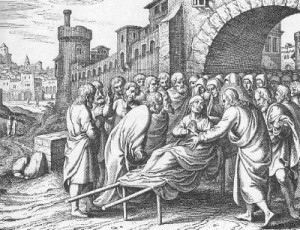
Jesus Raises the Son of the Widow of NainYou may remember that last week, as we were looking at the story of Elijah competing with the prophets of Ba’al, I said that Elijah was an unpleasant person. Well, this week we have another story of Elijah and another example of his unpleasantness. The Rev. Lia Scholl, a Mennonite pastor who writes sermon helps on a blog called The Hardest Question, said, “Every time I read this passage, my first reaction is, ‘Elijah is a jerk!'”

She points out that doesn’t ask for a drink of water or a morsel of bread, he demands them. Listen again to what the First Book of Kings says, “When [Elijah] came to the gate of [Zarephath], a widow was there gathering sticks; he called to her and said, ‘Bring me a little water in a vessel, so that I may drink.’ As she was going to bring it, he called to her and said, ‘Bring me a morsel of bread in your hand.'” He doesn’t introduce himself; he doesn’t explain himself; he just insists that the widow take care of his needs. “It’s just jerk behavior,” says the Rev. Scholl.

For the moment, though, let’s forgive Elijah his jerkiness, his unpleasant personality, and take a close look at this story. If it is an historical event (and about that there is some considerable doubt), and if the Books of Kings are intended to be a chronological record, then our lectionary has had us read about events in Elijah’s life out of sequence; this story is told one chapter before the sacrifice competition we heard about last week. The reason for us reading the stories out of order is pretty clear; our lectionary editors want us to hear and consider this story in connection with Jesus’ raising of the son of the widow of Nain.

This story about Elijah would have been very familiar to Jesus and those who witnessed what he did in Nain, and it’s possible that this Elijah story was known to Luke. They may have believed it to be an historical fact, but modern scholarship considers it unlikely that this is a factual story. It has the appearance of being a legend or folk tale intended by the author of First Kings to enhance Elijah’s standing as a prophet. First, there is the matter of the magic flask of oil and the magic container of flour, these vessels that never run out during the course of the three-year drought that is said to be affecting the land. (By the way, Elijah is credited with both causing and ending the drought with just a word, but other than this story in First Kings, there’s no evidence in any other historical or archeological record of there being a drought around his time.) Second, there is the manner in which Elijah brings the widow’s son back from the dead. Here’s the way it is described: “He [meaning Elijah] stretched himself upon the child three times.” This is what folklorists and anthropologists would call “sympathetic magic;” Elijah mimics the death of the boy, then acts out his desired resurrection, then utters some sort of magical formula, in this case a prayer to his god, Yahweh.

Now I said that those who witnessed Jesus raise the son of the widow of Nain probably knew this story and probably thought of it as factual. It is this prayer that Elijah speaks, and in fact the whole theology of the story, that makes me glad that we can look back at it and say it probably isn’t!

Listen to what the widow of Zarephath said to Elijah when her son died: “What have you against me, O man of God? You have come to me to bring my sin to remembrance, and to cause the death of my son!” This is awful theology! The widow blames herself for her child’s death. She believes that something she has done has caused her son to die. We still hear this kind of thinking today; we’ve all heard people in fits of grief cry out, “What have I done to deserve this?” Worse, she blames God because God’s prophet, Elijah, has come to her and this (she believes) has caused her sin to be recalled by God; in turn, because of that recollection, God has caused this terrible judgment (the death of her son) to happen. Now the poor woman in her grief, I suppose, can be forgiven this awful theology.

But Elijah in his prayer, his magic incantation after stretching out on the body of the deceased and enacting the boy’s resurrection, says exactly the same thing to God: “O Lord my God, have you brought calamity even upon the widow with whom I am staying, by killing her son?” According to the theology of this story, God punishes the sinful behavior (what ever it may have been) of parents by murdering their children!

I am often called upon to engage in conversation with atheists who want to tell me why they don’t believe in God. I don’t go looking for these conversations, but wearing a clerical collar in an airport or a restaurant or wherever they just seem to happen. And when they tell me why they don’t believe in God, in addition to all the allegedly scientific reasons about there being no credible experimentally verifiable evidence, there is always some variation on, “I can’t believe in a god that would allow (or cause) children to die.”

“Well, guess what?” I tell them. “I don’t either!” I don’t believe in the god that this story of Elijah portrays. I do not believe the theology of this story is correct! And that’s why I’m glad that I can say, “Modern biblical scholarship strongly suggests that this story never happened.” It was and is merely folklore preserved to enhance the reputation of this jerk Elijah as a powerful, miracle-working prophet of God.

But as I suggested, the people who witnessed Jesus’ action in raising the son of the widow of Nain revered Elijah’s memory and probably did believe it to be factual, and that’s why what Jesus did was so important. Let’s set Elijah and his awful theology aside for a moment and just focus on the gospel story.

First of all, let’s make note of the fact that this story is one of only three in which Jesus raises someone from the dead. One is the raising of the synagogue leader Jairus’s daughter told in all of the Synoptic Gospels. The second is the raising of Lazarus told only in John’s Gospel. And then there is this story told only by Luke.

In the first two, Jesus is asked by the grieving father, or by Lazarus’ grieving sisters, to come and heal their sick relative, but before he comes the patient dies. In this story, there is no request at all, and Jesus’ first knowledge of the death is when he happens upon the funeral procession. Luke writes, “As [Jesus] approached the gate of the town, a man who had died was being carried out. He was his mother’s only son, and she was a widow; and with her was a large crowd from the town. When the Lord saw her, he had compassion for her.” That’s it, that’s the key to this story. Jesus had compassion for the widow.

What does that word mean to you? When someone is said to be “compassionate,” what do you understand them to be saying? I asked some high-schoolers what it meant to them and one of them volunteered, “Well, it means you feel sorry for someone.” The rest all agreed with that. I suppose to most modern American folk that is what it means. We feel sorry for someone, so maybe we lend a hand if we have the time, or give a few dollars to charity, or if it’s someone we know we bake a casserole. The root of our word “compassion” is Latin for “feeling with” and feeling someone else’s sorrow, feeling “sorry for them” is part of that.

But that doesn’t hold a candle to the word Luke uses to describe Jesus! The Greek text here is the verb splanchnizomai. You know how some words just stick with you? When I was learning Greek that was one that did – splanchnizomai – I just loved the sound of it. It derives from the noun splanchna, which refers to offal, to inner organs – intestines, spleen, liver, kidneys – we would say “guts” today. Jesus didn’t just “feel sorry” for the widow of Nain; he felt this woman’s pain and grief down here, down deep, down in his offal, down in his guts . . . and he was determined to do something for her.

So Jesus does the unthinkable; he interrupts a funeral procession and takes hold of the corpse! In any culture that would be a violation of, at the very least, good taste, but amongst First Century Palestinian Jews this was an act of unspeakable uncleanness; it was a sacrilege! One simply did not touch, let alone grab hold of a dead body!

I was present at both my father’s and my paternal grandfather’s funerals. They were open-casket funerals because of their Lodge affiliations – my father was member of the BPOE; my grandfather, a Mason. Both groups have special funeral services that require an open casket. I remember that the morticians had arrange their hands so that they were laid across their chests, and I remember that both my mother and my grandmother at the conclusion of the services went up to the coffin, reached out, and grabbed hold of their husband’s hands. I’m certain that both of them, if they could have, would have pulled them out of those boxes and made them live again. They couldn’t, of course, but Jesus could do that for the widow of Nain. He could do it and did do it because he had compassion; he felt her pain and her grief right down there in his gut, and he gave her back her son.

And that is what makes this story so different from our Old Testament story!

The theology of the story of Elijah with widow of Zarephath tells of a god who punishes parents’ wrong doing by murdering their children. Jesus showed that theology to be not merely wrong, but awful, monstrously awful! God is a god of life, not of death. God is a god who not only does not murder children to punish their parents, God gives dead children back to their parents.

God moves powerfully beyond our theologies, especially our monstrous theologies, to give new life, to perform a new creation. God is a god of compassion, a god who feels our pain and our suffering and our grief down deep in God’s guts. (One might say that the offal theology of Jesus is beats the awful theology of Elijah.)

The Lord sets the prisoners free;
because the Lord feels their captivity in his guts.

the Lord opens the eyes of the blind; *
because the Lord feels their blindness in his guts.

the Lord lifts up those who are bowed down;
because the Lord feels their degradation in his guts.

the Lord sustains the orphan and widow.
because the Lord feels their pain and grief and loneliness in his guts.

The offal theology of Jesus beats the awful theology Elijah! Hallelujah!

====================

A request to my readers: I’m trying to build the readership of this blog and I’d very much appreciate your help in doing so. If you find something here that is of value, please share it with others. If you are on Facebook, “like” the posts on your page so others can see them. If you are following me on Twitter, please “retweet” the notices of these meditations. If you have a blog of your own, please include mine in your links (a favor I will gladly reciprocate). Many thanks!

====================

Father Funston is the rector of St. Paul’s Episcopal Church, Medina, Ohio.

Writing Sermons – From the Daily Office – June 8, 2013

From the Psalter:

Lord, you have searched me out and known me.

(From the Daily Office Lectionary – Psalm 139:1 (BCP Version) – June 8, 2013.)

to consider something deeply and thoroughlyToday, it is the evening psalm that I ponder.

The NRSV translation of the first verse of Psalm 139 is similar to that in The Book of Common Prayer: “O Lord, you have searched me and known me.” One renders the Hebrew verb chaqar as “search out;” the other as “search.” And both have always caused me to stop short and wonder, “What? The omniscient, omnipresent God has to look for me?”

Good thing chaqar has some other understandings:

  • In the First Book of Samuel, David is afraid that Saul has decided to kill him and so his friend, Saul’s son Jonathan, tells David that he will “sound out” his father. Chaqar is the verb translated as “sound out.” (1 Samuel 20:12 NRSV)
  • In the First Book of Kings, chaqar is rendered as “determined” when it is used in the story of Solomon making the bronze vessels for the Temple. They could not be weighed “because there were so many of them; the weight of the bronze was not determined.” (1 Kings 7:47 NRSV) – The New American Standard version of this verse uses “ascertained” to translate the Hebrew.
  • In the story of Job, the New American Standard translation uses “ponder” to translate chaqar when Elihu says to Job: “I waited for your words, I listened to your reasonings, while you pondered what to say.” (Job 32:11 NAS)

So “searching” or “searching out” as used in the Psalm doesn’t mean “looking for.” It means giving careful consideration, as in the weighing of precious metal vessels in the First Book of Kings. Even more, it means the give-and-take between two persons, the “sounding out” of ideas, the coming to mutual understanding as two people share their thoughts. And it means to contemplate and meditate upon what the other has revealed, to ponder what he or she has communicated.

Ponder is not a word we use much anymore in modern American English. Say the word to most people and probably the first thing that will come to their minds is the opening stanza of a famous American poem:

“Once upon a midnight dreary, while I pondered, weak and weary,
Over many a quaint and curious volume of forgotten lore,
While I nodded, nearly napping, suddenly there came a tapping,
As of some one gently rapping, rapping at my chamber door.
“Tis some visitor,” I muttered, “tapping at my chamber door —
Only this, and nothing more.”
(Edgar Allen Poe, The Raven)

Ponder, the dictionary tells us, means “to consider something deeply and thoroughly.” That is an image of God that resonates with me. I know full well that God is not an entity, not a being in the sense that God sits in heaven’s library late at night pondering over ancient tomes, leafing through the Book of Life or the Book of the Dead or the whichever book it is in which our “names are written in heaven.” (Luke 10:20) Nonetheless, I am intrigued and even comforted by that image.

Because that is precisely what I do! Especially on a Saturday when I do the final polishing of my sermon for the next day (and, if truth be told, more often than not “final polishing” actually means “start from scratch!”) Surrounded by bibles and books, my computer humming away, a cup of coffee (or other libation) nearby, I ponder God. That God might be simultaneously pondering me delights me. Together we ponder one another, we sound each other out, we ascertain our thoughts; perhaps (one hopes) we become “united in the same mind and the same purpose,” and perhaps within my mind forms “the same mind . . . that was in Christ Jesus.” (1 Cor. 1:10; Philip. 2:5) Hopefully, that gets onto the paper and into the sermon. That is, after all, the goal of writing and preaching homilies!

Lord, you have pondered me and known me; I ponder you and seek to know you . . . . and to preach your truth.

====================

A request to my readers: I’m trying to build the readership of this blog and I’d very much appreciate your help in doing so. If you find something here that is of value, please share it with others. If you are on Facebook, “like” the posts on your page so others can see them. If you are following me on Twitter, please “retweet” the notices of these meditations. If you have a blog of your own, please include mine in your links (a favor I will gladly reciprocate). Many thanks!

====================

Father Funston is the rector of St. Paul’s Episcopal Church, Medina, Ohio.

Bullshit, You F—–g Fundamentalist! – From the Daily Office – June 7, 2013

From the Psalter:

Sacrifice and offering you do not desire, but you have given me an open ear.

(From the Daily Office Lectionary – Psalm 40:6 (NRSV) – June 7, 2013.)

Religion BulletIn the Psalter in the Episcopal Church Book of Common Prayer this verse (numbered “7” there) is rendered: “In sacrifice and offering you take no pleasure (you have given me ears to hear you).” I rather prefer the NRSV’s translation because the “open ear” can hear more than God, and that open-eared hearing of others is much on my mind this morning.
Earlier this morning I was surfing around on Facebook when up popped a “meme” — one of those pictures over which a caption of some sort has been superimposed — from one of the liberal political pages I “follow.” (Yes, I follow liberal political pages. I also follow conservative political pages. And I follow pages with cute pictures of kittens and puppies. You can find just about everything on Facebook.)

The meme features a cartridge. I’m no expert, but I believe it to be a Russian 7.62x39mm round, or possible a 308 Win cartridge. In any event, on the bullet are inscribed three religious symbols: Judaism’s Star of David, a Christian Latin cross, and the Star-and-Crescent of Islam. The superimposed caption reads: “Religion. The Number One Cause of War.”

I commented that the meme reflected an historically invalid assertion and that there are many mixed causes of war, some of which (e.g., economics, nationalist politics, famine or natural disaster) may be more causative than religious belief. The first response to my comment was, “Bullshit!” Some other less scatological responses told me I was wrong. What followed was a fairly reasonable discussion with some commenters agreeing with me and arguing my point further, and others disagreeing but arguing their position rationally. The discussion came to an abrupt end when a dissenter called me a “f—–g fundamentalist.”

Although there was that brief rational discussion between the first response and the last one, it is those two replies — together with the nature of the meme itself — that frame my thoughts about the Psalm verse. In addition, my meditation this morning is informed by the gospel lesson from Luke:

Jesus told this parable to some who trusted in themselves that they were righteous and regarded others with contempt: “Two men went up to the temple to pray, one a Pharisee and the other a tax collector. The Pharisee, standing by himself, was praying thus, ‘God, I thank you that I am not like other people: thieves, rogues, adulterers, or even like this tax collector. I fast twice a week; I give a tenth of all my income.’ But the tax collector, standing far off, would not even look up to heaven, but was beating his breast and saying, ‘God, be merciful to me, a sinner!’ I tell you, this man went down to his home justified rather than the other; for all who exalt themselves will be humbled, but all who humble themselves will be exalted.” (Luke 18:9-14)

It seems to me that too much of our civic discourse is not civil discourse. Too often conversations, particularly political or religious discussions, are framed in obstinate, polarizing absolutes. These absolutes plug the ears of the participants, to use the Psalm’s image. The Pharisee in the parable represents this closed-minded, plugged-ear way of thinking: he is so certain and self-assured as to brook no contradiction. “Thank God I am not like other people. In everything I do and think, I am right; nothing anyone can ever say will change my opinion or belief.” The ears of the Pharisee are not open; he is impervious to inputs from outside his own mind. He inhabits a world of absolutes in which he is the paragon of virtue and rectitude. This is not someone one can talk to.

The tax-collector, on the other hand, represents a different approach. “I am a sinner. Something in my life and in the world which I inhabit is not right, and I cannot make it so. I need the help of someone or something other than myself.” The tax-collector is not self-assured; his ears are open and listening for the inputs of others, especially from God but also from others in the society around him. He is willing to admit (and does admit) his own fallibility. Not only might he be wrong, he is willing to accept already that he is. This is someone with whom one can converse.

The discussion of the meme on Facebook, insofar is it involved me and two others (and, to a lesser extent, the other participants, as well), can be cast as a conversation between the two characters of this parable:

Pharisee – “Religion is the cause of war.”
Tax-collector – “I think there may be other causes.”
Pharisee – “Bullshit, you f—–g fundamentalist.”

End of discussion.

I can’t really debate the assertion that religion is a cause of war. (It is, but not its principal source.) However, I believe that a “glittering generality,” an absolutist assertion like the meme — an unconditional statement that is not susceptible of historical validation — is not helpful to a reasoned discussion of war’s causes and, more importantly, its solution.

How have we arrived at this highly polarized state of civic discourse? I don’t know and that’s really not the issue either. The issue is how can we back away from it? How can we unplug the “open ear” that God has given us? How can the church, which once fostered and encouraged open debate of issues (that’s how the Reformation got started, for example) promote civil debate?

Many congregations across several denominations sponsor forums and workshops on the issues of the day. This is a step in the right direction but, more often than not, the participant audiences at these debates are merely our own people. My question (and I have no answers to it) is how to begin to dialog with the Pharisees of the day: what does one say in response to “Bullshit, you f—–g fundamentalist” that will allow the conversation to continue?

Jesus once told Peter to forgive someone “seventy times seven times” (Matt. 18:22). I struggle with finding one productive response to “Bullshit, you f—–g fundamentalist”! Coming up with 490 of them is going to be really, really difficult!

====================

A request to my readers: I’m trying to build the readership of this blog and I’d very much appreciate your help in doing so. If you find something here that is of value, please share it with others. If you are on Facebook, “like” the posts on your page so others can see them. If you are following me on Twitter, please “retweet” the notices of these meditations. If you have a blog of your own, please include mine in your links (a favor I will gladly reciprocate). Many thanks!

====================

Father Funston is the rector of St. Paul’s Episcopal Church, Medina, Ohio.

An Olive Tree in the House of God – From the Daily Office – June 3, 2013

From the Psalms:

But I am like a green olive tree in the house of God;
I trust in the mercy of God for ever and ever.

(From the Daily Office Lectionary – Psalm 52:8 (BCP Version) – June 3, 2013.)

Olive Tree in IsraelThe writers of the psalms used trees a lot as a metaphor for the righteous. The very first psalm says, “They are like trees planted by streams of water, bearing fruit in due season, with leaves that do not wither; everything they do shall prosper.” (Ps. 1:3, BCP) Throughout the psalms we find references to specific types of trees, and today “a green olive tree.”

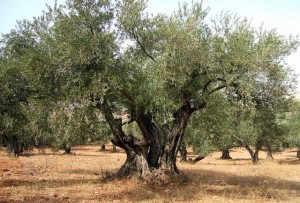
When we lived in Las Vegas we had two olive trees in our front yard, very large, well grown trees. We had a great arborist who trimmed and shaped them each year. They were beautiful trees with gnarled, twisting, yet graceful trunks. Their leaves were dark green on the top side, silver on the underside: when the wind blew they seemed to shimmer. Their grace and character set them apart from other trees. They provided wonderful shade in the hot desert summer, but they were messy. Olive trees are very productive; they dropped lots of fruit and lots of leaves!

Our olive trees were purely decorative. The fruit they produced was useless. In biblical Israel, however, the olive was a very important tree, a source of food, light, hygiene, and healing. For nearly 6,000 years, olives have been eaten in the Mediterranean as a staple food. Olive oil has been used for cooking, in lamps for light, for medicine, in bathing, and for religious anointing.

Olives are also extremely hardy, which is why we had them as shade trees in our desert landscape. They will live and produce fruit in any conditions: hot, dry, cold, wet, rocky, or sandy. It is said that you can’t kill an olive tree: when cut down or burned, new shoots will emerge from the root.

To be an olive tree, then, is to endure and to be productive. To endure and be productive in the house of God is the goal of every person of faith. As Paul reminded the Romans, endurance produces character, and character produces hope, and hope does not disappoint. (Rom. 5:5-4)

The Palestinian pastor of the Evangelical Lutheran Christmas Church in Bethlehem, the Rev. Mitri Raheb wrote in Bethlehem Besieged, “At times, when we feel as if the world must be coming to an end . . . our only hopeful vision is to go out . . . and plant olive trees. If we don’t plant any trees today, there will be nothing tomorrow. But if we plant a tree today, there will be shade for our children to play in. There will be oil to heal the wounds, and there will be olive branches to wave when peace arrives.”

This is what it is to be an olive tree in the house of God.

====================

A request to my readers: I’m trying to build the readership of this blog and I’d very much appreciate your help in doing so. If you find something here that is of value, please share it with others. If you are on Facebook, “like” the posts on your page so others can see them. If you are following me on Twitter, please “retweet” the notices of these meditations. If you have a blog of your own, please include mine in your links (a favor I will gladly reciprocate). Many thanks!

====================

Father Funston is the rector of St. Paul’s Episcopal Church, Medina, Ohio.

Ten Authentic Years – Sermon for Pentecost 2 (Proper 4C) – June 2, 2013

====================

This sermon was preached on the Second Sunday after Pentecost, June 2, 2013, at St. Paul’s Episcopal Church, Medina, Ohio, where Fr. Funston is rector.

(Revised Common Lectionary, Pentecost 2 (Proper 4, Year C): 1 Kings 18:20-39, Psalm 96, Galatians 1:1-12, and Luke 7:1-10. These lessons can be read at The Lectionary Page.)

====================

10th AnniversaryTen years ago yesterday, June 1, 2003, I became Rector of St. Paul’s Episcopal Church of Medina, Ohio, Inc. We didn’t celebrate that “new ministry” until sometime in October because of difficulties scheduling bishops and other dignitaries, but on Sunday, June 1, 2003, I presided at the Holy Eucharist for the first time in this space.

It was different then. One of the things we’ve done in the past ten years is remodel this space (thanks to a gift from Verna Bruckmann in memory of her late husband Jack whom many of us remember with affection). We’ve also upgraded the parish library, refurbished the dining room, and improved the parish hall (thanks to the good fund-raising efforts of the Episcopal Church Women). We’ve purchased additional real estate, torn down the derelict houses that were on it, incorporated those lots into our landscaping, and replanted nearly all of the decorative gardens, mostly with volunteer labor.

But more important than the building and the grounds are the ministries through which we have touched peoples’ lives. In these ten years, there have been more than 1,500 celebrations of the Holy Eucharist in this sanctuary! That means just here, in this space, there have been more than 250,000 administrations of Holy Communion; more than a quarter of a million times communicants have received the Blessed Sacrament, this sacrament which (as one of our prayers of thanksgiving says) is “the pledge of our redemption” through which the grace of God brings us “forgiveness of our sins, strength in our weakness, and everlasting salvation.”

During these ten years, since we started the Brown Bag Concerts in 2007, there have been more than seventy free concerts and recitals in this space, which means something on the order of 4,000 concert-goers have received the gift music which (the poet Berthold Auerbach said) “washes away from the soul the dust of everyday life.”

There have been more than seventy baptisms, more than forty-five weddings, and more funerals than I care to remember. Each summer up to fifty children have come into this worship space to sing songs, act in skits, and learn the stories of the faith at our annual Vacation Bible Schools.

And downstairs, twice month, 220 times in these ten years, the Free Farmers’ Market has opened its doors and provided sustenance to those unable to afford it in the stores. I suppose a statistician or an economist would invent some measure for what has been distributed like a “family-week of groceries” — we’ve distributed something like 16,000 or more “family-weeks” of food and other items to hundreds of needy households. All told, nearly a half-million pounds, 250 tons, of food have been given away by this parish.

And that’s just a small sample of the statistics we could boast. There have been home visits, picnics, hospital communions, confirmations, study groups, foyer groups, potluck suppers, and so much more.

It’s been a good ten years. So . . . Happy Anniversary!

I’ll come back to consideration of our decade together, but for now, let’s take a look at the lessons for today.

What we have in our three selections from Scripture this morning are stories of authority, but more than that, they are stories of authenticity. Let’s take a look at each one in turn.

First, we have the story of a competition between Elijah, a prophet of Yahweh, the God of Israel, and the priests and prophets of Ba’al, who was the god (or perhaps the pantheon of gods) of the Phoenicians. Elijah was a well-known prophet. We know that he was known in Syria and in Egypt and in other places because the Bible tells us this, that he was known as “the man of God.” Not simply as “a man of God” but as “the man of God.” He was well known as a prophet, but he was not well known as a pleasant fellow – I’ll get to that in a moment.

In our story today, “the man of God” is dealing with a competing religion. Ba’al worship had been brought to Israel when King Ahab married a woman whose name is familiar to all of us, Jezebel, the daughter of Ethbaal, King of Tyre. The marriage of their king to this Phoenician princess and his allowing her to set up temples and practices of her native religion in Shechem, the capital of the northern kingdom, caused a problem for the people of Israel. Should they continue in their old religion (represented by Elijah) or in this new religion followed by their queen and, eventually under her influence, their king? Being politically astute, they did the logical thing – a little bit of both. And this is where we enter the story in today’s reading from the First Book of Kings.

An assembly is called and Elijah says to everyone, “How long will you go limping with two different opinions? If the Lord is God, follow him; but if Ba’al, then follow him.” Nobody says a word . . . . So Elijah proposes a contest. “Let’s do this,” he says, “well set up two altars and put a bull carcass on each one. The priests of Ba’al will call on their god to consume his bull with fire and I’ll call on my god to consume his bull with fire, and the one that actually does it will be acknowledged as the god to be worshiped in this country.”

I love the way the New Revised Standard translation gives the people’s response: “Well spoken!” they say. It’s like he was just giving a speech – the Gettysburg Address or something. The actual Hebrew is “good utterance.” The American Standard translation renders it better as, “That is a good idea!” Everybody loves a sporting event; everybody loves a good contest! Good idea!

So they do it. The priests and prophets of Ba’al set up their altar and do their best. They chant and dance and even cut themselves in an attempt to get their god’s attention, but nothing. Then it’s Elijah’s turn. But before he prays, he tells those present to make it really hard to burn up the altar and the bull sacrifice – “Douse it with water,” he says, “douse it good.” Three times they flood it, until water is running everywhere and the whole place is a muddy mess.

That’s when he says, basically, “OK, God, do it!” And God does it – a lightning bolt or a pillar of fire or something – and all the wood, the water, the bull, the whole shebang is burnt up!

But this is where our lectionary gives us a false impression of the story. Our “official” reading cuts off a verse before the story actually ends. We are left hearing that all the people “fell on their faces and said, ‘The Lord indeed is God; the Lord indeed is God.'” It sounds like everybody, including the followers of Ba’al, agreed Yahweh was the real deal and lived happily ever after. Not so . . . .

The next verse:

Elijah said to them, “Seize the prophets of Baal; do not let one of them escape.” Then they seized them; and Elijah brought them down to the Wadi Kishon, and killed them there. (1 Kings 18:40)

You see, Elijah was not a particularly pleasant person. We know this from the story of Elijah cleansing the Syrian leper, the general Naaman; he wouldn’t even bother to talk to Naaman, just sent him a message to bathe in the Jordan. That really annoyed Naaman. And we see it in spades here. Elijah had won this battle. God was proven to be the true God and Ba’al was shown to be powerless. But Elijah can’t just leave it there; he has to drive the point home by slaughtering those who had served the false god. This really annoys Queen Jezebel who will send her army to find and kill Elijah. You all know the story of Elijah hiding in the cave and living through a storm, a mighty wind, and an earthquake, but finally hearing the voice of God in the silence. This little competition with and killing of the prophets of Ba’al is why he was hiding.

So this is a story of authority – the authority of Yahweh as the true god and the authority of Elijah as his prophet – but it is also a story of authenticity. Elijah made no bones about who and what he was; he was not a pleasant fellow. And everyone knew it. Nonetheless, they clearly respected him. Despite his unpleasantness, this defect in his character, they respected his role and office as a prophet of the living God. And God empowered him as and who he was.

So . . . second reading — the introduction to Paul’s Letter to the Galatians. Reading one of Paul’s letters it is always best to remember that almost all of them were written to solve problems.

Paul’s method of evangelism was to ride into town, spend time getting to know the people, gather a group of folks interested in the story of Jesus, share the gospel with them and instruct them, identify the leaders in the group, empower those leaders (ordain them, if you will) to carry on and minister within the community, and then move on to some new town and start the process all over again. What would happen then is that the community would have some problem and someone would contact Paul – “Dear Paul, you aren’t going to believe what is going on . . .” – and he would write a letter giving his advice on how to deal with it.

This is what has happened in Galatia. After Paul left, two other groups of Christian missionaries showed up and tried to convince the Galatians that Paul had been wrong. The first group were the Gnostics. The Gnostics had been around since before Jesus, but they’d sort of adopted Jesus as one of their own; some who were exposed to the Gnostic teachings found in Jesus the sort of teacher they’d had before. Gnosticism gets its name from the Greek word for “knowledge” and their approach to religion and spirituality was based on the idea that through special knowledge one could escape the evil of the material world. They thought that the material world was bad and that salvation was achieved by leaving it behind, and the only way to leave it behind was through initiation into this special or secret knowledge. Christian Gnostics taught that Jesus had given the secret knowledge to the Twelve and they had then passed it on to a few special leaders who passed it on to chosen initiates, and so forth. To them, Paul’s response was, “No way! The Gospel is open and transparent. It’s for everyone!”

The second set of folks who were causing the Galatians problems were Jewish Christians who taught that before you could be a Christian you had to be a Jew. We call them “the Judaizers.” They were teaching that a Gentile had to first convert to Jewish law and practice. Gentiles had to “keep kosher” (as we would currently say), then they could be baptized and be followers of Jesus’ Way. For example, they taught that adult males had to be circumcised. (I think it may have been one of those adult males who wrote to Paul – “You aren’t going to believe what these people are saying!”)

Paul’s response to the Judaizers was also a big “No way!” What he wrote to the Galatians was that Jesus and Jesus’ good news redeems them where and as they are. They do not need to become something else, something different. Rather, they need to be authentically themselves. It is as their authentic selves that Jesus redeems them and empowers them to be better Gentiles; they don’t have to become Jews.

Again, it is a story of authenticity and of God’s respect for people as and who they are.

Which brings us to the gospel lesson from Luke, a healing story told in both Matthew’s and Luke’s Gospels, but in Luke’s version it is unlike any other in all of the Gospels. In no other healing story does Jesus never talk to the person making the request, nor address the person being healed, nor even see (let alone touch) the person being healed, but that is exactly what happens here according to Luke. As Jesus arrives in Capernaum, some Jewish elders come to him and tell him about this Roman Centurion who has been very good to their community. Apparently there is someone in his household who is very important to him and this person is gravely ill. The Greek is unclear — the word used is pais which could mean “son” or “servant” or “slave” or, even possibly, “beloved” — but what is clear is that the Centurion would like this person healed.

Jesus is convinced by the elders to do so and sets off for the Centurion’s house. Before he gets there, however, the Roman sends messengers saying, “You don’t need to come. I’m unworthy to have you to enter my home. Just say the word and my son/servant/beloved will be healed.” Perhaps the Centurion knows of the Jewish custom forbidding an observant Jew from entering a Gentile home. In any event, his messengers convey his explanation: “Like you, Jesus, I am a man under authority. I answer to those above me, and I expect and get obedience from those below me.” He is saying that he recognizes that Jesus is under the authority of Heaven, and that as such he can expect and get the obedience of the powers of the world. Just say the word; it will be done.

In response to this message, Jesus praises the Roman’s faith: “Not even in Israel have I found such faith,” he tells the crowd. The word here translated as “faith” is pistis, the root of which is peitho which names the quality of having trust, or of being trusted, or trusthworthy, and confident. So while this, too, appears to be a story about authority it is, at its heart, a story about authenticity. This Roman was being true to who he was; not a Jew, he felt unable to appeal directly to Jesus or to have Jesus enter his home. Nonetheless, he had the confidence that Jesus would honor him and heal his son/slave/beloved. And Jesus does so. Jesus honors his honesty and authenticity.

Which brings me back to our 10th anniversary . . . .

Ten years and a few months ago we, this parish of St. Paul’s Episcopal Church of Medina, Ohio, and I began the courtship which is the way we Episcopalians pick and choose our clergy leadership. This parish, as any parish in search of a rector would do, did a self study and prepared a parish profile which was then entered in to our denominational dating computer in New York City. As a priest seeking a new call, I had done a personal profile and had it in entered into that same ecclesiastical “match-dot-com” system. The dating computer ran its algorithms and matched us up, and you all selected me as one of the priests to contact, so we started our conversations.

Now you all know that Evelyn and I are originally from Nevada, so while this was going on, she was praying that we would end up somewhere (as she put it) “western.” She didn’t disallow my consideration of a parish in Ohio, but she wasn’t really all that thrilled about it. One of the things that had attracted me to St. Paul’s Parish was your written profile, this booklet that parishes write and publish with pictures and financial reports and so forth, describing themselves, their town, the ministries they do, etc. etc. etc. Most of the time these profiles are not really very accurate; instead of being a description of the parish as it is, they describe what the congregation wants to be — they are “wish lists.” Sometimes, even worse, they are simply “what someone in the diocesan office told us we had to say if we wanted to get a priest.” St. Paul’s Parish Profile was different. It seemed to be honest and authentic. It told a story of a lot of good stuff, but it also admitted to some not very positive, not very inviting aspects of the church, as well. I remember one line, in particular, in the closing paragraphs of the booklet: “This is who we are . . . warts and all.” (I now have some suspicion about who probably wrote that line!)

At the same time, I tried to be honest and up-front with you, as well. While Evie was praying that I would get a call to someplace “western,” I kept telling her not to worry; each time I would answer one of your search committee’s requests for more information about me, or for a copy of a sermon, or for my position on some controversial issue, I would say to her, “Well, after they get this, they won’t be calling me.”

And then there was the face-to-face interview, the visit when we got to know one another. You told me what you were looking for in the future, what you hoped to be, what your problems as a church community were. I told you what my strengths and skills in ministry were and are; I told you what I didn’t (and still don’t) do well. Let’s face it — there are some things I’m pretty good at . . . and there are some things I’m really quite bad at! And after our last, extremely honest conversation, as we sat waiting to board the plane back to Kansas, I said to Evelyn one more time, “Well, after this, they won’t be calling me.” But you did.

I tell Evie that she got exactly what she prayed for! Where did we end up? In the “Western Reserve”! (I tell her now that she has to be more specific in her requests of God.)

Throughout our so-far-ten-year relationship we’ve stayed honest and up-front and authentic with one another. I think that’s how we’ve been able to accomplish the things we’ve done. And let’s be very honest about that — all of those statistics, the hundreds of worship services, the thousands of communions, the dozens of concerts, the tons of food distributed, I can’t take responsibility for those. I believe we have been able to do all of that because we have been authentic; I believe that God blesses those who are authentic, open, honest, and up-front with themselves, with one another, with the world around them, and with God. Just as Yahweh answered Elijah’s prayer, just as Jesus blessed the Centurion and healed his son/slave/beloved, God has answered our prayers and blessed our ministries.

I didn’t do those things. You did them. We did them together. About the only thing I can lay entirely at my own feet, the only statistic that I can take full responsibility for over the past ten years, is that I have gained about 70 pounds! I’m not happy about that, and I intend to change that.

But we together have done a lot, and I believe we have a lot more to do, and I believe that we will accomplish it together – openly, honestly, and authentically. It’s been a great ten years! Let’s have ten more! Amen.

====================

A request to my readers: I’m trying to build the readership of this blog and I’d very much appreciate your help in doing so. If you find something here that is of value, please share it with others. If you are on Facebook, “like” the posts on your page so others can see them. If you are following me on Twitter, please “retweet” the notices of these meditations. If you have a blog of your own, please include mine in your links (a favor I will gladly reciprocate). Many thanks!

====================

Father Funston is the rector of St. Paul’s Episcopal Church, Medina, Ohio.

Y’All Ain’t Gonna Believe This! – Sermon for Pentecost Sunday – May 19, 2013

====================

This sermon was preached on the Feast of Pentecost, May 19, 2013, at St. Paul’s Episcopal Church, Medina, Ohio, where Fr. Funston is rector.

(Revised Common Lectionary, Pentecost (Year C): Genesis 11:1-9; Psalm 104:25-35,37; Acts 2:1-21; and John 14:8-17,25-27. These lessons can be read at The Lectionary Page.)

====================

Iconic Fresco of the scattering at the Tower of BabelI was told once that there is a difference between Yankee fairy tales and Northern fairy tales, and the difference is found in the way they begin. Yankee fairy tales start off, “Once upon a time . . . . ” Southern fairy tales begin, “Y’all ain’t gonna believe this!”

We sort of have two stories of those sorts given to us today to go along with the lesson from the Gospel of John. Now, I’m not suggesting that the stories from Genesis and the Book of Acts are fairy tales . . . but the story of the Tower of Babel is a sort of “Once upon a time” story, and the story of the first Christian Pentecost is a “Y’all ain’t gonna believe this” story.

Sometimes I think that the entire Book of Acts was written with a sort of understood “Y’all ain’t gonna believe this” underlying all of its history of the earliest Christian community. The author of this book is the same person who wrote the Gospel of Luke, so we’ll call him “Luke”. Luke was writing to someone he addresses as “Theophilus”; I don’t know if that was his correspondent’s actual name – the word means “God lover” so it may not have been. In any case, Luke writes to Theophilus and in the introduction to Acts, Luke says something along the lines of, “In the first book, Theophilus, I wrote about all that Jesus did and taught from the beginning until the day when he was taken up to heaven, after giving instructions through the Holy Spirit to the apostles whom he had chosen.” (Acts 1:1-2) “Now, I’m going to tell you about what happened afterward with his followers . . . and y’all aint gonna believe this!” And then he goes on to tell all the things that the apostles and disciples did – healing people, raising people from the dead, living peacefully in community, supporting one another, spreading the Gospel, and growing the Christian community. It’s a pretty amazing story!

In today’s Gospel, Jesus promised Philip and the other apostles that, because he was going to the Father and because they would receive the Holy Spirit, they would do greater things than he had done. In the Book of Acts, this “ya’ll ain’t gonna believe this” story, Luke tells Theophilus that that promise had been fulfilled.

The “once upon a time” story that we get to go along with the Pentecost story is the tale of the Tower of Babel. In Jewish literature, this story is not called that. Jews prefer to call this “the story of the generation of division,” which is really a better title because it focuses on what’s important about the tale, the effect of building the tower, not the tower itself.

Now again, I’m not suggesting this is a fairy tale, but I would suggest to you that it is a myth, a word that I use in the strictest technical sense. This story is the last of the tales in what some scholars call the “prehistory” or “primeval stories” section of the Old Testament, Chapters 1 through 11 of the Book of Genesis, which deal with four large “themes” or theological issues at the heart of the Jewish faith and, thus, of our Christian religion, as well. They are myths in the sense that the writer Joseph Campbell hinted at when he said, “Myths are clues to the spiritual potentialities of the human life.” A myth, as defined by the Encyclopedia Britannica, is

a symbolic narrative, usually of unknown origin and at least partly traditional, that ostensibly relates actual events and that is especially associated with religious belief.

The church historian and theologian Phyllis Tickle makes a distinction between Scriptural stories which are “actual” and those which are “factual.” These mythic theological narratives of Genesis are actually true, even though they may not be factual. We don’t know when, or even if, they happened . . . “Once upon a time” . . . myths may not tell us any facts, but they convey great and central truths.

In Chapter 1 of Genesis, of course, we find the theme of creation, the great cosmic story of how everything came to exist, of how God created “in six days” all that is, seen and unseen. In Chapters 2 through 5, the story of Eden and of Adam and Eve, we learn how and why humankind is distinctive within creation; how and why men and women have knowledge, reason, and skill; how and why we are different from the other animals in the world. The themes here are knowledge and self-awareness. In part of this story, the subplot of Cain and Abel, the themes of evil and separation are brought in; the story seeks to answer the question, “Why — when given all this wonderful world, when blessed by God with memory, rationality, and talent — why do human beings nonetheless behave badly and hurt one another?” Chapters 6 through 10, the story of the Flood and of Noah and his family, the themes of obedience, disobedience, and sin, and of God’s response to them, become the focus.

And then we come to this story in Chapter 11. This story forms a sort of bridge between the mythic pre-history and the historic tales of the Jewish people themselves, beginning with the calling of Abram from his home in Ur of the Chaldees to become Abraham, the father of nations, the first of the Hebrews, and the spiritual ancestor of all Jews, Christians, and Muslims. This story treats of the question of diversity: why — if all humans came from one family, first from Adam and Eve, and then after the Flood from Noah and his brood — why are there so many different nations and races, so many different languages? But the theme here is not diversity.

Once upon a time, the story goes, all these people settled in the plain of Shinar (which would be in modern day Iraq, by the way), and they decided to build a city and, in that city, to build a tower that could reach to the heavens. They were united by one language and they shared a single purpose. But God objected! “We’re not going to allow that,” God said. One wonders, or at least I do, what’s the problem? These people are unified; they are functioning well as a community. They are doing the best they can – that’s the whole point of the storyteller pointing out that they used oven-fired bricks and “bitumen” (which is tar) to build the tower; these were the finest materials available in that place. But for some reason, God objected.

The source of God’s objection is revealed to us in the reason the people stated among themselves for undertaking this mighty building project. “Let us make a name for ourselves; otherwise we shall be scattered abroad upon the face of the whole earth.” (Gen. 11:4) This is not about unity of purpose, nor is it about religious faith, even though their goal is make a tower to reach to heaven. (Note that the Lord is not mentioned by these people, these tower-builders; God, the Lord, does not figure into their plans at all.)

No, this is not about unity, or community, or religion. This is about power. In the ancient middle east having a name meant having power. Having a name meant that you were somebody. Having a name meant that you have a position on the stage of the drama that is the world. Having a name might even mean that you were center stage. And knowing someone else’s name – that was about power, too.

Remember the story of Moses meeting God in the burning bush? Moses asks God’s name, and God basically says, “Nope. Not going to tell you. I am who I am and that’s name enough for you to use. As far as you’re concerned, that is my name for all time.” (See Exodus, Ch. 3) Knowing someone’s name in that time and place was believed to give you power over that other, and having a name of your own meant being the central power of your own life. The issue here, the great theme of this “Once upon a time” story is not about having unity; the theme is not about religion. The theme is about power and about who or what is central on the stage of human existence.

There is a secondary theme, as well, a theme that echoes the theme of the Flood story. When God created the first humans in the cosmic creation story of Genesis, Chapter 1, God commanded them: “Be fruitful and multiply, and fill the earth, and subdue it; and rule over the fish of the sea and over the birds of the sky and over every living thing that moves on the earth.” (Gen. 1:28) And after the Flood, God repeated this command to Noah and his family: ” God blessed Noah and his sons and said to them, ‘Be fruitful and multiply, and fill the earth.'” (9:1) These folks on the plain at Shinar wanted power to avoid “filling the earth.” They wanted to not be “scattered abroad,” but rather to remain in that one place; a direct violation of God’s mandate.

So God thwarted their designs. The story is a tale of folk etymology. The name of the place was “Babel” or Babylon, and no one really knows the origin of that name. But the Jews, in telling these stories, as they often did, linked the name to a word in their language, the word “balel,” a word meaning “confusion.” The story says the name of the place is “Babel” because it was there that God confused them by changing their speech, by creating a diversity of languages so that they no longer understood one another. They could not work together and in their confusion, they scattered, accomplishing God’s design that humankind fill the earth. They attempted to place themselves and their power at the center of the story, and they suffered the consequences.

The four human themes of the theological narratives of Genesis 1-11 are knowledge and self-awareness, evil and separation, obedience and sin, and power. Over-arching them all, though, is the theme of God’s creative spirit and of God’s grace. In the words of Psalm 99, “You were a forgiving God to them, and yet an avenger of their evil deeds;” the God who brought everything into being responds again and again with forgiveness and grace.

Coptic Icon of PentecostWhich brings us to the second story, the “y’all ain’t gonna believe this” story of the first Christian Pentecost. The twelve (with the addition of Matthias a few days before) who would become known as the Apostles were again together in the Upper Room, perhaps together with several other disciples including all those women, Joanna, Suzanna, Mary the mother of James, Mary Magdalen, and the other Mary, those women who “used to follow him and provided for him when he was in Galilee.” (Mark 15:41) The first ECW! They were there in that room where they’d shared that last supper, that Passover meal with Jesus, that room where they had cowered in fear on the day of the crucifixion and the next day hiding from the Jewish authorities and the Roman police, that room where the risen Jesus had come to them not once but twice and had allowed Thomas to feel his wounds, that room where Jesus had told them to wait for “the Advocate, the Holy Spirit, whom the Father will send in my name, will teach you everything, and remind you of all that I have said to you.” (John 14:26) There they were, in that room, probably as confused and bewildered as all those people on the plain at Shinar when the Lord scattered them with confused speech.

All of a sudden it happened, there was the sound a mighty rushing wind and . . . y’all ain’t gonna believe this . . . they all caught fire! Or, at least, that’s what it looked like. “Tongues, as of fire, appeared among them, and a tongue rested on each of them. All of them were filled with the Holy Spirit and began to speak in other languages.” (Acts 2:3) And they went out into the streets and began to preach the story of Jesus, the Good News of God’s salvation of humankind, to everyone there. It was the feast of Shavuot, called Pentecost in Greek. Fifty days after the Passover (that’s what Pentecost means in Greek, “fiftieth day”), this was an agricultural festival when Jews came from all over to make the offerings of the First Fruits at the Temple in Jerusalem. So there were Jews and proselytes from all the known world — from Pamphylia and Phrygia, from Egypt and Mesopotamia, from Libya and Crete, from Greece and Rome — people who spoke a bewildering variety of languages. Yet when the disciples went out into the streets, each of these heard the Gospel preached in his or her own language.

Now language, which had once divided and scattered the people, united them. The difference was in what was put at the center. Where the people on the plain at Shinar, the people who tried to build that great city and that tower reaching to the heavens, had put themselves and their own name, their own power, at the center, the disciples and those who heard their message, put God incarnate in Jesus Christ, God active in the Holy Spirit, at the center. From here they would go out — Andrew to Greece, Jude to Persia, Thomas to India, Mark to Egypt, Matthew to Ethiopia, Peter to Rome, Philip to Asia Minor, and others to many other places — they would fill the earth with the Good News of Jesus, healing the sick, raising the dead, creating the beloved community wherever they went. All because they put God at the center.

And this is the message for us in these two stories on this Pentecost Sunday, this birthday of the Church, this celebration of the coming of the Holy Spirit promised by Jesus in our reading from the Gospel of John.

Once upon a time we human beings put ourselves and our name and our power at the center of our lives . . . and look where that got us. But if we put God at the center? Y’all ain’t gonna believe this . . . . !

Amen!

====================

A request to my readers: I’m trying to build the readership of this blog and I’d very much appreciate your help in doing so. If you find something here that is of value, please share it with others. If you are on Facebook, “like” the posts on your page so others can see them. If you are following me on Twitter, please “retweet” the notices of these meditations. If you have a blog of your own, please include mine in your links (a favor I will gladly reciprocate). Many thanks!

====================

Father Funston is the rector of St. Paul’s Episcopal Church, Medina, Ohio.

In the Vice-Principal’s Office – From the Daily Office – May 17, 2013

From the Psalter:

Some went down to the sea in ships
and plied their trade in deep waters; . . . .

(From the Daily Office Lectionary – Psalm 107:23 (BCP Version) – May 17, 2013.)

School Office SignI cannot read this verse of Psalm 107 (today’s evening psalm) without remembering a poem, Sea Fever by the 20th Century English poet John Masefield:

I must go down to the seas again, to the lonely sea and the sky,
And all I ask is a tall ship and a star to steer her by,
And the wheel’s kick and the wind’s song and the white sail’s shaking,
And a grey mist on the sea’s face, and a grey dawn breaking.

I must go down to the seas again, for the call of the running tide
Is a wild call and a clear call that may not be denied;
And all I ask is a windy day with the white clouds flying,
And the flung spray and the blown spume, and the sea-gulls crying.

I must go down to the seas again, to the vagrant gypsy life,
To the gull’s way and the whale’s way, where the wind’s like a whetted knife;
And all I ask is a merry yarn from a laughing fellow-rover,
And quiet sleep and a sweet dream when the long trick’s over.

I remember this poem because of an incident from my late childhood when I was in the 7th Grade, about age 12, I guess.

I attended junior high in the San Fernando Valley suburbs of Los Angeles and in my 7th Grade English class we were required to memorize, recite, and offer an exegesis of poem. I chose this one. After dutifully reciting it, I explained what I believed the poem to mean. The teacher (whose name I do remember but will not give) praised my recitation, but then critiqued my interpretation by basically telling me I was wrong. My response in open class, “I can interpret a poem any damned way I please!”

As you might imagine, I was sent to the principal’s office. Well, I was really sent to the boy’s vice-principal, one of those people who seemed always to be smiling, even when angry or when disciplining a child. To be honest, I remember very little about the man except that smile which always seemed a bit creepy. The vice-principal decided my infraction was serious enough to require my mother to called and asked to come to the school.

If my mother had been a stay-at-home parent, that would not have been a big deal, I suppose. She was, however, a working woman, and at the time her work was as a secretary at a machine-tool manufacturing company in Long Beach. The last time I visited Southern California, the drive from Long Beach to the Valley took hours; traffic was awful. In those days, however, you could actually make the drive in about an hour. So, for an hour, I sat on a chair in the administrative office of the school, missing the rest of English class and whatever I had in the next period, dreading my mother’s appearance.

When my mother, neat, trim, petite woman of 45 years, standing all of 5’2″ tall, walked through the door, I could tell that she was more than angry. The hour on the freeway, I’m sure, had stoked the furnace of her ire; she was a force to be reckoned with, and I was not looking forward to the reckoning.

She told the school secretary who she was and why she was there, so far as she knew, and then sat down next to me with not a word. I knew I was in for it!

The vice-principal soon appeared, greeted my mother, and escorted us into his office. He explained to my mother what had been reported by the English teacher: “Eric told Mrs. ______ that he could, and I quote, ‘interpret a poem any damned way he pleases.'”

Something miraculous happened! In that instant my mother’s anger was redirected. I was no longer the object of her wrath. She met the vice-principal’s explanation with a stony silence, looking him squarely in the eyes, and then in a very calm and measured voice she said, “He can interpret a poem any damned way he pleases!” The vice-principal’s smile actually disappeared!

Now, I don’t really recommend that parents do exactly what my mother did. And I’m pretty certain that if she hadn’t been called away from her work, if she hadn’t had to drive the freeway for an hour, and if she hadn’t “stewed” in her car for that hour, she wouldn’t have said what she said. But I do know this . . . Although I do not remember what happened next, although I don’t recall the rest of the conversation with the vice-principal, and although I don’t recall whether I stayed in school the rest of the day or went home, I definitely remember one thing! I remember parental support. I remember my mother standing up for me.

To be honest, I have no idea what my interpretation of that poem was. Today, if I heard the 12-year-old child’s exegesis I gave that day, I’d probably agree with my English teacher and declare it dead wrong. But whatever the meaning of Sea Fever to the poet or English scholars in the century since it was written, for me that poem, and this psalm verse which always brings it to mind, mean parental support. They speak to me of a parent standing up for and standing by her child.

And this is part of the nature of scriptural interpretation. We each bring to the written text our own life’s experiences; these color our understandings and give us the images whereby we envision God. Psalm 107 sings of the gathering of God’s People, some who went east, some who went west, some who wandered trackless deserts, and some who went down to the sea in ships. God is said to gather them all and give them support and comfort, and the Psalmist repeatedly encourages each group, “Let them give thanks to the Lord for his mercy and the wonders he does for his children.” (vv. 8, 15, 21, and 31)

Like the merciful wonder of a mother supporting her son in the vice-principal’s office.

====================

A request to my readers: I’m trying to build the readership of this blog and I’d very much appreciate your help in doing so. If you find something here that is of value, please share it with others. If you are on Facebook, “like” the posts on your page so others can see them. If you are following me on Twitter, please “retweet” the notices of these meditations. If you have a blog of your own, please include mine in your links (a favor I will gladly reciprocate). Many thanks!

====================

Father Funston is the rector of St. Paul’s Episcopal Church, Medina, Ohio.

Something Is Wrong! Something Is Broken! – From the Daily Office – May 16, 2013

From the Psalter:

They asked, and quails appeared, and he satisfied them with bread from heaven.

(From the Daily Office Lectionary – Psalm 105:40 (BCP Version) – May 16, 2013.)

Grocery ShelvesOnce again I find this serendipitous connection between one verse in the Daily Office psalm and a news item in the daily papers. Psalm 105 is divided into two parts and our lectionary bids us read the first at Morning Prayer and the second at Evening Prayer. The psalm describes the Hebrews sojourn in Egypt. Part One (vv. 1-22) describes the captivity of Joseph and his later elevation to leadership in the pharaoh’s court, which occasioned the children of Israel taking refuge in “the land of Ham” where they were subsequently enslaved. Part Two (vv. 23-45) tells the story of Moses, the Exodus, and the Hebrews coming into the Promised Land.

So hunger and famine, deprivation and want surface as themes both as a cause of the Israelites residence and ensuing slavery in Egypt, and as a consequence of their journey through the Sinai desert escaping from that servitude. The quoted verse celebrates God’s provision of food during their desert trek.

In today’s Los Angeles Times there is an article which begins with this question, “What happens to the 40% of food produced but never eaten in the U.S. each year, the mounds of perfect fruit passed over by grocery store shoppers, the tons of meat and milk left to expire?”

Twice a month about 100 families line up in the parking lot and hallways of my church to receive a few bags of food. As a distribution point for the local food bank system, our pantry operation offers canned goods, fresh vegetables, meats, bread, and other staples, as well as such things as paper towels, toilet paper, and personal hygiene products, to those unable to afford them in the stores. On the last Saturday of each month we see our biggest crowds as the month’s Social Security, WIC, food stamps, and other assistance funds have diminished.

In light of that monthly experience, I read the L.A. Times’ opening question and all I can do is shake my head in wonder! 40% of food produced in this country is never eaten? And yet there are these hundreds of people lining up for a food hand-out in my church . . . and that scene is repeated across the country in countless venues, and on an almost daily basis. Something is wrong! Something is broken!

The partial answer to the Times’ question is that some of it goes into the production of electrical power. The article is about the Kroger grocery company (through its Ralph’s and Food4Less divisions) composting the “garbage” food and producing methane gas to power generators. While I applaud this environmentally sound disposal solution, I can’t help but wonder, “Wouldn’t it be better if the food didn’t go to waste? Wouldn’t it be better if, instead of allowing the food to become inedible, it was distributed to those who are hungry?”

In the story of the Exodus, the food provided by God – the quail and the manna – could not spoil because it could not be kept. It was to be gathered and eaten; whatever wasn’t eaten simply didn’t hang around – the quail flew off – the manna evaporated. So neither the psalm nor the longer story in Exodus provide guidance for what to do with leftovers. Common sense, I think, has to fill that in. And common sense, I think, suggests that instead of letting food go bad and become fodder for a methane generator, it ought to be used to feed the hungry. I also think that that would be more attuned to the Gospel imperative.

Turning old food into electricity is at least a sounder decision than that reported a few months ago in Augusta, Georgia, where the inventory of a bankrupt supermarket was simply thrown away – in the presence of hungry people hoping for a handout! The needy poor, according to an article in the Augusta Chronicle, stood in the parking lot and “watched marshals stand guard as food was tossed into the trash” and hauled away to the city dump. “Some people even followed the truck to the landfill and were still turned away,” GreenLeft reported.

God provided food for the people. God satisfied them with quail and bread. God still provides food for the people. How we use it or misuse it is up to us. We don’t seem to be doing a very good job. Something is wrong! Something is broken!

====================

A request to my readers: I’m trying to build the readership of this blog and I’d very much appreciate your help in doing so. If you find something here that is of value, please share it with others. If you are on Facebook, “like” the posts on your page so others can see them. If you are following me on Twitter, please “retweet” the notices of these meditations. If you have a blog of your own, please include mine in your links (a favor I will gladly reciprocate). Many thanks!

====================

Father Funston is the rector of St. Paul’s Episcopal Church, Medina, Ohio.

Dwelling in Cinderella’s Castle – From the Daily Office – May 15, 2013

From the Psalter:

Those who act deceitfully shall not dwell in my house, and those who tell lies shall not continue in my sight.

(From the Daily Office Lectionary – Psalm 101:7 (BCP Version) – May 15, 2013.)

Cinderella's CastleThere’s a homiletic maxim attributed to Karl Barth that clergy should preach with the Bible in one hand and a newspaper in the other. These days, that sort of describes how I say the Daily Office. I use my laptop computer (I’m still not hip enough to have a “tablet” device) to access the Online Book of Common Prayer and the lessons of the Lectionary, and then having completed the Office and my prayers, I move on to scanning the media sites, and then to Facebook.

I don’t often comment in these meditations on any linkage between the two, but today I couldn’t help but note how apropos the quoted verse from Psalm 101 (the first of two morning psalms today) was to New York Post article offered by a colleague on his Facebook wall. The headline reads, Rich Manhattan moms hire handicapped tour guides so kids can cut lines at Disney World. According to the first paragraph,

Some wealthy Manhattan moms have figured out a way to cut the long lines at Disney World — by hiring disabled people to pose as family members so they and their kids can jump to the front, The Post has learned. The “black-market Disney guides” run $130 an hour, or $1,040 for an eight-hour day.

One mom boasted that her child, through this cynical manipulation of Disney’s compassion for the disabled, waited only one minute for a ride, while other children stood in line for 2-1/2 hours.

This goes beyond deceit and falsehood; this is more than the mere telling of lies. This is trafficking in human flesh. This is prostitution; there’s no other word for it. Granted there’s no sex involved, but let’s be honest about what is going on here. The children of these wealthy moms are being taught that it is perfectly all right to purchase another person’s body for their pleasure. These disabled persons are offering their handicapped flesh in the service of the child’s desire for entertainment and gratification (instant gratification, in fact).

I am really blown away and disheartened by this report. I struggle to be positive about humankind. I try every day to eschew my natural inclination toward cynicism; theologically, I reject the Calvinist (some would say Augustinian) notion that as a consequence of Adam’s Fall, every person born into the world is morally corrupt, enslaved to sin and, apart from God’s grace, utterly unable to choose good. And then along comes something like this, and my cynicism bursts its bounds and this idea of “total depravity” (as this Calvinist doctrine is called) looks awfully accurate!

Or maybe it’s not my cynicism! I did a little mathematical calculation based on the fees listed in the article and figure out that a “black-market Disney guide” who “works” only 15 days a month (and takes two months of the year off) would have an annual income of $156,000! I don’t begrudge anyone income honestly made; nor do I criticize anyone for making the best and highest use of the abilities (or disabilities?) they have been given. But come on! Is this income honestly made? Is this the best and highest use of human potential? Is there anything more cynical, more depraved than this callous use of a handicap or disability? I don’t think so.

“Those who act deceitfully shall not dwell in my house, and those who tell lies shall not continue in my sight.” But apparently they will dwell in Cinderella’s Castle and continue to the head of the line at Disney World.

====================

A request to my readers: I’m trying to build the readership of this blog and I’d very much appreciate your help in doing so. If you find something here that is of value, please share it with others. If you are on Facebook, “like” the posts on your page so others can see them. If you are following me on Twitter, please “retweet” the notices of these meditations. If you have a blog of your own, please include mine in your links (a favor I will gladly reciprocate). Many thanks!

====================

Father Funston is the rector of St. Paul’s Episcopal Church, Medina, Ohio.

The Quintessence of Dust – From the Daily Office – May 9, 2013

From the Psalms:

What is man that you should be mindful of him?
the son of man that you should seek him out?

(From the Daily Office Lectionary – Psalm 8:5 (BCP Version) – May 9, 2013.)

Dust StormIt’s sort of the basic existential question, isn’t it? I mean it strikes me as equivalent to asking such questions as “What is the meaning of life? Who am I? What is my purpose? Is there a god, and, if so, what is God’s nature?” These are the questions that, in my life, occupy the “wee hours,” the dark times. I never seem to ask these questions when it’s bright and sunny, when it feels like “God’s in his heaven and all’s right with the world.” It’s when things aren’t right that these questions arise.

I’ve noticed that my “atheist” and “agnostic” friends — I put those terms in scare quotes because I’m never sure that those who use them mean the same thing by them that I do — whenever I hear them use those words I remember that line from The Princess Bride: “You keep using that word. I do not think it means what you think it means.” Anyway . . . I’ve noticed that they actually use this same question to argue against the existence of God. They don’t actually quote the Psalm, but they make the assertion that it is ridiculous to think that the creator of all that is should take any interest in humankind at all. Although they call themselves “humanists” — by which I assume they mean that humanity is the pinnacle of their belief system — by answering the Psalmists question negatively, they actually denigrate human beings. Their reasoning must lead to the conclusion that, assuming there might be a God, humankind is nothing in which that God would be the least bit interested; in a word, worthless. Mere dust.

Obviously, I reject that notion. Rather, I like Shakespeare’s answer to the Psalmist query, as expressed by Hamlet, “What a piece of work is a man, how noble in reason, how infinite in faculties, in form and moving how express and admirable, in action how like an angel, in apprehension how like a god! the beauty of the world, the paragon of animals.” Human beings are, as Hamlet added, the “quintessence of dust” — the fifth, or purest, extract from the dust of which all things are compounded.

Of course, Hamlet in his melancholy rejected is own description of humanity. “Man delights me not,” he declared. There is much to criticize in our species. We have been terrible stewards of creation. We treat each other badly. We make incredibly stupid decisions and terrible, terrible mistakes. And, yet, God is mindful of us; God does seek us out.

Us . . . the quintessence of dust. Think about just how wonderful that is. Especially in the “wee hours”, the dark times, when things aren’t quite right.

====================

A request to my readers: I’m trying to build the readership of this blog and I’d very much appreciate your help in doing so. If you find something here that is of value, please share it with others. If you are on Facebook, “like” the posts on your page so others can see them. If you are following me on Twitter, please “retweet” the notices of these meditations. If you have a blog of your own, please include mine in your links (a favor I will gladly reciprocate). Many thanks!

====================

Father Funston is the rector of St. Paul’s Episcopal Church, Medina, Ohio.

« Older posts Newer posts »