Occasional thoughts of an Anglican Episcopal priest

Category: Christianity (Page 61 of 84)

Between Me and Thee – From the Daily Office – February 19, 2014

From the Book of Genesis:

So Jacob took a stone, and set it up as a pillar. And Jacob said to his kinsfolk, “Gather stones,” and they took stones, and made a heap; and they ate there by the heap. Laban called it Jegar-sahadutha: but Jacob called it Galeed. Laban said, “This heap is a witness between you and me today.” Therefore he called it Galeed, and the pillar Mizpah, for he said, “The Lord watch between you and me, when we are absent one from the other. If you ill-treat my daughters, or if you take wives in addition to my daughters, though no one else is with us, remember that God is witness between you and me.”

(From the Daily Office Lectionary – Genesis 31:45-50 (NRSV) – February 19, 2014.)

Mizpah Pendant“The Lord watch between me and thee. . . . ” Years ago (several more than forty) I graduated from high school at the tender age of 16 and announced to my parents that I was getting married.

Rather than get their knickers in a twist and forbid it, they conspired with my older brother (a college professor) and his wife (also a college professor) to send me away for a good, long while. My brother and sister-in-law were on their way to Europe for three months of sabbatical study, and I was given the opportunity to go with them.

As I was leaving for that long summer trip, my girlfriend (she wasn’t yet my fiancée) gave me a medallion that was styled to look like one half of a broken coin. I was to wear that half and she would wear the other. When the two halves were put together, the word MIZPAH and this entreaty of Laban’s were inscribed across the whole.

Long story short . . . by the end of my summer-long absence, she had formed another relationship and I had no interest in trying to “win her back” or in getting married to her or anyone.

When I read this story, I think of her, even though that prayer’s implied petition for reunion and resumption of our relationship was not realized. When I think of her, a song which became popular many years after that summer comes to mind, Fifty Ways to Leave Your Lover by Paul Simon:

You just slip out the back, Jack
Make a new plan, Stan
You don’t need to be coy, Roy
Just get yourself free
Hop on the bus, Gus
You don’t need to discuss much
Just drop off the key, Lee
And get yourself free

Of course, although Laban is not Jacob’s lover, “slipping out the back” is exactly what Jacob tried to do in leaving Laban’s household, and “making a new plan” is exactly what our summer apart led my former girlfriend and me to do. But it seems to me that we never really finish our relationships; they never really end. We may leave one another’s presence; we may never see one another again; but the relationship, once established, endures.

A few thousand years later and humankind is still remembering and learning from the relationship between Jacob and Laban; nearly a half-century later I can still see my former girlfriend’s face in memory and hear her voice. There may be fifty ways to leave a relationship, but the relationship doesn’t end; it is transformed. It becomes a relationship of absence, and that makes it a relationship of untold, unrealized, and unrealizable possibilities. What might have happened if . . . ? Another lyric comes to mind:

Once upon a time
Once when you were mine
I remember skies
Reflected in your eyes
I wonder where you are
I wonder if you
Think about me
Once upon a time
In your wildest dreams

The Moody Blues got it right. Those “what if” musings are all “once upon a times” and “wildest dreams.” (The title of the song is In Your Wildest Dreams.) It is best to let them go, to focus on current, active relationships, and to consign those long-passed, transformed-but-not-ended relationships to God’s care. “The Lord watch between me and thee . . . .”

====================

A request to my readers: I’m trying to build the readership of this blog and I’d very much appreciate your help in doing so. If you find something here that is of value, please share it with others. If you are on Facebook, “like” the posts on your page so others can see them. If you are following me on Twitter, please “retweet” the notices of these meditations. If you have a blog of your own, please include mine in your links (a favor I will gladly reciprocate). Many thanks!

====================

Father Funston is the rector of St. Paul’s Episcopal Church, Medina, Ohio.

Too Blind to See – From the Daily Office – February 18, 2014

From the Book of Genesis:

So Jacob arose, and set his children and his wives on camels; . . . .

(From the Daily Office Lectionary – Genesis 31:17 (NRSV) – February 18, 2014.)

CamelThere’s been a dust-up in the press recently. A lot of ink (mostly secular press ink) spilled on the question of camels in the Bible. This is because some scientific, archeological evidence has been turned up suggesting that camels have been only relatively recently domesticated in the regions of the eastern Mediterranean, nowhere near as far back as the stories of the patriarchs and matriarchs in the Books of Moses would put them. It is, says the scientific evidence, impossible that Jacob should have “set his children and his wives on camels” because there were no domesticated camels at the time, how ever far back we think that may have been.

“OK,” says I. “So what?”

“So what?” screams back the press, “So the whole of the Scriptures must fall on this clearly erroneous detail.”

One story in the secular press reported (I could almost hear the writer chortling with glee), “Some scholars took these anachronisms as proof that the Bible was written centuries after the events that they talk about.” (Yes, the sentence was published exactly that way, bad grammar and all, in a daily newspaper of a major American city. Sad, isn’t it?)

Well, duh, I thought. Of course the Bible was written centuries after the events reported. It is the end product of centuries of oral transmission finally written down and then edited and redacted several times before arriving at the form we now know. Is this really news to anyone? Most, if not all, of the Pentateuch is mythic in character, not intended to be understood either as history (a modern idea which it is ridiculous to expect of the Scriptures) or as science (another modern concept which it is laughably silly to expect of the holy texts of any ancient religion).

There’s a recent tumblr post from someone whom I presume to be a seminarian reading, “Hebrew Bible professor blowing my mind with this: ‘Do you know how we know the Genesis 2-3 story was intended to be read as a myth, not as fact? IT HAS A TALKING SNAKE IN IT!'” The secular journalists all agog over the camel issue should read, mark, learn, and inwardly digest that little tid-bit.

They might also want to consider a little study of language, a look at the etymology of words, particularly the word camel. Where does this word come from? Well, in a nutshell, the English comes from the Latin which comes from the Greek which borrowed a word from ancient Hebrew and Arabic; in the former, the word is gamal and in the latter it is jamal. This ancient Semitic word is a verb which means “to repay” or “to bear;” upon it was based a verbal noun having the general meaning of “beast of burden.” While it is true that modern Hebrew and Arabic use the word gamal to refer to a camel, this does not necessarily imply that in ancient Hebrew that specific animal was denoted. It could refer to any beast of burden.

Now, of course, I have an earworm that will stay with me through the day. Over and over in my mind’s ear Mick Jagger is singing:

I’ll never be your beast of burden;
My back is broad, but it’s a-hurting.
All I want is for you to make love to me.

I’ll never be your beast of burden;
I’ve walked for miles, my feet are hurting.
All I want is for you to make love to me.

Am I hard enough?
Am I rough enough?
Am I rich enough?
I’m not too blind to see.

Anyway, when someone gleefully reports, “There were no domestic camels in ancient Canaan,” I again reply, “So what?” I think we can be reasonably sure there were beasts of burden and that is what the Hebrew Bible describes.

The truth of Scripture does not depend on details like camels. It does not depend on historic factuality, although that makes for interesting critical study. It doesn’t depend on scientific accuracy, which it has never claimed. Those concepts really have no pertinent application to myth, legend, poetry, proverbial wisdom, and the other genres of literature which make up the Bible. But those who want to “debunk” the Bible are, I think, just too blind to see!

====================

A request to my readers: I’m trying to build the readership of this blog and I’d very much appreciate your help in doing so. If you find something here that is of value, please share it with others. If you are on Facebook, “like” the posts on your page so others can see them. If you are following me on Twitter, please “retweet” the notices of these meditations. If you have a blog of your own, please include mine in your links (a favor I will gladly reciprocate). Many thanks!

====================

Father Funston is the rector of St. Paul’s Episcopal Church, Medina, Ohio.

Hope from Absence – From the Daily Office – February 17, 2014

From the Psalter:

How long will you hide yourself, O Lord? will you hide yourself for ever?
how long will your anger burn like fire?

(From the Daily Office Lectionary – Psalm 89:46 (BCP Version) – February 17, 2014.)

A Raging Sea at Seaham Lighthouse, EnglandWhen I was studying for ordination, one of the more interesting thinkers I read was the French Reformed theologian Jacques Ellul. Ellul was a lawyer and a sociologist; he was heavily influenced by the work of Karl Barth and of Søren Kierkegaard. He adopted a dialectic approach to theology and argued that only such a method could lead to understanding of Scripture; we cannot understand the Biblical text, he asserted, except be seeing it as a network of contradictions, a history of crises and the resolution of the crises, a series of apparent abandonments and the hope which arises from and resolves the abandonment.

I think of Ellul and his dialectic when I read a verse like this one from Psalm 89 (the second half, today’s evening psalm) — the God who would be in relationship with his creatures hides from them; the God who loves his children burns with anger toward them. It is, as Ellul suggested, a network of contradiction.

Ellul was also a poet who published one collection of verse entitled Silences. In that title, we see Ellul’s appreciation for the mystery of relationship, of human beings with one another and, especially, of the human creature with God; those relationships are often characterized by absences, by silences. For example, we see in this Psalm humankind confronted with death; in that confrontation, God seems absent, yet we wait for God in faith. In the Psalmist’s tragic and mysterious world hope dawns: it is hidden as God seems to be hidden and yet it is revealed in and through that same apparently absent God.

When God seems to be absent, when God hides himself, we sense no escape from death and oblivion; there is nothing to cling to. That is when true hope was born. Only when God is perceived as absent are human beings capable of getting to the end of our false illusions of hope. Only when we give up false hope do we become capable of discovering authentic hope which is found in wakeful and persistent expectation, and in prayer in which we wrestle with and demand that God become apparent once again, that God speak. Ellul offers a brilliant analogy of the ocean — its surface waves, its deep stillness, and its intermediate currents. On the surface of human lives are the superficial, transitory current events; beneath those we find the reality of the main currents in human society; and below those, we find ourselves in the depths of metaphysics and philosophy.

The “network of contradiction” which resolves this sense of absence, is found in the morning Psalm today (the first half of this same Psalm 89) where we are reminded that God “rules the raging of the sea and still the surging of its waves.” (v. 9) God is not absent, though God seems to be hidden. Though God may seem to be angry with his creatures; “righteousness and justice are the foundations of his throne, and love and truth go before him.” (v. 14) Even though we may be unable to see it, God rules the raging of human society and stills the surging of its affairs. In our inability to see this is our empowerment to demand that God speak; in this we find hope . . . hope for righteousness, for justice, for love, and for truth.

====================

A request to my readers: I’m trying to build the readership of this blog and I’d very much appreciate your help in doing so. If you find something here that is of value, please share it with others. If you are on Facebook, “like” the posts on your page so others can see them. If you are following me on Twitter, please “retweet” the notices of these meditations. If you have a blog of your own, please include mine in your links (a favor I will gladly reciprocate). Many thanks!

====================

Father Funston is the rector of St. Paul’s Episcopal Church, Medina, Ohio.

Choose Life! L’Chaim – Sermon for the 6th Sunday after Epiphany – February 16, 2014

====================

This sermon was preached on the Sixth Sunday after Epiphany, February 16, 2014, at St. Paul’s Episcopal Church, Medina, Ohio, where Fr. Funston is rector.

(The lessons for the day were: Deuteronomy 30:15-20; Ecclesiasticus 15:15-20 (used as the gradual); 1 Corinthians 3:1-9; and Matthew 5:21-37. These lessons can be read at The Lectionary Page.)

====================

Alphabet ChartAs I have mentioned here more than a couple of times, I went to high school at a boarding school in the middle of nowhere . . . a place called Kansas. At the time, my family was living in Southern California in the San Fernando Valley area of Los Angeles, so I was very far from home. Truth be told, nearly all of us in the cadet corps of St. John’s Military School in Salina were far from home; there were very few Kansans in the student body.

The dormitory at the school was called “the barracks” but, in truth, it wasn’t barracks-style living with everyone sharing one big room. We had discrete two-, three-, or four-bed rooms; there were also single rooms, but those were reserved to the highest ranking officers of the cadet battalion. At the end of each year, you could request a particular room for the next school year. Each size of room had its particular advantages; the four-bed rooms were newer, had better study carrels, nicer beds, and larger closets. So at the end of my first year, I requested a four-person room for the coming year.

You could also request particular roommates but that didn’t always work out. It usually would if it was just two people agreeing to share a two-bed room, but even then you couldn’t be guaranteed a roommate. I really didn’t care, so I just asked for the size of room I wanted and trusted to the luck of the draw for my roommates.

We got notice in late July what our room assignments were and who are roommates would be. As it turned out, two other continuing students with whom I was good friends got assigned to the same room, as did a new kid. I think they may have assigned him to room with me because, like me, he was from Southern California — San Diego, to be exact.

So I get this notice and it tells me that my roommates will be the two guys I knew and someone named “Joseph Joachim __________.” Well, with a name like that I was pretty certain that he was going to turn out to be Roman Catholic and Latino, specifically, since he was from San Diego, I figured he’d be a Mexican-American. So in August, when I reported to school, I was expecting to meet someone with brown skin and dark hair, and probably smaller than me. (This is an object lesson in never forming expectations based solely on someone’s name!)

What I encountered, instead, was a young man who stood about 6′ 2″ and towered over me! Plus, he had flaming red hair and a face full of freckles. He looked as Irish as Brian Boru! And turned out to be Jewish.

We became good friends and through that friendship, I had my first introduction to Judaism. Jojo (that was his nickname, Joseph Joachim shortened to “Jojo”) took me with him to a Chanukah party at one of the local — actually, I think, the only synagogue in Salina, Kansas, and it was there, also, that I experienced a Passover Seder for the first time. It was also because of my friendship with Jojo that I first experienced a traditional Jewish wedding.

I was attending college in San Diego, Jojo’s hometown. Jojo, though a year behind me in high school, had graduated from college before me, and shortly after completing his degree decided to get married. He invited me to be a part of that celebration and I accepted. One of the traditions of a Jewish wedding (as in every wedding) is the offering of toasts and one frequently given is the Hebrew salutation, “L’chaim!” — “To Life!” It is a wish for a person’s, or in this case the couple’s, health and well-being.

Jojo’s father was the first to offer the toast. I was standing beside him as he did so, and I may have been the only person to hear a muttered after-thought that he spoke when giving the toast. He said the usual few words about how proud and happy he was, loudly proclaimed “L’chaim!” and then muttered, “And don’t screw it up.”

That is precisely what Moses is saying to the people of the Hebrews today in our reading from the Old Testament: “L’Chaim! – And don’t screw it up!”

Remember where we are in this reading. The Book of Deuteronomy is supposed to be the farewell address from Moses to the people he has led across the desert for forty years. The first generation that had left Egypt has died off — you may remember that they angered God with their stiff-necked whining so God had sworn that none of them could enter the Promised Land, even Moses! God has promised Moses, however, that he would be able to see Canaan, even though he couldn’t go in.

So in Deuteronomy, we are standing on a high hill looking over the border into Canaan-land and Moses is reminding the Hebrews of their past. In a series of three discourses, Moses reminds them of their time of slavery in Egypt, of their liberation at the Passover, of their trek through the desert, and of God’s giving of the Law at Sinai. He has recounted the Ten Commandments and the rest of 613 mitzvot required in the Torah. And he is now, in the third discourse, consigning the Hebrews to the leadership of his assistant, Joshua the son of Nun, and encouraging them to success in the land God is giving them.

In the portion that was read this morning he says to them, “I am laying before you a choice between life and death. Choose life.” And then he tells them that doing so successfully is really a very simple thing; there are only three elements, three things that have to be done. There may be ten major commandments and 613 little rules and regulations, but really there are only three things that are required for them to live a good life in the land God is giving them: love God, obey God, and be faithful. He underscores this by saying it twice in this short passage: “If you obey the commandments of the Lord your God that I am commanding you today, by loving the Lord your God, walking in his ways, and observing his commandments, decrees, and ordinances, then you shall live . . . .” (v. 16) and again “Choose life so that you and your descendants may live, loving the Lord your God, obeying him, and holding fast to him . . . .” (vv. 19b-20) Love God, obey God, and be faithful. Choose life!

Or as Jojo’s father put it, “L’Chaim! And don’t screw it up!”

In our epistle lesson, Paul is writing to the Christians in Corinth. He’s gotten word that they are screwing it up! The church he planted there has become split; there is conflict; people are following different practices and different teachings, dividing themselves according to whomever they were converted or baptized or taught by. “It has been reported to me by Chloe’s people,” he says in the beginning of this letter, “that there are quarrels among you.” (1 Cor. 1:11) The followers of Apollos were at odds with followers of Paul and both were at odds with the followers of Cephas.

In correcting them, Paul basically tells them that they are acting like children! He reminds them that in proclaiming the Gospel to them he spoke to them as if they were children: “I could not speak to you as spiritual people, but rather as people of the flesh, as infants in Christ. I fed you with milk, not solid food, for you were not ready for solid food. Even now you are still not ready . . . . (1 Cor. 3:1-2)

Paul made the same point about religion, really about maturity in religion, in his letter to the Galatians when he spoke of the Jewish law (the Torah, the same law of ten major commandments and 613 mitzvot about which Moses had spoken to the Hebrews on that hill overlooking Canaan) as a “disciplinarian”:

Before faith came, we were imprisoned and guarded under the law until faith would be revealed. Therefore the law was our disciplinarian until Christ came, so that we might be justified by faith. But now that faith has come, we are no longer subject to a disciplinarian, for in Christ Jesus you are all children of God through faith. (Gal. 3:23-26)

The actual Greek word is paidagogos which is more accurately translated as “tutor” or “schoolmaster.” It is the word from which we get pedagogy.

Traceable Letter AAs I thought about this image of learning, this metaphor of the Law as schoolmaster, I thought about the way we all learn to write, by first learning to letter (or “print” as some people call it). I’m sure we all started in the same way, with those workbooks with very wide ruled lines, maybe 1/2 inch? And there were dashed lines over which we traced with our pencils. We started with the straight-line letters . . . I . . . then added a crossbar at the top . . . T . . . or a bar at the bottom . . . L . . . then two bars . . . F . . . and so on. Eventually, when we had mastered the straight lines, we learned to make diagonals . . . X . . . and . . . Z . . . and then . . . Y And after that came the curved letters . . . O . . . then . . . C . . . then . . . S. And I remember that . . . Q . . . was last because it had that little squiggly addition.

What was the point of that? Were we learning to trace dashed lines? Not really. The rule was to trace the dashed line, but what we were learning was lettering, writing, and really not even that . . . what we were learning was a means of communication! The point was not to trace dashed lines; the point was to communicate.

As I thought about that further, I remembered my grandfather Funston. I’ve mentioned him a time or two and told you how I spent my childhood summers with my grandparents. My grandfather, when I knew him, was an insurance salesman, the owner of the Funston Insurance Agency on Fourth Street in Winfield, Kansas (another part of the middle of nowhere). But earlier in life, before he “retired,” he was a school teacher, and he had been a certified Palmer method penmanship instructor. So one of the “fun” things his grandchildren got to do during their summer vacations was learn to write in cursive. Does anybody do that anymore? Write what we used to call “long-hand”? Email begat texting and texting begat tweeting and it seems no one writes notes or letters in beautiful flowing script anymore. But my grandfather made sure that my cousins and I learned to write that way!

There was one sentence that we practiced over and over. Later, in high school at St. John’s Military School, when I learned to type from a retired baseball player named “Lefty” Loy, I encountered that sentence again. And when my mother and I bought my first typewriter for college, we used that sentence to test the key action — and still to this day when I test computer keyboards I type out that same sentence. It’s one that I am sure is familiar to many if not most of you: “The quick brown fox jumps over the lazy white dog.” An English sentence containing every letter of the Latin alphabet.

The quick brown fox . . . .

Writing that sentence again and again, typing it over and over, was I learning about brown foxes or white dogs? No! The rule was to write or type the sentence, but the goal was to learn yet another means of written communication. The dashed lines in the workbook, the constant repetition of that sentence were training us in an underlying principle. In Paul’s words, they served as a schoolmaster until we had internalized the lessons. The Law of Moses, the Ten Commandments, the 613 mitzvot, served as schoolmaster until the Hebrews had (as Moses said) learned to love God, obey God, and be faithful. Until they had learned to choose life.

But over time, the rules and regulations, the commandments, the laws, and the ordinances had become more important than those underlying principles. They screwed it up! So that the tracing of the dashed lines was more important than the communication. Then, through God’s grace, Jesus came “so that we might be justified by faith,” so that we might be set free from a disciplinarian, from a schoolmaster which had become more important the lessons the schoolmaster was supposed to teach.

In our Gospel lesson, Jesus is on a hillside beside the Sea of Galilee delivering what we have come to know as “The Sermon on the Mount.” And here in this section we hear a part of what are known as “the antitheses” in which Jesus deals with this very issue. He takes apart the Torah and shows that beneath its specific rules is an underlying principle by dealing with several of the commandments in this fashion: “You have heard it said . . . . but I say to you.” You have heard the rule, but I tell you something more basic, something that is the foundation of the rule.

For example, he begins with the commandment, “You have heard that it was said to those of ancient times, `You shall not murder’; and `whoever murders shall be liable to judgment.'” (v. 21) So, why do people commit murder? The last time you murdered someone, why did you do it? Statistically, we know that most murders are committed in what the law calls “the heat of passion.” In other words, people mostly kill other people because they’re angry! They’re mad as hell and lose control. So Jesus says, “But I say to you that if you are angry with a brother or sister, you will be liable to judgment.” And he continues to say that if you act on that anger in any way you will be liable to damnation. It isn’t the rule against murder that is, in and of itself, important; it is the underlying principle of not losing control to anger. The commandment is a schoolmaster; the commandment is a dashed line; the commandment is a repetitive sentence teaching us the foundational lesson to control our passions. And so Jesus continues with the commandment against adultery and its relationship to foundational issue of lust and covetousness, and with the commandment against false swearing and its relationship to the foundational issue of honesty. And so it goes for all of the Ten Commandments and all of the 613 mitzvot. And the foundational principle for the whole of the Torah is what Moses taught on the hill overlooking Canaan: Love — love God, obey God, be faithful — choose life.

You recall that Jesus was once asked what the greatest commandment was and you remember how he answered: the greatest commandment is this, “Love the Lord your God with all your heart, with all your mind, and with all your strength.” And, he added, there is a second, “Love your neighbor as yourself.” In so answering, Jesus was not declaring anything new; his answer was straight up traditional rabbinic teaching.

There is a story about a rabbi contemporary to Jesus, Rabbi Hillel, the leader of one of the influential schools of Judaism at the time. A story related in the Jewish Talmud tells about a gentile who was curious about Judaism. This man challenged Hillel to explain Jewish law while he (the gentile) stood on one foot. Accepting the challenge, Hillel said: “What is hateful to you, do not do to your neighbor. That is the whole Torah; the rest is commentary. Now, go and read it!”

Jesus and Hillel, good First Century rabbis, were simply saying what Moses had said to the people of the Hebrews standing on that hill looking into Canaan-land so many centuries before. There are a lot of commandments, a lot of rules, a lot of ordinances . . . but they are simply schoolmasters, disciplinarians teaching an underlying, foundational principle: Love God, obey God, be faithful. To do this is to choose life; to do anything else is to choose death.

Choose life!

L’Chaim! And don’t screw it up!

Amen.

====================

A request to my readers: I’m trying to build the readership of this blog and I’d very much appreciate your help in doing so. If you find something here that is of value, please share it with others. If you are on Facebook, “like” the posts on your page so others can see them. If you are following me on Twitter, please “retweet” the notices of these meditations. If you have a blog of your own, please include mine in your links (a favor I will gladly reciprocate). Many thanks!

====================

Father Funston is the rector of St. Paul’s Episcopal Church, Medina, Ohio.

Bravo! Bishops of Kansas – From the Daily Office – February 15, 2015

From the Letter to the Romans:

Why do you pass judgment on your brother or sister? Or you, why do you despise your brother or sister? For we will all stand before the judgment seat of God. For it is written, “As I live, says the Lord, every knee shall bow to me, and every tongue shall give praise to God.” So then, each of us will be accountable to God. Let us therefore no longer pass judgment on one another, but resolve instead never to put a stumbling block or hindrance in the way of another.

(From the Daily Office Lectionary – Romans 14:10-13 (NRSV) – February 15, 2014.)

Kansas MapA few days ago, the Kansas state house of representatives did a horrendous thing. They passed HB 2453 granting public and private employees the right to deny services, including unemployment benefits and foster care, to same-sex couples on the basis of “religious freedom.” When I read this morning’s words from St. Paul to the Romans, I wanted to address that legislation. However, two other Episcopalians had already done so with more authority than I could muster and said precisely what I would have wanted to say. The bishops of the Episcopal Diocese of Kansas and the Episcopal Diocese of Western Kansas issued a joint statement apropos of this legislation:

Some people regularly suggest that the Church should stay out of politics, but we regret to observe that the current political agenda is encroaching upon fundamental principles that Christians, and people of all faiths, hold dear: compassion for the poor, safety for all people and equality for everyone.

House Bill 2453, which is currently before the Kansas Senate, proposes to legalize discrimination against gay and lesbian couples, attributing the excuse for such discrimination as “religious freedom.” In truth, this bill is not about religious freedom but is aimed at creating state-authorized bias and inequality.

Under this bill, government employees could refuse to offer services to their fellow citizens and taxpayers, while claiming religious motives. Business owners could refuse goods and services to people they perceive to be partnered gay or lesbians without repercussion. This proposed legislation is reminiscent of the worst laws that permitted discrimination against people on the basis of color, sex or nation of origin. The intent of this bill is an affront to the beliefs of all Kansans who support equal treatment under the law for every human being.

Kansas history is filled with examples of standing up for the expansion of rights – in our abolitionist, free state roots; as the first state in the country to elect a woman to a political office; and as a place identified with contributing to the end of school desegregation. We have a high calling to provide equality and equal opportunity to everyone.

For Episcopalians, our faith is unequivocal. Our Baptismal Covenant asks, “Will you seek and serve Christ in all persons, loving your neighbor as yourself? Will you strive for justice and peace among all people and respect the dignity of every human being?” Promising to strive for justice and peace among all people and to respect the dignity of every human being requires us to be adamantly opposed to legislation that does none of these things.

Our biblically based faith calls us to live out the command of Jesus Christ to love one another. You cannot love your fellow Kansans and deny them the rights that belong to everyone else.

We urge the rejection of this bill so that our great state might continue to stand for justice, dignity and equality.

In Christ,

The Right Reverend Dean E. Wolfe
Ninth Bishop
The Episcopal Diocese of Kansas

The Right Reverend Michael P. Milliken
Fifth Bishop
The Episcopal Diocese of Western Kansas

Well done, bishops! Bravo!

====================

A request to my readers: I’m trying to build the readership of this blog and I’d very much appreciate your help in doing so. If you find something here that is of value, please share it with others. If you are on Facebook, “like” the posts on your page so others can see them. If you are following me on Twitter, please “retweet” the notices of these meditations. If you have a blog of your own, please include mine in your links (a favor I will gladly reciprocate). Many thanks!

====================

Father Funston is the rector of St. Paul’s Episcopal Church, Medina, Ohio.

Irritating Rebekah – From the Daily Office – February 14, 2014

From the Book of Genesis:

Rebekah said to Isaac, “I am weary of my life because of the Hittite women. If Jacob marries one of the Hittite women such as these, one of the women of the land, what good will my life be to me?”

(From the Daily Office Lectionary – Genesis 27:46 (NRSV) – February 14, 2014.)

Rebekah and Jacob from the Maciejowski BibleI suppose at one time or another everyone has felt what Rebekah expresses to Isaac in this verse. “If X (or Y or Z) happens, I’ll just die. My life will not be worth living.”
Yesterday, a friend of mine died. She had been battling cancer and winning; she was doing chemotherapy. It was the chemo, not the cancer, that got her. She suffered a heart attack while undergoing treatment and could not be revived. She was a young woman, not that that matters.

On Monday morning, another friend of mine died. She, too, had cancer, but had chosen not to undertake chemotherapy. She was 83, and by the time her cancer was symptomatic and diagnosed it was advanced and metastasized. She had lived a full life, not that that matters, either.

In the reality of such lives lost, the petulant “I’ll just die; what good is my life?” from Rebekah is a bit hard to take. Of course, she isn’t just being petulant, she’s also being scheming and manipulative.

I don’t really like Rebekah. If Genesis were a novel or a series of short stories, I would be very critical of Rebekah as a literary character, and probably wouldn’t finish the book. But this is Holy Scripture, so I am required (by faith and by profession) to take her seriously and wrestle (as her son will) with meaning, the meaning of her portrayal.

And here is what I take away from that struggle . . . the honesty of Scripture in its portrayal of humanity. The patriarchs and matriarchs (of which she is one) are not portrayed as perfect super-people. They are flawed and fallible human beings. They make mistakes. They can be (and often are) petty, whining, manipulative. They can be (and often are) not very likeable.

And yet, it is with such as these that God works. It is with such as these that God covenants. It is such as these that God blesses and saves.

I do not think that my friends who passed away this week were petty or whining or manipulative. But they were human. They had their foibles and their flaws. My hope for them is founded on a God who covenants with, works with, blesses, and saves ordinary human beings . . . ordinary ornery irritating human beings like Rebekah. If God can work with, bless, and save her and her posterity, God can bless and save my friends — and I’m sure he has. May they and all the departed, through the mercy of God, rest in peace and rise in glory!

====================

A request to my readers: I’m trying to build the readership of this blog and I’d very much appreciate your help in doing so. If you find something here that is of value, please share it with others. If you are on Facebook, “like” the posts on your page so others can see them. If you are following me on Twitter, please “retweet” the notices of these meditations. If you have a blog of your own, please include mine in your links (a favor I will gladly reciprocate). Many thanks!

====================

Father Funston is the rector of St. Paul’s Episcopal Church, Medina, Ohio.

Insight into Paul – From the Daily Office – February 13, 2014

From the Letter to the Romans:

Beloved, never avenge yourselves, but leave room for the wrath of God; for it is written, “Vengeance is mine, I will repay, says the Lord.” No, “if your enemies are hungry, feed them; if they are thirsty, give them something to drink; for by doing this you will heap burning coals on their heads.” Do not be overcome by evil, but overcome evil with good.

(From the Daily Office Lectionary – Romans 12:19-21 (NRSV) – February 13, 2014.)

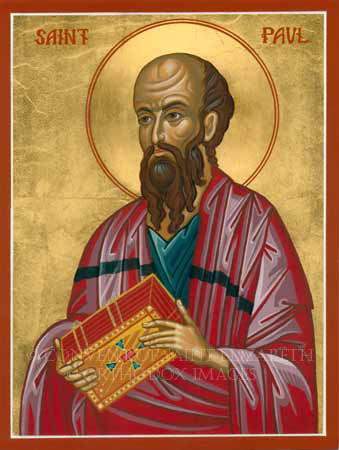
Saint Paul IconI have been known to say that I really don’t care for St. Paul. He often seems arrogant, and way to sure of himself. He admits to boastfulness and too often holds himself out as a paragon for others to emulate.

Years ago, when I would hear this passage read in worship, I thought it was just “Paul being Paul,” Paul showing off, Paul using colorfully inventive language, but it’s not. It’s Paul relying on his knowledge of the Hebrew scriptures to support his message of the gospel of Jesus Christ.

First, he conflates two verses from the Book of Deuteronomy: “Vengeance is mine” (Deut. 32:35) and “I will take vengeance on my adversaries, and will repay those who hate me” (Deut. 32:41). Then he supports his argument that we should foreswear revenge for the sake of the gospel by an appeal to the Book of Proverbs: “If your enemies are hungry, give them bread to eat; and if they are thirsty, give them water to drink; for you will heap coals of fire on their heads, and the Lord will reward you.” (Prov. 25:21-22)

Picking and choosing among the various writings of the Bible, “proof-texting,” is generally frowned upon, but that is not what Paul is doing. Instead, Paul is synthesizing law (torah) and wisdom (chochma) into a foundation for the message of forgiveness. The negative and restrictive ways of cultic law reserving revenge to God and of practical advice to eschew vengeance in favor of a greater reward are put in service of the positive gospel of reconciliation: “overcome evil with good.”

In these few short verses Paul demonstrates a maturational approach to the development of religion. This helps me to understand what he has written in other epistles.

Elsewhere he has said that the law (torah) was given to humankind as a sort of schoolmaster: to the “foolish Galatians” he wrote, “The law was our disciplinarian until Christ came.” (Gal. 3:24) As a child, we are told “Don’t do this; don’t engage in revenge” and, if we ask why, the answer is “because I said so.”

As we mature into adolescence and gain knowledge of the “ways of the world,” our developing wisdom (chochma) informs us with another reason, self-interest: “I won’t seek vengeance because I will profit more by not doing so.”

Finally, as mature adults, we come to know what Paul might have called “a still more excellent way,” forgiveness in place of revenge which benefits everyone and builds community: “If one member suffers, all suffer together with it; if one member is honored, all rejoice together with it.” (1 Cor. 12:26,31)

Paul does often seem boastful and arrogant, but give him his due: he knew his stuff! I’m learning to read the Pauline epistles holistically, as a body of work rather than as individual bits and pieces, and in doing so I gain insight into Paul and read him with new respect.

====================

A request to my readers: I’m trying to build the readership of this blog and I’d very much appreciate your help in doing so. If you find something here that is of value, please share it with others. If you are on Facebook, “like” the posts on your page so others can see them. If you are following me on Twitter, please “retweet” the notices of these meditations. If you have a blog of your own, please include mine in your links (a favor I will gladly reciprocate). Many thanks!

====================

Father Funston is the rector of St. Paul’s Episcopal Church, Medina, Ohio.

Dancin’ Already – From the Daily Office – February 12, 2014

From the Letter to the Romans:

For as in one body we have many members, and not all the members have the same function, so we, who are many, are one body in Christ, and individually we are members one of another.

(From the Daily Office Lectionary – Romans 12:4-5 (NRSV) – February 12, 2014.)

Fred Astaire and Ginger Rogers in Flying Down to RioPaul’s use of the “body” metaphor is so well known it’s almost a cliché, but it was brought into clear focus by an article published (apparently) nearly a year ago by the blog Viral Christ, but brought to light on Facebook the past couple of weeks.

In a nutshell, the story is that he shared with his class this quotation: “Christianity started in Palestine as a fellowship; it moved to Greece and became a philosophy; it moved to Italy and became an institution; it moved to Europe and became a culture; it came to America and became an enterprise.” He added, by way of explanation, that “an enterprise” here means “a business.” One young woman in the class then commented, “A business? But isn’t it supposed to be a body?” Prompted, she continued, “But when a body becomes a business, isn’t that a prostitute?” The professor, in his article, remarked, “There is only one answer to her question. The answer is ‘Yes.'”

I immediately thought of the comment made by Dorothy Day, the Roman Catholic social justice advocate, who wrote, “As to the Church, where else shall we go, except to the Bride of Christ, one flesh with Christ? Though she is a harlot at times, she is our Mother.” I was reminded also of the line spoken by actor Harold Gould, playing Salvadoran aristocrat Francisco Galedo in the biographical movie Romero; blaming the church for violent uprisings in El Salvador he mocks the archbishop, “The Church is a whore who will spread her legs to the highest bidder.”

So although the author of the article seemed shocked by his student’s suggestion, it wasn’t all that original. Nonetheless, his essay has sparked dialog among church folk. Several of my clergy colleagues on Facebook have been discussing the piece and in one such conversation, a colleague took issue with the professor’s blanket affirmation of his student’s comment. “No,” she said, “not necessarily. A body that becomes a business can also be a professional athlete, a dancer, a model, or a number of other things. The leap to prostitute as the only way in which a body can become a business is just that, a leap.”

Thank you, I said, bravo! She’s absolutely right. Body-to-business doesn’t necessarily imply prostitution; the alternatives she suggests, and many others, provide more positive metaphors for our consideration. And even if we decline to accept the shorthand history of Christian religious development from ancient Near Eastern fellowship to modern North American business offered by the professor, these metaphors provide instructive insight into Paul’s initial metaphor of church-as-body.

Paul’s point in using the metaphor was to illustrate how all who are members of the church have need of one another even though all are not of equal social standing or equal ability, or called to equal ministries: “The eye cannot say to the hand, ‘I have no need of you,’ nor again the head to the feet, ‘I have no need of you.'” (1 Cor. 12:21) But my friend’s objection to the prostitute metaphor is a reminder that bodies are more than the sum of their parts, and that bodies need things and do things. That, in turn, should speak volumes about the church. The church, like any body (but especially if the church is a professional athlete or a dancer), needs nourishment; it needs exercise; it needs rest; sometimes it needs treatment of injuries or diseases.

If we understand the church as a body, not just as a metaphor for the connection of the members one to another, but as a body that needs the same care and attention that our own physical bodies need, how would that change the way we “run the church”? How would that change the way we deal with issues, conflicts, and challenges within the church? How would that change the way we encourage and promote stewardship?

I intend to work on this some more, and work this broader, more holistic understanding of the body metaphor into my theology, into my preaching, and into my ministry of church leadership. The church as dancer, in particular, is an image that appeals to me. Church as Isadora Duncan, church as Nureyev, church as Fred and Ginger, church as Gene Kelly . . . We’re dancin’ already!

====================

A request to my readers: I’m trying to build the readership of this blog and I’d very much appreciate your help in doing so. If you find something here that is of value, please share it with others. If you are on Facebook, “like” the posts on your page so others can see them. If you are following me on Twitter, please “retweet” the notices of these meditations. If you have a blog of your own, please include mine in your links (a favor I will gladly reciprocate). Many thanks!

====================

Father Funston is the rector of St. Paul’s Episcopal Church, Medina, Ohio.

Miss the Mark? – From the Daily Office – February 11, 2014

From the Gospel of John:

[Jesus said:] “Let anyone among you who is without sin be the first to throw a stone at her.”

(From the Daily Office Lectionary – John 8:7 (NRSV) – February 11, 2014.)

Archery TargetA very familiar sentence from a very familiar story. I am intrigued today by the way in which Jesus carefully phrases his invitation to stone the woman caught in adultery. He does not say, “Let anyone among you who has not sinned be the first . . . .” Rather, “Let anyone among you who is without sin . . . .” As Jesus has phrased it, sin is not something done; it is a condition possessed. Those who would condemn the woman are focused on actions and behavior. Jesus turns their attention and their consciences from human behavior toward human nature.

The Greek here is complicated: the word used by John to relay Jesus’ words is anamartetos. It is a negated form of a term borrowed from archery meaning “to miss the mark;” with the addition of the negating prefix a- the word means “one who cannot sin.” In a way, Jesus is saying, “Throw a stone if you are absolutely sure that you can never miss.” “Who among you,” he seems to be asking, “is perfect?” His focus is the human condition, not on human activity, and his point is that we all share an imperfect nature; all of us can, and eventually all of will, miss. Obviously everyone in that crowd knew him- or herself well enough to know that none was incapable of missing the mark!

Are any of us? Do any of us always get everything right?

I am fascinated by the apprehension of the “human condition” in various cultures. Not every human culture believes the problem of the human condition is “sinfulness,” as western culture influenced by the Hebrew and Christian Scriptures, does. For example, Indian culture sees the problem as suffering; the traditional Chinese would see lack of social harmony to be the issue; Native American spirituality might focus on environmental harmony. Jesus’ invitation would make a different kind of sense in each of those contexts, but it would make sense. What I wonder is how his death makes sense, how the atonement makes sense, within these differing understandings of the basic human problem.

And I wonder if any 21st Century culture, west or east or Native American, sees sinfulness as the problem. What is the perceived problem of human existence in modern America? Boredom? Lack of meaning? Loneliness? No sense of personal value? How does Jesus’ death address that problem, whatever it is? What nature of atonement makes the act of atonement comprehensible in a new and different problematic context?

I won’t figure that out in an early morning meditation on the Daily Office, but today it seems to me that maybe this episode described by John, and Jesus’ careful phrasing of the invitation to stone the woman caught in adultery, might hold a key.

====================

A request to my readers: I’m trying to build the readership of this blog and I’d very much appreciate your help in doing so. If you find something here that is of value, please share it with others. If you are on Facebook, “like” the posts on your page so others can see them. If you are following me on Twitter, please “retweet” the notices of these meditations. If you have a blog of your own, please include mine in your links (a favor I will gladly reciprocate). Many thanks!

====================

Father Funston is the rector of St. Paul’s Episcopal Church, Medina, Ohio.

Dancing Shoes – From the Daily Office – February 10, 2014

From the Letter to the Hebrews:

Do not neglect to show hospitality to strangers, for by doing that some have entertained angels without knowing it.

(From the Daily Office Lectionary – Hebrews 13:2 (NRSV) – February 10, 2014.)

Dancing AngelThe writer of the Letter to Hebrews, of course, is making a tangential reference to Abraham’s experience at the oaks of Mamre when he entertained three “men” who turned out to be “angels of the Lord.” (Gen. 18)

The ministry of hospitality in the church is a subject of constant discussion. How do we make the stranger among us, the visitor, the newcomer, the seeker, welcome? How do we encourage them to make a connection with our church? How do we incorporate them into our fellowship?

These are important questions and there is never a final answer. The task of being a gracious host and, more importantly, the work of welcoming others as Christ would have welcomed them is never done and we can always get better at it.

However, I don’t believe the writer of this letter is addressing the issue of church growth. I’m not even all that sure he is talking about how we, collectively, as the church practice Sunday morning hospitality. I think he or she is simply giving advice about every day living, about how we interact with . . . well . . . everyone!

A few years ago I read a humorous article about hospitality in a Christian publication. The author had asked Sunday School children how they would obey this verse, how they would prepare to entertain angels. One youngster said that he would be sure that his house was clean and that there was a pot of potatoes in the oven. I think he may have been Irish. Another said that she would be sure to have on her dancing shoes. She may have been Irish, too.

I love that response! It’s great advice: prepare to dance! Some years ago I used to like to line dance at a particular country western saloon. I’m not a big fan of a lot of country western music, but the pieces you can line dance to, I kinda like. Back then one of the popular tunes for line dancing was a song by John Michael Montgomery entitled Life’s a Dance. The chorus went

Life’s a dance you learn as you go.
Sometimes you lead, sometimes you follow.
Don’t worry about what you don’t know.
Life’s a dance you learn as you go.

Prepare to dance! Prepare for life! Prepare to entertain angels . . . . G.K. Chesterton is supposed to have said that the reason angels can fly is because they take themselves lightly. When they come into your life, they’ll sweep you off your feet and you’ll be dancing amongst the clouds. Be sure to have on your dancing shoes.

====================

A request to my readers: I’m trying to build the readership of this blog and I’d very much appreciate your help in doing so. If you find something here that is of value, please share it with others. If you are on Facebook, “like” the posts on your page so others can see them. If you are following me on Twitter, please “retweet” the notices of these meditations. If you have a blog of your own, please include mine in your links (a favor I will gladly reciprocate). Many thanks!

====================

Father Funston is the rector of St. Paul’s Episcopal Church, Medina, Ohio.

« Older posts Newer posts »