Occasional thoughts of an Anglican Episcopal priest

Category: Christianity (Page 64 of 84)

Spooky Jesus – From the Daily Office – January 20, 2014

From the Gospel of John:

When he was in Jerusalem during the Passover festival, many believed in his name because they saw the signs that he was doing. But Jesus on his part would not entrust himself to them, because he knew all people and needed no one to testify about anyone; for he himself knew what was in everyone.

(From the Daily Office Lectionary – John 2:23-25 (NRSV) – January 20, 2014.)

Jesus Holy CardThe Definition of Chalcedon affirms, in part:

Following the holy fathers, we all with one accord teach men to acknowledge one and the same Son, our Lord Jesus Christ, at once complete in Godhead and complete in manhood, truly God and truly man, consisting also of a reasonable soul and body; of one substance (homoousios) with the Father as regards his Godhead, and at the same time of one substance with us as regards his manhood; like us in all respects, apart from sin . . . .

That last bit is derived from Holy Scripture, specifically from a verse in the Letter to the Hebrews: “We do not have a high priest who is unable to sympathize with our weaknesses, but we have one who in every respect has been tested as we are, yet without sin.” (Heb. 4:15 NRSV)

The Jesus described by the writer of Hebrews and affirmed in the Chalcedonian definition is a man I can follow. There are times when the Jesus described by the writer of the Fourth Gospel creeps me out! This is one of them. The thought that someone could “know all people” and “know what is in everyone” is just spooky.

Now, let me be clear, I am not speaking of the eternal Second Person of the Trinity; I’ve no doubt that God knows all people and knows what is in everyone. But the human person born in early First Century Palestine, who ate and drank and walked around, who expressed joy and disappointment, who got mad, who went to parties, who hiked the roads from town to town, that guy who was “like me in all respects” . . . . I don’t think that Jesus in his human life had access to the divine mind or could have known “what was in everyone.” If he did, he wasn’t like me and what he lived through, what he taught, and his death, resurrection, and ascension have no bearing on my life or meaning for me. He’s too spooky for me!

Years ago I was given a “holy card” which I have since lost. (In the Roman Catholic tradition, holy cards, also called “prayer cards” are small, devotional pictures, often mass-produced for the use of the faithful.) This card had what I’m sure is a very unrealistic portrait of Jesus done in what is technically called “lenticular printing;” that’s the process that makes the printed image seem to change or move as it is viewed from different angles. On that holy card, Jesus’ eyes seemed to move and follow you. It was creepy! When I read about Jesus reading the minds of everyone around him and knowing “what was in everyone,” I think of that spooky holy card.

John does this a lot; this gospel sometimes makes Jesus so divine that the human being gets lost. The wisdom of the biblical canon is that John’s too-divine Jesus is tempered by Mark’s portrait which is too human! (Could the longer ending of Mark’s Gospel, Mark 16:9-20 which includes the Great Commission and a description of Christ’s Ascension, have been added as a corrective to that too-human portrayal? That’s a topic for another exploration.)

I’m not suggesting that John’s Gospel be discounted or overlooked or thrown away. I’m just acknowledging that its mind-reading Jesus who “knew what was in everyone” is someone I wrestle with (like Israel in the desert with the angel of God). He’s spooky and spooky bothers me.

====================

A request to my readers: I’m trying to build the readership of this blog and I’d very much appreciate your help in doing so. If you find something here that is of value, please share it with others. If you are on Facebook, “like” the posts on your page so others can see them. If you are following me on Twitter, please “retweet” the notices of these meditations. If you have a blog of your own, please include mine in your links (a favor I will gladly reciprocate). Many thanks!

====================

Father Funston is the rector of St. Paul’s Episcopal Church, Medina, Ohio.

What’s a Cubit? – From the Daily Office – January 18, 2013

From the Book of Genesis:

God said to Noah, “I have determined to make an end of all flesh, for the earth is filled with violence because of them; now I am going to destroy them along with the earth. Make yourself an ark of cypress wood; make rooms in the ark, and cover it inside and out with pitch. This is how you are to make it: the length of the ark three hundred cubits, its width fifty cubits, and its height thirty cubits.”

(From the Daily Office Lectionary – Genesis 6:13-15 (NRSV) – January 18, 2014.)

Noah's Ark ReconstructionI read those words and heard Bill Cosby’s voice. I’ll bet I’m not alone. More than 50 years ago (1963), Cosby’s debut comedy album Bill Cosby Is a Very Funny Fellow…Right! included a 3-1/2 minute skit he’d been doing on stage entitled Noah: Right! Ever since, it has colored the story of Noah and the ark for Americans; I know people who wouldn’t be born for another quarter century after that album’s release for whom Cosby’s skit is nonetheless an interpretive filter for the Noah story. Millions read the story and hear Noah asking, in Cosby’s voice, “Lord, what’s a cubit?”
In 1979, the comedy sketch troupe Monty Python released a full length movie entitled Month Python’s Life of Brian, which spoofed the life and ministry of Jesus of Nazareth by telling the story of Brian, the baby born in the stable stall next door and who spends his life being mistaken for the messiah. When he is present at the Sermon on the Mount, Brian is at the edge of the crowd among those who are so far away from Jesus they cannot hear clearly what he says. As they struggle to hear and understand Jesus’ words, they have this conversation:

What did he say?
I think it was “Blessed are the cheesemakers.”
Aha, what’s so special about the cheesemakers?
Well, obviously it’s not meant to be taken literally; it refers to any manufacturers of dairy products.

I cannot read the Beatitudes without that dialog coming to mind; I have to bite my lip to keep from laughing. I’m sure that when it is the appointed Sunday Gospel, my parishioners wonder why I have such a goofy expression while reading it!

Because I’m a child of the television generation, I also cannot read the story of Adam and Eve without seeing in memory Bob Newhart and Ruth Buzzi in beige long underwear playing a Garden-of-Eden skit on the old Laugh-In show, or sometimes Richard Basehart as a shipwrecked, alien space-traveling Adam encountering a similarly shipwrecked Eve (the plot of an old Twilight Zone episode).

I’ve two points in mind this morning in recalling these comedy routines to mind. The first is the difficulty of setting aside preconceptions when reading the scriptures. What we think we know about the text may be helpful as we study and interpret it, but it can also be a barrier to hearing it fresh each time to encounter it. I am convinced that the bible speaks to us anew in each reading, and that what we already “know” can and does interfere with our appreciating that. So I struggle to not hear Cosby’s voice, to not understand peacemakers as cheesemakers, to not see Adam climbing out of his space ship.

The second point is rather the opposite of the first, that these comedic or fanciful takes on the stories of the bible are as helpful as they are distracting. I know a lot of people who have a hard time finding humor about God or Jesus or the bible acceptable. My staunch Methodist grandfather frowned upon any humor about church, Sunday School, or other things religious; he considered them disrespectful and (I’m sure) blasphemous.

I find wisdom in a line by Oscar Wilde (from Lady Windemere’s Fan): “Life is far too important a thing ever to talk seriously about it.” The same can be said of the bible. Theologian and author Madeleine L’Engle once wrote, “I take the Bible too seriously to take it all literally” (a quotation often misattributed to Karl Barth). Finding humor or inspiration for fanciful works of fiction and comedy in scripture is part of both taking it seriously and not talking seriously about it. These comedic or fanciful treatments help us hear the scriptures with new ears.

And the question still remains: “What’s a cubit?”

====================

A request to my readers: I’m trying to build the readership of this blog and I’d very much appreciate your help in doing so. If you find something here that is of value, please share it with others. If you are on Facebook, “like” the posts on your page so others can see them. If you are following me on Twitter, please “retweet” the notices of these meditations. If you have a blog of your own, please include mine in your links (a favor I will gladly reciprocate). Many thanks!

====================

Father Funston is the rector of St. Paul’s Episcopal Church, Medina, Ohio.

Obnoxious Jesus – From the Daily Office – January 17, 2014

From John’s Gospel:

On the third day there was a wedding in Cana of Galilee, and the mother of Jesus was there. Jesus and his disciples had also been invited to the wedding. When the wine gave out, the mother of Jesus said to him, “They have no wine.” And Jesus said to her, “Woman, what concern is that to you and to me? My hour has not yet come.” His mother said to the servants, “Do whatever he tells you.”

(From the Daily Office Lectionary – John 2:1-5 (NRSV) – January 17, 2014.)

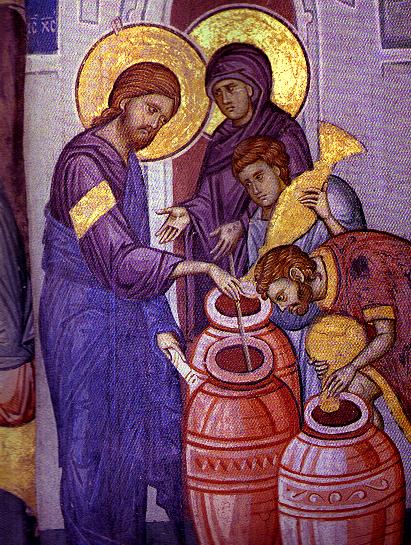
Icon of the Wedding at CanaToday is the feast of St. Antony of Egypt. According to a Life of St. Antony written by Athanasius, Antony and his younger sister were orphaned when he was about 18 years of age, inheriting a goodly estate which he began to manage. However, writes Athanasius, six months after his parents’ death he was “turning over in his mind the way the apostles had left everything to follow the Savior” when he heard a sermon on Christ’s encounter with the rich young man whom the Lord instructed, “If you wish to be perfect, go, sell your possessions, and give the money to the poor, and you will have treasure in heaven; then come, follow me.” (Matt. 19:21)

According to Athanasius:

As though this reminder of the saints had ben sent to him by God, and as though that passage had been read specially for his sake, Antony went out immediately, and gave to the villagers the possessions he had inherited from his ancestors — they consisted of some three hundred very pleasant and fertile acres — so that they would not be an encumbrance to him and to his sister. He sold all his possessions and gave the considerable sum h raised to the poor, keeping back only a little of it for his sister.

Again when he went into church, he heard what the Lord said in the gospel, “Do not be anxious about tomorrow.” He could not wait any longer, but went out and gave away even what he had kept back to the poor. He left his sister in the care of some well-known, trustworthy virgins, putting her in a convent to be brought up, and he devoted himself to the ascetic life not far from his home, living in recollection and practicing self-denial.

When I read that, I wondered what Antony’s sister’s reaction to it all might have been . . . . Truthfully, had I been her, my affections toward my older brother would not have been kindled! And then I read this morning’s Daily Office gospel about the wedding at Cana and the (to my mind) very uncomfortable repartee between Jesus and his mother. If we take off the rose-tinted glasses through which the Holy Family and the saints are often viewed and assess this conversation honestly, these are two people talking passed one another and not being terribly pleasant to each other!

When I was in seminary, my New Testament professor Bill Countryman referred to the portrayal of Jesus in the Fourth Gospel as “obnoxious.” In his book The Mystical Way in the Fourth Gospel, Countryman called Jesus’ repeated pattern of hard-to-understand responses to questions “obnoxious discourse.” Jesus seems intent on making his claims as difficult and offensive as possible; everything he says seems designed to irritate the people listening. And, in the story of the wedding at Cana, he seems to be starting with his mother!

Taken together, the story of Antony disposing of the family fortune and this gospel lesson serve as reminders that every family has its “issues.” The saints and holy people whom we revere and to whom we look as exemplars, even Jesus and his mother, were just “regular folks” doing the best they could and trying to work things out as well as possible. Sometimes they were wildly successful and are examples we should seek to emulate. Sometimes we look at them and question their judgments and their actions; not every example is one to follow. In either case, we hope to learn something, even when they are being obnoxious. Perhaps especially when Jesus is obnoxious!

====================

A request to my readers: I’m trying to build the readership of this blog and I’d very much appreciate your help in doing so. If you find something here that is of value, please share it with others. If you are on Facebook, “like” the posts on your page so others can see them. If you are following me on Twitter, please “retweet” the notices of these meditations. If you have a blog of your own, please include mine in your links (a favor I will gladly reciprocate). Many thanks!

====================

Father Funston is the rector of St. Paul’s Episcopal Church, Medina, Ohio.

Geographic Assumptions – From the Daily Office – January 16, 2014

From John’s Gospel:

Nathanael said to [Philip], “Can anything good come out of Nazareth?” Philip said to him, “Come and see.”

(From the Daily Office Lectionary – John 1:46 (NRSV) – January 16, 2014.)

Map  of StereotypesWe make many assumptions based on geography. Think of the all the comedians who make a living in North America by joking about stereotypes of Canadians — the television program South Park has made a running gag of Canadian stereotypes for years! Just try saying, as I truthfully can, “I was born in Las Vegas.” You’ll be very surprised by the reactions and the seriously ridiculous comments (I no longer am).

Although my wife is not a Las Vegan (she’s from a town in northeastern Nevada), we met and were married there. When I say that to someone in her presence — “We were married in Las Vegas” — she always adds “in a large church wedding.” She knows full well that the immediate assumption raised by my statement is that our marriage took place at the Little Chapel in the Parking Lot Behind Caesar’s Palace or some similar establishment.

Nathanael is voicing geographic assumptions in his question to Philip. In word, he is stereotyping.

Nazareth in Galilee, north of Jerusalem, was a nothing town, a poor, back water village of maybe 500 people ignored by nearly everyone, not only the Roman Empire but even by its nearby neighbors. Its residents were the First Century Jewish equivalent of hillbillies. It was not the sort of place from which one expected anything great, or anything at all . . . even an inhabitant of a similar neighboring town (like Bethsaida) could turn his nose up at it!

There are plenty of such places in the world today; there are many, many modern-day Nazareths. Every empire has its left-behind, forgotten, impoverished villages, its places from which no one expects any good thing to come. The spirit of Nazareth lives on in the slums and abandoned neighborhoods of Detroit, of Rio de Janeiro, of Calcutta, of hundreds of cities and towns around the globe.

“Can anything good come from [fill in the blank . . . I’m sure you know a place]?”

Philip’s answer to Nathanael is “Come and see.” God has two answers. The obvious answer: Yes! The less obvious answer is an admonition to stop stereotyping. If we can learn to take off the blinders of our geographic (and other) assumptions, if we can give up the habit of stereotyping, we will see greater things.

====================

A request to my readers: I’m trying to build the readership of this blog and I’d very much appreciate your help in doing so. If you find something here that is of value, please share it with others. If you are on Facebook, “like” the posts on your page so others can see them. If you are following me on Twitter, please “retweet” the notices of these meditations. If you have a blog of your own, please include mine in your links (a favor I will gladly reciprocate). Many thanks!

====================

Father Funston is the rector of St. Paul’s Episcopal Church, Medina, Ohio.

Unknown Ailments – From the Daily Office – January 15, 2014

From the Letter to the Hebrews:

Since, therefore, the children share flesh and blood, he himself likewise shared the same things, so that through death he might destroy the one who has the power of death, that is, the devil, and free those who all their lives were held in slavery by the fear of death.

(From the Daily Office Lectionary – Hebrews 2:14-15 (NRSV) – January 15, 2014.)

Low Back PainWhat is fear of death but fear of the unknown? The fear of death and the unknown brings anxiety, despair, and a frantic search for meaning. The fear of death and the unknown distracts us and makes us afraid to truly live. We end up fearing both death and life; we end up not attending to those things which are most important.
Yesterday, I woke up with an aching lower back. As the day progressed, the ache became acute, changing from ache to stabbing pain; it localized itself on the right side of my back. When the stabbing sensations occurred, the pain radiated around my right flank and into my abdomen. They got worse. “Kidney stone,” I thought, “I must have a kidney stone.” I’ve never had a kidney stone, but what I was experiencing seemed to be exactly what others have described as the symptoms of a kidney stone. I decided to seek medical advice.

It turned out to be no help. Diagnostic activities (urinalysis and a CAT scan) said it wasn’t a kidney stone. So what was it? What is it? It’s still here. I woke up with it again today. I’ve taken pain medication and applied heat, and they have helped with the discomfort . . . but the source remains unknown.

So I am concerned. Is my concern “fear?” Yes, to some extent it is. Is it disabling? It’s certainly distracting! Both the pain, which limits my motion, and the concern (or fear) which keeps my attention focused on it, and thus not on . . . my prayers, my work, my regular activities, the things important in my life . . . the distraction holds me in thrall. My imagination runs wild and I envision all sorts of dire and deadly medical conditions to explain my pain, when I know full well it’s probably nothing more than a pulled muscle. To the extent that I focus on the pain and its unknown source, I am a slave to my discomforts, both physical and psychological.

A petition from an old Scottish litany prays: “From ghoulies and ghosties, and long-leggedy beasties, and things that go bump in the night, Good Lord, deliver us!” It is a prayer for release from the fear of the unknown, a release the Letter to the Hebrews assures us we have already been given. The power of the unknown has been destroyed by God in Jesus sharing our flesh and blood, with all of its aches and pains and unknown ailments.

So today, I choose to be free of the pain. I may still feel it, but I won’t let it or fear of its still-unknown source distract me from getting on with life.

====================

A request to my readers: I’m trying to build the readership of this blog and I’d very much appreciate your help in doing so. If you find something here that is of value, please share it with others. If you are on Facebook, “like” the posts on your page so others can see them. If you are following me on Twitter, please “retweet” the notices of these meditations. If you have a blog of your own, please include mine in your links (a favor I will gladly reciprocate). Many thanks!

====================

Father Funston is the rector of St. Paul’s Episcopal Church, Medina, Ohio.

Angelic Toddlers – From the Daily Office – January 14, 2014

From the Book of Genesis:

The Lord God sent [Adam] forth from the garden of Eden, to till the ground from which he was taken. He drove out the man; and at the east of the garden of Eden he placed the cherubim, and a sword flaming and turning to guard the way to the tree of life.

(From the Daily Office Lectionary – Genesis 2:23-24 (NRSV) – January 14, 2014.)

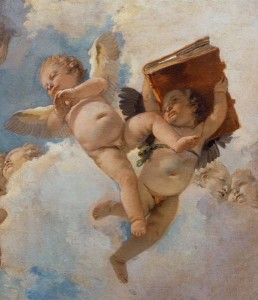
Putti with Book by Giovanni Battista Tiepolo, 1744Look up cherub in a secular dictionary and this is what you find: “a member of the second order of angels, often represented as a beautiful rosy-cheeked child with wings.” (Collins) I don’t know why, when, or how the fat little boys with aerodynamically inadequate wings came to be an artistic and now normative depiction of cherubs, but there it is! Technically, these little guys (and they are male) are known as putti — an Italian plural; the singular is putto. (Putto is occasionally used in modern Italian to mean a male toddler.)

Say the word cherub (or its adjectival form, cherubic) to nearly anyone, and the image that will spring to his or her mind is almost guaranteed to be a putto. For me, this inaccurate representation of the cherubim has become the poster child for everything that needs to be unlearned.

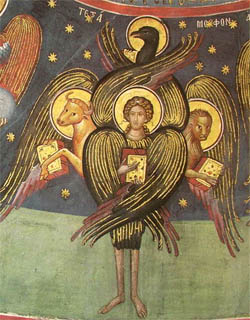
As the end of the story of the Garden of Eden ought to make clear, the cherubim are beings of immense power, stationed on the path to the tree of life wielding flaming swords. They are the bearers of the throne of God (see Isaiah 37:16). Ezekiel describes the cherubim when recounting his vision of “four living creatures” whom he later identifies as cherubim:

Tetramorph, Fresco at Meteora Monastery

They were of human form. Each had four faces, and each of them had four wings. Their legs were straight, and the soles of their feet were like the sole of a calf’s foot; and they sparkled like burnished bronze. Under their wings on their four sides they had human hands. And the four had their faces and their wings thus: their wings touched one another; each of them moved straight ahead, without turning as they moved. As for the appearance of their faces: the four had the face of a human being, the face of a lion on the right side, the face of an ox on the left side, and the face of an eagle. (Ezek. 1:5b-10; cf. Ezek. 10)

Although our error of imagination in regard to the appearance of the cherubim can be easily corrected by a few minutes of bible study like this, the larger issue of unlearning is not so quickly or easily dealt with.

An old comedy album by the group the Firesign Theatre was entitled Everything You Know Is Wrong. I wouldn’t go that far, but we are conditioned by our families, societies, and culture to “know” many things . . . and much what we “know” as a result of that conditioning is simply inaccurate. Before we can know the truth, we have to unlearn the things of which we are convinced because of our conditioning.

Unlearning, however, is not simply replacing inaccuracies with “true facts.” It is not about right or wrong. Unlearning is an attitude of openness to that which lies beneath the judgment of right or wrong. It is about “moving away from” rather than “moving towards.” Zen masters often use the metaphor of emptying a full cup of tea. There is nothing beyond the emptying. The cup is not emptied so that it can be refilled; it is emptied so that it can be empty. Only when it is truly empty with no expectation or anticipation of being filled is the cup open to the future.

Jesus used another metaphor, that of an innocent child: “Truly I tell you, whoever does not receive the kingdom of God as a little child will never enter it.” (Mark 10:15)

So perhaps our chubby little wingéd friends, those little angelic toddlers, are a good image after all. If they are, as I suggested, the poster children for unlearning, let’s think about the way toddlers receive things.

A way to unlearn might be to try to go back to our first learning experiences and explore new things as toddlers would, through playfulness and curiosity. Toddlers never seem to have a plan, no preconceived notion of where they are going, no expectation of what is coming next. Jiddu Krishnamurti, the Indian philosopher, often described truth as a “pathless land;” toddlers seem to live in such a pathless country, a place of endless discovery. This, I think, is where Jesus invites: to a place where we can open ourselves, empty ourselves, and unlearn our conditioning, to the pathless country of truth where we can wander like a toddler with playfulness and deep curiosity.

====================

A request to my readers: I’m trying to build the readership of this blog and I’d very much appreciate your help in doing so. If you find something here that is of value, please share it with others. If you are on Facebook, “like” the posts on your page so others can see them. If you are following me on Twitter, please “retweet” the notices of these meditations. If you have a blog of your own, please include mine in your links (a favor I will gladly reciprocate). Many thanks!

====================

Father Funston is the rector of St. Paul’s Episcopal Church, Medina, Ohio.

The Boa and the Wart-Hog – From the Daily Office – January 13, 2014

From the Letter to the Hebrews:

“In the beginning, Lord, you founded the earth, and the heavens are the work of your hands; they will perish, but you remain; they will all wear out like clothing; like a cloak you will roll them up, and like clothing they will be changed. But you are the same, and your years will never end.”

(From the Daily Office Lectionary – Hebrews 1:10-12 (NRSV) – January 13, 2014.)

The writer of the Letter to the Hebrews quotes from Psalm 102 and asserts that the words are spoken by God the Father to the Son. In The Book of Common Prayer (TEC 1979), the verses quotes read:

Constrictor with Prey

In the beginning, O Lord, you laid the foundations of the earth,
and the heavens are the work of your hands;
They shall perish, but you will endure; they all shall wear out like a garment;
as clothing you will change them, and they shall be changed;
But you are always the same,
and your years will never end.
(Psalm 102:25-27 – BCP Version)

The lessons today focus on beginnings — the Old Testament lesson is the second (but older) creation story from the Book of Genesis and the Gospel lesson is the prologue of John’s Gospel. The epistle and the psalm which it quotes, however, remind us of endings: created things “will all wear out like clothing; like a cloak you will roll them up.” I’ve always thought that a wonderful poetic metaphor for theoretical entropic nature of the universe, the idea that all of the matter and energy in the universe will ultimately degrade to a state of inert uniformity.

That these lessons of cosmic beginnings and endings are on the lectionary today is a coincidence that somehow seems appropriate as the world says “Good-bye” to Dr. Ian Barbour, who died yesterday at the age of 90. Barbour was a physicist who embraced the truth of the Christian faith while holding fast to the ethic of scientific inquire; he demonstrated to the world that there is no contradiction between the pre-scientific religious stories of creation and the scientific explanation of the universe’s beginnings.

When he won the Templeton Prize in 1999, Dr. Barbour said:

If we take the Bible seriously but not literally, we can accept the central biblical message without accepting the prescientific cosmology in which it was expressed, such as the three-layer universe with heaven above and hell below, or the seven days of the creation story.

In his book Religion in an Age of Science (Harper San Francisco: 1990), Dr. Barbour proposed a colorful metaphor for the relationship between science and religion, decrying what he called (with characteristic understatement) the “misuse” of each in the extremes of scientific materialism and biblical literalism:

Warthog

In a fight between a boa constrictor and a wart-hog, the victor, whichever it is, swallows the vanquished. In scientific materialism, science swallows religion. In biblical literalism, religion swallows science. The fight can be avoided if they occupy separate territories or if, as I will suggest, they each pursue more appropriate diets.

He wrote that “our personal and social lives are intimately bound to the rest of the created order. We are redeemed in and with the world, not from the world. Part of our task, then, is to articulate a theology of nature, for which we will have to draw from both religious and scientific sources.” The wart-hog and the boa constrictor each have their part to play and their perspectives to contribute. Unfortunate, there are many who still encourage them to fight to the death rather than change their diets and cooperate. We need fewer leaders of that sort in both religion and science, and more like Dr. Barbour, to whom we say, “Well done, good and faithful servant; rest in peace and rise in glory.”

====================

A request to my readers: I’m trying to build the readership of this blog and I’d very much appreciate your help in doing so. If you find something here that is of value, please share it with others. If you are on Facebook, “like” the posts on your page so others can see them. If you are following me on Twitter, please “retweet” the notices of these meditations. If you have a blog of your own, please include mine in your links (a favor I will gladly reciprocate). Many thanks!

====================

Father Funston is the rector of St. Paul’s Episcopal Church, Medina, Ohio.

Gimmicks Distract – From the Daily Office – January 11, 2014

From the Psalter:

Hallelujah!
Praise God in his holy temple;
praise him in the firmament of his power.
Praise him for his mighty acts;
praise him for his excellent greatness.
Praise him with the blast of the ram’s-horn; *
praise him with lyre and harp.
Praise him with timbrel and dance;
praise him with strings and pipe.
Praise him with resounding cymbals;
praise him with loud-clanging cymbals.
Let everything that has breath
praise the Lord.
Hallelujah!

(From the Daily Office Lectionary – Psalme 150 (BCP Version) – January 11, 2014.)

Clown Presiding at CommunionThe musical Godspell debuted in 1971 (my junior year in college); in it, Christ is portrayed as a clown. Whether it was an expression of or the catalyst for the phenomenon of offering clown eucharists as an edgy, avant-garde presentation of the Christian Mysteries, I really don’t know. The two are inextricably linked in my memory.
And . . . to be honest, I never cared for either. And . . . being further honest, that may be because I have never like clowns. I find them creepy. On the other hand, a bishop of whom I was very fond and for whom I had great respect, loved Clown Eucharists. He had a set of clown-decorated vestments made; he offered a clown eucharist at least once each year (often at diocesan convention) throughout his episcopate. They may have resonated for him because, unlike me, he loved clowns.

But I didn’t (and don’t) and so the clown eucharist was, for me, a distraction. I couldn’t get passed the gimmick, the clown images and the circus music, to the Christ at the center of mass. The clown gimmick, not the foolishness of God to which it was supposedly pointing, took over and seemed to be the point of the whole thing.

Some years later, when the music of U2 became popular and new generation were finding spiritual meaning in the band’s lyrics, someone put together a celebration of the Holy Mysteries in which that music played a part — the major part — it was the only music — and promoted the event as a U2charist.

“Right,” I thought. “The clown eucharist in a new guise.” Again, for me, the gimmick (the U2 music) distracts from the principal focus. I attended a U2charist and, for me, all I heard was the band’s music; I didn’t hear the gospel. That’s not to say it wasn’t there; it may have been. I just couldn’t hear it through the distraction of the soundtrack.

Since then I have heard of (but not attended) celebrations of Holy Communion in which the music was all from the Beatles canon, or all “oldies” from the 1960s, or all Broadway show tunes . . . and I wouldn’t be surprised if there have been other similar “thematic” eucharists. All, I think, the descendants of the clown masses of the 1970s — attempts to package the Christian Mysteries in edgy and avant-garde ways to present them to a target audience, to sneak the gospel message in under the guise of entertainment.

Now, don’t get me wrong. Let me hasten to say that I think entertainment is fine. If clowns float your boat, go the circus! If you like the music of U2 (and I do), listen to it! If you like Broadway musicals (and I do), go to the theater! And if you find something of spiritual import in those entertainments (and I do), great! Make use of it in your spiritual life and, even, in church services and celebrations.

The last of the psalms encourages the people of God to make use of many forms of entertainment, symbolized by musical instruments — trumpets and horns (the ram’s horn), stringed instruments, percussion, wood winds — and dance, in their worship. So I believe it’s fine to make use of clowns, to use of U2’s music, to sing the Beatles’ lyrics, to offer the tunes from Broadway shows as part of the liturgy.

But when these things become the reason for the service, when we name the service for the clowns or the bands or the theater district, the tool meant to be used for praising God has become the object of praise. The psalm says, “Praise God with strings and pipe,” not “Praise the strings and pipe;” “Praise God with resounding cymbals,” not “Praise the cymbals.”

Others, I am quite certain, will have found the U2charists a path to God. Other, I know, will have found in the Beatles mass and in the Broadway eucharists the truth of the gospel. After all, that bishop whom I really did love found Christ in clowns no matter how creepy I may have found them!

But for me, these feel “gimmicky” — one or two Beatles songs might be used to good effect, but nothing but Beatles music through the whole service? Not so much. U2’s Gloria could certainly stand as a liturgical piece, but all U2 music throughout the mass? Too much of a good thing. I’m not sure that I can say anything positive about clowns . . . but someone might, perhaps. My point is that themed eucharists like these, in which the theme predominates, feel like gimmicks. It feels to me like we have stopped praising God with the clowns and have started praising the clowns; the gimmick distracts. Praise God with the gimmick, but don’t praise the gimmick!

====================

A request to my readers: I’m trying to build the readership of this blog and I’d very much appreciate your help in doing so. If you find something here that is of value, please share it with others. If you are on Facebook, “like” the posts on your page so others can see them. If you are following me on Twitter, please “retweet” the notices of these meditations. If you have a blog of your own, please include mine in your links (a favor I will gladly reciprocate). Many thanks!

====================

Father Funston is the rector of St. Paul’s Episcopal Church, Medina, Ohio.

WYSIWYG World – From the Daily Office – January 10, 2014

From the Letter to the Colossians:

Therefore do not let anyone condemn you in matters of food and drink or of observing festivals, new moons, or sabbaths. These are only a shadow of what is to come, but the substance belongs to Christ.

(From the Daily Office Lectionary – Colossians 2:16-17 (NRSV) – January 10, 2014.)

Green-on-Black TextI sometimes wonder to what extent Paul, as an educated Jewish citizen of a Greek-speaking empire, was schooled in the classical Greek philosophers. Had he read Plato’s Republic? Was he aware of the conversation portrayed in Book VII between Socrates and Glaucon in which the allegory of the cave is laid out?

In the dialog, Socrates describes a prison cave in which the inmates have lived all of their lives chained in such a way that all they can see is a blank wall. The prisoners watch shadows formed on the wall by things passing between them and a fire behind them. They recognize the shadows, give them the names of the things which cast them, and believe them to actually be those things. The shadows, says Socrates, are as close as the inmates get to viewing reality. According to Socrates, a philosopher is like a prisoner who is loosed, sees the real forms casting the images, and comes to understand that the shadows are not reality at all. He is aware of the true form of reality, not the shadows seen by the chained inmates. The story illustrates Plato’s “Theory of Forms,” which holds that things in the material world perceivable through sensation are mere “shadows” of ideal “forms.” These “forms,” not the “shadows,” possess the highest and most fundamental reality.

When Paul writes things like “these are only a shadow . . . the substance belongs to Christ,” he seems to be buying into this Platonic idea. His famous line from the first letter to the church in Corinth seems to do so as well: “For now we see in a mirror, dimly, but then we will see face to face. Now I know only in part; then I will know fully, even as I have been fully known.” (1 Cor. 13:12) Take these sorts of Pauline statements and mix them with the Letter to the Hebrews (“They offer worship in a sanctuary that is a sketch and shadow of the heavenly one.” – Heb. 8:5) and even a bit of James (“Every generous act of giving, with every perfect gift, is from above, coming down from the Father of lights, with whom there is no variation or shadow due to change.” – James 1:17), and one can see where the Neoplatonists and even the Gnostics get the notion that the material world is less than ideal, fallen, corrupt, or even evil. That’s a position that, unfortunately in my opinion, has made a significant impact on Christian theology.

It is also not a view to which the Hebrew Scriptures lend much support and one doubts very much that it was the opinion of Jesus of Nazareth! Oh sure, there are hints of it in Hebrew poetry and prayer. For example, King David prays with the assembly of the people: “For we are aliens and transients before you, as were all our ancestors; our days on the earth are like a shadow, and there is no hope.” (1 Chron 29:15) And Bildad the Shuhite advises Job: “For we are but of yesterday, and we know nothing, for our days on earth are but a shadow.” (Job 8:9) And from time to time the Psalms say things like the description of human beings as “like a breath; their days are like a passing shadow.” (Ps. 144:4) But on the whole, the Old Testament and (I suggest) the Christian faith declare a much different understanding of reality!

Just read the accounts of creation in Genesis! God is not shown to be casting shadows; God is creating hard, physical reality and, at each step along the way, declares it good. In the second account (which is probably the older of the two), God gets God’s hands dirty in all that good, hard, physical reality molding human beings out of the clay. I’m particularly fond of poet James Weldon Johnson’s retelling of that story (which I quoted in last Sunday’s sermon):

Up from the bed of the river
God scooped the clay;
And by the bank of the river
He kneeled Him down;
And there the great God Almighty
Who lit the sun and fixed it in the sky,
Who flung the stars to the most far corner of the night,
Who rounded the earth in the middle of His hand;
This Great God,
Like a mammy bending over her baby,
Kneeled down in the dust
Toiling over a lump of clay
Till He shaped it in His own image;
Then into it He blew the breath of life.

(“The Creation”, from God’s Trombones)

When I was a second-year student at law school I was a member of the law review where we used some very early word processing equipment and software in which one had to enter the codes for changes in typeface, indentation, and so forth (not too dissimilar from writing HTML code, frankly). What you looked at on the green-on-black computer screen bore no resemblance to what (you hoped) the printer would produce. The next year, when I became an editor, we purchased a new computer and were introduced to a new concept – “WYSIWYG” (pronounced “wissy-wig”) – What You See Is What You Get. What was on the screen looked like what the printer produced!

I believe that’s the kind of world we have been given, one in which what we perceive is real. Yes, I know that quantum mechanics and superstring theory bring that into some question, that at some super-micro-nano-reality level things are not quite what they seem; but that is a different issue than this philosophical nothing-is-really-real shadow-world construct of Plato’s, and a far cry from the fallen, corrupt, evil world of some Christian theologies. We live in a real, physical world, one in which God was pleased to take on flesh and dwell among us (John 1:1-14).

When I see beautiful winter hillside covered with glistening snow, when I taste a sweet-tart bite of homemade cherry pie, when I kiss my wife or hug my daughter, when I listen to a Vivaldi concerto, I am seeing/tasting/feeling/hearing what I get, not some shadow of an unseen and unknowable “ideal form.” Like that mammy bending over her baby, what I am experiencing is real and good; it is the ideal. We live in a WYSIWYG world!

====================

A request to my readers: I’m trying to build the readership of this blog and I’d very much appreciate your help in doing so. If you find something here that is of value, please share it with others. If you are on Facebook, “like” the posts on your page so others can see them. If you are following me on Twitter, please “retweet” the notices of these meditations. If you have a blog of your own, please include mine in your links (a favor I will gladly reciprocate). Many thanks!

====================

Father Funston is the rector of St. Paul’s Episcopal Church, Medina, Ohio.

Sweetgum Balls – From the Daily Office – January 9, 2014

From the Psalter:

Have mercy upon us, O Lord, have mercy,
for we have had more than enough of contempt,
Too much of the scorn of the indolent rich,
and of the derision of the proud.

(From the Daily Office Lectionary – Psalm 123:4-5 (BCP Version) – January 9, 2014.)

Sweetgum Balls on SnowThere’s a lot of talk these days about “class warfare,” most of it sheer nonsense. There is, it must be admitted, a growing class divide, an increasing gap between the wealthiest Americans and the rest of us. One might be tempted to write about that in light of this psalm’s reference to the “scorn of the indolent rich” and the “derision of the proud.” But, let’s face it . . . scorn, derision, contempt, and generally obnoxious conduct transcend class and other distinctions.

Prickly, disagreeable people come in all income groups, all races, all genders and sexual preferences, all religions . . . in any grouping of human beings you care to make. Indeed, everyone of us can be and are, from time to time, prickly and unpleasant. A lot of the time, we are completely oblivious to our own unpleasantness.

Driving past our town square yesterday afternoon, I noticed that a sweet gum tree had shed its empty seedpods, the hard, prickly fruit littering the snow all around the trunk. I rolled down the car window, pulled out my smartphone and took this picture (which came out a bit unfocussed). I thought I might use it as inspiration (or illustration) for a poem. And then this psalm came up on the lectionary rotation and the sweet gum was an obvious metaphor.

Unpleasant people drop little bombs of scorn, little grenades of derision all around them. They mar the world around them the same way the sweet gum tree’s seedpods mar the snow around the tree. But like the tree, they are unaware (or uncaring) of the damage they are doing and seem unable (or unwilling) to bend; they lack the flexibility to remedy the mess they create around them.

The psalmist is right to pray for deliverance from such folk . . . but more importantly we should pray for change in ourselves, that we not be prickly, contemptuous, and scornful towards those around us. Jesus once said to his listeners:

Why do you see the speck in your neighbor’s eye, but do not notice the log in your own eye? Or how can you say to your neighbor, “Let me take the speck out of your eye,” while the log is in your own eye? You hypocrite, first take the log out of your own eye, and then you will see clearly to take the speck out of your neighbor’s eye. (Matt. 7:3-5, NRSV)

In terms of the tree on square . . . deal with your own prickly seedpods of contempt, scorn, or derision before criticizing another’s.

====================

A request to my readers: I’m trying to build the readership of this blog and I’d very much appreciate your help in doing so. If you find something here that is of value, please share it with others. If you are on Facebook, “like” the posts on your page so others can see them. If you are following me on Twitter, please “retweet” the notices of these meditations. If you have a blog of your own, please include mine in your links (a favor I will gladly reciprocate). Many thanks!

====================

Father Funston is the rector of St. Paul’s Episcopal Church, Medina, Ohio.

« Older posts Newer posts »