Occasional thoughts of an Anglican Episcopal priest

Category: Christianity (Page 68 of 84)

Clergy Cufflinks – From the Daily Office – December 7, 2013

From the Psalter:

The Lord has sworn and he will not recant: “You are a priest for ever after the order of Melchizedek.”

(From the Daily Office Lectionary – Psalm 110:4 (BCP Version) – December 7, 2013.)

Clergy CufflinksI have a pair of cufflinks with part of this verse inscribed on them in Latin: “Sacerdos in Aeternum” (“Priest Forever”). They were given to me as an ordination present. I seldom have reason or opportunity to wear them as I don’t generally wear long-sleeved, let alone French-cuff, shirts. But yesterday I did.

At my parish, our chapter of the Episcopal Church Women holds an annual “English Cream Tea” on the Friday nearest St. Nicholas Day. This is the group’s big fund-raiser for the year and it is a major undertaking. Yesterday was the day! The 21st Annual St. Nicholas Tea.

We are in the process of expanding our church building, specifically the fellowship area and gathering space, and the Tea was the first major event in the not-quite-finished new space. It took a lot of work by a lot of people to get things cleaned up, set up, and ready to go. It took more work by more people to host the event, seat the guests, serve the tea, run the gift shop which is part of the event . . . and then, after 140 guests (in two seatings) had enjoyed their tea and tid-bits, to tear it all down, clean it all up, and put it all away.

I wore my “Sacerdos in Aeternum” cufflinks because each year I join other men in the parish assisting the ladies. We dress in formal wear to do so. It’s the one day each year that I get to wear my tux, French-cuff shirt, silk waistcoat, and those cufflinks. Together, the day, the cufflinks, and their engraved message are a reminder that a priest is a priest in community. It is the community of the church which discerns the call to ordination, nurtures the priest in formation, ordains him or her to the office, and sustains his or her presbyteral ministry. Clergy do not minister in isolation.

Nor are the clergy the only ministers in the church. In my tradition (the Episcopal Church), our catechism reminds us that “the ministers of the Church are lay persons, bishops, priests, and deacons.” (BCP 1979, page 855) We take seriously the Reformation idea of the priesthood of all believers. We are a community of priests, some ordained to the sacerdotal priesthood, but all of us part of the “royal priesthood” about which Peter wrote in his first epistle, “a holy nation, God’s own people, in order that you may proclaim the mighty acts of him who called you out of darkness into his marvelous light.” (1 Pet. 2:9)

That Light is coming into the world. Be alert, be prepared. It’s Advent!

====================

A request to my readers: I’m trying to build the readership of this blog and I’d very much appreciate your help in doing so. If you find something here that is of value, please share it with others. If you are on Facebook, “like” the posts on your page so others can see them. If you are following me on Twitter, please “retweet” the notices of these meditations. If you have a blog of your own, please include mine in your links (a favor I will gladly reciprocate). Many thanks!

====================

Father Funston is the rector of St. Paul’s Episcopal Church, Medina, Ohio.

Nelson Mandela – From the Daily Office – December 6, 2013

From the Letter of Jude:

I find it necessary to write and appeal to you to contend for the faith that was once for all entrusted to the saints.

(From the Daily Office Lectionary – Jude 1:3 (NRSV) – December 6, 2013.)

Nelson MandelaNelson Mandela, an example of justice, courage, wisdom, patience, strength, love, hope, faith, forgiveness, and reconciliation, known to his countrymen and people of grace around the world as “Madiba,” died yesterday evening at the age of 95. His death was not unexpected; he had been ailing for quite a long time. This may be St. Nicholas Day, but really there’s no choice but to consider and write about Mr. Mandela!

He once wrote, “No one is born hating another person because of the color of his skin, or his background, or his religion. People must learn to hate, and if they can learn to hate, they can be taught to love, for love comes more naturally to the human heart than its opposite.”

That, I think, is the faith entrusted to the saints. It has nothing to do with intellectual acceptance of doctrines and dogmas, with creeds and confessions. Faith has to do with trust; in fact, the word in the Greek New Testament translated as “faith,” pisteuo, would better be rendered as “trust” in many circumstances. Faith is not some substance or trait of character that one can have to a greater or lesser extent. Faith is an action of the will, a decision to trust in something or someone other than yourself. To have faith is to love another.

Madiba also said that to be truly free “is not merely to cast off one’s chains, but to live in a way that respects and enhances the freedom of others.” That way of life is the way of faith, I think, the way of trust, the way of love.

He was imprisoned for 27 years! Eighteen of those were at Robben Island, where he was addressed officially only as “Inmate No. 466/64.” Even in his prison cell, even with that dehumanizing treatment, when released to freedom and eventually to political power he did not engage in revenge. He said, after leaving prison, “As I walked out the door toward the gate that would lead to my freedom, I knew if I didn’t leave my bitterness and hatred behind, I’d still be in prison.”

With Anglican Archbishop of Capetown Desmond Tutu, who led the South African Truth and Reconciliation process, President Mandela steered his country on a path of peace, justice, forgiveness, and trust. That is faith in action, the faith entrusted to the saints!

Rest eternal grant to him, O Lord;
And let light perpetual shine upon him.
May Madiba’s soul, and the souls of all the departed,
through the mercy of God, rest in peace. Amen.
====================

A request to my readers: I’m trying to build the readership of this blog and I’d very much appreciate your help in doing so. If you find something here that is of value, please share it with others. If you are on Facebook, “like” the posts on your page so others can see them. If you are following me on Twitter, please “retweet” the notices of these meditations. If you have a blog of your own, please include mine in your links (a favor I will gladly reciprocate). Many thanks!

====================

Father Funston is the rector of St. Paul’s Episcopal Church, Medina, Ohio.

Kitchen Sink – From the Daily Office – December 5, 2013

From the Psalter:

O Lord my stronghold, my crag, and my haven. My God, my rock in whom I put my trust, my shield, the horn of my salvation, and my refuge.

(From the Daily Office Lectionary – Psalm 18:1-2 (BCP Version) – December 5, 2013.)

Kitchen SinkWhat a great couple of verses to illustrate metaphoric thinking!

I’m reading an old book of popular theology from the 1960s in which one of the essays is about the church and the arts. In it the author makes the point that metaphors or artistic analogs are ways of “changing one’s mind.” They break through intellectual barriers and challenge literal preconceptions. The theological imagination must be an analogic imagination; the only way we can know anything about God is through analogs and metaphors.

Of course, we know clearly that God is not a crag, a shield, a horn, a refuge, a whatever. But God is like these things in some fashion; these things are metaphors that give us a hint of what God might be like. (I know, using “like” makes the analog a simile not a metaphor; deal with it.)

Another form of analogic thinking is the parable. Jesus taught primarily through parables. He did so because giving people straight-up philosophical principles or rules of how to live doesn’t work; it is perceived by one’s audience as … well … boring and uninteresting. But tell them a story of people killing their landlord’s son? You got ’em, Jesus, you got ’em!

Here’s something I don’t quite get, though. God becomes a human (incarnate, we say) in the person of a master storyteller who goes around breaking down his listeners’ intellectual barriers by using simile, metaphor, and parable . . . and a lot of his followers turn out to be literalists, swallowing the nonsense of biblical inerrancy and insisting that everything in the bible is scientific truth. How does that happen? I don’t get it.

So here’s a fun exercise for Advent . . . make up a really ridiculous metaphor or parable of the divine, and explore how that analog might inform your understanding of God. Things like “Jesus is my hot beverage.” (Thanks to my son and his Happening friends for that one.) Or one I suggested a few days ago, “The Kingdom of heaven is like a lawnmower.” Try “God is my kitchen sink” or “the Kingdom of heaven is like a bus station where someone gave away tickets” or, better yet, make up your own.

Exercise your analogic imagination. It will help you to understand that Scripture is too serious to be taken literally! It’s what Jesus would do; it’s what Jesus did!

====================

A request to my readers: I’m trying to build the readership of this blog and I’d very much appreciate your help in doing so. If you find something here that is of value, please share it with others. If you are on Facebook, “like” the posts on your page so others can see them. If you are following me on Twitter, please “retweet” the notices of these meditations. If you have a blog of your own, please include mine in your links (a favor I will gladly reciprocate). Many thanks!

====================

Father Funston is the rector of St. Paul’s Episcopal Church, Medina, Ohio.

Lions Eating – From the Daily Office – December 4, 2013

From the Prophet Amos:

Thus says the Lord: As the shepherd rescues from the mouth of the lion two legs, or a piece of an ear, so shall the people of Israel who live in Samaria be rescued, with the corner of a couch and part of a bed.

(From the Daily Office Lectionary – Amos 3:12 (NRSV) – December 4, 2013.)

Lion EatingI’m sitting here this morning knowing full well that I should be writing something about Advent and, truth be told, there are other parts of today’s daily readings that would lend themselves to an Advent reflection. But…. yesterday a federal court in Michigan decreed that the city of Detroit could carry on with a restructuring of its debt through bankruptcy and, more importantly and more destructively, that among the obligations that could be discharged are its pension responsibilities to former municipal employees. I was deeply troubled by that news when I heard it yesterday morning and I’ve been pondering it since.

It’s been more than thirty years since I graduated from law school (thirty years!) and at no time in those three decades have I practiced bankruptcy law, and I certainly haven’t kept up with the changes in statutory or judicial determination of what debts can and cannot be discharged. The only significant change that I know of personally is the legislative decision that student loans cannot be subjected to bankruptcy protection (about which I am keenly aware as the parent of a young adult with significant educational debt). Nonetheless, I recall from my law school studies that the basic concept of court-supervised bankruptcy is supposed to fairness and equity to both debtor and creditors. Sometimes fairness requires that an obligation cannot be set aside in bankruptcy; sometimes equity demands that the creditor be made whole to the greatest extent possible. There is something that seems to me grossly unfair about allowing an employer to simply walk away from a contractual promise to pay a pension, about putting pensioners into the same class of creditors with vendors and lenders.

So with that news of the day in my consciousness, I sat down to read the Daily Office and contemplate the Lectionary texts . . . and the image of the lion with two legs of a lamb or the ear of a goat hanging from its lips (which Amos has taken from the laws of Exodus) struck me as a visual metaphor for the plight of Detroit’s retirees (and possibly those of other employers, public and private, if this decision sets a precedent).

The law of Moses requires that someone entrusted with another’s livestock who has lost an animal to a predator, in order to prove that that is the case and that he has not taken it for his own use, salvage some part of the carcass (Exod. 22:13). Amos twists the legal requirement into a prophetic metaphor by using the verb “rescue” to refer to the salvage of the body parts and then uses the metaphor to describe the way in which God will “rescue” the Israelites of Samaria, driving the point home by saying that those few who will be “rescued” will also come away with only a fragment of their possessions, “the corner of a couch and part of a bed.”

I’m not really sure who’s the lion or who’s the rescuer in the Detroit bankruptcy, but I’m pretty certain who the sacrificial lambs are, who the people who are going to get to keep only a fragment (if that) of what ought to be legally theirs. At one point, Jesus warned his disciples about those whom he described as loving “to be greeted with respect in the marketplaces,” who want to have the “places of honor at banquets:” “They devour widows’ houses,” he said. (Luke 20:46-47) I can’t help but think of that warning, and see this image of the lion with legs dangling from its mouth, when I think of the pensioners who will be deprived of their retirement income by this court decision and the actions of the city managers of Detroit.

Perhaps the Advent message in the lesson from Amos today is found a few verses further on when the prophet addresses those “who oppress the poor, who crush the needy” and warns them, “The time is surely coming upon you, when they shall take you away with hooks . . . .” (Amos 4:1-2) That is the Advent theme, “The time is surely coming . . . the time is surely coming.”

The time is surely coming when the King will say to some, “I was hungry and you gave me no food, I was thirsty and you gave me nothing to drink, I was a stranger and you did not welcome me, naked and you did not give me clothing . . .” And he will assure them, “Truly I tell you, just as you did not do it to one of the least of these, you did not do it to me.” (Matt. 25:42-43,45)

I wonder if he will add, “I was a retiree and you did not pay me my pension.” I wonder if he will mention the bankruptcy of Detroit.

====================

A request to my readers: I’m trying to build the readership of this blog and I’d very much appreciate your help in doing so. If you find something here that is of value, please share it with others. If you are on Facebook, “like” the posts on your page so others can see them. If you are following me on Twitter, please “retweet” the notices of these meditations. If you have a blog of your own, please include mine in your links (a favor I will gladly reciprocate). Many thanks!

====================

Father Funston is the rector of St. Paul’s Episcopal Church, Medina, Ohio.

Stuff Happens – From the Daily Office – December 3, 2013

From the Prophet Amos:

Do two walk together unless they have made an appointment?
Does a lion roar in the forest when it has no prey?
Does a young lion cry out from its den if it has caught nothing?
Does a bird fall into a snare on the earth when there is no trap for it?
Does a snare spring up from the ground when it has taken nothing?

(From the Daily Office Lectionary – Amos 3:3-5 (NRSV) – December 3, 2013.)

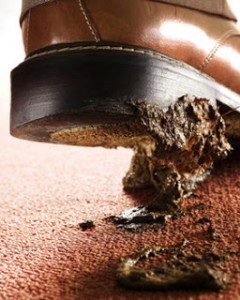
Shoe Stepping in StuffThis series of questions is asked by Amos just before he asks, “Does disaster befall a city unless the Lord has done it?” (v. 6b) He’s provoking his readers (originally, his listeners) to answer each preliminary question, “Of course not” so that their answer to his capper will also be “Of course not.”

Amos’ question: “Does disaster befall a city unless the Lord has done it?” Amos’ answer: “Of course not!”

What is Amos saying here? Is Amos promoting that sorry sort of pop theology that says, “Everything happens for a reason” and implies that the reason is the will of God? Is the prophet promoting that equally sorry sort of personal religion that, when some misfortune strikes, asks, “What did I do wrong?” and implies that personal unhappiness, too, is punishment from God for a failure of faith or a paucity of piety?

If so, I reject the notion. I think the prophet is just dead wrong! “Does disaster befall a city unless the Lord has done it?” Sure. Everything does happen for a reason, but not every reason is God’s doing. Sometimes, perhaps more often than not, the reasons have nothing to do with God, and everything to do with the nature of the physical and human reality within which we live.

I used to practice personal injury law litigating cases where misfortune befell people who then sued other people because everything has to be somebody’s fault . . . somebody else’s fault . . . and that somebody should be made to pay damages because of my inconvenience. I reject that notion, too. All too often the cause of injuries and misfortune is pure accident. Nobody did anything wrong. They couldn’t have done anything other than what they did. And yet … well … there’s a bumper sticker that (politely rephrased) reads, “Stuff Happens.”

That’s the nature of reality . . . that sometimes “stuff” just happens. Not because somebody willed it so, not because somebody made a mistake or acted negligently or did anything wrong, and certainly not because God decreed it. It just happens. The great British preacher Leslie Weatherhead once said, “Surely we cannot identify as the will of God something for which a man would be locked up in jail, or put in a criminal lunatic asylum.”

In fact, Weatherhead suggested that to blame catastrophes and other terrible events on “the will of God” is “a greater blasphemy than the denial of the Holy Trinity.” He went on to say, “One of the first things we must do is to dissociate from the phrase ‘the will of God’ all that is evil and unpleasant and unhappy.” Evil, he noted, is never creative of good; I think that was his polite British way to say “stuff happens.” But in every circumstance where calamity and misfortune befalls us, where “stuff happens,” there is opportunity for good to be revealed.

So what does a person of faith do with that? When “stuff” happens, what should a person of faith do? That’s a pretty good Advent question because one thing I know about Christmas celebrations is that, invariably, stuff happens. Things don’t go according to plan. Presents get lost or broken. Special dishes don’t get cooked properly (or at all). There are arguments. Feelings get hurt.

Be prepared for it! And when it happens look for the opportunity to redeem it, to sooth the hurt, to be an instrument of God’s good and creative will to redeem the “stuff.”

====================

A request to my readers: I’m trying to build the readership of this blog and I’d very much appreciate your help in doing so. If you find something here that is of value, please share it with others. If you are on Facebook, “like” the posts on your page so others can see them. If you are following me on Twitter, please “retweet” the notices of these meditations. If you have a blog of your own, please include mine in your links (a favor I will gladly reciprocate). Many thanks!

====================

Father Funston is the rector of St. Paul’s Episcopal Church, Medina, Ohio.

Advent Anger – From the Daily Office – December 2, 2013

From the Psalter:

He whose throne is in heaven is laughing; the Lord has them in derision.

(From the Daily Office Lectionary – Psalm 2;4 (BCP Version) – December 2, 2013.)

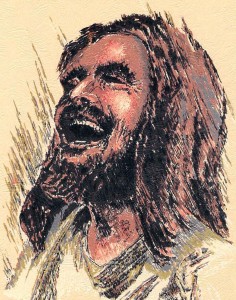
Laughing JesusIn the library of my parish church is a pen-and-ink drawing of Jesus laughing. It’s not a picture I particularly like, nor is it particularly well executed. In fact, if someone hadn’t told me that it is supposed to show Jesus laughing, I would have thought he was angry! Whenever I look at it, this verse from the Psalter comes to mind.

I think it’s hard for some people to conceive of Jesus (or God) showing emotions, particularly negative ones. I remember years ago (I was in my early 20s) listening to a meditation on anger at a church retreat. The priest offering the meditation said, “Jesus never displayed anger.” Really? I thought. What about that little incident in the Temple overturning tables and brandishing a whip? A false and mistaken idea that Jesus was never just plain mad, that God never gets royally pissed off does nothing more than create guilt in people who do (that would be everybody, I think).

One of the most interesting portrayals of the Lord in art that I have ever seen was a small hand-carved crucifix. The face of Jesus was contorted in obvious rage. I asked the artist about it and he told me it was how he saw Jesus saying, “Father, forgive them.” — “I think that what he is saying at that moment is, ‘You forgive them because, right now, I can’t! I have done everything you asked of me. I have taught them, healed them, exhorted them to proper conduct, shown them how to live, and this is what they do to me. I have run out of forgiveness. You do it!'” — I wish I’d been able to obtain that crucifix, but it wasn’t for sale.

I am quit certain that Jesus exhibited the full range of emotion, and I am equally certain that God does, as well. After all, Jesus was — is — God Incarnate. Furthermore, our faith teaches us that through his Ascension, Jesus has taken humanity into God’s heavenly domain; that includes everything it means to be human, including our emotions, positive and negative.

During these days of preparation for Christmas, this season the church calls “Advent,” emotions run high. For many people, sadness, anger, depression, a sense of loss, feelings of exclusion and betrayal may be the major emotions of the holidays. Laughing Jesus who looks to be angry, God laughing in derision, Jesus angry in the Temple, Jesus in exasperated rage on the cross . . . they should remind us that there should be no guilt in feeling these things. They are part of our humanity. Our human task is to accept them, work through them, and let go of them.

Lord, accept my Advent anger, my Christmas blues; help me lay them aside so that I may enter into the joy of your Incarnation.

====================

A request to my readers: I’m trying to build the readership of this blog and I’d very much appreciate your help in doing so. If you find something here that is of value, please share it with others. If you are on Facebook, “like” the posts on your page so others can see them. If you are following me on Twitter, please “retweet” the notices of these meditations. If you have a blog of your own, please include mine in your links (a favor I will gladly reciprocate). Many thanks!

====================

Father Funston is the rector of St. Paul’s Episcopal Church, Medina, Ohio.

The Advent Question – Sermon for Advent 1, RCL Year A – December 1, 2013

====================

This sermon was preached on the First Sunday of Advent, December 1, 2013, at St. Paul’s Episcopal Church, Medina, Ohio, where Fr. Funston is rector.

(The Revised Common Lectionary, Advent 1A: Isaiah 2:1-5; Psalm 122; Romans 13:11-14; and Matthew 24:36-44. These lessons can be read at The Lectionary Page.)

====================

Advent WreathFriday was a Holy Day in America! It was a day when all across the nation thousands, if not millions, of people breathed prayers of thanks. It was a day when all across the nation thousands, if not millions, improved the lives of many, many others. It was a day when news organizations from the smallest local radio station to international broadcast and cable conglomerates asked Americans across the nation, “How did you participate?” Yes, Friday was a Holy Day in America!

Wait! Did he say, “Friday?” Yes, he said, “Friday.” It was Black Friday. The day on which, we are told, retailers whose businesses have been operating at a loss all year long finally find themselves making a profit, when the ink on the ledger changes (in accounting tradition and terminology) from red to black. The thousands, possibly millions, uttering those thanksgivings were the managers, executives, Chief Executive Officers, financial officers, accountants, stockholders, and owners of retail concerns from smallest local boutique to the largest retail chains. Those thousands, possibly millions, who improved the lives of those retail owners and managers were the shoppers, the consumers, the buyers of bargains who . . .

In Odessa, Texas, trampled an 8-year-old boy and got themselves pepper-sprayed by store security in a mad rush to tear open a WalMart pallet of bargain-priced tablet computers.
* * *
In Las Vegas, Nevada, another shopper in the leg during a struggle over a bargain TV in a Black Friday sale at Target.
* * *
In incidents in Virginia and California, stabbed and slashed each other with knives in their efforts to get at sale-priced merchandise.

And they all did it in celebration of the birth of our Lord and Savior Jesus Christ. Or so those news organizations, from the smallest radio station to the international broadcast and cable conglomerates, tell us — this is all a part of “the Christmas Season.”

Somehow, though, I think we can be fairly sure that this isn’t what the Prophet Isaiah had in mind when he wrote:

Come, let us go up to the mountain of the LORD,
to the house of the God of Jacob;
that he may teach us his ways
and that we may walk in his paths.

Nor is it what St. Paul had in mind when he wrote:

Let us live honorably as in the day, not in reveling and drunkenness, not in debauchery and licentiousness, not in quarreling and jealousy.

Yes, the church has a rather different understanding of what we should be about during these days leading up to the celebration of the Messiah’s birth. Contrary to what the retail advertisers and the international news conglomerates tell us, this is not “the Christmas season.” This is the season of Advent. These four weeks or so leading up to Christmas Day are a time when the church bids us, as we make our preparations to celebrate the Messiah’s Birth, also to more consciously prepare for the his return. To ask ourselves a question . . .

But the question for Advent is not “When will Jesus come back?” Although the Scriptures continually remind us that one day God will, in Isaiah’s words, “judge between nations and shall arbitrate for many people,” Jesus reminds us that “about that day and hour no one knows.” So we must “keep awake” because we “do not know on what day [the] Lord is coming.” “The Son of Man is coming at an unexpected hour.” No, the question is not about when (or even if) the Messiah will return.

We all know that preparing to celebrate the birth of Christ is not a once-and-done thing. We do it again and again and again, every year. Sometimes we make mistakes doing it — We invite the wrong co-worker to our open house . . . next year we won’t do that again! We try using gorgonzola cheese in the stuffing . . . won’t do that again! Sometimes something new turns out to be something we want to do again — Apollo’s Fire’s Christmas vespers was lovely; we’ll take that in again next year. Going to church is great; let’s do that again soon! It’s not once-and-done; it’s something we do again and again and again.

Preparing for the Messiah’s return is also not a once-and-done thing. It’s something we have to work at and be ready at any time. This is what Jesus is saying when says that “two will be in the field; one will be taken and one will be left. Two women will be grinding meal together; one will be taken and one will be left,” or when he reminds us that “if the owner of the house had known in what part of the night the thief was coming, he would have stayed awake and would not have let his house be broken into.” It’s not that those things will happen at the end of time when he returns, but rather that they can happen at any time and, therefore, one must always be prepared. We must, in fact, always be preparing. We are to stay awake, to watch for signs of God’s activity in the world.

No, the question is not about when (or even if) the Messiah will return.

On the First Sunday in Advent, we are called upon to take our God and ourselves seriously. We are called upon to recognize that life can be changed, possibly even ended in an instant and to live our lives accordingly.

I was reminded earlier in the week by an old colleague from Kansas about something our bishop, the Rt. Rev. Bill Smalley, often said when we would gather as clergy. He liked to say that each order of the clergy, deacons, priests, and bishops, had a particular “iconic ministry.” Priests, in particular, he would say are the “icons of the story.” The role of the priest, in Bishop Smalley’s estimation, is to tell the story of God, the story of God’s People, the story of Jesus . . . to tell the story again and again and again. My colleague said, “Throughout the church year our worship tells the story over and over without much thought about how we live our lives, how we live in the Kingdom of God. We say we gather to praise God, but in truth we gather to tell the story, over and over. Our praise of God is in our lives.” And so, my old colleague suggested, a person who truly believes the story should ask him- or herself, “How does a person who believes this story live and praise God?”

That strikes me as a really good question to ask oneself during Advent, “How does a person who believes this story live?” Isaiah’s answer was, “they shall beat their swords into plowshares, and their spears into pruning hooks; nation shall not lift up sword against nation, neither shall they learn war any more.” St. Paul’s answer was, “Make no provision for the flesh, to gratify its desires.”

How does a person who believes this story live? It’s not a question that I can answer for you, but it is a question we can explore together and find answers that work for each of us, though our answers may not be exactly the same. And we may find answers that work for us today but won’t be right next year. It’s not a question with a once-and-done answer.

I was reading through a list of “things you can do for Advent,” things like read a chapter of Holy Scripture every morning, or reconnect with five old but not recently contacted friends, or reach out to a new charity. They were all good suggestions, but the one that particular rang a bell for me this year was to take five minutes every morning and make a list. Not a Christmas list of things to buy, or things to do, or things you want. Make an Advent list list of 24 blessings in your life, it could include the people you love, the people who love you in spite of yourself, the signs you recognize of God’s presence in your life. After you’ve made your list, each day in Advent pray a prayer of thanks for one of the things on the list.

That made sense to me this year because for me, this year, the answer to ” How does a person who believes this story live?” is “With gratitude.” And then my friend Mary Frances Schjonberg shared her sermon for this morning and in it introduced me to a poet new to me, Gunilla Norris. She is a psychotherapist who describes her work as “the practice of spiritual awareness in the most mundane and simple of circumstances.” In a poem called Polishing the Silver, she prays for the gift of gratitude:

As I polish let me remember
the fleeting time that I am here. Let me let go of
all silver. Let me enter this moment
and polish it bright. Let me not lose my life
in any slavery – from looking good
to preserving the past, to whatever idolatry
that keeps me from just this –
the grateful receiving of the next thing at hand.

Remember, it’s not Christmas yet. It’s Advent and Advent asks a question: “How does a person ‘keep awake’ because we ‘do not know on what day [the] Lord is coming?'” How does a person who believes this story live? Poet Norris suggests a pretty good answer to consider: By gratefully receiving the next thing at hand. Amen.

====================

A request to my readers: I’m trying to build the readership of this blog and I’d very much appreciate your help in doing so. If you find something here that is of value, please share it with others. If you are on Facebook, “like” the posts on your page so others can see them. If you are following me on Twitter, please “retweet” the notices of these meditations. If you have a blog of your own, please include mine in your links (a favor I will gladly reciprocate). Many thanks!

====================

Father Funston is the rector of St. Paul’s Episcopal Church, Medina, Ohio.

Open Windows — From the Daily Office — November 29, 2013

From the Prophet Isaiah:

For the windows of heaven are opened, and the foundations of the earth tremble.

(From the Daily Office Lectionary – Isaiah 24:18b (NRSV) – November 29, 2013.)

Open WindowBlack Friday. The day after Thanksgiving Day in the United States. A day whose name comes from financial accounting and the ancient practice of recording profits in black ink, losses in red. Supposedly, at one time, this was the day when retail merchants who might have been running “in the red” the whole year would see themselves “in the black” at long last. I don’t know if that is still the case, but the name has stuck. Black Friday is the day after Thanksgiving Day.
I’m never sure what to do on Black Friday. I am definitely not going shopping. I hate shopping in the first place, and the idea of being shoved and jostled about by larger crowds than usual would just make it worse! Looking at the news coverage of Black Friday events, one could almost imagine Isaiah’s prophecy has come true. Under the onslaught of all those trampling feet, surely “the foundations of the earth tremble.”

Anyway, what to do? The dishes need to be done. The leftovers from yesterday need to be checked; were they put away properly? Should I start stewing the turkey carcass to make the soup which will be a staple for the next week or so? Should I just kick back and relax and read a good book? (“But don’t forget you need to finish your sermon for Advent 1,” says the small voice of conscience somewhere inside my head.)

Even more so than Thanksgiving Day itself, this is a day to give thanks, but not for gifts received. This day is a day to give thanks for a future of limitless possibility. Isaiah’s statement, “the windows of heaven are opened,” reminds of me of summer mornings when my mother would wake me up by coming in my room and throwing open the window. In the Nevada desert, it would already be warm even early in the morning. The dry desert breeze would carry away the slightly musty, not-very-chill air from the “swamp cooler” that had kept us cool through the night. The arid warmth would suggest so many things a boy freed from school might do. The open window, the open windows of heaven, inviting one into a future of limitless possibility.

I’m never sure what to do on Black Friday. There are so many options, so much possibility, so much to be thankful for.

====================

A request to my readers: I’m trying to build the readership of this blog and I’d very much appreciate your help in doing so. If you find something here that is of value, please share it with others. If you are on Facebook, “like” the posts on your page so others can see them. If you are following me on Twitter, please “retweet” the notices of these meditations. If you have a blog of your own, please include mine in your links (a favor I will gladly reciprocate). Many thanks!

====================

Father Funston is the rector of St. Paul’s Episcopal Church, Medina, Ohio.

Like a Lawnmower — From the Daily Office – November 28, 2013

From Matthew’s Gospel:

[Jesus said:] For the kingdom of heaven is like a landowner who went out early in the morning to hire laborers for his vineyard.

(From the Daily Office Lectionary – Matthew 20:1 (NRSV) – November 28, 2013.)

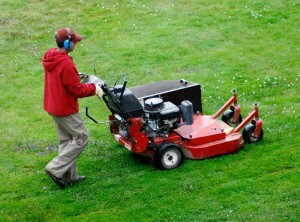
Man Mowing a LawnI had to read the first line of this familiar parable three or four times this morning before my eyes (it had to be my eyes; it couldn’t have been my brain) focused well enough to properly read the word landowner. On first reading, I read it as lawnmower.
“The kingdom of heaven is like a lawnmower . . . .”

What!?

I read it again; same thing! Shake my head; drink some coffee; look again. Oh! Landowner!

So I read the rest of the story about the vineyard owner hiring men in the morning, more at noon, a last bunch late in the day . . . and then paying them all the same wage. “So the last will be first, and the first will be last.” (v. 16) Nice counterpoint to the really awful bit of the First Letter of Peter appointed for today: “Slaves, accept the authority of your masters with all deference, not only those who are kind and gentle but also those who are harsh.” (1 Peter 2:18)

Although I really feel like I should be contemplating the issues of economic justice the two readings present, especially on Thanksgiving Day when I must acknowledge that I am so blessed and there are so many who aren’t, that has to be a conversation for another time. Meditating on the daily readings, I just kept coming back to my blurry-eyed misreading of the text.

“The kingdom of heaven is like a lawnmower . . . .”

Several weeks ago, back when it was warm and the grass was growing and it hadn’t rained for a few days so the dirt wasn’t spongy and the grass wasn’t too wet and I could mow the lawn, that’s what I was doing. Running the machine in long, curving swaths across our hillside back yard, I noticed a praying mantis in the piece I’d be covering in the next pass. The insect was bright green, about two inches long, and apparently injured.

Sure enough on my next pass there it was, right in front of the lawnmower. I disengaged the mower blade, disengaged the self-propelling mechanism, powered down the engine, set the brake, and walked around to scoop up the bug. I carried it to the edge of the lawn, to a flower bed where we have planted day lilies, forsythia, and butterfly bush, and set it among the plants. I hoped that I hadn’t been responsible for its injuries and that it would regrow whatever limb it was missing. (I think mantids are like crabs, that they can grow back whole limbs.) I walked back to the mower, re-engaged all the mechanisms, released the brake, and resumed my mowing.

So I think I can see how the kingdom of heaven might be like a lawnmower, if the word is understood to refer to the person doing the mowing, not to the machine.

I’m still working on the machine as a metaphor for heaven . . . I’ll probably be working on that one all day. Reading scripture in the early morning does that, sets my mind spinning and whirling and chopping away at these images, the ones actually in the bible and the extrabiblical ones my blurry-eyed imagination puts there. All day long. These images and metaphors challenge preconceptions, whack down received wisdom, pulverize prejudices, slice through both silly and profound notions, and mix my thoughts and the things I think I know all together in a rich mulch from which new ideas often grow and old ones give fruit.

Interestingly, a colleague yesterday commented on Facebook: “One of the things I am thankful for is the interesting dialogues and debates that can be fostered via Facebook. We may not always agree on any number of a wide variety of issues, but it is always interesting and informative to see the diversity of opinions that are offered on any number of topics from Ashes to Go, to politics, to how we prepare recipes, to how to approach some of the pressing social ills of our day, and so on and so forth. For me it helps further develop my own thoughts and perspective.” That’s my take on it, too, and it’s a lot like the processing I do as I reflect on biblical and extra-biblical metaphors; it all gets mashed together into a fertile mass.

So today while I’m at church presiding at the Eucharist, at home roasting a turkey, later in the day playing dominoes with friends, that’s what will be happening. I’ll be thinking about strange metaphors, about contemplation, about Facebook conversations, and what it all might teach, because “The kingdom of heaven is like a lawnmower . . . .”

Thanks be to God!

====================

A request to my readers: I’m trying to build the readership of this blog and I’d very much appreciate your help in doing so. If you find something here that is of value, please share it with others. If you are on Facebook, “like” the posts on your page so others can see them. If you are following me on Twitter, please “retweet” the notices of these meditations. If you have a blog of your own, please include mine in your links (a favor I will gladly reciprocate). Many thanks!

====================

Father Funston is the rector of St. Paul’s Episcopal Church, Medina, Ohio.

Just Deserts — From the Daily Office — November 27, 2013

From the Prophet Obadiah:

As you have done, it shall be done to you; your deeds shall return on your own head.

(From the Daily Office Lectionary – Obadiah 1:15b (NRSV) – November 27, 2013.)

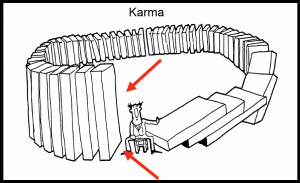
Karma DominoesObadiah’s words (on behalf of God) are directed to the Edomites; this short (one-chapter) book is a rather dire prediction of the complete destruction Edom for the way it had dealt with Israel. Apparently it was correct for there seem to be no Edomites, nor any descendants of Edomites identifiable in the modern world.

On another level, however, it speaks to all of us about the reality of consequences. If one were going to paraphrase this verse in modern idiom, it might be rendered “What goes around, comes around.” St. Paul struck the same theme in his letter to the Galatians when he reminded them that “you reap whatever you sow.” (Gal. 6:7)

Our Hindu friends have a word for this concept – Karma. Of course, in Hindu belief, which accepts the idea of reincarnation, karmic activity may not happen in this life, but in a later life. That is not an option given Christians; we do not teach a circular, repeating conception of time, nor the doctrine of reincarnation. The biblical understanding of time is that it had a beginning, it will have an end, and we get one chance in this world to do what is right. One’s karmic just deserts are either received in this life, which was the teaching of the ancient “wisdom” version of the Jewish religion (and of the “prosperity gospel” preachers), or in the great here-after, which is the teaching of some Christian sects.

That latter belief, of course, gives rise to questions about heaven, hell, purgatory, reward, punishment, eternal damnation, eternal life in heaven . . . O dear!

I had a parishioner several years ago who, on a pretty regular basis, would ask, “What happens when we die? Where do we go?” I had a standard answer for her: “Martha,” I would say, “I don’t know. I haven’t been there yet.” I would tell her, though, that I have a hope and my hope is that Obadiah, the old “goes around comes around” proverb, St. Paul, and the doctrine of karma are wrong! I hope that what awaits us is not the justice promised by all of them, but the grace promised by the gospel.

That’s no reason not to pay attention to Obadiah’s and karma’s implied admonition to do and be good, however. In a less cosmic sense, what goes around does come around. Treat someone badly, you’re likely to be treated badly yourself. Treat someone well, you’re likely to get the same treatment. I may not know what happens when we die (yet), but I’m pretty sure about this.

So when all is said and done, when it comes to getting our just deserts and reaping what we sow, call it “karma” or “wisdom” or whatever, my advice is to live like it’s absolutely true, and hope to God it’s not!

====================

A request to my readers: I’m trying to build the readership of this blog and I’d very much appreciate your help in doing so. If you find something here that is of value, please share it with others. If you are on Facebook, “like” the posts on your page so others can see them. If you are following me on Twitter, please “retweet” the notices of these meditations. If you have a blog of your own, please include mine in your links (a favor I will gladly reciprocate). Many thanks!

====================

Father Funston is the rector of St. Paul’s Episcopal Church, Medina, Ohio.

« Older posts Newer posts »