Revised Common Lectionary for Pentecost Sunday (Year B): Ezekiel 37:1-14; Psalm 104: 25-35,37; Acts 2:1-21; and John 15:26-27;16:4b-15
 What happened one thousand nine hundred and seventy-nine years ago?
If we can believe the calculations of an early medieval monk named Dennis the Short, one thousand nine hundred and seventy-nine years ago today (or thereabouts) the events described in the reading from the Book of Acts took place. On this day, in about the year 33 A.D. the Christian Church was born; the Holy Spirit came upon the disciples and they went out into the streets of Jerusalem proclaiming the gospel of salvation and baptizing thousands of people.
Happy Birthday, Church! Turn to someone near you and wish them “Happy Birthday!” Now turn to someone else near you and say, “O dry bones, hear the word of the Lord!” Say to them, “Thus says the Lord God: You are dried up! You are spiritually dehydrated!”
That’s not much of a birthday greeting is it? Doesn’t really seem like a very neighborly thing to say, does it?

But that is precisely the task that was given to the prophet Ezekiel. He was shown a series of visions that he was to communicate to the people of God, to his neighbors and fellow Israelites. In one of those visions, which we heard in our Old Testament reading today, he was taken to a valley and shown a pile of bones and told that these were his neighbors to whom he was to say to them, “You are nothing more than dried up on skeletons right now, and worse than that you are not even skeletons . . . you are disconnected bones. You are so spiritually dried up that even your connective tissues, your sinews, your ligaments and tendons have turned to dust.” So he was given the task to prophesy to the wind, that is to the Spirit, to the breath of God and call that breath to enter into the bones and return them to life.
In another vision, Ezekiel was shown a grand plan for a new temple – he goes on at length recording the measurements of the temple and its furnishings, its grounds and all the land surrounding it. He is shown a river flowing from the temple through all of the lands of the world; in places it is ankle-deep; in other places it is waist-deep; in still others it is deep enough to swim it. The river, he is told, is the river of life, “everything will live where the river goes” (Ezek. 47:9). On the banks of the river are trees, “all kinds of trees for food. Their leaves will not wither nor their fruit fail, but they will bear fresh fruit every month, because the water for them flows from the sanctuary. Their fruit will be for food, and their leaves for healing.” (Ezek. 47:12)
Quite a contrast . . . to call the people of God from parched desiccated bones with no life in them to a flood of living water, from spiritual dehydration to abundant life flowing from God’s temple.
Throughout the Old Testament, the prophets make use of water was a sign of God’s purifying Spirit: it was again through Ezekiel that God spoke saying, “I will sprinkle clean water upon you, and you shall be clean from all your uncleannesses, and from all your idols I will cleanse you.” (Ezek. 36:25) Speaking through the prophet Isaiah God promised: “I will pour water on the thirsty land, and streams on the dry ground; I will pour my spirit upon your descendants, and my blessing on your offspring. They shall spring up like a green tamarisk, like willows by flowing streams.” (Isa. 44:3-4). It was Zechariah who predicted that on the day of the Lord “living waters shall flow out from Jerusalem, half of them to the eastern sea and half of them to the western sea; it shall continue in summer as in winter.” (Zech. 14:8). There are so many examples it is not necessary to list them all. The people of First Century Israel knew all this well; their tradition was rich with it. Remember the conversation when Jesus said to Nicodemus: “Very truly, I tell you, no one can enter the kingdom of God without being born of water and Spirit.” (John 3:5). Water was and always is the symbol of God who purifies, who gives birth, who gives life, who heals, and who refreshes.
And so on that day in Jerusalem one thousand nine hundred and seventy-nine years ago, when the people in the streets thought the disciples were drunk, Peter spoke up and said, “No. It is not wine! It is the Spirit of God which, like water, has been poured out upon them so that they prophesy and tell you of Jesus.” And, the Book of Acts tells us, Peter and the others told them the story of Jesus, each in their own languages; Parthians, Medes, Elamites, Mesopotamian, Judeans, Cappadocians, Pontans, Asian, Phrygians, Pamphylians, Egyptians, Libyans, Romans, Cretans, and Arabs all heard the gospel in their own tongues. And the church was born.
Those who heard Peter and the other apostles asked them, “Brothers, what should we do?”
Peter said to them, “Repent, and be baptized every one of you in the name of Jesus Christ so that your sins may be forgiven; and you will receive the gift of the Holy Spirit. For the promise is for you, for your children, and for all who are far away, everyone whom the Lord our God calls to him.” . . . So those who welcomed his message were baptized, and that day about three thousand persons were added. (Acts 2:37-39,40)
That was the task set for the disciples, the same task that was set for Ezekiel – and it is the task set for us. Each and every person in this church today who has been baptized has accepted this same task. Some may have been baptized under the rite of the 1928 Book of Common Prayer in which they (or someone on their behalf) promised to “obediently keep God’s holy will and commandments, and walk in the same all the days of [their] life” and for them the community prayed that they would “not be ashamed to confess the faith of Christ crucified.” Some may have been baptized under the rite of the 1979 prayer book, in which all who participate, both those to be baptized and those who are already members of the church, promise to “proclaim by word and example the Good News of God in Christ.” Some may have been baptized under the rites of other Christian traditions that include similar prayers and promises. In any event, the import is the same: the task set before the baptized is that which was set for Ezekiel, that which was set for the disciples in Jerusalem one thousand nine hundred and seventy-nine years ago today.
But is it possible that we are more like the people in the streets of Jerusalem than like the disciples who went out to them? More like the Israelites of Ezekiel’s time than like Ezekiel himself? Is it possible that it is we who are desiccated, dehydrated, dried-up, and dispirited? Are we in need of God’s life-giving, life-renewing, healing water?
 If so, then receive it. [Each congregant was given a bottle of water when they entered the church.] I want you to give your bottle of water to someone whom you think might need some spiritual refreshment; and I want you to accept a bottle of water from someone who thinks you might need some spiritual refreshment. Let these bottles of water remind you that you are a source of refreshment to others, and that through others God provides you with spiritual renewal.
Take your bottle of water as a reminder of the prophets’ promise to God’s people, of Jesus’ promise to you: “Let anyone who is thirsty come to me, and let the one who believes in me drink.” Jesus also reminded us that as we slake our thirst on the living water he gives us, so we then become sources of living water to others. He went on to say, “As the scripture has said, ‘Out of the believer’s heart shall flow rivers of living water.'” (John 7:37-38) Let this bottle of water be a reminder that you are baptized, that you have received the gift of the Holy Spirit, that you promised to “proclaim by word and example the Good News of God in Christ,” that you are a prophet of the Most High God and a minister of the Gospel, and let your faith be refreshed, restored, and reinvigorated so that you may be a source of spiritual refreshment to others.
No longer are you dried-up bones! No longer are you spiritually dehydrated! No longer is your breath taken away! No longer are you but dust! God has sent forth his Spirit and you are renewed! Sing to the Lord as long as you live; praise your God while you have your being! Declare God’s glory among the peoples!
Happy Birthday, Church! Happy One Thousand Nine Hundred and Seventy-Ninth Birthday!
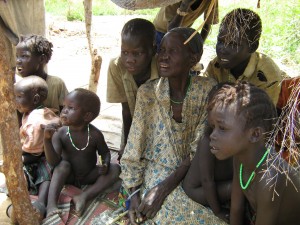 According to Luke, “there was not a needy person among them” because the apostles “distributed to each as any had need.” (Acts 4:34-35) Sounds a bit Bolshevik, doesn’t it? At least it certainly sounds like Karl Marx who, in 1875, wrote, “From each according to his ability, to each according to his needs!” Of course, Marx believed that this sort of social organization could only exist in a society where technology and social organization had substantially eliminated the need for physical labor in the production of things, which cannot in any way, shape, or form describe the situation in First Century Judea. Nonetheless, I’ve never understood how, with Holy Scripture describing and even extolling this social organization of the first disciples, any Christian could not strive toward a society of this sort. ~ Throughout the last two millennia there have been religious orders and utopian experiments which have sought to recreate the first Christian community as separate from, rather than in the midst of, the secular world. It seems to me that we are called to minister within the world order and try to reform it. As Christians we should strive to build a world where there is not a needy person and where all receive as any has need. Jesus put it this way, “Love your neighbor as your self.” (Mark 12:31) We have a word for that sort of love. We call it justice.
 It rained here last night – pretty spectacular electrical storm, to be honest. The dog spent the night cowering under a table. This morning when I took her out at 6 a.m. the world was freshly washed. In the trees surrounding our home, birds of all sorts were singing and there was a sweetness in the air. Sprinkles with clean water, the earth had been cleaned of its uncleannesses, if only for a moment. ~ It is only a coincidental convergence of the two lectionaries (Episcopal Daily Office two-year cycle with the Revised Common Lectionary three-year cycle), but tomorrow’s Old Testament lesson is Ezekiel’s vision of the valley of dry bones in the next chapter of his prophecy. Dry bones, dessicated, dehydrated – emblematic of spiritual emptiness. Clean water, washing, witnessing, revivifying – emblem of the Spirit herself. ~ Tomorrow we will baptize and welcome into God’s household a young lady of about 10 years of age. I find it difficult to conceive of her having “a heart of stone” but I am convinced that in her baptism God will give her a new heart and write on her heart his law of love. Her life will become like the world after the rain, freshly washed and filled with light and sweetness. This is not to say that there will not be dry patches in her life; there are in every life, even the lives of the saints. However, nurtured by the church and sustained by the Spirit, she will be able to make it through those times with more than enough spiritual “moisture”. The Psalms constantly remind us that “the river of God is full of water” (65:9) and that God changes “deserts into pools of water and dry land into water-springs” (107:35). ~ In another vision, Ezekiel saw a river of water flowing from the temple. It flooded the land, in places ankle-deep, in others knee-deep, and in still others waist-deep. The water flowed everywhere and everywhere it flowed was to be the land of God’s people, not just Israel, but all of God’s people. The dry bones of all nations will be restored in the water of God’s river; God will sprinkle clean water upon us all. We call this baptism.
 These three similes – I am like a vulture in the wilderness; I am like an owl in the ruins; I am like a lonely sparrow – intrigue me. They are metaphors of solitude but worse than solitude, of loneliness, of being completely cut off. ~ The word translated as “vulture” in the NRSV is qa’ath; older translations rendered this as “pelican”. According to the lexicon the word signifies “a ceremonially unclean bird”, but the lexicon admits that the exact meaning of the ancient Hebrew is unknown. The root of the word is qow’ which means “to vomit”. From some bit trivia learned long ago, I recall that vultures defend themselves with intentional projectile vomiting. The simile depicts one so distraught , so distressed, so stricken that she keeps others away, spewing her grief onto those who would comfort her. ~ The Hebrew word translated as “owl” is kowc: owls also are ritually unclean birds. The lexicon tells us that it is “from an unused root meaning to hold together.” This simile perhaps suggests the same thing as the English phrase “barely holding it together”; amidst the waste and devastation of his life, the psalmist is barely holding on, hanging from his last thread, unable to handle one more thing even a small expression of sympathy and support without “losing it altogether.” ~ In the third simile, the psalm uses the word tsippowr, here translated as “sparrow” although more generically it simply means “bird”. This simile holds out hope where the others do not. The same word is used by prophet Ezekiel to paint a picture Jesus will later use as an encouragement to faith: “On the mountain height of Israel I will plant [a cedar], in order that it may produce boughs and bear fruit, and become a noble cedar. Under it every kind of bird will live; in the shade of its branches will nest winged creatures of every kind.” (Ezek. 17:23) Jesus will change the cedar to a mustard tree and promise that even the smallest amount of faith, faith the size of a mustard seed, can accomplish miracles. (Matt. 13:31-32; Matt. 17:20) For the lonely sparrow on the house-top there is the hope of flocking with others in tree planted by the Lord; for the lonely sparrow there is the hope provided by faith. ~ The rest of the morning psalm expresses that hope. The psalmist acknowledges gratefully that God “will look with favor on the prayer of the homeless; he will not despise their plea” and “their offspring shall stand fast in [God’s] sight.” No matter how cast out, unclean, despairing, or distraught, even the vulture and the owl, together with the sparrow, can come and make nests in the branches of the tree planted by God.
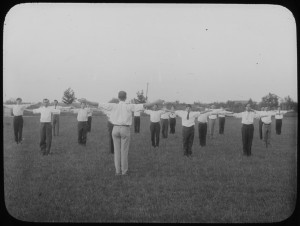 This is such a great verse! Matthew could have made some christological or soteriological comment about “the Son of Man” – in fact, he has done so earlier in this story and will do so again in the next chapter. But here the power and authority to heal is specifically described as being given not just to Jesus but “to human beings” . . . to you and to me! That’s great! ~ A couple of years ago the American Psychological Association reported that the first decade of the 21st Century saw a dramatic increase in the number of American adults praying about health issues. Even though attendance at formal religious services has fallen in the same period, informal and private spiritual practices such as prayer seem to be on the increase. One of the interesting results of a study by the Centers for Disease Control was that those who exercise are 25% less likely to pray than those who don’t…. One wonders if those who pray are less likely to exercise. ~ I’m not an exerciser myself. I admit that I should be; I’m just a lazy procrastinator who can’t get around to it. But I am a person who prays, and I often pray for health and healing for myself and for others. ~ The teacher of prayer who looms largest in my life is my late paternal grandfather. One of the things he taught me about prayer is “never pray for something you aren’t willing to work for.” His point was that God’s answer to your prayer just might be that God would send you into the midst of whatever the situation is to work toward a solution. I’m beginning to think that there’s a lesson here about exercise and health, too. I really shouldn’t be praying for my own physical health if I’m not willing to get off my duff and work for it. God has given me the authority to live a healthy life. I guess I’d better claim it and start doing it. ~ Tomorrow . . . maybe.
 This is the beginning of familiar story. The demons challenge Jesus, “What have you to do with us?” and he, in turn, banishes them into a herd of swine, which then rush into the Sea of Galilee and drown. The swineherds run into the nearby town and tell what happened. The townspeople come out and, being afraid, beg Jesus to leave. Of course, the demoniacs are cured but we don’t know anything further about them. Matthew’s version of the story puzzles me. Mark and Luke also tell the tale and, if scholars are correct, it’s likely that Luke and Matthew got it from Mark who wrote his gospel first. (Compare Mark 5 and Luke 8.) ~ Here’s the first thing that puzzles me – Matthew slightly changes the location. Mark and Luke say this happened in the country of Gerasenes; Matthew, in the country of the Gadarenes. Now I know from my bible studies that these towns, Gadara and Gerasa, are close to one another and neither is actually on the Galilean lake. Both are Gentile towns near the eastern shore of the lake. The town in that area on the lake was Hippos. Why did Matthew choose to put this event in this slightly different location? I don’t know. And, so far, as I know there is no scholarship to answer that question. It’s just, as Yul Brynners king of Siam would say, a puzzlement. ~ The second puzzlement is why Matthew doubles the number of demoniacs. In Marks original tale and Luke’s repetition of it, there is a single possessed man. Matthew says there were two. In all other respects than these two details, the stories are the same. Why does Matthew say there were two possessed persons? Does that make the healing twice the miracle as it is in Mark’s version? I don’t think so. It’s just as frightening to the townspeople – whether Jesus cures one man or two, they still beg him to leave. ~ I have no answers to these puzzlements. I don’t even know if these minor changes of detail have any significance. Probably they don’t. But these little details are among the things about scripture study and contemplation that sometimes grab my attention and make me lay awake at night wondering, “Why two? Why two?” ~ It’s a puzzlement!
 Although this is not the end of the the Letter to the Church in Ephesus, it sure sounds like it ought to be! Maybe that’s why the Book of Common Prayer uses it as one of the possible endings to the Daily Offices of Morning Prayer and Evening Prayer. The others are 2 Corinthians 13:14 and Romans 15:13; the first reminds us of God’s grace, love, and fellowship; the second, of hope, joy, and peace. This one reminds us of God’s abundance. God can do “abundantly far more” than we can conceive. The Prayer Book version is practically hyperbolic: “Glory to God whose power, working in us, can do infinitely more that we can ask or imagine.” (BCP 1979, p. 126) ~ This is a profoundly countercultural message! In a world controlled by bankers, insurers, and oil companies, we have been sold a story of scarcity that competes with and, in the popular secular imagination, has prevailed over the gospel of abundance. Yes, some resources (such as fossil fuels) are limited, so they have to properly used and preserved. But alternatives are not – science and agriculture have proven that there are many sources of fuel which are renewable. Because human culture has taken the irreplaceable resources (coal, oil, metals) as the paradigm for all economies, rather than sustainable and renewable resources (crops, herds, rapid-growth woods) we buy into the scarcity model even though these alternatives demonstrating God’s provident abundance are all around us. ~ What can we do to change this? How can the church of Christ, which has the gospel of plenty to preach, foster a paradigm shift from a distrustful economy of scarcity to generous economy of abundance? It seems to me that we don’t even try. Once a year, most church congregations beg their members for annual pledges and then budget on the scarcity model, denying even our most fundamental teaching of reliance on God. I wonder what would happen if we truly believed and truly lived the abundance Scripture assures us is there. I really do wonder . . . because abundance is wonderful!
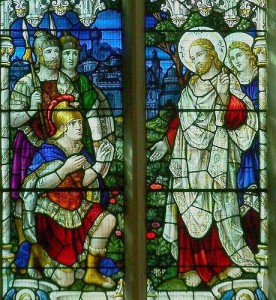 The words of the centurion are the root of a prayer spoken by many before receiving Holy Communion: “Lord, I am not worthy to receive you, but only say the word and I shall be healed.” As an Anglo-Catholic Episcopalian, recitation of this prayer used to be a part of my personal practice. But I have ceased to say it because I became uncomfortable about the change in emphasis from the biblical text to the liturgical text. A statement of faith in Christ’s power to heal another has been turned into a purely personal (and one is tempted to say “selfish”) prayer. ~ Paragraph 1386 of the catechism of the Roman Catholic Church explains the rational of the prayer: “Before so great a sacrament, the faithful can only echo humbly and with ardent faith the words of the Centurion: ‘Domine, non sum dignus ut intres sub tectum meum, sed tantum dic verbo, et sanabitur anima mea’ (‘Lord, I am not worthy that you should enter under my roof, but only say the word and my soul will be healed.’)” That’s great, except the quotation from the Centurion is inaccurate! In the Vulgate, the verse reads, “Tantum dic verbo et sanabitur puer meus.” (“Only say the word and my servant [or ‘child’] shall be healed.”) I am troubled reciting a prayer based on a misquotation of scripture. ~ The centurion in the story is about as far from self-centered as one can be. He seeks Jesus’ help not for himself but for his servant. He is unwilling for Jesus to be inconvenienced. It is in that spirit that he speaks these words, explaining that as a military officer he simply gives orders and things are done, so he has faith that One with the power of healing can simply do the same. It is for his selflessness that Jesus’ praises him and his faith. It seems somehow wrong to recite a prayer which turns that on its head! ~ I recall reading a few years ago about a medical brain-function study which demonstrated that selflessness is psychologically healthy and is the neuropsychological foundation of spiritual experience. Selfishness, on the other hand, is unhealthy: other scientific studies have demonstrated that it is impossible for a completely selfish individual to either survive or have a biological future. So I am unwilling to utter a prayer which turns a selfless intercession on behalf of another into a self-centered (one is tempted to say “selfish”) petition. “Lord, I am unworthy to receive you” … let’s just leave it at that.
 I wasn’t sure whether I wanted to quote this bit or the story from Numbers 11 (also in the Lectionary cycle for today) in which Moses chose 70 men to receive a portion of the spirit and to take on some of the burden of the people. Two of the men, Eldad and Medad, did’t make it to the tent of meeting, but nonetheless received the spirit in the camp. Joshua, Moses’ assistant, protested but Moses replied, “Would that all the Lord’s people were prophets, and that the Lord would put his spirit on them!” It seems to me that Paul is saying that’s what God accomplishes in Jesus; that all people now are prophets, all have the spirit, all together are becoming a dwelling place for God. ~ Today I’m drawn to Paul’s opening words in this passage, particularly “you are citizens.” We’ve seen a lot of politicking in our country recently and a lot of talk about a citizen’s duty. Partisans on both the Left and the Right correctly assert that a citizen should ask questions, know what’s going on, and be informed. I believe this is true regardless of where one lives, whether one is a citizen of the United States, Canada, Ireland, or Cameroon. Wherever one is a citizen, one should do these things to be an active participant in one’s country. ~ If we are “citizens with the saints,” of what are we citizens. Paul answers this question elsewhere saying “our citizenship is in heaven.” (Philippians 3:20) As citizens of heaven, then, we should be as informed as possible about “that heavenly country where, with all [God’s] saints, we [hope to] enter the everlasting heritage of [God’s] sons and daughters.” (BCP 1979, p. 369) This means that throughout life we have an obligation to engage in bible study, in life-long Christian formation and education, in asking questions of clergy and church leaders and questioning the answers we receive. There should never be “graduation” from Sunday School! ~ There is much wringing of hands and gnashing of teeth today about the failure of the church and its state of decline, and much of it is warranted. At root, however, I believe part of the fault for the state of the church lies in the laps of its leadership over the past several decades, leaders who have failed to encourage the church’s members to think of themselves as spirit-filled citizens, and I believe part of the failure in all this lies with ourselves and our fellow citizens to stay truly active and informed. ~ Do I have a solution? No, not really. I offer no panacea, just encouragement to acknowledge the spirit within you, to get involved, and be an informed citizen of heaven. Like the consuls of revolutionary France I cry, “Let our citizens arise for the security of what they hold most dear, for the sacred interests of humanity!”

