Revised Common Lectionary for the Fifth Sunday in Lent, Year B: Jeremiah 31:31-34; Psalm 51:1-13 or Psalm 119:9-16; Hebrews 5:5-10; and John 12:20-33
 This is the fifth and last Lenten sermon addressing a question posed by a parishioner and, in fact, I will try to answer succinctly two related questions that two parishioners asked. One was “What does the word catholic mean when we say it in the Nicene Creed?” and the other was “What do you (meaning me, Father Funston) mean when you describe the Episcopal Church as being ‘in the Catholic tradition’?” (If you could see the way I have typeset these sermon notes, you would see that I have capitalized the “C” in catholic in the second question, but not in the first. That’s an important point which I will address shortly. But let me start with a basic definition in answer to the first inquiry.
These questions arise, of course, because there is one church denomination in this country and throughout the world which has arrogated to itself this word catholic and, of course, I refer to the Church of Rome. In everyday speech if you say the word catholic nearly everybody will think you are referring to the Roman Catholic Church, but, in truth, the word has much broader meaning and application than one denomination, however large and powerful it may be or think itself.
Catholic comes from the Greek katholikos, a compound word made up of kata meaning “about” or “concerning” and holos meaning “whole” (from the latter we get a word familiar many, holistic, which means to look at something in its entirety). Thus, the word catholic means “regarding the whole” or, more simply put, “universal” or “general.” In the context of the Creed, the word does not have anything to do with any denomination which calls itself “Catholic” such as the Church of Rome. In the worship book of the rather evangelical Methodist church which my paternal grandparents attended there was an asterisk next to the word catholic in the Creed and a footnote which read “meaning universal” just to be sure no one misunderstood and thought the Methodists had reunited with the Bishop of Rome.
As used in the Creed, the word catholic describes one of what are called the “four marks of the church”; these are that the church is one, holy, catholic, and apostolic. These are set out in the Outline of the Faith we find in The Book of Common Prayer. If you would turn to page 854 in the BCP, you can follow along in Catechism:
Q. Why is the Church described as one?
A. The Church is one, because it is one Body, under one Head, our Lord Jesus Christ.
Q. Why is the Church described as holy?
A. The Church is holy, because the Holy Spirit dwells in it, consecrates its members, and guides them to do God’s work.
Q. Why is the Church described as catholic?
A. The Church is catholic, because it proclaims the whole Faith to all people, to the end of time.
Q. Why is the Church described as apostolic?
A. The Church is apostolic, because it continues in the teaching and fellowship of the apostles and is sent to carry out Christ’s mission to all people.
In the words of the Gospel according to Matthew, we are sent out by Christ [there’s the apostolicity] to “make disciples of all nations [there’s the catholicity], baptizing them in the name of the Father and of the Son and of the Holy Spirit [there’s the holiness], and teaching them to obey everything that [Jesus, our one Lord] commanded” the apostles (Matthew 28:19-20a).
So in the Creed we express our faith in the point that Jesus makes in today’s gospel lesson. This confrontation by the curious Greeks reiterates something Jesus said to Nicodemus not too long before: “When I am lifted up from the earth, will draw all people to myself.” The Church is catholic because its mission is to draw all people to Christ.
This is what we mean by catholic with a lower-case “c” and applies to all Christian churches without regard to their polity, their style of worship, their understanding of the sacraments, their theology, or their manner of choosing, training, and addressing their clergy and leadership. When we capitalize the word and apply it to a subset of Christian traditions or to one in particular, we removing it slightly from its original meaning, and giving it a different twist. We start with an old “canon” or rule attributed to St. Vincent of Lerins: “What everywhere, what always, and what by all has been believed, that is truly and properly Catholic.”
Thus, instead of looking to the writings and doctrines of any Medieval or Reformation theologian, a church in the Catholic tradition looks to the earliest, universally accept teachings of the church, in addition to Holy Scripture this means primarily the first seven Ecumenical Councils: the First Council of Nicaea (325), the First Council of Constantinople (381), the Council of Ephesus (431), the Council of Chalcedon (451), the Second Council of Constantinople (553), the Third Council of Constantinople (680), and the Second Council of Nicaea (787). While the writings and doctrines of the Medieval theologians (Aquinas, Abelard, Duns Scotus, and others) or the reformers (Martin Luther, John Calvin, John Knox, and so forth) are of interest, they are not definitive. Only Holy Scripture is definitive, and only these councils of the undivided church and certain early theologians, especially the universally acknowledged “doctors of the church”, are given authoritative weight in the development of theological doctrine. (Those doctors of the church, by the way, are Saints Ambrose, Augustine, Jerome, Gregory the Great, John Chrysostom, Basil the Great, Gregory of Nazianzus, and Athanasius of Alexandria.)
So here is one refinement on the concept of catholicity: In the Catholic tradition, our theology and doctrine are drawn primarily from that which has been universally accepted and taught since the earliest days of the church, not from the teachings of a Medieval or Reformation theologian (no matter how wise and scholarly that theologian may have been). Thus, the Catholic churches (including both the Roman and the Anglican Traditions) preserve an understanding of the sacramental nature of the priesthood, the oblationary nature of Holy Communion, and the Real Presence of Christ in the Eucharist.
Another refinement of the concept of catholicity is in the polity (or organization) of the church and a reliance upon an historic, ordered ministry. As our Catechism in The Book of Common Prayer defines it:
Q. Who are the ministers of the Church?
A. The ministers of the Church are lay persons, bishops, priests, and deacons.
A Catholic understanding of the ministry, then, is that there is one basic order of ministers encompassing all the baptized, the laos or people of God, some of whom are set apart for special ministries in the orders of deacon, priest, and bishop. In particular, Catholic polity reveres the office of the bishop. One of those early theologians we like to look to for guidance, in this case St. Ignatius of Antioch, who wrote: “Wherever the Bishop appears, there let the multitude of the people be; just as where Christ Jesus is, there is the catholic church.” In Ignatius’s view, the Eucharist is Christ-centered and both the bishop and the priest, through their ministry, enable Christ to be present when each presides at a Eucharist. The priest presides only because he or she is ordained by the bishop and the college of presbyters, and serves with the consent of the bishop. The bishop, in turn, was ordained by other bishops in historic succession. Thus, the ordered polity of the churches ministry preserves its Catholicity through time.
Finally, I would note that the high regard of churches in the Catholic tradition for the sacraments encourages a certain liturgical style. The Catholic revival in the Church of England in the mid-19th Century promoted the use of Eucharistic vestments, the priest standing at the center of the altar (not standing at the north end which had been the practice encouraged by the Puritans in the Anglican church), the use of unleavened bread for the Eucharist, the mixing of water with the wine, the use of candles and of incense, and the chanting of Psalms and other parts of the service; all of these are now standard practices in the Episcopal Church. Our worship at its best cultivates a sense of reverence, awe, and mystery in the presence of the Holy One before whom even the angels in heaven veil their faces.
This is what I mean when I describe the Episcopal Church as being within the “Catholic tradition.” And I believe this tradition to be soundly biblical.
In the Epistle Lesson today, the writer of the Letter to the Hebrews looks back to one of the obscure characters of the Old Testament, the priest Melchizedek, in making his theological argument for the divinity of Christ. He quotes from Psalm 110:4 in which the Psalmist quotes God speaking to some unnamed prince of the people, “The Lord has sworn and he will not recant: ‘You are a priest for ever after the order of Melchizedek.'” This, argues the writer of Hebrews, was said to Christ.
Melchizedek is mentioned only one other place. In the Book of Genesis, Abram (whom God had not yet renamed Abraham) does battle with and defeats King Chedorlaomer of Elam and three other kings. When he does so, Melchizedek, who is described as King of Salem and priest of God Most High, approaches him, gives him bread and wine, and blesses him saying, “Blessed be Abram by God Most High, maker of heaven and earth; and blessed be God Most High, who has delivered your enemies into your hand!”
A high, Catholic understanding of ministry, especially of priestly ministry and worship, is fully in keeping with Scripture’s reverent depiction of Melchizedek. His name means, “My king is righteousness.” In his offering of bread and wine to Abram, St. Cyprian of Carthage (d. 258) saw “the Sacrament of the Sacrifice of the Lord prefigured,” and in one of the church’s earliest Eucharistic prayers we find a petition that the bread and wine offered in our worship be accepted by God like “the bread and wine offered by your priest Melchisedech.” An early Christian document from the Nag Hammadi library even suggests that Melchizedek may have been Christ himself. Melchizedek is therefore a type or exemplar of the universal priesthood, what Scripture calls “the priesthood of all believers,” of which the sacerdotal priesthood is merely a subset.
Catholic spirituality also is profoundly incarnational. Through Jesus, the Word made flesh, we see, hear and touch God. Similarly today, through the Holy Spirit, God uses his creation (bread, wine, holy oil, holy water etc.) as ways we can know and experience him. The Catholic tradition, recalling that God has written his covenant in our hearts (to use an image from today’s Jeremiah reading), encourages us to use our whole selves and all of our senses in worship so that the whole self, both body and soul, is lifted up in prayer and praise of God.
So the simple answer to the question “What does catholic mean?” is that it means “universal” or “general”, that it means that the church offers a message of salvation that is for all people, in all places, at all times. And that is also what it means to describe our church as holding to a “Catholic tradition;” that we teach, organize ourselves, and worship in a manner consistent with “what everywhere, what always, and what by all has been believed” in an unbroken line of continuity stretching even as far back as Melchizedek, the king of righteousness and priest of God Most High. It means that we seek to exemplify and to proclaim to the world a faith that is incarnational, vibrant and inviting, rooted in the traditions of the past but living in the present and embracing of the future, a faith in the One who was lifted up from the earth, that he might draw all people to himself.
Let us pray:
O God of unchangeable power and eternal light: Look favorably on your whole Church, that wonderful and sacred mystery; by the effectual working of your providence, carry out in tranquillity the plan of salvation; let the whole world see and know that things which were cast down are being raised up, and things which had grown old are being made new, and that all things are being brought to their perfection by him through whom all things were made, your Son Jesus Christ our Lord. Amen.
 “They did not understand … and were afraid to ask him.” I had really hoped when I first studied this passage some years ago that the word afraid was really something like “reluctant” or “hesitant” in the original Greek of the New Testament. But, in fact, the Greek word is phobeo, the adjectival form of the word from which we get phobia in English; it really is afraid. In fact, the principal meaning of the word is to fear something to the extent of fleeing! Only secondarily does it mean the extend reverence, veneration, or respect to something or someone. I trust that Mark means the latter emotion, but I’m not sure. ~ I know there are times when I am in conversation with someone, often with several someones, and something will be said that I don’t fully understand. My usual tactic is not to ask, but rather to smile and nod, to try to look sage, and to hope that further comments will clarify things for me. I don’t want to look stupid, after all! Maybe that’s what Mark is suggesting, that the disciples were afraid of looking like idiots…. ~ Isn’t that nearly a universal feeling? Human beings just seemed predisposed to fear looking stupid; we don’t like being wrong; we don’t want to be embarrassed; we’re afraid of failure; we are constantly worried about what others think of us, especially those we respect. There is one word that describes this human condition: anxiety. ~ Paul wrote about anxiety to the Philippians: “Do not worry about anything, but in everything by prayer and supplication with thanksgiving let your requests be made known to God. And the peace of God, which surpasses all understanding, will guard your hearts and your minds in Christ Jesus.” (Philip. 4:6-7) Paul makes it sound so simple, but even those who knew Jesus first-hand, who were with him day by day, found it hard to do. “They did not understand … and were afraid to ask him.” Don’t beat yourself up if you sometimes don’t understand. Don’t beat yourself up if you are sometimes anxious. But don’t be afraid to ask; make your requests known to God!
 It was an extremely busy weekend. Our parish youth group held its Second Annual Homeless Awareness Sleep-Out with kids from several other parishes. Dozens of kids and adult chaperones slept in self-made cardboard shelters on the front lawn of the church to call attention to homelessness in our community. They raised more than $500 for Project Homes (our local shelter program) by “panhandling” on the town square. That was Saturday night.
 So here we are, the fugitive murderer is getting his commission to return to Egypt and speak truth to power, and he responds with a question probably every human being ever born has asked at least once, “Who am I that I should do this?” ~ A sense of inadequacy seems to inform Moses’ the question, “Who am I?” He’s been hiding out in Midian for forty years; he’s taken on a whole new identity as shepherd and husband and father. Now he is challenged by God’s commission to engage the deepening complexity of understanding himself. ~ It makes perfect sense for Moses to seek a deeper sense of himself in this situation. Whenever we are called to a new role in life it seems eminently prudent to become more aware of one’s thoughts, feelings, hopes, and fears, to take an inventory of one’s abilities, talents, skills, and knowledge. But just as the Moses who stands before the Burning Bush is not the same Moses who came to Midian as a fugitive from Egyptian justice, so the Moses who will confront Pharaoh and lead the Hebrews across the desert will not be the same Moses who is just now being commissioned by God. Human identity is an on-going process. The self constantly changes; it is perpetually being reframed, reorganized, rethought. ~ Dietrich Bonhoeffer once confronted this question in a poetic essay:
 One candidate has been married three times and divorced twice (cheating on the first two spouses before each of those divorces). Another strapped his dog to the top of his car and drove several hundred miles while on vacation, and seems to change his position on everything depending on his audience. The incumbent was fathered by a Muslim foreigner, attended a church pastored by a fire-brand preacher, and worked as a (sinister stage whisper) community organizer. These incidents in and facts from their pasts are seen by many as disqualifiers, reasons they should not serve as the leader of their people. None of them, to my knowledge, killed a man and then hid the body like the guy in today’s reading from the Hebrew Scriptures. ~ I find it amusing the mental and exegetical gymnastics some commentators go through to excuse Moses this breach of the Sixth Commandment (“Thou shalt not kill”) which, of course, was yet to be given (probably the best defense Moses has, retroactive application of a law being frowned on in most civilized cultures). I believe the text saying that “he looked this way and that” describes a furtive looking about to make sure he wouldn’t be seen, but I’ve read commentaries suggesting that Moses was simply looking for a supervisor to come discipline the wayward Egyptian. There’s even a venerable midrash to that effect (see Midrash Exodus Rabbah 1:29). I’ve also heard a preacher suggest that Moses simply spoke to the Egyptian with a “voice of command” and the poor man died of fright! Seriously! My unspoken response to that homiletic assertion: “Yeah, right!” ~ Let’s read the text honestly. He made sure no one was watching; he killed a man; he hid the body. And then he ran away, holed up with the yokels in Midian, worked as a shepherd, married the boss’s daughter, and stayed there for 40 years! (As a fugitive, he puts Dr. Richard Kimble’s run to shame!) It’s then that he encounters the Burning Bush and is commissioned by God to liberate the Hebrew slaves from Egypt. A murdering fugitive who’s been on the run and in hiding for four decades is chosen by God to lead God’s People. ~ So what does this tell us about God, God’s choices in leadership, and our own processes for selecting of leaders? Does it not suggest that God forgives past foibles, even pretty serious ones, and sees potential in even the least likely of candidates? Does it not suggest that God is not simply forgiving but incredibly forgiving? ~ As I recall, many of us have memorized a prayer which, in its most modern interpretation, includes this petition: “Forgive us our sins as we forgive those who sin against us.” I’m not entirely convinced that a politician’s sexual pecadilloes and divorces, or another’s insensitivity to animals, or another’s aggressive social activism are sins against me (or all of us), but assuming they are, if we are honest in saying that prayer, shouldn’t we forgive them and move on? Now, I have to admit that I’m not good at this. I’m politically partisan and when some past sin of the other party’s candidate comes to light, I take inordinate delight; schadenfreude should by my middle name! But I am also aware that I need to work on getting rid of and passed this. I truly do believe that we should focus on our current leadership needs and not on potential candidates’ past mistakes, even as I find that personally difficult to do. I believe that because that’s what God, speaking from the Burning Bush, seems to have done with the fugitive murderer named Moses.
 There’s a lot of talk of war these days, and I don’t mean about any on-going or planned military conflicts between sovereign states. Rather, harking back to at least the 1930s when FBI chief J. Edgar Hoover declared a “war on crime” and continuing in the 1960s when Pres. Lyndon Johnson declared a “war on poverty”, the war metaphor has been used again and again, officially and unofficially, until now it is ubiquitous! Pres. Nixon declared a “war on cancer” and another “war on drugs” (which Pres. Reagan later re-declared). Borrowing a phrase from philosopher William James, Pres. Carter called for the “moral equivalent of war” in dealing with the energy needs of the nation during the 1977 oil crisis. Pres. G.W. Bush declared the apparently still continuing “war on terrorism” (or “war on terror”; the exact name and nature of the enemy have never been clear). The so-called Christian Right has claimed for a few years that there’s been a “war on Christmas” being waged by the Left and now the Left is claiming that the Right is waging a “war on women” (or on women’s reproductive rights). Yesterday afternoon I happened to hear a discussion on NPR about the unfortunate killing of Trayvon Martin in Sanford, Florida; in that conversation, one of the participants asserted that “there is a war on young, black men in this country.” ~ After Congresswoman Gabby Giffords was shot in January 2011, there was a hue-and-cry for the ratcheting back of the violence and violent imagery of political rhetoric; it was and remains largely ineffectual. But I believe the underlying thought of that call was valid and worthy of continued consideration; I believe we need to give up this talk of war, this reliance on a metaphor of violence. ~ And let’s be clear, that’s what any talk of a “war on something” is! War is defined as “open armed conflict between two or more parties, nations, or states.” Wars are declared by national leaders and fought by citizens, often by citizens with no personal stake in whatever the underlying dispute between their countries’ leaders might have been, citizens who will end up either dead or wounded (emotionally if not physically), citizens who may suffer the trauma of taking another’s life. So regardless of what we or our society or our political opponents may do apropos of Christmas or drugs or women’s rights or whatever, unless it involves the actual taking up of weapons and killing people in open conflict … it’s not war! ~ Today’s reading from Exodus relates Pharoah’s orders to kill the male Hebrew children. It’s a terrible story, but nowhere does scripture suggest that Pharoah was involved in a “war on the Hebrews.” The Psalmist today complains of “those who hate me without a cause” but does not complain that they are “warring” against him. In today’s reading from Mark’s Gospel, Peter opposes Jesus’ plan to go to Jerusalem, but Jesus does not accuse him of waging a “war” on that plan. This rhetoric of “war” is overused by our political leaders and pundits; those who use it do so because they think it is the only way to get the American people “fired up” about something. That “war talk” does rally the masses, but surely it is not the only way to accomplish that. Surely the thoughtful people of our country can be energized by something other than “going to war.” In that speech (and later essay) of William James from which Pres. Carter got his phrase, the philosopher asserts: “It would be simply preposterous if the only force that could work ideals of honor and standards of efficiency into English or American natures should be the fear of being killed by the Germans or the Japanese. Great indeed is Fear; but it is not, as our military enthusiasts believe and try to make us believe, the only stimulus known for awakening the higher ranges of men’s spiritual energy.” In that same essay, James also argued, “Strenuous honor and disinterestedness abound everywhere. Priests and medical men are in a fashion educated to it, and we should all feel some degree of its imperative if we were conscious of our work as an obligatory service to the state.” ~ It’s that sense of having an “obligatory service to the state” that seems lacking in our society. It is that sense of being a “body,” such as Paul describes, in which all the parts, all the members work for the good of the whole that is missing. The church is supposed to be the model for such an understanding of community, for a society in which love and cooperation are as energizing as the politicians and pundits believe talk of fear and war to be …. but are we? When people look at the church today, do they see a body where conflict is considered counterproductive, a body which functions through the good work of all its members? Although I hope so, I sort of doubt it. Until the church fulfills that role, I’m afraid we’ll keep hearing about a “war on this” and a “war on that.”
 The lessons from the Hebrew Scriptures the past several days have been leading us through the story of Joseph who was sold into slavery by his brothers but rose to power in Egypt. This little bit is from the end of the story. I suppose it’s because I’ll be 60 years old this year that I’ve begun to ask myself questions like, “Where will I spend retirement?” and “Where will I be buried?” 60 really isn’t very old in today’s world, but in my family it’s a ripe old age. Although my paternal grandfather lived to be over 90, that hasn’t been so with the younger generations of the family tree. His oldest (of two sons), my uncle Scott died at 55 from cancer. My father died at 38 in a motor vehicle accident. My only sibling, my older brother, died of cancer at 49. So 60 looks pretty old. But age isn’t really what attracted me to this ending of Joseph’s story; rather, I’m intrigued by Joseph’s sense of place. ~ Of course, a sacred tie to land is part and parcel of the Hebrew story; I understand that. The thing is that I’ve never really felt such a tie to a place. I have sort of a tie to the whole state of Nevada – I was born in Las Vegas and lived there until I was 8, then returned at age 24 and stayed until age 41, but I have no particular attachment to Las Vegas. I realized when I was 37 and filling out a security clearance form that I’d had 36 addresses in those 37 years! Since then I’ve had six more. ~ I don’t have a single place where a significant number of family members are buried. My dad is buried in Las Vegas; my mother, in southern California; my brother, in southeastern Kansas. I don’t even know where my grandparents are buried. ~ So this reading in which Joseph insists an being returned in death to a special place, and in which his family actually swears to do so, somehow really strikes me today. I wish I really had the sense of place to which this scripture bears witness. A funny thing … as I think about this … the place where I have felt most at home is a place I’ve never really lived; it’s Ireland. I love that country, which I’ve been privileged now to visit four times for several weeks at a time, but I can’t really say that I have a “sense of place” about it in the way that Joseph had a sense about the promised land. My wife (I think) has that sense of place: her family roots are deep in northeastern Nevada. Her father still lives in the home he built 70 or so years ago, the home in which she grew up. She loves to return, and she can spend hours talking about her home town and region. ~ Buckminster Fuller once said, “The most important thing to teach your children is that the sun does not rise and set. It is the earth that revolves around the sun. Then teach them the concepts of North, South, East, and West, and that they relate to where they happen to be on the planet’s surface at that time. Everything else will follow.” I believe my spouse was better able than I to teach our children that sense of place, that tie “to where they happen to be on the planet’s surface.” They learned that lesson growing up in Kansas, where I served a parish for ten years and where I lived in one place for the longest single stretch in my life; thus, they are Kansans (even though my daughter now lives in Missouri). I’m glad they are; a tie to the land is important and it’s good they feel that tie. ~ Theologian and biblical scholar Walter Brueggemann has written, “Place is a space which has historical meanings, where some things have happened which are now remembered and which provide continuity and identity across generations. Place is space in which important words have been spoken which have established identity, defined vocation and envisioned destiny. Place is space in which vows have been exchanged, promises have been made, and demands have been issued. Place is indeed a protest against the unpromising pursuit of space. It is a declaration that our humanness cannot be found in escape, detachment, absence of commitment, and undefined freedom.” ~ I hope you have Joseph’s “sense of place” and feel the humanness that flows from it. Someday, perhaps, I may find my place.
 On nearly every Sunday for more than the past two decades I have repeated these words of Jesus quoted by Paul, the “words of institution” in the prayer called The Great Thanksgiving. I have said them at weekday services of the Eucharist, at funerals, at weddings, at retreats, and at conferences. Not only have I said them, but I’ve heard them at Masses where others have presided. ~ I will probably be criticized for sharing here two “pet peeves” about the Eucharist, and I’ll be the first to admit that doing so is probably not in the spirit of the rest today’s reading from Paul’s letter in which he condemns judgment and division. Nonetheless, I share with you here my annoyance at the way people read the Great Thanksgiving.
 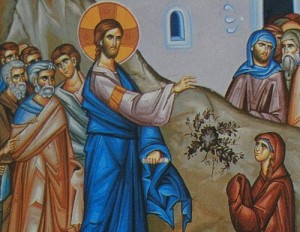 Jesus’ response to this Gentile woman who asks him to heal her demon-possessed daughter is very troubling. We are bothered, even angered that Jesus can be offensive, impatient, and rude. But Mark does not hesitate to show us Jesus as angry, sharp-tongued, and demanding. We are more comfortable with a tame, sentimentalized, gentle Jesus meek and mild. The Gospels and the extra-canonical tradition reveal Jesus to be a powerful and complex figure. He is, as tradition says, in every way as we are (yet did not sin), which should suggest that he shares all the complexity and emotional variety of any human being. In addition, we must remember that this man is the incarnation of a living and personal God, a passionate and sometimes angry God. We should not be surprised to find him displaying emotions that make us uncomfortable. ~ Moreover, this episode reminds us that Jesus was a Jew, a rabbi who firmly believed in the priority of the Jewish people in God’s eyes. He believed that there was an irrevocable covenant binding them to God and God to them. Jesus’ mission was to them: the message of liberation and reconciliation that he preached, taught, and lived was for them. ~ So Jesus was irritated and angry, and we are uncomfortable with that. However, given that anger is a very natural part of human life, and that Jesus was fully human, we should not be uncomfortable with those moments when Jesus got angry or irritated with the demands placed upon him. I think one reason we are uncomfortable is that we don’t want to think of Jesus as human, despite what our theology may say; we prefer to think of him as only divine, not given to the vagaries of the flesh. To deny Jesus’ temper, however, to refuse to allow him occasionally to be irritated is to deny him his full humanity. ~ The thing that is important is not that Jesus got angry, but that he was able to so without being controlled by his anger. This is important because of where we are at right now as a people. There are individuals (and groups) who are deliberately trying to irritate us because it helps them to earn their living or to push their political agenda. (Rush Limbaugh on the Right and Bill Maher on the Left both come to mind; they make their money by annoying their opponents and propping up their “bases”.) ~ We who follow Jesus, we who hope to conform our lives to his, need to emulate his example. We need to learn to not let our anger and irritation take control. Jesus obviously had learned ways to control this most troubling aspects of being human so that his divinity could shine through. As we follow Jesus, each of us must strive to do the same, and I believe we can with his help and grace. May each of us find ways (with God’s assistance) to manage our angers, our irritations, our irrationalities, to control those things within us that undermine the mission of liberation and reconciliation which was Jesus’ and which we have as Jesus’ disciples.
 The simple answer is that fasting is going without some or all food or drink or both for a defined period of time. An absolute fast is abstinence from all food and liquid for a period of at least one day, sometimes for several days. Other fasts may be only partially restrictive, limiting particular foods or substance. The fast may also be intermittent in nature; for example, Muslims fast during the daylight hours of the month of Ramadan which is intended to teach Muslims patience, spirituality, humility, and submissiveness to God. Fasting as a spiritual practice is common to all major religions. Mahatma Gandhi once noted:

