Occasional thoughts of an Anglican Episcopal priest

Category: Church (Page 44 of 115)

We Should Think . . . – From the Daily Office – August 21, 2014

From the Acts of the Apostles:

An angel of the Lord said to Philip, “Get up and go towards the south to the road that goes down from Jerusalem to Gaza.” (This is a wilderness road.) So he got up and went.

(From the Daily Office Lectionary – Acts 8:26-27a (NRSV) – August 21, 2014)

Telephone Call to MinistryI suppose that if “an angel of the Lord” told me to “get up and go” that I’d do as Philip did, even in these times when a trip to Gaza would not be the most pleasant journey one could make. I have often remarked at the willingness of the early disciples to drop everything and respond to these calls to ministry. The response of the first of the apostles, of Simon Peter and his brother Andrew, of James and John (the sons of Zebedee), to leave their fishing businesses and take off with Jesus is the same. (Mt 4:18-22) The response of Matthew (or was he called Levi) to leave his tax booth is the same. (Mt 9:9) “Come” and they come; “get up and go” and they go. Modern folk are seldom so swift to respond.

Of course, we live in a world (at least in the United States . . . at least in the Episcopal Church in the United States) that discourages swift responses to God’s call.

We should really think about that!

====================

A request to my readers: I’m trying to build the readership of this blog and I’d very much appreciate your help in doing so. If you find something here that is of value, please share it with others. If you are on Facebook, “like” the posts on your page so others can see them. If you are following me on Twitter, please “retweet” the notices of these meditations. If you have a blog of your own, please include mine in your links (a favor I will gladly reciprocate). Many thanks!

====================

Father Funston is the rector of St. Paul’s Episcopal Church, Medina, Ohio.

Anglo? Israel? What Is Truth? – From the Daily Office – August 20, 2014

From the Psalter:

“Greatly have they oppressed me since my youth,”
let Israel now say;
“Greatly have they oppressed me since my youth,
but they have not prevailed against me.”
The plowmen plowed upon my back
and made their furrows long.

(From the Daily Office Lectionary – Psalm 129:1-3 (BCP Version) – August 20, 2014)

Multivocality Depicted as Speech BubblesTruth, United States Senator Hiram Johnson observed in 1917, is the first casualty of war. When war becomes nearly universal is truth in danger of being fully obliterated? I don’t think so; I think truth will ultimately survive and prevail. My faith is that the Truth will no doubt prevail, but for the moment, I am speaking neither of grand philosophical concepts nor of the One who made the audacious claim, “I am the Truth.” (Jn 14:6) Rather, I speak simply of factual accuracy and of the intellectual integrity of those who communicate; that truth is suffering some mighty hurtful body blows at present.

Following up on Senator Johnson’s observation several decades later, linguist William Lutz (best known as the editor of the Quarterly Review of Doublespeak) suggested language as an alternative “first casualty of war” because, he said, “with language goes the truth.” In a 1992 essay in English Today, Lutz argued that in times of war and conflict language becomes corrupted and turned into “an instrument for concealing and preventing thought, not for expressing or extending thought.” (The First Casualty)

I was reminded of Johnson and Lutz this week when Missouri’s Republican lieutenant governor, in response to the civil unrest in Ferguson following the killing of Michael Brown, an 18-year-old black man, by a white police officer, suggested that those with grievances (and they and their complaints are many and legitimate) should turn not to the streets but to the “Anglo-American jurisprudence tradition.” Almost immediately a fire-storm erupted on social media and in the left-leaning press accusing the man of being a “white supremacist” because of his use of the term “Anglo-American.”

I was particularly astounded to see religious journalists, pastors, preachers, and essayists, friends and colleagues whom I respect, jumping on this bandwagon. I suggested in a couple of Facebook discussions that “Anglo-American” is not a white racist buzzword, that it is a term of art to those who study or have studied (as the Missouri politician and I both have) the law and the history of the American judicial system. It refers to the historical reality that our system and our preconceptions of fairness, equity, and justice stem from origins in the laws and processes of England and English jurisprudence (the “Anglo” part) imported to and further developed in this country (the “American” part). I have no doubt that our judicial system (and our entire society) embody a systemic racism that must be addressed, but vehement criticism of the Missouri lieutenant governor for use of a longstanding and venerable term of art is not the way to do it. As I pointed out, I have used the term “Anglo-American” myself on many occasions in briefs, oral arguments, and lectures, and I have never used it to mean “white supremacy,” so I give the Missouri politician the benefit of the doubt.

As I thought more about it, it took me back to my college days in the late 1960s and early 1970s in Southern California. Those were the heydays of La Raza Unida, LULAC, the United Farm Workers, and other Chicano labor and political organizations. (Does anyone even use the terms “Chicano” or “Chicana” any longer?) In the rhetoric of the day, any non-hispanic caucasian was an “Anglo.” It didn’t matter where in northern Europe one’s ancestors may actually have come from — Ireland, France, and Germany (my own heritage), Poland and Ukraine (my then-girlfriend’s background), or Scandinavia (my roommate’s family), we were all “Anglos.” What had previously been a prefix referring specifically to the English became an all-inclusive term for white people in general. The racial and ethnic conflict of the day corrupted the language; truth suffered. Apparently, the corruption still taints almost a half-century later.

Then this evening’s psalm — “let Israel now say” — and I am confronted with my own failure to embrace multiple word meanings, my own tendency to corrupt language and to distort truth! I hear the words of the psalm, “Greatly have they oppressed me since my youth,” and I hear them as untrue in today’s world. Israel (the modern nation state) is not oppressed; it is the oppressor! I hear Israel’s metaphoric claim that “plowmen [have] plowed upon my back,” and it rankles me! It is Israel with her air force and her bombs who is “plowing upon the backs” of others! I must divorce myself from my modern irritation for it is not the psalm but my reaction to it which is untrue. The word Israel is a word of many meanings, for some of which the psalm is true; for others, not.

Who is this “Israel”? What does the name mean?

Israel could mean

  • Jacob, son of Isaac, who spent a night wrestling with God and was given this new name
  • His genetic descendants
  • Those who adhere to the religion of Judaism as it has evolved from its earliest beginnings
  • Those like myself who adhere to the Christian faith, the “New Israel” grafted to the old (Romans 11)
  • The ancient ethnic “nation” of diverse tribes (twelve?) who inhabited the eastern Mediterranean, through its various permutations of governance
  • The original singular kingdom which was one of the iterations of that “nation”
  • The subsequent northern kingdom which rebelled against the central imperial government and established itself as a separate entity
  • The modern nation state established by United Nations Resolution 181 in 1947
  • The land on which that nation state sits
  • The additional land of “Greater Israel” claimed by ultra-Orthodox Zionists
  • And a host of additional meanings others may list

How I hear, interpret, pray, accept, reject, or otherwise respond to this evening’s (and any other) psalm naming “Israel” depends on which of these meanings I choose to accept at the moment, and in that choice lies either truth or falsehood. If I choose to accept only one of those meanings to the exclusion of all others, I corrupt language, I betray truth.

The internet discussion of “Anglo” focused (I think) on a single, limited understanding of the term and, in doing so, distorted it and betrayed the truth. There may have been truth — the truth of white privilege, the truth of non-uniform application of laws, the truth of a sometimes failing judicial system — but there was also falsehood and distortion — the condemnation of the Missouri lieutenant govern as a racist (he may be, I don’t know, but the use of the word is hardly sufficient evidence by itself), the dismissal of the historical term is nothing more than a “white supremacist buzzword,” the rejection of the notion of “Anglo-American civilization” as an oxymoron.

Back in college, I often protested, “I am not an Anglo!” My Irish and French ethnic heritage bristles at the very suggestion. And, yet, as an Anglican Episcopalian, as an American lawyer, as a speaker of the English language (corrupted though my American version may be), and in may other ways, I am very much an Anglo. As a student and practitioner of Anglo-American jurisprudence (I am still licensed and admitted to practice in two states and before the Federal judiciary), I am an Anglo. As a user of the term “Anglo-American,” however, I am not a white supremacist but, as a white person in the “Anglo-American civilization” which the Missouri politician lauded, I am a person who possesses (and must be conscious of) white privilege. Youthful protest notwithstanding, I must accept and admit that I am an Anglo.

My negative reaction to the psalm is the same. To be certain, in one sense, the modern state of Israel is not oppressed, nor is its back being plowed, but perhaps in another sense there is truth about the modern nation in the ancient psalm. If I am to hear that truth, I must not distort the language by closing off alternative understandings.

Who are these “Anglos”? Who is this “Israel”? There is more than a single answer to each question and the answers are many and varied, and in all of the several answers there is truth.

“What is truth?” Pilate famously asked. (Jn 18:38) Jesus did not answer him, but had elsewhere asserted, “You will know the truth, and the truth will make you free.” (Jn 8:32) It will only do so if we open ourselves to it. Truth is multi-vocal, and even though we may not want wish to hear all of the voices of truth, but we need to do so. To the extent that we limit, distort, or corrupt the language of our conversations, religious or political, we will be unable to hear its many voices. We must be open to truth’s multi-vocality; only then will the truth set us free.

====================

A request to my readers: I’m trying to build the readership of this blog and I’d very much appreciate your help in doing so. If you find something here that is of value, please share it with others. If you are on Facebook, “like” the posts on your page so others can see them. If you are following me on Twitter, please “retweet” the notices of these meditations. If you have a blog of your own, please include mine in your links (a favor I will gladly reciprocate). Many thanks!

====================

Father Funston is the rector of St. Paul’s Episcopal Church, Medina, Ohio.
An Aquifer – From the Daily Office – August 19, 2014

From the Psalter:

I lift up my eyes to the hills; from where is my help to come?

(From the Daily Office Lectionary – Psalm 121:1 (BCP Version) – August 19, 2014)

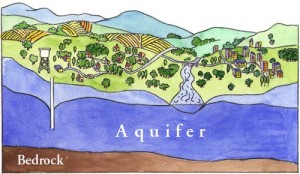
AquiferI love Psalm 121 for a variety of reasons. It is the psalm which the sanctoral lectionary provides for the feast of St. Francis of Assisi (October 4), always a favorite saint. It is the psalm my late mother chose to be read at her funeral. It is one of the psalms of ascent which pilgrims to the Temple are believed to have sung as they made their way to Jerusalem for the major festivals of ancient Judaism; on pilgrimage in Israel and Palestine, my wife and I recalled it as we rode in a travel coach from Ben Gurion Airport in Tel Aviv to ancient city. There many good memories, some joyful, some sad, all meaningful, associated with it.
Its first verse seems particularly appropriate this week as the world has come through and continues to experience the tragedy of conflict in Gaza, the carnage that is the on-going fighting in Iraq, and the violence that has erupted in Ferguson, Missouri. I can imagine people on every side of every one of those situations lifting their eyes and wondering where help is going to come from.

Help, the psalm assures us, comes from the Lord, “the maker of heaven and earth.” But I sometimes think that many (if not most) find that about as helpful as Job did: “Oh, that I knew where I might find him . . . If I go forward, he is not there; or backward, I cannot perceive him; on the left he hides, and I cannot behold him; I turn to the right, but I cannot see him.” (Job 23:3a,8-9) We live in a world where people do not know where to find God, do not know where to look for strength.

I would suspect that most who acknowledge the objective reality of God when asking the question posed in this psalm look for help “out there somewhere” hoping to find God swooping in like Superman bounding tall buildings, or more disturbingly like American bombers defending an Iraqi dam. On the other hand, those who deny the reality of God either don’t bother to look at all or (more commonly) also look “out there somewhere” expecting never to see anything.

A few, however, will know that (as St. Bernard de Clairvaux observed) our spiritual nourishment comes from the place where we think, pray and work, that we begin our spiritual journey where we are and not somewhere else. Moses promised his people that God was bringing them “into a good land, a land with flowing streams, with springs and underground waters welling up in valleys and hills,” (Dt 8:7) and while that may have been the promise of real and tangible place it is also a metaphor for the spiritual reality of God’s help and strength. Jesus told the Samaritan woman at Jacob’s Well that he would give those who asked the water of life which would become in them “a spring of water gushing up to eternal life.” (Jn 4:14)

God’s help, God’s strength, God’s spirit is like an aquifer underlying the soil of our lives. We tap that help and strength by going within, by searching the core of our being, not by looking “out there somewhere.” Yes, like the psalmist, we lift up our eyes to hills as we wonder where to find help, but we must turn our gaze around to actually discover it.

Certainly the people of Gaza, Iraq, and Missouri are right to look for help from outside, but such help is contingent and temporary; it cannot produce any real, lasting, long-term solution. Real change will only come when all people look deep within and tap that spiritual aquifer to which we all have access, that underground stream of living water, that spring of eternal life which has been promised all along.

From where is my help to come? From the Lord, deep within not “out there somewhere.”

====================

A request to my readers: I’m trying to build the readership of this blog and I’d very much appreciate your help in doing so. If you find something here that is of value, please share it with others. If you are on Facebook, “like” the posts on your page so others can see them. If you are following me on Twitter, please “retweet” the notices of these meditations. If you have a blog of your own, please include mine in your links (a favor I will gladly reciprocate). Many thanks!

====================

Father Funston is the rector of St. Paul’s Episcopal Church, Medina, Ohio.

Russian Steam Locomotive? – From the Daily Office – August 18, 2014

From the Gospel according John:

[Jesus said:] “Very truly, I tell you, anyone who hears my word and believes him who sent me has eternal life, and does not come under judgment, but has passed from death to life. Very truly, I tell you, the hour is coming, and is now here, when the dead will hear the voice of the Son of God, and those who hear will live.”

(From the Daily Office Lectionary – John 5:24-25 (NRSV) – August 18, 2014)

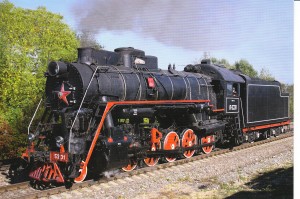
Russian Steam LocomotiveDid Jesus actually say these things? Most contemporary bible scholars would probably answer “No.” The author of John’s Gospel has made Jesus say the things a largely Jewish community of the church in the late 1st Century, a church struggling to cope with its separation from traditional Judaism, believed about Jesus; Jesus is thus both the subject and the interpreter of the message of John’s Gospel. In the 21st Century, we might have preferred the author to have included the interpretation of Jesus in the narrative, not in the words spoken by the character of Jesus portrayed here, but that’s not what we’ve got. What we’ve got is the Jesus remembered by a community with a highly developed Christology telling that community, and us, who Jesus was then and now.
Realizing that helps one realize that this is not Jesus’ predicting the end of the world as we know it. The tenses of verbs in this passage are important. The passing of believers “from death to life” is something that has already happened; it is not something in the future. The coming hour “is now here;” it is a present reality not something for which we are still waiting. This is a spiritual reality, not a prediction about physical reality. Death and life, eternity and judgment, coming hour and voice of the Son of God are all metaphoric terms describing a believer’s present spiritual reality, whether that believer is a 1st Century Jew or a 21st Century Gentile.

Metaphoric language is often difficult to understand, especially when the metaphor is an unfamiliar one. It can be confusingly dreamlike and stubbornly unenlightening. The past few days, recovering from minor surgery on my knee (a partial meniscectomy), I have also been “detoxing” from the general anesthesia used during surgery and the pain management medication prescribed afterward (which I only took for 36 hours). Apparently, vivid dreams are a part of that detoxification process.

One of the recurring images of these dreams is travel on a Russian cross-country train pulled by an antique steam engine! I have never been to Russia, rarely traveled anywhere by train, and never in steam-engine driven conveyance; as metaphors for something, these are highly unfamiliar images. To say the least, this imagery is disconcerting, disorienting, and (as I said) stubbornly unenlightening. I do believe that dreams, especially those we remember, are ways in which our minds work out issues in non-rational ways; I believe they are ways our psyches provide us insights not accessible by the conscious mind. But what are my dreams trying to tell me?

When I read today’s Gospel with Jesus’ interpretive discourse today, I have a similar experience of disorientation; I have almost as little experience with John’s images as I do with Russian steam locomotives. I have no direct experience of death though I have witnessed it; I have no direct experience of divine judgment though I have courtroom experience with its earthly analog; I have no direct experience of the voice of the Son of God though I have heard the voices of parents and children. What is scripture trying to tell me when John’s Jesus uses these metaphoric images?

Fortunately, as Walter Brueggemann has often reminded his readers, metaphors are not univocal, nor do they claim a one-to-one correlation with reality. They speak differently each time we encounter them. Today scripture’s voice maybe as confusing as the dream of a Russian train; tomorrow it may be as clear as a bell; the next day . . . who knows?

What I do know is this, that everyday I am called to listen to the voice of scripture and, in it, hope to hear the voice of the Son of God which promises life. Everyday, I must climb aboard the Russian steam-driven train that is Holy Write and ride where it takes me. Everyday, I must wrestle with scripture as Jacob wrestled with the angel at Peniel and hope that, as he saw God face to face and lived, so may I.

====================

A request to my readers: I’m trying to build the readership of this blog and I’d very much appreciate your help in doing so. If you find something here that is of value, please share it with others. If you are on Facebook, “like” the posts on your page so others can see them. If you are following me on Twitter, please “retweet” the notices of these meditations. If you have a blog of your own, please include mine in your links (a favor I will gladly reciprocate). Many thanks!

====================

Father Funston is the rector of St. Paul’s Episcopal Church, Medina, Ohio.

At the Center of the Heart – A Poem in Celebration of St. Mary the Virgin – August 15, 2014

Annunciation by Fra Angelico

O God, who have taken to yourself the blessed Virgin Mary, mother of your incarnate Son: Grant that we, who have been redeemed by his blood, may share with her the glory of your eternal kingdom; through your Son Jesus Christ our Lord, who lives and reigns with you, in the unity of the Holy Spirit, one God, now and for ever. Amen. (Collect for the Feast of St. Mary the Virgin, August 15, 2014)

At the Center of the Heart

God sat upon God’s big, white throne.
God sat staring out the window alone
not seeing the superstrings and quanta, the quarks and the gravitons, not
seeing the gamma rays and x-rays and the dark matter, not
seeing the galaxies and the suns, the stars and the planets, not
hearing the drumbeat of time nor the music of the spheres, not
witnessing the dances of asteroids and meteors and comets, not
appreciating the wonder and the beauty that sprang
forth from God’s word, from God’s Big Bang.

God sat upon God’s big, white throne,
God sat staring out the window alone
at what only God could see;
God sat listening
to what only God could hear;
God sat witnessing
what only God could understand;
God sat appreciating
what only God could answer;
God sat pondering the question
at the center of the human heart.

God heard that question arise
from women and men, from girls and boys of
every tribe and language and people and nation;
God heard that question asked
by each of them, in his or her own native language —
Parthians, Medes, Elamites,
and residents of Mesopotamia, Judea and Cappadocia,
Pontus and Asia, Phrygia and Pamphylia,
Egypt and the parts of Libya belonging to Cyrene,
Romans and Jews, Cretans and Arabs,
Angles and Saxons, Inca and Aztecs,
Iroquois and Dutch, Celts and Chinese,
Inuit and Swahili, Vikings and Fijians —
in their own languages God
heard them speaking the question
at the center of the their hearts.

God heard that question arise
from priests and shamans, prophets and philosophers of
every religion and sect and theology and denial;
God heard that question asked
by each of them, out of his or her own terms and conditions —
Law and Obedience, Relationship and Sinfulness,
Light and Shadow, Existence and Meaning,
Disease and Death, Poverty and Wealth,
Suffering and Satisfaction, Sacrifice and Service,
Time and Eternity, Rebirth and Completion,
Intimacy and Loneliness, Despair and Joy,
and even feelings and thoughts and emotions
the asker could not or would not name —
in their own terms and conditions God
heard them speaking the question
at the center of the their hearts.

God rose from God’s big, white throne.
God rose and walked out the door alone,
passing through choirs of
angels and archangels, and
all the company of heaven,
as they lauded and magnified
God’s glorious Name.
God passed out heaven and walked upon the earth;
God walked in gardens at the time of the evening breeze;
God strode among stones of fire and in the midst of flames;
God stirred up seas so that their waves roared;
God marched in the tops of trees and strolled through the grass of the fields;
God sat upon altars,
placed his feet on temples,
stood atop pyramids,
climbed the steps of ziggurats,
rested in secret places,
housed in Holies of Holies,
visited public sanctuaries,
spoke to prophets and priests,
gazed on household shrines,
sat in people’s kitchens and at their dinner tables,
stood in their chambers and at their bedsides,
guested in workrooms and in their parlors; and
heard them speaking the question
at the center of their hearts.

God returned to God’s big, white throne.
God returned and God called, “Gabriel!”
Robed in white, wings aflame,
a sword of righteousness in his angel hand,
Gabriel answered the holy summons:
“Here am I. Send me.”
Gabriel stood before God’s big, white throne and asked.
“Lord, should we strike with the sword?”
“Put your sword back into its place,” answered God.
“I have heard the question
asked in the tongues of mortals
and even of angels.
I have heard the question
ringing in the noise of gongs
and the clanging of cymbals.
I have heard the question
pursuing prophecies that will cease,
craving knowledge that will end.
I have the heard and there is
but a single answer to the question
at the center of the human heart.”


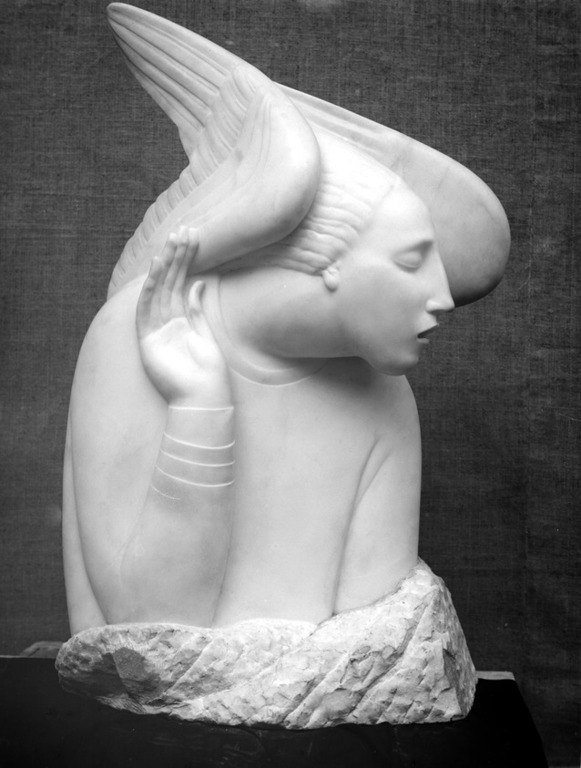
Archangel Gabriel by Ivan Mestrovic

Gabriel stood before God’s big, white throne.
Gabriel stood and trembled, anticipating
a mighty tempest, with peals of thunder, rumblings, flashes of lightning, expecting
a devouring fire, melting wax, refining silver and gold, awaiting
an earthquake, splitting mountains and breaking rocks.
A sound of sheer silence filled the room;
in a still small voice God said:
“Go to a town in Galilee called Nazareth,
to a virgin engaged to a man whose name is Joseph, of the house of David.
The virgin’s name is Mary.”
Gabriel stood and trembled, questioning
at the center of his angel’s heart,
“Why, God? Why this? Why her?”
God sat upon God’s big, white throne,
God sat staring out the window, not quite alone.
“Gabriel,” God said in that deep quiet voice,
“She alone can make the choice; she alone
of all flesh has heard me speaking the question
at the center of my heart.”

Gabriel stood and trembled, greeting
“Hail, thou that art highly favored,
the Lord is with thee:
blessed art thou among women.”
She questioned; he explained.
A sound of sheer silence filled the room;
in a still small voice Mary said:
“Be it unto me according to thy word.”
And Gabriel stood and trembled, sighing,
and relieved, departed,
still, perhaps, unsure of the question
at the center of his angel’s heart.

In the beginning was the Word,
and the Word was with God,
and the Word was God.
The Answer to the question
at the center of the human hearts,
however spoken, however phrased,
or never spoken, never phrased,
was in the beginning with God.
All things came into being through the Answer,
and without the Answer not one thing came into being.
The Answer was in the world,
and the world came into being through the Answer;
yet the world did not know the Answer.
Long ago God spoke to our ancestors
in many and various ways by the prophets,
but in these last days he has spoken to us the Answer,
and the Answer became flesh and lived among us.
The Answer grew and became strong,
increased in wisdom and in years,
and in divine and human favor, but
sometimes wondering, sometimes asking,
“Simon son of Jonah, all of you,
do you love me? Do you place me
at the center of your heart?”
before returning
to the center of God’s heart.

And Mary sat upon her chair crafted by Joseph;
Mary sat staring out the window alone.
Mary, who had birthed the Answer,
from the center of her womb,
treasured all these things,
at the center of her humble heart.

– by C. Eric Funston, 15 August 2014

Originally posted at the Episcopal Café’s Speaking to the Soul.

I Believe – From the Daily Office – August 15, 2014

From the Gospel according John:

There was a royal official whose son lay ill in Capernaum. When he heard that Jesus had come from Judea to Galilee, he went and begged him to come down and heal his son, for he was at the point of death. Then Jesus said to him, “Unless you see signs and wonders you will not believe.” The official said to him, “Sir, come down before my little boy dies.” Jesus said to him, “Go; your son will live.” The man believed the word that Jesus spoke to him and started on his way. As he was going down, his slaves met him and told him that his child was alive. So he asked them the hour when he began to recover, and they said to him, “Yesterday at one in the afternoon the fever left him.” The father realized that this was the hour when Jesus had said to him, “Your son will live.” So he himself believed, along with his whole household.

(From the Daily Office Lectionary – John 4:46b-53 (NRSV) – August 15, 2014)

Apostle's Creed in Prayer BookJohn uses the word “believe” three times in this short passage: once quoting Jesus about witnesses to his acts of power and twice regarding the royal official’s state of mind. What, precisely, does John mean by doing so? That is one of the ponderable but unanswerable questions about scripture, the precise meaning of a biblical author.

John wrote in Greek and in each of the three cases here the Greek word used is some form of the verb pisteuo, which is also occasionally translated as “faith” and as “trust.” It does not usually carry a strong sense of intellectual assent to a doctrine or concept, although our English “believe” certainly does. Jesus, most likely, did not actually use a Greek word in his statement; more likely he spoke Aramaic in which (as in Hebrew) the word for “believe” is ‘aman and, like the Greek, it does not carry a strong association with intellectual concurrence to a proposition.

When we read or hear John’s testimony in English, therefore, we have to appreciate both the ambiguity of the original and the rather different thrust of our modern understanding of the word “believe”. What we especially must not do is hear John’s “believe” in the same way that we use the word in the creeds.

Of course, when I make such a statement I am immediately confronted by the realization that I have not the slightest idea what you mean by the word “believe” when you recite the Nicene Creed! Even more so, I am confronted by my own lack of clarity when I recite the creed.

Recently, my friend and colleague in ordained ministry, Presbyterian elder Mark Sandlin, published an essay on his blog The God Article entitled “Jesus Is Not My God” in which he confessed to being a heretic by beginning with the declaration, “I am a believer. Mostly. I believe that there is probably a god . . . .” Mark then followed up with, “I also believe there might not be a god. . . .” So how is Mark using “believe”? I think (notice I avoided using the word “believe”) that he is saying that he can intellectually assent to those propositions.

That’s not, however, how I understand the word when it pops up in the Nicene Creed which, as a liturgical Episcopalian, I recite publicly at least once each week, or the Apostle’s Creed which, as a practitioner of the Daily Office, I recite twice each day. I regularly say that I believe that there is a God, that that God created everything, that God had a Son and that Jesus the Anointed One is that Son, that Jesus was born of a virgin, that Jesus was killed on a cross, that he rose from the dead, that he went to heaven and that I expect him to return.

When I do so, however, I am not limiting myself to merely assent to the factual accuracy of those statements. In fact, I’m not even concerned with facticity when I make these statements of belief. In the discussion in the comments about Mark’s “heretical” essay, I said this:

I have no problem whatsoever saying the traditional creeds (Nicene, Apostle’s), every single word of them – virgin birth, death on cross, resurrection, expected return, the whole kit-and-kaboodle. (Did I spell “kaboodle” correctly?) That’s because I understand that “believe” doesn’t mean “assent to the scientific [or historical, I will now add] factual accuracy” of the statements set forth. “Believe” means I trust that these things mean something — usually something more than I currently understand and certainly something a lot more important than mere scientific [or historical] factual accuracy.

I don’t (I hasten to add) disbelieve the factuality of the statements in the creeds, don’t get me wrong, but if it turned out that Mary wasn’t, for example, a virgin, I would still recite the creedal words without a qualm. They are metaphoric; they are symbolic; it’s what they say about Jesus, not what they say about Mary, that is important. Or suppose someone actually were to find and verify a bunch of bones as being the remains of Yeshua of Nazareth; I would still assert my belief in his resurrection. Why? Because his truth, his gospel, the good news that God loves the human race was resurrected in, made alive by, and continues to sustain us in his church.

Whatever Jesus and John may have meant by the word “believe” in this story of the healing of the royal official’s son, that’s what I understand it to be in the creeds. I trust in the importance of what the creedal assertions point us toward. Far from being answers, the creedal statements are starting points for further spiritual exploration; they raise more questions than they answer. And I believe (I am using the word intentionally) that exploring those questions is a healthy and health-giving spiritual activity.

====================

A request to my readers: I’m trying to build the readership of this blog and I’d very much appreciate your help in doing so. If you find something here that is of value, please share it with others. If you are on Facebook, “like” the posts on your page so others can see them. If you are following me on Twitter, please “retweet” the notices of these meditations. If you have a blog of your own, please include mine in your links (a favor I will gladly reciprocate). Many thanks!

====================

Father Funston is the rector of St. Paul’s Episcopal Church, Medina, Ohio.

Of Tombs and Siblings – From the Daily Office – August 14, 2014

From the Book of Acts:

[Stephen the Deacon answered the High Priest in the council and said:] “Joseph sent and invited his father Jacob and all his relatives to come to him, seventy-five in all; so Jacob went down to Egypt. He himself died there as well as our ancestors, and their bodies were brought back to Shechem and laid in the tomb that Abraham had bought for a sum of silver from the sons of Hamor in Shechem.”

(From the Daily Office Lectionary – Acts 7:14-16 (NRSV) – August 14, 2014)

Icon of the Martyrdom of St PhiloumenosShechem was known as Sychar in Jesus’ time. Near that land that Abraham had bought for use as a tomb, just a short walk south from the traditional location of Joseph’s tomb, is a well that belonged to Jacob. At that well, Jesus stopped to ask a Samaritan woman for a drink; part of the story of that meeting and Jesus’ conversation with the woman (the longest of all the conversations recorded in the Gospels) is today’s Gospel text (John 4:27-42).

Near Sychar the Romans built the Greek-named city of Flavia Neapolis which grew large and encompassed the ancient Jewish and Samaritan city. As the predominant local language changed to Arabic, the Greek name was retained but shortened and Arabicized, and now the modern city of Nablus is among the largest Arab cities in the Holy Land.

Over the site of Jacob’s Well stands the Greek Orthodox Church of St. Photini. The name Photini is given by Orthodox tradition to the Samaritan woman; it means “light bringer” in recognition of her bringing the light of Christ to the people of the city. The first church dedicated to her at the site was built in 311 AD.

There are two tombs at St. Photini Church. One inside houses the remains of Archimandrite Philoumenos, a priest who almost single-handedly restored the ancient church to its present modern condition. In 1979 a group of radical Zionists from a nearby Israeli settlement claimed Jacob’s Well, which is in a chapel inside the crypt of the church, as a Jewish holy place and demanded that crosses and icons be removed. A week later, on November 29, Fr. Philoumenos was hacked to death with an ax in the crypt and the church was desecrated. Although it is widely believed that the settlers were responsible, no one was ever convicted of the priest’s murder. Fr. Philoumenos was ranked among the Saints of the Church of Jerusalem on August 30, 2008, and his feast day set on November 29, the anniversary of his martyrdom.

Fr Justinus's TombThe second tomb is that of Fr. Justinus, the priest who took over the church from St. Philoumenos and continued his work of restoration. An accomplished artist, Fr. Justinus wrote all of the icons which now decorate the nave, sanctuary, and crypt, including an icon of the martyrdom of St. Philoumenos. Fr. Justinus’s tomb is empty because he is still alive. He built his tomb himself and it is placed just outside the front door of the church; he walks past it everyday coming from his residence in the neighboring monastery to the church. It is a daily reminder of his (and our) mortality and of the dangers he (and many) face in the on-going violence or threat of violence that characterizes the Holy Land today.

If we were to read further in Acts (and we will tomorrow and the day after) we would read of the martyrdom of Stephen. His address to the Sanhedrin (perhaps one would best characterize it as a polemical sermon) so enraged his hearers that “they dragged him out of the city and began to stone him” (Acts 7:58) which resulted in his death. We are told that “devout men buried Stephen and made loud lamentation over him” (8:2) but we are not told where his burial place may have been, though surely it is in or near Jerusalem.

Nonetheless, his sermon about Jesus at Jacob’s Well in Shechem-Sychar-Nablus, the well’s location near Joseph’s Tomb and its intimate connection to the martyrdom of St. Philoumenos, and the eventual outcome of Stephen’s address are stark reminders that the Good News of God (whether that be the Covenant of the Old Testament or the Gospel of the New) is not the promise of an easy life. One would not be surprised to hear the Almighty singing the lyrics of that old country song:

I beg your pardon; I never promised you a rose garden.
Along with the sunshine, there’s gotta be a little rain sometime.
When you take you gotta give so live and let live and let go.
I beg your pardon, I never promised you a rose garden.

In fact, Jesus did pretty much that when he disabused his disciples, “Do not think that I have come to bring peace to the earth; I have not come to bring peace, but a sword.” (Mat. 10:34)

The People of God are called to be risk-takers and, sometimes, to risk even death. Christians most surely must know that; we have only the example of our Lord to prove it. But it is also true of all the children of Abraham, not only Christians but also Jews and Muslims. What is sad is that Abraham’s descendants cannot live peaceably among themselves, that it is often our Abrahamic “siblings” from whom we face the greatest danger (sometimes even more so from our brothers and sisters within the same faith group). I believe that this breaks God’s heart!

As he died, Stephen the Deacon “knelt down and cried out in a loud voice, ‘Lord, do not hold this sin against them.’” (Acts 7:60) So should we all pray for those who persecute us, and let us pray especially for all who are the spiritual descendants of Abraham, that there may be peace among Jews, Muslims, and Christians.

(Note: The icon of the martyrdom of St. Philoumenos may be photographed by pilgrims and tourists, and those photographs are to be found widely posted on the internet, the Israeli Government and the Palestinian Authority will not permit the Greek Orthodox Patriarchate of Jerusalem nor the parish church or monastery to reproduce the icon. It is considered politically inflammatory and is therefore censored.)

====================

A request to my readers: I’m trying to build the readership of this blog and I’d very much appreciate your help in doing so. If you find something here that is of value, please share it with others. If you are on Facebook, “like” the posts on your page so others can see them. If you are following me on Twitter, please “retweet” the notices of these meditations. If you have a blog of your own, please include mine in your links (a favor I will gladly reciprocate). Many thanks!

====================

Father Funston is the rector of St. Paul’s Episcopal Church, Medina, Ohio.

Most Definitely – From the Daily Office – August 13, 2014

From the Book of Acts:

Now during those days, when the disciples were increasing in number, the Hellenists complained against the Hebrews because their widows were being neglected in the daily distribution of food. And the twelve called together the whole community of the disciples and said, “It is not right that we should neglect the word of God in order to wait at tables. Therefore, friends, select from among yourselves seven men of good standing, full of the Spirit and of wisdom, whom we may appoint to this task, while we, for our part, will devote ourselves to prayer and to serving the word.” What they said pleased the whole community, and they chose Stephen, a man full of faith and the Holy Spirit, together with Philip, Prochorus, Nicanor, Timon, Parmenas, and Nicolaus, a proselyte of Antioch. They had these men stand before the apostles, who prayed and laid their hands on them.

(From the Daily Office Lectionary – Acts 6:1-6 (NRSV) – August 13, 2014)

Coptic Pope Selected by a ChildMy wife refuses to use the word “coincidence.” She claims there are no such things. The concurrence in time of apparently unrelated but complementary and mutually reinforcing events, she asserts, is the intentional activity of the Holy Spirit. Nothing, “coincidental” (in the popular understanding of the word) about it.

Well, today one of these God-incidents, as she calls them, has occurred. When we are given this passage of scripture to read, we are also treated to the announcement of the Joint Nominating Committee for the Election of the Presiding Bishop (JNCPB) that it has issued a Call for Discernment and Profile for the election of the 27th Presiding Bishop of The Episcopal Church. (Notice all the “this is terribly important” capital letters in that announcement!) The “Call and Profile” can be found here: it is TWENTY pages long! The coincidence (Sorry, dear!) of this reading and this announcement seems instructive.

Luke (the author of Acts) doesn’t tell us how the apostles and the early Christian community actually called, profiled, [s]elected, and chose the first seven deacons, but I somehow doubt that they spent several months producing a twenty page document detailing the perceived needs, duties, qualifications, objectives, potential ministries, goals, and whatever-else-corporate-America-is-currently-buzzwording-for-CEOs of the job. Granted deacons are not presiding bishops. (Truth be told, I think deacons are more important than presiding bishops.) But diakonia is diakonia at whatever hierarchical level it may be performed.

I think the church has gotten lost. I hate to say that, but I think the church has truly gotten lost in the dark woods of corporate leadership process. We have followed the guidebook of the Harvard MBA and seem no longer to hear (or heed) the promptings of the Holy Spirit. As much as I value the democratic processes that make the Episcopal Church unique among Anglicans and the other branches of the Christian faith which preserve the Catholic Tradition, those processes do not and should not be permitted to make us a religious reflection of a for-profit corporation. What works (assuming it does work) for shareholders, directors, and managers of Wall-Street-traded business entities may not (probably does not) work for the church, but we seem to have adopted those processes and methods lock, stock, and barrel.

We use these methods now to select rectors of parishes, bishops of dioceses, and (now) the Presiding Bishop and Primate of the Episcopal Church. I ask, in all sincerity, have they worked? And my answer would be, “Sometimes.” Sometimes I believe the Holy Spirit uses our business methods and processes to do her work and help us select the best person. And sometimes I think our business processes and methods get in the way, and that the Holy Spirit just shrugs her shoulders, sits back, and waits for next time . . . .

When the Episcopal Cafe made note of the “Call and Profile” and posted that article on Facebook, I made this comment:

Put the names of all canonically eligible bishops in a large chalice then have my yet-to-be-born grandchild (who will be 9 months old and in attendance with his/her deputy parents) – or some other available innocent child – draw one name slip from the chalice. Make that person PB. Trust the Holy Spirit and stop all this corporate-America profiling-and-politicking nonsense.

This is a riff on the method the Coptic Orthodox Church uses to select its popes (as reported by NBC News). I believe it would work for us as well as, if not better than, all the profiling, job describing, nominating, and electing we go through; it is just as likely to be used and guided by the Holy Spirit, and maybe even more so. It was, basically, the method the apostles used to select a successor for Judas (Acts 1:15-26) and, in all honesty, I don’t think we’ve improved on it in nearly 2,000 years of adopting, changing, and monkeying with other methods.

My son is a clergy deputy to the upcoming General Convention (and his wife is a lay deputy). I asked if he thought Jr. Funston would be up to the task of selecting a name from a chalice. He replied, “Most definitely.”

====================

A request to my readers: I’m trying to build the readership of this blog and I’d very much appreciate your help in doing so. If you find something here that is of value, please share it with others. If you are on Facebook, “like” the posts on your page so others can see them. If you are following me on Twitter, please “retweet” the notices of these meditations. If you have a blog of your own, please include mine in your links (a favor I will gladly reciprocate). Many thanks!

====================

Father Funston is the rector of St. Paul’s Episcopal Church, Medina, Ohio.

Five AM Walking the Dog – From the Daily Office – August 12, 2014

From the Psalter:

Clouds and darkness are round about him,
righteousness and justice are the foundations of his throne.

(From the Daily Office Lectionary [Morning Psalm] – Psalm 97:2 (BCP Version) – August 12, 2014)

Moon Behind Clouds

“Comedian Robin Williams, the Oscar and Grammy winner known for his rapid-fire delivery, was found dead in his home after an apparent suicide, authorities said.” — NBC News

Five AM Walking the Dog

The clown is silent; the laughter stilled.
The last mad improvisation was fatal;
Often wisdom behind silliness
but I cannot see any sense
hidden in this.

In desperation, the jester demanded
attention in a world whose madness
was crazier than his own; the clouds
and darkness hiding any glimpse,
any chance of righteousness, no
justice visible, no
hope perceived, no
more wrestling with the black dog

A world in need of jesters
is one poorer as I walk beside
my black dog and try to make sense.
Moon glows small silvery yellow
disc behind mist behind
clouds behind dark behind
chill beyond thought beyond
sense below perception below
knees kneeling on cold wet
grass weeping beneath
the silence of the jest
praying in the darkness beneath
the silence of the clouds.

“Mork, calling Orson;
Mork, calling Orson . . . .”

====================

A request to my readers: I’m trying to build the readership of this blog and I’d very much appreciate your help in doing so. If you find something here that is of value, please share it with others. If you are on Facebook, “like” the posts on your page so others can see them. If you are following me on Twitter, please “retweet” the notices of these meditations. If you have a blog of your own, please include mine in your links (a favor I will gladly reciprocate). Many thanks!

====================

Father Funston is the rector of St. Paul’s Episcopal Church, Medina, Ohio.

Unsignaled Turns – From the Daily Office – August 11, 2014

From the Gospel according to John:

Jesus said to Nicodemus: “The wind blows where it chooses, and you hear the sound of it, but you do not know where it comes from or where it goes. So it is with everyone who is born of the Spirit.”

(From the Daily Office Lectionary – John 3:8 (NRSV) – August 11, 2014)

Turn SignalI wasn’t going to mention this, really, but the mind makes strange associations and when I read the Gospel lesson this morning, particularly this line about the wind blowing where it will and us being unable to tell its origin or its destination, the image that came immediately to mind is an automobile turn signal.

It may be that that happened because in the past several days there have been three incidents at intersections where other drivers have failed to signal their turns and I, anticipating that they would be going straight, have nearly collided with them. Yesterday’s near-collision, I thought, was the worst.

Since moving to Ohio eleven years ago, my wife and I have several times commented a local phenomenon of driver behavior that we have not previously encountered living in other states. We have lived and been licensed drivers in Nevada, California, and Kansas since marrying, and driven in many other places, and we’ve never seen this phenomenon with the same frequency that it occurs here. The phenomenon in question? Drivers signaling their turn after beginning their maneuver.

This is what happened yesterday: I arrived, northbound, at a four-way stop-sign-controlled intersection simultaneously with a southbound vehicle; neither of us were signaling a turn. There was one eastbound vehicle, which proceeded through the intersection as the southbound vehicle and I came to a stop. When the eastbound vehicle cleared the intersection, we both started, the southbound vehicle beginning a left turn into my drive path and at that moment turning on its turn signal. Of course, we both slammed on our breaks and the other driver began yelling at me. I yelled back and proceeded through the intersection.

That incident was still on my mind when I read about the wind and the Spirit’s unknown movements. I thought, “How silly and ridiculous! I’m not going to write about that!” But I couldn’t shake the image from my mind, so I resolved to write nothing in the way of a reflection or meditation until this evening when I would read the other lessons and the evening psalm and, perhaps, have a more “spiritual” take on things.

And then this happened . . . . On the way to the office this morning, northbound on a major roadway through the southern part of our town, I was nearly hit by an historical Jeep (I know it to have been “historical” because it had a license tag that so proclaimed it). The historical Jeep whipped around the corner of an east-west side street, neither stopping (or even slowing down) at a stop sign nor signaling its turn. Fortunately, I was able to (again) slam on my breaks and avoid a collision, the Jeep proceeding ahead of me, the driver completely oblivious to our near-collision; I don’t think he ever saw me! (But I got a good look at his historical vehicle license plate.)

I wonder if Jesus might have used this as alternative metaphor if he were talking with Nicodemus today: “Other drivers go where they choose, and you hear the sound of them, but you do not know where they come from or where they are going, because they do not signal or stop. So it is with everyone who is born of the Spirit.” Probably not. It lacks the ambiguity of the wind/spirit image inherent in both Hebrew and Greek where the same word is used for the two words.

Nonetheless, it reminds me how dangerous the Spirit can be! The danger of a ton or two of steel headed down a city street piloted by a driver who fails to obey traffic laws cannot compare to the danger presented by the Holy Spirit! I am reminded of a favorite quotation from Annie Dillard’s 1982 book Teaching a Stone to Talk:

Does any-one have the foggiest idea what sort of power we so blithely invoke? Or, as I suspect, does no one believe a word of it? The churches are children playing on the floor with their chemistry sets, mixing up a batch of TNT to kill a Sunday morning. It is madness to wear ladies’ straw hats and velvet hats to church; we should all be wearing crash helmets. Ushers should issue life preservers and signal flares; they should lash us to our pews. For the sleeping god may wake some day and take offense, or the waking god may draw us out to where we can never return.

It also reminds me how irresponsible God can be! These drivers who fail to signal, who fail to stop, who aren’t obeying the rules are simply irresponsible. Like the wind in Jesus’ metaphor they go where they choose and the rest of us have no idea where that might be; we just have to be on our guard or get out of the way. And Jesus says that this powerful, uncontrollable, unknowable, freely-changing-direction behavior is shared by those who are reborn in the Spirit. Have you taken a good, close look at the people that are so empowered? Have you really looked closely at anyone to whom God has given the power to make unsignaled turns in life?

If not . . . grab a mirror and do so.

====================

A request to my readers: I’m trying to build the readership of this blog and I’d very much appreciate your help in doing so. If you find something here that is of value, please share it with others. If you are on Facebook, “like” the posts on your page so others can see them. If you are following me on Twitter, please “retweet” the notices of these meditations. If you have a blog of your own, please include mine in your links (a favor I will gladly reciprocate). Many thanks!

====================

Father Funston is the rector of St. Paul’s Episcopal Church, Medina, Ohio.

« Older posts Newer posts »