Occasional thoughts of an Anglican Episcopal priest

Category: Church (Page 62 of 115)

The Bible Is Fun! – From the Daily Office – January 23, 2014

From the Book of Genesis:

The Lord came down to see the city and the tower, which mortals had built. And the Lord said, “Look, they are one people, and they have all one language; and this is only the beginning of what they will do; nothing that they propose to do will now be impossible for them.”

(From the Daily Office Lectionary – Genesis 11:5-6 (NRSV) – January 23, 2014.)

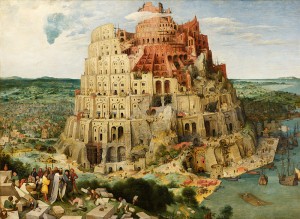
Construction of the Tower of Babel by Pieter Bruegel the ElderI’ve never quite understood the story of the tower of Babel. I get that it’s an etiological myth to explain the variety of languages spoken by human beings, but the picture of God that it paints is (shall we say?) less than positive. Might it have been better to cast someone else (say the Tempter?) as the “bad guy” who thwarts the plans of the tower builders?

As the story of God and God’s People develops over time and through the pages of Scripture, we learn that God’s goal is that “they may all be one. As you, Father, are in me and I am in you,” or at least that’s what Jesus said (John 17:21). The apostle Paul proclaimed this Good News setting out that the goal was that all people, indeed all things, be put in subjection under the Christ and ultimately under the one God “so that God may be all in all” (1 Corinthians 15:28). And his colleague, Peter, argued that preachers should speak as if speaking the very words of God so that “God may be glorified in all things through Jesus Christ” (1 Peter 4:11).

It’s not just the New Testament that proclaims this goal of universal solidarity. Solomon proclaimed in prayer that the goal of his kingdom was “that all the peoples of the earth may know that the Lord is God; there is no other” (I Kings 8:60). The prophet Isaiah proclaimed that “in days to come the mountain of the Lord’s house shall be established as the highest of the mountains, and shall be raised above the hills; all the nations shall stream to it” (Isaiah 2:2).

So, if that has been God’s goal all along, isn’t God’s fit of pique at the plain of Shinar just a wee bit counterproductive?

Playing with questions like that is why I so enjoy studying the Bible; the Bible is fun! So, I get really annoyed when someone treats it as some sort of scientifically or historically accurate text, and robs it of its capacity to provide fun and enjoyment.

It’s a bunch of stories and other sorts of literature! It’s a bunch of often contradictory stories, myths, poems, histories, memoirs, and so forth which, despite their contradictions (and often because of them) point to a truth that transcends our mundane perceptions. Sure, if I were writing a single text to tell the story of God, I’d use the Babel story quite differently and tell it from a very different perspective. But that’s not how the Bible came to be and, thanks be to God, I don’t have to write God’s story! Suffice to say that the Bible is not a history book; it’s not a scientific text. It’s a library, a collection of all different sorts of literature.

These texts must be read in light of each other. The prophet’s vision of the nations streaming to a temple on a hill and Jesus’ prayer for unity among all peoples (the prayer is not just about his followers) provide lenses through which we view the myth of the tower at Babel; the story of the tower provides a critical backdrop and foundation for the prophecy and the prayer. So, I may not understand the story of the tower of Babel standing alone, but I understand it in context. I understand it as a part of a synthetic whole (synthetic in the sense of dialectic synthesis, not as “artificial” or “unnatural”).

I’m not going to write a synthesis of these stories this morning (and probably not ever), but I am going to start the day acknowledging that, if the Bible is anything, it is fun!

====================

A request to my readers: I’m trying to build the readership of this blog and I’d very much appreciate your help in doing so. If you find something here that is of value, please share it with others. If you are on Facebook, “like” the posts on your page so others can see them. If you are following me on Twitter, please “retweet” the notices of these meditations. If you have a blog of your own, please include mine in your links (a favor I will gladly reciprocate). Many thanks!

====================

Father Funston is the rector of St. Paul’s Episcopal Church, Medina, Ohio.

Toxic Church – From the Daily Office – January 22, 2014

From the Letter to the Hebrews:

Ground that drinks up the rain falling on it repeatedly, and that produces a crop useful to those for whom it is cultivated, receives a blessing from God. But if it produces thorns and thistles, it is worthless and on the verge of being cursed; its end is to be burned over.

(From the Daily Office Lectionary – Hebrews 6:7-8 (NRSV) – January 22, 2014.)

West Virginia Toxic Chemical Storage TanksThe writer of the Letter to the Hebrews is speaking of folks (the “ground”) who have received the Gospel of Jesus Christ (the “rain”) and have either produced some sort of fruit of good works (a “useful crop”) or have fallen away from the church (producing “thorns”). Of the latter, he says they are “impossible to restore” because “they are crucifying again the Son of God.”
It’s a hard metaphor and a harsh judgment that doesn’t leave any room for repentance and reconciliation. It seems a denial of hope, frankly.

But the writer’s original intent is not what attracts me to his metaphor of ground, rain, and plant growth this morning.

It’s been more than a week since I scribbled down a poem. In fact, it’s been more than a week since I even made any notes that might later become a poem.

I keep a notebook in which I write down things that occur to me, images that I’ve seen or conceived, emotions that have been oddly triggered, anything. Driving down the road I may see (as I recently did) an overturned birdbath and begin playing with that image – it will go in the notebook. Singing along with the radio or a hymn in church I may get choked up with emotion for reasons not entirely apparent at the time – emotion and lyric will go into the notebook. In conversation with someone or just standing in line in the grocery store I may hear an odd turn of phrase from someone, a thought put into words in a way I wouldn’t have put it – it will go into the notebook. Eventually some of what is in the notebook will work its way into a sonnet or a work of free-verse (my usual form).

My time the past week, however, has been devoted to preparations for my congregation’s annual parish meeting. Which means I’ve been reviewing attendance figures and financial reports and numbers of communions, baptisms, weddings, funerals, etc. Not, for me, the stuff of wonder and delight. Not the stuff that goes in the notebook and, to be honest, nothing has gone into the notebook while I’ve been working on these reports.

While I’ve been doing the statistical and financial work (and not keeping the notebook), the news has been filled with the story of a chemical leak, a spill of toxic waste in West Virginia that poisoned a river and left 300,000 people unable to use their household water for anything other than flushing toilets.

And reading this morning’s metaphor of ground, rain, and plant growth, it occurs to me that although the ground may be ready, and though it might usually produce a useful crop, if it is not watered with the proper rain, it will produce nothing good. In fact, it may produce nothing at all! Perhaps, for me, the seeds of images, feelings, lyrics, and odd phrases are not growing into poems (nor even getting planted in my notebook!) because they are not being watered correctly. I’m not suggesting that year-end statistics and financial reports are toxic, but they certainly don’t nurture the muse!

Sometimes, it isn’t the ground’s fault that it’s not producing. And it isn’t the rain’s fault that it’s not falling on the ground that isn’t producing. Sometimes there’s something blocking the rain, or adulterating the rain. It is the church’s job to see that the rain of the Gospel falls on the ground of people free of toxic adulteration . . . but all too often the church is guilty of adding the poison! (These are church statistics and church finances, I’m dealing with!) All too often it isn’t the fallen-away that need to repent and be reconciled to the Gospel; it’s the church. The toxic church . . . .

The metaphor and the judgment of the writer of the Letter to the Hebrews is hard and harsh. And, like most metaphors, it can be stretched too far. I don’t think I’m doing so, however, because, like the writer, I am “confident of better things . . . things that belong to salvation.” Although the church can be, and often is, toxic, I still believe that it is also the Body of Christ and the means of salvation. We can, by the grace of God, clean up our toxic spills. (And get passed the annual meeting with its statistics and financial reports and maybe get back to some poetry!)

====================

A request to my readers: I’m trying to build the readership of this blog and I’d very much appreciate your help in doing so. If you find something here that is of value, please share it with others. If you are on Facebook, “like” the posts on your page so others can see them. If you are following me on Twitter, please “retweet” the notices of these meditations. If you have a blog of your own, please include mine in your links (a favor I will gladly reciprocate). Many thanks!

====================

Father Funston is the rector of St. Paul’s Episcopal Church, Medina, Ohio.

Hell can go to Hell! – From the Daily Office – January 21, 2014

From the Gospel of John:

For God so loved the world that he gave his only Son, so that everyone who believes in him may not perish but may have eternal life. Indeed, God did not send the Son into the world to condemn the world, but in order that the world might be saved through him.

(From the Daily Office Lectionary – John 3:16-17 (NRSV) – January 21, 2014.)

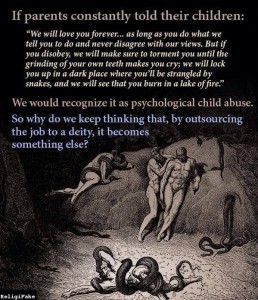
Outsourcing Abuse MemeMaking the rounds of Facebook these days is an anti-religious meme which basically equates religious teaching to child abuse. It says:

If parents constantly told their children:

“We will love you forever . . . as long as you do what we tell you to do and never disagree with our views. But if you disobey , we will make sure to torment you until the grinding of your own teeth makes you cry; we will lock you up in a dark place where you’ll be strangled by snakes, and we will see that you burn in a lake of fire.”

We would recognize it as child abuse.

So why do we keep thinking that, by outsourcing the job to a deity, it becomes something else?

There’s nothing in the meme which specifically mentions Christianity, but because members of our faith so often evangelize by fear, by threatening Hellfire and damnation on those who fail to convert, I’m fairly confident that we can assume the Christian faith to be the target. I wish it weren’t so and I wish I weren’t so sympathetic to the producers of the meme! But, let’s face it, there’s a good deal of really awful theology and really bad evangelism out there.

The truth, however, is that an awful lot (nearly all, in fact) of the mythology of Hell is not found in Holy Scripture. The English word Hell is derived from an ancient Germanic word (hel), which in Norse mythology named a place of eternal punishment. When the Greek Hades (used in the New Testament to name the place of dead) and the Hebrew terms Gehenna or Sheol (used in the Old Testament for the same purpose) were translated into English using this Germanic word, that resulted in a transfer of the pagan concept into Christian theology and its vocabulary.

Then along came poets like Milton and Dante and added all sorts of wonderful, fantastic, and clearly non-biblical imagery to the popular imagination — and, voila! — a full-blown picture of Hell featuring brimstone, lakes of fire, and tormenting demons ruled over by the fallen angel Lucifer, and inhabited by poor human souls condemned to an eternity of pain. One must admit that segments of the church have made full use of this as a scare-tactic mechanism to encourage conversions and to keep the faithful in line, but it was and is wrong to do so. Neither the New Testament Hades nor Old Testament Gehenna had any attached meaning of eternal torment; the Greek signified the place where all the dead, the good, the bad and the indifferent, were thought to go, while the Hebrew terms signified a place of disposal, a place of ending.

It is true that Jesus used imagery of an after-life fire to describe the punishment of unrighteous, but the implication is of annihilation and destruction, not eternal punishment. (See, for example, Matthew 13.) His parables, such as the tale of Dives and Lazarus (Luke 16), cannot be the basis of a theology of eternal torment; parables are metaphoric or analogic teaching tools of limited application and to stretch them beyond their immediate point is to misunderstand and misuse them.

This is especially so when we have his own direct testimony in the Gospel of John. Because of signs displayed in the crowds of many sporting events, many people are familiar with John 3:16 — “For God so loved the world that he gave his only Son, so that everyone who believes in him may not perish but may have eternal life.” And many of us were required to memorize this verse in Sunday School. Few, however, know or memorize the next verse — “Indeed, God did not send the Son into the world to condemn the world, but in order that the world might be saved through him.”

Two things must be observed and emphasized about how these verses describe the mission of the Christ. First, in verse 16 the alternatives are not an eternal life of joy versus an eternal life of punishment; the alternatives are “perishing” (i.e., annihilation and ending) or “eternal life.” Second, the purpose of Jesus’ life, teaching, death, resurrection, and ascension is not to condemn but to save.

The meme, so far as it goes, is accurate. There is way too much bad theology threatening people with Hellfire and damnation; to my way of thinking, any such theology is too much. But the meme is as wrong as those who promulgate the pagan mythology of Hell as a part of the Christian faith. It isn’t and we need to expunge it from our theology and from our vocabulary.

In a word, Hell can go to Hell!

====================

A request to my readers: I’m trying to build the readership of this blog and I’d very much appreciate your help in doing so. If you find something here that is of value, please share it with others. If you are on Facebook, “like” the posts on your page so others can see them. If you are following me on Twitter, please “retweet” the notices of these meditations. If you have a blog of your own, please include mine in your links (a favor I will gladly reciprocate). Many thanks!

====================

Father Funston is the rector of St. Paul’s Episcopal Church, Medina, Ohio.

Spooky Jesus – From the Daily Office – January 20, 2014

From the Gospel of John:

When he was in Jerusalem during the Passover festival, many believed in his name because they saw the signs that he was doing. But Jesus on his part would not entrust himself to them, because he knew all people and needed no one to testify about anyone; for he himself knew what was in everyone.

(From the Daily Office Lectionary – John 2:23-25 (NRSV) – January 20, 2014.)

Jesus Holy CardThe Definition of Chalcedon affirms, in part:

Following the holy fathers, we all with one accord teach men to acknowledge one and the same Son, our Lord Jesus Christ, at once complete in Godhead and complete in manhood, truly God and truly man, consisting also of a reasonable soul and body; of one substance (homoousios) with the Father as regards his Godhead, and at the same time of one substance with us as regards his manhood; like us in all respects, apart from sin . . . .

That last bit is derived from Holy Scripture, specifically from a verse in the Letter to the Hebrews: “We do not have a high priest who is unable to sympathize with our weaknesses, but we have one who in every respect has been tested as we are, yet without sin.” (Heb. 4:15 NRSV)

The Jesus described by the writer of Hebrews and affirmed in the Chalcedonian definition is a man I can follow. There are times when the Jesus described by the writer of the Fourth Gospel creeps me out! This is one of them. The thought that someone could “know all people” and “know what is in everyone” is just spooky.

Now, let me be clear, I am not speaking of the eternal Second Person of the Trinity; I’ve no doubt that God knows all people and knows what is in everyone. But the human person born in early First Century Palestine, who ate and drank and walked around, who expressed joy and disappointment, who got mad, who went to parties, who hiked the roads from town to town, that guy who was “like me in all respects” . . . . I don’t think that Jesus in his human life had access to the divine mind or could have known “what was in everyone.” If he did, he wasn’t like me and what he lived through, what he taught, and his death, resurrection, and ascension have no bearing on my life or meaning for me. He’s too spooky for me!

Years ago I was given a “holy card” which I have since lost. (In the Roman Catholic tradition, holy cards, also called “prayer cards” are small, devotional pictures, often mass-produced for the use of the faithful.) This card had what I’m sure is a very unrealistic portrait of Jesus done in what is technically called “lenticular printing;” that’s the process that makes the printed image seem to change or move as it is viewed from different angles. On that holy card, Jesus’ eyes seemed to move and follow you. It was creepy! When I read about Jesus reading the minds of everyone around him and knowing “what was in everyone,” I think of that spooky holy card.

John does this a lot; this gospel sometimes makes Jesus so divine that the human being gets lost. The wisdom of the biblical canon is that John’s too-divine Jesus is tempered by Mark’s portrait which is too human! (Could the longer ending of Mark’s Gospel, Mark 16:9-20 which includes the Great Commission and a description of Christ’s Ascension, have been added as a corrective to that too-human portrayal? That’s a topic for another exploration.)

I’m not suggesting that John’s Gospel be discounted or overlooked or thrown away. I’m just acknowledging that its mind-reading Jesus who “knew what was in everyone” is someone I wrestle with (like Israel in the desert with the angel of God). He’s spooky and spooky bothers me.

====================

A request to my readers: I’m trying to build the readership of this blog and I’d very much appreciate your help in doing so. If you find something here that is of value, please share it with others. If you are on Facebook, “like” the posts on your page so others can see them. If you are following me on Twitter, please “retweet” the notices of these meditations. If you have a blog of your own, please include mine in your links (a favor I will gladly reciprocate). Many thanks!

====================

Father Funston is the rector of St. Paul’s Episcopal Church, Medina, Ohio.

What’s a Cubit? – From the Daily Office – January 18, 2013

From the Book of Genesis:

God said to Noah, “I have determined to make an end of all flesh, for the earth is filled with violence because of them; now I am going to destroy them along with the earth. Make yourself an ark of cypress wood; make rooms in the ark, and cover it inside and out with pitch. This is how you are to make it: the length of the ark three hundred cubits, its width fifty cubits, and its height thirty cubits.”

(From the Daily Office Lectionary – Genesis 6:13-15 (NRSV) – January 18, 2014.)

Noah's Ark ReconstructionI read those words and heard Bill Cosby’s voice. I’ll bet I’m not alone. More than 50 years ago (1963), Cosby’s debut comedy album Bill Cosby Is a Very Funny Fellow…Right! included a 3-1/2 minute skit he’d been doing on stage entitled Noah: Right! Ever since, it has colored the story of Noah and the ark for Americans; I know people who wouldn’t be born for another quarter century after that album’s release for whom Cosby’s skit is nonetheless an interpretive filter for the Noah story. Millions read the story and hear Noah asking, in Cosby’s voice, “Lord, what’s a cubit?”
In 1979, the comedy sketch troupe Monty Python released a full length movie entitled Month Python’s Life of Brian, which spoofed the life and ministry of Jesus of Nazareth by telling the story of Brian, the baby born in the stable stall next door and who spends his life being mistaken for the messiah. When he is present at the Sermon on the Mount, Brian is at the edge of the crowd among those who are so far away from Jesus they cannot hear clearly what he says. As they struggle to hear and understand Jesus’ words, they have this conversation:

What did he say?
I think it was “Blessed are the cheesemakers.”
Aha, what’s so special about the cheesemakers?
Well, obviously it’s not meant to be taken literally; it refers to any manufacturers of dairy products.

I cannot read the Beatitudes without that dialog coming to mind; I have to bite my lip to keep from laughing. I’m sure that when it is the appointed Sunday Gospel, my parishioners wonder why I have such a goofy expression while reading it!

Because I’m a child of the television generation, I also cannot read the story of Adam and Eve without seeing in memory Bob Newhart and Ruth Buzzi in beige long underwear playing a Garden-of-Eden skit on the old Laugh-In show, or sometimes Richard Basehart as a shipwrecked, alien space-traveling Adam encountering a similarly shipwrecked Eve (the plot of an old Twilight Zone episode).

I’ve two points in mind this morning in recalling these comedy routines to mind. The first is the difficulty of setting aside preconceptions when reading the scriptures. What we think we know about the text may be helpful as we study and interpret it, but it can also be a barrier to hearing it fresh each time to encounter it. I am convinced that the bible speaks to us anew in each reading, and that what we already “know” can and does interfere with our appreciating that. So I struggle to not hear Cosby’s voice, to not understand peacemakers as cheesemakers, to not see Adam climbing out of his space ship.

The second point is rather the opposite of the first, that these comedic or fanciful takes on the stories of the bible are as helpful as they are distracting. I know a lot of people who have a hard time finding humor about God or Jesus or the bible acceptable. My staunch Methodist grandfather frowned upon any humor about church, Sunday School, or other things religious; he considered them disrespectful and (I’m sure) blasphemous.

I find wisdom in a line by Oscar Wilde (from Lady Windemere’s Fan): “Life is far too important a thing ever to talk seriously about it.” The same can be said of the bible. Theologian and author Madeleine L’Engle once wrote, “I take the Bible too seriously to take it all literally” (a quotation often misattributed to Karl Barth). Finding humor or inspiration for fanciful works of fiction and comedy in scripture is part of both taking it seriously and not talking seriously about it. These comedic or fanciful treatments help us hear the scriptures with new ears.

And the question still remains: “What’s a cubit?”

====================

A request to my readers: I’m trying to build the readership of this blog and I’d very much appreciate your help in doing so. If you find something here that is of value, please share it with others. If you are on Facebook, “like” the posts on your page so others can see them. If you are following me on Twitter, please “retweet” the notices of these meditations. If you have a blog of your own, please include mine in your links (a favor I will gladly reciprocate). Many thanks!

====================

Father Funston is the rector of St. Paul’s Episcopal Church, Medina, Ohio.

Obnoxious Jesus – From the Daily Office – January 17, 2014

From John’s Gospel:

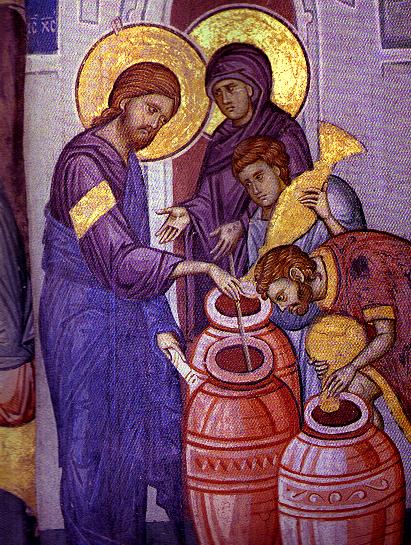
On the third day there was a wedding in Cana of Galilee, and the mother of Jesus was there. Jesus and his disciples had also been invited to the wedding. When the wine gave out, the mother of Jesus said to him, “They have no wine.” And Jesus said to her, “Woman, what concern is that to you and to me? My hour has not yet come.” His mother said to the servants, “Do whatever he tells you.”

(From the Daily Office Lectionary – John 2:1-5 (NRSV) – January 17, 2014.)

Icon of the Wedding at CanaToday is the feast of St. Antony of Egypt. According to a Life of St. Antony written by Athanasius, Antony and his younger sister were orphaned when he was about 18 years of age, inheriting a goodly estate which he began to manage. However, writes Athanasius, six months after his parents’ death he was “turning over in his mind the way the apostles had left everything to follow the Savior” when he heard a sermon on Christ’s encounter with the rich young man whom the Lord instructed, “If you wish to be perfect, go, sell your possessions, and give the money to the poor, and you will have treasure in heaven; then come, follow me.” (Matt. 19:21)

According to Athanasius:

As though this reminder of the saints had ben sent to him by God, and as though that passage had been read specially for his sake, Antony went out immediately, and gave to the villagers the possessions he had inherited from his ancestors — they consisted of some three hundred very pleasant and fertile acres — so that they would not be an encumbrance to him and to his sister. He sold all his possessions and gave the considerable sum h raised to the poor, keeping back only a little of it for his sister.

Again when he went into church, he heard what the Lord said in the gospel, “Do not be anxious about tomorrow.” He could not wait any longer, but went out and gave away even what he had kept back to the poor. He left his sister in the care of some well-known, trustworthy virgins, putting her in a convent to be brought up, and he devoted himself to the ascetic life not far from his home, living in recollection and practicing self-denial.

When I read that, I wondered what Antony’s sister’s reaction to it all might have been . . . . Truthfully, had I been her, my affections toward my older brother would not have been kindled! And then I read this morning’s Daily Office gospel about the wedding at Cana and the (to my mind) very uncomfortable repartee between Jesus and his mother. If we take off the rose-tinted glasses through which the Holy Family and the saints are often viewed and assess this conversation honestly, these are two people talking passed one another and not being terribly pleasant to each other!

When I was in seminary, my New Testament professor Bill Countryman referred to the portrayal of Jesus in the Fourth Gospel as “obnoxious.” In his book The Mystical Way in the Fourth Gospel, Countryman called Jesus’ repeated pattern of hard-to-understand responses to questions “obnoxious discourse.” Jesus seems intent on making his claims as difficult and offensive as possible; everything he says seems designed to irritate the people listening. And, in the story of the wedding at Cana, he seems to be starting with his mother!

Taken together, the story of Antony disposing of the family fortune and this gospel lesson serve as reminders that every family has its “issues.” The saints and holy people whom we revere and to whom we look as exemplars, even Jesus and his mother, were just “regular folks” doing the best they could and trying to work things out as well as possible. Sometimes they were wildly successful and are examples we should seek to emulate. Sometimes we look at them and question their judgments and their actions; not every example is one to follow. In either case, we hope to learn something, even when they are being obnoxious. Perhaps especially when Jesus is obnoxious!

====================

A request to my readers: I’m trying to build the readership of this blog and I’d very much appreciate your help in doing so. If you find something here that is of value, please share it with others. If you are on Facebook, “like” the posts on your page so others can see them. If you are following me on Twitter, please “retweet” the notices of these meditations. If you have a blog of your own, please include mine in your links (a favor I will gladly reciprocate). Many thanks!

====================

Father Funston is the rector of St. Paul’s Episcopal Church, Medina, Ohio.

Geographic Assumptions – From the Daily Office – January 16, 2014

From John’s Gospel:

Nathanael said to [Philip], “Can anything good come out of Nazareth?” Philip said to him, “Come and see.”

(From the Daily Office Lectionary – John 1:46 (NRSV) – January 16, 2014.)

Map  of StereotypesWe make many assumptions based on geography. Think of the all the comedians who make a living in North America by joking about stereotypes of Canadians — the television program South Park has made a running gag of Canadian stereotypes for years! Just try saying, as I truthfully can, “I was born in Las Vegas.” You’ll be very surprised by the reactions and the seriously ridiculous comments (I no longer am).

Although my wife is not a Las Vegan (she’s from a town in northeastern Nevada), we met and were married there. When I say that to someone in her presence — “We were married in Las Vegas” — she always adds “in a large church wedding.” She knows full well that the immediate assumption raised by my statement is that our marriage took place at the Little Chapel in the Parking Lot Behind Caesar’s Palace or some similar establishment.

Nathanael is voicing geographic assumptions in his question to Philip. In word, he is stereotyping.

Nazareth in Galilee, north of Jerusalem, was a nothing town, a poor, back water village of maybe 500 people ignored by nearly everyone, not only the Roman Empire but even by its nearby neighbors. Its residents were the First Century Jewish equivalent of hillbillies. It was not the sort of place from which one expected anything great, or anything at all . . . even an inhabitant of a similar neighboring town (like Bethsaida) could turn his nose up at it!

There are plenty of such places in the world today; there are many, many modern-day Nazareths. Every empire has its left-behind, forgotten, impoverished villages, its places from which no one expects any good thing to come. The spirit of Nazareth lives on in the slums and abandoned neighborhoods of Detroit, of Rio de Janeiro, of Calcutta, of hundreds of cities and towns around the globe.

“Can anything good come from [fill in the blank . . . I’m sure you know a place]?”

Philip’s answer to Nathanael is “Come and see.” God has two answers. The obvious answer: Yes! The less obvious answer is an admonition to stop stereotyping. If we can learn to take off the blinders of our geographic (and other) assumptions, if we can give up the habit of stereotyping, we will see greater things.

====================

A request to my readers: I’m trying to build the readership of this blog and I’d very much appreciate your help in doing so. If you find something here that is of value, please share it with others. If you are on Facebook, “like” the posts on your page so others can see them. If you are following me on Twitter, please “retweet” the notices of these meditations. If you have a blog of your own, please include mine in your links (a favor I will gladly reciprocate). Many thanks!

====================

Father Funston is the rector of St. Paul’s Episcopal Church, Medina, Ohio.

Unknown Ailments – From the Daily Office – January 15, 2014

From the Letter to the Hebrews:

Since, therefore, the children share flesh and blood, he himself likewise shared the same things, so that through death he might destroy the one who has the power of death, that is, the devil, and free those who all their lives were held in slavery by the fear of death.

(From the Daily Office Lectionary – Hebrews 2:14-15 (NRSV) – January 15, 2014.)

Low Back PainWhat is fear of death but fear of the unknown? The fear of death and the unknown brings anxiety, despair, and a frantic search for meaning. The fear of death and the unknown distracts us and makes us afraid to truly live. We end up fearing both death and life; we end up not attending to those things which are most important.

Yesterday, I woke up with an aching lower back. As the day progressed, the ache became acute, changing from ache to stabbing pain; it localized itself on the right side of my back. When the stabbing sensations occurred, the pain radiated around my right flank and into my abdomen. They got worse. “Kidney stone,” I thought, “I must have a kidney stone.” I’ve never had a kidney stone, but what I was experiencing seemed to be exactly what others have described as the symptoms of a kidney stone. I decided to seek medical advice.

It turned out to be no help. Diagnostic activities (urinalysis and a CAT scan) said it wasn’t a kidney stone. So what was it? What is it? It’s still here. I woke up with it again today. I’ve taken pain medication and applied heat, and they have helped with the discomfort . . . but the source remains unknown.

So I am concerned. Is my concern “fear?” Yes, to some extent it is. Is it disabling? It’s certainly distracting! Both the pain, which limits my motion, and the concern (or fear) which keeps my attention focused on it, and thus not on . . . my prayers, my work, my regular activities, the things important in my life . . . the distraction holds me in thrall. My imagination runs wild and I envision all sorts of dire and deadly medical conditions to explain my pain, when I know full well it’s probably nothing more than a pulled muscle. To the extent that I focus on the pain and its unknown source, I am a slave to my discomforts, both physical and psychological.

A petition from an old Scottish litany prays: “From ghoulies and ghosties, and long-leggedy beasties, and things that go bump in the night, Good Lord, deliver us!” It is a prayer for release from the fear of the unknown, a release the Letter to the Hebrews assures us we have already been given. The power of the unknown has been destroyed by God in Jesus sharing our flesh and blood, with all of its aches and pains and unknown ailments.

So today, I choose to be free of the pain. I may still feel it, but I won’t let it or fear of its still-unknown source distract me from getting on with life.

====================

A request to my readers: I’m trying to build the readership of this blog and I’d very much appreciate your help in doing so. If you find something here that is of value, please share it with others. If you are on Facebook, “like” the posts on your page so others can see them. If you are following me on Twitter, please “retweet” the notices of these meditations. If you have a blog of your own, please include mine in your links (a favor I will gladly reciprocate). Many thanks!

====================

Father Funston is the rector of St. Paul’s Episcopal Church, Medina, Ohio.

Angelic Toddlers – From the Daily Office – January 14, 2014

From the Book of Genesis:

The Lord God sent [Adam] forth from the garden of Eden, to till the ground from which he was taken. He drove out the man; and at the east of the garden of Eden he placed the cherubim, and a sword flaming and turning to guard the way to the tree of life.

(From the Daily Office Lectionary – Genesis 2:23-24 (NRSV) – January 14, 2014.)

Putti with Book by Giovanni Battista Tiepolo, 1744Look up cherub in a secular dictionary and this is what you find: “a member of the second order of angels, often represented as a beautiful rosy-cheeked child with wings.” (Collins) I don’t know why, when, or how the fat little boys with aerodynamically inadequate wings came to be an artistic and now normative depiction of cherubs, but there it is! Technically, these little guys (and they are male) are known as putti — an Italian plural; the singular is putto. (Putto is occasionally used in modern Italian to mean a male toddler.)

Say the word cherub (or its adjectival form, cherubic) to nearly anyone, and the image that will spring to his or her mind is almost guaranteed to be a putto. For me, this inaccurate representation of the cherubim has become the poster child for everything that needs to be unlearned.

As the end of the story of the Garden of Eden ought to make clear, the cherubim are beings of immense power, stationed on the path to the tree of life wielding flaming swords. They are the bearers of the throne of God (see Isaiah 37:16). Ezekiel describes the cherubim when recounting his vision of “four living creatures” whom he later identifies as cherubim:

Tetramorph, Fresco at Meteora Monastery

They were of human form. Each had four faces, and each of them had four wings. Their legs were straight, and the soles of their feet were like the sole of a calf’s foot; and they sparkled like burnished bronze. Under their wings on their four sides they had human hands. And the four had their faces and their wings thus: their wings touched one another; each of them moved straight ahead, without turning as they moved. As for the appearance of their faces: the four had the face of a human being, the face of a lion on the right side, the face of an ox on the left side, and the face of an eagle. (Ezek. 1:5b-10; cf. Ezek. 10)

Although our error of imagination in regard to the appearance of the cherubim can be easily corrected by a few minutes of bible study like this, the larger issue of unlearning is not so quickly or easily dealt with.

An old comedy album by the group the Firesign Theatre was entitled Everything You Know Is Wrong. I wouldn’t go that far, but we are conditioned by our families, societies, and culture to “know” many things . . . and much what we “know” as a result of that conditioning is simply inaccurate. Before we can know the truth, we have to unlearn the things of which we are convinced because of our conditioning.

Unlearning, however, is not simply replacing inaccuracies with “true facts.” It is not about right or wrong. Unlearning is an attitude of openness to that which lies beneath the judgment of right or wrong. It is about “moving away from” rather than “moving towards.” Zen masters often use the metaphor of emptying a full cup of tea. There is nothing beyond the emptying. The cup is not emptied so that it can be refilled; it is emptied so that it can be empty. Only when it is truly empty with no expectation or anticipation of being filled is the cup open to the future.

Jesus used another metaphor, that of an innocent child: “Truly I tell you, whoever does not receive the kingdom of God as a little child will never enter it.” (Mark 10:15)

So perhaps our chubby little wingéd friends, those little angelic toddlers, are a good image after all. If they are, as I suggested, the poster children for unlearning, let’s think about the way toddlers receive things.

A way to unlearn might be to try to go back to our first learning experiences and explore new things as toddlers would, through playfulness and curiosity. Toddlers never seem to have a plan, no preconceived notion of where they are going, no expectation of what is coming next. Jiddu Krishnamurti, the Indian philosopher, often described truth as a “pathless land;” toddlers seem to live in such a pathless country, a place of endless discovery. This, I think, is where Jesus invites: to a place where we can open ourselves, empty ourselves, and unlearn our conditioning, to the pathless country of truth where we can wander like a toddler with playfulness and deep curiosity.

====================

A request to my readers: I’m trying to build the readership of this blog and I’d very much appreciate your help in doing so. If you find something here that is of value, please share it with others. If you are on Facebook, “like” the posts on your page so others can see them. If you are following me on Twitter, please “retweet” the notices of these meditations. If you have a blog of your own, please include mine in your links (a favor I will gladly reciprocate). Many thanks!

====================

Father Funston is the rector of St. Paul’s Episcopal Church, Medina, Ohio.

The Boa and the Wart-Hog – From the Daily Office – January 13, 2014

From the Letter to the Hebrews:

“In the beginning, Lord, you founded the earth, and the heavens are the work of your hands; they will perish, but you remain; they will all wear out like clothing; like a cloak you will roll them up, and like clothing they will be changed. But you are the same, and your years will never end.”

(From the Daily Office Lectionary – Hebrews 1:10-12 (NRSV) – January 13, 2014.)

The writer of the Letter to the Hebrews quotes from Psalm 102 and asserts that the words are spoken by God the Father to the Son. In The Book of Common Prayer (TEC 1979), the verses quotes read:

Constrictor with Prey

In the beginning, O Lord, you laid the foundations of the earth,
and the heavens are the work of your hands;
They shall perish, but you will endure; they all shall wear out like a garment;
as clothing you will change them, and they shall be changed;
But you are always the same,
and your years will never end.
(Psalm 102:25-27 – BCP Version)

The lessons today focus on beginnings — the Old Testament lesson is the second (but older) creation story from the Book of Genesis and the Gospel lesson is the prologue of John’s Gospel. The epistle and the psalm which it quotes, however, remind us of endings: created things “will all wear out like clothing; like a cloak you will roll them up.” I’ve always thought that a wonderful poetic metaphor for theoretical entropic nature of the universe, the idea that all of the matter and energy in the universe will ultimately degrade to a state of inert uniformity.

That these lessons of cosmic beginnings and endings are on the lectionary today is a coincidence that somehow seems appropriate as the world says “Good-bye” to Dr. Ian Barbour, who died yesterday at the age of 90. Barbour was a physicist who embraced the truth of the Christian faith while holding fast to the ethic of scientific inquire; he demonstrated to the world that there is no contradiction between the pre-scientific religious stories of creation and the scientific explanation of the universe’s beginnings.

When he won the Templeton Prize in 1999, Dr. Barbour said:

If we take the Bible seriously but not literally, we can accept the central biblical message without accepting the prescientific cosmology in which it was expressed, such as the three-layer universe with heaven above and hell below, or the seven days of the creation story.

In his book Religion in an Age of Science (Harper San Francisco: 1990), Dr. Barbour proposed a colorful metaphor for the relationship between science and religion, decrying what he called (with characteristic understatement) the “misuse” of each in the extremes of scientific materialism and biblical literalism:

Warthog

In a fight between a boa constrictor and a wart-hog, the victor, whichever it is, swallows the vanquished. In scientific materialism, science swallows religion. In biblical literalism, religion swallows science. The fight can be avoided if they occupy separate territories or if, as I will suggest, they each pursue more appropriate diets.

He wrote that “our personal and social lives are intimately bound to the rest of the created order. We are redeemed in and with the world, not from the world. Part of our task, then, is to articulate a theology of nature, for which we will have to draw from both religious and scientific sources.” The wart-hog and the boa constrictor each have their part to play and their perspectives to contribute. Unfortunate, there are many who still encourage them to fight to the death rather than change their diets and cooperate. We need fewer leaders of that sort in both religion and science, and more like Dr. Barbour, to whom we say, “Well done, good and faithful servant; rest in peace and rise in glory.”

====================

A request to my readers: I’m trying to build the readership of this blog and I’d very much appreciate your help in doing so. If you find something here that is of value, please share it with others. If you are on Facebook, “like” the posts on your page so others can see them. If you are following me on Twitter, please “retweet” the notices of these meditations. If you have a blog of your own, please include mine in your links (a favor I will gladly reciprocate). Many thanks!

====================

Father Funston is the rector of St. Paul’s Episcopal Church, Medina, Ohio.

« Older posts Newer posts »