Occasional thoughts of an Anglican Episcopal priest

Category: Church (Page 69 of 115)

Irrelevant Shouting – From the Daily Office – August 17, 2013

From the Second Book of Samuel:

David and his men went on the road, while Shimei went along on the hillside opposite him and cursed as he went, throwing stones and flinging dust at him.

(From the Daily Office Lectionary – 2 Samuel 16:13 (NRSV) – August 17, 2013.)

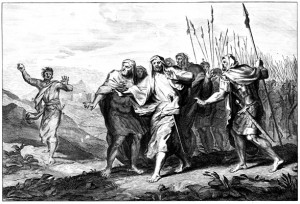
Shimei Curses David by Otto ElligerToday’s Old Testament reading describes part of what happened during the conflict between David and his rebellious son Absalom. Making his way from Hebron to Jerusalem, David is accosted by a Benjamite, Shimei the son of Gera, who curses and berates him, throws stones and dust at him, and predicts disaster ahead.

It is accompanied by a reading from the Gospel of Mark describing Jesus’ triumphal entry into Jerusalem:

Those who went ahead and those who followed were shouting, “Hosanna! Blessed is the one who comes in the name of the Lord! Blessed is the coming kingdom of our ancestor David! Hosanna in the highest heaven!” (Mark 11:10-11)

Quite a contrast, isn’t it? But here’s the thing, neither Shimei’s curses of David nor the Jerusalem crowd’s praises of Jesus accurately predicted the future. Although David’s son Absalom died in the conflict, and to a father that would be disaster, David did not; his rule as king over Israel was long and prosperous, and is considered a “golden age.” Jesus’ entry into Jerusalem would end in less than a week with his death by crucifixion.

That’s something to remember. The voices all around us, whether critical or flattering, whether damning or praising, do not foretell our future. As irritating or pleasant as they may be, they are of little import. What matters is the voice within. What matters is what we tell ourselves and what we believe we hear of the Voice of God, that still small voice that is often drowned out by the irrelevant shouting along the side of the road.

====================

A request to my readers: I’m trying to build the readership of this blog and I’d very much appreciate your help in doing so. If you find something here that is of value, please share it with others. If you are on Facebook, “like” the posts on your page so others can see them. If you are following me on Twitter, please “retweet” the notices of these meditations. If you have a blog of your own, please include mine in your links (a favor I will gladly reciprocate). Many thanks!

====================

Father Funston is the rector of St. Paul’s Episcopal Church, Medina, Ohio.

The Stones of Zion: the Hardscape of Salvation – From the Daily Office – August 16, 2013

From the Psalter:

You will rise up and have compassion on Zion,
for it is time to favor it;
the appointed time has come.
For your servants hold its stones dear,
and have pity on its dust.

(From the Daily Office Lectionary – Psalm 102:13-14 (NRSV) – August 17, 2013.)

Rocky PathMy parish is currently undertaking a building renovation which will include redoing some of the concrete pathways and landscaping. In the process of overseeing this work, I’ve learned a new word – hardscape – which means the area of a designed landscape made up of hard wearing materials such as stone, concrete, and similar construction materials. I’ve been thinking about rocks and stones for the better part of a month. That’s why I haven’t written one of these meditations . . .

I got hung up on an image from the Old Testament reading for July 22, 2013, which included this verse: “Saul took three thousand chosen men from all Israel and went to seek David and his men in front of the Rocks of the Wild Goats.” I couldn’t get that description, “the Rocks of the Wild Goats,” out of my mind. I’ve read the Daily Office lessons everyday, but as I thought about them, I kept coming back to “the Rocks of the Wild Goats.” And then, this morning’s Psalm has this bit about the stones of Zion and something clicked.

The Stones of Zion: the Hardscape of Salvation

Slipping from my hand
The looking glass falls to the rocky path
In a glittering crescendo
It shatters into shards of shimmering shine
And crashing crystalline cacophony

Saul went in the direction
Of the Rocks of the Wild Goats
In a dark and stony cavern
David silently snipped the corner of his cloak
And saved the king

Jesus walked the way of weary tears
Up the stony slope of an escarpment shaped like a skull
On that dark and windswept hillside
Soldiers tossed dice for a seamless tunic
And killed a king

The women gathered grieving in the garden
Beside a boulder that had blocked a burial vault
On a dark and cheerless morning
Magdalen turned from an empty shroud
And beheld her king

Slipped from my hand
The shattered mirror of my life fallen on a path
Strewn with goat rocks, gravelly skulls, and tombstones
The glittering, shimmering shards lovingly gathered
And saved by a king

====================

A request to my readers: I’m trying to build the readership of this blog and I’d very much appreciate your help in doing so. If you find something here that is of value, please share it with others. If you are on Facebook, “like” the posts on your page so others can see them. If you are following me on Twitter, please “retweet” the notices of these meditations. If you have a blog of your own, please include mine in your links (a favor I will gladly reciprocate). Many thanks!

====================

Father Funston is the rector of St. Paul’s Episcopal Church, Medina, Ohio.

Be Dressed for Action — Sermon for the 12th Sunday after Pentecost (Proper 14C) — August 11, 2013

====================

This sermon was preached on the Twelfth Sunday after Pentecost, August 11, 2013, at St. Paul’s Episcopal Church, Medina, Ohio, where Fr. Funston is rector.

(Revised Common Lectionary, Pentecost 12 (Proper 14, Year C): Isaiah 1:1,10-20; Psalm 50:1-8,23-24; Hebrews 11:1-3,8-16; and Luke 12:32-40. These lessons can be read at The Lectionary Page.)

====================

Children in British Slum, circa 1955We are used to thinking of the Book of Isaiah as the work of a single prophet, but it is really three books: First Isaiah, comprising chapters 1-39; Second Isaiah, made up of chapters 40-55; and Third Isaiah, chapters 56-66. These three prophets did their work in three different and distinct periods in Jewish history: the late 8th Century BCE; the mid-6th Century BCE, and the late 6th Century BCE, respectively. This is clear from evidence in their writings: their themes vary and each prophet speaks from a different location. First Isaiah is clearly set in pre-exilic Jerusalem; Second Isaiah was obviously written in Babylon; Third Isaiah speaks from post-exilic Jerusalem. Nonetheless, there is a sense of unity in the writings that make up this book. Phrases and themes recur, and there are linkages later and earlier passages. Today’s reading is from First Isaiah and introduces a topic which will be taken up again by Second and Third Isaiah: what constitutes proper worship?

Ritual worship in First Isaiah’s day was centered at the Temple in Jerusalem. Prof. James T. Dennison, Jr., of Northwest Theological Seminary, in an article about today’s reading from Isaiah describes the cultic activity:

At the temple, there were throngs of people. Multitudes trampled the courts of the temple – hustle and bustle, service upon service, activity upon activity. On the Sabbath; at the monthly new moon service; at the appointed feasts – Passover, Pentecost, Yom Kippur, Tabernacles. Why you couldn’t keep the good folks away. And offerings – did they bring offerings! Burnt offerings, peace offerings, grain offerings – why what more could you ask? All that Moses prescribed, they brought. Piety by the bushel; holiness by the herd; sanctity by the sheepfold. And the fellowship – oh, the friends they met and the people they talked to, the news they caught up on and the gossip they passed on. And the motions – why they spread out their hands in prayer. They lifted their arms to the sky – what a pious sight, the smoke of their offerings ascending and the ascension of these holy hands. What ecstasy! What piety! What religiosity! (A Tale of Two Cities: Isaiah and Worship)

“What liturgical hypocrisy!” cries Isaiah. Isaiah condemns this worship as so much theater in the absence of care for the weakest in society; God, he says, rejects liturgical activities devoid of the pursuit of justice and righteousness. The stinging critique of worship that we heard in today’s Old Testament lesson is not an indictment of worship in general. Rather, the prophet tells us that God takes no joy in the pomp and circumstance when it is accompanied by unjust behavior, when in fact it covers up injustice:

When you stretch out your hands, I will hide my eyes from you; even though you make many prayers, I will not listen; your hands are full of blood. Wash yourselves; make yourselves clean; remove the evil of your doings from before my eyes; cease to do evil. (Isa. 1:15-16)

It is a cry his successor, Third Isaiah, will take up two centuries later condemning hollow, hypocritical ritual fasting: the fast that God chooses, he says, is “to loose the bonds of injustice, to undo the thongs of the yoke, to let the oppressed go free, and to break every yoke.” (Isa. 58:6) The worship offered those whose hands are full, metaphorically, with the blood of the oppressed will not be accepted; the blood of animals offered in sacrificial worship will not atone for the injustice in the community. The emptiness of the ritual reminds the Divine Judge of society’s crimes against its weaker and less fortunate members.

Isaiah calls on his listeners, the worshipers of ancient Judah and worshipers in modern America, to hear the word of the Lord, the torah of God: “Learn to do good; seek justice, rescue the oppressed, defend the orphan, plead for the widow.” (Isa. 1:17)

This is precisely what Jesus says in today’s Gospel lesson: “Sell your possessions, and give alms. Make purses for yourselves that do not wear out, an unfailing treasure in heaven, where no thief comes near and no moth destroys. For where your treasure is, there your heart will be also.” (Lk. 12:33-34) And then he gives his famously imprecise warning of the Second Coming: “Be alert, be ready, be dressed for action, because you don’t when it will be.” How does one do this? By doing the things Jesus has already mentioned. As Lutheran pastor John Petty puts it:

If one’s treasure has been kept to one’s self, one’s treasure is always at risk. If one’s treasure has been given to the poor, it is “unfailing.” If your treasure is with yourself, your heart is directed toward yourself. If your treasure has been given to the poor, your heart is with the poor — or, in other words, with God. (Progressive Involvement)

“And why do you worry about clothing? Consider the lilies of the field, how they grow; they neither toil nor spin, yet I tell you, even Solomon in all his glory was not clothed like one of these.” (Matt. 6:28-29) If you have clothed the naked, you are dressed and ready to go. It’s like Jesus said at another time:

I was hungry and you gave me food, I was thirsty and you gave me something to drink, I was a stranger and you welcomed me, I was naked and you gave me clothing, I was sick and you took care of me, I was in prison and you visited me. * * * Just as you did it to one of the least of these who are members of my family, you did it to me. (Matt. 25:35-36,40)

The answer to the “how” question begs the next inquiry . . . when? That the tough one because we are dealing with what has been called “the uncertain certainty of Christ’s return.” Remember, Jesus said no one, including himself, would know when that day would come; like the old television show Candid Camera, it will happen when we least expect it. A ministerial colleague of mine in a more conservative evangelical tradition once commented, “We have focused so much emotional energy on the expectation that we have not done the work to be done before Jesus returns.” It’s just so much theater in the absence of care for the weakest in society. God takes no joy in ritual liturgy or any worship unaccompanied by righteous behavior and justice.

In the late 19th and early 20th Centuries, our own Anglican tradition was divided between those who favored a more ceremonial, ritual style of liturgy, commonly called Anglo-Catholics, and those who favored far less ritual in worship. The latter, generally referred to as Evangelicals or as “the Low Church Party” would have said that liturgy such as we usually celebrate now is “hollow and unsatisfying, ceremonial . . . in place of the life-giving Word.” In an Evangelical Australian publication it was denounced in terms nearly as prophetic as Isaiah’s:

We never read once of Paul, or Peter, or of any of the other apostles having lights and swinging censers and vestments and copes and mitres and chasubles, and elaborate processions, and so forth. * * * Seen in the clear light of the Word of God, [ritual worship] is not only blasphemous, but idolatrous. It is absolutely opposed to Scriptural teaching. (The Signs of the Times, August 27, 1923)

Eventually, as common Prayer Book liturgy makes clear, we Anglicans arrived (as is our wont) at a compromise encompassing many styles of worship and settling into the broad liturgical practices of today. But the concern of Isaiah for ritual worship accompanied by social justice was not lost on the Anglo-Catholics.
At the Second Anglo-Catholic Congress held in London in 1923, the Bishop of Zanzibar, the Right Reverend Frank Weston, closed the meeting with an address entitled Our Present Duty. The last words of Bishop Weston’s address, which could as easily be spoken to 21st Century Americans, are these:

I say to you, and I say it to you with all the earnestness that I have, that if you are prepared to fight for the right of adoring Jesus in his Blessed Sacrament, then you have got to come out from before your Tabernacle and walk, with Christ mystically present in you, out into the streets of this country, and find the same Jesus in the people of your cities and your villages. You cannot claim to worship Jesus in the Tabernacle, if you do not pity Jesus in the slum.

Now mark that — this is the Gospel truth. If you are prepared to say that the [Christian] is at perfect liberty to rake in all the money he can get no matter what the wages are that are paid, no matter what the conditions are under which people work; if you say that the [Christian] has a right to hold his peace while his fellow citizens are living in hovels below the levels of the streets, this I say to you, that you do not yet know the Lord Jesus in his Sacrament. You have begun with the Christ of Bethlehem, you have gone on to know something of the Christ of Calvary — but the Christ of the Sacrament, not yet. Oh brethren! if only you listen to-night your movement is going to sweep [this nation]. If you listen. I am not talking economics, I do not understand them. I am not talking politics, I do not understand them. I am talking the Gospel, and I say to you this: If you are Christians then your Jesus is one and the same: Jesus on the Throne of his glory, Jesus in the Blessed Sacrament, Jesus received into your hearts in Communion, Jesus with you mystically as you pray, and Jesus enthroned in the hearts and bodies of his brothers and sisters up and down this country. And it is folly — it is madness — to suppose that you can worship Jesus in the Sacraments and Jesus on the Throne of glory, when you are sweating him in the souls and bodies of his children. It cannot be done.

There then, as I conceive it, is your present duty; and I beg you, brethren, as you love the Lord Jesus, consider that it is at least possible that this is the new light that the Congress was to bring to us. You have got your Mass, you have got your Altar, you have begun to get your Tabernacle. Now go out into the highways and hedges where not even the Bishops will try to hinder you. Go out and look for Jesus in the ragged, in the naked, in the oppressed and sweated, in those who have lost hope, in those who are struggling to make good. Look for Jesus. And when you see him, gird yourselves with his towel and try to wash their feet.

(Our Present Duty, slightly amended. Bishop Weston said “Anglo-Catholic” rather than “Christian” and “England” rather than “the nation” – but with those simple amendments this statement applies as well to church members in the contemporary United States as it did to Anglo-Catholics in the England of a century ago.)

Another Anglican a century and a half earlier summarized the Christian duty somewhat more succinctly. Although it is disputed that John Wesley ever actually uttered what is now known as “John Wesley’s Rule,” it certainly accords with his preaching, with today’s lesson from Isaiah’s prophecy, and with the Gospel:

“Do all the good you can,
by all the means you can,
in all the ways you can,
in all the places you can,
at all the times you can,
to all the people you can,
as long as ever you can.”

This understanding and appreciation for the meaning behind Isaiah’s prophecy, his condemnation of worship not connected to a ministry of social justice has been a part of our Anglican ethos from the very beginning. Shortly after the Church of England separated from Rome, when Archbishop Thomas Cranmer and his collaborators produced the first English Book of Common Prayer in 1549, they included at the end of the rite of Holy Communion a closing prayer which included this petition:

We therfore most humbly beseche thee, O heavenly father, so to assist us with thy grace, that we may continue in that holy felowship, and doe all suche good woorkes, as thou hast prepared for us to walke in.

That prayer, or one very much like it, has been used to end Anglican services of the Holy Eucharist for nearly 500 years. In our current American Prayer Book we have a descendent of that prayer in contemporary English which includes the modern version of that petition:

And now, Father, send us out to do the work you have given us to do, to love and serve you as faithful witnesses of Christ our Lord.

Floating around the internet recently, being “tweeted” on Twitter and “shared” on Facebook, is a “meme” which also echoes Isaiah. A “meme” is a photograph over which has been superimposed, using Photoshop or some other graphics application, a caption. (Often the caption may seem to have nothing to with the picture.) This particular “meme” shows a man sitting on the floor of a work bay in an auto repair facility. The caption reads: “Sitting in church for an hour on Sunday morning doesn’t make you a Christian any more than sitting in a garage makes you a car.” A bit snarky, perhaps, but the message is clearly the same as First Isaiah’s.

Whether that prophet eight centuries before Christ, or Third Isaiah two centuries later, or Christ himself in the First Century, Cranmer in the 16th, Wesley in the 18th, the Evangelicals or Bishop Weston in the early 20th Century, or a snarky Facebook “meme” in the 21st, the message is the same: worship devoid of social justice and righteousness is unacceptable!

“Sell your possessions, and give alms.” (Luke 12:33)

“Sell your possessions, and give alms.” (Luke 12:33)

“Wash yourselves; make yourselves clean. * * * Learn to do good; seek justice, rescue the oppressed, defend the orphan, plead for the widow. ” (Isaiah 1:16-17)

“Be dressed for action and have your lamps lit.” (Luke 12:35)

Amen.

====================

A request to my readers: I’m trying to build the readership of this blog and I’d very much appreciate your help in doing so. If you find something here that is of value, please share it with others. If you are on Facebook, “like” the posts on your page so others can see them. If you are following me on Twitter, please “retweet” the notices of these meditations. If you have a blog of your own, please include mine in your links (a favor I will gladly reciprocate). Many thanks!

====================

Father Funston is the rector of St. Paul’s Episcopal Church, Medina, Ohio.

God Our Mother — Sermon for the 11th Sunday after Pentecost (Proper 13C) — August 4, 2013

====================

This sermon was preached on the Eleventh Sunday after Pentecost, August 4, 2013, at St. Paul’s Episcopal Church, Medina, Ohio, where Fr. Funston is rector.

(Revised Common Lectionary, Pentecost 11 (Proper 13, Year C): Hosea 11:1-11; Psalm 107:1-9, 43; Colossians 3:1-11; and Luke 12:13-21. These lessons can be read at The Lectionary Page.)

====================

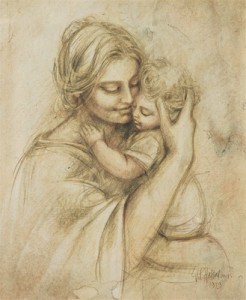
Drawing of Mother Holding Baby, Artist UnknownThis passage is one of my favorites in the book of the prophet Hosea. Hosea’s major metaphor for the relationship of God with Israel, as we learned last week, is that of marriage. Hosea portrayed God as Israel’s “husband” and condemned the nation because of the “adulterous” relationship it had had with other gods. As a “prophetic act” Hosea married a prostitute named Gomer, with whom his relationship parallels that of God with Israel. He tells of Gomer running away from him and having sex with another man, but he loves her and forgives her. Similarly, even though the people of Israel worshiped other gods, Hosea prophesied that Yahweh continues to love his people and does not abandon God’s covenant with them. This passage, however, departs from that metaphor and presents, instead, an image of God as Divine Parent, an image which is surprisingly feminine and maternal.

When Israel was a child, I loved him,
and out of Egypt I called my son.
* * *
It was I who taught Ephraim to walk,
I took them up in my arms;
but they did not know that I healed them.
I led them with cords of human kindness,
with bands of love.

In these verses God is portrayed as an adoptive parent. God’s lovingly brought Israel out of Egypt, cared for Israel, taught, comforted, healed, and nurtured Israel. The Divine Adoptive Parent nurtured this child, taught the child to walk, held this child in times of suffering and anguish, offered healing when he was injured. But just as Hosea’s earlier metaphor likened God to a cuckolded husband, God is now an abandoned parent.

Israel’s disobedient and defiant nature becomes clear as God offers a general indictment against Israel’s idolatry.

The more I called them,
the more they went from me;
they kept sacrificing to the Baals,
and offering incense to idols.

The Baals are competitor gods to Yahweh. They were local gods, represented by fertile fields, jars of olive oil, the smell of baking bread, the aroma of roasting meat. They appealed to the senses and to one’s immediate sense of satisfaction and well-being. In the Spring, the followers of the Baals would cry “Baal is alive” through the villages, and the worshipers of Yahweh would joined; they were hedging their bets hoping to ensure a bounteous crop and a satisfied family. The cult of Yahweh demanded worship in sometimes far-away sacred places. Sacrificial worship hadn’t yet been centralized at Jerusalem, but there were only a few places where it cold be offered. The Baals were more immediate so many Israelites would take out a little insurance and serenade Baal along with the neighbors. After all, where was YHWH anyway and what has he done for you recently?

These Baals of satisfaction and well-being are precisely the “gods” which got the attention of the rich man in the Gospel parable Jesus tells today.

The land of a rich man produced abundantly. And he thought to himself, ‘What should I do, for I have no place to store my crops?’ Then he said, ‘I will do this: I will pull down my barns and build larger ones, and there I will store all my grain and my goods. And I will say to my soul, ‘Soul, you have ample goods laid up for many years; relax, eat, drink, be merry.’ But God said to him, ‘You fool! This very night your life is being demanded of you. And the things you have prepared, whose will they be?’ So it is with those who store up treasures for themselves but are not rich toward God.

And so it was with the people of ancient Israel:

They shall return to the land of Egypt,
and Assyria shall be their king,
because they have refused to return to me.
The sword rages in their cities,
it consumes their oracle-priests,
and devours because of their schemes.
My people are bent on turning away from me.
To the Most High they call,
but he does not raise them up at all.

It was not the Baals who accomplished those things that many believed they had done; it was not they who were nurturing Israel; it was Yahweh! And like a spurned husband, like a rejected parent, Yahweh was angry! God, rejected and spurned, is furious and, frankly, vindictive. God will throw Israel out of the promised land. God will send them back to Egypt or turn them over to the invading Assyrians. God will allow war to consume the people and their lying priests. God is disgusted by their schemes. They think they have ample goods laid up for many years, so that they can relax, eat, drink, and be merry. God will show them what fools they are! God feels the indignation and rage that any parent might toward a disrespectful child.

Bu then, God rises above this anguish and anger; we are privileged to witness Yahweh’s churning emotional conflict commitment, the turmoil deep within God’s heart:

How can I give you up, Ephraim?
How can I hand you over, O Israel?
* * *
My heart recoils within me;
my compassion grows warm and tender.
I will not execute my fierce anger;
I will not again destroy Ephraim;
for I am God and no mortal,
the Holy One in your midst,
and I will not come in wrath.

At the heart of this passage are two Hebrew words, one of which is translated as “heart”; the other, as “compassion”. The first is leb and in Judaic understanding it refers not merely to the body’s physical heart, but to the innermost being of the human person. It refers to the center of personal life, to a human being’s psychic and spiritual energies upon which the whole moral and religious condition of a person completely depends. Here, it is God who has this sort of inner core of being, and the center of God’s Being is inextricably linked in Hosea’s prophecy with God’s compassion, not with Yahweh’s righteous anger and wrath . . . God’s essential Being is eternally and indelibly characterized by love and compassion.

Our English word compassion derives from the Latin for “suffering together”; compassion is the ability to share in the suffering of another, to be empathetic. There are two Hebrew words translated as “compassion;” Hosea uses them both. Although in this passage he uses is nichuwm, which has its root in the concept of regret or sorrow, elsewhere he describes God’s compassion using the synonym rechemet, which comes from the Hebrew root rechem which literally means “womb”. The Hebrew understanding of compassion is deeply maternal, rooted in a profound metaphor of birthing and motherhood; compassion in Hebrew thought might best be conceived not as “shared suffering”, but as “womb love”.

This word applied to God conjurs a beautiful image of God as our mother doing all the amazing and miraculous things a life-giving, nurturing mother does. She protects her child; she nourishes, cradles, and prepares her child. Whether she gives birth to the child or adopts the child, how can she give up or forget her child? “Can a woman forget her nursing child, or show no compassion for the child of her womb?” asks God in book of the prophet Isaiah, “Even these may forget, yet I will never forget you.” (Isaiah 49:15)

The 14th Century mystic and saint, Dame Julian of Norwich (1342-1416), wrote of God our Mother with these words:

It is a characteristic of God to overcome evil with good.

Jesus Christ therefore, who himself overcame evil with good, is our true Mother. We received our ‘Being’ from Him ­ and this is where His Maternity starts ­ And with it comes the gentle Protection and Guard of Love which will never ceases to surround us.

Just as God is our Father, so God is also our Mother.

And He showed me this truth in all things, but especially in those sweet words when He says: “It is I”.

As if to say, I am the power and the Goodness of the Father, I am the Wisdom of the Mother, I am the Light and the Grace which is blessed love, I am the Trinity, I am the Unity, I am the supreme Goodness of all kind of things, I am the One who makes you love, I am the One who makes you desire, I am the never-ending fulfillment of all true desires. (…)

Our highest Father, God Almighty, who is ‘Being’, has always known us and loved us: because of this knowledge, through his marvelous and deep charity and with the unanimous consent of the Blessed Trinity, He wanted the Second Person to become our Mother, our Brother, our Savior.

It is thus logical that God, being our Father, be also our Mother. Our Father desires, our Mother operates and our good Lord the Holy Ghost confirms; we are thus well advised to love our God through whom we have our being, to thank him reverently and to praise him for having created us and to pray fervently to our Mother, so as to obtain mercy and compassion, and to pray to our Lord, the Holy Ghost, to obtain help and grace. (From “Revelations of Divine Love”, LIX, LXXXVI).

We may, like the ancient Israelites or like the man in Christ’s gospel parable this morning, be tempted away from God by those things which seem to satisfy our immediate needs, by fertile fields, jars of olive oil, the smell of baking bread, the aroma of roasting meat; we may believe that we have ample goods laid up for many years, and so be tempted to relax, eat, drink, and be merry. But let us never forget the source of all those things. As the Psalm today recalls to us, it is God who puts our feet on a straight path; it is the Lord who does wonders for his children; it is God who satisfies the thirsty and fills the hungry with good things. Hosea reminds us that we are God’s children and that at the center of God’s Being is the womb-love of a mother for her child, for us.

Whoever is wise will ponder these things,
and consider well the mercies of the Lord.

Amen.

====================

A request to my readers: I’m trying to build the readership of this blog and I’d very much appreciate your help in doing so. If you find something here that is of value, please share it with others. If you are on Facebook, “like” the posts on your page so others can see them. If you are following me on Twitter, please “retweet” the notices of these meditations. If you have a blog of your own, please include mine in your links (a favor I will gladly reciprocate). Many thanks!

====================

Father Funston is the rector of St. Paul’s Episcopal Church, Medina, Ohio.

God’s Faithfulness Prevails — Sermon for the 10th Sunday after Pentecost (Proper 12C) — July 28, 2013

====================

This sermon was preached on the Tenth Sunday after Pentecost, July 28, 2013, at St. Paul’s Episcopal Church, Medina, Ohio, where Fr. Funston is rector.

(Revised Common Lectionary, Pentecost 10 (Proper 12, Year C): Hosea 1:2-10; Psalm 85; Colossians 2:6-19; and Luke 11:1-13. These lessons can be read at The Lectionary Page.)

====================

Baptism“Name this child.” That’s what I say to parents of infant baptismal candidates as I take their children from them. The words are not actually written in the baptismal service of The Book of Common Prayer as they are in some other traditions’ liturgies, but there is a rubric on page 307 that says, “Each candidate is presented by name to the Celebrant . . . .” so asking for the child’s name is a practical way of seeing that done. It’s practical, but it’s also a theological statement.
There is a common religious belief found in nearly all cultures that knowing the name of a thing or a person gives one power over that thing or person. One finds this belief among African and North American indigenous tribes, as well as in ancient Egyptian, Vedic, and Hindu traditions; it is also present in all three of the Abrahamic religions, Judaism, Christianity, and Islam.

The naming we do at baptism echoes the naming that takes place in Jesus’ tradition as a faithful Jew. In Judaism, when a male infant is circumcised on the eighth day after his birth, the mohel who performs the brit milah prays, “Our God and God of our fathers, preserve this child for his father and mother, and his name in Israel shall be called ________” and the prayer continues that, by his naming, the infant will be enrolled in the covenant of God with Israel. The same thing is done when a girl is named in the ceremony called zeved habat, or “presentation of the daughter” at the first formal reading of the Torah following her birth. In baptism, we do the same; the church says to its newest member, “This is who you are: washed in the waters of baptism, sealed by the Holy Spirit, and marked as Christ’s own forever,” a brother or sister in the church, a fellow member of the household of God.

To give a name to anything, especially to another human being, is a powerful thing! In the first verses of Genesis we are told, “God said ‘Let there be Light’ and there was light.” (Gen. 1:3) God named the light before it was created; this process continues through the rest of the story. God says, “Let there be” and names the thing which will come into existence; the naming seems a necessary first step in creation. There is a sense in which the name given shapes the future of the thing, or of the person, named.

So this morning I will ask that question of Danny and Nikki ___________ (parents) and of Peter ___________ (Godfather) who will name Ryan George __________ (infant) as a child of God, and of Mary __________ (sponsor) who will name Jacqueline Ann ____________ (adult) as a child of God, and through baptism we all will welcome Ryan and Jackie into the household of faith, into a covenant relationship with Almighty God and with each of us.

In today’s lesson from the Prophet Hosea, we find God instructing the prophet to give strange and bewildering names to his children as powerful, prophetic signs of Israel’s broken relationship with God. Hosea’s firstborn son is to be named Jezreel, which refers to the location of a particularly brutal and bloody massacre of Israelite royalty; his daughter is to be called, Lo-ruhamah, which means “no pity,” as a sign that God will have no compassion for his people who have gone astray; and a second son is to be named, Lo-ammi, which means “no people,” to let the Israelites know they are no longer God’s people.

Preachers often use their children as sermon illustrations, but what God demands of Hosea seems a little extreme. These poor kids aren’t going to have to live merely with the embarrassment of a single sermon, they are going to live with these names, these prophetic, judgmental names for their entire lives! But as bad as that is, giving these awful names to his children is not the hardest thing God demands of Hosea. No, the hardest thing is marrying their mother, Gomer.

Hosea is ordered by God to (in the words of our NRSV translation) “take for yourself a wife of whoredom and have children of whoredom.” He is to marry a prostitute who will continue in her scandalous and adulterous behavior, even though Hosea will be faithful to her throughout the marriage. Why? Because it is a prophetic sign, a prophetic action symbolizing the way in which Israel has dealt with God: because “the land commits great whoredom by forsaking the Lord.” God loves Israel with all the passion and loyalty of a faithful husband, but Israel, like a promiscuous wife, has been unfaithful to God.

It is an unfortunate prophetic metaphor, for it is misogynistic to the core! Portraying God as a faithful (but dominant) husband and Israel as a supposed-to-be obedient (and submissive) wife perpetuates a patriarchalism that is inappropriate to our society. As a metaphor it may have communicated clearly to its ancient Israelite audience, but it doesn’t communicate quite so clearly to us, clouded as it is with its ancient cultural bias. So as we read and seek to understand Hosea’s message in our day and age, we must extract the meaning from the metaphor and then, perhaps, cast the metaphor aside, separating the kernel of truth from the chaff of historical baggage.

In the modern world, marriage is not the patriarchal, male-dominated institution it was in Hosea’s time, but the metaphor can still work for us. In our Prayer Book, the meaning of marriage is summarized in the introductory comments with which the presiding minister begins the ceremony. We are told that it is a bond and covenant established by God in creation and that the union of the parties “in heart, body, and mind is intended by God for their mutual joy [and] for the help and comfort given one another in prosperity and adversity.” (BCP 1979, page 423)

Later in the service, just before the Nuptial Blessing is given, we pray for the couple that “each may be to the other a strength in need, a counselor in perplexity, a comfort in sorrow, and a companion in joy,” and that “their life together [may be] a sign of Christ’s love to this sinful and broken world, that unity may overcome estrangement, forgiveness heal guilt, and joy conquer despair.” (Page 429) In such a relationship neither party dominates the other, neither is submissive; it is a mutual and interdependent bond of covenant obligations, one to the other.

When Hosea’s prophetic metaphor is understood in these terms, it emphasizes that God is angry with God’s people for abandoning the covenant obligations they had to God, even as God remained faithful. What Hosea’s marriage metaphor communicates to us, as it did to his ancient audience, is that it is divine fidelity, not human inconstancy, that will ultimately save the relationship. It is God’s faithfulness, not our own, which prevails and redeems our relationship with God.

This is also the message of the author of the Letter to the Colossians, an epistle traditionally said to have been written by St. Paul, but which is now no longer believed to be of his authorship. The reason for that is in the very part of the text on which I want to focus our attention, the sentence where the author writes: “When you were buried with [Christ] in baptism, you were also raised with him through faith in the power of God, who raised him from the dead.” The author seems to echo Paul’s understanding of baptism in the Letter to the Romans, particularly a section we read every year on Easter Sunday. Paul writes, “Do you not know that all of us who have been baptized into Christ Jesus were baptized into his death? . . . . If we have been united with him in a death like his, we will certainly be united with him in a resurrection like his.” (6:3,5) The theology is similar, but note the significant shift: in Romans, Paul writes that we will be raised with Christ, whereas the author of Colossians asserts that our resurrection with Christ has already happened by reason of baptism. These two passages reflect the wonderful here-but-not-quite-here mysterious paradox of Christianity; we both celebrate the present reality of and anticipate the future consummation of our salvation in Christ. The victory has already been won, but not yet.

Now, what I really want to focus on is why our resurrection, our salvation, whether it is a present reality or something yet to occur, should happen at all! In Romans, Paul says that it happens “by the glory of the Father.” (v. 4) The author of Colossians asserts that it is “through faith in the power of God” according to our translation; that would seem to imply that our faith is somehow responsible for our salvation, that the means for our resurrection is our fidelity. But there is a growing body of scholarship which suggests that this is a misunderstanding of the original Greek of the text. The Greek is dia te pisteo te energeia tou theou . . . literally: “through the faith the working of God.” Traditional English translations add the preposition “in” into the interpretation which would imply that this powerful, operative faith is ours, but the Greek can also be understood to mean not “faith in” but rather “faith of” – in other words, it is God’s faith!

The 18th Century Lutheran translator Johann Albrecht Bengel suggested exactly this in his Annotations on the New Testament when he translated this text to say that our salvation, our resurrection comes about through faith which is a work of God. This text, he says, is “a remarkable expression: faith is of Divine operation.” (Gnomon of the New Testament, A. Fausset, tr., Clark:Edinburgh 1858, page 171, emphasis in original) Our resurrection with Christ is not brought about because of our faith; it is not because of us, or anything we do or believe! We are saved through the faithfulness of God who, by his glory and power, raised Christ from the dead.

It is also God’s faithfulness to which Jesus alludes in the parental metaphor which he uses in his instruction about prayer: “Is there anyone among you who, if your child asks for a fish, will give a snake instead of a fish? Or if the child asks for an egg, will give a scorpion? If you then, who are evil, know how to give good gifts to your children, how much more will the heavenly Father give the Holy Spirit to those who ask him!” God is the faithful parent who always responds when we ask, who is always there to be found when we search, who always opens the door when we knock. It is God’s faithfulness, not our own, which prevails and redeems our relationship with God.

On this we can rely; in this faithful God, we can have faith.

So let’s go back to Hosea’s marriage metaphor. The Lutheran Book of Worship, used by our brothers and sisters in the Evangelical Lutheran Church in America, with whom we enjoy a relationship of full communion, says this about marriage: “The Lord God in his goodness created us . . . and by the gift of marriage founded human community in a joy that begins now and is brought to perfection in the life to come. Because of sin, our age-old rebellion, the gladness of marriage can be overcast, and the gift of the family can become a burden. But because God, who established marriage, continues still to bless it with his abundant and ever-present support, we can be sustained in our weariness and have our joy restored.” (LBW 1978, page 203)

It is into the household of God, the community of joy restored, the covenant of mutual help and comfort sustained by the faithfulness of God, that we welcome Ryan George and Jacqueline Ann this morning. They (and we together with them) will make the statements of belief and the promises of action set out in the Baptismal Covenant (BCP 1979, pages 304-04), and they (and we) will try faithfully to keep them. Fortunately, however, it is God’s faithfulness, not theirs (nor ours), which will prevail and redeem them (and us), and their (and our) relationship with God.

Let us pray:

Almighty God, by our baptism into the death and resurrection of your Son Jesus Christ, you turn us from the old life of sin: Grant that we, being reborn to new life in him, may live in righteousness and holiness all our days; through Jesus Christ our Lord, who lives and reigns with you and the Holy Spirit, one God, now and for ever. Amen. (BCP 1979, page 254)

====================

A request to my readers: I’m trying to build the readership of this blog and I’d very much appreciate your help in doing so. If you find something here that is of value, please share it with others. If you are on Facebook, “like” the posts on your page so others can see them. If you are following me on Twitter, please “retweet” the notices of these meditations. If you have a blog of your own, please include mine in your links (a favor I will gladly reciprocate). Many thanks!

====================

Father Funston is the rector of St. Paul’s Episcopal Church, Medina, Ohio.

Passing On the Stories – From the Daily Office – July 22, 2013

From the Psalter:

We have heard with our ears, O God, our forefathers have told us,
the deeds you did in their days, in the days of old.

(From the Daily Office Lectionary – Psalm 44:1 (BCP Version) – July 22, 2013.)

Bible Title PageI am often complimented on my knowledge of biblical history, especially the lesser known stories of the Old Testament. Some members of my parish tell me how much they enjoy it when I make an exegetical digression in a sermon to explain the background of some bit of text. Yesterday, a retired clergy colleague extended the compliment to “your seminary professors,” who, he was sure, did a much better job of teaching the Scriptures than had his own mentors.

Responsibility for what I know of the Bible (and I consider my depth of knowledge shallow and inadequate) cannot be laid at the feet of my seminary professors. As many know, I read for Holy Orders rather than attend seminary and obtain the typical three year Master of Divinity degree. After being ordained a deacon, I went to a seminary for one academic year, during which I took only a New Testament survey course and a Greek language course which used the Epistle of James as its principal text. No . . . what little knowledge of Scripture I have is not a result of a seminary education.

There is one person who can claim the credit, my grandfather Charles Edgar Funston, Jr. My grandfather was a Methodist layman who spent nearly fifty years teaching Sunday School to all age groups in his local parish. During the summers of my childhood, which my four cousins and I spent living with our grandparents, he drilled his grandchildren in bible study. We heard with our ears what our grandfather told us, the deeds God did in the days of old.

One ritual, in particular, which committed bible verses to memory during those summer sojourns in our grandparents’ home was grace at the evening meal. Each morning before he went to work and we went to do whatever chore or mischief was on our agenda, C.E. (as my grandfather was called) would give us each a verse to contemplate and memorize during the day, and he would tell us something of its context. At supper, he would call upon one of us to offer a grace which was to incorporate the verse; we were not simply to parrot back the Scripture, but to use it or paraphrase it in a thanksgiving prayer of our own creation. We never knew whom he might call upon, so all of us had to be prepared. If you weren’t, there was no penalty . . . except Granddad’s disappointment, and no one wanted to risk that!

I suspect that that sort of familial instruction in the Holy Scriptures was rare enough at that time, and that it is practically nonexistent in today’s world. Few folks in my generation, or our children’s and grandchildren’s cohorts, will have received biblical education in the church, let alone at the feet of a grandparent. I find that most congregations to whom I preach are, as a result, largely biblically illiterate. Reciting Psalm 44 today for most people will not be a statement of their personal reality, merely an historical curiosity out of the Hebrew past. That’s a tragedy, I think.

I’ve long forgotten the exact words of many (indeed, nearly all) of those verses of the King James Bible memorized during those childhood summers, but a general knowledge of the stories of Scripture remains. More importantly, my grandfather provided me with a foundation on which to build the structure of faith, a knowledge of the past from which to move into the future. Sometimes I wonder, how is the faith community to move into the future? How is it to transmit the faith if children do not hear with their ears, from their forebears, the deeds of God did in days of old? How are children do develop the same sort of foundation if they do not learn those stories? And how can they hear those tales if their parents and grandparents themselves don’t know them?

The church’s task of Christian formation and Christian education gets more and more difficult with each passing year, each passing generation, as fewer and fewer people know the stories of faith. Those who do know them have an enormous responsibility to become storytellers and pass them on, so that recitation of this psalm becomes a reflection of reality, not merely an historical, liturgical curiosity.

====================

A request to my readers: I’m trying to build the readership of this blog and I’d very much appreciate your help in doing so. If you find something here that is of value, please share it with others. If you are on Facebook, “like” the posts on your page so others can see them. If you are following me on Twitter, please “retweet” the notices of these meditations. If you have a blog of your own, please include mine in your links (a favor I will gladly reciprocate). Many thanks!

====================

Father Funston is the rector of St. Paul’s Episcopal Church, Medina, Ohio.

The One Thing Needful in a Market Economy – Sermon for the 9th Sunday after Pentecost (Proper 11C) – July 21, 2013

====================

This sermon was preached on the Ninth Sunday after Pentecost, July 21, 2013, at St. Paul’s Episcopal Church, Medina, Ohio, where Fr. Funston is rector.

(Revised Common Lectionary, Pentecost 9 (Proper 11, Year C): Amos 8:1-12; Psalm 52; Colossians 1:15-28; and Luke 10:38-42. These lessons can be read at The Lectionary Page.)

====================

Fruit BasketIn last week’s sermon I talked about the first three prophetic visions God reveals to Amos: a plague of locusts devouring the crops of ancient Israel, a catastrophic fire destroying everything in the nation, and the plumb line set in the midst of the nation’s people demonstrating that they were not upright. This week Amos is shown a fourth prophetic vision.
The eighth chapter of this prophet opens with God showing Amos a basket of summer fruit, such things as peaches, apricots, nectarines, plums, and figs. We aren’t told the condition of the fruit, but some commentators suggest that it may be fruit that is over-ripe, maybe on the verge of going bad. They suggest this because God tells Amos that this vision means that “the end has come upon my people Israel; I will never again pass them by.” God’s explanation continues with visions of dead bodies in the street, wailing and lamentation in the temples, the nation destroyed, and the survivors wandering lost.

Well, it may be that the fruit is going bad, but in truth what God is doing is making a pun in Hebrew, a play on words that simply doesn’t translate into English. In Hebrew, the word for “summer fruits” is qayits; the word for “the end” is qets. The are spelled differently, but pronounced almost identically. Qayits . . . qets . . . God is making it clear that with respect to Israel, God is calling it quits! The finality of the passage is clear; Israel has no recourse.

And why has it come to this? Again, God is very clear, it’s because of economic injustice. God will punish the nation because its upper class, its wealthy merchants “trample on the needy.” They can’t wait Sabbaths and holy days to get over so they can resume their fraudulent business practices. They sell partial measures of wheat weighed on false scales that are overbalanced so that what is shown as a sheckel of wheat is far less. They measure ephahs of grain that are less than the regulation 35 liters. They “buy the poor for silver and the needy for a pair of sandals.” That they are described as “selling the sweepings of the wheats” suggests either that they are selling chaff as if it were good grain, or that they are selling even the gleanings which are required by the Law of Moses to be left for the homeless and the beggars. In short, God is more than a little unhappy about the disparity between the wealthy merchants and the poor who must buy from them.

In our world, as in ancient Israel, the overriding organizing principle of society is the market economy, profit at the bottom line: the measure for nearly everything is profit and how it can be increased. It is a principle which works on paper, yet it is not helpful when we encounter the most pressing issues in our society. By “society” I do not mean simply our nation, I mean our entire global society, but we do see this played out in our local and national communities.

We are concerned when our local superintendent of schools seems to abuse his financial privileges because we see our education system not keeping up in a world market. We complain about the cost of salaries and benefits for those who teach our children, and yet paradoxically use the superintendent’s apparent misuse of funds as an excuse to vote against school levies or otherwise reduce school budgets, as if cutting costs will improve our children’s education.

We have all witnessed the damage done to our environment by the continuing use of fossil fuels, and there is plenty of good scientific research indicating that it has resulted in man-made global climate change that is costing billions of dollars in storm damage, and disrupting (if not ending) the lives and livelihoods of millions of people. However, when solutions are proposed, the objection is always that it may impact the profitability of business.

The truth is that profitability is the wrong measure, that the market is unable to deal with these issues. The gap between rich and poor, between haves and have-not is huge when measured in dollars-and-cents; it is even more staggering when measured in education and quality of life, and it is continuing to grow.

Are we able to hear God’s word of justice spoken to Amos as applying to us? Do we even understand how clearly it applied to the ancient Israelites? Do we even remember that what was prophesied by Amos against them did, in fact, come to pass?

God’s word was given by Amos in approximately the year 750 BCE during the reign of Jeroboam II of the Kingdom of Israel. This is not the united monarchy of Saul, David, and Solomon; this is the northern kingdom which rebelled against Solomon’s son Rehoboam in about the year 930 BCE and set up Jeroboam I as a separate monarch in the region we now know as Samaria. These rebels included the tribes of Reuben, Simeon, Issachar, Zebulun, Dan, Naphtali, Gad, Asher, Ephraim, and Manasseh, ten of the twelve tribes. Only the tribes of Benjamin and Judah remained loyal to the House of David.

Ten tribes. Ten tribes. That ought to ring some bells; that ought to tickle something in your memory. These ten tribes are legendary, known to history as “the ten lost tribes of Israel.” Lost because less than twenty years after Amos prophesied that “dead bodies shall be cast out in every place,” it came to pass. Less than twenty years after God told them through Amos that their end would be bitter and that any survivors would “wander from sea to sea and from north to east . . . seeking the word of the Lord” and never finding it, that is exactly what happened. The Assyrian Empire invaded the northern Kingdom of Israel in 732 BCE and wiped . . . it . . . out . . .

Are we able to hear God’s word of economic justice spoken through Amos as applying to us? Not us the nation, but us the global economic society which cannot seem to divorce itself from the organizing principle of profit no matter what the issue may be, even when that organizing principle cannot address the issue. If we believe the witness of Holy Scripture, the ten lost tribes were lost, utterly destroyed, wiped from human history because God will not tolerate economic injustice!

Let’s leave that question for a moment and turn our attention to the Gospel lesson which seems at first glance to have little if any relationship to our Old Testament lesson. It is the familiar story of Jesus visiting his friends Mary and Martha of Bethany. He arrived and, like good friends and hosts, they held a dinner party. Luke does not tell us that others were present, but it would have been very much out of the ordinary for Jesus to have been alone with these women, so we can assume that others, at least their brother Lazarus, were there for the meal.

Martha, anxious for the comfort of their guest, busied herself with all the details of hospitality — setting the table, cooking, filling the glasses, bustling about will all of that sort of thing. Her sister Mary, however, did not pitch in to help. Instead, she sat with the other guests at Jesus feet, a student attentive to her teacher, listening to his words.

Martha, seeing Mary seeming not to care, became annoyed and ungracious. A word to her sister would probably have been sufficient to secure her help, but rather than do that Martha impatiently complained to Jesus: “Lord, do you not care that my sister has left me to do all the work by myself? Tell her then to help me.”

Jesus answered her, “Martha, Martha, you are worried and distracted by many things; there is need of only one thing. Mary has chosen the better part, which will not be taken away from her.” This text is commonly understood to contrast Mary’s attention to Jesus words — good — with Martha’s busy distraction — bad. But that’s overly simplistic and isn’t true to the spirit of Jesus teaching.

Martha has done the right thing; she has invited Jesus into her home and busied herself with the obligations of hospitality, something that Jesus values. The problem is that, as a hostess, she hasn’t been gracious; she hasn’t spent time with Jesus, her other guests, or even with her sister. She has let these tasks distract her. And worse, rather than speak with Mary directly and ask Mary directly for help, Martha did what we are all warned against; she dragged someone else into her tiff with her sister. It’s called “triangulation.” Like a school girl angry with a friend, she won’t talk directly to Mary, even when she’s in the same room: “Jesus, tell Mary (who was right there in the same room) to help me.” It’s a contentious move; it creates conflict.

It isn’t her busyness with hospitality and hosting, or her sister’s attention to his conversation, that Jesus referred to when he said, “There is need of only one thing.” Putting Mary to work at Martha’s task wasn’t what was required. It was something else. And to understand what it was, we have to step back from the gospel lesson and see this episode in context.

This visit with Mary and Martha happens immediately after Jesus has told the story we heard last week, the parable of the Good Samaritan. Remember that that story came in response to a question from a lawyer, “What must I do to inherit eternal life?”

In answer to that question, Jesus asked the lawyer what the Law of Moses says, to which the lawyer answered, “You shall love the Lord your God with all your heart, and with all your soul, and with all your strength, and with all your mind; and your neighbor as yourself. ”

Jesus told the lawyer that his answer was correct and then said, “Do this, and you will live.” The lawyer had given a two-part answer: love God — love your neighbor. But to Jesus it was not two things, but one. He did not say, “Do these.” He did not say, “Do those two thing.” He said, “Do this” — singular — one thing. Love God, love your neighbor. To Jesus, it’s one thing, one needful thing. (And, please, remember! This is not sloppy, emotional romantic love! This is Biblical love – chessed in Hebrew; agape in Greek – love which respects the dignity of human being, which promotes peace, and fosters justice.)

For Jesus, love is above and beyond all else. It takes precedence over every other consideration, every other organizing principle, every other motive. He will live by, and die because of, this one needful thing. He will stay true to this one thing even though it will mean his sacrifice on the cross of Calvary. “Through him,” writes Paul to the Colossians, and through the fullness of God, which is Love, which dwelt in him, “God was pleased to reconcile to himself all things, whether on earth or in heaven, by making peace through the blood of his cross.” Love is the one thing needful.

And that one thing is the answer to the economic injustice against which the prophet Amos railed. The answer does not and cannot lie within the context of the market economy itself. Just as taking Mary away from the conversation and putting her to work at Martha’s tasks would not really have answered Martha’s complaints and reconciled what had become the bitterness between them, simply taking money away from the rich and giving it to the poor will not correct economic injustice; it simply perpetuates it, giving the money a new owner, and making a new non-owner filled with resentment. Revolution, elevating the working proletariat above the rich merchant class, switching Mary for Martha, also is not the answer; it simply perpetuates the disparities by reversing the roles. The answer does not and cannot lie within the market economy; it must be found in a different context.

Reducing people to commodities — “buying the poor for silver and the needy for a pair of sandals” — being eager to sell on the Sabbath, shorting measures, and cutting corners were commonplace, if not integral, to the economy of ancient Israel; they are commonplace, if not integral, to all market economies. But these practices and attitudes of markets, like Martha’s bustling busyness, lack one thing needful. They lack love — love which respects dignity, promotes peace, and fosters justice. And because they lacked love, the ten tribes of the northern kingdom became lost, utterly destroyed, wiped from the human history because God will not tolerate economic injustice!

We must come to the realization as a society, as a global economic society, that we are no different from the lost tribes of Israel. That for many aspects of our modern life — health, education, clean air and water, public safety — profitability is the wrong measure, just as it was for them. The market was and is unable to deal with these issues; it was and is the wrong context within which to solve these and many other of society’s ills. As the Psalm for today says, we must stop trusting in great wealth; we must stop relying upon wickedness; we must, instead, trust in the mercy of God. In these areas of our common life, we need to change society’s organizing principle from market economics to gospel values, from profit as the bottom line to biblical love – dignity, peace, justice – as the bottom line.

It is the one thing needful. Amen.

====================

A request to my readers: I’m trying to build the readership of this blog and I’d very much appreciate your help in doing so. If you find something here that is of value, please share it with others. If you are on Facebook, “like” the posts on your page so others can see them. If you are following me on Twitter, please “retweet” the notices of these meditations. If you have a blog of your own, please include mine in your links (a favor I will gladly reciprocate). Many thanks!

====================

Father Funston is the rector of St. Paul’s Episcopal Church, Medina, Ohio.

No One Is Insignificant, Not Even Doeg – From the Daily Office – July 19, 2013

From the First Book of Samuel:

Now a certain man of the servants of Saul was there that day, detained before the Lord; his name was Doeg the Edomite, the chief of Saul’s shepherds.

(From the Daily Office Lectionary – 1 Samuel 21:7 (NRSV) – July 19, 2013.)

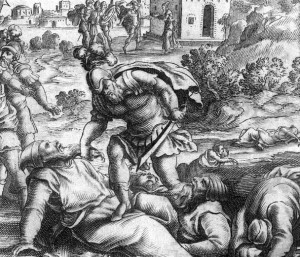
Doeg Slaying the PriestsI often find myself intrigued by the lesser characters we find in the Bible. At one time I started a project of writing short stories, sort of fictional midrash about some of them, but that project never went very far. Still, when a reading includes mention of someone I’ve not noticed before, it stirs my curiosity and my imagination.

Doeg the Edomite is mentioned in only four verses in two chapters of the First Book of Samuel; here and then in three verses of the next chapter. Those verses tell us that Doeg witnessed Ahimelech and the other priests give aid to David at Nob, told Saul what he had seen, was commissioned by Saul to punish the priests, and killed 85 of the clergy. The last mention of him is when David apologizes to Ahimelech’s son Abiathar for being the cause of his father’s death and offers Abiathar his protection:

David said to Abiathar, “I knew on that day, when Doeg the Edomite was there, that he would surely tell Saul. I am responsible for the lives of all your father’s house. Stay with me, and do not be afraid; for the one who seeks my life seeks your life; you will be safe with me.” (1 Sam. 22:22-23)

Doeg is identified as an Edomite but paradoxically as a chief shepherd in Israel, the latter term suggesting that he was not a tender of sheep, but rather a member of the Sanhedrin (a sort of parliament) or the Beth Din (a sort of supreme court). Therefore, rabbinic literature suggests that his identification as an “Edomite” merely refers to the land of his birth; it does not mean that he was a non-Jew.

According to midrashic tradition, Doeg was punished by three angels for his betrayal of David and his killing of the priests; one made him forget his learning, one incinerated his soul, and one scattered the ashes in the synagogues and study halls.

One of the minor tractates of the Babylonian Talmud, the Avot de-Rabbi Nathan, makes note of the fact that Doeg was one of three people who spoke the truth and died for it; what he reported about the priests at Nob was true, but it need not have been reported and the report led to needless death. (I don’t know, by the way, who the other two people who died for speaking truth would have been, although I have tried to find out.) Doeg is also listed in the midrashic literature as one of seven people (three kings and four commoners) who are said to have no share in the next world. I’m not sure what that means, whether the implication is that their souls wander aimlessly through nothingness or if they simply cease to exist, but the statement is there for whatever it is worth.

That is what I find most interesting about this minor character, that he has inspired such interest among the rabbis who wrote and compiled the various forms and collections of extra-biblical literature. What this suggests is that, in truth, there are no minor characters . . . in the Bible or in life.

No one is insignificant! One may not get top billing. One may only have a walk-on part, as it were. One may only be mentioned in a few verses of the book of life, perhaps only in one. But no one is insignificant. Not even Doeg the Edomite.

====================

A request to my readers: I’m trying to build the readership of this blog and I’d very much appreciate your help in doing so. If you find something here that is of value, please share it with others. If you are on Facebook, “like” the posts on your page so others can see them. If you are following me on Twitter, please “retweet” the notices of these meditations. If you have a blog of your own, please include mine in your links (a favor I will gladly reciprocate). Many thanks!

====================

Father Funston is the rector of St. Paul’s Episcopal Church, Medina, Ohio.

Tribalism and an Illustration of Compromise – From the Daily Office – July 18, 2013

From the Gospel according to Mark:

The Pharisees went out and immediately conspired with the Herodians against [Jesus], how to destroy him.

(From the Daily Office Lectionary – Mark 2:6 (NRSV) – July 18, 2013.)

Three Elders ConspiringJesus had healed someone on the sabbath; that’s the simple back ground to the Pharisees and Herodians conspiracy against Jesus. This alliance is an interesting one since in generally the two groups hated one another! But their fear of Jesus apparently was enough to get them to work together against him.

It’s an odd alliance, particularly if looked at from the view point of the Pharisees. Their name is taken from the Hebrew word parash meaning “to separate;” they adhered to a strict piety and disciplined adherence to the Torah. They refused to associate with Gentiles or any “unclean” person or thing. They exhibited all of the characteristics of what, in our modern world politics, has come to be called “tribalism.”

Recently a friend and colleague bemoaned what she called “the tyranny of liberalism” noting that those on the political left were “wasting precious energy and time beating each other up.” I suggested to her that the problem is not with liberalism (nor, indeed, with conservatism). Rather the issue in modern society is the “tribalism” that seems to have taken over all of American social thought and civic behavior (including behavior in the church).

Tribes (like the Pharisees) group around and define membership on the basis of some type of purity – purity of thought, purity of belief, purity of blood, purity of precious bodily fluids, purity of whatever. Stray even a little bit from that purity and, like white blood cells, other members of the tribe will attack. A liberal voicing illiberal opinions, a conservative embracing a liberal point . . . they will be pilloried by their co-tribalists much faster than by the “opposition.”

This kind of tribal thinking has infected both political parties, many churches, the liberal and conservative political camps . . . name some segment of current American society and you can identify its tribal attributes. There are Pharisees of all stripes in our national community today. Both houses of our nation’s legislature have succumbed to a deeply seated “us versus them” mentality of political tribalism that goes beyond even traditional partisanship; nothing is getting done and so long as this persists nothing is likely to get done.

Not a single one of us is immune to tribalism; none of us avoids it entirely. However, we can do something about it. We can become aware of it. We can identify our own biases and question our own motivation. We can confess our own sinfulness in this regard and repent, turning away from it in favor of a more constructive way of working together.

In the second chapter of his catholic epistle, James addresses the issue of favoritism:

If a man comes into your assembly with a gold ring and dressed in fine clothes, and there also comes in a poor man in dirty clothes, and you pay special attention to the one who is wearing the fine clothes, and say, “You sit here in a good place,” and you say to the poor man, “You stand over there, or sit down by my footstool,” have you not made distinctions among yourselves, and become judges with evil motives? (James 2:2-4)

He then condemns this favoritism as sinful: “If you show partiality, you are committing sin and are convicted by the law as transgressors.” (v. 9) It is, he says, a violation of what Christ called the second great commandment: Love your neighbor as yourself. Partisan tribalism, I would suggest, is simply a political form of the favoritism scripture here condemns.

I remember reading once that Christians are called to pledge unwavering allegiance to the Lamb, not to the donkey or the elephant. We are bidden by scripture to pray for our governments and our leaders without regard to their politics or our own. If we will do that, while becoming aware of our own motives and biases, we can eschew tribalism and model a way of doing social business, of being community that will benefit all.

The alliance between the Herodians and the Pharisees, even though it was against Jesus, demonstrates that even those with the most tribal of instincts can compromise and work together. We should foster and encourage such behavior, even if this example might not the best illustration to use.

====================

A request to my readers: I’m trying to build the readership of this blog and I’d very much appreciate your help in doing so. If you find something here that is of value, please share it with others. If you are on Facebook, “like” the posts on your page so others can see them. If you are following me on Twitter, please “retweet” the notices of these meditations. If you have a blog of your own, please include mine in your links (a favor I will gladly reciprocate). Many thanks!

====================

Father Funston is the rector of St. Paul’s Episcopal Church, Medina, Ohio.

The Worms of Pride – From the Daily Office – July 17, 2013

From the Book of Acts:

Now Herod was angry with the people of Tyre and Sidon. So they came to him in a body; and after winning over Blastus, the king’s chamberlain, they asked for a reconciliation, because their country depended on the king’s country for food. On an appointed day Herod put on his royal robes, took his seat on the platform, and delivered a public address to them. The people kept shouting, “The voice of a god, and not of a mortal!” And immediately, because he had not given the glory to God, an angel of the Lord struck him down, and he was eaten by worms and died.

(From the Daily Office Lectionary – Acts 12:20-23 (BCP Version) – July 17, 2013.)

Parasitic HookwormOccasionally when studying Scripture I have thought, “This can’t possibly have happened.” I’m sure that what I am reading is meant to be an allegory or a metaphor, or that it is simply pious legend that the biblical author has incorporated into his story. This strange little story of the death of Herod Agrippa I was one of those passages. It’s just a little weird.

It turns out, however, that this story is verified by an extrabiblical source. The Roman Jewish historian Flavius Josephus recounts almost the same series of events. In Josephus’s telling, Herod wears a robe of silver rather than purple, but the meaning is the same: royal pride. In addition, Josephus adds the details that Herod sees an owl perch overhead during the daytime, a negative omen, and that Herod suffered severe and disabling abdominal pain for five days before dying, suggesting that the “worms” may have been intestinal parasites.

Where Josephus and the author of Acts (Luke) most agree is with regard to royal pride. Not only do they both portray Herod in that splendid purple or silver robe, Josephus parallels Luke saying, “Presently his flatterers cried out, one from one place, and another from another, (though not for his good) that he was a god . . . . Upon this the king neither rebuked them nor rejected their impious flattery.” (Antiquities 19.8.2)

I don’t know whether Herod’s parasites, suffering, and death were, in fact, a divine punishment for pride; they may simply have been the result of his prideful behavior. Sometimes out of vanity, we humans can do things that are not good for our health. I’ve been guilty of that myself. Indeed, even during the past few days.

We are undertaking a remodeling project at my parish, expanding the parish hall and rebuilding the street-side entrance of one wing of our building. It is work necessitated by the deterioration of the foundation of a 1960s addition to the church building. That deterioration has been most evident inside a basement storage area we affectionately refer to as “the mushroom farm.” Dark, damp, dank, and smelly, this large closet has suffered most from seepage of ground water through the concrete and cinder block of the foundation. It has been, for a long time, a place of mold and mildew.

Another place where these have grown is in the plenum between the cinder block exterior walls and the interior drywall affixed to them through use of 1″ x 3″ wooden furring strips. Over the years, as water has leaked through the walls, the wood has been stained, has rotted, and has been a medium for growth of mold.

As the workers demolishing these structures in preparation for our new construction have done their work, they have kicked up mold-laden concrete and wood dust. Each day during their labors, I have been walked through the site several times taking photographs of their progress. I want to document the need for and the progress of this renovation. This may be, I will admit, a matter of vanity or pride that I do so.

It’s also rather stupid of me!

One of the earliest instructions that was deeply impressed upon me as a child was to instruct medical people that I am allergic to penicillin. Whenever I do, I am asked, “What happens when you take it?” I have to answer honestly, “I don’t know. I’ve just always been told that I am allergic to it.” Being allergic to penicillin might, you would imagine, suggest to one that there might be an issue of sensitivity to other molds . . . . But I grew up in the desert! Molds were not an issue!

Until I moved to the midwest . . . Twenty or so years ago when I moved to the Missouri River valley (in the Kansas City area) and the high humidity of northeastern Kansas, I discovered seasonal molds play havoc with my health. Then ten years ago I moved to northeastern Ohio – more of the same.

Knowing this, I should be staying completely away from the demolition of the mushroom farm and the moldy drywall furring, shouldn’t I? But I insist on documenting this project . . . so my allergy, like Herods “worms,” is having a field day.

A few years ago, the indie rock group Chaotica put out a tune called Mr. Vanity. Among its lyrics are these words:

Why must you hide
Way inside, Mr. Vanity?
Why do you try to deny
Your own humanity?

So who died? Made you king?
You’re not god of anything.
What are you? Just a man!
Who on Earth gave you
The master plan?
Get a life. Get a clue.
Someone here should humble you.

* * *

Feed your greed
And your pride…
Hope it eats you up inside.

Those lyrics could almost have been written based on the story of the death of King Herod Agrippa I! That story from Acts, which Josephus’s testimony shows to be an historic one, reads like an allegory. It certainly could be one. His pride (in the form of those worms, those intestinal parasites) ate him up inside! Mine is making me sneeze my fool head off!

Pride is destructive. The worms of pride do eat you up inside!

But . . . confession time . . . I plan to keep on visiting the work site and taking photographs. I will put up with the sneezing and coughing! Mea culpa, mea culpa, mea maxima culpa!

====================

A request to my readers: I’m trying to build the readership of this blog and I’d very much appreciate your help in doing so. If you find something here that is of value, please share it with others. If you are on Facebook, “like” the posts on your page so others can see them. If you are following me on Twitter, please “retweet” the notices of these meditations. If you have a blog of your own, please include mine in your links (a favor I will gladly reciprocate). Many thanks!

====================

Father Funston is the rector of St. Paul’s Episcopal Church, Medina, Ohio.

« Older posts Newer posts »