Occasional thoughts of an Anglican Episcopal priest

Category: Church (Page 70 of 115)

A Pew Poll, A Praying Mantis, And A Toad – From the Daily Office – July 16, 2013

From the Psalter:

As for me, I will live with integrity;
redeem me, O Lord, and have pity on me.
My foot stands on level ground;
in the full assembly I will bless the Lord.

(From the Daily Office Lectionary – Psalm 26:11-12 (BCP Version) – July 16, 2013.)

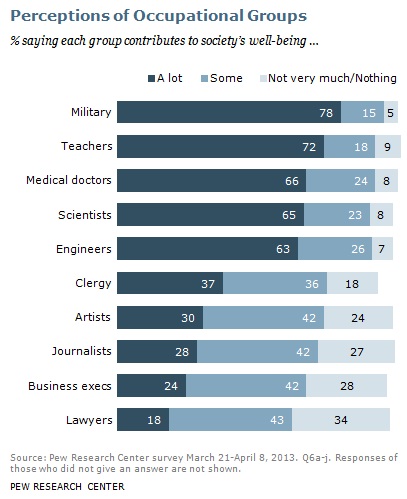
Praying MantisLast week, The Pew Forum on Religion and Public Life published the results of a survey testing the esteem in which Americans hold members of ten professions.

Respondents where asked say to what extent each group contributes to the well-being of American society: the possible responses ranged from “a lot” to “not at all.”

The professions were then ranked by the percentage of respondents who said they contributed “a lot” to our societal welfare. Topping the list were members of the military; at the bottom, lawyers. The graphic below shows the rankings of the ten professions (clipped from the Pew Forum article).

Pew Poll

A retired colleague reading the article commented that he had concluded in his personal career that clergy made a low impact on people’s lives and that that contributed to his decision to retire (or, as he put it, “give up”). “I’m told I’m a great preacher,” he said, “but my preaching didn’t seem to change people’s lives. Near as I could tell they were just indifferent.” I sympathize, in fact I often identify with my friend’s comments. There are days when being a clergy person is awful; there are times when one feels (and even worse times when one is told in no uncertain terms) that not only is one not contributing to society’s welfare, one is making it worse!

On the other hand, I rather enjoyed the fact that my current profession ranks above my former career as a lawyer!

Sunday after church I mowed the lawn. I didn’t want to mow the lawn, but I really had no choice. It has rained here quite a bit during the past three weeks and that rain had both encourage the grass to grow and prevented me from mowing the grass. So my one-third of an acre (on a steep hillside, by the way) was beginning to look like native grass pasture land rather than a suburban lawn. Normally, I can cut the grass in about an hour and, if I have to do it, I can get the “weed whacking” and edging done in another thirty minutes. On Sunday, because I had to mow twice (once with the mower deck at high setting followed by another pass at a lower level, both passes going relatively slowly), it took a bit longer. I started at 2:30 p.m. and finished at 6:19 p.m.

On my first pass through the back yard I noticed a bright, lime-green praying mantis struggling through the grass; the insect seemed to be injured, but I couldn’t tell. He (or she) was in the section I would mow on my next pass, so I kept an eye out and, sure enough, there it was in front of the mower when I pushed it back that direction. I stopped and let the mantis move out of the way, headed for the bushes at the edge of the lawn.

A couple of hours later, string trimmer in hand, I was whacking the tall growth around the stone-edged planters, the mail box, and the fire hydrant in the tree lawn, when I came across a small brown-green toad in among the plants I was about the decimate with .93 “fishing line.” I nudged the toad away with my toe (I was going to say I “toed away the toad” but that would be too cute, wouldn’t it?), moving it to safety before I continued trimming the grass.

Earlier in the day I had preached about a familiar parable. The gospel lesson appointed in the Revised Common Lectionary for the day was the story of the Good Samaritan, the story of a man on a journey, a man with a purpose of his own to accomplish, stopping to aid a fellow traveler in distress. Stopping to let an insect move out of danger or encouraging a toad to move out of harm’s way is not, I don’t think, equivalent, but the spirit is the same. And as I spent time in meditation trudging along behind the lawn mower, it occurred to me that all three actions provide a response to the Pew Research poll.

Clergy don’t, generally, make a big splash in the world, and the ones who do usually, it seems, do so to the detriment of our collective reputations! Sure, there are the exceptional clerics like Pope Francis, or Archbishop Desmond Tutu, or the Dalai Lama, but in general most clergy do small things in small congregations in small communities. We don’t make a difference in society at large; if we make any sort of contribution at all, it is in the lives of individual people – sitting at a hospital bedside, baptizing an infant, counseling two people about to get married, celebrating a teenager’s graduation from high school. The church as a whole is supposed to make a contribution to society; the clergy’s job is make a difference in the lives of the people who make up the church.

So, although I do understand my friend-and-colleague’s angst about indifference in society and that low 37% rating by the Pew Research folks, I’d encourage him and other clergy not to give it too much attention. Attend to the praying mantises and the toads, to the poor beggars in the roadside ditches, to the hospital patients and the babies and the newlyweds and the new graduates; do your best to make a difference in the lives of individuals. Do that and you’ll have lived with integrity and you’ll have something to tell about in the great congregation, something about which to bless the Lord in midst of full assembly. Then send the assembly out to contribute to the well-being of society: “Go in peace to love and serve the Lord!” It’s really their job!

====================

A request to my readers: I’m trying to build the readership of this blog and I’d very much appreciate your help in doing so. If you find something here that is of value, please share it with others. If you are on Facebook, “like” the posts on your page so others can see them. If you are following me on Twitter, please “retweet” the notices of these meditations. If you have a blog of your own, please include mine in your links (a favor I will gladly reciprocate). Many thanks!

====================

Father Funston is the rector of St. Paul’s Episcopal Church, Medina, Ohio.

Who Is My Neighbor? And Who Is the Good Samaritan? – Sermon for the 8th Sunday after Pentecost (Proper 10C) – July 14, 2013

====================

This sermon was preached on the Eighth Sunday after Pentecost, July 14, 2013, at St. Paul’s Episcopal Church, Medina, Ohio, where Fr. Funston is rector.

(Revised Common Lectionary, Pentecost 8 (Proper 10, Year C): Amos 7:7-17; Psalm 82; Colossians 1:1-14; and Luke 10:25-37. These lessons can be read at The Lectionary Page.)

====================
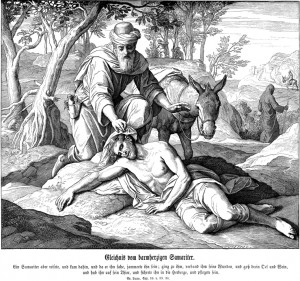
The Good Samaritan, engraving by Julius Schnorr von CarolsfeldThe nation’s legal system is corrupt; justice is for sale to the highest bidder. The guilty go free while the innocent suffer and die. The rich are crushing the poor. The affluent, the 1%-ers, are living a lavish life, with their costly perfumes and cosmetics, and their vacation homes with expensive furnishings, pleasure palaces where they can throw extravagant parties with music in every room. They revel in sexual debauchery of all sorts, but try to enforce a puritanical moral code on the rest of society. The poor are at the mercy of predatory lenders who exploit vulnerable families. The rich have more than enough to eat and to waste, while the poorest in the society go hungry. And government and religious leaders not only allow this to happen, they help it happen.

Just a brief summary of Chapters 1 through 6 of the Prophet Amos.

Some of you probably thought, “There he goes again, spouting his liberal politics from the pulpit.” But I’m not; as I said, it’s simply a paraphrase the Prophet Amos’s critique, of God’s critique, of ancient Israel at the time of King Jeroboam II. We just heard most of chapter 7 beginning at verse 7, in which Amos tells of the third of three prophetic visions. In verses 1 through 6, Amos tells of God showing him locusts devouring all the crops of the land and then another vision of fire destroying everything in the nation. Amos pleads with God not to let that happen. Most scholars interpret those visions as omens of what God might do to the nation, but I think perhaps they might instead be striking visions of prophetic judgment against the wealthy of ancient Israel and the rulers and religious leaders of the time. These are not visions of what God might do; they are visions of what those in power will do if not stopped. And God’s judgment spoken twice to Amos is, “This will not happen!” (vv. 3, 6)

So God shows Amos a vision of a plumb line. Do you know what a plumb line is? There’s a picture of a plumb line on the cover of the bulletin this morning. A plumb line is a string with a metal weight, or “plumb bob,” at one end which, when suspended, points directly towards the earth’s center of gravity so that the string hangs perpendicular to the plane of the earth’s surface; it is used to test the verticality of structures, how true to straight up-and-down they are. It sets the standard for up-rightness. God tells Amos that God is setting a metaphorical plumb line in the midst of God’s People and if they don’t measure up to the standard, “the high places of Isaac shall be made desolate, and the sanctuaries of Israel shall be laid waste, and [God] will rise against the house of Jeroboam with the sword.”

Well, you say, that’s ancient Israel. What’s that got to do with us?

Let me read you a news item from the past week. This is from the July 9, 2013, issue of the Florence, Alabama, Times-Daily:

Police Chief Lyndon McWhorter said Monday morning’s bank robbery [in Moulton, Alabama] was among the most unusual of his law enforcement career.

“I’ve been involved with several over the years, but none like this,” McWhorter said. “It’s one for the books.”

McWhorter said Rickie Lawrence Gardner, 49, of 7667 Alabama 33, Moulton, was arrested Monday morning while sitting on a bench outside the Bank Independent branch on Court Street in Moulton, minutes after he supposedly walked in and robbed the bank.

“When the officers got there, he was just sitting on the bench, waiting on them,” McWhorter said. “The money was locked up inside his truck, which was parked in the handicapped spot in front of the bank.

“He had a handicap sticker on his vehicle so he even parked legal.”

McWhorter said Gardner told authorities he robbed the bank because he had hurt his leg and wasn’t able to take care of himself.

“So, he decided to get arrested to have a place to live and someone to take care of him.”

Minutes before the arrest, McWhorter said, Gardner walked into the bank just off Alabama 157 and handed a teller a written note explaining that he had a gun and she was to give him money.

Authorities said no weapon, other than a pocketknife, was found when Gardner was taken into custody.

“The only thing he said to the teller was when he asked her to give him a bag to put the money in,” McWhorter said.

With the money in hand, McWhorter said Gardner walked out of the bank, laid the money inside his vehicle, locked the door and walked back to the bench. The chief said Gardner sat down on the wooden bench in front of the bank and waited on officers.

“When officers got there, he did not offer any kind of resistance. He was just waiting on them,” McWhorter said. “This is the first bank robbery I’ve ever worked where the robber was waiting outside the bank for the police to turn himself in.” (Times-Daily)

The Associated Press later reported that Gardner “mentioned the weapon in the note — even though he didn’t have one — because he thought it would get him a longer sentence;” he thought he’d get more time, which would mean more shelter, more food. (AP Story)

The reason you may have thought my opening paraphrase of Amos sounded like an indictment of our own society is simple. It does. The word of prophecy spoken by Amos to ancient Israel speaks directly to us.

You know the interesting thing about Amos’s prophecy is that we can’t even be sure it was heard by the rulers of the nation to which it was spoken. We know Amos wrote it down; we know that someone told the story of Amos delivering his prophecy to Amaziah (who was the high priest at Bethel the religious center of the northern kingdom), but we are told that Amaziah never delivered it to Jeroboam II, the reigning king.

Amaziah instead told the king that Amos was part of a conspiracy to kill him, and then Amaziah told Amos to return to his home which was in the southern kingdom. “O seer, go, flee away to the land of Judah,” he says, “earn your bread there, and prophesy there; but never again prophesy at Bethel, for it is the king’s sanctuary, and it is a temple of the kingdom.” And this is where Amos speaks one of my favorite lines in Scripture, “I am no prophet, nor a prophet’s son; but I am a herdsman, and a dresser of sycamore trees.”

Amos’s answer was to indicate that he was not a prophet by profession; he was not a member of one of the official “prophecy schools.” Indeed, as part of the official religious establishment, Amos thought those full-time prophets were as much a part of the problem as the priests, the king, and the wealthy! Amaziah proved that he was part of the problem by failing to communicate Amos’s prophecy to King Jeroboam, so our reading today ends with Amos’s personal prophecy against him: “Your wife shall become a . . . and your sons and your daughters shall fall by the sword . . . and you shall die in an unclean land.” A pretty pointed prophecy, if ever there was one!

But we, who hear in Amos’s condemnation of ancient Israel at least a bit of a word of warning to our own society, what are we to make of this prophecy of the plumb line? The standard for the People of God in Israel was the ancient law of Moses, the religious, ethical, and social rules we find in Genesis, Exodus, Leviticus, and Numbers (Deuteronomy was unknown at the time of Amos). What is it for us? How are we (as Paul wrote to the Colossians) to be “be filled with the knowledge of God’s will in all spiritual wisdom and understanding?” How are we to “lead lives worthy of the Lord, fully pleasing to him?” How are we to bear fruit in every good work and . . . grow in the knowledge of God?”

Well, that standard is easily stated. A young lawyer does so in today’s Gospel: “You shall love the Lord your God with all your heart, and with all your soul, and with all your strength, and with all your mind; and your neighbor as yourself.” It’s easily stated; it’s not so easily understood.

The young lawyer says as much when he asks his follow up question, “Who is my neighbor?” He wants to know what we want to know: are there limits? Is it sufficient to love only the people of my community — for him, Israel; for most of us, white descendants of Northern European immigrants? Does it include Mr. Gardner, the bank robber in Moulton, Alabama? Might it also include other undesirables, Samaritans and Gentiles, the Irish, descendants of African slaves, recently immigrated Asians, Hispanics? Does it include women, people with disabilities, lepers, and others frequently excluded from society? Do we get to define who is our neighbor, or does Someone else?

Ultimately, the answer to our question is the answer to another question: “Who does God love?” Jesus answers the question by telling a parable, the oh-so-familiar story of the “Good Samaritan.” In analyzing this story, Lutheran theologian Brian Stoffregen asks an important question: “Why does Jesus make the hero of this story a Samaritan?” In answering this question he writes:

The idea of being a “Good Samaritan” is so common in our culture, that most people today don’t realize that “Good Samaritan” would have been an oxymoron to a first century Jew. Briefly stated, a Samaritan is someone from Samaria. During an ancient Israeli war, most of the Jews living up north in Samaria were killed or taken into exile. However, a few Jews, who were so unimportant that nobody wanted them, were left in Samaria. Since that time, these Jews had intermarried with other races. They were considered half-breeds by the “true” Jews. They had perverted the race. They had also perverted the religion. They looked to Mt. Gerizim as the place to worship God, not Jerusalem. They interpreted the Torah differently than the southern Jews. The animosity between the Jews and Samaritans were so great that some Jews would go miles out of their way to avoid walking on Samaritan territory. Previously in Luke, the Samaritans had refused to welcome Jesus — the “bad” Samaritans. I’m certain that in the minds of many Jews, the only “good” Samaritan was a dead Samaritan. Note that the lawyer never says “Samaritan.” He can’t call him a “good Samaritan” (a phrase that doesn’t occur in the text). Anyway, we are still left with the question, “Why a Samaritan?”

If Jesus were just trying to communicate that we should do acts of mercy to the needy, he could have talked about the first man and the second man who passed by and the third one who stopped and cared for the half-dead man in the ditch. Knowing that they were a priest, Levite, and Samaritan is not necessary.

If Jesus were also making a gibe against clerics, we would expect the third man to be a layman — an ordinary Jew — in contrast to the professional clergy. It is likely that Jewish hearers would have anticipated the hero to be an ordinary Jew.

If Jesus were illustrating the need to love our enemies, then the man in the ditch would have been a Samaritan who is cared for by a loving Israelite.

One answer to the question: “Why a Samaritan?” is that we Christians might be able to learn about showing mercy from people who don’t profess Christ. I know that I saw much more love expressed towards each by the clients at an inpatient alcoholic/drug rehab hospital than I usually find in churches. Can we learn about “acting Christianly” from AA or the Hell’s Angels? (CrossMarks)

But Stoffregen proposes an alternative response: “Another answer to the question: ‘Why a Samaritan?’ is that we are not to identify with the Samaritan. A Jew would find that so distasteful that he couldn’t identify with that person. He wouldn’t want to be like the Priest or Levite in the story, so that leaves the hearer with identifying with the man in the ditch.” And that raises the further question, “Then who is the Samaritan?” to which there can only be one answer, “The Samaritan is God.”

If the Samaritan represents God, that means that God loves the penniless, the stripped naked, the beaten down, the ones left half dead, the ones passed-by by the leaders of society, by the rulers, by the punctiliously correct, and (I’m sorry to say) by the religious. It makes us realize that God is no respecter of position or wealth, God does not care about social class or religion. The man in the ditch had been stripped of everything that might have indicated his social standing, his religious faith, even his nationality; he was simply a person in need. That is who God loves, and that means that God loves everyone. In the human community, every person is potentially a person in need; truth be told, every person is a person in need.

Who is my neighbor? Who does God love? Everyone. No exceptions. No exclusions. That is the standard, the rule, the plumb line by which God judges society. This again and again is what the prophets of old told us; it is what Jesus told us; it is what our own modern prophets have said over and over. For example:

In the 18th Century, Dr. Samuel Johnson’s biographer James Boswell quoted him as saying, “A decent provision for the poor is the true test of civilization.” (Boswell, Life of Johnson)

In her book My Several Worlds (1954), Pearl S. Buck, wrote: “The test of a civilization is the way that it cares for its helpless members.”

In his last political speech, Sen. Hubert Humphrey said, “The moral test of government is how that government treats those who are in the dawn of life, the children; those who are in the twilight of life, the elderly; those who are in the shadows of life; the sick, the needy and the handicapped.”

And Mahatma Gandhi said, “A nation’s greatness is measured by how it treats its weakest members.”

Who is my neighbor? Who does God love? Everyone. No exceptions. No exclusions.

Every person is potentially a person in need, and every person is potentially a caregiver, a supplier of that which is needed. When we conclude our worship this morning, several young people and a few adults accompanying them will depart for Franklin, Pennsylvania, to be suppliers of that which is needed. At this point, they don’t know whose needs they are going to be supplying; they don’t know what those needs will be. All they know is that there are people in need and they are going to care for them, because they are our neighbors.

So at this point, let’s get on with the business of commissioning them for the ministry on which they are about the embark.

====================

A request to my readers: I’m trying to build the readership of this blog and I’d very much appreciate your help in doing so. If you find something here that is of value, please share it with others. If you are on Facebook, “like” the posts on your page so others can see them. If you are following me on Twitter, please “retweet” the notices of these meditations. If you have a blog of your own, please include mine in your links (a favor I will gladly reciprocate). Many thanks!

====================

Father Funston is the rector of St. Paul’s Episcopal Church, Medina, Ohio.
What Is A Church Building? – Sermon for a Ground Breaking on the 7th Sunday after Pentecost (Proper 9C) – July 7, 2013

====================

This sermon was preached on the Seventh Sunday after Pentecost, July 7, 2013, at St. Paul’s Episcopal Church, Medina, Ohio, where Fr. Funston is rector. The worship that morning included breaking ground on an expansion of the church’s parish hall.

The lessons were taken partially from the readings suggested in the rubrics of The Book of Occasional Services for a ground breaking liturgy and partially from the Revised Common Lectionary for Pentecost 7 (Proper 9, Year C). The Old Testament reading was Genesis 28:10-17; the Gradual was Psalm 132:1-9. The epistle was Galatians 6:1-16; the gospel lesson was Luke 10:1-11,16-20. The latter two lessons can be read at The Lectionary Page.

====================

Church Interior with Superimposed Question MarkWhat is a church building? It’s a holy place. It’s a place where people gather to worship. It’s a place where people encounter God. It’s a place where God’s people enjoy one another’s company. It’s a place where people get married, where babies are baptized, where funerals are held, where memories are made and lives remembered. It’s a place where the stories of faith are told and retold. It’s a place we teach and it’s a place where we learn.

Our reading from Genesis this morning is a small part of the story of Jacob, the son of Isaac who will later be called “Israel.” Jacob is the least likely of patriarchs. Of all the biblical patriarchs, he is the most enigmatic. He never exhibits either the awesome faith of Abraham or the level-headedness of Isaac. He is, in fact, a scoundrel. He’s tricked his father and cheated his brother out of the blessing of the first-born; his character emerges through a series of deceptions, intrigues, and conflicts. He will wrestle with God and be given the name “Israel,” the name that will identify his descendants for the rest of time. He must be taught by God; he has some learning to do.

In the story we heard today, he is on the run. He is afraid of his brother, whom he has cheated, so he has taken off. His father has told him to flee to Haran (his grandfather Abraham’s original home) and there find a wife. Along the way, he camps near a town called Luz and has this dream that we have all heard of before, the vision of a ladder on which angels are traveling back and forth between heaven and Earth. He learns that, like Moses before him, he is standing on holy ground. He says, “How awesome is this place! This is none other than the house of God, and this is the gate of heaven,” and so he renames it, Bethel, “House of God.” A lot of sermons have been preached about Jacob and his character flaws, or about this vision and what the angels coming and going might mean.

But, today, what I want to call to our attention is what God says to Jacob: “Your offspring [God says] shall be like the dust of the earth, and you shall spread abroad to the west and to the east and to the north and to the south; and all the families of the earth shall be blessed in you and in your offspring.”

The descendants of Jacob would go forth from that place to spread blessing to all the corners of the earth – to west, to east, to north, to south. They would go out from that place to change the world.

I’m particularly fond of an Orthodox Jewish translation of this text: “Your seed shall be as the dust of the earth; and you shall burst forth to the west, and to the east, and to the north, and to the south; and in you and in your seed shall all the families of the earth be blessed.” I love that image – Jacob and his descendants would not, could not stay in that awesome place; they could not stay in the house of God or at the gate of heaven. They had to leave, to spread from the Holy Land, to “burst forth” bringing a transformation to the world that would be explosive and dramatic.

We are not gathered in a desert wilderness. We have not gone to sleep on holy stones. We have not seen angels climbing to rocks to heaven . . . but we have gathered in a church building, a place that for many for generations has been an awesome place, a house of God, and a gate of heaven, a place where children have been blessed, where children have been told the stories of God, the stories of Jesus, where hymns of joy have been sung. We are gathered in this place to reaffirm our commitment that heritage and that ministry, to renew this place and to renew the ministry done here.

But like Bethel where Jacob camped for the night, this is not a place to stay; it is a place to leave. It’s a place from which the people of God are sent into the world.

Church buildings are centers of ministry, places of assembly, where God’s people gather to worship, to hear the good news, and to be transformed, not for themselves but in order to be sent back out into the world, to “burst forth” and change the world. Jesus’ last words to his followers were, “Go . . . and make disciples!” (Matt. 28:19)

In our gospel lesson today, Jesus gives his followers their marching orders. “The Lord appointed seventy [followers] and sent them on ahead of him in pairs to every town and place where he himself intended to go.” Some commentators suggest that seventy disciples were chosen because in rabbinic tradition, seventy represents the total number of nations in the world. Just as the children of Jacob were to spread to every corner of the earth, the disciples of Jesus are to go to every nation in the world. As the descendants of Israel are to be a blessing to others, the disciples of Jesus are to go into the world and announce that “the kingdom of God has come near.”

Church buildings, worship spaces and fellowship halls, are the bases from which the church is sent out to do that, as the disciples in today’s reading from Luke were sent out by Jesus. The Rev. Edward Markquart, pastor of Grace Lutheran Church in Seattle, Washington, writes this about our gospel lesson today:

What happened is that those disciples first went to a village or town. Those first disciples planted a church, and then went to a second village or town, and planted a church. They went to a third village or town and planted another church. They … whoops. We have to go back to that first village or town and look more carefully. We have to go back to that first village, because before the disciples went onto the second village, they left a group of people in that village who were committed to Jesus Christ. The Greek word is “laos.” They were called the “laos,” which means, “the laity,” “the people,” “the people of God.” The Apostles always left common and ordinary townspeople and villagers whose hearts were on fire, whose tongues were on fire, who hadn’t gone to the seminary, who hadn’t seen Jesus face to face, who hadn’t talked with him in the flesh. These were not the Apostles. These were not the twelve disciples. These were the people of God in each village who spread the Gospel from house to house, and neighbor to neighbor and friend to friend and family to family. That’s the way it always is. That fundamental principle is always true; it is the laity, the people of God, who become inspired by the Holy Spirit. They are the ones, not the twelve, not the Apostles, not the pastors. It is the laity, the people of God, who go about winning souls to Jesus Christ and nurturing those souls into maturity. (Sermons from Seattle)

Church buildings don’t change the world. They may be awesome; they may be houses of God; they may be gates of heaven. But by themselves, they don’t win people to Jesus, nurture souls to maturity, or change the world. Church buildings are meant to be the bases from which the people of God do that. Church buildings are meant to be places of life, living, breathing, growing, exciting places of life. Church buildings are meant to be centers of ministry, places of assembly, where God’s people gather to worship, to hear the good news, to celebrate the meaning of life, and to be transformed, and then “burst forth,” back out into the world to share that life and transform the lives of others.

We have broken ground today on our Inviting the Future project; after four years of visioning and planning, we have, at last, begun this project to improve this center of ministry, not as a monument to ourselves, but as a place from which we might better serve the world, that we might “burst forth” and tell the world that the kingdom of God is at hand.

Poet and priest Sheila Nelson-McJilton, offers a poetic retelling of our Old Testament reading in her poem Who Sleep on Holy Stones: A Meditation on Genesis 28:10-17.

Bearer of curse and blessing,
I left home to stumble into the desert,
Exhausted and empty
I watch fierce sun set over silent stones.
Stars ascend toward midnight,
The wind moans through desert canyons,
And clouds drift across a full moon like shimmering angels.
Broken and empty I come to you, O Lord God.
In a desert midnight,
There is no smell of blessed fields
No grain
No wine
No fatness of earth
No sweet dew of heaven.
Alone I sleep on holy stones,
Under stars that blaze fierce and countless as dust.
The wind moans high above me, through desert canyons.
Clouds veil the moon.
Strong shining faces of angels appear.
Michael Gabriel Raphael
Lean down to earth.
Their glittering swords carve stones into steps to heaven.
Angels descend in silence to gaze into my face.
Angels ascend in silence to bear my deceit away.
Then in a shimmering celestial dance
Of turning wings,
Swirling wings
They sweep aside clouds.
I see a heavenly host as countless as dust.
I hear a heavenly host, their voices joined by joyous stars.
Glory to God in the highest,
And on earth . . . peace.
Their alleluias echoing high above desert canyons,
The Holy One descends from the gate of heaven
To stand beside my stone pillow.
To wrap my empty fears
In an eternal mantle of blessing.
To hallow the ground on which I sleep.
Michael veils the moon with his wings
And the only light I see is God.
I left home, soul that raged with wild emptiness
And in this desert wilderness, angels carve holy names for sleep.
They dance a path between me and You, O Lord God.
You have found me, broken and empty,
On holy stones that ascend to the very gates of heaven,
And you have not cursed me.
In a desert midnight, I know the smell of blessed fields, grain.
I will tell of you, O Lord God,
To laughing children who bless my tent,
To strong children who become tribes as countless as dust.
I will tell them of desert midnights filled with blazing stars
Of fierce angels who carve holy stones
And dance with glittering swords among clouds
Of hymns sung by joyous stars over Bethel
And over Bethlehem.
(from Anglican Theological Review, Winter, 2000)

What is a church building? A church building is a place to leave. From this place, this improved place, this living, breathing and growing place, we will leave. We will “burst forth” to tell in story and in song, in words and in deeds, in actions and in ministries, of the love of God. We will tell of God to laughing children, to strong children, to hungry children, to mourning children, to children in need, to all of God’s children; we will tell them of desert midnights and blazing stars; we will tell them that the kingdom of God has come near!

As we do so, let us never forget the prayer which has guided us throughout this project, a prayer written by Archbishop Desmond Tutu adapted from an original by Sir Francis Drake.

Let us pray:

Disturb us, O Lord
when we are too well-pleased with ourselves
when our dreams have come true because we dreamed too little,
because we sailed too close to the shore.
Disturb us, O Lord
when with the abundance of things we possess,
we have lost our thirst for the water of life
when, having fallen in love with time,
we have ceased to dream of eternity
and in our efforts to build a new earth,
we have allowed our vision of Heaven to grow dim.
Stir us, O Lord
to dare more boldly, to venture into wider seas
where storms show Thy mastery,
where losing sight of land, we shall find the stars.
In the name of Him who pushed back the horizons of our hopes
and invited the brave to follow,
our Lord Jesus Christ. Amen.

====================

A request to my readers: I’m trying to build the readership of this blog and I’d very much appreciate your help in doing so. If you find something here that is of value, please share it with others. If you are on Facebook, “like” the posts on your page so others can see them. If you are following me on Twitter, please “retweet” the notices of these meditations. If you have a blog of your own, please include mine in your links (a favor I will gladly reciprocate). Many thanks!

====================

Father Funston is the rector of St. Paul’s Episcopal Church, Medina, Ohio.

Memories Persist – From the Daily Office – July 6, 2013

From the Psalter:

Bow your heavens, O Lord, and come down;
touch the mountains, and they shall smoke.
Hurl the lightning and scatter them;
shoot out your arrows and rout them.

(From the Daily Office Lectionary – Psalm 144:5-6 (BCP Version) – July 6, 2013.)

White Convertible 1957 ThunderbirdThe Psalmist might think that this is what has happened in the mountains around my home town of Las Vegas, Nevada.

I belong to a Facebook group of Las Vegas natives and during the past 24 hours other members have posted news of what is called the Carpenter Canyon Fire at Mt. Charleston, about 40 miles northwest of Las Vegas, and a fire near Kingman, Arizona, called the Dean Peak Fire. Kingman is 100 southeast of Las Vegas. As I write this, about 9,000 acres are reported burning at Mt. Charleston; 5,400 acres at Dean Peak. Neither fire is contained.

It is believed that both fires were started by lightning, or as the Psalmist might have put it, by God, shooting his arrows, touching the mountains, making them smoke! I don’t really think that’s the case (that God caused the fires), but the verses of the Psalm have made me think about the paradox of memory.

Both Mt. Charleston and Kingman are locations that loom large in my childhood memories. I learned to ski at Mt. Charleston, but that was as an adult. As a child my family would go to Mt. Charleston for one day every winter so that my older brother, some of my neighborhood friends, and I could play in the snow. Kingman was a place we stopped along the road when traveling east from Las Vegas to Kansas to visit grandparents and other relatives; it was also the place my father died of injuries sustained in a single-car motor vehicle accident when I was 5-1/2 years old. One of the single most vivid memories of my childhood was the day my mother and I drove to Kingman to claim the remains of my father’s automobile, a 1957 hard-top convertible Thunderbird.

That car figures large in nearly all my memories of my father. It was white with a red interior. During the top-down months of the year, the removable hard top would be leaned against the side of our house, protect from the elements by the grape arbor which functioned as a carport at our home and by a canvas tarp with which Daddy would carefully cover it. (Yes, I’m 61 and, yes, I still call my father “Daddy” – death does that; it freezes time and our ways of thinking about the beloved departed.)

The reports of the fires at Mt. Charleston and Kingman have brought those memories rushing back. For no good reason other than remembrance, my eyes filled with tears when I read of the Nevada fire.

I was angry when I first read of the Mt. Charleston fire; my first thought was, “My memories are being destroyed!” But the truth is that the places in my memories long ago ceased to be. The Mt. Charleston of 2013 is not the Mt. Charleston of 1955. The paradox is that our memories are both persistent and impermanent.

I’m sure it’s long gone, and although I don’t recall its name, I remember very clearly the coffee shop in Kingman where we would stop for breakfast on those eastbound trips. We would always get up and start before dawn; two hours or so later, we would get to the junction of Highway 93 and Route 66 at Kingman. I would have gone to sleep in the backseat of my mother’s car, so I would be awakened as we stopped there. It was the only place and the only time when I was allowed to have a chocolate milkshake for breakfast! My memory of that restaurant is persistent; the place was impermanent.

The same goes for the lodge at Mt. Charleston (still there, but completely different) . . . my dad’s Thunderbird (there are others still around; I’d like to own one, but I don’t have $50,000 to buy it) . . . the house we lived in (remodeled several times). My memories are persistent; the things and the places are not. Most importantly, the people are not. I believe they live on in the Presence of God and in the company of the saints in light . . . but they are not here. So memory is not only persistent, it is important.

The name of this blog is taken from another Psalm, Psalm 78. The first few verses are these:

Hear my teaching, O my people;
incline your ears to the words of my mouth.

I will open my mouth in a parable;
I will declare the mysteries of ancient times.

That which we have heard and known, and what our forefathers have told us,
we will not hide from their children.

We will recount to generations to come the praiseworthy deeds and the power of the Lord,
and the wonderful works he has done.

He gave his decrees to Jacob and established a law for Israel,
which he commanded them to teach their children;

That the generations to come might know, and the children yet unborn;
that they in their turn might tell it to their children.

Memory persists so that it may be shared, that the things which we have heard and known may be told to our children. Share your memories! Too many of us live with an absence of family memories; we hunger to know the past. Don’t let that happen to your children.

====================

A request to my readers: I’m trying to build the readership of this blog and I’d very much appreciate your help in doing so. If you find something here that is of value, please share it with others. If you are on Facebook, “like” the posts on your page so others can see them. If you are following me on Twitter, please “retweet” the notices of these meditations. If you have a blog of your own, please include mine in your links (a favor I will gladly reciprocate). Many thanks!

====================

Father Funston is the rector of St. Paul’s Episcopal Church, Medina, Ohio.

Does “Journey” Make Sense? – From the Daily Office – July 5, 2013

From the Gospel according to Luke:

As they led him away, they seized a man, Simon of Cyrene, who was coming from the country, and they laid the cross on him, and made him carry it behind Jesus.

(From the Daily Office Lectionary – Luke 23:26 (NRSV) – July 5, 2013.)

Start of a JourneyDo you know where Cyrene was? Its location was in the same place as present day Shahhat, a town in northeastern Libya, about 80 miles northeast of Benghazi and about five miles from the Mediterranean coast. It’s nearly 1300 miles from Jerusalem. Simon had “come from the country” a fair distance! And at the end of that very long journey, he was made to carry the cross up the hill to Golgotha. The journey is a common metaphor of the Christian life; Simon’s long journey could stand as an example. But does the metaphor, does Simon’s example make sense anymore?

In other reading today, I learned that although the United States as a whole has only 87 people per square mile, the average American lives in a metropolitan area with more than 5,000 people per square mile. Two-thirds of Americans live in metropolitan areas with half-a-million or more residents. The long journey may be a Christian metaphor, but it is probably not one that resonates with the personal experience of most modern Americans. Long journeys are no longer part of our everyday corporate experience.

Certainly Americans travel; last year we spent $597 billion on leisure travel and $259 billion on business trips. But living in cities with nearly every need, and most of our family and friends, close at hand, and without a religious or social tradition of pilgrimage, the long journey is not a common practice.

Paradoxically, we seem to be an increasingly mobile and transient society. We don’t do journeys, but we do seem to move about quite a bit. While my small-town (pop. 28,000) church has several long-term members who have been here most, if not all, of their lives, a significant part of our worshiping community is made up of those who have recently relocated to the area because of job transfers, and who expect to leave within just a few years. Indeed, many of those who have left the congregation in the past ten years have done so for the same reason. The long-term leadership of the congregation (and now that I’ve been here more than ten years, I feel like that includes me) has seen many active church members come and go as breadwinners are transferred into the area, work here for three to five years, and are then transferred elsewhere.

As I ponder these contradictory data, a mobile population lacking in experience of journeying, it seems to me that what we lack may be rootedness, a sense of permanent “home place,” an anchoring in space and time. There is a difference between a “journey” and a “trip” – and that difference is time. There is a difference between a “journey” and a life of constant work-related relocation – and that difference is the home place, the anchor point in space.

My family is as un-rooted as most; my personal history more so. Not quite half my lifetime ago, I was required to fill out an FBI background check form; doing so, I realized that by the time I was 35 years of age, I had had 37 addresses! When my children were in the fifth and third grades, we relocated from Las Vegas, Nevada, to an exurban, Kansas-side community of the Kansas City metroplex, where we lived for ten years; the home we owned there is still the place I have lived the longest in my life! Although they were born in San Diego and Las Vegas, it’s very clear that my kids think of Kansas as “home.” My wife and I moved to Ohio after the children had completed high school and they have never lived here. From time to time someone will ask one or the other, “Are you coming home for Christmas?” Their typical reply makes it very clear that they do not consider Ohio “home.” They have a sense of rootedness, and that root is not sunk into this soil.

Unlike my children, I do not have that sense of rootedness. I was born in Las Vegas, but left the place when I was only 8 years of age. For the next several years, my family relocated (always within the Los Angeles area) every twelve to eighteen months. I continued that pattern after leaving home, sometimes moving after only three or four months. As I aged and became employed, my length of stay in any one place grew. But it is only at more than 60 years of age that I can look back and make sense of life through the metaphor of “the journey.” I do wonder how useful this metaphor is for those still in the throes of an unrooted life, relocating every few years as jobs change, perhaps taking “business trips,” and maybe finding time for vacation travel.

Simon had a home, a place where he was rooted, Cyrene. He was on a journey when he encountered Christ on the way to Calvary. He was not on a “trip”; he was not relocating. What can we learn from Simon? Does the journey metaphor make sense anymore?

====================

A request to my readers: I’m trying to build the readership of this blog and I’d very much appreciate your help in doing so. If you find something here that is of value, please share it with others. If you are on Facebook, “like” the posts on your page so others can see them. If you are following me on Twitter, please “retweet” the notices of these meditations. If you have a blog of your own, please include mine in your links (a favor I will gladly reciprocate). Many thanks!

====================

Father Funston is the rector of St. Paul’s Episcopal Church, Medina, Ohio.

Honor Upon the Lawgiver – From the Daily Office – July 4, 2013

From the Book of Sirach:

A wise magistrate educates his people,
and the rule of an intelligent person is well ordered.
As the people’s judge is, so are his officials;
as the ruler of the city is, so are all its inhabitants.
An undisciplined king ruins his people,
but a city becomes fit to live in through the understanding of its rulers.
The government of the earth is in the hand of the Lord,
and over it he will raise up the right leader for the time.
Human success is in the hand of the Lord,
and it is he who confers honor upon the lawgiver.

(From the Daily Office Lectionary – Sirach 10:1-5 (NRSV) – July 4, 2013.)

American FlagIndependence Day is one of the few secular holidays to have lessons of its own in both the Eucharistic and Daily Office Lectionaries of the Episcopal Church. There is a set of lessons in the regular Daily Office schedule of readings for today, as well, and I am intrigued that the way the calendar falls this year the Gospel for that set is the unjust trial of Jesus. One could meditate for hours on the meaning to be drawn from that juxtaposition.
However, the reading from the apocryphal book The Wisdom of Jesus, Son of Sirach (a book also called “Ecclesiasticus”) has caught my attention because of a recent (and unfortunately repeated) incident at my church. The lines of particular import are: “As the ruler of the city is, so are all its inhabitants;” and “It is [God] who confers honor upon the lawgiver.”

In every form of the Prayers of the People in the American Book of Common Prayer (1979) there is a petition included for our civil leaders. According to the rubric in the service of Holy Communion (page 359 of the BCP), we are bidden to pray for “the Nation and all in authority.” At my church, we do so by name, listing our president, state governor, and city mayor, and conclude with a general petition for other elected legislators, judges, and executive department officials.

At my church, as well, we share leadership of the prayers. A single person reads the major biddings of the various forms, but additional petitions are read by members of the congregation. As worshipers arrive, our ushers and greeters ask if they would like to read a sentence or two of additional intercessions. Most readily agree.

However, from time to time someone will decline to do so and occasionally someone will specifically (and sometimes venomously) refuse to read the petition naming the president. This has only happened since the election of the current incumbent. My heart sinks when I hear these refusals or when I am told about them later. It’s an indication of how poorly I have taught the Christian ethos to this congregation.

“As the ruler of the city is, so are all its inhabitants.” If Jesus ben Sirach is correct, then we should very definitely be praying for our rulers and leaders, for they set the example and the tone for the entire populace. And yet people decline to do so . . . .

My parish is dedicated to St. Paul, the writer of most of the New Testament, and Paul was very clear on the duty Christian folk have with respect to secular authorities and civic leaders. He wrote to the young bishop, Titus of Crete, instructing him to teach his congregation to respect civil rulers:

Remind them to be subject to rulers and authorities, to be obedient, to be ready for every good work, to speak evil of no one, to avoid quarreling, to be gentle, and to show every courtesy to everyone. For we ourselves were once foolish, disobedient, led astray, slaves to various passions and pleasures, passing our days in malice and envy, despicable, hating one another. But when the goodness and loving kindness of God our Savior appeared, he saved us, not because of any works of righteousness that we had done, but according to his mercy, through the water of rebirth and renewal by the Holy Spirit. (Titus 3:1-5)

He wrote to the Romans in a similar vein:

Let every person be subject to the governing authorities; for there is no authority except from God, and those authorities that exist have been instituted by God. Therefore whoever resists authority resists what God has appointed, and those who resist will incur judgment. For rulers are not a terror to good conduct, but to bad. Do you wish to have no fear of the authority? Then do what is good, and you will receive its approval; for it is God’s servant for your good. But if you do what is wrong, you should be afraid, for the authority does not bear the sword in vain! It is the servant of God to execute wrath on the wrongdoer. Therefore one must be subject, not only because of wrath but also because of conscience. For the same reason you also pay taxes, for the authorities are God’s servants, busy with this very thing. (Romans 13:1-6)

And with regard to praying for our secular leadership, he was very clear in his instructions to another young bishop, Timothy of Ephesus:

First of all, then, I urge that supplications, prayers, intercessions, and thanksgivings be made for everyone, for kings and all who are in high positions, so that we may lead a quiet and peaceable life in all godliness and dignity. This is right and is acceptable in the sight of God our Savior, who desires everyone to be saved and to come to the knowledge of the truth. (1 Timothy 2:1-4)

I quite understand disliking secular authorities; I don’t understand disliking one so much that we refuse to follow the clear mandate of Holy Scripture and the tradition of our church! Anyone who has ever had even the shortest political conversation with me knows that, in my opinion, George W. Bush was the worst president in U.S. history. Nonetheless, every day of his eight years in office I prayed for him by name, twice a day. (I even pray for the vice-president by name and during those years that was an even more difficult thing to do!) I prayed for Bill Clinton even though his sexual pecadillo with Monica Lewinsky was more than a little off-putting. I pray for Barack Obama even though I am very disappointed with many aspects of his performance as president.

The point is that my prayers have nothing to do with my personal dislike or approval of any of these politicians. My prayers have nothing to do with them at all! My prayers have everything to do with me and my discipline as a follower of Jesus Christ. I am pretty sure that Jesus had some personal problem with the political authorities of his day, with Caiaphas the High Priest, with Herod the Tetrarch, with Pilate the Roman governor, and yet he prayed for them: “Father, forgive them; for they do not know what they are doing.” (Luke 23:34) As a disciple of Christ, I can do no less than to pray for the civil authorities in power over me!

“As the ruler of the city is, so are all its inhabitants.” If Jesus ben Sirach is correct, and I think he is, our prayer for our leaders is a prayer for ourselves. Any prayer is, in truth, a prayer for ourselves. We do not pray to bring to God’s attention something God has overlooked, nor do we pray to change God’s mind about something, to get God to do what we want. We pray to conform our wills to God’s Will; we pray that we might have what Paul called “the mind of Christ.” (1 Cor. 2:16) We pray that we might be like him who, on the cross, prayed for the civil authorities who hung him there.

On this day especially, let us pray for the Nation and all in authority; let us pray for them by name! For “human success is in the hand of the Lord, and it is he who confers honor upon the lawgiver.”

====================

A request to my readers: I’m trying to build the readership of this blog and I’d very much appreciate your help in doing so. If you find something here that is of value, please share it with others. If you are on Facebook, “like” the posts on your page so others can see them. If you are following me on Twitter, please “retweet” the notices of these meditations. If you have a blog of your own, please include mine in your links (a favor I will gladly reciprocate). Many thanks!

====================

Father Funston is the rector of St. Paul’s Episcopal Church, Medina, Ohio.

Seven Times a Day? – From the Daily Office – July 3, 2013

From the Psalter:

Seven times a day do I praise you, because of your righteous judgments.

(From the Daily Office Lectionary – Psalm 119:164 (BCP Version) – July, 2013.)

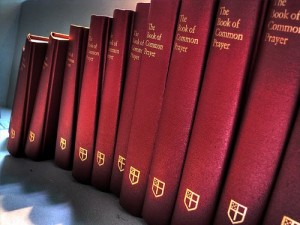
Book of Common Prayer (1979)The Book of Acts, the earliest church history, tells us that the followers of Jesus practiced daily prayer: “Day by day, as they spent much time together in the temple, they broke bread at home and ate their food with glad and generous hearts.” (Acts 2:46) Eventually, the Christians were excluded from Jewish worship assemblies, either by their own choice or by action of the authorities, and in an unrelated development, the Temple was destroyed in 70 AD. Where, then, did Christians pray together? Or, for that matter, alone?

It is likely that there were ascetics who sought solitude away from the cities and what they perceived as a sinful society around them from the start of the Christian community. They may have emulated John the Baptizer and his followers, the Jewish Essenes, or other esoteric communities. However, the first historically verifiable hermit (or “anchorite”) seems to be St. Anthony of Egypt. Unfortunately for him, others were attracted to his lifestyle and he found himself surrounded by disciples following his example. During Anthony’s lifetime, one of his followers, St. Pachomius established the first community for ascetics living together, “cenobites,” during the early part of the Fourth Century. By the end of the Fifth Century, these monks had developed the practice of gathering together for prayer and the early outlines of a Liturgy of the Hours composed of seven “offices” had emerged. It is possible that number of services was chosen because of this (and similar) verses in Scripture.

The foundation of modern western monasticism was the Rule of St. Benedict, authored by Benedict of Nursia in the 6th century. As part of his design for monks living in community, he adopted the practice of regular hours of prayer, adding an eighth. The eight monastic hours are the following:

  • Matins (during the night, usually at midnight; sometimes called Nocturns)
  • Lauds (at dawn, or 3 a.m.)
  • Prime (approximately 6 a.m.; this is the hour added by Benedict)
  • Terce (approximately 9 a.m.)
  • Sext (approximately 12 noon)
  • None (approximately 3 p.m.)
  • Vespers (approximately 6 p.m., “at the lighting of the lamps”)
  • Compline (approximately 9 p.m., before retiring)

Archbishop Thomas Cranmer, the genius behind the Anglican Prayer Book tradition, took bits and pieces of these monastic hours to create the offices of Daily Morning Prayer and Daily Evening Prayer included in The Book of Common Prayer of 1549 and in every revision of the Prayer Book since. It was Cranmer’s idea that individuals and families, like monks in community, would say these offices every day, coming together with others on Sundays to celebrate the Holy Communion.

It was, I’m afraid, a wonderful but never realized vision; I doubt very seriously that there has ever been a time since the Reformation when Anglicans, in general, stop during their days for even a single instance of regular, corporate, liturgical prayer, let alone twice a day, let alone seven or eight times a day. Nonetheless, the Anglican ethos is one of constant daily prayer deriving from the Scriptural witness of the Psalms.

It is my practice to say the Daily Offices at morning and evening and, occasionally, Compline before retiring. The current American Prayer Book of 1979 includes two forms of Morning Prayer, an office for Noonday Prayer, two forms of Evening Prayer, an order for Compline, and four short forms for individual prayer throughout the day. Our tradition is steeped in the monastic tradition!

But how many of us can say this verse of Psalm 119 with complete authenticity? I know that I can’t! Two times a day? Usually. Seven times a day? It just doesn’t happen! It probably should, but it doesn’t.

====================

A request to my readers: I’m trying to build the readership of this blog and I’d very much appreciate your help in doing so. If you find something here that is of value, please share it with others. If you are on Facebook, “like” the posts on your page so others can see them. If you are following me on Twitter, please “retweet” the notices of these meditations. If you have a blog of your own, please include mine in your links (a favor I will gladly reciprocate). Many thanks!

====================

Father Funston is the rector of St. Paul’s Episcopal Church, Medina, Ohio.

Mix Faith with Frustration – From the Daily Office – July 2, 2013

From the Gospel of Luke:

They said, “If you are the Messiah, tell us.” He replied, “If I tell you, you will not believe; and if I question you, you will not answer.”

(From the Daily Office Lectionary – Luke 22:67-68 (NRSV) – July 2, 2013.)

Frustration Relief KitIn the assembly of the elders of the people, the chief priests and the scribes, Jesus is asked, “Are you the Messiah?” and in response he gives vent to some very real human frustration.

I recently read an article about frustration as a plot element in writing fiction. The author suggested that frustration is, in fact, the most important emotion in fiction because nothing happens in a novel or short story unless the plans, wishes, or desires of the protagonist are frustrated. If Ahab had killed the white whale on his first attempt, Moby Dick would have been a very short tale, indeed. The author of the article pointed out, however, that frustration “is seldom a ‘pure’ emotion. It can come mixed with many others: anger (‘How dare they!’), hurt (‘Why won’t they help me?’), fear (‘I’ll never get what I want’), self-blame (‘I’m not good enough to succeed’), resignation (‘Can’t win ‘em all’), or bitterness (‘Life sucks’).”

One of my favorite episodes of The West Wing was about a submarine crisis off the coast of North Korea. The White House staff brought in an expert on submarine warfare to advise President Bartlett; Hal Holbrook played the character with droll dullness, droning on and on about difference experiences. In one scene, the expert and Leo McGarry were sitting on the sofas in the Oval Office talking; Leo was listening, the expert droning on. From off camera came the sound of a rhythmic thump – thump – thump. The camera pulled back to reveal the President banging his head on his desk . . . . I’m not sure what the President’s frustration might have been mixed with, but clearly that is not the best way to handle frustration!

With what, we might ask, is Jesus’ frustration mixed? I think the answer must be, “Faith.” Jesus is convinced that whatever happens, his God is with him. The night before this questioning, all the other emotions with which this frustration might have been mixed were sweated out in Garden of Gethsemane, leaving only faith: “Father, if you are willing, remove this cup from me; yet, not my will but yours be done.” (Luke 22:42) To be true to his mission (whatever we might now believe or understand it to be), to be true to his God, Jesus could not allow any other emotion to taint his frustration.

In any given situation, with what are our frustrations mixed? Too often they are like that article author described, mixed with emotions that result in negative or self-defeating outcomes. Our task is to spend some Gethsemane-time, sweating out those impurities, leaving only faith.

I think frustration mixed with faith might best be named “resolve,” which the dictionary defines as “firmness of purpose.” That certainly describes Jesus in the assembly of the elders (and throughout the Passion).

In an address at the University of Maine in October 1963, President John F. Kennedy exhorted his listeners: “Let us resolve to be masters, not the victims, of our history, controlling our own destiny without giving way to blind suspicions and emotions.” The example of Jesus suggests that, in some ways, we may still be “victims” no matter what we resolve and no matter how strong our faith may be. But our Lord’s example and the Christian faith also demonstrate that “victimization” to those who stand firm in their mission is a temporary state; on the other side one finds resurrection and redemption.

Frustration is a very real and very human situation. What we choose to mix with our frustrations is the determiner of outcome; followers of Jesus mix faith with frustration.

====================

A request to my readers: I’m trying to build the readership of this blog and I’d very much appreciate your help in doing so. If you find something here that is of value, please share it with others. If you are on Facebook, “like” the posts on your page so others can see them. If you are following me on Twitter, please “retweet” the notices of these meditations. If you have a blog of your own, please include mine in your links (a favor I will gladly reciprocate). Many thanks!

====================

Father Funston is the rector of St. Paul’s Episcopal Church, Medina, Ohio.

Leopards Changing Spots – From the Daily Office – July 1, 2013

From the Book of Acts:

They dragged [Stephen] out of the city and began to stone him; and the witnesses laid their coats at the feet of a young man named Saul.

(From the Daily Office Lectionary – Acts 7:58 (NRSV) – July 1, 2013.)

LeopardThis is the first appearance in the Christian story of the man who will become the early church’s greatest evangelist and the author of most of the New Testament. We are told that as he witnessed the martyrdom of the first deacon, “Saul approved of their killing him.” (Acts 8:1)

Saul would take the Gentile form of his name, Paul, when baptized and under that name would spread the Christian faith among non-Jews. One assumes that, from time to time, he might have told the story of witnessing Stephen being killed – it would make a powerful sermon illustration, don’t you think? He obviously told it to someone because eventually it got to Luke, who included it in his little history of the church.

This story of a public execution brought to mind a conversation I had with a parishioner just a few days ago. Texas recently executed its 500th death-penalty convict since resuming executions in 1980s; that news led us into a discussion of the death penalty. I am opposed to the death penalty on several grounds; my parishioner favors it. In the course of our conversation he put forth the argument that execution rids society of criminals who will kill again. He’s convinced that killers don’t change: “The leopard never changes his spots,” he said.

He certainly has the Bible (or at least the the Old Testament on his side. This old shibboleth comes from word of God spoken through the prophet Jeremiah! Lamenting the sinfulness of God’s People, the Lord asks: “Can Ethiopians change their skin or leopards their spots?”(Jer. 13:23, NRSV). Of course, the message of the prophet would suggest that the answer to that question is “Yes” else why call the people to repentance? And therein lies the theological and ethical issue I have with the death penalty. (I have legal, economic, and practical issues with it, as well.)

The death penalty denies the power of God in Christ to redeem, restore, and transform human existence. It precludes any possibility of repentance and amendment of life. When the capital punishment is imposed, the life of the convicted person is devalued and all possibility of change is ended. When the government undertakes capital punishment on behalf of the people (on my behalf), the people are implicated in that judgment and we are made to share in an ethic we may not accept (one which I do not accept). An ethic which says, as my congregant put it, that “leopards cannot change their spots.”

But that is not the Christian ethic (nor is it the ethic of the Old Testament in which that image is first spoken). The Christian ethic says that repentance is always possible. It is, in a very real sense, the whole message of Christ: “Repent, for the kingdom of heaven has come near.” (Matthew 3:2) The leopard can change its spots and the Christian hope is always that it will.

After all, Saul – who held the cloaks of the executioners and approved their killing of Stephen – changed his!

====================

A request to my readers: I’m trying to build the readership of this blog and I’d very much appreciate your help in doing so. If you find something here that is of value, please share it with others. If you are on Facebook, “like” the posts on your page so others can see them. If you are following me on Twitter, please “retweet” the notices of these meditations. If you have a blog of your own, please include mine in your links (a favor I will gladly reciprocate). Many thanks!

====================

Father Funston is the rector of St. Paul’s Episcopal Church, Medina, Ohio.

Give No Thought to Donkeys – From the Daily Office – June 29, 2013

From the First Book of Samuel:

As for your donkeys that were lost three days ago, give no further thought to them, for they have been found.

(From the Daily Office Lectionary – 1 Samuel 9:20 (NRSV) – June 29, 2013.)

Donkeys in the DesertThis advice not to worry about his donkeys is given by Samuel to Saul when Saul arrives at Ramah. It seems oddly out of place. Saul has been sent by God to Samuel, and God has informed Samuel that the man he will have sent to him is to be king over Israel. So Saul has had his cook set aside a special portion of meat and otherwise prepared to meet and anoint the man who would one day rule the country. Samuel comes to the town where he expects to find the man of God, and this statement is part of their first conversation:

Saul approached Samuel inside the gate, and said, “Tell me, please, where is the house of the seer?” Samuel answered Saul, “I am the seer; go up before me to the shrine, for today you shall eat with me, and in the morning I will let you go and will tell you all that is on your mind. As for your donkeys that were lost three days ago, give no further thought to them, for they have been found. And on whom is all Israel’s desire fixed, if not on you and on all your ancestral house?”

Again, the admonition about the donkeys seems oddly out of place. And, yet, I don’t think it is.

I think it’s Samuel’s way of telling Saul, “Don’t sweat the small stuff.” The lost donkeys are not important. They don’t matter right now; they have bigger, more important business to take care of. We all have bigger, more important business to take care of, yet we often get hung up worrying about missing donkeys. As Samuel has told Saul, someone else is seeing to them. Give them no further consideration; focus on what’s important!

So remember, give no further thought to your donkeys!

====================

A request to my readers: I’m trying to build the readership of this blog and I’d very much appreciate your help in doing so. If you find something here that is of value, please share it with others. If you are on Facebook, “like” the posts on your page so others can see them. If you are following me on Twitter, please “retweet” the notices of these meditations. If you have a blog of your own, please include mine in your links (a favor I will gladly reciprocate). Many thanks!

====================

Father Funston is the rector of St. Paul’s Episcopal Church, Medina, Ohio.

« Older posts Newer posts »