Occasional thoughts of an Anglican Episcopal priest

Category: Church (Page 71 of 115)

Taking the Train to God’s Picnic: A Homily for a Requiem – June 25, 2013

====================

This sermon was preached at the Requiem Mass on June 25, 2013, for Charlie Stehno, a member of St. Paul’s Episcopal Church, Medina, Ohio, where Fr. Funston is rector.

(Episcopal Church Lectionary, For Burials: Isaiah 25:6-9; Psalms 23; Revelation 21:2-7; and John 14:1-6. These lessons were selected by the family from among the options set forth in The Book of Common Prayer. All options can be found at The Lectionary Page.)

====================

Steam LocomotiveAre you familiar with those visions of the afterlife in which the dearly departed, clothed in flowing white robes lounge around on fluffy, white cotton clouds playing harps? I have to be honest with you that I cherish a very dear hope that such visions are 100% absolutely wrong! I cannot imagine any existence more boring than an eternity of cloud-floating and harp-playing, and if my ten years of knowing Charlie Stehno have given me a clue of anything about Charlie it is that he would most likely feel the same way. If he has gotten to the Great Hereafter only to find himself fitted out with a flowing white robe and issued a harp to play and cloud to lounge upon, I suspect that he is (as my grandmother would say) “fit to be tied.”

But I don’t really think there’s any danger of that! I believe that larger life in God’s Presence is quite a bit different from that beatific vision of robe wearing, harp playing, and cloud floating. As I spent the past few days contemplating the lessons that Kathy selected for today’s Requiem — this wonderful vision of Isaiah’s of a feast on a mountain top; John of Patmos’s vision of the new Jerusalem where our home will be with God, where hunger and thirst will be no more, where there will be these wonderful springs overflowing with the water of life, and where God will wipe away every tear; and most importantly Jesus’ promise that in God’s home there is a place for all of us — as I contemplated these readings and as I thought about Charlie’s life selling the heavy machinery that moved the rolling stock on the railways of this and several other countries, I kept having a childhood memory. It is a memory that informs my vision heaven, that shapes my belief about what lies through that doorway of death. I’d like to share it with you, so I hope you’ll forgive me if I spend a few minutes sharing something about my family as a means to come to terms with the grief and loss experienced by the Stehno family.

My parents were raised in a small town in southeastern Kansas and when I was very young my paternal grandparents and many members of my extended family on both sides still lived in and around that town. On my mother’s mother’s side, my great-grandfather, Hinrich Buss, had emigrated from the German farm country of Ostfriesland in the 1860s when he was about 20 years old. He settled in that area of Kansas and homesteaded several thousand acres, raising not one but three families. I am descended from him and his third wife, Harmke (who bore Hinrich 15 children who lived to adulthood).

Each summer of my childhood I would spend several weeks with my father’s parents, but for one day of each summer I would cease being a “Funston” and, instead, I become one of the several hundred “Buss cousins.” That one day was like a parenthetical note in my life: “This is Eric Funston – open parenthesis – who is also a Buss – close parenthesis.” Those parentheses were, if you will, represented by railroad journeys.

That day would start early in the morning when my great-uncle and great-aunt Roy and Blanche Buss would collect me from my Funston grandparents’ home and we would drive to the Santa Fe Train Station and catch the Atchison, Topeka & Santa Fe Railroad for the ancestral home, which was outside the next town to the west, an hour’s train ride away. Open parenthesis! When the train pulled out of station, I was no longer a Funston; I was a Buss.

When the train arrived, we would disembark to be picked up by other Buss cousins and driven to the farmhouse which had been and still was (and still is) the Buss family home.

As soon as we arrived, Blanche would join the other women in the farmhouse kitchen; Roy would go off with the other men to walk the fields and look at the livestock and smoke cigarettes and talk about the news of the day; and I would join the other kids swimming in the farm pond (which, to be honest, was pretty yucky, but we were kids, we didn’t care).

Around midday trestle tables would be set up in the yard and in pretty short order they would be overflowing with sauerbraten, and schnitzel, and wursts of all sorts, with sauerkraut and potato salad and fresh garden tomatoes, and more kinds of homemade bread and rolls and biscuits than you can imagine. Someone would say a prayer, and we would all dig in and eat way more than we should and, afterward, fall asleep in the shade of the barn.

A little later the older kids and the younger men would get up a football game. Because there were more of us descended from Greatgramma Harmke than from Hinrich’s first two wives it was usually organized as the third family against the first two. And there would be much cheering and yelling and arguing over plays and goals and whether someone is in-bounds or out; you know the sort of thing that happens in those sorts of games.

Sometime during the fourth quarter, the women would disappear back into that farmhouse kitchen and as the game came to its inevitable end, those trestle tables would again be loaded to overflowing, but this time with homemade pies, and cakes, and cookies, and even homemade ice cream. And, once again, we would all eat way more than a person ought . . . .

But in not-too-long a time, the sun would begin to set. And that would be the signal that Great-uncle Roy and Great-aunt Blanche and I would have to leave. We’d be driven back into town to catch the evening train back to my parents’ hometown. When we got there, I went back to being a Funston. That eastbound train ride was the end of my day of being a “Buss cousin.” Close parenthesis.

You know, there are a lot of songs about trains, and among those are a lot of songs about trains going to heaven. That’s another thing that kept coming to mind as I thought about what I might say here today. There’s Woody Guthrie’s familiar tune:

This train is bound for glory, this train.
This train is bound for glory,
Don’t carry nothing but the righteous and the holy.
This train is bound for glory, this train.

And there’s Boxcar Willie’s wonderful song of a hobo’s last train ride:

I’ll ride that last train to heaven
On rails of solid gold
In a boxcar lined with satin
Where the nights are never cold
Where a hobo’s always welcome
Even in his ragged clothes
I’ll ride that last train to heaven
When the final whistle blows.

And my personal favorite is Curtis Mayfield’s great song:

People get ready there’s a train comin’;
You don’t need no baggage, just get on board.
All you need is faith to hear the diesels hummin’;
You don’t need no ticket, just thank the Lord.

In the 23rd Psalm, David thanks the Lord for shepherding us as we walk through the valley of the shadow of death, for setting an abundant table for us in the midst of our enemies, and for pledging in God’s mercy and goodness that we will dwell in the house of the Lord for ever. Jesus affirms that in that home there are rooms for all of us, and both Isaiah and John of Patmos assure us that the abundance of that table will continue, that God will lay out a feast of “rich food . . . and well-aged wines strained clear,” that there will no hunger or thirst of any kind.

It will be like a family reunion, God’s family reunion, where everyone we’ve ever loved is present, and everyone they’ve ever loved (including us) eventually will be, “where sorrow and pain are no more, neither sighing, but life everlasting,” and where “God will wipe away the tears from all faces.” St. Paul, the patron of this parish, explained it this way in his First Letter to the Corinthians:

Since death came through a human being, the resurrection of the dead has also come through a human being; for as all die in Adam, so all will be made alive in Christ. But each in his own order: Christ the first fruits, then at his coming those who belong to Christ. Then comes the end, when he hands over the kingdom to God the Father, after he has destroyed every ruler and every authority and power. For he must reign until he has put all his enemies under his feet. The last enemy to be destroyed is death. (1 Cor. 15:21-26)

As a song I know was special to Charlie might put it:

The enemy must yield,
We’ll fight just like our ancestors
and march right down the field!
(University of Toledo Fight Song; Charlie was an alumnus and former football start of Toledo U.)

Charlie has marched down that field; he has finished his walk through the valley of the shadow of death. He has won the victory! He has gotten on board that train bound for glory, that last train to heaven; he’s left this life’s crippling, painful baggage behind, and he has arrived in that larger life where, as Isaiah assures us, he has not found a cloud or a harp.

No, he’s taken that train to a great family reunion, where the picnic tables are eternally laden with God’s overflowing abundance, where the faithful swim not in some yucky farm pond but in the clear river that flows from the springs of the water of life, where the family home has room for everyone, and where (if there isn’t one already, Charlie will make sure) there’s a football game going on.

And the greatest and most wonderful thing is that there will be no sunset and there will be no train going back to anywhere; there will be no “close parenthesis.”

Thanks be to God! Amen.

====================

A request to my readers: I’m trying to build the readership of this blog and I’d very much appreciate your help in doing so. If you find something here that is of value, please share it with others. If you are on Facebook, “like” the posts on your page so others can see them. If you are following me on Twitter, please “retweet” the notices of these meditations. If you have a blog of your own, please include mine in your links (a favor I will gladly reciprocate). Many thanks!

====================

Father Funston is the rector of St. Paul’s Episcopal Church, Medina, Ohio.

Change Is Life – From the Daily Office – June 25, 2013

From the Book of Acts:

“I tell you, keep away from these men and let them alone; because if this plan or this undertaking is of human origin, it will fail; but if it is of God, you will not be able to overthrow them — in that case you may even be found fighting against God!”

(From the Daily Office Lectionary – Acts 5:38-39 (NRSV) – June 25, 2013.)

Emerging Monarch ButterflyThe Pharisee Gamaliel gave sound advice to the Sanhedrin: “Leave them alone. If their movement is of God, you will not be able to stop it.” It’s advice the church, which benefited from it, has often failed to heed. We ought to follow it more often than we do . . . but there is that other rule the church more frequently follows: “Any change, at any time, for any reason, is to be deplored.” (Often attributed to an otherwise unidentified Victorian-era “Duke of Cambridge.”)

Episcopalians are said to be the poster children for this rule. The old joke asks, “How many Episcopalians does it take to change a light bulb?” . . . .

“Change! My grandmother gave that lightbulb!”

None of us are really comfortable with change. I suspect that most people, if they had their druthers, would just keep things mostly the same. For most of us the status quo is comfortable and staying the course gives us a sense of security. A read recently about a guy who bought a new radio, brought it home, placed it on the refrigerator, plugged it in, turned it to a station coming out of Nashville, home to the Grand Ole Opry, and then pulled all the knobs off. He had he wanted and had not intention to change.

But life without change isn’t life. It’s death. If there is one constant in this world it is that living things change; only lifeless things are static. And life, as Scripture tells us, is God’s will for God’s People. Isaiah prophesied, “No more shall there be in it an infant that lives but a few days, or an old person who does not live out a lifetime; for one who dies at a hundred years will be considered a youth, and one who falls short of a hundred will be considered accursed.” (Isa. 65:20)

Take heed of Gamaliel’s words to the Sanhedrin. Change is evidence of life, and life is the will of God, so change may be of God and, if so, you will be unable to overthrow it.

====================

A request to my readers: I’m trying to build the readership of this blog and I’d very much appreciate your help in doing so. If you find something here that is of value, please share it with others. If you are on Facebook, “like” the posts on your page so others can see them. If you are following me on Twitter, please “retweet” the notices of these meditations. If you have a blog of your own, please include mine in your links (a favor I will gladly reciprocate). Many thanks!

====================

Father Funston is the rector of St. Paul’s Episcopal Church, Medina, Ohio.

The Festal Shout – From the Daily Office – June 24, 2013

From the Psalter:

Happy are the people who know the festal shout!
they walk, O Lord, in the light of your presence.
They rejoice daily in your Name;
they are jubilant in your righteousness.

(From the Daily Office Lectionary – Psalm 89:15-16 (BCP Version) – June 24, 2013.)

Amen Corner“Festal shout” . . . the Hebrew is teruwah, a technical term for a liturgical response. (The root word is ruwa which is a verb meaning “to shout an alarm.”) It was probably something along the lines of “Hallelujah!” although it was probably not that particular Hebrew exclamation.

Episcopalians are well familiar with liturgical responses. We are almost programmed to make them. Say, “The Lord be with you,” to an Episcopalian, and it will prove very unlikely that he or she cannot help but say, “And also with you!” (Unless, of course, the person may be an old time traditional, in which case “And with thy spirit” will leap off the tongue.) However, familiar was we may be with liturgical responses, shouting them is something we simply don’t do, although in a crowded church we might be a little louder than usual.

And shouting out on our own in response to, say, a sermon? Out of the question!

Several years ago I had the privilege of preaching in a parish of the African Methodist Episcopal Church. I had gotten maybe two paragraphs into my prepared text when a member of the congregation called out, “Amen, preacher!” I must admit to being taken aback; I “stumbled” a bit, but got back on track pretty smoothly. Then it happened again! What had started as a typical Episcopal lecture-style homily turned into a dialog between the preacher and the congregation. We had fun together speaking the word of God to each other; there was joy and jubilation in that church It was great! I loved it! I’d never had a preaching experience like that before, and I’ve not had one since.

I don’t think we Episcopalians need to start shouting spontaneous responses to our sermons (although that might be fun), but I do think we need to cultivate that same sense of joy and jubilation, the vibrancy and liveliness that was evident in that AME congregation. We need to learn the “festal shout,” or at least find its spirit in our worship.

====================

A request to my readers: I’m trying to build the readership of this blog and I’d very much appreciate your help in doing so. If you find something here that is of value, please share it with others. If you are on Facebook, “like” the posts on your page so others can see them. If you are following me on Twitter, please “retweet” the notices of these meditations. If you have a blog of your own, please include mine in your links (a favor I will gladly reciprocate). Many thanks!

====================

Father Funston is the rector of St. Paul’s Episcopal Church, Medina, Ohio.

Legion . . . Silence: A Contrast – Sermon for the 5th Sunday after Pentecost (Proper 7C) – June 23, 2013

====================

This sermon was preached on the Fifth Sunday after Pentecost, June 23, 2013, at St. Paul’s Episcopal Church, Medina, Ohio, where Fr. Funston is rector.

(Revised Common Lectionary, Pentecost 5 (Proper 7, Year C): 1 Kings 19:1-15a; Psalms 42 and 43; Galatians 3:23-29; and Luke 8:26-39. These lessons can be read at The Lectionary Page.)

====================

Schizophrenia Illustration from Vimeo At the beginning of the sermon, following the reading of Gospel lesson, five readers scattered among the congregation, rose and loudly read the following five passages simultaneously:

Voice One: “Four score and seven years ago our fathers brought forth on this continent a new nation, conceived in liberty, and dedicated to the proposition that all men are created equal. Now we are engaged in a great civil war, testing whether that nation, or any nation so conceived and so dedicated, can long endure.”

Voice Two: “We the people of the United States, in order to form a more perfect union, establish justice, insure domestic tranquility, provide for the common defense, promote the general welfare, and secure the blessings of liberty to ourselves and our posterity, do ordain and establish this Constitution for the United States of America.”

Voice Three: “You can’t do anything right and never will be able to. Everyone hates you. You have no friends. You are the most useless, worthless human being on the planet. You know this is true, and you are powerless to change it. You should just end it right now. There’s no reason for you to keep living.”

Voice Four: “In a large bowl, beat together eggs, oil, white sugar and two teaspoons vanilla. Mix in flour, baking soda, baking powder, salt and cinnamon. Stir in carrots. Fold in pecans. Pour into prepared pan. Bake in the preheated oven for 40 to 50 minutes, or until a toothpick inserted into the center of the cake comes out clean.”

Voice Five “Mr. Dursley, a well-off Englishman, notices strange happenings on his way to work one day. That night, Albus Dumbledore, the head of a wizardry academy called Hogwarts, meets Professor McGonagall, who also teaches at Hogwarts, and a giant named Hagrid outside the Dursley home. Dumbledore tells McGonagall that someone named Voldemort has killed a Mr. and Mrs. Potter and tried unsuccessfully to kill their baby son, Harry.”

One of the many ways in which modern scholars try to make sense of the story of the Gerasene Demoniac is the suggestion that he was, in fact, schizophrenic. For example, the Dean of St. Alban’s Cathedral in England, Jeffrey John, writes:

Anyone presenting the symptoms of the Gerasene demoniac today would be rapidly committed for treatment of multiple schizophrenia – and quite rightly. It would be very foolish to do otherwise, or to discount the huge, God-given progress that has been made in our understanding and treatment of mental illness since biblical times. (The Meaning in the Miracles, p. 91, Eerdmans:2004)

A Roman Catholic writer who identifies himself only as “John” tells of accompanying a priest making his Eucharistic ministry rounds at a psychiatric hospital. He describes what happened when they arrived at the ward where the most seriously disturbed patients were housed:

My friend began to say the prayers and all was relatively calm until he raised the Eucharist. This very motion acted like a trigger for one of the patients who began to shout expletives, spit and hiss. This set off most of the others; he had to be restrained while we administered the Eucharist to those who wanted it and lined up to receive it. Amidst the cacophony I heard one thing that he shouted which remains with me to this day; he shouted “why are you coming in here tormenting us?” (John’s Ramblings)

He then comments, “It wasn’t until some time later that when meditating on the Healing of the Gerasene Demoniac . . . that I shuddered to a halt and recalled that event in the psychiatric hospital.”

Schizophrenics hear voices. This is the most common type of hallucination in schizophrenia. The voices may talk to the person about his or her behavior; they may order the person to do things; they may speak warnings of danger. Sometimes the voices talk to each other; sometimes they talk over one another, several voices speaking at once. What we experienced as these five people read these differing texts was a crude demonstration of what some schizophrenics experience, or what the Gerasene Demoniac seems to have suffered.

The great English author, C. S. Lewis, once wrote that we human beings are a “myriad of impulses, a cauldron of evil desires.” The Gerasene Demoniac certainly was. When Jesus asked him (or the demon within him) his name, the answer was, “We are legion.”

That is a very scary answer! That word, legion, is a Roman military term. In the Roman army, a legion consisted of six thousand men. We heard only five voices in our little demonstration. Can you imagine what it must have been like to hear thousands upon thousands of demonic voices? No wonder he would break his chains and shackles and run into the wilds to live in the cemetery among the tombs!

John, the Roman Catholic blogger, suggests that “all disorder, all conflict whether we call it civil, political, doctrinal, psychiatric, psychological, social or personal disorder, . . . anything that creates or contributes to disorder or conflict is the presence of evil at work in the world.” I believe he is correct, the message of the Prophets is that that disorder, that chaos is not, and never will be, the last word.

As dramatic counterpoint to the Gospel story today, we have another story of the Prophet Elijah. The Lectionary, as you remember, has had us bouncing around in the First Book of Kings reading stories of Elijah, but not in the order they are presented in that book. Instead, we have been getting the texts from First Kings as they may relate to the stories from Luke’s Gospel; today’s pairing seems to be a good example. What we see here is the stark difference between the chaotic disorder of evil, represented by demon possession (or schizophrenia), and the order of holiness, represented by the “sheer silence” in which Elijah encounters God.

You recall the story. Elijah has just killed the 450 prophets of Ba’al, which has royally angered the wicked Queen Jezebel. She has sent word to Elijah saying, “So may the gods do to me, and more also, if I do not make your life like the life of one of them by this time tomorrow.” In other words, “Look out, Dude! I’m gonna kill you!” So Elijah, in fear, flees into the desert and in a fit of depression prays that God will take his life. However, an angel appears and tells him that’s not going to happen. He is instructed to eat something and then travel to “Horeb, the mount of God.” This is understood to be the very same place where Moses received the Tablets of the Law. When he gets there, God asks what his problem is: “What are you doing here, Elijah?” Elijah answers that all the prophets of Yahweh have been killed (by Queen Jezebel and her army) and only he is left. So God tells him to stand at the mouth of his cave because God will pass by.

He does so and there is a storm, and then an earthquake, and then a fire. All of these things represent that disordered chaos which the Demoniac in the Gospel experiences, and God is in none of them. Instead, God is in the “sheer silence,” as the New Revised Standard Version translates the Hebrew. A literal translation of the Hebrew would be “the sound of gentle blowing,” and the King James Version translated this by that wonderful turn of phrase “a still small voice.”

So we have this wonderful juxtaposition of an image of loud, confusing, demonic chaos — the Gerasene Demoniac, a person in a situation which is overwhelmingly evil, permeated with and being buffeted by a legion of devils, thousands of incoherent voices, pulling him in every direction, ruining his life — with an image of calm, peaceful, gentleness — the still small voice of God present in sound of sheer silence, the sound of gentle blowing.

We, I hope, are not possessed of demons, nor suffering from schizophrenia or some other form of delusional mental illness. But we all inhabit a world of many, many voices, all talking to us, all telling us what to think, or do, or say. No matter how old we are, we will always have the voices of parents and grandparents playing in our heads; we have the voices of politicians, news reporters, bosses, spouses, our own children, their teachers, doctors, lawyers, tax advisers . . . and occasionally preachers . . . all telling us what to do. There are times when all of that noise can get us down, when we can all relate personally to the lament in today’s gradual psalm: “Why are you so full of heaviness, O my soul, and why are you so disquieted within me?”

Several years ago, there was a job opening on a cruise ship; a new communications officer was need. There were several applicants seeking the position and all were told to come to a particular office at the same time on the same day. They arrived and were shown in to a waiting room. While they waited to be interviewed, the conversed with one another and soon the room was filled with the sounds of conversation. After quite a long wait, another applicant who was late came in and sat down; everyone else was busy talking, so she just quietly waited for a few minutes, but then suddenly, she jumped up and walked through a door marked “Private.” A few minutes the personnel manager walked out of that door and announced that the position had been filled; the late-arriving applicant had been hired. The other applicants were extremely angry, “We were here first! How could she go ahead of us and get the job?” To which the personnel manager replied, “Any of you could have gotten the job if you had just been quiet long enough to pay attention to the message on the intercom.” “What message?” “All the time you were talking the intercom was broadcasting in Morse Code, ‘A ship’s communications officer must always be on the alert. The first person who gets this message and comes directly into my office will get the job.'”

I believe that God’s still small voice is like that coded message. It’s there if we will but take a few moments of silence and listen for it. And if it seems like we do not have the power to do so on our own, if we are unable to still the storms, the earthquakes, the fires, the voices . . . the story of the Gerasene Demoniac reminds us that Jesus can, because personal exorcism is not what this story is really about. “Rather,” as Jeffrey John reminds us, “it is about the promise . . . of God’s ability to defeat and re-order the disordered powers that afflict both individuals and communities.”

Life can sometimes, indeed, life can often be permeated with great evil that is almost beyond human comprehension and beyond our ability to handle. In those moments, we may be tempted to just give up and give in to the intensity of evil around us. Like the Psalmist we may cry out, “Why are you so full of heaviness, O my soul, and why are you so disquieted within me?” Like Elijah we may be tempted to just sit down in the desert and say, “Let me die.” But God does not give up; Jesus does not give up. Jesus faces the demons with his healing and his peace. There is no situation so bad that Jesus cannot or will not bring his healing power.

Why are you so full of heaviness, O my soul?
and why are you so disquieted within me?
Put your trust in God;
for I will yet give thanks to him,
who is the help of my countenance, and my God.
Amen.

====================

A request to my readers: I’m trying to build the readership of this blog and I’d very much appreciate your help in doing so. If you find something here that is of value, please share it with others. If you are on Facebook, “like” the posts on your page so others can see them. If you are following me on Twitter, please “retweet” the notices of these meditations. If you have a blog of your own, please include mine in your links (a favor I will gladly reciprocate). Many thanks!

====================

Father Funston is the rector of St. Paul’s Episcopal Church, Medina, Ohio.

The Dark Lining of Joy – From the Daily Office – June 21, 2013

From the Psalter:

My friend and my neighbor you have put away from me,
and darkness is my only companion.

(From the Daily Office Lectionary – Psalm 88:19 (BCP Version) – June 21, 2013.)

On Your Ordination Anniversary CardToday is the 22nd anniversary of my ordination as a priest in the Episcopal Church. It is also the 20th anniversary of the death of my older (and only) sibling, Rick.

Rick Funston died on Father’s Day 1993 of a cancer called Glioblastoma Multiforme Stage IV. Glioblastoma is an aggressive, extremely invasive, and invariably fatal form of primary site brain cancer; “primary site” means that it is not metastasized from some other location, as most brain cancers are (or so I’m told). Glioblastomas grew rapidly and are the sort of tumors that give cancer its name. Not many people know that cancer is called that because of invasive tumors’ resemblance to the many-legged crab. Cancer is the Latin word (derived from the Greek karkinos) for “crab.”

When Rick was diagnosed, I did some research and learned that the median survival time was about six months from date of diagnosis with nearly all patients passing away within two years. I just checked the current literature and see that the median has lengthened to 12 months and that 3-5% of patients survive as long as three years; they are called “long-term survivors.” Rick was not a long-term survivor.

His first symptoms appeared in October of 1992 and were initially misdiagnosed as a stroke. An accurate diagnosis was made in February of 1993; he died four months later.

Rick was nearly 10 years older than me. He went away to live with our grandparents and attend a private high school in my parents’ Kansas home town when I was 4 years old, so I really have almost no memory of him as a child. We next lived together, only very briefly, when he decided to leave the University of Texas in his sophomore year and attend UCLA; he moved into our parents’ and my home (our mother and stepfather; our father died when I was 5 years old) for a few months. We only really became close after I graduated from high school; he and his wife Janet and I toured Europe together the summer after my graduation.

I miss my brother a great deal. He had a wicked sense of humor. He was incredibly smart. His B.A. and M.A. were in American history; his Ph.D., in political science with a specialization in Constitutional law. He taught at San Diego State University and, at the time of his death, was the vice-president of the university. Somewhere along the line, he’d taken a few hours off from academe and gotten a J.D. as well. He spoke German, French, and Italian, and had more than a passing familiarity with Latin and Greek.

His cancer had attacked the part of the brain that controls speech. For pain relief and to extend his life as long as possible, surgery was done to remove as much of the tumor as could be gotten. This professor who spoke six languages, who lectured nearly every day, who had published several books and authored many articles lost his ability to form sentences and to converse easily. He couldn’t remember the names of colors; he couldn’t remember his children’s names. Sitting and talking with him you could see the frustration and anger, and the fear, in his eyes; he knew what he wanted to say, but he couldn’t get the words put together. It was maddening!

He set himself the goal of seeing his oldest child, my niece Saskia, graduate from college. He made that goal.

Every year on the anniversary of my ordination, I spend more time thinking about the brother I miss than about the ministry I have enjoyed. The last verse of the morning psalm, as a result, grabbed me by the throat! “My friend and my neighbor you have put away from me, and darkness is my only companion.”

Ordained ministry is lonely work. Clergy have very few friends or close companions, even among our colleagues in ministry. (A 1991 survey of clergy found that 70% of ordained ministers claimed to have no close friendships; a 2001 survey reported that 51% of clergy feel “lonely.”) During my first two and a half years of clergy life (one year as a deacon and eighteen months of priesthood before his diagnosis), my closest friend and adviser was my brother. He’d given some thought himself to becoming a pastor in the Lutheran tradition (something he was, and the entire Lutheran tradition should be, glad he didn’t pursue). I’ve not had a better, or even an equal, adviser since his death.

I won’t go so far as the psalmist and claim that “darkness is my only companion,” but there is a dark lining to the joy I feel remembering my ordination. I miss you, Rick, I really miss you!

====================

A request to my readers: I’m trying to build the readership of this blog and I’d very much appreciate your help in doing so. If you find something here that is of value, please share it with others. If you are on Facebook, “like” the posts on your page so others can see them. If you are following me on Twitter, please “retweet” the notices of these meditations. If you have a blog of your own, please include mine in your links (a favor I will gladly reciprocate). Many thanks!

====================

Father Funston is the rector of St. Paul’s Episcopal Church, Medina, Ohio.

Gandolfini, Hastings, and the Poor Widow: My Two Cents – From the Daily Office – June 20, 2013

From the Gospel according to Luke:

Jesus looked up and saw rich people putting their gifts into the treasury; he also saw a poor widow put in two small copper coins. He said, “Truly I tell you, this poor widow has put in more than all of them; for all of them have contributed out of their abundance, but she out of her poverty has put in all she had to live on.”

(From the Daily Office Lectionary – Luke 21:1-4 (NRSV) – June 20, 2013.)

Two CentsYesterday, the news services and Facebook were buzzing with the news of the death of James Gandolfini. Mr. Gandolfini, who was famous for playing the role of Tony Soprano in an HBO series The Sopranos, suffered a heart attack at the age of 51. The day before, there was a similar (though smaller) buzz about the death of investigative journalist Michael Hastings, aged 33, in an automobile accident.
Last week, a member of my congregation died at the age of 80 after years of crippling illness. Several weeks of acute respiratory distress came to an end when his family made the always difficult decision to withdraw life-sustaining medical treatment. Except for an obituary in the local papers and a notice on our parish’s Facebook page, his death received no press coverage and no social media mention.

It seems to me this morning that the contrast Jesus draws between the offering of the poor widow and the donations of the wealthy applies as well to the differences in how the world marks the passing of everyday folk compared to its notice of the deaths of celebrities. A man who has lived a life spent in productive work, making a small but steady contribution to the world, supporting his church, raising his children and grandchildren, quietly doing good works, has perhaps “put in more than all” of the famous actors or well-known reporters who get so much attention.

I suppose I may be biased. I knew my parishioner and I know his family. When I saw the news about Mr. Hastings, I had to do some research to find out if I know any of his work; it turns out I do – he is the journalist who broke the story about General Stanley McChrystal. When I saw the reports of Mr. Gandolfini’s death, I did not need to do so; I knew that he had played the Soprano part. But, truth be told, I’ve never seen an episode of The Sopranos and I have no idea what other roles the actor may have played. In either event, I can safely say that neither man has had as great an impact on my life and the lives of the people and community I know than my parishioner had.

I don’t mean to belittle their deaths nor the pain their passing may have caused those who love them, but I think perhaps we pay too much attention to those who claim (or are given) the name “celebrity” and not enough to the grandfathers and the poor widows around us, even in death. We should do as Jesus did in the Temple; we should take notice.

And that’s my two cents.

====================

A request to my readers: I’m trying to build the readership of this blog and I’d very much appreciate your help in doing so. If you find something here that is of value, please share it with others. If you are on Facebook, “like” the posts on your page so others can see them. If you are following me on Twitter, please “retweet” the notices of these meditations. If you have a blog of your own, please include mine in your links (a favor I will gladly reciprocate). Many thanks!

====================

Father Funston is the rector of St. Paul’s Episcopal Church, Medina, Ohio.

The Duties of the Priests – From the Daily Office – June 19, 2013

From the First Book of Samuel:

Now the sons of Eli were scoundrels; they had no regard for the Lord or for the duties of the priests to the people.

(From the Daily Office Lectionary – 1 Samuel 2:12-13a (NRSV) – June 19, 2013.)

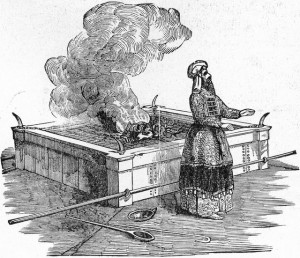
High Priest Offering Sacrifice of a Goat“. . . the duties of the priests to the people . . . ”

Canon 9 of Title III of the Constitution and Canons of the Episcopal Church is entitled “Of the Life and Work of Priests.” It is ten and a half pages long; several of its paragraphs begin with the words, “It shall be the duty . . . .”

The Catechism in The Book of Common Prayer teaches:

The ministry of a priest is to represent Christ and his Church, particularly as pastor to the people; to share with the bishop in the overseeing of the Church; to proclaim the Gospel; to administer the sacraments; and to bless and declare pardon in the name of God.

In the service of ordination of a priest, the candidate for ordination is asked early in the liturgy:

Will you be loyal to the doctrine, discipline, and worship of Christ as this Church has received them? And will you, in accordance with the canons of this Church, obey your bishop and other ministers who may have authority over you and your work?

Later in the service, the bishop addresses the ordinand with these words:

As a priest, it will be your task to proclaim by word and deed the Gospel of Jesus Christ, and to fashion your life in accordance with its precepts. You are to love and serve the people among whom you work, caring alike for young and old, strong and weak, rich and poor. You are to preach, to declare God’s forgiveness to penitent sinners, to pronounce God’s blessing, to share in the administration of Holy Baptism and in the celebration of the mysteries of Christ’s Body and Blood, and to perform the other ministrations entrusted to you.

In all that you do, you are to nourish Christ’s people from the riches of his grace, and strengthen them to glorify God in this life and in the life to come.

The ordinand is then asked eight more questions requiring him or her to promise to faithfully carry out specific ministries or to order his or her life in a particular way.

When the bishop and other presbyters lay hands upon the ordinand, the bishop prays:

Father, through Jesus Christ your Son, give your Holy Spirit to N.; fill him with grace and power, and make him a priest in your Church. May he exalt you, O Lord, in the midst of your people; offer spiritual sacrifices acceptable to you; boldly proclaim the gospel of salvation; and rightly administer the sacraments of the New Covenant. Make him a faithful pastor, a patient teacher, and a wise councilor. Grant that in all things he may serve without reproach, so that your people may be strengthened and your Name glorified in all the world. All this we ask through Jesus Christ our Lord, who with you and the Holy Spirit lives and reigns, one God, for ever and ever. [The pronouns are changed when the ordinand is a woman.]

When a priest accepts the call to be rector of a parish, he or she kneels in the center of the church’s worship space in the midst of the people and prays:

O Lord my God, I am not worthy to have you come under my roof; yet you have called your servant to stand in your house, and to serve at your altar. To you and to your service I devote myself, body, soul, and spirit. Fill my memory with the record of your mighty works; enlighten my understanding with the light of your Holy Spirit; and may all the desires of my heart and will center in what you would have me do. Make me an instrument of your salvation for the people entrusted to my care, and grant that I may faithfully administer your holy Sacraments, and by my life and teaching set forth your true and living Word. Be always with me in carrying out the duties of my ministry. In prayer, quicken my devotion; in praises, heighten my love and gratitude; in preaching, give me readiness of thought and expression; and grant that, by the clearness and brightness of your holy Word, all the world may be drawn into your blessed kingdom. All this I ask for the sake of your Son our Savior Jesus Christ. Amen.

“. . . the duties of the priests to the people . . . ”

I was a law office administrator and later a lawyer. I was an active member of the church. I served on the diocesan council, the commission on ministry, the camp and conference center board, and several other committees, commissions, and task forces. I even became the diocesan chancellor (the chief legal office of a diocese). From time to time my bishop (first Wes Frensdorff and then Stewart Zabriskie, both now departed) would say something like, “Why don’t we get you ordained?” or “When are you going to go to seminary?” or some other encouragement to take on the life and work of a priest, to bear the burden of “the duties of the priests to the people.” I would answer in protest, “I’m happy being a layman.”

Until one day, I couldn’t protest any longer. A friend who wanted to be a priest (he was a gas company engineer) but couldn’t afford the cost of changing careers died. He was only 45. At his funeral, I said to my wife, “I can’t do this anymore.” I started into the ordination process.

“. . . the duties of the priests to the people . . . ”

I didn’t want them. They can be onerous and burdensome. I don’t know how many of the duties of an Episcopal priest were also the duties of the priests of God at Shiloh. I know they had some duties that I’m very thankful we don’t have, like sacrificing animals. But I’ll bet the sons of Eli didn’t want them. The Law and the traditional inheritance of their tribe required that they do them, but I’ll bet they really didn’t want to, and that’s why they became “scoundrels.”

No one who does not feel that he or she cannot do anything else should take on “the duties of the priests to the people.” Maybe we ask the wrong questions at ordination. The really important question is “Can you do anything else?” because if you can, we shouldn’t be ordaining you. Our ordination screening process, the “discernment process” is (I guess) supposed to answer that question, although I’m not sure it does. But that is the most important question. Unless you simply cannot not be a priest, don’t be one.

“. . . the duties of the priests to the people . . . ”

They are often onerous and burdensome. I didn’t want them. In many ways, I still don’t want them. But I cannot not be a priest.

====================

A request to my readers: I’m trying to build the readership of this blog and I’d very much appreciate your help in doing so. If you find something here that is of value, please share it with others. If you are on Facebook, “like” the posts on your page so others can see them. If you are following me on Twitter, please “retweet” the notices of these meditations. If you have a blog of your own, please include mine in your links (a favor I will gladly reciprocate). Many thanks!

====================

Father Funston is the rector of St. Paul’s Episcopal Church, Medina, Ohio.

Nominate, Pray, Take Your Chances – From the Daily Office – June 18, 2013

From the Book of Acts:

So they proposed two, Joseph called Barsabbas, who was also known as Justus, and Matthias. Then they prayed and said, “Lord, you know everyone’s heart. Show us which one of these two you have chosen to take the place in this ministry and apostleship from which Judas turned aside to go to his own place.” And they cast lots for them, and the lot fell on Matthias; and he was added to the eleven apostles.

(From the Daily Office Lectionary – Acts 1:23-26 (NRSV) – June 18, 2013.)

Note: This blog has been “silent” the past few days for a variety of reasons. It was John Lennon, I believe, who observed that “life is what happens to you while you’re busy making other plans.” The past half-week or so has certainly been an example of that!

Drawing StrawsToday’s reading from Luke’s history of the early church details the method by which the eleven remaining apostles chose someone to replace Judas. It was a simple method: (a) identify the candidates; (b) pray; (c) take your chances. They drew lots, but they might have thrown dice, cut a deck of cards, flipped a coin, or done any number of other things that would have randomized the outcome.

There is something instructive in this lesson for Episcopalians who are now preparing for the 2015 meeting of the General Convention of the Episcopal Church at which a new Presiding Bishop will be chosen.

The Presiding Bishop is the Episcopal Church’s chief pastor (“head cook and bottle-washer” my late stepfather would have said). He or she (our current PB is a woman) is the Primate and Metropolitan of the church, equal in rank to the Archbishop of Canterbury and the other head pastors of the several autocephalic (independent and self-governing, though related and interdependent) provinces of the Anglican Communion.

How the Presiding Bishop is selected has changed three times in the 200-plus years of the American church’s existence. Under the original 1789 constitution of the church, the Presiding Bishop was simply the senior bishop in order of consecration. He (back then it was always “he”) served until death or retirement, when the next senior bishop took over; the Presiding Bishop retained his diocesan position (and in those days a bishop was also a parish rector). His only real duties were to be chief consecrator of new bishops and to preside at meetings of the House of Bishops; there was no national church administration and, to be honest, no Anglican Communion with which to interact. Eventually, the office was made elective in 1919. The archives of the Episcopal Church tell us:

The first election of a Presiding Bishop by General Convention took place in 1925. Since 1943 the Presiding Bishop has been required to resign diocesan jurisdiction upon election. In 1967 the duties of the office were significantly enhanced. As “Chief Pastor,” the Presiding Bishop is charged with initiating and developing church policy and strategy, speaking God’s Word to the church and the world, and visiting every diocese of the church. The title “Primate” was added in 1982. The Cathedral of Saint Peter and Saint Paul in Washington, D.C., is the official seat of the Presiding Bishop. The office of the Presiding Bishop is located at the Episcopal Church Center in New York City. The present term of office for the Presiding Bishop is nine years.

A term limitation was first imposed in 1976 when the canons were amended to provide for a twelve-year term (four triennia); this was amended in 1994 when the term was shortened to nine years. Our current Presiding Bishop was elected in 2006 and her term will end at the General Convention of 2015 when her successor will be elected.

In the past, the election has been by the House of Bishops with the House of Deputies concurring. Nominees were selected by the Bishops and the method of nomination and the balloting kept secret. At the last General Convention, it was decided that the whole church should be involved in the nomination process and a “joint commission” was created to select nominees consisting laity, clergy, and bishops. In the current budget of the church the princely sum of $226,000 is set aside for the expenses of this nominating committee. At the 2015 convention, because there has been no change in the Constitution or canons governing the process, the House of Bishops will elect and the election will be reported to the House of Deputies for its concurrence. Laity and clergy will not actually vote for the Presiding Bishop; they will “rubber stamp” the House of Bishops choice — the House of Deputies has never failed to concur in a Presiding Bishop election.

There are calls now to democratize the process further by amending the canons to provide that the PB be elected by both Houses of the General Convention, the House of Deputies voting “by orders” (which means the lay deputies and clergy deputies vote separately); to be selected, a nominee would need a majority of the votes of the bishops, a majority of clergy votes, and a majority of lay votes. (A “vote by orders” in the House of Deputies is a complicated and structurally conservative process actually requiring more than a simple majority, but that’s too much to think about this morning.)

I read about the drawing of lots by the Apostles in the first chapter of Acts and I begin to question the complication and expense of the processes we have devised . . . . Do they really work any better?

Praying and “taking your chances” has worked for the People of God throughout history, and random chance has been used to discern the divine will in many religions. For example, the I Ching (The Book of Changes) of China seeks guidance using the random tossing of yarrow stocks or the flipping of three coins to produce “hexagrams,” the meanings of which are recorded in the book. In the ancient Jewish religion, the High Priest carried two stones (or possible wooden or bone plates) in his breastplate, the Urim and Thummim, which were used to divine God’s Will; exactly what they were and how they were used is lost to history, but one speculation is that they were a sort of “holy dice” which would be cast and a message or meaning derived therefrom.

I have been told that in the tradition of some Eastern or Oriental Orthodox churches (particularly the Ethiopian church) bishops are selected by chance: the names of the eligible candidates are written on slips of paper which are put into a chalice and then one is randomly pulled out by a child. I’ve also been told that a similar method is (or was) used by the Moravians to select bishops with the interesting addition of a blank paper which, if drawn, would indicate that God was not satisfied with any of the named candidates and that the church should consider additional nominees.

It seems to me that these methods are equally as “democratic” as the expensive and complicated processes now underway in (or proposed for the future of) the Episcopal Church. We all share in such a random chance process!

Why not simply put the names of all eligible diocesan bishops (every bishop who has been in office at least five years and who will not reach mandatory retirement age before the end of the nine-year term) into a large chalice, pray, and let the youngest deputy present draw out a name? Presiding Bishop selected, complicated process and exorbitant expense avoided, and (by the way) the example of Scripture honored and followed.

Nominate, pray, take your chances! It worked for the Apostles. Surely it could work for us.

====================

A request to my readers: I’m trying to build the readership of this blog and I’d very much appreciate your help in doing so. If you find something here that is of value, please share it with others. If you are on Facebook, “like” the posts on your page so others can see them. If you are following me on Twitter, please “retweet” the notices of these meditations. If you have a blog of your own, please include mine in your links (a favor I will gladly reciprocate). Many thanks!

====================

Father Funston is the rector of St. Paul’s Episcopal Church, Medina, Ohio.

Honoring Women on Fathers’ Day – Sermon for the 4th Sunday after Pentecost (Proper 6C) – June 16, 2013

====================

This sermon was preached on the Fourth Sunday after Pentecost, June 16, 2013, at St. Paul’s Episcopal Church, Medina, Ohio, where Fr. Funston is rector.

(Revised Common Lectionary, Pentecost 4 (Proper 6, Year C): 1 Kings 21:1-21a; Psalm 5:1-8; Galatians 2:15-21; Luke 7:36-8:3. These lessons can be read at The Lectionary Page.)

====================

Mary Magdalene Susanna and Joanna by Janet McKenzieToday, I would like to talk about women. I know it’s Fathers’ Day but as my friend and colleague (someone known to many of you) the Rev. Jennifer Leider recently remarked, “The lectionary is no respecter of secular holidays.” On this 4th Sunday after Pentecost, looking at the lessons for Proper 6 in Lectionary Year C, we have some readings from Scripture which draw our attention to women: women as active agents in the world of men, as subjects who act rather than as objects which are acted upon. Given the cultures, the political realities, and the social mores of the times and places in which these stories happened and were recorded, that’s really quite amazing! So, it may be Fathers’ Day, but let’s take a look at these biblical women.

The first woman to consider is the wife of King Ahab of Israel, Queen Jezebel. Jezebel was the daughter of Ethbaal, king of Tyre, the Phoenician empire. She was a powerful woman who commanded her own army and had considerable control over the religious establishment of her homeland. According to the Scriptures, she converted her husband to the worship of Ba’al and convinced him to have many Jewish prophets killed. As we heard a couple of weeks ago, she brought 450 prophets of Ba’al into Israel and the Jewish prophet Elijah challenged them to a competition, which he and Yahweh won, and he then had the prophets of Ba’al slaughtered. This made Jezebel his enemy and, out of fear for her, he fled the country. In today’s lesson from the First Book of Kings we see her wielding this power and manipulating her husband’s acquisition of a vineyard by getting the legitimate owner, Naboth, falsely accused of and executed for blasphemy. This was not a woman to be messed with; she had political, military, and religious power.

This was not so with the second woman we meet in Scripture today, a woman described in Luke’s Gospel as a “notorious sinner” who interrupts a dinner party to wash Jesus’ feet with her tears, dry them with her hair, and anoint them with costly oil poured from an alabaster jar.

In all four of the gospels there is a story like this. Matthew, Mark, Luke, and John all relate a tale of a woman who, at a dinner party, comes and anoints Jesus with a jar of balm described as extravagantly expensive. In each story someone objects to the waste of the valuable ointment (or the money spent on it). In each story someone questions Jesus’ credentials as a religious person. In each story Jesus defends the woman’s action.

In Matthew’s Gospel the event happens “while Jesus was at Bethany in the house of Simon the leper,” just a few days before the Crucifixion; “a woman came to him with an alabaster jar of very costly ointment, and she poured it on his head as he sat at the table.” When the action is challenged by the disciples, Jesus defends it as an anointing for his burial. (Matt. 26:6-13) Mark’s version is essentially the same as Matthew’s.

John says that it was Jesus’ feet that were anointed, rather than his head, but agrees with Matthew and Mark this event took place just a few days before Jesus’ execution. Like Luke, John describes the woman as washing Jesus’ feet with her tears and drying them with her hair. But John identifies the woman as Mary of Bethany, the sister of Martha and Lazarus.

Luke is the only one who doesn’t put relate this story as part of the narrative Jesus’ passion and death. In this version, Luke takes the story of anointing, places it in the house of a Pharisee, adds the parable of excused mortgages, and gives us a story forgiveness, not a story of preparation for death.

In each of the other stories, especially John’s telling, there is some suggestion that the woman has a legitimate right to be at the dinner, or at least in the house. This is not the case here. As I said a moment ago, this woman is described by Luke as “a notorious sinner.” She is clearly not an invited guest; she is not a member of Simon the Pharisee’s household. She just comes in off the street and does this remarkable, surprising thing. We might wonder how this could have happened; how could she have gotten all the way into the dining room to do this? To answer that question, we need to imagine ourselves in First Century Palestine.

Imagine that world for a moment. There are no telephones, neither cell phones nor land lines. There is no air conditioning. There is no refrigeration. Nothing electric at all. Furthermore, there is no credit; lending or credit are forbidden in the Law of Moses. Whatever was needed for daily life, especially food, had to be purchased with cash everyday. Whatever communication there was need of had to be done in person or through a messenger, usually a servant or slave employed specifically to run messages around town. Whatever business was done was usually done from the home, not from an office somewhere else. There were no schools; whatever education a child may have gotten was done at home by parents or, if the family was wealthy, by servants or hired tutors.

So people were constantly coming and going; members of the household going out to shop everyday and returning with their purchases. Messengers from others delivering family or business communications; the households own messengers taking messages to others. Servants coming and going.

Houses of the sort a prominent man like Simon the Pharisee would have had had a central courtyard with a number of rooms opening off it. The courtyard would have been separated from the public street by a wall and a gate, the gate usually open to all that coming and going.

The other three sides of the courtyard was surrounded by rooms, which would have been open to the courtyard to provide ventilation and cooling. Their inner walls would have been finished with a smooth coat of clay or plaster, decorated with elaborate frescoes. Wide benches of stone for sitting and sleeping, and shelves for storage would have been built into the walls. Stairs or a ladder would have led up onto the roof, which was used as an outdoor room most likely for bathing and laundry during the day and for sleeping at night during summer heat.

These rooms tended to be small and dark, so the courtyard and the roof were the important parts of the house; here those activities needing good light, spinning and weaving, food preparation, and dining would have taken place. In the courtyard of a First Century house you might find:

  • the mikveh, a pool of clean rainwater used for ritual cleansing
  • a kitchen area where food, purchased day by day, was prepared
  • a covered area where people worked and socialized, where they ate

This was the center of activity and socializing; it was here that all that coming and going took place. It was here that a woman might enter the gate right off the public street and interrupt a dinner in progress.

And that is what this woman did. A “notorious sinner,” an outcast, one of the lowest of the low, took matters into her own hands. Knowing that Jesus was there and knowing that he might be able to help her do something to end her abject abnegation, she felt herself empowered. She had heard, no doubt, about the several times he had healed and forgiven others even when others thought it violated the Law in some way (Luke, Chapters 5 and 6). She might have heard about (or even been present at) his Sermon on the Plain. When he said:

Blessed are you who are poor, for yours is the kingdom of God. Blessed are you who are hungry now, for you will be filled. Blessed are you who weep now, for you will laugh. Blessed are you when people hate you, and when they exclude you, revile you, and defame you on account of the Son of Man. Rejoice in that day and leap for joy, for surely your reward is great in heaven; for that is what their ancestors did to the prophets. (Luke 6:20-23)

she might have understood that he was speaking to her. And when she heard him say:

Do not judge, and you will not be judged; do not condemn, and you will not be condemned. Forgive, and you will be forgiven; give, and it will be given to you. A good measure, pressed down, shaken together, running over, will be put into your lap; for the measure you give will be the measure you get back. (Luke 6:37-38)

she may have made her plan to give everything she had, to spend whatever she had on that costly jar of oil, to give him her best in thanksgiving for the forgiveness she felt had been given her. So she took matters into her own hands, bought that ointment, and walked through that gate and into that dinner party. Jesus rewarded her boldness and confirmed her forgiveness in the parable he told the Pharisee and in the words with which he thanked her and sent her on her way, “Your faith has saved you; go in peace.”

The last image of women we have in today’s lessons is not a single woman, but a group of women. Luke tells us that, shortly after this extraordinary dinner party, Jesus went on through cities and villages, proclaiming the good news, and that with him where the twelve and “some women who had been cured of evil spirits and infirmities: Mary, called Magdalene, from whom seven demons had gone out, and Joanna, the wife of Herod’s steward Chuza, and Susanna, and many others, who provided for them out of their resources.” (Luke 8:1-3) Here we have a picture of women of who in one sense are like Jezebel: they are independent women of means, some married, some unmarried, who own their own property and resources, women who have the authority to do as they wish. But in another sense they are like the woman with the alabaster jar; they give from their resources to provide for Jesus in his ministry.

So these are the three pictures of women in today’s scriptures: a woman of wealth and power who used who wealth and power to corrupt and manipulate; a woman of absolutely no status whatsoever who felt empowered to give probably everything she had in gratitude for the forgiveness brought to her by Jesus; and women of independent means who made their own decisions to work for the betterment of the world, who (in this particular instance) supported Jesus in his ministry of forgiveness. It is certainly not like Jezebel, but like the others that the Episcopal Church and the Anglican Communion encourages and hopes to help women to become through our adoption of the Third Millennium Goal: to promote gender equality and empower women.

Not only in this Gospel story, but again and again in the Gospels we see Jesus meeting and interacting with women in ways that honor them, raise them up, and empower them. There is the woman who argued that “even the dogs get to eat the crumbs under the table” as she begged for healing for her daughter, whose faith Jesus applauded. There is the widow he observed who gave all she had to the temple treasury, whom Jesus praised for putting the wealthy to shame. There was Mary Magdalene, who became the first witness to the resurrection, the first evangelist of the Good News of the Risen Christ.

These are women whom Jesus empowered to be something other than the role their society would have put them in, to act with confidence that they, like the men around them, were created in the image of God.

Many women around the world today live in circumstances that make it difficult, if not impossible, to act with similar confidence. News reports daily document the level of violence against women: rape as a weapon of war (or as a possible danger of military service), so-called honor killings, sex trafficking, and other horrors suffered by women simply because they are women. In the United States today, homicide is the third leading cause of death for girls aged 1 to 4 and also for young women, 15 to 24, and most are killed by someone they know.

We are called by Jesus and by the church to emulate his ministry of forgiveness and empowerment, to offer women throughout the world the opportunity to choose life in a world ravaged by war, hunger, disease, and death; to promote gender equality so that women and men have equal opportunities and equal roles in decision-making throughout society. To promote equality between the sexes is to promote the healing of our world and to further the church’s ministry of reconciliation.

Yes, it’s Fathers’ Day, and as Jennifer Leider said, “The lectionary is no respecter of secular holidays.” But as it happens, Time Magazine decided to celebrate Fathers’ Day this week by asking some famous fathers to write open letters to their daughters, and those letters echo remarkably the message of today’s lectionary readings. Senator Marco Rubio wrote to his daughters Amanda and Daniella: “My hope for my daughters is that they will grow up to be strong, confident women who understand that they can be whatever that want to be in life.” Chicago mayor Rahm Immanuel wrote to his daughters Ilana and Leah his hope that they would be “smart, fearless, independent . . . strong, trailblazing women.” And producer Aaron Sorkin wrote this advice to his daughter Roxanne: “Be brave and know that the bravest thing you can do is be willing to not fit in. Never take pleasure in someone else failing. Dare to fail yourself. Be the one who doesn’t care as much about clothes as the person wearing them. Be kind, be compassionate and be humble.”

Our call as Christians, the message of today’s lessons, is that we are to help build a world where that is possible, where no woman need be as conniving and manipulative as Jezebel, where no woman should be as put down and subjected as the woman who interrupted the dinner party, where every woman can be as independent and resourceful as those who followed Jesus and supported his ministry of forgiveness.

Today’s Gospel teaches us that the best way to honor fathers is empower their daughters.

====================

A request to my readers: I’m trying to build the readership of this blog and I’d very much appreciate your help in doing so. If you find something here that is of value, please share it with others. If you are on Facebook, “like” the posts on your page so others can see them. If you are following me on Twitter, please “retweet” the notices of these meditations. If you have a blog of your own, please include mine in your links (a favor I will gladly reciprocate). Many thanks!

====================

Father Funston is the rector of St. Paul’s Episcopal Church, Medina, Ohio.

Removing the Distraction of Personality – From the Daily Office – June 14, 2013

From the Book of Jesus Ben Sirach:

He exalted Aaron, a holy man like Moses
who was his brother, of the tribe of Levi.
He made an everlasting covenant with him,
and gave him the priesthood of the people.
He blessed him with stateliness,
and put a glorious robe on him.
He clothed him in perfect splendour,
and strengthened him with the symbols of authority,
the linen undergarments, the long robe, and the ephod.
And he encircled him with pomegranates,
with many golden bells all round,
to send forth a sound as he walked,
to make their ringing heard in the temple
as a reminder to his people;
with the sacred vestment, of gold and violet
and purple, the work of an embroiderer;
with the oracle of judgement, Urim and Thummim;
with twisted crimson, the work of an artisan;
with precious stones engraved like seals,
in a setting of gold, the work of a jeweller,
to commemorate in engraved letters
each of the tribes of Israel;
with a gold crown upon his turban,
inscribed like a seal with ‘Holiness’,
a distinction to be prized, the work of an expert,
a delight to the eyes, richly adorned.
Before him such beautiful things did not exist.
No outsider ever put them on,
but only his sons
and his descendants in perpetuity.

(From the Daily Office Lectionary – Ecclesiasticus 45:6-13 (NRSV) – June 14, 2013.)

Jewish High Priest in His Ceremonial VestmentsWow!

And some people think an alb, stole, and chasuble are “fancy!”

There are a lot of essays out there on the history, origin, function, and purposes of vestments. Every writer has a slightly different take on the matter.

Here’s what I think: vestments obscure the minister. In a sense, vestments “democratize” the priesthood. Vestments symbolize the office of the priest, minister, or elder. No matter what the denominational tradition – whether they are the richly decorated, colorful vestments of the Orthodox or Catholic traditions, or the simple black Geneva gown of the Reformed tradition – the ceremonial garb obscures the personality of the individual wearing them. Personal differences among and between clergy can be a distraction, and there should be no distractions in worship. The focus should be God, not the presider.

Suppose we didn’t wear vestments (and there are traditions in which the preachers and worship leaders do not). And suppose one worship leader is dressed in a very stylish, well-tailored, custom-made, $3,000 Brooks Brothers suit. Suppose another is dressed in a $150 off-the-rack, polyester suit. Another, in t-shirt and jeans. Each participant in worship will react differently to these three clergy, based solely on their appearance. This difference in reaction may rational or non-rational; it may be volitional or non-volitional. But it will be there.

Now, suppose we have these same three leaders. But over their street clothes all are wearing an alb, a stole, and a chasuble. One cannot see any difference in their attire. That distinction between the clergy is erased.

Whatever the other reasons may be that we wear vestments, I think this obscuring of differences amongst the clergy is the most important. Vestments, fancy or plain, remove the distraction of personality.

====================

A request to my readers: I’m trying to build the readership of this blog and I’d very much appreciate your help in doing so. If you find something here that is of value, please share it with others. If you are on Facebook, “like” the posts on your page so others can see them. If you are following me on Twitter, please “retweet” the notices of these meditations. If you have a blog of your own, please include mine in your links (a favor I will gladly reciprocate). Many thanks!

====================

Father Funston is the rector of St. Paul’s Episcopal Church, Medina, Ohio.

« Older posts Newer posts »