Occasional thoughts of an Anglican Episcopal priest

Category: Church (Page 73 of 116)

An Olive Tree in the House of God – From the Daily Office – June 3, 2013

From the Psalms:

But I am like a green olive tree in the house of God;
I trust in the mercy of God for ever and ever.

(From the Daily Office Lectionary – Psalm 52:8 (BCP Version) – June 3, 2013.)

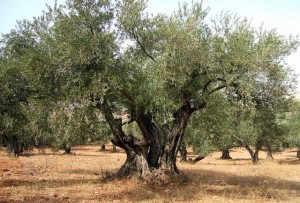
Olive Tree in IsraelThe writers of the psalms used trees a lot as a metaphor for the righteous. The very first psalm says, “They are like trees planted by streams of water, bearing fruit in due season, with leaves that do not wither; everything they do shall prosper.” (Ps. 1:3, BCP) Throughout the psalms we find references to specific types of trees, and today “a green olive tree.”

When we lived in Las Vegas we had two olive trees in our front yard, very large, well grown trees. We had a great arborist who trimmed and shaped them each year. They were beautiful trees with gnarled, twisting, yet graceful trunks. Their leaves were dark green on the top side, silver on the underside: when the wind blew they seemed to shimmer. Their grace and character set them apart from other trees. They provided wonderful shade in the hot desert summer, but they were messy. Olive trees are very productive; they dropped lots of fruit and lots of leaves!

Our olive trees were purely decorative. The fruit they produced was useless. In biblical Israel, however, the olive was a very important tree, a source of food, light, hygiene, and healing. For nearly 6,000 years, olives have been eaten in the Mediterranean as a staple food. Olive oil has been used for cooking, in lamps for light, for medicine, in bathing, and for religious anointing.

Olives are also extremely hardy, which is why we had them as shade trees in our desert landscape. They will live and produce fruit in any conditions: hot, dry, cold, wet, rocky, or sandy. It is said that you can’t kill an olive tree: when cut down or burned, new shoots will emerge from the root.

To be an olive tree, then, is to endure and to be productive. To endure and be productive in the house of God is the goal of every person of faith. As Paul reminded the Romans, endurance produces character, and character produces hope, and hope does not disappoint. (Rom. 5:5-4)

The Palestinian pastor of the Evangelical Lutheran Christmas Church in Bethlehem, the Rev. Mitri Raheb wrote in Bethlehem Besieged, “At times, when we feel as if the world must be coming to an end . . . our only hopeful vision is to go out . . . and plant olive trees. If we don’t plant any trees today, there will be nothing tomorrow. But if we plant a tree today, there will be shade for our children to play in. There will be oil to heal the wounds, and there will be olive branches to wave when peace arrives.”

This is what it is to be an olive tree in the house of God.

====================

A request to my readers: I’m trying to build the readership of this blog and I’d very much appreciate your help in doing so. If you find something here that is of value, please share it with others. If you are on Facebook, “like” the posts on your page so others can see them. If you are following me on Twitter, please “retweet” the notices of these meditations. If you have a blog of your own, please include mine in your links (a favor I will gladly reciprocate). Many thanks!

====================

Father Funston is the rector of St. Paul’s Episcopal Church, Medina, Ohio.

Ten Authentic Years – Sermon for Pentecost 2 (Proper 4C) – June 2, 2013

====================

This sermon was preached on the Second Sunday after Pentecost, June 2, 2013, at St. Paul’s Episcopal Church, Medina, Ohio, where Fr. Funston is rector.

(Revised Common Lectionary, Pentecost 2 (Proper 4, Year C): 1 Kings 18:20-39, Psalm 96, Galatians 1:1-12, and Luke 7:1-10. These lessons can be read at The Lectionary Page.)

====================

10th AnniversaryTen years ago yesterday, June 1, 2003, I became Rector of St. Paul’s Episcopal Church of Medina, Ohio, Inc. We didn’t celebrate that “new ministry” until sometime in October because of difficulties scheduling bishops and other dignitaries, but on Sunday, June 1, 2003, I presided at the Holy Eucharist for the first time in this space.

It was different then. One of the things we’ve done in the past ten years is remodel this space (thanks to a gift from Verna Bruckmann in memory of her late husband Jack whom many of us remember with affection). We’ve also upgraded the parish library, refurbished the dining room, and improved the parish hall (thanks to the good fund-raising efforts of the Episcopal Church Women). We’ve purchased additional real estate, torn down the derelict houses that were on it, incorporated those lots into our landscaping, and replanted nearly all of the decorative gardens, mostly with volunteer labor.

But more important than the building and the grounds are the ministries through which we have touched peoples’ lives. In these ten years, there have been more than 1,500 celebrations of the Holy Eucharist in this sanctuary! That means just here, in this space, there have been more than 250,000 administrations of Holy Communion; more than a quarter of a million times communicants have received the Blessed Sacrament, this sacrament which (as one of our prayers of thanksgiving says) is “the pledge of our redemption” through which the grace of God brings us “forgiveness of our sins, strength in our weakness, and everlasting salvation.”

During these ten years, since we started the Brown Bag Concerts in 2007, there have been more than seventy free concerts and recitals in this space, which means something on the order of 4,000 concert-goers have received the gift music which (the poet Berthold Auerbach said) “washes away from the soul the dust of everyday life.”

There have been more than seventy baptisms, more than forty-five weddings, and more funerals than I care to remember. Each summer up to fifty children have come into this worship space to sing songs, act in skits, and learn the stories of the faith at our annual Vacation Bible Schools.

And downstairs, twice month, 220 times in these ten years, the Free Farmers’ Market has opened its doors and provided sustenance to those unable to afford it in the stores. I suppose a statistician or an economist would invent some measure for what has been distributed like a “family-week of groceries” — we’ve distributed something like 16,000 or more “family-weeks” of food and other items to hundreds of needy households. All told, nearly a half-million pounds, 250 tons, of food have been given away by this parish.

And that’s just a small sample of the statistics we could boast. There have been home visits, picnics, hospital communions, confirmations, study groups, foyer groups, potluck suppers, and so much more.

It’s been a good ten years. So . . . Happy Anniversary!

I’ll come back to consideration of our decade together, but for now, let’s take a look at the lessons for today.

What we have in our three selections from Scripture this morning are stories of authority, but more than that, they are stories of authenticity. Let’s take a look at each one in turn.

First, we have the story of a competition between Elijah, a prophet of Yahweh, the God of Israel, and the priests and prophets of Ba’al, who was the god (or perhaps the pantheon of gods) of the Phoenicians. Elijah was a well-known prophet. We know that he was known in Syria and in Egypt and in other places because the Bible tells us this, that he was known as “the man of God.” Not simply as “a man of God” but as “the man of God.” He was well known as a prophet, but he was not well known as a pleasant fellow – I’ll get to that in a moment.

In our story today, “the man of God” is dealing with a competing religion. Ba’al worship had been brought to Israel when King Ahab married a woman whose name is familiar to all of us, Jezebel, the daughter of Ethbaal, King of Tyre. The marriage of their king to this Phoenician princess and his allowing her to set up temples and practices of her native religion in Shechem, the capital of the northern kingdom, caused a problem for the people of Israel. Should they continue in their old religion (represented by Elijah) or in this new religion followed by their queen and, eventually under her influence, their king? Being politically astute, they did the logical thing – a little bit of both. And this is where we enter the story in today’s reading from the First Book of Kings.

An assembly is called and Elijah says to everyone, “How long will you go limping with two different opinions? If the Lord is God, follow him; but if Ba’al, then follow him.” Nobody says a word . . . . So Elijah proposes a contest. “Let’s do this,” he says, “well set up two altars and put a bull carcass on each one. The priests of Ba’al will call on their god to consume his bull with fire and I’ll call on my god to consume his bull with fire, and the one that actually does it will be acknowledged as the god to be worshiped in this country.”

I love the way the New Revised Standard translation gives the people’s response: “Well spoken!” they say. It’s like he was just giving a speech – the Gettysburg Address or something. The actual Hebrew is “good utterance.” The American Standard translation renders it better as, “That is a good idea!” Everybody loves a sporting event; everybody loves a good contest! Good idea!

So they do it. The priests and prophets of Ba’al set up their altar and do their best. They chant and dance and even cut themselves in an attempt to get their god’s attention, but nothing. Then it’s Elijah’s turn. But before he prays, he tells those present to make it really hard to burn up the altar and the bull sacrifice – “Douse it with water,” he says, “douse it good.” Three times they flood it, until water is running everywhere and the whole place is a muddy mess.

That’s when he says, basically, “OK, God, do it!” And God does it – a lightning bolt or a pillar of fire or something – and all the wood, the water, the bull, the whole shebang is burnt up!

But this is where our lectionary gives us a false impression of the story. Our “official” reading cuts off a verse before the story actually ends. We are left hearing that all the people “fell on their faces and said, ‘The Lord indeed is God; the Lord indeed is God.'” It sounds like everybody, including the followers of Ba’al, agreed Yahweh was the real deal and lived happily ever after. Not so . . . .

The next verse:

Elijah said to them, “Seize the prophets of Baal; do not let one of them escape.” Then they seized them; and Elijah brought them down to the Wadi Kishon, and killed them there. (1 Kings 18:40)

You see, Elijah was not a particularly pleasant person. We know this from the story of Elijah cleansing the Syrian leper, the general Naaman; he wouldn’t even bother to talk to Naaman, just sent him a message to bathe in the Jordan. That really annoyed Naaman. And we see it in spades here. Elijah had won this battle. God was proven to be the true God and Ba’al was shown to be powerless. But Elijah can’t just leave it there; he has to drive the point home by slaughtering those who had served the false god. This really annoys Queen Jezebel who will send her army to find and kill Elijah. You all know the story of Elijah hiding in the cave and living through a storm, a mighty wind, and an earthquake, but finally hearing the voice of God in the silence. This little competition with and killing of the prophets of Ba’al is why he was hiding.

So this is a story of authority – the authority of Yahweh as the true god and the authority of Elijah as his prophet – but it is also a story of authenticity. Elijah made no bones about who and what he was; he was not a pleasant fellow. And everyone knew it. Nonetheless, they clearly respected him. Despite his unpleasantness, this defect in his character, they respected his role and office as a prophet of the living God. And God empowered him as and who he was.

So . . . second reading — the introduction to Paul’s Letter to the Galatians. Reading one of Paul’s letters it is always best to remember that almost all of them were written to solve problems.

Paul’s method of evangelism was to ride into town, spend time getting to know the people, gather a group of folks interested in the story of Jesus, share the gospel with them and instruct them, identify the leaders in the group, empower those leaders (ordain them, if you will) to carry on and minister within the community, and then move on to some new town and start the process all over again. What would happen then is that the community would have some problem and someone would contact Paul – “Dear Paul, you aren’t going to believe what is going on . . .” – and he would write a letter giving his advice on how to deal with it.

This is what has happened in Galatia. After Paul left, two other groups of Christian missionaries showed up and tried to convince the Galatians that Paul had been wrong. The first group were the Gnostics. The Gnostics had been around since before Jesus, but they’d sort of adopted Jesus as one of their own; some who were exposed to the Gnostic teachings found in Jesus the sort of teacher they’d had before. Gnosticism gets its name from the Greek word for “knowledge” and their approach to religion and spirituality was based on the idea that through special knowledge one could escape the evil of the material world. They thought that the material world was bad and that salvation was achieved by leaving it behind, and the only way to leave it behind was through initiation into this special or secret knowledge. Christian Gnostics taught that Jesus had given the secret knowledge to the Twelve and they had then passed it on to a few special leaders who passed it on to chosen initiates, and so forth. To them, Paul’s response was, “No way! The Gospel is open and transparent. It’s for everyone!”

The second set of folks who were causing the Galatians problems were Jewish Christians who taught that before you could be a Christian you had to be a Jew. We call them “the Judaizers.” They were teaching that a Gentile had to first convert to Jewish law and practice. Gentiles had to “keep kosher” (as we would currently say), then they could be baptized and be followers of Jesus’ Way. For example, they taught that adult males had to be circumcised. (I think it may have been one of those adult males who wrote to Paul – “You aren’t going to believe what these people are saying!”)

Paul’s response to the Judaizers was also a big “No way!” What he wrote to the Galatians was that Jesus and Jesus’ good news redeems them where and as they are. They do not need to become something else, something different. Rather, they need to be authentically themselves. It is as their authentic selves that Jesus redeems them and empowers them to be better Gentiles; they don’t have to become Jews.

Again, it is a story of authenticity and of God’s respect for people as and who they are.

Which brings us to the gospel lesson from Luke, a healing story told in both Matthew’s and Luke’s Gospels, but in Luke’s version it is unlike any other in all of the Gospels. In no other healing story does Jesus never talk to the person making the request, nor address the person being healed, nor even see (let alone touch) the person being healed, but that is exactly what happens here according to Luke. As Jesus arrives in Capernaum, some Jewish elders come to him and tell him about this Roman Centurion who has been very good to their community. Apparently there is someone in his household who is very important to him and this person is gravely ill. The Greek is unclear — the word used is pais which could mean “son” or “servant” or “slave” or, even possibly, “beloved” — but what is clear is that the Centurion would like this person healed.

Jesus is convinced by the elders to do so and sets off for the Centurion’s house. Before he gets there, however, the Roman sends messengers saying, “You don’t need to come. I’m unworthy to have you to enter my home. Just say the word and my son/servant/beloved will be healed.” Perhaps the Centurion knows of the Jewish custom forbidding an observant Jew from entering a Gentile home. In any event, his messengers convey his explanation: “Like you, Jesus, I am a man under authority. I answer to those above me, and I expect and get obedience from those below me.” He is saying that he recognizes that Jesus is under the authority of Heaven, and that as such he can expect and get the obedience of the powers of the world. Just say the word; it will be done.

In response to this message, Jesus praises the Roman’s faith: “Not even in Israel have I found such faith,” he tells the crowd. The word here translated as “faith” is pistis, the root of which is peitho which names the quality of having trust, or of being trusted, or trusthworthy, and confident. So while this, too, appears to be a story about authority it is, at its heart, a story about authenticity. This Roman was being true to who he was; not a Jew, he felt unable to appeal directly to Jesus or to have Jesus enter his home. Nonetheless, he had the confidence that Jesus would honor him and heal his son/slave/beloved. And Jesus does so. Jesus honors his honesty and authenticity.

Which brings me back to our 10th anniversary . . . .

Ten years and a few months ago we, this parish of St. Paul’s Episcopal Church of Medina, Ohio, and I began the courtship which is the way we Episcopalians pick and choose our clergy leadership. This parish, as any parish in search of a rector would do, did a self study and prepared a parish profile which was then entered in to our denominational dating computer in New York City. As a priest seeking a new call, I had done a personal profile and had it in entered into that same ecclesiastical “match-dot-com” system. The dating computer ran its algorithms and matched us up, and you all selected me as one of the priests to contact, so we started our conversations.

Now you all know that Evelyn and I are originally from Nevada, so while this was going on, she was praying that we would end up somewhere (as she put it) “western.” She didn’t disallow my consideration of a parish in Ohio, but she wasn’t really all that thrilled about it. One of the things that had attracted me to St. Paul’s Parish was your written profile, this booklet that parishes write and publish with pictures and financial reports and so forth, describing themselves, their town, the ministries they do, etc. etc. etc. Most of the time these profiles are not really very accurate; instead of being a description of the parish as it is, they describe what the congregation wants to be — they are “wish lists.” Sometimes, even worse, they are simply “what someone in the diocesan office told us we had to say if we wanted to get a priest.” St. Paul’s Parish Profile was different. It seemed to be honest and authentic. It told a story of a lot of good stuff, but it also admitted to some not very positive, not very inviting aspects of the church, as well. I remember one line, in particular, in the closing paragraphs of the booklet: “This is who we are . . . warts and all.” (I now have some suspicion about who probably wrote that line!)

At the same time, I tried to be honest and up-front with you, as well. While Evie was praying that I would get a call to someplace “western,” I kept telling her not to worry; each time I would answer one of your search committee’s requests for more information about me, or for a copy of a sermon, or for my position on some controversial issue, I would say to her, “Well, after they get this, they won’t be calling me.”

And then there was the face-to-face interview, the visit when we got to know one another. You told me what you were looking for in the future, what you hoped to be, what your problems as a church community were. I told you what my strengths and skills in ministry were and are; I told you what I didn’t (and still don’t) do well. Let’s face it — there are some things I’m pretty good at . . . and there are some things I’m really quite bad at! And after our last, extremely honest conversation, as we sat waiting to board the plane back to Kansas, I said to Evelyn one more time, “Well, after this, they won’t be calling me.” But you did.

I tell Evie that she got exactly what she prayed for! Where did we end up? In the “Western Reserve”! (I tell her now that she has to be more specific in her requests of God.)

Throughout our so-far-ten-year relationship we’ve stayed honest and up-front and authentic with one another. I think that’s how we’ve been able to accomplish the things we’ve done. And let’s be very honest about that — all of those statistics, the hundreds of worship services, the thousands of communions, the dozens of concerts, the tons of food distributed, I can’t take responsibility for those. I believe we have been able to do all of that because we have been authentic; I believe that God blesses those who are authentic, open, honest, and up-front with themselves, with one another, with the world around them, and with God. Just as Yahweh answered Elijah’s prayer, just as Jesus blessed the Centurion and healed his son/slave/beloved, God has answered our prayers and blessed our ministries.

I didn’t do those things. You did them. We did them together. About the only thing I can lay entirely at my own feet, the only statistic that I can take full responsibility for over the past ten years, is that I have gained about 70 pounds! I’m not happy about that, and I intend to change that.

But we together have done a lot, and I believe we have a lot more to do, and I believe that we will accomplish it together – openly, honestly, and authentically. It’s been a great ten years! Let’s have ten more! Amen.

====================

A request to my readers: I’m trying to build the readership of this blog and I’d very much appreciate your help in doing so. If you find something here that is of value, please share it with others. If you are on Facebook, “like” the posts on your page so others can see them. If you are following me on Twitter, please “retweet” the notices of these meditations. If you have a blog of your own, please include mine in your links (a favor I will gladly reciprocate). Many thanks!

====================

Father Funston is the rector of St. Paul’s Episcopal Church, Medina, Ohio.

The Hard Road to the Narrow Gate – From the Daily Office – June 1, 2013

From the Book of Deuteronomy:

You must follow exactly the path that the Lord your God has commanded you, so that you may live, and that it may go well with you, and that you may live long in the land that you are to possess.

(From the Daily Office Lectionary – Deuteronomy 5:33 (NRSV) – June 1, 2013.)

Forest PathsConfession: I have never followed any path exactly as it was laid out by anyone . . . even, I’m sure, God. Ever. Could that be why I’ve never lived long in any one place? The longest I ever lived in any place was in an exurban area of Kansas City on the Kansas side of the state line in a house I hated. (It was a split-level; I don’t like split-level homes.) Maybe not following the straight-and-narrow is why I’ve been something of a vagabond; the two do seem to go hand-in-hand.
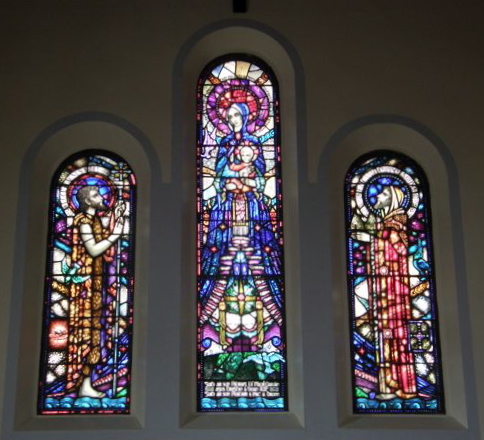
On the other hand, getting off “the beaten path” leads to wonderful discoveries and unique experiences. A few years ago when traveling Ireland, I decided to visit the Aran Islands. Most tourists head to Inis Mór, the largest of islands, where most ferries from County Galway dock and where Dún Aonghasa is to be found; many go to Inis Oírr, the smallest, where boats from County Clare dock. I chose to go to Inis Meáin, the middle island, the least touristy of the three. There I found An Seipéal Mhuire gan Smál agus Eoin Baiste — the Church of St. Mary Immaculate and St. John the Baptist.

The church is a newer church, built in 1939. I was entranced by stained glass windows which had a most remarkable jewel-like quality with brilliant colors. My poor skills at photography with my inexpensive digital camera couldn’t possible convey the beauty of those windows. I later learned that they were the work of Harry Clarke, considered Ireland’s greatest stained glass artist.

Altar Window - Church of St. Mary Immaculate & St. John the Baptist

Getting off the well-marked, well-travel road and taking a different path can be dangerous . . . but it can also be marvelous!

In any event, when I read Moses this morning I contrast his words with those of Jesus in Luke’s Gospel (not the gospel lesson for today):

Enter through the narrow gate; for the gate is wide and the road is easy that leads to destruction, and there are many who take it. For the gate is narrow and the road is hard that leads to life, and there are few who find it.

The easy road is the one well marked; the hard road to the narrow gate is difficult to find. It is the road less traveled about which Robert Frost wrote in The Road Not Taken

Two roads diverged in a yellow wood,
And sorry I could not travel both
And be one traveler, long I stood
And looked down one as far as I could
To where it bent in the undergrowth;

Then took the other, as just as fair,
And having perhaps the better claim,
Because it was grassy and wanted wear;
Though as for that the passing there
Had worn them really about the same,

And both that morning equally lay
In leaves no step had trodden black.
Oh, I kept the first for another day!
Yet knowing how way leads on to way,
I doubted if I should ever come back.

I shall be telling this with a sigh
Somewhere ages and ages hence:
Two roads diverged in a wood, and I —
I took the one less traveled by,
And that has made all the difference.

Get off the highways! Explore the by-ways . . . they may lead to wonderful discoveries . . . and they may lead to the hard road to the narrow gate, the one few find.

====================

A request to my readers: I’m trying to build the readership of this blog and I’d very much appreciate your help in doing so. If you find something here that is of value, please share it with others. If you are on Facebook, “like” the posts on your page so others can see them. If you are following me on Twitter, please “retweet” the notices of these meditations. If you have a blog of your own, please include mine in your links (a favor I will gladly reciprocate). Many thanks!

====================

Father Funston is the rector of St. Paul’s Episcopal Church, Medina, Ohio.

Entering the Kingdom by Force? – From the Daily Office – May 31, 2013

From the Gospel according to Luke:

[Jesus said,] “The law and the prophets were in effect until John came; since then the good news of the kingdom of God is proclaimed, and everyone tries to enter it by force.”

(From the Daily Office Lectionary – Luke 16:16 (NRSV) – May 31, 2013.)

Medieval Battering RamThe 16th chapter of Luke’s Gospel keeps pulling me up short with these weird little “What did Jesus mean by that” moments. There’s that “dishonest wealth” comment and now this one about entering the kingdom of God by force . . . .

There are alternative translations, but they aren’t much help in making sense of this. The Douay-Rheims translation, for example, is “The law and the prophets were until John. From that time the kingdom of God is preached: and every one useth violence towards it.” The notes to the New Revised Standard translation (quoted above) suggest this alternative which is truly different, “The law and the prophets were in effect until John came; since then the good news of the kingdom of God is proclaimed, and everyone is strongly urged to enter it.” That does make more sense, but it’s not a generally accepted rendering of the Greek, so we really do have to read this as “everyone tries to enter it by force.” What can we make of that?

Not quite a generation and a half or so ago (a “generation” is something like 30 years they tell me) I was a college drop-out working as an orderly in a small Southern California hospital. Nearby was one of the earliest start-up nondenominational conservative evangelical churches that eventually became a mega-church and is now the mother church of what might be called a “denomination.” A young member of that church was injured very seriously in an automobile accident and was brought to the hospital where I worked. Brain damaged and nearly dead he was put on life support. He was in our facility about three weeks before being transferred to a long-term care facility. During those 21 or so days, there was never a time during which members of the congregation were not present with him. 24 hours a day for three weeks at least a half-dozen church members were in his room praying. They told us they were “storming the gates of heaven” with intense, incessant prayer. (I have no idea if their intercession was effective. In general, I believe in the efficacy of intercessory prayer, but that is not to say that I expect God to work miracles in cases such as that boy’s horrendous injuries. I know that his condition had not changed when he was transported from that hospital to a long-term care facility, and I heard through the grapevine several months later that he was still there, so my suspicion is that his condition never improved.)

When I read of entering the kingdom of God “by force” I think of those folks “storming the gates of Heaven.” And I truly wonder, negatively, if that’s what Jesus ever had in mind in this or any other of his parables, proverbs, actions, or commandments — the two parables about incessant prayer come immediately to mind (the neighbor who gets out of bed to answer the door and the unjust judge who finally responds to the widow’s complaint) but even with those, I don’t believe Jesus ever meant that that is the proper attitude of intercessory prayer. Storming the gates of Heaven just seems some how wrong, as does entering the kingdom of God by force. I have this mental image of folks breaking down the Pearly Gates with a medieval battering ram — just not a great picture of prayer in my opinion.

Nonetheless, it seems to me that this is a prevailing attitude in some religious and political circles, and that it takes the form of “say something loud enough and often enough in enough venues and you’ll get your way” whether one is petitioning the Almighty or stating a partisan position.

Today is the Feast of the Visitation of the Blessed Virgin Mary, celebration on the church calendar since the mid-13th Century when the Franciscans began observing it. It commemorates the visit Mary made to her cousin Elizabeth, mother of John the Baptist, and if it celebrates anything, it celebrates their joy in being pregnant. As is my custom on feast days, I read various devotional texts dealing with the feast this morning, including some on the internet. After reading one of those, I skimmed the comments of other readers. I found in one the assertion that this ancient feast of the church is “the most important church holiday for pro-life forces.”

Now on this issue of abortion and its regulation, I am (I guess) in the politically liberal camp. I believe that abortion should be legal, regulated, and safe. I am also in the theologically conservative camp. If asked as a priest for my guidance and counsel on whether a woman should get an abortion, my advice is nearly always going to be “No.” But in the end it is not my decision. It is the woman’s and her physician’s and no one else’s. Years ago an older colleague and I took part in a discussion panel presentation about legal abortion. In answer to some participant’s question, he said words I’ve never forgotten: “I would rather counsel a woman who’s had a safe, legal abortion than bury one who’s had an illegal abortion. And I’ve done both.” Because of our current laws, I’ve not had to do the latter and I hope I never do!)

That said, I must admit that I am just tired of the way the so-called “pro life” advocates turn every (and I do mean every conversation into an abortion debate. They truly are “storming the gates” on this issue. Frankly, it is tedious and irritating; it does not further their cause; it is counterproductive. Like them, I would like to see the number of abortions reduced, but their way is not going to do that. Good sex education in the public schools, readily available contraception, parenthood training, and better moral education in churches and homes . . . those stand a much better chance than this constantly entering into the issue by force!

And their point is especially misplaced on this holy feast day! One of the most important theological aspects of Mary’s pregnancy, which this feast celebrates, is her choice! Nothing could have happened if she had not said, “Be it to me according to your word.” Her conception and pregnancy were not forced upon her; she chose them. One of my favorite paintings of the Annunciation is this one by Sando Botticelli in which Gabriel seems almost fearful that Mary will say “No” and Mary seems almost on the verge of doing so! If the feasts of the Blessed Virgin are about anything, they are about choice! This is not a “pro-life” holiday! And no amount of polemic, or prayer, will make it so. It really isn’t necessary to push the anti-abortion agenda, or any political or religious point of view, at every opportunity in every venue.

Annunciation of the Blessed Virgin Mary by Sandro Botticelli

So what are we to make of Jesus’ statement that “everyone tries to enter the kingdom of God by force?” I think it is a condemnation of the sort of prayer and the sort of politics that storms the gates of Heaven (or of public opinion) with incessant, tiresome, counterproductive petition or polemic. After uttering these words, he reminded his listeners that “it is easier for heaven and earth to pass away, than for one stroke of a letter in the law to be dropped.” Elsewhere he had summarized the law: “You shall love the Lord your God with all your heart, and with all your soul, and with all your strength, and with all your mind; and your neighbor as yourself.”

The law of love trumps force any day. Loving will accomplish more than storming!

====================

A request to my readers: I’m trying to build the readership of this blog and I’d very much appreciate your help in doing so. If you find something here that is of value, please share it with others. If you are on Facebook, “like” the posts on your page so others can see them. If you are following me on Twitter, please “retweet” the notices of these meditations. If you have a blog of your own, please include mine in your links (a favor I will gladly reciprocate). Many thanks!

====================

Father Funston is the rector of St. Paul’s Episcopal Church, Medina, Ohio.

Dental Hygiene and the Dishonest Steward – From the Daily Office – May 30, 2013

From the Gospel according to Luke:

[Jesus said,] “I tell you, make friends for yourselves by means of dishonest wealth so that when it is gone, they may welcome you into the eternal homes.”

(From the Daily Office Lectionary – Luke 16:9 (NRSV) – May 30, 2013.)

1899 Parisienne Brushing Her TeethIn August of last year the American Dental Association launched a campaign to get people to brush their teeth twice a day for two minutes each time. It was called “2min2x” and it even has its own website by the same name.

I recently discovered that if one sings the “Happy Birthday” song eight times while brushing your teeth — to yourself, in your head, I mean — singing it out loud would be messy — if you sing it eight times, you will have met the ADA’s goal. It takes two minutes to sing “Happy Birthday” eight times. I do it by naming all the singular and plural pronouns as the birthday greeting recipient – Happy Birthday to me . . . Happy Birthday to you . . . him . . . her . . . it . . . us . . . y’all . . . them . . . Two minutes. Teeth done.

Today, I mention that in this meditation inspired by the reading from Luke’s Gospel . . . because I have no idea what the hell Jesus is trying to say here, and I want to post something, so a useful dental hygiene tip seemed as good as anything else!

Every three years this story of the dishonest steward and Jesus’ advice to “make friends by means of dishonest wealth” rolls around on the Sunday lectionary (it’s Proper 20C in “Episcopal speak”) and every year I struggle to make some sense of it in my sermon. And every year I walk away from that sermon shaking my head and wondering, “What the hell was Jesus trying to say?” I don’t know; I honestly do not know.

And let me tell you . . . I don’t think anyone else does either. Like every other preacher, I read the scholarly commentaries; I read the annotations in the study bibles; I pull out my copy of the Greek New Testament and I try to find maybe an as-yet-unexplored meaning in the original language; I read other people’s sermons. None of it helps. Interpretations and exegeses are all over the board! In 30 years (that’s ten sermons) of preaching this text I got nuthin’ . . . . There are just times when Jesus doesn’t make sense! Or maybe it’s Luke who doesn’t make sense; after all, he’s the only gospeller to tell this story.

Every three years in the Sunday lectionary . . . and every two in the Daily Office lessons. And here it is again, and I’m still unsure what make of or do with it.

I do believe that Jesus is right about making friends. And I believe that one of the best things you can do to make sure that people will like you is not have bad breath. So remember when you hear the parable of the dishonest steward . . . “Happy Birthday” eight times while brushing your teeth, and you’ll have brushed them for two minutes!

====================

A request to my readers: I’m trying to build the readership of this blog and I’d very much appreciate your help in doing so. If you find something here that is of value, please share it with others. If you are on Facebook, “like” the posts on your page so others can see them. If you are following me on Twitter, please “retweet” the notices of these meditations. If you have a blog of your own, please include mine in your links (a favor I will gladly reciprocate). Many thanks!

====================

Father Funston is the rector of St. Paul’s Episcopal Church, Medina, Ohio.

The Little God Made By Human Hands – From the Daily Office – May 29, 2013

From the Book of Deuteronomy:

There you will serve other gods made by human hands, objects of wood and stone that neither see, nor hear, nor eat, nor smell.

(From the Daily Office Lectionary – Deuteronomy 4:28 (NRSV) – May 29, 2013.)

My Samsung Galaxy S2Seems to me that “gods made by human hands” these days can do some of these things. I have a smartphone that wakes me up by speaking out the time, the weather (current and predicted for the day), and a news headline (I have no idea what the algorithm for choosing the news item is, nor what news feed the alarm application uses). I think I can (if I knew how and did the set up) talk to my smartphone and get it to do things. My phone is not an iPhone, so it doesn’t have a name, but it can do a lot of seeing and hearing and speaking. I don’t think it’s gotten to the eating and smelling part . . . yet. But there are restaurant and wine review applications and who knows what upgrades may be coming . . . .

It would be an overstatement, I think, to say I “serve” my smartphone – after all, it’s supposed to serve me! But it’s all too true that I seem to be at it’s beck and call every minute of every day, or at least I can fall into the trap of thinking that way. The darned thing has a variety of “tones” by which it alerts me to, among things other than telephone calls, text messages, emails, Facebook postings, up-dates available for various applications, Amber alerts, severe weather alerts, voicemail messages, Words with Friends plays, and slew of other inputs. Telephone calls are neatly sounded with individual ringtones; my wife, my daughter, my son, my office, the bishop, and a few other people all have personalized sounds.

A few of those alerts I’ve learned to ignore. I often don’t even recognize the faint “buzz” of a Facebook notification. On the other hand, the raucous SS-siren of an Amber alert will waken me from a sound sleep several rooms away. And when the ringtones for my wife (something called Illuminator) or the bishop (Fanfare for the Common Man) sound, I know I’d better answer.

So, yeah, I guess it does feel like I serve this little “god made by human hands.”

Therefore, for a few minutes each day, and for several hours one day each week . . . I turn this little god off. I can do that. I make it a point to do that. And in the times it is turned off, I turn my attention to God, the real one, the “maker of heaven and earth, of all that is, seen and unseen.” I need to do this because when the phone is on, when it sounds one of its insistent tones, I can forget to turn to God. When my “little god made by human hands” is in control, I can (and frequently do) find myself relying on my own strength, or on human institutions, or on human technology, all of which are prone to fail. I need those moments when it is turned off to be reminded, as Moses reminded the Hebrews and the end of today’s reading, “The Lord your God is a merciful God, he will neither abandon you nor destroy you; he will not forget the covenant with your ancestors that he swore to them.”

====================

A request to my readers: I’m trying to build the readership of this blog and I’d very much appreciate your help in doing so. If you find something here that is of value, please share it with others. If you are on Facebook, “like” the posts on your page so others can see them. If you are following me on Twitter, please “retweet” the notices of these meditations. If you have a blog of your own, please include mine in your links (a favor I will gladly reciprocate). Many thanks!

====================

Father Funston is the rector of St. Paul’s Episcopal Church, Medina, Ohio.

A Comprehensive Redemption – From the Daily Office – May 28, 2013

From the Second Letter to the Corinthians:

Do I make my plans according to ordinary human standards, ready to say “Yes, yes” and “No, no” at the same time?

(From the Daily Office Lectionary – 2 Cor. 1:17b (NRSV) – May 28, 2013.)

Yes NoThree words come to mind as I read Paul’s question: indecision, duplicity, and dialectic. Each could be described as “saying ‘Yes, yes’ and ‘No, no’ at the same time.”

Indecision or indecisivenss is simply the inability to come to a decision, bouncing back and forth between alternatives, wavering between “yes” and “no” without ever coming to a conclusion. This would not describe Paul, but it certainly does describe many people. Sometimes it’s OK not to make a choice; in fact, sometimes it’s downright necessary! Decisions need to be made at the proper time. Years ago I was a cadet in the Reserve Officers Training Corps (ROTC). I don’t remember a good deal of that training, but I do remember this: “When it’s not necessary to make a decision, it’s necessary to not make a decision.” Read that again carefully: “When it’s not necessary to make a decision, it’s necessary to not make a decision.” In other words, don’t jump the gun. Don’t commit to an action before you have to. On the other hand, as William James said, “When you have to make a choice and don’t make it, that is in itself a choice.” While Paul certainly called for his listeners and correspondents to make decisions and faithful choices, and even though he introduces this question with the words, “Was I vacillating,” I don’t believe that simple indecision is what Paul refers to in this passage.

Indecision may be morally neutral; duplicity, however, is not. Duplicity is deliberate deceptiveness: saying one thing and meaning another, or saying one thing to one person and something different to another. Deceitfulness is one synonym; hypocrisy is another. I suspect that this, rather than mere indecision, is the “ordinary human standard” to which he refers and which, by implication, he eschews. He may be referring to Jesus’ words about oath-taking from the Sermon on the Mount which the Christian community remembered and later recorded in Matthew’s Gospel: “Let your word be ‘Yes, Yes’ or ‘No, No’; anything more than this comes from the evil one.” (Matt. 5:37) In any event, dishonesty is probably Paul’s issue here.

Post-modern Anglican that I am, however, I can’t help but go a step further and wonder, “But why is in an either/or thing? Why not look at this as both/and?” Saying “Yes, yes” or “No, no” at the same time may be way of working through two opposing theses to arrive at a synthesis; in other words, a dialectic process may be at work here. Paul is such a black-and-white kind of guy that I don’t think he’d have made a very good Anglican dialectician. The “both/and” thing just doesn’t seem to be his style, but as we read his words we can move beyond them to a greater comprehensiveness.

As Paul continues his letter to the Corinthians he writes, “In [Jesus Christ] it is always ‘Yes.’ For in him every one of God’s promises is a ‘Yes.’” (vv. 19-20) This is not simply a contradiction of a human “no” with some more powerful yet still human “yes.” Beyond either our “no” or our “yes” is a comprehensive divine affirmation. As Paul elsewhere wrote to the Colossians, “Christ is all and in all!” (Col. 3:11), and similarly to the Ephesians, “[God’s plan is] to gather up all things in him, things in heaven and things on earth” (Eph. 1:10), and earlier to the Corinthians, “[The plan of salvation is that] God may be all in all.” (1 Cor. 15:28). In other words, the divine “Yes” is a comprehensive synthesis which more than contradicts our human “No” and more than affirms our human “Yes.” Instead, it integrates both in a divine dialectic that produces something new that is neither our “No” nor our “Yes” but God’s redemption.

Reading Paul this morning, I am reminded of the need to make decisions in the best way and at the best time that we can, doing so honestly, but always remembering that even our best, most honest decisions may (and definitely will) be inadequate; all our decisions await God’s comprehensive redemption.

====================

A request to my readers: I’m trying to build the readership of this blog and I’d very much appreciate your help in doing so. If you find something here that is of value, please share it with others. If you are on Facebook, “like” the posts on your page so others can see them. If you are following me on Twitter, please “retweet” the notices of these meditations. If you have a blog of your own, please include mine in your links (a favor I will gladly reciprocate). Many thanks!

====================

Father Funston is the rector of St. Paul’s Episcopal Church, Medina, Ohio.

The Gospel Is a Living Thing – From the Daily Office – May 27, 2013

From the Gospel of Luke:

[Jesus said,] “Whoever comes to me and does not hate father and mother, wife and children, brothers and sisters, yes, and even life itself, cannot be my disciple.”

(From the Daily Office Lectionary – Luke 14: 26 (NRSV) – May 27, 2013.)

A Living ThingWow! Jesus says some really tough stuff occasionally, and this one ranks really near the top. In my opinion, this is just slightly below the cut-off-your-hand and pluck-your-eye out stuff in terms of toughness.
Both those instructions and this demand, however, are great examples of why the Gospels and, indeed, every book in the whole bible need to be read as units, rather than as collections of individual verses. This is true even of the Psalms and the Book of Proverbs which pretty much are collections of individual verses.

One cannot read this statement from Luke’s Gospel without also considering the following pronouncements from Jesus (also recorded in Luke):

“Love your enemies, do good to those who hate you.” (6:27)

“You shall love the Lord your God with all your heart, and with all your soul, and with all your strength, and with all your mind; and your neighbor as yourself.” (10:27)

“You know the commandments: ‘You shall not commit adultery; You shall not murder; You shall not steal; You shall not bear false witness; Honor your father and mother.’ ” (18:20)

And, of course, external to this Gospel are the other three Gospels and their record of other things Jesus said.

We cannot lift one statement out of context and focus on it in isolation; we cannot exclude everything else we know about Jesus and what he said when we consider this one pronouncement.

It occurred to me that someone might do that with my life. Someone might look at something I’d written or said 25 years ago when I was a practicing attorney litigating medical malpractice claims. Suppose my examiner had no other knowledge of who I am, what I had done, what I have done since. What a distorted image of my life that one statement, from the professional litigator I used to be, would present! Gospels (and all the biblical texts) are like that; they are living things. We have to read them and consider them as whole units.

Yes, Jesus said we have to hate our family members to be his disciples. Yes, he said to cut off our hands and pluck out our eyes if they are causes of stumbling. But . . . he was a First Century Palestinian Jew. But . . . he taught using a variety of techniques, including the Semitic hyperbole (Google that, if you like). But . . . he demanded love of neighbor and honor for parents a lot more often than he made outlandish statements like this. Take everything into account! Read everything in context! The Gospel is a living thing.

====================

A request to my readers: I’m trying to build the readership of this blog and I’d very much appreciate your help in doing so. If you find something here that is of value, please share it with others. If you are on Facebook, “like” the posts on your page so others can see them. If you are following me on Twitter, please “retweet” the notices of these meditations. If you have a blog of your own, please include mine in your links (a favor I will gladly reciprocate). Many thanks!

====================

Father Funston is the rector of St. Paul’s Episcopal Church, Medina, Ohio.

Mystery and Community: Trinity Sunday and Memorial Day – Sermon for May 26, 2013

====================

This sermon was preached on the Feast of the Holy Trinity, May 26, 2013, at St. Paul’s Episcopal Church, Medina, Ohio, where Fr. Funston is rector.

(Revised Common Lectionary, Trinity (Year C): Proverbs 8:1-4,22-31; Canticle 13 (Song of the Three Young Men, 29-34); Romans 5:1-5; and John 16:12-15. These lessons can be read at The Lectionary Page.)

====================

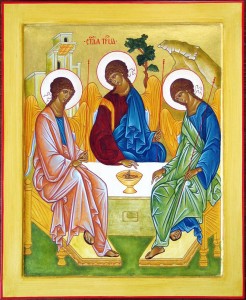
Andrei Rublev Icon of the Holy TrinityI’d like you to take out a pen (there are some in the pew racks if you don’t have one of your own) and on a blank piece of paper, or an empty spot on your service bulletin, I’d like you write down these numbers:

1,016,823
116,516
405,399
36,516
58,209
2,031
4,487
22
3

They are, respectively:

1,016,823 – the estimated number of war dead from the American civil war (the figures, especially for Confederate dead, are notoriously untrustworthy)
116,516 – the number of Americans who died in World War I
405,399 – the number of Americans who died in World War II
36,516 – the number of Americans who died in the Korean conflict
58,209 – the number of Americans who died in Vietnam
2,031 – the number of Americans who so far have died in Afghanistan during our so-called “war on terror”
4,487 – the number of Americans who so far have died in Iraq during our so-called “war on terror”
22 – the average number of U.S. Armed Forces veterans and active duty personnel who commit suicide every day because of combat-related PTSD
3 – the number of Persons in the One, Holy, Blessed, and Glorious Trinity

Today, our church asks us to focus our attention on the last of these numbers. Tomorrow, our country asks us to remember all the others. It is merely fortuitous that the calendar, this year, conflates the Feast of the Blessed Trinity with Memorial Day weekend, but it seems to me that the two speak to us with a united voice drawing our attention to common themes.

Memorial Day has its origins in a proclamation by General John A. Logan, commander-in-chief of the Grand Army of the Republic, the organization for Union Civil War veterans. On May 5, 1868, he called for an annual, national “Decoration Day.” It was observed for the first time that year on May 30; the date was chosen because it was not the anniversary of any particular battle and because it was the optimal date for flowers to be in bloom in most areas of the country. It was observed, that first year, in 27 states. A similar day of remembrance was held in the states of the former Confederacy on June 3, which was the birthday of Jefferson Davis, first and only President of the Confederate States of America. Beginning in the 1880s the name “Memorial Day” began to be used for these commemorations and it gradually became the more common term. For the first hundred years, these holidays were matters of state law, although in 1950 Congress issued a joint resolution requesting the President to issue a proclamation calling for a national observance on May 30 and every year since the presidents have done so. In 1967, by act of Congress, “Memorial Day” was declared the official name and May 30 the official date under Federal law. The following year, Congress passed the Uniform Monday Holiday Act, which moved Memorial Day, together with Washington’s birthday, Labor Day, Columbus Day, and Veterans Day, from their traditional dates to specified Mondays in order to create convenient three-day weekends.

The Veterans of Foreign Wars, by the way, opposed that change and has publicly stated its position that, “Changing the date merely to create three-day weekends has undermined the very meaning of the day.” Throughout his career in the Senate, the late Senator from Hawaii Daniel Inouye, a World War II veteran, annually introduced a measure to return Memorial Day to its traditional date of May 30. Obviously, his efforts proved unsuccessful.

The Solemnity, or Principal Feast, of the Most Holy Trinity has a somewhat longer history. The Sacramentary of St. Gregory the Great (who was pope from 590 to 604) contained prayers and a Preface for a celebration of the Trinity, but specified no date. Documents from the pontificate of Gregory VII (pope from 1073 to 1085) indicate that by that time an Office of the Holy Trinity was recited on the Sunday after Pentecost in some places, but it was not a universal practice. In 1162, Thomas á Becket (1118–70) was consecrated Archbishop of Canterbury on the Sunday after Pentecost, and his first act was to proclaim that the day of his consecration should be commemorated as a new festival in honor of the Holy Trinity. This observance spread from England throughout the western Catholic world until Pope John XXII in 1334, the last year of his 18-year papacy, ordered the feast observed by the entire Church on the first Sunday after Pentecost.

I want to suggest to you today that these two observances, one secular and one religious, share two common themes, and that this year’s fortuitous coincidence of Trinity Sunday and Memorial Day weekend allows us to explore them. Those themes are community and mystery.

There is a humorous video on YouTube made by a group calling themselves Lutheran Satire in which two Irishman engage St. Patrick in a dialog about analogies for the Holy Trinity. Although at first pronouncing themselves simple and unsophisticated, the two proceed to demonstrate considerable theological acumen as they condemn Patrick as a heretic each time he tries an analogy. The famous water-ice-steam analogy, they condemn as Modalism; the analogy of the sun, with its light and heat, they denounce as Arianism; when Patrick tries to liken the Trinity to a shamrock, they stop him and criticize him for preaching Partialism. Finally, Patrick gives up and asserts:

The Trinity is a mystery which cannot be comprehended by human reason, but is understood only through faith and is best confessed in the words of the Athanasian Creed which states that we worship one God in Trinity, and Trinity in Unity, neither confusing the Persons nor dividing the Substance, that we are compelled by the Christian truth to confess that each distinct Person is God and Lord, and that the deity of the Father, the Son and the Holy Spirit is One, equal in glory, co-equal in majesty.

The two Irishman, after a moment of stunned silence, respond, “Well, why didn’t you just say that?”

So there you have it: the Trinity is a mystery and every analogy by which we try to explain how God can be one-in-three fails, every attempt to comprehend the unity in which the Father, the Son, and the Holy Spirit together are one God ends up in heresy, and every sermon about the Doctrine of the Trinity either confuses the heck out of us or bores us to tears.

Therefore, rather than try to explain or comprehend the mystery that is the Trinity, let’s focus instead on the community that is the Trinity: the paradigm and model of all human community. The early Church Fathers explored in their writings how many aspects of our humanity reveal the divine image: our ability to perceive God’s presence; our apparently innate knowledge of the spiritual realm; our intellect; our ability to freely choose; and our capacity to live lives of goodness and love. These characteristics, they taught, belong to every human being and reveal much about God.

In the twentieth-century theologians have explored the concept of human personhood. To be made in the image of God is not to be made in the image of the Father only; it is to be made in the image of the Holy Trinity, to be made in the image of the Father, and of the Son, and of the Holy Spirit. Human beings are persons intended to be, like the Persons of the Blessed Trinity, in relationship with other persons. This means that participation in community is at the heart of our humanity; our relatedness to other persons is at the very core of who we are. The three Divine Persons are forever united with each other in mutual love. They dwell within one another; they collaborate and share in all their activities; they always act in harmonious accord. This is the model for the ideal human community, the paradigm of corporate human existence.

Human beings are supposed to work together in harmony in ways that preserve and respect the equality and dignity of every person. The English Orthodox bishop and theologian Kallistos Ware put it this way in an article in the journal of the Fellowship of St Alban & St Sergius:

Each social grouping — family, parish, diocese, church council, school, office, factory, nation — has as its vocation to be transformed by grace into a living icon of [the Holy Trinity], to effect a reconciling harmony between diversity and unity, human freedom and mutual solidarity, after the pattern of the Trinity. (The Human Person as an Icon of the Trinity, Sobornost 8, 17-18)

He also wrote in a later essay:

Belief in a God who is three-in-one, whose characteristics are sharing and solidarity, has direct and practical consequences for our Christian attitude toward politics, economics, and social action, and it is our task to work out these consequences in full detail. Each form of community — the family, the school, the workplace, the local eucharistic center, the monastery, the city, the nation — has as its vocation to become, each according to its own modality, a living icon of the Holy Trinity. (The Trinity: Heart of Our Life, in Reclaiming the Great Tradition: Evangelicals, Catholics and Orthodox in Dialogue, James S. Cutsinger, ed., InterVarsity:1997, 142)

On Friday, as has been customary in this country since 1950, the president issued a proclamation designating Memorial Day tomorrow as “a day of prayer for permanent peace.” In his proclamation, President Obama said:

On Memorial Day, we remember those we have lost not only for what they fought for, but who they were: proud Americans, often far too young, guided by deep and abiding love for their families, for each other, and for this country. Our debt to them is one we can never fully repay. But we can honor their sacrifice and strive to be a Nation equal to their example. On this and every day, we must meet our obligations to families of the fallen; we must uphold our sacred trust with our veterans, our service members, and their loved ones.

Above all, we can honor those we have lost by living up to the ideals they died defending. It is our charge to preserve liberty, to advance justice, and to sow the seeds of peace. With courage and devotion worthy of the heroes we remember today, let us rededicate ourselves to those unending tasks, and prove once more that America’s best days are still ahead. Let us pray the souls of those who died in war rest in eternal peace, and let us keep them and their families close in our hearts, now and forever. (Presidential Proclamation, May 24, 2013)

In other words, Memorial Day, like Trinity Sunday, is a day whose theme is community, the nation as community, the military services as community, the family as community. Bishop Ware’s description of Trinitarian community as embracing “diversity and unity, human freedom and mutual solidarity” could as easily have been used by the president to describe the community which celebrates Memorial Day; President Obama’s words of courage and devotion, sacrifice and trust, justice and eternal peace could as easily have been used to describe the community which is an icon of the Trinity.

There is also a mystery about Memorial Day, and the mystery is this: Why must young men and now young women go to war and die? One of my favorite Celtic folk songs reflects on this mystery. It was written in 1976 by the Scottish folksinger Eric Bogle and originally entitled No Man’s Land, but it is more commonly called The Green Fields of France or Willie McBride. It is the musing of a man stopping by a grave in a World War I cemetery and wondering about the man buried there. These are the last two verses:

Ah the sun now it shines on these green fields of France,
The warm summer breeze makes the red poppies dance,
And look how the sun shines from under the clouds;
There’s no gas, no barbed wire, there’re no guns firing now.
But here in this graveyard it’s still No Man’s Land,
The countless white crosses in mute witness stand
To man’s blind indifference to his fellow man,
To a whole generation that was butchered and damned.

Ah, young Willie McBride, I can’t help wonder why,
Did all those who lay here really know why they died?
And did they believe when they answered the call,
Did they really believe that this war would end war?
For the sorrow, the suffering, the glory, the pain,
The killing and dying were all done in vain,
For, young Willie McBride, it all happened again,
And again and again and again and again.

The mystery of Memorial Day is the mystery of war. No one wants it to happen, and yet it does, again, and again, and again, and again . . . The mystery of Memorial Day is . . . why?

The mystery of the Trinity is expressed in that number 3: How can God who is One be Three? It’s a mystery which we cannot comprehend. It can be understood only through faith; it can be lived out only in community.

The mystery of Memorial Day is expressed in those other numbers: 1,016,823 — 116,516 — 405,399 — 36,516 — 58,209 — 2,031 — 4,487 — 22. It’s a mystery we must comprehend and, through our faith and in our communities, bring to an end. Please take home the paper on which you wrote those numbers and tomorrow . . . think about that.

Let us pray:

Almighty God our heavenly Father, guide the peoples and nations of the world into the way of justice and truth, and establish among them that peace which is the fruit of righteousness, that the community of humankind may become more and more an image of the community of the Holy Trinity; through our Lord and Savior Jesus Christ. Amen.

====================

A request to my readers: I’m trying to build the readership of this blog and I’d very much appreciate your help in doing so. If you find something here that is of value, please share it with others. If you are on Facebook, “like” the posts on your page so others can see them. If you are following me on Twitter, please “retweet” the notices of these meditations. If you have a blog of your own, please include mine in your links (a favor I will gladly reciprocate). Many thanks!

====================

Father Funston is the rector of St. Paul’s Episcopal Church, Medina, Ohio.

Six New Oxen – From the Daily Office – May 25, 2013

From the Gospel of Luke:

Jesus said, “Someone gave a great dinner and invited many. At the time for the dinner he sent his slave to say to those who had been invited, “Come; for everything is ready now.’ But they all alike began to make excuses. The first said to him, “I have bought a piece of land, and I must go out and see it; please accept my regrets.’ Another said, “I have bought five yoke of oxen, and I am going to try them out; please accept my regrets.’ Another said, “I have just been married, and therefore I cannot come.'”

(From the Daily Office Lectionary – Luke 14:16-20 (NRSV) – May 25, 2013.)

Plowing with Oxen Teams, 1866, by William WatsonA few days ago an ordained colleague posted this status to Facebook:

Memorial Day Weekend & Trinity Sunday. First weekend of summer. Last weekend of church “program year”. #attendancedrop

In the discussion and comments that followed, he noted that his posting was not a complaint but “a reminder that parish life doesn’t exist apart from the lives of the folks who comprise a parish.” Sometimes, he suggested, we try to ignore that reality and end up causing ourselves (both ordained and lay church leadership) unnecessary angst.

I’m sure he’s right and yet I’m still saddened when attendance falls off. We joke about the excuses for low attendance at church – it’s the weather (good or bad) – it’s sports (professional, amateur, kids) – it’s traffic (bad getting to church or good getting to recreation venues) – it’s a three-day weekend (this one, for example) – it’s any number of things. We joke, but the jokes are tinged with that angst my friend mentioned. Always underneath our airy dismissal of low attendance is the conviction that if we just did the right thing, if we just had the right formula, if we could just implement the right program, if we just “tweeked” worship one way or the other people would not choose to try out their six new oxen instead of coming to church.

I wish I could say I’ve given up that sort of thinking. I wish I could say I don’t experience that angst. I wish I could believe that my colleague’s Facebook status was not a complaint. But . . . as my late mother-in-law was fond of saying . . . if wishes were horses we could all saddle up and ride. Ride to church, I suppose, in this case. But the truth is I still think in those sorts of thoughts, I still fret when attendance is down, and I do think my colleague was complaining even as he was facing the reality.

Is there a “right thing” that could change this picture? Given the story Jesus told in today’s gospel lesson, the very familiar parable of the wedding banquet, I’m going to take a wild guess that the answer is “No.” People not attending to religious business in favor of alternatives has been going a long time, at least since Jesus’ day and probably longer. If we church leaders haven’t figured out how to deal with that in 2,000 or more years, my guess is there isn’t a way to deal with it. People, as my non-complaining friend reminded us, have lives outside the parish church to which they are going to attend, even if it means skipping Sunday morning worship, and we forget that to our peril.

So I’ll continue to try not to feel the angst, to rejoice in the presence of those who attend, to pray for the well-being of those who do not, to wish them well with whomever or whatever they have “just been married,” and to hope that we will see them again when they finish training their six new oxen.

====================

A request to my readers: I’m trying to build the readership of this blog and I’d very much appreciate your help in doing so. If you find something here that is of value, please share it with others. If you are on Facebook, “like” the posts on your page so others can see them. If you are following me on Twitter, please “retweet” the notices of these meditations. If you have a blog of your own, please include mine in your links (a favor I will gladly reciprocate). Many thanks!

====================

Father Funston is the rector of St. Paul’s Episcopal Church, Medina, Ohio.

« Older posts Newer posts »