Occasional thoughts of an Anglican Episcopal priest

Category: Church (Page 80 of 116)

Enduring Enlightenment – From the Daily Office: Ash Wednesday – February 13, 2013

From the Letter to the Hebrews:

Lift your drooping hands and strengthen your weak knees, and make straight paths for your feet, so that what is lame may not be put out of joint, but rather be healed. Pursue peace with everyone, and the holiness without which no one will see the Lord.

(From the Daily Office Lectionary – Hebrews 12:12-4 (NRSV) – February 13, 2013.)

Running the RaceThe author of the Letter to the Hebrews is using an athletic metaphor, and borrowing from the Hebrew Scriptures, to make a point about endurance.

Taking up his own earlier metaphor of “running with perseverance the race that is set before us” (12:1), he echoes the Prophet Isaiah, “Strengthen the weak hands, and make firm the feeble knees. Say to those who are of a fearful heart, ‘Be strong, do not fear! Here is your God.'” (Isa. 35:3-4a) He draws from the Proverbs, “Keep straight the path of your feet . . . .” (Prov. 4:26)

Endurance, also known as “fortitude,” is one of Christianity’s four cardinal virtues. In Freemasonry (yes, I’m a Freemason), this Christian virtue is defined as “that noble and steady purpose of mind, whereby we are enabled to undergo any pain, peril, or danger, when prudentially deemed expedient.” As a subject of preaching, I’m afraid, this virtue gets rather short shrift in today’s church. I suppose that may be because the church reflects the popular culture which, with its emphasis on self-expression and instant gratification, emphasizes a sense of entitlement to ephemeral happiness and comfort.

As we begin Lent, it is well to reflect on this virtue. This period of forty days is meant to be our spiritual union with Jesus in his time of desert testing. If ever there was an example of endurance or fortitude, it has to be those days of temptation in the arid land beyond the Jordan. Endurance is a part of our Christian heritage, going back to Jesus and beyond him into the centuries-long story of the endurance of Israel, God’s chosen people.

Endurance is also one of the four Buddhist virtues, although in that religious tradition it is called “eternity”. It is regarded as a quality of inner being which allows the practitioner to remain unswayed by the ever-changing circumstances of life while confidently challenging him- or herself toward enlightenment. It leads, it is said, to another of the Buddhist virtues, happiness, a kind of contentment that can withstand the ups and downs of human existence including death. This is quite different from the vacuous “happiness” of the modern age, that insipid self-indulgence buoyed by unprecedented affluence and rampant consumerism.

This Lent let us eschew the world’s “happiness” and strive for that eternal happiness common to the Christian and Buddhist faith traditions, that noble and steady purpose of mind, that quality of inner being, that eternal endurance that leads to enlightenment, that leads to God.

====================

A request to my readers: I’m trying to build the readership of this blog and I’d very much appreciate your help in doing so. If you find something here that is of value, please share it with others. If you are on Facebook, “like” the posts on your page so others can see them. If you are following me on Twitter, please “retweet” the notices of these meditations. If you have a blog of your own, please include mine in your links (a favor I will gladly reciprocate). Many thanks!

====================

Father Funston is the rector of St. Paul’s Episcopal Church, Medina, Ohio.

Special Days, Sacred Time – From the Daily Office – February 4, 2013

From Paul’s Letter to the Galatians:

Formerly, when you did not know God, you were enslaved to beings that by nature are not gods. Now, however, that you have come to know God, or rather to be known by God, how can you turn back again to the weak and beggarly elemental spirits? How can you want to be enslaved to them again? You are observing special days, and months, and seasons, and years. I am afraid that my work for you may have been wasted.

(From the Daily Office Lectionary – Galatians 4:8-11 (NRSV) – February 4, 2013.)

Antique ClockWe are still reading through Paul’s correspondence with my Celtic friends of Anatolia. And, again, Paul is exasperated with them. They seem to be backsliding. I must admit, however, to some confusion here. Paul complains that they are “observing special days, and months, and seasons, and years.” What, I wonder, is wrong with that? Certainly the Jews, from whom Paul and Jesus came, observed special times, feasts, and seasons; and I’m pretty certain the earliest Christians observed Sunday as a “special day” – we still do.

Paul’s point, I know, is that the observance of “special days” in and of itself is not a meritorious work earning one salvation. But human beings need holidays — holy days — to mark the passage of time, to give it significance and meaning, to remember and perpetuate momentous events, to honor the cycles of life, not as meritorious acts but as memorials. The observance of “special days” creates a connectedness to other people and gives life events a spiritual meaning.

With some clergy colleagues I’m reading a book about being overly busy, especially as ordained ministers. In it the author includes this quotation (and I’m sorry I don’t know who it’s from): “Time is about God and the universe and all things human. Time is everywhere and it permeates everything: the cosmos, our solar system, the earth’s past, present and future, sociological existence. As such it has suffused knowledge since the dawn of humanity. It has occupied such a central place in the history of ideas and cultural practice because the temporality of being confronts us with the immemorial, existential issues of life and death, origin and destiny.”

While time itself is not sacred, times are redeemed and sanctified as human beings celebrate and participate in the eternal by “observing special days, and months, and seasons, and years.” These sacralized times join us as Christians in the Body of Christ across the generations, draw the worshiping community into a broader union with Christ, and connect us with the world. Sanctified and redeemed time focuses Christians on the great feasts celebrating the events of the life, death, and resurrection of Christ, events which we find echoed in the events of our own lives.

The observance of certain days in not in itself meritorious, but it can be redemptive. We human beings need our special days.

====================

A request to my readers: I’m trying to build the readership of this blog and I’d very much appreciate your help in doing so. If you find something here that is of value, please share it with others. If you are on Facebook, “like” the posts on your page so others can see them. If you are following me on Twitter, please “retweet” the notices of these meditations. If you have a blog of your own, please include mine in your links (a favor I will gladly reciprocate). Many thanks!

====================

Father Funston is the rector of St. Paul’s Episcopal Church, Medina, Ohio.

The Tongue of a Teacher – From the Daily Office – February 1, 2013

From the Prophet Isaiah:

The Lord God has given me
the tongue of a teacher,
that I may know how to sustain
the weary with a word.
Morning by morning he wakens —
wakens my ear
to listen as those who are taught.

(From the Daily Office Lectionary – Isaiah 50:4 (NRSV) – February 1, 2013.)

I Love My Teacher“The tongue of a teacher” is a such a ripe and fruitful image — it calls to mind all those wonderful people who are so formative in our lives. I remember particular teachers from throughout my life who have been and still are forces that formed and form who I am.

I’ve spent the past few days laid up by a case of viral enteritis with all of its unpleasant symptoms and so the first teacher to come to mind is my kindergarten teacher Mrs. Hancock. My most vivid memory of her is from a day when I was similarly ill and my father had to come to school to pick me up; I have other memories of Mrs. Hancock, but I especially remember how gentle and solicitous she was to a sick five-year-old.

In the Sixth Grade my teacher was Miss Upton. I was in love with Miss Upton, but she married during spring break and broke my heart! I think I fell in love with her because of how she dealt with the class the day President Kennedy was assassinated. I’m sure she appreciated the tragedy of the day much more than her group of 11- and 12-year-old students and was probably more upset than we were, yet she was a solid rock of calm and reassurance.

There were many others – Mrs. Weckle and Mr. Sallee in high school – Dr. Dykstra and Dr. Marcuse in college – professors in graduate school, law school, and seminary – and, of course, the many, many informal teachers we all encounter throughout life. All those people who have been given “the tongue of a teacher.” It is not the subjects they teach that makes them memorable; it is the way they taught, the way they lived their lives that infused their teaching.

Yes, teachers teach “subjects” – the nuts-and-bolts of mathematics or literature or property law or koine Greek. But more importantly a good teacher teaches how to learn and how to live. Good teachers foster critical thinking skills so that, given a concept, a student may go beyond the facts of the day and deal with any matter he or she may encounter. Great teachers foster critical living skills so that a student may go deeper than the mere facts and encounter the truth.

I thank God for Mrs. Hancock, Miss Upton, and all those to whom God has given “the tongue of a teacher” in my life.

====================

A request to my readers: I’m trying to build the readership of this blog and I’d very much appreciate your help in doing so. If you find something here that is of value, please share it with others. If you are on Facebook, “like” the posts on your page so others can see them. If you are following me on Twitter, please “retweet” the notices of these meditations. If you have a blog of your own, please include mine in your links (a favor I will gladly reciprocate). Many thanks!

====================

Father Funston is the rector of St. Paul’s Episcopal Church, Medina, Ohio.

A Gospel That Makes a Difference – From the Daily Office – January 28, 2013

From the Letter to the Galatians:

I am astonished that you are so quickly deserting the one who called you in the grace of Christ and are turning to a different gospel — not that there is another gospel, but there are some who are confusing you and want to pervert the gospel of Christ.

(From the Daily Office Lectionary – Galatians 1:6-7 (NRSV) – January 28, 2013.)

Diversity LogoI confess to a certain fondness for the Galatians. I’ve never been a really big fan of Paul the Apostle and I sometimes wistfully wonder how our Christian faith might have developed if he had not been its principal post-Ascension spokesperson. What if the Johanine community that produced the Gospel of John and the three letters that also bear his name had been more prominent? What if James and his insistence on works of mercy because “faith, if it has no works, is dead” (James 2:17) had been more influential than Paul’s assertion to the Romans that salvation is “by grace, it is no longer on the basis of works” (Romans 11:6)? Well, we’ll never know . . . but apparently the Galatians were listening to someone suggest an alternative to Paul’s understanding of the Christian gospel and, as a result, he wrote them this letter. Anybody that could so upset Paul that he would call them “you foolish Galatians” (Gal. 3:1) gets high marks in my book! That the Galatians were also Celts with whom I, as an Irish-American, share an ethnic heritage gives them additional credit.

But I have to admit that Paul does have a point about “a different gospel” and that “there is [not] another gospel.” What there are are differing interpretations of the gospel, different understandings of its import, different emphases on points of its message. What I really don’t like about what Paul is saying is the implication that his and his interpretation only is correct and that, therefore, anyone who disagrees with him “wants to pervert the gospel of Christ.” I believe it is entirely possible to have disagreement on this things, to have unity without uniformity. In fact, I would say it’s desirable, but here in his letter to the Celts of Asia Minor Paul doesn’t seem to think so.

Elsewhere Paul used the metaphor of the body when he tried to share with the church in Corinth the fundamental importance of unity. In the body metaphor in the 12th chapter of the First Letter to the Corinthians, Paul demonstrates how a body is made up of diverse members: “If all were a single member, where would the body be? As it is, there are many members, yet one body. The eye cannot say to the hand, ‘I have no need of you,’ nor again the head to the feet, ‘I have no need of you.'” (1 Cor. 12:19-21) Unity among diverse elements comes through inclusion of the various members of the body of Christ in deep sharing and mutual responsibility.

Of course, Paul was thinking of varying and diverse roles within the body of a congregation – apostle, evangelist, pastor, catechist, preacher, and so forth. He does not extend the body metaphor to those with differing opinions about the nature of faith, the person of Christ, the doctrine of atonement, the nature of salvation, and so forth. How much more lively might the church be if he had? How much more lively might the church be if we would?

If instead of thinking of the church as a community in which to find “the right answers,” we thought of it as a community in which to explore questions, how much more relevant and helpful to people’s lives might it be? So long as unity is seen as uniformity, we will be stuck trying to find (or convince others of) right answers. But if we can see unity in diversity, we will be able to hear a variety of responses; some responses will be useful for some seekers, and others will be useful for others. None will be “right” and none will be “wrong,” but all will be relevant.

This must be the church’s quest in the 21st Century, unity in diversity which makes the gospel relevant in the lives of all. No longer should we hear anyone address another as “you stupid Galatian!” No longer should we hear anyone condemned as “perverting the gospel.” We are not to preach “a different gospel,” but we are to offer a gospel that, with all its varied emphases and diverse applications, makes a difference.

====================

A request to my readers: I’m trying to build the readership of this blog and I’d very much appreciate your help in doing so. If you find something here that is of value, please share it with others. If you are on Facebook, “like” the posts on your page so others can see them. If you are following me on Twitter, please “retweet” the notices of these meditations. If you have a blog of your own, please include mine in your links (a favor I will gladly reciprocate). Many thanks!

====================

Father Funston is the rector of St. Paul’s Episcopal Church, Medina, Ohio.

Rector’s Address: “The Dream” by Wesley Frensdorff – Conversion of St. Paul (tr.) – January 27, 2013

====================

This address was given on Sunday, January 27, 2013, at St. Paul’s Episcopal Church, Medina, Ohio, where Fr. Funston is rector. The day was celebrated as the Patronal Feast of the parish by translating the Feast of the Conversion of St. Paul from January 25 to this, the closest following Sunday. Rather than preach on the propers of the day (Epiphany 3) or of the translated feast, Fr. Funston offered this assessment of the parish and how well it meets the vision of The Dream, a prophetic piece of prose written more than thirty years ago by the late Wesley Frensdorff, one-time bishop of the Episcopal Diocese of Nevada.

(Lessons for the Conversion of St. Paul according to the practice of the Episcopal Church: Acts 26:9-21; Psalm 67; Galatians 1:11-24; and Matthew 10:16-22. These lessons can be read at The Lectionary Page.)

====================
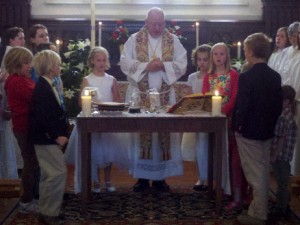
Fr. Funston assisted at the Communion Table by children of St. Paul's ParishMore than thirty years ago, a bishop named Wesley Frensdorff set out his vision for the church in a piece of writing he title simply The Dream. Wes Frensdorff was a good friend to Evelyn and to me. He was her parish priest when she was a child, and her boss when she was the director of the Diocese of Nevada’s summer camp. He officiated at our wedding, and is the person who spoke for God and hounded me into eventually becoming a clergyman. As my Rector’s Report, I’d like to share his dream with you, adding my own brief comments as to how I see this church meeting his vision.

Bishop Frensdorff begins . . .

Let us dream of a church . . .
in which all members know surely and simply God’s great love, and each is certain that in the divine heart we are all known by name.
in which Jesus is very Word, our window into the Father’s heart; the sign of God’s hope and his design for all humankind.
in which the Spirit is not a party symbol, but wind and fire in everyone; gracing the church with a kaleidoscope of gifts and constant renewal for all.

I think that is the sort of church we at St. Paul’s Parish are, a congregation which knows God and God’s Son and in which everyone’s gifts and ministries are welcomed, empowered, and celebrated. We have just received written and oral reports on the many and varied ways in which those gifts and ministries are embodied in our parish.

The bishop continues . . .

A church in which . . .
worship is lively and fun as well as reverent and holy; and we might be moved to dance and laugh; to be solemn, cry or beat the breast.
people know how to pray and enjoy it – frequently and regularly, privately and corporately, in silence and in word and song.
the Eucharist is the center of life and servanthood the center of mission: the servant Lord truly known in the breaking of the bread, with service flowing from worship, and everyone understanding why worship is called a service.

I believe we are such a congregation. We have affirmed often that we are a Eucharisticly-centered parish, a prayerful people, and a place of service. We have an active parish prayer chain; we have groups which meet weekly to read spiritual writings or study the Holy Scriptures (and I wish there were more of those); we have just instituted a new chapter of the Order of the Daughters of the King, whose ministry is one of intentional prayer. This is a parish with an active corporate and individual prayer life.

Let us dream of a church . . .
in which the sacraments, free from captivity by a professional elite, are available in every congregation regardless of size, culture, location, or budget.
in which every congregation is free to call forth from its midst priests and deacons, sure in the knowledge that training and support services are available to back them up.
in which the Word is sacrament too, as dynamically present as bread and wine; members, not dependent on professionals, know what’s what and who’s who in the Bible, and all sheep share in the shepherding.
in which discipline is a means not to self-justification but to discipleship, and law is known to be a good servant but a poor master.

I believe we are or are becoming such a congregation. We are a parish in which leadership of worship is shared, in which many study the Holy Scriptures (though I wish more would do so), and in which the discipline of the Christian life is a matter of trust and grace. This is a parish in which the “sheep share in the shepherding;” in addition to our Lay Eucharistic Visitors, we have many in our congregation who’s personal ministry is keeping in touch with those they may not see in church, those whom they know to be in need of a friendly visit, those who may not speak up when they are lonely. It is a delight to be the priest in a place where many share the pastoral service which is the ministry of the priesthood of all believers.

A church . . .
affirming life over death as much as life after death, unafraid of change, able to recognize God’s hand in the revolutions, affirming the beauty of diversity, abhorring the imprisonment of uniformity, as concerned about love in all relationships as it is about chastity, and affirming the personal in all expressions of sexuality;
denying the separation between secular and sacred, world and church, since it is the world Christ came to and died for.

I believe we are such a congregation. We are a parish which welcomes all regardless of race, origin, or sexuality; we are a parish in a tradition which boldly proclaims that creation is good and which seeks to husband and enhance that goodness.

A church . . .
without the answers, but asking the right questions; holding law and grace, freedom and authority, faith and works together in tension, by the Holy Spirit, pointing to the glorious mystery who is God.
so deeply rooted in gospel and tradition that, like a living tree, it can swing in the wind and continually surprise us with new blossoms.

I believe we are such a congregation. St. Paul’s Parish is a household which welcomes the seeker, the questioner, the curious, and the new, offering not easy, black-and-white answers, but responses and exploration in a community of questioners.

Let us dream of a church . . .
with a radically renewed concept and practice of ministry, and a primitive understanding of the ordained offices.
where there is no clerical status and no classes of Christians, but all together know themselves to be part of the laos – the holy people of God.
a ministering community rather than a community gathered around a minister.
where ordained people, professional or not, employed or not, are present for the sake of ordering and signing the church’s life and mission, not as signs of authority or dependency, nor of spiritual or intellectual superiority, but with Pauline patterns of “ministry supporting church” instead of the common pattern of “church supporting ministry.”
where bishops are signs and animators of the church’s unity, catholicity, and apostolic mission, priests are signs and animators of her Eucharistic life and the sacramental presence of her Great High Priest, and deacons are signs and animators – living reminders – of the church’s servanthood as the body of Christ who came as, and is, the servant slave of all God’s beloved children.

I hope we are becoming such a congregation in such a diocese. We have affirmed and celebrated today the ministry of many of God’s people through the activities and outreach of this parish. I look forward to a time when there may be one or more additional priests to animate (as Bishop Frensdorff put it) our Eucharistic life, when there may be one or more deacons to animate our life of service and servanthood, but whether we have those or not, we are now a community which, nourished on Christ’s Body and Blood, is corporately and individually reaching out in service to our community. The Free Farmers’ Market is our largest and most active corporate outreach ministry; but we have many members who are active in public service as hospital and hospice volunteers, as board members of charities, as tutors, and in a variety of other ways. Their public service is a testament to the Christian witness of this church to which they belong.

Let us dream of a church . . .
so salty and so yeasty that it really would be missed if no longer around; where there is wild sowing of seeds and much rejoicing when they take root, but little concern for success, comparative statistics, growth or even survival.
a church so evangelical that its worship, its quality of caring, its eagerness to reach out to those in need cannot be contained.

I believe we are becoming such a congregation. At a recent meeting of leadership in this parish, one of our people said, “I’m looking forward to failing!” What he meant was that he looks forward to us going out into the community around us with (as the bishop says) “little concern for success,” simply going out and getting something done, spreading the Gospel without worrying about the final outcome, which is always and ever in God’s hands.

A church . . .
in which every congregation is in a process of becoming free – autonomous – self-reliant – interdependent, none has special status: the distinction between parish and mission gone.
where each congregation is in mission and each Christian, gifted for ministry; a crew on a freighter, not passengers on a luxury liner.
of peacemakers and healers abhorring violence in all forms (maybe even football), as concerned with societal healing as with individual healing; with justice as with freedom, prophetically confronting the root causes of social, political, and economic ills.
which is a community: an open, caring, sharing household of faith where all find embrace, acceptance. and affirmation.
a community: under judgment, seeking to live with its own proclamation, therefore, truly loving what the Lord commands and desiring his promise.

I believe this is what we meant when we declared, as a congregation, that St. Paul’s Parish’s reason for being is “to set hearts on fire for Jesus” and that our mission is “to advance the Kingdom of God through liturgical worship, spiritual education, personal growth, and service to others.”

And finally, let us dream of a people
called to recognize all the absurdities in ourselves and in one another, including the absurdity that is Love,
serious about the call and the mission but not, very much, about ourselves,
who, in the company of our Clown Redeemer can dance and sing and laugh and cry in worship, in ministry, and even in conflict.
[Frensdorff was a great lover of clowns who often used the clown as a metaphor or illustration in his preaching about Jesus.]

I recently read an essay entitled Why Does God Need the Church? by Ragan Sutterfield, an Episcopalian who lives in Arkansas. Sutterfield’s answer is that God needs the church “to be God’s real presence in the world . . . a radical and amazing call for a group of people.” But, he wrote, “we need to realize . . . that the buildings, the ecclesial bodies, the liturgies, the hierarchies, the bishops, the priests, the laity, the budgets, etc, etc, etc, are only valuable as parts of the church in so far as they are fulfilling the mission of God. And . . . God’s mission is not nice services for nice people in nice buildings.” (Emphasis added.)

Sutterfield, I think, is echoing Bishop Frensdorff’s vision. In doing so, Sutterfield, proposed two new ways to think of our church congregations. First, as “icon” – an icon, he says, is an image that sparks the imagination to move beyond the image and see God. The question we must ask ourselves is “Are we such a community? Looking at us, visiting us, worshiping with us, being served by us, and serving with us, are others moved beyond us to see God?” I believe that we are such a community and I hope that others see through us in that way.

Sutterfield’s second new image of the church is as a “dojo.” A dojo, as you probably know, is “a practice community within martial arts – it is the place where adherents to a specific form come together to learn how to be better practitioners, both from each other and from recognized masters of the form.” It is, simply put, the place and community where people come to get better at what they do. In the church-as-dojo, the congregation becomes the place where we come together to work at becoming more Christ-like. The church becomes a place where we come not to sing some nice songs and hear an occasionally good sermon, but a community with which we gather to explore the faith with one another, recognizing that some among us are more practiced than we may be, challenging each other and learning from one another how better to practice the way of Jesus.

Sutterfield concludes with a vision not too much different from Bishop Frensdorff’s:

Imagine a church where, after a few months of regularly attending, you are able to recognize that you are less angry than you used to be. Imagine a church that shows you how to forgive the person who hurt you most profoundly. Imagine a church that measures your love of God as Dorothy Day did hers, by how much you love the person you love least. Imagine a church that loves you for who you are, away from all of the facades of the self, and teaches you how to love.

I believe that St. Paul’s Parish is and is constantly becoming such a place and such a community. The reports we have received today, the leadership our vestry and officers provide, the ministries of all of our members, all demonstrate that that is so, and for that I am grateful to each of you and to God.

Let us pray:

Almighty and everliving God,
ruler of all things in heaven and earth,
hear our prayers for this parish family.
Strengthen the faithful, arouse the careless, and restore the penitent.
Grant us all things necessary for our common life,
and bring us all to be of one heart and mind
within your holy Church;
through Jesus Christ our Lord. Amen.

Will you turn to the prayers page of the Annual Journal and join me in the “Disturb us, Lord” prayer attributed to Sir Francis Drake which our Inviting the Future Committee adopted as the guiding prayer for our capital project. After the prayer, we’ll sing I Have Decided to Follow Jesus (which is on the back cover of the Journal) and stand adjourned.

Disturb us, Lord, when we are too well pleased with ourselves, when our dreams have come true because we have dreamed too little, when we arrived safely because we have sailed too close to the shore.

Disturb us, Lord, when, with the abundance of things we possess, we have lost our thirst for the waters of life. Having fallen in love with life, we have ceased to dream of eternity and in our efforts to build a new earth, we have allowed our vision of the new Heaven to dim.

Disturb us, Lord, to dare more boldly, to venture on wider seas where storms will show your mastery; where losing sight of land, we shall find the stars.
We ask you to push back the horizons of our hopes; and to push us into the future in strength, courage, hope, and love. Amen.

Even More God Is Our Mother – From the Daily Office – January 26, 2013

From the Prophet Isaiah:

Listen to me, O house of Jacob,
all the remnant of the house of Israel,
who have been borne by me from your birth,
carried from the womb;
even to your old age I am he,
even when you turn grey I will carry you.
I have made, and I will bear;
I will carry and will save.

(From the Daily Office Lectionary – Isaiah 46:3-4 (NRSV) – January 26, 2013.)

Stone Sculpture, Motherhood, Artist UnknownAs anyone who knows me will testify, I am no Calvinist! But hats off to John Calvin who wrote about these verses, “God has manifested himself to be both Father and Mother so that we might be more aware of God’s constant presence and willingness to assist us.” (Commentaries, Vol. 8, Baker Books:2005) Isaiah’s words on behalf of God are among the strongest maternal images of God in Holy Scripture. Just three chapters later, speaking through the prophet, God will ask and declare, “Can a woman forget her nursing child And have no compassion on the son of her womb ? Even these may forget, but I will not forget you.” (49:14-15) And, again, Calvin wrote, “God did not satisfy himself with proposing the example of a father, but in order to express his very strong affection, he chose to liken himself to a mother, and calls His people not merely children, but the fruit of the womb, towards which there is usually a warmer affection.”

So forgive Calvin his use of the masculine pronoun and laud him for his forward thinking and astute observation of God’s Motherhood. Would that modern American Christians would follow his lead! I can’t count the number of times I’ve seen something from the conservative wing of the Church (from Orthodox, Roman Catholic, Anglican, and Protestant writers) decrying maternal metaphors as “Gnostic” or “pagan”. How sad that a theological tradition rooted in Scripture (and developed by preachers as early as Augustine of Hippo and John Chrysostom) should be ignored, devalued, debased, and rejected by so many. By doing so, they accomplish two things: they run the risk of alienating women (and, in fact, have done so), and they fail to communicate with those for whom the “fatherhood” metaphor is problematic. How much better might the church address the modern world if it remembered the words of Pope John Paul I that “we are the objects of undying love on the part of God. . . God is our father; even more God is our mother.” (Spoken at the time of the Camp David peace accords.)

My own biological father, of whom I have only vague memories, was an alcoholic whose most influential action contributing to the formation of his sons’ lives (at least my own, if not my late brother’s) was killing himself in a single-vehicle roll-over accident while driving drunk when I was 5-1/2 years old. When my mother remarried five years later, it was to a man to whom I could not relate at all for several years (though we became quite close once I’d been an adult for while); because of that strained relationship, at age 14 I chose to move away from home. Thus, I am one of those for whom the “fatherhood” metaphor is not all that significant. My best parental memories are of a strong and resourceful single mother; God described as “our true Mother in whom we are endlessly born and out of whom we shall never come” (Dame Julian of Norwich) makes a whole lot of sense to me.

This Isaiah passage resonates for me, and I am grateful to Calvin and Julian of Norwich, to Augustine and Chrysostom, and to John Paul I for developing the maternal metaphor. “Even more God is our mother.”

====================

A request to my readers: I’m trying to build the readership of this blog and I’d very much appreciate your help in doing so. If you find something here that is of value, please share it with others. If you are on Facebook, “like” the posts on your page so others can see them. If you are following me on Twitter, please “retweet” the notices of these meditations. If you have a blog of your own, please include mine in your links (a favor I will gladly reciprocate). Many thanks!

====================

Father Funston is the rector of St. Paul’s Episcopal Church, Medina, Ohio.

Employers and Employees – From the Daily Office – January 25, 2013

From the Letter to the Ephesians:

Slaves, obey your earthly masters with fear and trembling, in singleness of heart, as you obey Christ; not only while being watched, and in order to please them, but as slaves of Christ, doing the will of God from the heart. Render service with enthusiasm, as to the Lord and not to men and women, knowing that whatever good we do, we will receive the same again from the Lord, whether we are slaves or free. And, masters, do the same to them. Stop threatening them, for you know that both of you have the same Master in heaven, and with him there is no partiality.

(From the Daily Office Lectionary – Ephesians 6:5-9 (NRSV) – January 25, 2013.)

Victorian Child Labor PhotographSo let’s admit right off the bat that we have a problem here. Where the progressives and liberals among us would much prefer to read Paul condemning the institution of slavery, he does not. Instead, he simply admonishes slaves to be good slaves and masters to be good masters, and even goes so far as to analogize a Christian’s relationship with God (or Jesus) to slavery. This just doesn’t sit well in the modern mind and provides plenty of ammunition for those whom Friedrich Schleiermacher addressed as religion’s “cultured despisers.” We would much rather Paul hadn’t said this.
But he did. So what to think of it . . . .

First off, the Greek here is doulos which is most often translated as “slave” as it is here, but it can also refer to a bond-servant, a servant for hire, or to someone who is devoted to another without regard of his or her own interests (the last often metaphorically). It’s unlikely that Paul intended this as either a comment on non-slavery employment relationships or as a metaphorical statement, but we can certainly read it in those ways in our modern context.

Secondly, and this encourages us to read this text as applicable to modern employee-employer relations, the institution of slavery in the First Century Roman empire was an economic, not a racial, reality. We modern Americans, influenced by our own history, hear racial overtones in these verses, but they are not really there. In ancient Rome slaves might be prisoners of war, sailors captured and sold by pirates, slaves bought outside Roman territory, or even the children of desperately poor Roman citizens sold into bond-servanthood by their parents. Further, slaves were commonly and even rather frequently freed; a slave could buy his or her own freedom.

So if we read this text as referring not only to the First Century practice of slavery, but applying also to any economic institution wherein one person works at the behest of and for the benefit of another, it provides guidance for theological critique of contemporary employment practices and related laws. It requires the church to question any employment situation in which workers are inadequately paid, where worker safety is at risk, or which threatens to damage the family life or welfare of the worker and his or her dependents.

In fact, the long struggle to recognize and protect workers’ rights finds its genesis in this and similar biblical texts. In Great Britain and in our own country during the 18th and 19th Centuries (and even into the early 20th Century), children worked in mines and factories; all laborers worked six-day weeks and often 16- to 18-hour days; working conditions were often dangerous; and on-the-job death was a common occurrence. Fans of the series Downton Abbey (or earlier dramas such as Upstairs, Downstairs) need only think of the way in which the servants’ life is portrayed to see a small (and very toned-down) illustration of what a worker’s life was like, always at the beck-and-call of the employer.

The anti-slavery movement in Britain became the movement to bring about just and equitable labor laws, to prevent children from working, to reduce the work day to ten hours per day, and to make employers responsible for working conditions. That movement spread to the United States. In both Britain and America, it was driven by Christians, many of them Christian socialist Anglo-Catholics in the Church of England and the Episcopal Church, who read these texts as demanding the ends they sought.

So we need not apologize to our “cultured despisers” for Paul’s words about slavery. Instead, we are called like our forebears in the faith to see in them our call to champion workers’ rights and just labor laws.

====================

A request to my readers: I’m trying to build the readership of this blog and I’d very much appreciate your help in doing so. If you find something here that is of value, please share it with others. If you are on Facebook, “like” the posts on your page so others can see them. If you are following me on Twitter, please “retweet” the notices of these meditations. If you have a blog of your own, please include mine in your links (a favor I will gladly reciprocate). Many thanks!

====================

Father Funston is the rector of St. Paul’s Episcopal Church, Medina, Ohio.

Then A Miracle Occurs – From the Daily Office – January 24, 2013

From the Gospel according to Mark:

Jesus said, “The kingdom of God is as if someone would scatter seed on the ground, and would sleep and rise night and day, and the seed would sprout and grow, he does not know how. The earth produces of itself, first the stalk, then the head, then the full grain in the head. But when the grain is ripe, at once he goes in with his sickle, because the harvest has come.”

(From the Daily Office Lectionary – Mark 4:26-29 (NRSV) – January 24, 2013.)

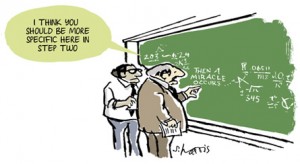
And then a miracle occurs cartoonMy late brother had a cartoon cut from some magazine taped to the door of his university office (he was a professor of political science and constitutional law) for years. I suspect it came from either Playboy or The New Yorker, but I really don’t know. It depicted two scientists working at a chalk board. To their left on the board was a complicated looking mathematical formula and to their right, another one. Connecting the two sets of numbers were arrows drawn from and to the words, “The a miracle occurs.” One of the scientists speaking to the other says, “I think you should be more specific here in step two.” (Of course, I’ve been able to find the cartoon on the internet and will post it with this meditation.)

That bit of scientific humor came to mind when I read this parable. I know this parable is meant to portray the church, the work of discipleship, the eschatological reality of the last judgement, etc. However, I am fascinated by the actual reality of planting seed, growing a crop, and harvesting the result, and Jesus’ words, “He does not know how!” 2,000 years after he spoke those words we truly still do “not know how” plants go from seed to harvest. We know a lot more of the “how” than we did, but we still don’t really have a clue what’s going on. We can name the elements and chemicals involved; we can describe the interactions and processes; we can pretty much point to the genes and DNA code that produce the end characteristics of the particular species. But when it comes right down to it, we don’t know how or why it happens, and we can’t actually produce it from scratch. We could mix all the constituent elements and chemicals together in exactly the right proportions and all we’ll have is a batch of chemicals, not a seed or plant or harvestable fruit.

Some day, perhaps, but not now. Research scientists keep pushing back the horizons of our knowledge, but there is still something we don’t know. Australian physicist Paul Davies put it this way in his book The Fifth Miracle, “Scientists still can’t quite put their finger on exactly what it is that separates a living organism from other types of physical objects.” Elsewhere, in an article in the journal BioSystems, Davies has said, “Living systems form a very special subset among the set of all complex systems. Biological complexity is distinguished by being information-based complexity, and a fundamental challenge to science is to provide an account of how this unique information content and processing machinery of life came into existence.”

In other words, the “how” (and especially the “why”) of what happens between planting of seed and harvesting of fruit remains a mystery. And, Dr. Davies helps frame the question: “Given a soup of classical molecular building blocks, how did this mixture ‘discover’ the appropriate extremely improbable combination by chance in a reasonable period of time?” I applaud the efforts of scientists to figure that out. I came across Dr. Davies’ writings because of my interest in quantum mechanics and string-theory; he proposes that quantum processes are at work in the origins of life. It’s an interesting hypothesis and might go a long way in answer the “how” question. It won’t, I don’t think, answer the “why”.

From my perspective (which I know some of my less religious friends and colleagues think is naive), what we don’t know (both the “how” and the “why”) is the second step in the cartoon’s equation. What we don’t know is the miracle that occurs, the miracle that occurred when the first primordial organism developed in the original soup of elements and chemicals way back when in the history of our earth.

It seems to me that this “then a miracle happens” unknown element is present in other parts of our existence, as well.

Two people meet, then a miracle happens – they fall in love. Sure, there’s a lot of interplay of pheromones and hormones and brain chemistry and what-not; we know a lot of the “how”, but we don’t know the “why”. Why these two and not those two, why each of these with the other and not with some other person, why sometimes two people once in love find themselves no longer so . . . . It’s in the second step, “then a miracle occurs.”

A human being grows to maturity and develops the ability to paint beautiful portraits or landscapes, to sculpt exquisite models of the human form, to write entertaining scripts, or to pen moving poetry. We can talk of environment and education and innate artistic ability; we can describe the “how” of her up-bringing and her craft. But we cannot answer the question “why” this person develops these talents and her sibling did not. It’s in the second step, “then a miracle occurs.”

The cartoon is right; we can’t just leave it at that! We need to be more specific in step two. So I cheer on the scientists who are seeking the answers. But I also celebrate the mysterious and the miraculous, and cheer on the mystics, the religious, the spiritual, the artists, the poets, the priests, and all the other seekers after truth. Let’s all try to learn what’s going on when a miracle occurs.

====================

A request to my readers: I’m trying to build the readership of this blog and I’d very much appreciate your help in doing so. If you find something here that is of value, please share it with others. If you are on Facebook, “like” the posts on your page so others can see them. If you are following me on Twitter, please “retweet” the notices of these meditations. If you have a blog of your own, please include mine in your links (a favor I will gladly reciprocate). Many thanks!

====================

Father Funston is the rector of St. Paul’s Episcopal Church, Medina, Ohio.

Lousy Soil or Lousy Sowing? – From the Daily Office – January 23, 2013

From the Gospel according to Mark:

Jesus explained the Parable of the Soils: “The sower sows the word. These are the ones on the path where the word is sown: when they hear, Satan immediately comes and takes away the word that is sown in them. And these are the ones sown on rocky ground: when they hear the word, they immediately receive it with joy. But they have no root, and endure only for a while; then, when trouble or persecution arises on account of the word, immediately they fall away. And others are those sown among the thorns: these are the ones who hear the word, but the cares of the world, and the lure of wealth, and the desire for other things come in and choke the word, and it yields nothing. And these are the ones sown on the good soil: they hear the word and accept it and bear fruit, thirty and sixty and a hundredfold.”

(From the Daily Office Lectionary – Mark 4:14-20 (NRSV) – January 23, 2013.)

The Sower by Van GoghIt’s a familiar enough parable, this story of the farmer who sows his seed only to have most of it fail to produce for one reason or another. Jesus’ use of the broadcasting seed as a metaphor for preaching is reassuring to those of us who preach on a regular basis. It seems to say it isn’t our fault if what we preach has little or no impact on the hearers; it’s the fault of the “soils” into which we are sowing – maybe “Satan” snatched it away, or maybe the hearers have no “depth”, or maybe they are just too concerned with “cares of the world”.

Or maybe we really are lousy preachers.

The task of ordained ministry is centered, at least in part, on the Word. The ministry of the clergy in many traditions is specifically referred to as a “ministry of Word and Sacrament.” A few years ago, an ecumenical group of pastors called The Eleison Group said that the clergy’s “primary responsibility is sharing the gospel of Jesus Christ with our congregations, our communities, and our world.” We who are ordained are expected to be wordsmiths and public speakers. The care with which we use words reflect not just upon us or upon the church; it reflects also upon the message we proclaim. “A bad book about the love of God remains a bad book,” wrote Thomas Merton. “[M]en pick up these books and say: If the ones who say they believe in God cannot find anything better than this to say about it, their religion cannot be worth much.” It is wrong to say of such readers that they have fallen prone to Satan, or that they lack depth, or that they are too concerned with worldly cares.

But Jesus’ point in the parable is well-taken. Communication is a two-way street. Even the best preacher can fail if she does not take into account the situation of her audience. It is the responsibility of the preacher to figure out what sort of “soil” the listener might be. In the mixed crowd of a congregation there will be some of all types, so preaching styles must vary; different texts must be chosen (the lectionary accomplishes this for those in such traditions); methods of delivery must be engaging and, frankly, entertaining; new technologies must be used. There are different kinds of “soils” and we must employ different kinds of techniques when “sowing” the Word. Sometimes we will fail, and sometimes it will not be our fault. But Jesus’ metaphor does not relieve the sower of all responsibility; the parable of the sower is not a blanket pardon from the sin of lousy preaching. No farmer knowingly wastes his seed on stony or weed-infested ground; no sower throws his seed where he expects the birds to immediately eat it up (nor does he fail to take precautions to keep the birds away). If any farmers do act thusly, they are lousy farmers and deserve the poor crops they get.

Preachers who fail to carefully prepare their homilies, who do not strive for excellence, are likely to get similar results. They have only themselves to blame, not the “soils” where they are sowing their seeds.

====================

A request to my readers: I’m trying to build the readership of this blog and I’d very much appreciate your help in doing so. If you find something here that is of value, please share it with others. If you are on Facebook, “like” the posts on your page so others can see them. If you are following me on Twitter, please “retweet” the notices of these meditations. If you have a blog of your own, please include mine in your links (a favor I will gladly reciprocate). Many thanks!

====================

Father Funston is the rector of St. Paul’s Episcopal Church, Medina, Ohio.

Jesus Is Crazy – From the Daily Office – January 22, 2013

From the Gospel according to Mark:

Then [Jesus] went home; and the crowd came together again, so that they could not even eat. When his family heard it, they went out to restrain him, for people were saying, “He has gone out of his mind.”

(From the Daily Office Lectionary – Mark 3:19b-21 (NRSV) – January 22, 2013.)

Buddy Jesus from the movie DogmaMark, Matthew, and John all report that on another occasion Jesus commented, “Prophets are not without honor except in their own country and in their own house.” One can’t get much more dishonored that being accused of being crazy!

I was at meeting today where the issue of evangelism was discussed – we were being honest, I think, in referring to it as “marketing” and using a marketing analysis of how we can go about putting the gospel before others.

At one point during the discussion, one of our number referred to a part of the market as “the crazies,” by which he meant those going through crises in their life: divorce, death of a loved one, loss of a job, alcoholism or other addiction (their own or someone else’s), etc. There are numerous disruptions, dysfunctions, crises, tragedies, and catastrophes that can lead to craziness in a family. What, he asked, can we offer to those facing “the crazies”?

We can offer Jesus whose family and friends thought he was “out of his mind”; we can offer the Jesus who is crazy! We have a crazy savior who is with us in the midst of the craziness. Of course, by calling Jesus “crazy,” I’m not saying Jesus was insane. C.S. Lewis, in Mere Christianity, addressed that issue when he suggested that in thinking about who Jesus was and is, we only three choices — (1) Jesus was mad. Only a madman would make some the outlandish statements Jesus made; (2) He was lying. He might or might not have believed what he said about himself, but regardless they were not true; or (3) What he said was and is true and he is the Son of God, the Incarnate Lord who came from heaven to live among us, who died on the cross, rose from the dead, and ascended into heaven opening the way of salvation to us. This is how Lewis makes this profound logical argument.

I am trying here to prevent anyone saying the really foolish thing that people often say about Him: “I’m ready to accept Jesus as a great moral teacher, but I don’t accept His claim to be God.” That is the one thing we must not say. A man who was merely a man and said the sort of things Jesus said would not be a great moral teacher. He would either be a lunatic – on the level with a man who says he is a poached egg – or he would be the devil of hell. You must take your choice. Either this man was, and is, the Son of God: or else a madman or something worse.

You can shut Him up for a fool, you can spit at Him and kill Him as a demon; or you can fall at His feet and call Him Lord and God. But let us not come with any patronizing nonsense about His being a great human teacher. He has not left that open to us. He did not intend to.

No, when I say that Jesus is “crazy,” I’m not thinking he was nuts. Rather, I’m remembering a character from a television show from my childhood – The Life and Loves of Dobie Gillis. Bob Denver played the beatnik character Maynard G. Krebs. When Maynard really liked something, he would say, “That’s like crazy, man!” That’s what I think about Jesus; he’s like crazy, man. And he’s with us when things go crazy!

====================

A request to my readers: I’m trying to build the readership of this blog and I’d very much appreciate your help in doing so. If you find something here that is of value, please share it with others. If you are on Facebook, “like” the posts on your page so others can see them. If you are following me on Twitter, please “retweet” the notices of these meditations. If you have a blog of your own, please include mine in your links (a favor I will gladly reciprocate). Many thanks!

====================

Father Funston is the rector of St. Paul’s Episcopal Church, Medina, Ohio.

« Older posts Newer posts »