Occasional thoughts of an Anglican Episcopal priest

Category: Episcopal (Page 58 of 114)

Life Isn’t a Game – From the Daily Office – March 19, 2014

From the First Letter to the Church in Corinth:

In fact, to have lawsuits at all with one another is already a defeat for you.

(From the Daily Office Lectionary – I Corinthians 6:7a (NRSV) – March 19, 2014.)

Judge with GavelThis may be the simplest, truest, most profound thing Paul ever wrote. No flowery language, no showing of his erudition and knowledge of the Hebrew Scriptures or of Greek philosophy, no convoluted logic, no run-on sentences. Just a simple declaration: if you are in litigation, you’ve already lost.

For nearly 20 years I was involved in a litigation law practice. First as a paralegal, then as a law office administrator, then (after going to law school myself) as an associate and later partner of one of the largest personal injury and malpractice defense firms in the state of Nevada. Somewhere along the line I learned a statistic that 95% of all such claims are settled before any complaint or petition is filed in a court of law, and of those cases were litigation is instituted only about 3% ever end up actually going through a trial, and of trials that begin at least 50% are settled before being submitted to the judge or jury for a decision. (Those statistics are at least 20 years old and, of course, 47% of all statistics are simply made up, so don’t quote me on this.)

Only a tiny fraction of personal injury or malpractice claims are litigated. I don’t know of the statistics regarding civil suits for breach of contract or other transactional litigation, but I suspect that it is the same. Nearly all disputes are settled in some faction before a lawsuit is initiated. If a complaint, information, or petition is filed, it means that other, less disruptive means of resolution have failed; it means that the relationship between the parties is almost irretrievably broken; it means that both have lost something precious.

This (I believe) is Paul’s point: litigation demonstrates the defeat of relationship. Modern psychologists have discovered that the end of a relationship, especially a romantic linkage or deep friendship, affects the human psyche in much the same way as a death. Years ago, Elizabeth Kübler-Ross identified the five stages of grieving a death: denial, anger, bargaining, depression, and acceptance. Movement through these stages is not neat and clean – different stages may take longer than others, some may be repeated, they may be experienced in a somewhat different order – but this progression is predictable. The same process occurs when a relationship ends. Litigation, which signals the irrefutable breakage of a relationship, is like death: to have lawsuits at all with one another is a defeat.

What relationship is deeper or more important than one’s brotherhood or sisterhood with another member of the church, someone to whom one is related as the parts of the body are related? To have lawsuits between church members is like the cutting off of body parts! (Jesus’ hyperbolic parable of cutting off body parts which cause one to sin has no application here.)

We live in a litigious society; lawyer advertising encourages lawsuits. Every perceived wrong, however slight, is portrayed as reason to seek redress in the courts. Where I live, I see at least five personal injury lawyers’ advertisements on television every evening, including one whose annoying slogan is “I’ll make them pay.” I suspect that a larger percentage of disagreements and grievances are litigated now than when I was in practice. I am convinced that our politics have become more fractious and hostile and that our social fabric is fraying, and that this is symptomatic of the same ill that increased litigation points to. Our society is losing, has already lost, a cohesion it cannot afford to lose.

It is one of the callings of the church to demonstrate the needlessness of this, to be a sign that reconciliation is not only possible but desirable, to witness to Paul’s simple profound truth that ” to have lawsuits at all with one another is already a defeat.” The Catechism of the Episcopal Church says as much:

Q. What is the mission of the Church?
A. The mission of the Church is to restore all people to unity with God and each other in Christ.
(BCP 1979, page 855)

I loved courtroom work! To be in a trial was great fun; it was a game and I was very good at it. Life, however, isn’t a game, and to the extent it may seem like one, to be in a trial is conclusive evidence that we have already lost it.

====================

A request to my readers: I’m trying to build the readership of this blog and I’d very much appreciate your help in doing so. If you find something here that is of value, please share it with others. If you are on Facebook, “like” the posts on your page so others can see them. If you are following me on Twitter, please “retweet” the notices of these meditations. If you have a blog of your own, please include mine in your links (a favor I will gladly reciprocate). Many thanks!

====================

Father Funston is the rector of St. Paul’s Episcopal Church, Medina, Ohio.

Zesty Vestry – From the Daily Office – March 18, 2014

From the First Letter to the Church in Corinth:

Do you not know that a little yeast leavens the whole batch of dough? Clean out the old yeast so that you may be a new batch, as you really are unleavened. For our paschal lamb, Christ, has been sacrificed. Therefore, let us celebrate the festival, not with the old yeast, the yeast of malice and evil, but with the unleavened bread of sincerity and truth.

(From the Daily Office Lectionary – I Corinthians 5:6b-8 (NRSV) – March 18, 2014.)

Saccharomyces Cerevisiae YeastPaul uses the metaphor of yeast in a negative way making it symbolize sin and corruption. In the letter to the Galatians, he uses it in a similar manner in an aside about the few who have “prevented you from obeying the truth,” saying, “A little yeast leavens the whole batch of dough.” (Gal. 5:7,9)

Jesus had used the metaphor in a positive way: “The kingdom of heaven is like yeast that a woman took and mixed in with three measures of flour until all of it was leavened.” (Matt. 13:33; cf. Luke 13:21) But he also warned his disciples to beware “the yeast of the Pharisees.” (Matt. 16:6, Mark 8:5, Luke 12:1)

The point of the metaphor is that a small number of individuals can influence the behavior of a large group. A few years ago, some British researchers demonstrated that this is true even when there is no conscious communication within the group. In a series of experiments groups of people were asked to walk randomly within a large but confined space. A few subjects were given detailed instructions about where to walk. Participants were all instructed to stay at least arms length away from any other person and they were not allowed to communicate with one another.

In every run of the experiment, the instructed subjects ended up being followed by others in the crowd, forming a sort of self-organizing conga line. Iterations with varying numbers of subjects up to 200 demonstrated that it only took 5% of the group being instructed to result in an unconscious group consensus. Despite the fact that participants weren’t allowed to talk or gesture to one another, the group ended up being led by the specially instructed minority.

Just think what a small minority within a church community could do if it were united and made conscious effort to influence the larger group. Think what a vestry, session, or other governing board could do if it put its collective mind to being a “yeast” for good within a congregation. Too often church leaders try to persuade congregations to grow through personal evangelism or to reach out in social ministry or to mature in faith through spiritual discipline without actually demonstrating those behaviors themselves. That hasn’t worked. What works is “leading by example,” which is what the small amount of yeast in a loaf does in a way; it’s what the instructed walkers in the British experiments did.

With just a little bit of care and nurture, a little bit of yeast can grow explosively; the most common yeast used in brewing and baking (Saccharomyces Cerevisiae) can double every 100 minutes! The English word “yeast,” according to the dictionary, derives from the Greek word zestos. The word used in the New Testament for “leaven” (and translated here as “yeast”) is zume. These words have no linguistic link to our modern words “zest” and “zoom,” but it occurs to me this morning that if small leadership groups in our churches got truly zesty for spiritual maturity, for personal evangelism, and for social ministry, there’d be no stopping the church; it would zoom. The church would explode! We need to cultivate a zesty vestry in every congregation!

====================

A request to my readers: I’m trying to build the readership of this blog and I’d very much appreciate your help in doing so. If you find something here that is of value, please share it with others. If you are on Facebook, “like” the posts on your page so others can see them. If you are following me on Twitter, please “retweet” the notices of these meditations. If you have a blog of your own, please include mine in your links (a favor I will gladly reciprocate). Many thanks!

====================

Father Funston is the rector of St. Paul’s Episcopal Church, Medina, Ohio.

Break the Chains – Sermon for the Second Sunday of Lent (Year A) – March 16, 2014

Croagh PatrickIn the Education for Ministry (“EfM”)[1] program we engage in a process called “reflection” (“theological reflection” to be precise). In this process, we take a close look at a thing or a story, an incident from life, a passage of scripture, or an object we use everyday. One of the best group reflections I ever took part in started when someone put their mobile phone in the center of the table and said, “Let’s talk about this.”

In part of the process, we draw on what are called the “four sources” to illuminate the subject of our reflection. The sources are experiential – this is the “Action” source: things we do, think, and feel; positional – our attitudes, opinions, beliefs, and convictions; traditional – drawn from our Christian heritage, scripture, liturgy, hymnody, and so forth; and cultural – popular songs, movies, novels, commercials and advertisements, politics, etc.

Continue reading

Theoretical Doctrines, Doctrinal Theories – From the Daily Office – March 15, 2014

From the Gospel of Mark:

[Jesus] entered the synagogue, and a man was there who had a withered hand. They watched him to see whether he would cure him on the sabbath, so that they might accuse him. And he said to the man who had the withered hand, “Come forward.” Then he said to them, “Is it lawful to do good or to do harm on the sabbath, to save life or to kill?” But they were silent. He looked around at them with anger; he was grieved at their hardness of heart and said to the man, “Stretch out your hand.” He stretched it out, and his hand was restored. The Pharisees went out and immediately conspired with the Herodians against him, how to destroy him.

(From the Daily Office Lectionary – Mark 3:1-6 (NRSV) – March 15, 2014.)

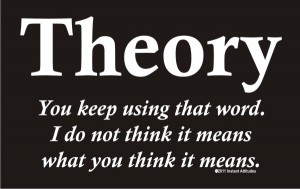
Theory - You keep using that word . . . . . Gregory of Nyssa, one of the Cappadocian Fathers, is supposed to have said, “Concepts create idols; only wonder comprehends anything. People kill one another over concepts. Wonder makes us fall to our knees.” I think that pretty much describes what is going on in today’s Gospel lesson, and pretty much describes what has become of conversation and discussion between groups in our society. The Pharisees and the Herodians, who disagreed with one another about nearly everything, could nonetheless come together and plot to kill Jesus because his words and actions threatened both of their conceptual frameworks. They had to defend their concepts against the wonder of healing, even if it meant killing.

A few days ago I had the thought that in the current debate (and I use the term advisedly and optimistically) between proponents of a scientific view of how the world got to be here and to be as it is (the champions, shall we say, of the theories of the “big bang” and of evolution) and the proponents of a religious view (the champions, shall we say, of the “young Earth creation” idea), the issue is one of language. It is a battle over concepts in which the two sides use language in ways the other doesn’t understand. They use the same words but use them with different meanings. They conceive of them differently and must defend their concepts to the death (of their perceived opponent).

For example, the word “theory” . . . . This word is used by scientists to mean an agreed upon explanation of some phenomenon, a description of the phenomenon which can be experimentally verified. Wikipedia offers this definition: “A well-substantiated explanation of some aspect of the natural world that is acquired through the scientific method, and repeatedly confirmed through observation and experimentation.” Those who champion a strictly religious view of creation, who insist on the accuracy of the Biblical account as factual (I’m not one of them, I hasten to add), hear the word differently. They hear the word “theory” and equate it to “hypothesis;” they hear the word “theoretical” and think “conjectural.” Theories are provisional, but they are not conjectural!

Or, on the other side (so to speak), the words “dogma” and “doctrine” . . . . In religion, a dogma is nothing more than a doctrine or a related set of doctrines relating to matters such as morality and faith set forth in an authoritative manner by a religious body. Doctrines are explanations; they attempt put into human language a definition or explanation of a spiritual or supernatural phenomenon. The Christian doctrine of the Trinity, for example, seeks to explain the nature of God through the metaphor of the relationship between the Creator (Father), Jesus the incarnate Son, and the Holy Spirit. The Vedic doctrine of karma seeks to explain the ethical harmony and equilibrium of life. Doctrine and dogma occupy, in the realm of religion, the same place theories occupy in the realm of science. Theological doctrines are just as provisional as theories; as one theologian has said, they are “temporary resting places” on the journey toward understanding.

Now I’m going to get pilloried by some, I’m sure, for suggesting any sort of equation or even similarity between scientific theory and religious dogma. “Theories are not dogmatic,” will say some scientist. “Doctrines are not hypothetical,” will say some religious apologist. Both will be right, of course, and both will be wrong; both will be reacting in that manner precisely because of the way each hears and understands the words. And their understandings are different.

In their doctrines and their theories, religion and science are trying to conceptualize the wonder of universe. Like the Pharisees and Herodians watching Jesus heal the man with the withered, they refuse to simply say, “Wow!” Both want to nail down an explanation, their explanation, their concept, as the only way to perceive and understand the wonder.

We need to get past this barrier, the wall of theoretical doctrines and doctrinal theories, the barricade of concepts that prevents us from listening to one another. The Pharisees and the Herodians were able to do it, albeit for the negative purpose of killing Jesus; we ought to be able to do it for the more positive purpose of working together.

====================

A request to my readers: I’m trying to build the readership of this blog and I’d very much appreciate your help in doing so. If you find something here that is of value, please share it with others. If you are on Facebook, “like” the posts on your page so others can see them. If you are following me on Twitter, please “retweet” the notices of these meditations. If you have a blog of your own, please include mine in your links (a favor I will gladly reciprocate). Many thanks!

====================

Father Funston is the rector of St. Paul’s Episcopal Church, Medina, Ohio.

Wine, New and Old – From the Daily Office – March 14, 2014

From the Gospel of Mark:

Jesus said: “No one puts new wine into old wineskins; otherwise, the wine will burst the skins, and the wine is lost, and so are the skins; but one puts new wine into fresh wineskins.”

(From the Daily Office Lectionary – Mark 2: 22 (NRSV) – March 14, 2014.)

New and Old WineskinsI remember preaching on this text some years ago and doing a lot of research into the meaning of “new wine” as used in the Bible (tirowsh in Hebrew, oinon neon in Greek) — whether it meant fermented wine or yet-to-be-fermented newly-crushed grape juice. There is a lot of differing scholarship on the issue, both among Biblical scholars and oenologists. I came to the conclusion that all of that scholarship is an interesting waste of time. None of it matters to Jesus’ meaning in using this metaphor for the spiritual life.

So what does it mean? I have to admit to being somewhat confused by it. One thing it could mean is that Jesus’ new teachings don’t it into the “old skin” of the Judaism contemporary to his day, either the Temple Judaism of the sacrificial system or the synagogue Judaism of the Pharisaic rabbis both of which were in operation. That is a popular interpretation among evangelical Christians. The problem with it is that Jesus, though critical of the manner in which Jewish leadership administered the religion, was faithful to it and, by his own statement, did not come to abolish it but to fulfill it. (Matt. 5:17)

I think what Jesus might have been referring to was not the formal structures of religion, but the attitudes of religious people. There’s not a church leader around who hasn’t heard the words, “We’ve never done it that way before” or “We’ve always done it this way.” I think the sentiment or attitude behind those words, the minds that conceive and use them, might be the “old skins” to which Jesus is referring. New ideas, new ways of thinking, new ways of doing things cannot be held by such attitudes, cannot be encompassed by minds which are hardened by “the ways we’ve always . . . . ”

I’ve noticed that new programs or new initiatives in an older parish are usually undertaken among and bought into by the newer members of the congregation, newer members who have little of the power in or control of the congregation. Older members used to and comfortable with the “the ways we’ve always” are not only less likely to participate in new initiatives, they are also prone to undermine them. This is why church leaders often apply the wineskin metaphor to the churches in which they work and remark that it is easier to start up a new congregation than to re-start an older one: the wineskin of “the ways we’ve always” haven’t yet hardened in a new church.

I don’t actually like to use the metaphor of the wineskin to refer to the church itself. The church, I think, is less like the wineskin and more like the burden-bearer that carries it, the donkey on which large wineskins were laid for long-distance transportation or the servant given smaller wineskins from which to serve at a banquet. The church can carry several wineskins, new and old, some containing the old wine of long-standing programs, services, and ways of being that “we’ve always done,” some containing the new wine of new initiatives that “we’ve never done before.” Members of the church can choose which “wine” to enjoy. Some, as Jesus remarked in Luke’s version of this story will say, “The old is good enough.” (Luke 5:39) Some will find, as God speaking through Isaiah noted, that there is a benefit in the new wine. (Isa. 65:8) But both are ministry of the church; neither should be denigrated or discarded.

====================

A request to my readers: I’m trying to build the readership of this blog and I’d very much appreciate your help in doing so. If you find something here that is of value, please share it with others. If you are on Facebook, “like” the posts on your page so others can see them. If you are following me on Twitter, please “retweet” the notices of these meditations. If you have a blog of your own, please include mine in your links (a favor I will gladly reciprocate). Many thanks!

====================

Father Funston is the rector of St. Paul’s Episcopal Church, Medina, Ohio.

Carrying Our Mat – From the Daily Office – March 14, 2014

From the Gospel of Mark:

Some people came, bringing to him a paralyzed man, carried by four of them. And when they could not bring him to Jesus because of the crowd, they removed the roof above him; and after having dug through it, they let down the mat on which the paralytic lay. When Jesus saw their faith, he said to the paralytic, “Son, your sins are forgiven.”

(From the Daily Office Lectionary – Mark 2:3-5 (NRSV) – March 13, 2014.)

Paralytic Lowered Through the RoofIt’s a familiar story. A paralyzed man on a pallet comes to Jesus carried by his friends. They can’t get by the crowd, so they cut a hole in the roof of the house where Jesus is staying. (The first verse of the chapter says “he was at home” in Capernaum. That’s an interesting thing to say of someone who “has nowhere to lay his head,” [Matt. 8:20] but I don’t want to be distracted by that this morning.) The man on his mat is lowered through the hole and Jesus heals him. A pretty straightforward story of a miracle healing.

Except for one thing. In every other story that I can think of it is the faith of the sick person that Jesus witnesses or credits with accomplishing (or at least setting up) their healing. In this story, it is “their faith,” the faith of the paralytic’s friends (perhaps his, as well, but the Greek taken in context is clearly plural).

We live in a world in which the besetting sin is individualism. Our (Episcopal Church) Presiding Bishop, Katharine Jefferts Schori, has commented that she believes the notion of a “personal relationship with Jesus” is “the great Western heresy—that we can be saved as individuals, that any of us alone can be in right relationship with God.” In her opening statement to the General Convention of 2009, she went on to say, “It’s caricatured in some quarters by insisting that salvation depends on reciting a specific verbal formula about Jesus. That individualist focus is a form of idolatry, for it puts me and my words in the place that only God can occupy, at the center of existence, as the ground of being.” Jesus attention to the faith of the paralytic’s community, not simply his personal faith underscores the communal nature of the Christian creed.

The writer of the letter to the Hebrews touched on this in the Daily Office epistle lesson for Ash Wednesday when he noted that we are surrounded by “so great a cloud of witnesses” and suggested by way of admonition that this allows us to “run with perserverance the race that is set before us.” (Heb. 12:1) Any of us alone cannot be in right relationship with God; we are surrounded and supported by the community of faith. The writer of Hebrews also emphasized the community in the next verse when he said of Jesus that he is the “pioneer and perfecter of our faith.” (12:2)

This is why the Nicene Creed was originally written as a “We believe . . . .” statement. Made personal as an “I believe . . . .” creed in Latin and then in English, it is now properly translated in the current Episcopal Church prayer book. It is a statement of the faith of the community, not that of any one individual. (The Apostle’s Creed, on the other hand, is a personal statement of faith made by the individual especially in connection with his or her baptism.)

When we recite the Nicene Creed together in worship, we are all standing on the roof of the house lowering the paralytic to the floor beneath where Jesus can heal him or her. We are also the paralytic on the pallet. Our voices united are the ropes and the Creed, “the sufficient statement of the Christian faith” as Anglicans call it, is our mat. Jesus bids us to stand up and carry our mat for all to see: “Let your light shine before others, so that they may see your good works and give glory to your Father in heaven.” (Matt. 5:16)

====================

A request to my readers: I’m trying to build the readership of this blog and I’d very much appreciate your help in doing so. If you find something here that is of value, please share it with others. If you are on Facebook, “like” the posts on your page so others can see them. If you are following me on Twitter, please “retweet” the notices of these meditations. If you have a blog of your own, please include mine in your links (a favor I will gladly reciprocate). Many thanks!

====================

Father Funston is the rector of St. Paul’s Episcopal Church, Medina, Ohio.

Simple Communication – From the Daily Office – March 12, 2014

From the First Letter to the Corinthians:

When I came to you, brothers and sisters, I did not come proclaiming the mystery of God to you in lofty words or wisdom.

(From the Daily Office Lectionary – 1 Corinthians 2:1 (NRSV) – March 12, 2014.)

Peanuts' Lucy offers writing advice for 5 centsI’m mentoring a study group in my parish, eight well-educated adults seeking to better understand their faith. We’re using some academic materials from a program well-known to Episcopalians. At our last meeting, nearly all of them commented on and complained about the “high falutin'” academic language used by some of our authors. I thought of that as I read Paul describing his missionary efforts as not proclaimed “in lofty words or wisdom.”

I’m amused that in this letter Paul claims to avoid “lofty words or wisdom” when he is often so long-winded and hard to follow! Reading this I couldn’t help but remember last Sunday’s epistle lesson from Romans in which, comparing Jesus to Adam, Paul went on and on about “the one man this” and “the one man that”. . . . (Rom. 5:12-19) Paul is really not one who eschews obfuscation!

I used to teach legal research and writing in a paralegal degree program at a community college. One of the things I would give my students was an essay by Kurt Vonnegut about simplicity in communications. (I have to admit that I no longer remember where I got it from.) In it he says (among other things):

As for your use of language: Remember that two great masters of language, William Shakespeare and James Joyce, wrote sentences which were almost childlike when their subjects were most profound. “To be or not to be?” asks Shakespeare’s Hamlet. The longest word is three letters long. Joyce, when he was frisky, could put together a sentence as intricate and as glittering as a necklace for Cleopatra, but my favorite sentence in his short story “Eveline” is this one: “She was tired.” At that point in the story, no other words could break the heart of a reader as those three words do.

Simplicity of language is not only reputable, but perhaps even sacred. The Bible opens with a sentence well within the writing skills of a lively fourteen-year-old: “In the beginning God created the heaven and the earth.”

This is good advice not only for writing but for all communication. I’m reminded of Jesus’ admonition about giving oaths, which could also be advice about writing and communication: “Let your word be ‘Yes, Yes’ or ‘No, No’; anything more than this comes from the evil one.” (Matt. 5:37)

There is a time for “lofty words and wisdom,” but more often (especially when trying to communicate the Gospel) it is time for simplicity.

====================

Father Funston is the rector of St. Paul’s Episcopal Church, Medina, Ohio.

Heavy snow and/or ice will cause hazardous driving conditions. If you will be traveling in the warning area, you should choose an alternate route if possible or you should use extreme caution if travel is unavoidable.

Give Me a Break! – From the Daily Office – March 11, 2014

From the First Letter to the Corinthians:

Where is the one who is wise? Where is the scribe? Where is the debater of this age? Has not God made foolish the wisdom of the world?

(From the Daily Office Lectionary – 1 Corinthians 1:20 (NRSV) – March 11, 2014.)

Proof-texting Cartoon: I'm looking for a verse of scripture to back up one of my preconceived notionsThe religion vs. science debate is heating up! Bill Nye the Science Guy recently debated Ken Ham, the founder of a “creation science” museum in Kentucky; they made headlines but not a lot of progress in resolving the phony conflict. Sunday night Neil deGrasse Tyson premiered his reboot of Carl Sagan’s classic Cosmos series, which included potshots at religious certainty including a very amateurish looking cartoon about Giordano Bruno which was, at best, inaccurate and, at worst, dishonest. (There’s been a lot of discussion among my Facebook friends about that.) I hope the series improves and doesn’t become a polemic against religion; the Sagan original certainly never was.

Recently in conversation with someone who has, shall we say, a rather more “conservative” view of the Bible and, thus, a considerably different view on the matter of creationism as opposed to the theory of evolution, I heard this very verse trotted out in support of the creationist view. Talk about misapplication of Scripture! Proof-texting gone crazy! This text has nothing to do with that debate. “Give me a break!” I said, “Do you seriously believe that Paul’s use of ‘wisdom’ is meant to refer to scientific knowledge? Do you even know what the Greek word used by Paul was? Or what Hebrew concept he might have been trying to express in koine Greek?” It turned out the other speaker knew nothing of Greek or Hebrew!

Well, I know a little . . . enough to know that “wisdom” is not “science” and that neither Paul nor God (assuming God was speaking through Paul – an assumption I do not make) meant this to refer to the scientific knowledge of the 21st Century! Sophia, the Greek word translated as “wisdom,” was used in the Septuagint (the Greek version of the Old Testament) to translate the Hebrew word chokhmah. This referred to skill in social intercourse, to shrewdness in dealing with one’s fellow human beings, to ethical practice, and to the proper conduct of religious affairs. It is likely that this is what Paul, the Pharisee, the classically trained rabbinic scholar, was thinking of when he chose to use the word. He was not referring to scientific knowledge.

Indeed, it is probably anachronistic to even talk about “scientific knowledge” as a thought-form in which or about which Paul would frame an argument; it really is a concept of the post-Enlightenment world. The closest Paul might have come in the Greek of his day would probably have been gnosis (knowledge), or he might have said something about philosophia (philosophy or science). In Hebrew, the closest concept would madda’ (factual knowledge) or possibly tushiya (applied wisdom or efficient wisdom). But Paul did not use any of these; Paul used sophia, so we can be fairly assured that his reference was to the social wisdom of chokhmah.

I could wish that Paul might have found a different way to express what I take to be his meaning, that God refused to follow the social norms of the day and, instead of choosing to be incarnate as a king or high priest or mighty warrior, appeared as a lowly, poor, carpenter-turned-rabbi from a backwater village. Unfortunately, he didn’t. But that’s no excuse to be proof-texting and making ignorant and idiotic arguments against science and scientific knowledge!

God has made foolish the social conventions of the age, not its science! Give me a break!

====================

Father Funston is the rector of St. Paul’s Episcopal Church, Medina, Ohio.

Tedious Temptations – From the Daily Office – March 10, 2014

From the Gospel of Mark:

And the Spirit immediately drove him out into the wilderness. He was in the wilderness for forty days, tempted by Satan; and he was with the wild beasts; and the angels waited on him.

(From the Daily Office Lectionary – Mark 1:12-13 (NRSV) – March 10, 2014.)

Procrastination Cartoon by Dave WalkerJesus’ time of temptation in the desert is related by each of the Synoptic Gospels. Luke and Matthew give us a detailed account, noting that Satan tries to get Jesus to (a) turn stones into bread, (b) throw himself from the pinnacle of the Temple so as to demonstrate his power over the angels, and (c) worship Satan who promises him world domination. (We heard Matthew’s version on Sunday morning.)

Mark is typically terse giving none of those details: Jesus “was in the wilderness for forty days, tempted by Satan.” I prefer Mark’s version. The writer of the letter to the Hebrews says of Jesus that he “in every respect has been tested as we are, yet without sin.” (Heb. 4:15) It’s Mark’s Jesus that the writer is talking about.

Matthew’s and Luke’s Jesus faced temptations I will never face: I know darned good and well that I can’t eat rocks nor make them into anything edible no matter how hard I try; I’m much too afraid of heights to even get to the top of a church steeple let alone be tempted to some daredevil base-jumping stunt; and no one is ever going to suggest that I become a world dictator. My temptations are of a much more pedestrian sort.

I often face the temptation to sit on my butt and do nothing; faced with an onerous task, or a boring one, or just a mildly unpleasant one, I will be tempted to turn away from it for something more enjoyable. Mark’s Jesus might have thought about (I think probably did consider) that possibility out there “with the wild beasts.” Then there’s procrastination, the simply putting off of something until it just has to be done; maybe that’s why Mark’s Jesus was out there for forty days, just putting off doing what he knew he had to do. And there are so many more . . . the prosaic and unexciting tests of everyday existence.

By not getting into too much detail Mark lets us believe, Mark encourages us to believe, that Jesus is with us in those. That’s my Jesus, Mark’s Jesus, the one who in every respect was tested as I am, who faced the tedious temptations and didn’t give in.

====================

Father Funston is the rector of St. Paul’s Episcopal Church, Medina, Ohio.

The Looking Glass – Sermon for the First Sunday in Lent (Year A) – March 9, 2014

====================

This sermon was preached on the First Sunday in Lent, March 9, 2014, at St. Paul’s Episcopal Church, Medina, Ohio, where Fr. Funston is rector.

(The lessons for the day were: Genesis 2:15-17,3:1-7; Psalm 32; Romans 5:12-19; and Matthew 4:1-11. These lessons can be read at The Lectionary Page.)

====================

Eve and the Serpent by Max KlingerToday, as we step further into the season of Lent, this season of self-examination when we liturgically join Jesus for his forty days in the desert, we are treated to what is traditionally known as the “Fall of Man.” Genesis, chapters 2 and 3 set out the Bible’s first story of human temptation and the first act of human disobedience in the garden of Eden, brilliantly portrayed by the Victorian-era lithographer Max Klinger in the etching on the cover of your bulletin in which the serpent presents Eve not just with an apple but with a mirror, a looking glass in which to examine herself.

The popular understanding of this story is that it explains why human beings do not live in a world of perfect comfort, why there is evil in the world, blaming it all on the Devil and on the weakness of the woman. That popular interpretation, however, is based on some frankly erroneous assumptions.

First, that God created an absolutely perfect and static world.

Well, that’s clearly wrong. The world that God has created in the Genesis accounts includes the raging sea, which has been divided into two waters – the water above the firmament and the water below the firmament. In the theological and cosmological understanding of the ancient middle eastern world, the sea was the place of chaos; God’s Spirit moves over and subdues that chaos, declaring to it (as the voice from the whirlwind in the Book of Job puts it), “Thus far shall you come, and no farther, and here shall your proud waves be stopped.” (Job 38:11) Far from static and far from perfect, God’s world contains the chaotic, the unsettled, and the creative.

And let’s not forget the serpent who “was more crafty than any other wild animal that the Lord God had made;” I’ll come back to him in a moment. He’s a part of this creation, which clearly is neither perfect and static.

The second erroneous assumption often made is that Eden was a luxurious paradise in which humans lived with no responsibilities.

We can only have that incorrect understanding if we overlook the first sentence of our reading: “The Lord God took the man and put him in the garden of Eden to till it and keep it.” (Gen. 2:15, emphasis added) The humans in this garden had work to do! One might quibble with the translation, however.

The traditional rendering of the Hebrew word ‘abad as “till” reflects the agriculturally based culture of 17th Century England; the word has been rendered in this manner (or by the equivalent word “cultivate”) since the Authorized Version of King James I & VI. But the Hebrew is better translated (and more frequently rendered throughout the rest of the Old Testament) as “serve;” it is the root from which the word “slave” derives. The distinction is significant. “Tilling” implies some control of the garden and suggests that the human can make it better or more productive. But the humans were not, in fact, in control at all; they were to be the servants of the soil, working in partnership with it to make the garden fruitful.

And then there’s the word translated “keep” — shamar in Hebrew. In common modern English, “keep” has the sense of ownership, of having a claim on the garden, the Hebrew really means “to keep safe, to guard, or to protect.” The humans were to serve the garden and to protect that which they were meant to serve. They were given neither control nor ownership.

But whether to cultivate and maintain or to serve and protect, the humans were given work and responsibility in this garden. No luxurious paradise, this Eden.

The third incorrect assumption is that the serpent was evil.

Actually, this error is a bit more serious than that. This mistake, in fact, holds that the serpent was Satan intent on bringing evil into God’s perfect creation, one of the central points of the popular interpretation.

But, again, one has to ignore the very words of the text to believe that about the serpent. As I pointed out a moment ago, the serpent is described as a “wild animal that the Lord God had made.” The serpent is a very clever and very conversational animal, but that’s all – an animal. This crafty old snake is just one of God’s own creatures who simply poses some questions and offers some alternative explanations about God to the humans who could have, if they’d chosen to do so, told the serpent that he was full of it and asked him to please go away.

The wily serpent is, one commentator has suggested, a “metaphor, representing anything in God’s good creation that is able to facilitate options for human will and action.” God has created a world in which human beings have choices, alternatives to the will of God. And in this world human choices count; our relationship with God is not predetermined and our response to God is neither coerced nor inevitable. The story reveals that there was and is something in human nature that resonates to the suggestion of suspicion that the serpent offered about the words and actions of God, and we’ll come back to that in a moment. So the serpent is not Satan and he does not bring evil into the picture; he’s a clever animal who introduces the humans to wariness and skepticism.

The fourth traditional, but wrong, supposition is that it was Eve alone who succumbed to temptation and so she alone is responsible for bringing sin into the world.

When we listen to people discuss this story, the impression is that they believe that Eve was all by herself, had this conversation with the snake, ate the apple, gained for herself the “knowledge of good and evil” (more needs to be said about that, by the way), and then went and tempted Adam to do the same. Nothing could be further from the truth!

The plain meaning of the words is that Adam was there all along: “She took of its fruit and ate; and she also gave some to her husband, who was with her, and he ate.” Just as, at any point in the conversation, the humans could have told the snake to get lost, Adam could have spoken up, at any point, and suggested to Eve that she discontinue the dialogue with the snake. But he doesn’t. While Eve converses with the serpent, expressing her knowledge of God’s command, Adam just stands there silent, and then he eats with no objection.

And take note! That’s when things start to happen. It isn’t until both of them have consumed the fruit that “the eyes of both were opened, and they knew that they were naked . . . .”

That last simply wrong understanding is that the “knowledge of good and evil” has something to do with morality.

It doesn’t. Hadda-‘at towb wara’ is simply idiomatic Hebrew for knowledge of everything; saying “good and bad” in Hebrew is like saying “lock, stock, and barrel” in American English.

The two most important words spoken by the crafty serpent are “God knows,” because they arouse suspicion. They carry a corollary suggestion: “God knows . . . and you don’t.” God, the snake hints, has not told you the full truth. And the surprising thing is that the serpent is telling the truth! The serpent may not tell the whole truth, but then neither has God.

Which brings us back to the question of suspicion. At its deepest level the issue of knowledge, the knowledge of good and evil, the knowledge of everything, becomes an issue of trust. Can human beings trust God? Can Adam and Eve, can any human being, trust that God has our best interests at heart?

Until they ate of that fruit, Adam and Eve were oblivious to their nakedness; after eating it, they find themselves hiding from God out of shame. Scholars and sages from the ancient Chinese philosopher Confucius to the 20th Century psychologist Eric Erickson have noted the intimate linkage between mistrust and shame. The moment Adam and Eve ate from the fruit of the tree of knowledge of everything, they began to experience a profound sense of vulnerability, a sense of distrust of God, perhaps even a distrust of one another and of the serpent with whom they (well, Eve anyway) have been conversing like old friends.

We all know what happens next, right? God shows up and asks what’s happened. Adam points to Eve, “She did it. She made me eat the fruit.” And Eve points to the snake, “The serpent tricked me!” This sense of shame and mistrust is grounded in their failure to fully realize that they were made in the image and likeness of God.

That is why I put that Victorian etching by Max Klinger on the cover of our bulletins this week. It is one of six panels in a work made by Klinger in 1880 entitled Eva und die Zukunft (“Eve and the Future”). In it the snake is holding a mirror and Eve, standing on tip-toe, is viewing her own image. The serpent’s appeal is to her (and to Adam’s) vanity. “God knows . . . and you don’t.” Invited (as we are during Lent) to examine herself, she cannot see the image of God in the mirror; she can see only her own suspicious visage.

So if this story is the story of a “fall” or “falling,” what sort of falling is it? Is it a falling down from some supposedly higher level of perfection? I think not. The initial creation was not a set-piece of static perfection. Is it a falling up into some greater human maturity as Iranaeus and other early theologians suggested, a leaving behind of some childlike innocence? In the story, the human beings, before the fruit, aren’t really presented as childlike or innocent, and afterwards Adam and Eve certainly don’t exhibit much in the way of adult maturity when confronted by God. So, I don’t really believe that interpretation works either.

The Lutheran theologian Terrence Fretheim has suggested that if this is the story of a “falling” it is a “falling out,” the story of a breach in relationship leading (as the rest of the Bible clearly demonstrates) to estrangement, alienation, separation, and displacement, an ever-increasing distancing of human beings from Eden, from each other, and ultimately from God.

That suspicious alienation is symbolized by the clothing Adam and Eve make for themselves: “they sewed fig leaves together and made loincloths for themselves.” As the ancient Hebrews knew all too well, the leaves of Mediterranean fig would not make a particularly comfortable garment; they have a rather rough and sandpaper texture and their underside is covered with fine spiny “hairs”! Those loincloths would have been scratchy and prickly and uncomfortable — a great metaphor for a relationship broken by distrust and shame.

Which brings us to the Gospel lesson.

The snake in the Genesis story may not have been Satan, but here he is at the beginning of our Lord’s ministry and he’s doing with Jesus exactly what the serpent did with Eve; he’s appealing to his vanity. “Are you the son of God? Well, then, act like it! Show these people! Do something really incredible — turn stones into bread, throw yourself off the Temple steeple, rule the world!”

Jesus, however, turns each temptation aside with a quotation from Scripture. Each is different, but each of his responses boils down to the same thing – “I trust God.” And his life and his gospel will bear that out even to the end. Even then, in the most painful of circumstances when death is imminent, he will live out that trust: “Not my will but yours” (Luke 22:42) . . . “Into your hands I commend my spirit” (Luke 23:46). And, in the end and for eternity, he is clothed as John of Patmos saw him and reported in the Book of Revelation, in a flowing white robe of righteousness, crowned with many crowns, and seated at the right hand of God.

“Great are the tribulations of the wicked,” says our psalm today . . . their tribulation is like wearing a rough and scratchy garment of fig leaves . . . “but mercy embraces those who trust in the Lord.”

In this season of self-examination, in we which are asked to look at ourselves in a spiritual looking glass, like Eve’s mirror in Klinger’s etching, we must ask ourselves the question, “Which is it to be for us?” The rough, painful garment of alienation, or the flowing robes of mercy and righteousness?

We live in a world in which we have choices, and our choices count. Which is it to be? Do you trust God? Amen.

====================

A request to my readers: I’m trying to build the readership of this blog and I’d very much appreciate your help in doing so. If you find something here that is of value, please share it with others. If you are on Facebook, “like” the posts on your page so others can see them. If you are following me on Twitter, please “retweet” the notices of these meditations. If you have a blog of your own, please include mine in your links (a favor I will gladly reciprocate). Many thanks!

====================

Father Funston is the rector of St. Paul’s Episcopal Church, Medina, Ohio.

« Older posts Newer posts »