Occasional thoughts of an Anglican Episcopal priest

Category: Episcopal (Page 60 of 114)

Political Calculation – From the Daily Office – February 26, 2014

From the Gospel of John:

You do not understand that it is better for you to have one man die for the people than to have the whole nation destroyed.

(From the Daily Office Lectionary – John 11:50 (NRSV) – February 26, 2014.)

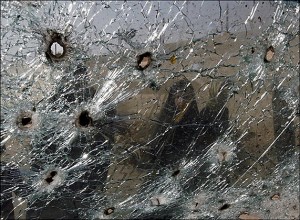
Broken GlassThe words of Caiaphas the high priest are reported by John as a prophecy that Jesus’ death would be an atoning sacrifice, that he would “die for the nation, and not for the nation only, but to gather into one the dispersed children of God.” (vv. 51-52) But I read them this morning as nothing more than political calculation.

More years ago than I care to remember I took a college class in political history. One of the things I learned is that nearly all decisions of government include two major components: political calculation, which is always based on past experience, and profound ignorance of current conditions and future potentials. Despite prodigious amounts of fact finding and data gathering, that ignorance remains a factor. There is always “one more fact” that could have been learned. And, more often than not, a “known fact” is not appreciated because prejudice, preconception, or inexperience blinds the decision-maker to its importance.

I suspect the lawmakers in Kansas and Arizona, where legislation has recently been enacted by one or both houses of the state legislatures permitting service providers, both private and public, to refuse service to gay, lesbian, and transgendered persons on the basis of “sincerely held religious belief,” have been surprised by the responses their actions elicited. They may have expected some reaction from the political left. It’s possible they anticipated some objection from more liberal religious bodies (such as the Episcopal Church). I don’t think they had a clue that the business community, represented by Apple, Delta, American Airlines, and other corporations, would oppose their action. I don’t know what data gathering they did before enacting those proposed laws, but they either failed to get the business data or failed to understand the data they got.

I could criticize what they did — these bills are, in my opinion, deeply flawed in several respects — but my thought today is that in our personal lives we do much the same thing. We make personal decisions on the basis of past experience in an atmosphere of profound ignorance; there is always something we don’t know. St. Paul was speaking of the eschaton, the end of time, about which we can know nothing when he wrote, “We see through a glass, darkly” (1 Cor. 13:12, KJV) but the truth is that our vision is always obscured. The glass through which we look at the present or the future is always darkened; there is always something we don’t see, some fact or bit of data of which we are ignorant either through lack or through misinterpretation.

So what does one do? Fail to decide? Fail to act? No, one cannot be paralyzed by fear. The only answer is to decide, to move forward in faith, to hope for the best. I don’t fault Caiaphas for his political calculation or for his ignorance; I am no different. I can hope I make better choices, but the process by which and environment in which human decisions are made has not changed in 2,000 years. Political calculation and profound ignorance are still the norm and probably will be until we get to the other side of Paul’s darkened glass.

====================

Father Funston is the rector of St. Paul’s Episcopal Church, Medina, Ohio.

Get Wisdom – From the Daily Office – February 25, 2014

From the Book of Proverbs:

Get wisdom; get insight: do not forget, nor turn away
from the words of my mouth.
Do not forsake her, and she will keep you;
love her, and she will guard you.
The beginning of wisdom is this: Get wisdom,
and whatever else you get, get insight.
Prize her highly, and she will exalt you;
she will honor you if you embrace her.
She will place on your head a fair garland;
she will bestow on you a beautiful crown.

(From the Daily Office Lectionary – Proverbs 4:5-9 (NRSV) – February 24, 2014.)

Christa by Edwina SandysMy favorite thing in the Book of Proverbs is the personification of Lady Wisdom. Perhaps because of the further development of her portrait in Chapter 8, where she is said to have been with God in the moments of creation, “daily his delight, rejoicing before him always, rejoicing in his inhabited world and delighting in the human race” (vv. 30-31), I see her as young, slender, and athletic, her rejoicing being manifest as dance.

Many scholars have pointed out that in pre-Christian Judaism, wisdom (sophia) and word (logos) were nearly synonymous alternative descriptions of the creative and immanent power of God. Some have suggested that the Prologue to John’s Gospel could have been written: “In the beginning was Wisdom, and Wisdom was with God, and Wisdom was God.” However, John — as either proponent or victim of patriarchy (or both) — chose to use word rather than wisdom because of this personification of Lady Wisdom. Perhaps John felt it would have been awkward to speak of a female figure “being made flesh” in Jesus, a male.

Several years ago, the Cathedral of St. John the Divine in New York City created quite a stir by exhibiting a crucifix displaying a nude female body as the Christ figure — Christa by Edwina Sandys. Parks Morton, the dean of the cathedral, said at the time, “Christa simply reminded viewers that women as well as men are called upon to share the suffering of Christ.” I think, however, that the sculpture did more than that. It challenged preconceptions and established theologies; it made graphically visible the inherent sexism in the notion that the Second Person of the Trinity is “eternally masculine” as some Orthodox theologians argue.

I’ve often wondered how the Christian faith might have developed if John had embraced that awkwardness and used the term wisdom, instead. He did not, but we still can. We can still “get wisdom; get insight,” and she will lead us “in the paths of uprightness.” (Prov. 4:11) Along those paths we still have much to see, much to learn.

====================

Father Funston is the rector of St. Paul’s Episcopal Church, Medina, Ohio.

Testing Spirits, Drawing Lots – From the Daily Office – February 24, 2014

From the First Letter of John:

Beloved, do not believe every spirit, but test the spirits to see whether they are from God; for many false prophets have gone out into the world.

(From the Daily Office Lectionary – 1 John 4:1 (NRSV) – February 24, 2014.)

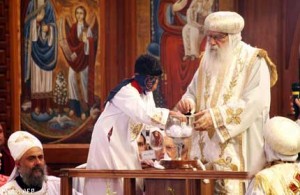
Coptic Pope Selection by LotHow does one “test the spirits”? How does one divine the promptings of the spirit or determine the will of God? That’s always the question we must face. In the ancient tabernacle, the high priest’s vestments included a breastplate in which he kept a couple of stones called the urim and the thummim (Exodus 28:30). What those were is a subject of much speculation, but one theory is that they were sort of like dice. The belief is that the high priest cast these dice to determine God’s guidance, to “test the spirit” when faced with a difficult decision.

Today is the feast of St. Matthias, who was selected by the eleven remaining apostles to replace Judas and restore their number to 12. Why they believed this was necessary would be an interesting subject of speculation, but what’s on my mind this morning is the method of selection. To “test the spirit,” to gain God’s guidance, they drew lots, much like casting dice:

They proposed two, Joseph called Barsabbas, who was also known as Justus, and Matthias. Then they prayed and said, “Lord, you know everyone’s heart. Show us which one of these two you have chosen to take the place in this ministry and apostleship from which Judas turned aside to go to his own place.” And they cast lots for them, and the lot fell on Matthias; and he was added to the eleven apostles. (Acts 1:23-26)

In the Episcopal Church, we use a rather lengthier process to select the successors of the apostles. Our method of choosing bishops includes appointment of nominating or screening committees, reception of nominations and applications, interviews, “meet-and-greet” tours (some refer to these as “dog-and-pony shows”), electing conventions, and finally approvals by other dioceses’ Standing Committees and bishops.

I’m told that in some Oriental Orthodox churches the method is more like that used by the eleven in today’s story from acts. The names of all clergy eligible to be bishop are written on slips of paper and placed in a chalice. A young child (sometimes blindfolded) is then asked to draw out a slip, and the named clergy person becomes the bishop. This is the manner in which the pope of the Coptic Orthodox Church is selected.

Does our lengthy (some might suggest inordinately long) process produce better apostles, better bishops than the drawing of lots? Does it “test the spirits” any more accurately than the casting of dice? One cannot say, but it’s a question to ponder on this feast of Matthias.

====================

Father Funston is the rector of St. Paul’s Episcopal Church, Medina, Ohio.

Living With Integrity – Sermon for the Seventh Sunday after Epiphany (Year A) – February 23, 2014

====================

This sermon was preached on the Seventh Sunday after Epiphany, February 23, 2014, at St. Paul’s Episcopal Church, Medina, Ohio, where Fr. Funston is rector.

(The lessons for the day were: Leviticus 19:1-2,9-18; Psalm 119:33-40; 1 Corinthians 3:10-11,16-23; and Matthew 5:38-48. These lessons can be read at The Lectionary Page.)

====================
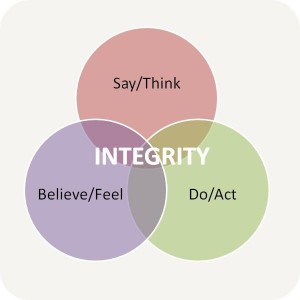
Integrity Venn DiagramJesus doesn’t ask much, does he? Only perfection! “Be perfect,” he tells us, “as your heavenly Father is perfect.” Of course, Jesus is simply echoing the words Moses spoke on God’s behalf delivering the Law to the Hebrews: “You shall be holy, for I the Lord your God am holy.” What can this mean? How can we be expected to be perfect and holy like God? How can we do that, especially when both Moses and Jesus insist that that means, among other things, loving our enemies, not seeking redress, not holding a grudge, and not getting that to which we are sure we are entitled?

Let’s first be certain that we know what we’re talking about! Let’s remember that these English words are translations of ancient Hebrew and biblical Greek, and that there may be connotations and nuances in those older languages that the English interpretations obscure.

The Hebrew in our reading from Leviticus is qadowsh and is derived from a root word meaning “set apart” (qadash). This, of course, was the purpose of the Law which God, through Moses, was giving to the Hebrews: it was to set them apart from other nations, other peoples. They were to be consecrated to God as a “holy nation” – a nation separated from the rest of humankind for a God’s special purposes.

God, through Moses and then repeatedly through the prophets, makes it clear that this does not mean that they are in any way better than other nations; they are simply different in that they will be used by God to accomplish God’s purposes. The prophet Amos, for example, reminded the Israelites that God had relationships with other nations: “Are you not like the Ethiopians to me, O people of Israel? says the Lord. Did I not bring Israel up from the land of Egypt, and the Philistines from Caphtor, and the Arameans from Kir?” (Amos 9:7)

The modern Orthodox Jewish view is that God chooses and sets apart many nations for differing purposes. The former Chief Rabbi of Great Britain, Immanuel Jakobovits, expressed it this way:

I believe that every people—and indeed, in a more limited way, every individual—is “chosen” or destined for some distinct purpose in advancing the designs of Providence. Only, some fulfill their mission and others do not. Maybe the Greeks were chosen for their unique contributions to art and philosophy, the Romans for their pioneering services in law and government, the British for bringing parliamentary rule into the world, and the Americans for piloting democracy in a pluralistic society. The Jews were chosen by God to be “peculiar unto Me” as the pioneers of religion and morality; that was and is their national purpose. (Commentary Magazine, August, 1966)

So this is what “holiness” means in our reading from Leviticus – to be set apart for God’s use in a particular way. It does not mean that the ancient Jews, nor we as the grafted-on “new Israel,” are expected to be God-like or sacred (whatever that means) or divine or particularly righteous or pure. It means, rather, that we are to be prepared, like a tool is prepared, to be used for God’s purposes.

In echoing Moses, however, Jesus chose to use another word, the word perfect. In the koine Greek of the New Testament, the word is teleios which signifies wholeness and completion, something brought to its intended end; it derives from a word meaning “the end” (telos) which carries with it a nuanced suggestion of a goal or a purpose. It is not identical to the Hebrew word used by Moses, but it carries much of the same implications. Jesus is not admonishing his hearers, then or now, to some sort of moral perfectionism, but rather to becoming what God has intended, to accomplishing one’s God-given purpose.

And so the question for us in response both to Leviticus and to Matthew’s Gospel is, “How do we do this? How can we be holy as God is holy? How can we be perfect as the Father is perfect?” We find the answer close at hand both in God’s giving of the Law and in Christ’s Sermon on the Mount.

The Levitical admonition to holiness is followed by several exemplary commandments, none of which are particularly religious! Leave something in your fields for the hungry to glean. Don’t lie to one another. Don’t defraud one another. Don’t steal from each other. Don’t mistreat the handicapped. Don’t be partial in your judgments. Don’t hate anyone or seek vengeance or even bear a grudge. That’s what holiness is; that’s what being set apart for God’s purposes is.

In the section of the Sermon on the Mount in today’s Gospel, Jesus continues with the rhetorical form he began in last week’s Gospel reading, the antitheses in which he contrasts the Law with his own teaching: “You have heard it said . . . but I say to you . . . .” You have heard the rule of justice, “an eye for an eye,” but I say to you, “Don’t insist on it. In fact, offer more. If you’re struck on one cheek, offer the other. If someone takes your cloak, give them your shirt, too. If you are pressed into service to carry a burden, carry it twice the distance.” You have heard it said, “Love your neighbor and hate your enemy” . . . . (Now, that one puzzles the scholars because although the Law does say, “You shall love your neighbor as yourself,” there is no commandment to hate one’s enemy. There are plenty of Old Testament examples of hating one’s enemy, but no commandment along those lines. In any event . . . .) You have heard it said, “Love your neighbor and hate your enemy,” but I say to you, “Love your enemies and pray for those who persecute you.” Why? Because God sends rain on the righteous and the unrighteous alike; God gives sunshine to both the good and the evil. God treats everyone impartially – and so should you. God is good to everyone impartially – and so should you be. That’s what it means to be perfect, to be whole and complete and living according to God’s purposes.

Another word for this is integrity. Integrity is that sort of wholeness that we experience or perceive in someone when their life is integrated – when who they are matches what they do. And more than that it’s that wholeness that we sense when a person not only “practices what they preach,” but when it all seems to flow from the very core of their being, when their preaching and their practice all seem to be in accord with God’s purpose for them. When we meet such a person, say for example Jesus, we know that they have no trouble forgiving their enemies and praying for their persecutors, don’t we? We’re sure of it!

So, how do we live an integrated life? How do we live with integrity? It’s really easy for a preacher to stand here and tell you to do that by imitating Christ, by living out God’s generous and unrestricted grace, mercy and love in all your relationships, with friend and foe alike. But that just begs the question! That’s just saying, “Live with integrity by living with integrity” and it’s not fair for a preacher to do that because we all know that there are times when being gracious and merciful and loving just isn’t all that easy, such as those times when we are called to love our enemies and those who do us wrong.

Frederick Buechner, the great Presbyterian story teller, wrote about this in his book Whistling in the Dark in an essay entitled Enemy:

Cain hated Abel for standing higher in God’s esteem than he felt he himself did, so he killed him. King Saul hated David for stealing the hearts of the people with his winning ways and tried to kill him every chance he got. Saul of Tarsus hated the followers of Jesus because he thought they were blasphemers and heretics and made a career of rounding them up so they could be stoned to death like Stephen. By and large most of us don’t have enemies like that anymore, and in a way it’s a pity.

It would be pleasant to think it’s because we’re more civilized nowadays, but maybe it’s only because we’re less honest, open, brave. We tend to avoid fiery outbursts for fear of what they may touch off both in ourselves and the ones we burst out at. We smolder instead. If people hurt us or cheat us or stand for things we abominate, we’re less apt to bear arms against them than to bear grudges. We stay out of their way. When we declare war, it is mostly submarine warfare, and since our attacks are beneath the surface, it may be years before we know fully the damage we have either given or sustained.

Jesus says we are to love our enemies and pray for them, meaning love not in an emotional sense but in the sense of willing their good, which is the sense in which we love ourselves. It is a tall order even so. African Americans love white supremacists? The longtime employee who is laid off just before he qualifies for retirement with a pension love the people who call him in to break the news? The mother of the molested child love the molester? But when you see as clearly as that who your enemies are, at least you see your enemies clearly too.

You see the lines in their faces and the way they walk when they’re tired. You see who their husbands and wives are, maybe. You see where they’re vulnerable. You see where they’re scared. Seeing what is hateful about them, you may catch a glimpse also of where the hatefulness comes from. Seeing the hurt they cause you, you may see also the hurt they cause themselves. You’re still light-years away from loving them, to be sure, but at least you see how they are human even as you are human, and that is at least a step in the right direction. It’s possible that you may even get to where you can pray for them a little, if only that God forgive them because you yourself can’t, but any prayer for them at all is a major breakthrough.

In the long run, it may be easier to love the ones we look in the eye and hate, the enemies, than the ones whom—because we’re as afraid of ourselves as we are of them—we choose not to look at, at all.

“Pray for them a little, if only that God forgive them because you yourself can’t . . . .”

When I read those words I was reminded of an incident in my own life which I’m pretty sure I have told here before. Back when I was a practicing attorney defending doctors and dentists in malpractice cases, I had occasion to defend a maxillofacial surgeon whose hobby was sculpting. One of the pieces he showed me was a crucifix on which the face of Jesus was contorted in extreme rage. When I asked him what that was all about, he asked if I remembered Jesus’ words in the Gospel according to Luke: “Father, forgive them; for they do not know what they are doing.” (Luke 23:34) He said he’d never heard those words as expressing forgiveness on Jesus’ part. Quite to the contrary, he said, he heard Jesus saying, “You forgive them, because right now, I can’t!”

Jesus was put in that place on that cross because he was holy – set apart for God’s particular purpose. Jesus was put in that place on that cross because he was perfect – he had a goal, a purpose, to be good, to live according to the law of love, to demonstrate God’s love for all humankind. If he was truly to live that life, to show that love, his integrity required that he do and say the things that put him in that place on that cross. But if my dentist client was correct (and I think he may have been), the best that even he could do in all his holiness, in all his perfection, in all his integrity, was turn forgiveness over to God; on his own on that cross, Jesus couldn’t do it.

And there is the answer to our question: How do we live with integrity? How can we be holy and perfect? Well, it’s what I suggested earlier, by imitating Christ, and that means by turning things over to God. On his own on that cross, Jesus couldn’t do it; on our own, we cannot do it. The Psalmist put it this way:

There is no king that can be saved by a mighty army; *
a strong man is not delivered by his great strength.
The horse is a vain hope for deliverance; *
for all its strength it cannot save. (Ps. 33:16-17; BCP version)

and again

Though my flesh and my heart should waste away, *
God is the strength of my heart and my portion for ever. (Ps. 73:26)

In our human weakness, we may be (we probably are) unable to not hate anyone, unable to eschew vengeance, unable to let go of our grudges. We may be (we probably are) unable to love our enemies or to pray for those who persecute us. But that’s OK. Because if the best we can do is pray, “God, you forgive them, because right now, I can’t!” that will be enough.

Let us pray:

O God, the Father of all, whose Son commanded us to love our enemies: Lead them and us from prejudice to truth: deliver them and us from hatred, cruelty, and revenge; and in your good time enable us all to stand reconciled before you, through Jesus Christ our Lord. Amen. (BCP 1979, page 816)

====================

A request to my readers: I’m trying to build the readership of this blog and I’d very much appreciate your help in doing so. If you find something here that is of value, please share it with others. If you are on Facebook, “like” the posts on your page so others can see them. If you are following me on Twitter, please “retweet” the notices of these meditations. If you have a blog of your own, please include mine in your links (a favor I will gladly reciprocate). Many thanks!

====================

Father Funston is the rector of St. Paul’s Episcopal Church, Medina, Ohio.

The Issue – From the Daily Office – February 22, 2014

From the First Letter of John:

How does God’s love abide in anyone who has the world’s goods and sees a brother or sister in need and yet refuses help?

(From the Daily Office Lectionary – 1 John 3:17 (NRSV) – February 22, 2014.)

Feet of the PoorThis, for me, is the issue of our day. It is the religious issue. It is the economic issue. It is the political issue. It is the moral issue. I think the answer to John’s question is, “It doesn’t.”
And anyone who claims to be Christian and yet supports policies that do not help those in need is not, in fact, a Christian.

Nor is such a person a moral or ethical person.

I cannot say anything more than that.

====================

A request to my readers: I’m trying to build the readership of this blog and I’d very much appreciate your help in doing so. If you find something here that is of value, please share it with others. If you are on Facebook, “like” the posts on your page so others can see them. If you are following me on Twitter, please “retweet” the notices of these meditations. If you have a blog of your own, please include mine in your links (a favor I will gladly reciprocate). Many thanks!

====================

Father Funston is the rector of St. Paul’s Episcopal Church, Medina, Ohio.

Wrestling – From the Daily Office – February 21, 2014

From the First Letter of John:

Beloved, we are God’s children now; what we will be has not yet been revealed.

(From the Daily Office Lectionary – 1 John 3:2a (NRSV) – February 21, 2014.)

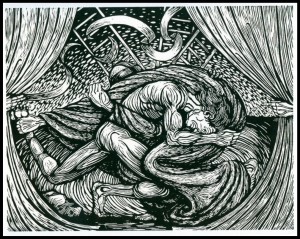
Jacob wrestling with the angel of God by Jack BaumgartnerThe author of this letter could simply have said, “We are God’s children,” but he didn’t. He emphasizes the present tense of the statement by adding the word “now.” In fact, in the original Greek text, the word nûn comes first; it means “at this time” or “at the present.” It emphasizes the present tense of the verb – “Now we are God’s children.”

This is so hard, it seems, for some — probably for most — people to grapple with and understand. Somehow it seems appropriate that today’s Old Testament lesson is the story of Jacob wrestling with an unnamed man (understood to be the angel of God) through the night and being renamed Israel, “the one who wrestles with God.” (Gen. 32:22-33:17) We all seem to wrestle with the idea that we are God’s children now, that we are forgiven now, that we don’t need to do anything to earn God’s favor, that grace is freely given.

Human beings, it would appear, are hardwired to expect the world always and everywhere, even when God irrupts into it, to work on the basis of reward and punishment: behave this way, receive a reward; behave that way, suffer a punishment. God turning everything on its head, so that the “reward” comes first and the behavior is a thankful response to it, is so surprising, so uncharacteristic of the way humans act and think, that we just can’t grasp it.

So John writes, “NOW we are God’s children.” We don’t have to do anything — and, in truth, we can’t do anything — to earn that status. We don’t have to wait for it, either. It’s now; it’s present; it’s what we are. And we find ourselves troubled by that; we wrestle with that!

There is a strain of midrashic theology which treats the story of Jacob wrestling with the angel at Peniel as a metaphor for his dealing with his own “shadow side.” It sees the nighttime struggle as Jacob grappling with the repressed and negative aspects of his character. His shadow side is made manifest and acknowledged in the person of the unnamed man, and then conquered and integrated into a healthier, more holistic personality. Jacob faces his own treachery, deceit, and dishonesty, and conquers it to become whole. Of course, Jacob represents all of us; he is “Everyman” in this scenario.

I think there is more than a grain of truth in that treatment of the Peniel story; we are unable simply to accept the truth of God’s unmerited favor and so we wrestle not with God but with our own nature, with our inability to receive God’s blessing, God’s adoption of us as God’s children. But there it is, a very real present truth: “We are God’s children now.” Accept that, even if it requires some wrestling with yourself.

====================

A request to my readers: I’m trying to build the readership of this blog and I’d very much appreciate your help in doing so. If you find something here that is of value, please share it with others. If you are on Facebook, “like” the posts on your page so others can see them. If you are following me on Twitter, please “retweet” the notices of these meditations. If you have a blog of your own, please include mine in your links (a favor I will gladly reciprocate). Many thanks!

====================

Father Funston is the rector of St. Paul’s Episcopal Church, Medina, Ohio.

Context, Habit & Laziness – From the Daily Office – February 20, 2014

From the Gospel of John:

The Jews gathered around Jesus and said to him, “How long will you keep us in suspense? If you are the Messiah, tell us plainly.” Jesus answered, “I have told you, and you do not believe.”

(From the Daily Office Lectionary – John 10:24-25a (NRSV) – February 20, 2014.)

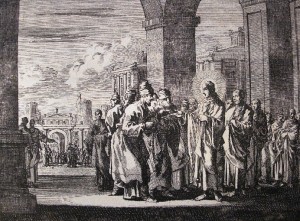
Jan_Luyken_Jesus_Disputes_with_the_PhariseesIt has been said that all human communication, even at its best, is an approximation of meaning. This is especially true of religious communication which is almost always analogic. When we try to speak of God we mean both more and less than we say; when we listen to others speak of God, we understand both more and less than we hear.

When we read the story of Jesus in the Gospels, we are given an informed (in fact, a nearly omniscient) outsider’s privileged position to overhear his interactions with the Jewish authorities. Because we are 2,000 years removed, through layer upon layer of exegesis and interpretation, we believe we know what Jesus has been telling them. We cheer for Jesus because we think he’s been telling them plainly. But do we know and should we be cheering? Would we be so certain if we were first-person, first-time participants in these conversations? I don’t think so! And I don’t think we should be so certain even now.

I’ve sort of come to the conclusion that there is no “telling plainly,” ever. The demand for “plain speaking” in religion or politics or whatever sphere of life is a plea for something that simply cannot exist, something that has never been.

We human beings are creatures of habit and we are essentially lazy. Because of our laziness, we seldom if every fully and completely say what we are hoping to communicate. Because of our habits, we don’t need to. When it comes to “speaking plainly,” both come into play. Take, for example, a simple declarative sentence: “You are going to die.”

If I were to say this to you, you might (and should) take it as a simple statement of the human condition. You are going to die; I am going to die; every body now alive is going to die. Plain, simple fact. But our habit of relying on context to supply meaning allows us to lazily use this simple declaration in differing ways.

Add one context: suppose I am a physician, an oncologist, and we are holding this conversation in a hospital room where you are in a bed. That plain and simple statement of fact takes on particularity and immediacy; the context supplies the implication of “soon” and demands some response, some action on your part. It’s time to “get your affairs in order,” if they are not already.

Add an alternative context: suppose we are at dinner, enjoying cocktails, and discussing the musical theater. You’ve just told me that you’ve gotten tickets to Monty Python’s Spamalot. I start laughing and exclaim, “You are going to die!” The plain and simple statement takes on the tone and character of hyperbole and metaphor; the context clearly indicates that I mean nothing of the sort. Not only am I not predicting your demise, I am suggesting that you are going to spend a very enjoyable evening filled with mirth and laughter.

We know, looking back from our privileged 2,000 years of exegesis and interpretation, that Jesus has told the Jewish authorities that he is the Messiah. In their context, filtering everything he said through habit and laziness, would they ever have understood? Could they have understood? Had we been there, in that context not our own, would we? Context, habit, and laziness. Nothing is ever “plain.”

====================

A request to my readers: I’m trying to build the readership of this blog and I’d very much appreciate your help in doing so. If you find something here that is of value, please share it with others. If you are on Facebook, “like” the posts on your page so others can see them. If you are following me on Twitter, please “retweet” the notices of these meditations. If you have a blog of your own, please include mine in your links (a favor I will gladly reciprocate). Many thanks!

====================

Father Funston is the rector of St. Paul’s Episcopal Church, Medina, Ohio.

Between Me and Thee – From the Daily Office – February 19, 2014

From the Book of Genesis:

So Jacob took a stone, and set it up as a pillar. And Jacob said to his kinsfolk, “Gather stones,” and they took stones, and made a heap; and they ate there by the heap. Laban called it Jegar-sahadutha: but Jacob called it Galeed. Laban said, “This heap is a witness between you and me today.” Therefore he called it Galeed, and the pillar Mizpah, for he said, “The Lord watch between you and me, when we are absent one from the other. If you ill-treat my daughters, or if you take wives in addition to my daughters, though no one else is with us, remember that God is witness between you and me.”

(From the Daily Office Lectionary – Genesis 31:45-50 (NRSV) – February 19, 2014.)

Mizpah Pendant“The Lord watch between me and thee. . . . ” Years ago (several more than forty) I graduated from high school at the tender age of 16 and announced to my parents that I was getting married.

Rather than get their knickers in a twist and forbid it, they conspired with my older brother (a college professor) and his wife (also a college professor) to send me away for a good, long while. My brother and sister-in-law were on their way to Europe for three months of sabbatical study, and I was given the opportunity to go with them.

As I was leaving for that long summer trip, my girlfriend (she wasn’t yet my fiancée) gave me a medallion that was styled to look like one half of a broken coin. I was to wear that half and she would wear the other. When the two halves were put together, the word MIZPAH and this entreaty of Laban’s were inscribed across the whole.

Long story short . . . by the end of my summer-long absence, she had formed another relationship and I had no interest in trying to “win her back” or in getting married to her or anyone.

When I read this story, I think of her, even though that prayer’s implied petition for reunion and resumption of our relationship was not realized. When I think of her, a song which became popular many years after that summer comes to mind, Fifty Ways to Leave Your Lover by Paul Simon:

You just slip out the back, Jack
Make a new plan, Stan
You don’t need to be coy, Roy
Just get yourself free
Hop on the bus, Gus
You don’t need to discuss much
Just drop off the key, Lee
And get yourself free

Of course, although Laban is not Jacob’s lover, “slipping out the back” is exactly what Jacob tried to do in leaving Laban’s household, and “making a new plan” is exactly what our summer apart led my former girlfriend and me to do. But it seems to me that we never really finish our relationships; they never really end. We may leave one another’s presence; we may never see one another again; but the relationship, once established, endures.

A few thousand years later and humankind is still remembering and learning from the relationship between Jacob and Laban; nearly a half-century later I can still see my former girlfriend’s face in memory and hear her voice. There may be fifty ways to leave a relationship, but the relationship doesn’t end; it is transformed. It becomes a relationship of absence, and that makes it a relationship of untold, unrealized, and unrealizable possibilities. What might have happened if . . . ? Another lyric comes to mind:

Once upon a time
Once when you were mine
I remember skies
Reflected in your eyes
I wonder where you are
I wonder if you
Think about me
Once upon a time
In your wildest dreams

The Moody Blues got it right. Those “what if” musings are all “once upon a times” and “wildest dreams.” (The title of the song is In Your Wildest Dreams.) It is best to let them go, to focus on current, active relationships, and to consign those long-passed, transformed-but-not-ended relationships to God’s care. “The Lord watch between me and thee . . . .”

====================

A request to my readers: I’m trying to build the readership of this blog and I’d very much appreciate your help in doing so. If you find something here that is of value, please share it with others. If you are on Facebook, “like” the posts on your page so others can see them. If you are following me on Twitter, please “retweet” the notices of these meditations. If you have a blog of your own, please include mine in your links (a favor I will gladly reciprocate). Many thanks!

====================

Father Funston is the rector of St. Paul’s Episcopal Church, Medina, Ohio.

Too Blind to See – From the Daily Office – February 18, 2014

From the Book of Genesis:

So Jacob arose, and set his children and his wives on camels; . . . .

(From the Daily Office Lectionary – Genesis 31:17 (NRSV) – February 18, 2014.)

CamelThere’s been a dust-up in the press recently. A lot of ink (mostly secular press ink) spilled on the question of camels in the Bible. This is because some scientific, archeological evidence has been turned up suggesting that camels have been only relatively recently domesticated in the regions of the eastern Mediterranean, nowhere near as far back as the stories of the patriarchs and matriarchs in the Books of Moses would put them. It is, says the scientific evidence, impossible that Jacob should have “set his children and his wives on camels” because there were no domesticated camels at the time, how ever far back we think that may have been.

“OK,” says I. “So what?”

“So what?” screams back the press, “So the whole of the Scriptures must fall on this clearly erroneous detail.”

One story in the secular press reported (I could almost hear the writer chortling with glee), “Some scholars took these anachronisms as proof that the Bible was written centuries after the events that they talk about.” (Yes, the sentence was published exactly that way, bad grammar and all, in a daily newspaper of a major American city. Sad, isn’t it?)

Well, duh, I thought. Of course the Bible was written centuries after the events reported. It is the end product of centuries of oral transmission finally written down and then edited and redacted several times before arriving at the form we now know. Is this really news to anyone? Most, if not all, of the Pentateuch is mythic in character, not intended to be understood either as history (a modern idea which it is ridiculous to expect of the Scriptures) or as science (another modern concept which it is laughably silly to expect of the holy texts of any ancient religion).

There’s a recent tumblr post from someone whom I presume to be a seminarian reading, “Hebrew Bible professor blowing my mind with this: ‘Do you know how we know the Genesis 2-3 story was intended to be read as a myth, not as fact? IT HAS A TALKING SNAKE IN IT!'” The secular journalists all agog over the camel issue should read, mark, learn, and inwardly digest that little tid-bit.

They might also want to consider a little study of language, a look at the etymology of words, particularly the word camel. Where does this word come from? Well, in a nutshell, the English comes from the Latin which comes from the Greek which borrowed a word from ancient Hebrew and Arabic; in the former, the word is gamal and in the latter it is jamal. This ancient Semitic word is a verb which means “to repay” or “to bear;” upon it was based a verbal noun having the general meaning of “beast of burden.” While it is true that modern Hebrew and Arabic use the word gamal to refer to a camel, this does not necessarily imply that in ancient Hebrew that specific animal was denoted. It could refer to any beast of burden.

Now, of course, I have an earworm that will stay with me through the day. Over and over in my mind’s ear Mick Jagger is singing:

I’ll never be your beast of burden;
My back is broad, but it’s a-hurting.
All I want is for you to make love to me.

I’ll never be your beast of burden;
I’ve walked for miles, my feet are hurting.
All I want is for you to make love to me.

Am I hard enough?
Am I rough enough?
Am I rich enough?
I’m not too blind to see.

Anyway, when someone gleefully reports, “There were no domestic camels in ancient Canaan,” I again reply, “So what?” I think we can be reasonably sure there were beasts of burden and that is what the Hebrew Bible describes.

The truth of Scripture does not depend on details like camels. It does not depend on historic factuality, although that makes for interesting critical study. It doesn’t depend on scientific accuracy, which it has never claimed. Those concepts really have no pertinent application to myth, legend, poetry, proverbial wisdom, and the other genres of literature which make up the Bible. But those who want to “debunk” the Bible are, I think, just too blind to see!

====================

A request to my readers: I’m trying to build the readership of this blog and I’d very much appreciate your help in doing so. If you find something here that is of value, please share it with others. If you are on Facebook, “like” the posts on your page so others can see them. If you are following me on Twitter, please “retweet” the notices of these meditations. If you have a blog of your own, please include mine in your links (a favor I will gladly reciprocate). Many thanks!

====================

Father Funston is the rector of St. Paul’s Episcopal Church, Medina, Ohio.

Hope from Absence – From the Daily Office – February 17, 2014

From the Psalter:

How long will you hide yourself, O Lord? will you hide yourself for ever?
how long will your anger burn like fire?

(From the Daily Office Lectionary – Psalm 89:46 (BCP Version) – February 17, 2014.)

A Raging Sea at Seaham Lighthouse, EnglandWhen I was studying for ordination, one of the more interesting thinkers I read was the French Reformed theologian Jacques Ellul. Ellul was a lawyer and a sociologist; he was heavily influenced by the work of Karl Barth and of Søren Kierkegaard. He adopted a dialectic approach to theology and argued that only such a method could lead to understanding of Scripture; we cannot understand the Biblical text, he asserted, except be seeing it as a network of contradictions, a history of crises and the resolution of the crises, a series of apparent abandonments and the hope which arises from and resolves the abandonment.

I think of Ellul and his dialectic when I read a verse like this one from Psalm 89 (the second half, today’s evening psalm) — the God who would be in relationship with his creatures hides from them; the God who loves his children burns with anger toward them. It is, as Ellul suggested, a network of contradiction.

Ellul was also a poet who published one collection of verse entitled Silences. In that title, we see Ellul’s appreciation for the mystery of relationship, of human beings with one another and, especially, of the human creature with God; those relationships are often characterized by absences, by silences. For example, we see in this Psalm humankind confronted with death; in that confrontation, God seems absent, yet we wait for God in faith. In the Psalmist’s tragic and mysterious world hope dawns: it is hidden as God seems to be hidden and yet it is revealed in and through that same apparently absent God.

When God seems to be absent, when God hides himself, we sense no escape from death and oblivion; there is nothing to cling to. That is when true hope was born. Only when God is perceived as absent are human beings capable of getting to the end of our false illusions of hope. Only when we give up false hope do we become capable of discovering authentic hope which is found in wakeful and persistent expectation, and in prayer in which we wrestle with and demand that God become apparent once again, that God speak. Ellul offers a brilliant analogy of the ocean — its surface waves, its deep stillness, and its intermediate currents. On the surface of human lives are the superficial, transitory current events; beneath those we find the reality of the main currents in human society; and below those, we find ourselves in the depths of metaphysics and philosophy.

The “network of contradiction” which resolves this sense of absence, is found in the morning Psalm today (the first half of this same Psalm 89) where we are reminded that God “rules the raging of the sea and still the surging of its waves.” (v. 9) God is not absent, though God seems to be hidden. Though God may seem to be angry with his creatures; “righteousness and justice are the foundations of his throne, and love and truth go before him.” (v. 14) Even though we may be unable to see it, God rules the raging of human society and stills the surging of its affairs. In our inability to see this is our empowerment to demand that God speak; in this we find hope . . . hope for righteousness, for justice, for love, and for truth.

====================

A request to my readers: I’m trying to build the readership of this blog and I’d very much appreciate your help in doing so. If you find something here that is of value, please share it with others. If you are on Facebook, “like” the posts on your page so others can see them. If you are following me on Twitter, please “retweet” the notices of these meditations. If you have a blog of your own, please include mine in your links (a favor I will gladly reciprocate). Many thanks!

====================

Father Funston is the rector of St. Paul’s Episcopal Church, Medina, Ohio.

« Older posts Newer posts »