Occasional thoughts of an Anglican Episcopal priest

Category: Episcopal (Page 63 of 114)

Different Strokes – From the Daily Office – January 27, 2014

From the Letter to the Hebrews:

But Jesus has now obtained a more excellent ministry, and to that degree he is the mediator of a better covenant, which has been enacted through better promises.

(From the Daily Office Lectionary – Hebrews 8:5 (NRSV) – January 27, 2014.)

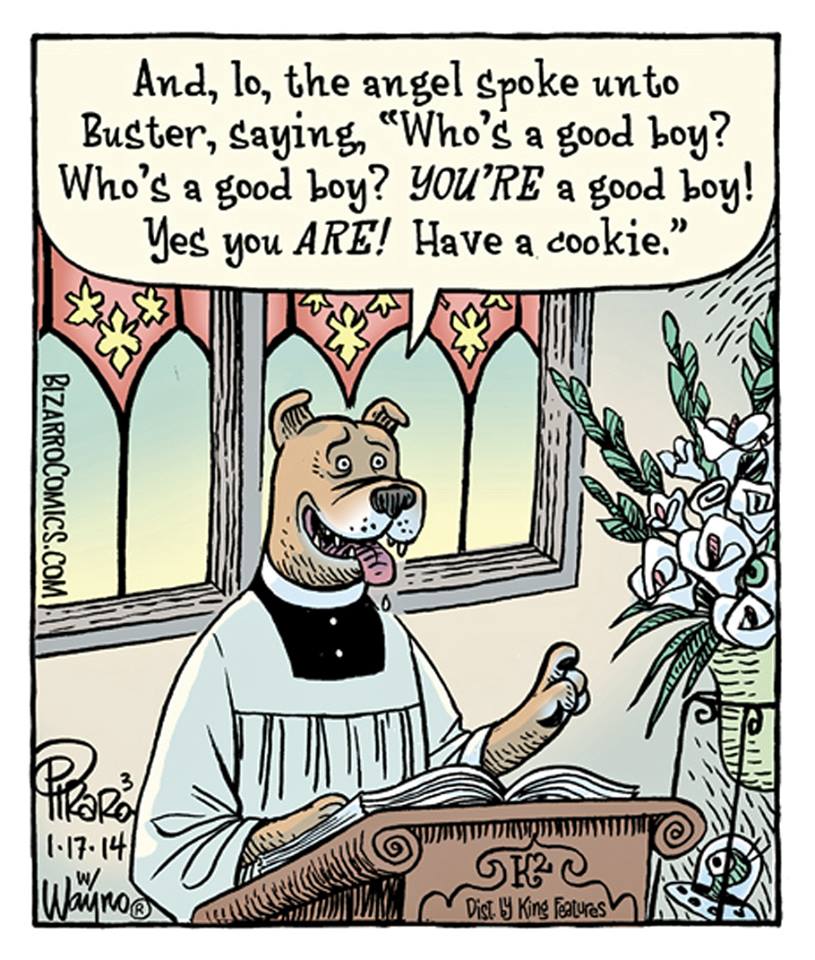
A cartoon showed up on Facebook this morning:

Who's a good boy? Canine preacher

It immediately brought to mind a cartoon from years ago, which I posted in answer to my friend who offered the first; I captioned it with a question — “Another denomination?”

Hellfire & Dalmatians - Canine preacher

And then the writer to the Letter to the Hebrews comes along in the Daily Office readings with his suggestion that the death, resurrection, and ascension of Jesus has created “a better covenant” than that made by God with the Hebrews at Sinai. He even goes so far as to say, in a few verses that God “has made the first one obsolete. And what is obsolete and growing old will soon disappear.” (v. 13) I don’t actually believe that’s so, as history has shown that Judaism is not likely to disappear. But what this has me thinking about is denominationalism and our tendency to think that our way of being Christian, whatever it may be, is better than some other way of being Christian.

Back in the 1970s we had a saying — “Different strokes for different folks” — which I’ve always thought a good reason for there to be differing expressions of the faith. I grew up in a multi-denominational household: my mother was reared in the Disciples of Christ; my father was a Methodist; my step-father was Baptist who had converted to Roman Catholicism; my brother joined the Missouri Synod Lutherans and then married a member of the United Church of Canada. And nearly all of them, by the time I became an Episcopalian, were non-practicing. So none of those traditions seemed any “better” than the others; they were simply different.

Yesterday we held the annual meeting of our parish. We heard reports from staff and program leaders about the past year and plans for the coming year; we elected members of the governing board; we appointed representatives to our larger judicatory; we received a budget. Then we held a worship service – the celebration of the Holy Eucharist, shared a meal, and went home. We did all these things the way Episcopalians do them. We could have done them the way Baptists or Lutherans or Methodists do them, but we didn’t. Because we’re Episcopalians. Our way isn’t “better;” it’s simply different.

From time to time members of our evangelism and growth teams will suggest that we do something like the big evangelical non-denominational church down the street or in another town. Usually the reason is because that church is bigger than we are, so they must be “doing something right.” The implication is that what that bigger church is doing is “better.” Maybe it is . . . but it may just be that it’s different.

The unfortunate problem with denominationalism is that sort of judgmentalism about which denomination, which way of being Christian, is “better” always seems to creep into the conversation! We need to remember that old saw from the 1970s — “Different strokes for different folks” — and recognize that not everyone is fed by our particular style of worship, governance, fellowship, or theology. For some, the church which emphasizes “Who’s a good dog? Who wants a cookie?” feeds their spirit; for others, the church which preaches “He said unto them ‘No, No'” makes more sense. Neither is better; they’re simply different.

====================

A request to my readers: I’m trying to build the readership of this blog and I’d very much appreciate your help in doing so. If you find something here that is of value, please share it with others. If you are on Facebook, “like” the posts on your page so others can see them. If you are following me on Twitter, please “retweet” the notices of these meditations. If you have a blog of your own, please include mine in your links (a favor I will gladly reciprocate). Many thanks!

====================

Father Funston is the rector of St. Paul’s Episcopal Church, Medina, Ohio.

The Neighbors Can See In! — Sermon for the Annual Parish Meeting — January 26, 2014

====================

This sermon was preached on the Patronal Feast Sunday of St. Paul’s Episcopal Church, Medina, Ohio, where Fr. Funston is rector. It was the Sunday of the Annual Parish Meeting and, as part of the service, a newly built Gallery addition to the parish’s fellowship hall was dedicated.

(The lessons for the day were for the Conversion of St. Paul from the Episcopal Church’s sanctoral calendar: Acts 26:9-21; Galatians 1:11-24; Psalm 67; and Matthew 10:16-22. These lessons can be read at The Lectionary Page.)

====================

St Paul's Church -- December 2013

A few decades ago when I was studying law I was introduced to the term “officious intermeddler.” In law, an officious intermeddler is someone who, on their own and without any authority either by invitation or pre-existing legal duty, interjects himself into the affairs of another, and then seeks some sort of recompense for doing so. That pretty much describes young Saul of Tarsus and at least his initial quest to rid Judaism of the followers of Jesus of Nazareth. He was simply a rabbinic student, not any sort of priest or religious official when he began his crusade against Peter and James and the others. I don’t think he was doing it for money, but I do think he might have been looking for a pay-off in the form a religious reputation; if he was successful, he would become a powerful rabbi among the Jewish the people.

Saul was born and raised in the Greek city of Tarsus and apparently received a good education both in orthodox Judaism and in Greek philosophy; Tarsus was a center of Stoic teaching and we see a good deal of Stoicism in the letters he wrote after becoming a Christian missionary. While still fairly young, Saul was sent to Jerusalem to receive rabbinic instruction at the Hillel school under Gamaliel, one of the most noted rabbis in Jewish history. This would have exposed the young rabbinic student to a broad range of classical literature, philosophy, and ethics. Not a lot more is known of his background before he decided to make a name for himself dealing with the pesky proclaimers of what he considered to be a pernicious heresy.

Until the destruction of the Jerusalem Temple in 70 A.D. the followers of Jesus of Nazareth were simply one of many subsets of Judaism; there were few, if any, Gentile followers of Jesus and those Gentiles who wanted to be a part of the new group were required to convert to Judaism before being allowed to join the Jesus group. Judaism at the time was much like Christianity is today; there were different “schools,” similar to our denominations.

We are familiar from the Gospel stories with the Pharisees and the Sadducees, two of the competing versions of the faith; we may also be familiar with the Essenes who were part of the mix. In addition, influential rabbis had their groups of followers: John the Baptizer had had his disciples; Gamaliel had his; perhaps Nicodemus, who became a secret follower of Jesus, had his own school; and, of course, Jesus had had his. On the major feasts and liturgical days, all Jews would observe the Temple rituals together, but for their sabbath observance and instruction they would go to the synagogue which adhered to the school they found most convincing, or where their rabbi taught. They recognized each other as Jews; they just didn’t agree on some particulars. No big deal. And, usually, when their rabbi passed away, their group disbanded.

Except for the disciples of Jesus, those people who followed what they called “the Way.” Their rabbi was dead; the whole city had seen him crucified. But unlike the followers of other dead rabbis, these people didn’t disband; they claimed that their rabbi was still alive and they still met to proclaim his teachings. They even went so far as to suggest that he was divine; they were claiming that he had ushered in a new kingdom of God. In the Jewish council, the Sanhedrin, some sought to have them kicked out of the temple, but Saul’s own teacher, Gamaliel, defended them. The Book of Acts reports his words to the Sanhedrin:

Fellow Israelites, consider carefully what you propose to do to these men. For some time ago Theudas rose up, claiming to be somebody, and a number of men, about four hundred, joined him; but he was killed, and all who followed him were dispersed and disappeared. After him Judas the Galilean rose up at the time of the census and got people to follow him; he also perished, and all who followed him were scattered. So in the present case, I tell you, keep away from these men and let them alone; because if this plan or this undertaking is of human origin, it will fail; but if it is of God, you will not be able to overthrow them — in that case you may even be found fighting against God! (Acts 5:35-39)

Apparently Saul did not agree with his teacher. He became an officious intermeddler, a self-appointed — that’s really what “officious” means — a self-appointed policeman protecting the purity of the Temple; he was going to get that Jesus crowd kicked out. In his letter to the Galatians he would confess that prior to his conversion he “was violently persecuting the church of God and was trying to destroy it.” (Gal. 1:13) It is in the description of the martyrdom of the first deacon, Stephen, that we first encounter Saul in the New Testament. We don’t know whether Saul was an instigator of the events that led to Stephen’s death, but we know that he was there.

The 7th Chapter of Acts tells us that Stephen preached a sermon in the presence of the Temple council, an admittedly rather inflammatory homily, after which “with a loud shout [those present] rushed together against him. Then they dragged him out of the city and began to stone him; and the witnesses laid their coats at the feet of a young man named Saul.” (Acts 7:57-58) We are told that “Saul approved of their killing him.” (Acts 8:1) Saul didn’t take part, really; he just stood at the road side looking on.

After that, Saul became more and more openly and actively involved in the persecution of the Jesus movement, “ravaging the church by entering house after house; dragging off both men and women, he committed them to prison.” (Acts 8:3) Eventually, this officious intermeddler received his remuneration — recognition and ratification of his activities by the high priest from whom he sought, and received, letters of warrant empowering him to go to Damascus, “arrest any who belonged to the Way, men or women, [and] bring them bound to Jerusalem.” (Acts 9:2) It was while journeying to Damascus that the events he described to King Agrippa in the reading we heard this morning occurred. It was while on that road to Damascus that the truth of the Gospel of Jesus Christ, which he had been unable to see, was revealed to him. As he wrote to the Galatians, God “was pleased to reveal his Son to me, so that I might proclaim him among the Gentiles.” But in the experience, we are told in Acts, something like scales covered his eyes as if symbolizing the blindness of heart he had suffered, and until he learned the fullness of the Gospel he was unable to see.

I will return to Saul and his conversion in a moment, but before I do I want to review a little bit of our parish history. So for the moment, let’s put Saul aside but keep in mind his story, especially those scales that eventually fell from his eyes.

We are beginning the 197th year of the life of St. Paul’s Parish. Founded in 1817 in Weymouth, the congregation moved to this location in the 1830s. After about 50 years in a wooden Greek revival structure, in 1884 the congregation built the stone church in which we are worshiping today. When weather permitted they would gather for after church fellowship on the lawn, fully open to their neighbors’ view and could invite the neighbors to take part.

In 1903, they built the Parish House in which our present day Parish Hall, kitchen, and dining room are located. It was a separate structure with one of those wide and inviting Victorian front porches. When the congregation gathered after church for fellowship, education, or other activities, they came and went through the front doors of the church, onto that veranda, and in and out the front door of the Parish House, again fully visible to their neighbors whom they continued to invite to participate.

Another fifty or so years later, the congregation built Canterbury House and linked it together with the Parish House and the church building with the concourse that came to be known simply as “the hallway.” The hallway replaced the Victorian veranda with fortress-like stone wall; it cut off the neighbors’ view of the congregation’s comings and goings, and blocked the neighbors’ appreciation of the church’s fellowship and other activities. The hallway incorporated a new entryway off the driveway leading to a parking lot that was built at the rear of the church property, and it was through those doors (and other doors at the rear of the Parish House) that members began entering the church building. The front doors of the Parish House and the church building fell into disuse, and the parishioners stopped invited the neighbors.

If anything was going on inside the Episcopal Church, you couldn’t tell it from the street. Stained glass windows on the church building, opaqued windows on the hallway, that imposing stone wall, and a set of large red doors which could not be opened from the outside blocked the public’s view of whatever it was the Episcopalians were doing.

Interestingly enough, the Episcopalians couldn’t see out, either. But until the new Gallery was built, and the sunshine and view of the street let in, we had failed to notice that! We were simply unaware that when we were inside this church’s physical plant we were visually cut off from the world around us; we just didn’t notice. We sat at here at the road side, but we were disconnected from the world going by on the major trafficway outside.

To be sure, there was plenty going on inside the church. Things were booming. It was the 1960s and the World War II and Korean War generations were coming to church, raising their children, participating in church clubs, holding fundraisers, even reaching out in overseas mission. The Episcopal Church was an active place . . . you just couldn’t tell it from the street.

And that story was true for the Episcopal Church as a whole, as a national institution, as well. We were pretty much a self-contained and self-reliant denomination. Someone not born into the Episcopal Church might occasionally wander through our doors, become fascinated with our peculiar style of being Christian, and join us, but we didn’t go out and encourage that sort of thing. Billy Graham and people like him might go out and evangelize and try to convert people, but that just wasn’t our style. We were doing quite well behind our stone walls and opaque windows, and our understanding of evangelism was that it was something other people did. After all, as one grand dame of the era is supposed to have put it, “Everyone who should be an Episcopalian already is one.” The world outside the Episcopal Church didn’t know much about us, and we were fine with that.

Then came the 1970s and things began to change. Social change was in the air both in the secular world and in the church. It was not comfortable. Women started suggesting that some of them might have a call to ordained ministry, and some of our best theologians supported them and agreed; behind our stone walls and opaque windows we were fighting like cats and dogs about it. The outside world only got a glimpse of it when a few very angry people threw open the red doors and stormed out, proclaiming themselves to be the only real Anglican Christians and the rest of us heretics, doomed to Hell. We got a lot of press, but not the kind of attention we really wanted. As soon as we could, we closed the red doors and regained our composure behind our stone walls.

But then, not very many years later, the General Convention approved a new Prayer Book. The process of revision had been going on for nearly 20 years but most of us hadn’t been paying attention. When the new book was approved in 1976 and then ratified in 1979 it seemed to many that the church was being completely overturned. The outside world got another glimpse of us when some more very angry people threw open the red doors and stormed out, proclaiming that they used the only real Anglican Prayer Book and that the rest of us were heretics, damned to Hell. Again, we got a lot of press, but once again it was not the kind of attention we really wanted. As soon as we could, we got back behind our stone walls.

Things were quiet for a while, but then the people of the Diocese of New Hampshire decided to elect their Archdeacon to be their Bishop and, horror of horrors, it turned out (they had known all along) he was a homosexual living in a committed, long-term relationship with another man. All hell broke loose behind our stone stone walls and opaque windows as we dealt with that. The arguing got so loud that the neighbors could hear us and, again, a group of very angry people threw open the red doors and stormed out, proclaiming themselves to be the only real Anglican Christians and the rest of us heretics, definitely headed straight to Hell. Again, we got a lot of press, and again we tried to regain our composure behind our stone walls. But we couldn’t because, finally, we started noticing something.

We noticed that the church was getting smaller. Fewer people were attending. Fewer children were enrolling in Sunday School. Fewer teens were coming to EYC meetings. Fewer dollars were getting deposited into the bank. And we decided, because we had gotten out of the habit of looking outside, that it was because of something we had done — it was because we ordained women; it was because we’d changed the Prayer Book; it was because we had a gay bishop. We were wrong, however. If we hadn’t been shut up behind our stone walls and opaque windows, we might have noted that the same thing — lower attendance, fewer children, fewer teens, less income — was happening to the Lutherans, and the Methodists, and the Presbyterians, and also to non-church groups like the Masons, and the Elks, and local bowling leagues. There was a societal change going on and, unable to see out through our stone walls and opaque windows, we couldn’t see it. We couldn’t figure out why the church was leaking membership because we weren’t looking in the right place.

And while all of that was going on . . . every time it rained there was water pouring into the church basement. Every time there was a heavy snow and it melted, there was water pouring into the basement. We got used to seeing buckets in the entryway and water stains on the basement ceiling because we couldn’t figure out where the leak was and we couldn’t figure out how to stop it. Physically, as well as metaphorically, we couldn’t figure out why the church was leaking.

We’ve learned a thing or two in the Episcopal Church in the last decade. We’ve learned that the church fails to grow not because of our internal failures; it fails to grow because of our external failures. The church has failed to grow because we have sequestered ourselves behind stone walls and opaque windows, and have failed to engage with our neighbors, who cannot see what we are doing and to whom we have not been paying attention. Out of this have come movements and experiments to get our denomination back out, on the other side of our stone walls, back into public engagement.

We are seeing new ministries such as “Church Without Walls,” an experiment in the Jacksonville, Florida, which calls people from all walks of life into partnership with “the least of these.” “Church Without Walls” describes itself as “a community of presence made up of individuals looking for the spiritual companionship and connection that give meaning to life.” The community seeks to welcome everyone — the homeless and the affluent, the addicted and those in recovery, the churched and the un-churched, the spiritual but not religious, the believer, the doubter and the seeker. They are grounded in the reality that “by opening ourselves to strangers, the despised or frightening or unintelligible other, we will see more and more of the holy.” (Description from the Diocese of Florida website.) And similar communities are being created in San Jose, California; Springfield, Pennsylvania; Bentonville, Arkansas; Milwaukee, Wisconsin; and elsewhere.

We are seeing experiments in public liturgy such as “Ashes to Go” — an effort to give people an opportunity to receive the mark of repentance and encourage them to give thought to their spiritual lives without requiring them to attend a full Ash Wednesday service. The first such public imposition of ashes was offered by the cathedral in Chicago, Illinois, and has since been offered in a variety of locations throughout the country, including some places here in Ohio.

What the Episcopal Church has learned through these and other programs is that we have to tear down the stone walls and break out the opaqued windows that have separated us from our neighbors. When we do that and the church again engages with the world around it, the leaking stops; the church begins to grow again. Like Saul, after the scales fell his eyes when he was baptized and took the name Paul, by which we know him better, we have seen the truth and know that we, too, are “to open [the eyes of those around us] so that they may turn from darkness to light and from the power of Satan to God, so that they may receive forgiveness of sins and a place among those who are sanctified by faith in [Jesus].” (Acts 26:18)

And here we are in a congregation that has quite literally removed its stone wall and its opaqued windows, whose neighbors can now see clearly what is going on in the Episcopal Church, and who can see our neighbors even when we are inside our building. We have opened ourselves to engagement with the world around us. We are not a “Church Without Walls,” but we have become a church that lives in glass house . . . the neighbors can see in and we’d better make sure that what they see is good stuff!

If you have picked up a copy of the 2014 Annual Journal, you will see some interesting data. We are at the beginning a new period of growth. For 2013 we have a mixed bag of membership statistics: 21 new members joined the congregation by baptism, confirmation, reception or transfer; we had larger congregations for both Easter and Christmas services; we had more Sunday services. On the other hand, our average attendance is down slightly. The task before us is to grow both in membership and active commitment. The foundation is here. For 2014, we have a 7% increase in the number of pledging households; total pledging is up (compared to last year) by over 4%. We have a committed membership.

Our outreach to the community is strong. The Free Farmers’ Market, our food pantry, assisted 5,333 individuals during the past year, distributing nearly 50,000 pounds of food. The volunteer effort to accomplish that is phenomenal, and all members of the coordinating committee and all the volunteer workers are to be commended. Our support of the regional Battered Women’s Shelter expanded this year as, in addition to the regular monthly collection of supplies, our new Lenten Rose Chapter of the Daughters of the King oversaw a special drive for personal hygiene items and, through the effort of our Senior Warden, we provided several dozen stuffed toys to the children sheltered there. Our youth group also continued their annual tradition of making and giving away teddy bears to needy children at Christmas time.

Outreach of a different sort is exercised in the monthly Brown Bag Concert program which is entering its seventh year. Our music director is to be commended for the excellent work she does in recruiting performers and hosting our guests at those events. Because of the construction of the new Gallery, we did not hold any “Fridays at St. Paul’s Concerts,” but we are looking forward to the return of that program as early as this coming May when the chamber ensemble of the Cleveland Philharmonic Orchestra will be performing in this sanctuary.

Fellowship continues with the men’s breakfasts, the Episcopal Church Women, the new Daughters of the King chapter, the Sunday morning breakfast group, and the return this month of the Foyer Group dinner program. Christian education for children and youth is going strong with Godly Play and the Episcopal Youth Community; many of our EYC members are recognized leaders in the diocesan youth programs and are to be commended for that. Many of them are not here today because they have spent the weekend in training to lead the next “Happening” retreat for young people. For adults we have a regular weekly bible study and, starting last September, an Education for Ministry seminar group going strong.

By nearly every measure, this is a vibrant and lively parish. This church is no longer leaking! It is not leaking rain water into the basement; it is not leaking membership. Both the literal and the figurative stone walls have fallen away, like the scales that fell from St. Paul’s eyes, and the vibrancy and life of this parish is visible for all to see and for all to be invited into.

We were blinded and confused by our stone walls and our opaque windows, whether figurative or literal, but in the end, we know that we are called, as Paul was, to share the wonderful news that the risen Jesus, the Son of God, is Messiah and his kingdom is here now. Our experience of engaging in the Inviting the Future Project and building our beautiful new Gallery, is our “ Damascus Road ” experience. A new day for St. Paul’s Parish is shining through the windows of the Gallery and our calling is to insure that the neighbors — who can see us once again, just as they could in 1884 and in 1903 and in every year up to 1960, and (more importantly) whom we can now see — our calling is to insure that they can see the kingdom of God shining out, that they are invited to come into it.

Let us pray:

Give us grace, O Lord, to answer readily the call of our Savior Jesus Christ and proclaim to all people the Good News of his salvation, that we and the whole world may perceive the glory of his marvelous works; who lives and reigns with you and the Holy Spirit, one God, for ever and ever. Amen. (Collect for the 3rd Sunday after Epiphany)

====================

A request to my readers: I’m trying to build the readership of this blog and I’d very much appreciate your help in doing so. If you find something here that is of value, please share it with others. If you are on Facebook, “like” the posts on your page so others can see them. If you are following me on Twitter, please “retweet” the notices of these meditations. If you have a blog of your own, please include mine in your links (a favor I will gladly reciprocate). Many thanks!

====================

Father Funston is the rector of St. Paul’s Episcopal Church, Medina, Ohio.

Extraordinarily Ordinary – From the Daily Office – January 25, 2014

From the Gospel of John:

Many Samaritans from that city believed in him because of the woman’s testimony, “He told me everything I have ever done.” So when the Samaritans came to him, they asked him to stay with them; and he stayed there for two days. And many more believed because of his word. They said to the woman, “It is no longer because of what you said that we believe, for we have heard for ourselves, and we know that this is truly the Savior of the world.”

(From the Daily Office Lectionary – John 4:39-42 (NRSV) – January 25, 2014.)

Jesus and the Samaritan Woman at the Well by GuercinoThese few verses are the end of the story of Jesus’ encounter with the Samaritan woman at Jacob’s well which led to his two-day sojourn in the Samaritan city of Sychar. Whenever I have heard this story preached (and, I confess, when I have preached it myself), the emphasis seems always to be on the Lord’s daring to speak with a woman, and a Samaritan woman, at that! The focus is his unconventionality, his willingness to step outside the Law, and his abrogation of ethnic and sexual norms. We are told how extraordinary this encounter was.

What strikes me this morning is how very ordinary it really was. The water remains water. The woman is not saved from an angry, legalistic mob. No one is healed; no one walks on water; no large crowds are fed. The dead are not returned to life. Despite its radical breaking of boundaries, this is a very boring story with a remarkable ending: two people meet, they talk, one of them talks to other people, the other people talk to the second person, and many people come to faith and belief as a result.

Immediately after this event, Jesus returned to his home territory, to Cana in Gallilee, and complained of a royal official, “Unless you see signs and wonders you will not believe.” (John 4:48) And even if there are “signs and wonders,” belief may not result. In John’s telling of the events of Holy Week he says of one crowd which Jesus confonts, “Although he had performed so many signs in their presence, they did not believe in him.” (John 12:37) The contrast between faith which depends on miracles (and may not come even when they are accomplished) and faith which comes from simple conversation is striking and instructive.

It’s also reassuring. It means that a simple person like me, unable to convert water to wine or to heal with a touch, can nonetheless effectively communicate the word of Lord. It means that anyone can do so; if an unremarkable (and, in fact, semi-outcast) woman can bring many to belief simply by telling her story, then anyone can. We don’t need a flashy show of signs of power; we just need to tell our story with integrity and authenticity.

For all its radical social message, the story of Jesus talking with the Samaritan woman at Sychar is simply the story of two people talking. It is extraordinarily ordinary.

====================

A request to my readers: I’m trying to build the readership of this blog and I’d very much appreciate your help in doing so. If you find something here that is of value, please share it with others. If you are on Facebook, “like” the posts on your page so others can see them. If you are following me on Twitter, please “retweet” the notices of these meditations. If you have a blog of your own, please include mine in your links (a favor I will gladly reciprocate). Many thanks!

====================

Father Funston is the rector of St. Paul’s Episcopal Church, Medina, Ohio.

Kintsugi Gospel – From the Daily Office – January 24, 2014

From the Psalter:

I am forgotten like a dead man, out of mind; I am as useless as a broken pot.

(From the Daily Office Lectionary – Psalm 31:12 (BCP Verson) – January 24, 2014.)

Kintsugi Repaired Blue-Green BowlIt might strike some as odd that of all the myriad metaphors and poetic images in the Psalter this this one, “I am as useless as a broken pot,” speaks to me most loudly.

About 15 years ago, serving in a different parish than the one where I am now rector, I suffered a period of severe depression. A couple of years of treatment on anti-depressant medication, cognitive therapy, and (most importantly) working with a spiritual director got me through it.

What didn’t get me through it was the support of the church as a community. There was none to speak of.

Oh, don’t get me wrong. There were church members who were great and on whom I could (and did) rely. But, in general, as a community, the parish where I’d been rector for five or so years at that point was of little or no support. In fact, when I informed the vestry and then the whole congregation of my diagnosis (after trying to hide it for several months), there was an influential woman in the parish who said to the senior warden (knowing full well I could overhear), “We’ll have to ask the bishop to pull him out of here. We can’t afford to support him while recovers; we don’t even know if he will recover.” She was not alone in her sentiment.

Truthfully, I almost agreed with her. I was as useless as a broken pot! What parish would want me to be their priest?

Thing about broken pots, however, is that they aren’t really useless. Even if broken beyond repair, the busted shards can still be put to use. And if the pot can be repaired, it can be even more useful than before.

In Japan, they practice the art of kintsugi. The word translates as “golden joinery” and refers to the art of repairing broken pottery with lacquer resins containing powdered precious metals. It has been called “talismanic proof that imagination has the power to make ill fortune good.” Its legendary origins date to the late 15th century, when the shogun Ashikaga Yoshimasa sent a damaged tea bowl back to China for repair. It was returned fixed with ugly metal staples. Japanese craftsmen, offended by the ugliness of the repair, sought and found method of fixing the broken pottery that could make a broken piece look as good as, or better than, new.

The possibilities presented by kintsugi, the new beauty it brings to the repaired broken pot, help us to see the value of a broken vessel. Where we might previously have seen in a broken pot or a broken person only trash, something or someone to throw away because we can’t afford to keep it or support the person, kintsugi permits us to see the possibility, even the likelihood, of a greater strength that follows healing. Kintsugi is good news for the broken. In a real sense, it is gospel and the gospel is kintsugi.

If we can see with “kintsugi eyes,” we may be more gentle with the people and the things around us that experience brokenness. And when we are broken ourselves, the promise of kintsugi, the promise of the gospel allow us to be hopeful.

I am grateful to those in my prior congregation who didn’t listen to the influential member and seek my removal, who were willing to give me time to heal, who believed in the possibility of repair. It was a learning experience; it was kintsugi for me. It taught me to believe in, preach, and try to live by a kintsugi gospel.

====================

A request to my readers: I’m trying to build the readership of this blog and I’d very much appreciate your help in doing so. If you find something here that is of value, please share it with others. If you are on Facebook, “like” the posts on your page so others can see them. If you are following me on Twitter, please “retweet” the notices of these meditations. If you have a blog of your own, please include mine in your links (a favor I will gladly reciprocate). Many thanks!

====================

Father Funston is the rector of St. Paul’s Episcopal Church, Medina, Ohio.

The Bible Is Fun! – From the Daily Office – January 23, 2014

From the Book of Genesis:

The Lord came down to see the city and the tower, which mortals had built. And the Lord said, “Look, they are one people, and they have all one language; and this is only the beginning of what they will do; nothing that they propose to do will now be impossible for them.”

(From the Daily Office Lectionary – Genesis 11:5-6 (NRSV) – January 23, 2014.)

Construction of the Tower of Babel by Pieter Bruegel the ElderI’ve never quite understood the story of the tower of Babel. I get that it’s an etiological myth to explain the variety of languages spoken by human beings, but the picture of God that it paints is (shall we say?) less than positive. Might it have been better to cast someone else (say the Tempter?) as the “bad guy” who thwarts the plans of the tower builders?

As the story of God and God’s People develops over time and through the pages of Scripture, we learn that God’s goal is that “they may all be one. As you, Father, are in me and I am in you,” or at least that’s what Jesus said (John 17:21). The apostle Paul proclaimed this Good News setting out that the goal was that all people, indeed all things, be put in subjection under the Christ and ultimately under the one God “so that God may be all in all” (1 Corinthians 15:28). And his colleague, Peter, argued that preachers should speak as if speaking the very words of God so that “God may be glorified in all things through Jesus Christ” (1 Peter 4:11).

It’s not just the New Testament that proclaims this goal of universal solidarity. Solomon proclaimed in prayer that the goal of his kingdom was “that all the peoples of the earth may know that the Lord is God; there is no other” (I Kings 8:60). The prophet Isaiah proclaimed that “in days to come the mountain of the Lord’s house shall be established as the highest of the mountains, and shall be raised above the hills; all the nations shall stream to it” (Isaiah 2:2).

So, if that has been God’s goal all along, isn’t God’s fit of pique at the plain of Shinar just a wee bit counterproductive?

Playing with questions like that is why I so enjoy studying the Bible; the Bible is fun! So, I get really annoyed when someone treats it as some sort of scientifically or historically accurate text, and robs it of its capacity to provide fun and enjoyment.

It’s a bunch of stories and other sorts of literature! It’s a bunch of often contradictory stories, myths, poems, histories, memoirs, and so forth which, despite their contradictions (and often because of them) point to a truth that transcends our mundane perceptions. Sure, if I were writing a single text to tell the story of God, I’d use the Babel story quite differently and tell it from a very different perspective. But that’s not how the Bible came to be and, thanks be to God, I don’t have to write God’s story! Suffice to say that the Bible is not a history book; it’s not a scientific text. It’s a library, a collection of all different sorts of literature.

These texts must be read in light of each other. The prophet’s vision of the nations streaming to a temple on a hill and Jesus’ prayer for unity among all peoples (the prayer is not just about his followers) provide lenses through which we view the myth of the tower at Babel; the story of the tower provides a critical backdrop and foundation for the prophecy and the prayer. So, I may not understand the story of the tower of Babel standing alone, but I understand it in context. I understand it as a part of a synthetic whole (synthetic in the sense of dialectic synthesis, not as “artificial” or “unnatural”).

I’m not going to write a synthesis of these stories this morning (and probably not ever), but I am going to start the day acknowledging that, if the Bible is anything, it is fun!

====================

A request to my readers: I’m trying to build the readership of this blog and I’d very much appreciate your help in doing so. If you find something here that is of value, please share it with others. If you are on Facebook, “like” the posts on your page so others can see them. If you are following me on Twitter, please “retweet” the notices of these meditations. If you have a blog of your own, please include mine in your links (a favor I will gladly reciprocate). Many thanks!

====================

Father Funston is the rector of St. Paul’s Episcopal Church, Medina, Ohio.

Toxic Church – From the Daily Office – January 22, 2014

From the Letter to the Hebrews:

Ground that drinks up the rain falling on it repeatedly, and that produces a crop useful to those for whom it is cultivated, receives a blessing from God. But if it produces thorns and thistles, it is worthless and on the verge of being cursed; its end is to be burned over.

(From the Daily Office Lectionary – Hebrews 6:7-8 (NRSV) – January 22, 2014.)

West Virginia Toxic Chemical Storage TanksThe writer of the Letter to the Hebrews is speaking of folks (the “ground”) who have received the Gospel of Jesus Christ (the “rain”) and have either produced some sort of fruit of good works (a “useful crop”) or have fallen away from the church (producing “thorns”). Of the latter, he says they are “impossible to restore” because “they are crucifying again the Son of God.”
It’s a hard metaphor and a harsh judgment that doesn’t leave any room for repentance and reconciliation. It seems a denial of hope, frankly.

But the writer’s original intent is not what attracts me to his metaphor of ground, rain, and plant growth this morning.

It’s been more than a week since I scribbled down a poem. In fact, it’s been more than a week since I even made any notes that might later become a poem.

I keep a notebook in which I write down things that occur to me, images that I’ve seen or conceived, emotions that have been oddly triggered, anything. Driving down the road I may see (as I recently did) an overturned birdbath and begin playing with that image – it will go in the notebook. Singing along with the radio or a hymn in church I may get choked up with emotion for reasons not entirely apparent at the time – emotion and lyric will go into the notebook. In conversation with someone or just standing in line in the grocery store I may hear an odd turn of phrase from someone, a thought put into words in a way I wouldn’t have put it – it will go into the notebook. Eventually some of what is in the notebook will work its way into a sonnet or a work of free-verse (my usual form).

My time the past week, however, has been devoted to preparations for my congregation’s annual parish meeting. Which means I’ve been reviewing attendance figures and financial reports and numbers of communions, baptisms, weddings, funerals, etc. Not, for me, the stuff of wonder and delight. Not the stuff that goes in the notebook and, to be honest, nothing has gone into the notebook while I’ve been working on these reports.

While I’ve been doing the statistical and financial work (and not keeping the notebook), the news has been filled with the story of a chemical leak, a spill of toxic waste in West Virginia that poisoned a river and left 300,000 people unable to use their household water for anything other than flushing toilets.

And reading this morning’s metaphor of ground, rain, and plant growth, it occurs to me that although the ground may be ready, and though it might usually produce a useful crop, if it is not watered with the proper rain, it will produce nothing good. In fact, it may produce nothing at all! Perhaps, for me, the seeds of images, feelings, lyrics, and odd phrases are not growing into poems (nor even getting planted in my notebook!) because they are not being watered correctly. I’m not suggesting that year-end statistics and financial reports are toxic, but they certainly don’t nurture the muse!

Sometimes, it isn’t the ground’s fault that it’s not producing. And it isn’t the rain’s fault that it’s not falling on the ground that isn’t producing. Sometimes there’s something blocking the rain, or adulterating the rain. It is the church’s job to see that the rain of the Gospel falls on the ground of people free of toxic adulteration . . . but all too often the church is guilty of adding the poison! (These are church statistics and church finances, I’m dealing with!) All too often it isn’t the fallen-away that need to repent and be reconciled to the Gospel; it’s the church. The toxic church . . . .

The metaphor and the judgment of the writer of the Letter to the Hebrews is hard and harsh. And, like most metaphors, it can be stretched too far. I don’t think I’m doing so, however, because, like the writer, I am “confident of better things . . . things that belong to salvation.” Although the church can be, and often is, toxic, I still believe that it is also the Body of Christ and the means of salvation. We can, by the grace of God, clean up our toxic spills. (And get passed the annual meeting with its statistics and financial reports and maybe get back to some poetry!)

====================

A request to my readers: I’m trying to build the readership of this blog and I’d very much appreciate your help in doing so. If you find something here that is of value, please share it with others. If you are on Facebook, “like” the posts on your page so others can see them. If you are following me on Twitter, please “retweet” the notices of these meditations. If you have a blog of your own, please include mine in your links (a favor I will gladly reciprocate). Many thanks!

====================

Father Funston is the rector of St. Paul’s Episcopal Church, Medina, Ohio.

Hell can go to Hell! – From the Daily Office – January 21, 2014

From the Gospel of John:

For God so loved the world that he gave his only Son, so that everyone who believes in him may not perish but may have eternal life. Indeed, God did not send the Son into the world to condemn the world, but in order that the world might be saved through him.

(From the Daily Office Lectionary – John 3:16-17 (NRSV) – January 21, 2014.)

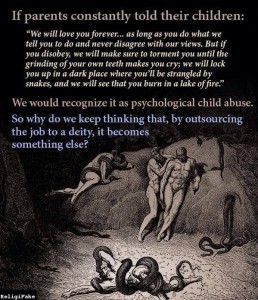
Outsourcing Abuse MemeMaking the rounds of Facebook these days is an anti-religious meme which basically equates religious teaching to child abuse. It says:

If parents constantly told their children:

“We will love you forever . . . as long as you do what we tell you to do and never disagree with our views. But if you disobey , we will make sure to torment you until the grinding of your own teeth makes you cry; we will lock you up in a dark place where you’ll be strangled by snakes, and we will see that you burn in a lake of fire.”

We would recognize it as child abuse.

So why do we keep thinking that, by outsourcing the job to a deity, it becomes something else?

There’s nothing in the meme which specifically mentions Christianity, but because members of our faith so often evangelize by fear, by threatening Hellfire and damnation on those who fail to convert, I’m fairly confident that we can assume the Christian faith to be the target. I wish it weren’t so and I wish I weren’t so sympathetic to the producers of the meme! But, let’s face it, there’s a good deal of really awful theology and really bad evangelism out there.

The truth, however, is that an awful lot (nearly all, in fact) of the mythology of Hell is not found in Holy Scripture. The English word Hell is derived from an ancient Germanic word (hel), which in Norse mythology named a place of eternal punishment. When the Greek Hades (used in the New Testament to name the place of dead) and the Hebrew terms Gehenna or Sheol (used in the Old Testament for the same purpose) were translated into English using this Germanic word, that resulted in a transfer of the pagan concept into Christian theology and its vocabulary.

Then along came poets like Milton and Dante and added all sorts of wonderful, fantastic, and clearly non-biblical imagery to the popular imagination — and, voila! — a full-blown picture of Hell featuring brimstone, lakes of fire, and tormenting demons ruled over by the fallen angel Lucifer, and inhabited by poor human souls condemned to an eternity of pain. One must admit that segments of the church have made full use of this as a scare-tactic mechanism to encourage conversions and to keep the faithful in line, but it was and is wrong to do so. Neither the New Testament Hades nor Old Testament Gehenna had any attached meaning of eternal torment; the Greek signified the place where all the dead, the good, the bad and the indifferent, were thought to go, while the Hebrew terms signified a place of disposal, a place of ending.

It is true that Jesus used imagery of an after-life fire to describe the punishment of unrighteous, but the implication is of annihilation and destruction, not eternal punishment. (See, for example, Matthew 13.) His parables, such as the tale of Dives and Lazarus (Luke 16), cannot be the basis of a theology of eternal torment; parables are metaphoric or analogic teaching tools of limited application and to stretch them beyond their immediate point is to misunderstand and misuse them.

This is especially so when we have his own direct testimony in the Gospel of John. Because of signs displayed in the crowds of many sporting events, many people are familiar with John 3:16 — “For God so loved the world that he gave his only Son, so that everyone who believes in him may not perish but may have eternal life.” And many of us were required to memorize this verse in Sunday School. Few, however, know or memorize the next verse — “Indeed, God did not send the Son into the world to condemn the world, but in order that the world might be saved through him.”

Two things must be observed and emphasized about how these verses describe the mission of the Christ. First, in verse 16 the alternatives are not an eternal life of joy versus an eternal life of punishment; the alternatives are “perishing” (i.e., annihilation and ending) or “eternal life.” Second, the purpose of Jesus’ life, teaching, death, resurrection, and ascension is not to condemn but to save.

The meme, so far as it goes, is accurate. There is way too much bad theology threatening people with Hellfire and damnation; to my way of thinking, any such theology is too much. But the meme is as wrong as those who promulgate the pagan mythology of Hell as a part of the Christian faith. It isn’t and we need to expunge it from our theology and from our vocabulary.

In a word, Hell can go to Hell!

====================

A request to my readers: I’m trying to build the readership of this blog and I’d very much appreciate your help in doing so. If you find something here that is of value, please share it with others. If you are on Facebook, “like” the posts on your page so others can see them. If you are following me on Twitter, please “retweet” the notices of these meditations. If you have a blog of your own, please include mine in your links (a favor I will gladly reciprocate). Many thanks!

====================

Father Funston is the rector of St. Paul’s Episcopal Church, Medina, Ohio.

Spooky Jesus – From the Daily Office – January 20, 2014

From the Gospel of John:

When he was in Jerusalem during the Passover festival, many believed in his name because they saw the signs that he was doing. But Jesus on his part would not entrust himself to them, because he knew all people and needed no one to testify about anyone; for he himself knew what was in everyone.

(From the Daily Office Lectionary – John 2:23-25 (NRSV) – January 20, 2014.)

Jesus Holy CardThe Definition of Chalcedon affirms, in part:

Following the holy fathers, we all with one accord teach men to acknowledge one and the same Son, our Lord Jesus Christ, at once complete in Godhead and complete in manhood, truly God and truly man, consisting also of a reasonable soul and body; of one substance (homoousios) with the Father as regards his Godhead, and at the same time of one substance with us as regards his manhood; like us in all respects, apart from sin . . . .

That last bit is derived from Holy Scripture, specifically from a verse in the Letter to the Hebrews: “We do not have a high priest who is unable to sympathize with our weaknesses, but we have one who in every respect has been tested as we are, yet without sin.” (Heb. 4:15 NRSV)

The Jesus described by the writer of Hebrews and affirmed in the Chalcedonian definition is a man I can follow. There are times when the Jesus described by the writer of the Fourth Gospel creeps me out! This is one of them. The thought that someone could “know all people” and “know what is in everyone” is just spooky.

Now, let me be clear, I am not speaking of the eternal Second Person of the Trinity; I’ve no doubt that God knows all people and knows what is in everyone. But the human person born in early First Century Palestine, who ate and drank and walked around, who expressed joy and disappointment, who got mad, who went to parties, who hiked the roads from town to town, that guy who was “like me in all respects” . . . . I don’t think that Jesus in his human life had access to the divine mind or could have known “what was in everyone.” If he did, he wasn’t like me and what he lived through, what he taught, and his death, resurrection, and ascension have no bearing on my life or meaning for me. He’s too spooky for me!

Years ago I was given a “holy card” which I have since lost. (In the Roman Catholic tradition, holy cards, also called “prayer cards” are small, devotional pictures, often mass-produced for the use of the faithful.) This card had what I’m sure is a very unrealistic portrait of Jesus done in what is technically called “lenticular printing;” that’s the process that makes the printed image seem to change or move as it is viewed from different angles. On that holy card, Jesus’ eyes seemed to move and follow you. It was creepy! When I read about Jesus reading the minds of everyone around him and knowing “what was in everyone,” I think of that spooky holy card.

John does this a lot; this gospel sometimes makes Jesus so divine that the human being gets lost. The wisdom of the biblical canon is that John’s too-divine Jesus is tempered by Mark’s portrait which is too human! (Could the longer ending of Mark’s Gospel, Mark 16:9-20 which includes the Great Commission and a description of Christ’s Ascension, have been added as a corrective to that too-human portrayal? That’s a topic for another exploration.)

I’m not suggesting that John’s Gospel be discounted or overlooked or thrown away. I’m just acknowledging that its mind-reading Jesus who “knew what was in everyone” is someone I wrestle with (like Israel in the desert with the angel of God). He’s spooky and spooky bothers me.

====================

A request to my readers: I’m trying to build the readership of this blog and I’d very much appreciate your help in doing so. If you find something here that is of value, please share it with others. If you are on Facebook, “like” the posts on your page so others can see them. If you are following me on Twitter, please “retweet” the notices of these meditations. If you have a blog of your own, please include mine in your links (a favor I will gladly reciprocate). Many thanks!

====================

Father Funston is the rector of St. Paul’s Episcopal Church, Medina, Ohio.

What’s a Cubit? – From the Daily Office – January 18, 2013

From the Book of Genesis:

God said to Noah, “I have determined to make an end of all flesh, for the earth is filled with violence because of them; now I am going to destroy them along with the earth. Make yourself an ark of cypress wood; make rooms in the ark, and cover it inside and out with pitch. This is how you are to make it: the length of the ark three hundred cubits, its width fifty cubits, and its height thirty cubits.”

(From the Daily Office Lectionary – Genesis 6:13-15 (NRSV) – January 18, 2014.)

Noah's Ark ReconstructionI read those words and heard Bill Cosby’s voice. I’ll bet I’m not alone. More than 50 years ago (1963), Cosby’s debut comedy album Bill Cosby Is a Very Funny Fellow…Right! included a 3-1/2 minute skit he’d been doing on stage entitled Noah: Right! Ever since, it has colored the story of Noah and the ark for Americans; I know people who wouldn’t be born for another quarter century after that album’s release for whom Cosby’s skit is nonetheless an interpretive filter for the Noah story. Millions read the story and hear Noah asking, in Cosby’s voice, “Lord, what’s a cubit?”

In 1979, the comedy sketch troupe Monty Python released a full length movie entitled Month Python’s Life of Brian, which spoofed the life and ministry of Jesus of Nazareth by telling the story of Brian, the baby born in the stable stall next door and who spends his life being mistaken for the messiah. When he is present at the Sermon on the Mount, Brian is at the edge of the crowd among those who are so far away from Jesus they cannot hear clearly what he says. As they struggle to hear and understand Jesus’ words, they have this conversation:

What did he say?
I think it was “Blessed are the cheesemakers.”
Aha, what’s so special about the cheesemakers?
Well, obviously it’s not meant to be taken literally; it refers to any manufacturers of dairy products.

I cannot read the Beatitudes without that dialog coming to mind; I have to bite my lip to keep from laughing. I’m sure that when it is the appointed Sunday Gospel, my parishioners wonder why I have such a goofy expression while reading it!

Because I’m a child of the television generation, I also cannot read the story of Adam and Eve without seeing in memory Bob Newhart and Ruth Buzzi in beige long underwear playing a Garden-of-Eden skit on the old Laugh-In show, or sometimes Richard Basehart as a shipwrecked, alien space-traveling Adam encountering a similarly shipwrecked Eve (the plot of an old Twilight Zone episode).

I’ve two points in mind this morning in recalling these comedy routines to mind. The first is the difficulty of setting aside preconceptions when reading the scriptures. What we think we know about the text may be helpful as we study and interpret it, but it can also be a barrier to hearing it fresh each time to encounter it. I am convinced that the bible speaks to us anew in each reading, and that what we already “know” can and does interfere with our appreciating that. So I struggle to not hear Cosby’s voice, to not understand peacemakers as cheesemakers, to not see Adam climbing out of his space ship.

The second point is rather the opposite of the first, that these comedic or fanciful takes on the stories of the bible are as helpful as they are distracting. I know a lot of people who have a hard time finding humor about God or Jesus or the bible acceptable. My staunch Methodist grandfather frowned upon any humor about church, Sunday School, or other things religious; he considered them disrespectful and (I’m sure) blasphemous.

I find wisdom in a line by Oscar Wilde (from Lady Windemere’s Fan): “Life is far too important a thing ever to talk seriously about it.” The same can be said of the bible. Theologian and author Madeleine L’Engle once wrote, “I take the Bible too seriously to take it all literally” (a quotation often misattributed to Karl Barth). Finding humor or inspiration for fanciful works of fiction and comedy in scripture is part of both taking it seriously and not talking seriously about it. These comedic or fanciful treatments help us hear the scriptures with new ears.

And the question still remains: “What’s a cubit?”

====================

A request to my readers: I’m trying to build the readership of this blog and I’d very much appreciate your help in doing so. If you find something here that is of value, please share it with others. If you are on Facebook, “like” the posts on your page so others can see them. If you are following me on Twitter, please “retweet” the notices of these meditations. If you have a blog of your own, please include mine in your links (a favor I will gladly reciprocate). Many thanks!

====================

Father Funston is the rector of St. Paul’s Episcopal Church, Medina, Ohio.

Obnoxious Jesus – From the Daily Office – January 17, 2014

From John’s Gospel:

On the third day there was a wedding in Cana of Galilee, and the mother of Jesus was there. Jesus and his disciples had also been invited to the wedding. When the wine gave out, the mother of Jesus said to him, “They have no wine.” And Jesus said to her, “Woman, what concern is that to you and to me? My hour has not yet come.” His mother said to the servants, “Do whatever he tells you.”

(From the Daily Office Lectionary – John 2:1-5 (NRSV) – January 17, 2014.)

Icon of the Wedding at CanaToday is the feast of St. Antony of Egypt. According to a Life of St. Antony written by Athanasius, Antony and his younger sister were orphaned when he was about 18 years of age, inheriting a goodly estate which he began to manage. However, writes Athanasius, six months after his parents’ death he was “turning over in his mind the way the apostles had left everything to follow the Savior” when he heard a sermon on Christ’s encounter with the rich young man whom the Lord instructed, “If you wish to be perfect, go, sell your possessions, and give the money to the poor, and you will have treasure in heaven; then come, follow me.” (Matt. 19:21)

According to Athanasius:

As though this reminder of the saints had ben sent to him by God, and as though that passage had been read specially for his sake, Antony went out immediately, and gave to the villagers the possessions he had inherited from his ancestors — they consisted of some three hundred very pleasant and fertile acres — so that they would not be an encumbrance to him and to his sister. He sold all his possessions and gave the considerable sum h raised to the poor, keeping back only a little of it for his sister.

Again when he went into church, he heard what the Lord said in the gospel, “Do not be anxious about tomorrow.” He could not wait any longer, but went out and gave away even what he had kept back to the poor. He left his sister in the care of some well-known, trustworthy virgins, putting her in a convent to be brought up, and he devoted himself to the ascetic life not far from his home, living in recollection and practicing self-denial.

When I read that, I wondered what Antony’s sister’s reaction to it all might have been . . . . Truthfully, had I been her, my affections toward my older brother would not have been kindled! And then I read this morning’s Daily Office gospel about the wedding at Cana and the (to my mind) very uncomfortable repartee between Jesus and his mother. If we take off the rose-tinted glasses through which the Holy Family and the saints are often viewed and assess this conversation honestly, these are two people talking passed one another and not being terribly pleasant to each other!

When I was in seminary, my New Testament professor Bill Countryman referred to the portrayal of Jesus in the Fourth Gospel as “obnoxious.” In his book The Mystical Way in the Fourth Gospel, Countryman called Jesus’ repeated pattern of hard-to-understand responses to questions “obnoxious discourse.” Jesus seems intent on making his claims as difficult and offensive as possible; everything he says seems designed to irritate the people listening. And, in the story of the wedding at Cana, he seems to be starting with his mother!

Taken together, the story of Antony disposing of the family fortune and this gospel lesson serve as reminders that every family has its “issues.” The saints and holy people whom we revere and to whom we look as exemplars, even Jesus and his mother, were just “regular folks” doing the best they could and trying to work things out as well as possible. Sometimes they were wildly successful and are examples we should seek to emulate. Sometimes we look at them and question their judgments and their actions; not every example is one to follow. In either case, we hope to learn something, even when they are being obnoxious. Perhaps especially when Jesus is obnoxious!

====================

A request to my readers: I’m trying to build the readership of this blog and I’d very much appreciate your help in doing so. If you find something here that is of value, please share it with others. If you are on Facebook, “like” the posts on your page so others can see them. If you are following me on Twitter, please “retweet” the notices of these meditations. If you have a blog of your own, please include mine in your links (a favor I will gladly reciprocate). Many thanks!

====================

Father Funston is the rector of St. Paul’s Episcopal Church, Medina, Ohio.

« Older posts Newer posts »