====================
This sermon was preached on the Feast of Pentecost, May 19, 2013, at St. Paul’s Episcopal Church, Medina, Ohio, where Fr. Funston is rector.
(Revised Common Lectionary, Pentecost (Year C): Genesis 11:1-9; Psalm 104:25-35,37; Acts 2:1-21; and John 14:8-17,25-27. These lessons can be read at The Lectionary Page.)
====================
 I was told once that there is a difference between Yankee fairy tales and Northern fairy tales, and the difference is found in the way they begin. Yankee fairy tales start off, “Once upon a time . . . . ” Southern fairy tales begin, “Y’all ain’t gonna believe this!”
We sort of have two stories of those sorts given to us today to go along with the lesson from the Gospel of John. Now, I’m not suggesting that the stories from Genesis and the Book of Acts are fairy tales . . . but the story of the Tower of Babel is a sort of “Once upon a time” story, and the story of the first Christian Pentecost is a “Y’all ain’t gonna believe this” story.
Sometimes I think that the entire Book of Acts was written with a sort of understood “Y’all ain’t gonna believe this” underlying all of its history of the earliest Christian community. The author of this book is the same person who wrote the Gospel of Luke, so we’ll call him “Luke”. Luke was writing to someone he addresses as “Theophilus”; I don’t know if that was his correspondent’s actual name – the word means “God lover” so it may not have been. In any case, Luke writes to Theophilus and in the introduction to Acts, Luke says something along the lines of, “In the first book, Theophilus, I wrote about all that Jesus did and taught from the beginning until the day when he was taken up to heaven, after giving instructions through the Holy Spirit to the apostles whom he had chosen.” (Acts 1:1-2) “Now, I’m going to tell you about what happened afterward with his followers . . . and y’all aint gonna believe this!” And then he goes on to tell all the things that the apostles and disciples did – healing people, raising people from the dead, living peacefully in community, supporting one another, spreading the Gospel, and growing the Christian community. It’s a pretty amazing story!
In today’s Gospel, Jesus promised Philip and the other apostles that, because he was going to the Father and because they would receive the Holy Spirit, they would do greater things than he had done. In the Book of Acts, this “ya’ll ain’t gonna believe this” story, Luke tells Theophilus that that promise had been fulfilled.
The “once upon a time” story that we get to go along with the Pentecost story is the tale of the Tower of Babel. In Jewish literature, this story is not called that. Jews prefer to call this “the story of the generation of division,” which is really a better title because it focuses on what’s important about the tale, the effect of building the tower, not the tower itself.
Now again, I’m not suggesting this is a fairy tale, but I would suggest to you that it is a myth, a word that I use in the strictest technical sense. This story is the last of the tales in what some scholars call the “prehistory” or “primeval stories” section of the Old Testament, Chapters 1 through 11 of the Book of Genesis, which deal with four large “themes” or theological issues at the heart of the Jewish faith and, thus, of our Christian religion, as well. They are myths in the sense that the writer Joseph Campbell hinted at when he said, “Myths are clues to the spiritual potentialities of the human life.” A myth, as defined by the Encyclopedia Britannica, is
a symbolic narrative, usually of unknown origin and at least partly traditional, that ostensibly relates actual events and that is especially associated with religious belief.
The church historian and theologian Phyllis Tickle makes a distinction between Scriptural stories which are “actual” and those which are “factual.” These mythic theological narratives of Genesis are actually true, even though they may not be factual. We don’t know when, or even if, they happened . . . “Once upon a time” . . . myths may not tell us any facts, but they convey great and central truths.
In Chapter 1 of Genesis, of course, we find the theme of creation, the great cosmic story of how everything came to exist, of how God created “in six days” all that is, seen and unseen. In Chapters 2 through 5, the story of Eden and of Adam and Eve, we learn how and why humankind is distinctive within creation; how and why men and women have knowledge, reason, and skill; how and why we are different from the other animals in the world. The themes here are knowledge and self-awareness. In part of this story, the subplot of Cain and Abel, the themes of evil and separation are brought in; the story seeks to answer the question, “Why — when given all this wonderful world, when blessed by God with memory, rationality, and talent — why do human beings nonetheless behave badly and hurt one another?” Chapters 6 through 10, the story of the Flood and of Noah and his family, the themes of obedience, disobedience, and sin, and of God’s response to them, become the focus.
And then we come to this story in Chapter 11. This story forms a sort of bridge between the mythic pre-history and the historic tales of the Jewish people themselves, beginning with the calling of Abram from his home in Ur of the Chaldees to become Abraham, the father of nations, the first of the Hebrews, and the spiritual ancestor of all Jews, Christians, and Muslims. This story treats of the question of diversity: why — if all humans came from one family, first from Adam and Eve, and then after the Flood from Noah and his brood — why are there so many different nations and races, so many different languages? But the theme here is not diversity.
Once upon a time, the story goes, all these people settled in the plain of Shinar (which would be in modern day Iraq, by the way), and they decided to build a city and, in that city, to build a tower that could reach to the heavens. They were united by one language and they shared a single purpose. But God objected! “We’re not going to allow that,” God said. One wonders, or at least I do, what’s the problem? These people are unified; they are functioning well as a community. They are doing the best they can – that’s the whole point of the storyteller pointing out that they used oven-fired bricks and “bitumen” (which is tar) to build the tower; these were the finest materials available in that place. But for some reason, God objected.
The source of God’s objection is revealed to us in the reason the people stated among themselves for undertaking this mighty building project. “Let us make a name for ourselves; otherwise we shall be scattered abroad upon the face of the whole earth.” (Gen. 11:4) This is not about unity of purpose, nor is it about religious faith, even though their goal is make a tower to reach to heaven. (Note that the Lord is not mentioned by these people, these tower-builders; God, the Lord, does not figure into their plans at all.)
No, this is not about unity, or community, or religion. This is about power. In the ancient middle east having a name meant having power. Having a name meant that you were somebody. Having a name meant that you have a position on the stage of the drama that is the world. Having a name might even mean that you were center stage. And knowing someone else’s name – that was about power, too.
Remember the story of Moses meeting God in the burning bush? Moses asks God’s name, and God basically says, “Nope. Not going to tell you. I am who I am and that’s name enough for you to use. As far as you’re concerned, that is my name for all time.” (See Exodus, Ch. 3) Knowing someone’s name in that time and place was believed to give you power over that other, and having a name of your own meant being the central power of your own life. The issue here, the great theme of this “Once upon a time” story is not about having unity; the theme is not about religion. The theme is about power and about who or what is central on the stage of human existence.
There is a secondary theme, as well, a theme that echoes the theme of the Flood story. When God created the first humans in the cosmic creation story of Genesis, Chapter 1, God commanded them: “Be fruitful and multiply, and fill the earth, and subdue it; and rule over the fish of the sea and over the birds of the sky and over every living thing that moves on the earth.” (Gen. 1:28) And after the Flood, God repeated this command to Noah and his family: ” God blessed Noah and his sons and said to them, ‘Be fruitful and multiply, and fill the earth.'” (9:1) These folks on the plain at Shinar wanted power to avoid “filling the earth.” They wanted to not be “scattered abroad,” but rather to remain in that one place; a direct violation of God’s mandate.
So God thwarted their designs. The story is a tale of folk etymology. The name of the place was “Babel” or Babylon, and no one really knows the origin of that name. But the Jews, in telling these stories, as they often did, linked the name to a word in their language, the word “balel,” a word meaning “confusion.” The story says the name of the place is “Babel” because it was there that God confused them by changing their speech, by creating a diversity of languages so that they no longer understood one another. They could not work together and in their confusion, they scattered, accomplishing God’s design that humankind fill the earth. They attempted to place themselves and their power at the center of the story, and they suffered the consequences.
The four human themes of the theological narratives of Genesis 1-11 are knowledge and self-awareness, evil and separation, obedience and sin, and power. Over-arching them all, though, is the theme of God’s creative spirit and of God’s grace. In the words of Psalm 99, “You were a forgiving God to them, and yet an avenger of their evil deeds;” the God who brought everything into being responds again and again with forgiveness and grace.
 Which brings us to the second story, the “y’all ain’t gonna believe this” story of the first Christian Pentecost. The twelve (with the addition of Matthias a few days before) who would become known as the Apostles were again together in the Upper Room, perhaps together with several other disciples including all those women, Joanna, Suzanna, Mary the mother of James, Mary Magdalen, and the other Mary, those women who “used to follow him and provided for him when he was in Galilee.” (Mark 15:41) The first ECW! They were there in that room where they’d shared that last supper, that Passover meal with Jesus, that room where they had cowered in fear on the day of the crucifixion and the next day hiding from the Jewish authorities and the Roman police, that room where the risen Jesus had come to them not once but twice and had allowed Thomas to feel his wounds, that room where Jesus had told them to wait for “the Advocate, the Holy Spirit, whom the Father will send in my name, will teach you everything, and remind you of all that I have said to you.” (John 14:26) There they were, in that room, probably as confused and bewildered as all those people on the plain at Shinar when the Lord scattered them with confused speech.
All of a sudden it happened, there was the sound a mighty rushing wind and . . . y’all ain’t gonna believe this . . . they all caught fire! Or, at least, that’s what it looked like. “Tongues, as of fire, appeared among them, and a tongue rested on each of them. All of them were filled with the Holy Spirit and began to speak in other languages.” (Acts 2:3) And they went out into the streets and began to preach the story of Jesus, the Good News of God’s salvation of humankind, to everyone there. It was the feast of Shavuot, called Pentecost in Greek. Fifty days after the Passover (that’s what Pentecost means in Greek, “fiftieth day”), this was an agricultural festival when Jews came from all over to make the offerings of the First Fruits at the Temple in Jerusalem. So there were Jews and proselytes from all the known world — from Pamphylia and Phrygia, from Egypt and Mesopotamia, from Libya and Crete, from Greece and Rome — people who spoke a bewildering variety of languages. Yet when the disciples went out into the streets, each of these heard the Gospel preached in his or her own language.
Now language, which had once divided and scattered the people, united them. The difference was in what was put at the center. Where the people on the plain at Shinar, the people who tried to build that great city and that tower reaching to the heavens, had put themselves and their own name, their own power, at the center, the disciples and those who heard their message, put God incarnate in Jesus Christ, God active in the Holy Spirit, at the center. From here they would go out — Andrew to Greece, Jude to Persia, Thomas to India, Mark to Egypt, Matthew to Ethiopia, Peter to Rome, Philip to Asia Minor, and others to many other places — they would fill the earth with the Good News of Jesus, healing the sick, raising the dead, creating the beloved community wherever they went. All because they put God at the center.
And this is the message for us in these two stories on this Pentecost Sunday, this birthday of the Church, this celebration of the coming of the Holy Spirit promised by Jesus in our reading from the Gospel of John.
Once upon a time we human beings put ourselves and our name and our power at the center of our lives . . . and look where that got us. But if we put God at the center? Y’all ain’t gonna believe this . . . . !
Amen!
====================
A request to my readers: I’m trying to build the readership of this blog and I’d very much appreciate your help in doing so. If you find something here that is of value, please share it with others. If you are on Facebook, “like” the posts on your page so others can see them. If you are following me on Twitter, please “retweet” the notices of these meditations. If you have a blog of your own, please include mine in your links (a favor I will gladly reciprocate). Many thanks!
====================
Father Funston is the rector of St. Paul’s Episcopal Church, Medina, Ohio.
 And there you have it, ten years in the lives of six people, and the deaths of three of them, put to rest in five short Bible verses. As Antonio said to Sebastian, “What’s past is prologue” (The Tempest, Act 2, Scene 1) and for the author of Ruth apparently not very interesting prologue. The storyteller is (pardon the pun) ruthlessly efficient in his introduction (I assume the author was “he” – maybe not). He clears away the unnecessary detail of sixty “person-years” of life to set the stage for what is to follow.
  I cannot read this verse of Psalm 107 (today’s evening psalm) without remembering a poem, Sea Fever by the 20th Century English poet John Masefield:
 Once again I find this serendipitous connection between one verse in the Daily Office psalm and a news item in the daily papers. Psalm 105 is divided into two parts and our lectionary bids us read the first at Morning Prayer and the second at Evening Prayer. The psalm describes the Hebrews sojourn in Egypt. Part One (vv. 1-22) describes the captivity of Joseph and his later elevation to leadership in the pharaoh’s court, which occasioned the children of Israel taking refuge in “the land of Ham” where they were subsequently enslaved. Part Two (vv. 23-45) tells the story of Moses, the Exodus, and the Hebrews coming into the Promised Land.
 There’s a homiletic maxim attributed to Karl Barth that clergy should preach with the Bible in one hand and a newspaper in the other. These days, that sort of describes how I say the Daily Office. I use my laptop computer (I’m still not hip enough to have a “tablet” device) to access the
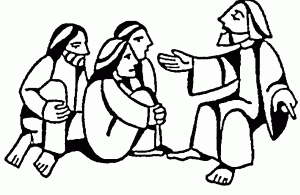
  I’ve been thinking a lot about this listen to voices stuff. A few weeks ago, the Fourth Sunday of Easter (April 21, 2013), we heard one of the “good shepherd” lessons in which Jesus says, “My sheep hear my voice. I know them, and they follow me.” (John 10:27). Now, he says, we hear his voice in the voices of his apostles, those whom he has sent. (This verse is taken from his instructions to and commissioning of the Seventy who are sent out to preach the Good News and heal those who come to them.)
 Today’s Old Testament reading is a disturbing piece in which the Prophet Ezekiel is instructed to lie down for several days (in fact, for more than a year) as a sign of the number of years Israel and then Judah will be punished.
  As I read this verse from the Letter to the Hebrews, continuing education in the faith (an “adult Christian formation” program) has apparently been an issue in the church for quite a while. There is certainly a crisis of lifelong learning – or the lack of it – in the church today!
 I have an inch-long scar on the palm of my left hand; if I look closely, I can still see the pin-prick scars on either side of it which represent where the sutures that closed the wound were placed. The scar is just below my left pinky finger, which doesn’t work quite so well as my right pinky because underneath the scar the tendon was cut and had to be reconstructed. I’ve had this scar and this less-than-functional finger since I was not quite nine years old. It is a reminder of the need for boldness.
  It’s sort of the basic existential question, isn’t it? I mean it strikes me as equivalent to asking such questions as “What is the meaning of life? Who am I? What is my purpose? Is there a god, and, if so, what is God’s nature?” These are the questions that, in my life, occupy the “wee hours,” the dark times. I never seem to ask these questions when it’s bright and sunny, when it feels like “God’s in his heaven and all’s right with the world.” It’s when things aren’t right that these questions arise.

