Occasional thoughts of an Anglican Episcopal priest

Category: Episcopal (Page 77 of 114)

The Helplessness of God – From the Daily Office – May 6, 2013

From the Book of Deuteronomy:

Know then in your heart that as a parent disciplines a child so the Lord your God disciplines you.

(From the Daily Office Lectionary – Deuteronomy 8:5 (NRSV) – May 6, 2013.)

Frustrated ManRecently, I sat down with a fellow clergy person, a cleric about my own age who is also a parent. We were talking about our kids and how there are times when, as mothers and fathers, we simply have to let go and let our children live their own lives and make their own mistakes. He made the interesting comment that, until he was parent to a maturing teenager, he hadn’t really understood what helplessness is. “As parents, ” he said, “we are essentially helpless.” This, he suggested, gives us a clue to understanding God.

I told him I wasn’t quite comfortable with the concept of helplessness; it feels somehow negative and akin to “playing the victim.” But then none of the synonyms of helpless – powerless, ineffective, inadequate, impotent – seem any better. I know what my friend is getting at . . . how to express it, that’s the issue.

I read this single verse of Deuteronomy and, as parent to adult children, I think, “How does one ‘discipline’ an adult child?” One doesn’t. It’s that simple. Adult children are adults, free to do as they will. The “children of Israel” had come of age. Like any nation, like any adult individual, they were free to do as they would. How was God the parent to discipline this mature, adult nation? Disinheritance? It wouldn’t work; I can attest to that from personal experience.

My parents, shortly after both turned 21 years of age, married in the face of parental opposition on both sides; neither set of my grandparents approved. So what did my grandparents do, on both sides? They disinherited my parents. And what did that accomplish? Nothing, except to alienate my folks from their siblings, and deprive me and my brother, my children and my brother’s children of any possibility of first-hand knowledge of our heritage. Who got punished? Who got disciplined? Certainly not my parents. I think the only people who really got hurt were my grandparents.

How does one “discipline” an adult child? One doesn’t. One simply loves them. One acknowledges that one is . . . helpless . . . it really is the only word to use . . . and one simply loves them. That’s a pretty good clue to understanding God.

====================

A request to my readers: I’m trying to build the readership of this blog and I’d very much appreciate your help in doing so. If you find something here that is of value, please share it with others. If you are on Facebook, “like” the posts on your page so others can see them. If you are following me on Twitter, please “retweet” the notices of these meditations. If you have a blog of your own, please include mine in your links (a favor I will gladly reciprocate). Many thanks!

====================

Father Funston is the rector of St. Paul’s Episcopal Church, Medina, Ohio.

One of Those Weeks (Salvation Belongs to Our God) – Sermon for the Fourth Sunday of Easter – April 21, 2013

====================

This sermon was preached on the Fourth Sunday of Easter, April 21, 2013, at St. Paul’s Episcopal Church, Medina, Ohio, where Fr. Funston is rector.

(Revised Common Lectionary, Fourth Sunday of Easter: Acts 9:36-43; Psalm 23; Revelation 7:9-17; and John 10:22-30. These lessons can be read at The Lectionary Page.)

====================
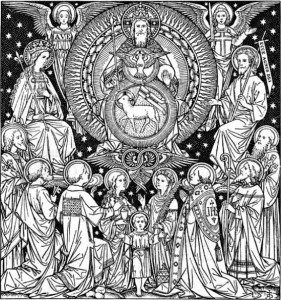
Etching of the Heavenly Throne RoomIt’s Good Shepherd Sunday . . . the Fourth Sunday of the Easter Season is always Good Shepherd Sunday. Every year, regardless of which of the three years of the Lectionary cycle we are in, we hear some lessons which mention shepherds or lambs, and we recite the 23rd Psalm as the Gradual, and we sing every “Shepherd hymn” in the hymnal. I’ve been preaching Good Shepherd sermons for 25 years, so I pretty much thought this was going to be one of those Sundays when I could just “wing it” and preach extemporaneously.

But it’s not. The events of the past week have made this a Good Shepherd Sunday unlike any that has come before. This Good Shepherd Sunday, as I read the words of the 23rd Psalm, “Though I walk through the valley of the shadow of death, I shall fear no evil,” (Ps. 23:4) I cannot help but be aware of all those who, unknowingly, were in that very place on Monday afternoon; I cannot help but think of Boylston Street, Boston, as “the valley of the shadow of death.”

Today’s Gospel lesson is John the Evangelist’s story of an event that happened before Jesus’ crucifixion, something that happened as he was teaching in the Jerusalem Temple. “The Jews,” which is John’s way of naming the temple authorities (the priests and scribes) gathered around Jesus and put him on the spot. “Are you the Messiah?” they ask, “Tell us plainly.”

Jesus’ answer is to say that he has said as much and that it is plain to those who are his sheep, because his sheep understand what he says: “My sheep hear my voice. I know them, and they follow me.” (John 10:27) They hear what I say; they understand my words; and they do what I tell them.

Well, maybe . . . .

Let’s be honest. Understanding Jesus and doing what he says aren’t always very easy. For example, St. Luke tells us that Jesus said, “Be merciful, just as your Father is merciful. Do not judge, and you will not be judged; do not condemn, and you will not be condemned. Forgive, and you will be forgiven.” (Luke 6:36-37) And St. Matthew tells us that he commanded, “Love your enemies and pray for those who persecute you.” (Matt. 5:44) I know what those words mean, but when it comes to the events of this week, they are not easy to obey.

But . . . OK . . . let’s give it a try. Our prayer book heritage gives us words to pray when we cannot think of the words ourselves, so let’s give this praying for those who hurt us a try using some of those prayers:

O God, the Father of all, whose Son commanded us to love our enemies: Lead them and us from prejudice to truth: deliver them and us from hatred, cruelty, and revenge; and in your good time enable us all to stand reconciled before you, through Jesus Christ our Lord. Amen. (Book of Common Prayer 1979, page 816)

Into your hands, O Lord, we commend Tamerlan Tsarnaev, as into the hands of a faithful Creator and most merciful Savior, praying that he may be redeemed in your sight. Wash him, we pray, in the blood of that immaculate Lamb who was slain to take away the sins of the world; that, whatever defilements he may have contracted in the midst of this earthly life being purged and done away, he may be presented before you pure and without spot; through the merits of Jesus Christ your only Son our Lord. Amen. (Adapted from the BCP 1979, page 488)

O God, whose mercy is everlasting and whose power is infinite; Look down with pity and compassion upon Dzhokhar Tsarnaev; and whether you visit him to test his fortitude or to punish his offences, enable him with your grace to submit himself willingly to your holy will and to your judgment. O Lord, go not far from him or any person whom you have laid in a place of darkness; and seeing that you have not cut him off suddenly, chasten him as a father and grant that he, duly considering your great mercies, may genuinely turn to you with true repentance and sincerity of heart; through Jesus Christ our Lord. Amen. (Adapted from the Book of Common Prayer of 1789, A Form of Prayer for the Visitation of Prisoners.)

This is what our Shepherd requires of us, that we pray for the repose of the soul of Tamerlan Tsarnaev and for the salvation Dzhokhar Tsarnaev, even though we find it very difficult to do.

When I was still practicing law, I had occasion to defend a dentist whose hobby was sculpting. One of the pieces he showed me was a very nicely done, and in most respects very traditional, Crucifix. What was nontraditional about it was the expression on Jesus’ face; it was contorted in obvious and quite extreme rage.

I asked him about that saying, “I don’t think I’ve ever seen Christ depicted in that way, and I can’t say that I’ve ever conceived of this reading any of the Gospels’ crucifixion stories.” He answered by asking me, “You know in the Gospel according to Luke when Jesus says, ‘Father, forgive them . . . . ?’ I’ve always heard that as angry, as Jesus saying to God the Father, ‘You forgive them because, right now, I can’t.'”

If you, like me, are having some difficulty in praying for those two boys, let these prayers be offered in that same spirit. We pray for God to take them, for God to forgive them, because right now, we can’t. We know exactly what Jesus meant but right now, we can’t do it. So we ask our Shepherd to do it for us. Because, as the multitude witnessed by St. John of Patmos cried so clearly, “Salvation belongs to our God who is seated on the throne, and to the Lamb!” (Rev. 7:10)

That’s one of the Good News lessons for today, for this week, I think. Jesus asks us to pray for and forgive those who do us wrong, but if we can’t, he can do it for us. We don’t need the fancy words of prayers out of the prayer book tradition. We just need Jesus’ own words, his words on the cross, “Father, forgive them.” That’s really all we need to say, “Father, forgive them.” Because even if we can’t, he can.

I think the other Good News lesson for this week is in something else Jesus says in today’s Gospel lesson: “I give them eternal life, and they will never perish. No one will snatch them out of my hand.”

Yesterday, I was at a diocesan leadership conference and, as you might expect, during the break times, our conversations centered around the events of the week.

A colleague commented at a diocesan meeting this morning, “It’s been one of those weeks.” My first thought was, “One of what weeks? There aren’t very many weeks like this!” The more I thought about it, however, I think maybe every week is like this. Every week people die. It’s an uncomfortable reality, but it’s true. Every week people die. It’s nothing to fear, however. I remember hearing a bishop (it may have been Desmond Tutu) say that being a Christian means (among other things) accepting the fact that you have already died. Certainly that is the witness of scripture: “Do you not know that all of us who have been baptized into Christ Jesus were baptized into his death? Therefore we have been buried with him by baptism into death, so that, just as Christ was raised from the dead by the glory of the Father, so we too might walk in newness of life.” (Rom. 6:3-4) And, again, “Set your minds on things that are above, not on things that are on earth, for you have died, and your life is hidden with Christ in God.” (Col. 3:2-3) And, again, “The saying is sure: If we have died with him, we will also live with him.” (2 Tim. 2:11) The very meaning of the Easter Season which we continue to celebrate is that death has been conquered, and that to God’s faithful people “life is changed, not ended; and when our mortal body lies in death, there is prepared for us a dwelling place eternal in the heavens.” (BCP 1979, page 382)

And every week people do awful things to other people. Sometimes those things are hugely catastrophic for many people, like the bombs at the marathon finish line. Sometimes those things go unseen by nearly everyone except the one injured, like the bullying that has led so many teens to commit suicide. Such things, awful things happen all the time. But . . . “Have you not known? Have you not heard? The Lord is the everlasting God, the Creator of the ends of the earth. He does not faint or grow weary; his understanding is unsearchable. He gives power to the faint, and strengthens the powerless.” (Isaiah 40:28-29) And, again, “The Lord upholds all who are falling, and raises up all who are bowed down.” (Psalm 145:14) And, again, “I can do all things through him who strengthens me.” (Philip. 4:13) The very meaning of the Easter Season which we continue to celebrate is that the power of God overcomes anything, any-awful-thing, the evildoers of this world can throw at us.

Not very long after the bombs exploded in Boston, comedian Patton Oswalt posted a reflection on his Facebook page in which he said:

I remember, when 9/11 went down, my reaction was, “Well, I’ve had it with humanity.”

But I was wrong. I don’t know what’s going to be revealed to be behind all of this mayhem — one human insect or a poisonous mass of broken sociopaths.

But here’s what I DO know. If it’s one person or a HUNDRED people, that number is not even a fraction of a fraction of a fraction of a percent of the population on this planet. You watch the videos of the carnage and there are people running TOWARDS the destruction to help out. (Thanks FAKE Gallery founder and owner Paul Kozlowski for pointing this out to me). This is a giant planet and we’re lucky to live on it but there are prices and penalties incurred for the daily miracle of existence. One of them is, every once in a while, the wiring of a tiny sliver of the species gets snarled and they’re pointed towards darkness.

But the vast majority stands against that darkness and, like white blood cells attacking a virus, they dilute and weaken and eventually wash away the evildoers and, more importantly, the damage they wreak. This is beyond religion or creed or nation. We would not be here if humanity were inherently evil. We’d have eaten ourselves alive long ago.

So when you spot violence, or bigotry, or intolerance or fear or just garden-variety misogyny, hatred or ignorance, just look it in the eye and think, “The good outnumber you, and we always will.”

I think that is the reality to which Scripture testifies; I think that is the triumph of Easter — that the good will always outnumber the evil. “I give them eternal life, and they will never perish. No one will snatch them out of my hand.”

So I guess my colleague was right. It’s been one of those weeks . . . a week when life was changed for some, a week in which the Presence of God helped people get through some really awful stuff, a week when the good outnumbered the bad. It’s been one of those weeks. Every week is. Thanks be to God!

====================

A request to my readers: I’m trying to build the readership of this blog and I’d very much appreciate your help in doing so. If you find something here that is of value, please share it with others. If you are on Facebook, “like” the posts on your page so others can see them. If you are following me on Twitter, please “retweet” the notices of these meditations. If you have a blog of your own, please include mine in your links (a favor I will gladly reciprocate). Many thanks!

====================

Father Funston is the rector of St. Paul’s Episcopal Church, Medina, Ohio.

The News vs. The Truth – From the Daily Office – April 20, 2013

From the Third Letter of John:

Beloved, I pray that all may go well with you and that you may be in good health, just as it is well with your soul. I was overjoyed when some of the friends arrived and testified to your faithfulness to the truth, namely, how you walk in the truth. I have no greater joy than this, to hear that my children are walking in the truth.

(From the Daily Office Lectionary – 3 John 2-4 (NRSV) – April 20, 2013.)

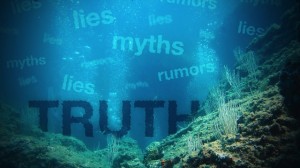
TruthThe first verse of this bit from John’s Third Letter brings to mind an old hymn, the first verse of which is
When peace, like a river, attendeth my way,
When sorrows like sea billows roll;
Whatever my lot, Thou has taught me to say,
It is well, it is well, with my soul.

In today’s world, it seems, the sea does not so much roll with sorrows, although there are plenty of those, as with speculations and rumors. There is a difference between “the news” and “the truth.”

For the past five days, since the bombs went off near the finish line of the Boston Marathon on Monday afternoon, the news media and social media have been awash in a sea of speculation into which have splashed the occasional fact and, more often, gross inaccuracies. It has all been “news,” but it has not often been the truth.

In the world of 24-hour news cycle anything and everything gets reported. Jon Stewart of The Daily Show eviscerated John King of CNN for his very early and very incorrect report that a suspect had been identified, found, and arrested. The report was apparently based on a misinterpretation of a tweet from a single law-enforcement officer. Such things used to be called “rumors” and checked out – now they are treated as sensational “breaking news” until disproved, and then the “news” becomes an excuse-laden analysis of “why we got it wrong” although it is never put quite so bluntly. It’s always someone else’s fault . . . . It’s all been “news,” but it has not often been the truth.

We have sacrificed truth on the altar of sensation; we have drowned it in the sea of speculation.

This morning we know who the perpetrators of Monday’s horror were. One of them is dead; one of them is in custody. Will we get to the truth of the matter? Will we ever know why this thing was done? I doubt it. We will learn some facts, perhaps, but the sea of speculation is deep and the truth may never surface.

In this environment, how does one read John and his praise for truth? How does one read Jesus’ claim to be “the Truth”? If one truly “walks in the truth,” if one is a follower of “the Truth,” I think it means viewing every report with suspicion; it means withholding judgment until “facts” are verified and more is known. It means being both skeptical and charitable. View the “news” in such a way and you may find the truth, and it will be well with your soul.

====================

A request to my readers: I’m trying to build the readership of this blog and I’d very much appreciate your help in doing so. If you find something here that is of value, please share it with others. If you are on Facebook, “like” the posts on your page so others can see them. If you are following me on Twitter, please “retweet” the notices of these meditations. If you have a blog of your own, please include mine in your links (a favor I will gladly reciprocate). Many thanks!

====================

Father Funston is the rector of St. Paul’s Episcopal Church, Medina, Ohio.

The Lesson of Bombings – From the Daily Office – April 19, 2013

From the Second Letter of John:

Everyone who does not abide in the teaching of Christ, but goes beyond it, does not have God; whoever abides in the teaching has both the Father and the Son. Do not receive into the house or welcome anyone who comes to you and does not bring this teaching; for to welcome is to participate in the evil deeds of such a person.

(From the Daily Office Lectionary – 2 John 9-11 (NRSV) – April 19, 2013.)

No Man Is an IslandReading this on a morning when parts of Watertown and Cambridge, Massachusetts, are “locked down,” when the entire city of Boston and its environs are under a “shelter in place” order as police engage in a massive manhunt for one of the two suspected perpetrators of the Boston Marathon bombing (the other having been killed already) is a bit strange.

“Do not receive into the house or welcome anyone who comes to you” is exactly what the authorities are telling people. Of course, they are doing so for safety’s sake not because of some religious or philosophical concern for approving or participating in evil.

Nonetheless, this is precisely the problem that the incidents of this week present to each of us. How do we, by our “welcome” or by our silence, participate in the evil deeds that pollute our world? John Stuart Mill in the late 1880s said, “Bad men need nothing more to compass their ends, than that good men should look on and do nothing.” Similarly, “All that is necessary for the triumph of evil is that good men do nothing,” runs a saying often attributed to Edmund Burke. Although it’s unlikely Burke ever said that, it is true.

Mosaic law, to which the elder may be referring in this letter, provides, “When any of you sin in that you have heard a public adjuration to testify and — though able to testify as one who has seen or learned of the matter — do not speak up, you are subject to punishment.” (Lev. 5:1) By one’s silence, one participates in the sin and is subject to the law.

Are there any who might have prevented the Boston bombings simply by speaking up? If so, how many? We may never know. What we do know is that each of us has an obligation to do what we can to improve the world, to do something when confronted with evil. A verse in the Mishnah reads:

Humans were created singly, to teach you that whoever destroys a single soul [of Israel], Scripture accounts it as if he had destroyed a full world; and whoever saves one soul of Israel, Scripture accounts it as if she had saved a full world. (Sanhedrin 4:5)

The Unitarian clergyman Edward Everett Hale, in the same spirit, is often quoted as saying, “I am only one; but still I am one. I cannot do everything; but still I can do something; and because I cannot do everything, I will not refuse to do the something that I can do.” (This is often misattributed to Helen Keller.)

Most artistically, perhaps, is the expression of this sentiment of connection in the famous poem by Anglican priest John Donne:

No man is an island,
Entire of itself.
Each is a piece of the continent,
A part of the main.
If a clod be washed away by the sea,
Europe is the less.
As well as if a promontory were.
As well as if a manor of thine own
Or of thine friend’s were.
Each man’s death diminishes me,
For I am involved in mankind.
Therefore, send not to know
For whom the bell tolls,
It tolls for thee.

There are many big lessons to be learned from the events of this week, but this lesson of individual responsibility may be the most important: we are not alone, we are not disconnected, we not without responsibility — to welcome the perpetrator of evil, even to remain silent in the face of evil, is to participate in it.

====================

A request to my readers: I’m trying to build the readership of this blog and I’d very much appreciate your help in doing so. If you find something here that is of value, please share it with others. If you are on Facebook, “like” the posts on your page so others can see them. If you are following me on Twitter, please “retweet” the notices of these meditations. If you have a blog of your own, please include mine in your links (a favor I will gladly reciprocate). Many thanks!

====================

Father Funston is the rector of St. Paul’s Episcopal Church, Medina, Ohio.

Mene, Mene, Tekel, Upharsin – From the Daily Office – April 18, 2013

From the Book of Daniel:

Daniel answered in the presence of the king, “You have exalted yourself against the Lord of heaven! The vessels of his temple have been brought in before you, and you and your lords, your wives and your concubines have been drinking wine from them. You have praised the gods of silver and gold, of bronze, iron, wood, and stone, which do not see or hear or know; but the God in whose power is your very breath, and to whom belong all your ways, you have not honored. So from his presence the hand was sent and this writing was inscribed. And this is the writing that was inscribed: mene, mene, tekel, and parsin. This is the interpretation of the matter: mene, God has numbered the days of your kingdom and brought it to an end; tekel, you have been weighed on the scales and found wanting; peres, your kingdom is divided and given to the Medes and Persians.”

(From the Daily Office Lectionary – Daniel 5:17,23-28 (NRSV) – April 18, 2013.)

Brass ScalesMene, mene, tekel, upharsin. (KJV)

“Your days are numbered. You have been judged and found wanting. Your possessions will be divided among others.” The writing on the wall is a harsh judgment and a decree of the sentence. As it turns out, the judgment is swiftly executed: “That very night Belshazzar, the Chaldean king, was killed. And Darius the Mede received the kingdom, being about sixty-two years old.” (vv. 30-31)

I read these lessons a few days ahead of time so that they can rumble around my head and I can figure out what I want to write about them. I had thought I would be writing something else – indeed, I thought I would be writing about a different lesson . . . . but yesterday the United States Senate voted 54-46 in favor of a bill that would have expand the federal background check system on gun purchases to include sales made at gun shows or over the internet. A majority of senators voted in favor of this legislation, and yet it will not become law. An overwhelming majority of American citizens favor this legislation (by some reports 90%), and yet it will not become law. It would not impose any burden on gun sellers or gun purchasers that is not now required in most gun transactions, and yet it will not become law.

“You have been weighed on the sales and found wanting.” I keep imagining a set of scales like those carried by Lady Justice. On one side of the scales stand 54 senators; on the other, 46. And yet the scales tip toward the 46, toward what should be the lighter side. On one side of the scales stand 90% of the American people; on the other, 10%. And yet the scales tip toward the 10%, toward what should be the light side.

On one side of the scales are the lives of 21 children and six adults killed at Newtown, twelve killed at Aurora, seven killed at Oak Creek, six killed in Tucson, nearly 3,500 people killed by guns since the Newtown massacre; on the other . . . . the interests of the N.R.A. and the gun industry. We know to which side the scales have been tipped.

We have been weighed on the scales. Have we been found wanting? I, for one, believe we have. We have to do something to change this unbalance. We have to do it soon.

Mene, mene, tekel, upharsin.

====================

A request to my readers: I’m trying to build the readership of this blog and I’d very much appreciate your help in doing so. If you find something here that is of value, please share it with others. If you are on Facebook, “like” the posts on your page so others can see them. If you are following me on Twitter, please “retweet” the notices of these meditations. If you have a blog of your own, please include mine in your links (a favor I will gladly reciprocate). Many thanks!

====================

Father Funston is the rector of St. Paul’s Episcopal Church, Medina, Ohio.

The Sin of Belshazzar – From the Daily Office – April 17, 2013

From the Book of Daniel:

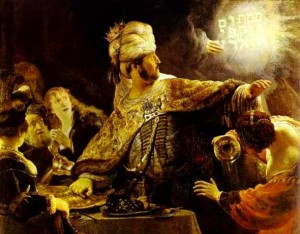
Immediately the fingers of a human hand appeared and began writing on the plaster of the wall of the royal palace, next to the lampstand. The king was watching the hand as it wrote. Then the king’s face turned pale, and his thoughts terrified him. His limbs gave way, and his knees knocked together. The king cried aloud to bring in the enchanters, the Chaldeans, and the diviners; and the king said to the wise men of Babylon, “Whoever can read this writing and tell me its interpretation shall be clothed in purple, have a chain of gold around his neck, and rank third in the kingdom.” Then all the king’s wise men came in, but they could not read the writing or tell the king the interpretation. Then King Belshazzar became greatly terrified and his face turned pale, and his lords were perplexed.

(From the Daily Office Lectionary – Daniel 5:5-9 (NRSV) – April 17, 2013.)

King BelshazzarMany are familiar with the phrase “the writing on the wall,” but few know that it has a biblical origin. Here, today, is the beginning of the story from which it comes. Belshazaar, son of Nebuchadnezzar, has thrown a party. He orders booty from the Jerusalem Temple, sacred vessels of silver and gold, used as drinking vessels. While he and his friends are partying, the hand appears as related above and writes on the wall.

The Boston Marathon was run this week. On Monday, 23,000 people ran the marathon. When about 75% of them had passed the finish line, two bombs went off in the midst of the observing crowds. As of this writing, three people (including one child) are dead; over 170 people are suffering injuries, some of them severally disabling and possibly still fatal. No person or group has yet claimed responsibility.

On the same day a bomb went off in Baghdad, Iraq. In fact, several bombs went off across that country and more than 75 people are dead and many others wounded. A colleague of mine commented that Baghdad “doesn’t seem so far away now.”

The writing on the wall provides some perspective. What was Belshazzar’s sin that prompted this display of divine displeasure? Using the Temple vessels in revelry, the abuse of a conquered people’s culture and values, imperial oppression of faith and identity. Could this not help explain of the acts of violence and terror perpetrated against our country from 9/11 to the present bloody mess in Boston? It could, if they are the acts of Muslim extremists. I am not suggesting that they are, but there are many who doing so.

Commentators left and right are trying to put spin on the Boston bombings, but everyone is speaking in ignorance right now because (as noted above) no one has claimed responsibility; law enforcement has identified no suspects. Nonetheless, plenty of people seem ready to point the finger at Muslims, but none of these finger-pointers appreciates that if that is the case, there is background to be dealt with . . . we may need to face the sin of Belshazzar committed anew by our own country. One of the more insightful comments, I think, came from an Arab editorial: “Whatever the truth about this latest bombing, the continued refusal to acknowledge the widespread grievances against the US and its allies caused by the wars and US policies in the Middle East will lead to turmoil until political solutions are found.” (Al Bawaba News Group)

The writer of Daniel tells us that Belshazzar’s “face turned pale, and his thoughts terrified him.” I think that pretty much describes the United States today . . . . The king could not understand the writing on the wall. At this point, we seem unable to understand what is written in blood on the sidewalks of Boston.

But if it turns out that this the act of Middle Easterners, we need to ask ourselves, “Are we guilty of the sin of Bleshazzar?” Many would answer that question, “Yes,” and call upon us to repent. We need to find not just political solutions, but spiritual solutions, as well.

====================

A request to my readers: I’m trying to build the readership of this blog and I’d very much appreciate your help in doing so. If you find something here that is of value, please share it with others. If you are on Facebook, “like” the posts on your page so others can see them. If you are following me on Twitter, please “retweet” the notices of these meditations. If you have a blog of your own, please include mine in your links (a favor I will gladly reciprocate). Many thanks!

====================

Father Funston is the rector of St. Paul’s Episcopal Church, Medina, Ohio.

What Is the Good of That? – From the Daily Office – April 16, 2013

From the First Letter of John:

God is love, and those who abide in love abide in God, and God abides in them. Love has been perfected among us in this: that we may have boldness on the day of judgment, because as he is, so are we in this world. There is no fear in love, but perfect love casts out fear; for fear has to do with punishment, and whoever fears has not reached perfection in love. We love because he first loved us. Those who say, “I love God”, and hate their brothers or sisters, are liars; for those who do not love a brother or sister whom they have seen, cannot love God whom they have not seen. The commandment we have from him is this: those who love God must love their brothers and sisters also.

(From the Daily Office Lectionary – 1 John 4:16-21 (NRSV) – April 16, 2013.)

Homeless Man Sleeping on the StreetIn the 1989 movie Romero starring Raul Julia as the martyred Archbishop of El Salvador, there is a scene in which Father Manuel Morantes (played by actor Tony Plana) paraphrases these words of the elder John: “How can we love God, whom we have not seen, if we do not love our brothers and sisters whom we do see?” It is clear from the setting that what Father Morantes means by “love” is not merely romantic emotion; it is not starry-eyed sentimentalism; it is not impractical idealism. What Father Morantes means, and what I believe the elder means in this letter, is hard and gritty, down-to-earth, hands-on, practical caring about and caring for others.

In the 10th Chapter of the Gospel of Luke, Jesus affirms that the way to salvation includes both loving God and loving one’s neighbors as one loves him- or herself. A lawyer challenges Jesus with the question “Who is my neighbor?” Jesus’ answer is to tell the story that has come down to us with the name The Good Samaritan, illustrating the concepts of love and neighbor with an appeal to action, to tending the wounds of the victim of a mugging, to nursing that victim back to health, to providing him food and shelter . . . hard and gritty, down-to-earth, hands-on, practical caring about and caring for another.

Recently, the US Conference of Catholic Bishops, which is sort of the governing body of Roman Catholicism in this country, has instituted a program they call Two Feet of Love in Action. The first “foot” is social justice which addresses the political and economic aspects, the structural dimensions of social problems and their solutions. The bishops call upon Roman Catholics to work to address the root causes of social issues by advocating for just public policies and working to change social structures which contribute to suffering and injustice. The second “foot” is charitable works, which are very simply our response to immediate needs and specific situations: feeding the hungry, clothing the naked, caring for and healing the sick, visiting those in prison, and so on. This includes all activities to aid or assist others both locally and globally to meet immediate, short-term needs.

I think the Roman Catholic bishops are on to something – love of neighbor, love of brother and sister, is a two-pronged action: reforming structures and meeting immediate needs. In the 2nd Chapter of the Letter of James, the writer asks a pertinent and poignant question: “If a brother or sister is naked and lacks daily food, and one of you says to them, ‘Go in peace; keep warm and eat your fill,’ and yet you do not supply their bodily needs, what is the good of that?” (James 2:15-16)

Love of brother and sister is the hard and gritty, down-to-earth, hands-on, practical work of caring about and caring for others, reforming structures and meeting immediate needs. What is the good of anything else? Those who do not do this for the brothers and sisters whom they have seen, cannot love God whom they have not seen!

====================

A request to my readers: I’m trying to build the readership of this blog and I’d very much appreciate your help in doing so. If you find something here that is of value, please share it with others. If you are on Facebook, “like” the posts on your page so others can see them. If you are following me on Twitter, please “retweet” the notices of these meditations. If you have a blog of your own, please include mine in your links (a favor I will gladly reciprocate). Many thanks!

====================

Father Funston is the rector of St. Paul’s Episcopal Church, Medina, Ohio.

Prayers for the Dead and Injured at the Boston Marathon – April 15, 2013

Votive Candles and Cross

O God, whose mercies cannot be numbered: Accept our prayers on behalf of your servants killed at the Boston Marathon, and grant them an entrance into the land of light and joy, in the fellowship of your saints; through Jesus Christ our Lord, who lives and reigns with you and the Holy Spirit, one God, now and for ever. Amen.

Heavenly Father, giver of life and health: Comfort and relieve your servants injured in the bombings at the Boston Marathon, and give your power of healing to those who minister to their needs, that they may be strengthened in their weakness, healed from their injuries, and have confidence in your loving care; through Jesus Christ our Lord. Amen.

Prayers adapted from The Book of Common Prayer (1979)

A Thing of Power – From the Daily Office – April 15, 2013

From the Book of Daniel:

Daniel, who was called Belteshazzar, was severely distressed for a while.

(From the Daily Office Lectionary – Daniel 4:19a (NRSV) – April 15, 2013.)

Name TagsThis renaming of Daniel by King Nebuchadnezzar intrigues me. Earlier in chapter 4, Nebuchadnezzar explains that Daniel “was named Belteshazzar after the name of my god” apparently because the king believed Daniel to be “endowed with a spirit of the holy gods.” (v. 8)

Daniel is not the only Jew in Babylon to be renamed by the king or on the king’s behalf. In a reading last week we learned that “the palace master gave them other names: Daniel he called Belteshazzar, Hananiah he called Shadrach, Mishael he called Meshach, and Azariah he called Abednego.” (1:7) Why, I wonder, do we remember Daniel by his Hebrew name, but Shadrach, Meshach, and Abednego by the names given them by their captors?

Naming is matter of power. The ancients knew this. Ancient myths of East and West tell of the power held in one’s name: it was believed that if one knew someone’s name one held power over that person. This may be why the Babylonians insisted on renaming these Jews.

In the Irish language the word for “name” is ainm – it is pronounced “AH-n’m”. The Irish word for “soul” is anam – it, too, is pronounced “AH-n’m”. It seems to me to be no coincidence that these words are homophones – one’s name is one’s identity; one’s soul is one’s identity. Certain schools of philosophy believe that the soul is the bearer of personal identity. In the language of the Inuit people there is the concept of the soul-name, atiq, which combines naming and identity, as well as family transmission. Names are definitive of who we are.

As children, we are taught to shrug off taunts and insults, “bad names” we called them; we are taught to recite a nursery rhyme – “Sticks and stones may break my bones, but names will never hurt me.” Of course, we know only too well that names do hurt and “bad names” hurt children very badly. Even as adults we may continue to be haunted by the taunts we endured as children. (I started wearing glasses even before going to kindergarten and I can still remember being called “Four-eyes” in the earliest grades of elementary school.) When we name someone or something, we do indeed exert power over that person or that thing.

We should treat all names with respect, especially our own, for a name, as the Babylonians knew, is a thing of power.

====================

A request to my readers: I’m trying to build the readership of this blog and I’d very much appreciate your help in doing so. If you find something here that is of value, please share it with others. If you are on Facebook, “like” the posts on your page so others can see them. If you are following me on Twitter, please “retweet” the notices of these meditations. If you have a blog of your own, please include mine in your links (a favor I will gladly reciprocate). Many thanks!

====================

Father Funston is the rector of St. Paul’s Episcopal Church, Medina, Ohio.

Going Fishing, Finding Grace – Sermon for the Third Sunday of Easter – April 14, 2013

====================

This sermon was preached on the Third Sunday of Easter, April 14, 2013, at St. Paul’s Episcopal Church, Medina, Ohio, where Fr. Funston is rector.

(Revised Common Lectionary, Third Sunday of Easter: Acts 9:1-20; Psalm 30; Revelation 5:11-14; and John 21:1-19. These lessons can be read at The Lectionary Page.)

====================

Palestinian Fishing Boat 1880Several years ago, shortly after my mother died, my step-dad’s business partner also passed away leaving my step-dad to run the business they had created together. Now it is no insult to my step-dad, Stan, who had never before been a business owner, to say that he knew little or nothing about running a business. He’d been a tool-and-die man most of his working life with a brief foray into sales, but he’d never been in the “front office” and he’d certainly never been a manager or executive of any sort. Stan didn’t know accounts receivable from fish, and inventory control was a foreign language to him.

So I took a leave of absence from the parish where I was then rector, left Evie and the kids on their own in Kansas, moved in with my step-dad in Costa Mesa, California, and became the de facto president and chief executive officer of Halogen Valve Systems. The company had been created to manufacture and market an emergency chlorine valve actuator for municipal water systems, a product my step-dad and his partner had invented and patented. I knew nothing about chlorine, water systems, or valves, but I did know computers, accounting, and business management, so I dove right in to the job, searching through computer files, finding blueprints and parts lists, learning supplier names and product numbers, customer contacts, and so forth; contacting suppliers and customers; charting supply and distribution patterns; organizing the warehouse, the manufacturing shop, and the front office. In the meantime, Stan taught me about chlorine gas and water purification and emergency valve actuators.

After a couple of months, I had the business pretty well systematized and was ready to turn it back to my step-dad and an office manager, so it came time to show my step-dad what I’d set up and teach him what he needed to know. We’d sit down in my office together and, at each session, we’d spend about an hour going over some aspect of the management plan. Our time was limited to an hour because each time, at just about the hour mark, Stan would stand up and say, “I’m going out to the shop.” And off he’d go, out to the manufacturing floor to work with the guys who were building the valve actuators. What he was doing is exactly what Peter does in today’s gospel lesson from John.

Stan could only take so much management talk, so much double-entry bookkeeping, so much inventory control . . . at some point, at that hour limit, he was filled up. He needed to do something with which he was familiar, to give his brain and his spirit time to process all the confusion of front office management. He was going back to the part of the business he could understand. Peter does the same thing in today’s gospel lesson. He’s taken as much confusion as he can stand. All the glory and wonder at the beginning of Holy Week, all the terror and sadness of Good Friday, all the bewilderment and relief and joy of Easter Sunday . . . it’s all been just about more than he can take and it’s time to do something he can understand. “I’m going fishing,” he says. “I’m going back to the part of this business I understand.” And the others know exactly how he feels and they chime in with, “We’ll join you.”

So off they go and as they are fishing, a figure appears on the beach and calls to them. It’s Jesus, who gives them some advice about fishing and then invites them to a grilled fish breakfast he is preparing. While they are eating, he and Peter engage in a conversation, but before we get into that, let’s take a look at the other major story of this morning.

Our Lectionary also gives us the story of St. Paul’s conversion in today’s reading from the Book of Acts. It’s a familiar enough story for us here at St. Paul’s Parish. We hear it at least twice a year, and now the Lectionary gives it to us a third time. Saul of Tarsus, a Jew among Jews, a Pharisee among Pharisees, a prosecutor of the heretics who proclaim this upstart rabbi Jesus to be the Messiah, is on his way to Damascus with letters of warrant from the chief priests to arrest and prosecute any Christians he finds there. Along the road, however, he is knocked on his butt, literally knocked off his horse by a blinding light and a crash of thunder and a voice which asks, “Saul, why are you persecuting me?” In surprise, he asks the voice who it is that is speaking and he is told, “I am Jesus!” And Saul and Jesus have a conversation.

Saul’s conversation with Jesus is rather abrupt. Jesus simply tells him to get up and go to a certain place in Damascus and there he will be instructed. Peter’s conversation is rather different. Three times Jesus asks him “Do you love me?” Three times Peter answers, “You know I do.” Three times Jesus tells Peter to take care of Jesus’ sheep.

When we read this in English, we miss a very important nuance in John’s use of language and we are apt to miss John’s point. The first two times Jesus asks Peter, “Do you love me?” John uses the word agape to render the question. This word is normally used in the Greek scriptures to describe perfect or “divine” love. When Peter answers Jesus in the affirmative, he uses another word, phileo, which means “brotherly love.” This suggests that he loved Jesus as a brother, not yet fully understanding his Risen Lord’s divinity. Jesus then calls Peter to feed the lambs. Jesus asks the second time, again using “agape.” Jesus at first had not gotten the answer from Peter that he wanted but, again, Jesus receives the same response from Peter. Jesus then repeats the feeding admonition, changing it so that Peter is responsible for feeding the not just the lambs, but the whole flock. The third time, Jesus changes the word and asks Peter the question in Peter’s own terms; Jesus uses the disciple’s “brotherly love” word, phileo.

What is happening in this conversation, indeed with this whole scene, is that Jesus is meeting Peter where Peter can meet Jesus. Peter had to get out of Jerusalem; he had to get to someplace, to doing something, that he could grasp. So Jesus met him there. Peter couldn’t quite yet understand Jesus’ godliness, using a term for human rather than divine love. So Jesus went along with him. Jesus met and interacted with Peter is a manner appropriate to Peter’s situation. Jesus does the same with Saul.

Saul was a fire-brand, a person who so aggressively and energetically promoted his own cause, his own understanding of religion that he encouraged unrest among Jews and kindled strife for the followers of Jesus. And Jesus did with him what he had done with Peter. He came to him in the place and in the manner in which Saul could be reached and led to understand. Saul clearly had heard the gospel message preached by the disciples; he’d heard it and rejected it. The soft and gentle approach hadn’t worked. So, in the alternative, Jesus came to him with flash of light and a clap of thunder, and knocked him on his butt!

The two stories from Scripture today teach us the same lesson. Jesus comes to us when and where and as we are able to understand and appreciate him, gently to some, more aggressively to others. But however he comes, he comes. We call this “grace.” Simply put, grace is the free and unmerited favor manifesting our salvation and bestowing blessings upon us. Both Peter and Paul received this grace in ways appropriate to them, as do we all.

Earlier this week an author named Brennan Manning passed away. Brennan was an American Roman Catholic, a friar, a priest (who had married!), a contemplative, and a frequent speaker at religious events. He lived a fascinating and turbulent life, and wrote many books, one of which was The Ragamuffin Gospel. In it, he wrote this about grace:

Because salvation is by grace through faith, I believe that among the countless number of people standing in front of the throne and in front of the Lamb, dressed in white robes and holding palms in their hands (see Revelation 7:9), I shall see the prostitute from the Kit-Kat Ranch in Carson City, Nevada, who tearfully told me that she could find no other employment to support her two-year-old son. I shall see the woman who had an abortion and is haunted by guilt and remorse but did the best she could faced with grueling alternatives; the businessman besieged with debt who sold his integrity in a series of desperate transactions; the insecure clergyman addicted to being liked, who never challenged his people from the pulpit and longed for unconditional love; the sexually abused teen molested by his father and now selling his body on the street, who, as he falls asleep each night after his last “trick,” whispers the name of the unknown God he learned about in Sunday school.

“But how?” we ask.

Then the voice says, “They have washed their robes and have made them white in the blood of the Lamb.”

There they are. There we are — the multitude who so wanted to be faithful, who at times got defeated, soiled by life, and bested by trials, wearing the bloodied garments of life’s tribulations, but through it all clung to faith.

My friends, if this is not good news to you, you have never understood the gospel of grace. (The Ragamuffin Gospel: Good News for the Bedraggled, Beat-Up, and Burnt Out)

The stories of Peter fishing on the Sea of Galilee and of Saul traveling to Damascus, and of their encounters with Jesus in those places, teach us that Jesus comes to us wherever and however we are, even defeated, soiled, and bloodied, to give us salvation and blessing, to give us the unmerited favor of God, to give us grace. We may have gone out to the manufacturing floor; we may have gone fishing; we may be on a trip pursuing our passion. Wherever we are, Jesus meets us, and there we find grace. Amen.

====================

A request to my readers: I’m trying to build the readership of this blog and I’d very much appreciate your help in doing so. If you find something here that is of value, please share it with others. If you are on Facebook, “like” the posts on your page so others can see them. If you are following me on Twitter, please “retweet” the notices of these meditations. If you have a blog of your own, please include mine in your links (a favor I will gladly reciprocate). Many thanks!

====================

Father Funston is the rector of St. Paul’s Episcopal Church, Medina, Ohio.

« Older posts Newer posts »