====================
This sermon was preached on Sunday, February 24, 2013, at St. Paul’s Episcopal Church, Medina, Ohio, where Fr. Funston is rector.
(Revised Common Lectionary, Lent 2, Year C: Genesis 15:1-12,17-18; Psalm 27; and Luke 13:31-35. These lessons can be read at The Lectionary Page. At St. Paul’s Parish, during Lent, we are using the Daily Office of Morning Prayer as our antecommunion; therefore, only these two lessons and the psalm were read. The epistle lesson, Philippians 3:17-4:1, was not used.)
====================
 Several years ago – 33 to be exact – Bruce Dern starred in a little-remarked movie entitled Middle Age Crazy; it dealt with the main character’s midlife crisis of turning 40 years of age.
Dern’s character is a construction company owner who has made it big by building taco stands for a successful chain. He’s married to Anne-Margaret (at least, Anne-Margaret plays his wife). He has a nice car, a nice house, a swimming pool and (as a friend reminds him) a jacuzzi. By the standards of success in 1980, he’s doing very well. But turning 40 has him questioning all of that.
At one point during the movie, he is attending his son’s high school graduation and begins to fantasize what he would say to the graduating class. He would start, he thinks, by criticizing graduation speeches that tell the kids they are “the future.” That’s nonsense, he says: “You can’t all be the future. There’s not that much future to go around.”
“If you’ve got any sense,” he tells the high school seniors, “give ’em back their [bleep] diplomas. Give ’em back their silly [bleep] hats and stay 18 for the rest of your life. You don’t want to be the future. No, no. Forget the future.” The future, he tells, them is absolutely awful! In the context of a story about a man dealing with a midlife crisis, it’s a very funny scene . . . but the truth is, it’s a tragic speech. (You can see the speech on YouTube. Be warned, however, I’ve cleaned up the quotations; Dern drops the “f-bomb” several times.)
It not only fails to be forward and future looking, it positively rejects the future, preferring a static and juvenile present. That is a tragedy!
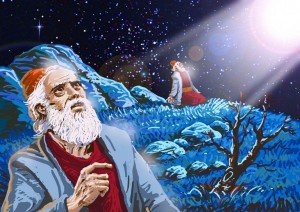
In contrast, we have our spiritual ancestor Abram . . . 75-year-old Abram, as-good-as-dead Abram (according to both Paul and the writer of the Letter to the Hebrews), set-in-his-ways Abram, but willing-to-move-into-the-future Abram.
In Chapter 12 of the Book of Genesis, Abram is told by God to leave his home in Ur and travel to a land that God will give to him and to his offspring, and that God will make him the ancestor of many nations, and Abram does as he is told. But after journeying through several lands, all the way down into Egypt and then back up into Canaan, Abram and Sarai still have not had any children, so we find him in today’s reading in Chapter 15 a little bit anxious about that. He is afraid that this “offspring” are really going to be the children of his servant Eliezer of Damascus.
Abram said, “O Lord God, what will you give me, for I continue childless, and the heir of my house is Eliezer of Damascus?” And Abram said, “You have given me no offspring, and so a slave born in my house is to be my heir.” But the word of the Lord came to him, “This man shall not be your heir; no one but your very own issue shall be your heir.” He brought him outside and said, “Look toward heaven and count the stars, if you are able to count them.” Then he said to him, “So shall your descendants be.” And he believed the Lord; and the Lord reckoned it to him as righteousness. (Gen. 15:2-6)
There are the important words in this story: “He believed the Lord, and the Lord reckoned it to him as righteousness.”
Unlike the character in Middle Age Crazy, Abram trusted in the promise of the future. The trouble with promises, of course, is that they entail waiting. No one likes to wait, but Abram is content to do so. Waiting on a promise of God, trusting in God, is what we call “faith”. Abram, or Abraham as he came to be known, is the prophet of faith; in fact, one of the titles given him in religious tradition is “the Father of Faith”.
Several years ago when our children were very young, we took a family “road trip” from our home in the Kansas City area back to Las Vegas so I could take part in a friend’s wedding. We stopped along the way to see the sights such as the Palo Verde Canyon in Texas, the Acama Pueblo in New Mexico, the Grand Canyon in Arizona, and so forth. Each morning we would tell the kids where we were going and what we expected to see and, of course, not long after we hit the road each day one of them would ask, “When will we get there? Are we there yet?” I don’t recall when I finally lost my patience with their impatience, but somewhere along the way I cautioned them as they got into the car, “We will get there when we get there. Don’t keep asking if we are there yet – understand?” We’d driven for a while, maybe an hour or two, when our son Patrick spoke up and asked, “Will I still be alive when we get there?” A promise of the future entails waiting, and sometimes we are just too impatient to wait.
Abraham the prophet of faith is presented to us in Lent, I think, as a challenge. Abraham’s faith in God’s promise that he would have offspring, despite all appearances to the contrary, challenges us to ask whether we have believed in the future God promises us with the kind of belief that can be reckoned as righteousness.
Now, please note one thing. Abraham believed God about the promise of offspring, but still asked God how he could know that the promise of possession of the land would be fulfilled. And God accepted his questioning, and offered as proof a demonstration of God’s power: “Bring me,” said God, “a heifer three years old, a female goat three years old, a ram three years old, a turtledove, and a young pigeon.” (Gen. 15:9) Abraham did so, and when it was dark, “a smoking fire pot and a flaming torch passed between [the] pieces” Abraham had prepared from the sacrificial animals. At that point, God said to Abraham, “To your descendants I give this land, from the river of Egypt to the great river, the river Euphrates.” (vv. 17-18)
There are two things about this promise: first, it is for a future Abraham would never see because it is to his descendants that the land will be given; second, it is a promise of something that cannot be fully seen by anyone. This tract of land stretches from the Nile in the southwest to the Euphrates in the northeast; wherever one may be in this vast territory, most of the promised area is beyond the horizon.
This text reminds us that a life of faith, a life lived in reliance on God’s promise is not about immediate gratification nor even about our own benefit. Living a faithful, righteous life is about moving forward into a vision that extends beyond our own lives. A faithful, righteous life is lived in deep expectation coupled with patient belief that God’s promises will be fulfilled.
This is the life to which the People of God are called, all of the descendants of Abraham, not only the Hebrews, not only the people of ancient Israel and Judah, not only the Chosen People of the Covenant, but also ourselves. For as St. Paul assured the Galatians, “those who believe are the descendants of Abraham.” (Gal. 3:7) And it is the failure of God’s People to believe in and trust that promise that the prophets decried in ancient Israel. When the prophets declared God’s judgment, it was their intent that those upon whom the judgment would fall might know their predicament, repent, and be rehabilitated. The prophets pronounced judgment in the hope of salvation. When the prophets lamented over Jerusalem, their sadness over a distressing state of affairs assumed that God would hear their cry and has turn that which was lamentable into something good.
The powers-that-were in Jerusalem, of course, did not want to hear this. They had no more patience with the future, no more vision for it, than did Bruce Dern’s character in Middle Age Crazy. They were perfectly happy with the status quo and, like that character, wanted to stay 18 forever! In terms of Jesus metaphor in the gospel lesson today (Luke 13:31-35), they wanted to remain chicks forever!
That is an extraordinary metaphor, by the way. As theologian William Loader says, “It speaks of being like a hen seeking to gather chicks throughout Jerusalem’s history. It cannot refer to Jesus’ short ministry. How can he speak as though he has been regularly present in Jerusalem over centuries? The context indicates that each prophet has been an embodiment of the hen gathering her chicks.” As the Logos of God from the beginning of time, Christ was present in the prophets. Jerusalem, the center of political and religious power, refused to heed the prophets in whom Christ himself was present; instead, it killed them. Unlike their ancestor, the descendants of Abraham were not people of faith who believed the promise and waited patiently for its fulfillment.
Dr. Arland Hultgren, a Lutheran theologian, says, “It is right, even inevitable, when dealing with this text, to ask about the present. Who or what is the ‘Jerusalem’ of the day in which one lives? Is it the political and civic sphere? Is it the religious sphere? Or is it both?” Maybe it’s us . . . .
Lent gives us the opportunity to reflect upon that question, to examine our own lives; it permits us to heed God’s call to live a faithful life, a life moving forward into God’s vision for us, for our church, for the world, knowing (as Abraham knew) that that vision may extend far beyond the horizon of our own lives. And, God assures us, it will be reckoned to us as righteousness and the promise will be fulfilled. Amen.
====================
A request to my readers: I’m trying to build the readership of this blog and I’d very much appreciate your help in doing so. If you find something here that is of value, please share it with others. If you are on Facebook, “like” the posts on your page so others can see them. If you are following me on Twitter, please “retweet” the notices of these meditations. If you have a blog of your own, please include mine in your links (a favor I will gladly reciprocate). Many thanks!
====================
Father Funston is the rector of St. Paul’s Episcopal Church, Medina, Ohio.
 I’ve been thinking about this all day and there is so much to say . . . but this cuts so deeply into so many areas of life that I cannot bring myself to say any of them.
 Some years ago, during the summer of 2000 to be exact, I was one of about a dozen adults who chaperoned 87 teenagers on a ten-day tour of northern Italy. One of the pieces of advice given our group by the organizing tour guide was that the young ladies would not be allowed into Italian cathedrals wearing shorts or tank-tops. She suggested that they take with them, and always have on hand a light-weight over-blouse and a large scarf that they could tie around their waist to form a sort of skirt. This caused no amount of amusement among our group 17- and 18-year-old, Twenty-First Century, American girls, but it only took one time being escorted out of a church by a stern Italian nun for them to realize how serious the advice was and to never again forget to put on their overshirts and their wrap-around skirts.
  Thirty or so years before the episode described here by John, Mary “gave birth to her firstborn son and wrapped him in bands of cloth, and laid him in a manger, because there was no place for them in the inn” in a town called Bethlehem. (Luke 2:7) We are told here and elsewhere that Jesus had brothers, and his brothers were named “James and Joseph and Simon and Judas.” (Matthew 13:55) He had sisters, too, but their names are not reported in Scripture.
 It’s called bibliolatry and it’s been around a long, long time. The dictionary definition of bibliolatry is “excessive reverence for the Bible as literally interpreted.” What I most enjoy about modern bibliolatry is that it denies that it is bibliolatry in the most circular and bibliolatrous of ways.
  Despite the tradition that the Psalms were written by King David, any good commentary will tell you that this Psalm was written probably in the first decades of the Sixth Century BC, at around the time of the fall of Jerusalem to the Babylonians circa 598 BC. Some scholars would even suggest that it was written as late as the Maccabean era (circa 165 BC). Personally, I tend to go with the earlier date; the Psalm’s description of wide spread destruction of religious meeting places seems more in line with the pre-Exilic invasion.
 Recently, a graphic has been making the rounds on Facebook. I received it from another church and posted it on my parish’s Facebook page about 24 hours ago with the caption, “Something to think about.” As of the moment I am writing, this graphic has been “liked” 235 times. It has been shared 1,412 times. And according to Facebook’s calculations, it has been seen over 132,400 times. That’s only as originating our page. It is being posted and shared on other pages and, no doubt, has even larger numbers than these at some of those other pages.
 As I read the lessons and Psalms of the Daily Office lectionary for today, this was the passage that spoke loudest to me, but I did not want to write about it. I tried to reflect upon and author a meditation about some other bits of the Scriptures appointed for today, but my thoughts kept returning to this one.
  These two verses have probably caused any number of people to scratch their heads in bewilderment over the centuries. Those who read them in English without looking behind the translation to the original language wonder, “What on earth does this mean?” Those who read them in Hebrew wonder, “How can God have such a terrible sense of humor?”
 A few days ago I wrote about my interest in superstring theory, m-theory, and the multiverse concept which springs from my life-long love of science fiction and the especially the “alternate reality” sorts of tales. I suggested that Jesus’ miracles might have been accomplished by his somehow accessing an alternate reality to affect this world; that would imply some sort of access to knowledge of those other universes.

