From Luke’s Gospel:
Jesus entered Jericho and was passing through it. A man was there named Zacchaeus; he was a chief tax collector and was rich. He was trying to see who Jesus was, but on account of the crowd he could not, because he was short in stature. So he ran ahead and climbed a sycamore tree to see him, because he was going to pass that way.
(From the Daily Office Lectionary – Luke 19:1-4 (NRSV) – November 28, 2012)
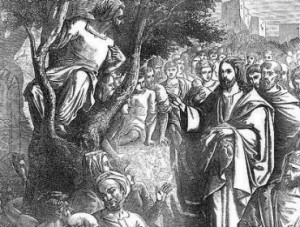 Zacchaeus climbs a tree to see Jesus. So today’s reading got me thinking scattered thoughts about trees. The weeping willow in my childhood backyard. The peach and cherry trees in my grandfather’s garden. The pinion pines of my native Nevada. The eucalyptus trees that were everywhere on my college campus. The huge ornamental pepper tree that shaded the first house my wife and I bought. I close my eyes, think of those trees, and I see my parents, my childhood friends, my college roommates. Trees are filled with meaning and memory; they bear the fruits of remembrance.
Zacchaeus hung in a tree to see Jesus. It won’t be too long before Jesus will be hung on a tree. Paul will write to the Galatian church, “Christ redeemed us from the curse of the law by becoming a curse for us – for it is written, ‘Cursed is everyone who hangs on a tree.'” (Gal. 3:13)
The tree Zacchaeus climbs is a Ficus Sycomorus. This tree produces an edible fruit, an inferior fig which the poor gathered. When I think of trees bearing fruit, I sometimes remember my grandfather’s peach and cherry trees. I sometimes remember the orange orchards around my parents’ retirement home. I sometimes remember the apple trees in my yard in Kansas that enticed my neighbor’s cows to break down the fence. And I sometimes remember a song sung by Billie Holiday; I remembered it as I thought of Zacchaeus and Jesus and the trees on which they hung. The song is entitled Strange Fruit and concerns the lynching of blacks in the American South:
Southern trees bear a strange fruit,
Blood on the leaves and blood at the root,
Black bodies swinging in the southern breeze,
Strange fruit hanging from the poplar trees.Pastoral scene of the gallant south,
The bulging eyes and the twisted mouth,
Scent of magnolias, sweet and fresh,
Then the sudden smell of burning flesh.Here is fruit for the crows to pluck,
For the rain to gather, for the wind to suck,
For the sun to rot, for the trees to drop,
Here is a strange and bitter crop.Words by Abel Meeropol.
The tree on Calvary bore a strange fruit, too. It bore the fruit of salvation. Because of that fruit, in a few weeks Americans will place trees in their homes (if they haven’t already) to commemorate the birth of the One who hung on that tree and offered that fruit to all. Those evergreens in American homes will also bear fruit. The fruit of good will, of families gathered in love, of traditions and family customs. Some will bear bitter fruit; not every family gathering will be happy, not every family will join in love. Families, like trees, bear different kinds of fruit, some good, some not so good, some downright bad. But the fruit borne by the tree on Calvary is for all, and that’s why we bring trees into our houses at Christmas. Those trees, like Zacchaeus’s sycamore, help us to see Jesus.
Scattered thoughts about trees. Trees fill our lives and we seldom notice them, but they bear all sorts of fruits. Strange fruits. Fruits of emotion and memory. Fruits of salvation. Zacchaeus climbed a tree to see Jesus.
====================
A request to my readers: I’m trying to build the readership of this blog and I’d very much appreciate your help in doing so. If you find something here that is of value, please share it with others. If you are on Facebook, “like” the posts on your page so others can see them. If you are following me on Twitter, please “retweet” the notices of these meditations. If you have a blog of your own, please include mine in your links (a favor I will gladly reciprocate). Many thanks!
====================
Father Funston is the rector of St. Paul’s Episcopal Church, Medina, Ohio.
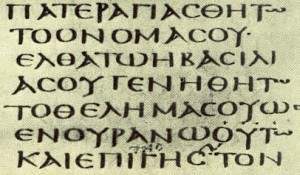 Who is you? That’s not a grammatically incorrect question. It’s a deeply important question in our study and understanding of scripture.
 Today is the last Sunday after Pentecost called “the Feast of Christ the King.” A relatively new feast on the calendar of the church, it was instituted by a 20th Century pope and originally set in late October as a response to the Protestant celebration of “Reformation Sunday” on the Sunday closest to October 31, the anniversary of Luther’s posting on the Wittenburg chapel door. The latter, I would suppose, started with the Lutherans but has spread throughout American Protestantism; I know of Presbyterian, Reformed, UCC, and Methodist churches that mark it. I know of no Episcopal congregations that do so. Episcopalians did take to Christ the King, however, and since Paul VI moved it to the last Sunday of the Christian year, every congregation I’ve been a part of has celebrated it. With the adoption of the Revised Common Lectionary, it is now an official part of our tradition.
 Although from a modern perspective, the prayer of the Pharisee is rather bigoted, but we should try to see it from his perspective and from within his culture, which Jesus shares. When we do so, we can see that Jesus is not criticizing the individual, but rather condemning an entire system of religion which divides and categorizes people. Jesus is denouncing any system, religious, social, or political, which separates people on the basis of bigotry and fear.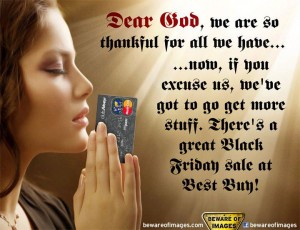
 It may be the United States’ holiday of Thanksgiving Day, but the Daily Office continues at this time of year delivering its message of repentance rather than encouraging thanksgiving. The Old Testament lesson is another from Malachi in which the Lord speaking to the priests says that he has spread dung on their faces and put them out of his presence! The gospel lesson from Luke has Jesus predicting the end of the world. And then there’s this epistle lesson which condemns the wealthy. Just not a lot of giving thanks!
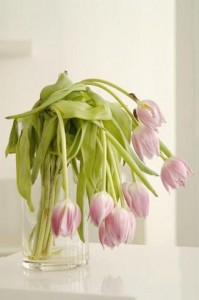 Several years ago I served in a small parish which had a very tight budget. Among its many cost-saving efforts was the reuse of altar flowers. Arrangements would be purchased and used on one Sunday, then quickly put away in the refrigerator in the basement kitchen to be used again the next week. Of course, they didn’t last as well as they might have been wished to (and some varieties of flower fared worse than others), so it was noticeable that they’d been around for awhile. In addition, if there’d been any sort of parish dinner in the interim so that food had been stored in the same refrigerator, they would often have taken on a bit of the odor of fried chicken or garlic or cheesy tuna surprise.
 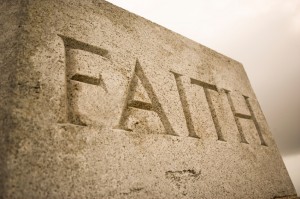 Giving thanks at a time privation, that’s what these two verses from Habakkuk’s prophecy are about. Habakkuk describes a situation in which he (and all the people of Jerusalem) have lost everything. Just look at what he lists in verse 17: figs, grapes, and olives, the year-round fruit crops of the area; the fields, which is to say the annual crops, the grains and staple foods; flock and herd, which means sheep and cows. All their their produce is gone, all their livestock are dead.
  There are two passages of Scripture that I always think of when vestries or other church governing boards begin to discuss a vision for the church’s mission and ministry. One is the King James version of Proverbs 29:18a – “Where there is no vision, the people perish.” – the other is this passage from Habakkuk. I really like the image of the vision being written so large that someone running by can read it and make sense of it; the church’s vision needs to be as big, expansive, and attention-getting as a billboard.
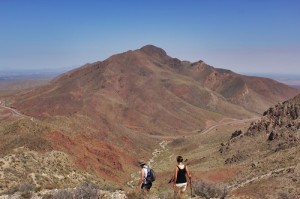 The “valley of decision” is probably another name for the Valley of Jehoshaphat referred to in an earlier verse of this chapter of the Prophet Joel. Jehoshaphat (a Hebrew name pronounced “yeh-hoh-shah-faht”) is a compound word of two other Hebrew terms, Yahweh (one of the names of God) and shaphat (meaning “to judge” or “to decide”). Jehoshaphat, therefore, means “God will judge” or “God will decide”. Geographically, the valley of Jehoshaphat, the valley of decision, lies between the city of Jerusalem and the Mount of Olives.

