====================
This sermon was preached on Sunday, July 15, 2012, at St. Paul’s Episcopal Church, Medina, Ohio, where Fr. Funston is rector.
(Revised Common Lectionary, Proper 10B: Amos 7:7-15; Psalm 85:8-13; Ephesians 1:3-14; and Mark 6:14-29)
====================
 In our lessons today, we have two stories about silencing the prophetic voice. First, a snippet of the not-very-familiar story of the Prophet Amos which is, frankly, cut from its context so badly that some explanation really is necessary. Second, the almost-too-familiar story of the beheading of John the Baptizer.
Amos, as he is at pains to say to the priest Amaziah, is not a professional prophet: “I am no prophet, nor a prophet’s son; but I am a herdsman, and a dresser of sycamore trees.” Nonetheless, Amos was commissioned by God in the middle of the 8th Century before Christ to leave his home in the southern kingdom of Judah, travel to the northern kingdom of Israel, and deliver there a condemnation of Israel, its monarch and its people. In this portion of his story, he tells of God showing him four quick visions, of which the plumb line is the third. First, he is shown a swarm of locusts, illustrating that God will wipe out Israel just as locusts wipe out a crop. Second, he is shown a shower of fire that would “eat up the land.” After each of these, Amos speaks up in defense of Isreal and God relents. Third is the vision we heard in the lesson, the plumb line; Amos, however, does not defend Israel after this vision. Instead, the series of visions is interrupted by the tale of the priest Amaziah and his attempt to silence this prophet.
Amos has delivered his message to Amaziah, a message to the whole of the country, but Amaziah, who is high priest at the king’s shrine at Bethel, has edited it before delivering it to the king. Instead of a message to the whole of society, he has made it sound like nothing more than a personal threat against the king and now, certain of the king’s reaction, he warns Amos to flee, to return to the south to make his living as a prophet there, but never to prophecy again in Israel. This is where Amos protests that he is not a professional prophet, but earns his living in agriculture; and this is where the lectionary reading ends. But it is not where the story ends.
Because of his attempt to silence the prophecy, Amos speaks a word from God for Amaziah, predicting that his family will fall in ruin and dishonor and that he himself will die “in an unclean land.” Amos then tells of the fourth of his visions, a bowl of fresh fruit which God explains illustrates that God’s patience with Israel is at an end. It’s a pun in Hebrew, the word for fruit being qay’its and that for end being qets. In English, I suppose, we would say that God is calling it quits with these people. The story ends with God’s final word to Amaziah, to the all of Israel, and to anyone who would muzzle his prophets: “Be silent!” Those who would interfere with God’s word to God’s people are themselves to shut up or face consequences like those promised Amaziah!
Which brings us to the gospel lesson and the beheading of John the Baptizer. It’s so familiar it hardly needs rehearsing, but let’s just refresh our memories, anyway.
Herod imprisoned John in an attempt to appease his wife Herodias because John had been raling against her and her marriage to Herod, who was her brother-in-law before he was her spouse and, therefore, John considered the marriage adulterous. (Some suggest that Herod did so to prevent Herodias from killing John herself.) At a birthday party he threw for himself, Herod witnessed a dance by his step-daughter and was so taken that he made a rash promise to give her anything she might ask for, up to half his kingdom. Consulting her mother, the girl asks for John’s head on a platter. Hoist on the petard of his public promise, Herod has no choice but to give her what she asks, even though he was quite fearful that John was, indeed, a prophet of God. Not recorded in the Bible is the fact that not too long after the events portrayed in the Gospels, Herod was deprived of his kingdom and all his property, and died in squalid poverty exiled to Gaul. Silencing God’s prophets, again, is obviously a really bad idea!
While I would be the last to suggest that the Episcopal Church or any of its leaders are equivalent to Amos or John the Baptist, I do believe that from time to the Church does speak with a prophetic voice. I believe that, in part, because of Christ’s promise that “where two or three are gathered in my name, I am there among them” (Matt. 18:20) and because it has been the tradition and belief of the church since the very first Ecumenical Counsel that (as some Lutheran bishops recently put it) “we trust that God’s Spirit will form the wisdom of God’s faithful people gathered in deliberative assembly.” (ELCA Conference of Bishops, March 10, 2009)
Over 1,000 Episcopalians on Thursday concluded the bicameral deliberative assembly known as The General Convention of the Episcopal Church: 165 bishops participated as voting members of the junior house; 844 lay and clergy deputies, as voting members of the senior house. They were presented with over 440 pieces of business ranging from courtesy resolutions commending the host hotel’s staff to the adoption of a budget for the next three years to the approval of new liturgies to the election of new leadership. Much of that was done quickly, with little fan-fare and hardly any notice. Much of it was done with the boring, long-drawn-out tedium that careful legislative work often seems to entail, but again with little notice. Some of it has received and will receive the attention of a secular press itching for scandal and sensationalism, eager to sell its advertising by selling the world a picture of a church gone (as Bishop Michael Curry of North Carolina, in fact, urged it in his keynote sermon) crazy! (Of course, Bishop Curry was encouraging the church to go “crazy for Christ,” something the secular press will overlook.) Some of what the church did at the 77th General Convention will, I believe, be seen in years to come to be truly prophetic, in the best sense of that word, speaking God’s Truth to a world in need of hearing it, and I suspect that there will be those who try to silence the Convention’s message or stop its actions as Amaziah and Herodias did those of Amos and John the Baptist.
Of all the work done by the Convention, there were three areas in which I believe its actions are the most important. First, it acted in regard to marriage and the promises couples make to one another when forming life-long, loving, and committed relationships. Second, it affirmed the church’s traditional understanding of the dominical sacraments of Baptism and Eucharist. Third, it committed the church to structural and organic reform.
With regard to life-long interpersonal commitments, the Convention called for an in-depth study and proclamation of the church’s contemporary theology of marriage. This, in my opinion, has been needed for many years. Holy Matrimony is one of the five sacramental rites of the church which our Articles of Religion tell us arise from “states of life allowed in the Scriptures” but which have neither “visible sign [n]or ceremony ordained of God.” (Art. XXV, BCP page 872) Marriage is one of those “Traditions and Ceremonies” that it “is not necessary . . . be in all places one, or utterly like.” (Art. XXXIV, BCP page 874) Since it was first identified as a sacrament in about the 10th Century, marriage practices “have been divers,” and the Articles of Religion assure us “may be changed according to the diversity of countries, times, and men’s manners.” (Ibid.) After a thousand years of monkeying about with marriage willy-nilly, and believe me we have done just that throughout the church’s history, taking a good, hard, methodical look at our theology and practice is a great idea!
In the same area, the Convention approved a provisional rite for the blessing of the committed, life-long relationships of same-sex couples. This is the one action that I am sure will be most discussed and most mischaracterized in the secular press. The Standing Liturgical Commission, which developed this rite, and the deputies and bishops who adopted it, have been quite clear that this is not marriage liturgy; it does not confer the sacrament of Holy Matrimony. Furthermore, it is a provisional rite, which means it may only be used provided certain conditions are met. I confess that I have not read the enabling legislation, but it is my understanding that this liturgy may only be used in those States or foreign jurisdictions where the civil authorities have either made the legal state of marriage open to same-sex couples or have created some other form of legally recognized civil union for such couples. Furthermore, it may only be used with the permission of the local bishop.
The second area of important action was in regard to the Sacraments of Baptism and Holy Communion. There was a motion put forward by the Diocese of Eastern Oregon to change the canons of the church so as to permit, as a regular matter, those who are not yet baptized to receive the Sacrament of the Altar. This would have changed what has been the practice and tradition of the church since its very beginning; there has never been a time when it was not considered necessary that a person be baptized before being invited to partake of the Body and Blood of Christ. While we do not check ID’s at the altar rail or communion station, and while we do now open our communion to all who are baptized in any Christian tradition (no longer restricting the Eucharist to those confirmed in the Episcopal Church), the General Convention was not willing to make that change. Instead, in a substitute resolution, the bishops and deputies affirmed that it is the normative practice and expectation of this church that Baptism precede reception of Holy Communion, and affirming that the Episcopal Church invites everyone to be baptized into the saving death and resurrection of Christ Jesus.
The third and, I believe, most important of what I have called the prophetic actions of the General Convention is to take the first step toward reorganization and restructuring of the Episcopal Church. We have a national, provincial, and diocesan structure which is often top-heavy, unwieldy, and counter-productive. One of the buzz-words of recent Convention was “nimble” – that is not a word that in any way, shape, or form describes the Episcopal Church! It doesn’t even describe one of our parishes let alone the entire national organization! All too often we find ourselves standing in our own way, tripping over our own feet. In passing the resolution to re-imagine and restructure the church and calling for a task force made up of new and younger leaders to do so, the General Convention has said that we will get out of the way; we will get out of the Spirit’s way; we will get out of our own way!
There is much work to be done, but it seems to me that the hardest work will be the letting-go and stepping-aside . . . letting go of old ways of doing and being church, letting go of expectations of how things have always been done and how we think they ought to be done, letting go of office and power by those who have governed the church for generations, letting go of the hurt and pain of change . . . stepping aside to allow those newer, younger leaders to come forward, stepping aside to let the Holy Spirit come in, stepping aside to free the center so that it may be filled with something new and different. I hope that the hard work of letting-go and stepping-aside will get done, although I’m not convinced that it will.
Shortly after adopting that resolution, the House of Deputies was given an opportunity to elect newer and younger leadership. It chose instead to elect as its president someone who has been a General Convention deputy eight times and who has had a seat in the highest councils of the church for years. It elected as its vice-president someone who has been a deputy at every General Convention since 1973. I know both of these individuals and I know that they are faithful, dedicated, and capable, but I have to be honest – these folks are part of the well-entrenched, long-experienced cadre of church governors; this is leadership that is anything but new or young (and it pains me to say that since the new president and I are essentially the same age). Still, I live in hope that they can and will, in fact, facilitate and accomplish the change that is needed, because (as I said earlier) I trust that God’s Spirit forms the wisdom of God’s faithful people gathered in deliberative assembly.
So let me bring us back to our lessons for today. What might they be teaching us about how to respond to the actions of our recently-concluded General Convention?
Well . . . first, I suggest that the story of Amos and Amaziah, and the story of the Baptizer and Herodias, these stories in which someone sought to silence the prophetic word encourage us to be aware of the distortions we may hear from both the religious and the secular media. Just as Amaziah misrepresented and tried to silence Amos’s prophecy when relaying it to King Jeroboam, so too may we find the reports distorting the actual words and actions of the Convention in an attempt to undermine and stop them. Just as Herodias sought to behead John, so too we may find the detractors of our church trying to assassinate the character of our leaders.
Secondly, the defense of prophecy in the Book of Amos with its pronouncement of judgment against Amaziah or the end to which Herod and Herodias came might stand as cautionary tales against our own tendency to silence whatever it is that we find unpalatable in the prophetic voices of our church’s Spirit-led Convention, voices calling us to change in those areas in which we as a church and as individuals may be in the greatest need of reformation.
Finally, we might find encouragement that we, like Amos and John, despite the dangers in doing so, might heed God’s call to exercise our own prophetic voices in our communities, in our workplaces, or among our circles of friends speaking on behalf of our church which welcomes all and proclaims the Good News that God loves everyone, no exceptions.
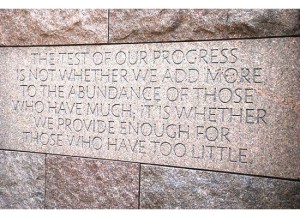
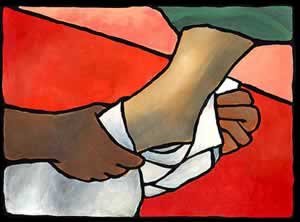 In yesterday’s gospel lesson Jesus told the story of the king separating the righteous form wicked as a shepherd separates sheep from goats and saying “As you care for the poor, you care for me.” It reminded me of a few cogent remarks that have been made about the measure of society – From Samuel Johnson: “A decent provision for the poor is the true test of civilization.” From Mahatma Ghandi: “A nation’s greatness is measured by how it treats its weakest members.” From Franklin Delano Roosevelt: “The test of our progress is not whether we add more to the abundance of those who have much, it is whether we provide for those who have too little.”
 More than any other story in all of the gospel accounts, this one underscores for me what is at the heart of the Good News of Jesus Christ: love of neighbor, service to others, care for those who are unable to care for themselves, and in so doing to demonstrate our love of God.
  You know this story. A rich man goes away for some period of time entrusting huge amounts of wealth to his servants. To one he gives five talents, an amount of silver roughly the value of one hundred years of work of an ordinary laborer. To another two and to the third one. The first two use the money and double it. The third, timid and fearful of his employer’s reprisal should he lose it, buries it in the ground. Upon the owner’s return, he is punished for failing to invest the money.
 This is one of the things that I find so captivating about the Old Testament: its heroes and heroines are not supermen and superwomen. They aren’t even regular, run-of-the-mill folks. They are often, as here, the outcasts and sinners, the morally flawed, the ethically ambiguous, the folks who were looking out for themselves as much as they were trying to do something good (sometimes a lot more the former than the latter). “A prostitute whose name was Rahab” was as capable of doing God’s work as was a Levite, a priest, or a great military leader.
  More than thirty years of studying scripture and today is the first time I really paid attention to the fact that “to those who have, more will be given; and from those who do not have, even what they seem to have will be taken away” is a dependent clause! Its meaning must be understood as deriving from the admonition to “pay attention to how you listen”! The entire sentence follows a remark about hidden things being disclosed, secrets coming to light, and facts becoming known. This is not a statement about position, possessions, wealth, or power; this is a statement about communication, understanding, and confusion. More specifically, it is a warning to be aware of the filters through which we hear and understand what we receive from others.
  The 77th General Convention of the Episcopal Church has just concluded and, I know from having been a deputy or a volunteer at past conventions, those who attended had a wonderful time (unless they came away righteously angry over one action or another, in which case they are now thoroughly enjoying being in the “right” while the rest of the church, they are sure, is going to Hell in a hand-basket). But I do wonder whether the actions of #GC77 (as the Twitter hashtag named it) will “drop like the rain” and “condense the like dew” and provide gentle nurture for “new growth.”
  This overload of unproductive work is not a “gentle rain” . . . this is a Category-5 hurricane, a tsunami, a deluge of biblical proportions! Actually, the thought did occur to me that it’s bigger than “biblical proportions” – the Law of Moses, the Torah, the Pentateuch, the first five books of Holy Scripture, the word of God to the Chosen People for all time (whatever one calls it) in my Oxford Annotated Bible only takes up 308 pages (complete with footnotes). The word of GC77 to the people of the Episcopal Church for a mere three years is more than twice the size, not including the loose-leaf supplement!
  God had made it abundantly clear to Moses that he wasn’t going to be allowed to cross over into the Holy Land. He would be allowed to see the Promised Land from the opposite side of the river, but not to enter it. Despite Moses’ requests, God’s mind was not going to be changed, as this divine outburst of temper makes clear. ~ There have been times in my career – maybe I should say “careers”, because it was true when I was a businessman and when I was a lawyer, as well as during my ministry as a parish priest – that I have felt like Moses standing on Mt. Pisgah: I can see where this business, firm, community is (or ought to be) headed, but I am pretty sure I’m not going to get there with them. ~ A colleague and I once made note of a common occurrence in parish ministry: the aftermath of a building program. It seemed to us (and later we both personally experienced) that once a pastor has led a congregation through a building program and the building is up and running, the pastor leaves. Like Moses’ life, his or her ministry among that people is at an end. We were never sure why that was, and even having been through the experience I’m still not sure. ~ Moses (and his brother), of course, died without entering the Promised Land because of his lack of faith: the Lord said to Moses and Aaron, “”Because you did not trust in me, to show my holiness before the eyes of the Israelites, therefore you shall not bring this assembly into the land that I have given them.” (Num. 20:12) Is it because clergy lose faith (maybe faith in their communities) during a building program? Is it because the community loses faith in the clergy? I remember reading (several times) about how the stress of designing and building a home can be a cause of divorce; maybe something of the same dynamic is at work in the pastor/parish relationship during a church building program. ~ In any event, whether a building program or a change of ministry direction or a shift in church style, I’m pretty sure that every church leader (clergy and lay, I’m sure, but probably more the clergy) has felt, at some time, that he or she could see a vision of the church’s future that he or she was probably not going to be joining in. And if it hasn’t happened yet, I’m confident that it eventually will. When that happens, clergy, know that you are in good company! You are standing with Moses atop Mt. Pisgah!
 The Pharisees are crawling out of the woodwork! After the vote yesterday by the Episcopal Church’s 77th General Convention to give bishop’s authority to permit a “provisional rite” for the blessing of committed same-sex relationships (it’s not a marriage rite – keep saying that!) the Twitterverse has erupted with some nasty stuff from detractors and supporters alike. We humans are always so much more likely to see and criticize what we consider the sinful foibles of others than we are those of ourselves. This is what Jesus addresses here. ~ The image of a “whited sepulchre” is so evocative. In an earlier verse, Jesus has accused the Pharisees of only washing the outside of their drinking cups. And elsewhere he reminded his disciples of the unclean mess inside every human being: “Whatever goes into the mouth enters the stomach, and goes out into the sewer . . . Out of the heart come evil intentions, murder, adultery, fornication, theft, false witness, slander. These are what defile a person, but to eat with unwashed hands does not defile.” (Matt. 15:17,19-20) The tweets coming from General Convention (and from those of us observing from afar) on all sides of the many issues facing the church are certainly demonstrating the truth of this! The insides of many “whited sepulchres” are being exposed to public view. ~ I’ve been thinking about the Letter of James and how it might have been written differently if today’s communication technology had been around back in First Century Palestine . . . . Perhaps we might there have read something like this:
 My church, the Episcopal Church meeting in its 77th General Convention, took two incredibly large steps today which, I believe (and hope and pray), will make us conquerors. First, the House of Deputies unanimously passed a resolution to set in motion a process for re-imagining and possibly restructuring the church. Second, the Deputies voted by a 3-to-1 majority (in both the clerical and lay orders) to concur in an action of the House of Bishops adopting a provisional rite for the blessing of the life-long committed relationships of couples of the same sex; the Bishops had approved the rite by a greater than 2-to-1 majority. Although the second action will get (and has already gotten) by far the greater press coverage and will generate the greatest amount of “heat” and public interest, it is the former that is of greater importance. ~ In preaching on this passage, a former mentor of mine often said that the most important potential obstacle included in the “anything else in all creation” that cannot separate us from God in Christ is . . . ourselves. In passing the resolution to re-imagine and restructure the church, the General Convention has said that we will get out of the way; we will get out of the Spirit’s way, we will get out of our own way! ~ There is much work to be done, but it seems to me that the hardest work will be the letting-go and stepping-aside . . . letting go of old ways of doing and being church, letting go of expectations of how it has been done and how it ought to be done, letting go of office and power by those who have governed the church for generations, letting go of the hurt and pain of change . . . stepping aside to allow new leaders to come forward, stepping aside to let the Holy Spirit come in, stepping aside to free the center to be filled with something new and different. ~ I commend and congratulate the bishops, lay deputies, and clergy who made this decision and have the hard work of letting-go and stepping-aside to do. I pray for the new generation of leadership that will lead the re-imagining and restructuring; I hope that I can join them in the effort. And I remind them that “we are more than conquerors through him who loved us.”

