Occasional thoughts of an Anglican Episcopal priest

Category: Family (Page 15 of 15)

Places Visited Recently – Pending Posts

I’ve been traveling a bit the past few days and have been joined by my daughter Caitlin for the week. Here’s where I’ve been since visiting Birr Castle.

First, I spent three days based in a B&B between Avoca and Redcross in County Wicklow. Of course, I visited Avoca where the BBC program about life in a small Irish village, Ballykissangel, was filmed.

Avoca, Ireland, scene of Ballykissangel

Avoca, Ireland, scene of Ballykissangel

About 25 kilometers from Avoca is Glendalough, the early Celtic monastery founded by St. Kevin. It is in a beautiful setting and is a popular attraction both for the Irish and for foreign visitors. I must have heard a half-dozen or more languages the day I was there, including German, Italian, Spanish, French, and Japanese, as well as English (and some I didn’t recognize).

The Round Tour at Glendalough, County Wicklow

The Round Tour at Glendalough, County Wicklow

In the southwest part of County Wicklow is Baltinglass where one finds another monastic ruin, the remains of Baltinglass Abbey. Unlike Glendalough, Baltinglass Abbey is not a Celtic cite. It is considered one of the most important Cistercian abbeys of Leinster. and was founded in 1148 by Dermot McMurrough, king of Leinster. It was the second house to be colonized by the Cistercians of Mellifont. One finds it now on the grounds of a small Church of Ireland parish tucked back in a corner of the town.

Baltinglass Abbey, County Wicklow

Baltinglass Abbey, County Wicklow

I visited the county town of Wicklow, but it was crawling with a motorcycle touring group and several groups of teenagers in buses visiting the historic gaol. So I didn’t stay long. I visited the other major town in the county, Arklow, and went to the modern shopping center to buy some supplies. I took no pictures in either place.

My daughter Caitlin and her friend Jeff arrived on Monday morning. I picked them up at the airport and we spent the day exploring Dublin. Our first stop was the famous Bewley’s Tea Room on Grafton Street for a bite of breakfast. We tried to see the Book of Kells, but there was a one-and-a-half-hour line so we decided we would return later to do that and come back early some other day. We then walked from there to the Guinness Storehouse and took that tour.

The Guinness Harp

The Guinness Harp

Our first full day together, yesterday, we were blessed with fabulously sunny (if cool and breezy) weather. We visited the Burren. Our first scheduled stop was to be the Burren College of the Arts which Caitlin had read about on-line. However, on the drive there we passed Dungaire Castle and decided to take a look.

Dungaire Castle, County Galway

Dungaire Castle, County Galway

After the castle we went to the art school:

Caitlin and Jeff at Burren College of the Arts

Caitlin and Jeff at Burren College of the Arts

Finally we went to the Caherconnell ringfort and the nearby Poulnabrone dolmen.

Poulnabrone Dolmen, The Burren, County Clare

Poulnabrone Dolmen, The Burren, County Clare

Between all this travel and taking my free time to work on translations, I’ve not had time to post to this blog. However, I am making notes and next week, when I am again on my own, I’ll post more photos and comments.

Memories and Good-Byes

I received word yesterday that Earl, a long-time parishioner and good friend back home, had passed away. This was not a surprise; he had been diagnosed with lung cancer some months ago and we expected that he would die while I was on sabbatical. Still, it has filled the day with sadness. I think of his wife, his children, his grandchildren, all of whom I know, and I know that today is a hard one for them. No matter how prepared for a loved one’s death we believe we are, we aren’t. It’s that simple. Death is never easy.

My father died suddenly and unexpectedly when I was not quite six years old; we weren’t prepared. My mother and step-father both died after long and protracted illnesses; we weren’t prepared either time. My mother-in-law passed away after several years of decline into the living death that is Alzheimer’s Disease; even with that long and difficult course, we weren’t prepared. Through the years other friends and family members have died. Parishioners and parishioners’ loved ones have died and I have officiated at their burials and celebrated the Requiem Masses for the repose of their souls. The one thing all of these passings has taught me … no matter how prepared for a loved one’s death we believe we are, we aren’t.

The Irish live with death closer at hand than any other people I’ve encountered. Oh, for sure, there are places where the physical reality of death is nearer at the present; places where famine reigns, places like Somalia and in recent years Ethiopia and other north African countries from which we see the pictures of emaciated corpses and children with malnutrition-distorted bodies. The Irish lived through times like those 165 and more years ago; as the saying goes, they’ve been there, done that.

I’ve written earlier about the famine houses and how they are a living, daily memory of that time. I didn’t write in that entry that in addition to the abandoned homes, there are famine houses that were tombs. Starving families would simply close their door and huddle together in a corner of the house and die. There was no food; there was nothing else to do. (I’m told that there are recorded instances of cannibalism during the famine years. I’ve not read those records myself.) The Irish have been there, done that.

The famine houses are not the only reminders of mortality on this island. There are also the ruins of churches, of small parish churches, of missionary encampments, of great monasteries dating back to the first days of Christianity in Ireland. The names of some are well known: Ballentubber Abbey, a ruin now restored as a parish church and described in another post on this blog; Clonmacnoise in County Offaly which dates from the middle of the 5th Century; the Rock of Cashel, the remains of a 12th Century monastery on a site reputed to have been used by Patrick for the baptism of the kings of Ireland in the 5th Century; Glendalough founded in the Wicklow Mountains by St. Kevin in the 6th Century.

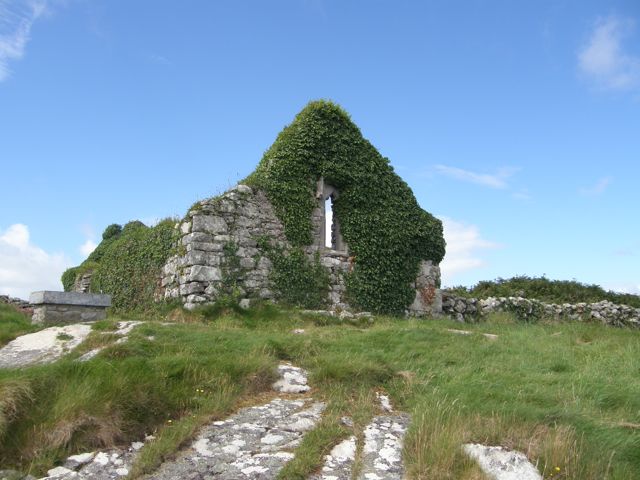
Others are not so well known; Teampall Mhic Ádhaimh (“Church of the Son of Adam”) is a local ruin here on An Cheathrú Rua. Local tradition has it that it was built by a Saint Smochan and archeological and architectural evidence points to a 15th Century construction date. This church is located near the water’s edge at Trá na Reilige (“Beach of the Burial Ground”) at Barr an Doire (“Oaktree Point”).

Teampall Mhac Ádhaimh (Church of the Son of Adam), An Cheathrú Rua

Teampall Mhac Ádhaimh (Church of the Son of Adam), An Cheathrú Rua

Teampall Mhac Ádhaimh (Church of the Son of Adam), An Cheathrú Rua

Teampall Mhac Ádhaimh (Church of the Son of Adam), An Cheathrú Rua

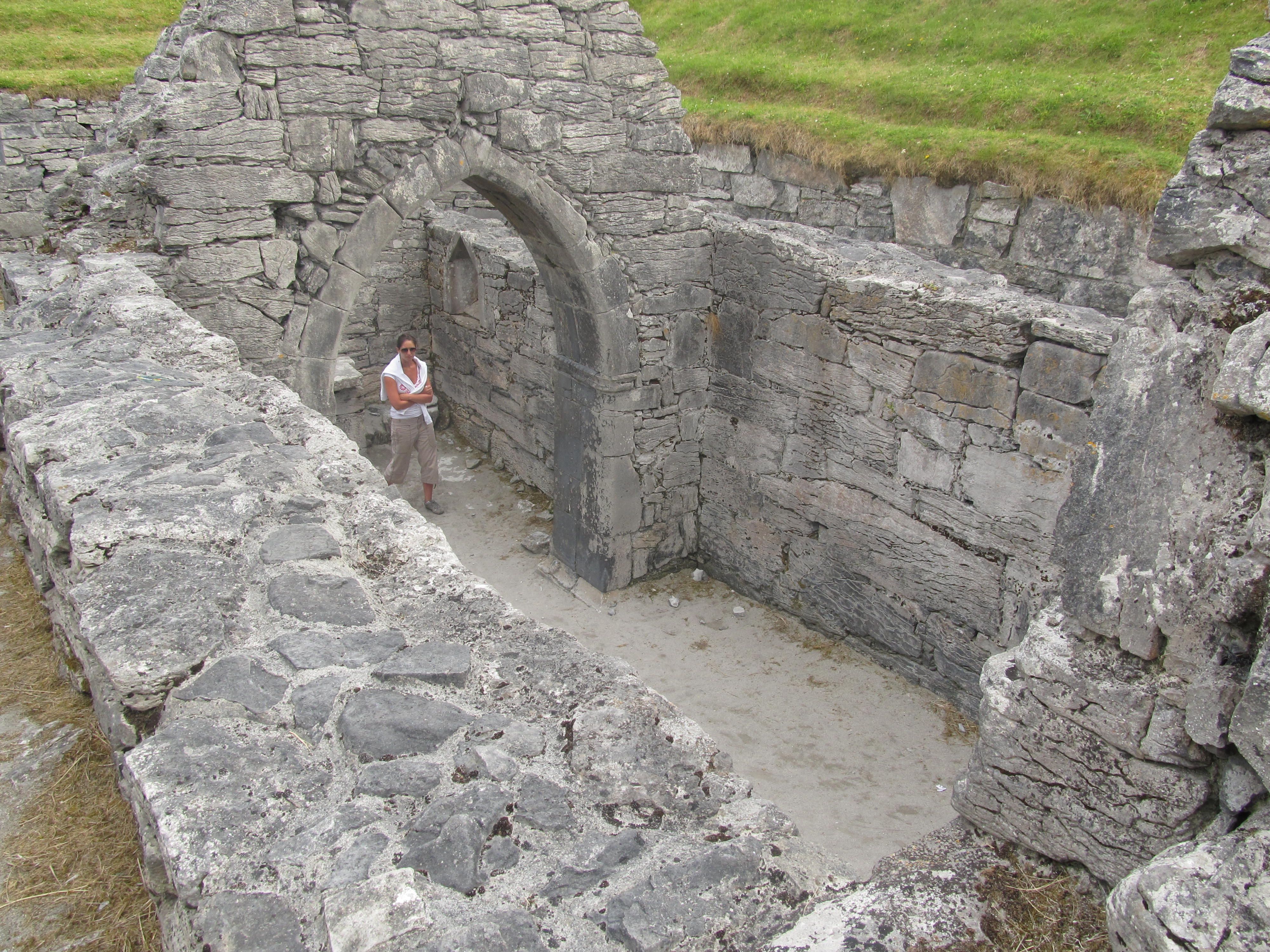
Another is Teampall Chaomháin (“St. Kevin’s Church”), the buried church on Inis Oírr, the smallest of the Aran Islands. These churches probably came into ruin as a result of “the Penal Years” when the practice of Roman Catholicism in Ireland was outlawed by the English. They came into ruin, but not disuse.

Teampall Chaomháin, Inis Oírr (photo from Ciara Grogan)

Teampall Chaomháin, Inis Oírr (photo from Ciara Grogan)

Teampall Chaomháin, Inis Oírr (photo from Ciara Grogan)

Teampall Chaomháin, Inis Oírr (photo from Ciara Grogan)

Like many local (and monastic) ruins throughout Ireland, these ruined churches were considered holy ground and so they became burial grounds.

Burial Ground at Teampall Chaomháin, Inis Oírr (photo from Ciara Grogan)

Burial Ground at Teampall Chaomháin, Inis Oírr (photo from Ciara Grogan)

Burial Ground at Teampall Chaomháin, Inis Oírr (photo from Ciara Grogan)

Burial Ground at Teampall Chaomháin, Inis Oírr (photo from Ciara Grogan)

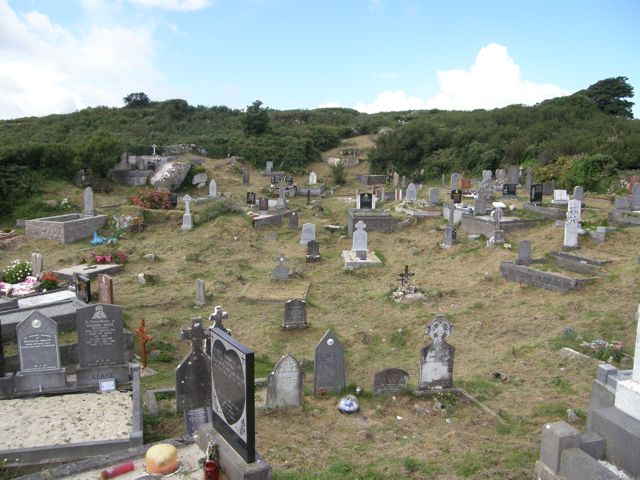
Burial Ground at Teampall Mhac Ádhaimh, Barr an Doire, An Cheathrú Rua

Burial Ground at Teampall Mhac Ádhaimh, Barr an Doire, An Cheathrú Rua

Burial Ground at Teampall Mhac Ádhaimh, Barr an Doire, An Cheathrú Rua

Burial Ground at Teampall Mhac Ádhaimh, Barr an Doire, An Cheathrú Rua

I wandered through the graveyard at Barr an Doire and photographed some of the gravestones, many carved in beautiful Gaelic text. This one marks the grave of Bairbre Nic Donncha, who died April 20, 1960, her husband Peadar, who followed her two days later, and their son Peadar, who died a few days before Christmas in 1995. The blessing on the marker reads, Ar deis De go raibh anam – A chlann a thog, which means “May their souls be at the right hand of God, their family prays.”

Gravestone at Teampall Mhac Ádhaimh, Barr an Doire, An Cheathrú Rua

Gravestone at Teampall Mhac Ádhaimh, Barr an Doire, An Cheathrú Rua

The next stands over the tomb of Chóilín Phádraig Pheatsín, who died April 2, 1959, and his wife Nora, who joined him on March 1, 2002. The prayer reads Taispeáin dúinn, a Thiarna, do trócaire agus tabhair do shlánú (“Show us, Lord, your mercy and grant us your salvation”).

Gravestone at Teampall Mhac Ádhaimh, Barr an Doire, An Cheathrú Rua

Gravestone at Teampall Mhac Ádhaimh, Barr an Doire, An Cheathrú Rua

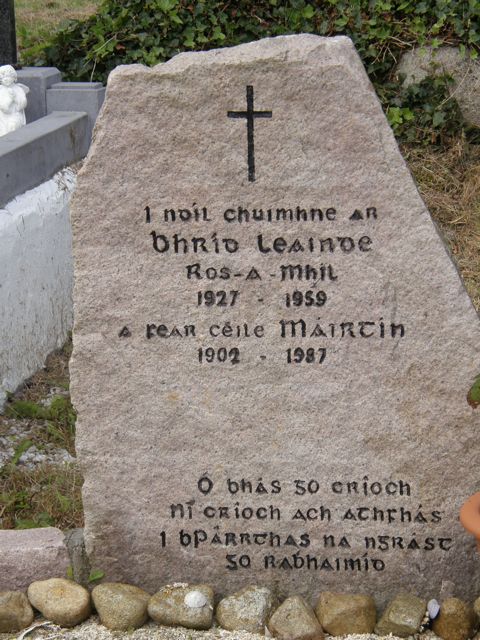
And finally this marker over the grave of Bhrid Leainde, who passed away at the young age of 32 in 1959 and was followed by her husband Máirtín, who died at the age of 85 in 1987. I really like the sentiment expressed on this gravestone: Ó bhás go críoch ní críoch ach athfhas i bPárrthas na ngrast go rabhaimíd (“From death to an end not an end but new growth, we go to the Paradise of grace”).

Gravestone at Teampall Mhac Ádhaimh, Barr an Doire, An Cheathrú Rua

Gravestone at Teampall Mhac Ádhaimh, Barr an Doire, An Cheathrú Rua

Though surrounded by reminders of the deaths of the famine years and by the ruins of churches and the graves they contain, I’m sure Bairbre’s and Peadar’s family, that Chóilín’s and Nora’s children, that Bhrid’s and Máirtín’s loved ones were not prepared for their deaths. No matter how prepared for a loved one’s death we believe we are, we aren’t. And yet we are sustained by faith, by the faith that assures us that death is not an end, but the beginning of new growth in a paradise of grace where, through the Lord’s mercy, we enjoy the fruits of salvation and sit at God’s right hand.

There is a poem by Máirtín Ó Direáin inscribed on a stone plaque dated August 2000 at Teampall Chaomháin on Inis Oírr. The plaque includes a verse of scripture (Is mise an t-aiséirí agus an bheatha – “I am the resurrection and the life”) and a prayer (Suaimhneas sioraí dar muintir a d’migh uainn – “Eternal peace to the people who have left us”). The poem is entitled Cuimhní Cinn (“Memories”). I’ve tried to find a translation, but failing that have translated it myself.

Stone Plaque at Teampall Chaomháin, Inis Oírr (photo from Ciara Grogan)

Teampall Chaomháin, Inis Oírr (photo from Ciara Grogan)

Their memory still lives in my mind:
A white jacket and a bright shirt,
a blue shirt and a green vest,
trousers and drawers of homespun;
our honored old men
traveling to Sunday morning Mass,
a long journey on foot
wakening in my youth my own thoughts:
our ground, our earth, still our blessing.

Their memory still lives in my mind:
Long red choir robes,
blue coats dyed with indigo,
neat knitting women
now in heavy shawls up from Galway
traveling to Mass in the same way;
and although they are going out of fashion
their memory still lives in my mind.
Certainly life will come to me from this land.

Earl’s memory lives in my mind – a tweed sport coat, a purple shirt, two canes, a bushy beard, and ready smile. We knew this was coming, but no matter how prepared for death we believe we are, we aren’t. Being in community, traveling together to Mass memories alive in everyone’s minds, helps us get through that unpreparedness. I’m sorry I can’t be there with our church community to say “Good bye”.

May he rest in peace and rise in glory.

A Drive Through the Bog

On a recent afternoon I had one of those introversive episodes when I needed to get away from everyone, from the teach lóistín (“boarding house”) where I am staying, away from housemates, host family, school, and so forth. So I told my bean an tí (“landlady”) that I wouldn’t be home for dinner, got in my rental vehicle (an Opel Astra), and drove away.

My first and only planned stop was at a famine house in the northern precincts of An Cheathrú Rua which I had seen from our school bus when returning from one of our “tours”. Unfortunately, I discovered that the property is fenced off by a vicious looking barbed wire fence, so the photos I had hoped to take, and did take, are all from a distance. I’d hoped to go inside it and take some interior shots, but alas ….

Famine House, An Cheathrú Rua

Famine House, An Cheathrú Rua

I then drove to what passes for a “main highway” in these parts; from an American perspective these are very narrow roads on which the Irish drive at unreasonably high speeds. I turned toward Leitir Moír, deciding on a moment’s notice that since I am familiar with the Irish folk song Peigín Leitir Móir (I can even sing part of it), I should be able to say that I’d been to the town. I have now been … it’s not much; it’s just a small Irish town with a “city center” consisting of a Roman Catholic church, a small park (and car park), a community activity center, and little grocery store. But the song is still catchy and fun – if you want to hear it, click here for a YouTube video of an Irish folk singing family singing it.

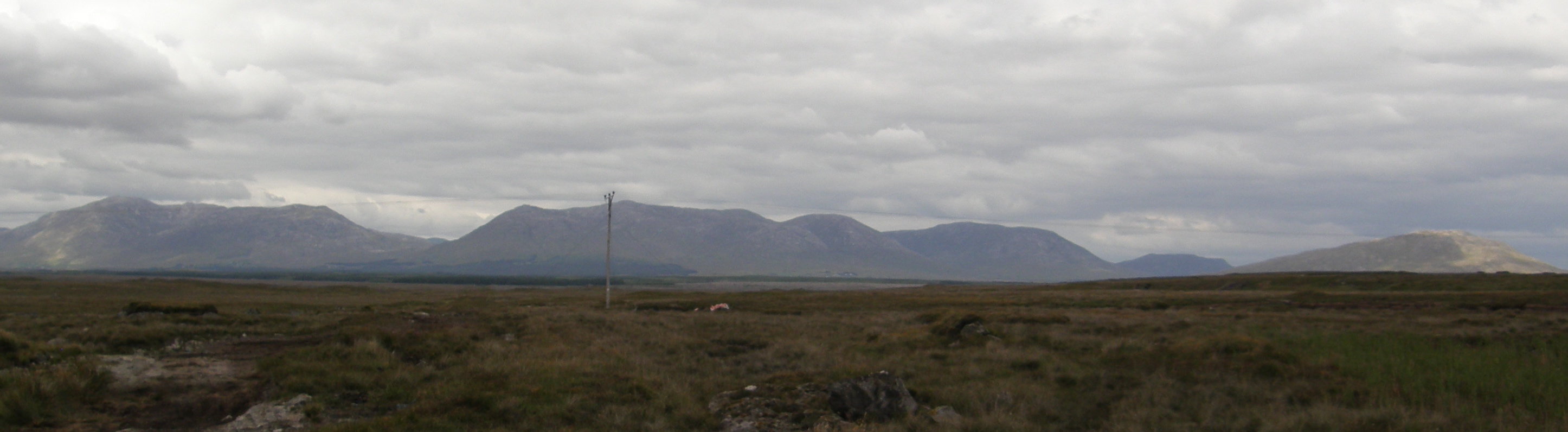
After Leitir Moír, I decided to go to Cloch na Ron (the Anglicized name of which is “Roundstone”, although the Irish actually means “rock of the seals”) and maybe have a bite to eat. That turned out to be a drive through “the bog” which is the area where locals “cut turf” to be used as fireplace fuel during the winter. I took some pictures of turf cutting along the way and enjoyed the views of the Twelve Bens which are the mountains of the Connemara. Lots of people go “hillwalking” among these mountains, a very popular holiday (vacation) activity for the Irish.

The Twelve Bens from Derryrush Road

The Twelve Bens from Derryrush Road

It is estimated that bogs cover about one-sixth of the available land in Ireland, which gets more of its fuel from peat than any country except Finland. In Ireland, many families have an inherited right to cut turf for domestic use which has been handed down for hundreds of years. This inheritable right is called turbary.

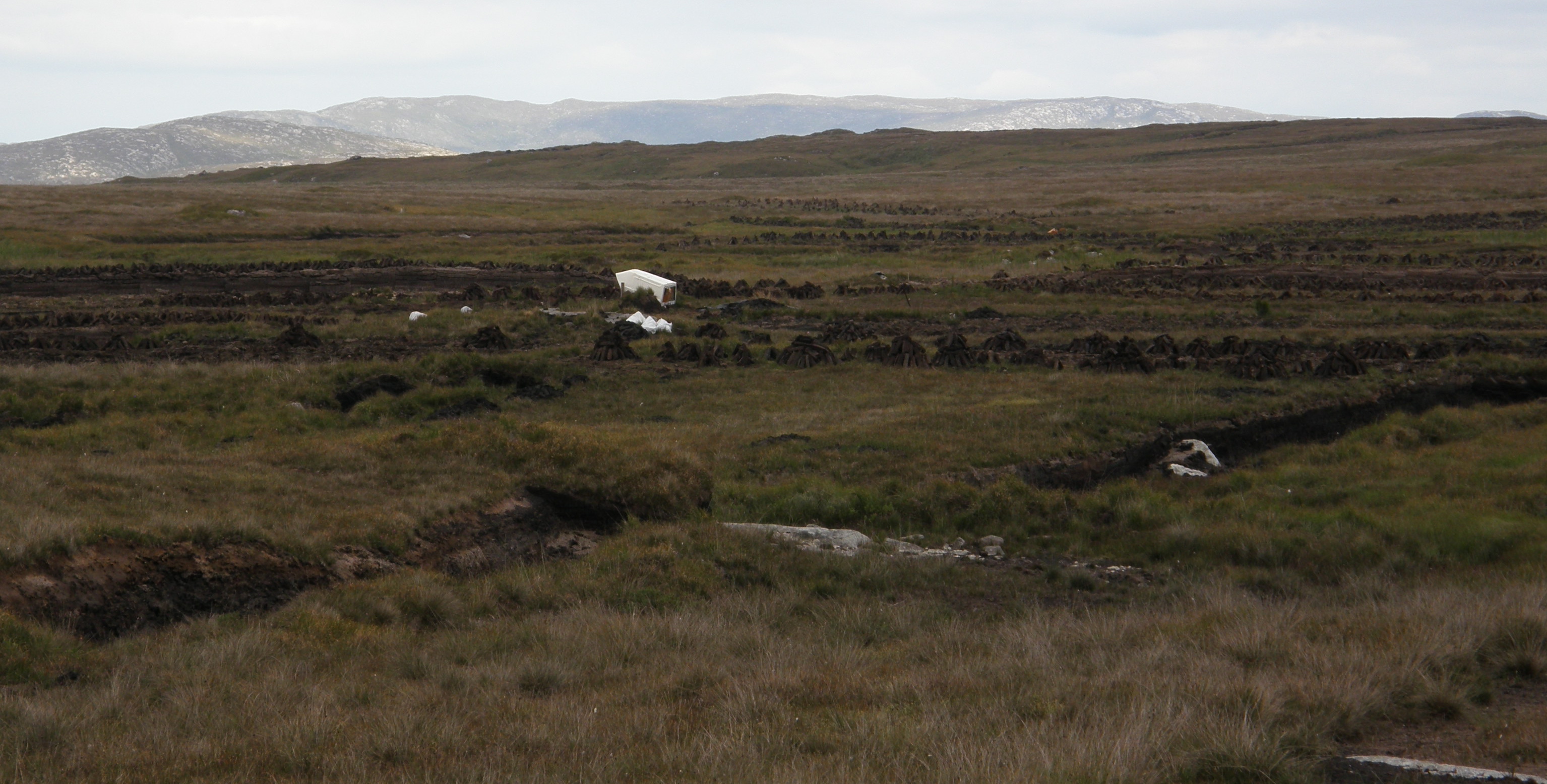
The Bog, Showing Family Turf Cutting or "Turbary" Areas

The Bog, Showing Family Turf Cutting or "Turbary" Areas

Here in the west of Ireland, the bog is technically a lowland blanket bog. These are unique in that they are formed in a rainfall-rich locale where the supply of minerals is kept up and the acidity down. The makeup of the bog material includes vegetation of many types.

According to tradition, turf is not cut until after St. Patrick’s Day after the March winds dry the boglands. Early May is generally the turf-cutting time in the West of Ireland, although it continues through the summer months and is still going on while I am here. My host family has gone out to the bog to cut turf, although I’ve been unable to go along because of classes a that the Acadamh. While driving the Derryrush Road from An Cheathrú Rua to Cloch na Ron, I witnessed an old man in rubber boots stacking footings and took the photos you see here. (In retrospect, I wish I’d pulled over – if I could have found a wide enough, dry enough spot to do so – and asked the old man about his activity … 20-20 hindsight!)

In some areas, before turf is cut the top layer of heather and roots is stripped; this can be done by the time consuming process of mowing the vegetation and then cutting back the top layer of soil, or by burning. Burning requires a permit, which is often difficult to obtain.

The Bog, Showing Turf Cutting "Ridge"

The Bog, Showing Turf Cutting "Ridge"

In this area, they don’t seem to strip the bog first. The top layer is fairly sparse here, so the turf is simply cut through the top surface. Generally, it takes one man a week of cutting to prepare a year’s worth of turf fuel.

Antique Slane (Modern Tools Have Steel Blades)

Antique Slane (Modern Tools Have Steel Blades)

Turf cutting is done with a sléan or slane, a long-handled turf spade with a shaped steel end. Slane styles vary from county to county. The direction of the cutting varies from place to place. In this area, turf is cut in a vertical direction; where the bog type is what is called a red raised bog, it is cut in a horizontal direction.

Dried Sods Ready to Burn in the Fire

Dried Sods Ready to Burn in the Fire

The depth of a single piece of cut turf is called a spit or a bar. A vertical turf bank is measured in numbers of bars to a depth of a slane (twelve to eighteen inches in this area.) A good bank might be six bars deep; I’m told that a day in the bog is difficult work and taxes the strength of even the fittest person. The bog is very wet and the trenches created as turf is cut fill almost immediately with water; cutters usually wear high gum or rubber boots. The lowest row of bars is the wettest, but they say that when dried they make the best fuel.

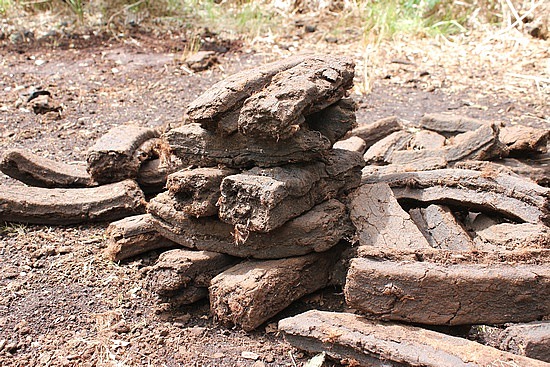
The cut turf is removed to open ground to dry. The soggy sods, as the brick shaped cuttings are called, are laid out on the ground to dry for a week. They are then stacked upright into a footing which continues the drying procedure.

A Field of Footings Next to the Trench or Ridge from which they were cut

A Field of Footings Next to the Trench or Ridge from which they were cut

Close-Up of Footing

Close-Up of Footing

Once the footed turf is somewhat dry, sods are piled into a rickle. When it is finally dry, the turf is carried home to be stacked against an east-facing wall or in a covered shed for protection from westerly winds.

A "Rickle" or Pile of Turf Ready to be Transported Home

A "Rickle" or Pile of Turf Ready to be Transported Home

In the past, turf cutting was only fuel available to many families living in the Connemara, where it is illegal to cut it other than by hand. Many families still use turf for homeheating, although today it can be purchased in compressed briquettes in supermarkets throughout Ireland. I’m told that turf burns cleaner than coal; it has a very a pleasant smell which, together with the smell of mown heather, has come to really be the scent of Ireland to me. There’s nothing quite so comfortable as sitting by a turf fire on cold, damp day with a mug of tea (or in my case, coffee) in hand. I’m told that scones cooked over a turf fire have an especially lovely flavor – I’ve not had (nor do I anticipate having) that experience, but I can imagine that it is true.

After my drive through the Bog along Derryrush Road, I connected with one of the small “highways” of Ireland and made it to Roundstone, which was a bit of a mess. It is a fishing village turned vacation resort. One very narrow street along the waterfront, several B&Bs and a few pubs/eateries. It was a “mess” because next Thursday is the running of the Tour de Bog, a bicycle road race that begins and ends in Roundstone and they were setting up signs, starting/ending line, viewer stands, etc. Some guy with a trailer was trying park it on the main street where there was patently no space to park it! So a long line of cars waited about fifteen minutes for the fruitless maneuvering to end.

I finally parked in the free public parking area and walked to a local pub – had a pint of Smithwick’s ale with the barkeep, a woman about my age who bemoaned the Irish economy and the fact that at 6 p.m. on a Friday evening she had absolutely no business. For the first twenty minutes or so, I was the only customer in the place, then a French family entered and since they had very little English and she had no French, I served as translator.

I finished my beer, bade my new friends farewell – “Adieu!” and “Bon nuit!” to the French family, “Slan!” and “Oíche mhaith!” to the Irish tavern owner – headed back to the car where I noticed that the music shop of Malachy Kearns, reputed to be the best bodhran (Irish drum) maker in Ireland, was open.

I bought a bodhran there in 2005 when Evelyn and I made our first trip to Ireland. We also bought a CD that I really, really liked, but which we gave to a friend (after making a bootleg copy for ourselves, a copy which has since disappeared). I thought I might find another copy but, alas, the stock at Malachy’s store has been replaced with Celtic Woman and a bunch of touristy “moods” CDs that you can find in any Celtic-Gaelic store in the USA. So I bought nothing.

I headed back to An Cheathrú Rua, covering the same roads in the reverse direction (I thought “Jack the GPS” might take me a different route, but no). I got back to town just in time for a really good lecture on “the function of music in the Irish tradition” by Breandán Ó Madagáin, an elderly professor from NUIG. Old he may be, but he has a great singing voice. He really knew his stuff. I had a chance to talk with him briefly about my project and he gave me a copy of an ethnomusicology article he had written which references and briefly discusses the hymnal I’m working on.

After the lecture, I headed for home and bed.

Traveling mercies! Please! (Part 1)

Seven shirts – check.
Three pairs of jeans – check.
Two pair of hiking shorts – check.
Swimming trunks – check.
Two sweaters – check.
Jacket – check.
Shoes, socks, etc. – check.

You know the drill! Plan ahead, figure out what you need to pack, lay it all out on the bed, determine what will go in which part of the suitcase (the bag that will be checked all the way to final destination and thus inaccessible during travel), what will be put in the carry-on bag(s).

The modern-world, security-conscious additions to all of this are weight limits and carry-on item restrictions. The checked luggage cannot weigh more than 50 pounds each; you cannot check more than two bags (without incurring hefty fees). You cannot have bottles of liquid in your carry-on bags (except for itty-bitty ones). And so on and so forth.

I started writing this at home, while I was sorting the clothes, toiletries, etc. I had planned to pack, but then the phone rang or something and I set this aside. In Newark Liberty International Airport, I tried to added to it. (I thought I was just going to surf the web or play on Facebook or something, but for reasons I was too tired to try to understand, I couldn’t seem to sign on through the airport’s Boingo network. I’m not a big fan of Boingo, in any event, so I’m not broken-hearted. It gave me a chance to share a few thoughts about modern air travel … and share the annoyances of the day.)

So, anyway this is what I wrote in Newark….

I thought I would check just one bag and carry on another. So I packed my rolling dufflebag as carefully as I could, sure I was not over-packing and that I would be under that 50-pound limit. Got it all zipped up! “My God, I thought, this thing is heavy. I can’t be that much over the limit!” I was – slightly more than 20 pounds over! The carry-on was awfully heavy, too. So … time to rethink the only-one-checked-bag decision.

I am using Continental Airlines this trip. On international flights, Continental (which charges $25 for the first checked bag on domestic flights) permits one piece of checked luggage without an additional fee. The weight limit, of course, is 50 pounds. The over-weight fee is $200. On the other hand, you can check a second 50-pound bag for $50 (or, I could because I purchased my ticket several months ago; for a passenger with a more recently purchased ticket, it’s $70). A no-brainer, right?

So I spent another 30 minutes or so juggling things from one back to another and finally getting the duffle down to 48.5 pounds and the second bag came in at 31 pounds. My single carry on item was now manageable – a backpack with a jacket, my computer, my camera, and a book.

Evie (my lovely wife) helped me get the bags to and into the car and, as we were doing this, my cellphone made it’s “you’ve-got-a-text-message” bong. It was Orbitz – my plane is delayed an hour because of high winds in Newark. This was not a problem; after all, I have a long layover at Newark.

We decided to take advantage of the delay to run and errand or two before heading for the highway and, as we were doing that, I realized … I had left my hat at home. So back we go, get the hat, get on the freeway. For some reason traffic in Medina that day was heavy! Lots of cars, slow speeds, crazy drivers … I’m the sort who likes to get to the airport rather early, so this drove me nuts!

On the way to the airport, I plugged my cellphone into the “cigarette lighter” charger to get that last little bit of power topped up. (You know what’s coming, but let’s wait for that … OK?)

We finally got to the airport. Evie decided that, rather than just drop me off, she would come in with me to see how the check-in process with an e-ticket works at the Continental counter since she’ll be doing this herself in a couple of months. The truth is, it doesn’t work all that well. After standing in the queue, we are directed to one of the self-serve kiosks and after claiming not to find my reservation by Continental’s tracking number, the machine responded to my driver’s license and led me through the baggage check (and payment) process and the boarding passes were printed. It then directed me to wait until an agent assists with baggage tagging. So we waited … and waited … and waited … Finally I went to the woman who was directing the traffic in the queue and said to her, politely, “No one seems to be working kiosk 25 to which I was directed.”

“Well,” came the exasperated reply, “all you have to do is ask!”

“I’m asking,” I said with a smile. Together we walked to the kiosk, I stopping on the customer side and she walking around the agent’s side.

“Here’s the problem,” she says, “you haven’t completed the process. There are no baggage tickets printed.”

“Yes, I have. Here is my receipt for $50 telling me to wait for an agent.”

“Oh.” She took my receipt and walked off. After she fiddled with the agent’s keyboard of another kiosk terminal, she turned my receipt (and the problem) over to a young man who was apparently able to solve the problem. In a few minutes, he came back to kiosk 25 with the tags for my bags, my receipt, my claim tickets, and good wishes for a safe trip.

Evie and I said our good-byes and I got in the line for the security check. About two-thirds of the way through the line, while organizing my items to put in the bins for the x-ray scanner, I realized (you saw this coming, remember?) that I didn’t have my cell phone! When I got to the woman who was checking identification, I asked if there was any way, if I could find a way to contact my wife, if she could get my phone to me. No. I would have to go back out and do the security thing all over again. I decided the phone wasn’t worth it since it would only be good in Newark (I don’t have an international phone).

Next thing I know, as I’m taking off my shoes, I heard my name on the PA system. (OK, I think, I’ll deal with that from the other side of security.) Just as I exitted the body scanner, a man with airport credentials around his neck comes up to me and asks if I am Eric Funston. Yes. “I have something for you from your wife,” he says. He was holding a plastic bowl containing the phone and my car charger! Bless you, Evelyn! These had to be run through the scanner while I put on my shoes, first locating my wife outside the security line, waving to her and blowing her a kiss.

It turned out that on returning to the car, she’d seen the phone and brought it back in. Continental Airlines was unable to help, but she had quickly figured out who to get to and gotten the phone over to me. Bless her! Because although it doesn’t work in Europe, it does have all my Stateside phone numbers in it and I can use it as an address book to get numbers I can call with the European phone I intend to buy.

(The boarding call for my flight has just sounded, so I will put this away and finish it later.)

— Seven days later —

Sitting in a Burger King just within the city limits of Coventry – I’m going to go ahead and post this odd little squib as an introductory piece to some thoughts about travel and monks … more on that in a later piece. I also want to post it as a big thank you and tribute to my wife who got my phone to me and without whose support I couldn’t be doing this at all! Love you, dear!

Sermon on the Sunday I Left for Sabbatical…. (June 26, 2011)

There is a lot happening at St. Paul’s Parish this morning – it would seem to be a lot more than one might expect to find going on in a church on a summer Sunday! If this is your first visit to our parish and you are not one of the members of Medina Lodge #58, Free & Accepted Masons of Ohio, who are our guests today, you may be wondering what sort of church this is, what is all this activity! Well, let me tell you ….

First – it is the last Sunday of the month and that means that, in addition to our regular weekly offerings, we take up a collection called “the 2-cent-a-meal offering” to fund hunger relief work in this parish and throughout the Episcopal Diocese of Ohio. Nick Magee, who oversees our Free Farmers Market food pantry ministry, sent me an email yesterday with the half-year statistics on that ministry. His spreadsheet showed that yesterday 221 people were provided with food by this parish, which just happens to be the average number of clients served each week the Free Farmers Market is open. In the first half of 2011, our food pantry has provided a week’s worth of groceries to 2,646 persons; nearly twenty thousand pounds of food have been distributed. A word of congratulations to Nick and the Free Farmers Market volunteers – the food pantry was recognized by the Akron Community Foundation last month which awarded it a grant of $4,000! It continues to be a vital and necessary ministry in our community and I encourage you to be as generous as the Akron foundation.

Second – also because it is the last Sunday of the month, this is the Sunday on which we offer prayers for healing and when we bless the work of our knitting circles. For those who are ill or injured, we offer unction and the laying on of hands here at the communion rail following the distribution of Holy Communion. You can also come forward to receive unction and prayer on behalf of someone else, someone unable to be here. The knitted items are, for the most part, prayer shawls made for the comfort of those recovering from illness or injury, warm garments (hats, scarves, and gloves) for merchant marine seamen served by the Episcopal Church’s Seamen’s Institute, and baby blankets for the newborn (many of which we now have or are soon expecting in this parish, by the way. Congratulations again to Nick Magee and to his wife Sian who this week welcomed Finn Griffiths Magee into the world and into their family.)

Third – this past week marked the 20th Anniversary of my ordination into the priesthood and my wife Evelyn and our Senior Warden Barbara Baird cooked up a scheme to have a reception acknowledging that milestone during our usual “coffee hour” after this service. Ladies, I’m very grateful to you for doing so. As I said in a post on Facebook on Tuesday, the actual anniversary, I am extremely grateful and humbled by the gift and privilege of priesthood which permits those of us in this office to share with each of you and all of you the milestones of your lives, to celebrate with you in times of joy and to grieve with you in times of misfortune and sorrow, to preside at our faith’s most significant acts of worship, and to participate in all the small but meaningful ways we form community. My wife secretly arranged for our children, Caitlin and Patrick, to be here for this reception, and Patrick (who was recently ordained a deacon and in a few months will himself be ordained a priest) is serving at the altar with me today – our first time to do so together.

Fourth – later this week … to be precise in four days, seven hours, and fifteen minutes (but who’s counting?) … I will be flying to Scotland to begin three months of sabbatical studying Celtic Christianity, learning more of the Irish Gaelic language, visiting ancient British, Scottish and Irish ruins, and translating and arranging some ancient Irish hymns. So the anniversary reception is also something of a going away party. Please join us in the Parish Hall after this service for the party!
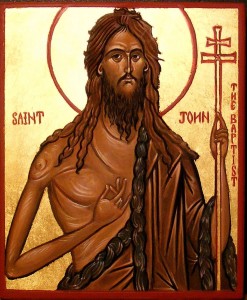
Finally – as we have done for the past few years, St. Paul’s Parish is hosting our friends from the local Masonic Lodge whom I mentioned earlier and whose custom it is to worship together on the Sunday closest to the feast of the Nativity of St. John the Baptist. Thus, we are using the lessons assigned to that feast not those of the usual Sunday lectionary, and singing songs which might seem to some more fitting for the season of Advent than for the middle of summer. The members of the Lodge do so because modern American Freemasonry regards both St. John the Evangelist and St. John the Baptist referring to them jointly as “the Holy Saints John of Jerusalem.”

Why, you may ask, would Masons, who insist that our fraternity is not a religious institution, thus venerate these saints? Why would Masons gather together in worship on this particular Sunday?

As every Mason knows, one of the symbols found in a lodge room is a certain point within a circle, bounded by two parallel lines, with the volume of sacred law displayed atop the circle. Christopher L. Hodapp, the author of the book Freemasons For Dummies, has suggested that this is one of the least understood Masonic emblems. On his internet blog, he writes:

The symbol is actually based on an old astrological and alchemical symbol. The point in the center represented the Earth, which was thought to be the center of the universe. The heavens were believed to spin around the Earth, represented by the circle. The two lines represented the summer and winter solstices, the longest and shortest days of the year. For thousands of years, these days were celebrated as pagan feast days all over the world, and they were especially important to farming societies, because they were the astronomical methods of determining planting seasons.

In about 300A.D., the [Christian] Church began to dedicate popular pagan feast days to the saints. June 24th, the longest day of the year, was declared St. John the Baptist day, while December 27th, the shortest day, was dedicated to St. John the Evangelist. Collectively, Masons refer to them as the Holy Saints John.

Operative Freemasonry was first developed when Roman Catholicism was the prevailing religion, and these feast days continued under the Church of England. It was common for guilds and other trade groups to adopt a patron saint or two. Some Masons picked both Saints John, and over the centuries Masons commonly celebrate their feast days with banquets. And curiously, even though Freemasonry today is non-denominational and non-sectarian, American Masons have retained these customs of old. ….

John the Baptist was zealous, while John the Evangelist was learned, and by picking both of them as patron saints, Masons symbolically united both passion and reason.

The symbol also shows the Volume of Sacred Law at the top. In Masonry, the point represents the individual, and the circle is the boundary of his actions. Taken as a whole, the symbol implies that a Mason should consult the sacred texts of his own religion to achieve the proper balance between passion and intensity on one side, and knowledge and education on the other. In other words, he should balance education, excitement and faith to effectively subdue his passions. In a way, it is a graphic representation of the conscience.

Zeal and learning, passion and reason, excitement and education … the effective blending of these supposed opposites into effective action and ministry … this is what is going on here at St. Paul’s Parish today.

It is all well and good to be zealous and passionate about the need to feed people, but to get it done people like Nick and the other Free Farmers’ Market leaders have to do the reasonable work, really the hard work of figuring out what’s needed, ordering it, stocking it, and organizing volunteers to actually get it done. The proper balance between passion and intensity on one side, and knowledge and education on the other, effectively accomplishes the mission of the church – people are fed.

It is all well and good to love to knit and want share what one makes with the excitement and intensity that our knitting circles display, but without someone to take on the job of learning where the shawls, the gloves and scarves, and the baby blankets are needed, and how to get them there, all that excitement and intensity goes nowhere. The proper balance between passion on one side, and knowledge and education on the other, effectively accomplishes the mission of the church – the ill are comforted and lonely seamen are kept warm.

Today, in commemorating St. John the Baptist, we honor the zealous, passionate, excited side of this equation; we honor the forerunners, the visionaries, the pioneers, the people who “dream dreams and see visions,” those who go to the mountain-top and cry out “Behold!”

It has been said of visionaries that what they do is make the untrue become true. Author Ken Zaretsky puts it this way:

If you say something you know isn’t true and just leave it at that, then you are a liar.

If you believe that untruth, then you are delusional.

On the other hand, if you say something you know isn’t true; then not only believe it but also make it true, you are a visionary! Visionaries are deserving of praise and accolades from friends, peers and the public.

There are fine lines between liars, delusional individuals and visionaries. After all, what is the difference between making something up and making something up?

The first difference is intent. A liar conjures an image. He or she might see it. He might get others to believe in it. But he doesn’t believe it himself. The liar has no intention to make anything happen.

Like the liar, the delusional person also has an image. He or she can see it and, unlike the liar, believe it. It’s possible that she can also get others to believe in it. But she doesn’t do anything beyond believing because, to the delusional person, the image already exists in reality.

A visionary has an image of the ideal. The visionary sees the image, believes it and gets other people to believe in it. Then the visionary works to make the image come to life.

Visionaries see and proclaim an inspired and inspiring positive picture of the future, with a clear sense of direction as to how to get there. They keep communicating the vision to create an energy that sometimes they, but more often others, use to bring their vision into physical reality. Nelson Mandela, for example, clearly held a positive vision of a racially harmonious South Africa during his 28 years in jail and helped bring it into reality peacefully – to the amazement of the world.

Visionaries inspire use to be better than we are and help us identify with what Lincoln called “the better angels of our nature.” This was the power of Martin Luther King’s “I have a dream” speech.

Visionaries often have the ability to see higher spiritual forces at work behind the scenes of events, and they align with the vision of these redemptive forces. Both George Washington and Winston Churchill spoke about the help they received from a “guiding hand.” Churchill said, “…we have a guardian because we serve a great cause, and we shall have that guardian as long as we serve that cause faithfully.”

Vision, it has been said, is an energy field that brings new realities into form. Visionaries tap into and transmit that energy to people, giving us a new sense of hope and confidence, helping us to believe in ourselves and work to create a better world.

More than twenty years ago I had a vision of the priesthood, a sense of call to the ministry of hope and confidence, to the work of creating a better world, to the gift of sharing with God’s people their times of joy and their times of misfortune and sorrow, to the privilege of presiding at our faith’s most significant acts of worship, and to the simple good fun of participating in all the small but meaningful ways the church forms community. I am very grateful for every minute of the twenty years that I have lived out that vision in this and other parishes, but let me be honest and tell you that after twenty years of managing tight budgets, chairing vestry meetings, rehearsing and solemnizing weddings, baptizing babies, leading bible studies, sitting beside hospital beds, and burying the dead … it’s time for a break. So I am also especially grateful for the opportunity to take these next several weeks of time away from the church.

I do so confident that this church will do just fine without me, that things will be (as I am wont to say) “Just peachy!” I know that they will be because our vestry, our lay leadership is a bunch of visionaries. They dream dreams and see visions and generate the energy make them come true. They are neither liars nor delusional, what they purpose they accomplish. They have dreamed a dream and seen a vision of a growing St. Paul’s Parish with and expanded and improved building, and they are going to see it accomplished. They have a clear sense of direction as to how to get there and over these coming weeks they will communicate that vision in way that I am sure will create the energy that they and you will use to bring that vision into reality.

Today, in commemorating St. John the Baptist, we honor the zealous, passionate, and excited leadership of the church; we honor the forerunners, the visionaries, the pioneers, the people who “dream dreams and see visions,” those who go to the mountain-top and cry out “Behold!”

The Vestry has begun closing its meetings with a prayer for vision attributed to Sir Francis Drake, the explorer who claimed North America on behalf of Queen Elizabeth the First and whose ship’s chaplain offered the first Christian worship on North American soil. I’m going to close my sermon today with that same prayer.

Let us pray:

Disturb us, Lord, when we are too well pleased with ourselves, when our dreams have come true because we have dreamed too little, when we arrived safely because we sailed too close to the shore. Disturb us, Lord, when with the abundance of things we possess we have lost our thirst for the waters of life; having fallen in love with life, we have ceased to dream of eternity and in our efforts to build a new earth, we have allowed our vision of the new Heaven to dim. Disturb us, Lord, to dare more boldly, to venture on wider seas where storms will show your mastery; where losing sight of land, we shall find the stars. We ask you to push back the horizons of our hopes, to push us into the future in strength, courage, hope, and love. Amen.

(This sermon is also posted at The Theology Diner)

Forever Young

My son graduated from seminary last week …. he will be ordained in a few more weeks.

My daughter is working on her degree in art ….

This song by Bob Dylan, but sung best by Joan Baez is for both of them, from me, from the bottom of my heart.

May God bless and keep you always
May your wishes all come true
May you always do for others
And let others do for you
May you build a ladder to the stars
And climb on every rung
May you stay forever young
Forever young, forever young
May you stay forever young.

May you grow up to be righteous
May you grow up to be true
May you always know the truth
And see the lights surrounding you
May you always be courageous
Stand upright and be strong
May you stay forever young
Forever young, forever young
May you stay forever young.

May your hands always be busy
May your feet always be swift
May you have a firm foundation
When the winds of changes shift
May your heart always be joyful
And may your song always be sung
May you stay forever young
Forever young, forever young
May you stay forever young.

Gnothach

“Gnothach” is the Irish Gaelic (Gaeilge) word for “busy” – “Táim gnothach” means “I’m busy.” This can be modified by prefixes such as “an-” meaning “very” and “ro-” which means “too”. “Táim an-gnothach” means “I’m very busy”; “Táim ro-gnothach” means “I’m too busy.”

The opposite of “gnothach” is “saor”. “Saor” can mean “free”, “cheap” or “off” (as in off from work, which is what I am today as I write this). The term for what Americans call “vacation” is “laethanta saoire”, which literally means “days free.”

Recently, I attended a conference for clergy anticipating sabbatical leave and our facilitator asked us to give up the use of the word “busy”. He suggested that it was a word which implied victimization! When one says, “I’m busy” there is an implication of negativity, as if one didn’t want to be doing the things that fill one’s day. (And, I must admit, that there are few of those sorts of things that fill my days … isn’t that true of all of us.) Most of what keeps us “busy” he argued are things we choose to be doing. And if we choose them, should we complain about them, should we be playing the victim because they are filling are day?

Rather, he suggested, we should abandon the word “busy” and instead describe our days as “rich and full.” I think he has a point … so even as I struggle to speak Irish (and it is a struggle!) I will abandon “busy” and “gnothach”.

Níl me gnothach; tá mo laethanta saibhir agus iomlán. (I am not busy; my days are rich and full.)

Preaching on Teen Suicide

The following is the text of an email I sent to some friends with whom I am part of an on-going internet community of some duration – an “email listserve” that has been in existence for several years.

This is long, but I have to write it down and share it with someone. And I apologize in advance for what I know to be offensive content below. It offended me – and I protested to the sender.

This morning I preached about the rash of recent gay teen suicides. I want to share the experience with you all. I preached ad lib with only a few notes.

I began reading John Donne’s Meditation XVII (“No man is an island, etc….”) and said that we had all been diminished recently by the suicides of Tyler Clementi (18 y.o. freshman at Rutgers), Asher Brown (13 y.o. middle school student in Houston), an unnamed 11 y.o. child in California, and Sladjana Vidovic (a Croatian immigrant student at a high school in Mentor, Ohio, age 16). Each of these children was driven to commit suicide because of bullying, teasing, oppression aimed at them because they were perceived as “different”, as outcasts. And the fault lies with each one of us because we have all participated in behaviour which has made such bullying permissible in our society. We have all sat by silently as jokes or political comments or gossip which was racist or sexist or heterosexist were uttered in our presence; we may even have told those jokes or made those remarks ourselves.

I then exegeted the lesson from Jeremiah and talked about how the Jews were the foreigners, the “other” in their exile in Babylon, and how although Jeremiah seems to be counseling assimilation, he is actually telling them to be proud of their heritage in a way that is respectful of those who are their oppressors, to pray and work for the welfare of the society in which they find themselves because in its welfare they will find their own wellbeing. And I noted how when they returned from exile, they hadn’t learned the lesson of what it is like to be “the other” in a strange society, how they had excluded the “Samaritans” from participating in the rebuilding of the Jerusalem temple and how the Jews continued, some of them even to this day, to practice religious intolerance and an exclusionary theology, noting particularly how it affected groups like women, gentiles, tax collectors, and the chronically ill (lepers) in Jesus’ day, and Palestinians today. I then moved on to the Gospel and focused on Jesus’s last words to Samaritan former leper – “your faith has made you well.”

I argued that it is our faith which can make our society well, if we will simply live up to it. Basically my message was “Stop it!” – do not in anyway participate in jokes, comments, conversations, that promote racism, heterosexism, sexism, or any other exclusionary ism. If you are with someone …who starts that kind of talk, tell them to stop it!

I made note of the fact that I had heard members of the congregation criticizing and making jokes about the President in the vilest and most racist of language, that I had heard men in the congregation make jokes about their wives or other women that were not fit to repeat, that I had heard women in the parish make jokes about gays and lesbians that were decidedly unladylike … and that I had said nothing when I had, but fair warning – no longer – if someone from now on says anything of that nature in my presence I will tell them “Stop it!”

I noted that in our Epistle Lesson, Paul warned Timothy of the power of words, of wrangling over words, and that’s basically what we have to deal with — the power of abusive, exclusionary words, of taunting and teasing and “making fun of” (a terrible euphemism if ever there was one). I made mention of James’s letter in which he notes that the tongue is a flame which can start a conflagration — and that is what we have – a conflagration of youthful suicides which result from words being spoken abusively, in a social climate which makes that acceptable behaviour. It is NOT acceptable and so we must stop it! So from now on, I will speak up and protest when I hear it. I will not do it myself … and I begged them not to do it and to speak up when they hear it.

Jesus told the outcast (the leper) that his faith had made him well – only our faith can make our society well – but that faith must be public and vocal – we must tell those who make an atmosphere of abuse acceptable through their racist, sexist, hetersexist jokes and snide remarks to STOP IT! And we must do it because that is the only way to be faithful to Jesus Christ!

That was my sermon, in a nutshell; it was longer, but that’s enough for here for now.

I expected a negative reaction from some, and I’m sure there was some. Mostly those who agreed with me told me as much, and those who didn’t avoided talking with me at all, even those very conservative members who usually do exchange pleasantries didn’t do so. Oh well….

Anyway, I came home … had lunch … checked my email.

So now I need to explain that we have a men’s group loosely affiliated with the church. It started as an attempt to create a men’s fellowship, but devolved into a poker and Scotch-sampling group and includes men whose families, for whatever reason, have left the Episcopal Church as well as members of the parish. This group meets on the 2nd Tuesday of the month and though I am usually unable to take part, I’m still on their email list. Tuesday is the next meeting and so several emails have been exchanged about where they are gathering, who’s hosting, the need to replenish the stock of various labels of Scotch, and so forth.

One of the men whose family are former members of the parish (now worshiping in a Southern Baptist church because of the couple’s very strong right-wing and Christian conservative feelings) … sent this email which I found in my in basket this afternoon:

Sorry guys, if any of you are offended by the attachment below, just couldn’t help it.

This will be my daily routine, through to 2012.

HOW TO START EACH DAY WITH A POSITIVE OUTLOOK

1. Open a new file in your computer.
2. Name it ‘Barack Obama’.
3. Send it to the Recycle Bin.
4. Empty the Recycle Bin.
5. Your PC will ask you: ‘Do you really want to get rid of ‘Barack Obama?’
6. Firmly Click ‘Yes.’
7. Feel better? GOOD! – Tomorrow we’ll do Nancy Pelosi.

Could there have been a more timely email, a better example of exactly what I was talking about? This offensive drivel was sent to about twenty men, mostly members of the parish, at least half of whom were in church this morning.

I sent this reply to the same recipients:

I am offended. This kind of nonsense is precisely what is wrong with this country. It comes from both sides of the political spectrum and it has to stop. This country and our society will only get worse if this kind of disrespect continues.

If anyone is tempted to send me anything of this nature, whether it be from the Left or the Right — Please don’t. And think about what you are doing and take my advice … don’t send it to anyone.

Stop this! Stop it now before this country sinks deeper into the abyss of incivility.

The sender very quickly sent a one-line email to the same list – “I apologize to everyone.” And I sent a quick one line, “Apology accepted. Thank you.”

It has to stop … it is this kind of incivility to those perceived as “other”, the demonizing of those that are different from ourselves, that has brought us to the point where 11 y.o. and 13 y.o. and 16 y.o. and 18 y.o. children are killing themselves because they are the targets of this sort of thing. It has to stop.

We have to stop it and we can only do that by standing up to it and demanding it stop.

Newer posts »