 There is an aphorism about preaching that says the preacher “must hold the Bible in one hand and the newspaper in the other.” This is often attributed to the influential Swiss theologian Karl Barth, whom Time Magazine in the 1960s called “the greatest living Protestant theologian.” Truth is, however, that he never really said it. What he actually said, in an interview with Time in 1963, was, “Take your Bible and take your newspaper, and read both. But interpret newspapers from your Bible.”[1] In other words, try to understand events in the world through the lens of Scripture and take guidance from it as you seek to live in this world.
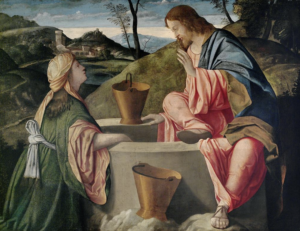
As I followed the news media the past few weeks, two stories stood out for me. One was the witness of the women who are the surivors of Jeffrey Epstein’s human trafficking enterprise. The other was the tale of the US Women’s Ice Hockey team who won the Olympic gold medal but were nonetheless made the butt of a joke by the president. It seemed to me that John’s story of Jesus’ long conversation with the Samaritan woman at Jacob’s well offers us a lens through which to view these news stories. So I started making notes for a sermon along those lines.
 Do you all know what a tort is? Tort … T-O-R-T … no E on the end; I’m not talking about those wonderful little German or Austrian pastries. A tort is a civil wrong that causes harm to another person, resulting in legal liability for the person who commits the wrong. You leave a puddle of milk on the floor of your grocery store knowing it’s there, then someone slips in it and injures themselves: you have committed a tort. You speed through a stop sign, collide with another car, and injure the driver: you’ve not only broken the law, you’ve committed a tort.
 Again this week as last, our first reading today is from the First Book of Kings and like last week’s, it is a prayer spoken by King Solomon. Last week, it was a private prayer spoken in a dream late at night. Today, it is a public prayer. As long as it was, this reading is just a small part of the dedicatory prayer that Solomon offered when the Temple was finished and consecrated. In it, Solomon asks an important question, “[W]ill God indeed dwell on the earth?”
 We have had more than enough of contempt,
 What does it mean to say “Jesus is Lord”? The question arises because of today’s dialog between Jesus and some of the Pharisees about the relative importance of the Commandments. Jesus responds to a lawyer’s question about the greatest commandment and then follows his response with a question about the lordship of the Messiah, the anticipated “Son of David.”
  Power and authority. These are the subjects of our lessons from Scripture this morning. Later this month they will figure as key concepts in a trial scheduled to begin in Fulton County, Georgia. That trial will focus on an alleged attempt to disrupt, even to stop, what we have come to call “the peaceful transfer of power.” Historian Maureen MacDonald wrote a few years ago:
 Come Holy Spirit, Comforter, Spirit of Truth,
 When my nephew, who’s now in his mid-40s, was about six years old, he was given a homework assignment that he found frustrating and he just didn’t want to finish it, but his mother made him sit down and do it rather than something else more to his liking. In his frustration, he blurted out, “I hate you!” My late sister-in-law responded calmly, “That’s too bad because I love you.” After a moment of reflection, my nephew amended his angry outburst: “I love you, too,” he said, “but I don’t like you right now.”
 Two things happened last Saturday.

