Occasional thoughts of an Anglican Episcopal priest

Category: Lectionary (Page 17 of 99)

Not Sheep, Not Slaves: Sermon for Easter 4, 7 May 2017

====================

A homily offered by the Rev. Dr. C. Eric Funston on the Fourth Sunday of Easter, May 7, 2017, to the people of St. Paul’s Episcopal Church, Medina, Ohio, where Fr. Funston is rector.

(The lessons for the service are from the Revised Common Lectionary: Acts 2:42-47; Psalm 23; 1 Peter 2:19-25; and St. John 10:1-10. These lessons can be read at The Lectionary Page.)

====================

It’s the Fourth Sunday of Easter and that means it’s “Good Shepherd Sunday.” And that means that clergy throughout the church have, for the last week, been scratching their heads thinking, “This again? What can I do this time with the sheep-and-shepherd simile?” But, I’m not among them. For three days this past week, the clergy of this diocese have been in conference with our bishop, with a retired seminary president, and with a retired cathedral dean exploring exactly what we understand our ordinations to the diaconate and to the presbyterate to mean. That has kind of taken my attention off the “Good Shepherd” metaphor.

In addition, tomorrow will be the twenty-seventh anniversary of the day the Bishop of Nevada laid his hands on my head and said:

Father, through Jesus Christ your Son, give your Holy Spirit to Eric; fill him with grace and power, and make him a deacon in your Church. (BCP 1979, Ordination of a Deacon, page 545)

I suppose the clergy conference and tomorrow’s anniversary may be why, as I studied today’s lessons, it is verses 19 through 21 of the second chapter of the First Letter of Peter, the words “For to this you have been called . . .,” that caught my attention rather than anything in the Gospel text, and focused my thoughts on Peter’s admonitions to patient endurance of wrongful suffering. Of course, Peter’s instructions are not particularly addressed to the clergy. The way in which our Lectionary is edited, the implication is that they are addressed to Christians in general and, in a broad and inchoate sort of way, they are.

In next Sunday’s epistle reading, we will be treated to some of the verses that precede today’s lesson; we will hear verses 2 through 10 in which Peter will address us as “newborn infants,” describe us as “living stones” being built into a “spiritual building,” and assure us that we are “a chosen race, a royal priesthood, a holy nation, [and] God’s own people.” What we did not hear today and will not hear next week and, in fact, never hear read in church on a Sunday as an official Lectionary reading are verses 11 through 18:

Beloved, I urge you as aliens and exiles to abstain from the desires of the flesh that wage war against the soul. Conduct yourselves honorably among the Gentiles, so that, though they malign you as evildoers, they may see your honorable deeds and glorify God when he comes to judge. For the Lord’s sake accept the authority of every human institution, whether of the emperor as supreme, or of governors, as sent by him to punish those who do wrong and to praise those who do right. For it is God’s will that by doing right you should silence the ignorance of the foolish.
As servants of God, live as free people, yet do not use your freedom as a pretext for evil. Honor everyone. Love the family of believers. Fear God. Honor the emperor.
Slaves, accept the authority of your masters with all deference, not only those who are kind and gentle but also those who are harsh.

And only then, after these introductory verses, does the selection we heard read today begin with a word edited out of our reading, “For it is a credit to you if, being aware of God, you endure pain while suffering unjustly . . . .” As true as those words may be, they are not addressed to you or to me; they are specifically addressed to aliens, exiles, and slaves. They are addressed to the marginalized and the oppressed; they are addressed to those who must endure injustice because they are powerless to do anything else. These are words of comfort to those who cannot escape oppression, a reminder of St. Paul’s words that “suffering produces endurance, and endurance produces character, and character produces hope, and hope does not disappoint.” (Rom 5:3-5) Certainly, we can learn from Peter’s words, but they are not addressed to us. We are not aliens, exiles, and slaves; we are not the marginalized or the oppressed; and we are not powerless.

The patient endurance of unjust suffering is not the life to which I was called as a deacon or as a priest, nor to which you have been called as a follower of Christ. As people who have power, and we do have power, we are called to do something about unjust suffering not simply endure it stoically or heroically.

I keep reading editorials and news analyses which assert that the outcome of the most recent US presidential election, the so-called “Brexit” vote of the electorate in the UK, and the rise of nationalist parties in Holland, France, and elsewhere in the European Union are the result of people rising up against an elite political class with regard to whom they have felt powerless. Well, I can’t speak to the situation in other countries, but I can call “Nonsense” on that assertion here in our own country. You and I and every other eligible voter in the United States are not powerless with respect to our elected politicians! We just aren’t!

What many voters in our country are is apathetic! What many voters in our country are is ill-informed! What many voters in our country are is disengaged! That’s not powerlessness; that’s surrender. Do you know what the percentage of eligible voters who actually bother to cast a ballot is? On average over the last 100 years, the turnout of registered, eligible voters in presidential elections is just over 55%. Expressed differently, that means that 45% of those who could have voted . . . didn’t. And the turnout in non-presidential elections is even worse. We are not a people without power; we are a people who have failed to exercise the power we have been given. We are not slaves patiently enduring unjust oppression; we are empowered people who have surrendered to political usurpation! When we do not exercise the power we are given, we “go astray like sheep.”

But, as Peter writes, we “have returned to the shepherd and guardian of [our] souls.” (1 Pet 2:25) We are followers of Jesus Christ who “calls his own sheep by name and leads them.” (Jn 10:3) Jesus who told us that on the last, great day, in his role as our shepherd, “he will separate people one from another as a shepherd separates the sheep from the goats . . . ” and to those who have truly followed him he will say, “I was hungry and you gave me food, I was thirsty and you gave me something to drink, I was a stranger and you welcomed me, I was naked and you gave me clothing, I was sick and you took care of me, I was in prison and you visited me.” (Mt 25:32,35-36)

In some metaphorical ways, we may be like sheep, but in truth we are not sheep. We are followers of Jesus Christ and, unlike sheep, we have the power to do all those things, the social power, the economic power, and the political power. We can, as our Free Farmers’ Market volunteers do, roll up our sleeves and distribute food to the hungry; as our Lay Eucharistic Visitors do, take time from our Sunday afternoons to call on sick and shut-in parishioners; as our greeters do, stand at the church door and welcome those unfamiliar to us. We can, as many of us do, give of our wealth to the church, to charities (such as the American Cancer Society, the SPCA, Let’s Make a Difference, Hospice of the Western Reserve, Project Learn, and many others), and to public institutions (such as PBS and NPR, the Medina Schools Foundation, and our universities’ and colleges’ alumni associations and foundations). And we can, as so few of our fellow citizens do, vote, participate in the political process informed by our Christian faith!

On that day 27 years ago tomorrow, the Bishop of Nevada said to me as every bishop says to those who stand before him or her to be ordained deacon:

As a deacon in the Church, you are to study the Holy Scriptures, to seek nourishment from them, and to model your life upon them. You are to make Christ and his redemptive love known, by your word and example, to those among whom you live, and work, and worship. You are to interpret to the Church the needs, concerns, and hopes of the world. You are to assist the bishop and priests in public worship and in the ministration of God’s Word and Sacraments, and you are to carry out other duties assigned to you from time to time. At all times, your life and teaching are to show Christ’s people that in serving the helpless they are serving Christ himself. (BCP, page 543)

We are not aliens, or exiles, or slaves; we are residents, and citizens, and politically empowered voters in one of the greatest nations on Earth. We have the political power to serve Christ himself ensuring that our country responds to “the needs, concerns, and hopes of the world,” that it serves the helpless, feeds the hungry, welcomes the stranger, houses the homeless, clothes the naked, and cares for the sick. If we truly follow Christ and live up to our baptismal promise to “strive for justice and peace among all people, and respect the dignity of every human being” (BCP, Holy Baptism, page 305), neither we nor anyone in our country need ever endure unjust suffering.

The idea that “a nation’s greatness is measured by how it treats its weakest members” is attributed to Mahatma Ghandi, the liberator of India, but he was not alone in expressing that sentiment. The anti-Nazi German pastor and theologian Dietrich Bonhoeffer is often quoted as saying, “The test of the morality of a society is what it does for its children.” Author Pearl S. Buck wrote, “[T]he test of a civilization is the way that it cares for its helpless members.” (My Several Worlds: A Personal Record, Pocket Books, New York:1954, page 337) And Vice-President Hubert Humphrey said:

The moral test of government is how that government treats those who are in the dawn of life, the children; those who are in the twilight of life, the elderly; and those who are in the shadows of life, the sick, the needy and the handicapped. (Remarks at the dedication of the Hubert H. Humphrey Building, Nov 1, 1977, Congressional Record, Nov 4, 1977, vol 123, p. 37287.)

The Book of Acts tells us that the earliest Christians devoted themselves to the fellowship and teachings of Christ and his apostles, that they ordered their small society so that any who had need were provided for, and that (as a result) they had the goodwill of all the people. Some of them were slaves, but we are not. We are neither sheep nor slaves, but we can follow the example of those early Christians and order our society so that the needy are cared for. We have the power, and we have made the promise, to do that.

In that service 27 years ago, as in every ordination service, the bishop offered this prayer:

O God of unchangeable power and eternal light: Look favorably on your whole Church, that wonderful and sacred mystery; by the effectual working of your providence, carry out in tranquility the plan of salvation; let the whole world see and know that things which were being cast down are being raised up, and things which had grown old are being made new, and that all things are being brought to their perfection by him through whom all things were made, your Son Jesus Christ our Lord . . . . (BCP, page 540)

It is through us, the followers of Jesus Christ, not as sheep nor as slaves, but as socially, economically, and politically empowered citizens of this great nation, that God accomplishes these things in our place and in our time.

“Truly I tell you,” the Good Shepherd will say, “just as you did it to one of the least of these who are members of my family, you did it to me.” (Mt 25:40)

Amen.

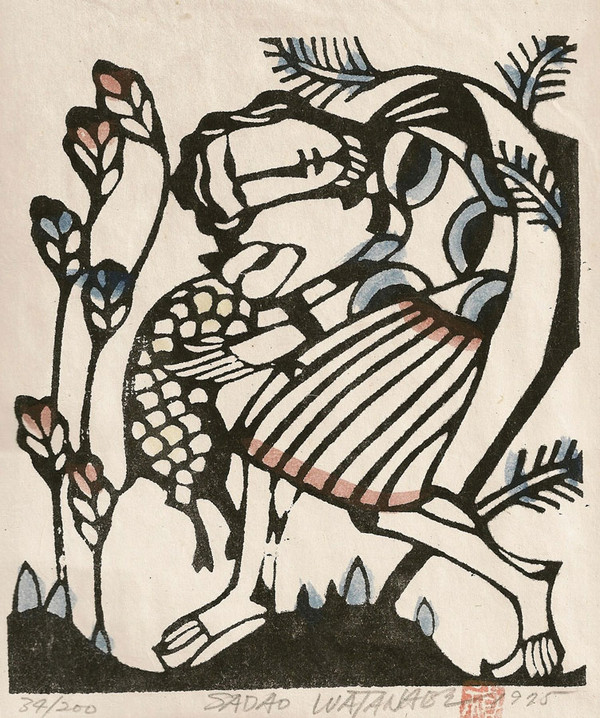
(The illustration is “The Good Shepherd” (1975) by Sadao Watanabe (1913-1996), a stencil print in the Mingei style.)

====================

Father Funston is the rector of St. Paul’s Episcopal Church, Medina, Ohio.
Our Door-Blowing-Open God: Sermon for Easter 2, April 23, 2017

====================

A homily offered by the Rev. Canon A. Brad Purdom III, Canon for Congregations in the Episcopal Diocese of Ohio, on the Second Sunday of Easter, April 23, 2017, to the people of St. Paul’s Episcopal Church, Medina, Ohio, while Fr. Eric Funston, rector, was attending his grandson’s baptism in Kansas.

(The lessons for the service are from the Revised Common Lectionary: Acts 2:14a,22-32; Psalm 16; 1 Peter 1:3-9; and St. John 20:19-31. These lessons can be read at The Lectionary Page.)

====================
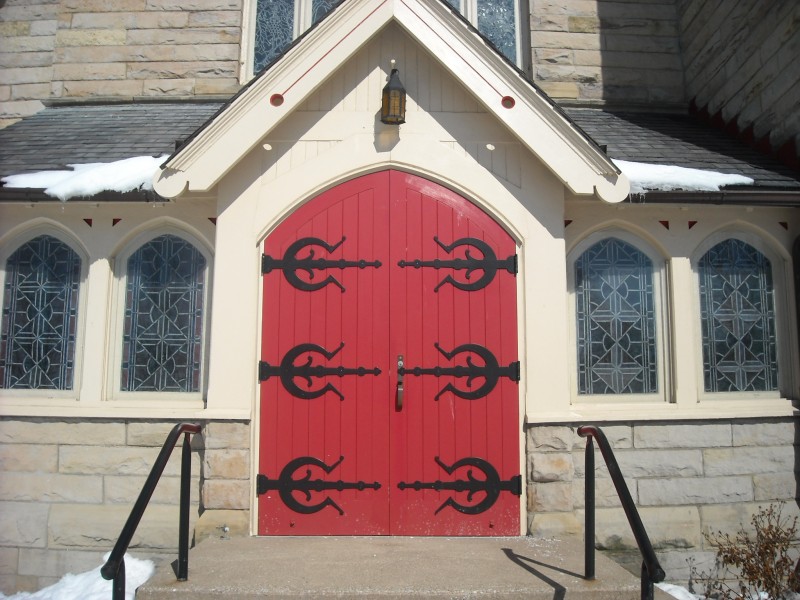
Like many (perhaps most) Episcopal churches, my first congregation had a set of large red doors on the front of their building. But also like many Episcopal churches, no one ever used them because all the members knew how to enter through a more convenient door near the parking lot.
And because they were never used, again like many Episcopal churches, the front doors had become stuck over the decades. They no longer opened at all.

But it got really hot in there, so one day when I was alone in the church, I threw my weight against those doors and busted them open. I remember a loud, frightening crack, but, lucky for me, they were more stuck than broken.

The next Sunday I opened those doors up as wide as they would go, and sure enough, the temperature dropped immediately as the morning breeze easily flowed. And the church looked . . . open for business. Win/win.

A few minutes later I met the choir at the back of the church next to those beautiful open doors, and headed down the aisle to begin the service. At the front, I turned around to face the congregation and proclaim the Opening Acclamation: “Blessed be God: Father, Son, and Holy Spirit, and blessed be those open doors!”

And you know what I saw: Two doors closed and locked. Two well-intentioned ushers had done their job . . . ensuring that we would not be in any way disturbed by that pesky world out there.

In the years since, I’ve come to think differently about what happened that morning than I did that day. That congregation had done exactly as we had taught them to do: made sure our little church was as it should be: snug . . . as a bug . . . in a rug: safe behind closed doors, a retreat from the distractions and dangers of the world.

This is the third of Jesus’ resurrection appearances in John’s Gospel. The first was to Mary at the tomb. The second was later that same day, behind locked doors, to everyone except Thomas. And this morning’s, the third, one week later and again behind closed doors.

But . . . this morning’s account is the last time in John’s Gospel that we see them hiding behind closed doors. It is the last time we see them retreating from the world, the last time we see them controlled by fear; in fact, the last time we see them anything but fully engaged in a wonderful though often dangerous world.

What happened? I think what happened was that moment so reminiscent of the Creation story when God breathed life into the human formed of mud from the river; the moment when Jesus breathed on his friends and said, “Receive the Holy Spirit.” For me that is the moment when the doors of that room, and of the disciple’s hearts and minds, blew wide open.

It is, of course, that same intimate breath of God that Jesus still breathes into us. Just as it was that same intimate breath of God that blew open the locked doors of that upper room once and for all and, I believe, is blowing open many once stuck sets of big red doors today.

The truth is, God has always been in the door-blowing-open business. And I think that’s exactly what God is doing today in the Christian church of western culture. You know, of course, that it is not just the Episcopal church that has lost its preeminence over the last fifty years. It is the entire Christian church in the developed Western world.

I have actually come to see that as a mostly good thing: not a curse but a corrective. I’m not saying there aren’t lots of other things going on that affect the relationship between church and culture, or that God is in any way punishing us. I’m just saying we’ve most certainly played our part.

The truth is that we did teach each other that our faith should be lodged behind locked doors and was private.

We did take faith formation of our children out of our homes and put it into the thirty minutes a week, or a month, they got in Sunday School.

We did develop a spirituality that understood the church’s purpose as providing a quiet, personal space to recharge enough to survive seven more days in the cold, hard world before getting back to some “us-time” among friends.

In fact, we did go down that kind of path so far and for so long that most of us didn’t even notice that so many of our big red front doors no longer opened. Talk about a metaphor!

But I said before that the breath, the Spirit, of God has always been in the door-blowing-open business. And I think we do notice those things now. I am confident your front doors open easily and wide!

And so do most of the front doors I encounter these days as I go to a different Diocese of Ohio church almost every week. I really do feel fresh breezes blowing through many of our churches.

Increasingly, everywhere I go, I see more and more of us getting that the church isn’t what happens to us in here nearly so much as it is what happens through us out there: as open-hearted, overtly Christian, people in the world.

The Spirit of God is breathing in and through us right now, and I believe American churches of most types are rediscovering our true purpose: to work alongside God in the world, restoring all people to unity with God and each other in Christ.

We can get all angry and judgmental with our non-Christian culture if we want to, but I think that is counterproductive. The church must always respond to the culture of its time and place.

That is what Jesus made possible for the disciples that morning when he breathed and filled them with the Holy Spirit. And that is what Jesus makes possible for us as he breathes upon us and fills us with that same Spirit again and again.

====================

Canon Purdom is the Canon for Congregations of Episcopal Diocese of Ohio.

Act Three (Pt 2): Monstrous Relief – Easter Day 2017

====================

A homily offered by the Rev. Dr. C. Eric Funston at the Festival Eucharist of the Resurrection on Easter Sunday, April 16, 2017, to the people of St. Paul’s Episcopal Church, Medina, Ohio, where Fr. Funston is rector.

(The lessons for the service are from the Revised Common Lectionary: Jeremiah 31:1-6; Colossians 3:1-4; Psalm 118:1-2,14-24, and St. Matthew 28:1-10. These lessons can be read at The Lectionary Page.)

====================

Make no mistake: if He rose at all
it was as His body;
if the cells’ dissolution did not reverse, the molecules
reknit, the amino acids rekindle,
the Church will fall.

It was not as the flowers,
each soft Spring recurrent;
it was not as His Spirit in the mouths and fuddled
eyes of the eleven apostles;
it was as His Flesh: ours.

The same hinged thumbs and toes,
the same valved heart
that – pierced – died, withered, paused, and then
regathered out of enduring Might
new strength to enclose.

Let us not mock God with metaphor,
analogy, sidestepping transcendence;
making of the event a parable, a sign painted in the
faded credulity of earlier ages:
let us walk through the door.

The stone is rolled back, not papier-mache,
not a stone in a story,
but the vast rock of materiality that in the slow
grinding of time will eclipse for each of us
the wide light of day.

And if we will have an angel at the tomb,
make it a real angel,
weighty with Max Planck’s quanta, vivid with hair,
opaque in the dawn light, robed in real linen
spun on a definite loom.

Let us not seek to make it less monstrous,
for our own convenience, our own sense of beauty,
lest, awakened in one unthinkable hour, we are
embarrassed by the miracle,
and crushed by remonstrance.

I love that poem, John Updike’s Seven Stanzas at Easter from the collection Telephone Poles and Other Poems. I have read it here before and, doubtless, I will read it again.

Only a poet like Updike could use the word monstrous to describe the Resurrection of Christ and, in spite of its shock value, or perhaps because of it, it is the perfect word, an ambiguous word that captures the essence of the entire Triumphal Entry – Passover Supper – Crucifixion – Resurrection event, the three-act drama of redemption which we began to remember on Palm Sunday.

Monstrous can, and usually does, mean something like “frightful or hideous; extremely ugly; shocking or revolting; awful or horrible,” and those are certainly good words to describe the way the people of Jerusalem turned on Jesus, the way his disciple Judas betrayed him, the way his other followers denied and abandoned him, the way the authorities, both Jewish and Roman, abused and killed him, mocking, scourging, and finally crucifying him. It was all monstrous; there’s no doubt about that!

Monstrous, however, can also mean “extraordinarily great; huge; immense; outrageous; overwhelming.” And those are superlative ways to describe the fact of Christ’s Resurrection from the dead! It is a huge thing! It is immense, outrageous, overwhelming! Yes, the Resurrection is monstrous!

There are two people who are hardly ever thought of in all of this three-part drama, in all the majesty of Holy Week and Easter: one of them is mentioned briefly only by John in his story of Jesus’ Crucifixion; the other isn’t named at all. I refer to Mary and Joseph, Jesus’ mother and foster father.

Of course, we know nothing of Joseph during Jesus’ adult ministry; after that event in the Jerusalem Temple when Jesus was about 13, Joseph is never again mentioned in the Gospels. Some suppose this is because he had passed away, but I like to think that he was just back home in Nazareth working the family business, doing carpentry or carving stone, making tables and chairs or building homes, keeping the family provided for so that Jesus could go about his ministry and Mary could accompany him.

Mary is mentioned in John’s story of the Crucifixion as standing at the foot of the cross and being entrusted by Jesus to the disciple whom he loved. And the legend from which we get the 14th Station of the Cross and Michelangelo’s exquisitely beautiful Pieta is that when his body was removed from the cross she held him, dead, in her arms. But there is no mention of her or of Joseph at Jesus’ burial, nor are they mentioned in any of the accounts of Christ’s post-resurrection appearances.

That omission, for I am sure that is what it is, an omission, disturbs me. Two weeks ago was the 59th anniversary of my father’s death at the age of 39. I am now about the age his mother and father, my grandparents, were when he died. One of my clearest memories of childhood is his funeral. I remember how, as we were leaving the graveside, my grandparents hung back, how they could not step away from nor turn their backs on the grave that held their child’s lifeless body. When, at last, they accepted my Uncle Scott’s physical encouragement to do so, my grandmother said to my mother, “A mother should not outlive her child.” She would know that feeling again just a few years later when my Uncle Scott died of cancer.

And own my mother would know it, as well, when in 1993 my only sibling, my older brother Rick, died of brain cancer. I vividly remember doing exactly what my uncle had done, physically moving my mother and stepfather away from the grave, the grave they could not leave on their own. Later that day, my mother said to me, “You’re grandmother was right. A parent should not outlive her child.”

Having seen my grandparents and my parents at the graves of their children, I cannot believe that Mary and Joseph were not there when the stone was rolled into place, when Jesus was buried in that borrowed tomb.

Updike’s portrayal of the Resurrection and his admonition to us, “Let us not seek to make it less monstrous,” so aptly describe the entire event of Holy Week and Easter, because we cannot appreciate the overwhelming wonder of the Resurrection, this third act of the redemption drama, without taking into account the first two acts, all of the horror and ugliness they portrayed: Judas’ betrayal, the other disciples abandonment, Peter’s denial, the trial before Pilate, Christ’s scourging and humiliation, his bitter agony on the Cross, his final self-emptying in death, and his burial. It is all monstrous; painful and ugly and awful in the first sense of that wonderfully ambiguous adjective. And I cannot believe that his parents were not there, did not experience the whole monstrous lot of it!

And, just as I am puzzled by the absence of almost any mention of Mary and Joseph in the narrative of Christ’s death and burial, and I am astounded that there is no allusion to them in the Gospel accounts of that first Easter morning or any time after his Resurrection! The only word about either of them is in the first chapter of the Book of Acts and, again, it’s only Mary who gets mentioned. Luke, the author of Acts, says that following Christ’s Ascension forty days after his Resurrection the apostles “were constantly devoting themselves to prayer, together with certain women, including Mary the mother of Jesus, as well as his brothers.” (Acts 1:14) That’s it, that one mention! I find that astonishing!

Apparently so have many Christians throughout the ages, because there is an extra-biblical tradition that the Virgin Mary was the first person to witness our Lord’s Resurrection. The Golden Legend, a medieval collection of stories about the saints, says that the first appearance of the resurrected Christ on Easter Day was to the Virgin Mary:

It is believed to have taken place before all the others, although the evangelists say nothing about it.. . . . [I]f this is not to be believed, on the ground that no evangelist testifies to it . . . perish the thought that such a son would fail to honor such a mother by being so negligent! . . . Christ must first of all have made his mother happy over his resurrection, since she certainly grieved over his death more than the others. He would not have neglected his mother while he hastened to console others.

St. Ignatius of Antioch (1st C.) claimed it was so, as did St. Ambrose of Milan (4th C.), St. Paulinus of Nola (4th C.), the poet Sedulius (5th C.), St. Anselm of Canterbury (11th C.), St. Albertus Magnus (13th C.), St. Bernardino da Siena (15th C.), and the bible scholar Juan Maldonado (16th C.) More recently, the late Pope John Paul II, in 1997 expressed his opinion that Mary “was probably the first person to whom the risen Jesus appeared.” (Gen. Aud., Wednesday, 21 May 1997)

We live through this three-act drama every year in a set series of events: triumphal entry on Palm Sunday, last supper and then the prayers at Gethsemane on Maundy Thursday, the crucifixion on Good Friday, weeping at the tomb on Holy Saturday, and then – of course – our liturgy and our hymns encourage us to express joy on Easter morning. In Matthew’s Gospel we are told that Mary Magdalene and the other Mary ran from the tomb “with fear and great joy,” but in our reading this morning from John a weeping Mary Magdalene, upon recognizing her risen teacher, literally clings to his feet in prostrate relieve; I wonder if that might have been the more common reaction of Jesus’ disciples and parents.

I believe that the legends and early fathers and the late pope are right, that the Risen Christ appeared to Mary and Joseph, as well as and probably before the eleven apostles and their friends, and that they would have been profoundly shaken, perhaps overwhelmingly frightened, and maybe eventually greatly reassured. But I’m not so sure that joy would be the best description of their initial reaction; perhaps the closest they might have come would have been relief.

We remember the three-act drama, as I said, in an orderly fashion. But if we know one thing about human beings, it is that we are not orderly creatures.

It may seem odd, but in just a few days, the Daily Office Lectionary will put us back to the beginning of Lent. At the end of the second week of Easter this year, the Daily Office gospel reading will be about Jesus’ temptations in the desert following his baptism.

That’s not odd, at all, really. Our spiritual life, like our emotional life, follows no particular schedule, no orderly progression. Elizabeth Kubler-Ross outlined five stages of grief – denial, anger, bargaining, depression, and acceptance – and people often think they follow an orderly progression, just like our Holy Week and Easter celebrations. But clinical experience has shown that a grieving person does not move neatly through them as if they were rungs on a ladder. One may move from denial to anger to bargaining and then return to denial; one may skip a stage only to return to it later; one may spend a good deal of time in one stage and only a short while in another. There is no orderly progression and I can well imagine that Mary and Joseph and the apostles and the women at the tomb were all experiencing that sort of emotional bouncing about, an emotional roller coaster the like of which probably none of us have ever known.

Our spiritual lives are the same. As one works through the process of enlightenment, of salvation, of spiritual growth, of whatever-one-calls-it, one does not follow a schedule. We may move back to an earlier stage, revisit issues we thought we’d dealt with.

St. Paul urged his friends in the church at Caesarea Philippi to “work out your own salvation with fear and trembling; for it is God who is at work in you, enabling you both to will and to work for his good pleasure.” (Philip. 2:12-13) Nowhere does Scripture promise that this work will be neat and tidy. If anything, the witness of Scripture is that spiritual and emotional growth is a messy affair.

That is why I suggest that the closest the first witnesses to Jesus’ Resurrection might have come to joy would perhaps better be described as relief. The dictionary defines relief as “alleviation of pain, as the easing of anxiety, as deliverance from distress.” This is an appropriate experience and emotion for Easter Day, profound relief.

I think the joy comes later in the Easter Season and that it comes later in life as we live out our Easter faith. But in the immediate aftermath of the monstrous-ness of Holy Week, here in the third act of the drama of redemption, in the wake of the horrible ugliness of betrayal and death that occurred in the first two acts, one may simply not be ready to be jubilant and happy. In the face of our own sinfulness and spiritual dysfunction, in the reality of our own messy spiritual lives, we may not be ready for joy and gladness. But the fact of Christ’s Resurrection relieves us of grief and sorrow; it relieves us of sin and death.

The experience and impact of Easter Day is one of profound, overwhelming, (one might even say) monstrous relief.

Perhaps that is why Jesus stuck around for forty days, to continually reassure and sustain the disciples in their relief from fear and sorrow and grief, so that they could move into joy and gladness as time went on. Perhaps that is why in producing the third act of the drama of redemption the church offers not a single day, but a season of fifty days, so that as it progresses we can . . . like Mary and Joseph, like Peter and the disciple whom Jesus loved, like all the apostles . . . move from shock into relief, from relief into joy, so that it provides a pattern with which we can handle the inevitable losses in our lives.

As life goes on and as the victory of life over death sinks in, Easter relief will grow into Easter joy, something that propels us toward action and compels us to invite others into the Resurrected life of our Risen Lord. As Christians, we have access through the relief of Christ’s Resurrection into a joy that is unshakable – for joy is really not an emotion; it is a virtue. Easter joy does not mean being happy all the time or being fine when times are difficult; Easter joy means being sustained by the power of the Resurrection.

What Easter means is that in the depths of our being, despite the circumstances we may face, despite any fears we may have, despite whatever may be tearing up our souls, despite whatever sin or spiritual malaise we may be suffering, despite whatever disorderly messes our spiritual lives may be in, we are able to get through them, to let go of them, and to find relief and eternal life in the Resurrected Christ, a life into which we invite others.

John tells us that on that first Easter morning, when Mary Magdalen fell at her Risen Lord’s feet, he admonished her, “Do not hold on to me; I am ascending to my Father.” It doesn’t sound to me like this woman who had just been grieving at his tomb was expressing joy, nor that Jesus’ was encouraging it. What I hear is Jesus offering comfort and relief.

It has been said that joy comes from letting go – letting go of our attachments, letting go of any thoughts that the present moment should or even could be different than it is, letting go of our expectations. Joy is the virtue of celebrating the present, of living in the moment, something to which we come through a process of detachment and release, something that we like Mary Magdalene let go of the old Jesus, the Jesus who died on the cross, and follow the now-Risen and ascended Jesus, “the pioneer and perfecter of our faith, who for the sake of the joy that was set before him endured the cross, disregarding its shame, and has taken his seat at the right hand of the throne of God.” (Heb. 12:2)

Resurrection Day is not the end of the process; it is the beginning. “Do not be afraid,” Jesus said to Mary Magdalen. In John’s Gospel, Jesus tells her not to hang on to him. In both gospels the message is, “Let go” – let go of me, let go of your fear.

Easter Day brings relief, overwhelming relief! Through that relief we are able to let go, to release our fears, our griefs, our worries, and our sorrows with absolute abandon, to be completely freed of our sinfulness! In letting go as the Easter Season and as our Easter faith progress, we are able to work out our salvation, for it is God who is at work in us, and ultimately find joy, unutterably ecstatic joy, huge, overwhelming, outrageous joy into which we are compelled to invite others!

Make no mistake: if He rose at all
it was as His body . . .
Let us not seek to make it less monstrous!

Alleluia! Christ is risen!

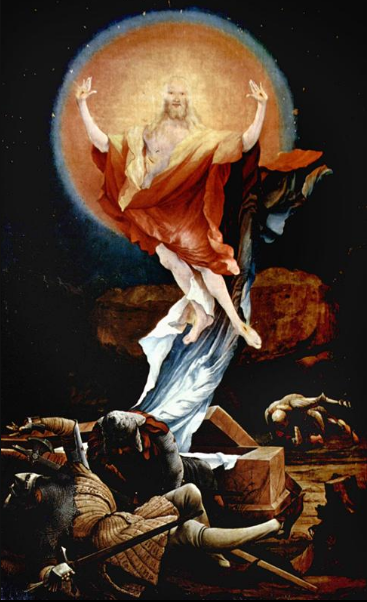
(The illustration is The Resurrection Of Christ (Right Wing Of The Isenheim Altarpiece) by Matthias Grünewald, c.1512–16)

====================

Father Funston is the rector of St. Paul’s Episcopal Church, Medina, Ohio.

Act Three (Pt 1): Fully Human – Easter Vigil 2017

====================

A homily offered by the Rev. Dr. C. Eric Funston at the Great Vigil of Easter, Saturday, April 15, 2017, to the people of St. Paul’s Episcopal Church, Medina, Ohio, where Fr. Funston is rector.

(The lessons for the service are from the Revised Common Lectionary: Genesis 1:1-2:4a; Exodus 14:10-31,15:20-21; Proverbs 8:1-8,19-21,9:4b-6; Zephaniah 3:14-20; Psalm 114; Romans 6:3-11; and St. Matthew 28:1-10. These lessons can be read at The Lectionary Page.)

====================

Two weeks ago, the Sunday lectionary treated us to the entire long Gospel lesson of the story of Jesus’ raising of Lazarus and then last week the Daily Office lectionary repeated it in smaller bits over the course of several days. Last Sunday I suggested that Holy Week and Easter can be conceived as a three-act drama to which the Triumphal Entry of Palm Sunday is an overture.
The Lazarus story, like last Sunday’s Gospel, is part of that overture, the introduction to the three-act drama of celebration in which we have participated this week and in which we have come, this evening, to the third and final act. Lazarus has been much on my mind as we have prepared for this Easter celebration and for the baptisms we have just performed. I believe the story of Lazarus’ raising has much to teach us about what we have done here tonight in this third act, this Baptismal Vigil, this liturgy of welcoming and inclusion.

Lazarus was the brother of Mary and Martha of Bethany; they are a family which figures prominently in the Gospels as friends of Jesus. They are clearly people who believe in Jesus and in his mission, but their belief is much, much more than simply signing on to his program, a new approach to religion. This family really seems to know Jesus; he apparently stayed with them on several occasions. He lodged with them, ate with them, taught in their home. When word is sent to Jesus that Lazarus is ill, Lazarus is described to him as “he whom you love.” (John 11:3) Lazarus and his sisters are close to Jesus; they are practically family, may even be family.

As the story of Lazarus raising is told, the family is described as accompanied by “Jews.” That has always struck me as a bit odd. After all, aren’t they all Jews? Mary, Martha, Lazarus, Jesus, the whole lot of them? Of course they are! So many scholars suggest that we should better understand John’s term Ioudaiou to mean “Judeans,” that is people native to the Jerusalem area; these scholars suggest that Mary, Martha, and Lazarus, like Jesus, were Galileans who had moved to Judea and been accepted into this southern community. This strengthens the suggestion that they may have been members of Jesus’ extended family.

Next, when both of the sisters greet Jesus (Martha’s greeting is earlier in the story), the very first thing each says is, “If you had been here, he wouldn’t have died.” (John 11:21 & 32) Not “Hi, how are you?” Not “Welcome back.” Not “I’m so sorry we have to tell you.” What the sisters say is not really a greeting; it’s an angry, accusative confrontation. “You could have prevented this!”

We’re told that Jesus’ response to this is that he is “greatly disturbed in spirit and deeply moved.” That’s a fine translation, but it’s also a bit misleading. The Greek word rendered “disturbed” very literally means he “snorted with anger”; and the word translated “deeply moved” means “stirred up” and implies a certain physicality, not simply an emotion. Jesus response to the sisters’ confrontations, to Lazarus’ death, to the whole situation is to become indignant and sick to his stomach.

The Lazarus story contains the shortest verse in the New Testament, famously rendered in the King James Version with only two words, “Jesus wept.” Some of the Judeans, John tells us, interpreted this as a sign of Jesus’ love for Lazarus; “See how he loved him!” they said. While I’ve no doubt that that is true, I suggest that, since John describes Jesus as angry and physically sick, we might consider another way to understand what is happening in this story.

We have just baptized four children and, together with them, we have affirmed the Baptismal Covenant beginning with a recitation of the Apostle’s Creed in which we will claim that Jesus, the Son of God, was “conceived by the power of the Holy Spirit and born of the Virgin Mary” (BCP 1979, p 304). In the Nicene Creed, which we recite most Sundays during the Holy Eucharist, we go further and declare that he “became incarnate . . . and was made man,” that is, that he became a flesh-and-blood human being. (BCP 1979, p 358). In the Definition of Chalcedon, which you can find on page 864 of the Prayer Book, the church goes even beyond that and asserts its conviction that Jesus is “truly [human] . . . like us in all respects, apart from sin.”

I believe that standing before that tomb where his beloved friend Lazarus had been buried four days earlier, feeling the anger and frustration of his close friends Mary and Martha, surrounded by Judeans muttering “couldn’t he have prevented this,” and perhaps physically exhausted from traveling from the other side of the Jordan valley where he was when he got the news, Jesus’ humanity hit him like a ton of bricks. In that moment, everything that it meant to be human came crashing in on him: the way human beings settle for easy answers, half-truths, and superficial relationships; the injustice, oppression, and exploitation we impose on one another; the pain, rejection, hunger, and war we endure . . . but, also, the love, friendship, community, family, support, and every other good thing about being a human being; it all come together in that moment standing at that grave.

Why do I think that? Because that’s what I feel every time I stand at a grave. The first time I did that, I was 5-1/2 years old. I remember standing between my mother and my paternal grandmother watching two members of the US Army fold the flag that had draped my father’s coffin, feeling loss, grief, anger, confusion, and emotions I couldn’t even name. But there was also the love of family, pride in my father’s military service, a sense of community with extended family and friends, all the comfort that comes from our common humanity. And every time I have stood beside a grave, I have felt that again, and I can surely imagine that our Lord experienced something very like that. No wonder Jesus – the sorrowful-but-also-angry and stirred-up Jesus, the knowing-he-too-might-soon-be-dead Jesus, the fully-human, like-us-in-all-respects Jesus – wept.

We should feel that same way when we welcome a new member into the household of God through the Sacrament of Baptism. Symbolically, baptism is burial; in the oldest tradition of the church, full immersion baptism, we go down under the water in the same way a body is buried in the earth, then we come up out of the water as Lazarus came from his tomb, as Jesus came from his grave. Baptism is death, burial, and restoration to life all encapsulated in one short liturgical act. As St. Paul asks in his letter to the Romans which was read just a few minutes ago, “Do you not know that all of us who have been baptized into Christ Jesus were baptized into his death?” The Prayer Book says in the blessing of the baptismal water, “In it we are buried with Christ in his death.”

St. Paul’s assurance that “if we have been united with him in a death like his, we will certainly be united with him in a resurrection like his,” is echoed by the Prayer Books bold promise that by baptism we share in Jesus’ resurrection, and that “through it we are reborn by the Holy Spirit.” (BCP 1979, p 306) As Jesus called for Lazarus to be unbound from his funeral wrappings, as Jesus himself rose and set aside his shroud, through Holy Baptism our Lord calls us “from the bondage of sin into everlasting life” (ibid), into a new life of full humanity joined with those whom the Psalmist describes as having “clean clean hands and a pure heart, [those] who have not pledged themselves to falsehood nor sworn by what is a fraud, [those who] shall receive a blessing from the Lord and a just reward from the God.” (Ps 24:4-5)

The Creation story in Genesis tells us that “God created humankind in his image, in the image of God he created them; male and female he created them.” (Gn 1:27) The story of the Fall reminds us that somehow that divine likeness has been marred, that on our own we fail to live up to that image; we fail to fully live up to the potential God created in humankind. Through baptism, the divine image is restore; through our baptism into the life, death, and resurrection of Jesus Christ, a process of transformation begins and God restores us to who and what we were meant to be – fully human.

When we baptized these children, we asked them and their baptismal sponsors (and we asked ourselves) some questions which are taken directly from the Apostle’s Creed, to which I referred earlier. These questions began with the words, “Do you believe . . . .”

A few years ago a colleague of mine said that he had once asked his congregation, when reciting the Nicene Creed, to say “We trust in” instead of “We believe in” since the original Greek could have been translated either way. He said he wondered if the church would be less fragmented if we had used “trust.” He suggested that there might have been far less of, “You don’t believe exactly what I believe, so I’m out of here,” or, “You don’t believe exactly what I believe, so you are out of here.” When we ask those questions of baptismal candidates and their Godparents, when we say the creeds ourselves, are expressing a deep affirmation of community whether we say, “We believe in . . .” or “We trust in . . .” Maybe we don’t “believe” exactly the same things that others here believe, but we all trust in the same God.

In that same conversation, another priest objected to what he called the distinction between “faith as trust and faith with content.” “It’s always struck me as a strange distinction,” he said. “If, for example, faith as trust is about relationship [and not about content], it is like someone saying to a prospective marriage partner, ‘I love you and I want to marry you, but I’m not certain who you are.’” I suggested to him, however, and I suggest to you now that this distinction really doesn’t exist, that faith as trust or as relationship necessarily implies and includes “faith with content.” One cannot place trust in another person, such as the Father, the Son, and the Holy Spirit named in the Creed, without assenting to that person’s existence and properties; to say, “I trust you” or “I love you” and not also agree that you exist makes very little sense.

This is why we ask those questions of baptismal candidates. When we say, “Do you believe in” the three Persons of the Holy Trinity, we are not merely asking if the candidates (and the congregation who join them in answering) are assenting to certain doctrines about them; we are asking if they claim to be in a relationship of trust and love with God the Holy Trinity, and through God with the full community of human beings whom God loves and whom God has redeemed in all that long salvation history that we have heard read from the Hebrew Scriptures this evening. When we baptized these children, when we baptize any new member of the Christian community, we recognize them as part of that fully human community whom God invites to “lay aside immaturity, and live, and walk in the way of insight” (Prov 9:6), whom God promises to save, and gather, and bring home, and restore. (Zeph 3:19-20)

That full human community relationship, I believe, is why Jesus wept. To be sure, he grieved the death of his friend Lazarus, but he knew he was about to do something to change that; there was no reason to cry about that. But that in-rushing crash of realization of what it is to be a human being, of what it is to be fully human, that is enough to make anyone cry. The story of the raising of Lazarus is a story about Jesus’ full humanity, the full humanity he shares with and promises to us, the full humanity which gathered with friends and family at the Last Supper in the first act of this drama of redemption, the full humanity which was arrested and brutalized and crucified in the second act, the full humanity whose Resurrection we celebrate in this, the third act, the feast of Easter. It is into that Easter promise that we have baptized Kadence, Bryce, Hadley, and Joseph this evening. And that is why the Lazarus story figures so prominently in the church’s preparations for Holy Week and Easter, part of the overture of this three-part drama of redemption!

In the words of a popular Franciscan blessing, let us pray that, as these children grow into the full humanity into which they are initiated today, God will bless them with discomfort at easy answers, half-truths, and superficial relationships, so that they may live deep within their hearts; that God will bless them with anger at injustice, oppression, and exploitation of people, so that they may work for justice, freedom, and peace; that God will bless them with tears to shed for those who suffer from pain, rejection, hunger, and war, so that they may reach out their hands to comfort others and turn their pain into joy; and that God bless them with enough foolishness to believe that they can make a difference in this world, so that they can do what others claim cannot be done, to bring justice, kindness, and love to all.

As they have been buried with Christ, they have begun to share in his Resurrection; may God bless them with the gift and the commission to be, like Christ, fully human. Amen.

====================

Father Funston is the rector of St. Paul’s Episcopal Church, Medina, Ohio.

Intermission: We Cannot Know – Holy Saturday 2017

====================

A meditation offered by the Rev. Dr. C. Eric Funston on Holy Saturday, April 15, 2017, to the people of St. Paul’s Episcopal Church, Medina, Ohio, where Fr. Funston is rector.

(The lessons for the day are from the Revised Common Lectionary: Lamentations 3:1-9, 19-24; Psalm 31:1-4,15-16; 1 Peter 4:1-8; and St. Matthew 27:57-66. These lessons can be read at The Lectionary Page.)

====================

Today is Holy Saturday, perhaps the least thought upon, least looked upon day in the Easter Triduum. A moment when the pomp and majesty of events ceases; no betrayals, no protestations of loyalty, no meaningful dinner, no demonstrations of servanthood, no admonitions to love, no agony, no dying, and, as yet, no rising — merely dormancy on all fronts. It is the Intermission of the three-act drama of Redemption.

A time, as poet Emily Polis Gibson quoting T.S. Eliot says is a time to Be Still and Wait:

I said to my mind, be still, and wait without hope

For hope would be hope for the wrong thing; wait without love
For love would be love of the wrong thing; yet there is faith
But the faith and the hope and the love are all in the waiting.
Wait without thought, for you are not ready for thought:
So the darkness shall be light, and the stillness the dancing.
~T. S. Eliot, from “East Coker,” The Four Quartets

This in-between day
after all had gone so wrong
before all will go so right,
puts us between the rock
and the hard place:
all hope, love and faith is squeezed from us.
Today we are flattened,
dried like chaff,
ground to pulp,
our destiny with death sealed.

We lie still
like sprinkled spices
trying to delay
inevitable decay,
wrapped up tight
stone cold
and futile.
The rock is rolled into place
so we lie underneath,
crushed and broken.
We are inside,
our bodies like His.
We are outside,
cut off and left behind.
We cannot know about tomorrow,
we do not fathom what is soon to come:
the stone lifted and rolled away,
the separation bridged,
the darkness giving way to light,
the crushed and broken rising to dance,
and the waiting stillness stirring, inexplicably,
to celebrate new life.

“We cannot know about tomorrow . . . . ” Poet and essayist Aaron Brown says that Holy Saturday “dwells in [the] place where words fail, between the bookends of suffering and resurrection. When the defiance of loss gives way to numbness, we are left in a space where time seems to slow, indeed seems to stop altogether.” (Brown) It is truly an intermission.

And yet it is not a time of inactivity. While we, the actors and cast of the yearly remembrance of the drama seem to languish, our faith teaches that the one who has died is active. We confess in each recitation of the Creed that “he descended to the dead.” It is the time called “the harrowing of hell” when the souls of the righteous dead are freed. An ancient anthem of the day sings

Our shepherd, the source of the water of life, has died.
The sun was darkened when he passed away.
But now man’s captor is made captive.

This is the day when our Savior broke through the gates of death.
He has destroyed the barricades of hell,
overthrown the sovereignty of the devil.
This is the day when our Savior broke through the gates of death.
(Responsory, Roman Rite Morning Prayer, Saturday of the Three Days)

The protagonist died, but the drama is not ended. This is merely Intermission, time to gather strength and prepare for the third act. Let us pray:

All-powerful and ever-living God, your only Son went down among the dead and rose again in glory. In your goodness raise up your faithful people, buried with him in baptism, to be one with him in the eternal life of your kingdom, where he lives and reigns with you and the Holy Spirit, one God, forever and ever. Amen.

====================

Father Funston is the rector of St. Paul’s Episcopal Church, Medina, Ohio.

Redemption: Drama in Three Acts (Sermon for Palm Sunday, 9 April 2017)

====================

A homily offered by the Rev. Dr. C. Eric Funston on Palm Sunday, April 9, 2017, to the people of St. Paul’s Episcopal Church, Medina, Ohio, where Fr. Funston is rector.

(The lessons for the day are from the Revised Common Lectionary, Year A, with the addition of a reading from the prophet Zechariah: at the Liturgy of the Palms: Zechariah 9:9-12; at the Liturgy of the Word: Isaiah 50:4-9a, Psalm 31:9-16, Philippians 2:5-11, and St. Matthew 21:1-11; following the distribution of Communion, St. Matthew 26:14-27:66. Most of these lessons can be read at The Lectionary Page.)

====================

Redemption is a drama in three acts – three acts and a brief intermission – today the prelude, the overture, an introduction encapsulating the story to be fleshed out as the action proceeds. Jesus and his companions enter the city of Jerusalem from the east while the Roman governor, Pilate, makes his annual procession into the city in pomp and circumstance from the west.

The crowds welcome Jesus, singing “Hosannas” (a Jewish word meaning “Save us, we pray!”). We can perhaps hear a chorus, as in the Greek theater, singing sentiments later put into writing by the English philosopher journalist G.K. Chesterton:

O God of earth and altar,
bow down and hear our cry,
our earthly rulers falter,
our people drift and die;
the walls of gold entomb us,
the swords of scorn divide,
take not thy thunder from us,
but take away our pride.

Jesus, eschewing pride and showing a different way, enters the city on a donkey.

Later in the week, Act One, Scene One – An upper room somewhere in Jerusalem.

In the first act, Jesus shares a Passover meal with his friends. He knows, although they seem not to, that this will be their last formal meal together. At supper he tries to explain to them what he believes is going to happen and how he hopes they’ll remember him. He uses bread and wine to make his point, but they don’t seem to understand. In fact, as the scene ends, they are arguing about their relative ranks! Who among them will be the greatest? The curtain falls on a frustrated rabbi.

Act One, Scene Two – the same upper room somewhere in Jerusalem.

Dinner is over, so Jesus tries something else. Taking on the role of a servant, he kneels down and washes their feet, but they still don’t get it. Later they would begin to understand; later they would re-enact Jesus’ actions and ponder them again and again, trying to more fully understand him. We, too, are pondering; we, too, grope for understanding.

Act One, Scene Three – a garden outside the city walls at Gethsemane.

Depressed and agonizing, feeling he has failed, knowing his actions of the past three years are leading inexorably to a final “showdown” with the political authorities, Jesus prays to be delivered from the inevitable. He asks his closest friends to stay awake with him, but they cannot. Falling asleep as he prays, they abandon him emotionally just as they will abandon him physically. Soldiers enter the scene led by one of Jesus’ own friends, Judas from the village of Kerioth. After a brief struggle in which a servant is injured, Jesus surrenders. His friends scatter and even deny knowing him. We hear the chorus sing more of Chesterton’s words:

From all that terror teaches,
from lies of tongue and pen,
from all the easy speeches
that comfort cruel men,
from sale and profanation
of honour and the sword,
from sleep and from damnation,
deliver us, good Lord!

Act Two – another place outside the city, a hill called “the place of a skull.”

Jesus, struggling under the weight of a cross, staggers up the hill from the city to the summit. Once there, he is nailed to the cross he has dragged along the way. The crowd jeers, the soldiers mock, his friends (so few of them now) weep. Speaking from the cross as he dies, “Forgive them…. It is finished.” His friends take his body and seal it in a borrowed tomb. What more is there to do? It certainly seems to be the end. What more could possibly come after the death of the drama’s protagonist?

Intermission – another garden occupied by a sealed tomb.

The characters have all left. The stage is as bare and as silent as a grave. Is this intermission or has the drama concluded? The principal’s death certainly seems to have ended things! The silence of Holy Saturday is profound; it is palpable; it is pregnant with uncertainty. What does all that has come before mean? How can there possibly be anything more after this?

Act Three – the same garden, the tombstone rolled away.

What seemed to be a tragedy at the end of the second act turns out to be a comedy. The tomb is empty! There are angels where there should be mourners! There are only folded linens where there should be a body! Confusion mixes with relief, disbelief encounters faith, death is overcome by life. The joke is on the powers of evil, but what does it all mean? Many who have missed the first two acts of this drama arrive to see the end of the story, but can one truly appreciate the momentous conclusion without having lived through it all? Can one really get the punchline without hearing the whole story?

As the drama ends, Jesus’ friends and others who now believe are moving into the world, a world they will change, a world to which they will bring a message of love and a vision of peace. The chorus sings the last of Chesterton’s verses, a triumphant supplication to the conqueror of death:

Tie in a living tether
the prince and priest and thrall,
bind all our lives together,
smite us and save us all;
in ire and exultation
aflame with faith, and free,
lift up a living nation,
a single sword to thee.

The story of our Lord’s Resurrection, the story of redemption is a drama in three acts. Today, only the overture . . . don’t miss the whole story!

====================

Father Funston is the rector of St. Paul’s Episcopal Church, Medina, Ohio.

Living Water: Sermon for Lent 3, RCL Year A (19 March 2017)

overflowingwellToday the lectionary gives us two stories about water. The first set in the Sinai desert where the Hebrews found themselves exhausted, thirsty, and more than a little bit feisty and quarrelsome demanding water from Moses and from God; the second set at a well in a Samaritan village where Jesus, “tired out by his journey” (Jn 4:6, NRSV), encountered a lone woman and asked her for a drink.

I sometimes think that we take the biblical metaphor water way too lightly. We live in a world which is water-abundant. Here in NE Ohio we are surrounded by the stuff! There’s that big lake up to the north of us; there are rivers and streams running nearby; and I’ll bet most of us live in neighborhoods where some of our neighbors have ponds in their back yards. There’s water everywhere.

Even in the sorts of desert places I lived as a young adult along the Southern California coast there is an abundance of water. There’s all that salt water in the ocean, of course, but that won’t sustain human life. What there is is water brought in by aqueduct from the Sacramento River or piped in from the Colorado River; without that Los Angeles and Orange and San Diego Counties could not sustain the populations that presently live there.

Continue reading

We Were There: Sermon for Lent 2 (RCL Year A) – 12 March 2017

====================

A homily offered by Mr. Donald Romanik, President of the Episcopal Church Foundation, on the Second Sunday in Lent, March 12, 2017, to the people of St. Paul’s Episcopal Church, Medina, Ohio. Mr. Romnanik led a Vestry Retreat for the Parish the previous two days and graciously agreed to preach the sermon for our congregation on Sunday morning.

(The lessons for the day are from the Revised Common Lectionary, Year A: Genesis 12:1-4a; Psalm 121; Romans 4:1-5,13-17; and St. John 3:1-17. These lessons can be read at The Lectionary Page.)

====================

We-Were-There-at-Pearl-HarborWhen I was child in my tween years, I spent a lot of time at the Public Library checking out stacks of books, with that wonderful musty library smell, to read under the big oak tree in our back yard on hot summer days. As I was a U.S. history buff both then and now, I gravitated toward a series of children’s books whose titles began with the phrase – “we were there”. For example, We Were There at Lexington and Concord, We Were There at Battle of Gettysburg and my favorite – We Were There at Pearl Harbor. The books had the same two characters – a boy and a girl around my age at the time, who happened to be living right in the middle of these key historic events. They often performed semi-heroic acts and were usually honored or congratulated by some famous person at the end of the book.

In addition to making these historic events come more alive, I was intrigued by the idea of actually being present during important times in human history and trying to imagine what I would see, say or do had I been there. I also engaged in this same exercise with bible stories, especially those involving Jesus. What would it be like to be living in first century Palestine and experience Jesus first hand? Which characters in the New Testament did I most identify with? And it was not just about being present during the most significant events in the life of Christ – his birth, death or resurrection. Sometimes I would just want to follow him along the way and watch him preach, teach and heal. And unlike the two protagonists in the “We were there” series, I didn’t even have to do or say anything – just be an innocent bystander or a proverbial fly on the wall.

Today’s Gospel passage would be a good time for me to be a fly on the wall in order to overhear the conversation between Jesus and Nicodemus. Like much of the Gospel of John, this passage is not about the action, it’s about the dialogue and Jesus has the principal speaking part. Furthermore, there isn’t a lot to see because it’s dark since Nicodemus comes to Jesus at night. So let’s set the scene and try to think about what we would hear and experience had we been there.

So far in John’s narrative, after being heralded by John the Baptist, Jesus does two main things – turning water into wine at the wedding feast and driving the moneychangers out of the temple in Jerusalem right before the Passover. Both of these events illustrate how God was acting out God’s purpose in the world in the person of Jesus – the wine as a symbol of God’s abundance and grace and the temple event suggesting that animal sacrifices were no longer necessary because human salvation was now assured through the cross and resurrection. It is with this background and in this context that Nicodemus comes to see Jesus.

In addition to dialogue, John is a master of dramatic setting and vivid imagery. Note that Nicodemus arrives at night with all of its connotations of darkness and secrecy. Nicodemus begins his encounter with a bold affirmation that clearly Jesus must have been sent by God as evidenced by his God-like actions and signs. In a somewhat typical John-like non-sequitur, Jesus responds with a pronouncement that no person can see or experience the kingdom unless being born from above, or, in some translations, born again. This is followed by back and forth interactions, confusion on part of Nicodemus on the difference between spirit and flesh, and Jesus’ somewhat glib comment that a Jewish leader and a learned scholar should be much more knowledgeable and astute. But Nicodemus’s apparent ignorance or naiveté provides Jesus with the perfect opportunity to proclaim the bold reality that the Son of Man has come from heaven to be lifted up as a sign that God loves the world and that whoever believes will have eternal life. Jesus invokes the image of Moses lifting up the serpent in the desert and portends his own lifting up on the cross at Calvary. We then hear one of the most famous and beloved passages in the Bible: “For God so loved the world that he gave his only Son, so that everyone who believes in him may not perish but have eternal life.”

All we know of Nicodemus in the Bible is contained in the Gospel of John. Nicodemus is described as a Pharisee, that group of Jews who were fastidious in keeping the letter of the law and often opposed Jesus throughout his ministry, especially when they felt he did not share their legalistic and ideological purity. Jesus criticized Pharisees on several occasions especially for their blatant hypocrisy. Nicodemus was also a member of the Sanhedrin in Jerusalem which was the final court of appeals for matters relating to Jewish law and tradition. It was the Sanhedrin that condemned Jesus to death but ultimately needed the approval of Pilate since the death penalty was beyond their jurisdiction under Roman law.

John reports that Nicodemus came to speak to Jesus at night. Some scholars speculate that since he was a Jewish leader and official, Nicodemus was afraid, or at least embarrassed, to be seen with Jesus in broad daylight. But given his position on the Sanhedrin, wasn’t it perfectly appropriate for Nicodemus to question Jesus in order to assess his theological credentials? No one should have been able to question Nicodemus’ authority or motivation for being there although his opening comment that Jesus must have been sent from God could have raised a few eyebrows back at the temple. Clearly, Nicodemus was as least curious about Jesus if not somewhat intrigued by and attracted to his ministry. Interestingly, after this incredible explanation by Jesus of his role as the Son of Man who came to reveal and demonstrate God’s love and the promise of new life, Nicodemus has no response. In fact, he simply disappears from the scene and presumably goes back to his former role as a member of the establishment – not yet ready to accept Jesus or to make a commitment to follow him and embrace his message of love. Perhaps after this encounter Nicodemus decided that he just wasn’t as curious or interested in Jesus as he thought he would be. As innocent bystanders and flies on the wall, all we are left with at the end of this passage is Jesus’ incredibly profound words.

Nicodemus reappears at two later points in John’s Gospel. In Chapter 7 he is sitting as a member of the Sanhedrin – that official body that condemns Jesus to die and offers a somewhat half-hearted defense that Jesus should at least have the right to defend himself and respond to the charges against him. In Chapter 20, however, Nicodemus accompanies Joseph of Arimathea, another secret follower of Jesus, and contributes an exorbitant quantity of spices for Jesus’ ritual burial. Can we assume that by the time of the crucifixion Nicodemus finally gets it and accepts Jesus as his Lord? Does Nicodemus finally have the conversion experience of being born from above and now able to experience God’s kingdom of love?

This passage from John’s Gospel is often used by fundamentalist, evangelical Christians to support their belief in the necessity of an actual and affirmative conversion experience – being born again – in order to be a true follower of Christ. But I think this approach sells these words of Jesus short and oversimplifies the concept of conversion. I’m sure there may be some people who truly have a dramatic experience of being born again into a new life in Christ. For most of us, including our friend Nicodemus, the process of discipleship moves much more slowly, and, may take an entire lifetime in order to be truly realized.

Let’s look at these famous words of Jesus once again – “God so loved the world that he gave his only son.” Jesus did not say that God was responding to the pleas of anguish from humankind or was acting from a sense of justice, power or expectation. God does not ask the world whether it wants to be loved. God just goes ahead and loves, and not only loves, but gives his only beloved Son over to death. God’s sending Jesus to our broken world was an act of unconditional love – plain and simple. God loves us whether we like it or not. In light of this love, however, we are called to accept it, embrace it and share it with others or, in the alternative, run away screaming. For it is virtually impossible to remain neutral or ambiguous in light of such Godly extravagance and abundance.

Notwithstanding a vivid imagination and my “we were there” reading memories from childhood, I was not present at Lexington and Concord, the Battle of Gettysburg or at Pearl Harbor on December 7, 1941. But, while I was not present with Nicodemus when he had his conversation with Jesus at night, attempted to defend him at his trial and helped prepare him for burial after his brutal passion and death, I feel that I and all of us have a lot in common with this famous Pharisee.

Ultimately, like Nicodemus, we have to choose to be followers of Christ fully mindful that the process is not easy, predictable, linear or quick. And that’s why we have Lent. Lent provides us with an incredible opportunity to step back, take a deep breath, appreciate God’s unconditional love and contemplate God’s ultimate act of redemption. What we learn from Nicodemus this morning is that being born from above takes time. And what we learn from Jesus’ interaction with Nicodemus is that God is infinitely patient, does not expect us to be perfect, loves us unconditionally and is waiting for us with open arms – dramatically symbolized by the open arms of Jesus on the cross. Amen.

====================

Donald Romanik is the President of the Episcopal Church Foundation.

Shortcut: Sermon for the First Sunday in Lent, Year A (5 March 2017)

====================

A homily offered by the Rev. Dr. C. Eric Funston on the First Sunday in Lent, March 5, 2017, to the people of St. Paul’s Episcopal Church, Medina, Ohio, where Fr. Funston is rector.

(The lessons for the day are from the Revised Common Lectionary, Year A: Genesis 2:15-17;3:1-7; Psalm 32; Romans 5:12-19; and St. Matthew 4:1-11. These lessons can be read at The Lectionary Page.)

====================

shortcutsThe First Sunday in Lent … that’s today. That means we get the story of Jesus being chased into the desert by the Holy Spirit after his baptism by John in the River Jordan, the story of Jesus being accosted in the desert by the Tempter (whom Matthew in our Gospel text today also names “the devil” – in Greek the word is diabolos meaning “accuser”), the story of Jesus refusing to give into the three temptations. We always get some version of this story on the First Sunday in Lent. And this year the Lectionary gives us a double-whammy of temptation by linking that familiar gospel tale with the equally family story of Eve and the serpent and the fruit of the tree of the knowledge of good and evil, the so-called “apple.”

Temptation writ large . . . and in reading these stories again and again over the week, I kept coming back to a single question, “What exactly is temptation?”

My colleague David Henson, in the on-going online dialog we clergy seem to have about preaching and the lessons given us to preach about, was addressing the dualistic nature of the gospel lesson, how it can be wrongly understood to suggest that God and the Tempter are equals. He rightly observed that the story of Christ’s temptations can encourage us to think that there

. . . are two powerful deities – God and Satan, good and evil – commanding from the two opposing fronts of heaven and hell and warring against each other for the territory of earth and for the soul of humankind. (The Rev. David Henson, Facebook posting, March 4, 2017)

And he correctly pointed out that that would be a gross distortion of the Christian understanding of God and creation. The Tempter, the Accuser, Satan, the Devil, the wily old serpent, is not God’s equal! In the course of that discussion, David said that one reason this story can encourage that incorrect dualistic thinking is that

. . . ultimately it makes folks profoundly uncomfortable to consider Jesus being tempted — really, really, really — wanting these things, really feeling the seductive call of comfort, power, and security.

We don’t want to think of the Savior of the world, the Incarnate Son of God, as temptable.

David’s comments, however, really stirred up for me this question about what temptation really is.

Another clergy friend, Nurya Love Parish, is an Episcopal priest who like me was born and raised in Las Vegas and who, also like me, was wasn’t raised in the church. She wrote in an article in a recent issue of The Christian Century that the three temptations offered to Jesus “stand for pride, power, and possession.” She said that when she first realized that, having read it in another essay during her pre-Christian life,

I didn’t know much about Jesus, the devil, or that desert, but I knew pride. I knew the desire for power; I knew the wish for possessions. I was familiar with all of them, from painful experience.

All of a sudden the story wasn’t just about Jesus; it was about me, too. And not just me: it was about all humanity. I knew from the history books and the newspapers that we all struggle with pride, power, and possession. People and nations fight, kill, and die over who is worthy of respect, who gets control, and who owns what. The more I thought about it, the more these three simple words seemed to be at the heart of the human experience. (Living by the Word)

When I read what Nurya wrote, I thought it was spot on, and I still do, but it occurred to me that pride, power, and possession don’t really help us, or at least they don’t help me, to understand today’s other temptation story, the tale of Eve (and Adam) and the serpent and the so-called “apple.” If the temptations of Christ represent pride, power, and possession, what does the temptation of the proto-parents in Eden represent?

Well, in the midst of contemplating that, I was also doing my reading for the Education for Ministry seminar group that I participate in each week at the Cathedral, and in this week’s readings I was reminded of the theological focus of our study this year, the idea of “deification” or (to give it its technical Greek name) theosis.

Way back in the Second Century, the Bishop of Lyons in what is now France, a man named Irenaeus, wrote a book entitled Against All Heresies (Adversus omnes Haereses) in which he said, “The sure and true Teacher, the Word of God, Jesus Christ our Lord, on account of his immense love was made what we are, so that we might become what he is.” A later bishop, Athanasius of Alexandria, about 150 years later wrote, “God became human that humans might become God.” (De Incarnatione) What these ancient writers are saying is that the ultimate end of human beings is union with the divine. This is what is meant by “deification” or theosis.

You will remember, I’m sure, the words of Genesis in which the creation of humankind is described, “God created humankind in his image, in the image of God he created them.” (Gen 1:27) The Russian Orthodox theologian Paul Evdokimov says that our creation in the image of God predestines us to theosis. Our creation in God’s image gives us a built-in longing to be united with our Creator, an innate desire for deification.

The the late-17th Century French philosopher Blaise Pascal wrote about this longing in this way:

What else does this craving, and this helplessness, proclaim but that there was once in man a true happiness, of which all that now remains is the empty print and trace? This he tries in vain to fill with everything around him, seeking in things that are not there the help he cannot find in those that are, though none can help, since this infinite abyss can be filled only with an infinite and immutable object; in other words by God himself. (Pensées VII[425])

Pascal’s formulation has been summarized by the often-heard comment that we human beings have a “God-shaped hole” in us.

So it seems to me that the temptation of Eve (and Adam) is the attempt to take a shortcut to the human destiny of deification. This is what the wily serpent promises her, “You will not die; . . . when you eat of [the fruit] your eyes will be opened, and you will be like God.” (Gen 3:4-5) You will have taken a shortcut to theosis!

Shortcuts are also what the Tempter offers to Jesus.

Have you ever baked bread? I used to bake bread every week. Back in my college days, I lived in a house with six other guys, nine dogs, and a cat. We shared the cooking responsibilities (well, the guys did – the dogs and the cat, not so much). I took on the task of making our breads. I loved to bake bread; there is something intensely satisfying about it. It’s a process: the measuring, the mixing, letting the dough rise, punching it down to rise again, forming and proofing the loaves, and then the oven . . . and what comes out! It’s heaven! I love it. I wish I had the time to do it now. The Accuser’s suggestion that Jesus turn stones into bread is a shortcut temptation; forget the process, skip the work and the effort, go straight to that wonderful stuff that comes out of the oven.

The proposal that he throw himself off the pinnacle of the Temple in a show of religious power is another temptation to shortcut. Do that, make a big splashy show of being divine, and you won’t have to go through the laborious, frustrating, and frankly painful process of calling, teaching, and leading disciples. The idea that Jesus might accept political domination of the world is nothing more than the temptation to shortcut the process of being and setting a moral example, of being and showing the love and life of God in human form.

Just as, for Eve (and Adam) the temptation to eat the fruit was a temptation to shortcut the long process of learning and growing into unity and community with their God, into theosis or deification, for the Son of God the Devil’s offerings of power, pride, and possession were temptations to shortcut the process of being incarnate, of taking part in those things which my friend Nurya correctly tagged as being “at the heart of the human experience.”

So it occurred to me that that is what temptation is. That there is really only one temptation – the shortcut. That every temptation boils down to what we in the modern world have come to call “instant gratification.”

I don’t spend all my reading time on the Bible, on Education for Ministry, or on theology. I actually do take time to read for fun and currently my leisure reading is a collection of novellas by the famous science fiction writer Ursula Leguin. They have been gathered into a single volume entitled The Found and the Lost. One of the stories is a first-person narrative called A Woman’s Liberation and tells the tale of woman raised in slavery who gains freedom and becomes a scholar. At one point, describing her education, she writes,

What I loved to learn was history. I had grown up without any history. There was nothing [where I lived] but the way things were. Nobody knew anything about any time when things had been different. Nobody knew there was any place where things might be different. We were enslaved by the present time. (Ursula Leguin, The Found and the Lost, Saga Press, New York:2016, page 389)

This is what the temptations of Eve (and Adam) and of Jesus represent: entrapment in a dead-end present where the process of growth, like the yeast in the bread, like the gathering of a community of disciples, like human development into theosis, is cut short.

To be sure, Jesus told us to live in the present. “Do not worry about tomorrow,” he said, “for tomorrow will bring worries of its own. Today’s trouble is enough for today.” (Mat 6:34) But the reason he gave that instruction was clear: he said, “Do not worry, saying, ‘What will we eat?’ or ‘What will we drink?’ or What will we wear?’ For . . . your heavenly Father knows that you need all these things. But strive first for the kingdom of God and his righteousness, and all these things will be given to you as well.” (Mat 6:31-33) Do not be enslaved by the present time; do not live in a dead-end present where you have filled your “God-shaped hole” with instant gratification because of worry over pride, power, and possession.

Live in an open-ended present where things might be different, an open-ended present that leads to the kingdom of God and his righteousness, an open-ended present that leads to deification.

So . . . I think that’s the answer to my question, “What is temptation?” Temptation is a shortcut that leads to entrapment in a dead-end present. This is why Lent is a season, a process that begins with the story of Jesus’ temptation. It reminds us to live in the open-ended present where the yeast can rise, where the community can form, where becoming is as important as being.

God became human . . . and refused the temptation to shortcut that process . . . that humans might become gods . . . despite Eve’s (and Adam’s) giving into the temptation to shortcut that process. Live into that process; live in the open-ended present, the open-ended Presence of God. Amen.

====================

Father Funston is the rector of St. Paul’s Episcopal Church, Medina, Ohio.

Listen to Him! – Sermon for the Last Sunday after Epiphany, 26 February 2017

====================

A homily offered by the Rev. Dr. C. Eric Funston on the Last Sunday after the Epiphany, February 26, 2017, to the people of St. Paul’s Episcopal Church, Medina, Ohio, where Fr. Funston is rector.

(The lessons for the day are from the Revised Common Lectionary, Year A: Exodus 24:12-18; Psalm 2; 2 Peter 1:16-21; St. Matthew 17:1-9. These lessons can be read at The Lectionary Page.)

====================

transfiguration_wLGHere we are at the end of the first period of what the church calls “ordinary time” during this liturgical year, the season of Sundays after the Feast of the Epiphany during which we have heard many gospel stories which reveal or manifest (the meaning of epiphany) something about Jesus. On this Sunday, the Sunday before Lent starts on Ash Wednesday, we always hear some version of the story of Jesus’ Transfiguration, a story so important that it is told in the three Synoptic Gospels, alluded to in John’s Gospel, and mentioned in the Second Letter of Peter.

Six days before, Jesus had had a conversation with the Twelve in which he’d asked them who they thought he was. They had said that other people thought Jesus might be a prophet and that some thought he might even be Elijah returned from Heaven or John the Baptizer returned from the dead. Jesus put them on the spot, though, and asked, “But who do you say I am?” (Mt 16:15; cf Mk 8:29; Lk 9:20) Peter answered, “You are the Messiah.”

Then they had an argument. Jesus congratulated Peter for his astute answer and then tried to explain to him and the others what that would mean predicting his own death in Jerusalem. Peter, headstrong and outspoken, had contradicted Jesus and vowed that they would never let that happen. That’s when Jesus called him “Satan” and told Peter to stop obstructing him. “Get behind me,” he said. (Mt 16:23) Then he told the rest of them that to be his disciple would mean suffering and probably death. “If any want to become my followers, let them deny themselves and take up their cross and follow me.” (Mt 16:25)

Continue reading

« Older posts Newer posts »