Occasional thoughts of an Anglican Episcopal priest

Category: Lectionary (Page 30 of 99)

Pray for Ali Dawabsheh – From the Daily Office Lectionary

From the Daily Office Lectionary for Friday in the week of Proper 12, Year 1 (Pentecost 9, 2015)

2 Samuel 5:6-8 ~ The king and his men marched to Jerusalem against the Jebusites, the inhabitants of the land, who said to David, “You will not come in here, even the blind and the lame will turn you back” – thinking, “David cannot come in here.” Nevertheless, David took the stronghold of Zion, which is now the city of David. David had said on that day, “Whoever wishes to strike down the Jebusites, let him get up the water shaft to attack the lame and the blind, those whom David hates.” Therefore it is said, “The blind and the lame shall not come into the house.”

This morning in Jerusalem, Jewish “Settlers” burned a Palestinian home. An 18-month-old toddler was burned to death and three other members of his family were injured. Will the Settlers claim to be acting in the tradition of David? Will the “city of peace” ever know peace? ~ The psalm says, “Pray for the peace of Jerusalem: ‘May they prosper who love you. Peace be within your walls and quietness within your towers.'” (Ps 122:6-7) Those who love Jerusalem are of many faiths, many traditions; why can’t they (we) find common ground there?

The child’s name was Ali Dawabsheh. Pray for Ali and for his family.

Police Brutality – From the Daily Office Lectionary

From the Daily Office Lectionary for Saturday in the week of Proper 12, Year 1 (Pentecost 9, 2015)

Acts 16:35-37 ~ When morning came, the magistrates sent the police, saying, “Let those men go.” And the jailer reported the message to Paul, saying, “The magistrates sent word to let you go; therefore come out now and go in peace.” But Paul replied, “They have beaten us in public, uncondemned, men who are Roman citizens, and have thrown us into prison; and now are they going to discharge us in secret? Certainly not! Let them come and take us out themselves.”

According to Wikipedia, “The term ‘police brutality’ was in use in the American press as early as 1872, when the Chicago Tribune reported on the beating of a civilian under arrest at the Harrison Street Police Station.” (Police Brutality article) The Book of Acts bears witness that harsh and cruel treatment of accused (or even un-accused) prisoners of law enforcement was not unknown in the First Century.

Just think about that for a moment.

What Can Flesh Do? – From the Daily Office Lectionary

From the Daily Office Lectionary for Monday in the week of Proper 12, Year 1 (Pentecost 9, 2015)

Psalm 56:4 ~ In God, whose word I praise, in God I trust and will not be afraid, for what can flesh do to me?

“Flesh” is sometimes used in Holy Scripture as a synonym for other human beings; in fact, this verse is repeated later in the psalm, but with this word changed to “mortals” (v. 10) making the psalmist’s intent clear. But as I read it this morning, I thought of the ways flesh, our own flesh, can betray us.

A few days ago, my wife and I watched a movie entitled The Widowmaker. It was about heart attacks and contrasted the ways in which interventionalist cardiologists (who rely on surgery and use of stents) and medical cardiologists (who rely on medication and change in lifestyle) treat heart disease. It was also an indictment of the fee-for-service, profit-motive practice of medicine. In a sense, it was about what “flesh” in both senses can do to us.

In any event, the movie was a reminder of one way our own flesh, our own bodies can betray us. Another is cancer. A little more than twenty-two years my older brother died of a cancer called “glioblastoma.” A kind of primary-site brain cancer, it truly is a disease in which the flesh betrays the spirit, and it is invariably fatal. When Rick was diagnosed, I did some research and found that, at that time, 50% of patients died within six months of diagnosis; the other 50% all died within two years. Those statistics may have changed a little as new treatments have been developed, but (so far as I know) the long-term outlook for glioblastoma patients hasn’t improved much.

Rick’s first symptom was misdiagnosed as a stroke in October 1992; he was correctly diagnosed a few months later in February 1993, and part of his brain was surgically removed. He died four months later. We lived far apart, so I didn’t see him often during those months, but I did visit at least once a month. I watched a man who had been a brilliant constitutional lawyer, a college professor, and the vice-president of a major university become someone who couldn’t carry on a conversation, couldn’t remember the colors of the spectrum, couldn’t recall his children’s name, couldn’t walk but only shuffle with a cane and the assistance of others. His brain, his flesh, had betrayed him.

I wish I could say that his faith did not, that he trusted in God to the end, but I can’t. At one time, my brother was an active member of the Lutheran Church, Missouri Synod. He even considered entering the ordained ministry in that tradition. However, that phase of his life did not last long and by the time of his death he had long ceased any outwardly noticeable religious practice or affiliation. I believe that he maintained a quiet and deeply personal faith ~ he celebrated my own ordinations, kept religious icons in his office, and could quote Scripture with the best of ’em ~ but he too much a secular intellectual, too much a political cynic to be public with it. So if he trusted God, he kept that trust to himself.

But his mother and his brother trusted for him. We committed him to God in our prayers and, though he was not cured of his cancer (no one is), we trusted God to receive him into the eternal habitations ” where sorrow and pain are no more, neither sighing, but life everlasting.” (BCP 1979, pg 499) I believe we shall meet again and the glioblastoma will be nothing more than a footnote.

Today would have been my brother’s 72nd birthday.

Overflowing Abundance: Sermon for the Ninth Sunday after Pentecost (Proper 12B, 26 July 2015)

====================

A sermon offered on Ninth Sunday after Pentecost (Proper 12B, Track 1, RCL), July 26, 2015, to the people of St. Paul’s Episcopal Church, Medina, Ohio, where Fr. Funston is rector.

(The lessons for the day are 2 Samuel 11:1-15; Psalm 14; Ephesians 3:14-21; and John 6:1-21. These lessons may be found at The Lectionary Page.)

====================
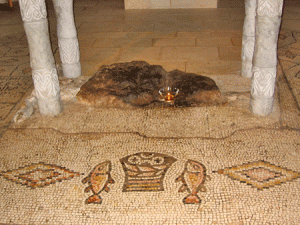
Tabgha Mosaic FloorSo this is a very familiar story, right? Actually, two very familiar stories. We all know about the feeding of the 5,000. All four gospels – Matthew, Mark, Luke, and John – tell it with slightly varying details. We all know about Jesus walking on the water. Three of the four gospels – Mark, Luke, and John – include that tale, again with slightly varying details. We sometimes mix up those variations, but basically the stories are the same so no big deal.

The problem is that we know the stories so well that we don’t know what we don’t know about them. We think we know the whole story, but we don’t! And one of the things we don’t know, as Evie and I discovered when we were in Palestine last summer, is the geography of the feeding of the multitude. So I thought start with a sort of geography lesson, if that’s OK with you? OK?

OK.

I want you, first, to think about what you know about Lake Erie. You know that it’s up there, north of us somewhere. You know that at one end (the western end) are Detroit and Toledo and at the other (the eastern end) is Buffalo. You know that the far shore is a foreign country called Canada, and you know pretty well where the cities and towns are located along the American shore.

So now I want you take Lake Erie and rotate it 90 degrees. Buffalo is now at the lower end; Toledo is at the top; the foreign country called Canada is still on the far shore. If we come down the near shore from Toledo, we’ll come to (among other places) Maumee, Sandusky, Lorain, Cleveland, Ashtabula, Erie.

By rotating Lake Erie, we’ve oriented it in the same way the Sea of Galilee is oriented and, by a strange coincidence, many of the places we know of along the shore of the Sea of Galilee are in relationship to one another in much the same way as places we know along the shore of Lake Erie! So … Bethsaida – you remember Bethsaida, it’s where Jesus healed a blind man and it was the hometown of Philip, Andrew, and Peter – Bethsaida would be about where Detroit is. Capernaum, which Jesus sort of made his home base and where Peter actually seems to have lived, would be about where Toledo is. A place called Tabgha, which is probably where the feeding of the 5,000 took place, would be about where Sandusky is. Gennesaret, which is where Mark says the apostles were headed when they saw Jesus walking on the water, would be about where Cleveland is. Tiberias, a resort city built by Herod Antipas (the king who beheaded John the Baptist), would about where Erie, Pennsylvania, is. Finally, go way away from the lake to Cincinnati, that would be about where Nazareth, Jesus’ hometown would be.

Except … shrink everything by at least a factor of ten, because that’s how much bigger Lake Erie is than the Sea of Galilee; that’s how much bigger Ohio is than the region of Galilee. So, now, Cincinnati/Nazareth, instead of 250 miles from the lake is 25 miles away, and Toledo/Capernaum, instead of being about 40 miles from Sandusky/Tabgha is less than 3 miles away. And the other distances are similarly reduced, but remember . . . they didn’t have cars and interstates; they would have been walking or riding a donkey on dirt paths, or maybe sailing or even rowing a fishing boat on the lake.

So let me tell you about Tabgha. Until 1948, when the Israelis uprooted its residents, there was a village there and had been for centuries; now it is simply an agricultural area and a place of religious pilgrimage. The name is a corruption of the Greek name of the place, Heptapegon, which means “seven springs;” its Hebrew name is Ein Sheva, which means the same thing. It is venerated by Christians for two reasons; on a bluff overlooking the place is where the feeding of the multitude is believed to have occurred and on the beach is where the Risen Christ is thought to have had a grilled fish breakfast with Peter during which he asked him, three times, “Do you love me?” At each location, there is a shrine and a church: the first is called The Church of the Multiplication; the second is called “Mensa Domini” (the Lord’s Table) and also known as the Church of the Primacy of Peter.

A Fourth Century pilgrim from Spain named Egeria reported visiting, in about 380 CE, a shrine where the Church of the Multiplication now stands; in her diary, she tells us that the site had been venerated by the faithful from the time of Christ onward. Shortly after her visit, a new church was built there in which was laid a mosaic floor depicting the loaves and fishes. That floor still exists today – a picture of it is on the front of your bulletin.

The reason I spend so much time on the geography of the place is this: we all know the story of the feeding of the 5,000, but sometimes we think to ourselves, “It probably wasn’t that big a crowd.” We think John and the other evangelists, or whoever first told the story, may have been exaggerating. But consider: it’s only about an hour’s walk from Capernaum to Tabhga, only an hour from Genessaret, only an hour and a half from Chorazin, maybe two hours from Bethsaida or Tiberias, perhaps several hours from Nazareth and more distant towns. But if one had a donkey or a horse, or if one could come over the water by boat, the time would be considerably less. If Jesus and his companions were there for several hours, word could easily have spread and people from all those places and more could have come to see this famous prophet and miraculous healer. Each of those places I’ve named was an important agricultural or fishing site, a residential center, a political center; each had a fairly large population for the time. It’s entirely possible that, hearing that this famous teacher was there, a crowd of thousands could have gathered there, a crowd of thousands who dropped what they were doing and headed out to see, not thinking about supplies or provisions, a crowd of thousands without enough to eat.

So there they are. Jesus has been teaching and healing, and it’s getting late, and people are getting hungry, and there’s nowhere to buy anything. Philip and Andrew are getting worried; they don’t know what a big crowd of hungry people might do, so they talk with Jesus about it. They want him to send the people away. After all, there’s nothing nearby, but (like I said) it would only take these people an hour or two to walk back home or to someplace where food could be found. But Jesus says, “No. They’re here because we’re here; we have to take responsibility for that and feed them.” Andrew says, “We’ve checked the supplies and all we have are these two fishes and five loaves (which, by the way, we didn’t bring; some boy brought them as his lunch, some boy with more smarts than a group of grown men).”

Jesus assures them it will be enough, tells everyone to sit down, blesses the food, and the picnic starts. Sure enough, there is enough. More than enough. Jesus, being environmentally aware, instructs the apostles to pick up after themselves and the crowd, and they gather the leftovers (all four of the gospels tell us) into twelve baskets. The Greek word used is kophinos, which the lexicon tells us is a wicker basket, probably a large one like a hamper. Twelve large hampers of leftovers! This isn’t simply a story about miraculously feeding a big bunch of people with a small amount of food…. this is a story about overfeeding a big bunch of people. This is a story about God’s abundance.

When Evie and I lived in Las Vegas, back before I was ordained, we used to go to a restaurant there called Keller’s. One of the things I liked about Keller’s (besides the really great food and their superb wine cellar) was that if you took home any leftovers, they made it an event. They were proud that you were taking home their food. Instead of a paper sack or styrofoam box, you got a work of art. Someone in the kitchen obviously knew the art of origami, so your bit of leftover chicken breast might come back to you packaged in a graceful silver swan; your second helping of trout, in a beautiful gold fish; your half-a-piece of cheesecake in a gorgeous multi-colored gift box.

I’ll bet that as people left the field at Tabgha that afternoon, they were sent home with leftovers, some more of the bread and fish to see them on their way. I’m pretty certain they didn’t get Keller’s origami packaging, but I like to visualize the scene that way with those thousands of people carrying silver foil swans, gold paper fish, and multi-colored paper gift boxes. Although I’m sure they didn’t have those pretty packages in their hands, they carried something even more precious as they made their way back to Bethsaida (up there about where Detroit would on Lake Erie) or Capernaum (sort of where Toledo is) or Genneserat (kind of where Cleveland is) or the longer journeys to Tiberias (about where Erie would be) or even distant Nazareth (far away like Cincinnati).

They carried the abundant, overflowing grace of God, what Paul called “the riches of [God’s] glory.” They carried the assurance in their hearts that they had been cared for with “the love of Christ that surpasses knowledge” and that they had been “filled with all the fullness of God.” They knew, because they had seen the evidence with their own eyes, tasted it with their own tongues, and carried it away in their own hands, that the power of God “is able to accomplish abundantly far more than all we can ask or imagine.”

Today, we are going to baptize Tatum E________ K_________; today, we are going to welcome her into the household of God in which that promise of abundance is realized; today, we are going to assure her that, as Mark says of the crowd in his telling of this story, God in Christ Jesus has abundant compassion for her. Whatever may happen in her life, whatever stormy seas she may sail, she has only to look (as the apostles looked from their boat) to see that Jesus is there and he will calm the storm.

These are familiar stories; they are familiar because they are important; they are so important that all four of the gospels tell them. They are important because remind us, they assure us of God’s overflowing, abundant love and grace of which there is always more than enough.

Let us pray:

O God, your Son Jesus Christ fed the crowds out of his copious compassion; he stilled the stormy seas with his plentiful power; and he prepared his disciples for the coming of the Spirit through the abundant grace of his teaching: Make our hearts and minds, and especially Tatum’s heart and mind, ready to receive the overflowing blessings of your Holy Spirit, that we may be filled with your grace and strengthened by your Presence; through Jesus Christ our Lord. Amen.

====================

A request to my readers: I’m trying to build the readership of this blog and I’d very much appreciate your help in doing so. If you find something here that is of value, please share it with others. If you are on Facebook, “like” the posts on your page so others can see them. If you are following me on Twitter, please “retweet” the notices of these meditations. If you have a blog of your own, please include mine in your links (a favor I will gladly reciprocate). Many thanks!

====================

Father Funston is the rector of St. Paul’s Episcopal Church, Medina, Ohio.

Don’t Carry All That Baggage – From the Daily Office Lectionary

From the Daily Office Lectionary for Saturday in the week of Proper 11, Daily Office Year 1 (Pentecost 8, 2015)

Mark 6:7-9 ~ He called the twelve and began to send them out two by two, and gave them authority over the unclean spirits. He ordered them to take nothing for their journey except a staff; no bread, no bag, no money in their belts; but to wear sandals and not to put on two tunics.

A few years ago I took a sabbatical. It was my first (and, so far, only) sabbatical in 40 years of professional life, 25 of them in ordained ministry. I went to England, Scotland, Wales, and Ireland for a total of three months. The first two weeks I visited pre-Christian and early Christian sites in southern Scotland, northern and western England, and Wales. Then I flew from Edinburgh to Dublin. Checking in for the flight, I learned that I had misunderstood an airline website and my baggage was overweight. Substantially overweight! The fees and penalties amounted to nearly £300! (I paid more for my baggage to go one way than for myself to fly round-trip.) I’d brought books for a course of study I was undertaking in Ireland; I’d brought a summer’s worth of clothing; I was carrying a heavy CPAP machine I use while sleeping; I was way, way overweight. I could have carried nothing, ” no bread, no bag, no money in [me] belt,” and purchased everything in Ireland for less than those airline penalties. I guess I would have needed the money, but the bread, the bag, and everything else I didn’t need.

We carry so much that we don’t need. That’s what this story always says to me. We carry so much that we don’t need, that gets in our way more than it helps, that weighs us down and impedes us, that distracts us from what we are supposed to be doing. Jesus is clearly telling his disciples, originally the Twelve and, through them, us, that we don’t need all that stuff. We need some good footwear and something to lean on when we’re weary, and that’s about it. Anything else we may need we can acquire along the way; in fact, the promise of the story is that we will acquire it – it will be provided when it is needed.

When my two-month sojourn in Ireland was ended and I flew back to Scotland to join my wife for a two-week end-of-sabbatical vacation, I left behind most of what I had paid £300 to ship there. Books I could purchase again in the US, I gave to a school library. Clothing I wouldn’t need for those last two weeks, I gave to church to pass on to the needy. A second bag no longer needed, I gave to my landlady who had admired it. Things I was keeping but didn’t need to travel with, I shipped home. The CPAP machine I took back to Scotland, but for that I had pared my possessions down to one backpack; I was carrying again the same spare load I had carried on my first three-month trip to Europe when I was 16 years old. Following Jesus’ lightweight travel advice, I received the promise of the Psalmist: “He satisfies you with good things, and your youth is renewed like an eagle’s.” (Ps 103:5)

Take Jesus’ advice: don’t carry all that baggage!

Choices – From the Daily Office Lectionary

From the Daily Office Lectionary for Friday in the week of Proper 11, Daily Office Year 1 (Pentecost 8, 2015)

1 Samuel 31:8-10 ~ When the Philistines came to strip the dead, they found Saul and his three sons fallen on Mount Gilboa. They cut off his head, stripped off his armor, and sent messengers throughout the land of the Philistines to carry the good news to the houses of their idols and to the people. They put his armor in the temple of Astarte; and they fastened his body to the wall of Beth-shan.

The Greek historian Herodotus gave us the name “Palestine,” which he adapted from an Egyptian word “pelesset” which named a sea people who may or may not have been the forerunners of the people named “Philistines” in the Hebrew Scriptures. The Roman Empire solidified Palestine’s place in geography by adopting the name for its eastern Mediterranean province which included the ancient lands of Israel and Judah.

So who are today’s Palestinians? Are they the descendants of the Philistine warriors who so brutally butchered Saul’s body (although they had not killed him)? Or are they (as Mitri Raheb argues) the descendants of the am haaretz, the “people of the land” named frequently in the biblical books of Kings, Chronicles, Leviticus, and Ezekiel, and less frequently elsewhere in the Hebrew writings? For that matter, who are the Jews? Are they the am haaretz? Today there are black Jews, asian Jews, and hispanic Jews, in addition to European ashkenazis and Middle Eastern sephardim. There are diaspora Jews and sabras.

Modern Palestine and contemporary Israel are not the nation-states of the Bible, nor are the people who call them “home” the people of the Bible. What they are, both the nation-states (whether recognized or not) and their residents, are entities which look back to myths and histories of the Bible (and the Qur’an and other texts) and lay claim to parts of those stories. What they are, both the nations and the peoples, are people who choose to be enemies of other people who lay claim to other parts of the same stories.

We choose to be who we are, individually and corporately. Both individuals and groups base their present on selective choices of the past and thereby chart their futures. We can make other choices. The ancient Philistines, happening upon the bodies of Saul and his weapon bearer and his sons, none of whom they had killed, chose to claim those deaths as their own responsibility and, thus, charted a course for generations yet unborn. Each generation, each person has the choice whether to be bound by the choices made by those before them.

Can we choose to be different? Must I, descendent of Irish Protestants, continue the enmity in which they chose to hold Irish Catholics? No, I need not. Must Palestinians and Israelis, whatever their ancestry, continue the enmity their forebears chose? I choose to believe otherwise; I pray that others can, as well.

Religion’s Sensuality – From the Daily Office Lectionary

From the Daily Office Lectionary for Thursday in the week of Proper 11, Daily Office Year 1 (Pentecost 8, 2015)

1 Samuel 28:7 ~ Then Saul said to his servants, “Seek out for me a woman who is a medium, so that I may go to her and inquire of her.” His servants said to him, “There is a medium at Endor.”

Sometime during my childhood, I don’t recall when exactly, I was given an illustrated King James Version of the Holy Scriptures. The illustrations were color plates of a variety of bible stories, but I only remember two of them.

One was Jesus clearing the Temple with a cat-o’-nine-tails. That was an exciting picture! Jesus swinging that whip over his head, his hair flying, tables knocked over, pigeons and lambs scurrying madly away, people looking frightened. Jesus was clearly a bad ass!

The other was Saul consulting the witch of Endor and the shade of Samuel. Samuel was appropriately ghostly ~ white robe, greyish-white long hair and beard, think Ian McKellan as Gandalf. Saul was frightened, cowering before Samuel. But the witch! Ah, the witch! Not your hook-nosed, wart-faced old hag ~ this witch was young and lovely and bare-bosomed, downright erotic for a pre-teen Christian boy. The witch of Endor was a babe!

What’s become of Christianity and Christian art? Jesus is a moralistic twit these days, more worried about what goes on in people’s bedrooms than with what happens in the money-changers’ boardrooms, and God forbid there should be anything erotic in life, especially not nubile young witches!

Well, I say, we need to bring back the bad-ass Jesus who cleanses the courtyard of capitalists; we need to bring back the sexy witches who remind us of religion’s sensuality. God help us if we don’t!

The Fling’s the Thing – From the Daily Office Lectionary

From the Daily Office Lectionary for Wednesday in the week of Proper 11, Yr 1 (Pentecost 8, 2015)

1 Samuel 25:29 [Abigail said to David,] “If anyone should rise up to pursue you and to seek your life, the life of my lord shall be bound in the bundle of the living under the care of the Lord your God; but the lives of your enemies he shall sling out as from the hollow of a sling.”

Several years ago there was a television show called Northern Exposure which was a favorite of mine. At the time it was in first run episodes, I was living apart from my family while attending seminary, living in a student dormitory. One of my dormitory neighbors owned a big screen color television and paid the fee for cable feed, so when Northern Exposure came on several of us would pile into her room, drinks and snacks in hand, for an hour (or more) of pure escape, wonderful camaraderie, fun, and games; we had a party there each of those show nights. When I read the words “bound in the bundle of the living,” when I think of church community, those evenings in my colleague’s dorm room are one of the predominant images. There was life and love, friendship and folly, sustenance and support, all bound and bundled together. ~ In an episode of the show that ran after I’d left the seminary community, a show entitled Burning Down the House, the local morning radio celebrity Chris builds a trebuchet with the intent of flinging a living cow across the town’s lake. Disappointed to learn that the Monty Python crew had already catapulted a cow in their movie Monty Python & the Holy Grail, Chris settles on flinging an upright piano instead (I’m told it was a Mason & Hamlin cabinet grand). That’s an image that comes to mind when I read of David’s enemies being “slung out as from the hollow of a sling.” I see that old piano flying through the cold air, losing some of its pieces as it goes, finally crashing in utter destruction. ~ Two images: the warmth of friends gathered in sustaining community for an evening of fun vs. the cold loneliness of being thrown to complete ruin. I’m amused (and I find it instructive) that both can be described with the same word. Fling, noun, a party, a dance, a shindig. Fling, verb, transitive, to throw, especially with force or abandon; hurl or toss. ~ At the end of the episode, as Chris prepares to cut the tension line on the trebuchet and fling the piano, he says, “It’s not the thing you fling. It’s the fling itself.” Abigail’s reassurance to David reminds us that it’s also the nature of the fling and the One who flings; we choose which fling we will experience at God’s hand.

Effin’ the Ineffable – From the Daily Office Lectionary

From the Daily Office Lectionary for Tuesday in the week of Proper 11, Yr 1 (Pentecost 8, 2015)

Mark 4:30 [Jesus] said, “With what can we compare the kingdom of God, or what parable will we use for it?”

This is the question, isn’t it? (Emphasis on “the”!) This is the religious question. At the heart of every religion, every spirituality, every theology is the experience of the [power, force, spirit, god, structure, law, probability] that [undergirds, overshadows, creates, sustains, regulates, controls, defines] everything that is. What follows that experience is the question of how to communicate it: what [parable, metaphor, simile, comparison] do we use? Demonstrating the difficulty of even asking the question, Jesus uses a metaphor to do so, i.e., “kingdom of God.” ~ The unfortunate next step seems always to be to concretize one or more of our metaphors or comparisons: this has been done in Christianity with Jesus’ term here, “kingdom of God,” so that any alternative metaphor (“dominion,” “realm,” “commonwealth”) is sometimes greeted with derision and claims of heresy. Even worse is are challenges to the metaphor “Father,” despite the venerable history of the alternative “Mother” in Christian spirituality. Concretized metaphors are, themselves, the stuff of heresy; we must abandon them. ~ The philosopher Paul Feyerabend was not the first (though perhaps one of the most succinct) in observing that “Ultimate Reality, if such an entity can be postulated, is ineffable.” Jesus’ question (and ours) is, “How do we eff the ineffable?” The first step, I think, is to let go of our effin’ metaphors.

The Rocks of the Wild Goats – From the Daily Office Lectionary

From the Daily Office Lectionary for Monday in the week of Proper 11, Yr 1 (Pentecost 8, 2015)

1 Samuel 24:2 Saul took three thousand chosen men out of all Israel, and went to look for David and his men in the direction of the Rocks of the Wild Goats.

Years ago I from a large western city to a small town in Kansas, a place I’d not lived before. Needing directions to a home I wanted to visit, a farm some miles outside of town, I asked a long-time resident how to get there. You take a particular street, I was told, until you a few miles outside of town where you come to the MacGregors’ barn used to be, then you turn there. While perhaps helpful instructions for another long-time resident who may have known the MacGregors or where their barn used to stand, this did not help me even a little bit. I sometimes feel that way about the stories in the Bible. Clearly, “the Rocks of the Wild Goats” was a place well-known to the original teller and the first hearers of the history of Saul and David; perhaps it still is to their descendants still living in the land. To one removed, however, by 2,500 or so years and several thousand miles, the meaning of the landmark is lost. ~ Landmarks, the dictionary tells, are prominent features of the landscape, natural or artificial, used for navigation; they are clearly visible and generally can be sighted well in advance (even the place where MacGregor’s barn used to be can be seen ahead of time by someone with the necessary knowledge). The term also applies to events which mark important stages of personal or social development or turning points in life or history. In this latter sense, particularly in one’s personal life, landmarks are only known in retrospect. ~ I first read this passage of First Samuel several years ago when I began my discipline of reciting the Daily Office; I’ve now read it perhaps fifteen times. On that first reading, I was struck by the poetry of the image and penned a sonnet about the images of rocks or stones in Scripture (it was an embarrassingly inept poem, long discarded). Since then, I have found it more useful as a metaphor for life’s landmark events. Often when taking stock of my life (as clergy are wont and even encouraged to do from time to time), I will ask “Where have I been in the Rocks of the Wild Goats?” Where are those events where the unsure footing has caused me to turn one direction or another, away from the path I had thought I was on? Where did I struggle to climb a difficult trail, or slide down an unexpected incline? ~ I don’t know where Saul’s and David’s Rocks of the Wild Goats were and, to be honest, I frequently don’t know where my own are, either. Only when I look back over the way I have come do I see them.

« Older posts Newer posts »