Occasional thoughts of an Anglican Episcopal priest

Category: Lectionary (Page 49 of 99)

A Present, Close, Immediate Reality – Sermon for Lent 5A – April 6, 2014

====================

This sermon was preached on the Fifth Sunday in Lent, April 6, 2014, at St. Paul’s Episcopal Church, Medina, Ohio, where Fr. Funston is rector.

(The lessons for the day were: Ezekiel 37:1-14; Psalm 130; Romans 8:6-11; and John 11:1-45. These lessons can be read at The Lectionary Page.)

====================

Valley of Dry BonesLet’s just do a bit of bible study today. I think we’ll see a common theme in the three lessons.

First, the very familiar prophetic vision of the “valley of dry bones” from the Book of Ezekiel. Scholars date this prophecy to about 587 BCE. Ezekiel was one of those taken into exile by the Babylonians ten years earlier in 597 BCE. The Babylonians had laid siege to Jerusalem for almost two years, creating conditions of famine, disease, and despair. They destroyed the city of Jerusalem, razed the temple to the ground, killed many of its inhabitants, and forced the rest to migrate to Babylon. This is how the Babylonian conquest is described in the Second Book of Kings, from the paraphrase entitled The Message:

[In] the ninth year and tenth month of Zedekiah’s reign, Nebuchadnezzar set out for Jerusalem immediately with a full army. He set up camp and sealed off the city by building siege mounds around it. The city was under siege for nineteen months (until the eleventh year of Zedekiah). By the fourth month of Zedekiah’s eleventh year, on the ninth day of the month, the famine was so bad that there wasn’t so much as a crumb of bread for anyone. Then there was a breakthrough. At night, under cover of darkness, the entire army escaped through an opening in the wall (it was the gate between the two walls above the King’s Garden). They slipped through the lines of the Babylonians who surrounded the city and headed for the Jordan on the Arabah Valley road. But the Babylonians were in pursuit of the king and they caught up with him in the Plains of Jericho. By then Zedekiah’s army had deserted and was scattered. The Babylonians took Zedekiah prisoner and marched him off to the king of Babylon at Riblah, then tried and sentenced him on the spot. Zedekiah’s sons were executed right before his eyes; the summary murder of his sons was the last thing he saw, for they then blinded him. Securely handcuffed, he was hauled off to Babylon. In the nineteenth year of Nebuchadnezzar king of Babylon, on the seventh day of the fifth month, Nebuzaradan, the king of Babylon’s chief deputy, arrived in Jerusalem. He burned The Temple of God to the ground, went on to the royal palace, and then finished off the city — burned the whole place down. (2 Kgs 25:1-9)

Ezekiel, a young apprentice priest, experienced this. The religious institution he served, the Jerusalem Temple, was destroyed and he was reduced from a prominent position as a priest in Jerusalem to that of a temple-less priest in exile. God then pegged him to become a prophet to the exile community; he tells us in the very first sentence of his book that he “was among the exiles by the river Chebar, the heavens were opened, and [he] saw visions of God.” (Ezek 1:1)

But not only did Ezekiel experience this historical trauma common to all the exiles to a greater or lesser extent, he experienced deep personal loss as well: his wife died and God commanded him not to mourn her. Again, I am reading from The Message:

God’s Message came to me: “Son of man, I’m about to take from you the delight of your life — a real blow, I know. But, please, no tears. Keep your grief to yourself. No public mourning. Get dressed as usual and go about your work – none of the usual funeral rituals.” I preached to the people in the morning. That evening my wife died. The next morning I did as I’d been told. (Ezek 24:15-17)

God’s command for him not to mourn her was to serve as an example for the exile community not to mourn the loss of the Temple.

I don’t know about you, but if I had to endure what Ezekiel and his contemporaries went through I would be a deeply depressed person! I would sink into the depths of despair. And that is what the exiles did. The psalms speak eloquently of their desperation: “By the waters of Babylon we sat down and wept, when we remembered you, O Zion.” (Ps 137:1; BCP version) Other psalms speak for the exiles in their sadness, their weariness settling deep within them. Psalm 31, for example:

Have mercy on me, O Lord, for I am in trouble;
my eye is consumed with sorrow, and also my throat and my belly.
For my life is wasted with grief, and my years with sighing;
my strength fails me because of affliction, and my bones are consumed.
(Ps 31:9-10, BCP version)

Or Psalm 102:

Incline your ear to me;
when I call, make haste to answer me,
For my days drift away like smoke, *
and my bones are hot as burning coals.
My heart is smitten like grass and withered, *
so that I forget to eat my bread.
Because of the voice of my groaning *
I am but skin and bones.
(Ps 102:2-5; BCP version)

Or Psalm 6:

Have pity on me, Lord, for I am weak; *
heal me, Lord, for my bones are racked.
My spirit shakes with terror; *
how long, O Lord, how long?
(Ps 6:2-3; BCP version)

In these psalms and elsewhere in the Hebrew Scriptures, the reference to “bones” is an idiomatic way of referring to one’s deepest self, a way for a person or a community to refer to its most essential self. And so we have Ezekiel’s vision of “dry bones,” a vision of the soul of the exile community. “Mortal,” says God, “these bones are the whole house of Israel.”

Since the dry bones represent the living exiles, we can see that this vision is not concerned with death; death here is a metaphor for the soul-deep desperation, the despair of the exiles. The exiles, bereft of their nation, their city, and (most importantly) their Temple, fear that God has abandoned them. Ezekiel speaks to this hopelessness with a startlingly simple metaphor of divine presence, the immediate closeness of breath, the pervading presence of wind. In just fourteen verses, the Hebrew word ruach occurs nine times, translated as “breath” in verses 5, 6, 8, and 10), as “wind” in verse 9, or as God’s own spirit in verse 14. The prophet’s repetitive use of the word drums the point of the message into his hearers’ consciousness: God’s spirit is the key. With God’s spirit, anything is possible. And God’s spirit is as close as the wind, as close as one’s own breath; there is no place on earth, no instant in time, and no situation of sin that can separate God’s people from God’s spirit. Not the loss of one’s country, one’s city, one’s Temple, even one’s beloved spouse; nothing! God’s spirit is always and everywhere present.

Which brings us to the Epistle lesson taken from the eighth chapter of Paul’s letter to the church in Rome. “To set the mind on the flesh is death,” writes Paul, “but to set the mind on the Spirit is life and peace.” (Rom. 8:6) We need first to understand that Paul’s use of “flesh” is not a reference to the physical body. The body is ethically neutral for Paul; it is neither good nor bad in and of itself. There certainly is nothing wrong with having a body. When Paul writes about the body, he uses the Greek word soma.

In this passage, however, he uses the word sarx, which means “flesh,” as in meat. Paul uses the word in Romans in two ways. First, he uses it to describe physical descent between ancestor and descendant. In the opening greetings of the letter, Paul identifies Jesus as a descendant of David “according to the flesh” (Rom 1:3) and later himself as a Jew because of “Abraham, our ancestor according to the flesh.” (4:1) In this sense, it is largely neutral, but in this sense also it can be negative. For Paul salvation or righteousness before God is not an honor due a particular blood line or a family heritage; it is not by the flesh but by the spirit of God that the followers of Jesus, the members of the community of faith receive life and peace.

In the second way in which Paul uses sarx or “flesh,” Paul is influenced by the dualism of his age which considered the flesh to be imperfect because it is capable of deterioration. Under that philosophical influence, Paul assigns to flesh negative characteristics such as death, hostility to God, and an incapacity to live according to God’s law. When a person’s focus in life is on the flesh and its appetites, that is a focus on death because the flesh does not last. “But,” Paul reassures his readers, “you are not in the flesh; you are in the Spirit, since the Spirit of God dwells in you.” Notice that, like Ezekiel’s message to the exiles in Babylon, Paul’s message is one for the present; not a promise of a future relationship with God, but an assurance of a present one.

Paul believes that this relationship with God is a present reality; it is not a something that exists somewhere else or that is coming in the future. Paul is certain that it is real, it is here, and it is now; because of the life, death, and resurrection of Jesus Christ this new reality is here today. Throughout the rest of this Chapter 8 he will develop his argument that we are currently children of the Father, that we are currently brothers and sisters of Christ, that we currently possess the gifts of the Spirit, and that we are currently enjoy the real and present love of God. He concludes this chapter asking:

Who will separate us from the love of Christ? Will hardship, or distress, or persecution, or famine, or nakedness, or peril, or sword? * * * No, in all these things we are more than conquerors through him who loved us. For I am convinced that neither death, nor life, nor angels, nor rulers, nor things present, nor things to come, nor powers, nor height, nor depth, nor anything else in all creation, will be able to separate us from the love of God in Christ Jesus our Lord. (Rom 8:35,37-39)

For Paul and for us, God is everywhere and always present.

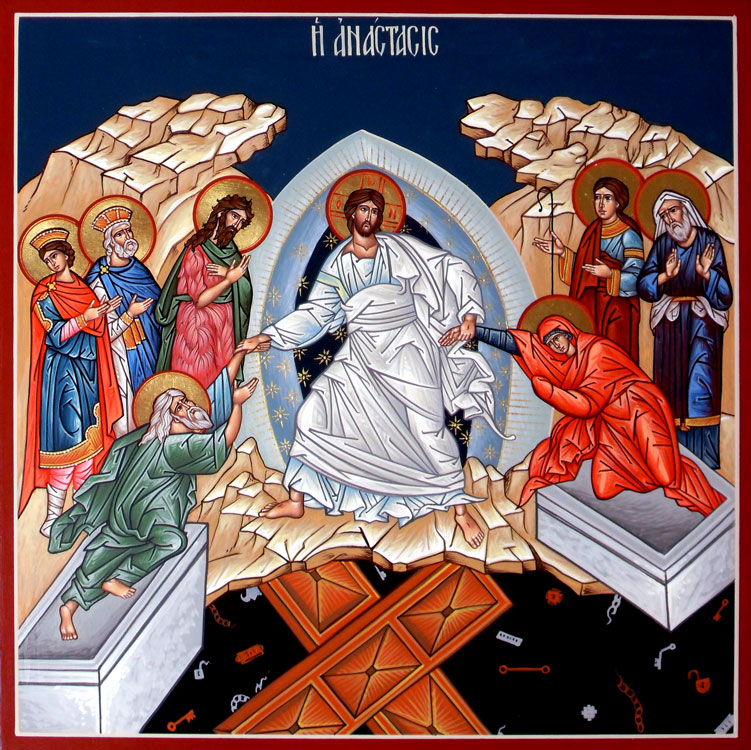
And so we come to the Gospel lesson — another familiar story from the Gospel of John — the raising of Lazarus, a story about what it means to be in relationship with Jesus, what it means to love him and be loved by him. Lazarus is identified by his sisters to Jesus as “he whom you love,” (v. 3) and then John underscores this by telling us that “Jesus loved Martha and her sister and Lazarus.” So in the way Jesus related to this Bethany family we get a clue of what it is to be in relationship with him. And what we learn, perhaps distressingly, is that doesn’t mean that one is protected from bad stuff. John’s Gospel makes this painfully obvious, for in this Gospel, love is linked inextricably to death.

Remember that what is perhaps the best known verse of Christian scripture is from this Gospel: “For God so loved the world that he gave his only Son . . . . ” (Jn 3:16) And it is in John’s Gospel that Jesus says, No one has greater love than this, to lay down one’s life for one’s friends.” (Jn 15:13) So it is with this family; that they love Jesus and he loves them does not mean that bad things, including death, do not happen. Lazarus dies.

And in John’s story, Jesus does not prevent it, nor even arrive until afterward. He is met on the road by Lazarus’ sister Martha who confronts him, “Lord, if you had been here, my brother would not have died.” (v. 21) In response, Jesus assures her that “your brother will rise again.” (v. 23), but she hears only the promise of a future resurrection: “I know that he will rise again in the resurrection on the last day.” (v. 24) And Jesus, “I am the resurrection and the life.” (v. 25) Note, if you will, the verb: Jesus’ reply is in the present tense — “I am . . . .”

The resurrection is not a distant promise; it is not a guarantee of salvation in the future; it is not about an eternal life with God and Jesus in heaven. In the next few chapters of John’s Gospel we will encounter Lazarus reclining at the table with Jesus, sharing food and fellowship. (Jn 13:28) His new relationship with Jesus is intimate and close; it is here and now. For Lazarus and for us, the resurrection is not a future with Jesus; it is a present with Jesus. Jesus is present with Lazarus and his sisters; he is present with us, and through him God is glorified even in that which feels irredeemably bad and painful.

Being in relationship with Jesus, loving him and being loved by him, does not mean that unpleasant things do not happen. It means that when they do, he faces them, even death and grief, with us. It means learning that, in spite of the worst the world can do, the worst that flesh can be subject to, even death and the finality of the grave, Jesus is the resurrection and the life. Nothing is ever so dead that it keeps him from being that in himself and for us. In John, the resurrection is not a future hope; it is the abundant life which is always here, always now. Nothing, as Paul reminded the Romans, not “death, nor life, nor angels, nor rulers, nor things present, nor things to come, nor powers, nor height, nor depth, nor anything else in all creation, [can] separate us” from it. It is, as Ezekiel prophesied to the exiles, as close as the wind, as close as one’s own breath; it is always and everywhere present.

Amen.

====================

A request to my readers: I’m trying to build the readership of this blog and I’d very much appreciate your help in doing so. If you find something here that is of value, please share it with others. If you are on Facebook, “like” the posts on your page so others can see them. If you are following me on Twitter, please “retweet” the notices of these meditations. If you have a blog of your own, please include mine in your links (a favor I will gladly reciprocate). Many thanks!

====================

Father Funston is the rector of St. Paul’s Episcopal Church, Medina, Ohio.

Given First by God – From the Daily Office – April 5, 2014

From the First Letter to the Corinthians:

Love is patient; love is kind; love is not envious or boastful or arrogant or rude. It does not insist on its own way; it is not irritable or resentful; it does not rejoice in wrongdoing, but rejoices in the truth. It bears all things, believes all things, hopes all things, endures all things.

(From the Daily Office Lectionary – 1 Corinthians 13:4-7 (NRSV) – April 5, 2014.)

Agape in Greek LetteringThere are six Greek words translated “love” in English: eros (sexual passion), philia (deep friendship), ludus (playful love), pragma (longstanding or mature love), philautia (self love), and agape (unconditional or selfless love). It is the sixth which Paul uses here and which is used extensively throughout the New Testament and in early Christian texts.

It is perhaps perhaps the most radical. This is the love that one extends to all people, whether friends, family members, or strangers. Agape was translated into Latin as caritas, which is the origin of our word “charity.” C.S. Lewis referred to it as “gift love,” the highest form of Christian love. It is similar in nature to concepts appearing in other religious traditions. For example, it has been suggested that the idea of metta or “universal loving kindness” in Theravada Buddhism is the same thing.

Agape is used in the Gospels to describe the love that God has for humanity in general: “For God so loved the world, he gave his only Son” (John 3:16).

It is also used to name the human response to God’s love and to describe the love that Jesus commands be shared and expressed between human beings. In Matthew 5:43-44, agape is used to describe both one’s love of neighbor and the love we are extend to our enemy.

It is not, despite the popularity of this passage as a reading at weddings, about marital love. This is Paul’s instruction to the Corinthians (and through them to all Christians) about “the more excellent way” mentioned at the end of Chapter 12, the manner in which they are to exercise their spiritual gifts.

Chapter 13 does not stand alone. It continues Paul’s discussion of spiritual gifts that begins in the previous chapter and continues through the next. Agape here is to be the guiding principal Christians employ in deciding when, where, and how to use the gifts God has given them. They are to be offered to the community with the same sort of self-sacrificing love exhibited by God to all of humankind: “For God so loved the world that he gave his only Son.”

Agape has nothing to do, as romantic love — eros — does, with attractiveness or attraction; it has nothing to do, as marital love — pragma — does, with compromise; it has nothing to do with any prior relationship, as familial or brotherly love — philia — does. It is to be bestowed on the unloved and the unlovely; it is to be given without regard to whether it is deserved or merited; it is to be given without thought of reciprocity or payback. It is, in a word, to be given as God gives it. It is something human beings are incapable of giving but for the fact that it is first given them by God.

====================

A request to my readers: I’m trying to build the readership of this blog and I’d very much appreciate your help in doing so. If you find something here that is of value, please share it with others. If you are on Facebook, “like” the posts on your page so others can see them. If you are following me on Twitter, please “retweet” the notices of these meditations. If you have a blog of your own, please include mine in your links (a favor I will gladly reciprocate). Many thanks!

====================

Father Funston is the rector of St. Paul’s Episcopal Church, Medina, Ohio.

Bodies, Bees, Ants, Trees – From the Daily Office – April 3, 2014

From the First Letter to the Corinthians:

The body does not consist of one member but of many. If the foot were to say, “Because I am not a hand, I do not belong to the body,” that would not make it any less a part of the body. And if the ear were to say, “Because I am not an eye, I do not belong to the body,” that would not make it any less a part of the body. If the whole body were an eye, where would the hearing be? If the whole body were hearing, where would the sense of smell be? * * * If one member suffers, all suffer together with it; if one member is honored, all rejoice together with it.

(From the Daily Office Lectionary – 1 Corinthians 12:14-17,28 (NRSV) – April 3, 2014.)

Leaf Cutter AntsThe “body analogy” is so deeply engrained in Christian theology through Paul’s use of it in his epistle to the Corinthians and elsewhere that it may be heresy to suggest that its usefulness in the modern world may have come to an end. It was, perhaps, an apt description of the church in a time when church communities were small and close-knit, but does it work in the modern age of the mega-church, or in an age of decentralization?

I ask the question because I truly don’t know . . . .

At a conference I attended recently, a speaker talked about the church as “hive” and described the way in which communities of bees and ants are similar and different, and how that model might be used to understand the modern church. I didn’t buy that argument. Churches are not colonies or hives.

For example, ants are simple creatures following simple rules, each one acting on local information; no ant sees the big picture. No leadership is required; no ant tells any other ant what to do. Even complex behaviors of the colony may be coordinated by relatively simple interactions. No generals command ant warriors. No managers boss ant workers. The queen plays no role except to lay eggs. Even with half a million ants, a colony functions just fine with no management at all. It relies instead upon countless interactions between individual ants, each of which is following simple rules of thumb. Scientists describe such a system as self-organizing.

In many ways, today’s church can seem like this. No single member sees the big picture; when the church community functions smoothly, no leadership is needed. Unfortunately for the analogy, however, human beings are not ants; they are possessed of individual identities and free will, so collections of humans, including churches, seldom run “smoothly.” Furthermore, the thing about ants is that they are pretty much interchangeable; an ant might be a nest worker one day, a trash collector the next, a forager the following day. And one ant can easily say to another, “I have no need of you” because there are plenty of replacements.

Beehives are a bit different from ant colonies, and the insects’ means of communication and “hive-mind” decision making differ, but as an analogy for the church, I think the beehive is as problematic as the ant colony.

More recently, another writer suggested the diffused process of creating computer code by several programmers all connected by a “tree” of files and directories, each working a peace of the bigger project, as an analogy for the church. This overcomes some of the objections to ant colony or beehive metaphors in that one programmer cannot easily take the place of another on the project. I’m not sufficiently familiar with the way teams of code writers work to engage the metaphor, however, so I don’t know how well it works.

Does the body analogy still work? Maybe . . . perhaps to a much less effective degree than when Paul first used it, however. Does the insect community work? Maybe . . . but not sufficiently to provide a true model. Does the programmer tree work? Maybe . . . it may speak to a new generation in ways analogies from nature do not.

What I do know is that each of these metaphors is limited (as any analogy is) and while any one of them may help us understand who we are as a community, they can also mislead us. What is common to them all, however, is that each points toward some form of organization, some type of communication, and a common purpose. Those are the hallmarks of entities — bodies, colonies, hives, communities, churches — that flourish.

====================

A request to my readers: I’m trying to build the readership of this blog and I’d very much appreciate your help in doing so. If you find something here that is of value, please share it with others. If you are on Facebook, “like” the posts on your page so others can see them. If you are following me on Twitter, please “retweet” the notices of these meditations. If you have a blog of your own, please include mine in your links (a favor I will gladly reciprocate). Many thanks!

====================

Father Funston is the rector of St. Paul’s Episcopal Church, Medina, Ohio.

Compartmentalization – From the Daily Office – April 2, 2014

From the First Letter to the Corinthians:

Now there are varieties of gifts, but the same Spirit; and there are varieties of services, but the same Lord; and there are varieties of activities, but it is the same God who activates all of them in everyone. To each is given the manifestation of the Spirit for the common good. To one is given through the Spirit the utterance of wisdom, and to another the utterance of knowledge according to the same Spirit, to another faith by the same Spirit, to another gifts of healing by the one Spirit, to another the working of miracles, to another prophecy, to another the discernment of spirits, to another various kinds of tongues, to another the interpretation of tongues. All these are activated by one and the same Spirit, who allots to each one individually just as the Spirit chooses.

(From the Daily Office Lectionary – 1 Corinthians 12:4-11 (NRSV) – April 2, 2014.)

Compartmented BoxThe genius of Paul is his holistic approach to understanding the gifts of the Spirit, the talents and skills of human beings. Yes, he says, there are all sorts of talents and skills, but they all come from the same source – God the Spirit – and they are all to be used for the same purpose – building up the community. It is a genius that is lost in the modern world, I’m sorry to say.

I spend some time on social media sites such as Facebook and I see people posting the silliest of comments (including some surprisingly stupid quotations from some otherwise intelligent people) which lay down hard-and-fast, black-and-white assertions about things that are clearly false. For example, on Facebook recently the philosophy Bertrand Russell, famously an atheist, was quoted as saying, “So far as I can remember, there is not one word in the Gospels in praise of intelligence.” I don’t know the accuracy or source of the quotation, but there it is. It’s a ridiculous statement on several levels, not the first of which is that it is clearly inaccurate.

Although Jesus or the gospel writers may never have specifically said or written, “Intelligence of good” or something of that nature, Jesus often praises those who understand his parables, or expresses frustration with those who don’t, which is a way of praising intelligence. Further, to limit the Christian message to the Gospels alone leaves out the greater part of the New Testament, including Paul who (as here) praises wisdom and knowledge as gifts of God.

In any event, the posting of that quotation led to a discussion in which one person asserted that “faith and reason are two entirely different things and have nothing to do with one another.” If the writer had been an atheist, I’d have chalked that up to polemic . . . . but the writer claimed to be a Christian! As a Christian, I would debate that proposition fully; faith and reason are neither different nor separate! I would not be alone, either. The late Pope John Paul II began one of his many encyclicals with these words:

Faith and reason are like two wings on which the human spirit rises to the contemplation of truth; and God has placed in the human heart a desire to know the truth – in a word, to know himself – so that, by knowing and loving God, men and women may also come to the fullness of truth about themselves. (Fides et Ratio, 14 Sept. 1998)

Another participant who self-identified as an American citizen asserted in the conversation that “religion has no place in public politics.” Coming from someone whose country’s foundational document, the Declaration of Independence, asserts “that all men are created equal, that they are endowed by their Creator with certain unalienable Rights, that among these are Life, Liberty and the pursuit of Happiness,” a clearly religious sentiment in a public political document, the participant’s argument was not only ridiculous, it could be considered hypocritical! Religion may have no place in government (the U.S. Constitution’s First Amendment is based on that premise), but that is a different thing from saying it has no place in politics.

I tried to suggest that these black-and-white generalizations were inaccurate and did not help to further rational consideration of Bertrand Russell’s assertion, the quotation which had started the conversation. Unfortunately, the discussion became so heated and counterproductive (what at one time back in the days of email list-serves would have been called a “flame war”) that I discontinued participation. Eventually, the original poster closed the discussion and deleted the entire thread.

Finally, this morning, I read a news report in which the first paragraph asserted: “Religion has never fully accepted the LGBT community. It goes against their doctrine, which in and of itself is an issue.” That’s so broad a generalization as to be laughable. “Religion” encompasses every faith system ever adopted by human beings and there is no common “doctrine” amongst them! Furthermore, as an Episcopalian whose church has elected and ordained gay and lesbian bishops, who works regularly with LGBT colleagues both lay and ordained, and whose denomination has come down squarely in favor of marriage equality, I can point to at least one religion about which this generalization is false.

Would that people who write for publication, who produce “content” for the internet, and who take part in the “flame wars” that erupt in social media could adopt St. Paul’s more holistic approach! Instead, we see the tendency to compartmentalize and separate, to insist on a division of public from private, politics from religion, faith from reason, gay from straight, black from white, this from that, whatever from something else, and on and on and on.

The world, however, isn’t black and white; it’s all sorts of grays and other colors. The world isn’t compartmentalized and neither are human beings. The world and the people in it are a fascinating mix of talents, skills, gifts, abilities, positions, attitudes, beliefs, and opinions that cross our arbitrary lines and divisions, that spill from one compartment to the next. We Christians believe all of this flows from one source and all of it has one purpose, to build up community. When we try to compartmentalize and separate, community suffers.

====================

A request to my readers: I’m trying to build the readership of this blog and I’d very much appreciate your help in doing so. If you find something here that is of value, please share it with others. If you are on Facebook, “like” the posts on your page so others can see them. If you are following me on Twitter, please “retweet” the notices of these meditations. If you have a blog of your own, please include mine in your links (a favor I will gladly reciprocate). Many thanks!

====================

Father Funston is the rector of St. Paul’s Episcopal Church, Medina, Ohio.

Gathered – From the Daily Office – April 1, 2014

From the Genesis:

When Jacob ended his charge to his sons, he drew up his feet into the bed, breathed his last, and was gathered to his people.

(From the Daily Office Lectionary – Genesis 49:33 (NRSV) – April 1, 2014.)

Pine Box CoffinHe has kicked the bucket, cashed in his chips, shuffled off this mortal coil, gone the way of all flesh, croaked, gone home, passed away, turned up his toes, ridden the pale horse, fallen off his perch, taken his last bow, entered larger life, joined the choir invisible.

We have so many idioms and euphemisms for the simple reality of death. I suppose that is because death is frightening, although if we take our Christian faith seriously it should not be.

The epistle lesson for the Easter vigil is always a short reading from Paul’s letter to the Romans in which the Apostle reminds us that “we have died with Christ, [and] we believe that we will also live with him.” (Rom. 6:8) There really is nothing to fear. Still, we avoid even mentioning death by using all these idioms and euphemisms (and many more).

As these turns of phrase go, none is quite so lovely as this verse in Genesis describing the death of Israel (Jacob): “He was gathered to his people.” I find something about that very comforting; I’ve never been a big fan of the “going home” euphemism which it resembles (even though there is biblical warrant for it), but I find this image of joining earlier generations inviting. Perhaps that is because of the fond memories I have of childhood family reunions.

In a former parish, I had a congregant who frequently would turn the discussion in bible study or adult education classes to the question of life after death. “I just want to know what happens when I die,” she would say. “Martha,” I would answer, “I don’t know. I haven’t been there yet.”

I don’t know, but I do have faith that our Book of Common Prayer is accurate when it says (in the Preface to the Eucharist to be said at a requiem), “to your faithful people, O Lord, life is changed, not ended; and when our mortal body lies in death, there is prepared for us a dwelling place eternal in the heavens.” (BCP 1979, page 381) One of the collects in the Burial Office includes this petition: “Give us faith to see in death the gate of eternal life, so that in quiet confidence we may continue our course on earth, until, by your call, we are reunited with those who have gone before.” (page 493) Until, the writers of Genesis might have said, we are gathered to our people.

Lent begins with a reminder of our mortality: “You are dust and to dust you shall return.” Here in the middle of the season we find another, but rather more comforting, reminder: you are a part of a people and to your people you shall be gathered.

====================

A request to my readers: I’m trying to build the readership of this blog and I’d very much appreciate your help in doing so. If you find something here that is of value, please share it with others. If you are on Facebook, “like” the posts on your page so others can see them. If you are following me on Twitter, please “retweet” the notices of these meditations. If you have a blog of your own, please include mine in your links (a favor I will gladly reciprocate). Many thanks!

====================

Father Funston is the rector of St. Paul’s Episcopal Church, Medina, Ohio.

Four-Legged Fealty – From the Daily Office – March 31, 2014

From the Gospel of Mark:

Now the woman was a Gentile, of Syrophoenician origin. She begged him to cast the demon out of her daughter. He said to her, “Let the children be fed first, for it is not fair to take the children’s food and throw it to the dogs.” But she answered him, “Sir, even the dogs under the table eat the children’s crumbs.” Then he said to her, “For saying that, you may go — the demon has left your daughter.” So she went home, found the child lying on the bed, and the demon gone.

(From the Daily Office Lectionary – Mark 7:26-30 (NRSV) – March 31, 2014.)

Shaggy MuttThis may be the most puzzling and disconcerting story in the Gospels. I was taught that Jews had a tradition of denigrating Gentiles as “dogs” — a reference to many negative characteristics of dogs as scavengers, publically shameless, and so on, and to their ritual uncleanness in Jewish law — and that Jesus is just being a typical First Century Palestinian Jew in referring to this obnoxious foreign woman in this way. But . . . the last time I had to preach on this text I did some additional research and found a well-documented paper by a Roman Catholic scholar who had found absolutely no historical literature to substantiate that exegetical tradition. None! In fact, it appears that the first instance in the literary record of a Jew insulting a Gentile by calling him or her a “dog” is . . . this one. Jesus. Insulting this woman.
And then there’s bit we are told about the form of the Greek word for “dog” used in this text. The usual Greek word for dog is kuon. Here, Jesus uses the diminutive noun kunaria. Kunaria refers to domesticated dogs, household pets say some, not wild dogs or mongrels that roam the streets. Of course, we don’t really know if Jesus used a word for “domesticated dog.” Jesus and this woman likely conversed in Aramaic, not Greek; what we have here is Mark’s report in Greek of a conversation in Aramaic (which we then read in English translation further muddying the waters). The usual point made when this is brought up is that Jesus is somehow softening the “traditional” Jewish insult of Gentiles — which (as noted above) didn’t actually exist so . . . what then?

What I’m left with is the feeling that I am reading a fragmentary and garbled account of a much longer conversation, exactly the sort of situation in which misunderstanding and error is likely to occur. (The dangers of acting on the basis of such a thing were explored in a Francis Ford Coppola movie, The Conversation, forty years ago. It’s a movie I highly recommend, but to discuss it here would be a diversion from the morning thought I want to get down about this pericope.)

So . . . here’s something that occurs to me about domestic dogs and this woman: tenaciousness, loyalty, and faithfulness. Instead of considering this epithet to be an insult, what if what we have here is Jesus making a favorable comparison? This woman is “like a dog with a bone;” she won’t let go of the matter of getting healing for her child. She is loyal to her child and her needs in the same way a domestic dog is loyal; dog are not called “man’s best friend” without reason.

I have had several canine companions over the years. I have loved every single one of them and still think of each of them time to time; I’ve forgotten the names and appearances of human friends, but of none of my dogs! Each of them was a model of unconditional love. If Jesus was referring not to the negative qualities of wild dogs and mongrels, but to the positive qualities of domestic dogs and household pets, then his commendation of the woman’s faith makes much more sense.

Years ago when I was a child, my parents owned a one-volume collection of poetry entitled something like Best Loved Poems of America. It included a poem entitled Rags. It’s not a great poem, but it’s the only poem I specifically remember from that entire tome:

We called him “Rags.” He was just a cur,
But twice, on the Western Line,
That little old bunch of faithful fur
Had offered his life for mine.

And all that he got was bones and bread,
Or the leavings of soldier grub,
But he’d give his heart for a pat on the head,
Or a friendly tickle and rub

And Rags got home with the regiment,
And then, in the breaking away-
Well, whether they stole him, or whether he went,
I am not prepared to say.

But we mustered out, some to beer and gruel
And some to sherry and shad,
And I went back to the Sawbones School,
Where I still was an undergrad.

One day they took us budding M. D.s
To one of those institutes
Where they demonstrate every new disease
By means of bisected brutes.

They had one animal tacked and tied
And slit like a full-dressed fish,
With his vitals pumping away inside
As pleasant as one might wish.

I stopped to look like the rest, of course,
And the beast’s eyes levelled mine;
His short tail thumped with a feeble force,
And he uttered a tender whine.

It was Rags, yes, Rags! who was martyred there,
Who was quartered and crucified,
And he whined that whine which is doggish prayer
And he licked my hand and died.

And I was no better in part nor whole
Than the gang I was found among,
And his innocent blood was on the soul
Which he blessed with his dying tongue.

Well I’ve seen men go to courageous death
In the air, on sea, on land!
But only a dog would spend his breath
In a kiss for his murderer’s hand.

And if there’s no heaven for love like that,
For such four-legged fealty — well
If I have any choice, I tell you flat,
I’ll take my chance in hell.
(Rags by Edmund Vance Cooke)

I’d like to think that Jesus was paying tribute dogs’ “four-legged fealty” and not insulting but complimenting this tenacious, loyal, faithful mother, commending her as an example to his disciples and to us. Mark just garbled the conversation!

====================

A request to my readers: I’m trying to build the readership of this blog and I’d very much appreciate your help in doing so. If you find something here that is of value, please share it with others. If you are on Facebook, “like” the posts on your page so others can see them. If you are following me on Twitter, please “retweet” the notices of these meditations. If you have a blog of your own, please include mine in your links (a favor I will gladly reciprocate). Many thanks!

====================

Father Funston is the rector of St. Paul’s Episcopal Church, Medina, Ohio.

Blind to Community – Sermon for the Fourth Sunday in Lent (Year A) – March 30, 2014

====================

This sermon was preached on the Fourth Sunday in Lent, March 30, 2014, at St. Paul’s Episcopal Church, Medina, Ohio, where Fr. Funston is rector.

(The lessons for the day were: 1 Samuel 16:1-13; Psalm 23; Ephesians 5:8-14; and John 9:1-41. These lessons can be read at The Lectionary Page.)

====================

Jesus Heals the Man Born BlindTwo weeks ago our Gospel lesson was the story of Nicodemus with whom Jesus discussed birth. Jesus talked about being born anew, being born of spirit, but Nicodemus could only think of physical birth and talked about crawling back into his mother’s womb. The words were all about birth, but the lesson wasn’t really about birth, at all. It was, as we all know, about a new life in Christ, about becoming a new person through the power of God.

Last week, we heard the story of the Samaritan woman at Jacob’s well. Jesus asked her for a drink and they talked about water. Jesus said that he could supply living water and that whoever drank it would never be thirsty and would live forever; she thought he was talking about physical water, so she asked for some so that she wouldn’t have to come to the well everyday. The words were all about water, but the lesson wasn’t really about water, at all. It was, as we all know, about sustaining the life of begun in new birth, about the constant refreshment of one’s spirit through the power of God.

Today, we have the story of the man born blind whom Jesus cures by applying a poultice of mud made with dust and spittle. The disciples want to know why he is blind: is it because he sinned or because his parents sinned. The people who knew the man as a blind beggar want to know if it’s really him: they don’t recognize him when he comes back to them sighted. The Pharisees want to know if any law was broken when his sight was restored: it happened on a sabbath and the healing might have constituted work. The words are all about blindness and sight, but . . . guess what? . . . the lesson isn’t really about sight or blindness, at all. So what’s this story about?

Let’s leave that question for a moment and remember what day this is, why it is we have flowers on the altar in the middle of Lent, why (if we had them) we would be using rose colored vestments today, and why (if we were the Crawleys of Downton Abbey) the servants would be away today. The answer to all those questions is that today is Mid-Lent, the fourth Sunday of the season, sometimes called Laetare Sunday or Refreshment Sunday or Mothering Sunday.

That Latin name (which means “Rejoicing Sundy”) comes from the practice of the medieval church which used, on Fourth Lent, an opening sentence derived from the Prophet Isaiah to begin the Mass

Laetare Jerusalem: et conventum facite omnes qui diligitis eam . . . .

Rejoice, O Jerusalem: and come together all you that love her . . . .

With this admonition to “rejoice,” the sobriety of Lent was lessened which was liturgically symbolized by replacing the penitential purple or violet vestments with rose colored garb for the clergy. Of interest to us in connection with our Gospel lesson, however, is the second admonition of the medieval introit: “Come together all you who love her.” Keep that in mind.

The name “Mothering Sunday” may come from the traditional epistle lesson read on this Sunday prior to the advent of the new lectionaries. In the English church, that lesson came from the Letter to the Galatians in which St. Paul refers to Jerusalem as “our mother” (Gal. 4:26). Perhaps because of that lesson, a tradition began in the early Renaissance (if not earlier) of people returning to their mother church, either the place where they were raised or the cathedral of their diocese. This was a particularly British and Irish tradition, but it was also observed in some places in continental Europe. Those who made the trek were commonly said to have gone “a-mothering,” hence the name Mothering Sunday. As the tradition continued, it became a custom of the aristocracy to give the day to their domestic servants as a day off to visit their mother church, and their own mothers and families. It also became a tradition for children to pick wild flowers along the way to place in the church or to give to their mothers, so we have flowers in church. Visiting one’s place and family of origin, then, is another hint, I think, to the meaning of today’s Gospel lesson.

Because of the gathering of families on Mothering Sunday, the Lenten fast was relaxed and it became known as “Refreshment Sunday.” There are special baked treats made for this day called “Simnel Cakes” and “Mothering Buns.” The first is an almond paste and candied fruit bread similar to, but not as heavy as, fruitcake. The second are sweet rolls topped with white icing and multi-colored sprinkles known in England as “the hundreds and thousands.” It’s believed that both traditions, like others I’ve mentioned, stem from a biblical passage traditionally used on this Sunday, in this case the feeding of the five thousand (John 6:5-14). Another old name for this day is “the Sunday of the Five Loaves” which these cakes represent.

A last “fun fact” about the Fourth Sunday in Lent. There is, for example, a very peculiar English custom associated with it called “clipping the church.” The word “clipping,” however, has nothing to do with cutting or with coupons in the newspaper; it is apparently from the an old Anglo-Saxon word meaning to clasp or to embrace. In “clipping the church,” the congregation form a ring around their church building and, holding hands, embrace it. If the weather were better (and the building smaller), I’d suggest we do that! (Apparently, “clipping the church” is also done on Shrove Tuesday and on the Monday of Easter week. I’m not sure why it’s ever done!)

So what do all these traditions of the Fourth Sunday in Lent have in common: an introit admonishing those who love Jerusalem to gather together; a tradition of return home and gathering with one’s family; special cakes commemorating the feeding of 5,000 people on a hillside in the Holy Land; and the members of a congregation holding hands and embracing their church building. If I were to suggest one word to name the commonality, it would be “community.” And I want to suggest to you that community is what the story of the healing of the man blind from birth is all about, although everyone in the story (other than Jesus) is unable to appreciate that, just as Nicodemus did not appreciate that the conversation about birth was not about birth and the Samaritan woman did not understand that the discussion of water was not about water.

So it’s about community in a sort of negative way . . . when the blind man is healed he goes back home to his neighborhood, and what happens?

The neighbors and those who had seen him before as a beggar began to ask, “Is this not the man who used to sit and beg?” Some were saying, “It is he.” Others were saying, “No, but it is someone like him.” He kept saying, “I am the man.” But they kept asking . . . . (Jn. 9:8-10)

They don’t even recognize him! Without the defining characteristic of his handicap, they can’t relate to him; they don’t even know who he is! Some community, huh?

And then, once he convinces them that he is who he says he is, what do they do? They question the process and the procedure and the legality of the healing. They take him to the Pharisees, to whom he has to give a detailed explanation of the mud, and even with that the Pharisees suggest that he’s lying to them, or that his parents were lying, that he wasn’t ever really blind: “The Jews did not believe that he had been blind and had received his sight until they called the parents of the man who had received his sight and asked them.” (Jn 9:18) And when they are finally convinced that he was blind and has been given his sight, they say it isn’t legal because Jesus did it on the Sabbath. And, in the end, this poor man, whose healing should be a source of rejoicing and celebration, is not embraced by his community; he is expelled! “And they drove him out.” (Jn. 9:34)

It’s really quite sad. This miraculous thing happens in their midst — “Never since the world began has it been heard that anyone opened the eyes of a person born blind” (Jn. 9:32) — and not a single one of them praises God for the healing. No one says, “Hallelujah!” No one congratulates the man who now has his sight! No one, not even his parents, says, “That’s great! We’re pleased.” The eyes of one man were opened . . . but because those around him could not see the wonder there was nothing but turmoil. Some community, huh?

In this awful way, this negative way, this story is not about blindness; it’s not about sight. It’s about community or, really, the failure of community. It underscores by their pronounced absence the terrible important of all the things the old medieval and renaissance traditions of this Fourth Sunday of Lent emphasize: gathering with family, rejoicing with friends, embracing the church, being in community.

Let us pray:

Heavenly Father, open our eyes that we may see you in our families, in our churches, in our communities, in the lives of all our sisters and brothers; open our minds that we may understand their sorrows and their pain, their hopes and their dreams, their triumphs and their joys; open our hearts to give generously of ourselves; grant us wisdom to respond effectively to the needs of your people with grace and compassion, to their blessings with thanksgiving and delight; give us the courage to speak your words of life, peace, love, mercy, gratitude, and human community; through him with whom in the company of the Holy Spirit you form the community we call the Trinity, our Lord Jesus Christ. Amen.

====================

A request to my readers: I’m trying to build the readership of this blog and I’d very much appreciate your help in doing so. If you find something here that is of value, please share it with others. If you are on Facebook, “like” the posts on your page so others can see them. If you are following me on Twitter, please “retweet” the notices of these meditations. If you have a blog of your own, please include mine in your links (a favor I will gladly reciprocate). Many thanks!

====================

Father Funston is the rector of St. Paul’s Episcopal Church, Medina, Ohio.

No Words – From the Daily Office – March 29, 2014

From the First Letter to the Corinthians:

No testing has overtaken you that is not common to everyone. God is faithful, and he will not let you be tested beyond your strength, but with the testing he will also provide the way out so that you may be able to endure it.

(From the Daily Office Lectionary – 1 Corinthians 10:13 (NRSV) – March 29, 2014.)

Tear on CheekA couple of months ago, a friend mine published a list of the ten things Christians can’t say while following Jesus. One of those things was “God never gives us more than we can handle.” My friend explained, “Ever tried saying this to a person contemplating suicide? No? Well, of course not. Why? Because it is just wrong. It’s wrong for the reason that #10 (Everything happens for a reason) is wrong and it’s wrong because factual circumstances of living prove that sometimes this life does bring with it more than we can handle.”

And here is Paul, in Paul’s own verbose inimitable way, saying exactly that, or is he? I’ll admit that I first read Paul as saying what my friend says Christians can’t say, but on reflection I think Paul is rather more nuanced than that. “God will not let you be tested beyond your strength” does not (as the thing we can’t say does) suggest that it is God doing the testing; further, Paul adds that God provides us additional strength (“the way out”) that should allow us to endure the testing.

The issue for us is whether we are able to recognize and take advantage of that “way out.”

I’ve known too many people who couldn’t, family members and friends who when faced with the trials and tribulations of life couldn’t handle them and simply cracked, became broken people. My father, who killed himself in a single-car motor vehicle accident while driving drunk, was probably one of them. My mother, who weathered that event and pulled herself and her children up out poverty into relative economic comfort, was not, although in retrospect I believe she waged a life-long battle with depression. How is one person able to contend with what life throws at us and one not?

Paul assures us that “no testing has overtaken you that is not common to everyone.” In other words, we all face the same trials; they are part of life, part of being human. They are not something “God gives us” to test us; God doesn’t give them to us at all. Some might not buy Paul’s assurances, but I think what he is saying is that the differences are of degree not kind, or perhaps that the differences have to do with our differing abilities and willingnesses to tap into “the way out” provided all of us by God.

Something I learned early in my ministry is that “the way out” has nothing to do with words, teaching, talking, writing, reading, or any of that. It has nothing to do with anyone hearing or anyone else saying “the right words.” Sometimes there are no right words. “The way out” has to do with human companionship, presence, and community.

When I was first ordained a deacon, a family in my congregation lost a teenage daughter to sudden and tragic death in a car accident. I couldn’t reach them by telephone when I first heard the news so I went to the family home thinking I could at least leave a note on the door. I found the parents just arriving home from the hospital. I had no idea what to say so I said virtually nothing; we simply sat together an wept. I felt like a complete pastoral failure; I had offered nothing that would “make it all make sense.” But several weeks later the girl’s mother sent me a short note thanking me for being there; specifically, she thanked me for not saying anything, for just being there to share their grief.

When Paul says that “no testing has overtaken you that is not common to everyone,” he is reminding us of the centrality of human community. When he says that God “will provide the way out,” that is what he is again referring to. God doesn’t send the test, the trial, or the tribulation. God, indeed, does not give us more than we can handle; he doesn’t give us these things at all! They are not from God. But the people around us, who weep with us when there are no words, who support us through the troubles, they are.

====================

Father Funston, a retired Episcopal priest, was last the rector of St. Paul’s Episcopal Church, Medina, Ohio.

The Deadly Pestilence – From the Daily Office – March 28, 2014

From the Psalter:

He shall deliver you from the snare of the hunter
and from the deadly pestilence.
He shall cover you with his pinions,
and you shall find refuge under his wings;
his faithfulness shall be a shield and buckler.
You shall not be afraid of any terror by night,
nor of the arrow that flies by day;
Of the plague that stalks in the darkness,
nor of the sickness that lays waste at mid-day.

(From the Daily Office Lectionary – Psalm 91:3-6 (BCP Version) – March 28, 2014.)

Robert Hooke's MicroscopeThe past couple of weeks my wife and I have suffered the slings and arrows of some sort of intestinal virus, or so we think. She had it first, seemed to get better, suffered a relapse. I didn’t seem to “catch” it from her, but a few days after her last bout I suffered an attack of what I thought was “food poisoning.” Three days later I’m not so sure.

In any event, it’s the sort of thing we’ve all suffered through and can hardly be described as “the deadly pestilence” or “the plague that stalks in the darkness” or “the sickness that lays waste at mid-day.” Still, reading this psalm today I have some small appreciation for the terror with which populations in pre-scientific societies must have viewed disease.

Today, of course, we have antivirals, antibiotics, and other medications to assist in treatment of these ills. We have indoor plumbing and sewage systems to remove the stuff our bodies produce when fighting them off. We know what causes these complaints and what the body needs in the way of fluids, rest, and other care to be best able to combat the infections.

We have all of that because modern science and modern medicine have done the hard work of scientific research, experimentation, and discovery. How did that get started? By religious people . . . by people of faith seeking to understand the Creation with which God had entrusted them.

For example, the 13th Century Franciscan, Roger Bacon was instrumental in formulating the process of research now generally called “the scientific method.” Further, he defended the need to utilize the philosophical and scientific writings of the ancient Greeks in Christian theology. It was his position that what was then called “natural philosophy” provided an essential complement to theology.

Another is Robert Hooke, the 17th Century Anglican who first saw cells in living matter and, in fact, coined the term “cells” (drawn from analogy to monastic cubicles). Hooke was the son and brother of Anglican clergymen and was the student of Dr. Richard Busby who had championed the church’s role in scientific investigations. In addition to his scientific achievements, Hooke was a devout church member who sang in choirs and designed church buildings.

Joseph Lister, the Scottish physician who pioneered modern surgery, did research into sepsis and infection, and developed modern antiseptic techniques. His name lives on in the antimicrobial mouthwash Listerine. He was raised a Quaker and later in life became an active member of the Scottish Episcopal Church. Lister has been quoted as saying, “I am a believer in the fundamental doctrines of Christianity.”

My point in rattling off this list of religiously-inclined scientists whose work laid the foundation for our modern understanding of disease and illness (and there are many, many others) is two-fold. First, there is (or, at least, there should be) no conflict between science and religion, despite what the hard-line proponents on either side of that divide may think or say. Second (and most pertinent to my Daily Office reading and experience today), it is through the work of these pioneers that we are no longer at the mercy of “the plague that stalks in the darkness” or “the sickness that lays waste at mid-day.” It is through the work of generations of scientists (believers and non-believers alike) that God has delivered us from “the deadly pestilence.”

So today, I sip my Gatorade and take my medications thankful to God for that deliverance.

====================

A request to my readers: I’m trying to build the readership of this blog and I’d very much appreciate your help in doing so. If you find something here that is of value, please share it with others. If you are on Facebook, “like” the posts on your page so others can see them. If you are following me on Twitter, please “retweet” the notices of these meditations. If you have a blog of your own, please include mine in your links (a favor I will gladly reciprocate). Many thanks!

====================

Father Funston is the rector of St. Paul’s Episcopal Church, Medina, Ohio.

Jesus’ Cellphone – From the Daily Office – March 27, 2014

From the Gospel of Mark:

Immediately he made his disciples get into the boat and go on ahead to the other side, to Bethsaida, while he dismissed the crowd. After saying farewell to them, he went up on the mountain to pray.

(From the Daily Office Lectionary – Mark 6:45-46 (NRSV) – March 27, 2014.)

Jesus with CellphoneJesus sure spends a lot of time on mountains! And I can understand why. They are generally inaccessible to all but the most determined making them the perfect place for someone who needs a little “down” time, a little bit of “I’m exhausted by all of this and need to recharge” time, a little “leave me be for a while” time.

It may be cynical of me, but my first thought reading these two verses was, “I hope he remembered to turn off his cellphone.” I have learned that lesson well, even though I sometimes fail to follow my own advice and answer the phone on my day away from church business and usually regret it when I do.

Why is it that we take little note of, and often ignore, these last two verses of the story of the feeding of the 5,000? When Matthew’s version of the tale is used in the Sunday readings (as Proper 13 in Year A of the Revised Common Lectionary), his similar statement is cut off from it:

Immediately he made the disciples get into the boat and go on ahead to the other side, while he dismissed the crowds. And after he had dismissed the crowds, he went up the mountain by himself to pray. (Matt 14:22-23)

Luke does not mention Jesus’ behavior after the miracle of the loaves and fishes, but neither Luke’s nor Mark’s versions are read in the Sunday rotation. John’s version ascribes a motive other than prayer to Jesus’ climbing the mountain: “When Jesus realized that they were about to come and take him by force to make him king, he withdrew again to the mountain by himself.” (John 6:15, RCL Year B, Proper 12)

I don’t give John’s political twist much credence. It may be that people wanted to “make him king,” after all the Jews were anticipating that sort of Messiah, but I suspect that exhaustion and the need for privacy were much bigger motives for Jesus at the moment.

When in public worship we end the story with the report that “those who ate were about five thousand men, besides women and children” (Matt. 14:21, cf. Mk. 6:44), we get an incomplete picture of Jesus. And John’s “I don’t want to be king” motivation for his departure just makes it worse! He becomes a superman who does incredible miraculous things with little or no effort and with no cost to himself, and then (like some super-spy) thwarts the political designs of the ignorant and ill-informed; as a model for life or ministry, he is an impossible paradigm. Being Christ-like becomes an impossible task beyond the ken of mortal human beings.

But what if we include these two verses, this post-script about depleted reserves, this acknowledgement of Jesus’ weariness and need to replenish? What a richer, more nuanced vision we are given! Jesus becomes a much more accessible savior! He truly is seen to be (as the writer of the Letter to Hebrews insisted) someone who is able “to sympathize with our weaknesses . . . in every respect . . . as we are.” (Heb. 4:15) He is seen as a model of healthy ministry, of self-care following service to others. We see him as someone who really would turn off his cellphone!

====================

A request to my readers: I’m trying to build the readership of this blog and I’d very much appreciate your help in doing so. If you find something here that is of value, please share it with others. If you are on Facebook, “like” the posts on your page so others can see them. If you are following me on Twitter, please “retweet” the notices of these meditations. If you have a blog of your own, please include mine in your links (a favor I will gladly reciprocate). Many thanks!

====================

Father Funston is the rector of St. Paul’s Episcopal Church, Medina, Ohio.

« Older posts Newer posts »