From the Psalms:
Your adversaries roared in your holy place;
they set up their banners as tokens of victory.
They were like men coming up with axes to a grove of trees;
they broke down all your carved work with hatchets and hammers.
They set fire to your holy place;
they defiled the dwelling-place of your Name and razed it to the ground.
They said to themselves, “Let us destroy them altogether.”
They burned down all the meeting-places of God in the land.
There are no signs for us to see; there is no prophet left;
there is not one among us who knows how long.
How long, O God, will the adversary scoff?
will the enemy blaspheme your Name for ever?
(From the Daily Office Lectionary – Psalm 74:4-9 (BCP version) – February 28, 2013.)
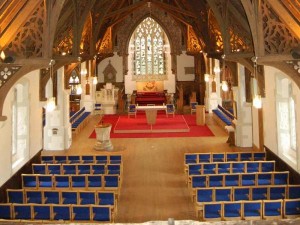 Despite the tradition that the Psalms were written by King David, any good commentary will tell you that this Psalm was written probably in the first decades of the Sixth Century BC, at around the time of the fall of Jerusalem to the Babylonians circa 598 BC. Some scholars would even suggest that it was written as late as the Maccabean era (circa 165 BC). Personally, I tend to go with the earlier date; the Psalm’s description of wide spread destruction of religious meeting places seems more in line with the pre-Exilic invasion.
The first deportation of the Jewish leadership followed almost immediately; two more deportations would occur. Those who were taken away were separated from their land and from the temple, central elements in their identity as the People of God. Loss of their homeland and, more importantly, the loss of their exclusive worship space, the temple made a critical impact on their experience and understanding of God. Could they worship God in a foreign land? Where was God in this alien land? For that matter, who was God? Their confusion is expressed in Psalm 137:
By the waters of Babylon we sat down and wept,
when we remembered you, O Zion.
. . .
How shall we sing the Lord’s song
upon an alien soil? (vv. 1,4 BCP version)
Today’s evening Psalm expresses the dismay of those left behind, those who are still in the land but whose places of assembly and worship have been destroyed. Both groups face the same issue: how to worship God without the traditional, exclusive-use worship spaces? Could it even be done?
They learned the lesson that God is not tied to land or temple, that God’s rule extends everywhere. They learned that their appreciation of God’s presence was not dependent on there being the traditional, exclusive-use worship place, that they could worship God anywhere. This is, unfortunately, a lesson that God’s People have forgotten and need to learn again.
We in the Christian church are tied to our buildings, especially those of us who are part of highly liturgical traditions. Our custom (or perhaps we would be better to call it a habit or even an addiction) of structured, even majestic worship with processions, high altars, choirs, fancily vested clergy, and pipe organs seems to demand special spaces in which to indulge it. We forget that these spaces are simply tools for ministry; instead, we treat them as holy themselves and we use them exclusively for worship. We call them “houses of worship” or, even more telling, “houses of the Lord.”
In the spring of 2009 in Cleveland, Ohio, near where I live, the Roman Catholic bishop announced the closure of 52 parish church buildings because the parishes were deemed financially nonviable. The outcry was deafening; the members of many of these congregations could not imagine being the church without their historic building. The Cleveland Plain Dealer reported that the pastor of one of the closed churches tried to teach his flock that the “building is a beautiful building. A magnificent building, but the bottom line is, it isn’t the church. We are.”
Buildings are simply tools and tools should be properly used. While they are useful tools, the loss of buildings and property could actually be a blessing in disguise to such congregations. In American church culture, many churches, like these Roman Catholic parishes, have developed an unwholesome attachment to their buildings and locations. Loss of their building and property could free a congregation to discover its identity as the Body of Christ. The threat of loss could also be salutary; it can encourage a rethinking of our stewardship and use of space.
Proper stewardship of space would encourage the use of our worship locations for other, additional purposes. Flexible space could allow the area used for worship a few hours each Sunday to be used, for example, as a soup kitchen on weekdays. This is exactly what an historic Episcopal church in New York has done. Church of the Holy Apostles‘ nave becomes a dining room where thousands of people are fed. The church which worships there has come to understand that space is not holy because “God lives there.” It is holy because they worship there, and it is no less holy when used for other purposes, such as feeding the poor. After all, “just as you did it to one of the least of these who are members of my family, you did it to me.” (Matthew 25:40 NRSV) Thirteen of the closed Roman Catholic parishes successfully appealed the closure order to the Vatican and the bishop was ordered to reopen the buildings, which occurred late in 2012. Whether the parishes will make any changes in the way they do outreach ministries in their neighborhoods remains to be seen.
The Babylonians destroyed the holy places, but the People of God learned a lesson about their need of holy space . . . that they didn’t need an exclusive-use worship space . . . and they lived on. Today’s economy is, perhaps, making exclusive worship places nonviable, but the People of God can live on without them, or they can live on while making faithful multiple uses of them. The lesson learned by the Jews during the Exile must constantly be relearned.
====================
A request to my readers: I’m trying to build the readership of this blog and I’d very much appreciate your help in doing so. If you find something here that is of value, please share it with others. If you are on Facebook, “like” the posts on your page so others can see them. If you are following me on Twitter, please “retweet” the notices of these meditations. If you have a blog of your own, please include mine in your links (a favor I will gladly reciprocate). Many thanks!
====================
Father Funston is the rector of St. Paul’s Episcopal Church, Medina, Ohio.
 Recently, a graphic has been making the rounds on Facebook. I received it from another church and posted it on my parish’s Facebook page about 24 hours ago with the caption, “Something to think about.” As of the moment I am writing, this graphic has been “liked” 235 times. It has been shared 1,412 times. And according to Facebook’s calculations, it has been seen over 132,400 times. That’s only as originating our page. It is being posted and shared on other pages and, no doubt, has even larger numbers than these at some of those other pages.
 As I read the lessons and Psalms of the Daily Office lectionary for today, this was the passage that spoke loudest to me, but I did not want to write about it. I tried to reflect upon and author a meditation about some other bits of the Scriptures appointed for today, but my thoughts kept returning to this one.
  These two verses have probably caused any number of people to scratch their heads in bewilderment over the centuries. Those who read them in English without looking behind the translation to the original language wonder, “What on earth does this mean?” Those who read them in Hebrew wonder, “How can God have such a terrible sense of humor?”
 Several years ago – 33 to be exact – Bruce Dern starred in a little-remarked movie entitled Middle Age Crazy; it dealt with the main character’s midlife crisis of turning 40 years of age.
  A few days ago I wrote about my interest in superstring theory, m-theory, and the multiverse concept which springs from my life-long love of science fiction and the especially the “alternate reality” sorts of tales. I suggested that Jesus’ miracles might have been accomplished by his somehow accessing an alternate reality to affect this world; that would imply some sort of access to knowledge of those other universes.
 Some years ago, my wife and I were members of a congregation in Southern California where the assistant priest was a military chaplain originally from Georgia. He was normally rather soft-spoken, but when he would introduce the traditional (Jacobean English) version of the Lord’s Prayer using the words from The Book of Common Prayer he would emphasize one word: “And now, as our Savior Christ has taught us, we are BO-WULD to say . . . .”
 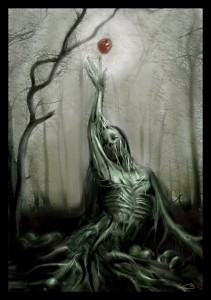 Every time I recite Psalm 19 with its words of praise for the Law, I am caught up short by verse 12. In verses 7-11 we read that the Law is perfect and just, that it provides wisdom and rejoicing, that it is more desirable than gold or honey, and that in keeping it there is enlightenment and reward. Then comes the kicker, “Who can tell how often he offends? Cleanse me from my secret faults.” In other words, despite all the grandeur and wonder of the Law, no one can actually keep it!
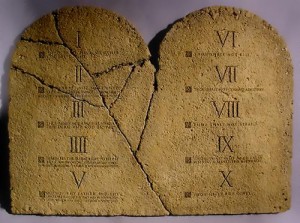 The Bible tells us that the Tablets of the Law were kept in the Arc of the Covenant which traveled with the Hebrews throughout their forty years in the desert and that it was later housed in the Tabernacle and then in the Temple until lost at or about the time of the Babylonian Exile. According to Rabbinic lore, the Ark contained not only the second, whole Tablets, but the broken fragments of the first Tablets, to which Moses refers in this speech from the Book of Deuteronomy.
 We human beings are so proud, so prone to taking credit we really have no right or basis to claim and, apparently, we’ve been doing it for a long time. Moses’ caution to the Hebrews not to do so, not to think that it is through their own merit that the Promised Land is being given them, is a caution to all of us, for we are all “a stubborn people.” Self-importance and obstinacy are the human condition.

