Occasional thoughts of an Anglican Episcopal priest

Category: Lectionary (Page 75 of 99)

Far More Than We Can Ask Or Imagine – From the Daily Office – January 19, 2013

From the Letter to the Ephesians:

Now to him who by the power at work within us is able to accomplish abundantly far more than all we can ask or imagine, to him be glory in the church and in Christ Jesus to all generations, for ever and ever. Amen.

(From the Daily Office Lectionary – Ephesians 3:20-21 (NRSV) – January 19, 2013.)

IMAGINATION by archanNEpiscopalians who say the Daily Office are familiar with this text; a variation of it is one of the options for the Grace at the end of both Morning and Evening Prayer. Each time I recite those words at the end of the office, I am reminded how limited our imaginations are!

Yesterday, I wrote here about seeking ways to incorporate the cutting-edge practices of the “emerging church” into the life and ministry of the “inherited church”. I received one response which asked, “so there is no place for people who have grown up in the Church, then?” Of course there is, I replied. Something new is not a threat to that which is old, it is simply new. Are our imaginations are so limited that we cannot envision there being something new in the church without also thinking that means the loss of something old and valued? Are our churches and church structures so limited that they cannot encompass both old and new together?

We are bounded by our questions; our imaginations are limited by what we ask. It is not without good reason that St. Paul phrased this doxology to say that God can accomplish “more than we can ask or imagine.” What we ask limits what we can imagine. How we ask frames our expectations. The sorts of questions we pose determine the limits of our thinking. When we ask the right questions, we get the right answers; with the right questions, we expand our thinking and with expanded thinking, we broader horizons.

There are many trite and hackneyed sayings about imagination: “All things are possible to those who believe.” — “What the mind can conceive, it can achieve.” The thing about the trite and the hackneyed, however, is that it’s true; we say these things again and again because we recognize their validity. Just consider what human imagination has wrought: humankind has gone to the moon; heavier-than-air contraptions carry human beings through the sky at supersonic speeds; kidneys, lungs, hearts, hands, and faces have been transplanted from one body to another; we carry small light-weight devices with which we can access all the knowledge human beings have ever accumulated. These things were the stuff of science fiction not too long ago; they are now science fact.

So why is our imagination so limited when it comes to the future of the church? In our spiritual and religious life we should be even more imaginative. “Ask, and it will be given you; search, and you will find; knock, and the door will be opened for you.” (Matthew 7:7) Ask anything you like, said Jesus. Tell trees to be uprooted! Cause mountains to be thrown into the sea! For God’s sake, use your imagination! We are made, the Genesis story tells us, in the image of God. The novelist Henry Miller once wrote, “Imagination is the voice of daring. If there is anything godlike about God, it is that. He dared to imagine everything.” If there is anything godlike about us, it is that we have that same voice of daring. “Use it,” is the command of our Lord.

God is able to do far more than we can ask or imagine. The funny thing is, so are we.

====================

A request to my readers: I’m trying to build the readership of this blog and I’d very much appreciate your help in doing so. If you find something here that is of value, please share it with others. If you are on Facebook, “like” the posts on your page so others can see them. If you are following me on Twitter, please “retweet” the notices of these meditations. If you have a blog of your own, please include mine in your links (a favor I will gladly reciprocate). Many thanks!

====================

Father Funston is the rector of St. Paul’s Episcopal Church, Medina, Ohio.

Bursting The Old Wineskin – From the Daily Office – January 18, 2013

From the Gospel according to Mark:

Jesus said, “No one sews a piece of unshrunk cloth on an old cloak; otherwise, the patch pulls away from it, the new from the old, and a worse tear is made. And no one puts new wine into old wineskins; otherwise, the wine will burst the skins, and the wine is lost, and so are the skins; but one puts new wine into fresh wineskins.”

(From the Daily Office Lectionary – Mark 2:21-22 (NRSV) – January 18, 2013.)

Bursting WineskinFor the past few years, I’ve been reading some of the folks who are writing about “emerging Christianity,” primarily Brian McLaren and Phyllis Tickle, but others as well. So last weekend I went to an event called an “Emergence Christianity conversation,” which was really a kick off for Ms. Tickle’s latest book. I was one of 400 or so participants, many of whom had been to earlier “emergence” events or are members of “emerging church” communities or both. Since I have not and am not, I was at most a johnny-come-lately to the conversation and at least an outsider. Nonetheless, I took part as I hoped to learn more about this (as Ms. Tickle put it) new tributary in the river that is Christianity.

My reason for doing so was, frankly, practical. What, I wanted to know, is happening on the ground in those places where “emerging Christianity” has taken the form of viable communities and working ministries? What might we in the historic, institutional church (what the emergent community calls “the inherited church”) learn from them?

I got fewer answers to those questions than I had hoped. The major presentations of this conversation were more about “framing the discussion” of the emerging church than about the practical ministries of emerging congregations. However, in smaller gatherings and in private conversations, I did pick up some ideas.

The practical question is how one can incorporate these new ways of being Christian into the life of an established, institutional congregation with a nearly 200-year history: how to, in the words of Jesus’ metaphors today, sew new cloth onto an old garment, how to pour new wine into an old wineskin. The emerging church conversation yields no answers to these questions because most of these experiments in doing new things (or old things a new way) are “start ups” outside of traditional church structures. Those few that are within older institutions are from less structured denominations with fewer restrictions (real or perceived) than our Anglican/Episcopal tradition, and even they show the signs of strain Jesus’ parable suggests.

Of course, we’re not dealing with old cloth or old leather . . . we’re dealing with people and, unlike cloth or leather, people can make the conscious decision to change, to be more flexible, to give up old ways and old notions. Henry Ford has been quoted (probably inaccurately) as saying, “I’m looking for a lot of people who have an infinite capacity to not know what cannot be done.” That’s the kind of people who aren’t old cloth or old leather. People who won’t say, “Oh, it can’t be done,” or “We’ve never done it that way,” but who will say, “Hey, anything’s possible. If the Lord is with us, let’s give it a shot.” The cloth wouldn’t tear and the wineskin wouldn’t burst if they were able to think like that.

Although I’m also thinking that maybe bursting the old wineskin of the church wouldn’t be a bad thing . . . .

====================

A request to my readers: I’m trying to build the readership of this blog and I’d very much appreciate your help in doing so. If you find something here that is of value, please share it with others. If you are on Facebook, “like” the posts on your page so others can see them. If you are following me on Twitter, please “retweet” the notices of these meditations. If you have a blog of your own, please include mine in your links (a favor I will gladly reciprocate). Many thanks!

====================

Father Funston is the rector of St. Paul’s Episcopal Church, Medina, Ohio.

Understanding the Citizenship Metaphor – From the Daily Office – January 17, 2013

From the Letter to the Ephesians:

So [Christ] came and proclaimed peace to you who were far off and peace to those who were near; for through him both of us have access in one Spirit to the Father. So then you are no longer strangers and aliens, but you are citizens with the saints and also members of the household of God, built upon the foundation of the apostles and prophets, with Christ Jesus himself as the cornerstone. In him the whole structure is joined together and grows into a holy temple in the Lord; in whom you also are built together spiritually into a dwelling-place for God.

(From the Daily Office Lectionary – Ephesians 2:17-22 (NRSV) – January 17, 2013.)

Ant HillFor many years, I have rather liked Paul’s citizenship metaphor for our participation in the household of God. It made sense . . . but I’m not sure it makes sense any longer because I’m not sure we understand any longer what citizenship is!

A historical review of the understanding of citizenship going back to the earliest Greek city-states suggests that there are two basic classical theories: the humanist and the individualist.

The humanist conception of citizenship emphasizes our political nature viewing citizenship as an active process of involvement in the affairs of the state. Under this theory, being a citizen means being active in government affairs; citizens and the government are mutually interrelated. An ideal citizen is one who exhibits good civic behavior and acts out of a commitment to civic duty and virtue. The individualist view, on the other hand, assumes that human beings act not out of civic morality, but out of enlightened self-interest. Citizens are seen as essentially passive politically, as sovereign, morally autonomous beings primarily focused on their own economic betterment. Nonetheless, between citizen and state there is a mutuality of obligation. The citizen is expected to pay taxes, obey the law, engage in business, and defend the nation if it comes under attack; the state has the duty to respect and protect the civil and political rights of the citizen.

The Enlightenment vision of citizenship, which gave rise to modern democratic republics like the United States, incorporates both of these classical models.

At the recent Emergence Christianity conversation, Phyllis Tickle used the examples of a beehive and an anthill to contrast traditional and emerging notions of leadership. Beehives are hierarchies with a controlling matriarch, the “queen”, and all workers exist to serve her needs and follow her direction. Anthills have “queens” but they are non-directive. The ant queen serves her function in the community (producing young) but does not control what others do. Instead, anthills exhibit a collective intelligence which does not depend upon the decision-making or direction of any one individual or even small group of individuals; in fact, there are no individuals, only the collective. Ms. Tickle suggested that because of the increase in knowledge and communication, which the internet and social media perhaps exemplify best, human society is moving away from the beehive and toward the anthill. One might say we are becoming “ant-i-fied”.

She may be right . . . and that’s the problem with the “citizenship” metaphor now. Neither the beehive nor the anthill understands the concept of “citizen” and if modern human society has been or is becoming patterned on either, Paul’s use of the term to describe our relationship with one another and with God in the context of the church becomes meaningless. Furthermore, if we human beings are becoming nothing more than “ants” in a collective intelligence, there is push back against that, and that push back is also counter to the classical notions of citizenship. The reaction to the “ant-i-fying” of human society is equally destructive of the citizenship metaphor because it has emphasized the individual over against society rather than the individual within and mutually related to society.

We are, Paul wrote, citizens with the saints and members of the household of God. If we do not understand what it is to be citizens of a human society, if we are all simply workers in a beehive hierarchy, or faceless units in an anthill collective, or individuals over against a society, can we make sense of this metaphor? Let us hope we can so that our understanding of Paul’s citizenship model will shape not only the church, but our society as well.

====================

A request to my readers: I’m trying to build the readership of this blog and I’d very much appreciate your help in doing so. If you find something here that is of value, please share it with others. If you are on Facebook, “like” the posts on your page so others can see them. If you are following me on Twitter, please “retweet” the notices of these meditations. If you have a blog of your own, please include mine in your links (a favor I will gladly reciprocate). Many thanks!

====================

Father Funston is the rector of St. Paul’s Episcopal Church, Medina, Ohio.

Restored to Usefulness of Life – From the Daily Office – January 16, 2013

From the Gospel according to Mark:

As soon as they left the synagogue, they entered the house of Simon and Andrew, with James and John. Now Simon’s mother-in-law was in bed with a fever, and they told [Jesus] about her at once. He came and took her by the hand and lifted her up. Then the fever left her, and she began to serve them.

(From the Daily Office Lectionary – Mark 1:29-31 (NRSV) – January 16, 2013.)

John Bridges, Christ Healing the Mother of Simon PeterDoes it bother anyone else that as soon as Mrs. Simon’s mother is healed by Jesus she gets up from her sick bed and “begins to serve them”? That has always bothered me. I don’t know why it should. After all, if she’s healed (and one assumes that when Jesus healed someone they were really healed), then there’s no reason for her not to do what she would have done if she’d not been sick in the first place. But . . . it has bothered me. Why, I have thought, should this poor woman who’s been sick have to get out of bed and serve these men?
In The Book of Common Prayer 1979 there is a prayer for use when visiting a sick person, particularly one who is about to undergo surgery:

Strengthen your servant N., O God, to do what s/he has to do and bear what s/he has to bear; that, accepting your healing gifts through the skill of surgeons and nurses, s/he may be restored to usefulness in your world with a thankful heart; through Jesus Christ our Lord. Amen.

I suppose that the healing of Simon’s mother-in-law is a story of one being “restored to usefulness in [God’s] world with a thankful heart,” although we hear no more about her, nor do we know anything of her attitude about her healing or her service.

As I pondered this story, this prayer, and my own experience, I realized a couple of things. First of all, I hate being sick, and when I’m sick, I hate being visited. I’m an introvert, which means that although I enjoy being with people, I find the experience of social interaction very draining; when I’m sick and already feeling low on energy, a visit is the last thing I want or need. But, second, when I am better, I am bursting with energy.

I know that I am fully recovered from an illness when, for no good reason other than I feel better, I get out of bed and start doing housework! When I recover from an illness, that is precisely what I do – I do the laundry; I wash the dishes; I even (as God is my witness) vacuum the house! I get up from my illness and start serving those with whom I live (these days, that is only my wife, a dog, and three cats). I am, as the prayer says, “restored to usefulness” and I actually enjoy doing the housework I have been unable to do while ill.

So I realize now that I have been viewing Simon’s mother-in-law’s healing and subsequent service to her guests from the wrong point of view, from the perspective of an observer or possibly the one receiving her hospitality. But I should be looking at the story from her viewpoint! When I’ve been ill and have recovered, getting out of bed and cleaning the house is exactly what I want to do, so isn’t it just as likely that upon being restored to wholeness she might want to do the same, to be of usefulness, as well?

Considering the story further, I begin to wonder about its value as a metaphor for forgiveness of sin, another sort of healing. Just as one rises full of energy and readiness to be of service following the end of physical illness, should we not also feel that way when we are healed of our sinfulness? Each Sunday when we confess our sins in the liturgy of the Eucharist, we are assured that God forgives our sins, strengthens us in goodness, and powerfully keeps us in eternal life. At the conclusion of the liturgy, we are sent forth in the Name of Christ, to love and to serve, to rejoice in power. Like Simon’s mother-in-law, we rise from the sickness of sin restored to usefulness in God’s world, and like her we are ready to begin to serve.

====================

A request to my readers: I’m trying to build the readership of this blog and I’d very much appreciate your help in doing so. If you find something here that is of value, please share it with others. If you are on Facebook, “like” the posts on your page so others can see them. If you are following me on Twitter, please “retweet” the notices of these meditations. If you have a blog of your own, please include mine in your links (a favor I will gladly reciprocate). Many thanks!

====================

Father Funston is the rector of St. Paul’s Episcopal Church, Medina, Ohio.

The Actual or the Factual – From the Daily Office – January 15, 2013

From the Gospel according to Mark:

As Jesus passed along the Sea of Galilee, he saw Simon and his brother Andrew casting a net into the lake — for they were fishermen. And Jesus said to them, “Follow me and I will make you fish for people.” And immediately they left their nets and followed him. As he went a little farther, he saw James son of Zebedee and his brother John, who were in their boat mending the nets. Immediately he called them; and they left their father Zebedee in the boat with the hired men, and followed him.

(From the Daily Office Lectionary – Mark 1:16-20 (NRSV) – January 15, 2013.)

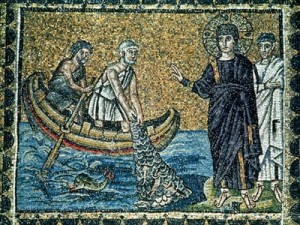
Mosaic, Sant'Apollinare Nuovo, Ravenna, Italy“I don’t know if this story happened, but I know it is true.” One of my favorite stories begins this way. The Gospel accounts do not, but they could . . . .

One of the things critics of Christianity like to point out is the inconsistency one finds in the gospel accounts of the various events they report. It cannot be denied that the stories of the calling of the initial disciples are contradictory. Mark’s is believed to be the earliest gospel and, therefore, one can assume the one written closest in time to the events described, but even it was probably written about sixty years after this event on the shore of Lake Galilee. Matthew relates the story similarly, but in Luke’s account Jesus first uses Simon Peter’s boat as a place from which to preach to crowds on the shore. Afterward, he tells Simon where to fish for a large catch and Simon actually tells Jesus to leave him because he, Simon, is a sinful human being; Andrew is never mentioned. John’s Gospel tells a very different story in which Andrew, described as a follower of the Baptizer, first encounters Jesus and then a day later introduces Simon to him.

So the community of faith has these three rather different accounts of his initial followers’ encounter with Jesus and the critics find in this a reason to disbelieve them all. I always ask them if their extended families have any favorite stories that are told at family gatherings, you know, the “remember the time Crazy Uncle Harry . . . . ” sorts of tales. My family did. If you were to go to one of my family’s reunions, you’d probably hear that story told. You’d probably hear it told by several different people. And you’d probably hear it told in several different ways. And you’d walk away wondering if you’d actually heard the same story because the details are so widely and wildly different! That’s the way it is with oral transmission of family stories, particularly as they are told by those who weren’t present but have heard them from someone else who heard them from someone else who maybe heard them from someone who was actually there.

A few days ago I heard the author Phyllis Tickle make a distinction between believing that the Bible is actually true and believing that the Bible is factually true. Her contrast is catchier than my own – in Bible studies and in confirmation classes I tell my students to make a distinction between facticity and truth – but the point is the same. Stories may be true (actual) without being factual. We make the Bible and its various forms of literature into something they are not if we insist upon treating them as factually accurate, as though they were scientific history, a reporting of facts. They are not. Biblical literature is concerned with truth, not with fact. Facts are true, but truth is larger than a collection of facts. To insist that truth is only factual devalues beauty, love, the spirit, personal honor, all those things which cannot be scientifically verified.

Were Simon and Andrew, James and John disciples of Jesus? Yes. Were they called as Mark relates? I have no idea. Is there truth in Mark’s story of their being called? Of course there is. Mark wants us to understand and appreciate the urgency of their call, the immediacy of their response to the call, the nature of the ministry to which they were called. These are all matters of truth although Mark’s account may not be factual. We of the modern age with our scientific worldview need to set aside our infatuation with the factual and become passionate about the actual, to give up our lust for facts and fall deeply in love with truth.

I don’t know if this story happened, but I know that it is true . . . .

====================

A request to my readers: I’m trying to build the readership of this blog and I’d very much appreciate your help in doing so. If you find something here that is of value, please share it with others. If you are on Facebook, “like” the posts on your page so others can see them. If you are following me on Twitter, please “retweet” the notices of these meditations. If you have a blog of your own, please include mine in your links (a favor I will gladly reciprocate). Many thanks!

====================

Father Funston is the rector of St. Paul’s Episcopal Church, Medina, Ohio.

Emerging Does Not Mean Leaving Behind – From the Daily Office – January 14, 2013

From the Letter to the Ephesians:

In Christ we have also obtained an inheritance, having been destined according to the purpose of him who accomplishes all things according to his counsel and will, so that we, who were the first to set our hope on Christ, might live for the praise of his glory. In him you also, when you had heard the word of truth, the gospel of your salvation, and had believed in him, were marked with the seal of the promised Holy Spirit; this is the pledge of our inheritance towards redemption as God’s own people, to the praise of his glory.

(From the Daily Office Lectionary – Ephesians 1:11-14 (NRSV) – January 14, 2013.)

Hands Holding SeedlingAt the emergence Christianity conversation I took part in at St. Mary’s Cathedral in Memphis, Tennessee, this past weekend a distinction was made between “emergence Christianity” and “inherited Christianity”. Paul’s thesis that “in Christ we have obtained an inheritance” and that this inheritance is “redemption as God’s own people” has brought this to mind. (For the details of this movement and some of its history, the book to read is Emergence Christianity by Phyllis Tickle, who was the keynoter of this weekend’s conversation.)

The conclusion I have drawn from the Memphis Conversation is that “emergent” and “emerging” are essentially meaningless labels, other than that the former is a brand name for the Emergent Village and the latter might describe anything that can be associated with what contemporary historians are calling “The Great Emergence” (a way to describe the current upheaval in western society). If it’s an edgy praxis that somehow claims to be “Christian” and uses glitzy up-to-date technology, it can call itself “emergent” or “emerging” without regard to theological content. (Nadia Bolz-Weber referred to this when suggesting that a label that could be applied to her and to Mark Driscoll is a meaningless term.) There are so many things that claim to be “emergent” or “emerging” (from post-evangelical neo-pentacostalism to a post-theist deconstructed church that claims to be “Christian” without any of the marks of the church) that there really is no substance in these terms; they signify nothing.

Perhaps helpfully another participant has suggested that “Emergence does not modify Christianity. Emergence describes an era; Christianity describes a movement. Whether or not Christianity as we/I know it is modified in this new era remains to be seen.” That may be as far as we can currently go with defining this thing that is happening.

As for the “inherited church” and Paul’s reference to our heritage (with the Ephesians) as followers of Christ, I am struck again by the wisdom of my own Episcopal/Anglican tradition. In the 1880s the bishops of the Episcopal Church looked at the question of organic reunions of the various streams of post-Reformation Christianity and suggested there are really only four things on which Christians would need to be agree. The fourth was “the historic episcopate” which, being bishops, you can sort of understand them thinking important. I value to apostolic office of bishop, but I’m not sure it’s a necessity. The other three, though, really our what we, the “inherited church” offer as foundation for the experimentation in the faith that the “emergent” group is undertaking. What those bishops produced was called a “quadrilateral” and their four points were later affirmed by the gathered bishops of the Anglican Communion and is now referred to as The Chicago/Lambeth Quadrilateral. The substantive content of what the American bishops wrote is:

We do hereby affirm that the Christian unity . . .can be restored only by the return of all Christian communions to the principles of unity exemplified by the undivided Catholic Church during the first ages of its existence; which principles we believe to be the substantial deposit of Christian Faith and Order committed by Christ and his Apostles to the Church unto the end of the world, and therefore incapable of compromise or surrender by those who have been ordained to be its stewards and trustees for the common and equal benefit of all men.

As inherent parts of this sacred deposit, and therefore as essential to the restoration of unity among the divided branches of Christendom, we account the following, to wit:

1. The Holy Scriptures of the Old and New Testaments as the revealed Word of God.

2. The Nicene Creed as the sufficient statement of the Christian Faith.

3. The two Sacraments, — Baptism and the Supper of the Lord, — ministered with unfailing use of Christ’s words of institution and of the elements ordained by Him.

4. The Historic Episcopate, locally adapted in the methods of its administration to the varying needs of the nations and peoples called of God into the unity of His Church. (The Book of Common Prayer – 1979, page 877)

I am quite certain that some among the “emergent” or “emerging” church movement would reject this foundational deposit. I am also quite certain that without at least the first three (as I said, I’m not so certain about the necessity of bishops) the movement cannot be considered “Christian” nor would its embodiment be “church”. I think we can talk about these things critically (for instance, noting that the first does not require a belief in the literal factuality or inerrancy of Scripture, or that the third does not set out a specific theology of the Sacraments, but that both leave open the possibility of a wide variety of understandings). But I do not believe that we can abandon them.

I do not believe that “emerging” means “leaving behind.” It does not mean abandoning our inheritance.

====================

A request to my readers: I’m trying to build the readership of this blog and I’d very much appreciate your help in doing so. If you find something here that is of value, please share it with others. If you are on Facebook, “like” the posts on your page so others can see them. If you are following me on Twitter, please “retweet” the notices of these meditations. If you have a blog of your own, please include mine in your links (a favor I will gladly reciprocate). Many thanks!

====================

Father Funston is the rector of St. Paul’s Episcopal Church, Medina, Ohio.

More Than Lukewarm – From the Daily Office – January 12, 2012

From the Revelation to John of Patmos:

To the angel of the church in Laodicea write: The words of the Amen, the faithful and true witness, the origin of God’s creation: “I know your works; you are neither cold nor hot. I wish that you were either cold or hot. So, because you are lukewarm, and neither cold nor hot, I am about to spit you out of my mouth. For you say, ‘I am rich, I have prospered, and I need nothing.’ You do not realize that you are wretched, pitiable, poor, blind, and naked.”

(From the Daily Office Lectionary – Revelation 3:14-17 (NRSV) – January 12, 2013.)

Boiling WaterWell! Here we are . . . just a few days ago I mentioned this text in regard to another lectionary reading. I am attending a conference on “emerging Christianity” this week and this text (having come up in that meditation) has been on my mind. There are many among the participants in this conversation who are quite passionate about the “emerging church” movement; they are definitely not “lukewarm”.

How, I wonder, can this passion enliven the “inherited church” (as Phyllis Tickle calls the institutional church)? Can what is happening among the emergents inspire those of us who still value the traditional church? I hope so.

But there is much about the emergent experience about which I am lukewarm! During the “tweet” conversations that accompanied the presentations there was much dismissiveness expressed. There were comments about the “irrelevancy” of holy orders and of the Holy Sacraments. There is a participant who describes himself as “post-theist” and a panel presenter who suggested that the emergent church needed to abandon Christianity! There are inconsistencies such as following a speaker who argued for a new understanding of the atonement (abandoning the substitutionary penal theory) with a congregational song about Jesus “shedding his precious blood for my sins,” or the movement’s infatuation with ancient spiritual practices (chant, incense, candles) coupled with rejection of the ancient creeds. None of these things are true of emergents across the board (anymore than any particular practice of the inherited church is true across the board of all traditions) but encountering them in this conference leaves me . . . lukewarm.

There is much in this conference of value and there is much about the emergent church that gives me hope, but I am firmly convinced that there is just as much if not more of value in the traditions of the faith and in the treasure of the institutional church. Our task is not to abandon the past, but to turn up the heat in the present. We must be more than lukewarm. I hope the experiments of the emerging church can show us one way to do that.

====================

A request to my readers: I’m trying to build the readership of this blog and I’d very much appreciate your help in doing so. If you find something here that is of value, please share it with others. If you are on Facebook, “like” the posts on your page so others can see them. If you are following me on Twitter, please “retweet” the notices of these meditations. If you have a blog of your own, please include mine in your links (a favor I will gladly reciprocate). Many thanks!

====================

Father Funston is the rector of St. Paul’s Episcopal Church, Medina, Ohio.

The One Who IS – From the Daily Office – January 11, 2013

From the Gospel of John:

When evening came, his disciples went down to the lake, got into a boat, and started across the lake to Capernaum. It was now dark, and Jesus had not yet come to them. The lake became rough because a strong wind was blowing. When they had rowed about three or four miles, they saw Jesus walking on the lake and coming near the boat, and they were terrified. But he said to them, “It is I; do not be afraid.” Then they wanted to take him into the boat, and immediately the boat reached the land towards which they were going.

(From the Daily Office Lectionary – John 6:16-21 (NRSV) – January 11, 2013.)

Gustav Dore, Jesus Walking on the Water (1866)Jesus walking on the water has always struck me as a very funny story. “Funny” in the sense of “oddly out of place”, although it also has a certain Monty-Python-esque quality to it as well. The fact that it is reported in three of the Gospels – in the synoptic Gospels of Mark and Matthew and here in John – attests to its importance for the early church. John’s version of the story is the simplest, but it contains all the elements – a storm, rough seas, disciples’ fear. Like Mark, John leaves out Matthew’s addition of Peter trying to join Jesus on the surface of the lake.

I say the story seems out of place because it is (other than Jesus’ fit of pique at the poor fruitless fig tree, which has a parabolic quality to it, the fig being a rabbinic metaphor for the Torah; Mark 11:12-14, and Matthew 21:18-22) the single demonstration of divine power by Jesus which does not benefit another person or group of people. Other manifestations of power result in the provision of food (the wine at the wedding in Cana, the feeding of crowds of 5,000 and 4, 000) or in the healing of the supplicant or some other person. Jesus here seems to be simply about his own business. In fact, Mark makes it clear that “He intended to pass them by.” (Mark 6:48b) However, the disciples see him so he must respond.

It is Jesus’ response that underscores why this story is here, I think, and the NRSV translation does not do it justice. The Greek is “Ego eimi, me phobeithe.” The words “ego eimi” are the same words used in the Septuagint (the early Greek translation of the Hebrew Scriptures) when God’s identity is revealed as “I AM” (for this is what the Greek emphatically states). In Exodus, God speaks to Moses out of the burning bush and, when Moses asks God’s name, he is told, “I AM who I AM;” the Greek is “ego eimi”. (Exodus 3:14) In a similar way, Isaiah the prophet reports God saying several times, “I, even I AM He;” the Greek is “ego eimi.” Later in John’s Gospel, Jesus will use this same construction in his famous “I am” statements. Here as there, Jesus’ identity with God is what is stressed.

And this is also the import of the story of Jesus’ walking on the water, this miracle with no other purpose, no parabolic meaning as in the blasting of the fig tree, no benefit to another as in the feeding or healing miracles. This miracle simply demonstrates the power of Jesus over nature, and simply over nature, but over the forces of death and chaos represented by water and the storm. It is, purely and simply, a manifestation of divine power.

I try always to keep before my mind’s eye the Jesus who is human, to remember that he was “one who in every respect has been tested as we are” (Heb. 4:15) But every so often it is important to remember that Jesus is also divine, fully divine, God incarnate. It is necessary every so often simply to stand in awe of the One who walked on the water, the One WHO IS, and yet who humbled himself to become as we are.

====================

A request to my readers: I’m trying to build the readership of this blog and I’d very much appreciate your help in doing so. If you find something here that is of value, please share it with others. If you are on Facebook, “like” the posts on your page so others can see them. If you are following me on Twitter, please “retweet” the notices of these meditations. If you have a blog of your own, please include mine in your links (a favor I will gladly reciprocate). Many thanks!

====================

Father Funston is the rector of St. Paul’s Episcopal Church, Medina, Ohio.

Ready To Be Sought? – From the Daily Office – January 10, 2013

From the Prophet Isaiah:

I was ready to be sought out by those who did not ask,
to be found by those who did not seek me.
I said, “Here I am, here I am”,
to a nation that did not call on my name.
I held out my hands all day long
to a rebellious people,
who walk in a way that is not good,
following their own devices;
a people who provoke me
to my face continually,
sacrificing in gardens
and offering incense on bricks; . . . .

(From the Daily Office Lectionary – Isaiah 65:1-3 (NRSV) – January 10, 2013.)

Waiting Figure“I was ready to be sought . . . I said, ‘Here I am, here I am’.” Almost more than anything else in Scripture, these words speak to me of God as not just wanting but needing to be in relationship with creation. I have written elsewhere about my understanding of God as the God who communicates; here is the God who seems almost desperate to be in relationship with his people. God speaks and everything comes in to being; in the beginning was the Word. But what good is speaking, what good is a word, if no one hears it, no one answers it? “Here I am, here I am” seems like a plea to be heard, to be recognized, to be answered. But in our modern society, very few people seem to be answering. Many claim to be seeking, many claim to be “spiritual but not religious,” but few are finding God in the traditional faiths and faith communities.

Recently, I had a discussion with a colleague about the non-church-goers who are best described as “apatheists”. This word is a “mash-up” of the words “apathy” and either “theist” or “atheist”. It describes people for whom religious belief is a matter of indifference. It’s not that they disbelieve (a recent article suggested that 80% of apatheists believe there is a God) or that they acknowledge some doubt or lack of understanding of God (as an agnostic would); it’s that the simply don’t care! An acquaintance of mine who accepts the label “apatheist” has put it this way: “I wouldn’t live my life any differently whether there is a God or not. It makes no difference.”

I think this is the modern trend, even among churchgoers. Cultural indifference to religion of any form, a “take or leave it” attitude, is becoming, if not already, the norm in our society. Religion and religious activities are one on a long list of options, and for most people not near the top.

But God is ready to be sought; God stands there in our world saying, “Here I am, here I am.” God does this through the church (and, I believe, other religious institutions of many faith traditions). If God is waiting to be sought, if God is calling “Here I am, here I am,” and people are not seeking and not answering the call, whose fault is that? If God and religion have become a matter of indifference, we who are active leaders of society’s communities of faith must bear the responsibility for that.

Among the Daily Office readings in this season are the letters to the churches in the Book of Revelation, and though it is not today’s reading, I am reminded of the letter to the church in Laodicea: “I know your works; you are neither cold nor hot. I wish that you were either cold or hot. So, because you are lukewarm, and neither cold nor hot, I am about to spit you out of my mouth.” (Rev. 3:15-16) If people are lukewarm about religion, it is because we, the religious, have become lukewarm, worthy of nothing more than being spat out.

Isaiah presents God as not just wanting but needing to be in relationship with creation. God is ready to be sought and calls out clearly “Here I am, here I am.” But does the church?

====================

A request to my readers: I’m trying to build the readership of this blog and I’d very much appreciate your help in doing so. If you find something here that is of value, please share it with others. If you are on Facebook, “like” the posts on your page so others can see them. If you are following me on Twitter, please “retweet” the notices of these meditations. If you have a blog of your own, please include mine in your links (a favor I will gladly reciprocate). Many thanks!

====================

Father Funston is the rector of St. Paul’s Episcopal Church, Medina, Ohio.

Wrap Yourself in God’s Mantle – From the Daily Office – January 8, 2013

From the Prophet Isaiah:

The Lord saw it, and it displeased him
that there was no justice.
He saw that there was no one,
and was appalled that there was no one to intervene;
so his own arm brought him victory,
and his righteousness upheld him.
He put on righteousness like a breastplate,
and a helmet of salvation on his head;
he put on garments of vengeance for clothing,
and wrapped himself in fury as in a mantle.

(From the Daily Office Lectionary – Isaiah 59:15b-17 (NRSV) – January 8, 2013.)
 
Armor of Emperor Maximilian II am fascinated by this picture of God arming for battle, putting on his breastplate, his helmet, and his mantle, donning the “garments of vengeance.” It is, of course, injustice and evil against which God is arming. St. Paul picked up on the picture painted here by Isaiah when he admonished the Christians in Ephesus:

Take up the whole armor of God, so that you may be able to withstand on that evil day, and having done everything, to stand firm. Stand therefore, and fasten the belt of truth around your waist, and put on the breastplate of righteousness. As shoes for your feet put on whatever will make you ready to proclaim the gospel of peace. With all of these, take the shield of faith, with which you will be able to quench all the flaming arrows of the evil one. Take the helmet of salvation, and the sword of the Spirit, which is the word of God. (Eph. 6:13-17)

When Paul tells the Ephesians (and us) to put on “the whole armor of God” that is precisely what he means! We are to wear God’s own battle gear and just as God is portrayed by the prophet as going to war against injustice, so are we; our battle is “against the cosmic powers of this present darkness, against the spiritual forces of evil in the heavenly places.” (Eph. 6:12) That, one has to admit, is a tall order . . . but it is our order.

How does one wage war against “this present darkness” and “the spiritual forces of evil”? The answer is contained within the admonition: truth, righteousness, peace, faith. This is a battle we do not with outside forces, but with ourselves. If we are true and righteous, if we live lives of peace, if we have faith, we win the battle. And the only ones who can prevent us from doing so are ourselves! Wrap yourself in God’s mantle!

====================

A request to my readers: I’m trying to build the readership of this blog and I’d very much appreciate your help in doing so. If you find something here that is of value, please share it with others. If you are on Facebook, “like” the posts on your page so others can see them. If you are following me on Twitter, please “retweet” the notices of these meditations. If you have a blog of your own, please include mine in your links (a favor I will gladly reciprocate). Many thanks!

====================

Father Funston is the rector of St. Paul’s Episcopal Church, Medina, Ohio.

« Older posts Newer posts »